The Common Potoo Nyctibius griseus (Nyctibiiformes: Nyctibiidae) in mangroves of the Brazilian Amazon
ABSTRACT
The Common Potoo, Nyctibius griseus (Gmelin, 1789), is a nocturnal bird widely distributed in South America, primarily in tropical forests and dense vegetation areas. Despite its broad range, its presence in Brazilian coastal mangroves remains poorly documented. We recorded the species in the Amazonian mangroves of the Ajuruteua Peninsula, Bragança, Pará. Observing an adult with a chick confirms that mangrove forests serve as reproductive habitat. This record demonstrates the ecological plasticity of N. griseus and its ability to occupy structurally distinct environments. Our findings highlight the importance of mangrove ecosystems for terrestrial avifauna and underscore the need for further studies on bird biology in understudied Amazonian habitats.
KEYWORDS:
Avifauna; coastal ecosystems; habitat use; Neotropical region; reproduction
Habitat loss, driven by deforestation, agricultural expansion, urbanization, and climate change, causes entire biotas to shift into alternative environments (Faria et al. 2023, Jaramillo et al. 2023). The fragmentation and removal of vegetation in forests connected to mangroves can convert these coastal ecosystems into refuges where species find shelter, food, and breeding sites, making mangroves a vital location for the survival and preservation of this biota (Jaramillo et al. 2023). Transitional environments are crucial for biodiversity conservation across different ecosystems (Flores et al. 2024). This is especially true for mangroves, which are highly connected to both marine and terrestrial systems. For instance, the movement of species from dryland forests into mangrove areas can cause subtle impacts or major imbalances in local biodiversity and other interconnected systems. In the Caeté-Taperaçu Marine Extractive Reserve, several marine species enter mangroves and their tidal channels. Conversely, terrestrial species establishing within mangroves-even when competing with native species for resources-can boost biological diversity and reinforce ecological processes (Donati et al. 2022).
Here we record the presence of the Common Potoo, Nyctibius griseus (Gmelin, 1789), in mangrove areas. This nocturnal, inconspicuous bird is endemic to the Neotropics and found throughout South America. It inhabits various habitats, including woodlands, savannas, and secondary forests (Pérez-Granados and Schuchmann 2020). Like all Nyctibiidae, it is insectivorous and features cryptic plumage along with an upright, still posture that mimics a tree branch (Cleere 2010). During the day, the bird becomes nearly invisible by perching on broken logs or branches, an adaptation that helps it blend seamlessly into its environment (Cleere 2010, Pérez-Granados and Schuchmann 2020). This mimicry strategy protects it from predators and helps it integrate into the ecosystem while it hunts flying insects at night.
Ecologically, N. griseus helps control nocturnal insect populations, supporting ecosystem balance (Cleere 2010). Although it is widely distributed and tolerant of human disturbance, its biology remains poorly understood, especially regarding social behavior and reproductive habits (Cleere 2010). In Brazil, its reproductive biology is not well documented, and there are no records of the species in Brazilian mangroves, particularly in the Amazon region. This report documents an adult Common Potoo with a chick in a mangrove forest, providing evidence that this environment is suitable for reproduction.
The Common Potoo was observed during a nycthemeral study measuring CO2 emissions from mangrove trunks in Furo Grande, km 32 of the PA-458 highway, Ajuruteua Peninsula, Caeté-Taperaçu Marine Extractive Reserve, Brazilian Amazon coast (Fig. 1A, B). The individual was perched 130 meters from the highway (Fig. 1A, B) in June 2019, at the end of the rainy season. The area features typical mangrove vegetation, dominated by Rhizophora mangle (L.), Avicennia germinans (L.) L., and Laguncularia racemosa (L.) C.F. Gaertn. (Virgulino-Júnior et al. 2020). Although mangroves are primarily known for marine fauna, they support a diverse range of terrestrial vertebrates, including birds. Nyctibius griseus was seen during both day and night. Observations were made using binoculars and digital cameras to document plumage patterns and camouflage behavior, confirming the species’ presence in this unusual habitat.
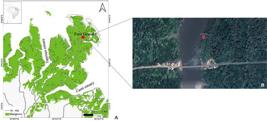
Location of the study area: (A) Furo Grande, Ajuruteua Peninsula, Pará; (B) sampling point where Nyctibius griseus, was found in the Amazonian mangroves.
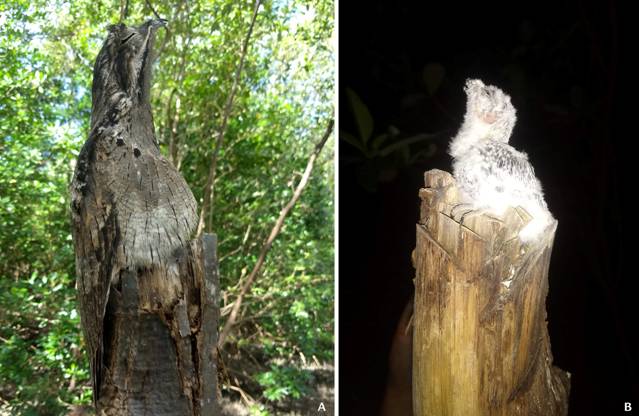
Scientific literature (Scopus and Web of Science) and citizen science platforms (e.g., WikiAves) scarcely record the Common Potoo in mangroves, though some authors suggest these forests may be part of its habitat (Pérez-Granados and Schuchmann 2020). This record on the Brazilian Amazon coast expands its known distribution and highlights its ecological plasticity. During the day, the bird was motionless and camouflaged on a cut trunk of A. germinans (Fig. 2A), approximately 2 m above the muddy ground. At night, foraging behavior became evident. The presence of a chick on the same trunk (Fig. 2B) confirms the site as a breeding area.
Image of Nyctibius griseus in its mangrove habitat on the Ajuruteua Peninsula: (A) camouflaged during the day, in a motionless posture on the stump of an Avicennia germinans tree, approximately 2 m above the muddy ground, (B) young potoo perched on the stump.
The discovery of an adult with a chick shows that mangroves do more than just provide temporary shelter; they also provide vital resources for the species’ reproductive cycle. Some species inhabit nearby habitats to access new resources, adjusting their feeding and reproductive behaviors while using these areas as resting sites, predator refuges, or microclimate spots (Yeo et al. 2021). The presence of N. griseus indicates complex interactions within the mangrove’s structure. Research on nocturnal birds highlights camouflage and night foraging as key survival traits (Cleere 2010, Pérez-Granados and Schuchmann 2020). Living near brackish waters benefits the species by offering abundant insect prey (Yeo et al. 2021). By perching on Avicennia or Rhizophora stumps, the species forages at night, avoiding overlap with daytime birds. Its presence in preserved mangroves emphasizes its potential as an environmental health indicator. This adaptability offers new insights into the species’ natural history and stresses the importance of mangroves for terrestrial biodiversity conservation amid increasing human pressures.
ACKNOWLEDGMENTS
The authors would like to thank Yan C.G. Lima, Mayk S. Rosa, and Mayko D.D. Rabelo for their support with fieldwork. We also thank the project Mangues da Amazônia (Programa Petrobras Socioambiental) for supporting the research.
LITERATURE CITED
- Cleere N (2010) Nightjars: a guide to nightjars and related birds. Christopher Helm Publishers, A&C Black, London, 317 pp.
-
Donati GF, Bolliger J, Psomas A, Maurer M, Bach PM (2022) Reconciling cities with nature: Identifying local Blue-Green infrastructure interventions for regional biodiversity enhancement. Journal of Environmental Management 316: 15254. https://doi.org/10.1016/j.jenvman.2022.115254
» https://doi.org/10.1016/j.jenvman.2022.115254 -
Faria D, Morante-Filho JC, Baumgarten J, Bovendorp RS, Cazetta E, et al. (2023) The breakdown of ecosystem functionality driven by deforestation in a global biodiversity hotspot. Biological Conservation 283: 110126. https://doi.org/10.1016/J.BIOCON.2023.110126
» https://doi.org/10.1016/J.BIOCON.2023.110126 -
Flores BM, Montoya E, Sakschewski B, Nascimento N, Staal A, et al. (2024) Critical transitions in the Amazon forest system. Nature 626: 555-564. https://doi.org/10.1038/s41586-023-06970-0
» https://doi.org/10.1038/s41586-023-06970-0 -
Jaramillo JJ, Rivas CA, Oteros J, Navarro-Cerrillo RM (2023) Forest fragmentation and landscape connectivity changes in ecuadorian mangroves: Some hope for the future? Applied Sciences 13: 5001. https://doi.org/10.3390/APP13085001/S1
» https://doi.org/10.3390/APP13085001/S1 -
Pérez-Granados C, Schuchmann K-L (2020) Monitoring the annual vocal activity of two enigmatic nocturnal neotropical birds: the Common Potoo (Nyctibius griseus) and the Great Potoo (Nyctibius grandis). Journal of Ornithology 161: 1129-1141. https://doi.org/10.1007/s10336-020-01795-4
» https://doi.org/10.1007/s10336-020-01795-4 -
Virgulino-Júnior PCC, Carneiro DN, Nascimento WR, Cougo MF, Fernandes MEB (2020) Biomass and carbon estimation for scrub mangrove forests and examination of their allometric associated uncertainties. Plos One 15: e0230008. https://doi.org/10.1371/JOURNAL.PONE.0230008
» https://doi.org/10.1371/JOURNAL.PONE.0230008 -
Yeo D, Srivathsan A, Puniamoorthy J, Maosheng F, Grootaert P, et al. (2021) Mangroves are an overlooked hotspot of insect diversity despite low plant diversity. BMC Biology 19: 202. https://doi.org/10.1186/S12915-021-01088-Z
» https://doi.org/10.1186/S12915-021-01088-Z
ADDITIONAL NOTES
- ZooBank register
-
Data Availability
No datasets were generated or analyzed in this study. Data sharing is not applicable to this article.
-
Funding
This research received no external funding.
-
Ethical Statement
This study did not involve live vertebrate animals and therefore did not require approval by an ethics committee. Field activities were conducted under collection permits issued by Instituto Chico Mendes de Conservação e Biodiversidade - ICMBio (permit no. 77497-3).
-
AI Statement
No artificial intelligence tools were used in the preparation of this manuscript.
-
How to cite this article
Mendes DS, Silva-Gomes JL, Vieira-Rabelo MTB, Paixão ESM, Silva MR, Galvão ML, Virgulino-Júnior PCC, Fernandes MEB (2026) The Common Potoo Nyctibius griseus (Nyctibiiformes: Nyctibiidae) in mangroves of the Brazilian Amazon. Zoologia 43: e25037. https://doi.org/10.1590/S1984-4689.v43.e25037
-
Published by
Sociedade Brasileira de Zoologia at Scientific Electronic Library Online - https://www.scielo.br/zool
No datasets were generated or analyzed in this study. Data sharing is not applicable to this article.