Length-weight and length-length relationships, and length at first maturity of freshwater fish species in the Salto Osório Reservoir, Iguassu River Basin, Brazil
ABSTRACT
Length-weight relationships (LWR) and length-length relationships (LLR), along with length at first maturity (L50), were estimated for 24, 25, and 16 freshwater fish species, respectively, caught in the Salto Osório Reservoir, Iguassu River Basin, Paraná State, Brazil. Sampling was conducted over a 20-year period at three sites within the reservoir’s influence area. Significant differences in LWR between sexes were observed in 15 fish species. Isometric growth (b = 3) was recorded in six species, with an average b-value of 2.87 (SE ± 0.06). The average b-value for LLR was 1.143 (SE ± 0.020), with significant differences between sexes found in 14 species. Length at first maturity was estimated for 16 species, with significant sex-based differences in L50 observed in two species. This study provides the first references for LWR, LLR, and L50 in nine, 12, and 10 species, respectively, as well as new maximum total lengths for 20 species. These parameter estimates can support assessments of species conservation status and inform models of fish growth, reproduction, and fisheries management.
KEYWORDS:
Allometry; population structure; individual growth models; dams; Neotropical fishes
INTRODUCTION
An understanding of fish biology is essential to comprehend the life history of species (Petrere 1989, Froese 2006, Gubiani and Horlando 2014). Estimating the parameters of length-weight relationships (LWR), length-length relationships (LLR), and length at first maturity (L50) is crucial for monitoring programs, fisheries resource management, and species conservation, particularly in Neotropical aquatic environments (Petrere 1989, Froese 2006, Gubiani and Horlando 2014). These parameters also enable the generation of estimates for biomass based on length-frequency distributions, life history traits, population dynamics, and biogeographical relationships (Froese 2006, Gubiani et al. 2020, Oliveira et al. 2020).
One of the most critical biological characteristics for fishery management is the L50, as highlighted by Castro (1999). This parameter indicates the average size at which individuals reach adulthood, typically when 50% of the population becomes reproductively active. Estimating L50 provides essential insights into the reproductive capacity of fish populations and helps identify potential needs for sustainable resource management (Barbieri 1995). It reflects a reproductive strategy shaped by the interplay of genetic factors and environmental conditions (FC Paiva unpublished data), making it a key indicator for both conservation and fishery policies.
Understanding LWR allows for the indirect determination of weight, analysis of growth patterns, and assessment of the health status of fish species (Braga 1993, Agostinho and Gomes 1997, Lemos et al. 2007, Rêgo et al. 2008). Additionally, this relationship provides valuable insights into fish diet, growth, and reproduction (Silva-Júnior et al. 2007). Conversely, LLRs are used to estimate the maximum length a fish can attain and to analyze aspects of population structure (Helfman et al. 1997, Keast et al. 1966). For instance, fish length often plays a more significant role than age, influencing various physiological and ecological aspects, such as growth, reproduction, diet, behavior, and predator resistance (Sinovčić 2004).
Despite the importance of these parameters, LWR, LLR, and L50 remain unknown for many Neotropical fish species (see Azevedo-Santos et al. 2018). For example, in the ichthyofauna of the Iguassu River Basin-one of the main tributaries on the left margin of the Paraná River and renowned for its high degree of endemism (Baumgartner et al. 2012, Daga and Gubiani, 2012, Daga et al. 2015, Mezzaroba et al. 2021)-few studies have investigated these relationships (e.g., Wolff et al. 2007, Gubiani et al. 2009, Gubiani and Horlando 2014, Genovai et al. 2024). The Iguassu Basin is located in a region characterized by rugged terrain, particularly in its middle and lower reaches. This topography has led to the construction of successive dams along its main channel, significantly impacting the life histories of fish species (see Daga and Gubiani 2012, Gubiani and Horlando 2014).
To address these knowledge gaps, we estimated the LWR, LLR, and L50 for 24, 25, and 16 fish species, respectively, caught in the Salto Osório Reservoir, Iguassu River Basin, Paraná State, Brazil. Many of these fish species are locally captured for consumption using fishing rods and hooks. Consequently, the findings of this study are crucial for developing management and sustainable exploitation plans for fish stocks. They also provide support for species conservation strategies aimed at ensuring the multiple uses of fish populations in the basin, balancing ecological preservation with human needs.
MATERIAL AND METHODS
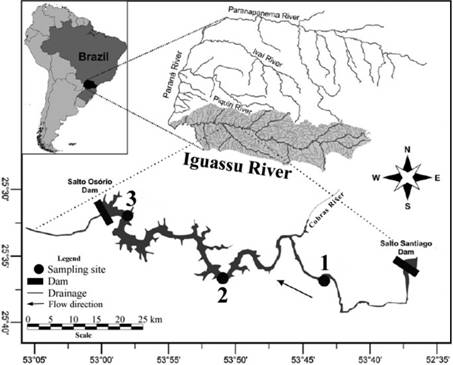
Fish were sampled monthly from July 2003 to June 2005, bimonthly from July 2005 to November 2018, and quarterly from February 2019 to February 2022, totaling 20 years of data collection at three sites in the Salto Osório Reservoir (52°58’57.4”W; 25°31’56.1”S; Fig. 1). The Salto Osório Reservoir was formed by damming the Iguaçu River in the municipality of São Jorge do Oeste. The hydroelectric plant began operating in September 1975 with six turbines, providing a total capacity of 1,078 MW. The main dam stands 56 m high and 750 m long at its crest, creating a “run-of-the-river” reservoir extending 70 km. It floods an area of 55 km2, and has a maximum storage capacity of 1.124 x 10⁹ m3 of water. The water residence time is 16 days, with an average depth of 25.5 m and a maximum depth of 40 m (Tractebel Energia and ECSA 2002). This reservoir is the fourth in a sequence of dams along the main channel of the Iguassu River (Daga and Gubiani 2012).

Sampling sites (1, 2, and 3) in the Salto Osório Reservoir, located in the Iguassu River Basin, Paraná State, Brazil.
For sampling, simple gillnets (with mesh sizes ranging from 2.4 to 16.0 cm between opposite knots) and trammel nets (locally known as ‘feiticeiras’, with inner mesh sizes ranging from 6.0 to 8.0 cm between opposite knots) were used. These nets were deployed for 24 hours and checked at 8:00 a.m., 4:00 p.m., and 10:00 p.m. The captured fish were anesthetized and euthanized using an overdose of benzocaine solution (250 mg/L; AVMA 2001), following a protocol approved by the Ethics Committee on the Use of Animals at the Universidade Estadual do Oeste do Paraná (License Number: Protocol 52/09 - CEUA/Unioeste).
Afterward, the fish were placed into labeled plastic bags and stored in cooler boxes with ice for preservation and transport to the laboratory. In the laboratory, the speci mens were identified, according to Ingenito et al. (2004), Baumgartner et al. (2012), and Garavello et al. (2012). Subsequently, they were measured for total length (TL) and standard length (SL) to the nearest 0.1 cm and weighed for total weight (TW) to the nearest 0.01 g. Additionally, the sex and gonadal development stages of each individual were determined by macroscopic visual inspection of the gonads, following Vazzoler (1996).
Some voucher specimens (Supplementary Table S1) were preserved in 70% alcohol and deposited in the Ichthyological Collection of GERPEL (CIG) at the Universidade Estadual do Oeste do Paraná, Campus Toledo.
Length-weight relationships (LWRs) were determined using the equation TW = a*SLb (Ricker 1973). Length-length relationships (LLRs) were estimated with the equation TL = a + b*SL using a linear regression model based on the least-squares method (Zar 1999). The L50 (length at 50% maturity) was estimated using a maturity ogive (logistic model) via the sizeMat package (Torrejon-Magallanes 2020) in R software (R Core Team 2024). For the LWRs, the variables TW and SL were log10-transformed (log10TW = log10a + blog10SL) for linearization. Scatter plots were created for visual inspection of outliers, and extreme outliers (absolute value of standardized residuals ≥ 4) were excluded prior to the regression analysis.
The degree of model fit was evaluated using the determination coefficient (r2), and 95% confidence intervals (α = 0.05) for parameters a and b were estimated for each relationship. A Student’s t- test (Zar 1999) was used to test for significant deviations from the isometric condition (b = 3 for the LWR). Analysis of covariance (ANCOVA, Goldberg and Scheiner 1993) was applied to test for differences between parameters adjusted for males and females in the LWR, LLR, and L50 analyses. When ANCOVA indicated significant differences, the LWR, LLR, and L50 were calculated separately for each sex; otherwise, the combined parameters were presented for both sexes (denoted as ‘B’ in the tables). All statistical analyses were performed using R software (R Core Team 2024). A significance level of p < 0.05 was applied to all analyses.
RESULTS
A total of 98,209 individuals were caught, comprising 46,542 males and 48,241 females. For 3,426 specimens, sex could not be determined through macroscopic inspection of the gonads. These individuals belonged to 25 fish species (Supplementary Table S1). Length-weight relationship (LWR) adjustments were made for 24 species (Table 1; Supplementary Fig. S1). After excluding outliers and specimens whose sex could not be identified, 94,723 individuals were used to fit the LWR (Table 1; Supplementary Fig. S1).
Descriptive statistics and estimated parameters of length-weight relationships for 24 fish species caught in the Salto Osório Reservoir, Iguassu River Basin, Paraná State, Brazil, from July 2003 to February 2022. (B) Both sexes; (M) males; (F) females; (N) total number of fish caught; (Min) minimum value reported; (Max) maximum value reported; (a) intercept; (b) slope; (CI) confidence interval; (SE) standard error; (r2) determination coefficient. *First report of LWR according to FishBase.
The number of individuals per species ranged from 48 for Coptodon rendalli (Boulenger, 1897) to 37,937 for Psalidodon bifasciatus (Garavello & Sampaio, 2010) (Table 1). The smallest recorded standard length was 4.20 cm for Hoplisoma longipinne (Knaack, 2007) and P. bifasciatus, while the largest standard length was 50.00 cm for Hoplias sp. (Table 1). A new maximum total length was reported for 20 fish species (Table 2; values in bold), based on information available in FishBase (Froese and Pauly 2024). For 18 species (Table 2), the maximum total length recorded in FishBase was lower than that observed in our study.
Descriptive statistics and estimated parameters of length-length relationships for 25 fish species caught in the Salto Osório Reservoir, Iguassu River Basin, Paraná State, Brazil, from July 2003 to February 2022. (B) Both sexes; (M) males; (F) females; (N) total number of fish caught; (Min) minimum value reported; (Max) maximum value reported; (a) intercept; (b) slope; (CI) confidence interval; (SE) standard error; (r2) determination coefficient. Values in bold indicate the new maximum total length according to FishBase, and *first report of LLR according to FishBase.
The lowest total weight recorded was 3.20 g for P. bifasciatus, and the highest was 2,934.90 g for Hoplias sp. (Table 1). Significant differences in LWRs between sexes were observed for 15 species (ANCOVA; p < 0.05; Table 1).
All LWR adjustments were significant (p < 0.01). A new LWR was reported for six fish species (Table 1; values marked with asterisks). The estimated values for parameter b ranged from 1.52 to 3.38 (Table 1). The average b-value was 2.87 (SE ± 0.06), and the median b-value was 2.96, with 50% of the values falling between 2.87 and 3.09. Only six species exhibited isometric growth (b = 3; p > 0.05; Table 1; Supplementary Fig. S1).
The coefficient of determination (r2) ranged from 0.48 for females of Bryconamericus ikaa Casciotta, Almirón & Azpelicueta, 2004, to 0.99 for C. rendalli, males of Geophagus iporanguensis Haseman, 1911, and females of Oligosarcus longirostris Menezes & Géry, 1983 (Table 1).
To fit the LLR, 93,760 individuals were used (Table 2; Supplementary Fig. S2). The total number of individuals per species ranged from 19 for males of Tatia jaracatia Pavanelli & Bifi, 2009, to 19,509 for females of P. bifasciatus (Table 2). The minimum recorded total length was 5.40 cm for Pimelodus britskii Garavello & Shibatta, 2007 (Table 2; Supplementary Fig. S2), while the maximum value was 57.50 cm for females of Hoplias sp. (Table 2; Supplementary Fig. S2). Similarly, the minimum recorded standard length was 3.90 cm for males of P. bifasciatus (Table 2; Supplementary Fig. S2), whereas the maximum length was 49.30 cm for females of Hoplias sp. (Table 2; Supplementary Fig. S2). A new maximum total length was reported for 20 fish species (Table 2) based on information available in FishBase (Froese and Pauly 2024).
All LLR fits were significant (p < 0.05). A new LLR was reported for eight fish species (Table 2; values marked with asterisks). The estimated b parameter value ranged from 0.419 for females of T. jaracatia (Table 2) to 1.314 for Hypostomus commersoni Valenciennes, 1836. The average b-value was 1.143 (SE ± 0.020), and the median b-value was 1.167, with 50% of the values ranging from 1.142 to 1.203.
The ‘a’ intercept value was significant for all fits except for females of Crenicichla tesay Casciotta & Almirón, 2009, and males of Crenicichla yaha Casciotta, Almirón & Gómez, 2006, and G. iporanguensis (p < 0.05; in Table 2, no confidence interval included zero).
The r2 value ranged from 0.40 for females of T. jaracatia to 0.99 for 13 fish species (Table 2). A significant difference in LLRs was detected between sexes for 14 fish species (ANCOVA; p < 0.05; Table 2; Supplementary Fig. S2). For most species, females were bigger than males of the same species (Table 2; Supplementary Fig. S2).
Length at first maturity was estimated for 16 fish species only (Table 3; Supplementary Fig. S3). A total of 89,392 individuals were used to fit the L50 (Table 3; Supplementary Fig. S3). The total number of individuals per species ranged from 140 for H. commersoni to 19,883 for females of P. bifasciatus (Table 3). The estimated b parameter value ranged from 0.40 for Crenicichla iguassuensis Haseman, 1911 (Table 3) to 2.66 for Astyanax lacustris (Lütken, 1875); the average b-value was 1.218 (SE ± 0.157), and the median b-value was 1.00, with 50% of the values ranging from 0.865 to 1.645.
Descriptive statistics and estimated parameters of length at first maturity for 16 fish species caught in the Salto Osório Reservoir, Iguassu River Basin, Paraná State, Brazil, from July 2003 to February 2022. (B) Both sexes; (M) males; (F) females; (N) total number of fish caught; (a) intercept; (b) slope; (L50) length at first maturity; (CI) confidence interval; (r2) determination coefficient. *First report of L50 according to FishBase.
The ‘a’ intercept value was significant for all fits (p < 0.05; Table 3). The r2 value ranged from 0.13 for C. iguassuensis to 0.75 for females of O. longirostris (Table 3; Supplementary Fig. S3). Despite the low r2 value for some species, we present the first record of L50 for 10 species (Table 3). A significant difference between sexes for L50 was observed for O. longirostris and P. bifasciatus (ANCOVA; p < 0.05; Table 3; Supplementary Fig. S3), with females having a greater L50 than males (Table 3; Supplementary Fig. S3). In addition, for Apareiodon vittatus Garavello, 1977, L50 could only be estimated for females (Table 3; Supplementary Fig. S3).
DISCUSSION
Our results indicated that the b values for the length-weight relationship ranged from 1.52 to 3.37, a pattern consistent with that reported by Tesch (1971). This author noted that b values for fish are typically centered around 3, generally ranging from 2 to 4. Our findings corroborate this expected variability, with 17 out of 24 adjustments indicating isometric growth (b = 3; Table 1). Such regularity in the b parameter has been widely documented across numerous fish species and aquatic environments. For instance, Froese (2006), in a review of LWRs, observed that most b values fell within the range of 2.5 < b < 3.5. Similarly, Gubiani et al. (2009) estimated b values for 48 fish species in reservoirs across Paraná State, Brazil, reporting values between 2.49 and 3.46. More recently, Genovai et al. (2024) analyzed LWRs for 10 fish species in headwater streams in the lower stretch of the Iguassu River basin, finding values ranging from 2.37 to 3.62. These studies, along with others (e.g., Gubiani and Horlando 2014, Nobile et al. 2015, Freitas et al. 2017, Lubich et al. 2021), consistently highlight that b estimates generally fall within the range of 2 to 4.
As noted, most species exhibited isometric growth, reflecting proportional increases in length and weight (Benedito-Cecílio and Agostinho 1997). However, Gubiani and Horlando (2014), in their analysis of 20 fish species from the Salto Santiago Reservoir, Iguassu River, Brazil, and Gubiani et al. (2009), in their study of 48 species across 30 reservoirs from Paraná State, Brazil, reported predominantly positive allometric growth, where weight increases at a faster rate than length (b > 3; Ricker 1979). In our study, we observed positive allometry for Cyphocharax cf. santacatarinae (Fernández-Yépez, 1948), Glanidium ribeiroi Haseman, 1911, Hoplias sp., Odontesthes bonariensis (Valenciennes, 1835), O. longirostris, P. britskii, Pimelodus ortmanni Haseman, 1911, Rhamdia branneri Haseman, 1911, and Rhamdia voulezi Haseman, 1911. Notably, P. ortmanni exhibited sexual variation in allometry, with males showing negative allometry (b < 3; see Table 1). Variations in LWRs within the same species are common and influenced by factors such as resource availability, gastric fullness, gonadal development stage, sex, health, and the size distribution of individuals (Tesch 1971, Wootton 1998, Cherif et al. 2008).
Other species, including Astyanax lacustris, A. vittatus, B. ikaa, C. iguassuensis, C. tesay, G. iporanguensis, H. longipinne, Hypostomus derbyi (Haseman, 1911), P. bifasciatus, Psalidodon dissimilis (Garavello & Sampaio, 2010), Psalidodon minor (Garavello & Sampaio, 2010), and males of P. ortmanni, displayed negative allometry, indicating that length increased faster than weight (b < 3). Similarly, G. iporanguensis exhibited sexual variation, with males showing isometric growth (Table 1). According to Rêgo et al. (2008), who analyzed morphometrics and LWRs in Prochilodus lineatus (Valenciennes, 1836) and Leporinus friderici (Bloch, 1794) from the Nova Ponte Reservoir, Araguari River, negative allometry may often reflect juvenile-dominated samples.
Differences in body size between sexes in fish species are well-documented and often linked to sexual dimorphism (Haas, 1976). In our study, differences in LWRs between males and females were evident for A. lacustris, A. vittatus, B. ikaa, C. cf. santacatarinae, G. iporanguensis, H. longipinne, H. derbyi, O. longirostris, P. bifasciatus, P. britskii, P. dissimilis, Psalidodon gymnodontus Eigenmann, 1911, P. minor, P. ortmanni, and R. voulezi. In general, females exhibited greater growth than males, likely reflecting higher energy allocation toward reproduction (Vazzoler 1996). However, in species such as A. vittatus, G. iporanguensis, P. bifasciatus, H. derbyi, and R. voulezi, males demonstrated greater growth.
Sexual differences were also evident in the length-length relationships, with females of A. lacustris, A. vittatus, H. longipinne, Hoplias sp., O. longirostris, P. bifasciatus, P. dissimilis, P. gymnodontus, P. minor, and T. jaracatia having longer caudal fins. This trait may enhance swimming capacity. Conversely, males of C. tesay, C. yaha, G. iporanguensis, and O. bonariensis displayed longer caudal fins, potentially linked to sexual display behaviors, metabolic differences, or greater genetic variability (Rêgo et al. 2008).
Length at first maturity (L50), representing the size at which half the population reaches sexual maturity, showed interpopulation differences. For example, O. longirostris reached L50 at 10.20 cm in our study, compared to 9.52 cm reported by Gubiani and Horlando (2014) in the Salto Santiago Reservoir. Similarly, for O. bonariensis, our estimate was 14.40 cm, slightly higher than the 13.16 cm reported by the same authors. The largest discrepancy occurred in C. iguassuensis (L50 = 7.65 cm vs. 9.64 cm). Such differences can be attributed to environmental variability, fishing pressures, and methodological differences.
This study provides the first reference for the LWRs of six fish species, including C. cf. santacatarinae, C. tesay, C. yaha, H. longipinne, R. branneri, and R. voulezi. Additionally, it documents new maximum length records for 20 species and establishes L50 values for 10 fish species, highlighting important data gaps. These findings enhance our understanding of fish growth strategies and support fisheries management and conservation particularly in regions with high endemism and vulnerability to anthropogenic impacts.
ACKNOWLEDGMENTS
We thank the Research Group on Fishery Resources and Limnology (GERPEL) for their assistance with fieldwork.
LITERATURE CITED
- Agostinho AA, Gomes LC (1997) Reservatório de Segredo: bases ecológicas para o manejo. Eduem, Maringá, 387 pp.
-
AVMA (2001) Panel on euthanasia. Report of the AVMA panel on euthanasia. Journal American Veterinary Medical Association 218(5): 669-696. https://avmajournals.avma.org/
» https://avmajournals.avma.org/ -
Azevedo-Santos VM, Coelho PN, Brambilla EM, Lima FP, Nobile AB, Britton JR (2018) Length-weight relationships of four fish species from the upper Paraná River basin, Southeastern Brazil. Journal of Applied Ichthyology 34: 237-239. https://doi.org/10.1111/jai.13542
» https://doi.org/10.1111/jai.13542 - Barbieri G (1995) Biologia populacional de Cyphocharax modesta (Hensel, 1869) (Characiformes, Curimatidae) da Represa do Lobo, Estado de São Paulo. 1 - Estrutura populacional e crescimento. Boletim Instituto da Pesca 22(2): 49-56.
- Baumgartner G, Pavanelli CS, Baumgartner D, Bifi AG, Debona T, Frana VA (2012) Peixes do baixo rio Iguaçu. Eduem, Maringá, 203 pp.
- Benedito-Cecílio E, Agostinho AA (1997) Estrutura das populações de peixes do reservatório de Segredo. In: Agostinho AA, Gomes LC (Eds) Reservatório de Segredo: bases ecológicas para o manejo . Eduem, Maringá, 113-139.
- Braga FMS (1993) Análise do fator de condição de Paralonchurus brasiliensis (Perciformes, Sciaenidae). Revista Unimar 15(2): 99-115.
- Castro ACL (1999) Tamanho e idade de primeira maturação da corvina, Plagioscion squamosissimus (Heckel, 1840) (Teleostei, Sciaenidae), do reservatório de Barra Bonita - SP. Boletim do Museu Paraense Emilio Goeldi, Série Zoologia 15(2): 117-133.
- Cherif M, Zarrad R, Gharbi H, Missaoui H, Jarboui O (2008) Relações comprimento-peso para 11 espécies de peixes do Golfo de Túnis (SW Mar Mediterrâneo, Tunísia). Pan-American Journal of Aquatic Sciences 3: 1-5.
-
Daga VS, Gubiani ÉA (2012) Variations in the endemic fish assemblage of a global freshwater ecoregion: associations with introduced species in cascading reservoirs. Acta Oecologica 41: 95-105. https://doi.org/10.1016/j.actao.2012.04.005
» https://doi.org/10.1016/j.actao.2012.04.005 -
Daga VS, Pelicice FM, Gubiani ÉA, Vitule JRS (2015) Homogenization dynamics of the fish assemblages in Neotropical reservoirs: comparing the roles of introduced species and their vectors. Hydrobiologia 746: 327-347. https://doi.org/10.1007/s10750-014-2032-0
» https://doi.org/10.1007/s10750-014-2032-0 -
Freitas TMS, Souza JBS, Prudente BS, Montag LFA (2017) Length-weight relationship in ten fish species from the Nhamundá River, the Amazon Basin, Brazil. Acta Amazonica 47(1): 75-78. https://doi.org/10.1590/1809-4392201601272
» https://doi.org/10.1590/1809-4392201601272 -
Froese R (2006) Cube law, condition factor and weight-length relationships: history, meta-analysis and recommendations. Journal of Applied Ichthyology 22: 241-253. https://doi.org/10.1111/j.1439-0426.2006.00805.x
» https://doi.org/10.1111/j.1439-0426.2006.00805.x -
Froese R, Pauly D (2024) FishBase. Database version 02/2024. http://www.fishbase.org [Accessed: 08/05/2024]
» http://www.fishbase.org -
Garavello JC, Britski HA, Zawadzki CH (2012) The cascudos of the genus Hypostomus Lacépède (Ostariophysi: Loricariidae) from the Rio Iguaçu Basin. Neotropical Ichthyology 10(2): 263-283. https://doi.org/10.1590/S1679- 62252012000200005
» https://doi.org/10.1590/S1679- 62252012000200005 -
Genovai N, Maciel AL, Piana PA, Gubiani ÉA (2024) Length-weight and length-length relationships of 10 fish species from headwater streams of the lower Iguassu River basin, Brazil. Zoologia 41: e23025. https://doi.org/10.1590/S1984-4689.v41.e23025
» https://doi.org/10.1590/S1984-4689.v41.e23025 - Goldberg DE, Scheiner SM (1993) ANOVA and ANCOVA: field competition experiments. In: Scheiner SM, Gurevitch J (Eds) Design and analysis of ecological experiments. Chapman & Hall, New York, 69-93.
-
Gubiani ÉA, Gomes LC, Agostinho AA (2009) Length-length and length-weight relationships for 48 fish species from reservoirs of the Paraná State, Brazil. Lakes & Reservoirs: Research and Management 14: 289-299. https://doi.org/10.1111/j.1440-1770.2009.00411.x
» https://doi.org/10.1111/j.1440-1770.2009.00411.x -
Gubiani ÉA, Horlando SS (2014) Length-weight and length-length relationships and length at first maturity for freshwater fish species of the Salto Santiago Reservoir, Iguaçu River Basin, Brazil. Journal of Applied Ichthyology 30: 1087-1091. https://doi.org/10.1111/jai.12444
» https://doi.org/10.1111/jai.12444 -
Gubiani ÉA, Ruaro R, Ribeiro VR, Santa-Fé UMG (2020) Relative condition factor: Le Cren’s legacy for fisheries science. Acta Limnologica Brasiliensia 32(3): e3. https://doi.org/10.1590/S2179-975X13017
» https://doi.org/10.1590/S2179-975X13017 - Helfman GS, Collette BB, Facey DE (1997) The diversity of fishes. Blackwell Science, Hoboken, 528 pp.
- Ingenito LFS, Duboc LF, Abilhoa V (2004) Contribuição ao conhecimento da ictiofauna da bacia do alto rio Iguaçu, Paraná, Brasil. Arquivos de Ciências Veterinárias e Zoológicas da UNIPAR 7(1): 23-36.
-
Keast A, Webb D (1966) Mouth and body form relative to feeding ecology in the fish fauna of a small lake, Lake Opinicon, Ontario. Journal of the Fisheries Board of Canada 23: 1845-1874. https://doi.org/10.1139/f66-175
» https://doi.org/10.1139/f66-175 -
Lemos JRG, Tavares-Dias M, Sales RSA, Nobre Filho GR, Fim JDI (2007) Parasitos nas brânquias de Brycon amazonicus (Characidae, Bryconinae) cultivados em canais de igarapé do Turumã-Mirim, estado do Amazonas, Brasil. Acta Scientiarum Biological Sciences 29: 217-222. https://doi.org/10.4025/actascibiolsci.v29i2.593
» https://doi.org/10.4025/actascibiolsci.v29i2.593 -
Lubich CCF, Aguiar-Santos J, Freitas CEC, Siqueira-Souza FK (2021) Length-weight relationship of 16 fish species from the Negro River basin (Amazonas state, Brazil). Journal of Applied Ichthyology 37: 342-346. https://doi.org/10.1111/jai.14112
» https://doi.org/10.1111/jai.14112 -
Mezzaroba L, Debona T, Frota A, Graça WJ, Gubiani ÉA (2021) From the headwaters to the Iguassu Falls: Inventory of the ichthyofauna in the Iguassu River ba sin shows increasing percentages of nonnative species. Biota Neotropica 20(4): e20201083. https://doi.org/10.1590/1676-0611-BN-2020-1083
» https://doi.org/10.1590/1676-0611-BN-2020-1083 -
Nobile AB, Brambilla EM, Lima FP, Freitas-Souza D, Bayona-Perez IL, Carvalho ED (2015) Length-weight relationship of 37 fish species from the Taquari River (Paranapanema Basin, Brazil). Journal of Applied Ichthyology 31: 580-582. https://doi.org/10.1111/jai.12761
» https://doi.org/10.1111/jai.12761 -
Oliveira MSB, Silva LMA, Prestes L, Tavares-Dias M (2020) Length-weight relationship and condition factor for twelve fish species from the Igarapé Fortaleza basin, a small tributary of the Amazonas River estuary. Acta Amazonica 50: 8-11. https://doi.org/10.1590/1809-4392201900702
» https://doi.org/10.1590/1809-4392201900702 -
Petrere Jr M (1989) River fisheries in Brazil: a review. Regulated Rivers: Research & Management 4(1): 1-16. https://doi.org/10.1002/rrr.3450040102
» https://doi.org/10.1002/rrr.3450040102 -
R Core Team (2024) R: A Language and Environment for Statistical Computing. R Foundation for Statistical Computing, Vienna. https://www.R-project.org/
» https://www.R-project.org/ - Rêgo ACL, Pinese OP, Magalhães PA, Pinese JF (2008) Relação peso-comprimento para Prochilodus lineatus (Valenciennes, 1836) e Leporinus friderici (Bloch, 1794) (Characiformes) no reservatório de Nova Ponte - EPDA de Galheiro, rio Araguari, MG. Revista Brasileira de Zoociências 10: 13-21.
-
Ricker WE (1973) Linear regressions in fisheries research. Journal of the Fisheries Reserach Board of Canada 30: 409-434. https://doi.org/10.1139/f73-072
» https://doi.org/10.1139/f73-072 -
Ricker WE (1979) Growth rates and models. In: Hoar WS, Randall DJ, Brett JR (Eds) Fish physiology, bioenergetics and growth. Academic Press, New York, 677-743. https://doi.org/10.1016/S1546-5098(08)60034-5
» https://doi.org/10.1016/S1546-5098(08)60034-5 - Silva-Júnior MG, Castro ACL, Soares LS, França VL (2007) Relação peso-comprimento de espécies de peixes do estuário do rio Paciência da ilha do Maranhão, Brasil. Boletim do Laboratório de Hidrobiologia 20(1): 65-74.
- Sinovčić G, Franičević M, Zorica B, Čikeš-Keč V (2004) Length-weight and length-length relationships for 10 pelagic fish species from the Adriatic Sea (Croatia). Journal of Applied Ichthyology 20: 156-158.
- Tesch FW (1971) Age and growth. In: Ricker WE (Ed.) Methods for assessment of fish production in fresh waters. Blackwell, Oxford, 98-130.
-
Tractebel Energia, ECSA (2002) Plano de uso e ocupação das águas e entorno do reservatório da usina hidrelétrica Salto Santiago. ECSA, vol. 1, 115 pp. https://www.engie.com.br/wp-content/uploads/2023/10/Plano-Salto-Santiago-Volume1.pdf [Accessed: 08/05/2024]
» https://www.engie.com.br/wp-content/uploads/2023/10/Plano-Salto-Santiago-Volume1.pdf -
Torrejon-Magallanes J (2020) sizeMat: An R package to estimate size at sexual maturity. R Foundation for Statistical Computing, Vienna . https://cran.r-project.org/web/packages/sizeMat/vignettes/sizeMat.html
» https://cran.r-project.org/web/packages/sizeMat/vignettes/sizeMat.html - Vazzoler AEAM (1996) Biologia da reprodução de peixes teleósteos: teoria e prática. Eduem, Maringá, 169 pp.
- Wolff LL, Hreciuk ER, Viana D, Zaleski T, Donatti L (2007) Population structure of Phalloceros caudimaculatus (Hensel, 1868) (Cyprinodontiformes: Poeciliidae) collected in a brook in Guarapuava, PR. Brazilian Archives of Biology and Technology 50(3): 417-423.
- Wootton RJ (1998) Ecology of Teleost fishes. Chapman and Hall, London, 392 pp.
- Zar JH (1999) Biostatistical analysis. Prentice Hall, New Jersey, 718 pp.
ADDITIONAL NOTES
-
Funding
Coordenação de Aperfeiçoamento de Pessoal de Nível Superior (CAPES Finance Code 001) This study was partially funded by the Coordenação de Aperfeiçoamento de Pessoal de Nível Superior (CAPES Finance Code 001).
- ZooBank register
-
How to cite this article
Rios B, Garcia AVS, Gubiani ÉA (2025) Length-weight and length-length relationships, and length at first maturity of freshwater fish species in the Salto Osório Reservoir, Iguassu River Basin, Brazil. Zoologia 41: e24028. https://doi.org/10.1590/S1984-4689.v42.e24028
-
Published by
Sociedade Brasileira de Zoologia at Scientific Electronic Library Online - https://www.scielo.br/zool
Supplementary material 1
Authors: B. Rios, A.V.S. Garcia, É.A. Gubiani
Data type: Species data.
Supplementary material 2
Authors: B. Rios, A.V.S. Garcia, É.A. Gubiani
Data type: Species data.
Supplementary material 3
Authors: B. Rios, A.V.S. Garcia, É.A. Gubiani
Data type: Species data.
Supplementary material 4
Authors: B. Rios, A.V.S. Garcia, É.A. Gubiani
Data type: Species data.
Copyright notice: These datasets are made available under the Open Database License (http://opendatacommons.org/licenses/odbl/1.0/). The Open Database License (ODbL) is a license agreement intended to allow users to freely share, modify, and use this Dataset while maintaining this same freedom for others, provided that the original source and author(s) are credited.
Link: https://doi.org/10.1590/S1984-4689.v42.e24028