 The condemned crab: dilemmas in the conversion of crustaceans into commodities
Abstract
This photographic essay explores the engagements between crabs, crab-harvesters (caranguejeiros) and their bosses in the e Parnaíba Delta Marine Extractive Reserve. Through its images, the essay shows a crucial moment in the conversion of crabs into commodities: the cut, when crabs in poor condition for sale are separated from the rest. The aim is to demonstrate how the cut simultaneously brings into relation labour practices, technical processes and interactions between humans and other living beings in contemporary capitalism. Hence, the crab-commodity is not produced solely through a commercial relationship but is mediated by an orchestrated set of dynamics involving people, crustaceans and the paths along which they circulate.
Keywords:
Human-animal relations; Commodities; Capitalism; Artisanal fishing; Caranguejo-uçá; Visual ethnography.
Resumo
Este ensaio fotográfico se debruça sobre os engajamentos entre caranguejos, caranguejeiros e seus patrões na Reserva Extrativista Marinha do Delta do Parnaíba. Através das imagens, o trabalho mostra um momento crucial na conversão dos caranguejos em mercadorias: o corte, quando caranguejos em más condições de comercialização são separados do restante. A ideia do ensaio é mostrar como o corte relaciona, a um só tempo, relações de trabalho, processos técnicos e interações entre humanos e outros viventes no capitalismo contemporâneo. Assim, o caranguejo-mercadoria não se faz apenas a partir de uma relação comercial, mas mediado por um conjunto orquestrado de dinâmicas entre pessoas, crustáceos e os caminhos pelos quais circulam.
Palavras-chave:
Relações Humanos-animal; Mercadoria; Capitalismo; Pesca artesanal; Caranguejo-uçá; Etnografia visual
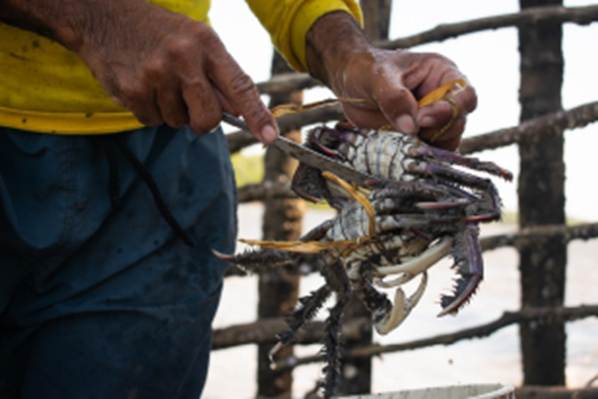
After roughly seven hours spent in the mangroves, the crab-harvesters make their way back to their canoes. The men carry with them dozens of crustaceans that will be passed on to their patrões (bosses) and later sold on to other intermediaries. However, the conversion of a crab into a commodity involves a set of processes that resist reduction to what appears to be - an appearance only - a simple act of buying and selling. This essay explores this question through the idea of the corte, the cut, a specific moment in the cycle via which crustaceans are transformed into commercially selected products. In this sense, the cut is the cut-off point that determines which live crabs will continue along the commercial pathway and which will be discarded.
Discussing the cut through this visual essay leads to a reflection on two points. First, the relations among diverse living beings (human and non-human) that constitute the production of the caranguejo-uçá, the swamp ghost crab (Ucides cordatus), in northeastern Brazil; and second, the crafting of visual ethnographies in collaboration with traditional fishing communities - specifically, groups of artisanal fishers engaged in crab harvesting, the caranguejeiros. In the Parnaíba Delta, crab harvesting is an overwhelmingly male occupation, carried out predominantly by black men. Here it is worth noting that the mangroves of northeastern Brazil are a source of life and labour for diverse fishing communities, especially for black and indigenous collectives - usually organised in the fight for freedom and autonomy, rooted in their relations with the mangroves, the land and the waters (Silveira 2020, 2023, Sacramento 2019).
The images presented here were taken over fourteen months of fieldwork conducted between 2018 and 2019 in the Parnaíba Delta Marine Extractive Reserve (Resex Delta do Parnaíba), located on the border between the states of Piauí and Maranhão in northeastern Brazil. This conservation unit was created in 2000 amid a series of debates about the harvesting of the swamp ghost crab and the conservation of local coastal ecosystems, especially the mangroves (Coelho Pereira 2021). The reserve covers an area of 27,000 hectares and includes parts of the municipalities of Ilha Grande, in Piauí, and Água Doce and Araioses, in Maranhão.
In the Resex Delta do Parnaíba, I was able to accompany the crab-harvesters (caranguejeiros) in their everyday fishing activities. My hosts organised themselves into turmas, the term used for groups of crab-harvesters led by a patrão, a boss, who in this case is the first buyer of the crustaceans they capture. It is common for bosses to be people within the crab-harvesters’ own kinship or friendship networks: neighbours, uncles, compadres. People who are very close and generally live in the same community. Sometimes, the boss provides the crab-harvester with the boat and the fuel needed to travel to the mangrove. He may even distribute food for the harvesters and their families when searching for crabs demands spending days away from home. None of this, however, creates an unbreakable bond between fishers and their bosses. A caranguejeiro may switch turma, or even form his own, whenever he wishes (or has the means to manage other crab-harvesters).
The broad notion of the ‘fisher’ - as well as characterising collectives with their own forms of labour and political organisation (Colaço 2012, Maldonado 1986) - is generally employed in the anthropological literature to refer to subjects who inhabit the conflictual space between the uncertainty of the catch and mercantile production (Alencar 1991, Diegues 1983). Yet it is only possible to apprehend the full meaning of this category when we also attend to the engagements of fishers with very specific kinds of ‘catch’ (Sautchuk 2007, Silveira et al. 2013, Ramalho 2016). By this I mean that each specific fishing practice shapes distinct kinds of fishers through their interactions with an assemblage of living beings, tools, materials and environments (Sautchuk 2010). This in turn leads us to use methodologies that, beyond humans, attend to the pathways and engagements of other beings: fish, plants, fungi and so on (Tsing 2015, 2019, Kirksey & Helmreich, 2010). Pursuing this line of inquiry, the following question also arises: given the multispecies assemblages that constitute them, how are crabs transformed into commodities? This photographic essay focuses on a crucial point for understanding this issue, since the crab-commodity does not come into being only at the moment when the animal reaches its final buyer, but is constituted through a series of transformations starting the moment it is captured. In the corte, questions related to the crab’s size and quality, for instance, are brought into play. It is the moment when the commodity or mercadoria - as my caranguejeiro friends would say - arrives in the hands of the boss, the first in the sequence of intermediaries that will follow.
The ‘production’ of the swamp ghost crab involves entanglements of vital processes, beginning in the mangrove and marked by developmental cycles such as birth, fattening and growth (Pitrou 2017a, 2017b), followed by technical processes (like those involved in the capturing of the crabs) and market processes. In this last regard, the corte occupies a special place: it is at this moment that crabs that fail to meet commercial standards, or conform to the regulations established by environmental agencies, are discarded. Crabs must be sold alive: it is thus a commerce organised around careful attention to the crustacean’s vitality, since they generally die between two to four days after being extracted from the mangroves. A trade conducted with living beings, then. This enables us to perceive - inspired by Bear, Ho, Tsing and Yanagisako (2015) - how capitalism transforms people, vital processes, plants and animals into resources, through productive dynamics capable of encompassing both humans and non-humans.
The visual essay presented below was produced as part of my doctoral research (Coelho Pereira 2021) and primarily accompanies the movements of Zequinha. who, at the time, was a middle-aged man and one of the bosses with the largest number of caranguejeiros in his turma, based in the community of Torto, municipality of Araioses, Maranhão, within the Parnaíba Delta Marine Extractive Reserve.
Following Zequinha’s movements around the mangrove - including his gestures and the multiplicity of interactions he establishes - affords a reflection on the production of images with different peoples and traditional communities (Fagundes 2019, Villas Boas 2016, Cardoso 2018). In this context, the making of photographic images, far from being a mere visual record, becomes an ethnographic tool that enables us to inquire into the ways our interlocutors relate to their environment, other living beings and, indeed, the capitalist and commercial dynamics that traverse their everyday lives. Understanding the corte as part of the crab trade means attending to the processual character of the conversion of crustaceans into commodities.
***
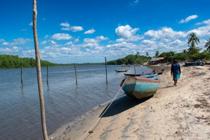
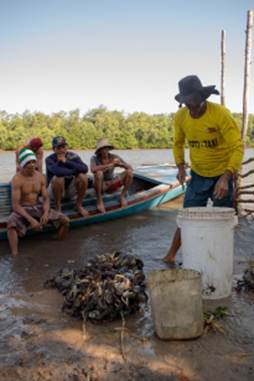
In the community of Torto, located within the Parnaíba Delta Marine Extractive Reserve, the caranguejeiros or crab-harvesters usually leave the mangrove around 1 pm, the exact time varying according to the day’s tidal conditions. Zequinha, one of Torto’s patrões, knowing roughly when the crab-harvesters from his turma will arrive, wanders down to the riverbank. He needs to receive the merchandise.
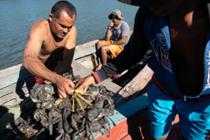
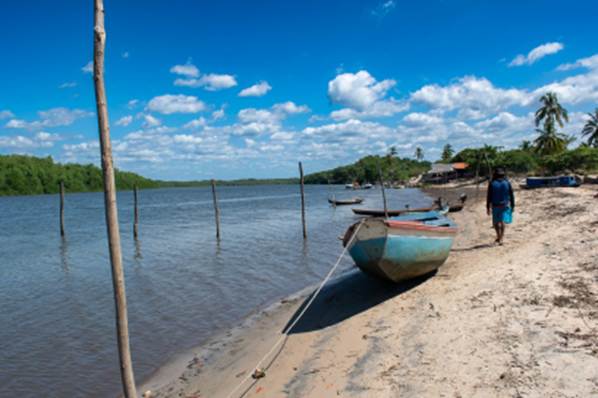
Not all caranguejeiros travel to the mangrove on foot. Those who choose to harvest crabs in more distant mangrove areas use boats.
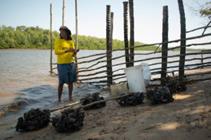
At least two kinds of intermediaries are involved in the crab trade: those who live within the community, as in Zequinha’s case, and those who reside in nearby urban centres, such as the city of Parnaíba, in Piauí. The latter resell the crabs to markets and restaurants along the coast of Piauí and Ceará.
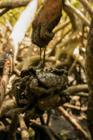
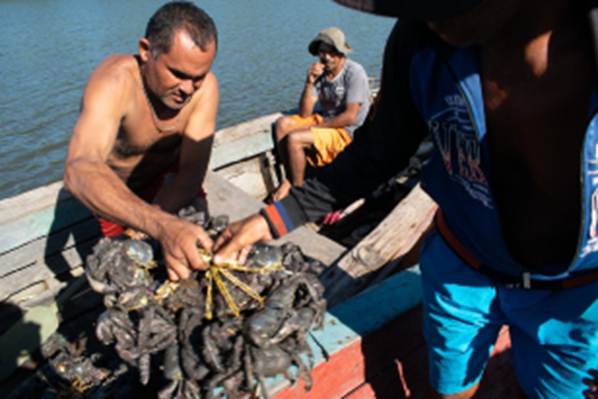
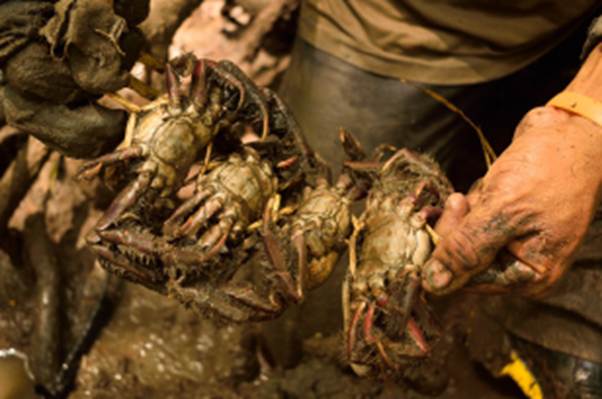
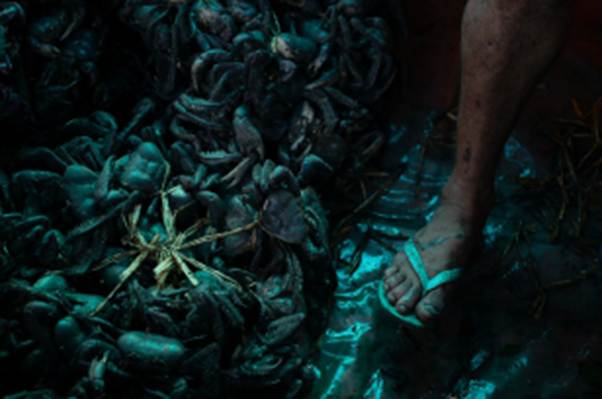
A ‘crab string’ (corda de caranguejo) is composed of four crustaceans and is assembled while still in the mangrove. Defining the exact moment when the living crab is converted into a commodity is difficult. In fact, this ambiguity - living being/commodity - is constitutive of all relations between my crab-harvester hosts and the crabs themselves. In the corda, this ambiguity becomes even more pronounced.
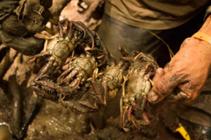
Only male crabs may be harvested, a regulation established by environmental agencies and a practice traditionally followed by the harvesters themselves. Within the Resex Delta do Parnaíba, the minimum size for captured crustaceans is seven centimetres. In addition, in the corda - a string of four crabs - the larger ones are placed on top and the smaller ones below, in order to make the string more appealing to the bosses and other buyers.
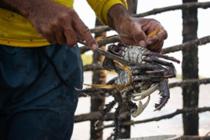
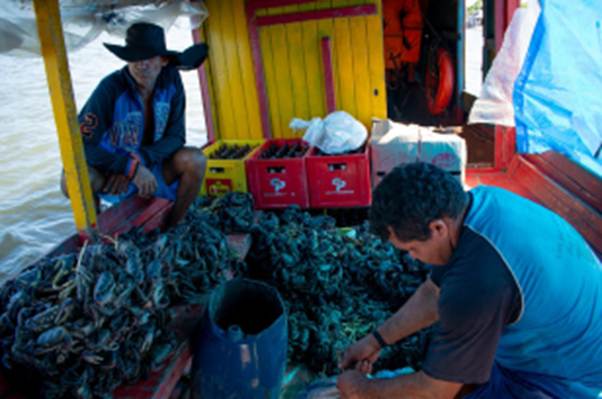
External intermediaries order crabs by the unit, not by the corda. Zequinha was perhaps the only boss in Torto who selected his crabs before selling them to outside buyers. In this way, he maintained greater control over how many crabs in perfect condition he was selling, he told me. Suspicious.
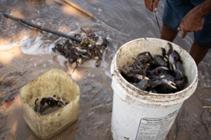
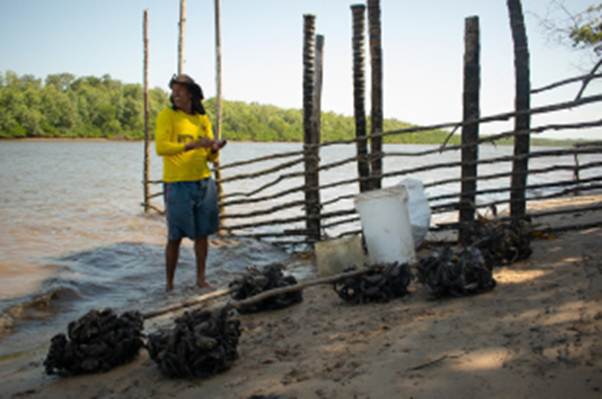
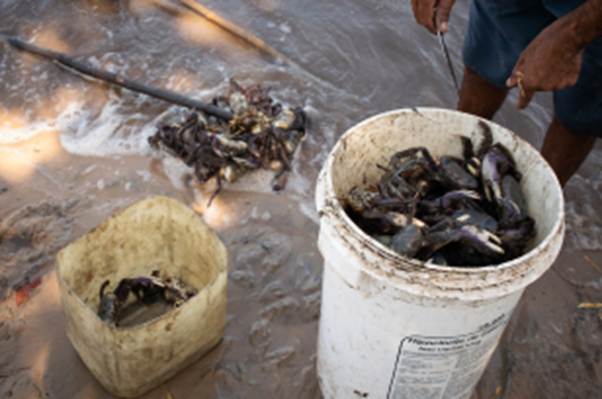
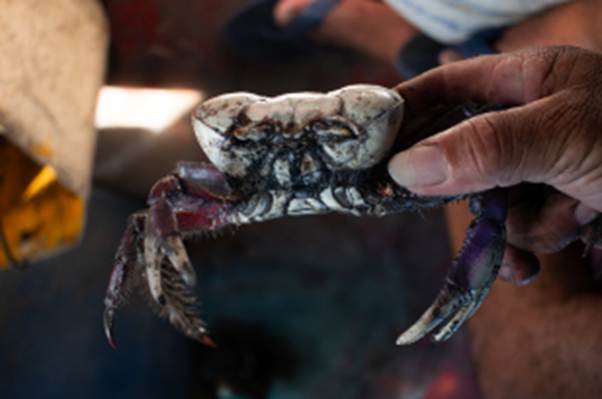
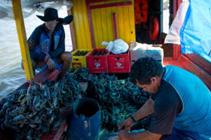
The smaller bucket holds the crabs that have been condenados, condemned, those that do not make the corte or the cut - that is, the boss’s selection - either because they are too small, they have lost their larger claws, or they display weak vital reflexes due to the exertion involved in their capture.
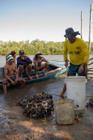
Condemned crabs are not purchased by the boss. This is one of the main points of conflict between caranguejeiros and turma leaders. Complaints that the boss is discarding crabs in good selling condition, merely because they are not as large as he would like, are a constant refrain among the crab-harvesters.
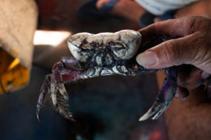
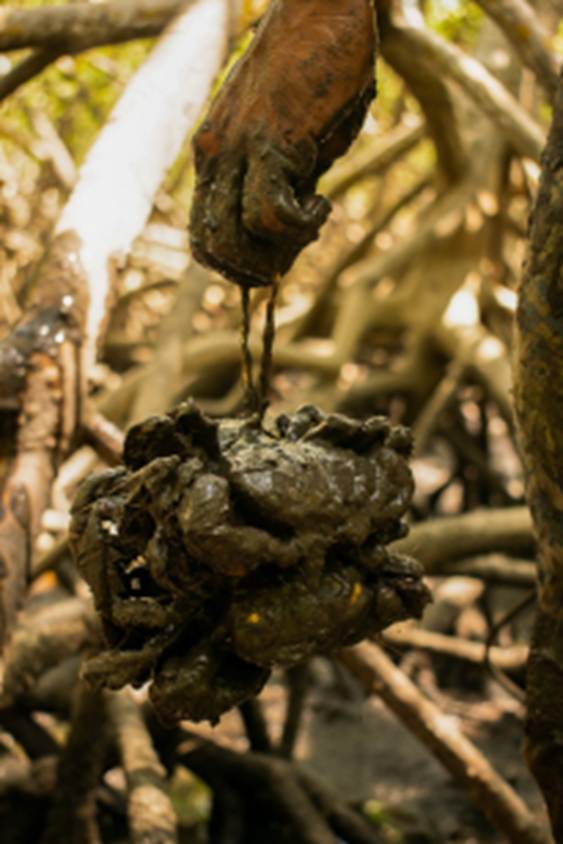
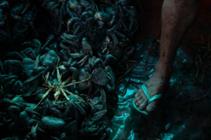
Not every crustacean captured becomes a commodity. Some die along the way, while others are returned alive to the mangrove because they are too small for their meat to be useful. As in this case, in which the crab is still alive.
The crab must remain alive throughout the commercialisation process. From the Resex, in the municipality of Araioses, Maranhão, the crabs are taken to the neighbouring town of Ilha Grande, in Piauí, where they are placed in basquetas - plastic crates - lined with layers of moistened foam.
REFERENCES
- ALENCAR, Edna Ferreira. 1991. Pescadeiras, Companheiras e Perigosas: a pesca feminina na ilha dos Lençóis Dissertação de Mestrado, Programa de Pós-Graduação em Antropologia Social, Universidade de Brasília - Brasília.
-
BEAR, Laura, HO, Karen, TSING, Anna Lowenhaupt, and Sylvia YANAGISAKO. 2015. “Gens: A Feminist Manifesto for the Study of Capitalism”. American Anthropological Association: Society for Cultural Anthropology, March 30. https://www.culanth.org/fieldsights/gens-a-feminist-manifesto-for-the-study-of-capitalism
» https://www.culanth.org/fieldsights/gens-a-feminist-manifesto-for-the-study-of-capitalism - CARDOSO, Thiago Mota. 2018. Paisagens em transe: ecologia da vida e cosmopolítica Pataxó no Monte Pascoal Brasília: IEB; Mil Folhas.
- COELHO PEREIRA, Lucas. 2021. Maré de lua: capitalismo, práticas e ecologias na lida com o caranguejo-uçá no Delta do Parnaíba (PI/MA) Tese de Doutorado, Universidade de Brasília - Brasília.
- COLAÇO, José. 2012. Quanto custa ser pescador artesanal? Etnografia, relato e comparação entre dois povoados pesqueiros no Brasil e em Portugal Tese de Doutorado, Programa de Pós-Graduação em Antropologia, Universidade Federal Fluminense - Niterói.
- DIEGUES, Antônio Carlos. 1983. Pescadores, camponeses e trabalhadores do mar São Paulo: Ática.
- FAGUNDES, Guilherme Moura. 2019. “Colheita Dourada: A Arranca do Capim no Gerais do Jalapão (TO)”. Anuário Antropológico, 1(44): 319-327.
- KIRKSEY, S. Eben, and Stefan HELMREICH. 2010. “The emergence of multispecies Ethnography”. Cult. Anthropol, 25: 545-76.
- MALDONADO, Simone Carneiro. 1986. Pescadores do mar São Paulo: Ática .
- PITROU, Perig. 2017a. “Life is a making”. Nature Culture, 4: 1-37.
- PITROU, Perig. 2017b. “Life form and form of life within an agentive configuration. A birth ritual among the Mixe of Oaxaca (Mexico)”. Current Anthropology, 58(3): 360-380.
- RAMALHO, Cristiano Wellington Noberto. 2016. “Pescados, pescarias e pescadores: notas etnográficas sobre processos ecossociais”. Boletim do Museu Paraense Emílio Goeldi Ciências Humanas, 11(2): 391-414.
- SACRAMENTO, Elionice Conceição. 2019. Da diáspora negra ao território das águas: ancestralidade e protagonismo de mulheres na comunidade pesqueira e quilombola Conceição de Salinas-BA Dissertação de Mestrado, Universidade de Brasília - Brasília.
- SAUTCHUK, Carlos Emanuel. 2007 O arpão e o anzol: técnica e pessoa no estuário do Amazonas (Vila Sucuriju, Amapá) Tese de Doutorado, Programa de pós- Graduação em Antropologia Social, Universidade de Brasília - Brasília.
- SAUTCHUK, Carlos Emanuel. 2010. “O que a rede ensina sobre o pescador”. Revista Coletiva, (1): 1-3
- SILVEIRA, Pedro Castelo Branco. 2020. “Caminhando pelos manguezais do fim do mundo”. Clima Com, 7(17): 1-11.
- SILVEIRA, Pedro Castelo Branco. 2023. “Conversando com Josué de Castro e os povos do manguezal sobre vida, fome e luta”. Revista Coletiva, (33): 1-24.
- SILVEIRA, Pedro Castelo Branco Silveira, MESQUITA, Beatriz, MELO, Luciana, and Ivson OLIVEIRA FILHO. 2013. “Estuário, paisagem-fluxo de pescadores artesanais”. Iluminuras, 14(34): 304-32.
- TSING, Anna. 2015. The Mushroom at the End of the World On the possibility of life in capitalist ruins Princeton: Princeton University Press.
- TSING, Anna. 2019. Viver nas Ruínas: paisagens multiespécies no antropoceno Brasília: IEB Mil Folhas.
- VILLAS BOAS, Maria José Villares Barral. 2016. {Per[for(mar)]}: Imagens das crianças no Nêgo Fugido, Acupe/ BA Dissertação de Mestrado, Programa de Pós-Graduação em Antropologia Social, Universidade de Brasília - Brasília.
-
This work was carried out with research grants and funding from the National Council for Scientific and Technological Development, the Coordination for the Improvement of Higher Education Personnel, and the Joaquim Nabuco Foundation.This article was translated with support from ‘The Vibrant Project: Publishing Indigenous and Black Brazilian Anthropologists in foreign languages,’ funded by the Wenner-Gren Foundation for Anthropological Research as part of its Global Initiative Grant programme.
-
Data Availability Statement:
The data generated or analyzed during this study are included in this article. The doctoral thesis related to the research that originated the text can be consulted in the University of Brasília Repository through the following link: https://repositorio.unb.br/handle/10482/43278?mode=full
Edited by
-
Dossier Editors
Vinícius Venancio (vini.venancio2@gmail.com | https://orcid.org/0000-0003-3245-1204)Federal University of Goiás, Faculty of Social Sciences, Goiânia, GO, Brazil Universidade Federal de Goiás, Faculdade de Ciências Sociais, Goiânia, GO, BrasilAndréa Lobo (andreaslobo@yahoo.com.br | https://orcid.org/0000-0001-7525-1953)University of Brasília, Departament of Anthropology, Brasília, DF, Brazil Universidade de Brasília, Departamento de Antropologia, Brasília, DF, Brasil
The data generated or analyzed during this study are included in this article. The doctoral thesis related to the research that originated the text can be consulted in the University of Brasília Repository through the following link: https://repositorio.unb.br/handle/10482/43278?mode=full