 Preservationism in the Plantationocene: protection as exploitation in Brazil’s Cerrado
Abstract
This article proposes a relational approach to the notion of the plantation in order to identify continuities between the exploitation and the protection of forms of life in modernity. We mobilise the concept of plantation in an operational sense, rather than as a substantive category or a merely metaphorical figure. This approach allows us to foreground mechanisms of ecosystem homogenisation, forms of colonial violence, and the disciplining of bodies that continue to operate in the expansion of colonial modes of inhabitation of the earth. Drawing on the history of establishing a natural park overlapping a traditional Quilombola territory in Brazil’s Cerrado, we show how necropolitical violence, wildfires, and racialized labour emerge as effects of preservationist governance on the land. The aim of the article is to broaden analyses of the plantation phenomenon to encompass not only seventeenth-century agricultural enterprises and their continuation in contemporary agribusiness, but also what might be considered their antithesis: natural areas conserved under full protection regimes.
Keywords:
Plantation; Environmental Conservation; Quilombos; Cerrado Biome; Anthropology of Technology
Resumo
Este artigo propõe uma abordagem relacional da noção de plantation a fim de identificar continuidades entre a exploração e a proteção de formas de vida na modernidade. Mobilizamos o conceito de plantation em sentido operacional, e não como uma categoria substantiva ou uma figura meramente metafórica. Essa abordagem nos permite colocar em primeiro plano mecanismos de homogeneização de ecossistemas, formas de violência colonial e o disciplinamento de corpos que continuam a operar na expansão de modos coloniais de habitar a terra. A partir da história de criação de uma Unidade de Conservação que se sobrepõe a um território quilombola no Cerrado brasileiro, mostramos como a violência necropolítica, os incêndios florestais e o trabalho racializado emergem como efeitos da governança preservacionista sobre a terra. O objetivo do artigo é ampliar as análises do fenômeno da plantation para abarcar não apenas os empreendimentos agrícolas do século XVII e sua continuidade no agronegócio contemporâneo, mas também aquilo que poderia ser considerado seu antípoda: áreas naturais conservadas sob regimes de proteção integral.
Palavras-chave:
plantation; conservação ambiental; quilombos; Cerrado; antropologia da técnica
INTRODUCTION
This article adopts a relational approach to the notion of the plantation in order to identify continuities between the exploitation and protection of forms of life in modernity. Based on ethnographic research into the history and management of the Serra Geral do Tocantins Ecological Station (hereafter EESGT) in the Jalapão region (Tocantins State, Brazil), we mobilise the notion of the plantation in an operative sense, rather than as a substantive category or a merely metaphorical figure. We propose a pragmatic approach focused on the dispositifs through which ecosystems are homogenised, colonial violence is enacted, and bodies are disciplined - dispositifs that continue to be deployed in the extension of a colonial inhabitation. The aim of the article is to widen the scope of analyses of plantation formations so as to encompass not only seventeenth-century agricultural enterprises and their continuation in contemporary agribusiness, but also what would seem to be their opposite: strict-protection protected areas where modern naturalism seeks to celebrate its redemption.
The term preservationism used in the article’s title refers to an environmental philosophy that prioritizes keeping valued landscapes and species intact and insulated from human use (Humphrey, 2002). That particular strand of modern environmentalism has its singularity rooted in the invention of the North American notion of wilderness (Ferdinand, 2022b). Across the humanities and social sciences, preservationism has been criticized when wilderness protection is treated as socially neutral, thereby masking how protected areas may be produced through exclusion, displacement, and the criminalization of local practices (Cronon 1996; Spence 1999; Jacoby 2001).
In political ecology and critical conservation studies, these tensions are frequently analyzed under the rubric of “fortress conservation” and related debates about enforcement, eviction, and justice around protected areas (Brockington 2002; Brockington and Igoe 2006; Brockington, Duffy, and Igoe 2008). For more than a century, this naturalist ideology has insisted on promoting the implantation of full protection areas, purged of human presence, on a global scale.1 This has entailed the appropriation of commonly used lands and the encirclement, enclosure and curtailment of the ways of life of indigenous peoples and other traditional communities, not infrequently culminating in expulsion from their territories and other forms of violence, as amply documented in the specialised literature on socioenvironmental conflicts - especially in Brazil (Diegues 1996, Fany 2004, Viana 2008, Arruti 2013, Talbot 2016).
The second noun in the title, Plantationocene, is understood as a concept collectively developed in an interdisciplinary conversation associated with Donna Haraway and colleagues, later consolidated through Haraway’s formulation and the published transcript “Anthropologists Are Talking About the Anthropocene” (Haraway 2015; Haraway et al. 2016). In Haraway’s widely cited definition, the term names the historical conversion of diverse, human-tended landscapes into extractive, enclosed plantation formations, sustained by enslaved labor and other coercive regimes of work (Haraway 2015). Proposed as an alternative to the Anthropocene - a term that has been criticized for universalizing responsibility by attributing planetary crisis to a generic “humanity,” while underemphasizing colonial histories and racial capitalism - Plantationocene has gained traction across the humanities and social sciences as a framework for tracing the ecological and political afterlives of plantation systems (Yusoff, 2018; Davis et al. 2019).
Contemporary deployments range from analyses of extraction, extinction, and more-than-human “(un)worlding” in plantation landscapes (Chao, 2022b) to accounts that foreground plantations in the historical remaking of capitalist geographies, including center-periphery relations (Wolford 2021). At the same time, commentators caution that Plantationocene can be used in ways that risk diluting the analytic centrality of racial capitalism - particularly when “multispecies” framings become disconnected from histories of racialized dispossession - hence calls to align such analyses with explicit commitments to ecological justice (Davis et al. 2019). Speaking of the Plantationocene directs us to situate this problematic in the establishment of plantations - that is, in the colonial infrastructure that Arturo Escobar (1999: 5) called ‘capitalist nature’: a mode of enslaving, alienating and homogenising exploitation of the land and its living beings, beginning with racialised humans, the mode underpinning the primitive accumulation of capital.
Our intention in using the term preservationism ‘in’ (rather than ‘against the’) Plantationocene in the title may appear counter-intuitive. Nevertheless, it rests on an argument already well established in the anthropological literature on preservationism. This argument involves recognising that the protection and exploitation of ‘nature’ are complementary movements within processes of colonial modernisation (Blanc 2022). In his recent work on hunting, modernity and the “crisis of the wild,” Charles Stépanoff has proposed the neologism “exploitection” to name the structural coupling, rather than the opposition, between protection and exploitation of “nature” in modern societies (Stépanoff 2021, 8-11). Working from long-term ethnography in rural France, he shows how modernity has divided animals and environments between those that are worthy of being loved and protected and those that can be rendered as raw material for industry. The same civilizational project, in other words, simultaneously fosters an expanding sensibility of care for emblematic species and landscapes and a productivist regime that subjects other beings and territories to intensive extraction.
Stépanoff condenses this dual movement in the expression “L’exploitation-protection - appelons-la « exploitection »” (Stépanoff 2021: 11), which he describes as the ecological counterpart of the modern metaphysical split between “nature” and “culture,” grounded in a “division of moral labour” that segregates social worlds devoted to production from those consecrated to sensibility and sanctuarisation. In his subsequent synthesis on attachements to the more-than-human (Stépanoff, 2024), he generalises this diagnosis into the idea that we now inhabit a global regime of “exploitection”, organised around the alternation between ever more intensive extractive zones and ever more strictly protected zones, and calls for ways of dwelling on Earth that are not imprisoned in the exploitation/protection dualism.
In the Brazilian context, the work of Henyo Barretto (2001; 2010) was perhaps the first to observe that agricultural expansion fronts and environmental protection fronts, far from being antagonistic forces, are complementary movements in the authoritarian modernisation of Amazonia. In his doctoral dissertation, which analyses the creation processes of two strict-protection Conservation Units (UCs) in the Brazilian Amazon, Barreto identifed ‘a common colonial topology’ shared by both agricultural and preservationist modernisation within the technocracy of the military regime. Doing so, this anthropologist had already noted, more than twenty years ago, that…
…the period in which the highest number of full protection Conservation Units (Unidades de Conservação, UCs) were created in Brazil - and in Amazonia in particular - surprisingly coincides with the period of state-induced expansion of the agricultural frontier into that biome. (Barreto-Filho 2010: 151)
Barreto also makes an analytical use of the notion of “artifact” to analyses UC as a way of emphasising the “technological dimension of construction: a process that operates with material means upon natural materials” (2010, 165). Beyond a normative analysis that would conceive UCs as “natural” areas that are stable and given in advance, such a perspective prompts us to explore documents, discourses, instruments of action and rites of institution of a UC with the same accuracy as one would apply to the description of the fabrication of a technical object. In this article, we aim to advance the agenda opened by Barreto, extending it both geographically - to the Cerrado biome, the Brazilian savannah and the most biodiverse in the world - and analytically. To this end, we propose a relational and, above all, an operative (Guchet 2017) mode of analysis of plantations, with the aim of approaching full protection Conservation Units not only as complementary, but also as technologically analogous to them. This operative approach to sociotechnical phenomena traces back to the tradition inaugurated by Marcel Mauss in which technology is taken to be the study or science of technique (Mauss, 2006).
It is above all through Mauss’s students like André Leroi-Gourhan and André-Georges Haudricourt that this operative approach to ‘technology’ - understood as the human study or science of technique (Haudricourt 1987, Lemmonier 1992, Sigaut 1994) - acquires programmatic contours. This begins with its relative distancing from studies of material culture, placing emphasis on action and movement rather than on the formalist description of objects (Simondon 2017, Guchet 2017, Sautchuk 2018). The notion of the chaîne opératoire, for instance, is a methodological concept that, arising from this tradition of studies, has enabled anthropologists and archaeologists to perceive, describe and analyse the sequence of acts that compose technical facts (Balfet 1991, Schlanger 2005, Coupaye 2017).
In turning to this operative approach, our intention is not to follow to the letter an analysis of the making of protected areas as strict technical objects, susceptible to being broken down through the delineation of a sequence of actions upon matter. Rather, our inclination is less strict and more purely prophylactic. By this we mean the way in which a technological examination, grounded in modes of action and expression, allows us to divert both from an analysis oriented towards the form and from an analysis oriented towards the materiality of technical objects. While a formalist analysis would lead us to a forced metaphorical comparison between Conservation Units and plantations, as if the former were symbolic representations of the latter, a substantive analysis might lapse into an anachronism that attempts to see Conservation Units as the historical continuation of the large colonial farm estates. By invoking a structuralist approach to technological phenomena, our interest focuses instead on the functioning of full protection areas and on the ways in which their operational modes allow us to establish continuities with plantations.
Our proposition is based on the ethnographies produced by Brazilian anthropologists on environmental conservation as a sociotechnical phenomenon (Barretto 2010, Sautchuk 2017, Fagundes 2019a, Sautchuk and Fagundes 2020; Sautchuk, Fagundes and Barreto 2025). The methodological proposal combines insights from historical ecology, anthropology of techniques, and social studies of science and technology, mobilizing the notion of sociotechnical networks and a meticulous description of operations to examine how conservation practices transmute times, spaces, and collectives of human and nonhuman actors (Balée 2006; Latour and Woolgar 1986; Pfaffenberger 1992). The method proposes tracing, step by step, the sociotechnical genesis of protected areas and the material and relational reconfigurations it imposes on local communities as well as on managers, scientists, and environmentalists, thereby addressing a persistent gap in conservation studies regarding techniques - both those of local populations and those embedded in the very apparatuses of management (Esterci 2014).
In this article, we taking as our case study the implementation of the EESGT in southeastern Tocantins, a territory where we have been researching and developing relations for at least a decade (Fagundes 2019a, 2019b, 2019c, 2021; Barradas 2017, 2025; Barradas et al. 2020; Barradas and Borges 2021; 2025). This full protection Conservation Unit was created in 2001 and occupies an area of 716,000 hectares in the southern part of the Jalapão region. It is one of the most fire-prone protected areas in Brazil, accounting for as much as 35 per cent of the area burned annually in federal Conservation Units. Although it is classified as an Ecological Station - a category within the National System of Conservation Units (Sistema Nacional de Unidades de Conservação: SNUC) in which, by law, the presence of human groups is not permitted - the northern portion of this CU overlaps with a territory of approximately 200,000 hectares claimed by the Quilombola2 Association of Rio Novo, Rio Preto and Riachão (Ascolombolas-Rios). The association represents some twenty family nuclei whose way of inhabiting the gerais environment through the use of fire challenges both a naturalist preservationism that rejects agro-extractivist burning and the soybean and cotton monocultures planted on the Serra Geral plateau, which compete with traditional territorialities in the states of Tocantins and Bahia.3
This article does not set out to describe the specificities of quilombola habitability through fire management - a task that would require exploring a complex agropastoral system that articulates burning regimes for free-range cattle husbandry (Eloy et al 2019), for ambush hunting (Fagundes 2019a), for the maintenance of roças de toco (swiddens) and roças de esgoto (flood-recession fields) (Borges et al 2016), and for the extraction of capim-dourado (Schmidt et al 2011, Silva 2019) in areas that are contiguous or overlap with the agribusiness frontier of MATOPIBA and with Conservation Units (Fagundes, 2019b). Instead, we would like to take advantage of the opportunity opened by this Black Brazilian Anthropology dossier to advance a decades-long collaboration between two Black researchers - an anthropologist and a forest engineer - whose work in the Jalapão region has consistently been shaped by encounters with preservationist whiteness. Although this is not the article’s primary focus, the central argument emerges from our racialized experience. Our aim is to formulate an operative use of the notion of the plantation, approached from the standpoint of preservationism, in order to show how the implementation of a full-protection Conservation Unit - whose vocation should be the promotion of biodiversity - has generated distinctive forms of violence and ecological simplification, while instrumentalizing racial labor through the infrastructures and procedures of preservationist coloniality (Ferdinand 2022a; Blanc 2022).
NECROPOLITICAL PRESERVATIONISM
The Cameroonian philosopher Achille Mbembe argues that the germ of states of exception must be located precisely in the slavery regime intrinsic to the plantation system, comprehended as one of the earliest manifestations of biopolitical experimentation (Mbembe, 2018). We draw on his proposition to suggest that this engineering of death - responsible for disseminating horror and terror through colonial extermination policies - not only violated the boundaries between humans and non-humans and went beyond the exploitation of the living, but also engendered its counterpart in modernity’s techniques for nature preservation. If, within spaces of bionecropolitical experimentation, living beings are subjected to a set of techniques and procedures that render human and non-human populations ‘living dead,’ liable to be exterminated in acceptable fashion, then full protection conservation areas are likewise legitimate candidates to occupy this position. The history of the implantation of the EESGT is a clear example of this architecture of ecological terror.
According to the Brazilian System of Conservation Units (SNUC), the creation of ecological stations does not require prior consultation with the peoples who have traditionally lived in the territories transformed into protected areas. Such was the case with the EESGT’s creation in 2001. The Quilombola communities and other inhabitants of the gerais environment, who had occupied the territory for at least three centuries, were not even consulted during the demarcation of the CU. Although the presence of communities within the area demarcated by the EESGT had been known to ICMBio since the first aerial surveys, environmental management sought ways to delegitimise their existence, whether by denying them recognition of traditionality or simply by expelling them. Their presence immediately came to be viewed not only as undesirable but also as criminal. This reminds us of Ferdinand’s (2022a) formulation of altericide as one of the principles of colonial inhabitation, referring to the refusal of the possibility of cohabiting the same space with an other whose appearance, belonging and cosmologies differ from those of the coloniser.
Created in 2001, the Conservation Unit began to affect local inhabitants more directly from 2002 onward, when monitoring and enforcement systems were put in place. The EESGT’s management and planning instruments did include measures meant to bring the environmental agency closer to traditional communities, such as visits to residents inside the unit and in the surrounding area. In practice, however, these visits largely took the form of enforcement patrols. Residents’ customary practices were classified as “activities in conflict” with the objectives of establishing a full-protection Conservation Unit.
This overt power of enforcement held by the management team became consolidated in 2008, the year that marked the beginning of the physical and administrative restructuring of this protected area. The process was prompted by the creation, in August of the previous year, of the Chico Mendes Institute for Biodiversity Conservation (ICMBio),4 which would henceforth manage Brazil’s Conservation Units in place of the Brazilian Institute for the Environment and Renewable Natural Resources (IBAMA).5 In the same year, the EESGT also received new computer and office equipment, vehicles and an additional three environmental analysts. All of this operational reinforcement would subsequently be allocated to wildfire suppression operations, which, as we have aimed to demonstrate in our research, cannot be reduced to a technical action of directly extinguishing fire, but may also be understood as a technology that radiates into the ways in which environmental management disciplines and controls its human and non-human alterities (Haudricourt 2013).
As a former manager expressed clearly in his testimony regarding the first decade of the CU, enforcement and firefighting were ‘two sides of the same coin’ (Fagundes 2019a) . So just as fire was being combated, so too were the quilombola agro-extractivist practices linked to burning in the gerais. This entailed not only constraining, fining and expelling the quilombola communities - who came to be reclassified as ‘residents’ of this full protection CU - but also directing the same coercive force towards the slaughter of free-range cattle herds, the confiscation of capim-dourado harvests,6 and the pursuit of hunters. Constitutive of inhabiting and cohabiting the gerais, all of these activities of livestock husbandry, gathering and hunting rely on distinctive burning regimes and, for this same reason, also promote a spatio-temporal diversification of combustible vegetal materials - something that, in turn, contributes to reducing the occurrence of large wildfires (Fagundes 2019b; Barradas, 2017; Eloy et al. 2019).
The consolidation of the apparatus for enforcement and wildfire suppression in Brazil reverberated in subsequent years through a series of high-profile joint enforcement operations carried out in the Jalapão region, such as Operação Capim Dourado (2009), Operação Pré-Fogo no Cerrado (2009) and Operação Gato-do-Mato for combating wildfires (2010). Owing to its scale and its particular relevance to the issues addressed here, Operação Boi Pirata (2008) warrants special attention. The result of an inter-institutional initiative coordinated by the Ministry of the Environment and covering the entirety of Legal Amazonia, Boi Pirata dominated Brazilian news output in 2008, publicising the imposition of more than 15 million reais in fines and the seizure of thousands of head of cattle. In the Jalapão, the environmental enforcement operation was implemented through a partnership between IBAMA/TO and ICMBio, which conducted helicopter flyovers to georeference cattle herds precisely during the period that the geralista quilombolas call refrigério - the height of the dry season, when the cattle are completely free-ranging, wandering through the veredas (palm-lined wetlands) and grazing on the fresh shoots promoted by burning. Following this survey, enforcement teams moved into the field to remove and cull more than 6,000 head of cattle, as well as fine their owners (Barradas 2017).
Despite the complexity of free-range cattle breeding in this gerais (upland savannah) environment - both for quilombola agro-extractivist systems and for the ecology of fire in the Cerrado - federal environmental regulations categorically reduce cattle to an exotic and undesirable species. Although, formally, the operation deemed only the herds belonging to ‘users’ of the EESGT to be ‘illegal’ and not those recognised as its ‘residents,’ in practice Boi Pirata terrified everyone. So much so that it remains vivid in the imagination of the gerais inhabitants and recurs frequently in my conversations with quilombola hosts in the town of Mateiros. The operation can be viewed as one of the principal factors behind the widespread sense of terror in relation to environmental agencies in the region. Unsurprisingly, it still evokes fear today and inhibits trust in environmental management among local communities.
The following account from a geralista, whose anonymity we preserve, recalls this period:
2008 was when ICMBio came in hard, saying that we could no longer graze cattle there. Anyone who did would have to pay a fine and the Devil knows what else… People were really scared because they talked about handing out fines and killing the cattle. They went to ADAPEC [the state agricultural agency] and got hold of everyone’s ferros [‘brands’: registrations]. Whatever they found inside [the area], they would kill. Mister, it was incredibly aggressive. They turned this place into something scary, you know? A real fright! (Fagundes 2019a: 397)

Herds intercepted within the EESGT in 2008. Map produced from aerial surveys conducted as part of Operação Bío Pirata (2008). Source: EESGT Archives.
The map above - which could easily be mistaken for a war chart - captures well this period remembered as ‘the time of terror and haunting.’ It was a preservationism that mobilised fear, aggression and trepidation, assuming a distinctly martial aesthetic. The memories that geralistas have of this time recall an era in which environmental management not only controlled cattle but also carried out direct culling operations. Not only did it exercise the techniques for managing life, but also the right to kill. This was a form of preservationism enacted via a sovereign power capable of determining who matters and who does not, who is disposable and who is not. Turning again to Mbembe (2017), it was a necropolitical preservationism, based not just on the direct actions of ‘making die’ but also on the wars that implode the conditions of life and, we would add, of habitability. (Figure 1)
The technical procedures of this necropolitical preservationism, expressed in this war chart directed at the cattle and at the geralista way of life based on free-range husbandry, lie precisely at the root of how the inhabitants of Rio Preto, Rio Novo and Riachão understand the genesis of the fires in the EESGT. We now turn to examine this relationship between ecological simplification and wildfires.
ECOLOGICAL SIMPLIFICATION
As well as the necropolitical violence, a second recurrent theme in definitions of plantations - especially in the context of their semantic expansion prompted by the Plantationocene - is the idea of ‘ecological simplification.’ The very term plantation evokes the agricultural monocultures that have exhausted landscapes, rendering them homogeneous and diversity-poor. The anthropologist Anna Tsing goes further, arguing that ‘the ecological simplification that enters a plantation accumulates and nourishes diseases, and even creates new ones’ (Tsing 2021: 183). Within the realm of preservation plantations, wildfires are one of these new pathologies. The case of the EESGT is another illustrative example.
Following operations such as Boi Pirata, the herbivorous activity of free-range cattle was drastically reduced. Performing an ecological function similar to the Cerrado megafauna that became extinct at the beginning of the Holocene (Galetti 2023), when cattle are no longer grazing among the veredas and the Cerrado, only smaller herbivores fulfil this role, but without the same effectiveness in reducing combustible vegetation. As a quilombola firefighter told me on this point: ‘For as long as I’ve known myself, there was always plenty of cattle. They never ruined anything. Now, after IBAMA started coming here, that’s when things got bad with the fires, mister. Before, there weren’t these big blazes like this’ (Fagundes 2019a: 392).
From this interlocutor’s perspective - one shared by the majority of the quilombolas and firefighters with whom we have worked over the past ten years - wildfires arise, paradoxically, from the success, not the failure, of the fire command-and-control measures of environmental management. What the specialised literature calls ‘the suppression paradox’ (Pyne 2020) is locally explained by the fact that, after the removal of a substantial proportion of the gerais cattle herds, fire began to assume a scale never attained before. If the extent reached by fires came to be treated by environmental management as something aberrant, then the policy of cattle removal, fire suppression and community expulsion pursued since the creation of the Conservation Units in the Jalapão region should also be held responsible. After all, in symmetry with the cattle, one of the effects of the prohibition on burning in the gerais has been an increase in both the quantity and the contiguity of combustible vegetal materials. In the perception of quilombolas and other inhabitants of the region, it is precisely the entanglement between Operação Boi Pirata and the ‘zero fire’ policy that, paradoxically, explains the emergence of the large wildfires that began to occur in the Jalapão after the 2000s. (Figure 2)

The burn scars shown above make visible this transformation in the fire regime following the removal of cattle. The panel is a montage of images extracted from the EESGT’s 2017 Fire Management Report, coordinated by one of the authors of this article. The four images were captured by the Landsat satellite in the month of October and focus on the central portion of the CU. The first two images, from 1984 and 1994 - respectively seventeen and seven years before the creation of the CU - show a fire regime composed of a high number of burn scars with gradations in tone (indicating temporal variation in burning: pinkish tones signalling recent burns, white tones older ones) and a wide variety of shapes but mostly small in size. This is a pattern of burn scars typically associated with fires used in cattle breeding or hunting, which occur at different times of the year and are not usually very large. The largest burned areas during these two years amounted to 3,500 and 8,000 hectares, respectively - small compared to the 80,000-hectare mega-fire that would strike the EESGT in September 2010, nine years after the ‘zero fire’ policy.
In the lower left-hand image, taken in the third year after the creation of the CU (2004), we can see few burn scars, none of them recent, indicating low-intensity fires at the beginning of the dry season. Also clearly visible are the effects of the CU’s territorial consolidation on the homogenisation of the landscape, represented by the continuity and accumulation of combustible vegetal materials in an almost monochromatic green tone - in other words, a veritable powder keg ready to explode. Finally, in the 2014 image we can again observe the homogeneity of the fuel load on the ground, but this time in contrast with extensive and likewise continuous scars indicating the occurrence of a single, large late-season fire. Unsurprisingly, the largest fire during that year, 2014, reached 88,000 hectares, equivalent to twenty-five times larger than the 3,500 hectares burned in the largest fire of 1984.
The alteration of the fire regime, provoked precisely by the success of preservationist command-and-control initiatives, only served to heighten the urgency of firefighting and fire-prevention actions. This recalls the argument of the philosopher Vladimir Safatle (2017: 19), drawing on the theses of Carl Schmitt, that what we generically call the ‘state’ operates not merely as a repressive instance, but acts above all as ‘the manager of the continuous reminder that there is something to repress.’ In this sense, state environmental management is not just the fire-fighter of social life but also the pyromaniac. It thus has a dual agency. While it creates the conditions necessary for the emergence of ecological violence as expressed in vegetation fires, it simultaneously legitimises its monopoly over the force used to combat and control fire. This takes us to the final topic of this article, namely, the disciplining of labour through the formation of firefighting brigades and the colonial legacy of replicant labour in the plantations.
DISCIPLINED LABOUR
Before the launch of integrated fire-management programs and their claims to a new, co-participatory approach after 2014, it was common among environmental managers of Conservation Units in the Cerrado to assume that traditional peoples and communities neither knew how to use fire nor how to manage it, because they allegedly lacked the necessary techniques and ecological knowledge. They therefore had to be instructed. In this context, shaped by broader expectations of mastery over nature, environmental management concentrated its efforts on training paramilitary specialists to wage war on fire. Here we refer to the brigadistas-combatantes, civilians - often belonging to the territory under dispute - who are trained to operate within a command-and-control logic, cultivating feelings of aversion to fire and automatised responses directed towards its suppression. These combatants come to be viewed as the socially accepted type of fire professional, while the more specialised formal knowledge about fire remains confined to the public agencies responsible for managing protected natural areas (Pyne 2012).
The logic of ‘world-destruction’ identified by Ferdinand (2022a) seems to persist in the Brazilian context, enacted by actors within public environmental management. Although ICMBio has no systematisation of the profile of its firefighters, our research with CU management indicates that those who are hired are mostly people living in rural areas: men, racialised, with incomplete primary schooling, yet possessing exceptional physical aptitude and skills in handling agricultural tools. Unlike IBAMA, which explicitly composes brigades with people hired from indigenous, quilombola and INCRA rural settlements, ICMBio is notable for assimilating inhabitants of traditional communities under the predicate of merely being ‘local residents,’ stripped of their own worlds.
Under the contractual category of ‘temporary public employees,’ work as a firefighter (brigadista) is one of the major sources of income in the Jalapão region - not only in Rio da Conceição, the base of the EESGT, but also in Mateiros and other small towns bordering the Conservation Units that make up the region’s mosaic of protected areas. A significant proportion of local youths alternate between firefighting and operating machinery for the planting and harvesting of soybean and cotton crops in the gerais da Bahia, as they customarily refer to the large monocultural estates located on the Serra Geral plateau, one of the major regions of agribusiness production in Brazil. Within the wider regional economy in which brigade labour is embedded, the soy/cotton frontier in the gerais da Bahia can be read as a contemporary afterlife of plantation work: not a return to the colonial plantation as such, but the persistence of a labour regime organised around extractive monocultures and preservationist mononatures, both characterised by large-scale landholdings and racialised hierarchies of management and execution.
As other researchers of the Plantationocene have pointed out (Chao et al. 2023), labour relations are critical sites through which the plantation persists in the contemporary world. In the Jalapão context - which also encompasses the western portion of the state of Bahia, the gerais da Bahia - these dynamics have been examined by Andrew Ofstehage (2018, 2021). In his ethnography, Ofstehage shows how foreign-capital industrial farms around the city of Luís Eduardo Magalhães mobilise a segmented workforce: Black field and gin workers alongside white tractor operators, agronomists, accountants, and lawyers. In this large Cerrado biome, the alternation - so common among local youths - between seasonal firefighting contracts and machine work on the plateau’s monocultures is not merely a livelihood strategy, but an articulation between two contemporary technologies for ordering labour and land: one that disciplines bodies for the suppression of fire within a command-and-control logic, and another that disciplines landscapes and workforces for the reproduction of commodity agriculture.
In addition to undergoing a training and evaluation course, candidates - including the few women - for the temporary position of brigadista must perform well in the physical aptitude and tool-use tests. During the theoretical and practical sessions of the course, their attitudes in class are assessed, along with their behaviour towards fellow trainees and squad leaders, their skills and the care shown in handling tools and equipment, among other aspects. On the fifth and final day of training, candidates are given a written test composed of multiple-choice questions through which their assimilation of the material taught is evaluated.
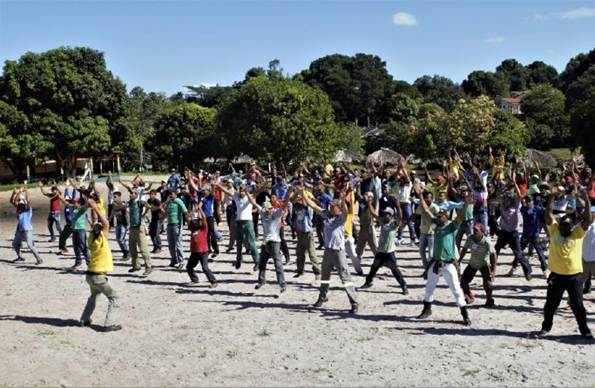
Throughout the entire selection and training process, the residents of the small town of Rio da Conceição form the audience for a veritable rite of passage. The town quite literally comes to a halt just to watch the prospective brigadistas march past in columns, chanting their numbers and parading in front of friends and relatives who watch from their doorways. Precisely for this reason, the event holds great significance as part of the process of assimilating the values and modes of relating to fire propagated by the brigade technology. This stage of the selection is highly revealing of the way in which the operations underlying the transition from local resident to brigadista rely on the standardisation of gestures and the disciplining of behaviours. (Figure 3)

Star jump exercise during the 2016 brigadista training course at the EESGT. Source: Fagundes (2019a).
Although the instructors assume the role of taskmasters during the performance, this enactment cannot be comprehended separate from the field of relations in which they are embedded throughout the rite. It is the internal characteristics of disciplinary technology that demand hierarchy and submission to various initiation-like ordeals. The military aesthetic employed by the instructors, directed at disciplining the body, combined with the recourse to hierarchy and the accompanying ordeals, is a technology mobilised in order to organise the brigades, in contrast to a training model deemed ‘too soft’ (muito solto). As one of the instructors for the EESGT 2016 firefighter training course put it:
The brigade has a paramilitary organisation, similar to the military. You’re very lucky I’m not a soldier. We won’t be as strict as the military, but we won’t be that loose either. You need a minimum of organisation. This organisation brings discipline and hierarchy. (Fagundes 2019a)
The construction of a disciplined corporeality through exercises, hierarchised in the form of squadrons, is fundamental to the formation of what the instructor called ‘organisation.’ His discourse reproduces to the letter the prescriptions found in Brazilian manuals on wildfire prevention and suppression, according to which ‘fighting a fire closely resembles a military operation, in which hierarchy and discipline are fundamental to the success of the action’ (Soares et al. 2008: 40).
Even though the course is taught by environmental analysts who have been certified to act as instructors, the examination also involves a team of monitors composed of management agents or brigadistas with recognised experience. They are tasked not only with recording the time taken to complete a given task, but also with observing inappropriate chatter or joking around, sloppiness in the handling of tool, and the overall comportment of the candidates. Despite their friendships - and, in some cases, kinship ties - with the candidates, monitors are required to minimize proximity during the examination and to adopt the hierarchical perspective of management. In this way, a configuration of distributed surveillance is instituted, through which the apparatus of power is generalised beyond the figure of the CU chief.
Whenever an instructor ‘corrects’ a candidate’s answer in the classroom or a squad leader ‘aligns’ his brigade, the discipline exercised on the course operates through constraint, rewarding the ‘normal’ while correcting the deviants. The long treks carrying tools, for example, serve to weed out those with lower performance during the course. As one management agent who acted as a monitor put it, ‘it’s important to tighten things on the physical side because there are a lot of good people here.’ Even the candidates expressed a desire for the course to be demanding from the outset, so that the weak would give up early. Their frequent assertions that ‘in IBAMA’s time it was tougher’ celebrated the pride of those who had been submitted to the even more militarised regime in the past: ‘in IBAMA’s time the instructor would order a hundred star jumps and anyone who failed had to pay with push-ups.’ Hardships and overcoming them are elements that heighten the pride of the neophytes.
To refer to this set of techniques operating at the level of the body, taking it simultaneously as the object and instrument of the exercise of power, enhancing its physical aptitude and training its conduct, Foucault consolidated the term ‘disciplines’ or ‘disciplinary technology’ (2007: 118). The resources furnished by this kind of disciplinary formation remind us of the ways in which institutions operate power relations not only at the level of law, but also through techniques that turn the body into the receptacle of procedures. Analysed in continuity with the cattle-culling actions and the ecological simplification that marked the implantation of the EESGT, this technology for shaping brigade labour also reinforces what Mbembe (2017: 137) describes as the concatenation of necropolitical, biopolitical and disciplinary powers within colonial occupations.
FINAL REMARKS
This article set out to demonstrate how the principles of ecological simplification, homogenisation and disciplinary that characterise the Plantationocene (Chao 2022a: 362) can be identified not only in agricultural monocultures but also in the mononature fashioned and managed within full protection Conservation Units. Read through this lens, the Cerrado case examined in this article suggests that preservationism “in” the Plantationocene is one of the privileged historical configurations of protection as exploitation.
The juxtaposition of agro-industrial frontiers and strict “integral protection” areas does not simply dissolve the contradiction between the exploitation and the protection of nature; rather, it fabricates a single technological regime that distributes land, labour, and life between spaces devoted to monocultural production and spaces devoted to the cultivation of a purified “nature”. In this sense, the Brazilian case extends Stepanoff’s (2021; 2024) argument beyond the European hunting grounds that inform his analysis, by showing how a similar division of moral and territorial labour underwrites the overlapping of agribusiness expansion and conservation units established on quilombola and other traditional territories. The very sites where modern naturalism seeks to stage its redemption - national parks and ecological stations - appear, here, as the apparent “reverse side” of the plantation that is nonetheless constituted by the same technical, legal and epistemic operations of simplification and exclusion that make large-scale monocultures (and mononatures) possible. Far from standing “against” the Plantationocene, preservationism in this context exemplifies its inner logic. It is precisely by intensifying protection that the Plantationocene can legitimate and deepen exploitation, thereby enacting in the Cerrado the ecological and moral regime that Stépanoff designates as “exploitection” (Stépanoff , 2021; 2024).
In this article we align ourselves with recent attempts to expand the conceptual reach of the notion of the plantation. On one hand, there are those that track the transformations of ‘nature’ that have occurred in its wake, beyond any historical or geographical exclusivity (Tomich 2011). On the other, there are others that seek to expose the continuities of colonial inhabitation and its machinery for producing ‘off-world lands’ (Ferdinand 2022a). In this article, however, we have taken an alternative route, based on an operative treatment of the notion of the plantation. Although heterodox within the debates on environmental conflicts and territorial overlaps produced by conservation, this path remains a classical approach within the anthropology of technique (Sautchuk, Fagundes and Barreto, 2025), seeking to apprehend the meaning of tools, devices, machines and other technical objects through what they do and what they make others do, rather than through what they are or signify (Ingold 2011, Ferret 2014).
It is true that the Brazilian history of full protection areas has its own contours, forged in struggles between authoritarian preservationism and popular, grassroots socio-environmentalism (Santilli 2005). A more exhaustive analysis of the phenomenon would require us to also consider contemporary transformations in environmentalism, which displace the idea of nature preservation towards new socioeconomic conservation arrangements and even towards environmental restoration premised on the monetisation of ecosystem services (Caldeira, Sekula and Schabid 2020) - or even, more recently, towards the horizon of a post-capitalist convivial conservation (Büscher and Fletcher 2020). In any case, the military technoaesthetic, the decrees ‘guaranteeing law and order’ - which authorise the deployment of the armed forces in environmental enforcement -and the culling operations directed at undesired forms of life continue to be mobilised in defence of ‘nature,’ including by sectors of Brazilian socioenvironmentalism that like to place themselves on the left of the political spectrum.
The premise guiding this article is that, even though preservationist coloniality is no longer the only grammar available within the contemporary repertoire of environmental management, its dispositifs of ecological homogenisation, racial violence, and the disciplining of labour continue to reverberate among us through selective wars against certain forms of life. In the case of the EESGT, we show that full protection can function as the plantation’s only apparent opposite. Even as it promises to protect biodiversity, it reiterates technologies of enclosure, administrative terror, ecological simplification, and the capture of racialised labour, producing wildfires, precariousness, and worlds rendered disposable. For this reason, repairing the ecological harm generated by this arrangement - including that stemming from the establishment of the EESGT - should not be reduced to restoring environments and quantifying “ecosystem services.” What is required is to disable the very technical regime that produced unworlding in the name of “nature.” Without incorporating truth commissions, practices of memory, and measures of historical and territorial reparation into environmental restoration programmes, restoration will remain unable to recover the forms of life that were, and continue to be, wounded by plantations, both in their agricultural and in their preservationist expression
REFERENCES
- ARRUTI, José Maurício. 2013. “Sobre políticas de reconhecimento e sobreposições territoriais: apresentação deste volume”. Ruris: Revista do Centro de Estudos Rurais, 7: 7-17.
- BALÉE, William. 2006. “The Research Program of Historical Ecology.” Annual Review of Anthropology 35: 75-98.
- BALFET, Hélène. 1991. Observer l’action technique: des chaînes opératoires, pour quoi faire? Paris: Editions du CNRS.
- BARRADAS, Ana Carolina Sena 2017. A gestão do fogo na Estação Ecológica Serra Geral do Tocantins, Brasil Dissertação de Mestrado, Instituto de Pesquisas Jardim Botânico do Rio de Janeiro, Escola Nacional de Botânica Tropical (ENBT) - Rio de Janeiro.
- BARRADAS, Ana Carolina Sena 2025. Fraturas do fogo: ecologia e colonialidade na aplicação do conceito de manejo integrado do fogo no Brasil Tese de Doutorado, Instituto de Pesquisas Jardim Botânico do Rio de Janeiro, Escola Nacional de Botânica Tropical (ENBT) - Rio de Janeiro.
- BARRADAS, Ana Carolina Sena, BORGES, Marco Assis, COSTA, Máximo Menezes, and RIBEIRO, Katia Torres. 2020. “Paradigmas da Gestão do Fogo em Áreas Protegidas no Mundo e o Caso da Estação Ecológica Serra Geral do Tocantins.” Biodiversidade Brasileira 10: 71-86.
- BARRADAS, Ana Carolina Sena, and RIBEIRO, Katia Torres. 2021. “Manejo Integrado do Fogo: Trajetória da Estação Ecológica Serra Geral do Tocantins (2001 a 2020)”. Biodiversidade Brasileira, 11: 139-152.
- BARRETTO FILHO, Henyo Trindade. 2001. Da nação ao planeta através da natureza: uma abordagem antropológica das unidades de conservação de proteção integral na Amazônia Brasileira Tese de Doutorado, FFLCH, USP - São Paulo.
- BARRETTO FILHO, Henyo Trindade . 2010. “Áreas naturais, artefatos culturais: uma Perspectiva Antropológica sobre as Unidades de Conservação de Proteção Integral na Amazônia Brasileira”. In: A. W. B. de Almeida, E. de A. Farias Júnior (eds.), Mobilizações étnicas e transformações sociais no Rio Negro Manaus: UEA Edições. pp. 148-212.
- BLANC, G. 2022. The Invention of Green Colonialism Translated by Helen Morrison. Cambridge: Polity Press.
- BORGES, Sílvia Laine, Ludivine Eloy, Isabel Belloni Schmidt, Ana Carolina Sena Barradas, and Ivanilton Almeida dos Santos. 2016. “Fire Management in Veredas (Palm Swamps): New Perspectives on Traditional Farming Systems in Jalapão, Brazil.” Ambiente & Sociedade 19: 269-294.
- BROCKINGTON, Dan. 2002. Fortress Conservation: The Preservation of the Mkomazi Game Reserve, Tanzania Oxford: James Currey. ISBN 9780852554173
- BROCKINGTON, Dan, and IGOE, Jim. 2006. “Eviction for Conservation: A Global Overview.” Conservation and Society 4(3): 424-470
- BROCKINGTON, Dan, Rosaleen DUFFY, and IGOE, Jim. 2008. Nature Unbound: Conservation, Capitalism and the Future of Protected Areas London: Earthscan. ISBN 9781844074402.
- BÜSCHER, B., and FLETCHER, R. 2020. The Conservation Revolution: Radical ideas for saving nature beyond the Anthropocene London: Verso.
- CALDEIRA, Sekula, and SCHABID, Luana. 2020. Brasil: paraíso restaurável Rio de Janeiro: Estação Brasil.
-
CHAO, Sophie. 2022a. “Plantation”. Environmental Humanities, 14(2): 361-366. https://doi.org/10.1215/22011919-9712423
» https://doi.org/10.1215/22011919-9712423 -
CHAO, Sophie. 2022b. “(Un)Worlding the Plantationocene: Extraction, Extinction, Emergence”. eTropic: Electronic Journal of Studies in the Tropics, 21(1): 165-191. https://doi.org/10.25120/etropic.21.1.2022.3838
» https://doi.org/10.25120/etropic.21.1.2022.3838 -
CHAO, Sophie, WOLFORD, Wendy, OFSTEHAGE, Andrew, GUTTAL, Shalmali, GONÇALVES, Euclides, and AYALA, Fernanda. 2023. “The Plantationocene as Analytical Concept: A Forum for Dialogue and Reflection.” The Journal of Peasant Studies, July 10, 2023. https://doi.org/10.1080/03066150.2023.2228212
» https://doi.org/10.1080/03066150.2023.2228212 - COUPAYE, Ludovic. 2017. “Cadeia operatória, transectos e teorias: algumas reflexões e sugestões sobre o percurso de um método clássico”. In: C. E. Sautchuk (ed.), Técnica e transformação: perspectivas antropológicas Rio de Janeiro: ABA Publicações. pp. 475-94.
-
CRONON, William. 1996. “The Trouble with Wilderness; or, Getting Back to the Wrong Nature.” Environmental History 1(1): 7-28. https://doi.org/10.2307/3985059
» https://doi.org/10.2307/3985059 -
DAVIS, Janae, Alex A. MOULTON, Levi VAN SANT, and WILLIAMS, Brian. 2019. “Anthropocene, Capitalocene, … Plantationocene?: A Manifesto for Ecological Justice in an Age of Global Crises.” Geography Compass 13 (5): e12438. https://doi.org/10.1111/gec3.12438
» https://doi.org/10.1111/gec3.12438 - DIEGUES, Antônio Carlos. 1996. O mito moderno da natureza intocada São Paulo: HUCITEC.
- ELOY, Ludivine, SCHMIDT, Isabel Belloni, BORGES, Silvia Laine, FERREIRA, Maxmiller Cardoso, and SANTOS, Teomenilton A. dos. 2019. “Seasonal Fire Management by Traditional Cattle Ranchers Prevents the Spread of Wildfire in the Brazilian Cerrado.” Ambio 48: 890-899.
- ESCOBAR, Arturo. 1999. “After Nature: Steps to an Antiessentialist Political Ecology”. Current Anthropology, 40(1): 1-30.
- ESTERCI, Neide. 2014. “Cientistas e povos da floresta: A invenção de novos territórios de proteção ambiental na Amazônia.” In Territórios socioambientais em construção na Amazônia brasileira, edited by Neide Esterci, Horácio A. Sant’ana Jr., and TEISSERENC, Marie-José S. A., 21-38. Rio de Janeiro: 7Letras.
- FAGUNDES, Guilherme Moura. 2019a. Fogos gerais: transformações tecnopolíticas na conservação do Cerrado (Jalapão-TO) Tese de Doutorado, Programa de Pós-Graduação em Antropologia Social, Universidade de Brasília - Brasília.
- FAGUNDES, Guilherme Moura. 2019b. “Fire normativities: environmental conservation and quilombola forms of life in the Brazilian savanna”. Vibrant: Virtual Brazilian Anthropology, 16(e16501): 1-22.
- FAGUNDES, Guilherme Moura. 2019c. “Fazer o fogo fazer:”. Revista Equatorial - Revista dos Alunos do Programa de Pós-Graduação em Antropologia Social, 6: 16-49.
- FAGUNDES, Guilherme Moura. 2021. “Libres de brûler / Free to Burn: Autonomy and Heteronomy Toward Fire in the Brazilian Savannah”. Journal des Anthropologues, 164: 67-87.
- FAGUNDES, Guilherme Moura. 2022. “Sociedade contra a Plantation: uma ressemantização ecológica dos quilombos”. In: Malcom Ferdinand, Uma ecologia decolonial: pensar a partir do mundo caribenho 1st ed. São Paulo: UBU. pp. 311-316.
- GUCHET, Xavier. 2017. “Objet versus artefact: Pour une philosophie des techniques orientée-objet”. Cahiers COSTECH, 1: 1-4.
- FANY, Ricardo. (ed.). 2004. Terras Indígenas & Unidades de Conservação da natureza: o desafio das sobreposições São Paulo: Instituto Socioambiental.
- FERDINAND, Malcom. 2022a. A Decolonial Ecology: Thinking From the Caribbean World / translated by Anthony Paul Smith.. Ed: Polity.
-
FERDINAND, Malcom. 2022b. Behind the Colonial Silence of Wilderness: “In Marronage Lies the Search of a World”. Environmental Humanities 1 March 2022; 14 (1): 182-201. doi: https://doi.org/10.1215/22011919-9481506
» https://doi.org/10.1215/22011919-9481506 - FERRET, Carole. 2014. “Towards an anthropology of action: from pastoral techniques to modes of action”. Journal of Material Culture, 19(3): 279-302.
- FOUCAULT, Michael. 2007. Vigiar e punir: nascimento da prisão 34th edition. Petrópolis: Ed. Vozes.
- GALETTI, Mauro. 2023. Um naturalista no Antropoceno: um biólogo em busca do selvagem São Paulo: Editora Unesp Digital.
-
HARAWAY, Donna J. 2015. “Anthropocene, Capitalocene, Plantationocene, Chthulucene: Making Kin”. Environmental Humanities, 6(1): 159-165. https://doi.org/10.1215/22011919-3615934
» https://doi.org/10.1215/22011919-3615934 -
HARAWAY, Donna, Noboru ISHIKAWA, Scott F. GILBERT, Kenneth OLWIG, Anna L. TSING, and BUBANDT, Nils. 2016. “Anthropologists Are Talking - About the Anthropocene”. Ethnos, 81(3): 535-564. doi:10.1080/00141844.2015.1105838.
» https://doi.org/10.1080/00141844.2015.1105838 - HAUDRICOURT, André-Georges. 1987. La technologie science humaine, recherche d’histoire et d’ethnologie des techniques Paris: Maison des Sciences de L’Homme.
- HAUDRICOURT, André-Georges. 2013. “Domesticação de animais, cultivo de plantas e tratamento do outro”. Série Tradução, (7): 1-12.
- HUMPHREY, Mathew. 2002. Preservation Versus the People? New York: Oxford University Press.
- INGOLD, T. 2011. “Walking the plank: meditations on a process of skill”. In: Tim Ingold, Being alive: essays on movement, knowledge and description London: Routledge. pp. 51-62.
- JACOBY, Karl. 2001. Crimes Against Nature: Squatters, Poachers, Thieves, and the Hidden History of American Conservation Berkeley: University of California Press
- LATOUR, Bruno, and WOOLGAR, Steve. 1986. Laboratory Life: The Construction of Scientific Facts 2nd ed. Princeton, NJ: Princeton University Press.
- LEMONNIER, Pierre. 1992. Elements for an Anthropology of Technology. Anthropological Ann Arbor: Museum of Anthropology, University of Michigan.
- MAUSS, Marcel. 2006. Techniques, technology and civilization New York: Berghahn Books.
-
MBEMBE, Achille. 2017. “Necropolítica”. Arte & Ensaios, (32): 2448-3338. https://revistas.ufrj.br/index.php/ae/article/view/8993
» https://revistas.ufrj.br/index.php/ae/article/view/8993 - MBEMBE, Achille. 2018. Necropolítica: biopoder, soberania, estado de exceção, política de morte Translated by Renata Santini. São Paulo: n-1 edições.
- PFAFFENBERGER, Bryan. 1992. “Social Anthropology of Technology”. Annual Review of Anthropology, 21: 491-516.
- PYNE, Stephan J. 2012. Fire: nature and culture London: Reaktion Books.
- PYNE, Stephen. 2020. Pyrocene: How We Created an Age of Fire, and What Happens Next Oakland: University of California Press.
- SCHLANGER, Nathan. 2005. “The chaîne opératoire”. In: C. Renfrew and P. Bahn (eds.), Archaeology - Key concepts Londres: Routledge. pp. 25-31.
- SAFATLE, Vladimir. 2017. “Lógicas do reconhecimento”. Curso Ministrado no Departamento de Filosofia Universidade de São Paulo no primeiro semestre de 2017.
- SANTILLI, Juliana. 2005. Socioambientalismo e novos direitos: proteção jurídica à diversidade biológica e cultural São Paulo: ISA; Instituto Internacional de Educação do Brasil.
- SAUTCHUK, Carlos Emanuel. 2017. “Matar e manter: conservação ambiental como transformação técnica”. In: C. E. Sautchuk (ed.), Técnica e transformação: perspectivas antropológicas. pp. 183-212.
-
SAUTCHUK, Carlos Emanuel. 2018. “The pirarucu net: Artefact, animism and the technical object.” Journal of Material Culture 24(2): 176-93. https://doi.org/10.1177/1359183518804268
» https://doi.org/10.1177/1359183518804268 - SAUTCHUK, Carlos, and FAGUNDES, Guilherme. 2020. “Conservação como técnica: transformações na pesca amazônica e nos incêndios cerratenses”. In: Fabrício Neves (ed.), Tramas Epistêmicas e Ambientais: Contribuições dos Estudos em Ciência, Tecnologia e Sociedade. pp. 63-82.
- SAUTCHUK, Carlos Emanuel, Guilherme Moura Fagundes, and BARRETO FILHO, Henyo T.. 2025. “Sociotechnical Approach to Protected Areas and Traditional Communities.” Conservation Biology 39: 1-8.
- SCHMIDT, Isabel B., SAMPAIO, M. B., FIGUEIREDO, I. B., and TICKTIN, T. 2011. “Fogo e artesanato de capim-dourado no Jalapão: usos tradicionais e consequências ecológicas”., 2: 67-85.
- SIGAUT, François. 1994. “Technology.” In: Tim Ingold (ed.), Companion Encyclopedia of Anthropology: Humanity, Culture and Social Life. pp. 420-57.
- SILVA, Ana Cláudia Matos da. 2019. Uma escrita contra-colonialista do Quilombo Mumbuca Jalapão (TO) Dissertação de Mestrado, Universidade de Brasília (UnB) - Brasília.
- SIMONDON, Gilbert. 2017. On the Mode of Existence of Technical Objects Minneapolis, MN: Univocal Publishing.
- SOARES, R. V. et al. Manual de Prevenção e Combate a Incêndios Florestais 2nd ed. Curitiba: AJIR, 2008.
- SPENCE, Mark David. 1999. Dispossessing the Wilderness: Indian Removal and the Making of the National Parks
- STÉPANOFF, Charles. 2021. L’animal et la mort: Chasses, modernité et crise du sauvage Paris: La Découverte.
- STÉPANOFF, Charles. 2024. Attachements: Enquête sur nos liens au-delà de l’humain Paris: La Découverte
- TALBOT, V. 2016. Termos de compromisso: histórico e perspectivas como estratégia para a gestão de conflitos em unidades de conservação federais. Dissertação de Mestrado, Escola Nacional de Botânica Tropical, Instituto de Pesquisa Jardim Botânico do Rio de Janeiro - Rio de Janeiro.
- TOMICH, Dale. 2011. “Rethinking the Plantation: Concepts and Histories”. Review (Fernand Braudel Center), 34(1-2): 15-39.
- TSING, Anna. 2021. “O Antropoceno mais que humano”. Ilha, 23(1): 176-191.
- VIANA, L.P. 2008. De invisíveis a protagonistas: populações tradicionais e unidades de conservação São Paulo: Annablume; FAPESP.
-
WOLFORD, Wendy. 2021. “The Plantationocene: A Lusotropical Contribution to the Theory.” Annals of the American Association of Geographers, 111(6): 1622-1639. https://doi.org/10.1080/24694452.2020.1850231
» https://doi.org/10.1080/24694452.2020.1850231 - YUSOFF, Kathryn. 2018. A Billion Black Anthropocenes or None Minneapolis: University of Minnesota Press.
-
1
‘Target to “protect” 30% of earth by 2030 - a disaster for people and bad for the planet.’ Amnesty International:https://www.amnesty.org/fr/documents/ior40/6269/2022/fr/ Consulted 5 May 2024.
-
2
Quilombolas designates Afro-descendant populations historically associated with quilombos - settlements formed by people who fled enslavement and other coercive regimes in Portuguese America. In contemporary Brazil, quilombola communities also constitute a major political and ecological movement, often articulated with Indigenous peoples and other traditional groups (Fagundes, 2022).
-
3
Both the EESGT and the territory claimed by Ascolombolas-Rios are located precisely at the centre of the MATOPIBA region, an official acronym formed from the initial letters of the states of Maranhão, Tocantins, Piauí and Bahia, recognised as the ‘final frontier’ of agribusiness expansion in the Cerrado.
-
4
In Portuguese, Instituto Chico Mendes de Conservação da Biodiversidade.
-
5
In Portuguese, Instituto Brasileiro do Meio Ambiente e dos Recursos Naturais Renováveis.
-
6
Syngonanthus nitens, a grass-like species native to the Jalapão region, widely used in handicrafts.
-
Data Availability Statement
All data supporting the findings of this study are included within the article.
Edited by
-
Dossier Editors
Vinícius Venancio (vini.venancio2@gmail.com | https://orcid.org/0000-0003-3245-1204)Federal University of Goiás, Faculty of Social Sciences, Goiânia, GO, Brazil Universidade Federal de Goiás, Faculdade de Ciências Sociais, Goiânia, GO, BrasilAndréa Lobo (andreaslobo@yahoo.com.br | https://orcid.org/0000-0001-7525-1953)University of Brasília, Departament of Anthropology, Brasília, DF, Brazil Universidade de Brasília, Departamento de Antropologia, Brasília, DF, Brasil
All data supporting the findings of this study are included within the article.