 How to narrate the periphery: ethics, aesthetics and style in Rio de Janeiro
Abstract:
In this article, I turn to the verbal, visual and sonoric discourses of two peripheral fashion designers in their conversations with a black visual artist, proposing that the fashion they create encapsulates memory, kinship, locality and history - an interweaving that translates through the style of their productions, bringing together ethics and aesthetics. I also demonstrate that they aim at the epicentre of taste production while resisting to maintain their non-hegemonic character. With the coincidence between ethics and aesthetics and the residual character with which these creators occupy the formal fashion industry, I consider that each city produces its own ways of narrating what it means to be peripheral and its own mode of conceptualising the periphery. I suggest, therefore, that Rio de Janeiro is governed by a utopia of connections and that Rio funk provides the material for peripheral subjectivation.
Keywords:
Fashion; Style; Ethic; Aesthetics; Funk Carioca; Formative Processes
Resumo:
Neste artigo, volto-me para os discursos verbais, visuais e sonoros de dois estilistas periféricos em seus diálogos com um artista visual negro para propor que a moda que criam encapsula memória, parentesco, localidade e história, imbricação que se traduz por meio do estilo de suas produções, fazendo coincidir ética e estética. Demonstro ainda que eles visam o centro da produção do gosto ao mesmo tempo em que resistem para manter seu caráter não hegemônico. Com a coincidência entre ética e estética e o caráter residual com que esses criadores ocupam a indústria formal da moda, cogito que cada cidade produz modos próprios para narrar o que é ser periférico e para conceituar a periferia. Sugiro assim que o Rio de Janeiro é regido por uma utopia das conexões e que o funk carioca fornece o material para a subjetivação periférica.
Palavras-chave:
moda; estilo; ética; estética; funk carioca; processos formativos
I
The question guiding this text is how to narrate the periphery - a problem that has accompanied me along with two specific images. The first is the mural that covered the gable wall of the Rio Art Museum (Museu de Arte do Rio: MAR) at the opening of the exhibition Funk! A Cry of Audacity and Freedom, hosted at the museum from 29 September 2023 to 30 March 2025. The second captures a moment from the arremate (conclusion) of the Folia de Reis (Three Kings Celebration) held in June 2025 in the Santa Marta favela, also in Rio de Janeiro - an expression of popular Catholicism and folk culture, yet certainly not part of mass pop culture like funk carioca. However, the connection between these two images became evident when, after the performance in Santa Marta, the boy in the photograph, like others who participated in the event, took off his mask to reveal the same close-cropped hairstyle that had provided the emblematic image of funk on the museum’s mural. A close-up of this hairstyle can be found in Image 3 below.


With these images in my mind, I began to ponder the seeming omnipresence of funk carioca within peripheral cultural expressions. This article results from an attempt to articulate these observations in written form, which I initiated by turning to Walter Benjamin and focusing analytically on peripheral fashion in Rio de Janeiro.
Narration, Benjamin (1968) argues, simultaneously allows us to witness the disappearance of a form and to access its beauty in the very act of recovering it. Through narration, one can confront both the destructive effects of capitalism and the fissures it contains where creative activity can be exercised. This allows us to approach narration as an artistic-political practice that, in the medieval workshop, combines the sedentary mastery of the artisan with the itinerant condition of the apprentice. The ‘good narrator’ melds two sets of qualities, discernible in the ‘lifestyles’ of the sedentary peasant and the migratory sailor. These qualities converge in the figure of the craftsman, someone who was once ‘itinerant’ as an apprentice and is now sedentary as a master.
A critical thinker of modernity, Benjamin develops his philosophy without any excessive abstraction. This is evident in ‘The storyteller’ where he emphasises the hand and the relationship between thought and action, conceiving narration as a manual and artisanal activity. This focus on manual craft shows us how narrative transforms memory into ‘the most epic of faculties’ since to narrate, erzählen in the original German, means to tell a story, which is not done merely with the voice but also depends equally on bodily gesture, as well as the audience’s listening and memorising, enabling the tale to be retold and shared. This depends on an engagement of the body and the senses that, if only momentarily, makes us forget who we are.
Benjamin avoids the binary divide between modern and non-modern societies, as we can discern in ‘The work of art in the age of mechanical reproduction.’ Although they induce a sense of loss, the machinic transformations - responsible for the advent of cinema, the press and the graphic industry - also give rise to new modes of relating to the sensory dimensions of social and collective life. In the art of storytelling, the same process that ‘has quite gradually removed narrative from the realm of living speech’ simultaneously ‘making it possible to see a new beauty in what is vanishing.’ Within this ‘decline’ of the ‘art of storytelling,’ the circulation of information plays a notable role, accelerating the process of fragmentation that unfolds alongside the ‘secular productive forces of history.’
Information, then, is a form of communication alien to narrative: it aspires to ‘prompt verifiability,’ must appear ‘understandable in itself’ and ‘requires plausibility,’ ‘rendering it incompatible with the spirit of storytelling.’ Unlike information, narrative does not seek to explain but to open itself to the listener’s interpretation, which will also be retold (Benjamin 1968: 80-83).
…half the art of storytelling [is] to keep a story free from explanation. (Benjamin 1968: 83)
This understanding allows the narrated episode to achieve ‘an amplitude that information lacks.’ Almost nothing that reaches us through facts ‘shot through with explanations (...) benefits storytelling’ (Benjamin 1968: 82-83). Narration, then, is ‘the ability to exchange experiences’ (Benjamin 1968: 78), much like the migrant craftsman who draws sustenance from the things of the world.
Benjamin wrote during the interwar years, impelled by the inability to narrate the incommunicable experience of the First World War. My argument does not rest on the impossibility that haunted the German philosopher, however. It focuses instead on two aspects elicited by funk carioca. The first is the recognition that the musical genre has reached a stage - in both its projection and its history - that it can now retell what the periphery is and what belonging to it comprises. From this perspective, funk, beyond an expression of the periphery or a cultural manifestation from the periphery, provides the material for peripheral subjectivation (Mizrahi 2024). It allows people from the periphery to narrate themselves as peripheral. Yet if, as a cultural expression, funk can be recognised through its music - through its lyrics and sound - this recognition also occurs through the body and primarily through the things that compose it. Body and objects that can be apprehended as the materialisation of the music itself. As the image on the exterior wall of the Rio Art Museum illustrates. This brings us to the second aspect of my argument: beyond gestures, certain objects, particularly those imbued with affects, histories and localities, are crucial to narration. This is a narration that is above all visual and that produces a visuality, as illustrated by the image on the exterior wall of the Rio Art Museum.
I shall focus on specific fashion items that encapsulate the periphery to the same degree that they have been and continue to be shaped within the relational universe of funk carioca. While my interest in materialities has previously been explored through the ‘humility of objects’ (Miller 1987), their agentive qualities (Gell 1998, Latour 2005) and the ‘generative power of form’ (Ingold 2012), here I turn my attention to things imbued with affects (Pina-Cabral 2021), foregrounding their histories. Through these objects, I expose distinct ways of narrating the periphery, varying with the city that produces them. The city, the social relations that shape it and the values that govern it all act on the style through which the periphery is narrated, steering us towards recognising the indissoluble relationship between aesthetics, style and ethics.
My analysis will focus on the creations of two stylists from the periphery: Bernardo, a designer for the Pormenor brand and Abacaxi, a designer for Piña, who describe the styles of their work as estilo suburbano (suburban style) and estética de cria (homegrown aesthetics), respectively. The analysis also includes the dialogue between these designers and the black visual artist Maxwell Alexandre. Through their work, I aim to offer an investigation of fashion that transcends fashion itself, extending beyond the circumscribed phenomenon with which it is typically identified. At the same time, I retrace the path that led me not only to research and theorise in anthropology but also to the periphery itself and its study. It was through fashion - and a seemingly mundane consumer object, a pair of jeans-like trousers - that I began my research journey into peripheral arts and aesthetics (Mizrahi 2019). This text is thus about fashion and the periphery simultaneously. Approached from this angle, fashion is not a case study I use to illustrate what the periphery is, just as I do not take the periphery merely as a backdrop to explain the clothing fashion it produces.
This reflection is also about the city and race: about the distinct ways each city navigates its social divisions. Observing these varying dynamics, I propose that different cities can offer different conceptions of the periphery. Through fashion, I explore a particular mode of making oneself peripheral that, I argue, is unique to Rio de Janeiro, a modality that engages with the formal fashion system and centres of taste production while simultaneously striving to remain peripheral, non-hegemonic and minoritarian.
Following this introduction, I present the fashion and art event that united designers Bernardo and Abacaxi in the exhibition space of visual artist Maxwell Alexandre. I then turn to funk carioca and São Paulo hip hop researchers and artists to suggest that the social relations shaping Rio de Janeiro and São Paulo as cosmopolitan capitals influence how each city conceptualises the periphery and what it means to be peripheral. Next, I examine the Pormenor and Piña fashion shows and, in the subsequent section, I turn to the reflections of various canonical anthropologists in the field of art to discuss ethics, aesthetics and style. Before concluding, I return to the roundtable discussion that included the artist and designers, exploring João de Pina-Cabral’s distinction between object and thing so as to argue that what gives meaning to the exemplary objects of each analysed brand - both in terms of their reception and the development of their style - is the way each encapsulates memory, kinship, locality and history.
II
It was a Friday in May 2023. Doubly excited by the prospect of visiting Maxwell Alexandre’s exhibition at his 1st Pavilion, entitled Novo Poder: Passabilidade (New Power: Passability), and attending the runway shows of the emerging Piña and Pormenor brands, I made my way to São Cristóvão, a district in Rio de Janeiro’s North Zone, bordering the more affluent South Zone.1 The distribution of the artist’s works effectively divided the ground floor of the large, temporarily occupied warehouse into two areas. Towards the front, where the ceiling was lower, a kind of foyer had been formed. One of its walls featured a print of Nathalia Grilo’s text on the exhibition, also reproduced in the brochure handed out at the entrance. In the rear section of the hall - about one-third of the total space - Maxwell Alexandre’s paintings were on display.
From the ceiling hung large panels of brown paper as though floating mid-air. The front of the sheets, painted white, bore realistic images of black individuals of various ages in everyday poses. Though only their bodies were represented, the images evoked a sense of people moving through public spaces. The focus on corporeality - hair, clothing and other fashion items - was clear. Their attire ranged from municipal school uniforms to formal suits with ties and shirts, from jeans paired with sportswear to football team shirts, security guard uniforms (Segurança Presente) and jackets. including one that seemed to mimic one of the jackets made and worn by the artist Bispo do Rosário. Accessories alternated between backpacks, chains, rings, bracelets, eco-bags, hair scarves and a diverse array of hairstyles, haircuts and colours. Through these varied appearances, composed of distinct positional goods, Maxwell Alexandre interrogated the idea of passabilidade, ‘passability’ - the unobstructed movement of black individuals through public space, as expressed in the text reproduced at the entrance to the Pavilion (Grilo 2023). Figure 4

The theme of Maxwell Alexandre’s exhibition was precisely the articulation between fashion and contemporary art, ‘two fields of Western hegemonic culture.’ The artist’s own training took place in close proximity to the world of fashion. The brown paper used as the medium for his works is a reference to this early period, when he repurposed the material discarded by fashion workshops. By inviting the two young peripheral designers to showcase their collections in his Pavilion, Maxwell Alexandre seemed to be inviting them to join him in the shared endeavour of perceiving
both fashion and art (...) as a challenge to the colonial idea that sensitivity and beauty are qualities not pertaining to melanised bodies [and as] spaces [that] must be reclaimed by black bodies, since it is in these domains that narratives and the construction of images are manipulated and legitimised. (Grilo 2023, my translation)
Contrary to Bourdieu’s ‘taste of necessity’ (Bourdieu 1984), Rio’s peripheral fashion had already made it clear to me that ‘sensitivity and beauty’ are not exclusive to hegemonic taste and, in fact, inexorably guide the stylistic choices of Rio’s working-class youth (Mizrahi 2019). This, however, was affirmed on the margins of the fashion industry: on the bodies of users in bailes (dance parties), peripheral neighbourhoods and streets and on items displayed in feirinhas - the informal markets that make peripheral fashion available for sale, typically at the foot of favela hills (the pés de morro). As evidenced by the designation made by Abacaxi and Bernardo, the designers from Piña and Pormenor, the aim now is to participate in the formal fashion industry by reproducing an estética de cria (homegrown aesthetics) or estilo suburbano (suburban style). This new direction was made explicit in the exhibition folder and reaffirmed through the performative presence of the passersby in Maxwell Alexandre’s paintings. As we shall see realised in the fashion shows discussed below, the artist and the two designers stake a claim: by retaining the singularity of the periphery, they seek to occupy the hegemonic spaces of both the art gallery and the fashion runway.
This mode of occupation seems especially characteristic of the funk artist. What funk has achieved so deftly is the occupation of hegemonic environments while retaining its difference, its residual character, so to speak. In this vein, if passinho, the dance born alongside funk music in favela bailes, takes its dancers to Paris, what is really cool is arriving there and reasserting its peripheral essence, taking the Eiffel Tower - the ultimate symbol of the City of Lights - as its backdrop. (Figure 5)

Note the white clothing that accentuates the dancers’ black skin, the baseball caps worn backwards and, above all, the Kenner flip-flops on their feet, a brand that has become not only an object of consumer desire but also an indexical and iconic element (Descola 2023, Mizrahi 2018b, 2020b, Keane 2007) of what funk represents and what it means to be peripheral. The potential of funk to encapsulate this peripheral element transforms the genre into a device for the most diverse kinds of subjectivation (Mizrahi 2020).
Anitta, a singer who emerged from funk carioca, also now sings pop, electropop, reggaeton and MPB, circulating through the most hegemonic global spaces - from the pop music industry to high fashion and international jet-set parties. Yet when declaring how she veio do gueto, ‘came from the ghetto,’ she turns to funk carioca, drawing not only on its lyrics or sound but on the entire visual and material repertoire associated with the musical genre. This can be seen in the viral music video for her song Vai Malandra (Anitta 2018), which is not only set in the favela but also follows the artist as she wanders through it. Anitta appears in one scene tanning on the rooftop of a building, wearing a bikini made of electrical tape to achieve the coveted marquinha - the strip of skin, shielded by the plastic tape, that remains much lighter in contrast to the suntanned skin. In another, we can see her sat on the back of a motorcycle, dressed in short clothing, her jaguar-print underwear and the polpa of her buttocks exposed. The motorcycle’s licence plate evokes her name and, below it, the number of the 2017 law bill that tried to criminalise funk.2 (Figure 6)

The ‘flexible gays’ of a peripheral neighbourhood in Salvador develop their bodily skills and perform professionally primarily to the sound of funk music (Lopes 2025). Rebecca Andrade, the black Olympic gymnastics medallist, competes in major global sporting events not only to the sound of funk but by choosing a song that doubles down on her peripheral roots, turning música de favela (favela music) into her personal brand. Here, “Brasileirinho”, the chorinho tune used by the equally celebrated black Olympic gymnast Dayane Alves to bring brasilidade (Brazilianness) to global spaces, is replaced by Baile de Favela. This shift contributes to the recognition of the Brazilian periphery as one of the hubs of national creativity. Funk bom, baile bom, é na favela (good funk, good partying, is in the favela), Rebecca seems to tell us - not because the favela population lacks alternative forms of entertainment, but because the periphery is pure creative force (Mizrahi 2021).3
III
In the above examples, we can observe funk carioca being mobilised within processes of subjectivation that bet on the creativity that the periphery appears to encapsulate. It is from this perspective that I turn my attention to how individuals assert their peripheral identity by drawing on funk elements in the construction of their own narratives. As Simone Pereira de Sá (2021) argues, funk is part of Brazil’s música pop-periférica (peripheral pop music), an umbrella term under which the author groups a series of musical expressions that are ‘negatively valued’ in ‘Brazilian musical culture.’ For my part, I focus on the ambiguity that accompanies the reception and circulation of these ‘marginal’ productions to propose that funk, apprehended through both its sound and its verbal and visual imagery, can be understood as an archive providing a repertoire - acoustic, visual and imagistic - through which adherence and affiliation to the periphery are expressed. Hence, my concern is not to offer, in this text, a precise concept of periphery or objectify the productions that emerge from it.
By contrast, hip hop, the emblematic music of São Paulo, appears to be governed by a logic of denunciation. As I shall argue, both funk and hip hop invest in the mediating potential of music. But while funk conceives the periphery through its connections to the diversity of the surrounding social and aesthetic spaces, hip hop constructs the periphery through a sharp rupture with the city’s other territories.
Daniela Vieira dos Santos (2022), revealing the dynamics underlying what she terms the ‘new condition of rap,’ demonstrates an ideological shift in hip hop’s social role as a musical movement. According to Santos, this transformation directly influences the performances and modes of dress of its practitioners. Tracing the career trajectory of the artist Emicida, Santos examines the process through which hip hop acquires legitimacy and becomes detached from its ‘street’ culture. A particularly telling moment in her argument comes from an interview in which Emicida explains that ‘rap music is not confined to specific social and political conditions’ (2022: 6). It is this relative autonomisation of artistic creation that, Santos argues, enables Emicida to mark out his ‘place as an artist,’ shifting from artisan to artist, reflected in his bodily gestures and style of dress, a ‘smile on his face’ replacing the ‘stern expression and raised fists’ associated with hip hop’s street-era identity.
If Emicida illustrates the process of rap’s legitimation, Tiaraju D’Andrea (2020) sets out from an analysis of the discourses of the São Paulo hip hop group Racionais MC’s to offer both qualitative and quantitative definitions of the periphery. Taking as a common denominator what he conceptualises as consciência periférica (peripheral consciousness) - a ‘territorial perception that permeates all experiences, even the most disparate’ whose epicentre is formed by artistic and cultural collectives - the author defines the periphery as a term expressing the correlation between unequal wealth distribution and territory. ‘Peripheral subjects’ are defined by their engagement in progressive political practices aimed at improving the localities where they live. From this perspective, we can grasp the significance acquired by the rapper GOG’s formulation ‘the periphery is the periphery anywhere’ in D’Andrea’s argument. This same phrase is echoed in the call for papers for the present Vibrant dossier, emphasising the global dimension of peripheral experience, ‘a product of the dynamics of capitalist production, which creates peripheries even at the core of capitalism.’ However, this is not the same as advocating for some kind of ‘homogenisation of differences.’ In tune with this regime of differences and similarities that the discussion around the periphery allows us to access and drawing on my own research on funk carioca, I suggest that each city produces a particular style for narrating the tensions that allow the periphery to be conceptualised.
Both Santos and D’Andrea have been contributing to the debate alongside artists whose formation and practice are rooted in São Paulo city. Derek Pardue (2021), also focusing on Racionais MC’s, sees the release of the album Sobrevivendo no Inferno (Surviving in Hell) as the triumph of an ‘aesthetic of accusation.’ As all three authors demonstrate, hip hop’s original motivation lies in explicitly denouncing the divisions that separate the city’s diverse territories and social classes. Pardue’s account does not let us forget the luxuries and comforts that São Paulo’s privileged strata refuse to relinquish, supporting the idea that any exploration of São Paulo’s hip hop inherently involves narrating the city that engenders it. D’Andrea, for his part, shows that the ‘sense of shared belonging’ acquired by the term periphery has been shaped by ‘some common antagonists,’ identifiable through categories such as ‘elites, bourgeoisie, police, spoiled rich boys and girls or wealthy neighbourhoods’ (D’Andrea 2020: 23).
As I have demonstrated on diverse occasions (Mizrahi 2016, 2015, 2014, 2009), funk carioca is also built on a dual logic. However, this musical genre opposes not only collectives of different classes or spatialities but also categories within its relational universe: man and woman - as in the song ‘Um otário para bancar,’ sung by Valeska along with her glorious Gaiola das Popozudas - different types of women - like the amante (lover/mistress), the fiel (faithful partner/wife) and the lanchinho da madrugada (late-night snack), as sung by MC Mascote in ‘Tem que ter uma amante’ -and the rival factions controlling favelas - as in the various versions of ‘Chumbo quente,’ a song originally attributed to the Goianian duo Léo Canhoto and Robertinho and later appropriated by funk carioca artists and crews to sing about rivalry between communities in Rio’s peripheries and suburbs.
This dual logic intrinsic to funk is not without consequences for the way in which its relationship with the surrounding society is conceived - including the latter’s hegemonic tastes and modes. Moreover, it signals a quest to place differences in relation, making them visible, a feature that, I have been arguing, is inherent to funk carioca. From this perspective, I echo the argument of Bruno Carvalho (2019), according to which the dynamics established by the different diasporas that engendered the relational universe designated as Praça Onze - specifically the European Jewish and Afro-descendant diasporas - made it possible to access a certain porous quality very specific to Rio de Janeiro. Thus, though above I contrasted funk carioca and hip hop on the basis of the differential ways in which these two musical genres mobilize the periphery as a condition, I now add both the search for connections that governs the funk carioca artist and the division between the different urban territories developed by the hip hop artist.
As I was able to conceptualize with the artist Mr. Catra and the collective of artists that formed around him, funk carioca objectifies ‘society’ not so much in order to reject or denounce it and thereby belong to it, but rather to run parallel to it and in relation with it, retaining its difference while at the same time manipulating its rules so as to take exploit them better (Mizrahi 2014). I termed this logic the connective dimension of funk artistic practice, an argument that I later refined together with other artists and also their circulation through their image (Mizrahi 2024). This connective dimension has been identified in research conducted with other artists whose trajectories intersect with funk, like Anitta (Coppa 2025), dance instructor Duda Dance (Melo 2026) or multiartist Taísa Machado (Silva 2025). Taísa has also reflected on her own work (Machado 2020). In my view, both she and Mr. Catra demonstrate, each in their own way, that becoming a funk artist is linked to a distinct mode of ‘becoming peripheral.’
Mr. Catra passed away in 2018, but his long-standing relationship with funk carioca allows us to trace the history of the musical rhythm itself. Regarded by specialist critics as the most important artist in funk’s first 40 years (Essinger 2018), the singer transited through diverse subgenres of the style, starting his career in the early 1990s performing raps de contexto (‘context raps’) as a duo with his cousin Dr. Rocha. By the turn of the millennium, by now a solo artist, he became known as the Rei do Proibidão (King of Forbidden Funk), a nickname received due to the fame achieved through songs that voiced the antagonisms between the favela and the local police forces. In the early 2000s, as the crackdown on funk intensified, Catra became the Rei da Putaria (King of Smut), excelling in songs that playfully, lovingly and explicitly explored gender and sexual relations. Mr. Catra also navigated distinct musical genres - including MPB, dub, samba, rap and rock - as well as the most diverse social environments in Rio de Janeiro, never abandoning his rebellious spirit. As he told me in one of our conversations, he could have chosen any musical genre for his artistic career, but funk allowed him to make music his own way, para ele mesmo dançar (‘for himself to dance to’).
Taísa Machado, for her part, before becoming a multiartist recognised for her immersion in a funk aesthetics, created the Afrofunk dance workshop, curated the exhibition Funk: Um Grito de Ousadia e Liberdade (Funk: A Cry of Audacity and Freedom), and worked as artistic director for the talent acceleration course Estude o Funk (Study Funk). She built her early career in the performing arts, working with the Nós do Morro theatre company, based in the Vidigal favela, embedded in the affluent South Zone of Rio de Janeiro, alongside the director Jamil Haddad. While Taísa’s artistic formation did not originate within funk’s chain of production, she also chose the genre as the genre for projects that challenge normative values, especially those relating to bodily aesthetics, including dance, physical appearance, clothing and other forms of bodily adornment. Accompanied by funk music and, above all, its dance style, Taísa campaigns for alternative corporealities - as becomes evident in the workshops she offers and coordinates - and affirms herself as a peripheral artist.
If Mr. Catra established himself as an artist by foregrounding differences through his lyrics, sound and movements across the city, Taísa Machado does so primarily through the body, its movements and adornments, connecting diverse audiences: white, black, foreign, thin, fat, cis, trans, hetero and queer-affective women. Despite the differences in the trajectories of Mr. Catra and Taísa and the more or less organic ways each pursued their careers within the musical genre, I draw on the mirroring between the two in order to argue that their decision to follow the path of funk was linked to a distinct mode of becoming peripheral - one in which the artist is simultaneously situated at the margin and actively sets differences in relation (Mizrahi 2018a). This modality appears singular to Rio de Janeiro, both in terms of the social relations that engender it and a certain ideal of the city that it contains, a utopia in the fullest sense of the term, which provides a certain lodestar for creation even while this ideal is known to be unattainable. It is the pursuit of this ideal that I have termed connectivity: the funk artist’s project of establishing ambiguous relations in which conflict is not excluded. Seen from this perspective, conflict is not a refusal of relation but another means of establishing it.
In other words, the capacity to produce connections is not limited to the artist - whether Mr. Catra, Anitta or Taísa - but belongs to the city that forges them as artists. The utopia they seek to realise is also a utopia of and for the city, one that, as I shall argue, materialises through fashion and style as well.
IV
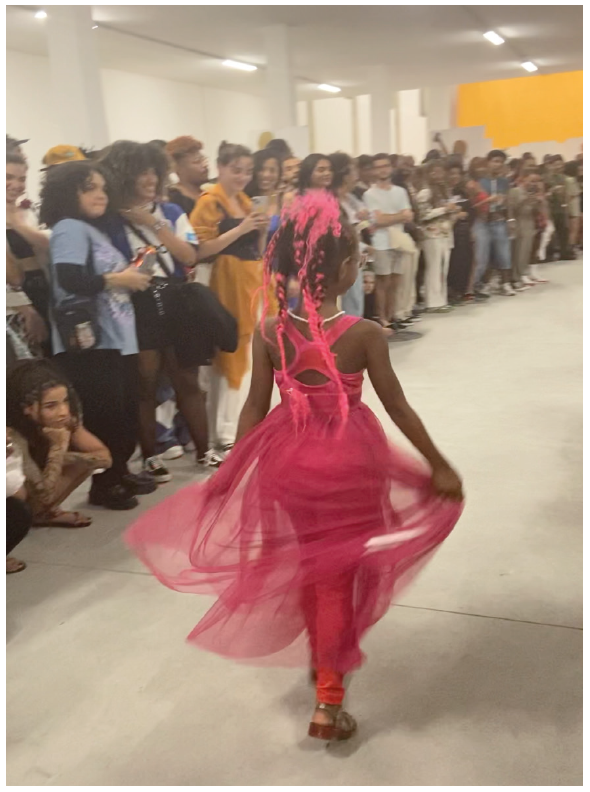
It was getting later in Maxwell Alexandre’s Pavilion. Looking around at the audience, composed mostly of black people wearing clothing styles reminiscent of those depicted in the exhibited works, I began to wonder if the fashion show would truly reflect the visuality he had created. But the crowd started to organise at the front of the hall, splitting into two densely packed groups, stretched out to form a corridor down the middle, like a runway. First to walk was a girl aged about eight, dressed in an all-cherry-pink ensemble, composed of what appeared to be a fitted, sleeveless bodysuit with a swimmer’s scoop neckline, paired with a long, voluminous overskirt in sheer fabric of the same cherry pink shade. The skirt had three white stripes along its sides, echoing the Adidas branding. Her hair was braided and interwoven with strips of fabric matching the colour and texture of the skirt, whose hems the girl clutched as she carried herself with the poise of a professional model down the runway. (Figure 7)

Next came a very tall, slender young man with closely cropped black hair and a fade sharply defined at the temples and nape without any apparent colouring. He too moved with the gestures of a professional model, wearing a lightweight, undyed jacket that looked like linen, paired with loose trousers in a pale blue shade and white Nike sneakers with black and burgundy details. He walked with his lapel turned up, adding an extra touch of charm. Both the girl and the young man were black. (Figure 8)

But the fashion show itself would arrive. And rather than reproducing the taste reflected in the audience, it was entirely conceptual. The commercial appeal of the clothing on display did not seem to be what drove its creators in the production of these pieces.
The first brand to take to the runway was Pormenor. Accompanied by the sound of fireworks, a group of about 15 men entered dressed as bate-bolas, figures typical of Rio’s suburban Carnival celebrations. They shouted É o subúrbio, porra! (It’s the suburbs, for fuck’s sake!). But instead of the multicoloured, pop-culture-inspired costumes typical of the bate-bolas and bate-boletes (Andrade 2022), they wore black from head to toe. Their heads, rather than wigs or masks, were covered by balaclavas. In one hand, each carried a black banner emblazoned with the Pormenor logo in white; in the other, a pole from which hung am ellipsoid black rubber ball in a nylon net, evoking the inflated ox bladder traditionally used in the bate-bola performance to create a loud startling sound when slammed against the ground. Their all-black attire was composed of a knee-length, ballooned satin skirt and a vest reminiscent of police gear - evoking the confrontations in favelas and peripheral communities. The vest bore the brand’s logo in white on the back and was complemented by long, billowing satin sleeves. Beneath the costume, their bodies were covered in tight black knitwear, including their hands and feet, which were clad in black trainers or flip-flops like those of the Kenner brand. (Figure 9 & 10)

The second part of Pormenor’s performance was punctuated by the sound of funk carioca, accompanied by lyrics declaring deixar os cria desfilar (let the locals parade), that the outfit to be ‘worn’ was Pormenor’s and that a tropa tá na pista (the crew is on the runway).
But while each of the bate-bolas processions is indeed accompanied by its own anthem, based on funk carioca beats and sounds, the Pormenor show aimed to mark its designer’s ‘entrance’ into the world of ‘art,’ as Bernardo himself declared. This was embodied by the final bate-bola to take to the runway, dressed identically to the other performers except now in vivid red, repeated in the lighting that bathed the entire Pormenor section of the show. As Bernardo explained just before stepping onto the runway himself, the chosen colour evoked the red carpet that leads celebrities into the grand halls of major events and awards ceremonies, like the Oscars, or even the fashion world’s Met Gala, hosted by the Metropolitan Museum of Art’s Costume Institute in New York. It is through fashion, Bernardo affirms, that he can become the artist he has always aspired to be (Pavilhão Maxwell Alexandre 2023).
Next came the Piña brand, which showcased equally conceptual fashion items. Models emerged one by one from a large white van parked in front of the Pavilion entrance, its sliding door opening and closing as each model exited. The clothing was presented by pairs of models, each walking the runway just once, each design entirely monochromatic, centred around vibrant, body-hugging lace and worn by a diverse range of non-hegemonic bodies - whether in terms of skin colour, shape or the ways they signalled sexuality and/or gender identity. At the same time, the collection leaned distinctly feminine, reinforced by sleek, fringed wigs, high heels and small handbags, all typically matching the colour of the outfit. The music provided a continuous, syncopated and faintly melodic backdrop, marked by a drum beat. (Figures 11, 12 & 13)

As Abacaxi, Piña’s fashion designer, revealed during a roundtable discussion held in the same Pavilion the following week, the collection was conceived to contrast with Pormenor’s performance. This was clearly visible in the distinctly feminine inclination of Piña’s designs, opposing the exclusively masculine ensemble of the previous show; in the explosion of colours, contrasting with the dominant black of the earlier performance; and in the structure of each presentation: the first resembling a flash mob, the second following the parameters of a traditional fashion show.
At the close of the Piña show, Abacaxi himself emerged from the front of the white van, dressed entirely in black, wearing a long-sleeved top in the same lace featured in his collection, paired with utilitarian microfibre trousers styled with pointed protrusions made from the fabric itself, accessorised with silver metal rings from which wide laces hung. Gold jewellery completed the look: three necklaces, one with a pendant; rings on both hands; and a solitary earring with a colourless stone. Next to him stood Bernardo, a light-skinned black man, wearing a simplified version of the outfit showcased by his brand: a straight, pleated skirt in matte fabric, the same vest, – socks, papete-style sandals and knit sleeves, all in black. Together, they made the final entrance of the show, thanking the audience to huge applause. (Figures 14 & 15)

Like Bernardo’s designs, most of the pieces shown by Abacaxi were impractical for everyday use: bust bands, stockings, thongs, deep-cut bodysuits and ‘second-skin’ tops. This is even more notable given that Piña is not a brand focused on underwear. The choices made by both brands thus diverged from the fashion items that had made them famous: Piña’s Bad Boy shorts and Pormenor’s team jersey. A roundtable discussion held two weeks after the shows helped shed light on the meaning of these pieces, revealing the entanglements between kinship, locality, memory and history that shape the fashion they produce. They thus demonstrated how ethics and aesthetics converge in Rio’s periphery - a discussion with which anthropology has not always been willing to engage, particularly when the material objects in question are produced and used in modern, Western, capitalist contexts.
V
The anthropological discussion of aesthetics reached a pivotal moment in the 1990s during a debate at the University of Manchester on transcultural uses of the term (Morphy et al. 1996). The encounter brought together senior figures in the anthropology of art - Howard Morphy and Jeremy Coote - on one side, and two specialists in Amerindian societies - Joanna Overing and Peter Gow - on the other and culminated in the reaffirmation of Pierre Bourdieu’s (1984) theories of distinction. Gow argued that aesthetics could only be understood as the exercise of judgment in taste, a practice inherently linked to classification, hierarchy and discrimination, and thus distinctive to Western societies. Viewed from this perspective, deploying aesthetics as an analytical category would inevitably lead the analyst into an anti-anthropological posture. However, as several commentators in the audience - Sonia Greger, Michael O’Hanlon, Peter Wade and Alfred Gell - observed, both Overing and Gow operated from a historically specific definition of aesthetics. This definition was so deeply entwined with canonical notions of art and beauty, as codified in disciplines like Art History or Aesthetic Theory, that its application inevitably imposes a framework not only binding the beautiful to the good and the right, but also implying a universal conception of beauty.
Since then, much has changed and the concept of aesthetics has been reinvented, including through the contributions of some of the anthropologists present at that debate. Joanna Overing (1991), who at Manchester had argued against the transcultural use of the category of aesthetics, later demonstrated how the concept could be analytically productive if we reconceptualise it in dialogue with our research interlocutors. In her 1989 article ‘The aesthetics of production: the sense of community among the Cubeo and the Piaroa,’ Overing shows how aesthetics - which she approaches as an attribute of beauty - results from creative labour among the Piaroa: beautiful tools or lovely children are all products of a person’s ‘life of thoughts,’ which is inherently fertile. Overing thus reveals the articulation between ethics and aesthetics, where the beautiful, the good and the right coalesce in her analysis. She also highlights the agency of objects, which possess ‘their own agency.’
As we know, the notion of agency became the defining theme of Alfred Gell’s own distinctive approach within the broader field of the anthropology of art, a perspective that challenged the Western concept of art as something confined to extraordinary spheres, separate from everyday life (Gell 1998). This critique allowed Gell to also question the ‘aesthetic attitude,’ which he argued had prevented anthropologists from studying expressive forms that diverged from their personal tastes, since art could only be conceived according to the investigator’s own criteria of contemplation and beauty (Gell 1992). The antidote to this aesthetic attitude was for the anthropologist of art to adopt a ‘philistine’ gaze toward their object of study. Just as anthropologists do not need to believe in the religions they study, neither should it be essential for the aesthetic objects under analysis to conform to their own tastes.
Gell’s (1998) recovery of the notion of agency for the field of study of material objects helped move beyond their purely representational dimension (Keane 2007), converging with other critical readings that had already questioned those approaches focused on the purely symbolic quality of objects and artefacts (Appadurai 1986; Miller 1994). However, this emphasis resulted in the neglect of the object’s indexical character in favour of its iconicity. As Philippe Descola (2023) points out, this shift weakened Gell’s theory, which, by privileging the agentive dimension of art objects, also prioritised their indexical quality, their capacity to make an absence present, ‘to render visible and vivid a deity, a spirit, a place, an animal or the dead’ (Descola 2023: 19). Yet this capacity, Descola adds, requires recognisability and identifiability, which can only be achieved via some kind of sign - precisely the object’s iconic quality. By ignoring this tension, Gell’s refusal to distinguish between art objects and everyday or ritual objects expanded the category of artistic objects to such an extent that it became impossible to differentiate ‘an art object from a mundane artefact’ (Descola 2023: 26).
In my approach to aesthetics, I have prioritised the insights that a consideration of the sensory dimension of social life can bring to social analysis. This has led me to emphasise both the agentive quality of objects and their representational and symbolic attributes (Mizrahi 2018b, 2020b). By revisiting the historical evolution of the concept of aesthetics, I wish not only to situate my own approach but also to expand it. Particularly interested in the relationship between aesthetics and affects, I now wish to explore the relationship between style and affective objects, while also highlighting the interplay between ethics and aesthetics. Despite the work of Gell, Overing, Miller and Descola, all driven by the urgent need to systematically reflect on this dimension of social life, as underscored by the Manchester debate, aesthetics continues to be approached, conceived and understood as pure form, ignoring Edmund Leach’s categorical assertion that ‘logically, aesthetics and ethics are identical’ (Leach 1996: 75).
In ‘Style, grace and information’ (1973), Gregory Bateson argues that art is part of humanity’s search to reclaim the ‘grace’ that animal communication and behaviour seem to retain. This grace is achieved through the psychic integration of consciousness and unconsciousness, what Bateson formulates as the ‘reasons of reason’ and the ‘reasons of the heart.’ As in the art object, which condenses the mental universe into the emotional tone of a culture, a process he also demonstrates through his ethnography of the naven ritual (Bateson 1958). This condensation is made possible by the code inscribed in the art object, which he designates as its style. From this perspective, the enigma of what defines an art object cannot be unravelled through its semantic content or by adopting an ‘instrumental’ attitude aimed at revealing its ‘history’ or ‘mythology.’ Rather than explaining or ‘decoding’ an object, the search for its meaning directs the analyst toward the chosen code in order to transform people and things - both material and ‘supernatural’ - into art objects. A code ‘implicit’ in the materials, composition, rhythm and skills that result in the art object. As Bateson’s illustrative example suggests, the power of the British Empire could be equally represented in Trafalgar Square if the lions adorning the London plaza were replaced by eagles or bulldogs - but never if they were made of wood.
Grace thus enables Bateson to respond both to Leach’s question- how the art of one culture can hold meaning and validity for critics formed in another - and to the concerns of the anthropologists gathered in Manchester. It is the possibility of locating grace that grants art its potential for transcultural communication. The effort to achieve grace through style, which imbues the art object with meaning, also allows the possibility of universal apprehension. If art expresses ‘something like grace,’ understanding it would allow the art object to ‘be recognisable across cultural barriers’ (Bateson 1973: 236).
Bateson’s endeavour, alongside the notion of style, was to develop a theory of the non-verbal arts, a perspective I have also adopted in my analyses, even when examining the lyrics of funk music. I have approached the word not in its semantic sense but through the materiality of sound that it allowed me to access (Mizrahi 2011a). However, in revisiting Bateson’s discussion of style, what interests me is the relationship between ethics and aesthetics. By turning to appearance, visuality, beauty and surfaces, aesthetics has enabled me to engage with previously unheard discourses (Miller 1987) rather than merely apprehending it as pure form. From this viewpoint, I side with Leach’s understanding that ethics and aesthetics coincide.
It was also the coincidence between ethics and aesthetics that allowed Overing to identify an ‘aesthetics of conviviality’ among the Piaroa. Echoing Leach’s argument that when we seek to understand the ethical rules of a people, group or community, we must turn to aesthetics (Leach 1996: 75), Overing asserts that apprehending what ‘the social’ means for Amazonian indigenous peoples requires us to understand aesthetics ‘as a moral and political category’ - one that is not autonomous (Overing 1991: 10). The relationship between style and collective life was also central to Benedict Anderson’s (2008) analysis of nationalism. The author argues that nations are ‘imagined’ since most of their members will never meet, encounter or even hear about most of their fellow citizens. Their legitimacy arises from the emotional bonds forged among their peers, distinguished by the ‘style’ in which they are imagined (Anderson 2008: 33). Here, imagining has nothing to do with falsity or authenticity but with creation and imagination. This relationship between style and community was revisited by Birgit Meyer to conceptualise what she termed ‘aesthetic formations’: social formations constituted alongside discursive practices that are formed within more or less discrete religious relational contexts, sometimes extending beyond them (Meyer 2004, 2011; Rocha 2021).
The articulation between style and community - as explored by Anderson and Meyer, as well as to a lesser extent by Overing - suggests pathways for us to understand how style enables artists to imagine themselves as belonging to a peripheral space-time (Mizrahi 2018a). Nonetheless, periphery refers less to a social or aesthetic formation, as in Meyer’s argument, and more to a space-time and a way of being in the world. A funk style of imagining the periphery takes divisions not as ruptures but as possible connections - connections that, it should be emphasised, do not exclude conflict. As we will see, these connections are made through certain consumer items that are, in fact, objects imbued with affects and encapsulating memories. A funk way of becoming peripheral.
VI
Having both been invited by Maxwell Alexandre to showcase their designs in his Pavilion, Abacaxi, pondering ‘what concept he would deliver’ and aware that Bernardo would present an all-black collection, began devising his own show. He wanted something that would make his proposal distinct from Pormenor’s. After unsuccessfully searching Rio de Janeiro for a suitable fabric, he travelled to São Paulo. It was on the bus journey that the concept for his show took shape in his mind, ‘lots of colour,’ and he immediately sketched designs for the clothes. The vibrant palette was a reference to diversity and the ethos of his own brand, ‘diverse,’ much like Abacaxi himself - a tall, slender man with dark skin and short, bleached hair, whose presence seems to glide between genders.
The Piña brand encapsulates the story of its founder. As well as being ‘diverse,’ its style takes inspiration from the 2000s, a homage to Abacaxi’s mother, celebrating her role not only in developing his taste but also in nurturing his skills. Through his mother, he gained access to knowledge and information about fashion, since, he points out, he never studied or went to college. Emerging from adolescence, he wondered which professional path to pursue and realised that what he loved most was ‘dressing others.’ This marked the beginning of his career: he customised a pair of second-hand trousers and sold them in a ‘Facebook auction.’ This success led him to open a small store with a friend who was a ‘digital influencer,’ using his former wife as a model.
Abacaxi’s trajectory exemplifies Cristina Toren’s notion of history through which she shows us how we have no alternative but to creatively imagine our futures, inventing our histories along with the past we inherit. We are thus the product of the particular histories of our relationships, neither part nor whole, neither purely individualised nor purely collectivised (Toren 1999, 2010). The legacy of the 2000s is crucial to Abacaxi’s aesthetic choices. Today, he takes inspiration from the brand Gang, a sensation at Rio’s funk balls in the 2000s and which first introduced me to the aesthetic and visual universe of funk carioca (Mizrahi 2011b). It is also the Rio fashion of the 2000s that accounts for the resounding success that definitively established Piña in its world. His journey also allows us to perceive the role that locality performs in his stylistic choices. As he reiterated during the conversation with Bernardo and Maxwell Alexandre, he aims to make the estética de cria (homegrown aesthetic) recognised worldwide.
Piña’s iconic piece is a black elastic knit pair of shorts featuring a white, mischievous-eyed design on the back, mimicking a graffiti-style. Originally produced by Bad Boy, a company founded in California, USA, in 1982, the brand became associated with jiu-jitsu, skateboarding, surfing and other urban sports. Its repercussion among the Brazilian public can be traced to the brand’s sponsorship of Brazilian fighters like Rickson Gracie and Vitor Belfort, as well as the appeal of Californian and Australian surf brands among young funk carioca enthusiasts (Mizrahi 2007). Launched in the 1990s, the fashion item became emblematic of the 2000s in the funk imagination, encapsulating for young consumers in the 2020s the memories of their childhoods and teenage years. This leads us to the distinction João de Pina-Cabral makes between thing and object.
Like Benjamin, Pina-Cabral avoids making any sharp divide between modern and non-modern societies. He argues that there exists a kind of ‘implicit universal animism in the potential for engagement’ that objects offer: ‘the way people participate in things is a general characteristic of all human societies,’ including modern ones, even if they lack ‘a ready language to express this fact.’ Objects, for their part, are not ‘independent of life’ but the result of ‘historically continued sociality.’
Objects differ from things - a distinction Pina-Cabral explores through Renzo Bodei’s initial formulation - precisely because, abstracted from immediate participation (in Lucien Lévy-Bruhl’s sense), they become a ‘collective creation’ and thus ‘material culture.’ From this perspective, objects always follow things: while the latter were once ‘particular and imbued with specific participations,’ the former do not lose their histories but are now infused with a ‘generic past.’
Contrary to what modernity would have us believe, items in the world were not originally abstract ‘objects’ that then became ‘things’ by being associated with people. Rather, originally, objects were ‘things,’ in that they were present to someone who, in their nearness, participated in them. (Pina-Cabral 2021: 836)
Pina-Cabral develops these propositions via the life trajectory of a ‘thingist’ - a man who, in the wake of the 2008 global financial crash and its profound impact on daily life in Portugal, dedicates himself to dismantling and reassembling houses, managing their former belongings and making them suitable for reincorporating into new homes, also made by new nexuses of relations. Through Pedro, the ‘thingist,’ we accompany a life guided by the entanglements of care and the management of things.
For my part, I turn to the nuances uncovered by Pina-Cabral in an attempt to capture the meaning that certain consumer goods acquire in narratives about the periphery. In other words, it is through the oscillation between a more or less specific history and a more or less shared sociality that I seek to understand why it is with some objects and not others, but always banal, that it becomes possible to narrate the periphery and narrate oneself as peripheral.
In the 2020s, the designer Abacaxi debuted in the fashion world with his estética de cria, his homegrown aesthetic, based around his iconic shorts. The item was later worn by the singer Anitta in one of her music videos, but it reached the wider public through a short reel that went viral on Instagram. The clip features two young women - the dancers Aline Maia and EuEuJuliete - stepping off a circular bus onto a street that could be in any Rio suburb. To the sound of a funk carioca track by Tati Quebra Barraco, a star of 2000s funk, they blend passinho with voguing, wearing the now-famous shorts, paired with black-and-white tops and flip-flops that appear to be from the brand Kenner. By narrating themselves as peripheral - through the shorts, the funk music and the suburban landscape - the two dancers also went viral. Not that here funk is not merely background music. As Abacaxi puts it, funk is the possibility of expression for the periphery, the potential for visibility, breaking the silence: ‘Funk is our foundation, our beat, our manifesto.’ (Uabacaxii, 2023). But this funk is not just music: it moves through the body. (Figure 16)

Aline Maia and EuJuJuliete and their Bad Boy shorts. Source: (Aline Maia Dance, Eu Eu Juliete 2025).
The significance that the shorts acquired in the funk carioca imagination can be attested in the image used for the opening call of the funk exhibition at the MAR (Rio Art Museum), a reinterpretation of the image of the singer Anitta in the viral clip - taken from her ‘Vai Malandra’ music video, discussed earlier in the article - by replacing Anitta’s generic shorts with the Bad Boy shorts, referencing the artist and the criminalisation of funk through the museum’s name and the event’s opening date, and swapping her boots for Kenner flip-flops. As noted by their recurring presence in this article, this footwear is another key element in the material and memorial repertoire of funk carioca. (Figure 17)

Bernardo, designer of the Pormenor brand, weaves together style, history and locality through memories of his own childhood, which he connects to the children of today, including his own son. He explains that in his show, he wanted to evoke the ‘chaotic perspective’ of the suburbs. He and his business partner, Matheus, grew up on the same street as Ronaldo Fenômeno, the soccer star who represented the ideal of adult life for the neighbourhood’s children and youth. But Bernardo chose a different path, aiming to propose an alternative model to that of the global football icon. Showing an inclination toward creative activities and ‘art’ from an early age, he was fascinated by the bate-bolas groups, which he ‘identified only by their clothes.’ It was clothing, and fashion more specifically, that drew him into the artistic world. He began college but did not complete his degree, as he was about to become a father. At the same time, his questioning attitude, which led him to challenge the value of formal schooling in his own life, was later extended to fashion, where he challenged the stereotype that Rio is only about ‘beach fashion.’ During his talk, he repeatedly linked the brand’s name, Pormenor, meaning ‘detail,’ to his concern for the children of the peripheries, aligning it with his own son. Por menor (‘lower’) could also refer to the brand’s commitment to keeping prices low, making their designs accessible to the lower purchasing power of ‘suburban’ consumers. In a recent interview, however, he explained that the name was chosen to reflect the brand’s focus on detail and the ‘minimalism’ that guides it. In the same interview, he and his business partner emphasised their commitment to building their production chain with local, suburban labour (Lucena 2025).
It is most singularly through the blusas de time or team shirts that Pormenor embodies Bernardo’s questioning attitude, making them the brand’s signature product. Here again, history, memory and locality intertwine. Researchers familiar with the peripheries of Rio de Janeiro and São Paulo know that football team shirts have long been - and still are - coveted objects among young people, especially funkeiros. While these shirts were once primarily worn by young men, over time they have also become sought after by young women (Magalhães 2023). The original shirts, which always were and are expensive, are often purchased in informal markets as near-identical copies, with the option to add one’s own name or that of others. But where Pormenor innovates is in its creation of shirts for ‘suburban teams’ - Madureira, Bangu, São Cristóvão - and thus in its questioning of the fashion system. They subvert some of the common assumptions about both fashion and Rio de Janeiro. One such subversion is shifting the desire away from shirts produced by hegemonic domestic or foreign teams. While fashion trends like blokecore merge streetwear with football kits, Pormenor roots this aesthetic in Rio’s suburban scene. This allows us to note a second subversion: the destabilisation of the dominance of surf fashion, which also appeals to funk boys and shapes peripheral tastes in Rio. Finally, they decentralise the Zona Sul (South Zone) as the epicentre and repository of the city’s fashion industry trends. (Figure 18)

VII
In this article, I was guided by the question of how to narrate the periphery. I looked to respond by accompanying the verbal and visual narratives of two Rio-based fashion designers and one visual artist, born and raised in the city’s suburbs or favelas. This choice led me to two fundamental developments. The first relates to the specific ways each city shapes peripheral subjectivity. In Rio de Janeiro, it is a utopia of connections that informs artistic creation, stylistic choices and the very conception of what it means to be peripheral. The second development concerns a modality of narration that unfolds not through words but through gestures and the body. However, if Benjamin’s argument is about storytelling, in Rio de Janeiro’s peripheries it is through aesthetics that people narrate themselves - most notably, through certain objects that encapsulate memories, allowing individuals to position themselves as peripheral in relation to the surrounding society.
From this perspective, we can consider that the success of the Bad Boy shorts and the team shirts can be traced to the fact that these items possess a history that, on breaking into a market, allows them to be recognised as pertaining to a generic sociality. This generalised sociality arises from the significance these objects held previously - as things in which someone from one’s relational network (family, friends, neighbours) participated in the past. It is this oscillation between participation and desubjectification that the designer captures and translates through style: the non-verbal code resulting from the integration of the reasons of the mind and the reasons of the heart, to borrow the terms of Pina-Cabral and Bateson. It is from this perspective that we can say ethics and aesthetics coincide, since ethics here does not refer to the pursuit of the good or the distinction of moralities but to the set of values that govern everyday life (Lambek 2010). This becomes discernible in how territory is embedded in creative processes and how the life experiences and histories of fashion creators materialise in style, shaping the constitution of taste. Or, to return once again to Abacaxi’s crystalline exposition of why funk defines a style: ‘Funk is our foundation, our beat, our manifesto.’ As music and object, funk provides the possibility to express the periphery, making it visible and breaking the silence.
The coincidence between ethics and aesthetics, as explored here, can be extended to other scales. The way aesthetic productions from the peripheries - on the margins of major trend-setting centres - have been revitalising the fashion industry can be observed in African countries, the United States and the United Kingdom (Sargent 2019, Checinska 2022), underscoring the global dimension of the peripheral experience while retaining its unique stylistic singularities. They thus allow us to conceive of style as the fractal structure that Paul Gilroy identified in the formation of the Black Atlantic (Gilroy 2001).
In this vein, what is most compelling no longer merely resides in the unexpected and creative uses of consumer goods, as explored in the Anthropology of Consumption (Miller 1987, Carrier 1990, McCracken 1988). The new generation of creators - fashion stylists, producers, photographers and visual artists - by infusing fashion and style with their lived experiences, tastes and histories, reveals a transition from consumers to producers within the formal fashion industry, resisting the conformation to hegemonic tastes, much like funk music has done to the present. Designations like estética de cria (homegrown aesthetics) and estilo suburbano (suburban style), which define their output, underscore how formative processes and style are deeply intertwined. This reiteration of territory and life histories is also evident in Maxwell Alexandre’s choices for his various pavilions: São Cristóvão, the Rocinha favela and Parque da Cidade - which lends its name to the favela that contains it.
By seizing the power of representation through the creation of fashion items - not just their consumption - these young creators claim the periphery while simultaneously striving to bring it to the centre of taste and stylistic production.
References
-
ALINE MAIA DANCE. 2025. “Se prepara mona que a gente tá...”. Instagram, 17 June. https://www.instagram.com/reel/CZScW6dhyZu/?utm_source=ig_web_copy_link&igsh=MzRlODBiNWFlZA==
» https://www.instagram.com/reel/CZScW6dhyZu/?utm_source=ig_web_copy_link&igsh=MzRlODBiNWFlZA== - ANDERSON, Benedict. 2008. Comunidades imaginadas: reflexões sobre a origem e a difusão do nacionalismo São Paulo: Companhia das Letras.
- ANDRADE, Priscila. 2022. A persona no cotidiano e a persona no carnaval: bate-bolas, bate-boletes e uma pesquisa sobre a cultura do vestir Phd thesis, Pontifícia Universidade Católica do Rio de Janeiro - Rio de Janeiro.
- ANITTA. 2018. “Vai malandra...”. Instagram, 18 December.
- APPADURAI, Arjun. 1986. The Social Life of Things: Commodities in Cultural Perspectives Cambridge: Cambridge University Press.
- BATESON, Gregory. 1958. Naven: the culture of iatmul people of New Guinea as revealed through a study of the “naven” ceremonial Stanford: Stanford University Press.
- BATESON, Gregory. 1973. “Style, Grace and Information in Primitive Art”. In: A. Forge (ed.), Primitive Art and Society London: Oxford University Press. pp. 235-255.
- BENJAMIN, Walter. 1968. Illuminations New York: Harcourt, Brace & World.
- BOURDIEU, Pierre. 1984. Distinction London: Routledge and Kegan Paul.
- CARRIER, James. 1990. “Reconciling commodities and personal relations in industrial society”. Theory and Society, 19: 579-598.
- CARVALHO, Bruno. 2019. Cidade porosa: dois séculos de história cultural do Rio de Janeiro São Paulo: Objetiva.
- CHECINSKA, Christine. 2022. Africa Fashion London: V&A Publishing.
- COPPA, Pedro Italo. 2025. Fator Anitta na expansão internacional do funk carioca. Como o funk carioca de Anitta ressignifica o espaço cultural da favela? Master’s thesis, University of Leuven - Leuven.
- D’ANDREA, Tiaraju. 2020. “Contribuições para a definição dos conceitos periferia e sujeitas e sujeitos periféricos”. Novos Estudos CEBRAP, 39(1): 19-36.
- DESCOLA, Philippe. 2023. As formas do visível: uma antropologia da figuração São Paulo: Editora 34.
-
ESSINGER, Silvio. 2018. “Análise: Mr. Catra foi a maior figura dos primeiros 30 anos do funk carioca”. O Globo, 10 Sept. https://oglobo.globo.com/cultura/musica/analise-mr-catra-foi-maior-figura-dos-primeiros-30-anos-do-funk-carioca-23054362
» https://oglobo.globo.com/cultura/musica/analise-mr-catra-foi-maior-figura-dos-primeiros-30-anos-do-funk-carioca-23054362 -
EU EU JULIETE. 2025. “Se prepara mona que a gente tá...”. Instagram, June 17. https://www.instagram.com/reel/CZScW6dhyZu/?utm_source=ig_web_copy_link&igsh=MzRlODBiNWFlZA==
» https://www.instagram.com/reel/CZScW6dhyZu/?utm_source=ig_web_copy_link&igsh=MzRlODBiNWFlZA== - GELL, Alfred. 1992. “The Technology of Enchantment and the Enchantment of Technology”. In: J. Coote and A. Shelton (orgs.), Anthropology, Art and Aesthetics Oxford: Clarendon Press, pp. 40-63.
- GELL, Alfred. 1998. Art and Agency: An Anthropological Theory Oxford: Oxford University Press.
- GILROY, Paul. 2001. O Atlântico negro: modernidade e dupla consciência Rio de Janeiro: Editora 34.
- GRILO, Nathalia. 2023. “Novo Poder: passabilidade”. Pavilhãofaith, n.d.
- INGOLD, Tim. 2012. “Trazendo as coisas de volta à vida”. Horizontes Antropológicos, 18(37): 25-44.
- KEANE, Webb. 2007. Christian Moderns: Freedom & Fetish in the Mission Encounter Berkeley: University of California Press.
- LAMBEK, Michael (org.). 2010. Ordinary Ethics: Anthropology, Language, and Action New York: Fordham University Press.
- LATOUR, Bruno. 2005. Reassembling the Social Oxford: Oxford University Press .
- LEACH, Edmund. 1996. Sistemas políticos da Alta Birmânia São Paulo: Editora da Universidade de São Paulo.
- LOPES, Maycon. 2025. Na trilha dos bondes: dança, ética e aprendizagem sensível entre gays “flexíveis” do subúrbio de Salvador Doctoral dissertation, Universidade Federal da Bahia - Salvador.
-
LUCASALVESLC. 2025. “Os Quebradeiras...”. Instagram, 17 Jul. https://www.instagram.com/reel/DI_7WOqOUlN/?igsh=MTZ6MTN5cWpoOHBlNA==
» https://www.instagram.com/reel/DI_7WOqOUlN/?igsh=MTZ6MTN5cWpoOHBlNA== -
LUCENA, Felipe. 2025. “Camisas de times de subúrbios do Rio de Janeiro fazem sucesso em moda que une estilo e futebol”. Diário do Rio, 13 May. https://diariodorio.com/camisas-de-times-de-suburbios-do-rio-de-janeiro-fazem-sucesso-em-moda-que-une-estilo-e-futebol/
» https://diariodorio.com/camisas-de-times-de-suburbios-do-rio-de-janeiro-fazem-sucesso-em-moda-que-une-estilo-e-futebol/ - MACHADO, Taísa. 2020. Taísa Machado, o afrofunk e a ciência do rebolado Rio de Janeiro: Cobogó.
-
MAGALHÃES, Adrieny. 2023. “O estilo mandrake não se resume a roupas e é uma manifestação cultural”. Capricho, 29 Oct. https://capricho.abril.com.br/moda/o-estilo-mandrake-nao-se-resume-a-roupas-e-e-uma-manifestacao-cultural/
» https://capricho.abril.com.br/moda/o-estilo-mandrake-nao-se-resume-a-roupas-e-e-uma-manifestacao-cultural/ - MCCRACKEN, Grant. 1988. Culture and Consumption: New Approaches to the Symbolic Character of Consumer Goods and Activities. Bloomington: Indiana University Press.
- MELO, Natália de Oliveira. 2026. “A aula ajuda a mulher resgatar a feminilidade, autoestima, conhecer o próprio corpo”: a produção política do feminino com uma professora de funk no Rio de Janeiro Doctoral dissertation, Pontifícia Universidade Católica do Rio de Janeiro - Rio de Janeiro.
- MEYER, Birgit. 2004. “Praise the Lord: Popular Cinema and Pentecostalite Style in Ghana’s New Public Sphere”. American Ethnologist, 31(1): 92-110.
- MEYER, Birgit. 2011. “Introduction: From Imagined Communities to Aesthetic Formations: Religious Mediations, Sensational Forms, and Styles of Binding”. In: B. Meyer, Aesthetic Formations: Media, Religion, and the Senses New York: Palgrave Macmillan. pp. 1-28.
- MILLER, Daniel. 1987. Material Culture and Mass Consumption Oxford: Basil Blackwell.
- MILLER, Daniel. 1994. “Artefacts and the Meaning of Things”. In: T. Ingold (org.), Companion Encyclopedia of Anthropology London: Routledge, pp. 396-419.
- MIZRAHI, Mylene. 2007. “Indumentária funk: a confrontação da alteridade colocando em diálogo o local e o cosmopolita”. Horizontes Antropológicos, 13(28): 231-262.
- MIZRAHI, Mylene. 2009. “De agora em diante é só cultura: Mr. Catra e as desestabilizadoras imagens e contra-imagens Funk”. In: M. A. Gonçalves and S. Head (eds.), Devires imagéticos: representações/apresentações de si e do outro Rio de Janeiro: Sete Letras. pp. 203-231.
- MIZRAHI, Mylene. 2011a. “‘É o beat que dita’: criatividade e não-proeminência da palavra na Estética Funk Carioca”. Desigualdade & Diversidade, 7: 175-204.
- MIZRAHI, Mylene. 2011b. “Brazilian Jeans: Materiality, Body and Seduction at a Rio de Janeiro Funk Ball”. In: D. Miller and S. Woodward (eds.), The Global Denim Project Oxford: Berg, pp. 103-126.
- MIZRAHI, Mylene. 2014. A Estética Funk Carioca: criação e conectividade em Mr. Catra Rio de Janeiro: 7 Letras; UFRJ.
- MIZRAHI, Mylene. 2015. “Englobamiento, subversión y conectividad en el funk carioca”. Apuntes de Investigación del CECYP, 17: 51-89.
- MIZRAHI, Mylene. 2016. “A música como crítica social: lógica dual e riso conectivo no funk carioca”. Revista Anthropológicas, 27: 64-96.
- MIZRAHI, Mylene. 2018a. “Mr. Catra e sua vontade pela margem: judaísmo, negros e brancos na formação de um artista não erudito”. Religião e Sociedade, 38: 19-39.
- MIZRAHI, Mylene. 2018b. “Rio de Janeiro is a Land of Vain Men”. Cadernos Pagu, 52: e185215.
- MIZRAHI, Mylene. 2019. Figurino Funk: roupa, corpo e dança em um baile carioca Rio de Janeiro: 7 Letras; UFRJ .
- MIZRAHI, Mylene. 2020a. “Funk é cultura?: arte, racismo e nação na criminalização de um ritmo musical”. METAXY: Revista Brasileira de Cultura e Políticas em Direitos Humanos, 3: 40-59.
- MIZRAHI, Mylene. 2020b. “O que a humildade dos objetos pode nos dizer sobre a beleza no Rio de Janeiro: notas sobre uma trajetória de pesquisa”. Revista Sociologia e Antropologia, 10: 1,045-1,056.
-
MIZRAHI, Mylene. 2021. “Rebeca Andrade causou comoção nas redes”. Instagram, July 27. https://www.instagram.com/p/CR1sDLzJFCW/?utm_source=ig_web_copy_link
» https://www.instagram.com/p/CR1sDLzJFCW/?utm_source=ig_web_copy_link - MIZRAHI, Mylene. 2024. “O Drive Canibalista Funk: partes da pessoa, matéria do artista”. Ilha, 26(2): 6-27.
- MORPHY, Howard, OVERING, Joanna, COOTE, James, and GOW, Peter. 1996. “Aesthetics is a Cross-Cultural Category”. In: T. Ingold (ed.), Key Debates in Anthropology London: Routledge . pp. 203-236.
- MUSEU DE ARTE DO RIO. 2023. “Opening call for the Funk um grito de ousadia”. Instagram, n.d.
-
NUNES, Caio. 2017. “Na motinha: Anitta divulga segunda capa do single ‘Vai Malandra’. Popline, 14 Dec. https://portalpopline.com.br/na-motinha-anitta-divulga-segunda-capa-single-vai-malandra/?utm_source=chatgpt.com
» https://portalpopline.com.br/na-motinha-anitta-divulga-segunda-capa-single-vai-malandra/?utm_source=chatgpt.com - OVERING, Joanna. 1991. “A estética da produção e o senso de comunidade entre os cubeo e os Piaroa”. Revista de Antropologia, 34: 7-33.
- PARDUE, Derek. 2021. Sobrevivendo no Inferno New York; London; Dublin: Bloomsbury Academic.
-
PAVILHAOMAXWELLALEXANDRE. 2023. “Palavra e oração a noiva”... Instagram, 27 May. https://www.instagram.com/reels/CvF6leuJG6o/
» https://www.instagram.com/reels/CvF6leuJG6o/ - PEREIRA DE SÁ, Simone. 2021. Música pop-periférica brasileira: videoclipes, performances e tretas na cultura digital Curitiba: Appris.
- PINA-CABRAL, João. 2021. “The Happy Story of a ‘Thingist’”. Etnográfica, 25(3): 819-841.
-
PORMENOR.CO. 2023. “Exaltando a cultura brasileira”. Instagram, 21 November. https://www.instagram.com/p/Cz7H1lUvY3y/?utm_source=ig_web_copy_link&igsh=MzRlODBiNWFlZA%3D%3D
» https://www.instagram.com/p/Cz7H1lUvY3y/?utm_source=ig_web_copy_link&igsh=MzRlODBiNWFlZA%3D%3D - ROCHA, Cristina. 2021. “Cool Christianity: The Fashion-Celebrity-Megachurch Industrial Complex”. Material Religion, 0(0): 1-24.
- SANTOS, Daniela Vieira dos. 2022. “A nova condição do rap: de cultura de rua à São Paulo Fashion Week”. Estudos de Sociologia, 27(n. esp. 1): 1-21.
- SARGENT, Antwaun. 2019. The New Black Vanguard New York: Aperture.
- SILVA, Juliana Moreira da. 2025. Mulher, corpo e sexualidade: uma reflexão a partir da oficina de Afrofunk Master’s thesis, Universidade Federal do Rio de Janeiro - Rio de Janeiro.
- TOREN, Cristina. 1999. Mind, Materiality and History: Explorations in Fijian Ethnography New York: Routledge.
- TOREN, Cristina. 2010. “A matéria da imaginação: o que podemos aprender com as ideias das crianças fijianas sobre suas vidas como adultos”. Horizontes Antropológicos, 16(34): 19-48.
-
UABACAXII. 2023. Unavailable post. Instagram, n.d. https://www.instagram.com/p/DKZucQ4NyX5/?utm_source=ig_web_copy_link&igsh=MzRlODBiNWFlZA==
» https://www.instagram.com/p/DKZucQ4NyX5/?utm_source=ig_web_copy_link&igsh=MzRlODBiNWFlZA==
-
1
The mezzanine also featured the work of a young woman artist, though it will not be considered in the present analysis.
-
2
I actively participated in the events surrounding the attempted criminalisation of funk in the late 2010s, including as a panellist at the Federal Senate hearing on the issue. In two articles, I draw out the theoretical implications of these episodes (Mizrahi 2020a, 2024).
-
3
After this article was already completed, I was pleasantly surprised to receive Pope Francis’s Address to Participants in the World Meeting of Popular Movements, in which he states precisely that creative and innovative production emerges from the global peripheries, rather than consisting of the technological advancements developed in major centres, mistakenly leading us to believe that there is no life beyond Artificial Intelligence and/or the digital world. https://www.vatican.va/content/leo-xiv/pt/speeches/2025/october/documents/20251023-movimenti-popolari.html
-
Data Availability Statement
The entire dataset supporting the results of this study was published in the article itself.
-
Funding Statement
This research was funded by a Young Scientist from Our State grant from FAPERJ as well as by CAPES-PROEX, CAPES-PrInt and undergraduate research grants from FAPERJ and CNPq.
Edited by
-
Dossier Editors
Adriana FacinaPrograma de Pós-graduação em Antropologia Social, Museu Nacional, Universidade Federal do Rio de Janeirohttp://adriana.facina2@gmail.com | https://orcid.org/0000-0001-9381-5134Silvia CapanemaUniversité Sorbonne Paris Nord, pesquisadora de Pléaide/Campus Condorcet, pesquisadora bolsista CNRS CREDA-IHEAL (2024-2025)silvia.capanema@gmail.com | https://orcid.org/0000-0002-1607-2055
The entire dataset supporting the results of this study was published in the article itself.