 The Movimento Brega and peripheral music production within the context of the pandemic and neoliberal politics
Abstract:
In this article, I examine the Movimento Brega [Brega Movement] not merely as a musical genre, but primarily as a social, cultural, political and economic movement, historically linked to the peripheries of Recife, Brazil. Analysis focuses on the processes of subjectivation of peripheral subjects and how they articulate practices of creation, cultural agency, and political recognition in contexts of precarity, neoliberalism, and the COVID-19 pandemic. The research was conducted using audio-visual materials produced with interlocutors, together with contents produced by them or the media, including podcasts, social media posts, YouTube videos, journalistic articles, and official documents. Drawing on this approach, the article examines how the social, cultural, political and economic dimensions of the Movimento Brega are articulated, highlighting creativity, popular entrepreneurship, and modes of resistance in the face of social inequalities and pandemic-related impacts.
Keywords:
Brega Music; Periphery; Popular Entrepreneurship; Creativity; Covid-19; Neoliberalism
Resumo:
Neste artigo, discuto o Movimento Brega não apenas como gênero musical, mas sobretudo como movimento cultural, social, político e econômico, historicamente vinculado às periferias do Recife. A análise enfoca os processos de subjetivação dos sujeitos periféricos e como estes articulam práticas de criação, agenciamento cultural e reconhecimento político em contextos de precariedade, neoliberalismo e emergência pandêmica. A pesquisa foi realizada a partir de materiais audiovisuais produzidos com os sujeitos, bem como de conteúdos produzidos por eles ou pela mídia, incluindo publicações em redes sociais, podcasts, vídeos do YouTube, matérias jornalísticas e documentos oficiais. A partir dessa abordagem, o artigo examina como as dimensões econômica, cultural, social e política do Movimento Brega se articulam, destacando a criatividade, o empreendedorismo popular e os modos de resistência frente às desigualdades sociais e aos impactos da Covid-19.
Palavras-chave:
música brega; periferia; empreendedorismo popular; criatividade; Covid-19; neoliberalismo
INTRODUCTION
This article1 is the result of a broader research project on the subjective and material processes that constitute the Movimento Brega2 [Brega Movement] in the city of Recife,3 Pernambuco, Brazil. The research was conducted using audio-visual materials that I produced with interlocutors, together with other materials produced and published by them or by numerous media outlets. This includes publications on Instagram (texts and videos), newspaper and magazine articles, podcasts, YouTube videos, official documents (laws, decrees, reports, and so on).
The purpose of this article is to analyse the Movimento Brega as a complex analytical category, considering its social, cultural, political, and economic dimensions, while paying special attention to its historical relations with the peripheries of Recife, and the effects of the COVID-19 pandemic and neoliberal policies on the movement’s musical and artistic production. I seek to examine how the peripheral subjects who participate in the Movimento Brega articulate practices of creation, cultural agency, and political recognition, in the face of precarious conditions and the context of COVID-19.4
In this research, the notion of the Movimento Brega is quite complex and involves several analytical layers; however, this category has a productive axis that involves two initial aspects that branch out into other issues. The first refers to the Movimento Brega as a mode of economic production that generates income for the people who form part of it. This production drives the formal and informal markets, in which singers, DJs, producers, dancers, stylists, tailors/seamstresses, street vendors, entrepreneurs, and others, participate.5 The second aspect refers to the cultural dimension, that is, the appropriation of the idea of movimento no bregafunk [movement in bregafunk] or movimento no brega [movement in brega]6 to refer to a musical genre in constant transformation and reinvention. These aspects, in turn, mobilise social and political dimensions, which are both consequences and producers of the economic and cultural dimensions.
The Movimento Brega is understood here as an analytical category: this concerns considering the movement beyond that of musical genre, highlighting the different social, cultural, political, and economic movements it engenders. Thus, this article avoids establishing comparative distinctions between different styles of brega music, such as romantic brega and bregafunk, rather it proposes an analysis of how those who identify as part of the Movimento Brega act in diverse ways, strengthening their cultural agency and their political recognition.
Due to the strong connection between brega music and the popular classes, many artists live in peripheral neighbourhoods, and it is there that the artists reach both their audiences and the spaces to express their art. In my research, the results indicated that the recent process of patrimonialisation of the Movimento Brega7 has implications for the way cultural public policies are formulated and implemented in Recife, and highlights the ways in which the state is related to this process. Concurrently, it reveals the ways in which the Movimento Brega has dealt with this process in terms of claiming rights and recognition, appropriating and using it politically to request public resources, even though these are duly guaranteed by law. It is, therefore, a complex process that expresses different social, political, cultural, and economic conflicts.
By highlighting that ‘Recife é brega, meu amor!’ [Recife is brega, my love!], my interlocutors attest to the relationship between the city of Recife and the Movimento Brega, as well as the centrality of this relationship in their life trajectories. Through analytical problematisation of this expression, I also seek to dispute the place of the periphery. In dialogue with Simone Pereira de Sá (2021), I mobilise the category of periphery so as to distance it from essentialising debates or readings that presuppose an almost mechanical correspondence between the fields of territory, social class, and musical genre. The intent is to problematise this category and consider it from a strategic perspective that recognises contingent and unstable modes of articulation in relation to physical and symbolic spaces, paying attention to the intersections and ambiguities that constitute them and, in particular, to the multiple forms of staging in the field of popular culture. Sá engages in dialogue with Angela Prysthon (2003), highlighting the limitations of using the term ‘peripheral music’ in a decentralised, globalised world, while maintaining that she does not make use of the term in an essentialist or strictly geographical manner. Rather she defends that the periphery should be understood from a relational perspective, as a position relative to a symbolic power that produces and disseminates value judgments concerning the various dimensions that constitute popular culture (Sá 2021).
With regard to the fields of artistic production and the entertainment industry, the term ‘periphery’ is characterised by changes in meaning and disputes surrounding its use. This results in perspectives that coexist, but are autonomous in relation to their practices and objectives, as well as their positions within the social structure. In this discussion, I am particularly interested in highlighting the issue of the term ‘peripheral subjects’. According to Tiaraju Pablo D’Andrea (2022), this is a term whose construction is linked to a set of relationships that are both social and spatial. At the same time, this term results from a particular historical process that has its own characteristics and conditions. Thus, when referring to the experiences of the individuals studied, I seek to highlight the economic possibilities and limitations that shape their subjective and artistic experiences. Although these subjects have particular experiences, it is important to remember that these experiences are common in the peripheries and, therefore, are not isolated. The subjects form their experiences within historically situated relationships. Consequently, peripheral subjectivities are formed through the social dynamics that surround the subjects and the internalised relationships they experience.
In the context of my research, these are subjects who, for the most part, are socially and economically exposed to precarious working conditions. It is worth emphasising that within the broader scope of contemporary biopolitics, precarity has become the form of our existence (Albino, Oliveira & Melo 2021), particularly regarding the processes of constitution of peripheral subjects. This is a social, political, and economic condition in which subjects are increasingly exposed to, for example, the precarity of unemployment. This condition in particular, induced politically and economically by neoliberal rationality, is characterised by social insecurity, marked above all by the generalisation of entrepreneurship as a new lifestyle model (Foucault 2008). The perspective of this new model urges subjects to assume precarity as a choice, incorporating it into their ways of thinking and feeling (Laval 2014). In my research, precarity also constitutes the modes of artistic production of the Movimento Brega, requiring individuals to become productive even when conditions are unfavourable.
The fieldwork for this research was directly impacted by COVID-19. Thus, this article also considers the effects of this pandemic emergency on the practices and experiences of the individuals who constitute the Movimento Brega, particularly regarding the reach of these effects on the movement’s musical production. These are temporal and spatial practices and experiences that were reconfigured by social isolation as a direct consequence of the health crisis, which intensified the urgency of actions and mobilisations on the part of this movement, to try to reduce the social impacts of the pandemic on the lives of peripheral individuals. Even though the conditions of precarity that the subjects studied here are impacted by predate the emergence of the pandemic (Albino, Oliveira 2021), this period constitutes a landmark in which the sense of urgency to ensure your own survival intensifies and becomes collectively shared.
In this scenario, where ‘survival is not guaranteed’ (Lopes, Facina & Silva 2019: 16), uncertainty and instability regarding the future and the material conditions of existence deepen, placing these individuals face-to-face with an open-ended and uncertain temporality that urges them to formulate survival strategies. In this sense, when analysing the narratives and experiences of popular and peripheral cultural practitioners who dream of living off the guarantees of their own work, Adriana Facina (2019) points out that, for them, the meaning of art as work is related to projects and achievements marked by hope for the future. In this context, the processes of cultural creation are ‘invented not despite precarity, but from it, simultaneously critical of and overcoming a condition where not even the right to life is guaranteed’ (Facina 2019: 105). These are individuals who, faced with the political dismantling of cultural policies, have increasingly demanded that the state guarantee culture as a right. But at the same time, while they fight for their rights alongside the state, they support each other collectively, for instance, by seeking alternative forms of financing.
FROM KITSCHY BREGA TO THE MOVIMENTO BREGA
In a pioneering work on brega music, musicologist Samuel Araújo Júnior (1988) highlights that it was after the release of Eduardo Dusek’s album Brega Chique/Chique Brega (1984) that the word brega gained notoriety and sparked public debate. Although the term is commonly used to designate popular music aimed at the masses, the singer indicated that the term brega had a close relationship with broader socioeconomic aspects. Araújo Júnior (1988) highlights the historical moment when this debate arose in the media, involving three aspects: first, the economic aspect, resulting from a major internal economic recession, producing inflation and a high unemployment rate; second, the political aspect, resulting from the military dictatorship (1964-1985); and third, a social aspect that mobilised a debate on national sovereignty and cultural identity. In this regard, he elaborates:
According to the singer (see Xexeo 1984), brega as a musical term would mean música periferica (“peripheral music”) for “the great masses of the interior,” interior, in this case, becoming much more an economic category (i.e., relatively distant from the metropolis) than a geographical one (a small coastal city or the poor neighborhoods and slums of a big city would be considered “interior” under this criterion). There was also, affirmed Dusek, a social meaning in brega, a term used in Rio de Janeiro as a derogatory substitute for domestic servant (coinciding with this author’s first recollections). As an extension of that sense, the term might also be applied to anything vulgar, dated, kitsch, or, in a more abstract way, to any “representation of nothing” (Xexeo 1984: 78). In opposition, brega-chique (“chic brega”) would refer to the reversal of that pejorative sense and - suggested the singer - the acknowledgment of the “racial milkshake,” an essential feature of Brazilian society. (Araújo Júnior 1988: 52)
As peripheral music, this social and economic production of brega within Brazilian society has important implications for how its exponents deal with depreciation, discrimination and prejudiced value judgments. The analytical tools mobilised for the discussion of brega as peripheral music involve reflecting on social markers of difference, like class and race. What is the musical background of these artists? What spaces of sociability do they occupy? How are these artists constituted in their gestures and clothing? In which media are these artists mentioned? Is there public respectability? Is there an association with improvisation, with precarity? For Araújo:
Considered as a whole, the several meanings of brega reveal a multifarious universe which has as a common denominator its deprecation, usually according to prejudicious value judgments. Quite coherently, prejudice, mobility, and discrimination are also significant aspects in the trajectories of brega exponents. (Araújo Júnior 1988: 55)
For the most part, the life trajectories of the representatives of brega music ‘[fit] into a well-known stereotype in terms of social mobility: the self-made man (women are apparently a minority in brega)’ (Araújo Júnior 1988: 56). According to the author, with the exception of Roberto Carlos, Nelson Ned, and Sidney Magal, the life stories of numerous artists was marked by precarity, financial instability, and they were residents of favelas and tenements. Araújo highlights three aspects that constitute the artist’s public image: first, a moderate image, in which the artist presents a more discreet image and emphasises socially accepted moral values - singer Roberto Carlos fits this profile; second, a romantic image, in which the artist and subject are constituted with no separation between the public and private spheres, as exemplified by Sidney Magal, José Rico, and Agepê; and third, a neutral image, in which the artist’s privacy is protected and they do not divulge personal opinions, as exemplified by Amado Batista and Carlos Santos. Despite differing profiles, social prejudice was common to all artists who were socially identified as exponents of brega music. In this sense, ‘brega singers seem to suggest that a substantial part of the Brazilian media still saw (at least around 1984) brega as a manifestation of the underdog or the nonconsumer, a “representation of nothing”’ (Araújo Júnior 1988: 57).
(…) the term brega consistently implies a depreciative value judgment. Despite its socially determined roots, it can be attached to anything or anyone. In fact, brega is even a commonly used label to qualify the behavior, attitudes, or values of the upper social strata and particularly those who reveal the “nouveauness” of their riches.
The various definitions of brega also indicate that music is an important dimension of the phenomenon. (Araújo Júnior 1988: 84)
Adriana Facina (2011) points out that despite arousing an emotional connection in millions of Brazilians, since the 1960s, brega music has been classified by critics as ‘disposable “cultural trash” of dubious taste and alienating’ (Facina 2011: 5). Regarding how the movement to resignify the term brega took place, it could be argued that, although brega is currently appropriated by artists and consumers as a marker of cultural identity and even as an economic strategy, its origin carries a pejorative character. At one point, the term was used to criticise the romantic, melodramatic songs enjoyed by the popular classes, reflecting a historical tension between social recognition and cultural stigmatisation related to the genre.
In this regard, the author mobilises Pierre Bourdieu’s concept of taste to highlight how ‘good taste’ is produced based on the relationship between the dominant class and the production of a certain aesthetic classified as ‘refined’, in opposition to the tastes of the working class, which are considered a ‘tacky’ aesthetic. However, according to Facina (2011), brega is not restricted to an aesthetic category, it functions as an arena of political and ideological dispute within the culture. The genre highlights inequalities between social classes and reveals different market niches, which, at certain times, complement each other under the specific logic of the cultural industry.
Brega is a social phenomenon with its own characteristics, which includes unique patterns of interaction and moral, aesthetic and political values. This dynamic manifests in both the massive sales of records and the various spaces of sociability that bring together its fans, configuring forms of taste and culture linked to certain social strata (Facina 2011).
The term brega expresses a tension and a complexity in classification, since, on the one hand, it is linked to a musical genre historically associated with the popular classes and constitutes part of Brazil’s mass culture, while on the other, as an aesthetic category, it expresses value judgments and attests to how taste is related to class. Moreover, brega music is still considered ‘bad taste’ by many. And although brega music is commonly understood as romantic music that appeals to sentimentality, in the strictest sense, brega has no specific musical rhythm, such that when we use the term brega to refer to a musical genre or an aesthetic category, it becomes particularly difficult to define exactly what can or cannot be classified as brega (Andrade 2021; Mattos 2011).
In this regard, I consider it relevant to point out that classifying a musical genre into categories results in exclusions and can be unproductive. Hence, if we look primarily at the 1980s, we also see the emergence of record labels like Polydisc and Polysom, which had a regional presence, and this reconfigured the phonographic market for brega music. However, a brega aesthetic remained even if it was reconfigured. Other brega aesthetics began to be developed, particularly in the North and Northeast regions of the country, with Recife and Belém as the main cities harbouring this development, from the 1990s onwards. In these cities, electronic versions of brega music emerged independently, namely bregapop,8tecnobrega,9 and brega-calypso or calypso10 (Fontanella 2005; Guerreiro do Amaral 2011; Azevedo 2017, 2019; Costa 2011).
Concurrently, I would like to emphasise that this complexity regarding classification, based solely on the characteristics of musical language, is not unique to brega music, but also applies to other musical genres. This is because musicality is one of many contributing factors in the dynamic process of constructing a musical genre, that is, besides sound alone, musical genres involve constant disputes, tensions, and negotiations (Janotti Jr. and Pereira de Sá 2019). Therefore, analysis of brega music, and other musical genres, requires elements beyond melody, harmony, or even musical language. We must also consider the various agencies that permeate musical genres (Born 2005).11 Moreover, if classifying brega as a musical genre involves a complexity composed of different artists, movements, and relationships, the intersections apropos classification indicate that musical genres are not stable, such that the same cultural product can be classified in different ways (Frith 1998), and these differences in classification reveal a play of tensions, that is, ‘genre (...) is one of the arenas in which the patterns and contradictions of ideology become visible’ (Brackett 2016: 26).
Simone Pereira de Sá (2021) proposes an update to the timeline on the new musical genres identified as kitsch or brega music in contemporary times. These musical genres emerged on the margins of the market dominated by major record labels and are linked, through local circuits, to the peripheries of inland, medium and large cities. For this reason, these genres are classified as peripheral. These peripheral genres share ‘the stigma of “music of poor quality”, “in bad taste”, “commercial” or “without substance”’ (2021: 24), much like Recife’s own brega music.
In Recife, there is greater recording, production and distribution of brega music compared with other cities in Pernambuco. In a home-grown and, simultaneously, unique manner, this musical genre circulates strongly in the peripheries of Recife. This circulation takes place through shows, radio, local television programmes, and street vendors, through podcasts, music streaming services, and photo- and video-sharing social media platforms. Due to the strong connection between brega music and the popular classes, many artists live in peripheral neighbourhoods, and it is there that the artists reach their audiences, while accessing the spaces to express their art (Fontanella 2005; Soares 2021). With regard to artistic production, these individuals develop quite complex techniques in their creative processes. Furthermore, since ‘brega music is not experienced by its audience in a disengaged manner, but rather mainly through bodily sensibility that is in the dance’ (Fontanella 2005: 12-13), the dancers in particular have a prominent place, and at ‘brega shows, all singers and bands are accompanied by groups of dancers who perform elaborate choreographies with exaggerated movements, often dramatising the lyrics of the songs’ (Fontanella 2005: 13).
Considering this context, it is important to emphasise that, in this research, my interest is focused not merely on brega as a musical genre, but essentially as a social, cultural, political and economic movement that is rooted in the peripheries of Recife and forms part of the culture of the popular classes. This is a movement linked to a production chain that generates formal and informal employment and income for singers, DJs, producers, dancers, stylists, tailors/seamstresses, street vendors, entrepreneurs, and other professionals. Consequently, the following section discusses how the economy of brega music is constituted within the Movimento Brega. To this end, I present the experiences and narratives of different individuals who perform various activities within this movement in order to describe the brega production chain, which includes not only artists but other professionals as well.
PERIPHERAL PRODUCTION AND THE PROFESSIONALISATION OF THE MOVIMENTO BREGA
When we consider that the historical tensions between social recognition, cultural stigmatisation, and the marginalisation of those who produce and consume brega music persists even in the face of social, cultural and political appropriation promoted by peripheral subjects, we can understand this appropriation as a form of resistance. It transforms an originally pejorative meaning into an instrument of social empowerment, artistic expression, and community mobilisation, especially in contexts marked by economic precarity and the challenges imposed by crises like the COVID-19 pandemic.
From a broader perspective, when considering the socioeconomic context in which the Movimento Brega is embedded, ‘entrepreneurship’ emerges in association with the subjects and economies of the Recife peripheries, articulating specific ways of doing, feeling, and thinking that relate to a neoliberal governmentality. In the narratives analysed, it is possible to identify a strong presence of concepts like ‘entrepreneurship’, ‘human capital’, and a ‘do it yourself’ attitude. These practices reflect a type of entrepreneurial action that is simultaneously encouraged by the state through laws and programmes aimed at fostering ‘popular entrepreneurship’, demonstrating how public policies and peripheral experiences form entanglements in the social, cultural and economic production of these communities.
In this regard, it seems relevant to cite that Recife appears as the best city in the Northeast region in terms of competitiveness, according to the 2021 Ranking de Competitividade dos Municípios12 [Municipal Competitiveness Ranking], and in reference to the Índice de Capital Humano [Human Capital Index], Recife ranked second in the country. The interlocutors cited CredPop, GO Recife, and ‘Mais Vidas nos Morros’ [lit. More Lives in the Hills] as examples of this ‘popular entrepreneurship culture’, all of which are projects run by local government.
Through his first Bill on the Movimento Brega, second-term councilman Marco Aurélio Filho is making the movement an intangible cultural heritage of Recife. Recognition of the councilman as part of the Movimento Brega came from members of the movement itself; therefore, including him as a member of the Movimento Brega in my research means highlighting the political alliances established by the interlocutors, as well as the social, cultural, and political importance that the Movimento Brega assumes in the context of the city of Recife. In the field, the use of expressions like ‘dar a cara’ [lit. showing your face], ‘vestir a camisa’,13 and ‘apaixonado pelo brega’ [passionate about brega] were recurrent to indicate that Marco Aurélio Filho is also part of the Movimento Brega.
From councilman Marco Aurélio Filho’s perspective, there is a strong relationship between the Movimento Brega and entrepreneurship. He recalls the artists who recorded and sold their own CDs from street carts. That is why he affirms that ‘this attitude of the artist being an entrepreneur; the person singing, producing the music, putting it on the platform and selling it - that’s what being an entrepreneur is all about’ (Marco Aurélio Filho, January 2022). On the other hand, he also emphasises that besides the artist being entrepreneurial, the movement also encompasses other entrepreneurs, such as the Estilo Bregoso brand. At this point, the councilman highlights the importance of supporting entrepreneurship through the public sector, ‘providing opportunities (...) to help entrepreneurs is important. City Hall has a strong handle on this. There’s a department today that takes care of (...) this issue of entrepreneurship’. The councilman even mentioned that he was contacted by the municipal secretary to include the movement’s artists on the Go Recife platform. For the councilman, this ‘attitude’ translates into a form of ‘care’, because that is how City Hall makes ‘the art of entrepreneurship available to these people’, helping them to qualify.
Often the artist themselves don’t have this vision, but if you approach them and talk to them, they start to see things differently. So, I believe that the Movimento Brega - as I told you when we approved the project, I’m not talking about the brega rhythm itself, I’m talking about the movement, about many people involved in the social, economic, and cultural sectors - the Movimento Brega has this approach, without a doubt, that’s the movement’s key. And from the public sector’s point of view, when you invest in entrepreneurship, it’s very important. (Marco Aurélio Filho, January 2022)
According to councilman Marco Aurélio Filho, educating people on entrepreneurship broadens their worldview, leading them to improve themselves. In the case of the Movimento Brega, this can also mean the pursuit of professionalisation within the movement.
Regarding the Movimento Brega, it’s very much the same: you have a producer who is already established in the market, how can you bring them in with a more entrepreneurial and professional ‘attitude’. And then you create this world of opportunities that the Movimento Brega, which is already organic by itself, it already sustains itself, but we can refine it, improve it. (Marco Aurélio Filho, January 2022)
At the same time, the councilman emphasises that entrepreneurship should not be reduced solely to large business owners. Recife, as he points out, has this ‘attitude’ of supporting ‘popular entrepreneurship’. He draws attention to the so-called CredPop,14 which aims to provide opportunities for small entrepreneurs.
In highlighting the notion of popular entrepreneurship, I consider it important to reflect on certain points: how does the neoliberal context shape and modify our subjectivities? How do the popular classes appropriate the principles present in neoliberalism (Tsing 2013) - resilience, human capital, productivity, competitiveness, and meritocracy - while developing and/or practicing these principles from a ‘bottom-up’ perspective? (Gago 2017). In other words, the proposal is to consider how widely popularised concepts, like entrepreneurship, are being mobilised in popular contexts. Who are these individuals, what is their relationship with the Movimento Brega and ‘Brega Business’, and how does this relationship contribute to understanding the influence of neoliberalism and the production of subjectivities?
Among the narratives of the interlocutors studied, there is a strong connection with ideas that include ‘entrepreneurship’, ‘human capital’, and ‘do it yourself’. Among these, two points stand out. The first is related to the moralisation of the Movimento Brega, over which a victimising discourse of the popular classes seems to prevail. This discourse often places the individuals who are part of this movement in a subordinate position, in which they are mere reproducers of the logic of self-entrepreneurship, as formulated within neoliberal rationality. In the field, on the other hand, I observe that these individuals are aware of the context in which they are situated and attentive to its implications, negotiating and reinterpreting these principles in their daily practices. In this sense, the term ‘entrepreneur’ emerges in the field as a local category, that is, the interlocutors themselves self-identify in this way, appropriating a neoliberal grammar that circulates socially, but resignifying it from their situated experiences.
The second point I would like to highlight is linked to the recognition of these individuals as entrepreneurs. By self-identifying as ‘entrepreneurs’, they also fight for the recognition of the other, mobilising this category as a strategy for moral and political legitimation. They argue how much the Movimento Brega contributes to the local economy, for example, by generating jobs and income, which demonstrates the incorporation of the language of productivity and human capital as a form of public claim. There is, therefore, a subjective investment in this identification, but also a desire for social and institutional recognition as entrepreneurs.
The Estilo Bregoso brand, mentioned by councilman Marco Aurélio, is an example of how these entrepreneurs fight for recognition among others. Tarcísio dos Santos is one of the brand’s partners. He is 32 years old, married, and graduated in Design at the Federal University of Pernambuco (Caruaru campus). He defines himself as a ‘true entrepreneur’. His involvement with the Movimento Brega began at age 14, when he worked with ‘piracy’ and sold brega music CDs from carts that circulated through the city’s fairs. At Estilo Bregoso, he creates the prints, produces the t-shirts, manages the finances, and handles the marketing, among other tasks; in short, as he says, ‘Really, I take care of everything’. Currently, he has been trying to partially detach himself from this centralisation of functions because, if he stops working or suffers an accident, the company stops or, at the very least, loses a lot of productivity. Today, he tries to work an average of 10 hours a day; previously, he worked between 14 and 16 hours a day. ‘The company was, therefore, my life’. ‘When Father’s Day and Carnival comes around, I go, like, two or three days without sleep because of the high demand and to be able to deal with everything’ (Tarcísio dos Santos 2021). (Figures 1-3)

The story of the Estilo Bregoso brand, September 2025. Source: Estilo Bregoso’s Instagram (original in Portuguese).
Pertaining to the Movimento Brega, many individuals begin their journey as a leisure activity or youth occupation, but experience, combined with economic needs, transforms these practices into social inclusion and forms of entrepreneurship. As Tarcísio dos Santos (Estilo Bregoso brand) illustrates, the intense dedication to all stages of the business and the effort to reconcile work and pleasure show that involvement with brega constitutes a lifestyle that combines elements of fun and obligation, to the extent that professionalisation becomes a condition for survival and recognition within the movement. This trajectory also highlights how the incorporation of the logic of entrepreneurship, marked by the centralisation of responsibilities, work intensification and permanent self-management, permeates the forms of production in the Movimento Brega, revealing both the effects of neoliberal rationality on subjectivities and the strategies of agency mobilised by the interlocutors in contexts of precarity.
Michelle Melo is 45 years old and has been singing brega since she was 17. Born in the periphery of Recife, at the age of 5 she moved to the Chão de Estrela Community, where she came into contact with Pernambuco culture and began her artistic devir, together with her affective relationship with the state. From a young age, she fought against the stereotype that society placed on her, as a child of the periphery, a child of her community, who therefore could not be recognised for her art. Like the singer Palas Pinho,15 she was one of the first women to lead brega bands. Michelle Melo is not only recognised as a brega singer, but also as the mother of Bianca, a city council candidate, a businesswoman, and an artist whose project was approved for an award under the Aldir Blanc Law passed by Recife City Hall, granted by the Secretariat of Culture and the Cultural Foundation. She broke barriers and secured approval for the first music production course focused on brega, Capacita Brega16 [Empower Brega], in partnership with her partner and music producer, Raphael Formiga. Michelle Melo and Pernambuco’s brega music are mutually intertwined. She is increasingly recognised in the state as the ‘Queen of Brega’, a title bestowed upon her by King Reginaldo Rossi, and the Movimento Brega, which is shaped and influenced by numerous Michelles.
For me, brega music can’t be explained with words, it can’t be measured, because brega gave me everything I have and everything I am. When I say that, I’m not just talking financially, I’m also talking emotionally. The woman you see here today is no longer that naive girl from the periphery. She’s a woman who had to learn to manage herself. She’s a woman who had to learn to sing, to dance, to produce, you know? (Michelle Melo, February 2022)
For Michelle Melo, the fact that the singer comes from the community, and therefore knows it ‘in the most beautiful way, which is by living within it’, means that many people are entrepreneurs from within the community. At the same time, she points out that not all of these people know exactly what entrepreneurship is, but that they know how to ‘do a little bit of everything’. Thus, she emphasises the community’s ability to ‘survive within the community itself’. This is the reason she highlights the importance of people helping each other, which, in turn, can financially strengthen the periphery.
Within the community, there’ll always be entrepreneurs. Look, I challenge anyone to tell me there aren’t any: a bricklayer who’s never studied but knows how to build houses; there’s a seamstress, a hairdresser, a barber, a dancer, a cook. In other words, the community has every type of entrepreneur. What there isn’t is someone who comes up to them and says, ‘Hey, you’re already an entrepreneur’. There’s some woman who doesn’t work outside the home but earns far less than a minimum wage to stay with someone else’s daughter, (...), as was my case. So, in every professional field you can imagine, there’s someone in the community already doing it. (Michelle Melo, February 2022)
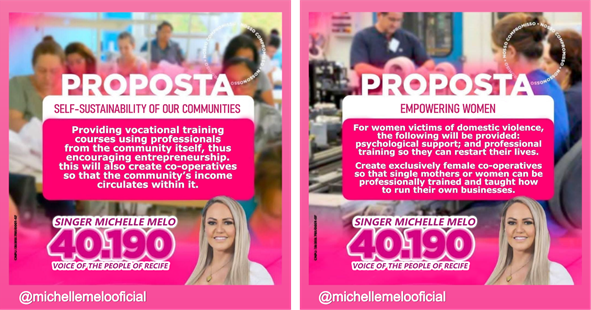
In this regard, I feel it is particularly important to highlight that Michelle Melo was a candidate for city councillor in Recife in 2020, running for the Brazilian Socialist Party (PSB). Among her proposals was the idea of community self-sustainability, that is, providing vocational training courses taught by professionals from the community itself, together with promoting entrepreneurship and creating co-operatives, with the goal to maintain community income circulating within the same. She also proposed the idea of empowering women through the creation of co-operatives exclusively for women, in order to professionally train single mothers or unemployed women, as well as advising them how to become ‘owners of their own businesses’. (Figure 4)

Proposals for Michelle Melo’s campaign, September 2020. Source: Michelle Melo’s Instagram (original in Portuguese).
She also talks about her experience as an ambassador for City Hall’s ‘Mais Vidas nos Morros’ project. As she explains, this project consists of ‘giving the community the right to say what they want done in that community’. Thus, City Hall provides the necessary materials to the community and the community, in turn, chooses what is prioritised and carries out the practical work. For Michelle, this type of project ends up involving the community in the actions carried out and, above all, ‘provides the communities with dignity’, since it enables the community to choose what it considers best for itself.
They arrive there, a meeting is held with the community, and the community says, ‘Look, what we need here is a small park for the children to play in’. What does City Hall do? City Hall provides the materials, and the community comes together to do what’s necessary. So, what happens then? If I made this door, I feel like I own that door; inevitably, I’m going to take care of it because I don’t want anyone to break what I’ve made. You end the depreciation of property; you have a much lower rate of people destroying it because those who participated won’t let people break or damage it. Not to mention that you give dignity to the communities because, imagine I come to your house and give you the best sofa, the best TV, but what I chose wasn’t your choice. I may know what’s best for me, but I don’t know what’s best for you. So, when we do this kind of thing, we show the community that they can be entrepreneurs, that they can help each other. The community ends up becoming a family, and a family protects itself, a family makes things grow. (Michelle Melo, February 2022)
Michelle Melo exemplifies the articulation between peripheral culture, entrepreneurship, and social agency within the Movimento Brega. Her journey as a brega singer began in her youth, engaging with the social and economic challenges of the periphery, and confronting class and gender stereotypes. A pioneer in leading brega bands, her work extends beyond musical performance, encompassing roles as businesswoman, mother, and promoter of training initiatives. For Michelle, her experience in brega is not limited to financial sustenance, it involves the development of a diverse range of skills, community survival strategies, and co-operative practices. Her role as ambassador for the ‘Mais Vidas nos Morros’ project attests to the political dimension of her engagement, enabling the community to choose local priorities and implement actions with the materials provided, strengthening participation, belonging and the preservation of heritage. Furthermore, her candidacy for city council in 2020 reinforces the political and strategic dimension of her trajectory, proposing measures for self-sustainability, professional training, and the encouragement of entrepreneurship, particularly focused on women’s empowerment through co-operatives. Her trajectory demonstrates how the Movimento Brega integrates leisure, artistic production, entrepreneurship, social agency, and participatory policies, contributing to the constitution of peripheral subjectivities, networks of recognition, and the strengthening of community in Recife.
These narratives exemplify the economic relevance of the Movimento Brega for the city of Recife, an issue raised by all the interlocutors. At the same time, it shows how there are incentives for the practice of entrepreneurship that are also linked to the movement, in Recife. The fact that Recife values first position in the Northeast in municipal competitiveness and second position in the country in the human capital index - terms typical of neoliberal economic policies - reveals, for example, a connection with the ‘purposes’ that underpin the CredPop and Go Recife programmes, since both encourage ‘social/popular entrepreneurship’. These are programmes that have ‘purposes’ very similar to those shared by the interlocutors. Thus, the idea of ‘opportunity’ has a central place in their narratives, because they say these individuals only need ‘opportunities’ to start businesses and thus have better living conditions.
In my view, this issue of ‘opportunity’ and ‘entrepreneurship’ is related to a context marked by precarious living conditions, such that, in the narratives of those involved, there is an articulation between ‘doing it through sheer grit’ and the need to ‘take it seriously’ with professionalism in performance within the Movimento Brega. Throughout the thesis, some of the trajectories presented attested to the movement between leisure and the opportunity for survival in a broader sense. The movement towards the second status does not necessarily imply the exclusion of the first, but rather the adoption of a more committed and engaged posture with the idea of professionalisation within the movement. In the peripheries, there is a close relationship between leisure activities and their transformation into economic activity, or rather, the possibility of economic ascension through the utilisation of a peripheral art.
This interpenetration between leisure and responsibility finds support in the analysis of Simões (2013), who states:
Understanding the professionalisation strategies adopted in a creative field is inseparable from the problem of defining the boundaries that arise between what constitutes a domain of ‘free’ time and a domain characterised by ‘obligatory’ activities. This boundary is all the less clear and objective the more the level of involvement with the practices in question configures a particular lifestyle, which is associated not only with moments of ‘leisure’ and admittedly playful activities, but also with moments of ‘responsibility’. (Simões 2013: 169)
The author highlights the centrality of the school period in the development of young people. It is in the school environment that young people find a place for sociability, blurring the boundaries between ‘school obligations’ and ‘leisure activities developed during class breaks’. A second point refers to the occupational status aspired to by young people in the transition to adulthood. When faced with the need for a professional activity, many of these young people aspire to the possibility of uniting their passion, ‘doing what they love’, with the possibility of financial survival through art. However, in Simões research, most professional experiences indicated the need to combine this with another professional activity, considering that historically some branches of hip-hop have an aversion to any attempt at business or commercialisation,
whether through concessions to the market, publishers, or the music industry (in the case of music), or through the sale of their services or any other products resulting from their activity (in the case of graffiti), they therefore forego any professionalisation strategy. In such cases, amateurism presents itself as an option, an attitude, and a hip-hop way of life. (Simões 2013: 172)
In my research on the Movimento Brega in Recife, the relationship between the market and the commercialisation of creativity is similar to the analyses presented by Mylena Mizrahi (2016), who conducted an ethnography on funk aesthetics based on the artist Mr. Catra. This research disclosed the relationship between art and the market, distancing itself from analyses that treat these fields as opposing poles, due to the exaltation of the sublimation of the work of art. Intent on valuing the creative matrix of funk, Mizrahi (2016) distanced herself from more coercive analyses and focused her analyses on the circulation of funk, because ‘art, for the funk artist, is that which circulates, not that which is confined to the realm of the extraordinary’ (Mizrahi 2016: 255). Therefore, pondering the intersection of art with the market, and with money, does not invalidate the importance of the intersections marked ‘by the different aspects of social life’ (Mizrahi 2016: 255).
In dialogue with the debates circulating within the field of new economic sociology and anthropology, Mizrahi (2016) emphasizes that money is not detached from our subjective meanings, since it is incorporated into the most intimate aspects of our daily lives. Moreover, money is also linked to ‘calculative agencies’ that cannot be defined in essentialist terms. Grounded in this perspective, the author proposes a broadening of thinking concerning the market, seeking to define it as a process, that is, beyond competition and exchange or the disconnection between the stages of production and consumption.
(...) we have chosen a path that distances itself from traditional perspectives on the culture industry, such as those that follow in the wake of the Frankfurt School, in which the market is understood as unlimited and to which the producer, the creator, the designer, and even the consumer, must submit. From the Frankfurt School perspective, the market emerges almost as a supra-social entity, imposing its will on individual and collective agencies. (Mizrahi 2016: 257)
In both my research on the Movimento Brega and Mizrahi’s (2016) research on funk, there is a more dialogical relationship between the market, the artist, and innovation, as opposed to a more deterministic relationship that treats these fields as opposing poles. Following the same line of reasoning, Maria Isabel Mendes de Almeida (2012) highlights the importance of an analytical perspective on the relationship established between artistic creativity and its professionalisation.
A unique reconfiguration of the opposing regimes, that have hitherto characterised both professional repertoires, seems to be taking place if we calibrate our gaze and sensitivity towards the recent movements maximising values like competence, professionalism, expertise, and performance, now allied, on an equal footing, with the values of creativity, playfulness, expressiveness, and pleasure. We therefore allowed ourselves to be guided by the initial focus on the growing and significant movements of reciprocal contamination between the notions of creativity and productivity. And, more than this, we seek to follow in the footsteps of regimes and mechanisms of subjectivity that are at play in the simultaneous processes of the creativisation of the profession (movement that is shifting the value of creativity, more commonly associated with the art world, into the realm of ‘business’) and the professionalisation of creativity (movement that increasingly bestows a professional dimension on artistic creation, influenced by competent, assertive and ‘responsible’ functioning characteristic of business models). (Almeida 2012: 25)
No longer subsumed by the idea of creating something unprecedented, or the necessary condition of a ‘blank slate’, invention consists of a different mode of arranging, or dealing with, what is already ‘right there’. (Almeida 2012: 31)
The professionalisation of creativity is mobilised in the field based on the notion of entrepreneurship. Recognising themselves as entrepreneurial subjects, the individuals who compose the Movimento Brega seek professionalisation through courses like SENAI, SENAC, and SEBRAE;17 for example, they begin to consume books and media focused on entrepreneurial culture in a broader sense. However, consuming such material does not imply following a pre-established script. On the contrary, the entrepreneurial subjects move around, producing intersections between different instances.
BREGAFUNK AS A SURVIVAL STRATEGY
Robson Oliveira Rodrigues and Cleiton José da Silva, respectively known as Shevchenko and Elloco (in memoriam), were celebrating 12 years in the bregafunk music scene on the day of our meeting in January 2022. Robson Oliveira Rodrigues is 38 years old. At thirteen, he lost his mother. ‘My mum [died] from an intestinal disease’, and ‘they killed my dad, you get that?’ and since then, he was raised by his grandmother. It is important to highlight the central figure of his grandmother, Adeilda Avelino de Oliveira (in memoriam), in his life trajectory as someone who cared for him, fed him, gave him advice, and never gave up on the young man despite all their financial difficulties. For him, it was ‘thanks to his grandmother’s struggle’ that he never turned to crime because ‘despite the hardship,’ he never lacked for ‘a plate of food’. Elloco passed away prematurely at the age of 34 on March 21, 2024, after suffering a heart attack.
The duo’s first song, ‘Sou Favela’18 [I’m From the Favela], was inspired by the ‘movements’ of a boy flying his kite:
‘Skay, Skay, de bica, de bica, olha o buruçu’ is a dialect. The boy flying a kite and that thing there, and the movement he was making, we put it in brega. That’s when we realised that brega and the passinho [dance steps] were really taking off. (Elloco, January 2022)
There is a mutual relationship between bregafunk music and the ‘passinho do maloka’ (a dance style) that produces an entanglement between the ‘movement’ of bregafunk music and the ‘movement’ of the body. The synchronised poetics of the passinho do maloka is the result of a work created in ‘collectivity’ and in ‘harmony’, characteristics highlighted by the duo when discussing the relationship between music and dance in bregafunk.
The duo’s narratives demonstrate a movement produced collectively, and pondering this collectivity seeks to generate opportunities that break with the idea of a life trajectory composed of hopelessness and denial of the possibility of social and economic advancement in an honest, dignified manner. In this sense, Shevchenko emphasises that ‘I didn’t want to do the same thing they did to us. Just because they didn’t give us opportunities doesn’t mean we’re going to do what they did to us’ (Shevchenko, January 2022). Such opportunities seek to awaken a sense of commitment, responsibility, and discipline in young people. The concept of ‘meritocracy’ is used under erasure, because there is a relationship of ‘merit’, ‘hard work’, ‘dedication’, ‘perseverance’, for example, but this ‘meritocracy’ is reformulated and is not achievable without some possibility of an ‘opportunity’, as well as the ‘will of God’.
When reflecting on the context of the health crisis emergency and their musical productions, the MC duo Shevchenko and Elloco draw attention to the social and economic context in which they were already inserted before the COVID-19 pandemic, the lack of opportunities combined with financial insecurity, which means that low-income people need to know how to deal with the risks of everyday life in order to continue surviving. Shevchenko stated that ‘the favela already lives in a pandemic’, which is a particularly critical observation of the current context.
The favela already lives in a pandemic because everything is difficult for us in the favela. Everything, everything… Jobs are hard to find in the favela… paying for our kid’s schooling is hard for the favela. Because the favela survives on one minimum wage, man! There are mums here in my community who have six children and live on one minimum wage, so that’s a pandemic too. Because everything, everything is difficult for the favela. It’s not easy, get it? So, we have to know how to live with reality, you know? Today I live in the favela… I grew up here, I was born and raised here. I’ve always known how to live with very little, right? So, today, I manage with very little, being grateful, you know? Because I’ve lived here and only those who go through it, who live here, know, for real? So, everything is difficult for the favela! If it’s buying a thousand bricks, for a worker who earns minimum wage, is that easy? A bag of… a pack of diapers, a carton of milk, is that easy? … Rent. Most people who live in the favela live in rented accommodation. Why? Because it’s where you can still afford to live on one minimum wage, right? So, the favela has been living through a pandemic since we were born. Nothing has been easy for us, so now it’s just another stage that we’re going to try and overcome. (Shevchenko, January 2022)
The context of uncertainties, highlighted by Shevchenko, serves as inspiration for the musical compositions of bregafunk, which, through its art, seeks an opportunity for social transformation and the hope for better days. Elloco emphasises that, ‘even when things sometimes seem difficult, the favela seems to look back, saying, “Bro, another chance to be happy!”, “How’s that?” In the form of music’.
For the MC duo Shevchenko and Elloco, bregafunk is synonymous with joy, which is why the duo aims to portray the daily life of the peripheries with irreverence in their music, whether through the more social aspects of bregafunk, which seek to raise awareness among the population about a particular theme, such as songs about the coronavirus (Shevchenko 2020), emergency aid (600 meu amor, 2020), and vaccination (Shevchenko 2021), or in the bregafunk genre that talks about having fun, ‘raving’ and relationships. Below is an excerpt from the song ‘600 meu amor’ by Shevchenko and Elloco.
Tava em casa de quarentena, vendo live de boinha
Tava em casa de quarentena, vendo live de boinha
Eu nem queria, eu nem queria, cair 600 na conta para nossa alegria
Foi nada reclamar esse dinheiro me ajudou
Oh oh 600 meu amor
Oh oh 600 meu amor
I was quarantined at home, watching live streams, just chilling
I was quarantined at home, watching live streams, just chilling
I didn’t even want it, didn’t even want it, but 600 [reais] landed in my account, to our delight
Nothing to complain about, this money helped me
Oh, oh, 600 my love
Oh, oh, 600 my love
(‘600 meu amor’,19 2020)
Reflecting on their motivation for writing the song about emergency aid, the duo mentions that they made the song as a way of giving thanks for the opportunity to receive some extra money and that, regardless of the amount, for the favela that money was a significant help to survive.
I wrote the song as a way of saying thank you, because, you know? Because in the favela, when you see 100 reais, when you see 200, it doesn’t matter what it is, right? For the favela, it’s money, man! So ‘oh, oh, 600 my love’ is a way of saying what? That… the pandemic arrived, so we’ll learn to survive with the little we’re going to earn. I didn’t write it as a way of praising the government, of praising any party, because we don’t even have a party, we’re our own party, we’re already political, right? Just through what we already do in the communities with nothing from there. So that, I did it as an expression of the favela, that 600 is coming, [give] thanks that 600 is coming, because in a pandemic… we’re in a time of pandemic and everything will become more difficult because, for the favela, nothing is easy, for us to keep going. So, for what little that comes, we give thanks. I did it as a way of saying thank you. (Shevchenko, January 2022)
As Shevchenko said, we also made the song as a way to express joy, like, ‘wow, I’m gonna get 600!’ Even when things seem difficult, the favela seems to look... ‘Bro, another chance to be happy’, ‘How’s that?’ In the form of music. Hey, ‘600, my love, and whatever else’. Like, the people embraced it in a way that made us think, ‘damn, bro!’ Our influence went beyond the joy, the music, beyond just making that one song, for this. No, the people liked it! (Elloco, January 2022)
I wanted to highlight two aspects of this reflection. First, Shevchenko’s reflection on the fact that they carry out work in their communities and do not link the duo’s image to politicians or parties. It is important to point out that the duo has been responsible for the Children’s Day celebration in the Arruda community for 16 years, with no help from the authorities, as well as being responsible for the construction of a small square in front of Tropa’s headquarters, on the Arruda canal. There are also the actions of Tropa Solidária [Solidarity Troup], which every two weeks distributes hot meals to the homeless. Second, their reflection on the influence they exert on others. For them, musical production goes beyond the idea of music to listen and dance to. These productions bring about a transformation in the lives of those people. And here they highlight the importance of this influence in the vaccination against COVID-19 as well.
Then, when the vaccine song came out, it was like an extra incentive. Hey, let’s use our encouragement to help people see that the vaccine ain’t a bad thing. It’s not something like, ‘Oh, so-and-so, the vaccine is going to cause this...’ or ‘No, how do you know? You don’t know the future’. Science today shows that there’s an opportunity, there’s an option, there’s the vaccine. So, let’s try and be another option, let’s show that the vaccine also saves lives, regardless of what’s happening in the world, but if the vaccine is here, if science has proven that the vaccine is effective against this virus that came and drove everyone crazy, ‘oh my god, what’s going to happen?!’ After the vaccine came out, after we recorded the vaccine song, it was a way to encourage people to get vaccinated too, because regardless of whether it’s mandatory to get vaccinated to enjoy a show, to go to the supermarket, to go to a restaurant, to go to certain places, we need to embrace this, because this is the new world. There’s the world before the pandemic and the post-pandemic world; this is the post-pandemic world. (Elloco, January 2022)
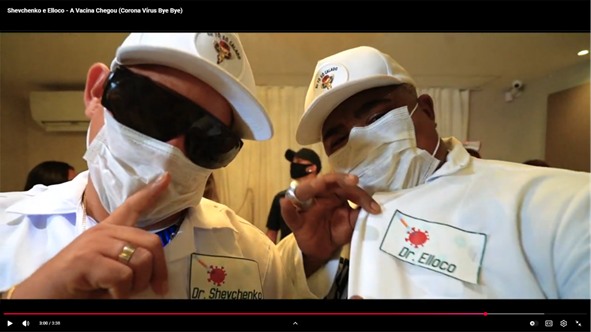
In a context of denialism regarding vaccine effectiveness, artistic production is seen as an ally in raising public awareness about the importance of vaccination. ‘The vaccine has arrived and is 100% effective’, emphasised ‘Drs. Shevchenko and Elloco’. (Figure 5)
Coronavírus, bye bye
A vacina chegou e é 100% eficaz
Vai toma vacina
Vai toma vacina
Faz a posição que eu empurro a seringa
bum tam tam, bum tam tam
bum tam tam, bum tam tam
Coronavirus, bye bye
The vaccine has arrived and it’s 100% effective
Go get vaccinated
Go get vaccinated
Assume the position so I can push the syringe in
boom tam tam, boom tam tam
boom tam tam, boom tam tam

Drs. Shevchenko and Elloco,20 February 2021. Source: Shevchenko and Elloco’s YouTube channel.
On the one hand, the ambivalence present in a passage from the song ‘Faz a posição que eu empurro a seringa’ - free translation, ‘Assume the position so I can push the syringe in’ - promotes the potential to go viral and raise awareness about the importance of vaccination among the popular classes. Among those who judge it, however, the effectiveness of this musical production is rendered invisible because the lyrics and the music video could be perceived solely for their sexual appeal.
For the MCs, this discussion was not only present in bregafunk, but because it is a favela rhythm, the judgment always weighs more heavily. However, what really matters is the importance of audio-visual production in encouraging vaccination.
It’s not only about how they talk and judge, lyrics, lyrics and lyrics. This issue of lyrics already existed among other artists, but since it’s a favela bregafunk, it will always carry more weight, but regardless of that, regardless of our lyrics, we also do things… besides social projects, we also make social music. Because if they saw something good in that song [the vaccination song], wow… There are loads of people saying ‘what a crazy song, you guys are crazy’, but then the music is on television encouraging people to get vaccinated, and we are living proof that brega, beyond the games and jokes, the raving, as we say… there’s also the socialisation and awareness of ‘hey man, let’s get vaccinated’, ‘hey man, 600 my love! Thank you, thank you’. So, let’s face life’s difficulties with joy. Because the ‘no’, the bad stuff, we already have that. We’re going to try to push that away and bring good things into our lives. (Elloco, January 2022)
Considering what this music does, it is clear that brega music contributed to encouraging the population to get vaccinated, as well as expanding the space for representation for young people, since they have a song from the periphery being used in the official vaccination campaign of City Hall.
We did something so we could also achieve something, so City Hall pays more attention to us, you got that? Because it’s not easy, we also have a plan, and we’ll get there through sheer grit, got it? Without help from City Hall, without help from any government, right? We’ve gotten this far. So, we’re nudging them, you know, to get them to pay more attention to us. And we felt grateful for that. (Shevchenko, January 2022)
Thus, it can be said that the use of art as a political instrument is recurrent in the Movimento Brega, in such a way that the inventive, transformative force of peripheral art challenges the theoretical debates about what constitutes art, and what constitutes politics. It could be said that brega is linked to activism and protest, as well as to collective processes of self-organisation. It is also linked to the processes of denunciation and the demand for rights, which intensify during times marked by social, economic and health crises. It is also true that brega has been the subject of debates regarding both its effectiveness and its legitimacy, given that it is a musical genre historically marked by stigmatisation and criminalisation.
The narratives of Shevchenko and Elloco attest to the centrality of family networks in mediating the difficulties of life in marginalised communities and in preventing trajectories of criminalisation, articulating forms that traverse the processes of subjective constitution. Situated in precarious socioeconomic conditions, they highlight the importance of creating opportunities for survival and social and artistic expression, such that their musical productions are the result of collective processes that reinforce values like discipline, responsibility, and social commitment. Artistic work, therefore, constitutes a means of economic advancement and social recognition, mediated not only by individual merit, but by dedication, perseverance, and the availability of opportunities made possible by the context and, in a certain sense, by the ‘will of God’.
The pandemic context intensified tensions related to structural precarity, financial insecurity, and limited opportunities. By affirming that ‘the favela already lives in a pandemic’, Shevchenko highlights the historical continuity of vulnerabilities materialised in the daily difficulties and restrictions in their access to basic rights. In this context, the musical production of bregafunk emerges as a strategy of social mediation, transforming art into an instrument of hope and community mobilisation.
Beyond their musical content, Shevchenko and Elloco articulate autonomous community organising practices, carrying out social actions like children’s parties, building public squares, and distributing food, with no partisan affiliations. These practices attest to the activist nature of bregafunk, articulating cultural production, the claiming of rights, and the strengthening of community networks. Music, therefore, acts as a technology for social recognition and legitimacy, broadening the community’s perception of its capacity for self-management.
The Movimento Bregafunk is thus configured as a space for the experimentation of subjectivities, where leisure, activism, solidarity, and professionalisation are entangled. In this space, concepts like merit and work are brought into question, while the boundaries between the political and the artistic are examined. In this regard, the pandemic not only exacerbated vulnerabilities, but also highlighted the transformative power of peripheral art as an instrument of resistance, awareness, and social affirmation, revealing the role of bregafunk in the formation of socially engaged subjectivities in contexts of structural precarity.
FINAL CONSIDERATIONS
Analyses of the subjective and material processes that constitute the Movimento Brega in Recife in this research has shown that brega goes beyond a musical genre, establishing itself as a social, cultural, political, and economic movement. The peripheral subjects who participate in this movement articulate creative practices, cultural agency, and political recognition in contexts marked by structural precarity, neoliberalism, and the pandemic emergency.
In addition to providing aesthetics and entertainment, peripheral musical production acts as an instrument of resistance, community mobilisation, and the affirmation of rights, promoting opportunities for expression and economic advancement in a dignified manner. The research shows that material and social precarity, together with the challenges imposed by the pandemic, shape modes of artistic production and highlight creativity, solidarity, and popular entrepreneurship as central strategies for survival and social transformation.
Among the contributions of this research, the understanding of brega as a space for experimentation with peripheral subjectivities and political action stands out, revealing how cultural practices can function as instruments of social recognition and mobilisation in the face of inequalities. The movement simultaneously presents itself as a space for work, leisure, and community engagement, challenging concepts like merit, entrepreneurship, and the boundaries between the political and the artistic.
In short, the Movimento Brega constitutes a multi-faceted expression of peripheral life, articulating artistic production, resistance, and solidarity, and highlighting the transformative potential of culture in contexts marked by economic precarity, social inequality, and health crises. Finally, my research concludes that brega offers a significant analytical lens for understanding the dynamics of popular culture, peripheral subjectivity, and ways of coping with conditions inherent to pandemic-related impacts and neoliberal policies.
REFERENCES
- ALBINO, Chiara. 2019. “Economia performativa da infregatividade: Estado, subjetividades, políticas e corpos em movimento no contexto da música eletrônica bagaceira”. Visagem, 4: 253-289.
- ALBINO, Chiara, and OLIVEIRA, Jainara. 2021. “O governo neoliberal das vidas precárias”. In: Chiara Albino, Jainara Oliveira, and Mariana Melo (orgs.), Neoliberalismo, neoconservadorismo e crise em tempos sombrios Recife: Editora Seriguela. pp. 245-272.
- ALBINO, Chiara, OLIVEIRA, Jainara, and MELO, Mariana (orgs.). 2021. Neoliberalismo, neoconservadorismo e crise em tempos sombrios Recife: Editora Seriguela .
- ALMEIDA, Maria Isabel Mendes de. 2012. “Criatividade contemporânea e os redesenhos das relações entre autor e obra: a exaustão do rompante criador”. In: Maria Isabel Mendes de Almeida, and J. M. Pais (orgs.), Criatividade, juventude e novos horizontes profissionais Rio de Janeiro: Jorge Zahar Editor Ltda. pp. 23-54.
- ANDRADE, Rafael. 2021. Centenas de casos de amor: as performances do Brega em Reginaldo Rossi Belo Horizonte: Fafich; Selo PPGCOM; UFMG.
- ARAÚJO JÚNIOR, Samuel. 1988. “Brega: music and conflict in urban Brazil”. Latin American Music Review, 9(1): 50-89.
- AZEVEDO, João Victor de Souza. 2023. O Movimento Brega na Região Metropolitana do Recife: perspectivas entre patrimonialização, produção periférica e sonoridades Final project, Universidade Federal de Pernambuco - Recife.
- AZEVEDO, Rafael José. 2017. “Do brega paraense ao tecnobrega: história e tradução na websérie Sampleados”. GALÁXIA, 35: 80-92.
- AZEVEDO, Rafael José. 2019. Derivas do brega paraense: escutas em tempos e lugares múltiplos Belo Horizonte: UFMG.
- BORN, Georgina. 2005. “On Musical Mediation: Ontology, Technology and Creativity”. Twentieth-century music, 2: 7-36.
- BRACKETT, David. 2016. Categorizing Sound: Genre and Twentieth-Century Popular Music Berkeley: University of California Press.
- COSTA, Tony Leão da. 2011. “Notas sobre o ‘brega’ no Pará”. In: A. Facina (org.), Vou fazer você gostar de mim: debates sobre a música brega Rio de Janeiro: Multifoco. pp. 87-116.
- D’ANDREA, Tiarajú Pablo. 2022. A formação das sujeitas e dos sujeitos periféricos São Paulo: Dandara Editora; Fundação Rosa Luxemburgo.
- FACINA, Adriana. 2011. Vou fazer você gostar de mim: debates sobre a música brega 1st ed. Rio de Janeiro: Multifoco .
- FACINA, Adriana. 2019. “Cultura em tempo de perigo”. In: Adriana C. Lopes, Adriana Facina, and Daniel N. Silva (orgs.), Nó em pingo d’água. Sobrevivência, cultura e linguagem Rio de Janeiro/Florianópolis, Mórula Editorial/Editora Insular. pp. 99-107.
- FONTANELLA, F. 2005. A estética do brega: cultura de consumo e o corpo nas periferias do Recife Master’s dissertation, Universidade Federal de Pernambuco - Recife.
- FOUCAULT, Michel. 2008. The Birth of Biopolitics. Lectures at the Collège de France (1978-1979) London, New York: Palgrave Macmillan.
- FRITH, Simon. 1998. “Genre Rules”. In: Simon Frith, Performing Rites: on the value of popular music Cambridge: Harvard University Press. pp. 75-95.
- GAGO, Verónica. 2017. Neoliberalism from Below: Popular Pragmatics and Baroque Economies Durham: Duke University Press.
- GUERREIRO DO AMARAL, Paulo Murilo. 2011. “Do Brasil ao Pará: Considerações sobre o tecnobrega e a constituição/trajetória da música brega regional”. In: FACINA, Adriana (org.). Vou fazer você gostar de mim: debates sobre a música brega Rio de Janeiro: Multifoco . pp. 117-140.
- JANOTTI JR., J., and PEREIRA DE SÁ, S. 2019. “Revisitando a noção de gênero musical em tempos de cultura musical digital”. GALÁXIA, 41: 128-139.
- LAVAL, Christian. 2014. “La précarité comme ‘art de vivre’ à l’époque néolibérale”. In: Silvia Contarini, Luca Marsi (eds.), Précariat: pour une critique de la société de la précarité Nanterre: Presses universitaires de Paris Nanterre. pp. 19-31.
- LOPES, Adriana C., FACINA, Adriana, and SILVA, Daniel N. (orgs.). 2019. Nó em pingo d’água: sobrevivência, cultura e linguagem Rio de Janeiro; Florianópolis: Mórula Editorial; Editora Insular.
- MALUF, Sônia Weidner. 1999. “Antropologia, narrativas e a busca de sentido”. Horizontes Antropológicos, 12(5): 69-82.
- MATTOS, A. A. 2011. “A Jovem Guarda e a “música brega”: as brechas na indústria cultural”. In: A. Facina (org.), Vou fazer você gostar de mim: debates sobre a música brega Rio de Janeiro: Multifoco . pp. 9-24.
- MIZRAHI, M. 2016. “Produzindo estilo negociando sentidos: arte, mercado e criatividade junto ao funk carioca”. Antropolítica, 40: 252-273.
- PRYSTHON, Angela. 2003. “Margens do mundo: a periferia nas teorias do contemporâneo”. Revista FAMECOS, 10(21): 43-50.
- SÁ, Simone Pereira de. 2021. Música pop-periférica brasileira: videoclipes, performances e tretas na cultura digital Curitiba: Appris.
- SANTANA, Tarsila Chiara Albino da Silva. 2016. “Música bagaceira e malícia: sentidos erótico-dançantes da infregatividade entre homens com práticas homoeróticas em Recife”. Revista Equatorial, 5(3): 120-154.
- SANTANA, Tarsila Chiara Albino da Silva. 2017. Da house music à bagaceira: uma etnografia sobre música eletrônica, espacialidades e (Homo)sexualidade masculina em Recife, PE Master’s dissertation, Universidade Federal do Rio Grande do Norte - Natal.
- SANTANA, Tarsila Chiara Albino da Silva. 2024. “Recife é brega, meu amor!”: música periférica, Movimento Brega e modos de subjetivação em contexto pandêmico e neoliberal PhD Thesis, Universidade Federal de Santa Catarina - Florianópolis.
- SIMÕES, José Alberto. 2013. “Viver (d)o hip-hop: entre o amadorismo e a profissionalização”. In: Maria Isabel Mendes de Almeida , José Machado Pais (org.), Criatividade e profissionalização: jovens, subjectividades e horizontes profissionais Lisboa: Imprensa de Ciências Sociais. pp. 163-184.
- SOARES, Thiago. 2021. “Ninguém é perfeito e a vida é assim”: a música brega em Pernambuco 2nd ed. Recife: Carlos Gomes de Oliveira Filho.
- TSING, Anna. 2013. “Free in the forest: popular neoliberalism and the aftermath of war in the US Pacific Northwest”. In: Zeynep Gambetti and Marcial Godoy-Anativia (eds.), Rhetorics of Insecurity: Belonging and Violence in the Neoliberal Era New York: New York University Press. pp. 20-39.