
 Cracolândia in printed photographs: the emergence of an art world around the Birico collective
Abstract
Production in visual arts by crack users, who reside in or frequent Cracolândia, as well as artistic interventions by activists and professionals who work with these people, have been present at least since 2014. Through description and analysis of the Birico collective, the purpose of this work is to understand how the emergence of an art world in Cracolândia was brought about, founded on its own characteristics and relations with the territory. To this end, throughout June 2021, we conducted an ethnographic research in the municipal area occupied by the Teatro de Contêiner Mungunzá in which we were able to interact daily with people from the different entities and collectives housed in the containers located on the land. We were able to observe how the Birico collective emerges, under the risks and difficulties imposed by COVID-19, in which the ‘law of the birico’, that came from the streets, with its imperative of exchange and refuge, was able to foster the ‘logic of the collective’ among activists who are also artists. An art world was able to emerge in São Paulo’s Cracolândia because this territory attracted activists dedicated to working with art, which ended up generating two movements: artists towards Cracolândia and crack users towards the arts.
Keywords:
Art; Cracolândia; COVID-19
Resumo
A produção em artes plásticas por parte de usuários de crack, que residem ou frequentam a Cracolândia, assim como intervenções artísticas por parte de ativistas e profissionais que trabalham com essas pessoas se fazem presentes ao menos desde o ano de 2014. O objetivo desse trabalho é compreender, através da descrição e análise do coletivo Birico, como foi possível o surgimento de um mundo da arte na Cracolândia, em suas características próprias e relações com aquele território. Para tanto realizamos uma pesquisa etnográfica na área municipal ocupada pelo Teatro de Contêiner Mungunzá, durante todo mês de junho de 2021, em que pudemos conviver diariamente com pessoas das diversas entidades e coletivos que se instalaram nos containers dispostos pelo terreno. Pudemos observar como surge o coletivo Birico, sob as dificuldades e riscos impostos pela COVID-19, em que a “lei do birico”, vinda da rua com seu imperativo da troca e do acolhimento, pôde fomentar a “lógica do coletivo” entre ativistas que também são artistas. Um mundo da arte pôde surgir na Cracolândia paulistana por aquele território ter exercido atração sobre ativistas dedicados ao trabalho com arte, o que acabou por gerar dois movimentos: dos artistas em direção à Cracolândia e dos usuários de crack em direção às artes.
Palavras-chave:
arte; cracolândia; COVID-19
INTRODUCTION
What to do in a time of chaos? This question is posed by visual artist Dentinho, a harm reduction worker and former homeless person in the Cracolândia region. When he started Birico, together with 30 other artists at the onset of the COVID-19 pandemic, Dentinho was looking not only for a space to exhibit and sell his art, but also for a way to raise funds and provide assistance to as many people as possible in the territory. Two editions of Birico have been held up to the completion of this article, both involved the exhibition of artworks in a virtual environment, the first in mid-2020 and the second at the end of the same year. The number of artists increased from 30 to 40, from the first exhibition to the second.
We chose to investigate the Birico project because we had noticed for some time, at least since 2014, that in this stigmatised area of the city (De Almeida and Franco 2019) there was room for more than mere crack consumption. With the De Braços Abertos (DBA) [With Open Arms] programme, a municipal initiative between 2014 and 2017, that provided food, lodging, and work for crack users in Cracolândia, artistic interventions have been initiated in the territory: art workshops, the production of urban furniture, and street film screenings (Alves 2017). Thus, we believe we can unveil some of the artistic production currently being made in Cracolândia, some of the actors involved, and their modes of organisation. We seek to contribute to a better understanding of the richness contained in the actions of people who may or may not be using crack, but who produce artworks and organise themselves to exhibit and sell these works. We hope that by shedding light on this production, its discussion in the academic sphere will lead to greater recognition of the artists, their works, and the struggles they wage to improve the living conditions of crack users.
At the time of writing this article, we found no academic work that addresses Birico. However, among the works available, we consider that the master’s thesis ‘Fluxo(s) da luz’ by André Okuma (2019), written before Birico’s first exhibition in 2020, examines artistic production in Cracolândia. In addition, there are authors who have addressed artistic production in Cracolândia, from music, the ethnography conducted at choro and samba events on Rua General Osório (Aderaldo and Fazzioni 2012), to the works of Alves (2017) and Nogueira (2021) that describe Blocolândia, a carnival group from Cracolândia.
The production of visual arts by crack users who reside in or frequent the territory has been present since the implementation of the DBA programme, starting in 2014. Casa Rodante, a multidisciplinary initiative of artists, was able to offer photography studios and urban furniture workshops to beneficiaries of the programme for ten months, in partnership with the municipal government (Vianna 2019). At the same time, the ‘visual artist Eduardo Kobra, known internationally for his large-scale graffiti’ (Okuma 2019: 61) exhibited some of his works and guided crack users to collectively produce a painting, which was auctioned off on behalf of DBA. In addition to these initiatives, we should highlight the workshops ‘on handcrafted objects, decorative items made from tires, wood and polystyrene foam, painting on canvas, drawing and others’ (Adesaf 2017: 48) developed by the DBA manager, within the scope of actions promoted by the former municipal Department of Labour and Entrepreneurship.
Also worthy of note among the artistic production in Cracolândia prior to Birico are the paintings of Badarós, a resident of the territory and a crack user from Pernambuco. Sometimes called the ‘Basquiat of Cracolândia’, in 2018, he managed to exhibit his works at the Oficina Cultural Oswald de Andrade [Oswald de Andrade Cultural Workshop] and the Memorial da Resistência [Resistance Memorial] (Okuma 2019; Nogueira 2021).
Over the last 12 years, at least, certain authors have sought to distinguish and elucidate some of the more significant characteristics of Cracolândia. Frúgoli Jr. and Cavalcanti (2013) observed how this place has been constituted as an itinerant territory, amidst disputed territories and in the context of large urban interventions, which generates conflicts and connections with other spaces. Thus, Cracolândia is a place of exile and, for this very reason, a great attraction (Rui 2014), people who consume crack in this context cannot be defined solely by their drug use (Alves and Macrae 2019; Alves and Pereira 2019), people are drawn there and end up developing their own daily survival strategies as they navigate the local institutional landscape (Fromm 2017). The policies implemented by the public authorities could indeed produce veritable labyrinths (Nasser 2018) that induce and condition the movement of such people in the city. Under these circumstances, crack use can be attractive because it provides a communal type of life, with fraternal relations among the dispossessed (Alves 2014).
Although aspects like attraction, territoriality, and community are raised in academic research, the mainstream media portrays people who use crack in Cracolândia as vulnerable beings susceptible to great suffering, but who are simultaneously afflicted by anger, who react and resist (Martino et al. 2022). During the COVID-19 pandemic, it was possible to verify one of the potentialities of this resistance when the situation was managed by activists and professionals engaged in defending the health of the residents of Cracolândia and its habitual visitors, who distributed hygiene kits, meals, and clothing (Alves and Pereira 2022; Alves, Pereira and De Freitas Silva 2020). The mobilisation around protection against COVID-19 became even more urgent due to the actions of city hall, which closed a facility intended to serve the residents of Cracolândia and its repeat visitors, ATENDE II. Under the pretext of avoiding crowds, healthcare workers were even prevented from entering the area, forcing people in need of assistance to leave the territory (Cirillo 2020).
When we began our investigation, the information available about Birico was limited to a few publications on internet pages, because as soon as the first biricada (as the project’s initiatives were called) took place in mid-2020, some news articles reported on it. This material underlines that Birico was an initiative of artists linked to Cracolândia, 30 in total, including people who had recently experienced homelessness (Nicolau 2020). This is the case of the artists Thiago Mundano, Anita Silvia and Cleiton Ferreira, aka Dentinho, one of our interlocutors in this research. The articles also highlight that the funds obtained by the project were to be divided equally between that intended for the artists and that intended for the collectives - Tem Sentimento, Pagode na Lata and Companhia Mugunzá de Teatro1 - which distributed masks, lunch boxes, and hygiene kits during the pandemic. One other piece of information of note is the origin of the term birico, linked to the practices of crack consumption in which a portion of a rock - the birico - is shared, sometimes in a gesture of solidarity among drug users. Another journalism article, published at the end of 2020, made mention of the visual artist Badarós, who at the time sold his paintings on the sidewalks of Cracolândia, MC Kawex, a singer and composer of themes related to this vicinity, and the poet Fábio Rodrigues, a resident of the territory. The idea of the second biricada is alluded to, which aimed to increase the number of people benefiting from rent paid by the project to six individuals, in addition to the proposal of an art school (Garcia 2020).
Our ethnographic investigation was motivated by the purpose of clarifying certain aspects of the Birico project’s organisation that were not available in the media. We wanted to understand how it was possible for a proposal to exhibit and commercialise artworks developed in Cracolândia, what relationship this proposal had with the people who reside in or frequent this territory, and not only with regard to Birico as a project, but also the artists themselves. In seeking information concerning the initiative, our initial impressions led us to investigate how these artists lived, whether they could survive exclusively from their art, or whether they engaged in other activities in Cracolândia.
The theoretical references on which we base our reasoning were chosen according to a criterion of relevance and begin with the contributions of Howard Becker (1982) in his work Art Worlds. The author proposes that artistic work is similar to other human activities, involving the combined action of a large number of people. There is, therefore, a social division of artistic work between artists and support staff, which may constitute an art world, formed by all the networks of co-operation between people whose activities are necessary for the production, dissemination, and commercialisation of the works that this world accepts as art. In this world, according to Becker, the artist who intends to live exclusively from their art, to some extent, needs to be concerned with pleasing the public that can guarantee them the money required for their existence.
The artist who does not have the means or does not intend to reach a large audience needs to rely on groups of friends, who also share their collective values (Bastide 1979). Moreover, Bastide argues that in the relationship the artist needs to establish between content and form, it becomes evident that the content of art is not conferred by society, but rather, in the formal realm, by drawing the connections between societies and the arts closer.
While observing, in line with Paul Valéry, that technical changes would affect artistic creation itself and might modify the very notion of art, Walter Benjamin (1969) goes on to discuss the novel possibilities of the reproduction of works of art, particularly photography. Through technical reproduction, the very notion of authenticity is questioned, and with it the authority of the thing, the aura of the work of art. Due to the need to possess the object as closely as possible, in image or in reproduction, artworks are made precisely to be reproduced; and the relationship between the artist and the public comes to depend on the mediation of the devices.
The dimensions of agency, regarding objects and people who actuate in the context of crack cocaine use in downtown São Paulo, leads us to the work of Alfred Gell and his reflections on art as a nexus of complex intentionalities. Across several works (1993, 1995, 1996, 1998, 2001), Gell proposes a sophisticated theory, highlighting the processes of agency, intention, causation, result, and transformation. However, in this article, it is not our intention to make use of this author’s work, which we have discussed previously (Alves and Pereira, 2024), nor do we intend to address contributions on the subject by Latour (2005) and Ingold (2006, 2010, 2011).
Besides Gell’s own conceptions of artworks, essays like those by Abalos Júnior (2018, 2019) deal with urban art as previously imagined artistic interventions that require action and gesture. These are ideas linked to street art, its socialisation activities, its partnerships, its search for funding, its choice of itineraries, and its working forms. Since we are not specifically dealing with street art, these and other contributions to the subject will not be considered at this time.
Thus, based on the literature consulted, the results of our ethnography and respecting the limitations of an academic article, we chose to define the purpose of this work as understanding how the emergence of an art world in Cracolândia was brought about, founded on its own characteristics and relationships with the territory, through the description and analysis of Birico.
METHODOLOGY
This article stems from ethnographic research, understood as a fieldwork practice that involves living with the social group being studied. The exercise of looking and listening imposes a shift in the researcher’s culture through participation in the forms of sociability through which the researched reality presents itself (Eckert and Da Rocha 2008).
The ethnography was conducted in the municipal area occupied by the Teatro de Contêiner Mungunzá [Mungunzá Container Theatre], located at Rua dos Gusmões, 43, Santa Ifigênia, São Paulo, Brazil. Throughout June 2021, we were able to interact daily with people from the various entities and collectives that were installed in the containers scattered around the site, namely: the Coletivo Tem Sentimento (CTS), the Coletivo Birico; the Paulestinos; Pagode na Lata; and the Mungunzá theatre itself. Each of these organisations deserves its own investigative ethnographic work.
The researcher and first author of this article was able to approach the field through a prior relationship with social worker Carmen Lopes, or Dona Carmen as she is commonly known, who is responsible for the CTS. Thus, it was possible to have broad access to the activities and daily interaction with the visitors and workers on site. Mungunzá was established in 2016 on land previously occupied by the metropolitan police parking lot, and the collectives were later invited to share the area. The installation in the space occurred by accommodating each entity in different containers, some very close to or overlapping others, which gives the place a high social density of people who may have diverse interests, interacting throughout the day.
We were able to coexist, dialogue, and observe with reasonable ease, made possible by the generally friendly atmosphere prevailing among our interlocutors, and between them and us. The place was frequented by CTS workers and visitors, Birico artists and the Paulestinos, samba composers, Mungunzá workers and artists, and people who lived in or frequently visited the surrounding area and who came seeking information and assistance. We had ample freedom to film, photograph, and record in the environment. We conducted 36 interviews, 12 of which were directly related to Birico, along with recording dozens of videos and taking numerous photographs. The interlocutors were selected according to criteria of interest and availability according to the purposes of the research. We were able to record the interviews and transcribe them later.
As ethnographers, we were able to remain on site during the morning and afternoon periods, leaving at night. The interlocutors were contacted during their daily activities, and sometimes we accompanied them in the performance of some work, such as producing posters, flyposting paste-ups, presenting new songs, work meetings, among other events. We considered the events that took place inside the container occupied by the collective - printing posters and their production in other spaces on the land occupied by the theatre - to be relevant to the research on Birico.
Regarding the ethical aspects of our research, it is important to disclose that we do not consider it appropriate to request that interlocutors sign a term of free and informed consent, since this is a delicate moment in the field, in which certain activists have been facing accusations from the justice system. Artists with publicly exhibited works had their real names cited in the article, while the identities of other participants in Birico were maintained anonymous to preserve their privacy.
After reading the material produced in the ethnography, we selected five units of analysis: the birico as a social relation in Cracolândia; what Birico sells; how Birico is organised, the division of tasks and the ‘logic of the collective’; Birico’s affinities with other actors in the territory; and the financial sustainability of the artists.
FROM THE ‘LAW OF THE BIRICO’ TO THE ‘LOGIC OF THE COLLECTIVE’: FINDINGS OF AN ETHNOGRAPHY AMONG ARTISTS IN CRACOLÂNDIA
In this section we intend to highlight the most important characteristics of the Birico collective identified in our ethnography. We initially address the birico, a piece of crack cocaine, as a social relation in Cracolândia. Next, we present the products sold on the website, and then describe a mode of organisation concerning what we call the ‘logic of the collective’. In the penultimate topic, we examine the collective’s relationships with other actors in the territory and, lastly, given that Birico is also an activity focused on artists’ sustainability, we address how they strive to survive financially.
THE LAW OF THE BIRICO
Birico was the name chosen by the artists and activists of Cracolândia to name their initiative for commercialising artworks, but birico as a social relation may have served to inspire the form of commercialisation adopted by these people. In Cracolândia, biricos - small pieces of crack cocaine - gain importance in the circulation of other goods in addition to crack, (Costa 2017), in a process described to us by the visual artist Dentinho, a former resident of the territory.
Dentinho, our interlocutor in the ethnography at the time, was over 40 years old and was employed as a harm reduction worker. He had started using crack about two decades earlier, in the region of Avenida Paulista, and gradually moved down towards Cracolândia, making numerous friends until he decided to stay. Here, it was difficult to make money, unlike his place of origin near the affluent Jardins region, in the vicinity of Praça Júlio Prestes, where he found the open scene of crack use in the modest Campos Elísios neighbourhood. In his words, ‘bums up there make money, but not here, it’s a whole other story here.’
And what exactly is the Cracolândia ‘story’? First, a range of activities and people willing to engage in them: cigarette and cachaça vendors; manufacturers and sellers of crack pipes; people renting out their ‘shacks’; others setting up veritable ‘mini shops’ on tarps spread on the ground. Second, the exchange of goods is constant, as vividly illustrated in our interlocutor’s words.
Here everything transforms. A guy wakes up and wants a cigarette to smoke. ‘Who’ll chip in a cigarette for me?’ So, the guy’s wearing flip-flops, he gets three cigarettes on a flip-flop. With these three cigarettes, the guy yells, ‘Who has cigarettes for a treta?’ Then he pays for a biriquinho, and with that biriquinho, he takes a drag.
‘Taking a drag’ means consuming crack or smoking a biriquinho (diminutive of birico). Dentinho provides numerous examples, including how he managed to earn 300 reais with just three cigarettes, after successive exchanges in his favour. The very clothes he was wearing at the time indicated they came from treta, that is, from exchanges in the ‘mode of the flow’. Exchanges involving biricos in the ‘flow’ - the most concentrated portion of crack users in Cracolândia - not only deal in goods, but also services or favours, such as storing other people’s belongings, and even providing refuge:
[...] my street dad. The guy would take you in, you know. He didn’t need to move around, he would just welcome you and chat. People supported him for who he was. And they chatted. He welcomed people daily and on a rotating basis.
The constant exchanges that take place in Cracolândia - involving activities and people dedicated to selling certain products, along with goods exchanged for other goods, for favours and refuge - form the basis of the practices and values appropriated by artists and activists involving the birico. These widespread exchange practices and values, like acceptance and solidarity, are summarised by Dentinho in his vision of Cracolândia, stating that, ‘The law there is the law of the birico’.
WHAT BIRICO SELLS
Birico sells prints of files sent to a printing company. The files are usually photographs, but they can also be images produced entirely on a computer by the artist. We purchased one of the prints for sale on Birico’s website, a photograph of a sculpture by the artist Cleiton Ferreira, better known as Dentinho. The name of the work, Fluxo Capacitor, is a reference to the flux capacitor, a central component of the time machine that Dr. Emmett Brown’s DeLorean vehicle became in the movie Back to the Future. The flux capacitor that made time travel possible.
We received our purchase a few days after ordering, within the deadline. The packaging (item 1, Figure 1), consisted of a folded piece of cardboard, with the warning ‘FRAGILE DO NOT BEND’ and the logo of the company Ateliê Dois e Meio, responsible for printing using a process known as ‘fine art’. Upon opening the package, under a sheet of parchment paper held together with masking tape (item 2, Figure 1), we saw the contents of our purchase. The print of Dentinho’s artwork came with an informational pamphlet (item 3, Figure 1) about the printing process and with maintenance tips like ‘Do not leave your print exposed directly to the sun’. In addition, it included a scannable QR code that led to the page https://qrco.de/bblA6W, where the client can respond to a survey on quality. At the bottom of the pamphlet were the logos of Ateliê Dois e Meio, the fine art paper brand Canson, and the coated paper manufacturer for inkjet printing Hahnemühle Fine Art, Inc. The artwork (item 4, Figure 1) shows three crack pipes joined in the centre of a wooden frame, with a red and black coloured background, composed of hexahedrons that appear to extend from the centre to the sides. We spoke with the author on at least three occasions regarding the meaning of his work in the context of Cracolândia, a topic that, due to the limitations of this article and its objectives, we will address at another time, along with other productions from Birico.

The artworks offered for sale are of two types: one that is more expensive, with ‘fine art’ printing on 200g coated paper, that costs approximately 150 reais (US$ 30); and the other printed on cheaper paper, which according to our interlocutors was to enable purchases for a more democratic public. We verified that 100 sheets of A4, 200g coated paper, in premium matte white costs 40.90 reais (US$ 8.20) in a popular online store, which is roughly 40 cents (8 cents) per sheet. We do not know the costs of printing, or creating and maintaining the website, but shipping is paid by the customer. In addition to these production and marketing related costs, there are also criteria concerning the authenticity of the works: numbered prints, limited editions, and artist signatures.
For the second Birico, 20 prints of each work were made. In this first edition, each printed item received a serial number. If the collective decides to release another edition, it will receive numbering that differs from the first, and will have a lower value in the art market. For the first Birico, the artworks could not be signed individually due to the COVID-19 pandemic, which led to the need to create a digital certificate that accompanied the print directly from the printing press. The artists signed on paper and this signature was transformed into a file that was then transferred to each certificate. Since the pandemic, the artworks are signed one by one.
One of our interlocutors, the photographer responsible for the images sold by Birico, summarised what the collective sells as follows: ‘What the person receives at home is a limited edition of an artwork’. Photography is the tool used to enable the reproduction for sale of this artwork at an affordable price. People who could not afford to acquire the sculpture, which served as the basis for the commercialised image, end up gaining the opportunity to display an artistic object in their homes, a print of the photograph of the sculpture.
Cleiton’s work, it was me who photographed it. That also counts towards the work, right? It’s a way of transforming the work of those who can’t produce on a large scale, right, or so that people can own these things at home.
For our interlocutor, the artwork is its printed photograph. ‘Let’s say that it (Cleiton’s sculpture) is the raw material, right?’ The fact that the print is numbered, that is, that they use certain practices of the established art market, serves to ‘validate the work, right?’ Thus, Birico aims to open up opportunities for people would not otherwise have access to the formal art market, like Cleiton, and encourage them to produce. And while some of the collective’s participants are represented by galleries, not all have the possibility of exhibiting in these environments.
HOW IS BIRICO ORGANISED, THE DIVISION OF TASKS, AND THE ‘LOGIC OF THE COLLECTIVE’?
Birico emerged in the context of addressing the consequences of the COVID-19 pandemic in Cracolândia, with the goal of raising funds for participating artists and assisting those who reside in and frequent the territory, as well as financing initiatives like the CTS. The money raised, which according to our interlocutor Raphael Escobar reached approximately 120,000 reais (US$ 24,000) in the two Biricos held in 2020, paid for the accommodation of homeless people, the distribution of supplies for protection against the virus and harm reduction from crack use, in addition to one of the containers that houses the CTS.
In the first Birico, the artworks of 30 artists were exhibited and sold on a website created for this purpose. In addition to the person responsible for creating and managing the website, two other people volunteered to handle Birico’s Instagram, and a fourth member dealt with the prints that were delivered to buyers. A fifth participant took care of sales, another wrote the texts for the website, and yet another took the photographs used for publication on the website and for printing. This is how they formed what was eventually named the Birico collective.
According to our interlocutor Raphael Escobar, the division of labour in what became the Birico collective was based on ‘expertise’: the person responsible for producing the texts for the website is a journalist; one of the people who writes the Instagram texts works with poetry; the person responsible for ordering and approving the prints is a muralist, producing murals from printed images; the person responsible for general production at Birico works as a producer, including for CTS. In other words, they are professionals with their own areas of expertise who come together and, as summed up by our interlocutor, ‘so, they decided to create a collective to make things happen together, because it’s easier together.’
In addition to facilitating the realisation of complex projects, participation in a collective makes activism safer. In early 2020, some activists from Cracolândia began to face legal proceedings because of their work in the territory, but not Raphael Escobar, who was not prosecuted, even though he is one of the best-known of these activists. Our interlocutor attributes the freedom with which he was able to continue operating to never having positioned himself as an individual while acting politically in the area. In his words, he says he always believed that ‘because it was done within the logic of the collective, nothing would happen. No sooner said than done. Nothing happened.’
BIRICO’S AFFINITIES WITH OTHER ACTORS IN THE TERRITORY
Birico is housed on municipal land occupied by the Teatro de Contêiner Mungunzá, headquarters of the Companhia Mungunzá de Teatro, more specifically in the container that initially served as the theatre’s storage room. We were able to observe how interactions between people who visit and work at the theatre and the participants of Birico are daily occurrences. Moreover, members of Birico have even worked as employees at the theatre, like the person responsible for creating and administering the website. Since space in the container that houses Birico is limited, occupied by files, a table, and a large plotter printer, the theatre also serves as a studio. We followed the production of dozens of screen-printed pieces that were left to dry in the theatre’s arena before being finished. The image below shows prints being left to dry before being used in one of Birico’s public events. (Figure 2)
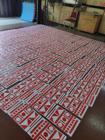
Screen-printed pieces drying on the floor of the Mungunzá theatre. Source: Authors’ private collection.
Another collective that also occupies the theatre grounds and has an affinity with Birico is CTS. Besides contributing to the acquisition of one of the containers that houses this collective - the largest one, where the sewing machines are located - part of the funds raised at each Birico event are used to meet certain needs of the people in Cracolândia, sometimes through products ordered from the collective. As explained by one of the social work professionals participating in CTS.
Everything Birico does is geared towards the homeless population. The people in this area. So, when they launch a campaign, they have the money, and it’s something related to garment manufacturing, making something, like clothes, a small bag, whatever. They ask us, then we make it and distribute it across the territory.
One of Birico’s goals is to house homeless people from Cracolândia in hotels in the region, which is the collective’s main form of interaction with the local population. We saw how a CTS participant was accommodated in this way, along with her partner and daughter, in a budget hotel near the theatre. The search for accommodations is the responsibility of the people who will be hosted, but contracts are the responsibility of a Birico artist, one of the Paulestinos duo:
[…] at Birico, I take care of the guys, I handle where everyone’s going to stay, I ask them to check things out, but I’ll go there to double-check. I organise everything, and then I pass it on to the group to pay.
The Paulestinos are an artist duo, Átila Fragozo and Renoir Santos, who work with paste-ups and posters, mostly flyposted in public places. Their name derives from a combination of the adjectives ‘paulista’ [from São Paulo], ‘nordestino’ [from Northeast Brazil], and ‘latino’ [from Latin America]. Their symbolic image is a female warrior whose attire combines elements of the clothing of Lampião’s gang with items from the Star Wars universe, such as the double-bladed lightsabre of the villain Darth Maul. In the image below, on the left, the duo prepares prints in front of the container that houses them and serves as the Birico headquarters. On the right, performer Laurah Cruz from CTS poses in front of a mural installed on the door of the same container, where we can see the symbolic figure of the Paulestinos. (Figure 3)

The members of Paulestinos work, and Laurah Cruz poses. Source: Authors’ private collection.
The Birico headquarters and Paulestinos container is the also one they like to call a studio-school. The idea is that this initiative will be based on three pillars - pedagogy, harm reduction, and income generation - and will focus on the vulnerable population of the Luz and Santa Ifigênia neighbourhoods. One of the Birico artists explained the project’s intentions: ‘The idea is to create a free, anarchic art school. People get close to you, and then you start teaching them.’
This studio-school proposal has been circulating within Birico. In the future, perhaps the collective can offer artistic workshops and from that space, select artworks to be sold at a new Birico event, but this is not yet the case. The works present at each Birico event are not strictly selected, so much as their display on the website for sale fundamentally depends on the availability of each artist’s production.
One of the members of the duo Paulestinos is the son of the owner of Bar da Nice, located a short walk from Birico’s headquarters and a meeting place for the musical group, also composed of some of the collective’s participants, Pagode na Lata. The walls of the commercial establishment are all decorated with paste-ups, and the bar serves as a place for almost daily meetings of artists, musicians, and activists. Pagode na Lata emerged in 2017, after the DBA programme was dismantled, and followed in the wake of Bateria Coração Valente [Brave Heart Drumming Group], which had been organised by members who were necessarily crack users, registered and working in DBA (Alves and Pereira 2019). Among those who frequent Cracolândia, one of purposes of Pagode na Lata is to produce moments free from crack use.
THE ARTISTS’ FINANCIAL SUSTAINABILITY
As a rule, the artists who participate in Birico do not live solely from their art. One of our interlocutors even stated that none of these artists supported themselves exclusively through their artistic work; however, it is common for them to have a professional career linked to the arts. About a dozen of the people who exhibited their work in the first and second editions of Birico are represented by art galleries. This is true of Raphael Escobar, represented by a gallery located in the Butantã neighbourhood of São Paulo. The gallery’s website features 19 photographs of the artist’s works, his curriculum, and three short articles about his work. Thus, those interested in acquiring the pieces can learn about his solo and group exhibitions, the awards he has received, and the collections in which his work is present. Besides his work as an artist, Escobar has been employed as an educator in the Cracolândia region since 2012, having come from Fundação CASA, a centre providing socio-educational services dedicated to the rehabilitation of youths and young adults (12 to 21-year-olds) who have committed offenses, where, according to our interlocutor, ‘we were just bailing water out of a sinking ship’. A situation that seems to have improved a few years later, in his own words.
[...] we accomplished a lot in 2015, 2014. In 2015 we managed to do a lot here at Craco, things I didn’t even believe could be done, but we did them.
The period the artist refers to is that of the implementation of the DBA programme in Cracolândia. Another artist who began working in the area around that time, in 2014, was Átila, from the duo Paulestinos. His start was with Casa Rodante, where street art posters divided their time between producing street furniture, such as benches and planters, in streets occupied by crack users. Currently, his works are produced on the computer using Photoshop and printed at a print shop or on the duo’s plotter machine. They have over 300 pieces on file, which are sold through Instagram. Those interested request the posters and receive a link to download the files, while also being invited to make a donation, the amount of which varies.
Like, folks have already donated 300 reais [US$ 60], I think the biggest was 300, the smallest was 20 [US$ 4]. So, everyone’s making a donation, and there was one month that it saved me, when I managed to pay rent and all that, from this whole game.
The work that Átila would most like to dedicate himself to is education in Cracolândia, something perhaps similar to the workshops he conducts, in which he uses his paste-ups:
In the workshops I give, I usually bring the paste-ups and ask people to tear them up and create new phrases. It’s pretty crazy, since there’s already a rupture in the crew tearing up my graft. And from that process, like, they create their own. I say: ‘it needs to be your phrase too; you can take a phrase from a song and change something, now it’s yours.’
In addition to these workshops, the artist works in film post-production, an activity that he told us has been hampered by the COVID-19 pandemic. Working through Birico and sales via Instagram came about as an attempt to cover this drop in monthly income.
Another Birico artist, Júlio Dojcsar, was part of Casa Rodante along with Átila. His income was similarly affected by the pandemic. The artist told us how the idea for Birico emerged at the beginning of COVID, when few people had work. Júlio, for example, is a theatre set designer and was left with no income. According to the artist, the aforementioned Raphael Escobar, and ‘the group’, had the idea of ‘making some prints and selling them’. Each artist earned close to 800 reais (US$ 160), resulting from an equal division of half the money obtained from sales. Furthermore, it generated interest from SESC2 Bom Retiro, as Júlio explained:
From the exhibition at SESC, part of the money will be reinvested in actions supported by Birico. Half the artist fee from SESC will be passed on to Birico. SESC bought the exhibition and pays well. Keeping the network alive. There were offers to buy the headdress sculpture.
Birico itself generated income for people who had lost their activity due to the pandemic and created new possibilities for financial gain. The headdress sculpture, mentioned by Júlio, was exhibited at the Birico, photographed, and a print of the photograph was sold on the collective’s website. Later, opportunities arose to sell the sculpture itself. In the image below, we present the work 5 cachimbos em um cocar [5 pipes in a headdress] by Júlio Dojcsar. (Figure 4)

5 cachimbos em um cocar, by Júlio Dojcsar. Available at: https://www.facebook.com/photo.php?fbid=10218924066748805&set=t.1117121935&type=3.
AN ART WORLD IS ESTABLISHED IN CRACOLÂNDIA
This section is divided into four topics. In the first, we review the relevant findings of our research, then we provide a critical evaluation of the research, seeking to present its limitations and positive aspects. In the penultimate topic, we compare our results with the relevant literature, and finally conclude the section by seeking to interpret our findings.
ACTIVISTS AND ARTISTS IN A LARGE-SCALE ENTERPRISE
Birico is an initiative for commercialising artworks for the purpose of meeting the needs of artists in Cracolândia, during a difficult time caused by the COVID-19 pandemic. It also obtains funds to provide accommodation for homeless people in the territory and to promote actions in favour of crack users. The name of the project, which has become a collective, is based on the birico as an existing social relationship in Cracolândia, named by one of our interlocutors as ‘the law of the birico’, that involves the sale of products and the exchange of goods, favours, solidarity, and refuge.
Birico sells prints from digital photo files or computer-generated images, both sent to a printing company. In order to democratise access to these goods, more affordable versions were put on sale, while the more expensive ones, with higher print quality, cost around 150 reais (US$ 30). That said, all buyers receive an item from a limited edition of an artwork, exclusivity guaranteed by numbering each of the artworks, the restricted print run, and the artist’s signature on each piece. These are conventions used in the established art market appropriated by the Birico collective.
To succeed in an undertaking the size of Birico, its creators and participants promoted the division of labour according to each person’s expertise, with those responsible for sales, printing, taking photographs, managing the website, taking care of Instagram, and writing texts for dissemination. Over time, this formed what they came to call the Birico collective. The so-called ‘logic of the collective’ prevailed, not only to facilitate the execution of complex projects, but also to make this and other forms of activism safer.
The members of the Birico collective are activists and artists, the vast majority with ties to Cracolândia. Few support themselves exclusively through their art, although it is common for them to have professional careers linked to the arts. A significant portion of our interlocutors began their activism in the territory during the DBA programme. The artist Dentinho, for example, started producing his works in workshops promoted by DBA. The exhibition of these works at Birico provided visibility and opened up possibilities, such as the collective being hired by SESC Bom Retiro and new offers of acquisition for their works.
AN ART WORLD IN CRACOLÂNDIA
In Art Worlds, Howard Becker observed how much the work of an artist requires the combined action of other people, and it was no different when we examined the Birico collective. The very ‘logic of the collective’, as one of our interlocutors described it, dictates that to achieve the goal of producing and marketing artworks, a fairly intricate division of labour among various agents was necessary. Based on each person’s expertise, they organised themselves to produce and maintain a website focused on the exhibition and sale of artworks, which first had to be photographed and printed under the supervision of other participants in the collective. Dozens of artists co-operating with each other, and with others who support them, to produce, publicise, and market works that they consider artistic, thus constitute an art world in Cracolândia.
The shared values that enable joint and coordinated work around Birico, the ‘logic of the collective’, are present in the environment in which they are inserted, that is, in Cracolândia, synthesised in the ‘law of the birico’, in the imperative of exchange, in solidarity, in refuge. The birico as a social relationship inspires both the mode of organisation and the egalitarian division of funds obtained from the commercialisation of artistic works that, as observed in the exhibition at SESC, reach a large audience.
Bastide (1979) emphasised the importance for the artist to reach a large audience in order to be able to live to a greater extent from their art, and how important the support of groups of friends was in achieving this goal. The need to please the public was also highlighted by Becker (1982), and it seems probable that the use of printed photography by the Birico collective materialised in this context; printing images on special paper for commercialisation, in addition to utilising certain conventions of the formal art market, such as print numbering, limited editions, and the artist’s signature. Ultimately, all these practices could be included in what Bastide (1979) observed regarding the formal connection between the arts and society. While the content of the pieces sold by Birico may make use of unusual objects, such as pipes for smoking crack, and refer to its consumption, the printed and framed format intended for displaying in the home cannot be considered exceptional.
The use of photographic printing techniques enables the commercialisation of images of sculptures that otherwise would be sold if exhibited in an art gallery. Although artists present at Birico effectively have works exhibited in the commercial art circuit, when we reflect on Walter Benjamin’s (1969) observations on the subject, photographic reproduction raises the question of the authenticity of the work and how Birico deals with it. It seems clear that, for the artists and the photographer responsible for obtaining the images from the sculptures, the artistic object is both the photograph and the photographed element. Júlio Dojcsar secured a better offer for his headdress, a sculpture, after selling a printed photograph of it and participating in a Birico exhibition at SESC. The printed image, even when reproduced dozens of times for sale, maintains an aura of authenticity through mechanisms present in the formal art market: print numbering, limited editions, and the artist’s signature. Through this set of measures, more people can access an artistic work to display in their homes, access mediated by a set of techniques in photography, printing, exhibition, and sales operated by experts gathered in a collective.
THE ‘LAW OF THE BIRICO’ AND THE ‘LOGIC OF THE COLLECTIVE’ COMBINE
The possibility of an art world emerging in Cracolândia may seem remote to an observer far removed from the events that take place in this territory, besides the stigmas present in the media (De Almeida and Franco 2019). However, we have seen that since the DBA programme, a significant number of people have started working in the territory, using the arts as a resource to access and deal with the people who consume crack there (Vianna 2019). All the interlocutors in our research who form the Birico collective had, in one way or another, some participation in the DBA programme. The artist Dentinho overcame homelessness and became an artist following his inclusion in this programme. However, we believe that something deeper may exist in the fact that a collective with these characteristics emerged precisely in this territory, something linked to the very community dynamics that surround crack consumption, marked by fraternal relationships among the dispossessed (Alves 2014).
The ‘law of the birico’ and the ‘logic of the collective’ seem to combine in the values and practices present in the collective that is the subject of our research. The production of a place of outcasts that simultaneously exerts attraction (Rui 2014) ended up aggregating people who were forced to develop their own survival strategies in the territory (Fromm 2017), synthesised within the ‘law of the birico’. The imperative of exchange, solidarity, and refuge was incorporated by artists who lived with crack users, while working with art in Cracolândia. Moreover, the repression that assails crack users also affects activists, making the ‘logic of the collective’ indispensable.
CONCLUSIONS
An art world was able to emerge in São Paulo’s Cracolândia because the territory exerted an attraction (Rui 2014) on a large number of people, not only focused on crack use, but also dedicated to activism in defence of drug users. Among the activists in Cracolândia, a portion have dedicated themselves to working with art in the territory, at least since the De Braços Abertos programme. Activism, combined with working with art, ended up generating two movements: one of artists towards Cracolândia, and another of crack users towards the arts. From there, artworks emerged in which the content discloses themes related to life in Cracolândia. Even after the DBA programme ended, artists remained present in the Cracolândia region, engaged in activism. With the advent of COVID-19, these people, the residents and habitual visitors of Cracolândia who used crack, found themselves in an even more adverse situation; the hardships of life on the street were compounded by the new difficulties regarding work encountered by artists during the pandemic, all exacerbated by the virus.
The Birico collective emerged in Cracolândia with its distinctive characteristics, bringing together, under the risks and difficulties imposed by the pandemic, artists who came from local activism with people from the territory who use or used crack and who became artists - men and women who find in art an alternative to earn a living, at the same time that the legitimacy of their production is disputed (Campos 2022). ‘The law of the birico’, that came from the streets, was able to foster the ‘logic of the collective’ among activists who are also artists. The first imposes the imperative of exchanges, solidarity, and refuge; the second aims to facilitate the execution of complex tasks, but is also necessary as a form of protection for the individual sheltered by the collective. Being an activist in Cracolândia has its risks, as does being a crack user in the territory. The latter protect themselves amidst the ‘flow’, the former within the collective.
By producing art and being able to disseminate this production, whether with themes related to crack cocaine use or produced by drug users themselves, the artists of Birico elevate elements of life in Cracolândia to an artistic level, such that the people who consume crack in this context can no longer be defined solely by their drug use. The implications of the emergence of an art world in Cracolândia are not yet reflected in more respectful treatment by public authorities towards the people of this territory. Unfortunately, at the time of writing this article, daily violence continues to be exercised against crack users in the area. Time will tell if the recognition of this art world by renowned institutions like SESC will have any impact on the violence. Despite this, we still believe it is worthwhile for researchers to explore the increasingly vast artistic production in Cracolândia, the relationship between this production and the community-based life that develops there, and to more broadly consider the limits of culture in the production of politics.
REFERENCES
- ABALOS JÚNIOR, José Luís. 2018. “Quem sujou as mãos de tinta? Estética, gesto e matéria em intervenções artísticas urbanas”. Vista, 3: 148-171.
- ABALOS JÚNIOR, José Luís. 2019. “Os gestos da arte urbana: por uma etnografia das gestualidades”. Forum Sociológico, 35: 19-29.
-
ADERALDO, Guilhermo, and FAZZIONI, Natália. 2012. “Choro e samba na Luz: etnografia de práticas de lazer e trabalho na R. Gal. Osório”. Ponto Urbe, 11. https://doi.org/10.4000/pontourbe.1159
» https://doi.org/10.4000/pontourbe.1159 - ADESAF. 2017. Crack e outras drogas: o ineditismo e os resultados da política de redução de danos em São Paulo São Vicente: ADESAF.
- ALVES, Ygor. 2014. A Cracolândia como “Communitas” e o frade craqueiro. In: T. Ramminger and M. Silva (orgs.), Mais substâncias para o trabalho em saúde com usuários de drogas Porto Alegre: Rede UNIDA. pp. 83-98.
- ALVES, Ygor. 2017.Jamais fomos zumbis: contexto social e craqueiros na cidade de São Paulo Salvador: SciELO-EDUFBA.
- ALVES, Ygor, and MACRAE, Edward. 2019. “Uma abordagem teórica sobre o contexto social do uso de drogas”.Revista TOMO, (34): 81-114.
- ALVES, Ygor, and PEREIRA, Pedro Paulo Gomes. 2019. Sob fogo cruzado: antecedentes, construção e desmonte do programa De Braços Abertos na Cracolândia paulistana Salvador: EDUFBA.
- ALVES, Ygor, and PEREIRA, Pedro Paulo Gomes. 2022. “Etnografía de un colectivo centrado en la generación de ingresos para mujeres cis y transgénero en Cracolândia”.Encuentros Latinoamericanos (segunda época), 6(1): 73-95.
- ALVES, Ygor, and PEREIRA, Pedro Paulo Gomes. 2024. “A arte dos Paulestinos: lambe-lambes e reflexões do degredo”.Cadernos de Arte e Antropologia, 13: 103-124.
- ALVES, Ygor, PEREIRA, Pedro Paulo Gomes, and DE FREITAS SILVA, Elizângela. 2020. “Aspectos relevantes da cultura do crack para a transmissão da covid-19 entre consumidores da droga e possíveis meios de prevenção”. Capim Dourado: Diálogos em Extensão, 3(2): 101-127.
- BASTIDE, Roger. 1979. Arte e sociedade São Paulo: Companhia Editora Nacional.
- BECKER, Howard S. 1982. Art Worlds Berkeley: University of California Press.
-
BENJAMIN, Walter. 1969. “The Work of Art in the Age of Mechanical Reproduction”. In: H. Arendt (ed.), Illuminations New York: Schocken Books. pp. 10-21. https://web.mit.edu/allanmc/www/benjamin.pdf
» https://web.mit.edu/allanmc/www/benjamin.pdf - CAMPOS, Marcos Vinicius Lopes. 2022. Sobre o corre da arte: uma etnografia dos futuros vividos e do ganhar a vida na cidade do Rio de Janeiro Doctoral thesis, Universidade do Estado do Rio de Janeiro - Rio de Janeiro.
- CIRILLO, Fernanda Russo. 2020. Territórios de riscos e de disputas: discussão em torno da abjeção dos usuários de crack numa cidade do interior paulista Master’s dissertation, Universidade Estadual Paulista - Brasília.
- COSTA, Roberta Marcondes. 2017. Mil fitas na Cracolândia: amanhã é domingo e a craco resiste Doctoral thesis, Universidade de São Paulo - São Paulo.
-
DE ALMEIDA, Camila Campos, and FRANCO, Fernando Túlio Salva Rocha. 2019. “Cotidiano e espetáculo: territórios e narrativas em disputa na Cracolândia”. Revista Extraprensa, 12: 596-612. https://doi.org/10.11606/extraprensa2019.153510.
» https://doi.org/10.11606/extraprensa2019.153510 -
ECKERT, Cornelia, and DA ROCHA, Ana Luiza Carvalho. 2008. “Etnografia: saberes e práticas”. Iluminuras, 9(21). https://doi.org/10.22456/1984-1191.9301
» https://doi.org/10.22456/1984-1191.9301 -
FROMM, Deborah. 2017. “Percursos e refúgios urbanos. Notas sobre a circulação de usuários de crack pela trama institucional da Cracolândia de São Paulo”. Ponto Urbe 21: 1-17. https://doi.org/10.4000/pontourbe.3604.
» https://doi.org/10.4000/pontourbe.3604 - FRÚGOLI JR, Heitor, and CAVALCANTI, Mariana. 2013. “Territorialidades da(s) cracolândia(s) em São Paulo e no Rio de Janeiro”. Anuário Antropológico, 38(2): 73-97.
-
GARCIA, Cecilia. 2020. “Redução de danos por meio de arte e cultura: conheça a campanha Biricada”. Educação e Território, november 27. https://educacaoeterritorio.org.br/reportagens/reducao-de-danos-por-meio-de-arte-e-cultura-conheca-campanha-biricada/
» https://educacaoeterritorio.org.br/reportagens/reducao-de-danos-por-meio-de-arte-e-cultura-conheca-campanha-biricada/ - GELL, Alfred. 1993. Wrapping in Images: Tattooing in Polynesia Oxford: Clarendon Press.
- GELL, Alfred. 1995. “On Coote’s ‘Marvels of Everyday Vision’”. Social Analysis, 38: 18-31.
- GELL, Alfred. 1996. “Vogel’s Net: Traps as artworks and artworks as traps”. Journal of Material Culture, 1(1): 15-38.
- GELL, Alfred. 1998. Art and Agency: An Anthropological Theory Oxford: Clarendon Press .
- GELL, Alfred. 2001. The Art of Anthropology (essays and diagrams) London: The Athlone Press.
- INGOLD, Tim. 2006. “Rethinking the Animate, Re-Animating Thought”. Ethnos, 7(1): 9-20.
-
INGOLD, Tim. 2010. Bringing Things Back to Life: Creative Entanglements in a World of Materials (NCRM Working Paper No. 10/05). Manchester: Realities; Morgan Centre, University of Manchester. http://eprints.ncrm.ac.uk/id/eprint/1306/
» http://eprints.ncrm.ac.uk/id/eprint/1306/ - INGOLD, Tim. 2011. Being Alive: Essays on Movement, Knowledge, and Description Abingdon: Taylor & Francis.
- LATOUR, Bruno. 2005. Reassembling the Social: An Introduction to Actor-Network Theory Oxford: Oxford University Press.
-
MARTINO, Luis et al. 2022. “Atravessamentos do tempo e do olhar na imagem jornalística de vidas precárias da ‘cracolândia’ (SP)”. Brazilian Journalism Research, 17(2): 452-487. https://doi.org/10.25200/BJR.v17n2.2021.1367.
» https://doi.org/10.25200/BJR.v17n2.2021.1367 -
NASSER, Marina Mattar Soukef. 2018. “Entre a ameaça e a proteção: categorias, práticas e efeitos de uma política de inclusão na Cracolândia de São Paulo”. Horizontes Antropológicos, 24(50): 243-270. https://doi.org/10.1590/S0104-71832018000100009.
» https://doi.org/10.1590/S0104-71832018000100009 -
NICOLAU, André. 2020. “Da pedra às artes, Birico transforma vidas no coração da Cracolândia”. Elástica, September 9. https://elastica.abril.com.br/especiais/cracolandia-arte-projeto-birico/
» https://elastica.abril.com.br/especiais/cracolandia-arte-projeto-birico/ - NOGUEIRA, Paulo Victor de Figueredo. 2021. Profissionais da saúde e militantes na Cracolândia paulistana: uma etnografia Doctoral thesis, Universidade de São Paulo - São Paulo.
- OKUMA, Andre Massanori. 2019. Fluxo(s) da luz: um emaranhado de feixes sobre a Cracolândia Master’s dissertation, Universidade Federal de São Paulo - São Paulo.
-
RUI, Taniele. 2014. “Usos da ‘Luz’ e da ‘cracolândia’: etnografia de práticas espaciais”. Saúde e Sociedade, 23(1): 91-104. https://doi.org/10.1590/S0104-12902014000100007.
» https://doi.org/10.1590/S0104-12902014000100007 - VIANNA, Cristiano. 2019. “A experiência do projeto casa rodante nas ruas da luz: química dos encontros e o imaginário político das ruas”. In: L. Matos, L. Medeiros, and V. Lima (orgs.), Brinquedos de saúde: experiências de educação e cuidado na produção de vida Belém: Paka-Tatu. pp. 215-230.


