 Does the intensity of dissociation predict antidepressant effects 24 hours after infusion of racemic ketamine or esketamine in treatment-resistant depression? A secondary analysis from a randomized controlled trial
Abstract
Objective Ketamine and esketamine have both shown significant antidepressant effects in treatment-resistant depression (TRD) and conflicting evidence suggests that dissociation induced by these drugs could be a clinical predictor of esketamine/ketamine's efficacy.
Methods This study is a secondary analysis of data from a two-center, randomized, controlled trial. Participants were randomly assigned 1:1 to receive an IV infusion of either esketamine (0.25 mg/kg) or racemic ketamine (0.50 mg/kg) over 40 minutes. Dissociative symptoms were assessed using the Clinician-Administered Dissociative State Scale (CADSS) 40 minutes following the beginning of the infusion. Variations in depression scores were measured with the Montgomery-Åsberg Depression Rating Scale (MADRS), which was administered before the intervention as a baseline measure and 24 hours, 72 hours, and 7 days following infusion.
Results Sixty-one patients were included in the analysis. Examining CADSS scores of 15 or below, for every 1-point increment in the CADSS score, there was a mean change of −0.5 (standard deviation [SD] = 0.25; p = 0.04) of predicted MADRS score from baseline to 24 hours. The results for 72 hours and 7 days following infusion were not significant. Since the original trial was not designed to assess the relationship between ketamine or esketamine-induced dissociation and antidepressant effects as the main outcome, confounding variables for this relationship were not controlled.
Conclusion We suggest a positive relationship between dissociation intensity measured with the CADSS and the antidepressant effects of ketamine and esketamine 24 hours after infusion for CADSS scores of up to 15 points.
Keywords:
Ketamine; esketamine; treatment-resistant depression; major depressive disorder; dissociation
Introduction
Major depressive disorder (MDD) is a recurrent and disabling psychiatric condition, and it is the single biggest contributor to non-fatal health loss worldwide.1 The main goal of MDD treatment is to achieve remission, which translates to patients returning to their previous level of functioning.2 Approximately one-third of patients with MDD fail to achieve remission with available treatments, which is associated with a poor prognosis in clinical and functional terms.3-6 Over recent decades, new strategies for managing treatment-resistant depression (TRD) have been proposed. N-methyl-D-aspartate (NMDA) antagonists, such as ketamine and its enantiomers, S (+)-ketamine (esketamine) and R (-)-ketamine (arketamine), have demonstrated a robust antidepressant effect and acceptable tolerability in the short term.7-12 Recently, the Canadian Network for Mood and Anxiety Treatments (CANMAT) guideline included a single infusion of racemic ketamine as having level 1 evidence for treatment of TRD,13 and the Food and Drug Administration (FDA) also approved intranasal esketamine for TRD.14 Identifying predictors of response to the effects of ketamine or esketamine could facilitate patient selection for more intensive regimes, therefore decreasing expenditure on futile care and reducing side effects.15 A series of predictors are being tested, but results have not yet proved conclusive.16 Although potentially less precise, clinical predictors may represent a cheaper and simpler strategy for maximizing the effects of ketamine and esketamine.17 The validity of dissociation as a clinical predictor of antidepressant efficacy has been extensively studied, with mixed results.6,17-20 A recent systematic review addressed this matter and concluded that further clarification is needed since two out of five studies found a significant correlation between depression scores and induced dissociation as measured by the Clinician-Administered Dissociative State Scale (CADSS).21 Moreover, only one publication examined the relationship between esketamine induced dissociation and antidepressant effects.22
The aim of this study was to assess the relationship between dissociation induced with racemic ketamine or esketamine and their antidepressant effects 24 hours, 72 hours, and 7 days following infusion in TRD subjects. We hypothesized that a higher intensity of dissociative side effects would predict improvement of depressive symptoms. We performed a post-hoc analysis of data from the first head-to-head study between ketamine and esketamine.9
Methods
Study design and location
This study is a secondary analysis of data from a randomized, active-controlled, double-blinded trial with two parallel groups conducted at Universidade Federal da Bahia (UFBA) and Universidade Federal de São Paulo (UNIFESP), both located in Brazil.9
Ethical considerations
The study was approved by the local Institutional Review Boards (Hospital Universitário Professor Edgard Santos: 46657415.0.0000.0049; Hospital São Paulo: 46657415.0.3001.5505) and adheres to the ethical principles of the Declaration of Helsinki, 2013. The study protocol was registered with the Japan Primary Registries Network (JPRN): UMIN000032355. Additional information is available in the previously published protocol.23
Participants
We included participants over 18 years of age with an MDD diagnosis based on the Diagnostic and Statistical Manual of Mental Disorders, 4th edition (DSM-IV) criteria and confirmed by experienced psychiatrists and psychologists using the Brazilian version of the Mini International Neuropsychiatric Interview 5.0.0 (MINI- Plus).24 All included patients were diagnosed with TRD, which is defined as therapeutic failure after at least one adequate antidepressant treatment lasting for a minimum of 12 weeks, considering that there is no consensual definition of TRD and some studies classify this as its first stage.25
Exclusion criteria were: (a) concomitant treatment with electroconvulsive therapy; (b) diagnosis of a psychotic disorder; (c) intellectual disability or dementia; (d) unstable heart disease; and (e) current illicit drug use. In addition to using a less restrictive definition of TRD, we did not exclude other psychiatric or clinical comorbidities or augmentation treatments for TRD, in order to obtain a naturalistic sample.
Patients maintained their previous treatment regimen (types of medications and doses remaining unchanged) for at least 15 days before randomization and were unable to change dosages or start to use new drugs during the study follow-up week (except for non-benzodiazepine sleep inducers). All participants voluntarily agreed to participate and signed a written Informed Consent Form.
Intervention
Each participant received a single dose of one of the two drugs in the study: ketamine racemic mixture (0.5 mg/kg) or esketamine (0.25 mg/kg). Drugs were infused intravenously for 40 minutes.
Randomization
Participants were randomized into esketamine and ketamine groups, on a 1:1 ratio, using electronic randomization software (http://www.randomizer.org). Randomization was carried out by a single independent investigator for both locations. The only professionals who knew which drug had been infused were the investigator responsible for the allocation and two nurses responsible for drug preparation (one for each center). These professionals did not participate in any clinical evaluation.
Outcomes and assessment
Dissociative symptoms were assessed using the 23-item CADSS26 at the 40th minute of drug infusion. CADSS is the most widely used scale for assessment of dissociative symptoms induced by ketamine or esketamine.27-29 Depression severity was assessed using Montgomery-Åsberg Depression Rating Scale (MADRS)30 scores. The MADRS was administered before the intervention as a baseline measure and 24 hours, 72 hours, and 7 days following infusion.
Statistical analyses
Statistical analyses were conducted using IBM SPSS v. 25 for Windows and the R statistical package).31 The normality of samples was determined by Q-Q plot and histogram analysis. Descriptive statistics are presented as frequencies, means, and medians based on variable distribution. We used Student's t tests for univariate comparisons of group means, Mann-Whitney U tests for univariate comparisons of group medians, and Pearson's chi-squared test or Fisher's exact test for univariate comparisons of proportions.
We calculated the absolute variation in the MADRS scores between baseline and the three post-infusion measurement points at 24 hours, 72 hours, and 7 days. We then used a Locally Weighted Scatterplot Smoothing (LOESS) curve for each variation and the CADSS scores, allowing us to visually assess non-linear relationships between antidepressant response and dissociation. These curves seemed to indicate a non-linear relationship resembling two straight lines with a break at 15 points on the CADSS. We then fitted a longitudinal fixed-effects model with time, treatment group, and CADSS scores as predictors. Fixed models are akin to mixed models, and they work by modeling the response variable – in our cases the MADRS score – as a function of time and any number of specified covariates. Their main advantage is the parsimony of assumptions when the outcome is measured at fixed time intervals, as we did. By using an unstructured covariance matrix, we are able to control for observation interdependence and calculate p-values while making few assumptions regarding the behavior of covariance over time. To better model the non-linear CADSS x MADRS relationship, we compared four different types of modeling strategies: a linear model, an exponential model, a quadratic model, and different piecewise linear splines with a single knot at different CADSS values. We selected a piecewise spline with a knot at 15 points on the CADSS scale on the basis of model fit, Akaike information criterion (AIC), likelihood ratio tests, and p-values for the coefficients. All longitudinal models in the final report were estimated using restricted maximum likelihood (REML).
We conducted all analyses with interaction terms allowing the ketamine and esketamine groups to be treated as separate from one another, to allow for effect modification of the CADSS x MADRS relationship by type of ketamine. Since these terms did not reveal different profiles for the types of ketamine, in relation to p-value, model fit, or AIC, we decided to drop the interactions and treat both ketamine groups as similar. These findings are in line with results from the non-inferiority study, which showed no significant differences between these two forms of ketamine in terms of efficacy or safety outcomes.
Results
The complete clinical outcomes of the trial have been published previously.9 Sixty-three patients were included in the original study, but CADSS scores were incomplete for two of these patients, so this secondary analysis only includes 61 of them. Of these patients, 32 received esketamine infusion and 29 received ketamine. There were no statistically significant differences between the two groups for the observed variables. Table 1 shows the participants’ characteristics at baseline. Almost all of the participants in the esketamine group (90.6%) and all of the participants in the ketamine group had proved resistant to at least two previous antidepressant treatments.
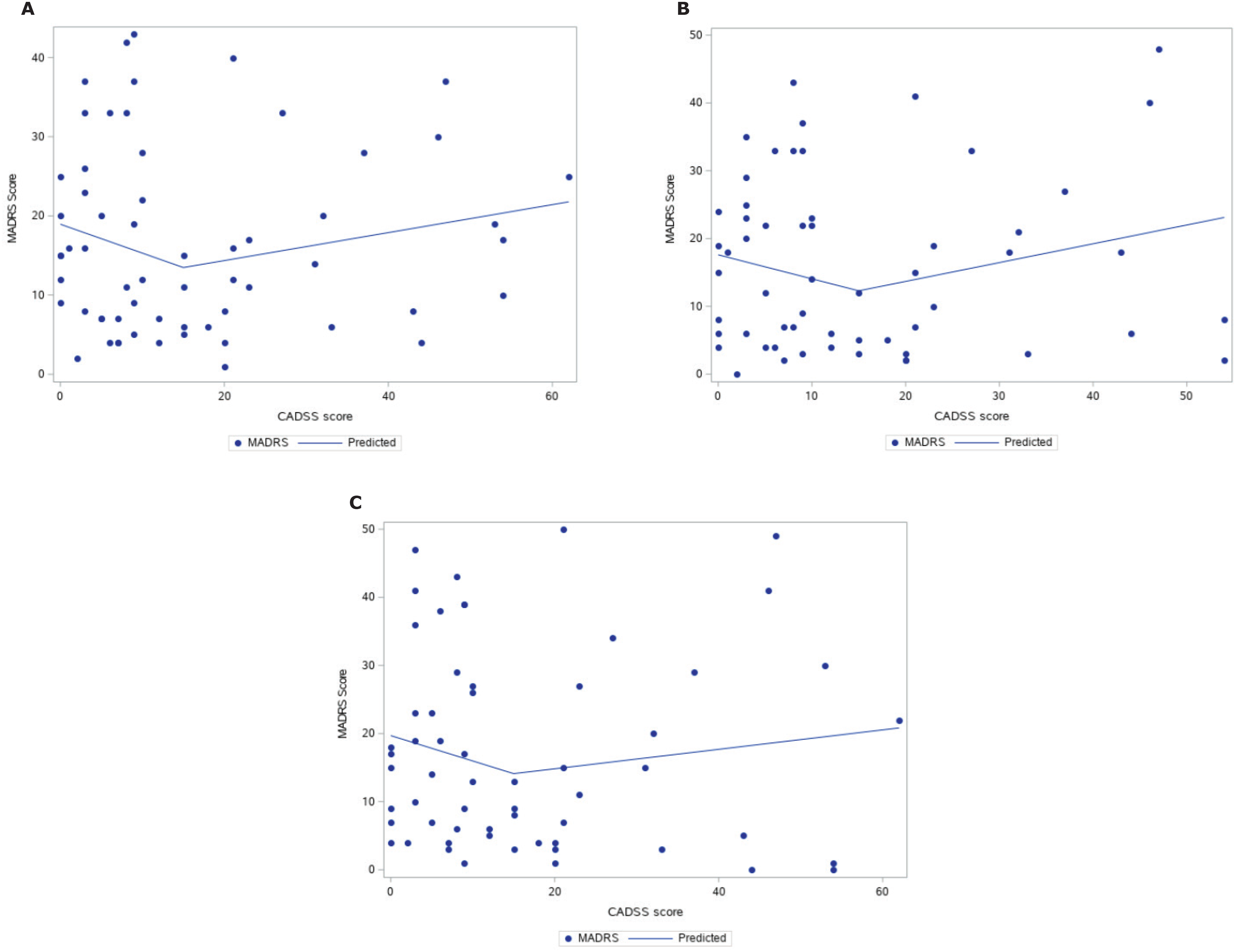
The median CADSS score was 9 (interquartile range [IQR] 16; range 0-62) for the esketamine group and 15 (IQR 26; range 0-54) for the ketamine group, with no statistical difference between the groups (p = 0.4). For CADSS scores of 15 or below, every 1-point increment in the CADSS score was associated with a mean change of −0.5 (SD = 0.25; p = 0.04) in predicted MADRS score from baseline to 24 hours. For CADSS scores greater than 15, there was a mean change of 0.01 (95% confidence interval [95%CI] −0.11 to 0.3; p = 0.3) of predicted MADRS score from baseline to 24 hours for every 1-point increase in CADSS. This relationship is illustrated in Figure 1A. The results for 72 hours (Figure 1B) and 7 days (Figure 1C) following infusion were not significant. Considering CADSS scores of 15 or below, for every 1-point increment in the CADSS score, there was a mean change of −0.5 (SD = 0.28; p = 0.07) in the predicted MADRS score from baseline to 72 hours and a mean change of −0.5 (SD = 0.31; p = 0.10) in the predicted MADRS score from baseline to 7 days.

Relationship between induced dissociative symptoms and predicted depressive symptom severity after ketamine or esketamine infusion. Induced dissociative symptoms were measured with the Clinician-Administered Dissociative States Scale (CADSS) at the 40th minute of ketamine or esketamine infusion. Depressive symptom severity was measured by Montgomery-Åsberg Depression Rating Scale (MADRS) scores. Predicted depressive symptom severity was estimated with a longitudinal fixed-effects model with time (24 hours [A], 72 hours [B] or 7 days [C]), treatment group, and CADSS scores as predictors. Since these terms did not reveal different profiles for the types of ketamine, in terms of p-values, model fit, or Akaike information criterion (AIC), we decided to drop the interactions and treat both as ketamine. The model selected is a piecewise spline with a knot at 15 points on the CADSS scale, based on model fit, AIC, likelihood ratio tests, and p-values for the coefficients.
Discussion
The findings of the present study suggest that the intensity of dissociative symptoms induced by both racemic ketamine and esketamine is associated with the antidepressant effects observed 24 hours after infusion. This relationship was similar in the ketamine and esketamine groups. Although induced dissociation may be a clinical marker of the antidepressant effect of ketamine and esketamine, this evidence was restricted to those with CADSS scores up to 15. To our knowledge, this is the first study to identify a specific cutoff point for the relationship between dissociation and the changes in depressive symptoms induced by different enantiomeric forms of ketamine.
Luckenbaugh et al.19 carried out a study with 108 patients diagnosed with TRD or bipolar disorder to evaluate possible predictors of antidepressant efficacy after ketamine use (0.5 mg/kg by intravenous infusion over 40 minutes). They showed a significant association between increased CADSS scores at 40 minutes and antidepressant efficacy measured by Hamilton Depression Rating Scale (HDRS) scores at 230 minutes and 7 days, but not at 24 hours. Niciu et al.32 extended these findings by examining specific CADSS subscale scores (depersonalization, derealization, and amnesia) for 126 patients suffering from a major depressive episode (both unipolar and bipolar disorders), who also received a single (0.5 mg/kg intravenous [i.v.]) ketamine infusion. The results demonstrated that depersonalization was positively related to antidepressant effects. It should be noted, however, that both studies have limitations in respect to the highly heterogeneous population. Most recently, Phillips et al.20 assessed dissociation after infusion of 0.5 mg/kg of ketamine in 22 participants with TRD. They found a significant association between antidepressant response and variation on CADSS scores at 24 hours post-infusion. Based on an analysis of data from a phase 3, randomized withdrawal (maintenance-of-effect) study of intranasal esketamine, an advisory committee to the US Food and Drug Administration (FDA) concluded that dissociative symptoms are associated with a delay in depression relapse. However, their analysis could not determine whether this association was due to an unblinding effect or to a direct antidepressant effect linked to dissociation.33
The relationship between ketamine-induced dissociation and antidepressant response is not clear, as shown by studies with contrasting results. Valentine et al.34 found no association between an increase in CADSS scores and antidepressant effects after one intravenous ketamine infusion (0.5 mg/kg) in 10 subjects with MDD. Lapidus et al.35 showed no association between dissociation intensity after administration of intranasal ketamine and antidepressant effects in 18 participants with depression who had failed at least one prior antidepressant trial. A recent study conducted with 99 participants with TRD also failed to show an association between CADSS scores and improvement in HDRS scores on day 1 and day 3.18 Subjects were assigned to one of five arms, either to receive a single dose of ketamine 0.1 mg/kg i.v., a single dose of ketamine 0.2 mg/kg i.v., a single dose of ketamine 0.5 mg/kg i.v., a single dose of ketamine 1 mg/kg i.v., or a single dose of midazolam 0.045 mg/kg i.v. (active placebo). Only the participants who received 0.5 mg/kg (n = 22) and 1.0 mg/kg of ketamine (n = 20) had a significant increase in CADSS scores, which could have affected the posterior analysis. A systematic review, including 17 studies of patients with depression, also did not find an association between CADDS and antidepressant response.36
Two more recent studies have analyzed this relationship in multiple-dose treatments. Wlodarczyk et al.37 found no association in a study with eight doses of intravenous ketamine (0.5 mg/kg) in 49 inpatients with TRD or bipolar disorder. Chen et al.22 published the first results concerning esketamine induced dissociation. They analyzed data from three Phase III trials of multiple doses of intranasal esketamine and did not find a correlation between dissociation and antidepressant effects. These aforementioned conflicting results regarding the relationship between dissociation and antidepressant action were similar in the fact that they all adopted linear statistical analysis. Since it is unlikely that the psychometric variables show a linear relationship throughout the assessment, as required by Pearson's correlation, or even a monotonic relationship, as assumed by Spearman's correlation, nonlinear exploratory analysis may prove useful in future studies in the area.
There are some possible explanations for our result. There is evidence that dissociative symptoms correlate with blood ketamine levels.38,39 However, the correlation between blood ketamine/esketamine levels and therapeutic efficacy may be encompassed within a therapeutic window for ketamine/esketamine that has not been defined yet.40 Singh et al.11 showed that lower doses of esketamine (0.2 mg/kg versus 0.4 mg/kg i.v.) have equivalent efficacy but better tolerability. The therapeutic windows for other drugs have been established, but initial adjustments were necessary. It is now well known that higher doses of first-generation antipsychotics only induce more extrapyramidal effects without increasing efficacy for controlling psychotic symptoms.41 The antidepressant response to nortriptyline also has a specific window and there is a curved relationship between blood levels and efficacy, meaning that a level that is too low or too high can compromise response.42 We hypothesize that a similar phenomenon may happen with ketamine/esketamine.
Another aspect to consider is the influence of the psychoactive state as an inherent part of the antidepressant effect, as is often credited to the therapeutic effects of serotonergic psychedelics such as psilocybin, lysergic acid diethylamide (LSD), dimethyltryptamine (DMT), and ayahuasca.43 The CADSS is designed to assess dissociation as an adverse effect, which can be experienced by some individuals in a qualitatively negative way, especially at higher levels, and this could also influence our findings. One study showed that ketamine non-responders had significantly higher scores than responders in the "anxious ego-disintegration" 5-Dimensional Altered State of Consciousness Rating Scale (5D-ASC) subscale, but another study, however, did not find a significant correlation between 5D-ASC dimensions and MADRS percentage change.44,45 Ketamine/esketamine can also induce other acute psychoactive effects, which are not well captured by the CADSS, such as mystical experiences,46 characterized by feelings of oneness, experiences of joy, sacredness or holiness, and acknowledging that the experience provides a new understanding of the reality.47 A study that used ketamine to treat cocaine addiction showed that mystical experiences, measured by the Hood Mysticism Scale, mediated therapeutic efficacy.48 In this study, the dissociative symptoms assessed by CADSS were associated with but did not mediate therapeutic efficacy.
One challenge to this relationship between dissociation and the antidepressant effect of ketamine is the possible role of R(-)-ketamine (arketamine). Animal studies49,50 and only one study in humans51 suggested that use of arketamine would produce an antidepressant effect without occurrence of psychotomimetic effects. Indeed, many ketamine or esketamine responders do not experience drug provoked dissociation.22 One possible explanation is that dissociative experiences or other acute psychoactive effects induced by ketamine/esketamine may have an additional antidepressant effect, as occurs with serotonergic psychedelics. Regardless, dissociation may be important as a cheap and safe clinical predictor of treatment efficacy, even if it is not important as a mediator of efficacy.
Limitations
These findings should be interpreted with caution, as our study had several limitations. Firstly, the results presented in this study were from a secondary analysis. The original study was not designed to assess the relationship between dissociation induced by ketamine or esketamine and their antidepressant effects as the main outcome. Secondly, there may be confounding variables for this relationship that were not controlled for in this study, such as pharmacokinetic measures and personality disorders. To conduct the study in a naturalistic way, a diagnosis of a personality disorder was not an exclusion criterion in the protocol. Since this variable was not evaluated, it was not possible to control for it. Most studies do not exclude comorbid BPD and no studies have controlled pharmacokinetic measures for this relationship.
Conclusion
Our study suggests a positive relationship between dissociation intensity, measured by CADSS, and antidepressant effect 24 hours after ketamine and esketamine infusion for patients with CADSS scores of up to 15 points. By identifying the cutoff point for the relationship between dissociation and response, this study may enable future investigators to pursue a therapeutic window for ketamine/esketamine. We suggest that further studies adjust this relationship for potential confounding variables.
Acknowledgements
This work was supported by the public research-funding program Programa de Pesquisa para o SUS (PPSUS/BA research grant number 003/2017). Additionally, the two university hospitals involved provided necessary hospital structure, medications, and human resources.
Acioly L. T. Lacerda has received grants from Conselho Nacional de Desenvolvimento Científico e Tecnológico (CNPq) and Fundação de Amparo à Pesquisa do Estado de São Paulo (FAPESP). Lucas C. Quarantini has received research fees from Fundação Baiana de Infectologia.
The authors would like to thank Rodrigo L. Alves, Jessica P. Matos, and Maria São Pedro for their technical assistance. We are also grateful to Ângela Tavares Nunes and Laisa Cristian Vieira Pereira.
References
- 1 World Health Organization (WHO). Depression and other common mental disorders global health estimates. Geneva: WHO; 2017.
- 2 Trivedi MH, Daly EJ. Measurement-based care for refractory depression: a clinical decision support model for clinical research and practice. Drug Alcohol Depend. 2007;88:S61-71.
- 3 Adli M, Bauer M, Rush AJ. Algorithms and collaborative-care systems for depression: are they effective and why? A systematic review. Biol Psychiatry. 2006;59:1029-38.
- 4 Fava M, Davidson KG. Definition and epidemiology of treatment-resistant depression. Psychiatr Clin North Am. 1996;19:179-200.
- 5 Rush A. Acute and longer-term outcomes in depressed outpatients requiring one or several treatment steps: A STAR*D report. Am J Psychiatry. 2006;163:1905.
- 6 Gaynes BN, Warden D, Trivedi MH, Wisniewski SR, Fava M, Rush AJ. What did STAR*D teach us? Results from a large-scale, practical, clinical trial for patients with depression. Psychiatr Serv Wash DC. 2009;60:1439-45.
- 7 Canuso CM, Singh JB, Fedgchin M, Alphs L, Lane R, Lim P, et al. Efficacy and safety of intranasal esketamine for the rapid reduction of symptoms of depression and suicidality in patients at imminent risk for suicide: results of a double-blind, randomized, placebo-controlled study. Am J Psychiatry. 2018;175:620-30.
- 8 Correia-Melo FS, Argolo FC, Araújo-de-Freitas L, Leal GC, Kapczinski F, Lacerda AL, et al. Rapid infusion of esketamine for unipolar and bipolar depression: a retrospective chart review. Neuropsychiatr Dis Treat. 2017;13:1627-32.
- 9 Correia-Melo FS, Leal GC, Vieira F, Jesus-Nunes AP, Mello RP, Magnavita G, et al. Efficacy and safety of adjunctive therapy using esketamine or racemic ketamine for adult treatment-resistant depression: a randomized, double-blind, non-inferiority study. J Affect Disord. 2020;264:527-34.
- 10 Leal GC, Bandeira ID, Correia-Melo FS, Telles M, Mello RP, Vieira F, et al. Intravenous arketamine for treatment-resistant depression: open-label pilot study. Eur Arch Psychiatry Clin Neurosci. 2021;271:577-82.
- 11 Singh JB, Fedgchin M, Daly E, Xi L, Melman C, De Bruecker G, et al. Intravenous esketamine in adult treatment-resistant depression: a double-blind, double-randomization, placebo-controlled study. Biol Psychiatry. 2016;80:424-31.
- 12 Wan LB, Levitch CF, Perez AM, Brallier JW, Iosifescu DV, Chang LC, et al. Ketamine safety and tolerability in clinical trials for treatment-resistant depression. J Clin Psychiatry. 2015;76:247-52.
- 13 Swainson J, McGirr A, Blier P, Brietzke E, Richard-Devantoy S, Ravindran N, et al. The Canadian Network for Mood and Anxiety Treatments (CANMAT) task force recommendations for the use of racemic ketamine in adults with major depressive disorder. Can J Psychiatry. 2021;66:113-25.
- 14 Traynor K. Esketamine nasal spray approved for treatment-resistant depression. AM J Health SYST PHARM. 2019;76:573.
- 15 Niciu MJ, Luckenbaugh DA, Ionescu DF, Guevara S, Machado-Vieira R, Richards EM, et al. Clinical predictors of ketamine response in treatment-resistant major depression. J Clin Psychiatry. 2014;75:e417-23.
- 16 Iadarola ND, Niciu MJ, Richards EM, Vande Voort JL, Ballard ED, Lundin NB, et al. Ketamine and other N-methyl-D-aspartate receptor antagonists in the treatment of depression: a perspective review. Ther Adv Chronic Dis. 2015;6:97-114.
- 17 Pennybaker SJ, Niciu MJ, Luckenbaugh DA, Zarate CA. Symptomatology and predictors of antidepressant efficacy in extended responders to a single ketamine infusion. J Affect Disord. 2017;208:560-6.
- 18 Fava M, Freeman MP, Flynn M, Judge H, Hoeppner BB, Cusin C, et al. Double-blind, placebo-controlled, dose-ranging trial of intravenous ketamine as adjunctive therapy in treatment-resistant depression (TRD). Mol Psychiatry. 2020;25:1592-603.
- 19 Luckenbaugh DA, Niciu MJ, Ionescu DF, Nolan NM, Richards EM, Brutsche NE, et al. Do the dissociative side effects of ketamine mediate its antidepressant effects? J Affect Disord. 2014;159:56-61.
- 20 Phillips JL, Norris S, Talbot J, Birmingham M, Hatchard T, Ortiz A, et al. Single, repeated, and maintenance ketamine infusions for treatment-resistant depression: a randomized controlled trial. Focus. 2020;18:236-43.
- 21 Mathai DS, Meyer MJ, Storch EA, Kosten TR. The relationship between subjective effects induced by a single dose of ketamine and treatment response in patients with major depressive disorder: a systematic review. J Affect Disord. 2020;264:123-9.
- 22 Chen G, Chen L, Zhang Y, Li X, Lane R, Lim P, et al. Relationship between dissociation and antidepressant effects of esketamine nasal spray in patients with treatment-resistant depression. Int J Neuropsychopharmacol. 2022;25:269-79.
- 23 Correia-Melo FS, Leal GC, Carvalho MS, Jesus-Nunes AP, Ferreira CBN, Vieira F, et al. Comparative study of esketamine and racemic ketamine in treatment-resistant depression: protocol for a non-inferiority clinical trial. Medicine (Baltimore). 2018;97:e12414.
- 24 Amorim P. Mini International Neuropsychiatric Interview (MINI): validação de entrevista breve para diagnóstico de transtornos mentais. Braz J Psychiatry. 2000;22:106-15.
- 25 McIntyre RS, Filteau MJ, Martin L, Patry S, Carvalho A, Cha DS, et al. Treatment-resistant depression: definitions, review of the evidence, and algorithmic approach. J Affect Disord. 2014;156:1-7.
- 26 Bremner JD, Krystal JH, Putnam FW, Southwick SM, Marmar C, Charney DS, et al. Measurement of dissociative states with the clinician-administered dissociative states scale (CADSS). J Trauma Stress. 1998;11:125-36.
- 27 DiazGranados N, Ibrahim LA, Brutsche NE, Ameli R, Henter ID, Luckenbaugh DA, et al. Rapid resolution of suicidal ideation after a single infusion of an N-methyl-D-aspartate antagonist in patients with treatment-resistant major depressive disorder. J Clin Psychiatry. 2010;71:1605-11.
- 28 Murrough JW, Iosifescu DV, Chang LC, Al Jurdi RK, Green CE, Perez AM, et al. Antidepressant efficacy of ketamine in treatment-resistant major depression: a two-site randomized controlled trial. Am J Psychiatry. 2013;170:1134-42.
- 29 Zarate CA, Singh JB, Carlson PJ, Brutsche NE, Ameli R, Luckenbaugh DA, et al. A randomized trial of an N-methyl-D-aspartate antagonist in treatment-resistant major depression. Arch Gen Psychiatry. 2006;63:856-64.
- 30 Montgomery SA, Åsberg M. A new depression scale designed to be sensitive to change. Br J Psychiatry. 1979;134:382-9.
-
31 R Core Team. R: a language and environment for statistical computing [Internet]. 2015 Feb 10 [cited 2024 apr 10]. www.gbif.org/tool/81287/r-a-language-and-environment-for-statistical-computing
» www.gbif.org/tool/81287/r-a-language-and-environment-for-statistical-computing - 32 Niciu MJ, Shovestul BJ, Jaso BA, Farmer C, Luckenbaugh DA, Brutsche NE, et al. Features of dissociation differentially predict antidepressant response to ketamine in treatment-resistant depression. J Affect Disord. 2018;232:310-5.
-
33 Food and Drug Administration (FDA). Joint Meeting of the Psychopharmacologic Drugs Advisory Committee and the Drug Safety and Risk Management Advisory Committee [Internet]. 2019 Jun 02 [cited 2022 Nov 16]. Available from: https://public4.pagefreezer.com/content/1740341363638/FDA/04-03-2022T19:30/ https://www.fda.gov/media/121376/download
» https://public4.pagefreezer.com/content/1740341363638/FDA/04-03-2022T19:30/» https://www.fda.gov/media/121376/download - 34 Valentine GW, Mason GF, Gomez R, Fasula M, Watzl J, Pittman B, et al. The antidepressant effect of ketamine is not associated with changes in occipital amino acid neurotransmitter content as measured by [1H]-MRS. Psychiatry Res. 2011;191:122-7.
- 35 Lapidus KAB, Levitch CF, Perez AM, Brallier JW, Parides MK, Soleimani L, et al. A randomized controlled trial of intranasal ketamine in major depressive disorder. Biol Psychiatry. 2014;76:970-6.
- 36 Grabski M, Borissova A, Marsh B, Morgan CJA, Curran HV. Ketamine as a mental health treatment: are acute psychoactive effects associated with outcomes? A systematic review. Behav Brain Res. 2020;392:112629.
- 37 Włodarczyk A, Cubała WJ, Gałuszko-Węgielnik M, Szarmach J. Dissociative symptoms with intravenous ketamine in treatment-resistant depression exploratory observational study. Medicine (Baltimore). 2021;100:e26769.
- 38 Glue P, Neehoff S, Sabadel A, Broughton L, Le Nedelec M, Shadli S, et al. Effects of ketamine in patients with treatment-refractory generalized anxiety and social anxiety disorders: exploratory double-blind psychoactive-controlled replication study. J Psychopharmacol (Oxf). 2020;34:267-72.
- 39 Xu Y, Hackett M, Carter G, Loo C, Galvez V, Glozier N, et al. Effects of low-dose and very low-dose ketamine among patients with major depression: a systematic review and meta-analysis. Int J Neuropsychopharmacol. 2016;19:pyv124.
- 40 Kim JW, Monteggia LM. Increasing doses of ketamine curtail antidepressant responses and suppress associated synaptic signaling pathways. Behav Brain Res. 2020;380:112378.
- 41 Kapur S, Zipursky R, Jones C, Remington G, Houle S. Relationship between dopamine D2 occupancy, clinical response, and side effects: a double-blind PET study of first-episode schizophrenia. Am J Psychiatry. 2000;157:514-20.
- 42 Asberg M, Cronholm B, Sjoqvist F, Tuck D. Relationship between plasma level and therapeutic effect of nortriptyline. Br Med J. 1971;3:331-4.
- 43 Ballard ED, Zarate CA Jr. The role of dissociation in ketamine's antidepressant effects. Nat Commun. 2020;11:6431.
- 44 Aust S, Gärtner M, Basso L, Otte C, Wingenfeld K, Chae WR, et al. Anxiety during ketamine infusions is associated with negative treatment responses in major depressive disorder. Eur Neuropsychopharmacol J Eur Coll Neuropsychopharmacol. 2019;29:529-38.
- 45 Vidal S, Gex-Fabry M, Bancila V, Michalopoulos G, Warrot D, Jermann F, et al. Efficacy and safety of a rapid intravenous injection of ketamine 0.5 mg/kg in treatment-resistant major depression: an open 4-week longitudinal study. J Clin Psychopharmacol. 2018;38:590-7.
- 46 van Schalkwyk GI, Wilkinson ST, Davidson L, Silverman WK, Sanacora G. Acute psychoactive effects of intravenous ketamine during treatment of mood disorders: analysis of the clinician administered dissociative state scale. J Affect Disord. 2018;227:11-6.
- 47 Stace WT. Mysticism and philosophy. New York: St. Martin's Press; 1960.
- 48 Dakwar E, Nunes EV, Hart CL, Hu MC, Foltin RW, Levin FR. A sub-set of psychoactive effects may be critical to the behavioral impact of ketamine on cocaine use disorder: results from a randomized, controlled laboratory study. Neuropharmacology. 2018;142:270-6.
- 49 Hashimoto K. Rapid-acting antidepressant ketamine, its metabolites and other candidates: a historical overview and future perspective. Psychiatry Clin Neurosci. 2019;73:613-27.
- 50 Wei Y, Chang L, Hashimoto K. Molecular mechanisms underlying the antidepressant actions of arketamine: beyond the NMDA receptor. Mol Psychiatry. 2022;27:559-73.
- 51 Leal GC, Bandeira ID, Correia-Melo FS, Telles M, Mello RP, Vieira F, et al. Intravenous arketamine for treatment-resistant depression: open-label pilot study. Eur Arch Psychiatry Clin Neurosci. 2021;271:577-82.