 Haloperidol versus second-generation antipsychotics on the cognitive performance of individuals with schizophrenia and related disorders: pairwise meta-analysis of randomized controlled trials
Abstract
Objective Despite previous literature, the superiority of second-generation antipsychotics (SGAs) relative to first-generation antipsychotics – especially haloperidol – on cognitive management in schizophrenia is still controversial. Thus, we aimed to compare the effects of haloperidol versus SGAs on the cognitive performance of individuals with schizophrenia or related disorders.
Methods We conducted an updated systematic review and nine pairwise meta-analyses of double-blinded randomized controlled trials published up to October 30th, 2022, using MEDLINE, Web of Science, and Embase.
Results Twenty-eight trials were included, enrolling 1,932 individuals. Compared to SGAs, haloperidol performed worse on cognitive composite (mean difference [MD] −0.13; 95% confidence interval [95%CI] −0.33 to −0.03), processing speed (MD −0.17; 95%CI −0.28 to −0.07), attention (MD −0.14; 95%CI −0.26 to −0.02), motor performance (MD −0.17; 95%CI −0.31 to −0.03), memory and verbal learning (MD −0.21; 95%CI −0.35 to −0.08), and executive function (MD −0.27; 95%CI −0.43 to −0.11). In contrast, there were no significant differences between SGAs and haloperidol on working memory (MD 0.10; 95%CI −0.08 to 0.27), visual learning (MD 0.08; 95%CI −0.05 to 0.21), social cognition (MD 0.29; 95%CI −0.30 to 0.88), and visuoconstruction (MD 0.17; 95%CI −0.04 to 0.39).
Conclusion Haloperidol had poorer performance in global cognition and in some cognitive domains, but with small effect sizes. Therefore, it was not possible to conclude that haloperidol is certainly worse than SGAs in the long-term cognitive management of schizophrenia.
Keywords:
Cognition; schizophrenia; haloperidol; antipsychotics; meta-analysis
Introduction
Impairments in cognitive functions are considered a central feature and an important predictor of functionality in schizophrenia.1,2 Individuals with schizophrenia are likely to perform poorer in several cognitive domains, including global cognitive scores.3-5 The main challenge is establishing pharmacological treatments that effectively improve or reduce cognitive deficits in psychotic disorders. In the last decades, numerous studies have shown that second-generation antipsychotics (SGAs) enhance cognitive performance in patients with psychosis, with better results when compared to first-generation antipsychotics (FGAs).6-11 Previous meta-analyses have confirmed the superiority of SGAs, but with a modest-to-moderate effect size.12-14
Despite several evidence suggesting SGAs as a better option for long-term treatment in schizophrenia, especially considering their relative superiority to cognitive symptoms, the inferiority of FGAs is still controversial. A meta-analysis published by Mishara and Goldberg15 showed that the continued use of FGAs provided significant gains in multiple cognitive domains. Moreover, more extensive clinical trials have also questioned the cognitive superiority of SGAs. The European First Episode Schizophrenia Trial study (EUFEST) analyzed 498 patients with schizophreniform disorder or first-episode schizophrenia and identified a moderate cognitive improvement in the cognitive tests for both SGAs and FGAs, finding no difference in the magnitude of improvement between haloperidol and SGAs.16 The Clinical Antipsychotic Trials of Intervention Effectiveness (CATIE), a double-blind randomized controlled trial (RCT) with neuropsychological testing of 817 individuals with schizophrenia, showed a similar effect of perphenazine, a FGAs, compared to olanzapine, risperidone, quetiapine, and ziprasidone.17 Therefore, it is unclear the inferiority or non-inferiority of FGAs in cognitive management on psychosis.
Comparing the cognitive effects between FGAs and SGAs is of paramount importance, since both classes were widely used, but with different prevalence around the world. Several low- and middle-income countries keep using FGAs as one of the first options as maintenance treatment in psychotic disorders. The latest World Mental Health Report showed that some SGAs, such as risperidone and clozapine, were only included in less than 35% of national essential medicines lists in low-income countries.18 In Brazil, for instance, haloperidol is the main antipsychotic considered essential medicines for public pharmaceutical assistance in the Brazilian Unified Health System (SUS), a national system that ensures access to medicines and health services for the entire population, especially for people with less financial resources.19 In contrast, SGAs (clozapine, olanzapine, quetiapine, risperidone, and ziprasidone) are considered specialized medications for pharmaceutical assistance, with more restricted access in the Brazilian public health system.19
We previously conducted a systematic review and network meta-analyses to compare the individual effect of 14 antipsychotics on the cognitive performance of individuals with schizophrenia and psychotic disorders.20 In this study, we showed that haloperidol has the poorest outcomes in the treatment of cognitive symptoms, but with small effect sizes when compared to SGAs. Thus, considering these unfavorable – and inconclusive – findings, and the widespread use of haloperidol, we designed an updated, complementary analysis to directly compare the cognitive effects of haloperidol and other antipsychotics in the treatment of schizophrenia. The current study extends our previous analyses by assessing whether haloperidol remains with poorer cognitive outcomes even when compared to all other SGAs pooled together. This strategy aims to assess whether haloperidol should be considered a second-line treatment for the cognitive symptoms of schizophrenia.
Methods
As mentioned above, the present study is a secondary and update analysis of the systematic review and network meta-analyses previously published by our team.20 The present study was already described in the original protocol (PROSPERO, number CRD42019142330).
Systematic review
Search strategies
We conducted the systematic review using three databases: MEDLINE (PubMed), Web of Science, and Embase. We first included all studies published up to November 30th, 2018, and we updated data on October 30th, 2022. The search included the following general terms: schizophrenia, psychosis, mood disorder, bipolar disorder, antipsychotic, cognition, memory, attention, working memory, executive function, neuropsychology, and randomized controlled trial. These terms were expanded by the synonym search, and the specific antipsychotic names were also included. We also analyzed all the bibliographic references of the selected studies and all systematic reviews previously published. We followed the Cochrane Handbook for Systematic Reviews of Interventions21 and the Preferred Reporting Items for Systematic Reviews and Meta-Analyses (PRISMA) guidelines for systematic reviews and meta-analyses.22 We point out that the original search strategy included different psychotic diagnoses to enable comparative analyses between schizophrenia and other disorders. However, in the current analysis, we only included studies related to schizophrenia, excluding studies with patients with bipolar disorder or psychotic depression. The complete search strategies are available in Supplementary Material S1.
Inclusion criteria
We included only double-blind RCTs. All studies analyzed individuals between the ages of 18 and 65 diagnosed with schizophrenia or related disorders (schizoaffective disorder and schizophreniform disorder) according to Diagnostic and Statistical Manual of Mental Disorders 3rd edition (DSM-III), 4th edition (DSM-IV), or 4th edition Text Revision (DSM-IV-TR) criteria. We included trials with a follow-up greater than or equal to 4 weeks that compared haloperidol with one or more other antipsychotics – all administered orally. We included studies that measured cognitive performance using neuropsychological tests that considered at least one of the following criteria: (1) the test is completely described in the main compendium of neuropsychology,23,24 (2) the test is validated in the main cognitive assessment batteries in schizophrenia,25-28 and (3) the test presents a detailed description of its procedures in an article published in a high impact journal.
Exclusion criteria
We excluded unblinded trials, co-intervention or adjunct therapy studies, studies with cognitive assessments performed by questionnaires or psychometric scales, trials with participants with neuropsychiatric comorbidities (attention-deficit/hyperactivity disorder, intellectual developmental disorder, and dementia), trials that included individuals with substance-use disorder, and studies that solely examined injectable antipsychotics. We also excluded studies that compared only SGAs versus SGAs, only FGAs versus FGAs, and trials that compared a unique antipsychotic with placebo.
Studies’ selection
The screening phase (title and abstracts reading) and eligibility phase (full article reading) were executed independently by two authors (DPB and TBB), and the inconsistencies were analyzed by a third author (FDRP). Data extraction was also carried out by two independent researchers (DPB and GPN). The selections of the cognitive tests were conducted by three trained neuropsychologists (FDRP, DSM, and LSC). The cognitive tests were allocated on cognitive domains by two investigators (FDRP and DSM), also independently, according to the major neuropsychology compendiums,23,24 the main cognitive assessment batteries in schizophrenia,25-28 and the test definition present in its validation articles (Supplementary Material S2). A third investigator (LSC) analyzed the divergences. We completed the original systematic review in November 2018, but the final analyses were conducted in October 2022 after the update.
Meta-analyses
Pairwise meta-analyses were carried out to compare the effect of haloperidol and all other antipsychotic agents on cognition. Antipsychotics were primarily classified into FGAs and SGAs,29 but we have included drugs from both types. We considered the following cognitive domains: attention, executive function, memory and verbal learning, motor performance, processing speed, social cognition, visual learning, visuoconstruction, and working memory. A cognitive composite score was estimated as described below. The selection of the cognitive domains was based on scientific literature.23-28
We performed one meta-analysis for each cognitive domain through the results of cognitive tests (means and standard deviations [SD]) applied in the selected studies. We contacted the study's author in the absence of any published data, and we performed imputation data when the dispersion measures were not available (e.g., SD). The imputation data considered the dispersion measures presented in other included studies (Supplementary Material S3). Studies that evaluated the same sample were grouped as a "single study" to avoid duplication in the statistical analysis. Besides, when different neuropsychological tests referring to a single cognitive domain were applied to the same sample, we considered only the cognitive test with the largest sample size. More details are also presented in the Supplementary Material S3.
In meta-analyses with continuous outcomes, there are different ways of choosing which variable (measure) of a study (trial) will be used for the meta-analysis. We considered the difference (subtraction) between the mean obtained at the study's endpoint and the mean obtained at the study's baseline (Δ or change from baseline) as the measure to be meta-analyzed. We estimated one Δ for each cognitive test applied in each study's arm. The Δ was converted into z-scores (standardized Δ) to allow the results of different tests (with different metrics and units of measure) to be later combined into a single result from a cognitive domain. The SD of Δ was estimated with a correlation index of 0.5.30
After measuring the standardized Δ, we calculated the cognitive domain score through the weighted arithmetic average of the standardized Δs, weighted for the number of patients (n) submitted to each test. This weighting was used because we consider that respective tests equally evaluate the cognitive domain. The association between neuropsychological tests and cognitive domains is described in Supplementary Material S2.
We estimated a composite cognitive score for studies that have not previously calculated this measure. The composite score was estimated through the simple arithmetic average of the domains included in the study, giving the same weight to all domains. The composite score was only estimated in studies that evaluated at least the following domains: attention, executive function, memory and verbal learning, processing speed, and working memory. More details are presented in the Supplementary Material S4.
Our meta-analyses were performed in the software R (version 4.2.1), using the package "meta." We used the inverse variance method and the random effect model to calculate the effect sizes, with a 95% confidence interval (95%CI). The summary measures were estimated by mean difference (MD). We did not use the standardized mean difference (SMD) because the results of cognitive tests were previously standardized in z-scores (standardized Δ). The homogeneity was assessed by the Q and I² tests and the similarity was analyzed based on clinical characteristics of the included studies (Supplementary Table S1, available as an Excel file for download). We did not estimate publication bias because none of the direct comparisons included ten or more trials.31 The results were presented in forest plots.
The risk of bias and the quality of evidence were assessed by the Cochrane risk of bias 1.0 tool30 (Supplementary Material S5). That tool was applied by two independent authors and the disagreements were solved through discussion. The analysis was completed in October 2022.
Results
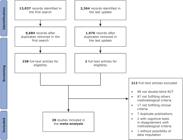
The study selection process is shown in Figure 1, the list of included studies is presented in Table 1, and the complete extraction table is presented in Supplementary Table S1 (available as Excel file for download). Briefly, we included 13,037 records in the first search and selected 28 studies for the meta-analysis, comprising 21 independent randomized double-blind controlled trials with 1,932 individuals. In update review, we extracted 2,364 more records; from these, only two articles were included to full-text reading, but none was selected for analysis – we did not find RCTs published from 2020 onwards that met our inclusion criteria. As to the selected studies, 67.29% were multicentered, 64.29% presented a follow-up under 6 months, 92.30% received industry sponsorship, and 89.29% allowed the sporadic use of anticholinergic during the study. Besides, 41.66% included inpatients exclusively, 29.17% included outpatients exclusively, and 29.17% included in and outpatients. We only found RCTs comparing haloperidol versus SGAs. There were no direct comparisons between haloperidol and FGAs.
As to the complete sample, 81.19% had a diagnosis of schizophrenia (11.83% had schizoaffective disorder and 6.98% had schizophreniform disorder), 82.14% had previous psychotic episodes, 85.71% had previous history of antipsychotic use, and 67.86% were considered non-refractory to treatment. Moreover, the mean duration of illness was 12.92 years (SD 6.97 years) and the mean age at onset of illness was 24.08 years (SD 7.39 years). Regarding the symptoms’ severity, the sample had an average score of 81.78 (SD 13.98) on Positive and Negative Syndrome Scale (PANSS). We point out that the means described above were estimated considering only the studies that present the respective data. Studies without available data were excluded from the calculation of the percentages and means.
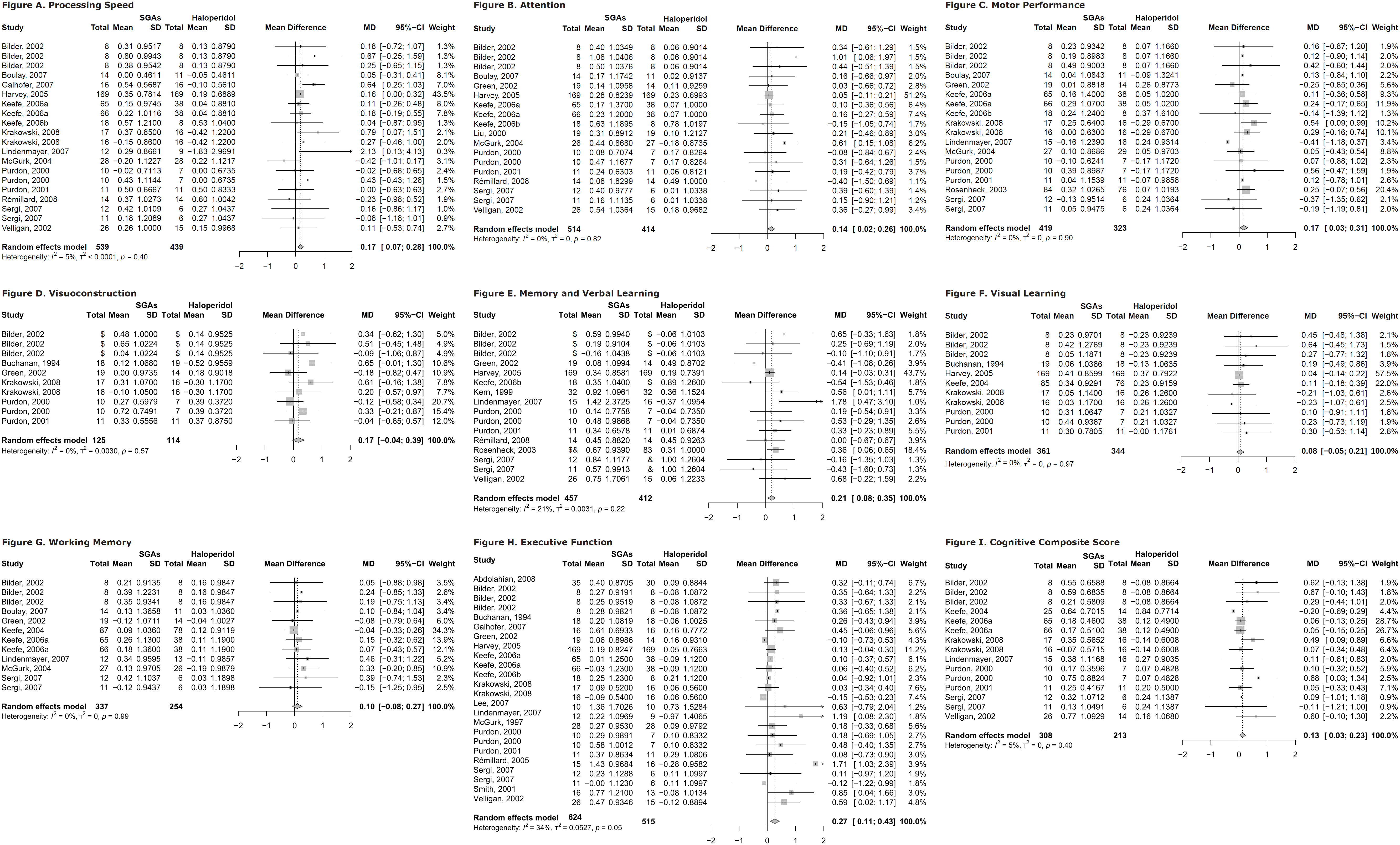
The main findings are presented below. The forest plots are presented in Figure 2.
Forest plots for cognitive domains and cognitive composite score. Each figure is a forest plot comparing atypical antipsychotics versus haloperidol in a respective cognitive domain, namely: processing speed (A), attention (B), motor performance (C), visuoconstruction (D), memory and verbal learning (E), visual learning (F), working memory (G), executive function (H), and cognitive composite score (I). In forest plots, each row represents an included clinical trial (for trials with only two arms). When the trial has three or more arms (studies that tested three or more drugs separately), each row represents a possible comparison between the study's drugs, making the same trial occupy more than one row. For trials with three or more arms, all possible pairwise comparisons (between the drugs of each arm) must be performed in the meta-analysis. However, in our analysis, we considered only comparisons that included haloperidol and atypical agent. For instance, if a clinical trial included haloperidol, olanzapine, and quetiapine, we only considered haloperidol versus olanzapine and haloperidol versus quetiapine comparisons, excluding olanzapine versus quetiapine. For trials with three or more arms, the sample size (n) of each drug in a pairwise comparison is estimated by the ratio (division) between the total number of individuals who used the drug and the number of comparisons involving the respective drug. Hypothetically, in a trial with four arms (A, B, C, D), six comparisons are performed (A-B, A-C, A-D, B-C, B-D, C-D). If 90 subjects received drug A, the sample size (n) of drug A in each comparison (A-B, A-C, and A-D) is 30 (90/30). 95%CI = 95% confidence interval; MD = difference between means (or mean difference); mean = continuous variable considered in the metanalysis estimate; SD = standard deviation; SGA = second-generation antipsychotic; total = number of participants; weight = study’ weight in the metanalysis.
Processing speed
Fourteen trials were included, with 978 individuals. The mean age was 37.44 years (SD 8.75 years) and 74% males. The analysis included six antipsychotics: clozapine, haloperidol, olanzapine, quetiapine, risperidone, and sertindole. SGAs performed better than haloperidol (MD 0.17; 95%CI 0.07-0.28). The sample showed low and non-significant heterogeneity (I² = 5%; p = 0.40). The results are shown in Figure 2A.
Attention
Thirteen trials were included, with 928 individuals. The mean age was 38.26 years (SD 8.86 years) and 72.39% males. The analysis included five antipsychotics: clozapine, haloperidol, olanzapine, quetiapine, and risperidone. SGAs performed better than haloperidol (MD 0.14; 95%CI 0.02-0.26). The sample showed non-significant heterogeneity (I² = 0%; p = 0.82). The results are shown in Figure 2B.
Motor performance
Twelve trials were included, with 742 individuals. The mean age was 38.31 years (SD 8.66 years) and 80.97% males. The analysis included five antipsychotics: clozapine, haloperidol, olanzapine, quetiapine, and risperidone. SGAs performed better than haloperidol (MD 0.17; 95%CI 0.03-0.31). The sample did not show significant heterogeneity (I² = 0%; p = 0.90). The results are shown in Figure 2C.
Visuoconstruction
Six trials were included, with 239 individuals. The mean age was 35.91 years (SD 8.68 years) and 80.78% males. The analysis included five antipsychotics: clozapine, haloperidol, olanzapine, quetiapine, and risperidone. There was no statistically significant difference between the SGAs and haloperidol (MD 0.17; 95%CI −0.04 to 0.39). The sample did not show significant heterogeneity (I² = 0%; p = 0.57). The results are shown in Figure 2D.
Memory and verbal learning
Twelve trials were included, with 869 individuals. The mean age was 38.64 years (SD 8.57 years) and 80.42% males. The analysis included five antipsychotics: clozapine, haloperidol, olanzapine, quetiapine, and risperidone. SGAs performed better than haloperidol (MD 0.21; 95%CI 0.08-0.35). The sample showed low and non-significant heterogeneity (I² = 21%; p = 0.22). The results are shown in Figure 2E.
Visual learning
Seven trials were included, with 705 individuals. The mean age was 32.38 years (SD 8.03 years) and 75.16% males. The analysis included five antipsychotics: clozapine, haloperidol, olanzapine, quetiapine, and risperidone. There was no statistically significant difference between SGAs and haloperidol (MD 0.08; 95%CI −0.05 to 0.21). The sample did not show significant heterogeneity (I² = 0%; p = 0.97). The results are shown in Figure 2F.
Working memory
Eight trials were included, with 591 individuals. The mean age was 39.47 years (SD 8.63 years) and 77.69% males. The analysis included four antipsychotics: clozapine, haloperidol, olanzapine, and risperidone. There was no statistically significant difference between SGAs and haloperidol (MD 0.10; 95%CI −0.08 to 0.27). The sample did not show significant heterogeneity (I² = 0%; p = 0.99). The results are shown in Figure 2G.
Executive functions
Eighteen trials were included, with 1,139 individuals. The mean age was 37.17 years (SD 8.29 years) and 75.91% males. The analysis included six antipsychotics: clozapine, haloperidol, olanzapine, quetiapine, risperidone, and sertindole. SGAs performed better than haloperidol (MD 0.27; 95%CI 0.11-0.43). The sample showed moderate heterogeneity but was not statistically significant (I² = 34%; p = 0.05). The results are shown in Figure 2H.
Social cognition
We found only two clinical trials that met our inclusion criteria. The complete sample (53 subjects) included only three drugs (haloperidol, olanzapine, and risperidone). Therefore, we decided not to perform the meta-analysis for social cognition.
Cognitive composite score
Nine trials were included, with 521 individuals. The mean age was 37.01 years (SD 8.56 years) and 75.76% males. The analysis included five antipsychotics: clozapine, haloperidol, olanzapine, quetiapine, and risperidone. SGAs performed better than haloperidol (MD 0.13; 95%CI 0.03-0.23). The sample showed low and non-significant heterogeneity (I² = 5%; p = 0.40). The results are shown in Figure 2I.
Discussion
This study presents the largest meta-analyses comparing the effect of haloperidol and SGAs on the cognitive performance of individuals with schizophrenia. Our results demonstrated poorer performance of haloperidol on cognitive composite score and in the following domains: processing speed, attention, motor performance, memory and verbal learning, and executive function. However, these comparisons had small effect sizes, and there were no statistically significant differences between haloperidol and SGAs on working memory, visual learning, and visuoconstruction.
Previous meta-analyses of clinical studies demonstrated better results to SGAs on cognitive management of schizophrenia and related disorders. Keefe et al.14 revealed that SGAs are superior to FGAs to improve cognitive functions in individuals with schizophrenia, especially on verbal fluency, digit-symbol substitution, motor functions, and executive functions. Woodward et al.12 also suggested that SGAs are better at improving overall cognitive function, especially processing speed and visual and verbal learning. Guilera et al.56 ratified the SGAs’ superiority on the global cognitive index, processing speed, psychomotricity, and language. Désaméricq et al.13 showed poorer performance of haloperidol on global score (compared to quetiapine, olanzapine, and risperidone), memory (compared to ziprasidone and olanzapine), attention and processing speed (compared to quetiapine, ziprasidone, olanzapine, and amisulpride), and executive function (compared to quetiapine and olanzapine). Other previous reviews also corroborate these findings. Grada and Dinan57 suggested that SGAs had more efficacy in ameliorating inhibition, sustained attention, and set-shifting, all components of executive function. Meltzer et al.58 demonstrated that clozapine – a prototype of SGAs – is especially superior to FGAs in some types of cognition, especially verbal fluency. Lee and Park59 associated SGAs with better performance in memory and attention.
In contrast, two major RCTs questioned the advantages of SGAs in cognitive performance in schizophrenia. The EUFEST trial also found no differences among haloperidol (FGA) and amisulpride, olanzapine, quetiapine, and ziprasidone on a composite cognitive score.16 Despite its large sample size, the EUFEST study had two limitations to be considered: (1) this was an open-label trial, which may have influenced the outcomes; and (2) the cognitive outcomes were assessed by a short cognitive battery, with only five neuropsychological tests, which may not have been able to estimate a global cognition evaluation adequately. The second study was the CATIE trial, that reported no differences in effectiveness between perphenazine (FGA) and olanzapine, quetiapine, risperidone, and ziprasidone (SGAs) on a cognitive composite score, processing speed, reasoning, working memory, verbal memory, and vigilance.17
Although our study had shown some unfavorable results for haloperidol, our meta-analysis did not find a worse performance of haloperidol on working memory, visual learning, and visuoconstruction. Previously, Woodward et al.12 and Guilera et al.56 also did not identify the superiority of SGAs on working memory, visual learning, and visuospatial processing, while Désaméricq et al.13 did not test these respective domains. However, our findings are not theoretically grounded in preclinical studies, which tend to demonstrate poor haloperidol results in working memory tasks.60-63 Regarding social cognition, it was not possible to perform a meta-analysis because we found only two double-blind RCTs testing antipsychotics’ effects in this domain. A previous study analyzed 15 articles and did not find any conclusive results on the possibility that antipsychotics could specifically facilitate social recovery.64 About visuoconstruction, we did not find previous systematic reviews to comparatively evaluate our results.
Our findings should be interpreted considering our limitations and methodological choices. First, in our study, haloperidol showed unfavorable results with small effect sizes. This raises a question about the clinical relevance of our findings, as small statistically significant differences may not be clinically significant. Second, the present study is not theoretically a post-hoc analysis, as it was described a priori as a secondary objective of the systematic review in the original protocol. However, we emphasize that all outcomes from secondary objectives have less methodological robustness.
Thirdly, we did not find enough data to assess the dose-dependent effect of haloperidol on cognition (in comparison with SGAs). In previous studies comparing SGAs versus FGAs, there is a recurrent concern that the superiority of the SGAs is justified by the higher doses of the FGAs commonly used in these trials.65 However, a previous meta-analysis has already shown that the negative effects of high-dose haloperidol do not explain the cognitive improvements observed with SGAs.66 Unfortunately, our review failed to detect the doses’ influence because most of the included trials (19/28 studies) allowed a wide range of haloperidol doses in their samples. Therefore, these trials could not be classified as low-dose (< 12 mg/day) or high-dose (≥ 12 mg/day), which did not enable subgroup analyses. Furthermore, more than half of these trials (15/28) did not present their average antipsychotic daily dose (mg per day), which also did not allow the conduction of secondary analyses.
Fourth, our meta-analyses included studies with a minimum follow-up of 4 weeks, which may be considered short by some authors, but appropriate for others. The minimum follow-up period required for clinical trials to adequately assess the cognitive effects of antipsychotics in schizophrenia is unclear. While Harvey and Keefe35 indicate that a 4-week follow-up is sufficient to demonstrate the cognitive effect of antipsychotics and to exclude the effects of previously used medications, the Measurement and Treatment Research to Improve Cognition in Schizophrenia (MATRICS) group suggested longer follow-ups.67 Despite the divergences present in the literature, our study is in accordance with the above assumptions.
Fifth, our meta-analyses included individuals at different stages of schizophrenia, indiscriminately, with no specific analysis for each stage of the disease. Thus, our results did not consider the disease's severity as a moderating factor in the effect of antipsychotics on cognition. We could not avoid this limitation because most selected clinical trials gathered patients indistinctly, combining individuals in early stages of the disease and chronic patients. Sixth, we cannot exclude anticholinergics’ influence in our results because most studies did not describe how these drugs were used. This is a relevant limitation, as anticholinergics are associated with cognitive impairment, and the concomitant use of these drugs is more associated with FGAs.68
Seventh, we did not consider injectable drugs, such as depot preparations, in our analysis due to pharmacokinetic and pharmacodynamic differences between oral and injectable routes of administration.29 In the future, we plan to perform additional analyses focusing exclusively on injectable medications. Eighth, our results may have been significantly influenced by industry bias, as most studies we analyzed were sponsored by pharmaceutical companies. It is important to emphasize that industry bias can exert a powerful influence on the research process.69 Finally, due to the small number of RCT designed to assess cognition as a primary outcome in schizophrenia, the results of our meta-analyses are based on secondary outcomes, which reduces the statistical power of our findings.
Our meta-analyses respected statistical and methodological homogeneity assumptions. All meta-analyses obtained results without statistically significant heterogeneity (Q test with p < 0.05), and our screening was able to select trials with methodological and clinical similarities: we only included double-blind RCT, with subjects with a clear diagnosis of schizophrenia, and with no other neuropsychiatric comorbidities, including substance use disorder.
In conclusion, our meta-analyses showed a tendency for haloperidol to present less expressive benefits in the long-term cognitive management in schizophrenia when compared to SGAs. However, it was not possible to conclude that haloperidol is certainly worse than SGAs, because our findings showed small effect sizes, which may not be clinically relevant. Despite our methodological limitations, our results reiterate previous evidence that suggests a possible superiority of SGAs on processing speed, attention, motor performance, memory and verbal learning, executive function, and composite cognition.
Acknowledgements
This study received financial support from Coordenação de Aperfeiçoamento de Pessoal de Nível Superior (CAPES; Finance Code 001).
-
This study was presented as a poster titled "Haloperidol versus second-generation antipsychotics on cognitive performance of individuals with schizophrenia and related disorders: paired meta-analysis of randomized controlled trials," at III Simpósio Gaúcho de Farmacologia, Universidade Federal do Rio Grande do Sul, on November 10th, 2022.
References
- 1 Harvey PD, Parrella M, White L, Mohs RC, Davis KL. Convergence of cognitive and functional decline in poor outcome schizophrenia. Schizophr Res. 1999;35:77-84.
- 2 Sheffield JM, Karcher NR, Barch DM. Cognitive Deficits in Psychotic Disorders: A Lifespan Perspective. Neuropsychol Rev. 2018;28:509-33.
- 3 Bowie CR, Harvey PD. Cognitive deficits and functional outcome in schizophrenia. Neuropsychiatr Dis Treat. 2006;2:531-6.
- 4 Heinrichs RW, Zakzanis KK. Neurocognitive deficit in schizophrenia: A quantitative review of the evidence. Neuropsychology. 1998;12:426-45.
- 5 Czepielewski LS, Alliende LM, Castañeda CP, Castro M, Guinjoan SM, Massuda R, et al. Effects of socioeconomic status in cognition of people with schizophrenia: Results from a Latin American collaboration network with 1175 subjects. Psychol Med. 2022;52:2177-88.
- 6 Bilder RM, Goldman RS, Volavka J, Czobor P, Hoptman M, Sheitman B, et al. Neurocognitive effects of clozapine, olanzapine, risperidone, and haloperidol in patients with chronic schizophrenia or schizoaffective disorder. Am J Psychiatry. 2002;159:1018-28.
- 7 Harvey PD, Green MF, McGurk SR, Meltzer HY. Changes in cognitive functioning with risperidone and olanzapine treatment: A large-scale, double-blind, randomized study. Psychopharmacology (Berl). 2003;169:404-11.
- 8 Harvey PD, Patterson TL, Potter LS, Zhong K, Brecher M. Improvement in social competence with short-term atypical antipsychotic treatment: A randomized, double-blind comparison of quetiapine versus risperidone for social competence, social cognition, and neuropsychological functioning. Am J Psychiatry. 2006;163:1918-25.
- 9 Harvey PD, Siu CO, Hsu J, Cucchiaro J, Maruff P, Loebel A, et al. Effect of lurasidone on neurocognitive performance in patients with schizophrenia: A short-term placebo- and active-controlled study followed by a 6-month double-blind extension. Eur Neuropsychopharmacol. 2013;23:1373-82.
- 10 Keefe RSE, Seidman LJ, Christensen BK, Hamer RM, Sharma T, Sitskoorn MM, et al. Long-term neurocognitive effects of olanzapine or low-dose haloperidol in first-episode psychosis. Biol Psychiatry. 2006;59:97-105.
- 11 Keefe RSE, Seidman LJ, Christensen BK, Hamer RM, Sharma T, Sitskoorn MM, et al. Comparative effect of atypical and conventional antipsychotic drugs on neurocognition in first-episode psychosis: a randomized, double-blind trial of olanzapine versus low doses of haloperidol. Am J Psychiatry. 2004;161:985-95.
- 12 Woodward ND, Purdon SE, Meltzer HY, Zald DH. A meta-analysis of neuropsychological change to clozapine, olanzapine, quetiapine, and risperidone in schizophrenia. International Journal of Neuropsychopharmacology. 2005;8:457-72.
- 13 Désaméricq G, Schurhoff F, Meary A, Szöke A, Macquin-Mavier I, Bachoud-Levi AC, et al. Long-term neurocognitive effects of antipsychotics in schizophrenia: a network meta-analysis. Eur J Clin Pharmacol. 2014;70:127-34.
- 14 Keefe RSE, Silva SG, Perkins DO, Lieberman JA. The effects of atypical antipsychotic drugs on neurocognitive impairment in schizophrenia: A review and meta-analysis. Schizophr Bull. 1999;25:201-22.
- 15 Mishara AL, Goldberg TE. A meta-analysis and critical review of the effects of conventional neuroleptic treatment on cognition in schizophrenia: opening a closed book. Biol Psychiatry. 2004;55:1013-22.
- 16 Davidson M, Galderisi S, Weiser M, Werbeloff N, Fleischhacker WW, Keefe RS, et al. Cognitive effects of antipsychotic drugs in first-episode schizophrenia and schizophreniform disorder: A randomized, open-label clinical trial (EUFEST). Am J Psychiatry. 2009;166:675-82.
- 17 Keefe RSE, Bilder RM, Davis SM, Harvey PD, Palmer BW, Gold JM, et al. Neurocognitive effects of antipsychotic medications in patients with chronic schizophrenia in the CATIE Trial. Arch Gen Psychiatry. 2007;64:633-47.
-
18 World Health Organization. (2022). World mental health report: transforming mental health for all. World Health Organization. https://apps.who.int/iris/handle/10665/356119.
» https://apps.who.int/iris/handle/10665/356119. - 19 Relação Nacional de Medicamentos Essenciais Rename 2022 [recurso eletrônico] / Ministério da Saúde, Secretaria de Ciência, Tecnologia, Inovação e Insumos Estratégicos em Saúde, Departamento de Assistência Farmacêutica e Insumos Estratégicos. - Brasília: Ministério da Saúde, 2022.
- 20 Baldez DP, Biazus TB, Rabelo-da-Ponte FD, Nogaro GP, Martins DS, Kunz M, et al. The effect of antipsychotics on the cognitive performance of individuals with psychotic disorders: network meta-analyses of randomized controlled trials. Neurosci Biobehav Rev. 2021;126:265-75.
-
21 Higgins JPT, Green S (editors). Cochrane Handbook for Systematic Reviews of Interventions Version 5.1.0. The Cochrane Collaboration, 2011. Available from www.handbook.cochrane.org 2011.
» www.handbook.cochrane.org - 22 Moher D, Liberati A, Tetzlaff J, Altma D. Preferred Reporting Items for Systematic Reviews and Meta-Analyses: The PRISMA Statement. PLoS Med. 2009;6:e1000097.
- 23 Lezak MD, Howieson DB, Bigler ED, Tranel D. Neuropsychological assessment (5th ed.). Oxford University Press. 2012.
- 24 Strauss E, Sherman EMS, Spreen O. A compendium of neuropsychological tests: Administration, norms, and commentary. (3rd ed.). Oxford University Press. 2006.
- 25 Keefe RSE, Mohs RC, Bilder RM, Harvey PD, Green MF, Meltzer HY, et al. Neurocognitive assessment in the clinical antipsychotic trials of intervention effectiveness (CATIE) project schizophrenia trial: Development, methodology, and rationale. Schizophr Bull. 2003;29:45-55.
- 26 Keefe RSE, Goldberg TE, Harvey PD, Gold JM, Poe MP, Coughenour L. The Brief Assessment of Cognition in Schizophrenia: Reliability, sensitivity, and comparison with a standard neurocognitive battery. Schizophr Res. 2004;68:283-97.
- 27 Nuechterlein KH, Green MF, Kern RS, Baade LE, Barch DM, Cohen JD, et al. The MATRICS consensus cognitive battery, part 1: Test selection, reliability, and validity. Am J Psychiatry. 2008;165:203-13.
- 28 Pietrzak RH, Olver J, Norman T, Piskulic D, Maruff P, Snyder PJ. A comparison of the CogState Schizophrenia Battery and the Measurement and Treatment Research to Improve Cognition in Schizophrenia (MATRICS) Battery in assessing cognitive impairment in chronic schizophrenia. J Clin Exp Neuropsychol. 2009;31:848-59.
- 29 Stahl SM. Stahl's essential psychopharmacology : Neuroscientific basis and practical applications. Cambridge: Cambridge University Press. 2008.
- 30 Higgins JPT, Altman DG, Gøtzsche PC, Jüni P, Moher D, Oxman AD, et al. The Cochrane Collaboration's tool for assessing risk of bias in randomised trials. Br Med J. 2011.
- 31 Sterne JAC, Sutton AJ, Ioannidis JPA, Terrin N, Jones DR, Lau J, et al. Recommendations for examining and interpreting funnel plot asymmetry in meta-analyses of randomised controlled trials. BMJ (Online). 2011;343:1-8.
- 32 Abdolahian E, Mohareri F, Bordbar MRF. Haloperidol versus risperidone: A comparison of beneficial effect on cognitive function of patients with chronic schizophrenia. Iran J Psychiatry Behav Sci. 2008;2:14-20.
- 33 Boulay LJ, Labelle A, Bourget D, Robertson S, Habib R, Tessier P, et al. Dissociating medication effects from learning and practice effects in a neurocognitive study of schizophrenia: Olanzapine versus haloperidol. Cogn Neuropsychiatry. 2007;12:322-38.
- 34 Buchanan RW, Holstein C, Breier A. The comparative efficacy and long-term effect of clozapine treatment on neuropsychological test performance. Biol Psychiatry. 1994;36:717-25.
- 35 Gallhofer B, Jaanson P, Mittoux A, Tanghøj P, Lis S, Krieger S. Course of recovery of cognitive impairment in patients with schizophrenia: A randomised double-blind study comparing sertindole and haloperidol. Pharmacopsychiatry. 2007;40:275-86.
- 36 Green MF, Marder SR, Glynn SM, McGurk SR, Wirshing WC, Wirshing DA, et al. The neurocognitive effects of low-dose haloperidol: A two-year comparison with risperidone. Biol Psychiatry. 2002;51:972-8.
- 37 Harvey PD, Rabinowitz J, Eerdekens M, Davidson M. Treatment of cognitive impairment in early psychosis: A comparison of risperidone and haloperidol in a large long-term trial. Am J Psychiatry. 2005;162:1888-95.
- 38 Keefe RSE, Young CA, Rock SL, Purdon SE, Gold JM, Breier A. One-year double-blind study of the neurocognitive efficacy of olanzapine, risperidone, and haloperidol in schizophrenia. Schizophr Res. 2006;81:1-15.
- 39 Kee KS, Kern RS, Marshall BD, Green MF. Risperidone versus haloperidol for perception of emotion in treatment- resistant schizophrenia: Preliminary findings. Schizophr Res. 1998;31:159-65.
- 40 Kern RS, Green MF, Marshall BD, Wirshing WC, Wirshing D, McGurk S, et al. Risperidone vs. haloperidol on reaction time, manual dexterity, and motor learning in treatment-resistant schizophrenia patients. Biol Psychiatry. 1998;44:726-32.
- 41 Kern RS, Green MF, Marshall BD, Wirshing WC, Wirshing D, McGurk SR, et al. Risperidone versus haloperidol on secondary memory: Can newer medications aid learning? Schizophr Bull. 1999;25:223-32.
- 42 McGurk SR, Green MF, Wirshing WC, Ames D, Marshall B, Marder SR, et al. The effects of risperidone vs haloperidol on cognitive functioning in treatment-resistant schizophrenia: the Trail Making Test. CNS Spectr. 1997;2:60-4.
- 43 McGurk SR, Green MF, Wirshing WC, Wirshing DA, Marder SR, Mintz J, et al. Antipsychotic and anticholinergic effects on two types of spatial memory in schizophrenia. Schizophr Res. 2004;68:225-33.
- 44 Krakowski MI, Czobor P, Nolan KA. Atypical antipsychotics, neurocognitive deficits, and aggression in schizophrenic patients. J Clin Psychopharmacol. 2008;28:485-93.
- 45 Lee S-M, Chou YH, Li M-H, Wan F-J, Yen M-H. Effects of antipsychotics on cognitive performance in drug-naive schizophrenic patients. Prog Neuropsychopharmacol Biol Psychiatry. 2007;31:1101-7.
- 46 Lindenmayer J-P, Khan A, Iskander A, Abad MT, Parker B. A randomized controlled trial of olanzapine versus haloperidol in the treatment of primary negative symptoms and neurocognitive deficits in schizophrenia. Journal of Clinical Psychiatry. 2007;68:368-79.
- 47 Liu SK, Chen WJ, Chang CJ, Lin HN. Effects of atypical neuroleptics on sustained attention deficits in schizophrenia: A trial of risperidone versus haloperidol. Neuropsychopharmacology. 2000;22:311-9.
- 48 Purdon SE, Jones BDW, Stip E, Labelle A, Addington D, David SR, et al. Neuropsychological change in early phase schizophrenia during 12 months of treatment with olanzapine, risperidone, or haloperidol. Arch Gen Psychiatry. 2000;57:249-58.
- 49 Purdon SE, Malla A, Labelle A, Lit W. Neuropsychological change in patients with schizophrenia after treatment with quetiapine or haloperidol. Journal of Psychiatry and Neuroscience. 2001;26:137-49.
- 50 Rémillard S, Pourcher E, Cohen H. The effect of neuroleptic treatments on executive function and symptomatology in schizophrenia: A 1-year follow up study. Schizophr Res. 2005;80:99-106.
- 51 Rémillard S, Pourcher E, Cohen H. Long-term effects of risperidone versus haloperidol on verbal memory, attention, and symptomatology in schizophrenia. Journal of the International Neuropsychological Society. 2008;14:110-8.
- 52 Rosenheck R, Perlick D, Bingham S, Liu-Mares W, Collins J, Warren S, et al. Effectiveness and Cost of Olanzapine and Haloperidol in the Treatment of Schizophrenia. J Am Med Assoc. 2003;290:2693-702.
- 53 Sergi MJ, Green MF, Widmark C, Reist C, Erhart S, Braff DL, et al. Social Cognition and Neurocognition: Effects of Risperidone, Olanzapine, and Haloperidol. Am J Psychiatry. 2007;164:1585-92.
- 54 Smith RC, Infante M, Singh A, Khandat A. The effects of olanzapine on neurocognitive functioning in medication-refractory schizophrenia. International Journal of Neuropsychopharmacology. 2001;4:239-50.
- 55 Velligan DI, Newcomer J, Pultz J, Csernansky J, Hoff AL, Mahurin R, et al. Does cognitive function improve with quetiapine in comparison to haloperidol? Schizophr Res. 2002;53:239-48.
- 56 Guilera G, Pino O, Gómez-Benito J, Rojo JE. Antipsychotic effects on cognition in schizophrenia: A meta-analysis of randomised controlled trials. Eur J Psychiat. 2009;23:77-89.
- 57 Grada CO, Dinan T. Executive function in schizophrenia: what impact do antipsychotics have? Hum Psychopharmacol. 2007;22:397-406.
- 58 Meltzer HY, Thompson PA, Lee MA, Ranjan R. Neuropsychologic Deficits in Schizophrenia: Relation to Social Function and Effect of Antipsychotic Drug Treatment. Neuropsychopharmacology. 1996;14:28S-32S.
- 59 Lee J, Park S. Effects of Antipsychotic Drugs on Memory and Attention in Schizophrenia. Psychiatry Investig. 2006;3:55-65.
- 60 Rosengarten H, Quartermain D. The effect of chronic treatment with typical and atypical antipsychotics on working memory and jaw movements in three-and eighteen-month-old rats. Prog Neuropsychopharmacol Biol Psychiatry. 2002;26:1047-54.
- 61 Castner SA, Williams G V., Goldman-Rakic PS. Reversal of Antipsychotic-Induced Working Memory Deficits by Short-Term Dopamine D1 Receptor Stimulation. Science (1979). 2000;287:2020-2.
- 62 Gemperle AY, McAllister KH, Olpe HR. Differential effects of iloperidone, clozapine, and haloperidol on working memory of rats in the delayed non-matching-to-position paradigm. Psychopharmacology (Berl). 2003;169:354-64.
- 63 Beatty WW, Rush JR. Spatial Working Memory in Rats: Effects of Monoaminergic Antagonists. Pharmacol Biochem Behav. 1983;18:7-12.
- 64 Kucharska-Pietura K, Mortimer A. Can antipsychotics improve social cognition in patients with schizophrenia? CNS Drugs. 2013;27:335-43.
- 65 Harvey PD, Keefe RSE. Studies of Cognitive Change in Patients With Schizophrenia Following Novel Antipsychotic Treatment. Am J Psychiatry. 2001:176-84.
- 66 Woodward ND, Purdon SE, Meltzer HY, Zald DH. A meta-analysis of cognitive change with haloperidol in clinical trials of atypical antipsychotics: Dose effects and comparison to practice effects. Schizophr Res. 2007;89:211-24.
- 67 Buchanan RW, Davis M, Goff D, Green MF, Keefe RSE, Leon AC, et al. A Summary of the FDA-NIMH-MATRICS Workshop on Clinical Trial Design for Neurocognitive Drugs for Schizophrenia. Schizophr Bull. 2005;31:5-19.
- 68 Risacher SL, McDonald BC, Tallman EF, West JD, Farlow MR, Unverzagt FW, et al. Association between anticholinergic medication use and cognition, brain metabolism, and brain atrophy in cognitively normal older adults. JAMA Neurol. 2016;73:721-32.
- 69 Fabbri A, Lai A, Grundy Q, Bero LA. The influence of industry sponsorship on the research agenda: A scoping review. Am J Public Health. 2018;108:e9-16.