
 Symbolic Symbols and Their Philosophical Implications in the Literati Paintings of the Song Dynasty
Abstract:
As an important art form in the history of Chinese painting development, the cultural status and ideological consciousness of Song Dynasty literati painting are far-reaching. This paper combines the analysis of specific works with philosophical interpretation to explore the symbolic symbols and philosophical implications in Song Dynasty literati painting, analyze how these symbols reflect the literati mentality and social reality in a specific historical period, and explore their inspiration for the development of contemporary art. The argument shows that the symbolic symbols in Song Dynasty literati painting are not only an artistic language, but also a carrier of ideology and cultural identity, reflecting the literati group’s dual response to political reality and individual spiritual freedom. Through the exploration of this system, the influence of literati painting on traditional thought can be better understood, providing a new thinking path for contemporary art to construct modern art identity through symbolic representation.
Keywords:
Painting; Literati; Song Dynasty; Symbols; Confucianism; Taoism; Zen; Buddhism; Culture
Resumo:
Como importante forma de arte, na história do desenvolvimento da pintura chinesa, o estatuto cultural e a consciência ideológica da pintura dos literatos da Dinastia Song são de grande alcance. Este artigo combina a análise de obras específicas com a interpretação filosófica, para explorar os símbolos simbólicos e as implicações filosóficas, na pintura dos literatos da Dinastia Song, analisa como esses símbolos refletem a mentalidade e a realidade social dos literatos, num período histórico específico, e explora a sua inspiração para o desenvolvimento da arte contemporânea. O argumento mostra que os símbolos simbólicos, na pintura dos literatos da Dinastia Song, não são apenas uma linguagem artística, mas também um portador de ideologia e identidade cultural, refletindo a dupla resposta do grupo literato à realidade política e à liberdade espiritual individual. Através da exploração desse sistema, pode-se compreender melhor a influência da pintura dos literatos no pensamento tradicional e fornecer um novo caminho de pensamento para a arte contemporânea construir a identidade da arte moderna, por meio da representação simbólica.
Palavras-chave:
Pintura; Literatos; Dinastia Song; Símbolos; Confucionismo; Taoismo; Zen; Budismo; Cultura
INTRODUCTION
As a page in the history of the development of Chinese art, Song Dynasty literati paintings are not only the pinnacle of visual art, but also the main vehicle for literati to express their thoughts, feelings and philosophy. The Song Dynasty (960-1279) is a period of great prosperity in culture and art in Chinese history. The changes in its political, economic and social environment bring profound changes to artistic forms and ideologies. Especially in the field of painting, Song Dynasty literati paintings have not only inherited the traditions since the Tang Dynasty, but have also created a new artistic style, emphasizing “spiritual resemblance” over “physical resemblance” and focusing on the expression of artistic conception and philosophical thinking behind the picture.
The symbolic symbols in Song Dynasty literati paintings carry rich cultural information and gradually form a unique visual language in the development of painting art. “Copper chickens are common in court paintings of the Song Dynasty. Their symbolic meaning involves political order and social stability, reflecting the rulers’ expectations for national governance” (Duan, 2023, p. 7). In contrast, the symbol system in literati paintings focuses more on expressing personal thoughts and cultural pursuits.
Flower-and-bird paintings have developed greatly during this period. Different images of flowers and birds are given specific cultural connotations, such as symbolizing a prosperous scene of living and working in peace and contentment. The rise of this theme is inseparable from the pursuit of a better life by all social classes (Liu, 2023, p. 18).
In terms of image expression, “[…] literati paintings emphasize ‘spiritual resemblance’ over ‘physical resemblance’” (Su, 2023, p. 72). Painters often express their emotions through symbolic symbols, making the artistic conception of the picture transcend the object itself.
The philosophical implications and cultural functions of the symbols in the painting are deeply influenced by Confucianism, Taoism and Zen, and carry thoughts on nature, society and life. The influence of Taoist thought on painting during this period is particularly significant. For example, Ma Yuan’s paintings deliberately use large areas of negative space to create a tranquil and profound atmosphere. This visual expression is highly consistent with the Taoist ideal of emptiness (Fan; Shukor, 2024). His paintings have strong Chinese cultural traditional philosophical concepts and ideologies that match his history, culture and religious beliefs, and traditional philosophical ideologies can be seen in his works (Hu, 2023). The scholar group’s cultural psychology also shapes the philosophical connotations of literati painting. Painting is not only an artistic expression, but also a way of identity recognition, reflecting the scholars’ pursuit of the spiritual world (Zhang, 2025). “Aesthetic thought gradually becomes systematized during this period. In addition to art, literati painting assumes the function of spreading ideas and becomes an important carrier for expressing social values” (Wang; Phu-Ngamdee, 2024, p. 1442). It can be seen that the literati paintings of the Song Dynasty are not only a kind of visual art, but also a kind of ideological expression. The construction of its symbolic symbols is inseparable from the philosophical implications. While innovating in art, it has also become a unique reflection of the scholars’ spiritual world. Most existing studies focus on the aesthetics of form or a single philosophical perspective, lacking in-depth exploration of the interaction between the symbol system and the historical context.
Compared with previous studies that focused on formal aesthetics or a single philosophical perspective, this paper systematically explores symbolic symbols across disciplines by constructing a multi-dimensional analysis framework of “historical background-philosophical implications-cultural functions”. Through case studies, it reveals the multiple functions of these symbols in identity recognition, ideological exchange and political criticism, proving that they are not just a carrier of traditional culture, but the literati’s dual response to social reality and personal spiritual freedom. By analyzing the representative symbolic symbols, such as pine, bamboo, plum, landscape, fisherman and woodcutter, it reveals the profound philosophy of Confucianism, Taoism and Zen contained in it, explores its functions in expressing emotions, identity recognition and ideological communication, and shows the change of the literati’s thinking in the Song Dynasty from political frustration to spiritual cultivation, as well as the enlightenment of symbolic symbols to the development of contemporary art. This paper reveals the unique charm and profound cultural heritage of the painting art of this period and provides a new perspective for understanding how ancient literati expressed themselves, their emotions and sought spiritual freedom through art. It has important implications for the development of modern art.
1 SYMBOLIC SYMBOL SYSTEM IN SONG DYNASTY LITERATI PAINTINGS
The Song Dynasty is an important stage in the development of Chinese culture (Zhang, 2023). The changes in its political, economic and social environment promote the profound changes in the artistic form and ideology of literati paintings and develop a unique symbolic symbol system on this basis.
1.1 Source and construction of symbolic symbols
Since the late Tang Dynasty and the Five Dynasties, separatist regimes had become increasingly serious, leading to the gentry’s shaken position in the court. Although the “civil governance” policy, in the early Song Dynasty, has restored the gentry’s influence, the policy of “valuing civil governance over military governance” has greatly restricted the gentry’s right to speak in the court. In the late Northern Song Dynasty, with the intensification of factional struggles, the gap between the political ideals and the literati’s reality becomes increasingly obvious. After the Southern Song Dynasty retreats to the south of the Yangtze River, the national strength weakens, and the conflict between the pro-war and pro-peace continues to intensify, making many literati pessimistic and even critical of the real politics. Against this background, literati painting gradually becomes a major way for scholars to express their inner feelings and place their spiritual pursuits.
At the same time, with the booming urban economy of the Song Dynasty, as well as its developed industry and commerce, the entire society’s structure has also undergone tremendous changes (Li, 2023). This also prompts the literati to break free from the simple bureaucratic system and begin to seek independent spiritual life and artistic creation. Economic independence strengthens the literati’s cultural awareness and gradually frees painting from the shackles of the court and religion, becoming the literati’s spiritual expression. Especially during the Southern Song Dynasty, the prosperity of the urban economy in the south of the Yangtze River created a group of scholars whose motivation was cultural consumption. In addition to engaging in painting creation, these scholars also participated in art activities through various forms, such as collection, communication and commentary, which promoted the widespread application and dissemination of these visual symbols in paintings.
Driven by this series of social, economic and ideological changes, literati painting breaks away from traditional court painting and develops an independent aesthetic system. During this period, the literati not only makes great progress in painting skills, but also pays more attention to the philosophy and spirit conveyed in the works. The aesthetic characteristics of the Song Dynasty are mainly reflected in the observation of nature, the expression of the soul and the expression of art. In literati paintings, painters use meticulous brushwork to skillfully blend their inner feelings into the landscape, creating an artistic space full of symbolic meanings. In the creation of cultural images, they show a strong sense of individuality. Its origins not only come from the ethical and moral norms in traditional culture, but also involve the inheritance and innovation of natural images, poetic artistic conception and the symbols of previous generations of paintings. Traditional culture gives paintings special value symbols, which is also an important reason for the symbolization of literati paintings. The aesthetic concept of “poetry and painting as one” gives literati paintings a multidimensional symbolic meaning. It is no longer just a visual expression, but a fusion of poetry and emotion.
1.2 Main symbolic symbols and their cultural meanings
In the long historical process, the symbolic symbol system of Song Dynasty literati paintings has drawn nourishment from traditional culture and been influenced by the literati’s spiritual world, gradually forming a unique form of expression, which has strong consistency in the visual expression and cultural connotation of the picture. The metaphorical structure in literati paintings often use natural things as a medium, with the help of specific composition methods, brush and ink language, and artistic conception to express the literati’s thinking on ideal personality, political reality and life philosophy. It is not only an artistic reproduction of real life, but also contains Confucianism, Taoism and Zen philosophy, which makes it go beyond simple aesthetic functions and become a carrier of spiritual sustenance and ideological communication.
The combination of pine, bamboo and plum, known as the “Three Friends in Cold Weather”, is the iconic symbol of Song Dynasty literati paintings. Due to its indomitable character, it has been endowed with lofty and steadfast spiritual connotations since ancient times. Pine and cypress never wither all year round, and they are a symbol of the literati’s perseverance and fearlessness of power. Bamboo is hollow, but the outside is straight, which is the character of a gentleman’s modesty and open-mindedness, and also a manifestation of not yielding in adversity (Wang, 2020). Plum blossoms bloom in the cold, symbolizing arrogance and elegance in adversity.
In addition to the “Three Friends in Cold Weather”, flower images, such as orchids, chrysanthemums and lotus flowers, also have profound symbolic meanings (Guo et al., 2022). Orchids live in deep valleys, exuding fragrance. They are a symbol of the hermits’ character and personality, and are known as the “gentleman among flowers” (Ze, 2024). Chrysanthemums bloom in the severe cold, showing a character that is not dependent on worldly affairs and does not compete with the world. In particular, influenced by Tao Yuanming’s idea of “picking chrysanthemums under the eastern fence and leisurely looking at the southern mountains” in the Eastern Jin Dynasty, it has become a symbol of seclusion. The lotus, with its character of “coming out of the mud without being stained”, symbolizes the literati’s spiritual realm, who are pure in mind and desire and detached from the world. From the perspective of expression, Song people mostly use simple brush and ink to depict flowers, supplemented by poems and inscriptions, so that the picture and the literary artistic conception complement each other and further enhance the cultural connotation of the elements (Zhao, 2024).
In landscape paintings, specific geographical scenes often have special symbolic meanings. Stones represent steadfastness (Wang; Phungamdee, 2022); mountains symbolize morality; water symbolizes the cycle of life; the fisherman and woodcutter fishing alone are metaphors for the literati’s wandering mentality. In the Song Dynasty, Guo Xi’s Linquan Gaozhi mentions that landscape painting emphasizes “walkability, visibility, travelability, and habitability”. Attaching importance to scenery is not only a description of natural scenery, but also a spiritual sustenance. Many literati painters use high and deep scenery as the subject matter to express their recognition of the Taoist idea of “harmony between man and nature” and, at the same time, express their dissatisfaction with the real world. Towering peaks often contain the meaning of the solitude and self-denial of scholars. Winding streams symbolize the free flow of thoughts (Liu; Lyu; Cho, 2022). These symbols give the works a deeper philosophical connotation through the changes in layout and ink method. For example, Guo Xi’s Early Spring creates a remote environment with the help of layers of mountains. It not only expresses the subtle changes in early spring, but also symbolizes the life’s gradual development and reflects the literati’s understanding of life.
2 PHILOSOPHICAL IMPLICATIONS OF SYMBOLIC SYMBOLS
The image elements in the paintings of Song Dynasty literati are not only a form of artistic expression, but also have profound philosophical significance. They constitute a spiritual space that transcends reality, reflecting the Song Dynasty literati’s thoughts on life, society and cosmic order. It is not the product of a single philosophical system, but the result of the integration of Confucianism, Taoism and Zen. Confucianism endows symbols with moral values. Taoism injects natural consciousness. Zen deepens the spiritual dimension of symbols. Although the three religions have their own emphases, they are not separated from one another in Song Dynasty literati paintings, but present a state of integration and commonality. This diverse ideological resource together constitutes the foundation of the literati’s spiritual world, making literati paintings not only a form of visual art, but also a unique language for the scholar group to express its identity, political attitudes and spiritual pursuits, and profoundly affecting their choice and interpretation of symbolic symbols.
2.1 Confucianism thought: Personal ideals and social responsibilities
Confucius advocates “benevolence”, gives up the small self to achieve the big self, and puts forward the idea of “virtue first and benevolence as the basis” (Sernelj, 2021). With a humble and compassionate attitude, a broad mind that accommodates all things, and lowering one’s head, one’s spiritual pursuits are enhanced and one’s inner character is enriched (Khan et al., 2022). Later, Mencius further develops Confucius’s “benevolence” theory, changes Confucius’ “self-cultivation” to “cultivation of nature” and puts forward the aesthetic view of “fulfillment is beauty” (Yuan et al., 2023; Hu; Pu, 2024). This view has developed greatly in the Song Dynasty. Confucianism, represented by Cheng-Zhu Neo-Confucianism, focuses on “investigating things to gain knowledge” and regards “cultivating oneself, managing the family, governing the country, and pacifying the world” as the goal pursued by literati.
In literati paintings, many elements contain Confucian core values, such as moral cultivation, personal ideals and social responsibility. Wen Tong’s Ink Bamboo Picture is a work with symbolic significance in Song Dynasty literati paintings. In Confucian culture, bamboo represents a gentleman’s perseverance, purity and modesty,, which is consistent with the Confucian concept of “modesty”. Wen Tong uses simple brushstrokes to express the majestic posture of bamboo, implying that literati should be upright and have a noble heart. At the same time, the “hollow” nature of bamboo also reflects a gentleman’s humble character,, which is also in line with Confucius’ concept of “benevolence loves others”. This symbol is widely used in the literati’s paintings in the Song Dynasty. It is not only a manifestation of aesthetic taste, but also a way to intuitively show the literati’s ideal personality. They create paintings based on this concept. When using symbols, they often pay attention to the straightness and simplicity of lines, avoid complicated decorations, make the picture more spiritual and reflect the cultural connotation beyond natural things.
2.2 Taoist thought: View of nature and the way of inaction
Taoism has a profound influence on the literati paintings of the Song Dynasty (Tang, 2024). In particular, Zhuangzi’s pursuit of the spiritual realm of “free and unrestrained wandering” inspires literati painters to use symbolic symbols to express the Taoist concepts of “unity of man and nature” and “emptiness, tranquility, and inaction” (Kreider, 2021; Sun; Chen, 2024). Zhuangzi proposes “riding on things to wander the mind”, advocating that the human mind should break free from external constraints and naturally wander in the infinite, so as to achieve the freedom of the mind, make life more open and, thus, achieve a state of tranquility and inaction (Owusu-Addo; Yao, 2022). This concept has been figuratively expressed in symbolic images, such as mountains, rivers, smoke, clouds, fishermen and woodcutters.
As a major theme of literati painting, landscape painting uses natural elements, such as mountains, rocks, flowing water and clouds, as core symbols. This is not only a manifestation of the scholars’ admiration for natural beauty, but also the essence of the Taoist idea of “harmony between man and nature” (Gesterkamp, 2022; Saatchi; Zafarnavaei, 2021). Fan Kuan’s Traveling in the Mountains and Rivers uses vigorous and powerful brushstrokes to depict the towering mountains and gurgling streams vividly, giving people a sense of being there and experiencing a kind of tranquility and peace beyond the world. Mi Fu’s Spring Mountain and Auspicious Pine uses a vast layout of smoke and waves to depict the world’s vastness and the tranquility of the human heart, which is thought-provoking. Li Tang’s Qingxi Yuyin Tu depicts the slope of trees with a broad brush and wet ink. In the center of the picture, a fisherman sits quietly by the stream, fishing quietly, as if integrated into the natural landscape. These symbolic symbols reflect both the Taoist concept of “ruling by inaction” and the literati’s desire for personal freedom in troubled times. The state of “harmony between man and nature” not only expresses the nature’s beauty,, but also expresses a life ideal of staying away from the hustle and bustle and pursuing inner peace, which is consistent with the Taoist “inaction”.
2.3 Zen thought: Emptiness and sudden enlightenment
Zen thought reflects its two important concepts of “emptiness” and “sudden enlightenment” in the literati paintings of the Song Dynasty, which are deeply expressed through visual symbols, such as blank space, dead trees, and strange stones. Zen emphasizes “emptiness” and “no thoughts”, advocating that everything is illusory and that, only by calming down in the mind, one can achieve sudden enlightenment (Lee, 2023). This way of thinking has a profound impact on the expression of literati paintings, especially the application of blank space techniques. Cold Forest and Plains by Li Cheng, a painter in the early Northern Song Dynasty, depicts a desolate and lonely winter scene and displays symbolic symbols, such as “clear snow” and “cold clouds”. The picture uses dead trees, cold clouds and light snow to create a quiet and distant artistic conception, highlighting the philosophical meaning of “emptiness”. It allows the viewer to realize the purity of the mind in silence. This style of painting is not only separated from complicated narratives, but also in line with Zen thought, expressing the profound spiritual world with the simplest visual elements.
From the perspective of content, “flying waterfalls”, “cold clouds”, “clear snow”, “single tree”, “plank road”, and so on are all important symbols in the literati’s creation. From the perspective of form, the author’s open-mindedness, shown in the blank space of the painting, has reached a very high level of integration with the emptiness and enlightenment of the Zen state (Liu, 2022). Zen advocates that true wisdom lies not in the accumulation of knowledge, but in the ability to directly understand the essence of things (Shen et al., 2024).
3 CULTURAL FUNCTIONS AND IDEOLOGICAL EXCHANGES OF SYMBOLIC SYMBOLS
The symbols in the literati’s paintings,, in the Song Dynasty, are not only a form of artistic expression, but also a special social context that enables the literati group to play its cultural role. At the three levels of expressing emotions, identity recognition and ideological exchange, it demonstrates its unique cultural function with rich visual language and profound cultural implications.
3.1 Lyrical expression of aspirations
Song Dynasty literati paintings rearrange vision and thought. Literati paintings put emotion first and vision second. Putting emotion first shows the strong subjectivity of painting creation. The value of literati paintings is not limited to the painting itself. It can also extend outward through the works to express the author’s thoughts and feelings, and express a non-visual artistic conception beauty, which is its aesthetic pursuit. It is a lyrical work, intended to express emotions and aspirations. The painter takes his own feelings as the main body and subjectively dominates his creation. The main visual content of the painting is symbols, and symbols are essential carriers of the author’s emotions.
In the social background of social turmoil, due to the political reality of unsuccessful official careers and the family’s and the country’s worries, many literati fall into inner contradictions and struggles and express their yearning for spiritual freedom through landscapes. Pine trees, bamboos and plum blossoms, known as the “Three Friends of Cold Weather”, not only carry life ideals, but are also important symbols for literati to express their own voices. Yang Wujiu’s Four Plums uses four plum blossoms to show the four stages of blooming to withering. It is not only a true reflection of nature, but also a metaphor for life. This expression method not only enhances the artistic charm of the work, but also deepens people’s understanding of the symbolic meaning of “plum”. The author uses the image of plum to express his determination to stick to his own cultivation and character in adversity.
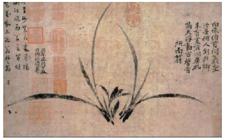
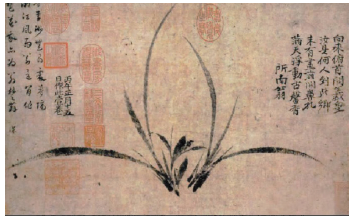
Similarly, as a “gentleman’s flower”, orchids are a symbol of seclusion and elegant spiritual character. Orchids grow in valleys, away from the hustle and bustle, which coincides with the Song people’s pursuit of tranquility. Painters often use light brushstrokes and concise structures to highlight the posture of orchid and highlight its characteristics of “clear”, “light”, “elegant” and “quiet”. Zheng Sixiao’s Ink Orchid features orchids without roots or soil, and a few orchid leaves standing independently on paper, as shown in Figure 1. Through concise brushstrokes, the orchid leaves are depicted standing independently in the void, which not only shows the aesthetic qualities of “clear”, “light”, “elegant” and “quiet”, but also metaphorically represents the displaced scholars’ fate after the fall of the Southern Song Dynasty and their inner struggle with loneliness. This choice and expression of the image of “orchid” echoes the Confucian ethical sentiment of “loyalty to the emperor and patriotism”, and also highlights the literati’s spiritual character,, who adhere to their integrity when facing political reality. Although the picture does not directly depict social turmoil, its empty composition and cold brushwork convey a profound sense of worry and cultural crisis, becoming an important visual language for literati to construct identity. Through Ink Orchid, Zheng Sixiao closely links personal destiny with the country’s rise and fall,, making the symbolic symbol transcend the simple description of nature and sublimate it into an expression of cultural identity and a sustenance of spiritual power.
3.2 Identity
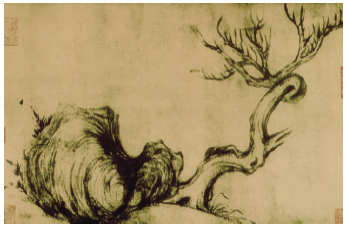
Symbolic symbols play an important role in strengthening the literati group’s identity in literati painting and are an important carrier for building the literati cultural society in the Song Dynasty. As a special art form, literati painting pays attention to the integration of “poetry, calligraphy, painting, and seal”, embodies the subject identity of literati creation and becomes an important way for literati groups to communicate. As shown in Figure 2, Su Shi’s Dry Trees and Strange Rocks uses pictures to show the literati’s tenacity in adversity. His inscriptions and seals further strengthen the cultural characteristics of this painting, making it a spiritual wealth shared by literati (Sturman, 2022). Most of the inscriptions are classic books or famous sayings. While showing the literati’s knowledge,, they also strengthen the cultural identity within the scholar group.
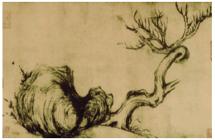
In this work, Su Shi depicts a dead tree and a strange rock with simple and expressive strokes. Through this seemingly simple composition, he conveys profound philosophical thinking and personal emotions. The dead tree symbolizes the tenacious vitality that has gone through hardships, and the strange rock represents the firm will to stand firm in adversity. Through this combination, Su Shi not only expresses his tenacious spirit in adversity, but also metaphorically the scholars’ spirit who adhere to integrity and indomitable spirit in a turbulent society. By appreciating and communicating such works, scholars can not only find spiritual comfort, but also build a strong sense of cultural identity in the ever-changing social environment. From this point of view, his works are not only an expression of personal emotions, but also the entire scholar group’s spiritual world’s microcosm,, reflecting their value pursuit and role positioning in a complex and changing social background. With the help of these expressive elements, the scholar group constructs its own unique values and roles in the ever-changing social context and establishes a strong cultural identity (Jiao, 2025).
3.3 Exchange of thoughts
Literati painting is an important carrier for literati to express their philosophy. It transforms the literati’s ideals into tangible and visible language through artistic techniques and realizes the dialogue and integration of various philosophies. Symbolic images, such as plum, orchid, bamboo and chrysanthemum, make the Confucian idea of “cultivating oneself and bringing peace to others” concrete and become symbols of the literati’s ideal of self-cultivation, family management, the country’s governance and peace in the world. The Taoist concepts of “harmony between man and nature” and “rule by inaction” bring the viewer into a spiritual space beyond reality through the visualization of mountains, rivers, mist and fishermen. The artistic concepts of “emptiness” and “sudden enlightenment” in Zen Buddhism, through symbolic techniques, such as blank space, dead trees and strange stones, make the viewer have infinite reverie.
Through these metaphorical structures, literati not only complete their own ideological expression, but also promote the in-depth integration of Confucianism, Taoism and Zen in the Song Dynasty. This integration and innovation are not only the inheritance and development of traditional philosophy by literati, but also reflect the literati’s unique creativity under the times’ special background. The symbolic symbols in the literati’s paintings,, in the Song Dynasty, play a role in communicating ideas by reinterpreting Confucianism, Taoism and Zen. These symbols are the inheritance of traditional philosophical thoughts, as well as the innovative interpretation of the personal feelings and the literati’s times’ background,, and therefore play a pivotal role in the social context at that time (Yang, 2022). Li Tang’s Picking Wild Wheat is set against the background of Boyi and Shuqi’s retreat to the mountains and forests, integrating the Confucian loyalty to the emperor and the Taoist way of freedom, showing the literati’s contradictory psychological state between ideals and reality. Ma Yuan’s Fishing Alone in the Cold River uses the technique of leaving blank space to integrate the “emptiness” artistic conception of Zen into the expression of landscape painting, allowing the viewer to gain a momentary sense of enlightenment through its empty artistic conception. These symbols are not only the inheritance of traditional philosophy by literati, but also the literati’s creativity and reinterpretation in a special era.
4 INSPIRATION OF TRADITIONAL SYMBOLIC SYMBOLS TO MODERN ART
Symbolic symbols are an important cultural heritage, which still have a profound impact in the context of contemporary art. The literati paintings of the Song Dynasty construct multiple functions of lyricism, identity recognition and communication with visual symbols, and there are still many cultural characteristics worth referring to. Contemporary art can realize creative transformation of symbolic symbols, in the contemporary context, on the basis of inheriting the spiritual connotations contained in symbolic symbols, thereby giving them vitality in a new artistic form.
4.1 Re-exploring the cultural value of traditional symbols and constructing the identity of modern art
In the context of global integration, contemporary art faces the uncertainty of its own cultural identity (Al-Zadjali, 2024). The symbolic symbols in the literati paintings of the Song Dynasty provide a specific way for artists to rediscover this traditional culture. The pine trees, bamboos and plum blossoms, represented by the “Three Friends of Cold Weather”, embody the Confucian ethical pursuit of “cultivating oneself, managing the family, and governing the country”, and are also the literati’s praise for the gentleman’s personality. In the creation of works, artists can give traditional symbols a new contemporary connotation through modern interpretation, thereby strengthening their cultural identity.
In actual operation, symbols, such as pine trees, bamboo and plum blossoms, can be combined with modern design and installation art. Their spiritual core in the current era can be expressed in an abstract way or through cross-media forms, awakening the audience’s memory of traditional culture and, thus, arousing cultural resonance in a new context. Wang et al. (2025) took four famous Lingnan gardens, including Guangzhou Yuyin Garden, Foshan Liangyuan, Shunde Qinghui Garden and Dongguan Keyuan, as the main cases to examine the types, decorative features and aesthetic qualities of their doors and windows. Based on aesthetic imagery, they also explored their aesthetic resonance with traditional Chinese arts, such as calligraphy, painting and poetry. By deepening the theoretical understanding of the forms and artistic characteristics of Lingnan garden doors and windows, the application and inheritance of the cultural value of traditional symbols, in modern garden architecture, were promoted. It is through this abstract or cross-media form of expression that contemporary artists show the contemporary connotations of these traditional symbols and strengthen cultural identity.
4.2 Exploring the ideological depth and universal value of art with philosophical implications as the core
The symbolic symbols of Song Dynasty literati paintings, in addition to their aesthetic value, contain the deep philosophy of Confucian “self-cultivation”, Taoist “natural inaction” and Zen “emptiness”. The ideological concepts of contemporary art are often restricted by the innovation of media forms and lack cultural heritage. In its artistic practice, in addition to paying attention to visual expression, it can strengthen the philosophical interpretation of symbolic symbols to allow the audience to have a deeper level of thinking space besides sensory experience. Wang and Huang (2024) emphasized that philosophical ideas should be injected into cultural and creative design to stimulate creativity and important expressions, give full play to the potential of philosophy in art and creativity, and achieve design details through cultural context analysis, cultural semantic association and cultural image extraction. By being inspired by the philosophical connotation of Song Confucian paintings, it can be used for deeper thinking and universal value pursuit. For example, in the creation of ecological art themes, the image of “fisherman and woodcutter” can be used as a case study and, through local themes, ecological art and other methods, it can be explored how modern people find peace of mind and freedom in a fast-paced life. This symbol can be reinterpreted through sculpture, photography, installation and other methods to show its profound ideological connotation and universal significance.
4.3 Promoting cross-cultural communication and promoting artistic innovation in the context of globalization
In the context of globalization, cross-cultural communication has become a major trend in the development of art today, and the symbolic symbols, used in Song Dynasty literati paintings, provide a specific means for painters. Philosophical ideas, such as “harmony between man and nature”, are widely used in ecological art and serve as an important subject for painters to express the harmonious coexistence between humans and nature. Contemporary artists can interpret this concept in a modern way and apply it to international art exhibitions and cooperative projects, thereby promoting the exchange and understanding of Eastern and Western cultures. The digital technology is used to reproduce the artistic conception of landscape paintings, and the Western minimalism is used as a design language to create artworks that combine oriental style and international aesthetics.
CONCLUSIONS
This paper focuses on the symbolic symbols in Song Dynasty literati paintings and explores the spiritual pursuits they carry. It also explores how these symbols carry the criticism of the scholars’ political reality and the desire for personal freedom, as well as the complex meanings they have in the times’ special context. This paper sorts out the origin and construction of symbolic symbols and analyzes their philosophical connotations and cultural functions. It can be found that the symbols in Song Dynasty literati paintings are not only a symbol carrier of traditional culture, but also a carrier of dual response to political reality and personal spiritual freedom. The artistic language and symbolic system, contained in literati paintings, enables literati to express their emotions, establish a strong identity and constitute a closely related cultural group. These symbols have played a positive role in promoting the reinterpretation and inheritance of Confucianism, Taoism and Zen, making them still of great reference significance in contemporary times.
From a theoretical perspective, this paper interprets the cultural connotation and role of symbols in Song Dynasty literati paintings by taking its historical background and philosophical connotation as the starting point. This not only deepens the understanding of the artistic value of symbols, but also enables people to rethink the special significance of literati paintings as a carrier of ideological communication and identity recognition. It helps to deepen the understanding of ancient Chinese art, reveal the integration and innovation of Confucianism, Taoism and Zen thoughts in artistic expression, and provide a new perspective for exploring the mutual influence between other art forms, such as poetry and calligraphy. In practice, the symbolic symbol system, in Song Dynasty literati paintings, provides a rich cultural heritage for contemporary artists. Through the reinterpretation of traditional symbols, they can explore their enlightenment to contemporary art and provide suggestions for artistic creation on the path of cultural inheritance and innovation.
Future research can further explore the mutual influence between Song Dynasty literati painting and other art forms, such as poetry, calligraphy and seal cutting, and analyze the influence of other media on literati painting creation. On this basis, from a cross-cultural perspective, the role of Song Dynasty literati painting, in East Asian and even world art, is explored, and its universal value, in the context of globalization, is analyzed, so as to more fully understand the cultural connotation and ideological value of Song Dynasty literati painting, providing more theoretical support for the modernization of traditional art. Through the analysis of the correspondence between philosophical concepts and symbols, it reveals how visual symbols carry and transform abstract philosophy to form a “visualized system of thought”. In terms of the cross-domain application of the integration of cultural heritage and modern design, it is suggested to incorporate the symbolic symbols in literati paintings into modern visual communication and other fields, and transform themes, such as “Three Friends of Winter” and “Fishermen, Woodcutters, Farmers and Scholars”, into modern design elements with oriental spirit, so as to enhance cultural identity and international communication, and explore its reinterpretation and innovative practice in the context of globalization.
REFERENCES
- AL-ZADJALI, Z. The significance of art in revealing a culture’s identity and multiculturalism. Open Journal of Social Sciences, v. 12, n. 1, p. 232-250, 2024.
- DUAN, M. Study on the Symbol of Chinese Copper Pheasant in Court Painting in Song Dynasty. Research and Commentary on Humanities and Arts, v. 1, n. 1, p. 7-9, 2023.
- FAN, X.; SHUKOR, R. Explaining the Beauty of Liu Bai in the Works of Ma Yuan, a Chinese Painter of the Southern Song Dynasty, with Taoist Thought. Asian Journal of Research in Education and Social Sciences, v. 6, n. 3, p. 644-656, 2024.
- GESTERKAMP, L. A Thousand Miles of Streams and Mountains: Daoist Self-Cultivation in a Song Landscape Painting. Journal of Daoist Studies, v. 15, n. 15, p. 31-65, 2022.
- GUO, D.; MI, D.; CUI, Z. Painting into Gardens: The Influence of Chinese Traditional Painting on Garden Making. Journal of Landscape Research, v. 14, n. 5, p. 93-96, 2022.
- HE, Y. Dry Trees and Strange Rocks (partial). Moon Reading, v. 10, p. 1, 2018.
- HU, L.; PU, J. Confucian Teachings on the Moral Self-cultivation. US-China Education Review, v. 14, n. 3, p. 170-179, 2024.
- HU, M. A Study of the development history and stylistic features of Chinese ink painting. Pacific International Journal, v. 6, n. 1, p. 71-76, 2023.
- JIAO, H. A Multi-Dimensional Interpretation of the View of Nature and Humanistic Spirit in Chinese Landscape Paintings from the Perspective of Art Criticism. Cultura: International Journal of Philosophy of Culture and Axiology, v. 22, n. 2, p. 524-544, 2025.
- KHAN, U.; WANG, H.; CUI, Z.; BEGUM, A.; MOHAMED, A.; HAN, H. The philosophical thought of Confucius and Mencius, and the concept of the community of a shared future for mankind. Sustainability, v. 14, n. 16, p. 9854-9861, 2022.
- KREIDER, S. E. Epistemology and ethics in Zhuangzi. Philosophies, v. 6, n. 3, p. 58-65, 2021.
- LEE, D. T. Being Zen: Pelevin, Buddha, and the Void. The Russian Review, v. 82, n. 4, p. 599-612, 2023.
- LI, H. The Song Dynasty’s Fiscal and Economic Policy and Its Social Economy. Social Sciences in China, v. 44, n. 3, p. 90-114, 2023.
- LIU, D. On the “Virtual and Real” and Blankness in Chinese Landscape Painting. International Journal of Advanced Culture Technology (IJACT), v. 10, n. 3, p. 174-183, 2022.
- LIU, S. The Characteristics of Zhao Ji’s Meticulous Flower and Bird Paintings. Frontiers in Art Research, v. 5, n. 9, p. 18-21, 2023.
- LIU, X.; LYU, X.; CHO, T. Aesthetic Research in the Northern Song Dynasty Landscape Painting “Cloudy Mountains” Based on Neuroaesthetics. Journal of the Korean Society Design Culture, v. 28, n. 2, p. 199-210, 2022.
- OWUSU-ADDO, A.; YAO, D. W. J. Visualising the Historical Development and Belief System of Taoism. Convergence Chronicles, v. 3, n. 1, p. 491-502, 2022.
- SAATCHI, S. M.; ZAFARNAVAEI, K. The Meaning of “Nature” in Chinese Landscape Paintings According to the Daoism. Asian Culture and Art Studies (Motaleat-e Farhang va Honare Asiya), v. 2, n. 2, p. 169-192, 2021.
- SERNELJ, T. Confucian and Daoist Aesthetics. Synthesis philosophica, v. 36, n. 2, p. 251-256, 2021.
- SHEN, J. S.; XIAO, Y. M.; LIN, C. L. Exploring the Characteristics of Zen Painting. Creative Education, v. 15, n. 4, p. 652-677, 2024.
- STURMAN, P. C. Inscriptional practices of the song literati: Revisiting Su Shi’s old tree, rock, and bamboo. Archives of Asian Art, v. 72, n. 1, p. 75-95, 2022.
- SU, Y. Emotional analysis in artistic picture design: Taking Song Dynasty literati paintings as an example. Footwear Craftsmanship and Design, v. 3, n. 10, p. 72-74, 2023.
- SUN, Y.; CHEN, Y. Tao is hidden and nameless: Exploring the mysticism path of Laozi and Zhuangzi. HTS Teologiese Studies/Theological Studies, v. 80, n. 3, p. 10109-10114, 2024.
- TANG, Y. A Brief Discussion on the Influence of Lao-Zhuang Aesthetics on the Creation of Song Dynasty Landscape Paintings: Taking Fan Kuan’s Travelers among Mountains and Streams as an Example. Open Access Library Journal, v. 11, n. 9, p. 1-8, 2024.
- WANG, C.; HUANG, Y. Philosophy of Creative Thinking: How Philosophical Concepts in Cultural and Creative Design Inspire Innovation and Expression. Cultura: International Journal of Philosophy of Culture and Axiology, v. 21, n. 2, p. 259-279, 2024.
- WANG, M.; PHU-NGAMDEE, S. The Analysis of Influencing Factors and Characteristics of Chinese Painting in Song Dynasty (960-1279 Ad). Journal of Roi Kaensarn Academi, v. 9, n. 12, p. 1442-1454, 2024.
- WANG, S.; PHUNGAMDEE, S. Aesthetic embodiment of stones in literati paintings with garden themes in Song, Yuan, Ming and Qing Dynasties. International Journal of Multidisciplinary in Management and Tourism, v. 6, n. 2, p. 113-128, 2022.
- WANG, Y. Viewing bamboo from the window: The image of “window bamboo” in Bai Juyi’s poems and the “window without window” in literati paintings. Journal of Graduate School of Chinese Academy of Social Sciences, v. 240, n. 6, p. 100-109, 2020.
- WANG, Z.; ZHENG, R.; TANG, J.; WANG, S.; HE, X. The Aesthetic Imagery of Traditional Garden Door and Window Forms: A Case Study of the Four Major Traditional Gardens of Lingnan. Buildings, v. 15, n. 4, p. 513-541, 2025.
- YANG, J. On the philosophical characteristics and historical context of Chinese traditional aesthetic thoughts. Psychology, v. 12, p. 8, p. 592-607, 2022.
- YUAN, L.; CHIA, R.; GOSLING, J. Confucian virtue ethics and ethical leadership in modern China. Journal of Business Ethics, v. 182, n. 1, p. 119-133, 2023.
- ZE, J. Exploration of the Spirit of Song Dynasty Flower and Bird Painting. Cultural and Artistic Innovation · International Academic Forum, v. 3, n. 5, p. 32-34, 2024.
- ZHANG, F. The transformation of aesthetic research in the Song Dynasty: concepts, perspectives, and paths. Journal of Guangzhou University (Social Science Edition), v. 24, n. 1, p. 54-63, 2025.
- ZHANG, Y. Analysis of the Development of Traditional Chinese Culture: A Case Study of the Highly Prosperous Song Dynasty Culture. International Journal of Frontiers in Sociology, v. 5, n. 10, p. 21-25, 2023.
- ZHAO, S. An Evolving Elegant Medium: The Thriving, Composition, and Changes in the Trend of Round Fan Paintings of Flowers and Birds in the Song Dynasty. Frontiers of History in China, v. 19, n. 3, p. 273-286, 2024.
- ZHU, W. Comparison of Two “Ink Orchids” in the Song Dynasty - Taking the Works of Zheng Sixiao and Zhao Mengjian as Examples. Beauty and Times (Mid-monthly), Journal of Fine Arts, v. 000, n. 007, p. 56-57, 2019.
-
Data availability statement:
The dataset for this article is available in the SciELO Dataverse of the Trans/Form/Ação Journal, at the link: https://doi.org/10.1590/0101-3173.2025.v48.n5.e025124
-
Patents
2024.02 - Utility Model Patent: Adjustable Foldable Environmental Report Display Stand (Ranked 1st). Patent nº ZL 2023 2 2247705.0. Authorization nº CN 220442368 U.
-
4
2023.08 - Design Patent: Environmental Monitoring Information Display Stand (Ranked 1st). Patent nº ZL 2023 3 0553574.1. Authorization nº CN 308595459 S.
The dataset for this article is available in the SciELO Dataverse of the Trans/Form/Ação Journal, at the link: https://doi.org/10.1590/0101-3173.2025.v48.n5.e025124

 Source:
  Source: