
 FOSTERING SECOND-ORDER THEORY OF MIND (TOM) IN EFL/ESL CLASSES: BILINGUAL ADVANTAGES AND CLASSROOM ACTIVITIES FOR SCHOOL-AGE CHILDREN
Abstract
Theory of Mind (ToM), the ability to understand and attribute mental and emotional states to oneself and others, has been a central focus in cognitive science since the 1980s. While early research predominantly focused on ToM development in infancy, recent studies highlight its continued evolution into later childhood, adolescence, and even adulthood. Second-order ToM, which involves more complex mental reasoning about others’ thoughts and beliefs, typically develops later in childhood and is associated with the maturation of the prefrontal cortex. This article explores the potential for fostering second-order ToM in English as a Foreign Language (EFL) and English as a Second Language (ESL) classrooms. It outlines three hands-on activities designed to promote second-order ToM, emphasizing the role of ToM in social competence and its connection to interpersonal and professional success. Drawing on the theoretical foundations of the Faux Pas Task and the Strange Stories Task, the proposed activities integrate visual, narrative-based, and interactive-dialogic elements that support both language use and real time mental state reasoning. By incorporating these activities, teachers can support the development of critical social-cognitive skills in school-age children, enhancing their ability to navigate complex social interactions.
Keywords:
Theory of Mind (ToM); second-order ToM; bilingualism; classroom activities.
Resumo
Teoria da Mente (TdM), a capacidade de entender e atribuir estados mentais e emocionais a si mesmo e a outros, tem sido um foco central na ciência cognitiva desde a década de 1980. Enquanto pesquisas iniciais tinham como enfoque principal o desenvolvimento de TdM na infância, estudos recentes ressaltam sua evolução contínua até a infância tardia, adolescência e até mesmo adultez. TdM de segunda ordem, que envolve raciocínios mentais mais complexos a respeito dos pensamentos e crenças de outros sujeitos, tipicamente se desenvolve nos estágios finais da infância, estando associada à maturação do córtex pré-frontal. Este artigo explora o potencial de promover TdM de segunda ordem em salas de aula de Inglês como Língua Estrangeira (ILE) e Inglês como Segunda Língua (ISL). São elaboradas três atividades práticas criadas para promover ToM de segunda ordem, enfatizando o papel desempenhado pela ToM na competência social e sua conexão com o sucesso profissional e interpessoal. Com base nos fundamentos teóricos da Faux Pas Task e da Strange Stories Task, as atividades propostas integram elementos visuais, narrativos e interativo-dialógicos que promovem tanto o uso da língua quanto o raciocínio mental em tempo real. Incorporando essas atividades, professores podem auxiliar no desenvolvimento de habilidades sócio-cognitivas críticas em crianças em idade escolar, promovendo sua habilidade em navegar interações sociais complexas.
Palavras-chave:
Teoria da Mente (TdM); TdM de segunda ordem; bilinguismo; atividades de sala de aula.
1. INTRODUCTION
In the 1980s, the field of cognitive sciences witnessed the emergence of a new branch of research as the concept of Theory of Mind (ToM) began to develop. In a broad sense, ToM refers to a person’s ability to understand both their own and other people’s mental and emotional states (e.g., beliefs, emotions and intentions; Premack; Woodruff, 1978; Kalbe et al., 2010; Baimel et al., 2015; Polyanskaya et al., 2021). Prior research on this topic has widely focused on child development and, more specifically, on infancy, a period often considered as one of the milestones in the development of ToM (Carlson; Koenig; Harms, 2013; Ruitenberg; Santens; Notebaert, 2020). However, recent years have witnessed a growing body of research on ToM development in later childhood, adolescence and even adulthood.
This methodological shift appears to be associated with the distinction made between two ToM dimensions: first-order and second-order (Rubio et al., 2022). First-order ToM refers to an individual’s knowledge that others have emotional and mental states distinct from one’s own. On the other hand, second-order ToM refers to the ability to infer someone’s disposition and/or knowledge about a third party’s mental or emotional states (Rubio et al., 2022). Whilst first-order ToM can be seen even in toddlers, second-order ToM is likely acquired later in life, between the ages of six and nine (Perner, 1988; Carlson; Koenig; Harms, 2013; Sher; Koenig; Rustichini, 2014).
Second-order ToM is a more complex type of mental reasoning. The main difference between first-order and second-order ToM can be considered in terms of dimension: for example, a toddler may be able to understand and perceive an individual’s response to a given stimulus by interpreting their facial expressions or movements. However, a deeper comprehension of underlying mental states most likely occurs much later in childhood. Recent research has even suggested that ToM continues to evolve well into adolescence and even adulthood (Carlson; Koenig; Harms, 2013), a premise backed up by the fact that ToM is associated with activity in the prefrontal cortex, which continues to develop up until early adulthood (Cassetta; Pexman; Goghari, 2018).
Both first-order and second-order ToM have been pointed out as crucial skills in social interaction due to the importance of understanding other peoples’ intentions when partaking in communication (Kalbe et al., 2010). For example, in order to grasp an ironic undertone in a given communicative context, one needs to realize that the speaker is conveying an intentionally false utterance, a type of second-order mental reasoning that requires deeper and more complex understanding than first-order ToM (Sodian; Kristen, 2016; Filippova; Astington, 2010). Authors have also suggested that second-order ToM has a degree of embeddedness of beliefs (i.e., understanding that someone can hold a belief about a third party’s belief; Polyanskaya et al., 2021).
Second-order ToM is particularly important when it comes to the pragmatic dimension of language. Research has pointed out that understanding figurative language, such as idiomatic expressions, irony, sarcasm, and metaphors, involves second-order reasoning to a certain degree (Caillies; Le Sourn-Bissaoui, 2008; Massaro; Valle; Marchetti, 2013; Filippova; Astington, 2010). In a more general sense, ToM allows individuals to exercise empathy, moral reasoning, and cooperation (Baimel et al., 2015).
Although there is little research on the training of ToM skills, evidence suggests that second-order ToM can be enhanced through social interaction and training (Goldstein; Winner, 2012). More recent studies have focused on the impact of the implementation of different types of exercises and training in second-order ToM. Goldstein and Winner (2012) compared children and adolescent’s ToM and emphatic abilities before and after a 10-month arts intervention and found that both were enhanced by the art training the participants received. A few studies have also implemented ToM training in clinical populations. Polyanskaya et al. (2021), for example, found that an experimental group of autistic children who received training in either recursive phrases or working memory displayed better second-order false belief skills in comparison to a control group of autistic children who did not receive training.
Studies have also posited that bilingual individuals may have an advantage in the development of second-order ToM (Schroeder, 2018), given there is a strong correlation between ToM performance and language proficiency, as well as an association between ToM, executive function (EF) and verbal IQ. Bilingualism has been widely considered to improve both executive functioning and an individual’s verbal IQ. This bilingual advantage may be largely due to the cognitive effort made by speakers of two or more languages (e.g., when switching between languages), who may perform better in tasks that require the use of executive functioning and metalinguistic awareness (Kroll; Bialystok, 2013; Bialystok, 2011; Bialystok, 2015; Becker; Prat; Stocco, 2016; Buac; Kaushanskaya, 2019), which are also associated with second-order ToM (Devine; Hughes, 2014; Wade et al., 2018).
Before proceeding, it is important to define the conceptualization of bilingualism upon which this article is grounded. Since the late 1980s, a new and more dynamic conception of bilingualism has emerged, recognizing that bilingual individuals acquire and use their languages for diverse purposes, in interaction with various interlocutors and across multiple contexts (Grosjean, 1989). Furthermore, as Finger (2024) asserts, bilingualism is a multifaceted phenomenon shaped by a complex interplay of individual and contextual factors. As a result, bilinguals may exhibit varying degrees of proficiency in their languages, given that the fluency and linguistic competence they develop are molded by their lived experiences.
Rather than categorizing individuals rigidly as either “monolingual” or “bilingual,” Grosjean (1989) proposed the concept of a “bilingualism continuum,” in which bilingualism is understood not as a binary condition, but as a spectrum of experiences that differ according to multiple variables. Bilingual individuals also display a wide range of proficiency levels, fluency, and language-use abilities, all of which are shaped by their specific experiences with language and influenced by individual and contextual factors that impact language mastery.
Bialystok (2021) employs the metaphor of a “Swiss cheese” to illustrate the high degree of variability that characterizes the bilingual experience. She compares bilingualism to a package of Swiss cheese, where each slice contains holes of different sizes and shapes, symbolizing the diverse manifestations of bilingual experience. Although each slice is unique - reflecting the individuality of each bilingual speaker - they all share a common trait: each represents, in its own particular way, a slice of the broader “Swiss cheese” of bilingualism.
That being said, drawing upon the recent literature on ToM training and bilingualism, this article aims to outline three hands-on activities that may foster second-order ToM in English as Foreign Language (EFL) or English as Second Language (ESL) classrooms. Effective ToM has been considered a predictor of social competence, given it is involved in our mental reasoning about other people’s motives and intentions (Sher; Koenig; Rustichini, 2014), an ability associated with higher rates of interpersonal and professional success. Moreover, ToM performance is a crucial component of everyday social interactions, given it is involved in understanding others’ intentions and predispositions (Cassetta; Pexman; Goghari, 2018).
The hands-on activities proposed in this article differ from those typically used in clinical environments in both scope and pedagogical orientation. While clinical activities are often individualized, diagnostically driven, and aimed at remediating specific cognitive or socio-emotional deficits, the activities described here are designed for group-based, educational contexts in EFL/ESL classrooms. They prioritize naturalistic social interaction, communicative language use, and peer collaboration, embedding Theory of Mind stimulation within meaningful language-learning tasks. This integration allows learners to develop second-order ToM skills incidentally through authentic communicative exchanges, rather than through structured therapeutic protocols. Consequently, the approach emphasizes linguistic, cultural, and interpersonal competence in tandem, aligning with curricular goals while fostering ToM development in a non-clinical, inclusive, and linguistically rich environment. School-age children may thus benefit from activities designed to foster and stimulate ToM development, and teachers can apply hands-on activities in the classroom to promote the development of these skills.
2. THE ASSOCIATION BETWEEN TOM DEVELOPMENT, BILINGUALISM AND EXECUTIVE FUNCTIONS
Recent empirical research has demonstrated a significant association between language proficiency, bilingualism, and the development of ToM (Buac; Kaushanskaya, 2019). Previous research has suggested that linguistic ability is closely linked to ToM performance, given ToM tasks are usually linguistic in nature (Buac; Kaushanskaya, 2019). Researchers have posited that linguistic ability serves as a predictor of ToM performance, rather than ToM development influencing linguistic proficiency (Astington; Jenkins, 1999).
The premise of a bilingual advantage in ToM skills has been largely localized to the differences observed in terms of executive functioning between monolinguals and bilinguals (Buac; Kaushanskaya, 2019; Huang, 2022). A growing body of research has aimed to investigate the correlation between ToM development and bilingualism both in clinical (e.g., Peristeri; Vogelzang; Tsimpli; Durrleman, 2024; Cummings et al., 2024) and non-clinical populations (e.g., Chan, 2004; Huang; Baker; Wang, 2023). This correlation most likely stems from the fact that bilinguals outperform monolinguals in verbal and nonverbal tasks involving the three main EFs (Bialystok, 2011; 2015; Grundy, 2020). Moreover, it has been suggested that bilinguals outperform monolinguals in switching tasks (Bialystok, 2011; Prior; Macwhinney, 2010). Whereas bilingualism was once thought as detrimental for a child’s cognitive development, more recent research has demonstrated that using two or more languages may present a range of advantages related to EF, metalinguistic awareness, cognitive flexibility and healthy aging, even though these findings are still questioned in the literature (Antoniou, 2019; Azevedo et al., 2023).
EFs can be defined as a range of mental processes that involve a certain degree of cognitive effort and are considered essential to different aspects of interpersonal, cognitive, social and professional life (Diamond, 2013). EFs are usually required when an individual cannot or should not rely on autopilot or instinct to complete a given task (Diamond, 2013). According to Diamond (2013), there are three core EFs: working memory, inhibition or inhibitory control, and cognitive flexibility. Working memory involves holding information when it is no longer accessible. Baddeley (2010, p. 136) conceives of working memory as a “system or systems that are assumed to be necessary in order to keep things in mind while performing complex tasks”. As such, it is a central component in the process of learning. Inhibition or inhibitory control involves being capable of controlling one’s predispositions (attention, thought, emotions and behavior) to fight an impulse (Diamond, 2013), and is thus closely related to self-control. Cognitive flexibility, on the other hand, refers to an individual’s ability to adapt their behavior to a given setting or task, change their perspectives about a given topic and/or adjust their demands or priorities to a current situation (Diamond, 2013).
Studies sought to apply tests such as the Simon task (Bialystok et al., 2004), which assesses inhibitory control, and the Stroop task (Coderre; van Heuven, 2014), which measures both cognitive flexibility and inhibitory control, to bilingual and monolingual populations in order to confirm the hypothesis that bilinguals outperform monolinguals in terms of EF (Bialystok, 2011). Even though there is a wide body of research indicating a bilingual advantage in the three EF skills, authors have questioned the validity of these results. In a recent quantitative study, Grundy (2020) conducted a Bayeasian analysis to assess a range of independent studies whose findings point out a bilingual advantage in EFs. The results of Grundy’s (2020) analysis suggest that, despite some null findings observed in studies in favor of a bilingual advantage, there is enough evidence to support the claim that bilinguals outperform monolinguals in a range of EF tasks. It is worth noting, however, that this “bilingual advantage” has been more observed in older adults and children (Antoniou, 2019). Antoniou (2019) associated this tendency with the fact that executive function tends to peak in early adulthood, which makes it harder to locate a bilingual advantage in executive function in young adults.
Some studies have revealed a strong correlation between ToM and EF (Cassetta; Pexman; Goghari, 2018; Devine; Hughes, 2014; Economacou; Karousou; Makris, 2023). Many linguistic tasks and situations that involve ToM also seem to require the use of one or more EFs. For example, cognitive flexibility may prove necessary when assuming a different perspective in a situation in which an individual has to resort to second-order reasoning. In order to empathize with and understand others’ mental and emotional states, one must be able to distance themselves from their own and assume a different perspective, which may also involve a certain degree of inhibitory control.
Figurative language processing also appears to rely on both ToM and EF. Let us imagine the following scenario: faced with a comic strip containing some type of figurative language, such as metaphors or irony, a subject must first recognize the existence of two potential meanings (i.e., a literal meaning and a figurative meaning). Doing so requires engaging ToM skills, given they must interpret the mental or emotional states of another individual. To grasp the figurative meaning, they must also suppress or inhibit the more readily apparent literal meaning. ToM tasks also require that children inhibit their own mental and emotional states in favor of another’s (Buac; Kaushanskaya, 2019). Such mental reasoning also involves a certain degree of cognitive effort. Nonetheless, although the ToM-EF correlation seems evident, it is worth noting that there is still no agreement in the scientific literature as to the exact nature of this relationship (Economacou; Karousou; Makris, 2023).
Given scientific literature also points out a correlation between ToM and pragmatic competence, a wide range of studies have sought to investigate the nature of this association. Research on irony processing (e.g., Shibata et al., 2010; Spotorno et al., 2012) and conversational inference (e.g., Feng; Yu; Zhou, 2021) reveals that these processes activate similar brain regions to those used for ToM, suggesting a strong connection between figurative language, mentalizing, and inference. This finding supports the idea that stronger ToM abilities are linked to better pragmatic competence (Rubio-Fernandez, 2020; Feng; Yu; Zhou, 2021; Fairchild; Papafragou, 2021). For example, Rubio-Fernandez (2020) suggests that our ability to understand pragmatic markers, such as demonstratives, depends on ToM-related processing - we grasp their contextual use by attributing mental states to our conversational partners. This link is further supported by studies on children with autism spectrum disorder, which is often associated with pragmatic language impairment, suggesting a direct connection between pragmatic competence and ToM (Baixauli-Fortea et al., 2019; Rosello et al., 2020). In fact, some researchers, such as Sperber and Wilson (2002), argue that pragmatic competence inherently requires mind-reading, which is considered synonymous with ToM (Bosco; Tirassa; Gabbatore, 2018).
Numerous studies have also demonstrated a bilingual advantage in the development of second-order ToM. In a study conducted with economically disadvantaged preschool children, Huang (2022) found that bilingualism predicted better performance in tests commonly used to assess ToM development and suggested executive functions may play a significant role in this correlation. ToM performance is also traditionally measured through the use of first-order and second-order false belief tasks (Feng; Cho; Luk, 2024). In second-order false belief tasks, children must recognize that others can hold false beliefs about something or someone. Presented with a situation in which a character stores an item that is then moved by another character to a different location without knowing the first character is watching him, children must answer the following question: “Where will character two think that character one will look for the item?” (Buac; Kaushanskaya, 2019, p. 340). According to Feng, Cho, and Luk (2024), the ability to recognize a false belief requires a separation between a participant’s egocentric perception and others’ perception. However, the validity of false belief tasks has previously been questioned in the literature (Feng; Cho; Luk, 2024).
It is worth noting that past neuroscientific research has distinguished between two main ToM components: cognitive (related to attribution of mental states) and affective (related to attribution of emotional states) (Ruitenberg; Santens; Notebaert, 2020; Kalbe et al., 2010). According to Kalbe et al. (2010), emotional ToM involves a certain degree of emphatic appreciation of an individual’s emotional states, whereas cognitive ToM refers to one’s knowledge about an individual’s beliefs and intentions. Affective ToM is considered to involve a more complex mental reasoning that draws upon cognitive ToM (Feng; Cho; Luk, 2024). In their study, Cassetta, Pexman, and Goghari (2018) found that inhibitory control and verbal IQ predicts cognitive ToM, whereas only verbal IQ predicts affective ToM.
Taken together, the vast range of studies that sought to investigate a relationship between ToM, EFs and bilingualism seem to converge in a crucial aspect: even though it is yet unclear what the nature of such relationship may be, evidence indicates that bilingualism predicts better ToM performance and development. Given ToM performance can be enhanced through training and practice and is influenced by language and EF, EFL/ESL classrooms may prove to be an optimal environment to train second-order reasoning.
3. HANDS-ON ACTIVITIES TO FOSTER SECOND-ORDER TOM IN EFL/ESL CLASSROOMS
Despite previous research showing that a wide range of social and cognitive factors influence the development of second-order ToM, few studies have focused on the relationship between educational environment and ToM development (Smogorzewska; Szumski; Grygiel, 2020). According to Bianco et al. (2021), school-age children make progress on what is called second-order recursive thinking, which refers to the ability of thinking recursively about another person’s mental states - e.g., being able to understand that someone may hold a false belief about another person’s belief. In this sense, the school environment may play a major role in ToM development. Given the relationship between language, EF and ToM, we consider that EFL/ESL classrooms are an optimal environment for fostering second-order ToM.
Most training programs conducted on ToM have focused on clinical groups, and only few studies have sought to translate research findings on ToM development into practice with typically developing children (Bianco; Lecce, 2016). To address this research gap, Bianco and Lecce (2016) sought to transfer the results of experimental studies conducted on a ToM training program to the primary-school classroom. Instead of suggesting practices to be applied in clinical groups, the authors outlined activities to be implemented with typically developing children (Bianco; Lecce, 2016). Based on a prior study (Bianco; Lecce, 2014), the authors used written narratives containing non-literal language in their ToM training, a genre of activity considered as optimal for the development of second-order ToM skills (Bianco; Lecce, 2016). Storytelling or narrative-based activities not only enhance first-order and second-order ToM development, but they can also serve as a versatile tool for fostering student engagement, creativity, and collaboration. Teachers can also choose to incorporate specific linguistic content, such as grammar or vocabulary, into these activities. For instance, students could be asked to identify idiomatic expressions within a narrative if this is a topic being covered in class.
When designing tasks to be implemented in EFL/ESL classrooms, it is important to take into consideration their age-appropriateness. Second-order reasoning begins to develop later in childhood, between the ages of six and nine. Further, it has been suggested that children begin to understand faux pas and ironic utterances between the ages of eight and nine, and only then start experiencing a considerable improvement in the detection of relevant information within complex communicative scenarios (Bianco; Lecce, 2016). Thus, children in this age range may benefit more from participating in tasks that involve second-order ToM than younger children, who may not yet dispose of the skills required to complete these activities or pass a false-belief test. The hands-on activities proposed in the present article are designed to be implemented with students that fall within this age range, although they may also prove to be beneficial to older children and adolescents.
Second-order reasoning is activated when one must predict another person’s behavior based on their current emotional or mental state. Many different tests have been applied to assess second-order ToM in both clinical and nonclinical populations, such as the Faux Pas Task and the Strange Stories Test, which were originally designed to be applied in autistic children (Bianco et al., 2021). The hands-on activities proposed in this section are based on the premises underlying these two tests.
“Faux pas” (literally, “false step”) is an expression that refers to an embarrassing, accidental mistake made in a social situation. In the Faux Pas Task, participants are presented with a narrative in which a person accidentally or unintentionally makes an offensive remark to the listener due to a false belief (Baron-Cohen et al., 1999; Korman; Zalla; Malle, 2017). Happé (1994) developed the Strange Stories Test to address the premise that autistic subjects were handicapped due to an impairment in ToM. The original test comprises a battery of 24 short vignettes with 12 story types - i.e., lie, white lie, joke, pretend, misunderstanding, persuade, appearance/reality, figure of speech, sarcasm, forget, double bluff, and contrary emotions (Happé, 1994). The vignettes display a short story that illustrates one of the 12 story types designed by Happé (1994). Both the Faux Pas Task and the Strange Stories Test can be used to measure second-order ToM (van Aalten, 2020).
In the following sections, we propose three activities to be implemented in EFL/ESL classrooms with the aim of promoting ToM development and performance among school-age children. These activities draw upon the premises underlying both the Faux Pas Task and the Strange Stories Task. The activities focus on the following aspects: visual, narrative-based task and interactive and dialogic task (to activate language use and ToM reasoning in real-time). The teacher may adapt the activities to the context of the classroom. Moreover, the activities can be included in different stages - e.g., as a warm-up, cooler1 or controlled/freer practice task - depending on the focus of the lesson. It is worth noting that students should be encouraged to complete the activities in an interactive manner, so that they can also work on their social interaction skills.
3.1 Activity one: storytelling
Storytelling activities can be an engaging way of fostering second-order ToM skills in EFL/ESL classes. There are many different ways of implementing this type of task in the classroom, but considering the possibility of greater interaction among students, it might be interesting to divide the class into two distinct groups and have them work together. The following assignment may be implemented in the warm-up or cooler stage of the lesson.
Firstly, the teacher should provide students with a short story and with guiding questions for them to discuss and brainstorm with their classmates. For the purpose of this article, we created a short story titled “Mark’s birthday party”. In this story, there is a misunderstanding when a friend throws a surprise birthday party for another friend, who actually loathes surprises. Students are supposed to read the story in their groups. The teacher may choose to incorporate visual aids - e.g., drawings - so as to facilitate students’ reading comprehension.
Mark’s birthday party
Martin and Lucas are organizing a themed birthday party for their best friend, Mark. What they do not know is that Mark hates surprises. With the best of intentions, Martin and Lucas use Mark’s favorite video game, “The Legend of Zelda”, to decorate Mark’s party. Martin, Lucas, and Mark’s other friends spend the day organizing the party decorations, with themed cakes, candles, and sweets. When Mark finally arrives in the room and their friends scream “Surprise!”, he takes a step back and, trying to hide his discontent, says: “Wow, guys. This is so nice. I was really not expecting it.” Mark answers: “We knew you would love this from what you said last week.”
A week before, Martin, Lucas and Mark were watching an episode of their favorite TV show in which a boy throws a surprise party to his best friend and invites everyone they know. Watching the boy’s reaction, Mark stated: “Oh, that’s just great! Can you imagine walking into a room with everyone you have ever met? That shouldn’t be the slightest bit awkward.”
In this narrative, Martin misinterprets Mark’s ironic remark. This misunderstanding is largely attributed to the ambiguity inherent in Mark’s utterance, which could be construed as either literal or ironic. Students should be encouraged to think about and discuss with their peers what may have been the intentions and motivations of the characters in the story. Some of the questions provided could be the following: (i) Why did Martin and Lucas decide to throw a birthday party for Mark?; (ii) Why did Martin think Mark would love the surprise party?; (iii) How many times did Martin misunderstand Mark’s words?; (iv) What did Mark mean by “that’s just great”? We developed these questions based on the Strange Stories Task and Bianco and Lecce’s (2016) ToM training, which included questions related to the protagonist’s mental or emotional states, a given character’s beliefs about another character’s mental or emotional state, and the relationship between a character’s mental or emotional state and their social behavior.
Given prior research has pointed out that conversation about mind states may help foster ToM development and performance (Lecce et al., 2014), students should be encouraged to share their answers with the group after brainstorming with their classmates, so that they can compare their interpretations with their peers and engage in a larger interaction with the class. Following the premises of a student-centered approach, the teacher should act more as an instructor and facilitator, not providing the answers right away and letting the students reach conclusions by their own means.
The second part of this assignment involves creating a story that also presents some misunderstanding between two or more characters. If the teacher chooses to include the first part of the assignment as a cooler task, it may be advisable to assign the second part as homework. Students should then be able to use their creative and critical thinking strategies to create a scenario in which a given character misunderstands another character’s mental or emotional states. Once again, the teacher can act as a facilitator, providing guidance when necessary. Subsequently, students should create five questions similar to those presented by the teacher in the first part of the exercise for the students in the other group to answer. Groups should exchange their stories and then share their answers to the questions formulated by the other group with the class. The purpose of this task is twofold: to encourage students to recognize underlying motivations and intentions in a communicative act and to cultivate their creativity.
Table 1 displays a step-by-step version of the “Storytelling” activity.
3.2 Activity two: interpreting comic strips
Comics have been widely used in EFL/ESL classes due to their potential of promoting and heightening students’ motivation, vocabulary acquisition, and grammar comprehension (Clark, 2017). As a result of their inherent visual nature, comic strips may facilitate second language acquisition, fostering a more engaging, motivating and ultimately more effective learning experience. Combining textual elements with corresponding visual aids may facilitate the comprehension of linguistic content, given students can rely on the relationship between text and image to infer the linguistic meaning of a statement (San Martín; Delgado, 2024). Moreover, due to their inherent insertion in a meaningful text, comic strips, unlike “loose” sentences, present the student with a statement based on a situation that may be closer to their reality (San Martín; Delgado, 2024).
Much of the humor conveyed in comic strips relies upon the interactions between humans or characters with human traits. To understand the comic meaning of these fictional texts, students often need to deduce the characters’ mental and emotional states, as well as their intentions towards one another. Apart from presenting students with visual aids that may foster vocabulary acquisition and grammar comprehension, comic strips require that students draw upon first-order and second-order ToM to understand textual meaning and may thus serve the purpose of fostering both ToM skills and linguistic comprehension in EFL/ESL classes.
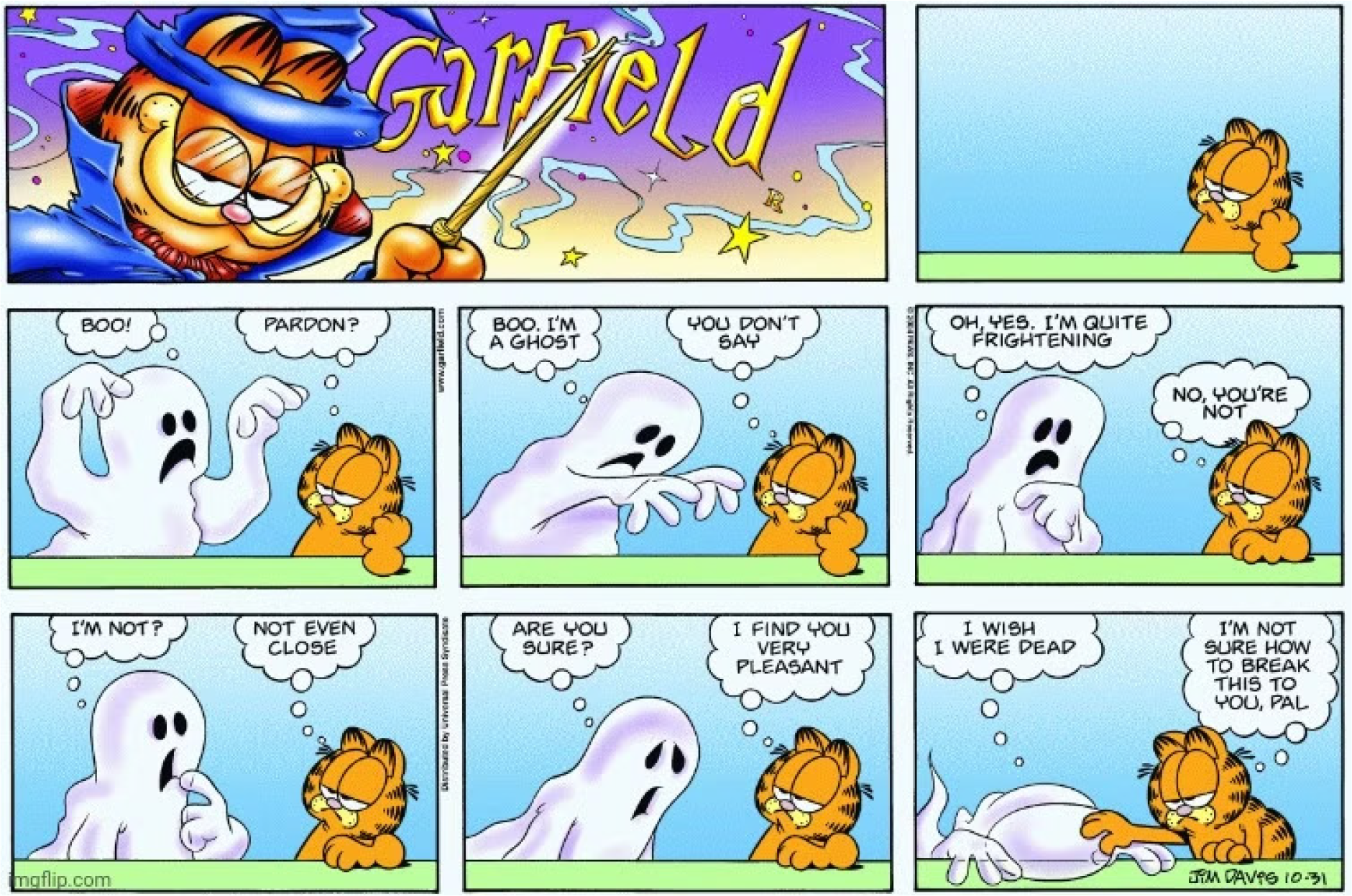
For the purpose of this article, we outline a reading comprehension exercise based upon Jim Davis’ Garfield comic strips. The teacher or instructor can introduce this activity as part of a larger lesson plan based upon a vocabulary or grammar topic. This comic strip requires students to understand irony; to do so, they must grasp the ironic undertone conveyed in utterances.

In this Garfield comic strip, a classic-looking ghost tries to scare Garfield, who seems unmoved by the ghost’s attempt. It may be interesting to divide students into pairs so they can discuss the figurative meaning that conveys the comic dimension of this specific strip. The teacher can present students with questions to guide their discussion, such as “What was Garfield’s intention in his conversation with the ghost?” or “Why is the ghost disappointed with Garfield’s reaction?”. Students should be encouraged to share their interpretations with the group.
It is worth pointing out that phrases such as “you don’t say”, “not even close” and “break something to someone” are commonly seen in everyday interactions between English speakers. Thus, it may be interesting to include this activity in the warm-up or cooler stage of a lesson focused on everyday language - e.g., phrasal verbs, idioms, collocations, and so on. Table 2 summarizes the “Interpreting comic strips” activity.
3.3 Activity three: social scenario role-play and reflection (or “what should I say?”)
In the English language classroom, role-play activities serve as an effective means of enhancing students’ intercultural communicative awareness and competence, while simultaneously developing their overall communicative skills. Rooted in the situational teaching method, role-play involves the simulation of real-life scenarios, allowing students to assume various roles based on their personality traits, learning profiles, and level of language proficiency (Liu, 2024). Under the guidance of the teacher, students are organized into groups to collaboratively design a storyline, assign character roles, and develop appropriate dialogue. In addition, students are encouraged to incorporate nonverbal elements - such as facial expressions, eye contact, and gestures - that align with their spoken lines and the context of the interaction (Aliakbari; Jamalvandi, 2010). This process not only promotes creative interpretation and personalized engagement with the content, but also fosters active knowledge construction. As a pedagogical strategy, role-play integrates both language input and output, reinforcing listening and speaking skills in a communicative context. Given its emphasis on interaction and dialogue, role-play has proven to be particularly effective in improving students’ oral proficiency and communicative competence.
For the purposes of this article, a second-order Theory of Mind activity is proposed in which students are required to infer not only what characters know or feel, but also what would be socially appropriate to say - or refrain from saying - in complex and nuanced social situations. This activity reflects the cognitive reasoning involved in the Faux Pas Task, while incorporating an additional communicative dimension that aligns with the goals of language learning and classroom interaction.
In terms of cognitive load, in this activity students need to interpret a character’s mental/emotional state, consider another character’s belief or knowledge, decide how one should respond - thinking about social appropriateness and perspective-taking and - use modal/conditional forms (e.g., “He shouldn’t say that because she doesn’t know…”).
This activity was designed for intermediate to advanced EFL/ESL school-age learners (8-14 years old). The teacher should provide social scenarios where a character is about to say something that might be inappropriate, unaware of someone else’s mental/emotional state. In pairs or small groups, students should: (i) identify what each character knows or believes; (ii) discuss what would be a better or worse thing to say; and (iii) justify their answers using ToM-related language (e.g., “because she thinks…” or “he doesn’t know that she already heard…”). Students should be encouraged to role-play both good and bad responses and then reflect on how each outcome might affect the people involved. Below we outline three possible scenarios:
-
i. Scenario 1. A surprise party: Emma is planning a surprise party for Jack. She tells Mia about it, but she doesn’t know that Mia has already told Jack. During lunch, Emma says, “Jack is going to be so surprised!”
-
ii. Scenario 2. The test results: Liam thinks he failed his math test and is feeling very upset. Ava already saw the results and knows he actually passed. She walks by Liam and says, “Wow, that test was so easy!”
-
iii. Scenario 3. The Birthday Gift: Carlos bought a gift for his friend Leo, but Leo saw it by accident. Maria doesn’t know Leo has already seen the gift. She says to Carlos, “I hope he likes the surprise!”
Students could be encouraged to consider the following scenario example: Emma is planning a surprise party for Jack. She tells Mia about it, but she doesn’t know that Mia has already told Jack. During lunch, Emma says, “Jack is going to be so surprised!”. Possible questions that could arise from this specific scenario are: (i) what does Emma believe?; (ii) what does Mia know that Emma does not?; (iii) what would be a good way for Mia to respond?; and (iv) what might be a faux pas? Why? The language focus of the activity could be reported speech, modal verbs (should, could, must), second conditional (“If I were her…”), or embedded clauses (He thinks that she does not know…). The teacher can choose to include a language box containing a few useful phrases, such as “she doesn’t know that…”, “if I were him, I would…”, “he might feel…”, “that could be a mistake because…” and “what she should say is…”.
Instructions for students could be as follows: (i) read each scenario; (ii) discuss the following questions with your partner or group: what does each person know or believe? Is someone missing important information? What could be a polite or thoughtful way to respond? What could be a faux pas (social mistake) in this situation?; and (iii) role-play the conversation using both a good and bad version (for a summarized, step-by-step version of this activity, see Table 3 below).
As outlined above, we have proposed three pedagogical activities designed to foster the development and application of second-order ToM in EFL/ESL classroom settings for school-age learners. Drawing on the theoretical foundations of the Faux Pas Task and the Strange Stories Task, the proposed activities integrate visual, narrative-based, and interactive-dialogic elements that support both language use and real-time mental state reasoning. These activities are adaptable and can be implemented flexibly at various stages of a lesson - whether as warm-ups, coolers, or controlled practice tasks - depending on the instructional objectives. Importantly, educators are encouraged to facilitate these tasks in a collaborative and interactive format, thereby promoting not only linguistic competence but also students’ broader social and communicative skills.
4 CONCLUSION
The ability to understand and attribute mental and emotional states-commonly referred to as Theory of Mind (ToM)-has long been recognized as a foundational aspect of human cognition and social functioning. While earlier research concentrated primarily on ToM development during infancy, there is increasing recognition that ToM, particularly in its more advanced forms such as second-order reasoning, continues to develop well into later childhood, adolescence, and even adulthood. This extended developmental trajectory highlights the importance of providing continued and age-appropriate opportunities for ToM stimulation and practice beyond the early years.
In this context, the present article has examined the relevance and applicability of fostering second-order ToM within English as a Foreign Language (EFL) and English as a Second Language (ESL) classrooms for school-age learners. The three pedagogical activities proposed herein-drawing on the principles underlying the Faux Pas Task and the Strange Stories Task-were designed not only to enhance students’ social-cognitive reasoning but also to align with communicative language teaching practices. By integrating visual, narrative, and dialogic elements, these tasks create meaningful opportunities for learners to engage in perspective-taking, recognize subtle social cues, and practice linguistically complex forms such as embedded clauses and conditional structures.
Based on the scope and focus of the present study, some limitations should be acknowledged. First, the proposed hands-on activities have not yet been empirically tested in classroom settings, which limits the ability to draw conclusions about their effectiveness in fostering second-order Theory of Mind in EFL/ESL learners. Additionally, the activities are described in a generalized manner, without systematic adaptation guidelines for different age groups, proficiency levels, or cultural contexts, which may affect their applicability across diverse learning environments. Future research could therefore benefit from experimental or quasi-experimental studies assessing the impact of these activities on both Theory of Mind (ToM) performance and language development, ideally incorporating longitudinal and classroom-based designs to examine sustained effects over time. Such investigations might also explore the measurable impact of these tasks on learners’ pragmatic competence, social inference skills, and cross-linguistic transfer of mentalizing abilities. Comparative studies contrasting the outcomes of educational interventions with those of clinically oriented approaches could deepen understanding of how different contexts and methodologies support ToM growth. Furthermore, examining the interplay between bilingualism, sociocultural factors, and ToM development in diverse linguistic settings would help refine and contextualize the pedagogical strategies proposed here. This interdisciplinary line of inquiry opens promising avenues for collaboration between cognitive scientists, applied linguists, and educational practitioners, fostering a more integrated understanding of the linguistic and socio-emotional dimensions of learning.
Ultimately, the integration of second-order ToM activities in language classrooms offers dual benefits: it strengthens learners’ communicative competence while also supporting their broader social and cognitive development. Given the close relationship between ToM and interpersonal success, educators are encouraged to view language instruction as a fertile ground for cultivating socially meaningful cognitive skills. With careful adaptation to age, language proficiency, and classroom context, these activities can be a valuable addition to the EFL/ESL teaching repertoire, contributing not only to language acquisition but also to the formation of empathetic, socially aware individuals.
DECLARATION OF RESEARCH DATA AVAILABILITY
The sources of all data and information cited in the research are indicated in the final reference list. There are no data used that have not been indicated or made available.
References
-
ALIAKBARI, M.; JAMALVANDI, B. The impact of “role play” on fostering EFL learners’ speaking ability: A task-based approach. Journal of Pan-Pacific Association of Applied Linguistics, v. 14, n. 1, p. 15-29, 2010. Available at: https://eric.ed.gov/?id=EJ920501 Accessed on: 15 Apr. 2025.
» https://eric.ed.gov/?id=EJ920501 -
ANTONIOU, M. The advantages of bilingualism debate. Annual Review of Linguistics, v. 5, pp. 395-415, 2019. Available at: https://doi.org/10.1146/annurev-linguistics-011718-011820 Accessed on: 23 Jan. 2025.
» https://doi.org/10.1146/annurev-linguistics-011718-011820 -
ASTINGTON, J. W.; JENKINS, J. M. A longitudinal study of the relation between language and Theory-of-Mind development. Developmental Psychology, v. 35, n. 5, p. 1311-1320, 1999. Available at: https://doi.org/10.1037//0012-1649.35.5.1311 Accessed on: 08 Feb. 2025.
» https://doi.org/10.1037//0012-1649.35.5.1311 -
AZEVEDO, A. F.; ESPER, N.; SILVA, A.; PORTUGUEZ, M.; BUCHWEITZ, A. Dyslexia and the perks of being bilingual: A study on the neurobiology of reading with fMRI. Ilha do Desterro, v. 76, n. 3, p. 279-299, 2023. Available at: https://doi.org/10.5007/2175-8026.2023.e94524 Accessed on: 12 Apr. 2025.
» https://doi.org/10.5007/2175-8026.2023.e94524 -
BADDELEY, A. Working memory. Current Biology, v. 20, n. 4, p. R136-R140, 2010. Available at: https://doi.org/10.1016/j.cub.2009.12.014 Accessed on: 23 Jan. 2025.
» https://doi.org/10.1016/j.cub.2009.12.014 -
BAIXAULI-FORTEA, I.; CASAS, A. M.; BERENGUER-FORNER, C.; COLOMER-DIAGO, C.; ROSELLÓ-MIRANDA, B. Pragmatic competence of children with autism spectrum disorder. Impact of theory of mind, verbal working memory, ADHD symptoms, and structural language. Applied Neuropsychology: Child, v. 8, n. 2, p. 101-112, 2019. Available at: https://doi.org/10.1080/21622965.2017.1392861 Accessed on: 08 Aug. 2025.
» https://doi.org/10.1080/21622965.2017.1392861 -
BAIMEL, A.; SEVERSON, R. L.; BARON, A. S.; BIRCH, S. A. J. Enhancing “theory of mind” through behavioral synchrony. Frontiers in Psychology, v. 6, article 870, 2015. Available at: https://doi.org/10.3389/fpsyg.2015.00870 Accessed on: 10 Jan. 2025.
» https://doi.org/10.3389/fpsyg.2015.00870 -
BARON-COHEN, S.; O’RIORDAN, M.; STONE, V.; JONES, R.; PLAISTED, K. A new test of social sensitivity: Detection of faux pas in normal children and children with Asperger syndrome. Journal of Autism and Developmental Disorders, v. 29, p. 407-418, 1999. Available at: https://docs.autismresearchcentre.com/papers/1999_BCetal_Socialsensitivity.pdf Accessed on: 27 Jan. 2025.
» https://docs.autismresearchcentre.com/papers/1999_BCetal_Socialsensitivity.pdf -
BECKER, T. M.; PRAT, C. S.; STOCCO, A. A network-level analysis of cognitive flexibility reveals a differential influence of the anterior cingulate cortex in bilinguals versus monolinguals. Neuropsychologia, v. 85, p. 62-73, 2016. Available at: https://doi.org/10.1016/j.neuropsychologia.2016.01.020 Accessed on: 15 Jan. 2025.
» https://doi.org/10.1016/j.neuropsychologia.2016.01.020 -
BIALYSTOK, E. Bilingualism as a slice of Swiss cheese. Frontiers in Psychology, v. 12, 769323, 2021. Available at: https://doi.org/10.3389/fpsyg.2021.769323 Accessed on: 23 Apr. 2025.
» https://doi.org/10.3389/fpsyg.2021.769323 -
BIALYSTOK, E. Bilingualism and the Development of Executive Function: The Role of Attention. Child Development Perspectives, v. 9, n. 2, p. 117-121, 2015. Available at: https://www.ncbi.nlm.nih.gov/pmc/articles/PMC4442091/ Accessed on: 15 Jan. 2025.
» https://www.ncbi.nlm.nih.gov/pmc/articles/PMC4442091/ -
BIALYSTOK, E. Reshaping the mind: The benefits of bilingualism. Canadian Journal of Experimental Psychology, v. 65, n. 4, p. 229-235, 2011. Available at: https://doi.org/10.1037/a0025406 Accessed on: 20 jan. 2025.
» https://doi.org/10.1037/a0025406 -
BIALYSTOK, E.; CRAIK, F. I. M; KLEIN, R.; VISWANATHAN, M. Bilingualism, aging, and cognitive control: evidence from the Simon task. Psychology Aging, v. 19, n. 2, p. 290-303, 2004. Available at: https://doi.org/10.1037/0882-7974.19.2.290 Accessed on: 15 Jan. 2025.
» https://doi.org/10.1037/0882-7974.19.2.290 -
BIANCO, F.; LECCE, S. Translating child development research into practice: Can teachers foster children’s theory of mind in primary school? British Journal of Educational Psychology, v. 84, n. 4, p. 592-605, 2016. Available at: https://doi.org/10.1111/bjep.12125 Accessed on: 03 Feb. 2025.
» https://doi.org/10.1111/bjep.12125 -
BIANCO, F.; LOMBARDI, E.; LECCE, S.; MARCHETTI, A.; MASSARO, D.; VALLE, A.; CASTELLI, I. Supporting children’s second-order recursive thinking and advanced ToM abilities: A training study. Journal of Cognition and Development, v. 22, n. 4, p. 561-584, 2021. Available at: https://doi.org/10.1080/15248372.2021.1901712 Accessed on: 26 Jan. 2025.
» https://doi.org/10.1080/15248372.2021.1901712 -
BOSCO, F. M.; TIRASSA, M.; GABBATORE, I. Why pragmatics and Theory of Mind do not (completely) overlap. Frontiers in Psychology, v. 9, Article 1453, 2018. Available at: https://doi.org/10.3389/fpsyg.2018.01453 Accessed on: 08 aug. 2025.
» https://doi.org/10.3389/fpsyg.2018.01453 -
BUAC, M.; KAUSHANSKAYA, M. Predictors of Theory of Mind performance in bilingual and monolingual children. International Journal of Bilingualism, v. 24, n. 2, p. 1-21, 2019. Available at: https://doi.org/10.1177/1367006919826866 Accessed on: 23 Jan. 2025.
» https://doi.org/10.1177/1367006919826866 -
CAILLIES, S.; LE SOURN-BISSAOUI, S. Children’s understanding of idioms and theory of mind development. Developmental Science, v. 11, n. 5, p. 703-711, 2008. Available at: https://doi.org/10.1111/j.1467-7687.2008.00720.x Accessed on: 12 Jan. 2025.
» https://doi.org/10.1111/j.1467-7687.2008.00720.x -
CARLSON, S. M.; KOENIG, M. A.; HARMS, M. B. Theory of mind. WIREs Cognitive Science, v. 4., p. 391-402, 2013. Available at: https://doi.org/10.1002/wcs.1232 Accessed on em: 10 Jan. 2025.
» https://doi.org/10.1002/wcs.1232 -
CASSETTA, B. D.; PEXMAN, P. M.; GOGHARI, V. M. Cognitive and Affective Theory of Mind and Relations with Executive Functioning in Middle Childhood. Merrill-Palmer Quarterly, v. 64, n. 4, p. 514-538, 2018. Available at: https://doi.org/10.13110/merrpalmquar1982.64.4.0514 Accessed on: 11 Jan. 2025.
» https://doi.org/10.13110/merrpalmquar1982.64.4.0514 - CHAN, K. T. Chinese-English Bilinguals’ Theory-of-Mind Development Dissertation (Doctor of Philosophy) - Department of Human Development and Applied Psychology, Ontario Institute for Studies in Education, University of Toronto, Toronto, 2004.
-
CLARK, E. E. Are comics effective materials for teaching ELLS? A literature review on graphic media for L2 instruction. IJAEDU - International E-Journal of Advances in Education, v. 3, n. 8, p. 298-309, 2017. Available at: https://doi.org/10.18768/ijaedu.336260 Accessed on: 01 Feb. 2025.
» https://doi.org/10.18768/ijaedu.336260 -
CODERRE, E. L.; VAN HEUVEN, W. J. B. The effect of script similarity on executive control in bilinguals. Frontiers in Psychology, v. 5, 1070, 2014. Available at: https://doi.org/10.3389/fpsyg.2014.01070 Accessed on: 25 Jan. 2025.
» https://doi.org/10.3389/fpsyg.2014.01070 -
CUMMINGS, L. Theory of mind in utterance interpretation: the case from clinical pragmatics. Frontiers in Psychology, v. 6, Article 1286, 2015. Available at: https://doi.org/10.3389/fpsyg.2015.01286 Accessed on: 06 Aug. 2025.
» https://doi.org/10.3389/fpsyg.2015.01286 -
CUMMINGS, K. K.; GREENE, R. K.; CERNASOV, P.; KAN, D. D. D.; PARISH-MORRIS, J.; DICHTER, G. S.; KINARD, J. L. Bilingualism predicts affective Theory of Mind in autistic adults. Journal of Speech, Language, and Hearing Research, v. 67, n. 6, p. 1785-1802, 2024. Available at: https://doi.org/10.1044/2024_JSLHR-23-00431 Accessed on: 13 Jan. 2025.
» https://doi.org/10.1044/2024_JSLHR-23-00431 -
DAVIS, J. Garfield, 31 oct. 2004. GoComics Available at: https://www.gocomics.com/garfield/2004/10/31 Accessed on: 08 Feb. 2025.
» https://www.gocomics.com/garfield/2004/10/31 -
DEVINE, R. T.; HUGHES, C. Relations between false belief understanding and executive function in early childhood: a meta-analysis. Child Development, v. 85, n. 5, p. 1777-94, 2014. Available at: https://doi.org/10.1111/cdev.12237 Accessed on: 15 Jan. 2025.
» https://doi.org/10.1111/cdev.12237 -
DEVINE, R. T.; HUGHES, C. Silent films and strange stories: Theory of Mind, gender, and social experiences in middle childhood. Child Development, v. 84, n. 3, p. 989-1003, 2013. Available at: https://doi.org/10.1111/cdev.12017 Accessed on: 04 Feb. 2025.
» https://doi.org/10.1111/cdev.12017 -
DIAMOND, A. Executive functions. Annual Review of Psychology, San Mateo, v. 64, p. 135-168, 2013. Available at: https://doi.org/10.1146/annurev-psych-113011-143750 Accessed on: 23 Jan. 2025.
» https://doi.org/10.1146/annurev-psych-113011-143750 -
ECONOMACOU, D.; KAROUSOU, A.; MAKRIS, N. The relationship between Theory of Mind and Executive Functioning in typically developing children: A systematic review. Psychology: The Journal of the Hellenic Psychological Society, v. 28, n. 2, p. 223-250, 2023. Available at: https://doi.org/10.12681/psy_hps.33349 Accessed on: 25 Jan. 2025.
» https://doi.org/10.12681/psy_hps.33349 -
FAIRCHALD, S.; PAPAFRAGOU, A. The role of executive function and Theory of Mind in pragmatic computations. Cognitive Science, v. 45, e12938, 2021. Available at: https://doi.org/10.1111/cogs.12938 Accessed on: 08 Aug. 2025.
» https://doi.org/10.1111/cogs.12938 -
FENG, J.; CHO, S.; LUK, G. Assessing Theory of Mind in bilinguals: A scoping review on tasks and study designs. Bilingualism: Language and Cognition, v. 27, p. 531-545, 2024. Available at: https://doi.org/10.1017/S1366728923000585 Accessed on: 26 Jan. 2025.
» https://doi.org/10.1017/S1366728923000585 -
FENG, W.; YU, H.; ZHOU, X. Understanding particularized and generalized conversational implicatures: Is theory-of-mind necessary? Brain and Language, v. 212, 104878, 2021. Available at: https://doi.org/10.1016/j.bandl.2020.104878 Accessed on: 07 Aug. 2025
» https://doi.org/10.1016/j.bandl.2020.104878 -
FILIPPOVA, E.; ASTINGTON, J. W. Children’s understanding of social-cognitive and social-communicative aspects of discourse irony. Child Development, v. 81, n. 3, p. 913-928, 2010. Available at: https://www.jstor.org/stable/40599142 Accessed on: 11 Jan. 2025.
» https://www.jstor.org/stable/40599142 -
FINGER, I. Bilinguismo, biliteracia e alfabetização bilíngue. Signo, v. 49, n. 95, p. 26-40, 2024. Available at: https://doi.org/10.17058/signo.v49i95.19510 Accessed on: 30 Apr. 2025.
» https://doi.org/10.17058/signo.v49i95.19510 -
GOLDSTEIN, T. R.; WINNER, E. Enhancing empathy and Theory of Mind. Journal of Cognition and Development, v. 13, n. 1, p. 19-37, 2012. Available at: https://doi.org/10.1080/15248372.2011.573514 Accessed on: 15 Jan. 2025.
» https://doi.org/10.1080/15248372.2011.573514 -
GROSJEAN, F. Neurolinguists, beware! The bilingual is not two monolinguals in one person. Brain and Language, v. 36, n. 1, p. 3-15, 1989. Available at: https://doi.org/10.1016/0093-934X(89)90048-5 Accessed on: 26 Apr. 2025.
» https://doi.org/10.1016/0093-934X(89)90048-5 -
GRUNDY, J. G. The effects of bilingualism on executive functions: an updated quantitative analysis. Journal of Cultural Cognitive Science, v. 4, p. 177-199, 2020. Available at: https://doi.org/10.1007/s41809-020-00062-5 Accessed on: 23 Jan. 2025.
» https://doi.org/10.1007/s41809-020-00062-5 -
HAPPÉ, F. G. E. An advanced test of theory of mind: Understanding of story characters’ thoughts and feelings by able autistic, mentally handicapped, and normal children and adults. Journal of Autism and Developmental Disorders, v. 24, n. 2, p. 129-1-54, 1994. Available at: https://doi.org/10.1007/BF02172093 Accessed on: 27 Jan. 2025.
» https://doi.org/10.1007/BF02172093 -
HUANG, R. Effects of early bilingualism on theory of mind development among children in economic adversity Dissertation (Doctor of Philosophy) - School of Education, Department of Educational and Counseling Psychology, State University of New York, Albany, 2022. Available at: https://scholarsarchive.library.albany.edu/legacy-etd/2927/ Accessed on: 23 Jan. 2025.
» https://scholarsarchive.library.albany.edu/legacy-etd/2927/ -
HUANG, R.; BAKER, E. R.; WANG, T. Early bilingualism enhances theory of mind in children from low-income households via executive function skills. Cognitive Development, v. 68, 101389, 2023. Available at: https://doi.org/10.1016/j.cogdev.2023.101389 Accessed on: 23 Jan. 2025.
» https://doi.org/10.1016/j.cogdev.2023.101389 -
KALBE, E.; SCHLEGEL, M.; SACK, A. T.; NOWAK, D. A.; DAFOTAKIS, M.; BANGARD, C.; BRAND, Matthias; SHAMAY-TSOORY, Simone; ONUR, Oezguer A.; KESSLER, Josef. Dissociating cognitive from affective theory of mind: A TMS study. Cortex, v. 46, n. 6, p. 769-780, 2010. Available at: https://doi.org/10.1016/j.cortex.2009.07.010 Accessed on: 11 Jan. 2025.
» https://doi.org/10.1016/j.cortex.2009.07.010 - KORMAN, J.; ZALLA, T.; MALLE, B. F. Action understanding in high-functioning autism: The Faux Pas Task revisited. In: GUNZELMANN, G.; HOWES, A.; TENBRINK, T.; DAVELAAR, E. J. (eds.). Proceedings of the 39th Annual Conference of the Cognitive Science Society Austin: Cognitive Science Society, 2017. p. 2451-2456.
-
KROLL, J.; BIALYSTOK, E. Understanding the consequences of bilingualism for language processing and cognition. Journal of Cognitive Psychology, v. 25, n. 5, p. 1-18, 2013. Available at: http://dx.doi.org/10.1080/20445911.2013.799170 Accessed on: 15 Jan. 2025.
» http://dx.doi.org/10.1080/20445911.2013.799170 -
LECCE, S.; BIANCO, F.; DEVINE, R. T.; HUGHES, C.; BANERJEE, R. Promoting theory of mind during middle childhood: A training program. Journal of Experimental Child Psychology, v. 126, p. 52-67, 2014. Available at: https://doi.org/10.1016/j.jecp.2014.03.002 Accessed on: 03 Feb. 2025.
» https://doi.org/10.1016/j.jecp.2014.03.002 -
LIU, J. The Influence of Role-Play Activity in Improving English Learner’s Communicative Skills. Journal of Education and Educational Research, v. 9, n. 3, p. 142-145, 2024. Available at: http://doi.org/10.54097/rq0yj127 Accessed on: 20 Apr. 2025.
» http://doi.org/10.54097/rq0yj127 -
MASSARO, D.; VALLE, A.; MARCHETTI, A. Irony and second-order false belief in children: What changes when mothers rather than siblings speak? European Journal of Developmental Psychology, v. 10, n. 3, p. 301-317, 2013. Available at: https://doi.org/10.1080/17405629.2012.672272 Accessed on: 12 Jan. 2025.
» https://doi.org/10.1080/17405629.2012.672272 -
PERISTERI, E.; VOGELZANG, M.; TSIMPLI, I. M.; DURRLEMAN, S. Bilingualism and second-order theory of mind development in autistic children over time: Longitudinal relations with language, executive functions, and intelligence. Autism Research, v. 17, n. 9, p. 1818-1829, 2024. Available at: https://doi.org/10.1002/aur.3214 Accessed on: 13 Jan. 2025.
» https://doi.org/10.1002/aur.3214 - PERNER, J. Higher-order beliefs and intentions in children’s understanding of social interaction. In: ASTINGTON, J. W.; HARRIS, P. L.; OLSON, D. R. (eds). Developing theories of mind New York: Cambridge University Press. p. 271-294.
-
POLYANSKAYA, I.; EIGSTI, I.-M.; BRAUNER, T.; BLACKBURN, P. Second-order false beliefs and linguistic recursion in autism spectrum disorder. Journal of Autism and Developmental Disorders, v. 52, n. 9, p. 3991-4006, 2021. Available at: https://doi.org/10.1007/s10803-021-05277-1 Accessed on: 09 Jan. 2025.
» https://doi.org/10.1007/s10803-021-05277-1 -
PREMACK, D.; WOODRUFF, G. Does the chimpanzee have a theory of mind? The Behavioral and Brain Sciences, v. 1, n. 4, p. 515-526, 1978. Available at: https://doi.org/10.1017/S0140525X00076512 Accessed on: 09 Jan. 2025.
» https://doi.org/10.1017/S0140525X00076512 -
PRIOR, A.; MACWHINNEY, B. A bilingual advantage in task switching. Bilingualism: Language and Cognition, v. 13, n. 2, p. 253-262, 2010. Available at: https://doi.org/10.1017/S1366728909990526 Accessed on: 23 Jan. 2025.
» https://doi.org/10.1017/S1366728909990526 -
ROSELLO, B.; BERENGUER, C.; BAIXAULI, I.; GARCÍA, R.; MIRANDA, A. Theory of Mind profiles in children with Autism Spectrum Disorder: Adaptive/social skills and pragmatic competence. Frontiers in Psychology, v. 11, Article 567401, 2020. Available at: https://doi.org/10.3389/fpsyg.2020.567401 Accessed on: 08 aug. 2025.
» https://doi.org/10.3389/fpsyg.2020.567401 -
RUBIO, F.; NEIRA, C.; VILLACURA-HERRERA, C.; CASTILLO, R. D. First and second-order Theory of Mind as predictors of cooperative behaviors in preschool and school children. PSYKHE, v. 31, n. 1, p. 1-15, 2022. Available at: https://doi.org/10.7764/psykhe.2021.36317 Accessed on: 10 Jan. 2025.
» https://doi.org/10.7764/psykhe.2021.36317 -
RUBIO-FERNANDEZ, P. Pragmatic markers: the missing link between language and Theory of Mind. Synthese, v. 199, p. 1125-1158, 2021. Available at: https://doi.org/10.1007/s11229-020-02768-z Accessed on: 08 aug. 2025.
» https://doi.org/10.1007/s11229-020-02768-z -
RUITENBERG, M. F. L.; SANTENS, P.; NOTEBAERT, W. Cognitive and affective Theory of Mind in healthy aging. Experimental Aging Research, v. 46, n. 5, p. 382-395, 2020. Available at: https://doi.org/10.1080/0361073X.2020.1802980 Accessed on: 10 Jan. 2025.
» https://doi.org/10.1080/0361073X.2020.1802980 -
SAN MARTÍN, E. M.; DELGADO, A. V. Teaching vocabulary using comic strips to EFL learners. Bridges for EFL Teaching, v. 3, n. 1, p. 29-47, 2024. Available at: https://beflt.ufro.cl/index.php/beflt/article/view/3358 Accessed on: 01 Feb. 2025.
» https://beflt.ufro.cl/index.php/beflt/article/view/3358 -
SCHROEDER, S. R. Do Bilinguals Have an Advantage in Theory of Mind? A Meta-Analysis. Frontiers in Communication, v. 3, Article 36, 2018. Available at: https://doi.org/10.3389/fcomm.2018.00036 Accessed on: 15 Jan. 2025.
» https://doi.org/10.3389/fcomm.2018.00036 -
SHER, I.; KOENIG, M.; RUSTICHINI, A. Children’s strategic theory of mind. PNAS (Proceedings of the National Academy of Sciences of the United States of America), v. 111, n. 37, p. 13307-13, 2014. Available at: https://doi.org/10.1073/pnas.140328311 Accessed on: 10 Jan. 2025.
» https://doi.org/10.1073/pnas.140328311 -
SHIBATA, M.; TOYOMURA, A.; ITOH, H.; ABE, J. Neural substrates of irony comprehension: A functional MRI study. Brain Research, v. 1308, p. 114-123, 2010. Available at: https://doi.org/10.1016/j.brainres.2009.10.030 Accessed on: 06 aug. 2025.
» https://doi.org/10.1016/j.brainres.2009.10.030 -
SMOGORZEWSKA, J.; SZUMSKI, G.; GRYGIEL, P. Theory of mind goes to school: Does educational environment influence the development of theory of mind in middle childhood? PLos ONE, v. 15, n. 8, e0237524, 2020. Available at: https://doi.org/10.1371/journal.pone.0237524 Accessed on: 26 Jan. 2025.
» https://doi.org/10.1371/journal.pone.0237524 - SODIAN, B.; KRISTEN, S. Theory of Mind. In: GREENE, J. A.; SANDOVAL, W. A.; BRÅTEN, I. (eds.). Handbook of epistemic cognition New York: Routledge, 2016. p. 68-85.
-
SPERBER, D.; WILSON, D. Pragmatic, modularity and mind-reading. Mind & Language, v. 17, n. 1-2, pp. 3-23, 2002. Available at: https://doi.org/10.1111/1468-0017.00186 Accessed on: 08 aug. 2025.
» https://doi.org/10.1111/1468-0017.00186 -
SPOTORNO, N.; KOUN, E.; PRADO, J.; VAN DER HENST, J.-B; NOVECK, I. A. Neural evidence that utterance-processing entails mentalizing: the case of irony. NeuroImage, v. 63, n. 1, p. 25-39, 2012. Available at: https://doi.org/10.1016/j.neuroimage.2012.06.046 Accessed on: 06 aug. 2025.
» https://doi.org/10.1016/j.neuroimage.2012.06.046 -
VAN AALTEN, E. D. M. Second-order Theory of Mind and peer popularity: Examining the relation between level of understanding of second order Theory of Mind and peer popularity in pre-adolescent children. Thesis (Clinical Child and Adolescent Psychology). Utrecht University, Utrecht, 2020. Available at: https://studenttheses.uu.nl/handle/20.500.12932/36439 Accessed on: 01 Feb. 2025.
» https://studenttheses.uu.nl/handle/20.500.12932/36439 -
WADE, M.; PRIME, H.; JENKINS, J. M.; YEATES, K. O.; WILLIAMS, T.; LEE, K. On the relation between theory of mind and executive functioning: A developmental cognitive neuroscience perspective. Psychonomic Bulletin & Review, v. 25, pp. 2119-2140, 2018. Available at: https://doi.org/10.3758/s13423-018-1459-0 Accessed on: 15 Jan. 2025.
» https://doi.org/10.3758/s13423-018-1459-0
-
Editora-chefe:
Simone Tiemi Rashiguti

 Source: