
 Students making videos on social media: exploring the potential of online videos for language learning
Abstract
In recent years, communication on social media has undergone major changes, shifting towards being more multimodal and video-centred. This study investigates the engagement of Portuguese university students in video production within social media platforms and examines their perceptions of language learning opportunities inherent to this practice. We conducted a questionnaire among 212 students at the University of Aveiro (Portugal), delving into the role of video-making as an interactive learning tool. Our results show that roughly 22% of the respondents make videos, indicating that video production is not very common among them, especially when compared to video watching. Despite this, our analysis highlights several possible educational benefits of making online videos. Our data illustrate the interactive and multilingual nature of online video-making, encompassing practices such as searching for information, collaborating with others, or watching other similar videos in different languages. Finally, while this study highlights the infrequency of video production, it underscores its potential as a holistic approach to language learning and the development of multiliteracies.
Keywords:
Online videos; Social media; Multiliteracies; Informal language learning
Resumo
Nos últimos anos, a comunicação nas redes sociais passou por significativas transformações, evoluindo para uma abordagem mais multimodal e orientada para o vídeo. Este estudo investiga o envolvimento de estudantes universitários portugueses na produção de vídeos em plataformas de redes sociais e examina as suas percepções de oportunidades de aprendizagem de línguas inerentes a esta atividade social. Para atingir estes objetivos, realizamos um questionário com 212 estudantes da Universidade de Aveiro. Os resultados mostram que cerca de 22% dos inquiridos fazem vídeos, o que indica que esta atividade não é muito comum entre eles, especialmente quando comparada com a visualização de vídeos. Apesar disso, os resultados destacam vários benefícios educativos possíveis da criação de vídeos online, como a sua natureza interativa e multilíngue. Essas práticas incluem a busca de informações, a colaboração com outros e a visualização de vídeos semelhantes em diferentes línguas. Por fim, embora este estudo destaque a pouca frequência da produção de vídeos, sublinha o seu potencial como abordagem holística à aprendizagem de línguas e ao desenvolvimento de multiletramentos.
Palavras-chave:
Vídeos online; Redes sociais; Multiletramentos; Aprendizagem de línguas fora da escola
Introduction
In recent years, communication on social media has undergone major changes, shifting towards being more multimodal and video-centred ( Yus, 2023 ). One example of this trend is TikTok, the most popular social media channel among teenagers and young people, characterized by its exclusive reliance on videos ( Aslam, 2022 ). Additionally, in 2017, Instagram introduced video features, such as stories – short videos/images which disappear after 24 hours –, and in 2019, reels, videos that are posted in the feed, which consist of images, videos and music and can be edited directly on the platform ( Instagram, 2020 ). Thus, video-form has become an important tool for interaction on social media. In this study, we use the term videos broadly, including all multimodal artefacts that incorporate moving images. Such a broad definition allows us to encompass a spectrum of social media video options, such as TikTok videos, Instagram stories and reels, YouTube videos, as well as streaming across various platforms.
Videos emerging on social media can be considered an equally significant means of interaction to posts or tweets. This relevance notably extends to research, particularly in the area of language education. For instance, from a second language learning perspective, research indicates that video-making can improve proficiency in speaking a foreign language ( Cassany; Shafirova, 2021 ). Simultaneously, online videos represent multimodal objects that can include different modes such as writing, images, and video recordings. Through this array of modes, videos can showcase multiple languages and cultural contexts, making them a powerful interactive tool on social media. Consequently, video-making is a promising object of research, particularly in the analysis of language learning opportunities, linguistic and cultural diversity, and multimodality.
Take TikTok, for example, where videos can be made in multiple modes and languages, as users can speak one language, utilize audio from another, and add text in yet another language ( Vazquez-Calvo; Shafirova; Zhang, 2023 ). Social media users engage in multilingual expression for various reasons including language teaching or learning, living in another country, travelling or speaking in their mother tongue ( Chang; Chang, 2019 ). Additionally, speakers of minority languages can actively promote their linguistic heritage by making videos in their mother tongues ( Stern, 2017 ). Despite these benefits, language education, both at the basic and higher education levels, still heavily relies on text-based methodologies ( Chik; Benson, 2021 ). Given this context, we propose taking a closer look at what is happening in the “digital wild”.
Rewilding language education is a new and prominent idea based on the learners’ experiences outside the classroom and aimed at transforming language classrooms into highly engaging and collaborative learning environments ( Thorne, Steven L.; Hellermann; Jakonen, 2021 ). Students take on a proactive role and bring their online and offline language usage into the classroom, while teachers facilitate opportunities for such language use. To achieve this rewilding of the classroom, teachers must gain insight into the students’ digital practices. Considerable research on language learning in the wild describes cases of learners engaging in sophisticated language practices, such as writing fanfiction ( Black, 2006 ), translating subtitles ( Zhang, Tian Leticia; Cassany, 2016 ), or dubbing popular shows ( Shafirova; Cassany, 2019 ). These practices are frequently socially constructed and embedded into the communities of fans, passionate consumers and producers of popular culture content.
To give an example, Zhang, Leticia-Tian; Vazquez-Calvo ( 2022 ) documented the story of Miree, a Japanese and Korean popular culture fan engaged in the practice of fandubbing, who became famous in a particular community by publishing her videos online. By engaging in this activity, Miree unintentionally improved her proficiency in several languages such as Japanese, Korean and English. Her engagement in translation, video production, search for information and interaction with fans especially influenced her linguistic growth. The study reveals positive self-reported language learning results driven by motivation and feedback from the fan community. It contributes to our understanding of self-motivation, language use, and autonomous learning while proposing innovative ideas for the classroom. Nonetheless, a noticeable gap exists in the literature, with a lack of studies employing a more quantitative approach. So, it remains uncertain whether such cases of language learning are commonplace and how many students show similar levels of proactivity outside the classroom, actively posting videos in multiple languages.
To address these questions within the Portuguese university context, the objective of our exploratory study is to explore through a questionnaire how students create videos in the interactive environment of social media. This includes examining their use of different languages, resources, platforms, and objectives, while also assessing students perceptions of how video practices connect with language learning. The research questions of the study include: (1) What social media platforms do students use to post videos and for what purposes? (2) What languages do students use when making videos? (3) In what practices do students engage before and after video production? (4) What are the students’ perceptions of the impact of video production in comparison to video viewing on language learning?
Finally, this article is organized as follows: it begins with a theoretical framework, focusing on previous studies on video-making and language learning, along with the framework of multiliteracies. Next is the methods section, which describes the organization of the questionnaire, data gathering, participants, and data analysis. The results section is structured around the research questions, emphasizing the social media platforms and languages students use for video production, the practices students engage in before and after making videos, and students perceptions of the impact of video production on language learning. Lastly, the discussion section examines the results in dialogue with previous studies, and the conclusion section draws broader implications.
Theoretical framework
In this section, we will review prior research related to video-making and its connection to language learning. Also, we will outline our approach to analysing video-making, employing the framework of multiliteracies.
Video-making and language learning
For the last 20 years, research has expanded into diverse aspects of learners engagement with videos. This research delved into how video production was used in the classroom to foster students’ creativity and enhance social competence ( Fethi; Marshall, 2018 ), to increase active knowledge construction and students’ cooperation ( Nikitina, 2010 ), digital competence ( Yeh, 2018 ), critical digital literacies ( Ríos, 2018 ) or to improve speaking competence ( Devana; Afifah, 2021 ).
Several studies have extensively explored speaking competence in the context of video production, as videos could be useful for educators due to the ability to revise and practice the students’ speech ( Cassany; Shafirova, 2021 ). This competence encompasses a spectrum of skills including pronunciation, comprehension, fluency, vocabulary, and grammar of oral production ( Devana; Afifah, 2021 ). Several studies highlighted videos as a valuable instrument to practice speaking fluency or motivation to speak ( Tan et al., 2022 ). For instance, Devana; Afifah ( 2021 ), in a quasi-experimental study conducted at an Indonesian university, demonstrated that the students who followed tasks of making video blogs in English achieved significantly higher speaking scores and were more motivated to speak in comparison to a control group. Similarly, in another study employing qualitative analysis, students’ speaking competence scores also improved after producing TikTok videos ( Zaitun; Hadi; Indriani, 2021 ). Nevertheless, some studies yielded more mixed findings. For instance, a qualitative study conducted in a high school in the Philippines found no improvement in students’ perceptions of their speaking ability through the use of TikTok ( Asio; Pasubillo; Valenzuela, 2023 ). The authors suggest that this may be because the tasks needed to be more contextualised to be meaningful.
A systematic review of studies on TikTok indicates that in-school research on video production has predominantly focused on speaking competence ( Tan et al., 2022 ). Meanwhile, the research on out-of-school language learning through video production highlights the value of written interaction as a source of learning ( Cassany; Shafirova, 2021 ). For instance, when users post videos on social media, they also interact with their followers by reading and writing comments, frequently in a foreign language. These interactions could be important for language learning, as illustrated in the study of Boris Vazquez-Calvo; Zhang ( 2023 ), where the comments under TikTok and YouTube videos were analyzed and described as a valuable discussion environment for Korean language learning. In addition, a study on Instagram revealed that reading in English was the competence highlighted by the students when asked about their perceptions of language learning on Instagram ( Gonulal, 2019 ).
Reading, writing, chatting, and translating were found to be frequent practices in another area of out-of-school learning – fandom, meaning the organisation of affectionate consumers ( Sauro, 2017 ). In this line of research, the focus has been on video-making through fan translation, i.e., fansubbing, creating subtitles for videos ( Tee et al., 2022 ) and fandubbing, and recording voice acting in a different language ( Shafirova; Cassany, 2019 ). This research on subtitling and dubbing highlights the pivotal role of community and feedback provided in these learning spaces ( Zhang, Tian Leticia; Cassany, 2016 ). Fans engaged in these spaces self-reported improvement in various foreign language skills including translation, written interaction, writing, reading and speaking ( Benson, 2015 ; Shafirova; Cassany, 2019 ).
Moreover, plurilingualism and intercultural learning have been important topics in both contexts of social media and fandom research. Case studies focused on YouTube described some results on cultural identity development by creating vlogs in a foreign country ( Chang; Chang, 2019 ), and learning multiple languages by fandubbing, singing and interacting with followers ( Zhang, Leticia-Tian; Vazquez-Calvo, 2022 ). Also, on TikTok, Vazquez-Calvo; Shafirova; Zhang ( 2023 ) focused on the platform’s language learning opportunities in different languages (Russian, Chinese and Italian). The study highlights TikTok’s potential for plurilingual and pluricultural learning through the variety of languages used in the videos and the focus on different cultural stereotypes usually discussed in the comments.
In conclusion, our analysis suggests that the main focus of research regarding in-school video-making is somewhat different from the out-of-school context. In-school studies primarily focus on the development of speaking competence ( Asio; Pasubillo; Valenzuela, 2023 ; Devana; Afifah, 2021 ; Tan et al., 2022 ; Zaitun; Hadi; Indriani, 2021 ), whereas out-of-school data mostly centres around interaction, translation, and intercultural competence ( Gonulal, 2019 ; Vazquez-Calvo; Shafirova; Zhang, 2023 ; Zhang, Leticia-Tian; Vazquez-Calvo, 2022 ). Also, the majority of the out-of-school research results come from case studies, so it is difficult to understand if video-making is a frequent and beneficial practice among the majority of the students. This study focuses on contributing to minimising these gaps and offering valuable insights into the field of out-of-school language learning.
Multiliteracies and video-making
We look at video production from a multiliteracies perspective in which digital multimodal communication can disrupt traditional text-based literacies and should be incorporated into the classroom and curriculum ( Cope; Kalantzis, 2015 ; Thorne, Steven, 2013 ). Digital multimodal tasks are suggested to enhance the students’ learning by bringing education closer to the out-of-school reality ( Ito et al., 2013 ), positioning the students at the centre of the learning process ( Cope; Kalantzis, 2009 ), and motivating them to engage in the tasks ( Muñoz-Basols, 2019 ).
Similarly to Yeh ( 2018 ), we look at online video-making as a multiliteracy practice, hence we focus our attention on the fact that this practice could be multilingual, multimodal and interactive. As a social and multimodal practice, it could be complex and include various modalities ( Cope; Kalantzis, 2009 ). Video production can include various activities during its preparation, such as searching for information, analysing similar videos, writing descriptions or scripts, or collaborating with others, as highlighted by Yeh ( 2018 ). Also, video production can involve a variety of interactive activities after the video is completed, such as reading and responding to comments. In addition, as a possibly multilingual practice, all of the activities of preparation for the video and management of the feedback after posting a video can be done in different languages, providing a field for engagement among different languages in several modalities.
With this study, we are focusing on adding knowledge to the video practices of the students from a multiliteracy perspective including the use of different languages, and various interactive activities undertaken before and after video production.
Materials and methods
In this section, the methodological aspects of the study will be discussed including the procedure, participants, analysis and ethical considerations. As an exploratory study, the majority of our inquiries were inherently descriptive, intending to provide a wide picture of the phenomenon and lay the groundwork for future studies. The main method of the study is a quantitative questionnaire with some open questions analysed qualitatively.
Questionnaire
We started the data collection with a questionnaire which was distributed to all the students in bachelor, master and PhD programs at the University of Aveiro. Thus, on 17.02.2022 the Heads of all of the departments sent the questionnaire to the students via email. Two reminders were issued to obtain more responses. In total, 299 responses were obtained from 11,932 students. Within this number, 212 questionnaires were fully answered, hence, the total N is 212. The low rate of response to the questionnaire could be related to the fact that there are many questionnaires distributed at the University so the students are normally flooded with demands for participation in research. The questionnaire consisted of two separate parts: (1) video viewing (212 answers) and (2) video production (46 answers). In this paper, we will mostly centre on the second part of the questionnaire, which was answered by 46 students, with the use of the whole dataset only for comparisons. This part has 14 questions including 4 yes/no questions, 5 multiple choice questions, 3 matrix questions, 1 Likert question and 1 open question. The questionnaire was validated by two researchers in the areas of plurilingualism and technology-mediated education who gave their written feedback. Moreover, a small pilot study was conducted with 17 PhD students from the University of Aveiro, Education and Psychology faculty, on the 28th of January 2022. It consisted of a recorded one-hour focus-group session during which the participants filled up the questionnaire, wrote their critique and afterwards discussed it via ZOOM. Based on this feedback, subsequent changes were made to it.
Also, the study received approval from the data protection committee of the University of Aveiro. The consent forms were elaborated and validated according to the Portuguese data protection laws. The consent form appeared before the questionnaire, so the participants had to agree with the conditions to fill in the questionnaire.
Participants
The participants of the questionnaire were mostly randomly sampled from the students at the University. The main sampling criteria was to be enrolled in the University. The descriptive statistics of the whole questionnaire and the second part of the questionnaire regarding the age and gender of the participants are presented in Table 1 . Students’ mother tongues are shown in Table 2 . These specific languages were chosen based on the statistics of international students at the university. Table 3 shows how many students are currently learning an additional language. Also, most of the departments are represented in the video production part, however, most students are from the departments of Education and Psychology (45.7%), Biology (13%) and Languages and Cultures (10.9%). It is important to mention that the curriculum of the Education and Psychology department includes Masters programmes with language classes and language didactics in the bachelors degree. In the Biology department programmes, there are almost no obligatory language courses.
Following Table 1 , we can see that in the video viewing section, we had more students ranging from 18 to 23 years, than in the video production section, in which the age of the participants is distributed more towards the option “more than 36” (39.1%). According to Table 2 , most of the students reported Portuguese as their mother tongue. It is important to note that this question allowed multiple selections, though only a few respondents chose multiple languages (hence, the percentages in the “total” column slightly exceed 100%). Moreover, Table 3 shows that slightly more participants are not currently learning any language, particularly in the video production section of the questionnaire.
Analysis
All of the answers provided were first analysed with descriptive statistics of SPSS including frequencies. We also ran comparison or cross-tabulation tests with age and gender regarding the platforms the students chose, and regarding the students’ mother tongues when producing videos. When providing comparisons among age and gender concerning the platforms the students chose, we considered the Pearson chi-square test and significance.
We also analysed the open questions with a bottom-up content analysis. We followed the topics of the responses which arrived from the data; hence, the majority of the responses were centred on the descriptors of language proficiency. Consequently, we centred on these descriptors including pronunciation, vocabulary, grammar, comprehension, communicative skills, language use in a context, and cultural aspects. The codebook and examples of analysis are in Annex A .
Results
This section is divided into three main topics. First, we will discuss the social media platforms and languages students use, along with the objectives they pursue when making videos. Second, we will describe what students do before and after making videos. Third, we will examine students’ perceptions of language learning through video-making.
Social media platforms, languages, and objectives
In general, 46 people, or only 21.7% of the participants of the overall questionnaire, reported that they occasionally had been making videos in a broad sense (including reels and stories on Instagram). We will centre most of our results section on these participants.
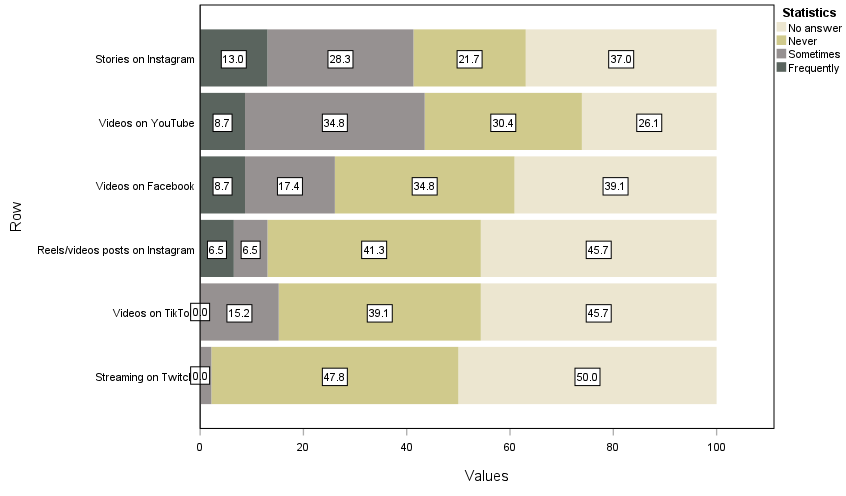
Stories on Instagram and videos on YouTube were the most frequently produced types of videos according to Figure 1 . Instagram stories are used 28.3% sometimes and 13% frequently , meanwhile, videos on YouTube are made 34.8% sometimes and 8.7% frequently . Notably, almost nobody used Twitch and a small percentage of the students made videos on TikTok (15.2%).
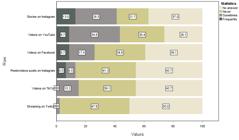
We also observe a pattern across all platforms, with the least common response being to make videos frequently (from 13% on Instagram to 0% on TikTok), indicating that a relatively low percentage of respondents makes videos frequently, especially in comparison with the practice of watching videos ( Shafirova; Sá, 2023 ). Moreover, we found a correlation between the age of the students and the types of video production. The correlation was found in the social media platforms of TikTok, YouTube and Facebook, in which older students (older than 36) tend to make videos for Facebook (due to cross tabulation with Pearson chi-square test with 0.019 significance in case of YouTube and 0.004 in case of Facebook). Meanwhile, younger students (from 18 to 23) tend to make videos on TikTok (due to cross tabulation with Pearson chi-square test with 0.008 significance). It is noteworthy that, on Instagram, we did not find any correlation with age.
In general, in our data, age does not influence the frequency of making videos, however, it points out that some social media platforms are more frequently used by younger respondents and some by slightly older respondents (similarly found in the dataset concerning the US population from Ortiz-Ospina ( 2019 )). Moreover, the students post videos in different languages, mostly in Portuguese and English ( Table 4 ), while other languages have a relatively smaller presence (max. 20% with Spanish on Facebook).
In comparison, our previous study shows that video consumption on social media and streaming platforms could be considered more diverse and plurilingual. Even though English and Portuguese were still the most popular languages, Spanish was used by roughly half of the participants on streaming platforms such as Netflix and HBO. Additionally, such languages as French, Italian, Korean or Japanese were also present, with more than 10% on various platforms ( Shafirova; Sá, 2023 ). There could be various reasons for this difference in language variety in video production and consumption. One possible explanation could be the amount of resources available for watching videos in languages you do not have a perfect command of, such as subtitles in different languages, captions, scripts and more ( Shafirova; Sá, 2023 ).
Moreover, we asked the participants if they tended to use several languages in one video. The participants responded with 26.1% “yes”, with the main objective of reaching out to a vast audience (41.6%), or because of being multilingual (30%).
Why students make and post videos
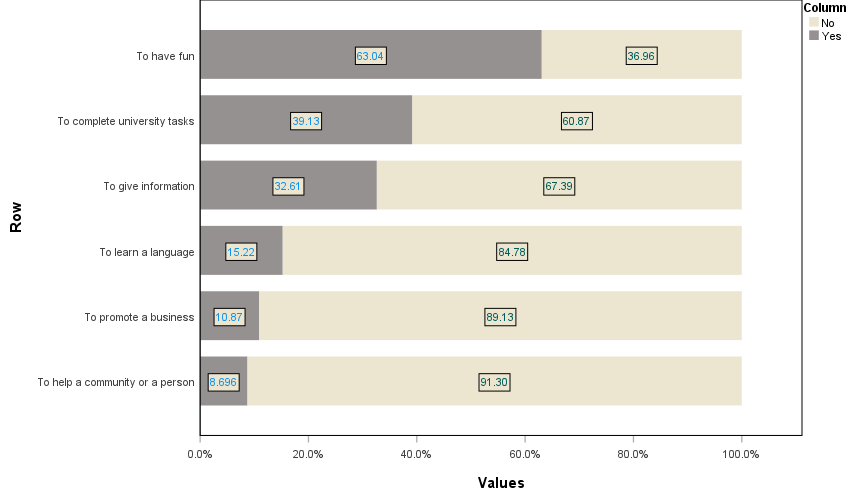
To understand students’ intentions behind video production, we asked about their objectives when making videos. According to Figure 2 , the majority of the students make videos to “have fun” (63%), which goes along with previous research on video creation beyond the classroom ( Zhang, Leticia-Tian; Vazquez-Calvo, 2022 ).
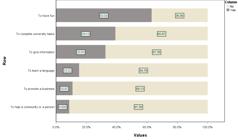
However, the second most popular answer is “to complete university tasks” (39.1%), which is a thought-provoking result indicating that some of the university tasks require students to make videos (similar results at the school level in Cassany; Shafirova ( 2021 )). It would be valuable to explore the potential differences between the videos created for leisure and those made as university tasks, even though these videos would not necessarily be connected to language learning.
Moreover, the third answer was “to give information” (33%), which also seems like a serious and not entertaining goal, which can include making videos or reposts of some news or events. This goes against the assumption of some researchers that social media is always used only for entertainment purposes Rosyida; Seftika ( 2019 ). Also, the option “to learn a language” was not popular (15.2%), which is an expected result as only 33% of the participants are current language learners.
What students do before and after producing videos
Much like when watching videos online ( Shafirova; Sá, 2023 ), around half of the respondents were engaged in some communicative actions before and after making a video. According to Table 5 and Table 6 , the communicative actions included searching (information or visuals), reading (comments), writing (descriptions of the videos), watching videos (to analyse similar videos), translating and interacting with others (collaborating with others, responding to comments, making video responses). The most frequent action before video production is searching for information ( Table 5 ), while the most frequent after production is reading the comments or feedback on the videos ( Table 6 ). The options of writing descriptions or interacting with others were less popular (roughly half of the responses).
Interestingly, if videos were mostly created in Portuguese and English, the actions made before and after video production had more linguistic variability, with the 7 languages present before video production, and 11 after production.
Furthermore, we made a comparison or cross-tabulation comparing the participants mother tongues with the actions taken before video production ( Table 5 ). The results showed that most participants were using a foreign language before and after making a video. In the case of activities made before video production, several participants used such foreign languages as English, French and Italian. Also, some participants used their mother tongues, including Portuguese, Spanish, Chinese and Persian. Similar data emerged when comparing the responses concerning the actions taken after posting the videos in relation to the participants’ mother tongues ( Table 6 ).
For instance, in Table 6 , most participants used English as a foreign language when reading and responding to comments. Other foreign languages included Spanish (only one respondent used it as a mother tongue), French, Italian and Korean. These data indicate that students engaged in communicative activities in foreign languages both before and after making a video. This characterizes video production as interactive and increases language input through various modes, including written, oral, interactive, and information-seeking activities.
The students’ perceptions of language learning with video production and consumption
The questionnaire included two questions about students’ perceptions of language learning while watching or producing videos. The questions went as follows: “To what extent do you agree with the statement: Watching/producing videos in (an)other language(s) helped me in learning this(ese) language(s)”.
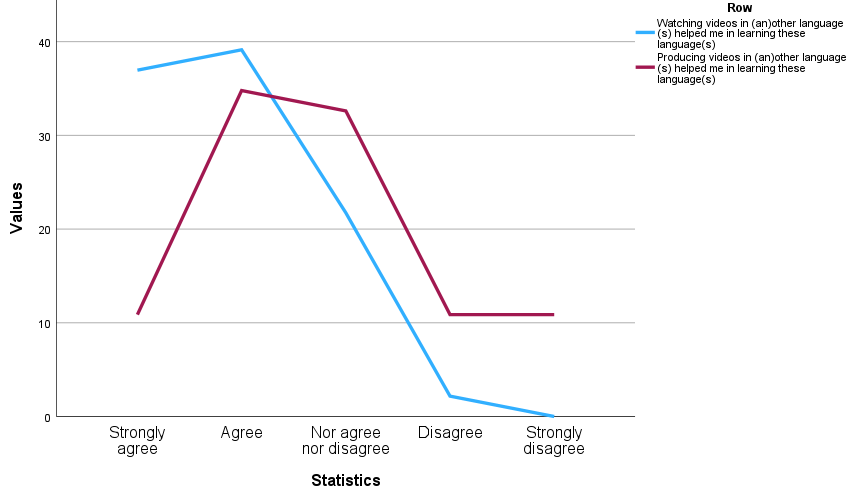
In Figure 3 , we compare the answers to these questions divided into two graphics (based on N-46), one focused on video viewing (blue) and the other on video production (red). The line on video viewing is much more accentuated in comparison with video production which has an almost normal distribution.

It indicates that in the case of video watching, the students mostly “strongly agree” and “agree” (around 75%) with the proposed statement. However, in the case of video producing, most respondents “agree” or “neither agree nor disagree” (around 70%), with some respondents “disagreeing” and “strongly disagreeing” (around 22%). This comparison shows a division in opinions on the benefits of video production, with more uncertainty in the results for video production compared with video watching.
These results could be connected to the frequency of video production compared to video viewing and the fact that students could be engaged in very different forms of video production, from Instagram stories to lengthy videos on YouTube. It can also be connected to our particular dataset which includes students from non-language studies. In general, we consider this discrepancy in data on video viewing and production an interesting phenomenon for further investigation.
Additionally, we ran a cross-tabulation test with a Pearson Chi-Square test to examine if there is a correlation between these students’ perceptions of video production ( Figure 3 ) and the fact that they are current language learners ( Figure 3 ). The p-value (or significance) for the Chi-Square test was 0.6, indicating no significant correlation between these two variables. However, due to the small sample size, seven cells had an expected count of less than 5, which may make the results unreliable. To address this, we combined the cells “agree” and “strongly agree,” as well as “disagree” and “strongly disagree,” transforming the 5-level Likert scale into a 3-level scale. In this adjusted analysis, only two cells had an expected count of less than 5, making the results more reliable. Similar to the previous test, the p-value was 0.3, indicating no significant correlation between these categories. In addition, we ran the Fisher Exact test which is better suited for smaller samples, nevertheless, it also did not indicate any correlation ( \begin{equation}p=0.7\end{equation} in the first case and \begin{equation}p=9.4\end{equation} in the second case).
These results indicate that there is no significant correlation between these two categories. We also examined the categories of current language learners and students perceptions of video watching, and similarly found no correlation (Chi-Square test, \begin{equation}p=0.5\end{equation} ; Fisher Exact test, \begin{equation}p=0.7\end{equation} ). However, it would be beneficial to test this hypothesis with a larger dataset to confirm these findings.
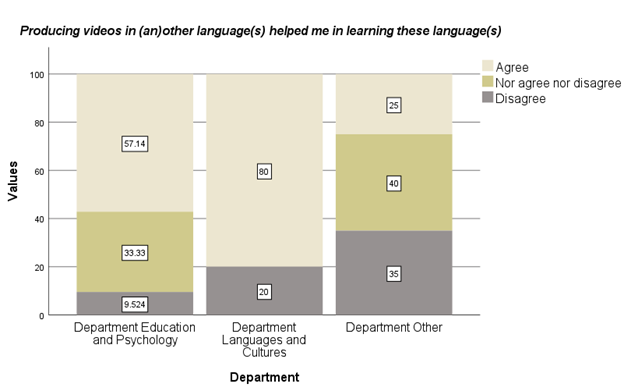
Moreover, we examined the relationship between the category of students’ perceptions of video production benefits and the departments where the students study. We combined our categories into 1) Language Department, 2) Education and Psychology, and 3) Other to see if there are some correlations between our specific dataset and the question. The Chi-Square test showed no significant correlation \begin{equation}(p= 0.066)\end{equation} , however, the Fisher Exact test showed some significance \begin{equation}(p = 0.05)\end{equation} . In this case, as our dataset is small and 50% of the results have an expected count of less than 5, the Fisher Exact Test seems to be more reliable ( Jung, 2014 ). Figure 4 also shows a strong indication of dependence between these categories.
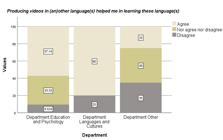
According to Figure 4 , we can see that in the Languages and Cultures department, most students agree that video production helps in learning a language (adjusted residual 1.6), while in Other Departments fewer people agree with this statement (adjusted residual -2.5). In the Department of Education and Psychology, fewer students disagreed that video production could help language learning (adjusted residual -1.8). The distribution observed here indicates more positive perceptions of video production in the Department of Languages and Cultures. This suggests that teaching methodologies in the Languages and Cultures and the Education and Psychology departments may be influencing students perceptions. In comparison, when we tested the correlation between a departmental distribution and students’ perceptions of video watching, we found no significant correlation using either the Chi-Square test \begin{equation}(p=0.3)\end{equation} or the Fisher Exact test \begin{equation}(p=0.3)\end{equation} . Examining this question across different departments would be beneficial, as our current dataset is too small to draw definitive conclusions.
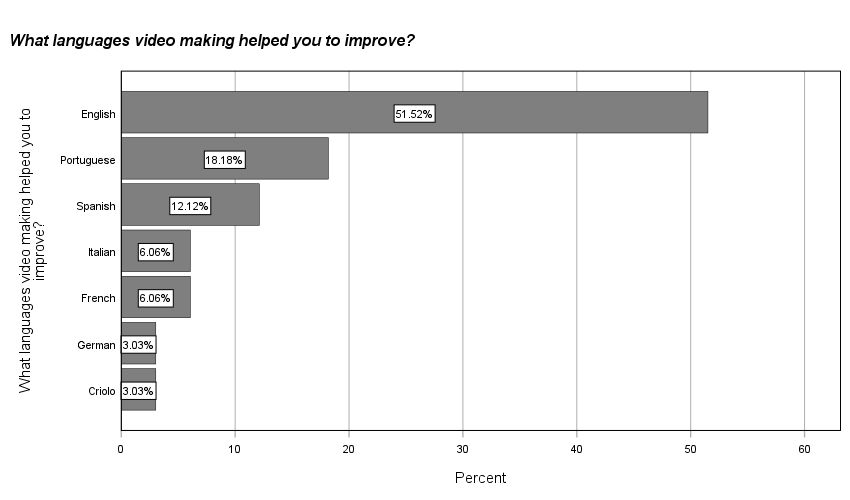
Moreover, 46% of students chose the categories “strongly agree” and “agree” with the benefits of video production for language learning. They also answered the next question regarding the languages that video-making helped them learn ( Table 5 ).
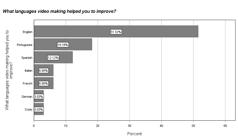
According to Figure 5 , the respondents chose a considerable variety of languages, taking into account that only 21 people (from 46) responded to that question and chose seven languages. English was the most popular response, followed by Portuguese and Spanish. Notably, we can also see Crioulo derived from the Portuguese language (variation from Cabo Verde) in the responses, which was completely absent from video viewing responses ( Shafirova; Sá, 2023 ).
The students also responded to an open question concerning language learning and video viewing/production: “How have you improved your language and cultural skills by watching/producing videos in different languages?” In the case of video viewing, we received 52 responses or around 25% of 212 respondents. According to our codebook ( Appendix A ), 23 responses included the learning of vocabulary, oral comprehension had 9 responses, and pronunciation had 7. Students also noticed learning the cultural aspects (7) of countries where languages are used and underlined the importance of learning the language in the context of its use (5). Overall, the detailed responses indicate that students view this knowledge as important to share.
In the case of video production, we received 8 responses out of 46, in other words, 17% of the students responded, including such categories as vocabulary (4), speaking (2) and cultural aspects (1). The answers were less detailed than those in the viewing section, with a lower overall response rate. Additionally, most responses came from the Departments of Languages and Cultures and Education and Psychology. Some responses highlighted that not only video production was beneficial for language learning but also the work completed beforehand or afterwards ( Appendix A ). For instance, one respondent noticed: “The research required to produce most of my content has allowed me to widen my vision of the English language and culture”.
We observe that students frequently highlighted vocabulary as the primary area of improvement in both video viewing and production. This suggests that, from the respondents perspective, vocabulary could be the most beneficial aspect of both practices.
Discussion
Our findings reveal that video production in general is relatively uncommon among the respondents, with less than a quarter of them producing videos. Also, older students (more than 36 years old) were found to be as frequent producers of video content as the younger generation. According to our data, age was a decisive factor in the choice of several platforms to publish videos, where YouTube was the most popular platform among older students and TikTok among younger students.
The respondents’ objectives when producing videos mostly correspond to previous studies on language learning in the wild and the idea of “rewilding” language education, indicating that the most popular objective of the practice was entertainment ( Thorne, Steven L.; Hellermann; Jakonen, 2021 ). However, a considerable number of students made videos as university tasks, which could be a field for further investigation. For instance, exploring the types of videos students create at the university and the languages used in these tasks could be an interesting topic for research, especially as it questions the boundaries between formal and informal learning at the university level.
Also, according to our data, students suggest that video visualization contributes to a greater extent to language learning compared to video production. Several reasons could explain this finding. First and foremost, nearly all the respondents were active and frequent consumers of video content, while fewer people were posting videos frequently (max. 13% of frequent posts on Instagram). This discrepancy could lead to a certain interpretation in which the respondents place a higher value on frequent video exposure than on occasional video production in a foreign language. Another potential factor is our use of a broad definition of video production, including videos which are very different in length and complexity, from Instagram stories to lengthy YouTube videos. The language input and its impact on language learning could considerably differ between these diverse formats, which could also explain the different perceptions of the students of its effectiveness.
Interestingly, the data indicated that being a current language learner was not a decisive factor in students’ perceptions of language learning through video production. This may be due to the requirement in the Portuguese school system for all high school students to attend foreign language classes, providing most of them with an intentional language learning experience. Instead, differences in perceptions regarding the impact of video production on language learning were found among students from different departments. Students from the Department of Languages and Cultures had a much more positive perception of video production. This suggests that the pedagogical approaches in the Languages and Cultures department may influence students’ perceptions of their video production practices, both formal and informal. Nevertheless, more data needs to be collected to substantiate this point.
Overall, these data encourage us not to assume that all students highly value their social media activity in terms of language learning, potentially challenging some of the results of previous case studies ( Junior, 2020 ; Zhang, Leticia-Tian; Vazquez-Calvo, 2022 ), and indicating a necessity for further quantitative research to improve our understanding of how students perceive video content in their language learning journeys on a broader scale.
Moreover, students highlighted that both video viewing and production contributed to the improvement of their vocabulary. This correlates with data on all types of out-of-school language learning ( Gonulal, 2019 ; Soyoof et al., 2023 ), and with some research on video-making in the English classroom, in which vocabulary improvement was also the most valued aspect by the students ( Yeh, 2018 ). In addition, in the case of video production, speaking was also mentioned by the students, which was the main focus of the in-class video-making investigation ( Devana; Afifah, 2021 ).
Our findings also illustrate that video production on social media could be considered a valuable multiliteracy practice and an interactive environment, as it frequently includes searching for information, writing the descriptions, collaborating with other creators, and reading and interacting in the comment section ( Cope; Kalantzis, 2009 ).
According to students self-reporting, these communicative actions, involving text rather than speaking, had more linguistic diversity than actual video production (11 languages used after video production). In addition, a lot of these actions were made in foreign languages, with English being the most frequent foreign language of use. The students also mention in the open-answer questions the importance of searching for information for their overall cultural and language learning. Hence, our findings indicate the possible significance of all the multifaceted practices that surround video production on social media. This perspective aligns with previous research on learning outside the classroom ( Zhang, Leticia-Tian; Vazquez-Calvo, 2022 ), and underlines the value of having a multiliteracy perspective in the classroom context ( Yeh, 2018 ).
Limitations and future research
The main limitations of this study are the small number of respondents and the low response rate, which constrains the ability to extrapolate the results to wider contexts. We also think that analysing the students’ perceptions of learning through a quantitative perspective was methodologically challenging due to the students’ individual preferences and perceptions. Moreover, the main contribution of this study is opening the discussion about the communicative actions that surround video-making and students’ perception of video production as a practice that contributes to language learning. Our analysis also indicated that students from the Language and Cultures department had a more positive view of video production. Also, the study brings attention to the practices in which students engage before and after making videos, and how these practices can be perceived as multilingual and beneficial by language learners. Finally, future studies could be focused specifically on language students and future language teachers. In such a case, we could have some data on whether the university’s pedagogy influences students’ perceptions of the videos they make in or out of the classroom.
References
-
ASIO, John Mark; PASUBILLO, Mark Anthony; VALENZUELA, Christian Loid. Edutoking: Improving the English-Speaking Skills of Grade 9 Learners using Tiktok-Based Activities. Journal of English as A Foreign Language Teaching and Research, v. 3, n. 1, p. 57–70, Mar. 2023. DOI: 10.31098/jefltr.v3i1.1444. Available from: https://journals.researchsynergypress.com/index.php/jefltr/article/view/1444 . Visited on: 9 July 2024.
» https://doi.org/10.31098/jefltr.v3i1.1444» https://journals.researchsynergypress.com/index.php/jefltr/article/view/1444 -
ASLAM, Shahzaib. TikTok by the Numbers: Stats, Demographics & Fun Facts. Jan. 2022. Available from: https://www.omnicoreagency.com/tiktok-statistics/ . Visited on: 21 Apr. 2022.
» https://www.omnicoreagency.com/tiktok-statistics/ -
BENSON, Philip. Commenting to learn: Evidence of language and intercultural learning in comments on YouTube videos. Language Learning & Technology, v. 19, n. 3, p. 88–105, Aug. 2015. DOI: 10125/44435. Visited on: 5 Jan. 2024.
» https://doi.org/10125/44435 -
BLACK, Rebecca W. Language, Culture, and Identity in Online Fanfiction. E-Learning and Digital Media, v. 3, n. 2, p. 170–184, Feb. 2006. DOI: 10.2304/elea.2006.3.2.170.
» https://doi.org/10.2304/elea.2006.3.2.170 -
BORIS VAZQUEZ-CALVO, Sergio Duarte-Marti; ZHANG, Leticia-Tian. Commenting on learning Korean on TikTok and YouTube. Interactive Learning Environments, Routledge, p. 1–18, 2023. DOI: 10.1080/10494820.2023.2249045. Visited on: 1 July 2024.
» https://doi.org/10.1080/10494820.2023.2249045 -
CASSANY, Daniel; SHAFIROVA, Liudmila. “¡Ya está! Me pongo a filmar”: Aprender grabando vídeos en clase. Revista signos, scielocl, v. 54, n. 107, p. 893–918, Dec. 2021. ISSN 0718-0934. Available from: http://www.scielo.cl/scielo.php?script=sci%5C_arttext%20&pid=S0718-09342021000300893&nrm=iso .
» http://www.scielo.cl/scielo.php?script=sci%5C_arttext%20&pid=S0718-09342021000300893&nrm=iso -
CHANG, Yueh-ching; CHANG, Yu-jung. Identity negotiation in the third space: an analysis of YouTube channels hosted by expatriates in Taiwan. Language and Intercultural Communication, NCA Website, v. 19, n. 1, p. 77–92, Jan. 2019. DOI: 10.1080/14708477.2018.1450878. Visited on: 5 Jan. 2024.
» https://doi.org/10.1080/14708477.2018.1450878 -
CHIK, Alice; BENSON, Phil. Commentary: digital language and learning in the time of coronavirus. Linguistics and Education, Elsevier, v. 62, p. 1–4, Apr. 2021. ISSN 0898-5898. DOI: 10.1016/j.linged.2020.100873. Visited on: 5 Jan. 2024.
» https://doi.org/10.1016/j.linged.2020.100873 -
COPE, Bill; KALANTZIS, Mary. “Multiliteracies”: New Literacies, New Learning. Pedagogies: An International Journal, Routledge, v. 4, n. 3, p. 164–195, 2009. DOI: 10.1080/15544800903076044.
» https://doi.org/10.1080/15544800903076044 -
COPE, Bill; KALANTZIS, Mary. The Things You Do to Know: An Introduction to the Pedagogy of Multiliteracies. In: A Pedagogy of Multiliteracies: Learning by Design. Ed. by Bill Cope and Mary Kalantzis. London: Palgrave Macmillan, 2015. p. 1–36. ISBN 978-1-137-53972-4. DOI: 10.1057/9781137539724_1.
» https://doi.org/10.1057/9781137539724\_1 -
DEVANA, Trisilia; AFIFAH, Nurul. Enhancing Students’ Speaking Skill and Motivation Through Instagram Vlog. In: PROCEEDINGS of the 4th Sriwijaya University Learning and Education International Conference (SULE-IC 2020). [S. l.]: Atlantis Press, 2021. p. 358–363. ISBN 978-94-6239-313-4. DOI: 10.2991/assehr.k.201230.131.
» https://doi.org/10.2991/assehr.k.201230.131 -
FETHI, Khalid; MARSHALL, Helaine W. Flipping Movies for Dynamic Engagement. In: Innovations in Flipping the Language Classroom: Theories and Practices. Ed. by Jeff Mehring and Adrian Leis. Singapore: Springer Singapore, 2018. p. 185–202. ISBN 978-981-10-6968-0. DOI: 10.1007/978-981-10-6968-0_13.
» https://doi.org/10.1007/978-981-10-6968-0\_13 -
GONULAL, Talip. The Use of Instagram as a Mobile-Assisted Language Learning Tool. Contemporary Educational Technology, v. 10, n. 3, p. 309–323, 2019. DOI: 10.30935/cet.590108. Visited on: 5 Jan. 2024.
» https://doi.org/10.30935/cet.590108 -
INSTAGRAM. Introducing Instagram Reels. 2020. Available from: https://about.instagram.com/blog/announcements/introducing-instagram-reels-announcement . Visited on: 15 July 2022.
» https://about.instagram.com/blog/announcements/introducing-instagram-reels-announcement - ITO, Mizuko; GUTIÉRREZ, Kris; LIVINGSTONE, Sonia; PENUEL, Bill; RHODES, Jean; SALE, Katie; SCHOR, Juliet; SEFTON-GREEN, Julian; WATKINS, S. Craig. Connected Learning: An Agenda for Research and Design. Irvine: Digital Media and Learning Research Hub, 2013.
-
JUNG, Sin-Ho. Stratified Fisher’s exact test and its sample size calculation. Biometrical Journal, v. 56, n. 1, p. 129–140, 2014. DOI: 10.1002/bimj.201300048. Visited on: 4 July 2024.
» https://doi.org/10.1002/bimj.201300048 -
JUNIOR, Ronaldo Corrêa Gomes. Instanarratives: Stories of foreign language learning on Instagram. System, v. 94, p. 102330, Nov. 2020. ISSN 0346-251x. DOI: 10.1016/j.system.2020.102330. Available from: https://www.sciencedirect.com/science/article/pii/S0346251X20306904 . Visited on: 5 Jan. 2024.
» https://doi.org/10.1016/j.system.2020.102330» https://www.sciencedirect.com/science/article/pii/S0346251X20306904 -
MUÑOZ-BASOLS, Javier. Going beyond the comfort zone. Language, Culture and Curriculum, Routledge, v. 32, n. 3, p. 299–321, Sept. 2019. DOI: 10.1080/07908318.2019.1661687. Visited on: 5 Jan. 2024.
» https://doi.org/10.1080/07908318.2019.1661687 - NIKITINA, Larissa. Video-making in the Foreign Language Classroom: Applying Principles of Constructivist Pedagogy. Electronic Journal of Foreign Language Teaching, National University of Singapore, v. 7, n. 1, p. 21–31, 2010.
-
ORTIZ-OSPINA, Esteban. The Rise of Social Media. Accessed on: July 15, 2022, Visited on: 5 Jan. 2024. Sept. 2019. Available from: https://ourworldindata.org/rise-of-social-media .
» https://ourworldindata.org/rise-of-social-media -
RÍOS, Cati V. de los. Bilingual Vine making. Learning, Media and Technology, Routledge, v. 43, n. 4, p. 359–373, 2018. DOI: 10.1080/17439884.2018.1498350. Visited on: 5 Jan. 2024.
» https://doi.org/10.1080/17439884.2018.1498350 -
ROSYIDA, Elvira; SEFTIKA, Seftika. How is Instagram Implemented in Teaching Speaking? In: PROCEEDINGS of the Eleventh Conference on Applied Linguistics (CONAPLIN 2018). [S. l.]: Atlantis Press, June 2019. p. 386–388. ISBN 978-94-6252-749-2. DOI: 10.2991/conaplin-18.2019.288. Visited on: 5 Jan. 2024.
» https://doi.org/10.2991/conaplin-18.2019.288 - SAURO, Shannon. Online Fan Practices and CALL. Calico Journal, v. 34, n. 2, p. 131–146, 2017.
-
SHAFIROVA, Liudmila; CASSANY, Daniel. Bronies Learning English in the Digital Wild. Language Learning & Technology, v. 23, n. 1, p. 127–144, Feb. 2019. DOI: 10125/44676. Available from: https://doi.org/10125/44676 . Visited on: 12 Aug. 2024.
» https://doi.org/10125/44676» https://doi.org/10125/44676 -
SHAFIROVA, Liudmila; SÁ, Maria Helena Araújo e. Multilingual encounters in online video practices: the case of Portuguese university students. International Journal of Multilingualism, Routledge, v. 21, n. 3, p. 1680–1699, Apr. 2023. DOI: 10.1080/14790718.2023.2205142. Visited on: 12 Aug. 2024.
» https://doi.org/10.1080/14790718.2023.2205142 -
SOYOOF, Ali; REYNOLDS, Barry Lee; VAZQUEZ-CALVO, Boris; MCLAY, Katherine. Informal digital learning of English (IDLE). Computer Assisted Language Learning, Routledge, v. 36, n. 4, p. 608–640, 2023. DOI: 10.1080/09588221.2021.1936562. Visited on: 5 Jan. 2024.
» https://doi.org/10.1080/09588221.2021.1936562 -
STERN, Alissa Joy. How Facebook can revitalise local languages: lessons from Bali. Journal of Multilingual and Multicultural Development, Routledge, v. 38, n. 9, p. 788–796, Jan. 2017. DOI: 10.1080/01434632.2016.1267737. Visited on: 5 Jan. 2024.
» https://doi.org/10.1080/01434632.2016.1267737 -
TAN, Kim Hua; RAJENDRAN, Agila; MUSLIM, Nazri; ALIAS, Jamsari; YUSOF, Nor Afian. The Potential of TikTok’s Key Features as a Pedagogical Strategy for ESL Classrooms. Sustainability, v. 14, n. 24, Dec. 2022. ISSN 2071-1050. DOI: 10.3390/su142416876. Available from: https://www.mdpi.com/2071-1050/14/24/16876 . Visited on: 5 Jan. 2024.
» https://doi.org/10.3390/su142416876» https://www.mdpi.com/2071-1050/14/24/16876 -
TEE, Yee Han; AMINI, Mansour; SIAU, Ching Sin; AMIRDABBAGHIAN, Amin. Tradução de inglês para chinês do fansub de humor em The Marvelous Mrs. Maisel. Texto Livre, v. 15, e37677, Feb. 2022. DOI: 10.35699/1983-3652.2022.37677. Available from: https://periodicos.ufmg.br/index.php/textolivre/article/view/37677 . Visited on: 7 Mar. 2024.
» https://doi.org/10.35699/1983-3652.2022.37677» https://periodicos.ufmg.br/index.php/textolivre/article/view/37677 - THORNE, Steven. Literacias digitais. In: HAWKINS, Melissa (ed.). Framing Languages and Literacies. [S. l.]: Routledge, 2013. p. 202–228.
-
THORNE, Steven L.; HELLERMANN, John; JAKONEN, Teppo. Rewilding Language Education: Emergent Assemblages and Entangled Actions. The Modern Language Journal, v. 105, n. 1, p. 106–125, 2021. DOI: 10.1111/modl.12687. Available from: https://onlinelibrary.wiley.com/doi/abs/10.1111/modl.12687 . Visited on: 5 Jan. 2024.
» https://doi.org/10.1111/modl.12687» https://onlinelibrary.wiley.com/doi/abs/10.1111/modl.12687 -
VAZQUEZ-CALVO, Boris; SHAFIROVA, Liudmila; ZHANG, Leticia-Tian. Language Learning Hashtags on TikTok in Chinese, Italian, and Russian. In: IDENTITY, Multilingualism and CALL: Responding to New Global Realities. [S. l.]: Equinox Publishing Ltd. p. 104–134.
» https://doi.org/10.1080/10494820.2023.2249045 -
YEH, Hui-Chin. Exploring the Perceived Benefits of the Process of Multimodal Video Making in Developing Multiliteracies. Language Learning & Technology, v. 22, n. 2, p. 28–37, June 2018. DOI: 10.10125/44642. Visited on: 5 Jan. 2024.
» https://doi.org/10.10125/44642 - YUS, Francisco. Humour on Social Networking Sites. In: YUS, Francisco (ed.). Pragmatics of Internet Humour. [S. l.]: Springer International Publishing, 2023. p. 189–244.
- ZAITUN; HADI, Muhammad Sofian; INDRIANI, Emma Dwi. TikTok as a Media to Enhancing the Speaking Skills of EFL Students. Jurnal Studi Guru dan Pembelajaran, v. 4, n. 1, p. 89–94, 2021.
-
ZHANG, Leticia-Tian; VAZQUEZ-CALVO, Boris. “¿Triste estás? I don’t know nan molla”. ITL International Journal of Applied Linguistics, John Benjamins, v. 173, n. 2, p. 197–227, Aug. 2022. ISSN 0019-0829. DOI: 10.1075/itl.21007.zha. Available from: https://www.jbe-platform.com/content/journals/10.1075/itl.21007.zha . Visited on: 5 Jan. 2024.
» https://doi.org/10.1075/itl.21007.zha» https://www.jbe-platform.com/content/journals/10.1075/itl.21007.zha - ZHANG, Tian Leticia; CASSANY, Daniel. Fansubbing del español al chino: organización, roles y normas en la escritura colaborativa. BiD: textos universitaris de biblioteconomia i documentació, n. 37, p. 1–12, Dec. 2016.
-
FundingThis work is funded by national funds through FCT – Fundação para a Ciência e a Tecnologia, I.P., under the Scientific Employment Stimulus - Individual Call – [2022.06443.CEECIND] with DOI: 10.54499/2022.06443.CEECIND/CP1720/CT0040 and the CIDTFF Research Centre (projects UIDB/00194/2020 and UIDP/00194/2020). It was also partly supported by OralGrab. Grabar vídeos y audios para ensenyar y aprender (PID2022-141511NB-100, Ministry of Science and Innovation), Gr@el - Grup de recerca sobre aprenentatge i ensenyament de llengües (SGR471, AGAUR), and by DEFINERS: Digital language learning of language teachers (TED2021-129984A-I00, Ministry of Science and Innovation, Spain).
Codebooks of video viewing and production
Table 7 . Categories of language learning through video consumption.
| Category | Freq. | Examples in Portuguese | Our translation to English | Departments |
|---|---|---|---|---|
| Pronunciation | 7 | Tentando repetir pronúncias e palavras, principalmente com músicas. | Trying to repeat pronunciations and words, especially with songs. | Languages and Cultures, Biology |
| Vocabulary (everyday language, slang) | 23 | Enriquecimento de vocabulário novo, expressões de gíria e fonética. Novas expressões, pesquisa depois de ver o vídeo, entre outras. | Learning new vocabulary, slang expressions, and phonetics. New expressions, research after watching the video, etc. | Education and Psychology, Languages and Cultures, Biology, Environment, Engineering |
| Grammar | 1 | Aprendi questões de gramática. | I learnt about grammar. | Languages and Cultures |
| Oral comprehension | 9 | Comecei por ver com legendas na minha língua materna e fui me apercebendo do que significavam as palavras/expres-sões ditas. Mais tarde via sem legendas e tentava entender. | I started watching it with subtitles in my mother tongue and realised what the words/expressions meant. Later, I watched without subtitles and tried to understand. | Biology, Education and Psychology, Languages and Cultures |
| Speaking skills | 2 | Muitas vezes em conversa com os colegas fico firme e convicta do que falo. | Often, when talking to colleagues, I’m firm and convinced of what I’m saying. | Mathematics |
| Language use in context | 5 | Vendo os vídeos é possível compreender um pouco mais o contexto e o uso das expressões em outra língua. | By watching the videos you can understand a little more about the context and the use of expressions in another language. | Physics, Engineering, Education and Psychology, Languages and Cultures |
| Cultural aspects | 7 | As séries permitem aprender outra língua e ao mesmo tempo os contextos sociais/culturais do país ou região onde é falada. Por exemplo, vi uma série chinesa que mostrava a vida de uma funcionária de uma empresa chinesa para aprender o chinês em contexto laboral. | TV shows allow you to learn another language and at the same time the social/cultural contexts of the country or region where it is spoken. For example, I saw a Chinese TV show that showed the life of an employee of a Chinese company learning Chinese in a work context. | Biology, Education and Psychology, Environment, Languages and Cultures, Geosciences |
Table 8 . Video production.
| Category | Freq. | Examples in Portuguese | Our translation to English | Departments |
|---|---|---|---|---|
| Communicative skills | 2 | A expressão oral | Speaking | Languages and Cultures; Education and Psychology |
| Vocabulary | 4 | Consegui aprender novas palavras | I was able to learn new words | Education and Psychology; Languages and Cultures |
| Cultural aspects | 1 | A pesquisa necessária para produzir a maioria dos meus conteúdos permitiu-me alargar a minha visão à cerca da língua e cultura inglesa (…) | The research required to produce most of my content has allowed me to widen my vision of the English language and culture (…) | Biology |
Edited by
-
Section Editor:Daniervelin Pereira
-
Layout editor:João Mesquita

 Source: Own elaboration.
 Source: Own elaboration.
 Source: Own elaboration.
 Source: Own elaboration.
 Source: Own elaboration.