
 School Leadership and the Pedagogical Integration of Generative AI in Writing Instruction: A Chilean Secondary School Case
Abstract
The integration of generative artificial intelligence (AI) in schools offers new pedagogical possibilities but also introduces significant challenges for school leadership. This study examines how leadership mediates the use of tools such as ChatGPT in secondary-level writing instruction in a public Chilean school. Using a convergent parallel mixed-methods design, we analyzed classroom observations, text mining of field notes, and national education policy documents. Students who engaged with generative AI displayed greater emotional involvement and produced more lexically diverse written work. Policy analysis revealed tensions between equity-oriented innovation discourses and insufficient operational guidance for school implementation. Findings indicate that generative AI tends to be layered onto existing instructional practices rather than transforming them, highlighting the need for context-sensitive leadership capable of aligning innovation policies with classroom realities. The study concludes that equitable and meaningful integration of generative AI requires leadership that supports pedagogical intentionality, infrastructure development, and sustained professional learning.
Keywords:
Generative artificial intelligence; School leadership; Writing instruction; Technology integration; Educational equity
Resumo
A integração da inteligência artificial generativa (IAg) nas escolas apresenta novas oportunidades pedagógicas, mas também desafios importantes para a liderança escolar. Este estudo investiga como a liderança medeia o uso de ferramentas como o ChatGPT no ensino da escrita em uma escola pública chilena de ensino médio. Utilizando um delineamento de métodos mistos paralelo e convergente, analisamos observações de sala de aula, mineração de texto de notas de campo e documentos de políticas educacionais nacionais. Os resultados mostram que estudantes que utilizaram IAg demonstraram maior engajamento emocional e produziram vocabulário mais variado durante as atividades de escrita. A análise de políticas revelou tensões entre discursos de inovação orientados para a equidade e a escassa orientação operacional disponível para as escolas. Os achados indicam que a IAg tende a ser sobreposta às práticas tradicionais, em vez de transformá-las, exigindo uma liderança sensível ao contexto para alinhar as políticas de inovação às realidades das salas de aula. Conclui-se que a integração equitativa e significativa da IAg depende de processos de liderança capazes de articular infraestrutura, desenvolvimento profissional e intencionalidade pedagógica.
Palavras-chave:
Inteligência artificial generativa; Liderança escolar; Ensino da escrita; Integração tecnológica; Equidade educacional
1 Introduction
The emergence of generative artificial intelligence (AI) technologies has sparked intense debate in education. Tools such as ChatGPT are transforming how students engage with writing, research, and knowledge production, opening new pathways for personalization, automation, and creative expression (Floridi; Chiriatti, 2020; Duart, 2024). However, these opportunities come with complex pedagogical and ethical dilemmas, particularly in under-resourced educational systems where digital inequality persists (UNESCO, 2021).
Chilean curricular reforms have introduced new competencies related to the production of discursive genres (e.g., essays, reports) and 21st-century skills, emphasizing effective and purposeful communication (Ministerio de Educación de Chile, 2019). Writing is required across most subject areas, making the instructional conditions under which writing tasks are assigned critical to students’ success (Tolchinsky; Simó, 2001). However, writing often remains marginal in classroom practice, receiving limited attention or being relegated to a secondary role (Figueroa; Chandía; Meneses, 2018). This contributes to persistent challenges in writing instruction, such as unclear purposes, decontextualized activities, implicit assessment of hidden skills, and artificial task settings. In this context, pedagogical leadership is essential for reshaping institutional conditions that affect writing instruction. Where writing holds a marginal role, school leadership becomes central to mediating the integration and sustainability of technological innovations. Research shows that adaptive and distributed leadership models are vital for responding to emerging challenges, fostering institutional resilience, and promoting equitable innovation (Heifetz; Grashow; Linsky, 2009; Montecinos; Bush; Aravena, 2018). Nevertheless, little is known about how school leadership in Latin American public education interprets and implements national AI policy frameworks in everyday classroom practices.
Chile has shown growing interest in regulating and promoting the ethical and critical use of generative artificial intelligence (GAI), particularly in education. This commitment is evident in the National Artificial Intelligence Policy (Ministerio de Ciencia, Tecnología, Conocimiento e Innovación, 2021) (updated in 2024), which outlines a roadmap based on three pillars: enabling conditions (e.g., infrastructure, teacher training), AI development and adoption, and ethical governance. The policy incorporates international guidelines - such as those of UNESCO - and promotes a participatory and socially responsible approach to technological innovation. However, its practical implications for school-level implementation and leadership remain underexplored.
Building on this broader framework, Chile’s Ministry of Education has developed targeted guidelines for schools. One such initiative is the PotencIA el aprendizaje [Boosting AI Learning] guide (Ministerio de Educación de Chile, 2025), which supports and assists teaching teams in integrating GAI tools, such as ChatGPT or Gemini, in a creative and reflective manner. Additionally, the Center for Improvement, Experimentation, and Pedagogical Research (CPEIP) has developed a national teacher training plan in AI through various courses and workshops. These initiatives aim to strengthen educators’ digital competencies and promote critical pedagogical appropriation. Together, they seek to foster institutional conditions that ensure equitable and curriculum-aligned implementation across school contexts.
Nevertheless, implementation remains uneven, and many schools face a lack of concrete guidance, insufficient infrastructure, and limited professional development opportunities (Ministerio de Educación de Chile, 2023; Gobierno de Chile, 2024). Despite regulatory advances, significant gaps persist between the design of public policies and their enactment in classrooms. Even less is known about how writing tasks are being reshaped by the emerging use of generative AI tools in day-to-day pedagogical practice. This study is guided by the following research question: how can student experiences inform school leadership practices related to the integration of generative AI in writing instruction, and to what extent is this alignment supported by Chilean curriculum and policy frameworks?
Drawing on classroom observations, text mining of field notes, and qualitative analysis of policy documents, the study examines the role of school leadership in mediating the integration of GAI into secondary-level writing instruction. It investigates whether leadership practices align with national policy orientations and how students’ experiences reflect - or challenge - these frameworks.
The inquiry is part of a broader research project on writing practices in secondary education. While the initial focus was on student engagement with writing tasks, the growing presence of generative AI during classroom observations prompted an inductive shift in analytical focus. This emergent theme led to a more targeted examination of the intersections between technology, leadership, and policy in a digitally evolving school context.
2 Theoretical Framework
2.1 School Leadership and Educational Innovation
School leadership plays a pivotal role in shaping how educational innovations are understood, adopted, and sustained at the institutional level. In the context of digital transformation, leadership is not only about managing change but about enabling new pedagogical cultures (Fullan, 2020). Adaptive leadership, as proposed by Heifetz, Grashow, and Linsky (2009), emphasizes the need for leaders to engage with complexity, facilitate learning, and promote responsiveness to emerging challenges such as the ethical use of generative AI.
Distributed leadership further expands this notion by recognizing that meaningful innovation requires shared responsibility among administrators, teachers, and students (Harris, 2014; Montecinos; Bush; Aravena, 2018). In this view, leadership becomes a relational process embedded in the school’s capacity to support teacher agency, experimentation, and reflective practice (Poekert; King, 2023).
However, research also highlights persistent tension: while policies often promote school autonomy and innovation, standardization pressures and lack of institutional support can restrict pedagogical flexibility (Swaffield; Poekert, 2020; Bass, 1990). Understanding how leadership operates in practice, especially in resource-constrained settings, is therefore essential to evaluating the conditions under which educational innovations like AI integration can take root.
2.2 Equity, AI, and Pedagogical Change
The integration of generative artificial intelligence in education has opened new avenues for pedagogical innovation, especially in fields such as writing instruction. However, the implementation of these technologies remains uneven and potentially inequitable across different educational contexts. While high-performing schools may incorporate AI tools to personalize learning and foster creativity, public schools with fewer resources often face significant challenges in accessing and sustaining such innovations (UNESCO, 2021; Atuahene; Xusheng, 2024).
Digital equity is not limited to access to devices or connectivity. It also encompasses the capacity of students and teachers to use digital tools meaningfully and ethically. This involves developing critical digital literacies, encouraging reflective practices on AI use, and addressing the socio-emotional and ethical dimensions of human-machine interaction (Knox, 2023; Selwyn, 2019). In this regard, pedagogical innovation must be accompanied by leadership strategies that attend to both structural conditions and professional development needs (Ng et al., 2023).
From a pedagogical standpoint, the incorporation of AI requires a shift away from purely instrumental uses toward more transformative models of teaching and learning. Rather than replacing traditional writing instruction, AI tools should be embedded within broader strategies that promote critical thinking, multimodal communication, and student agency (Ríos-Cabrera; Bolívar-Ruiz, 2020). For example, generative AI can support ideation, draft revision, or peer feedback, but only when framedby clear pedagogical intentions and guided by teacher mediation.
Leadership plays a central role in ensuring that these innovations are not simply adopted, but meaningfully integrated. In low-resource environments, this includes advocating for infrastructural investments, fostering communities of practice among teachers, and co-constructing ethical guidelines that govern the use of AI in the classroom (Filgueiras, 2024; Greco et al., 2024). Leadership must also consider how curricular frameworks, assessment of cultures, and institutional priorities shape the opportunities and limitations for pedagogical experimentation.
Moreover, the integration of AI into education cannot be disentangled from broader social inequities. Students from marginalized backgrounds often face cumulative disadvantages that extend beyond the digital realm. If not critically addressed, AI may exacerbate rather than alleviate these disparities, reinforcing patterns of exclusion or misrepresentation. This underscores the need for equity-oriented leadership, which positions technology as a tool to support inclusive learning environments rather than as a neutral solution.
Ultimately, equitable AI integration depends on school leadership that is not only adaptive and distributed, but also ethically committed and contextually aware. It requires a vision of innovation that places pedagogy and justice, not technology, at the center of educational change.
3 Methods
This study employed a convergent parallel mixed-methods design (Creswell; Plano Clark, 2018) to investigate how school leadership mediates the integration of generative artificial intelligence into writing instruction in secondary education. The research combines non-participant classroom observations, text mining of field notes, and qualitative content analysis of policy documents to generate a multidimensional understanding of leadership practices and policy alignment.
3.1 Participants and Context
The study was conducted in a public school located in La Florida, a working-class neighborhood in Santiago, Chile. Eighteen eleventh-grade students participated. Each student was observed twice over six weeks, with a total of six 90-minute sessions across subjects including Language Arts, English, and Biology. The school had limited technological infrastructure, and the presence of generative AI tools in the classroom was uneven and covered by some students’ own resources, reflecting broader structural inequalities observed in research on educational technology (UNESCO, 2021; Atuahene; Xusheng, 2024). On the one hand, teachers permit the deployment of mobile devices and the use of AI. On the other hand, not all students have access to these resources, which include the device and the internet.
3.2 Data Collection Instruments
A classroom observation rubric was developed and approved by the Ethics Committee of the Pontificia Universidad Católica de Chile. The instrument included three dimensions: (1) student disposition toward writing tasks, (2) use of time during writing activities, and (3) types of materials used. Each indicator was recorded using a Yes/No or Applicable/Not Applicable scale, and field notes were added to capture contextual and behavioral data (see Andrews-Todd and Forsyth (2020), for similar classroom-based designs). A total of 55 field note entries were generated, each linked to a specific student, session, and set of behavioral markers. All participants signed informed assent, and parental consent was obtained due to the involvement of minors.
3.3 Qualitative Analysis
The qualitative strand of the study focused on a policy-oriented documentary analysis, aiming to understand how Chilean national frameworks conceptualize the integration of generative AI in education and how these frameworks align with leadership practices in schools. Four key documents were selected for this analysis:
-
The National Curriculum for 11th and 12th Grades (Ministerio de Educación de Chile, 2019),
-
The National Artificial Intelligence Strategy (Gobierno de Chile, 2024),
-
The ChatGPT Teacher Guide (Ministerio de Educación de Chile, 2023), and
-
PotencIA el Aprendizaje, an official manual for integrating AI in the classroom (Ministerio de Educación de Chile, 2025).
These documents were coded using an interpretive content analysis approach, which was chosen for its theoretical flexibility and ability to identify themes and patterns (Saldaña, 2010). The analytical process consisted of five main phases (Braun; Clarke, 2006), detailed below (Table 1).
This procedure used an open coding strategy to identify meaningful units of meaning and generate preliminary categories. This process was inductive and theoretical, drawing on previous literature on educational leadership, equity, and digital innovation. Five general thematic categories were consolidated: (1) digital equity, (2) pedagogical autonomy, (3) adaptive and distributed leadership, (4) generative AI and writing, and (5) ethical and critical use of AI. Key analytical questions guiding this process included:
-
How do the documents define the role of school leaders in AI integration?
-
What assumptions are made about teachers’ and students’ agencies?
-
Are there contradictions or omissions between curriculum goals and innovation frameworks?
This qualitative strand not only revealed policy-level discourses but also helped contextualize the patterns observed in classroom practice. The findings informed the interpretation of classroom data and contributed to triangulation across methodological strands.
3.4 Quantitative Text Mining
The quantitative strand of this mixed-methods design applied computational text analysis techniques to the field notes derived from non-participant classroom observations. A total of 55 observational entries were preprocessed and analyzed using RStudio with a suite of text mining packages: tidytext, tm, igraph, ggraph, syuzhet, and widyr (Silge; Robinson, 2017; Jockers, 2017).
3.5 Preprocessing
Text data were first normalized to lowercase to ensure consistency across entries. All punctuation marks, numbers, and standard Spanish stopwords (e.g., the, of, and, in) were removed. Additionally, a custom list of domain-specific stopwords (e.g., teacher, book, task) was applied to reduce lexical noise associated with common but analytically irrelevant terms in the classroom context. Tokenization was then performed to generate unigrams (individual words) and bigrams (pairs of consecutive words), enabling further lexical and semantic analyses.
3.6 Frequency and Co-occurrence
Word frequency was calculated using simple token counts across the full corpus, as well as within subgroups (e.g., students who used cellphones vs. those who did not). Bigram analysis was conducted to identify pairs of words that appeared in sequence, applying a minimum frequency threshold of two occurrences and excluding trivial or generic combinations. To further explore lexical relationships, co-occurrence networks were generated using the pairwise_count() function to detect word proximities across student entries. These networks were represented as undirected graphs using the igraph and ggraph packages in RStudio, with the Fruchterman-Reingold layout algorithm applied to visualize the relative strength of connections between terms.
3.7 Sentiment Analysis
Lexical sentiment was analyzed using the NRC Emotion Lexicon (Spanish version), which categorizes words into affective dimensions such as positive, negative, joy, trust, sadness, fear, disgust, and surprise. Sentiment scores were computed for each observational entry by tallying the frequency of emotion-related terms. Mean scores were then calculated and compared across two conditions: (1) cellphone use during the session (1 = used, 0 = not used), and (2) observed levels of enthusiasm (1 = high, 0 = low).
3.8 Statistical Summary
The analysis was descriptive and exploratory. No inferential statistics were applied due to the sample size and the qualitative nature of the observational entries. However, comparative summaries across groups provided insight into affective engagement and lexical variation associated with different classroom conditions.
This quantitative analysis enabled the transformation of rich qualitative field notes into structured lexical indicators, supporting triangulation with the policy and leadership-focused qualitative strand of the study.
3.9 Integration of Mixed-Methods Findings
This study followed a convergent parallel mixed-methods design (Creswell; Plano Clark, 2018), in which qualitative and quantitative strands were implemented simultaneously and analyzed independently. The qualitative strand focused on thematic analysis of educational policy documents, while the quantitative strand applied lexical and sentiment analysis to classroom observation notes.
The integration occurred at the interpretation stage, where patterns identified in the field notes, such as increased student engagement associated with generative AI use, were examined considering the official policy discourse. For instance, student themes of agency, ethical AI use, and distributed leadership found in documents such as PotencIA el Aprendizaje were used to contextualize and critically interpret classroom-level affective and lexical trends.
This integrative approach allowed for a triangulated understanding of the relationship between leadership, technology, and pedagogical innovation. It also enabled the study to contrast normative expectations embedded in national policy with the realities of practice, offering insights into institutional gaps, enabling conditions, and emerging possibilities for AI-informed leadership in secondary education.
4 Qualitative Results
The qualitative analysis allowed us to identify five dimensions around the integration of GAI in Chilean school education. The main findings are presented below (Table 2).
4.1 Leadership Expectations and Limitations
The Curricular Bases for Grades 11-12 (Ministerio de Educación de Chile, 2019) promotes school autonomy and professional reflection, stating that schools should develop educational projects tailored to their unique contexts. Yet, the pressure of standardized assessments and limited institutional support constrains the actual enactment of innovative pedagogies.
Documents such as PotencIA el Aprendizaje (Ministerio de Educación de Chile, 2025) and the ChatGPT Teaching Guide (Ministerio de Educación de Chile, 2023) call on teachers to assume a leadership role in integrating AI critically and ethically. Nevertheless, these documents offer few concrete mechanisms or institutional structures to support this shift, leaving schools and teachers without clear pathways for collaborative innovation or ongoing professional development.
4.2 Generative AI and Writing Instruction
Policy guidance frames AI tools as pedagogical assistants capable of enhancing creativity, critical thinking, and student curiosity. In particular, the ChatGPT Teaching Guide encourages using AI to generate writing prompts, revise drafts, and provide feedback. However, concerns remain around the ethical boundaries of AI use and its impact on student authorship, especially in high-stakes academic settings.
Although the curriculum acknowledges multimodal literacies, it does not explicitly incorporate generative AI or provide criteria for evaluating AI-mediated writing. This policy-practice gap reinforces the need for leadership that bridges technical guidance with pedagogical vision.
4.3 Ethical Integration and Critical Reflection
Across all documents, there is a strong emphasis on promoting ethical and responsible use of AI in education. Teachers are encouraged to guide students in reflecting on the implications of AI tools not only in terms of efficiency, but also in how they shape knowledge, relationships, and learning purposes (Beroíza-Valenzuela, 2026).
Still, these ethical principles are often abstract and disconnected from practical implementation. The documents provide limited scaffolding for teachers or leaders to transform ethical guidelines into classroom strategies, highlighting the need for leadership that is both value-driven and operationally grounded.
4.4 Student Agency in AI-Mediated Learning
Recent documents emphasize student agency and digital creativity. PotencIA el Aprendizaje, for instance, asks teachers to design tasks where students are not just consumers of information but creators of knowledge using AI. While this aspiration is pedagogically ambitious, it relies heavily on local capacity and assumes a level of digital readiness that may not exist uniformly across schools.
This reinforces the argument that school leadership must act as a mediating force, not only facilitating access to infrastructure but also fostering the development of critical digital literacies and collaborative cultures that support meaningful innovation.
5 Quantitative Results
The quantitative analysis focused on a corpus of 55 field notes collected during non-participant classroom observations. These notes were processed and analyzed using text mining techniques in RStudio, allowing for an exploration of lexical patterns and affective sentiment linked to students’ engagement with writing tasks and technology use, particularly generative AI tools such as ChatGPT.
5.1 Word Frequency Analysis
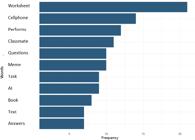
The word frequency analysis revealed that the most common terms were “worksheet”, “cellphone”, and “performs”, suggesting a classroom environment where traditional instructional materials coexist with emerging digital practices. This hybrid pedagogical scenario indicates that generative AI is being layered into, rather than replacing, conventional methods (Figure 1).
5.2 Lexical Differences by Cellphone Use
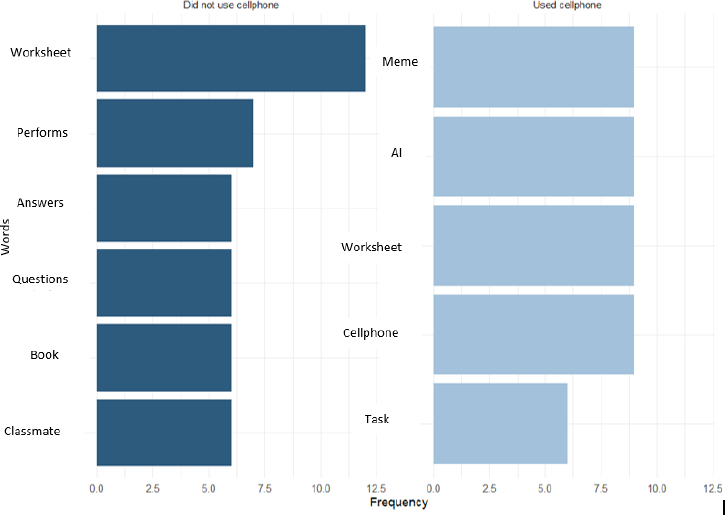
Comparing observations with and without cellphone use revealed notable differences in lexical content. In lessons without cellphone use, frequent words included “worksheet”, “performs”, “book”, and “classmate”, indicating a focus on structured, peer-supported, and print-based tasks. In contrast, classes with cellphone use showed increased lexical variety, with terms such as “meme”, “AI”, and “task” appearing more often and pointing to creative, tech-mediated practices (Figure 2).

5.3 Co-occurrence Networks
The overall co-occurrence analysis revealed strong associations between “worksheet” and “AI”, particularly in writing-focused sessions. This suggests that digital tools are not replacing printed materials but are increasingly integrated with them (Figure 3).

In cellphone-enabled lessons, the co-occurrence network further highlighted associations between terms like “meme”, “AI”, “task”, and “worksheet”, illustrating how students navigated between digital tools and curriculum-based resources.
5.4 Sentiment Analysis
Students who used their cellphones during class (coded as 1) exhibited higher average levels of both positive (M = 2.32) and negative (M = 1.11) sentiment compared to those who did not use their phones (positive: M = 1.50; negative: M = 0.56). Notably, cellphone users showed elevated joy (M = 0.79 vs. 0.56), while trust levels remained relatively stable across both groups (M = 1.16 vs. 1.11). These patterns suggest a more emotionally intense classroom experience-both positively and negatively-for students who interacted with their devices (Figure 4).

In addition, sentiment was analyzed based on observed student enthusiasm. Students who displayed observable enthusiasm (coded as 1) had higher average sentiment scores across positive categories, including positivity (M = 2.29), trust (M = 1.35), and joy (M = 0.82), and lower scores in negative categories such as negativity (M = 0.59), sadness (M = 0.76), and disgust (M = 0.29). In contrast, students with no observable enthusiasm (coded as 0) scored lower in positivity (M = 1.60) and higher in negativity (M = 1.05), sadness (M = 0.65), and disgust (M = 0.45), suggesting a clear affective pattern linked to engagement (Figure 5).

The quantitative results suggest that generative AI tools and mobile technology use in the classroom are associated with greater emotional engagement and lexical richness in writing tasks. These benefits, however, appear to be context-dependent, emerging primarily in settings where students had access to digital tools and the freedom to explore. This reinforces the role of school leadership in enabling inclusive, flexible, and emotionally supportive learning environments.
6 Mixed Results
This study followed a convergent parallel mixed-methods design, analyzing quantitative and qualitative data separately before integrating findings to develop a comprehensive understanding of the interplay between leadership, policy, and classroom practice in the integration of generative AI into writing instruction.
The qualitative strand, based on national policy documents and curricular guidelines, revealed a discursive emphasis on ethical AI use, student agency, and pedagogical innovation. Documents such as the National AI Strategy and PotencIA el Aprendizaje promoted adaptive and distributed leadership as central to meaningful digital transformation. However, while these texts articulated ambitious goals, they lacked operational guidance on how schools and teachers could implement such changes in resource-constrained public-school contexts.
The quantitative analysis provided a grounded perspective on these themes. Text mining of classroom field notes showed that AI-related terms (e.g., “AI”, “meme”) coexisted with traditional pedagogical vocabulary (e.g., “worksheet”, “book”), suggesting that generative AI is not displacing but rather complementing conventional approaches. Furthermore, lexical sentiment analysis indicated that classrooms where students used cellphones or engaged with digital tools expressed higher levels of positivity and joy, especially when students were observed as enthusiastic.
To synthesize both strands, a joint display was developed to identify convergence and divergence across key thematic categories (see Table 3).
The joint display confirms areas of convergence, particularly regarding the hybrid pedagogical model and the emotional benefits of technology use and highlights key disconnections. Most notably, while policies promote ethical and adaptive AI integration, the conditions enabling such integration (infrastructure, training, leadership capacity) are unevenly distributed. The success of generative AI in enhancing student engagement and creativity seems to depend not solely on national vision but on school-level leadership decisions and flexibility.
The integration of both data strands suggests that effective and equitable use of AI in education depends on how school leaders interpret and enact national directives within their local realities. Where leadership supports experimentation and values teacher agency, students are more likely to benefit from the emotional and pedagogical opportunities enabled by generative AI.
7 Discussion
This study explored how student experiences with generative artificial intelligence in writing instruction inform school leadership practices, and whether these practices align with Chilean national policy frameworks. The use of a convergent parallel mixed-methods design (Creswell; Plano Clark, 2018) enabled a triangulated interpretation of both classroom realities and institutional discourses. Findings reveal a complex relationship between innovation, leadership, and policy, shaped by unequal access, ambiguous institutional guidance, and evolving pedagogical cultures.
National documents such as the National AI Strategy (Gobierno de Chile, 2024), the ChatGPT Teaching Guide (Ministerio de Educación de Chile, 2023), and PotencIA el Aprendizaje (Ministerio de Educación de Chile, 2025) promote a progressive discourse of innovation. They call for ethical AI use, distributed leadership, and student-centered learning. These aspirations are consistent with global policy trends that position AI as both a challenge and an opportunity for education (UNESCO, 2023; Zawacki-Richter et al., 2019; Azevedo et al., 2024). However, these documents often lack operational clarity and do not articulate how schools, particularly under-resourced ones, can translate these visions into everyday practices (Filgueiras, 2024; Knox, 2023). The burden of implementation tends to fall on individual teachers, who are expected to innovate within structurally limited conditions (Bannister; Carver, 2024).
Leadership, in this context, is not merely about endorsing innovation but about enabling it. This includes fostering professional learning communities (Poekert; King, 2023), creating protected time for pedagogical planning (Swaffield; Poekert, 2020), and advocating for alignment between curriculum and emergent tools (Fullan, 2020; Nicolae; Nicolae, 2018). Nonetheless, as observed in this study, school leadership remains constrained by systemic inequities. Even when teachers display agency, the absence of strategic leadership, particularly in areas of digital equity, limits the sustainability and ethical depth of AI integration (Ng et al., 2023; Greco et al., 2024).
Quantitative findings reinforce the pedagogical potential of generative AI. Students exposed to AI-supported writing activities exhibited higher lexical diversity, more positive sentiment, and stronger emotional engagement. These affective and cognitive benefits align with previous research suggesting that AI can enhance personalization and motivation in learning (Chookaew et al., 2024; Mohlake; Mohale, 2023). However, this positive impact was conditional. It depended on teacher initiative, availability of devices, and school-level openness to experimentation-factors deeply shaped by leadership styles and institutional culture.
From an equity perspective, the results are ambivalent. On the one hand, AI offers tools that can democratize learning, scaffold writing, and support differentiated instruction (Wang et al., 2024; Dakakni; Safa, 2023). On the other, its integration risks reinforcing structural disparities if leadership does not explicitly address unequal access and teacher preparation (UNESCO, 2021; McGrath et al., 2023). Equity must be understood not only in terms of physical access to devices, but also in terms of epistemic access-who gets to define, lead, and shape the use of AI in the classroom (Knox, 2023; Roshanaei, 2024).
These findings point to the urgent need for leadership models that are context-sensitive, ethically grounded, and strategically distributed (Heifetz; Grashow; Linsky, 2009; Harris, 2014). Leadership must mediate between national policy rhetoric and school-level practice, ensuring that innovation is not an isolated endeavor but a supported, institutional process. This includes designing policies that go beyond symbolic inclusion and articulate concrete pathways for teacher development, infrastructure investment, and curricular redesigning.
Ultimately, generative AI does not innovate education on its own; leaders do. School leadership must be reframed as a catalyst for ethical, inclusive, and pedagogically meaningful innovation. This means enabling teachers and students to engage critically with AI, rather than merely using it. Only through deliberate, systemic leadership can educational technologies fulfill their promise of transforming, not just digitizing, teaching and learning.
This study examined the role of school leadership in the integration of generative AI into writing instruction, focusing on the interplay between national education policies and student experiences in a Chilean public school. The findings reveal a clear gap between policy aspirations and school-level realities. While national documents promote ethical AI use, pedagogical autonomy, and innovation, the lack of operational guidance and uneven infrastructure constrain implementation. Students responded positively to AI-supported writing tasks, demonstrating higher engagement and emotional connection. However, these benefits were contingent on contextual factors such as digital access, teacher initiative, and leadership support.
Considering these findings, it is recommended that school leaders adopt a proactive and enabling stance toward AI integration. This involves advocating for digital equity, aligning curriculum with emergent tools, and fostering teacher-led innovation through collaboration and ongoing professional learning. Ministries and policymakers must move beyond rhetorical commitments and provide schools with the resources, time, and framework needed to implement ethical, inclusive, and sustainable AI practices. For generative AI to serve as a tool for educational transformation rather than reproduction of existing inequalities, leadership must operate not only as governance, but as a space of pedagogical mediation and institutional imagination.
Data availability
Research data is only available upon request.
References
-
ANDREWS-TODD, J.; FORSYTH, C. M. Exploring Social and Cognitive Dimensions of Collaborative Problem Solving in an Open Online Simulation-Based Task. Computers in Human Behavior, v. 104, p. 105759, 2020. DOI: 10.1016/j.chb.2018.10.025.
» https://doi.org/10.1016/j.chb.2018.10.025 -
ATUAHENE, Samuel Amoah; XUSHENG, Qian. Overcoming E-Learning Hurdles: Strategies for Enhancing STEM Education in Africa Through Digital Innovation. Studies in Higher Education, 2024. DOI: 10.1080/03075079.2024.2413866.
» https://doi.org/10.1080/03075079.2024.2413866 -
AZEVEDO, L.; MALLINSON, David J.; WANG, J.; ROBLES, P.; BEST, E. AI Policies, Equity, and Morality and the Implications for Faculty in Higher Education. Public Integrity, 2024. DOI: 10.1080/10999922.2024.2414957.
» https://doi.org/10.1080/10999922.2024.2414957 -
BANNISTER, P.; CARVER, M. I Don’t Need Professional Development; I Want Institutional Development: Legitimising Marginalised Epistemic Capital That Disrupts Generative AI Discourse. Professional Development in Education, p. 1-19, 2024. DOI: 10.1080/19415257.2024.2427873.
» https://doi.org/10.1080/19415257.2024.2427873 -
BASS, Bernard M. From Transactional to Transformational Leadership: Learning to Share the Vision. Organizational Dynamics, v. 18, n. 3, p. 19-31, 1990. DOI: 10.1016/0090-2616(90)90061-S.
» https://doi.org/10.1016/0090-2616(90)90061-S -
BEROÍZA-VALENZUELA, Felipe. Educational Change in the Age of Artificial Intelligence: Anticipatory Governance, Equity, and the Future of PK-12 Systems. Journal of Educational Change, 2026. DOI: 10.1007/s10833-026-09556-5.
» https://doi.org/10.1007/s10833-026-09556-5 -
BRAUN, Virginia; CLARKE, Victoria. Using Thematic Analysis in Psychology. Qualitative Research in Psychology, v. 3, n. 2, p. 77-101, 2006. DOI: 10.1191/1478088706qp063oa.
» https://doi.org/10.1191/1478088706qp063oa -
CHOOKAEW, S.; KITCHAROEN, P.; HOWIMANPORN, S.; PANJABUREE, P. Fostering Student Competencies and Perceptions Through Artificial Intelligence of Things Educational Platform. Computers and Education: Artificial Intelligence, v. 7, p. 100308, 2024. DOI: 10.1016/j.caeai.2024.100308.
» https://doi.org/10.1016/j.caeai.2024.100308 - CRESWELL, John W.; PLANO CLARK, Vicki L. Designing and Conducting Mixed Methods Research. 3. ed. [S. l.]: SAGE Publications, 2018.
-
DAKAKNI, D.; SAFA, N. Artificial Intelligence in the L2 Classroom: Implications and Challenges on Ethics and Equity in Higher Education: A 21st Century Pandora’s Box. Computers and Education: Artificial Intelligence , v. 5, p. 100179, 2023. DOI: 10.1016/j.caeai.2023.100179.
» https://doi.org/10.1016/j.caeai.2023.100179 -
DUART, Josep M. Trends and Challenges in Digital Education in the Age of Artificial Intelligence. In: MA, W. W. K.; LI, C.; FAN, C. W.; U, L. H.; LU, A. (eds.). Blended Learning. Intelligent Computing in Education. [S. l.]: Springer Nature, 2024. p. 15-20. DOI: 10.1007/978-981-97-4442-8_2.
» https://doi.org/10.1007/978-981-97-4442-8_2 - FIGUEROA, J.; CHANDÍA, E.; MENESES, A. Calidad de la escritura en explicaciones y argumentaciones: validación estructural de una rúbrica para medir desempeños. Boletín de Lingüística, v. 30, n. 49-50, p. 43-67, 2018.
-
FILGUEIRAS, Fernando. Artificial Intelligence and Education Governance. Education, Citizenship and Social Justice, v. 19, n. 3, p. 349-361, 2024. DOI: 10.1177/17461979231160674.
» https://doi.org/10.1177/17461979231160674 -
FLORIDI, Luciano; CHIRIATTI, Massimo. GPT-3: Its Nature, Scope, Limits, and Consequences. Minds and Machines, v. 30, n. 4, p. 681-694, 2020. DOI: 10.1007/s11023-020-09548-1.
» https://doi.org/10.1007/s11023-020-09548-1 - FULLAN, Michael. Leading in a Culture of Change. [S. l.]: Jossey-Bass, 2020.
-
GOBIERNO DE CHILE. Estrategia Nacional de Inteligencia Artificial: Actualización 2024. [S. l.], 2024. Available from: https://www.ciencia.gob.cl/inteligenciaartificial
» https://www.ciencia.gob.cl/inteligenciaartificial -
GRECO, D.; TURSUNBAYEVA, A.; CAPURRO, R.; STAFFA, M. Digital Transformation of Teaching and Learning in Higher Education Institutions: A Case Study of the University of Naples “Parthenope”. In: PALOMBA, F.; GRAVINO, C. (eds.). Artificial Intelligence with and for Learning Sciences. Past, Present, and Future Horizons. [S. l.]: Springer Nature Switzerland, 2024. v. 14545. (Lecture Notes in Computer Science). p. 99-111. DOI: 10.1007/978-3-031-57402-3_11.
» https://doi.org/10.1007/978-3-031-57402-3_11 - HARRIS, Alma. Distributed Leadership Matters: Perspectives, Practicalities, and Potential. [S. l.]: Corwin Press, 2014.
- HEIFETZ, Ronald A.; GRASHOW, Alexander; LINSKY, Martin. The Practice of Adaptive Leadership: Tools and Tactics for Changing Your Organization and the World. [S. l.]: Harvard Business Press, 2009.
-
JOCKERS, Matthew L. syuzhet: Extract Sentiment and Plot Arcs from Text. [S. l.]: CRAN, 2017. Computer software. Available from: https://CRAN.R-project.org/package=syuzhet
» https://CRAN.R-project.org/package=syuzhet -
KNOX, Jeremy. (Re)politicising Data-Driven Education: From Ethical Principles to Radical Participation. Learning, Media and Technology, v. 48, n. 2, p. 200-212, 2023. DOI: 10.1080/17439884.2022.2158466.
» https://doi.org/10.1080/17439884.2022.2158466 -
MCGRATH, C.; CERRATTO PARGMAN, T.; JUTH, N.; PALMGREN, P. J. University Teachers’ Perceptions of Responsibility and Artificial Intelligence in Higher Education-An Experimental Philosophical Study. Computers and Education: Artificial Intelligence , v. 4, p. 100139, 2023. DOI: 10.1016/j.caeai.2023.100139.
» https://doi.org/10.1016/j.caeai.2023.100139 -
MINISTERIO DE CIENCIA, TECNOLOGÍA, CONOCIMIENTO E INNOVACIÓN. Política Nacional de Inteligencia Artificial. [S. l.], 2021. Available from: https://www.minciencia.gob.cl/areas/inteligencia-artificial/politica-nacional-de-inteligencia-artificial/
» https://www.minciencia.gob.cl/areas/inteligencia-artificial/politica-nacional-de-inteligencia-artificial/ -
MINISTERIO DE CIENCIA, TECNOLOGÍA, CONOCIMIENTO E INNOVACIÓN. Política Nacional de Inteligencia Artificial: Actualización 2024. [S. l.], 2024. Available from: https://www.minciencia.gob.cl/areas/inteligencia-artificial/politica-nacional-de-inteligencia-artificial/
» https://www.minciencia.gob.cl/areas/inteligencia-artificial/politica-nacional-de-inteligencia-artificial/ -
MINISTERIO DE EDUCACIÓN DE CHILE. Bases curriculares para 3° y 4° medio. [S. l.], 2019. Available from: https://www.curriculumnacional.cl
» https://www.curriculumnacional.cl -
MINISTERIO DE EDUCACIÓN DE CHILE. Guía para docentes: ChatGPT en el aula. [S. l.], 2023. Available from: https://www.mineduc.cl
» https://www.mineduc.cl -
MINISTERIO DE EDUCACIÓN DE CHILE. PotencIA el aprendizaje: Orientaciones para la integración de IA generativa en el aula. 2025. Available from: https://centroinnovacion.mineduc.cl
» https://centroinnovacion.mineduc.cl -
MOHLAKE, M. M.; MOHALE, M. A. Student Assistants’ Perceived Leadership Impact of Artificial Intelligence on the Reading and Writing Landscape. In: MAYISELA, T.; CILLIERS, L. (eds.). Proceedings of the University of Fort Hare Teaching and Learning Conference (UFHTL 2023). [S. l.]: Atlantis Press, 2023. v. 22. (Advances in Social Science, Education and Humanities Research), p. 150-162. DOI: 10.2991/978-94-6463-439-6_11.
» https://doi.org/10.2991/978-94-6463-439-6_11 -
MONTECINOS, Carmen; BUSH, Tony; ARAVENA, Felipe. Moving the School Forward: Problems Reported by Novice and Experienced Principals During a Succession Process in Chile. International Journal of Educational Development, v. 62, p. 201-208, 2018. DOI: 10.1016/j.ijedudev.2018.04.008.
» https://doi.org/10.1016/j.ijedudev.2018.04.008 -
NG, D. T. K.; LEUNG, J.; SU, J.; NG, R.; CHU, S. K. W. Teachers’ AI Digital Competencies and Twenty-First Century Skills in the Post-Pandemic World. Educational Technology Research and Development, v. 71, p. 137-161, 2023. DOI: 10.1007/s11423-023-10203-6.
» https://doi.org/10.1007/s11423-023-10203-6 -
NICOLAE, M.; NICOLAE, E. E. Leadership in Higher Education - Coping with AI and the Turbulence of Our Times. In: 1. PROCEEDINGS of the International Conference on Business Excellence. [S. l.]: De Gruyter, 2018. v. 12, p. 683-694. DOI: 10.2478/picbe-2018-0061.
» https://doi.org/10.2478/picbe-2018-0061 -
POEKERT, Philip; KING, Fiona. Leading Professional Learning to Navigate Complexity. Professional Development in Education , v. 49, n. 6, p. 953-957, 2023. DOI: 10.1080/19415257.2023.2277572.
» https://doi.org/10.1080/19415257.2023.2277572 -
RÍOS-CABRERA, P.; BOLÍVAR-RUIZ, C. La innovación educativa en América Latina: lineamientos para la formulación de políticas públicas. Revista Innovaciones Educativas, v. 22, n. 32, p. 199-212, 2020. DOI: 10.22458/ie.v22i32.2828.
» https://doi.org/10.22458/ie.v22i32.2828 -
ROSHANAEI, M. Towards Best Practices for Mitigating Artificial Intelligence Implicit Bias in Shaping Diversity, Inclusion and Equity in Higher Education. Education and Information Technologies, v. 29, n. 14, p. 18959-18984, 2024. DOI: 10.1007/s10639-024-12605-2.
» https://doi.org/10.1007/s10639-024-12605-2 - SALDAÑA, Johnny. The Coding Manual for Qualitative Researchers. New Delhi: Sage Publications, 2010.
- SELWYN, Neil. Should Robots Replace Teachers?: AI and the Future of Education. [S. l.]: Polity Press, 2019.
- SILGE, Julia; ROBINSON, David. Text Mining with R: A Tidy Approach. Sebastopol, CA: O’Reilly Media, 2017.
-
SWAFFIELD, Sue; POEKERT, Philip E. Leadership for Professional Learning. Professional Development in Education , v. 46, n. 4, p. 517-520, 2020. DOI: 10.1080/19415257.2020.1793500.
» https://doi.org/10.1080/19415257.2020.1793500 -
TOLCHINSKY, Liliana; SIMÓ, Nuria. La producción escrita en la escuela: Algunas condiciones que la favorecen. Infancia y Aprendizaje, v. 24, n. 3, p. 353-364, 2001. DOI: 10.1174/021037001316978007.
» https://doi.org/10.1174/021037001316978007 - UNESCO. Reimagining Our Futures Together: A New Social Contract for Education: Executive Summary. [S. l.]: UNESCO, 2021.
-
UNESCO. Inteligencia artificial y educación: oportunidades, desafíos y políticas. [S. l.], 2023. Available from: https://www.unesco.org/es/digital-education/artificial-intelligence
» https://www.unesco.org/es/digital-education/artificial-intelligence -
WANG, C.; WANG, H.; LI, Y.; DAI, J.; GU, X.; YU, T. Factors Influencing University Students’ Behavioral Intention to Use Generative Artificial Intelligence: Integrating the Theory of Planned Behavior and AI Literacy. International Journal of Human-Computer Interaction, 2024. DOI: 10.1080/10447318.2024.2383033.
» https://doi.org/10.1080/10447318.2024.2383033 -
ZAWACKI-RICHTER, Olaf; MARÍN, Victoria I.; BOND, Melissa; GOUVERNEUR, Frank. Systematic Review of Research on Artificial Intelligence Applications in Higher Education - Where Are the Educators? International Journal of Educational Technology in Higher Education, v. 16, n. 1, p. 39, 2019. DOI: 10.1186/s41239-019-0171-0.
» https://doi.org/10.1186/s41239-019-0171-0

 Source: The authors.
 Source: The authors.
 Source: The authors.
 Source: The authors.
 Source: The authors.