
 The Council of State and the foreign policy of the Empire of Brazil: neutrality and strategy in the Río de la Plata during the Guerra Grande (1838-1852)
The article analyzes Brazil’s position during the Guerra Grande (1838-1852), focusing on the Council of State’s role in shaping foreign policy. Rather than a stance of serene neutrality, it reveals a complex position shaped by internal, regional, and international dynamics. Created in 1841, the Council was key in diplomatic deliberations. The study examines the Consultations of the Second Council (1841-1848), highlighting views on neighboring republics and their often-distrusted leaders. Brazilian neutrality is portrayed as a strategic, flexible posture amid concerns about borders, the Farroupilha Revolt, and the risk of war with Argentina. The article shows how Brazil sought to balance national and regional interests in a volatile 19th-century South American context.
Keywords:
Imperial Brazil; Uruguay; State Council
 Thumbnail
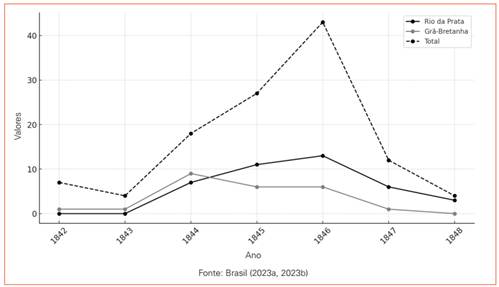 O gráfico mostra o número de Consultas do Conselho de Estado sobre Negócios Estrangeiros comparando o número total e os números relativos ao Rio da Prata e à Grã-Bretanha. Enquanto ano após ano os números relativos à Grã-Bretanha desciam, os números relativos ao Rio da Prata cresciam, ultrapassando-os.