
 EVALUATION OF THE JOHNS HOPKINS EVIDENCE-BASED PRACTICE MODEL: A PRELIMINARY STUDY WITH CLINICAL NURSES
Objective: to preliminarily evaluate the efficacy of the Johns Hopkins Nursing Evidence-Based Practice model used in an educational workshop as a facilitator in structuring/description an evidence-based practice project from the perspective of clinical nurses and in compliance criteria by external evaluation.
Method: this is a randomized, parallel, preliminary controlled trial with masking for external evaluation, conducted in a private hospital in São Paulo, from December 2020 to March 2021, with 13 nurses in the control group and 12 in the intervention group. The intervention used seven tools from the Johns Hopkins model to support the exercise of structuring/describing an evidence-based practice project. The educational workshop consisted of two meetings lasting three hours each. Three questionnaires were used: 1) to assess the nurses’ prior knowledge; 2) to assess the perception of facilitation in relation to the material offered; and 3) to analyze compliance by external evaluation. Descriptive analyses and Poisson regression were used.
Results: from the clinical nurses’ perspective, the intervention group demonstrated greater ease in developing an evidence dissemination plan and going through all phases of a project than the control group (with 90% and 79% less risk of responding “very easy” to these aspects - relative risk 0.10 and 0.21). There was no statistically significant difference in compliance between the groups according to the external evaluation.
Conclusion: this preliminary study suggests that the model showed partial efficacy according to the clinical nurses, which was not observed in the external evaluation.
DESCRIPTORS:
Evidence-based clinical practice; Nursing education; Teaching; Knowledge; Evidence-based nursing; Randomized controlled clinical trial
 Thumbnail
 Thumbnail
 *JHNEBP = Johns Hopkins Nursing Evidence-Based Practice
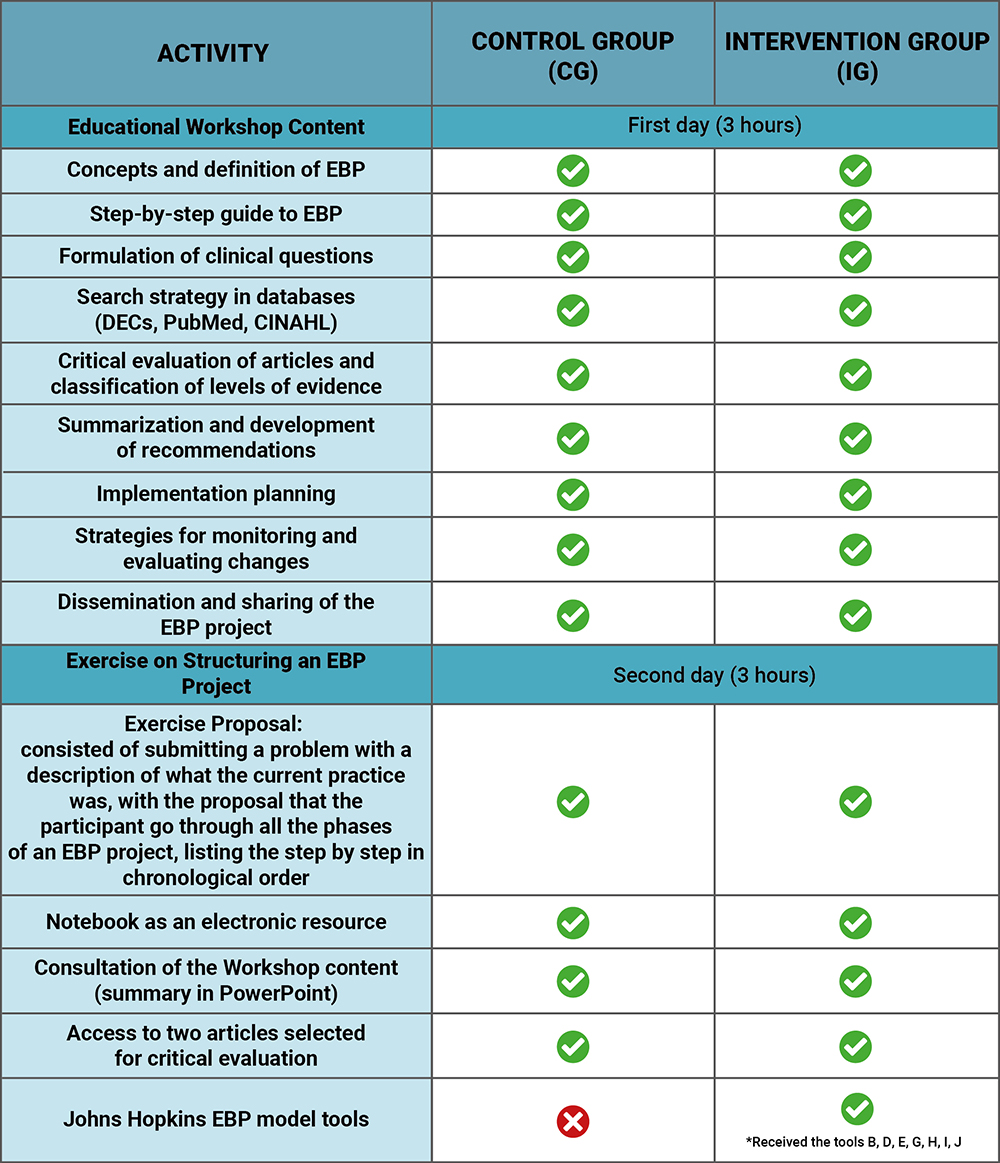 *EBP = Evidence-Based Practice