
 EVALUATION OF THE JOHNS HOPKINS EVIDENCE-BASED PRACTICE MODEL: A PRELIMINARY STUDY WITH CLINICAL NURSES
ABSTRACT
Objective: to preliminarily evaluate the efficacy of the Johns Hopkins Nursing Evidence-Based Practice model used in an educational workshop as a facilitator in structuring/description an evidence-based practice project from the perspective of clinical nurses and in compliance criteria by external evaluation.
Method: this is a randomized, parallel, preliminary controlled trial with masking for external evaluation, conducted in a private hospital in São Paulo, from December 2020 to March 2021, with 13 nurses in the control group and 12 in the intervention group. The intervention used seven tools from the Johns Hopkins model to support the exercise of structuring/describing an evidence-based practice project. The educational workshop consisted of two meetings lasting three hours each. Three questionnaires were used: 1) to assess the nurses’ prior knowledge; 2) to assess the perception of facilitation in relation to the material offered; and 3) to analyze compliance by external evaluation. Descriptive analyses and Poisson regression were used.
Results: from the clinical nurses’ perspective, the intervention group demonstrated greater ease in developing an evidence dissemination plan and going through all phases of a project than the control group (with 90% and 79% less risk of responding “very easy” to these aspects - relative risk 0.10 and 0.21). There was no statistically significant difference in compliance between the groups according to the external evaluation.
Conclusion: this preliminary study suggests that the model showed partial efficacy according to the clinical nurses, which was not observed in the external evaluation.
DESCRIPTORS:
Evidence-based clinical practice; Nursing education; Teaching; Knowledge; Evidence-based nursing; Randomized controlled clinical trial
RESUMO
Objetivo: avaliar preliminarmente a eficácia do modelo de prática baseada em evidências Johns Hopkins Nursing Evidence-Based Practice, utilizado em oficina educacional, como facilitador na estruturação/descrição de um projeto de prática baseada em evidências na perspectiva de enfermeiros clínicos e em critérios de conformidade por avaliação externa.
Método: ensaio controlado randomizado, paralelo, preliminar, com mascaramento para a avaliação externa, conduzido em um hospital privado em São Paulo, no período dezembro/2020 a março/2021, com 13 enfermeiros no grupo controle e 12 no grupo intervenção. A utilização de sete ferramentas do modelo Johns Hopkins, para apoiar o exercício de estruturação/descrição de um projeto de prática baseada em evidências, foi a intervenção realizada. A oficina educacional foi composta de dois encontros com duração de três horas cada. Foram utilizados três questionários: 1) para avaliar o conhecimento prévio dos enfermeiros, 2) avaliar a percepção da facilitação com relação ao material oferecido e, 3) para analisar a conformidade por avaliação externa. Utilizaram-se análises descritivas e regressão de Poisson.
Resultados: na perspectiva do enfermeiro clínico, o grupo intervenção demonstrou maior facilidade para elaborar um plano de disseminação das evidências e percorrer todas as fases de um projeto do que o grupo controle (90% e 79% menos risco de responder com “facilitou muito” a esses aspectos - risco relativo 0,10 e 0,21). Não houve diferença estatisticamente significativa na conformidade entre os grupos pela avaliação externa.
Conclusão: este estudo preliminar sugere que o modelo mostrou eficácia parcial segundo os enfermeiros clínicos, o que não foi observado na avaliação externa. NCT04483713.
DESCRITORES:
Prática clínica baseada em evidências; Educação em enfermagem; Ensino; Conhecimento; Enfermagem baseada em evidências; Ensaio clínico controlado aleatório
RESUMEN
Objetivo: evaluar preliminarmente la efectividad del modelo de Johns Hopkins Nursing Evidence-Based Practice, utilizado en un taller educativo, como facilitador en la estructuración/descripción de un proyecto de práctica basada en evidencia desde la perspectiva de enfermeras clínicas y en cumplimiento de criterios de evaluación externa.
Método: ensayo clínico preliminar, aleatorizado, paralelo, controlado, con enmascaramiento para evaluación externa, realizado en un hospital privado de São Paulo, de diciembre/2020 a marzo/2021, con 13 enfermeras en el grupo control y 12 en el grupo intervención. La intervención realizada fue el uso de siete herramientas del modelo Johns Hopkins para apoyar el ejercicio de estructuración/descripción de un proyecto de práctica basada en evidencia. El taller educativo constó de dos encuentros de tres horas de duración cada uno. Se utilizaron tres cuestionarios: 1) para evaluar los conocimientos previos de las enfermeras, 2) para evaluar la percepción de facilitación en relación con el material ofrecido y 3) para analizar el cumplimiento mediante una evaluación externa. Se utilizaron análisis descriptivos y regresión de Poisson.
Resultados: desde la perspectiva de la enfermera clínica, el grupo de intervención demostró mayor facilidad para desarrollar un plan de difusión de evidencia y atravesar todas las fases de un proyecto que el grupo control (90% y 79% menos riesgo de responder con “muy fácil” a estos aspectos - riesgo relativo 0,10 y 0,21). No hubo diferencia estadísticamente significativa en el cumplimiento entre los grupos según la evaluación externa.
Conclusión: este estudio preliminar sugiere que el modelo mostró efectividad parcial según las enfermeras clínicas, lo que no se observó en la evaluación externa.
DESCRIPTORES:
Práctica clínica basada en la evidencia; Educación en enfermería; Enseñanza; Conocimiento; Enfermería basada en evidencia; Ensayo clínico controlado aleatorizado
INTRODUCTION
Evidence-based practice (EBP) is defined as the use of the best and most current scientific evidence available, combined with clinical experience and consideration of patient values and preferences1. EBP in Nursing is associated with better clinical outcomes for patients and contributes to reducing variations in practice, which results in better quality of care. Positive impacts are observed in indicators such as average length of hospital stay and mortality. Additionally, EBP in nursing provides a positive return on investment, which reinforces its relevance for patient safety, the efficiency of care practices and sustainability of health services2.
The importance of EBP in nursing has been highlighted by relevant groups. The Nursing and Midwifery Council (NMC) of the United Kingdom has designated EBP as a professional responsibility of nurses. In addition, the Magnet® Program, coordinated by the American Nurses Credentialing Center (ANCC), determines EBP application as an essential criterion to recognize excellence in nursing1,3-4.
However, EBP implementation faces challenging barriers such as the lack of resources needed to advance development of clinical nurses’ skills and competencies, limited time to dedicate to this activity, and especially in countries where English is not the native language, an additional barrier of low English proficiency4-8.
It is then recommended to adopt strategies to overcome barriers aimed at strengthening an organizational culture focused on EBP9-10. Implementation of an EBP model stands out among such strategies, considered a key element to guide professionals in the EBP process and to support managing its complexity11-15.
Different EBP models are available in the literature, including the Johns Hopkins Nursing Evidence-based Practice Model (JHNEBP)12-13. The JHNEBP model was established as a result of collaboration between nursing leaders in teaching and clinical practice at Johns Hopkins Hospital and Johns Hopkins University School of Nursing16. It includes tools divided into 10 forms from A to J, used individually or in groups to provide support from identifying a question in care practice to applying the evidence, evaluating and communicating the results17-18.
When evaluating the EBP scenario in Brazil (the site of this study), the proposal of the Joanna Briggs Institute (JBI) from Australia has been the only initiative explored. The Brazilian Center for Evidence-Informed Healthcare (JBI Brazil) has been involved in training and conducting systematic and non-systematic reviews, in addition to providing evidence synthesis and transferring findings13,19.
In turn, the lack of national or translated models available for free use by clinical nursing in the national scenario motivated this study. Given the gaps in knowledge and the relevance of the topic, the need to evaluate and explore the use of EBP models in the population of clinical nurses is justified. Thus, the objective of this study was to preliminarily evaluate the efficacy of the Johns Hopkins Nursing Evidence-Based Practice (JHNEBP) model used in an educational workshop as a facilitator in the structuring/description of an EBP project from the perspective of clinical nurses and in compliance criteria by external evaluation.
METHOD
This is a preliminary study conducted as a randomized controlled trial in parallel with masking for the external evaluator researcher and composed of two groups: intervention group (IG), consisting of participants who attended the educational workshop (EW) and received the tools of the JHNEBP model; and a control group (CG), composed of participants who attended the EW without application of the model.
The study was conducted in São Paulo, SP, Brazil, in a private general hospital, with 649 operational beds. The participants worked in the following areas: Medical Surgical Clinic, Oncology, Maternal and Child, Offices, Diagnostic Medicine and Department of Critical Patients. The data collection period occurred between December 2020 and March 2021.
The target population of the study was composed of clinical nurses. vacancies were advertised via email invitation sent to the leaders of the local research institution so that they could share them with their teams to recruit participants. The invitation presented the initial study proposal with information on voluntary participation, including possible dates and times for the Educational Workshops, as well as the inclusion and exclusion criteria for the initial selection of participants. Nurses participating in the study had to be released during their work shift for the two days of EW.
The inclusion criteria were: clinical nurses working at the bedside, with at least two years of training and with self-reported instrumental English at an intermediate level for reading, since reading scientific articles in English would be required during the workshop. The exclusion criteria were: previous participation in an EBP project, previous involvement in the institutional EBP board or in research projects or participation in stricto sensu graduate programs.
The RedCap® (Research Electronic Data Capture) platform was used for randomization. The randomization stage was carried out after verifying the inclusion and exclusion criteria of the participants and obtaining informed consent through signing the Informed Consent Form (ICF). A simple, non-stratified randomization was performed, with a 1:1 ratio between the IG and CG. The participants were randomly and automatically allocated into the groups by the RedCap® system with guarantee of allocation confidentiality, meaning that the participant and the researcher did not know in advance which group the participant would be allocated to.
It was not possible to mask the participants during the intervention due to its nature, since the IG participants would have direct contact with the tools of the JHNEBP model. An external researcher with a postdoctoral degree and a specialist in EBP was invited without contact with the nurses of the institution or with the groups to which each participant belonged in order to reduce the risk of bias for the outcome analysis and to assess the compliance of the practical exercise performed by the participants during the EW.
A total of 29 participants responded to the invitations, confirmed their eligibility, signed the informed consent form and were randomized to the CG and IG. A total of 25 participants completed the study (valid sample), 13 in the CG and 12 in the IG. Two participants in each group were excluded from the sample because they did not attend the educational workshops on the proposed dates. The loss to follow-up was less than 15%.
The inclusion of participants, allocation to groups, follow-up and the reason for exclusions are represented in the standard flow diagram for clinical trials Consolidated Standards of Reporting Trials (CONSORT)20, as illustrated in Figure 1.

The original language of the JHNEBP tools is American English. Thus, it was necessary to translate them into Brazilian Portuguese to facilitate their use in the population that comprised the study sample. The translation precision of the JHNEBP tools was validated as a pre-intervention step.
The translation of the JHNEBP tools was authorized on March 16, 2018, by a representative of the Institute for Johns Hopkins Nursing, documented by institutional email. Then, the free translation was reviewed in February 2019 by the Translation and Review Service of the Integrated Library System of the Teaching and Research Institute of the local institution of the study.
Although this step of the study does not deal with the validation of measurement properties since the tools do not measure attributes represented by scores, it was decided to submit the translation for verification of precision adequacy by a committee of five master’s nurses with expertise in the area of EBP and members of the EBP Council of the local hospital of the study.
In turn, two of the participants in the review suggested adjustments to the translation, which were evaluated, accepted or rejected with explanations by the researchers, who resubmitted it to the same group for a second round of evaluations. This stage was completed after two rounds with the approval of the final versions by the five nurses (100% agreement), with the goal of achieving an agreement of over 80%.
There was no modification of the original content or layout, ensuring the legal terms of ©Copyright and the reference ©The Johns Hopkins Hospital/The Johns Hopkins University on each form. The JHNEBP 2022 tools have been available free of charge since 2023 on the Johns Hopkins website in four languages: English, Spanish, Mandarin and Portuguese21. The Portuguese version available was created from this Brazilian initiative.
The study also incorporated the five steps proposed for the EBP process to be taught and implemented. They are: 1) transform the information needs or problems into an answerable question; 2) track the best scientific evidence to answer them with maximum efficiency; 3) critically evaluate this evidence for quality and clinical applicability; 4) integrate the evaluation with clinical experience and apply the results in practice; and 5) evaluate the results and performance22-24. These key elements were considered in this study as fundamental to the concept of an EBP project in the practical exercise.
Next, the age, sex, time since graduation, time working as a nurse and workplace variables were evaluated to characterize the participant demographics. In addition, the Evidence-Based Practice and Clinical Effectiveness Questionnaire (EBPQ) was used to assess the participants’ prior knowledge regarding EBP as part of the characterization25.
The following evaluation parameters were considered primary outcomes: the perspective of clinical nurses regarding the ease of structuring and describing the practical EBP exercise in comparing the IG (which received the tools of the JHNEBP model), with the CG (which did not use these tools); and an evaluation by an external researcher of the exercise’s conformity with the concept presented, taking into account the five steps of the EBP process as key elements for an EBP project.
Then, two questionnaires were used to assess the outcomes: a questionnaire to assess structuring and description of an EBP project from the clinical nurse’s perspective; and a questionnaire to verify compliance in the exercise of preparing an EBP project from the researcher’s perspective. A summary of each questionnaire is presented below, and the full content of the questionnaires and the researcher’s evaluation form is available in the supplementary material.
First, the Evidence-Based Practice and Clinical Effectiveness Questionnaire (EBPQ): Originally developed in English25, validated and adapted to Brazilian Portuguese26. It has 24 items on a Likert scale (1 to 7) divided into the domains: practice, attitudes and knowledge related to EBP, totaling 168 points. Higher scores indicate greater competence in these areas. It was answered by all participants before starting the EW.
Second, the questionnaire to assess the structuring and description of an EBP project from the clinical nurse’s perspective: Developed by the researchers to assess key elements of an EBP project. It contains closed questions on a Likert scale and one open question for comments. The questions cover everything from formulating the clinical question to disseminating evidence. All participants answered the questionnaire immediately after the EW.
Third, the questionnaire to assess compliance in an exercise to develop an EBP project from the researcher’s perspective: Prepared by the researchers to assess the compliance of the practical exercise with the EBP process, considering the key elements for an EBP project22-24. It contains five closed questions, with the compliance assessment being conducted based on the Joint Commission International compliance framework27. Compliance values were defined after a detailed assessment of the expectations for each question and consensus among the researchers. Standardized criteria ensured uniformity in the assessment, allowing correction and assignment of concepts by the external researcher. The score for each question resulted from the sum of the percentages assigned to each criterion assessed. The responses were categorized into three levels of compliance: ≥90%: “yes and sufficient”, 50-89%: “partially sufficient”, <49%: “no or insufficient”. The questionnaire was completed by the external researcher after the end of all the Educational Workshops.
The external researcher was trained through two online meetings to prepare them for completing the questionnaire to verify compliance in an exercise involving the development of an EBP project from the researcher’s perspective. A questionnaire completion simulation was performed and any questions regarding the evaluation form were clarified in advance.
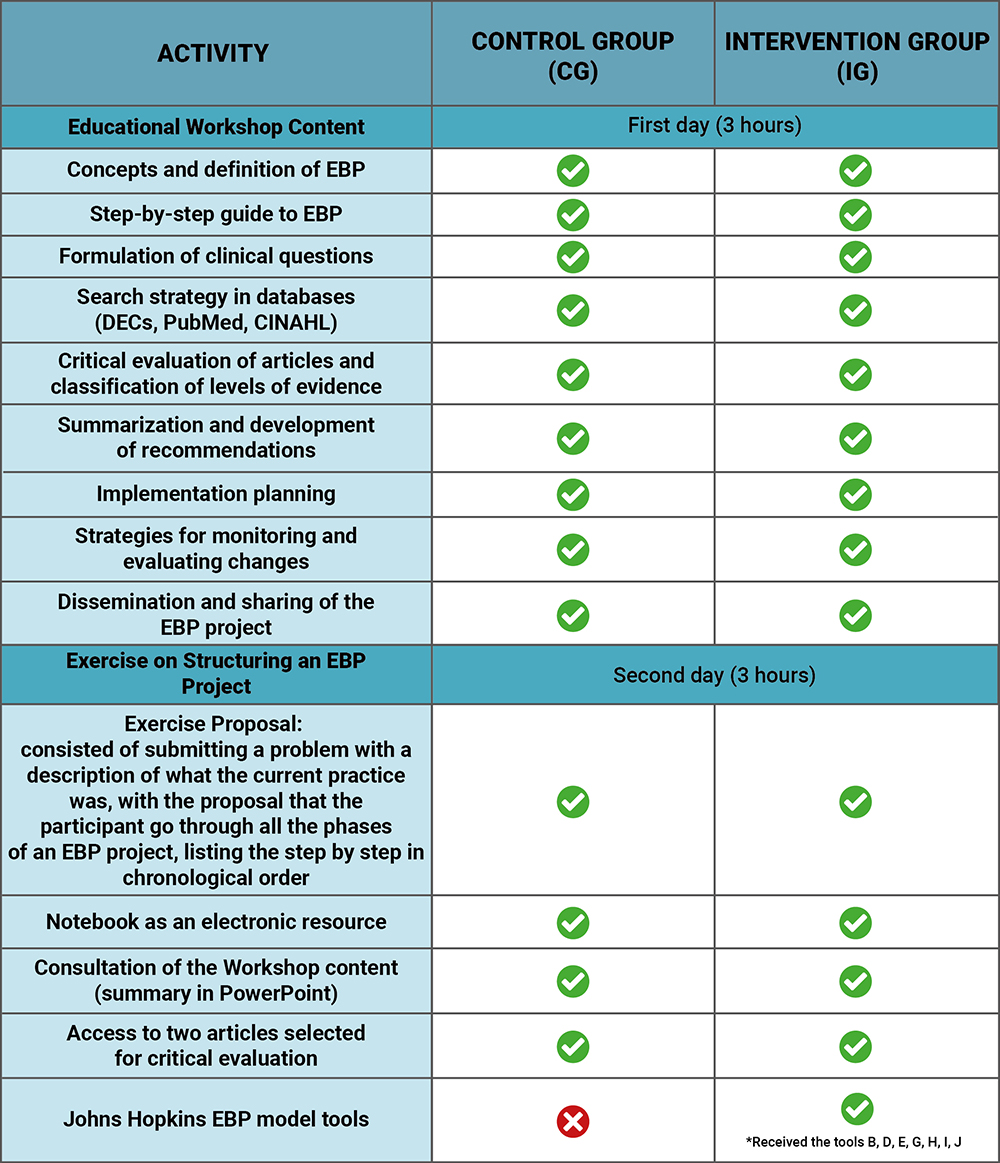
The EW lasted six hours in total, divided into two days of equal content for both groups on the historical phases of EBP, without mentioning the JHNEBP model or other models. Both groups then performed a practical exercise on the second day of the EW which consisted of submitting a problem and describing what the current practice was, with the proposal that the participant go through all the phases of an EBP project, which includes the five steps mentioned in pre-intervention procedures.
The exercise was of an essay nature completed manually by the participants. It was based on an example shared by the Johns Hopkins team, which also served as a template to guide the external researcher’s corrections.
Next, two articles published in English that were part of the content of the example mentioned as a basis were made available to the participants during the practical exercise. Only the IG on the second day of the EW was provided with a brief presentation of the tools, mentioning the name of each tool and delivery of printed copies. The following tools were used in this intervention: Appendix B - Question Development Tool; Appendix D - Evidence Level and Quality Guide; Appendix E - Research Evidence Assessment Tool; Appendix G - Individual Evidence Summary Tool; Appendix H - Synthesis Process and Recommendations Tool; Appendix I - Action Planning Tool and Appendix J - Dissemination Tool17-18.
The lead investigator was responsible for conducting the EWs. The program content and interventions for the IG and CG are detailed in Figure 2.
The data were described using absolute and percentage frequencies (qualitative variables) and mean, standard deviation, minimum, median and maximum (quantitative variables). Analysis of covariance (ANCOVA) was proposed for comparisons between groups regarding EBPQ scores, which, in addition to comparing groups, allows adjustment of covariates. All models were adjusted for time and place of training and age. Already consolidated scientific literature was considered for selecting these variables. All assumptions of the models were verified using normality tests and graphs such as histogram and quantile-quantile.
The Poisson regression model with robust variance was used to compare the groups regarding the items of the questionnaires used and consequently estimate the relative risks (RRs). The items of these questionnaires were regrouped so that there were binary items and it was possible to estimate the RRs. All graphs presented were created using R software, version 4.0.4, and analyses were performed using the SAS 9.4 program. A significance level of 5% was adopted for all comparisons.
It was decided to use a convenience sample given the exploratory nature of this preliminary study. The main variables of interest in the study came from questionnaires constructed by the researchers, so there was no prior information about the distribution of categories or the differences that would be found.
The study was conducted in accordance with the regulations of the Declaration of Helsinki. It was approved by the Research Ethics Committee and registered with ClinicalTrials.gov under number NCT04483713. Informed Consent Forms were applied to the participants before starting the study, guaranteeing them the option of not participating in the study without any harm or of withdrawing their consent at any time. The privacy, anonymity and confidentiality of the participants were ensured during all study stages.
RESULTS
A total of 29 participants were included, of whom 25 completed the study. The characteristics of the groups evaluated were similar, as shown in Table 1. One participant from the CG did not answer the question about time since graduation, and two participants from the IG did not answer one of the questions in the knowledge and skills dimension associated with evidence-based practice of the EBPQ questionnaire.
The results regarding the practice, knowledge, and attitudes scores of the participating nurses through the EBPQ questionnaire showed an average score of 120.15 for the CG and 112.5 for the IG. Two nurses of the IG were excluded from the analysis of the knowledge and skills dimension in EBP because they did not answer one of the questions. There was no statistically significant difference between the groups in the average EBPQ scores, supporting the similarity between the groups regarding the characteristics of practice, attitudes, and knowledge related to EBP prior to participating in the study.
Effects of the Intervention: assessment of the structuring and description of an evidence-based practice project from the perspective of the clinical nurse
The preliminary results of this study related to the responses on the description of the clinical question, the search for evidence in the database, understanding scientific articles regarding critical analysis, quality classification, summarization and description of the feasibility of the application did not demonstrate significant statistical differences between the groups, with few responses on the positive ends (very fast, very easy, or I understood completely) for both groups.
Regarding the responses on elaboration of an action plan for disseminating evidence and on going through all the phases of an EBP project in relation to the material offered during the EW, most of the IG responses were “it made it very easy” for both questions, IG nine (75%) versus CG two (15.38%) and nine (75%) versus three (23.08%) respectively, evidencing a significant statistical difference between the groups (p < 0.01).
The RR calculation was 0.10, meaning that the CG had a 90% lower risk of responding with “it made things much easier” about developing an action plan for disseminating evidence; and the RR was 0.21, so the CG had a 79% lower risk of responding “it made things much easier” about going through all the phases of an EBP project when compared to the IG. The summary of the questions and all the results are shown in Table 2.
Effects of the Intervention: questionnaire to verify compliance in the exercise of preparing an EBP project from the perspective of the external researcher
There was no statistically significant difference between the groups evaluated in verifying compliance in the practical exercise performed by the external researcher. Participants in both groups performed relatively well in the proposed exercise, receiving “yes” and “partially” in most responses. Moreover, the majority of both groups were non-compliant regarding the elaboration of an action plan and the dissemination of evidence, with the CG 11 (84.62%) versus IG seven (58.33%). Table 3 shows the results and RR analysis of this evaluation.
DISCUSSION
Investing in environments that support EBP is an important path for institutions seeking quality nursing care. This preliminary study conducted as a randomized controlled trial explored the efficacy of the JHNEBP model tools in Portuguese regarding their facilitating potential from the perspective of clinical nurses and in the compliance assessment performed by an external researcher.
The results obtained in this study, specifically regarding the questions regarding elaboration of an action plan for disseminating evidence and about going through all the phases of an EBP project from the perspective of IG nurses suggest agreement with the positive perceptions described in publications on the use of EBP models. Conceptual models which have been created to guide EBP implementation are described as essential to assist leaders, educators and clinicians to advance strategies that promote EBP28.
The use of multifaceted strategies to promote advances in EBP, such as leadership support, EBP education programs, and provision of library resources, combined with the use of an EBP model to overcome the barriers experienced, reinforces the need for nurses to be supported in facing the complexity of EBP. This exploratory and initial study in Brazil aimed to preliminarily test the JHNEBP model for its efficacy7,9,11-13,16.
A literature review addressed six main EBP models available regarding the role of EBP models among the strategies to be used, including the JHNEBP model. It concluded that all models contribute in a unique way to implementing EBP in daily practice14. This observation was partially suggested in the results of this study by the clinical nurses of the IG. Although they perceived some benefit in facilitation, challenges and limitations related to the use of the tools also emerged.
The challenges were evident in the results of the external researcher’s assessment, who did not identify any differences between the IG and CG in preparing the practical exercise, especially in the question about preparing an action plan for disseminating evidence. Although the IG participants responded to this question as “it made things much easier”, the majority of both groups (IG and CG) were evaluated as “non-compliant” in the external researcher’s assessment in a similar aspect that evaluated the dissemination process.
The tools helped in structuring and (from the nurses’ perception) provided greater ease in going through all the phases of an EBP project, increasing comfort in dealing with a complex topic. However, the results indicate that their use in a six-hour educational workshop did not guarantee execution of the complete and fully compliant process, highlighting the need for adequate theoretical preparation of the nurses.
In view of this discussion, it is reinforced that training in EBP is essential, which can be done through specific training29-30. One possibility is that training should go beyond a six-hour workshop, which seemed insufficient considering this finding (and which may have been the reason for non-compliance in the IG).
In this perspective, it is pertinent to consider the partial findings of this study regarding the efficacy of the JHNEBP model as a facilitating tool in structuring and describing a practical EBP exercise. It is relevant to discuss the context of the Magnet® Program movement, which promotes implementing EBP through the “new knowledge, innovations and improvements” component, which presents in its manual practical examples of how EBP is applied by clinical nurses3-4.
In a study with 181 research leaders in Magnet® institutions, more than 90% used some EBP model, with the JHNEBP model being the second most used model by these institutions (n = 20 of 105, 19%)15. This data highlights the high prevalence of EBP models in institutions designated as excellent in nursing, and the results in this study were partially aligned.
In the analysis and comparison of the external researcher’s evaluation, no statistically significant difference was found between the groups. Most of the responses included “yes” and “partially”, reflecting that both groups were able to elaborate, at least partially, a description of an EBP project in a practical exercise.
The groups received training in EBP on the first day of the EW; although few studies robustly evaluate the results of educational interventions, it is known that they bring positive results to improve knowledge and contribute to knowledge construction about EBP for a real translation and implementation29-34.
Furthermore, the nurses in this study work in an institution with recognized care quality and with a different profile from clinical nurses, which in itself may have influenced the ease of practical exercise but may differ in institutions with other organizational characteristics. This study was conducted with clinical nurses with previous experience controlled by inclusion and exclusion criteria and by analyzing previous knowledge with the EBPQ questionnaire, which thus reduced the potential bias of previous experience.
Randomizing participants is considered a reference standard for testing interventions, supporting the constitution of a homogeneous population for the study. The lack of masking participants, which occurred due to the nature of the intervention, cannot go unmentioned as a limitation, since when participants are faced with the tools of the JHNEBP model from a renowned international health institution, they may be affected by valuation bias.
The participation of an external researcher with experience in EBP, masked to the groups and without contact with or knowledge of the participants was important in controlling confounding factors in the study, and similar choices can be used in future studies. The fact that the study was conducted in a single center requires that the results be interpreted with caution. In addition, the use of two articles published in English may have limited the participants’ performance in the study in some way. Another limitation is the use of questionnaires developed by the researchers to assess the outcomes, which may generate criticism. However, this strategy also represents progress, since there are no specific tools for this purpose in the literature.
This study proposes an initial exploration of the perception of an EBP model, which can still be improved in future research. Despite the limitations discussed, the data obtained are valid and bring relevant contributions to the studied topic. It is noteworthy that there are no EBP models of Brazilian origin or in Latin American countries12-13, therefore this study is a pioneering approach to the topic for this geographic region and initiates an important discussion and reflection based on its results.
We strongly encourage Brazilian and Latin American nurses to explore EBP models in future research using models which have already been published or even developing new ones, considering cultural aspects as an important element related to strategies that improve the favorable environment for EBP to occur. Strategies to increase the consumption of science and guide the practice of clinical nurses are necessary, thus promoting the advancement of scientific knowledge and the use of science in practice in the field of nursing.
The implications for practice reinforce the facilitating potential of the JHNEBP model in the perception of clinical nurses, despite the need for additional strategies to strengthen implementation of the EBP process. Inserting the model into training programs can increase the adoption of EBP in healthcare practice, which contributes to the quality of care and results in better outcomes for patients. Future studies with greater statistical power are needed to confirm the findings in order to broaden understanding of the studied model.
CONCLUSION
This preliminary study suggests that the JHNEBP model was partially effective as a facilitator in structuring/describing a practical EBP exercise in an educational workshop from the perspective of clinical nurses. Efficacy was observed in terms of ease in developing an action plan for disseminating evidence and ease in going through all phases of an EBP project.
However, the compliance assessment performed by an external researcher did not identify statistically significant differences between the groups, indicating that the JHNEBP model did not guarantee implementation of a practical exercise with greater compliance in the sample studied.
REFERENCES
-
Kerr H, Rainey D. Addressing the current challenges of adopting evidence-based practice in nursing. Br J Nurs [Internet]. 2021 [cited 2024 Aug 10];30(16):970-4. Available from: https://doi.org/10.12968/bjon.2021.30.16.970
» https://doi.org/10.12968/bjon.2021.30.16.970 -
Connor L, Dean J, McNett M, Tyndings DM, Shrout A, Gorsuch PF, et al. Evidence-based practice improves patient outcomes and healthcare system return on investment: Findings from a scoping review. Worldviews Evid Based Nurs [Internet]. 2023 [cited 2025 Mar 07];20(1):6-15. Available from: https://doi.org/10.1111/wvn.12621
» https://doi.org/10.1111/wvn.12621 -
Abuzied Y, Al-Amer R, Abuzaid M, Somduth S. The magnet recognition program and quality improvement in nursing. Glob J Qual Saf Healthc [Internet]. 2022 [cited 2024 Aug 10];5(4):106-8. Available from: https://doi.org/10.36401/JQSH-22-12
» https://doi.org/10.36401/JQSH-22-12 -
Mathew D, Cesario SK, Malecha A, Toms R. Role of Magnet®-recognized hospital nurse managers in implementing evidence-based practice: A mixed-method study. Worldviews Evid Based Nurs [Internet]. 2024 [cited 2024 Aug 10];21(1):23-33. Available from: https://doi.org/10.1111/wvn.12693
» https://doi.org/10.1111/wvn.12693 -
McNett M, Tucker S, Melnyk BM. Implementation science: A critical strategy necessary to advance and sustain evidence-based practice. Worldviews Evid Based Nurs [Internet]. 2019 [cited 2024 Aug 10];16(3):174-5. Available from: https://doi.org/10.1111/wvn.12368
» https://doi.org/10.1111/wvn.12368 - Li S, Cao M, Zhu X. Evidence-based practice: Knowledge, attitudes, implementation, facilitators, and barriers among community nurses-systematic review. Medicine (Baltimore) [Internet]. 2019[cited 2024 Aug 10];98(39):e17209. Available from: https://doi.org/10.1097/md.0000000000017209
-
Crawford CL, Rondinelli J, Zuniga S, Valdez RM, Tze-Polo L, Titler MG. Barriers and facilitators influencing EBP readiness: Building organizational and nurse capacity. Worldviews Evid Based Nurs [Internet]. 2023 [cited 2024 Aug 10];20(1):27-36. Available from: https://doi.org/10.1111/wvn.12618
» https://doi.org/10.1111/wvn.12618 -
Schneider LR, Pereira RPG, Ferraz L. Evidence-based practice in the context of Primary Health Care. Saúde Debate [Internet]. 2018 [cited 2024 Aug 10];42(118):594-605. Available from: https://doi.org/10.1590/0103-1104201811804
» https://doi.org/10.1590/0103-1104201811804 -
Yoo JY, Kim JH, Kim JS, Kim HL, Ki JS. Clinical nurses' beliefs, knowledge, organizational readiness and level of implementation of evidence-based practice: The first step to creating an evidence-based practice culture. PLoS One [Internet]. 2019 [cited 2024 Aug 10];14(12):e0226742. Available from: https://doi.org/10.1371/journal.pone.0226742
» https://doi.org/10.1371/journal.pone.0226742 -
Melnyk BM, Tan A, Hsieh AP, Gallagher-Ford L. Evidence-based practice culture and mentorship predict EBP implementation, nurse job satisfaction, and intent to stay: support for the ARCC© model. Worldviews Evid Based Nurs [Internet]. 2021 [cited 2024 Aug 10];18(4):272-81. Available from: https://doi.org/10.1111/wvn.12524
» https://doi.org/10.1111/wvn.12524 -
Duff J, Cullen L, Hanrahan K, Steelman V. Determinants of an evidence-based practice environment: An interpretive description. Implement Sci Commun[Internet]. 2020 [cited 2024 Aug 10];1:85. Available from: https://doi.org/10.1186/s43058-020-00070-0
» https://doi.org/10.1186/s43058-020-00070-0 -
Dusin J, Melanson A, Mische-Lawson L. Evidence-based practice models and frameworks in the healthcare setting: A scoping review. Br Med J Open[Internet]. 2023[cited 2024 Aug 10];13(5):e071188. Available from: https://doi.org/10.1136/bmjopen-2022-071188
» https://doi.org/10.1136/bmjopen-2022-071188 -
Camargo FC, Iwamoto HH, Galvão CM, Monteiro DAT, Goulart MB, Garcia LAA. Models for the Implementation of evidence-based practice in hospital based nursing: A narrative review. Texto Contexto Enferm [Internet]. 2017 [cited 2024 Aug 10];26:4. Available from: https://doi.org/10.1590/0104-07072017002070017
» https://doi.org/10.1590/0104-07072017002070017 -
Schaffer MA, Sandau KE, Diedrick L. Evidence-based practice models for organizational change: Overview and practical applications. J Adv Nurs [Internet]. 2013 [cited 2024 Aug 10];69(5):1197-209. Available from: https://doi.org/10.1111/j.1365-2648.2012.06122.x
» https://doi.org/10.1111/j.1365-2648.2012.06122.x -
Speroni KG, McLaughlin MK, Friesen MA. Use of Evidence-based practice models and research findings in magnet-designated hospitals across the United States: National survey results. Worldviews Evid Based Nurs [Internet]. 2020 [cited 2024 Aug 10093;;17(2):98-107. Available from: https://doi.org/10.1111/wvn.12428
» https://doi.org/10.1111/wvn.12428 -
Newhouse R, Dearholt S, Poe S, Pugh LC, White KM. Evidence-based practice: A practical approach to implementation. J Nurs Adm [Internet]. 2005[cited 2024 Aug 10];35(1):35-40. Available from: https://doi.org/10.1097/00005110-200501000-00013
» https://doi.org/10.1097/00005110-200501000-00013 - Dang D, Dearholt SL. Johns Hopkins nursing evidence-based practice: Model & guidelines. 3rd ed. Indianapolis: Sigma Theta Tau International; 2017.
- Mark HD, Park H, Dudley-Brown S, Tearhaar M. Johns Hopkins nursing evidence-based practice: Model and guidelines. 3rd ed. Indianapolis: Sigma Theta Tau International; 2019.
-
Püschel V, Lockwood C. Translating knowledge: Joanna Briggs Institute’s expertise. Rev Esc Enferm USP [Internet]. 2018 [cited 2024 Aug 10];52:e03344. Available from: https://doi.org/10.1590/S1980-220X2018ed0103344
» https://doi.org/10.1590/S1980-220X2018ed0103344 -
Schulz KF, Altman DG, Moher D, CONSORT Group. CONSORT 2010 statement: Updated guidelines for reporting parallel group randomised trials. Br Med J [Internet]. 2010 [cited 2024 Aug 10];340:c332. Available from: https://doi.org/10.1136/bmj.c332
» https://doi.org/10.1136/bmj.c332 -
Johns Hopkins Medicine. Evidence-based practice model and tools [Internet]. Baltimore: Johns Hopkins medicine [cited 2025 Mar 11]. Available from: https://www.hopkinsmedicine.org/evidence-based-practice/model-tools
» https://www.hopkinsmedicine.org/evidence-based-practice/model-tools -
Johnson C. Evidence-based practice in 5 simple steps. J Manipulative Physiol Ther [Internet]. 2008[cited 2024 Aug 10];31:169-70. Available from: https://doi.org/10.1016/j.jmpt.2008.03.013
» https://doi.org/10.1016/j.jmpt.2008.03.013 -
Parrish DE. Evidence-based practice: A common definition matters. J Soc Work Educ [Internet]. 2018 [cited 2024 Aug 10];54(3):407-11. Available from: https://doi.org/10.1080/10437797.2018.1498691
» https://doi.org/10.1080/10437797.2018.1498691 -
Sackett DL. Evidence-based medicine. Semin Perinatol [Internet]. 1997 [cited 2024 Aug 10];21(1):3-5. Available from: https://doi.org/10.1016/S0146-0005(97)80013-4
» https://doi.org/10.1016/S0146-0005(97)80013-4 -
Upton D, Upton P. Development of an evidence-based practice questionnaire for nurses. J Adv Nurs [Internet]. 2006 [cited 2024 Aug 10];53(4):454-8. Available from: https://doi.org/10.1111/j.1365-2648.2006.03739.x
» https://doi.org/10.1111/j.1365-2648.2006.03739.x -
Rospendowiski K, Costa NMA, Estevam MC. Adaptação cultural para o Brasil e desempenho psicométrico do “evidence-based practice questionnaire”. Acta Paul Enferm [Internet]. 2014[cited 2024 Aug 10];27(5):405-411. Available from: https://doi.org/10.1590/1982-0194201400068
» https://doi.org/10.1590/1982-0194201400068 - Joint Commission International. Joint Commission International survey process guide for clinical care program certification. 3rd ed. Illinois: JCI; 2015.
-
Melnyk BM. Models to Guide the Implementation and Sustainability of Evidence-Based Practice: A Call to Action for Further Use and Research. Worldviews Evid Based Nurs [Internet]. 2017[cited 2024 Aug 10];14(4):255-6. Available from: https://doi.org/10.1111/wvn.12246
» https://doi.org/10.1111/wvn.12246 -
Albarqouni L, Hoffmann T, Glasziou P. Evidence-based practice educational intervention studies: A systematic review of what is taught and how it is measured. BMC Med Educ [Internet]. 2018 [cited 2024 Aug 10];18(1):177. Available from: https://doi.org/10.1186/s12909-018-1284-1
» https://doi.org/10.1186/s12909-018-1284-1 -
D'Souza P, George A, Nair S, Noronha J, Renjith V. Effectiveness of an evidence-based practice training program for nurse educators: A cluster-randomized controlled trial. Worldviews Evid Based Nurs [Internet]. 2021 [cited2024 Aug 10];18(4):261-71. Available from: https://doi.org/10.1111/wvn.12521
» https://doi.org/10.1111/wvn.12521 -
Gallagher-Ford L, Koshy Thomas B, Connor L, Sinnott LT, Melnyk BM. The effects of an intensive evidence-based practice educational and skills building program on EBP competency and attributes. Worldviews Evid Based Nurs [Internet]. 2020 [cited 2024 Aug 10];17(1):71-81. Available from: https://doi.org/10.1111/wvn.12397
» https://doi.org/10.1111/wvn.12397 -
Liu M, Lin Y, Dai Y, Deng Y, Chun X, Lv Y, et al. A multi-dimensional EBP educational program to improve evidence-based practice and critical thinking of hospital-based nurses: Development, implementation, and preliminary outcomes. Nurse education in practice [Internet]. 2021[cited 2024 Aug 10];52:102964. Available from: https://doi.org/10.1016/j.nepr.2020.102964
» https://doi.org/10.1016/j.nepr.2020.102964 -
Mena-Tudela D, González-Chordá VM, Cervera-Gasch A, Maciá-Soler ML, Orts-Cortés MI. Effectiveness of an evidence-based practice educational intervention with second-year nursing students. Rev Lat Am Enfermagem [Internet]. 2018[cited 2024 Aug 10];26:e3026. Available from: https://doi.org/10.1590/1518-8345.2502.3026
» https://doi.org/10.1590/1518-8345.2502.3026 -
Mickan S, Hilder J, Wenke R, Thomas R. The impact of a small-group educational intervention for allied health professionals to enhance evidence-based practice: Mixed methods evaluation. BMC Med Educ [Internet]. 2019 [cited 2024 Aug 10];19(1):131. Available from: https://doi.org/10.1186/s12909-019-1567-1
» https://doi.org/10.1186/s12909-019-1567-1
NOTES
-
ORIGIN OF THE ARTICLE
Extracted from the dissertation - Modelo de Prática Baseada em Evidência: Perspectiva do Enfermeiro Clínico e Efetividade de Oficina Educacional no Conhecimento: Ensaio Controlado Randomizado, presented to the Professional Master’s Degree Program at the Albert Einstein Israelite Faculty of Health Sciences in 2022.
-
APPROVAL OF ETHICS COMMITTEE IN RESEARCH
Approved by the Ethics Committee in Research of the Hospital Israelita Albert Einstein, opinion no. 3,826,442/2020, Certificate of Presentation for Ethical Assessment 26787019.5.0000.0071.
-
TRANSLATED BY
Christopher J. Quinn.
-
DATA AVAILABILITY
The data that support the findings of this study are available from the corresponding author, Costa LSS, upon reasonable request.
Edited by
The data that support the findings of this study are available from the corresponding author, Costa LSS, upon reasonable request.

 *JHNEBP = Johns Hopkins Nursing Evidence-Based Practice
 *EBP = Evidence-Based Practice