 Experimental research of the effects of adding different chemical reagents to clayey soil on improving its physical and mechanical properties
Abstract
Clayey soil in its natural state usually has a low bearing capacity, high compressibility, and high sensitivity to changes in water content. These properties represent an obstacle to the use of this type of soil in construction industry projects, so it is necessary to stabilize it before its application for construction purposes. This paper presents the results of a comparative study of the effects of chemical stabilization of clayey soils on improving soil properties by considering a variety of chemical reagents. In addition to commonly used chemical reagents such as calcium carbonate (lime), alternative materials such as magnesium carbonate, sodium silicate, and potassium hydroxide were also considered. With an aim to determine the optimal content of reagent in a mixture with clayey soil, each of the selected chemical reagents was considered with three different percentage shares in the mixture. Given that the permanent improvement of soil properties is of utmost importance in geotechnical engineering, for this purpose, changes in the crucial physical and mechanical properties of the treated clayey soil (Atterberg limits, unconfined compressive strength, and shear strength) were also monitored over time after the chemical treatment. The research results revealed that the selected chemical reagents have different efficiencies on the considered physical and mechanical properties of clayey soil, whereby each of them contributed to the soil improvement. This opens up the possibility of applying the selected stabilizers within the framework of the chemical soil stabilization technique, primarily in the field of roadway construction.
Keywords:
Clayey soil; Chemical stabilization; Reagents; Atterberg limits; Unconfined compressive strength; Shear strength parameters
1. Introduction
Clayey soils pose a challenge in the roadway construction due to their properties, caused by the mineralogical composition of clay and water content, in terms of low bearing capacity, high compressibility, and high sensitivity to water content, which make them prone to cracking or swelling (Marinković et al., 2021). This makes them unsuitable for direct application in roadway construction projects. The problem can be overcome by applying soil stabilization techniques aimed at improving physical and mechanical properties of the soil, among which the soil stabilization using chemical reagents is one of the most commonly applied. The development of this technique dates back thousands of years, from the early attempts of the ancient Greeks and Romans to use materials such as lime and ash to improve soil properties (Han, 2015). This engineering technique has evolved throughout history, enabling the construction of stable and long-lasting structures on a wide range of soil types. Chemical soil stabilization techniques have been enhanced over time with the use of new types of reagents. Recently, in order to reduce the impact on the environment, research has focused on reagents acceptable from an ecological point of view.
The effects of a stabilization technique depend largely on both the type of reagent and the type of soil to which it is applied, as well as on the amount of reagent added and the time elapsed since the reagent and soil were mixed. The reactions between the reagent and the clayey soil occur through two main processes: a rapid ion exchange reaction process, known as soil modification, and a slower pozzolanic reaction process, known as soil stabilization or hardening (Maaitah, 2012).
Soil stabilizers are usually classified into two categories - those commonly used in the roadway construction (lime, cement, fly ash, bituminous products, etc.) and alternative ones that do not have a commercial use for the aforementioned purpose. Considering the most commonly used reagents on the one hand, these materials are most often used for soil stabilization in engineering practice, in more than 80% of cases (Cristelo et al., 2009; Shon et al., 2010; Onyelowe & Okafor, 2012; Zafirovski et al., 2024) and have been proven to be effective in improving soil properties. On the other hand, alternative materials, which do not yet have widespread commercial use in geotechnics, are still insufficiently investigated and have recently attracted increasing attention from researchers. The application of new chemical stabilizers has opened up new opportunities to address the challenges posed by clayey soils, offering more sustainable and cost-effective solutions for construction industry projects. However, in previous studies, the emphasis has mainly been on the effects of combining an alternative reagent with some of the commonly used materials listed above, according to the specific project needs and local soil characteristics (Kamon & Nontananandh, 1991; Vakili et al., 2016; Firoozi et al., 2017; Behnood, 2018; Andavan & Pagadala, 2020; Silva et al., 2025), whereas research into the individual effects of alternative materials was represented to a much lesser extent (Marto et al., 2014; Davidovic et al., 2012; Moayedi et al., 2012; Latifi et al., 2016; Miranda Neto & Mahler, 2017; Singh et al., 2020; Seco et al., 2022; Silva et al., 2022).
In the present research, in addition to previously known chemical reagents, such as lime (calcium carbonate), alternative reagents such as magnesium carbonate, sodium silicate, and potassium hydroxide were also examined in the chemical stabilization of clayey soil. On the basis of the study on the soil Atterberg limits and unconfined compressive strength (UCS), monitored at four different time intervals after the soil treatment (3, 7, 14, and 28 days), the optimal content for each of the considered reagents in the mixture with clayey soil was determined. In the subsequent stage of the research, direct shear tests were carried out on the soil samples prepared with the optimal content for each of the considered reagents, in order to identify the individual effect of each reagent on the shear strength parameters of the clayey soil. The effects of the reagents were observed 3, 14, and 28 days after the chemical stabilization, thus assessing both the short-term effects and the long-term effects of stabilization.
2. Materials and methods considered in the research
2.1 Natural clayey soil
The clayey soil considered in the research originates from the Crvena Reka borrow pit, along the E-80 Niš–Dimitrovgrad Highway route in the south-eastern part of the Republic of Serbia. During the construction of the Highway, a landslide occurred at this location. The remediation measures involved the construction of a retaining structure as a curtain of piles. Samples of clayey soil for the research were taken during the construction of bored piles, from the depth of the registered sliding surface.
The mineralogical composition of the natural clayey soil was determined by X-Ray Diffraction (XRD) analysis at the Laboratory for General and Inorganic Chemistry at the Faculty of Science and Mathematics of the University of Niš (Serbia). It consists of clay minerals (montmorillonite (CaO2(Al,Mg)2SiO10(OH)24H2O) – 15%, illite (KAl2Si3AlO10(OH)2) – 11%, and clinochlore (Mg5Al(Si,Al)4O10(OH)8) – 10%) in combination with other minerals (calcite (CaCO3) – 39% and quartz (SiO2) – 25%). The results of this research should indicate the potential of reusing the clayey soil material for the roadway construction purposes after mixing with a certain chemical reagent.
The physical and mechanical properties of the natural clayey soil, which was used in this research, were determined by tests carried out at the Laboratory for Geotechnics of the Faculty of Civil Engineering and Architecture of the University of Niš (Serbia). The results are shown in Table 1.
2.2 Reagents
One of the most commonly used reagents for soil stabilization is lime (calcium carbonate) - Ca(OH)2. This natural mineral, often found in the form of limestone, has been used for decades in a wide range of construction industry projects. Lime is considered a versatile and cost-effective solution, primarily due to its neutralizing effect on soil acidity. When added to acidic soils, lime reacts with the acidic compounds, increasing the pH value of the soil and improving its physico–mechanical properties. This stabilizer also stimulates the flocculation of soil particles, thereby reducing the swelling potential and enhancing the shear strength of the soil. According to Bell (1996), all types of clay minerals react with lime. In addition, clayey soils with medium to high plasticity, where the plasticity index PI is greater than 15%, are most suitable for stabilization with lime.
While lime represents the standard selection for soil stabilization, several less commonly used materials for chemical stabilization have shown potential for soil stabilization in specific applications, as presented below.
Magnesium carbonate (MgCO3) is a viable option for improving the physical and mechanical properties of soils, particularly those with a high clay or silt content. This reagent has been shown to be effective in increasing the cohesion, reducing the plasticity, and enhancing the load-bearing capacity of the treated soil (Yi et al., 2013; Taha Jawad et al., 2014; Seco et al., 2017).
Sodium silicate (Na2SiO3), also known as water glass, has been used to stabilize soils under specific conditions. It contributes to reducing the permeability and increasing the cohesion of fine-grained soils. Sodium silicate forms chemical bonds with soil particles, reducing their susceptibility to moisture-induced expansion and contraction (Hurley & Thornburn, 1972; Maaitah, 2012). Research by Pakir et al. (2015) has shown the successful application of this reagent to improve the properties of marine clay.
Potassium hydroxide (KOH) is a highly alkaline substance that can be used to stabilize soils under certain conditions. It is particularly effective in improving the bearing capacity and compaction of clayey soils. The addition of potassium hydroxide initiates reactions that increase the strength of the soil and reduce its sensitivity to changes in moisture content (Elkhebu et al., 2018).
The selected reagents with the considered percentage shares in the mixture with respect to the dry weight of the soil sample (3%, 5%, and 7% each), along with the corresponding labels of the examined mixtures, are summarized in Table 2.
Overall, the primary goal of the present research was to examine the potential of each of the selected reagents alone (i.e., without combining them mutually) in terms of improving the Atterberg limits, unconfined compressive strength, and the shear strength parameters (cohesion and internal friction angle) of the clayey soil, which are of a paramount importance in geotechnical engineering and roadway construction.
2.3 Methods of experimental research
The soil material from the site was brought to the laboratory. Selected reagents were added individually to the clay material with the considered percentage shares in the mixture (according to Table 2) in relation to the dry weight of the soil.
The Atterberg limits were tested according to the national standard SRPS EN ISO 14688-12:2018 (SRPS EN ISO, 2018) harmonized with the European norms (EN). The Liquid Limit (LL) was determined by applying the fall cone method and the Plastic Limit (PL) using the thread rolling method. The samples were dried, crushed, and sieved through a 425 μm sieve, and then mixed with each of the four selected reagents at three different percentage shares, in order to determine the effect of each of them on the change in the values of the Liquid Limit and the Plastic Limit, as well as the associated Plasticity Index (PI).
The samples for the unconfined compressive strength (UCS) test and the direct shear test were prepared with a moisture content equal to the optimal moisture content of natural soil according to the Proctor test (OMC = 18.5%, Table 1), for the purpose of comparability of the results of natural and chemically stabilized clayey soil. The samples were compacted during the standard Proctor test with compaction energy of 600 kNm/m3. The treated samples were wrapped in a plastic foil and stored in a closed plastic box until the corresponding time for conducting the test, in order to maintain the same moisture content of the sample over time.
UCS testing was applied to all samples in accordance with the national standard SRPS EN ISO 13286-41:2022 (SRPS EN ISO, 2022), which is in line with the European standards. The cylindrical sample was 15 cm in height and 10 cm in diameter. Each sample was compressed until reaching the peak load, where the applied load was recorded by the data acquisition system. The UCS test was used to determine the compressive strength of the soil in natural conditions and the chemically treated soil for each of the four reagents considered with three different percentage shares. The obtained result represents the mean value of three tested samples.
In terms of obtaining the shear strength parameters, direct shear tests were performed according to the national standard SRPS EN ISO 17892-10:2019 (SRPS EN ISO, 2019) harmonized with the actual European norms, on samples with the optimal content for each of the selected reagents, which was determined based on the UCS test results. The samples were square in shape at the base, measuring 6.0 cm × 6.0 cm, and 2.0 cm high. The shear rate was 0.0083 mm/min. For each of the considered reagents and for each of the considered time intervals after the soil treatment, in accordance with the specified standard, three specimens from one soil sample were prepared for shearing under three different vertical pressures (a constant normal stress of 50 kPa, 100 kPa, and 200 kPa during the tests), to allow the shear strength parameters to be determined. During shearing, draining of the samples was enabled, and as a result, the effective shear strength parameters (effective cohesion c' and effective internal friction angle φ') were obtained.
The complete experimental research and accompanying tests were carried out at the Laboratory for Geotechnics of the Faculty of Civil Engineering and Architecture of the University of Niš. Table 3 summarizes the experimental program.
3. Comparative analysis and discussion of results
3.1 Atterberg limits
Table 4 summarizes the values of consistency limits obtained for clayey soil mixtures treated with three different percentages (3%, 5%, and 7%) of four selected reagents, at four curing intervals (3, 7, 14, and 28 days after the treatment). For comparative purposes, it is important to note that the natural (untreated) clayey soil exhibited the values of LL, PL, and PI of 49%, 23%, and 26%, respectively, as indicated in Table 1.
Values of the consistency limits of the clayey soil after the chemical stabilization with the selected reagents and with the considered percentage shares.
For all reagents considered, the value of LL remained almost unchanged, with no significant changes observed either due to increased reagent content or over time. The most pronounced increase in LL value was observed in the case of sodium-silicate treated samples (SS) after 3 days of curing. By the 7th day, LL values of all samples became comparable, and this pattern continued at the subsequent time intervals of 14 and 28 days. The most substantial increase in LL occurred with the addition of 7% magnesium carbonate (MC7) after 28 days, where the LL reached a value of 54%.
Changes in the plastic limit and the plasticity index were observed for all the tested samples throughout the curing period. The most pronounced changes in PL and PI values occurred after 28 days since the treatment. The highest PL values were recorded on soil samples treated with 7% lime (L7, PL = 36%) as well as with 7% potassium hydroxide (PH7, PL = 35%), which also exhibited the lowest PI values of 17% and 16%, respectively. The other samples resulted in PI values ranging between 19% and 26% after 28 days, indicating minimal variation in outcomes regardless of the type of chemical reagent used.
Given that the LL values remained unchanged, the increasing trend in PL values and the decreasing trend in PI values over time can be viewed positively, in terms that the treated clayey soil maintains a semi-solid state of consistency even at higher water content.
3.2 Unconfined Compressive Strength (UCS)
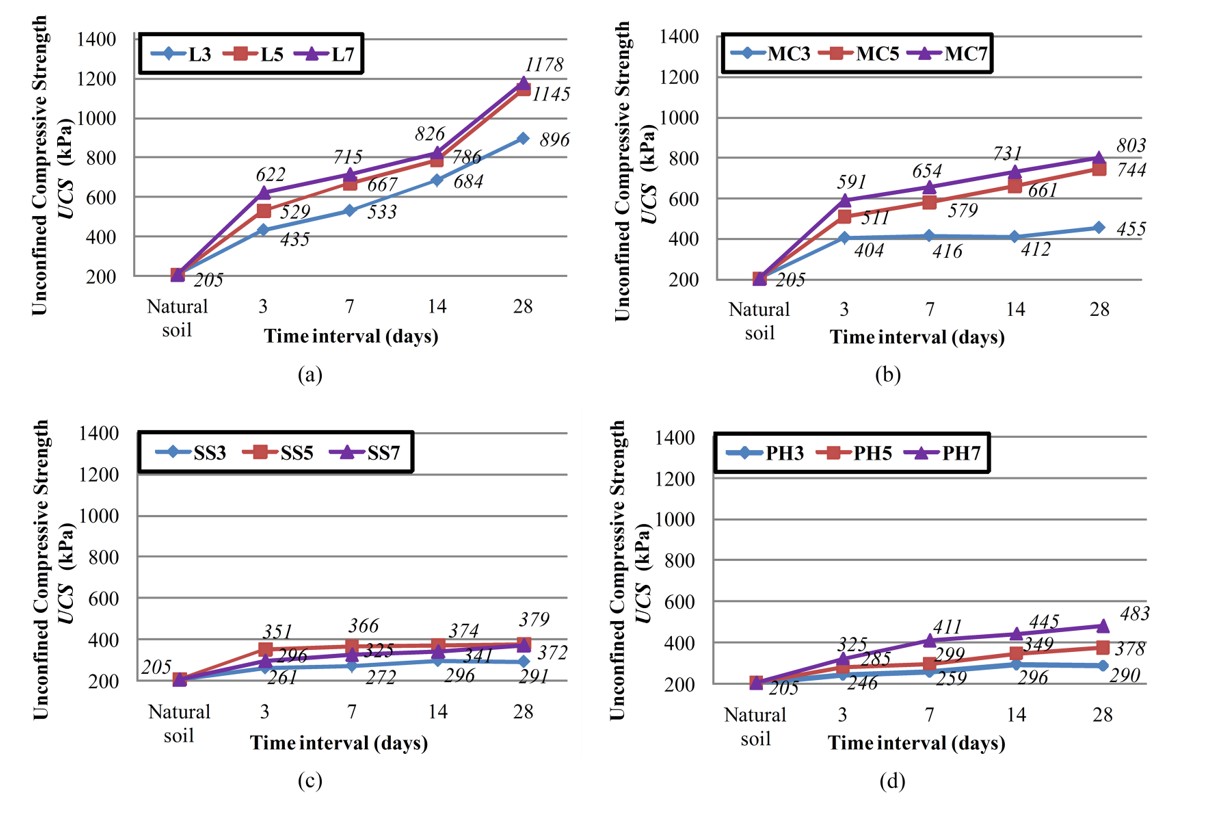
The clayey soil samples were tested with different amounts of reagents (3%, 5%, and 7%) and with different curing times, specifically at intervals of 3, 7, 14, and 28 days after the chemical treatment. The results of the UCS tests for the treated clayey soil are presented in Figure 1, showing the effects of the selected reagents at the considered percentage shares and over time after the treatment (lime – Figure 1a, magnesium carbonate – Figure 1b, sodium silicate – Figure 1c, and potassium hydroxide – Figure 1d). Each data point represents the average value of three tested samples per reagent, for each percentage share and curing interval.
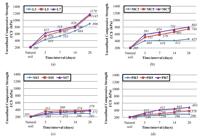
Change in the UCS values of the clayey soil over time after the chemical stabilization with the selected reagents and with the considered percentage shares: (a) lime, (b) magnesium carbonate, (c) sodium silicate, and (d) potassium hydroxide.
Overall, the research revealed that each of the selected reagents contributed to the improvement of the UCS of the treated soil. Lime and magnesium carbonate exhibited the most pronounced effects, with a significant increase in the UCS value over time. On the other hand, sodium silicate and potassium hydroxide showed a significantly weaker effect in terms of improving the UCS value of the soil.
The lime-treated samples demonstrated the highest UCS values after the treatment (Figure 1a). A clear improvement in terms of UCS was observed as the content of lime in the mixture with the clayey soil increased. The results showed a significant increase in strength when the lime content increased from 3% to 5%, whereas increasing the lime content from 5% to 7% did not significantly affect the increase in UCS values. Regardless of the content of lime added, a substantial increase in the UCS values was evident over time. Specifically, after a 3-day curing period, the UCS value increased from 205 kPa (untreated clayey soil) to 435 kPa for clayey soil treated with 3% lime (L3), to 529 kPa for soil with 5% lime (L5), whereas the addition of 7% lime (L7) resulted in an increase in the UCS value to 622 kPa. After 28 days of curing, the UCS value increased to 896 kPa, 1145 kPa, and 1178 kPa for the treatments with 3%, 5%, and 7% lime, respectively. A similar trend of increasing UCS values over time with the addition of lime as a stabilizer to residual granite soil was registered in the study of Cristelo et al. (2009).
The addition of magnesium carbonate yielded results comparable to those obtained with the addition of lime, particularly at 5% and 7% percentage shares, but this similarity was only observed during the first 14 days of curing. By the end of 28 days, the samples treated with magnesium carbonate resulted with UCS values approximately 30% lower than those treated with lime (Figure 1b). Similar to the case of adding lime, the increase in UCS values was more pronounced when the magnesium carbonate content was increased from 3% to 5% than from 5% to 7%. For example, after 3 days of curing, the recorded UCS values were 404 kPa for the addition of 3% magnesium carbonate (MC3), 511 kPa for the addition of 5% magnesium carbonate (MC5), and 591 kPa for the addition of 7% of this reagent (MC7). After 28 days of curing, the measured UCS values were 455 kPa, 744 MPa, and 803 kPa for magnesium carbonate contents of 3%, 5%, and 7%, respectively. The trend of a rapid increase in the UCS value in the initial curing period was also observed in the study by Yi et al. (2013), although in their study soil carbonation was achieved in a different way – by permeation of gaseous CO2 through prepared reactive MgO-treated soil samples.
The measured UCS values achieved with the addition of sodium silicate (Figure 1c), as well as potassium hydroxide (Figure 1d), were significantly lower compared to those obtained with lime and magnesium carbonate. Nevertheless, their use yet led to a measurable improvement in the unconfined compressive strength of the soil. In particular, the highest UCS value recorded for the addition of sodium silicate was 379 kPa, achieved with 5% reagent content after 28 days of curing. Interestingly, the results for the considered curing periods up to 28days revealed that slightly higher UCS values were obtained with 5% sodium silicate content than with 7% content. The conclusion that increasing the sodium silicate content in a mixture with clayey soil results in a decrease in the UCS value is in line with the findings of Latifi et al. (2014) who considered tropical laterite soil (decrease in UCS value for sodium silicate content above 9%) and Pakir et al. (2015) who considered marine clay (decrease in UCS value for sodium silicate content above 6%).
The samples treated with potassium hydroxide resulted in a maximum UCS value of 483 kPa after 28 days at a reagent content of 7%. It was also observed that UCS values remained almost unchanged between 14 and 28 days, regardless of the percentage share of potassium hydroxide used. Unlike the previously elaborated reagents, potassium hydroxide exhibited a steady trend of increasing UCS values as the content of the reagent increased throughout all the curing intervals considered. This suggests that future research should examine the effects of using higher percentages of potassium hydroxide in a mixture with the clayey soil, in order to identify the optimal reagent content for which maximum soil strength will be achieved.
The observed increase in soil strength during the curing process can be attributed to the formation of a gel-like material with strong binding properties. This material is formed due to chemical reactions between the soil and the reagent, which contributes to increasing the compressive strength of the treated soil.
Furthermore, extended duration of curing plays a vital role in enhancing the rate of reaction among the soil particles and the reagent. This is primarily due to the amplified positive charge within the soil–reagent mixture, which leads to the repulsion of soil particles and facilitates more effective stabilization (Latifi et al., 2014). This can also be seen from the diagrams in Figure 1, where it is observed that the uniaxial strength of the soil for all the selected reagents continues to increase even after the considered curing period of 28 days.
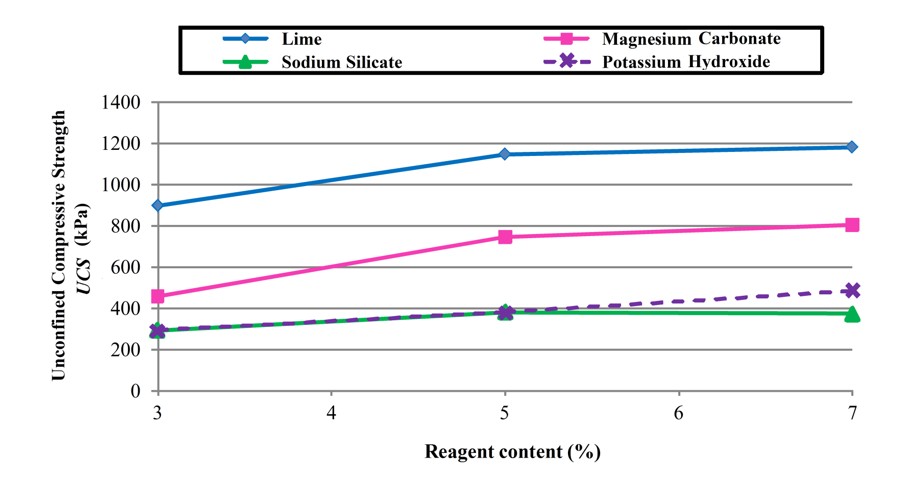
Based on the results obtained from the UCS test for samples after 28 days, the optimal content for each of the considered reagents was determined. The optimal content of reagents was selected based on the diagram in Figure 2, where it can be seen that with an increase in the content of the reagent in the mixture with the soil from 5% to 7% (for lime and magnesium carbonate), the value of UCS slightly increased, whereas the increased consumption of reagents is significant. The results for sodium silicate revealed that slightly higher UCS value was obtained with 5% sodium silicate content than with 7% content. Accordingly, for each of the above mentioned reagents, an optimal content of 5% was determined (L5, MC5, and SS5, respectively). Given the optimal content of lime, this is consistent with the conclusions of the study by Bell (1996), in which the optimal amount of lime varies between 4% and 6% depending on the type of clayey soil tested. In the case of potassium hydroxide, the optimal reagent content of 7% was chosen (PH7), since the UCS value increased almost linearly with the content of the reagent.
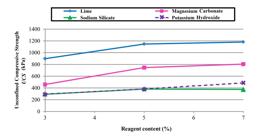
Variation of unconfined compressive strength of clayey soil with reagent content after 28 days.
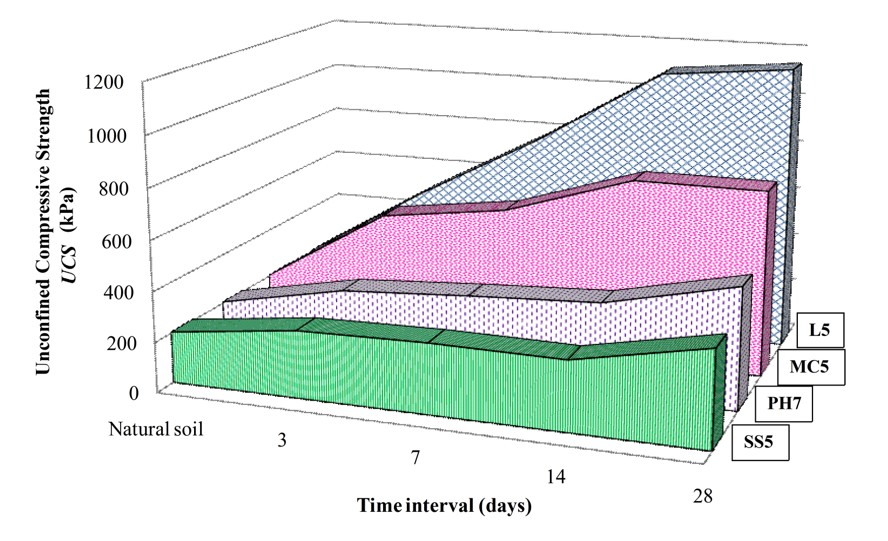
The comparative results of the UCS values determined on samples with the optimal content of each of the considered reagents over time can be seen in Figure 3, based on which the previously drawn conclusions regarding the order of the reagents in terms of their efficiency were confirmed.
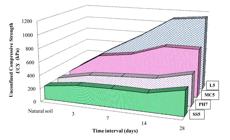
Comparison of the trend of change in UCS over time after the chemical stabilization of clayey soil with the corresponding optimal content for each of the considered reagents.
3.3 Shear strength parameters determined by the direct shear test
The shear strength of the soil is one of the most important geotechnical properties of the soil. It is represented with the Coulomb–Mohr failure criterion, which gives the dependence of shear stress (τ) and normal stress (σ) in the form τ = c + σ ·tgφ, where c and φ represent the shear strength parameters of the soil, i.e. cohesion and angle of internal friction. These parameters were determined as part of the research by the direct shear test. During shearing, draining of the samples was enabled, and as a result, the effective shear strength parameters (c' and φ') were obtained.
The tests were performed on samples with the optimal content for each of the selected reagents, which was determined based on the UCS test results. The tests were conducted for three time intervals (3, 14, and 28 days after mixing the reagent with the natural clayey soil).
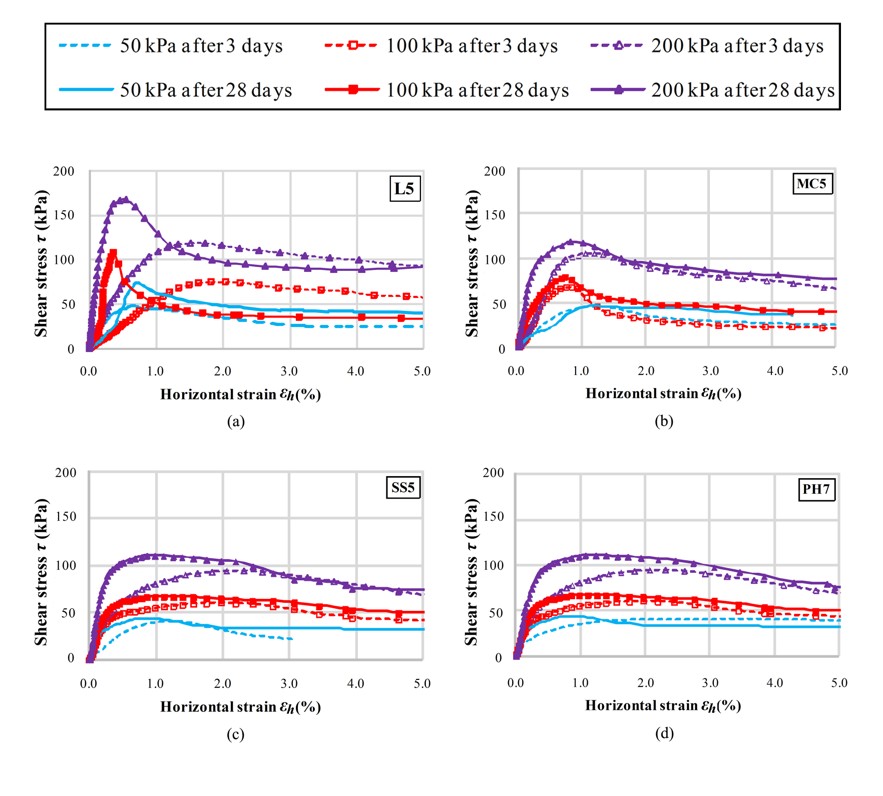
During the test, changes in shear stress (τ) and horizontal strain (εh) along the failure plane were recorded, which is illustrated in Figure 4. The diagrams represent the dependence of these values at a normal stress of 50 kPa, 100 kPa, and 200 kPa, after 3 days and after 28 days since the treatment of the clayey soil with the selected reagents.
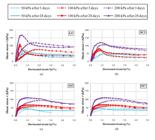
Shear stress–horizontal strain behavior at normal stress of 50 kPa, 100 kPa, and 200 kPa, after 3 days and after 28 days since the treatment of clayey soil with the optimal reagent content for each of the selected reagents: (a) lime, (b) magnesium carbonate, (c) sodium silicate, and (d) potassium hydroxide.
The shear stress values at failure (τ) of the natural clayey soil for the applied normal stresses (σ) of 50 kPa, 100 kPa, and 200 kPa were 30.9 kPa, 49.8 kPa, and 78.1 kPa, respectively. It can be seen from Figure 4that the shear strength increased over time in the case of all the selected reagents. All the maximum shear strength values were obtained at the test time of 28 days after the treatment, at a normal stress of 200 kPa. Specifically, in the case of adding the optimal reagent content, the maximum shear stress value was:
-
for lime (L5, Figure 4a): 167.8 kPa;
-
for magnesium carbonate (MC5, Figure 4b): 119.9 kPa;
-
for sodium silicate (SS5, Figure 4c): 114.0 kPa;
-
for potassium hydroxide (PH7, Figure 4d): 109.4 kPa.
Furthermore, from the same figure it is clearly seen that the τ values recorded on the samples with lime addition (Figure 4a) represent the highest values of all the tested samples (Figures 4b-d). In addition to the significantly higher shear stress values, the shape of the diagrams has a pronounced peak indicating a brittle failure.
Considering the alternative reagents, only the sample with the addition of magnesium carbonate (MC5, Figure 4b) indicated the occurrence of a brittle failure. All other samples indicated a ductile failure (Figures 4c, d), i.e. without a large change in shear force, there was a significant displacement along the failure plane.
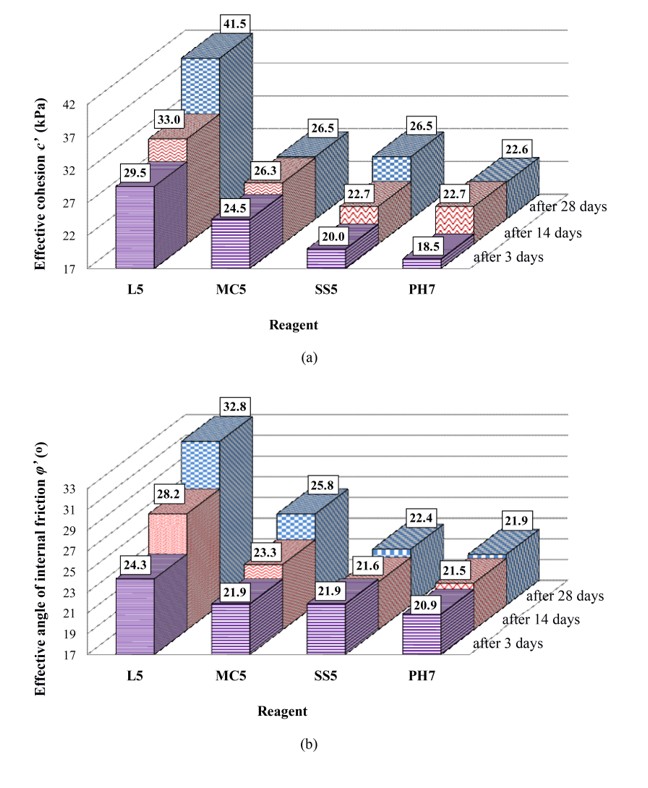
The trends of changes in the values of shear strength parameters (cohesion (c') and internal friction angle (φ') in relation to the natural state of the clayey soil (c' = 16.9 kPa and φ' = 16.5°) are given in Figure 5.
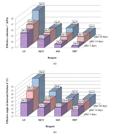
Comparison of the trend of change over time after the chemical stabilization of clayey soil with the corresponding optimal content for each of the selected reagents: (a) effective cohesion c' and (b) effective angle of internal friction φ'.
The lime-based reagent (L5) significantly contributed to the increase in shear strength parameters compared to the natural state of the soil. The improvement of these soil properties is noticeable for all the test time intervals. The trend of increasing shear strength parameter values with time is almost linear, both in terms of the increase in the value of cohesion (after 28 days, the increase in the value of c' was 2.5 times) and in terms of the increase in the angle of internal friction (after 28 days, the increase in the value of φ' was two times).
With regard to alternative materials, approximate values of cohesion (in the range from 18.5 kPa to 26.5 kPa) and internal friction angle (in the range from 20.9 kPa to 25.8 kPa) were recorded for all the considered curing periods.
The greatest improvement in the strength parameters was recorded with the addition of magnesium carbonate (MC5), with an increase in both c' and φ' values of about 50% after 28 days. An increasing trend of the angle of internal friction with time can also be observed, whereas the value of cohesion registered 3 days after the treatment remained almost unchanged.
In the case of potassium hydroxide (PH7), after 3 days since the treatment, the values of cohesion and internal friction angle were slightly increased compared to the values of the parameters for the natural clayey soil. After 14 and 28 days since the treatment, the value of cohesion constantly increased (up to the value reached also with the addition of magnesium carbonate after 28 days), whereas the value of internal friction angle remained unchanged.
The addition of sodium silicate (SS5) also contributed to the improvement of the shear strength parameter values compared to the natural state of the soil – the results for the cohesion value after 14 days and 28 days were quite similar, whereas the increase in the value of the angle of internal friction was already evident during the first 3 days after the treatment and the value did not significantly change over time (the increase in both the c' value and the φ' value was about 35% after 28 days).
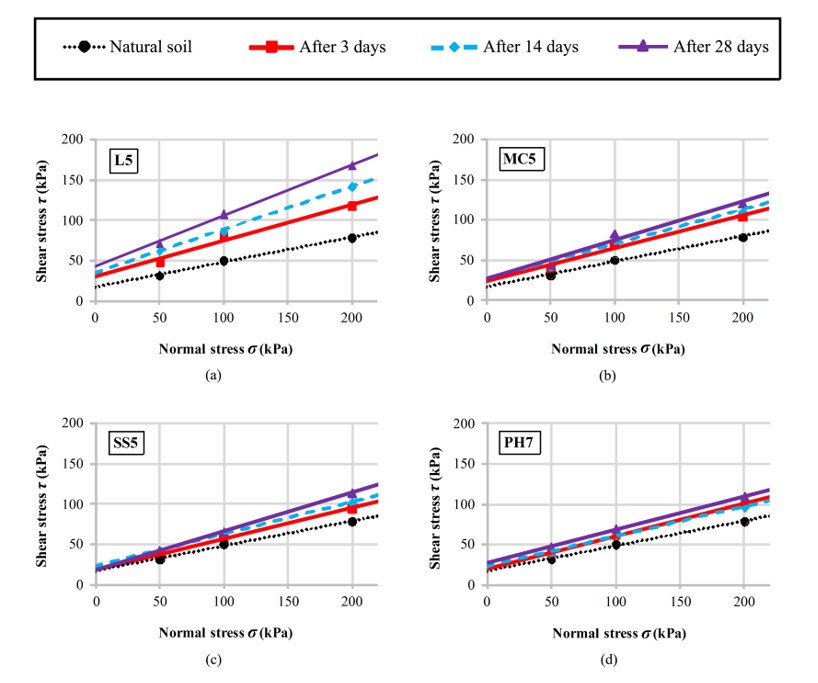
Figure 6 shows the Coulomb–Mohr failure lines for the natural clayey soil, as well as for all the considered reagents obtained by direct shear tests on samples tested 3, 14, and 28 days after the clayey soil treatment. Regarding cohesion, which represents the intercept of the Coulomb–Mohr failure line with the shear stress axis (τ), it can also be observed that the value of cohesion in the case of adding lime increases significantly over time, whereas in the case of other reagents a slightly lower increase in cohesion values was achieved.

Comparison of the effects of each of the selected reagents on the shear strength parameters of clayey soil: (a) lime, (b) magnesium carbonate, (c) sodium silicate, and (d) potassium hydroxide.
On the other hand, there were significant changes in the value of the angle of internal friction, which represents the slope of the Coulomb–Mohr line. The illustrated lines for each of the considered reagents have a noticeably higher slope compared to the slope of the line for the natural clayey soil. In the case of lime addition, a significant change in the slope of the Coulomb–Mohr line was observed, whereas in the case of alternative reagents there is no significant change in the Coulomb–Mohr line slope.
4. Conclusions
In this research, a clayey soil of unfavorable physical and mechanical properties in its natural state was examined in laboratory before and after chemical stabilization, considering a variety of reagents, different percentages of reagents in the mixture with clay, as well as different time intervals after stabilization.
The results presented in this paper confirmed that the improvement of clayey soil properties can be successfully achieved by applying lime, magnesium carbonate, sodium silicate, and potassium hydroxide as reagents on the clayey soils. Each of the considered reagents added to the natural clayey soil contributed to an increase in the values of physical and mechanical properties of the clayey soil and thus enabled their application for various practical construction purposes.
Modification of the values of Atterberg limits, UCS, and shear strength parameters of the clayey soil were tested. The most important findings are as follows:
-
None of the selected reagents contribute to a significant increase in the LL value, regardless of the content of the reagent in the mixture, as well as the time elapsed since the soil treatment. On the other hand, each of the selected reagents results in an increase in the value of PL. This ultimately yields a decrease in the value of PI, particularly over time, thus enabling the treated clayey soil to remain in a semi-solid state of consistency even with a higher water content, which has a favorable effect on its use for practical purposes in construction.
-
From the aspect of increasing the UCS values of the treated clayey soil, it has been proven that lime and magnesium carbonate are the most effective reagents. On the other hand, sodium silicate and potassium hydroxide show a significantly weaker effect in terms of improving the UCS value of the clayey soil. Based on the results related to UCS values, it was concluded that the optimal content of reagent for the treated soil is 5% in the case of applying lime, magnesium carbonate, or sodium silicate, and 7% in the case of applying potassium hydroxide.
-
During the direct shear test, changes in the failure mode of the treated soil can be observed based on the εh – τ diagram. Namely, the samples with the addition of lime and the samples with the addition of magnesium carbonate had a more pronounced peak at failure compared to the other reagents, which indicates a brittle failure of the soil. In the case of sodium silicate and potassium hydroxide, ductile failure was recorded.
-
An increase in the soil shear strength is observed with the addition of the optimal stabilizer content for each of the selected reagents. The greatest increase in the shear strength parameter values is achieved with the addition of lime (after 28 days, the increase in the value of c' was 2.5 times and the increase in the value of φ' was two times). With regard to alternative materials (magnesium carbonate, sodium silicate, and potassium hydroxide), lower increases of cohesion and internal friction angle were achieved with mutually similar values.
After conducting this research, among the tested reagents, lime with a 5% share in the mixture with the clayey soil proved to be the most effective reagent. Nevertheless, this study confirmed that alternative additives, such as magnesium carbonate, sodium silicate, and potassium hydroxide, are also substantially promising as sustainable stabilizing materials considering the examined physical and mechanical properties of the clayey soil.
In addition to significantly improving the properties of soil materials, lime is also the most cost-effective stabilizer. Compared to sodium silicate and potassium hydroxide, the costs of using lime as a chemical stabilizer are several times lower, whereas compared to magnesium carbonate they are even several dozen times lower. All reagents used in this study are commercially available are environmental-friendly materials that do not pollute the environment. Because of that there is no health risk for personnel in laboratory during testing.
It should be noted, however, that all the results presented in this paper relate to the local clayey soil of a specific mineralogical composition. Therefore, there is a need for more comprehensive further research, which would analyze a wider range of soils with different mineralogical compositions.
List of symbols and abbreviations
c Cohesion
c' Effective cohesion
s Swelling
CBR California bearing ratio
CC Coefficient of curvature
CU Coefficient of uniformity
EN European Norms
Gs Particle density
ISO International Organization for Standardization
ISS Institute for Standardization of Serbia
L Lime
L3 Soil with 3% of lime in mixture
L5 Soil with 5% of lime in mixture
L7 Soil with 7% of lime in mixture
LL Liquid limit
MC Magnesium carbonate
MC3 Soil with 3% of magnesium carbonate in mixture
MC5 Soil with 5% of magnesium carbonate in mixture
MC7 Soil with 7% of magnesium carbonate in mixture
MDD Maximum dry density
Mv Modulus of compressibility
OMC Optimal moisture content
PH Potassium hydroxide
PH3 Soil with 3% of potassium hydroxide in mixture
PH5 Soil with 5% of potassium hydroxide in mixture
PH7 Soil with 7% of potassium hydroxide in mixture
PI Plasticity index
PL Plastic limit
SRPS Designation of standards and related documents issued by the Institute for Standardization of the Republic of Serbia
SS Sodium silicate
SS3 Soil with 3% of sodium silicate in mixture
SS5 Soil with 5% of sodium silicate in mixture
SS7 Soil with 7% of sodium silicate in mixture
UCS Unconfined compressive strength
εh Horizontal strain in direct shear test
σ Normal stress
τ Shear stress
φ Internal friction angle
φ' Effective internal friction angle
Acknowledgements
The authors gratefully acknowledge the support of the Science Fund of the Republic of Serbia in the scope of the scientific–research project “A New Concept in Improvement of Geotechnical Properties of Ground – Chemical Electrokinetic Treatment of Soils (ElectroSoil)”, Grant No. 7742530.
-
Discussion open until February 28, 2026.
-
Data availability
The datasets generated analyzed in the course of the current study are available from the corresponding author upon request.
-
Declaration of use of generative artificial intelligence
This work was prepared independently, without the assistance of generative artificial intelligence (GenAI).
References
-
Andavan, S., & Pagadala, V.K. (2020). A study on soil stabilization by addition of fly ash and lime. Materials Today: Proceedings, 22, 1125-1129. http://doi.org/10.1016/j.matpr.2019.11.323
» http://doi.org/10.1016/j.matpr.2019.11.323 -
Behnood, A. (2018). Soil and clay stabilization with calcium-and non-calcium-based additives: a state-of-the-art review of challenges, approaches and techniques. Transportation Geotechnics, 17, 14-32. http://doi.org/10.1016/j.trgeo.2018.08.002
» http://doi.org/10.1016/j.trgeo.2018.08.002 -
Bell, F.G. (1996). Lime stabilization of clay minerals and soils. Engineering Geology, 42(4), 223-237. http://doi.org/10.1016/0013-7952(96)00028-2
» http://doi.org/10.1016/0013-7952(96)00028-2 -
Cristelo, N., Glendinning, S., & Jalali, S. (2009). Sub-bases layers of residual granite soil stabilized with lime. Soils and Rocks, 32(2), 83-88. http://doi.org/10.28927/SR.322083
» http://doi.org/10.28927/SR.322083 - Davidovic, N., Bonic, Z., & Prolovic, V. (2012). Waste glass as additive to clayey material in subgrade and embankment of road pavement. Facta Universitatis, Series: Architecture and Civil Engineering, 10(2), 215-222.
-
Elkhebu, A.G., Zainorabidin, A., Bujang, H.B., Bakar, I.H., Abdeljouad, L.A., & Dheyab, W. (2018). Alkaline activation of clayey soil using potassium hydroxide & fly ash. International Journal of Integrated Engineering, 10(9), 84-89. http://doi.org/10.30880/ijie.2018.10.09.016
» http://doi.org/10.30880/ijie.2018.10.09.016 -
Firoozi, A.A., Guney Olgun, C., Firoozi, A.A., & Baghini, M.S. (2017). Fundamentals of soil stabilization. International Journal of Geo-Engineering, 8(1), 26. http://doi.org/10.1186/s40703-017-0064-9
» http://doi.org/10.1186/s40703-017-0064-9 - Han, J. (2015). Principles and practice of ground improvement Hoboken: John Wiley & Sons.
-
Hurley, C.H., & Thornburn, T.H. (1972). Sodium silicate stabilization of soils: a review of the literature (pp. 46-79). Champaign: University of Illinois. Retrieved in January 31, 2025, from http://onlinepubs.trb.org/Onlinepubs/hrr/1972/381/381-007.pdf
» http://onlinepubs.trb.org/Onlinepubs/hrr/1972/381/381-007.pdf -
Kamon, M., & Nontananandh, S. (1991). Combining industrial wastes with lime for soil stabilization. Journal of Geotechnical Engineering, 117(1), 1-17. http://doi.org/10.1061/(ASCE)0733-9410(1991)117:1(1)
» http://doi.org/10.1061/(ASCE)0733-9410(1991)117:1(1) -
Latifi, N., Eisazadeh, A., & Marto, A. (2014). Strength behavior and microstructural characteristics of tropical laterite soil treated with sodium silicate-based liquid stabilizer. Environmental Earth Sciences, 72(1), 91-98. http://doi.org/10.1007/s12665-013-2939-1
» http://doi.org/10.1007/s12665-013-2939-1 -
Latifi, N., Marto, A., & Eisazadeh, A. (2016). Physicochemical behavior of tropical laterite soil stabilized with non-traditional additive. Acta Geotechnica, 11(2), 433-443. http://doi.org/10.1007/s11440-015-0370-3
» http://doi.org/10.1007/s11440-015-0370-3 -
Maaitah, O.N. (2012). Soil stabilization by chemical agent. Geotechnical and Geological Engineering, 30(6), 1345-1356. http://doi.org/10.1007/s10706-012-9549-7
» http://doi.org/10.1007/s10706-012-9549-7 -
Marinković, N., Jovanovski, M., Zlatanovic, E., Bonic, Z., & Davidovic, N. (2021). Chemical stabilization of soil using lime as a chemical reagent. Scientific Journal of Civil Engineering, 10(1), 37-43. http://doi.org/10.55302/SJCE21101037m
» http://doi.org/10.55302/SJCE21101037m -
Marto, A., Latifi, N., & Eisazadeh, A. (2014). Effect of non-traditional additives on engineering and microstructural characteristics of laterite soil. Arabian Journal for Science and Engineering, 39(10), 6949-6958. http://doi.org/10.1007/s13369-014-1286-1
» http://doi.org/10.1007/s13369-014-1286-1 -
Miranda Neto, M., & Mahler, C.F. (2017). Study of the shear strength of a tropical soil with grass roots. Soils and Rocks, 40(1), 31-37. http://doi.org/10.28927/SR.401031
» http://doi.org/10.28927/SR.401031 -
Moayedi, H., Hua, B.B., Kazemian, S., & Daneshmand, S. (2012). Stabilization of organic soil using sodium silicate system grout. International Journal of Physical Sciences, 7(9), 1395-1402. http://doi.org/10.5897/IJPS11.1509
» http://doi.org/10.5897/IJPS11.1509 - Onyelowe, K.C., & Okafor, F.O. (2012). A comparative review of soil modification methods. ARPN Journal of Earth Sciences, 1(2), 36-42.
-
Pakir, F., Marto, A., Mohd Yunus, N.Z., Ahmad Tajudin, S.A., & Tan, C.S. (2015). Effect of sodium silicate as liquid based stabilizer on shear strength of marine clay. Jurnal Teknologi, 76(2), 45-50. http://doi.org/10.11113/jt.v76.5432
» http://doi.org/10.11113/jt.v76.5432 -
Seco, A., Miqueleiz, L., Prieto, E., Marcelino, S., García, B., & Urmeneta, P. (2017). Sulfate soils stabilization with magnesium-based binders. Applied Clay Science, 135, 457-464. http://doi.org/10.1016/j.clay.2016.10.033
» http://doi.org/10.1016/j.clay.2016.10.033 -
Seco, A., del Castillo, J.M., Espuelas, S., Marcelino, S., & García, B. (2022). Sulphate soil stabilization with magnesium binders for road subgrade construction. The International Journal of Pavement Engineering, 22(6), 1840-1850. http://doi.org/10.1080/10298436.2020.1825711
» http://doi.org/10.1080/10298436.2020.1825711 -
Shon, C., Saylak, D., & Mishra, S.K. (2010). Combined use of calcium chloride and fly ash in road base stabilization. Transportation Research Record: Journal of the Transportation Research Board, 2186(1), 120-129. http://doi.org/10.3141/2186-13
» http://doi.org/10.3141/2186-13 -
Silva, J.D.J., Santos, O.F.D., & Paiva, W.D. (2022). Compressive and tensile strength of aeolian sand stabilized with porcelain polishing waste and hydrated lime. Soils and Rocks, 46(1), e2023002322. http://doi.org/10.28927/SR.2023.002322
» http://doi.org/10.28927/SR.2023.002322 -
Silva, J.D.J., Santos Júnior, O.F., Freitas Neto, O., Silva, R.S.A., Farias, M.L.A., & Lira, B.S. (2025). Undrained monotonic behavior of a dune sand stabilized with porcelain waste and lime. Soils and Rocks, 48(1), e2025011023. http://doi.org/10.28927/SR.2025.011023
» http://doi.org/10.28927/SR.2025.011023 -
Singh, J., Singh, U.K., & Singh, R.K. (2020). Stabilization of clayey soil using gypsum and calcium chloride. International Journal of Recent Technology and Engineering, 9(2), 668-673. http://doi.org/10.35940/ijrte.B3828.079220
» http://doi.org/10.35940/ijrte.B3828.079220 - SRPS EN ISO 14688-12. (2018). geotechnical investigation and testing - identification and classification of soil - part 2: principles for a classification. Institute for Standardization of Serbia, Belgrade.
- SRPS EN ISO 17892-10. (2019). Geotechnical investigation and testing - laboratory testing of soil - part 10: direct shear tests. Institute for Standardization of Serbia, Belgrade.
- SRPS EN ISO 13286-41. (2022). Unbound and hydraulically bound mixtures - part 41: test method for the determination of the compressive strength of hydraulically bound mixtures. Institute for Standardization of Serbia, Belgrade.
-
Taha Jawad, I., Raihan Taha, M., Hameed Majeed, Z.A., & Khan, T. (2014). Soil stabilization using lime: advantages, disadvantages and proposing a potential alternative. Research Journal of Applied Sciences, Engineering and Technology, 8(4), 510-520. http://doi.org/10.19026/rjaset.8.1000
» http://doi.org/10.19026/rjaset.8.1000 -
Vakili, M.V., Chegenizadeh, A., Nikraz, H., & Keramatikerman, M. (2016). Investigation on shear strength of stabilized clay using cement, sodium silicate and slag. Applied Clay Science, 124-125, 243-251. http://doi.org/10.1016/j.clay.2016.02.019
» http://doi.org/10.1016/j.clay.2016.02.019 -
Yi, Y., Liska, M., Unluer, C., & Al-Tabbaa, A. (2013). Carbonating magnesia for soil stabilization. Canadian Geotechnical Journal, 50(8), 899-905. http://doi.org/10.1139/cgj-2012-0364
» http://doi.org/10.1139/cgj-2012-0364 -
Zafirovski, Z., Markovski, M., Ognjenovic, S., Gacevski, V., Nedevska, I., & Ristov, R. (2024). Subbase stabilization with fly ash. Facta Universitatis, Series: Architecture and Civil Engineering, 22(1), 79-88. http://doi.org/10.2298/FUACE230630033Z
» http://doi.org/10.2298/FUACE230630033Z
Edited by
-
Editor:
Renato P. Cunha https://orcid.org/0000-0002-2264-9711
The datasets generated analyzed in the course of the current study are available from the corresponding author upon request.