 Elastic settlements of closely spaced asymmetrical footings
Abstract
This study aims to estimate the settlement of two distinct angular footings (i.e. distinct square-square, rectangular-rectangular and square-rectangular footings) found alongside on homogeneous, isotropic and elastic granular medium. The settlement of these footings has been assessed by considering the interference effect as the footings are in closed proximity. To evaluate the interference settlement for two distinct angular footings found alongside on the surface of the granular medium, a simplified method has been proposed based on the principle of superposition. The assessment is carried out by varying length-to-width ratio, clear spacing between the footings, loads on the footings, centre lines, and footing width. The outcomes are provided as interference factors. The study shows that, the settlement interference factors were more pronounced for the smaller footing, even with symmetrical loads. These factors increased as the load intensity on the adjacent footing grew and were higher with smaller spacing and reduced with greater spacing between the footings. The impact of interfering settlements owing to embedment depth is also investigated and reported as a settlement ratio. The findings were compared to the available literature.
Keywords
Two distinct footings; Granular medium; Interference settlement; Clear spacing; Length-to-width ratio; Embedment depth
1. Introduction
Shallow foundations must be designed with the soil's bearing capacity, i.e., the load on the footing and the permissible settlement in consideration. The bearing capacity of the soil is the maximum load it can withstand without failing. Settlement is nothing but the amount of vertical displacement that takes place under the footing. The essential parameters to consider while designing the shallow foundations are the soil's load-carrying capacity and the acceptable limits of settlement. The load-carrying capacity and settlement of shallow footings in the soil is an intricate process affected by various parameters, including soil characteristics, footing size and shape, and embedment depth. In general, the settlement of a shallow footing can be categorised into two components: elastic settlement and time-dependent settlement. Elastic settlement is the instantaneous settlement when a load is applied to a footing. It is caused by the deformation of the soil beneath the footing. Time-dependent settlement occurs over time as the soil consolidates under the load. It is mainly due to the expulsion of water from the soil. The bearing capacity and settlement of shallow isolated footings can be predicted with the available methods (Terzaghi, 1943; Meyerhof, 1951; Vesic, 1973; Burland et al., 1985; Bowles, 1987, 1988; Berardi & Lancellotta, 1991). All these methods are applicable or assume that the footings are isolated. In other words, the footings have sufficient space to extend the failure zone. That means there is no footing within the zone of influence.
Their settlements can interact when two or more footings are located close together. This is known as the settlement interference effect. The interference effect can increase or decrease the settlement of the footings, depending on the spacing between the footings and the properties of the soil. Many research scholars (West & Stuart, 1965; Das & Larbi-Cherif, 1983; Das et al., 1993; Kumar & Saran, 2003; Griffiths et al., 2006; Kumar & Ghosh, 2007a, b; Lee et al., 2008; Kumar & Bhoi, 2009; Lee & Eun, 2009; Mabrouki et al., 2010; Ghosh & Kumar, 2011; Kumar & Bhattacharya, 2010; Nainegali et al., 2013; Srinivasan & Ghosh, 2013; Ghosh et al., 2014; Roy & Deb, 2019) have studied the interference impact of closely spaced footings using experimental, analytical, and numerical methods. They discovered that when the distance between the footings reduces, the ultimate bearing capacity of the interfering footings rises. On the other hand, the interference impact on the settlement of closely spaced footings has received little attention. The majority of the investigations were carried out on strip footings lying on sandy soils. There have been few investigations on the settlement of shallow footings due to the interfering impact of square and rectangular footings when they were found nearby (Saran & Agarwal, 1974; Nainegali, 2013; Nainegali et al., 2013; Shahein & Hefdhanllah, 2013; Srinivasan & Ghosh, 2013; Roy & Deb, 2019).
To the best of the author's knowledge, there is no documented evidence of interference settlements for square - rectangular footing combinations, square (small) - square (large) footing combinations, or rectangular (small) - rectangular (large) footing combinations. The impact of interference on the immediate settlement of shallow footings placed in close proximity on geomaterials is an important issue. This study reviews the relevant literature on predicting the settlement of shallow footings placed close together on elastic soil medium or the instantaneous settlements of cohesive-frictional materials.
The proposed method is particularly relevant in modern urban environments, where space constraints often require closely spaced buildings with varying foundation types and sizes. Such conditions are common in metropolitan developments involving retrofits, expansions, or mixed-use structures. By addressing asymmetric footing interactions, this study aligns closely with current geotechnical challenges in urban planning. It offers practical value for engineers tasked with designing foundations in densely built-up areas.
2. Problem description
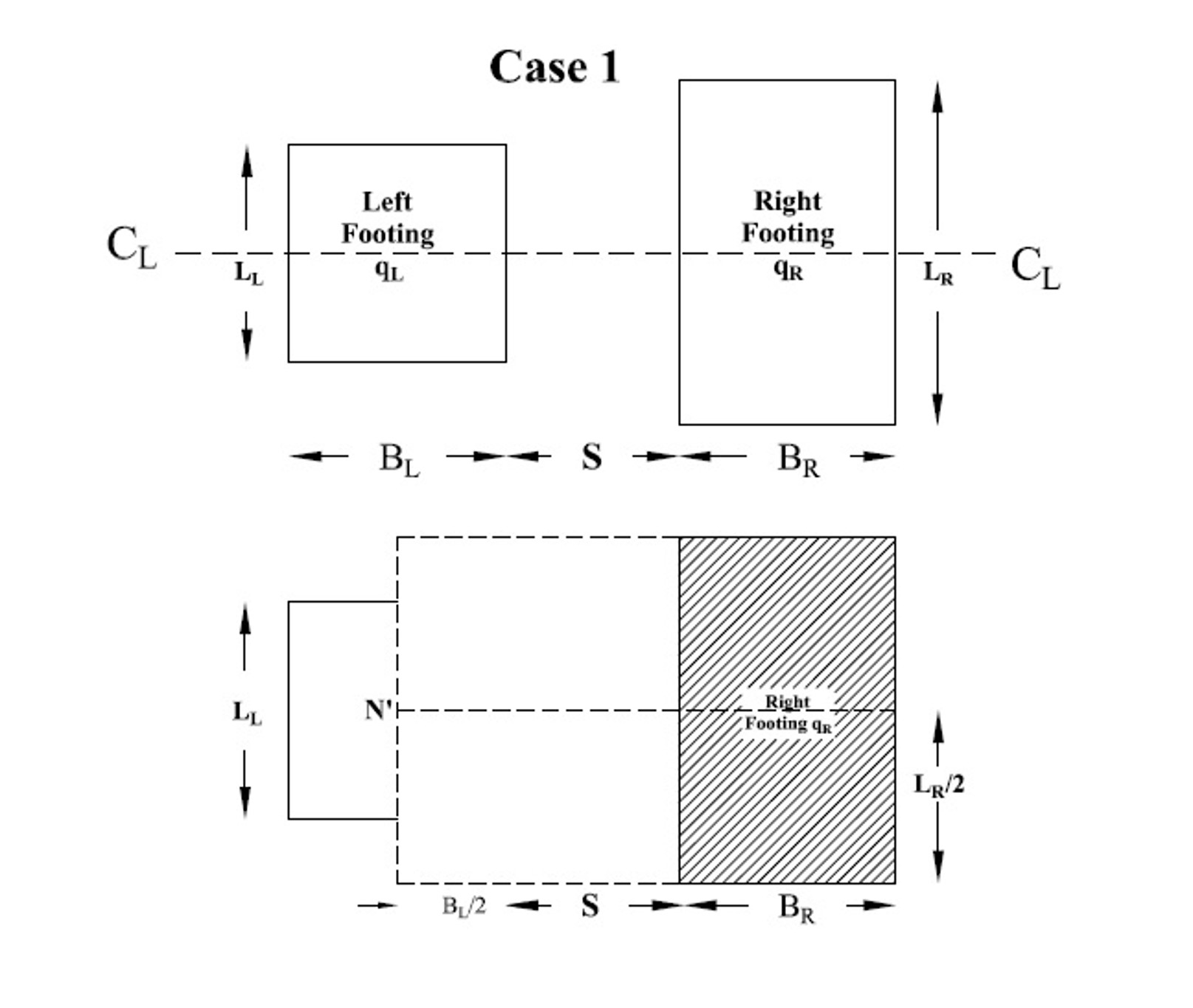
The elastic settlements of two distinct footings placed adjacent to each other have been assessed in the present study by considering the interference effect. The elastic settlements under the two distinct footings found alongside have been determined to correspond to the service loads ofqLandqR. WhereqLandqRare the intensity of loads on the left and right footing, respectively. The width and length of the distinct left and right footings areBLandLL,BRand LR,respectively. The impact of elastic settlements under the two distinct footings placed adjacent to each other resting on the surface of the cohesionless soils under the service vertical loads due to the interference effect has been explored. The possible combinations of two distinct footings considered in the present study are shown in Figure 1. The effect of settlements for the footings has been analysed for the parameters called clear spacing between the footings (S), aspect ratio (i.e. left footingLL/BL,right footingLR/BR) and the load intensity on the left footing to the right footing by varyingnvalues where n refers to the ratio of load intensity on the left footing to that of the right footing (i.e.n = qR/qL).

The current analysis has been carried out for four different cases as shown in Figure 1. Case 1: Square (left) and Rectangular (Right) Footing (centre line, CL of both the footings coincides), Case 2: Square footing (left) and Rectangular footing (Right) (centre line, CL of both the footings are not coinciding), Case 3: Two distinct square footings (LL/BL=1 and LR/BR=1) and Case 4: Two distinct rectangular footings (LL/BL >1 and LR/BR >1). The different parameters considered in the current analysis are given in Table 1.
3. Methodology
3.1 Assumptions
The footings rest on an elastic, homogenous, isotropic and dry granular soil medium subjected to vertical service loads throughout the analysis. The Poisson’s ratio (µ) and Young’s modulus (E) of the soil under the footings are uniform to an infinite depth. The footings considered in the present analysis are rigid. The footing's base is deemed perfectly rough to avoid horizontal sliding. By keeping the loads on the left footing constant, the loads on the right footing have been varied compared to the left footing loads in the analysis.
3.2 Proposed method
Terzaghi (1943) proposedEquation 1 to assess the elastic settlements at any given corner point of an isolated square or rectangular flexible footing resting on the semi-infinite soil medium subjected to vertical loads on a finite area and assumed that the soil medium is perfectly elastic. Hence, the law of superposition of loads and displacements is valid.
where: = Elastic settlement at the corner of the footing; Uniformly distributed surcharge per unit of area; B = width of the footing; E = Young’s modulus of the soil below the footing; Steinbrennr’s Influence factor.
The elastic settlements of the two distinct square and rectangular footings found alongside due to the interference have been assessed from Equation 1 for all the cases given in Figure 1 in the present study. Schleicher (1926) proposed Equation 2 extensively used in the current study to assess the interference settlements for all the cases.
The equations are put together using a dimensionless quantity known as the interaction factor i.e Equation 4 and Equation 5. The geometrical arrangement of two distinct square and rectangular footings (Figure 1) was investigated by adjusting the aspect ratio, clear spacing, S, between the footings, and the severity of stress on the right footing concerning the left footing.
This simplified method for estimating interference settlements is based on the superposition principle and is extended to handle asymmetric footing combinations. The proposed method aims to offer a simplified yet validated analytical approach that enables rapid parametric analysis, making it particularly useful for preliminary design and comparative studies where efficiency and repeatability are essential. The proposed method offers a more time-efficient and accessible alternative. It requires fewer input parameters while maintaining practical relevance for routine engineering applications.
3.3 Procedure
Case 1: Square (left) and Rectangular (Right) Footing (centre line, CL of both the footings coincides) has been investigated to comprehend better the development method for two distinct footings found nearby on the surface of homogenous and isotropic soil. Sarvesh et al. (2023) first proposed and considered this concept for identical square and rectangular footings. The same has been extended for the asymmetrical two distinct angular footings in the current study. The following example illustrates the procedure.
Interaction factor for square footing (left) due to the interference of rectangular footing (right):
The average settlement of an isolated left footing can be calculated using Equation 1. The average settlement of a square footing (left) at Nʹ due to the interference of a rectangular footing (right) can be calculated from Figure 2. Here, Nʹ is the centre of the square footing (left). To analyse the average interfering settlements at Nʹ due to the presence of the rectangular footing (right), the entire area is divided into two rectangles through Nʹ. Figure 2 shows the loaded area taken into account in determining SR (the shaded portion). The average interference settlements at Nʹ due to the presence of the rectangular footing (right) have been calculated. The settlement interaction factor for the left footing is proposed as follows:
where: SCR = Average settlement of interfering left footing.
SCR = SiL + SR (7)
where: SiL = Average settlement of isolated left footing; SR = Average settlement of left square footing due to the interference of right rectangular footing.
where: I1 and I2 are the influence factors for considering rectangular portions in Figure 2. Determine the B1, B2, I1 and I2 values and substitute in Equation 9. Then, the simplified equation for assessment of the interaction factor as defined for left footing due to the presence of right footing is as follows:
where: l1 = the maximum and minimum dimensions’ ratio of [2S+BL+2BR, LR]; l2 = the maximum and minimum dimensions’ ratio of [2S+BL, LR]; B1 = min of (2S+BL+2BR)/2, LR/2]; B2 = min of [(2S+BL)/2, LR/2].
Average Elastic Settlement of left square footing at Nʹ due to the interference of right rectangular footing.
Similarly, the interaction factor for right footing due to the presence of left footing is given by:
where: l3 = the maximum and minimum dimensions’ ratio of [2S+2BL+BR, LL]; l4 = the maximum and minimum dimensions’ ratio of [2S+BR, LL]; B3 = min of (2S+2BL+BR)/2, LL/2]; B4 = min of [(2S+BR)/2, LL/2].
In Figure 2, the values B1, B2, B3, and B4 represent the widths of the rectangular or square region being analysed. The values of l1, l2, l3, and l4 are the aspect ratios of the rectangular or square regions in Figure 2. These elements are modified based on the S/B ratio of a specific geometric configuration of an interfering footing. The values of the elements are the function of clear spacing, length and width of the left footing and right footing. As a result, a computational MATLAB program was created to solve the equations mentioned above. The results were presented in terms of the dimensionless parameters ξδL and ξRL.
In order to explore the parametric study on interaction settlement factors for left and right footings placed in closed proximity on homogeneous soil, the graphs between ξδL Vs S/B and ξδR Vs S/B for different L/B ratios and intensity of loading (i.e. the intensity of load on left footing keeping constant and varying on the right footing with respect to left footing) have been developed.
To investigate the parametric study of interaction settlement factors for left and right footings placed in close proximity on homogeneous soil, graphs were developed showing the relationship between ξδL Vs S/B as well as ξδR Vs S/B, for different geometrical configurations and intensities of loading. The loading intensity on the left footing was kept constant, while the intensity on the right footing varied relative to the left footing.
4. Results and discussion
The settlement interaction factors for the two distinct footings found alongside have been studied with the proposed methodology with the parameters considered in Table 1. The interaction settlements have been reviewed and summarised into four cases, as shown in Figure 1. The Analysis results are presented in the form of non-dimensional factors called settlement interaction factors ξδL and ξδR. Throughout the analysis, the intensity of load on the left footing (qL) is constant, and the intensity of load on the right footing has been varied with respect to the left footing (qR = n* qL).
4.1 Case 1: square (left) and rectangular (right) footing (centre line, CL of both the footings coincides)
The analysis has been carried out for the Case 1. Adjustments to the n values are made to investigate the interference effects under unsymmetrical loading conditions. In the present case, the width of the footing is kept uniform to simplify the analysis, i.e. the width of the square footing is equal to the width of the rectangular footing (BL=BR=B=1) in case 1. The aspect ratio of the square footing (i.e.LL/B=1) is held constant. In contrast, the aspect ratio of the rectangular footing (LR/B) is varied from 2 to 6. The variation of settlement interference factors for left and right footings (ξδLandξδR) to the spacing (S/B) ratio for different intensities of loading has been presented in Figure 3. The charts depict that the interference factors increase at a closer spacing ratio for both footings and attain a unit value (i.e., no interference effect) at a higher spacing ratio for all aspect ratios and n values.

Variation of settlement interaction factors with respect to S/B ratio for two distinct angular footings for (a) Two distinct footing with symmetrical loading (n=1) (b) LL/B = 1 and LR/B = 2 (c) LL/B = 1 and LR/B = 4 (d) LL/B = 1 and LR/B = 6.
Figure 3a shows the variation of interaction factors (ξδLandξδR) for two distinct footings subjected to symmetrical loading (n=1) with spacing ratio (S/B). The interaction factors for left-footing (ξδL) and right-footing (ξδR) are different even though the intensity of loads on footings are the same. The chart shows that the smaller one experiences significantly larger settlements than the larger one at a closer spacing ratio (S/B =0.5). Additionally, the interaction factors for square footings (LL/B=1) increase with increasing nearby footing aspect ratio (LR/B = 2 to 6) at a closer spacing ratio. The extremity of settlement interaction factors for the two distinct footings placed adjacent to each other, subjected to symmetrical loading, was observed at a closer spacing ratio (S/B=0.5). The settlement of a square footing LL/B=1 interfering with a rectangular footing LR/B increases in the range of 36.5% to 73% as the aspect ratio (LR/B) of the rectangular footing increases from 2 to 6 in comparison with the settlement of an isolated square footing. In the same way, the settlement of a rectangular footing interfering (LR/B >1) with a square footing (LL/B=1) increases in the range of 14% to 9% for aspect ratios of 2, 4, and 6 at a spacing ratio of S/B = 0.5 in accordance with the similar rectangular isolated footing.
The interpretation has been extended to asymmetrically loading conditions to quantify the settlement interference effect for the two distinct (square (LL/B=1) and rectangular (LR/B >1)) footings placed adjacent to each other. It is represented in the form of non-dimensional factors ξδLandξδR by varying the spacing ratio S/B. The non-dimensional factor n is varying from 1.25 to 2.0. The variability of interference factors relative to the spacing ratio is well established in Figures 3b to 3d. The charts show similar patterns to those of two distinct footings subjected to symmetrical loading (see Figure 3a). As the load intensity increases, the interference factors ξδL and ξδR increase. The interference effect peaks at a lower S/B ratio and then declines to unity at a higher S/B ratio. In all cases shown in Figures 3b to 3d, the interference effect increases in both the left and right footings as the load intensity on the right footing increases (n=1.25 to 2.0). This effect is more pronounced at lower S/B =0.5. As the spacing increases, the interference effect approaches unity. Additionally, it is observed that the interference effect increases with increasing aspect ratio of right footing (LR/B = 2 to 6) in left square footing (LL/B =1). The interference effect is more pronounced on the left square footing (LL/B =1) than on the right rectangular footing (LR/B>1). This may be due to the fact that the influence zone of the right footing overlaps to a greater extent with the influence zone of the left footing. This overlap can increase the settlement of the left footing, as the stress from the right footing is essentially "pushing" down on the left footing. The influence zone of the left footing will likely have a smaller impact on the right footing, as it has less overlap.
When the value of n is increased from 1 to 2, at an S/B of 0.5, the percentage increase in settlement for left footing LL/B=1 located adjacent to a right footing LR/B=2 is in the range of 36.5% to 73%, compared to a similar footing with no interference. Similarly, the settlements increase in right footing LR/B=2 by 14% to 7%, compared to a similar footing with no interference. Likewise, the percentage increase in settlement for a left footing LL/B=1 located adjacent to a right footing LR/B=4 is in the range of 63.5% to 127%, while the percentage increase in settlement for the right footing is in the range of 11% to 5.5% at spacing ratio of S/B =0.5, n varying from 1 to 2. This contrasts the settlements of respective isolated footings with similar soil properties. Further, as n is varied from 1 to 2, at an S/B of 0.5, the percentage increase in settlement for a left footing LL/B=1 positioned beside a right footing LR/B=6 is between 83% and 166% when compared to a similar footing with no interference. Similarly, the settlement percentage rose by 9.70% to 4.85% in right footing LR/B=6 compared to a similar footing with no intervention.
4.2 Case 2: square footing (left) and rectangular footing (right) (centre line, CL of both the footings are not coinciding)
The present investigation was further extended for present Case 2. The footing geometry is shown in Figure 1, Case 2. The average interference settlement with the predefined parameters in Table 1 has been evaluated using the proposed method. The current case has been restricted to the aspect ratio of LR/B =2 as it is observed that the aspect ratio increases and the interference effect becomes negligible as the distance between them is further. To study the interference effect for the described case, the variation of interference factors (ξδL and ξδR) along with the S/B ratio has been well established and presented in Figure 4. The variation pattern of the interference factors is similar to the previous case. The factors are lower at a higher S/B ratio and higher at a lower S/B ratio for all n values. At a ratio of S/B = 0.5, the ξδL and ξδR factors increase as n increases from 1 to 2. The interference effect is more pronounced on the smaller (left square footing) than the larger (right rectangular footing). In the present case, the factors ξδL and ξδR are lower than in the previous case of LL/B = 1 and LR/B = 2 with CL coincides because the CL distance is greater in the present case. The factors ξδL and ξδR vary from 35% to 70% and 14% to 7%, respectively, at S/B = 0.5 for n values of 1 to 2.

Variation of settlement interaction factors with respect to S/B ratio for LL/B =1 and LR/B =2 footings for CL not coinciding.
4.3 Case 3: two distinct square footings ((L/B)L=1 and (L/B)R =1)
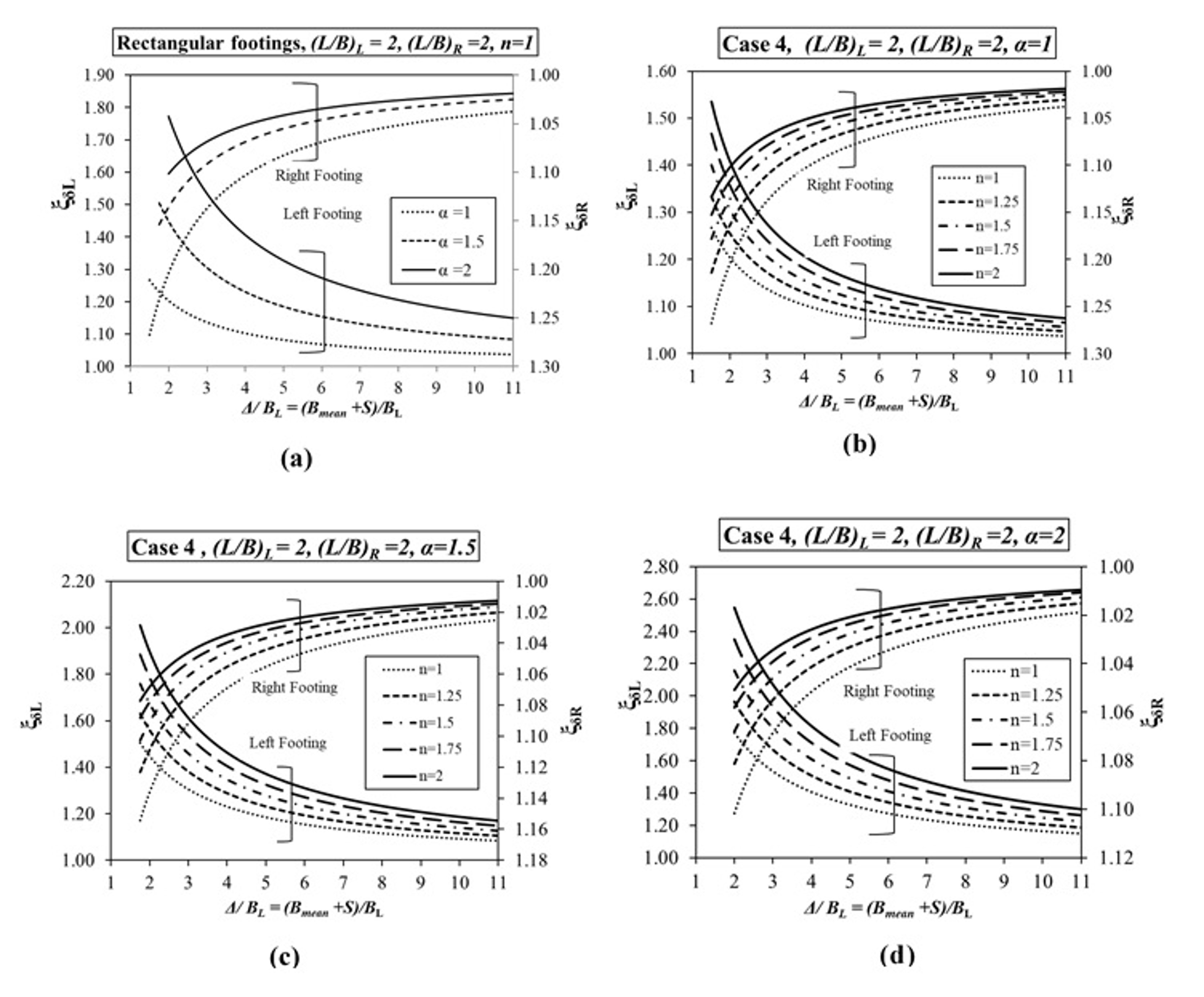
The current investigation extended to two distinct square footings with different lengths and widths. The length of the right footing was varied relative to the left footing (i.e. LR = α * LL). The length and width of the left footing (i.e. LL and BL) were constant, and the length and width of the right footing (i.e. LR and BR) were varied. The effect of settlement interference was assessed and presented in the form of interference factors ξδL and ξδR of the left footing and right footing, corresponding to the spacing ratio Δ/BL = (Bmean + S)/BL are presented in Figure 4. Bmean is the mean width of the left footing and right footing.
Figure 5a shows the variation of factors ξδL and ξδR for two distinct footings subjected to symmetrical loads (n=1) found nearby with Δ/BL different α = 1, 1.5 and 2.0. The factors ξδL and ξδR amplify at a lower Δ/BL ratio as the size of the footings increases and drops to a unit value as the Δ/BL ratio enhances. Further, the factors of ξδL are more heightened than the factors of ξδR at lower Δ/BL for all α values. The intensification of the increase in factors of ξδL is more as compared to that of intensification of increase factors of ξδR for an increase in the values of α at a lower spacing ratio. The underlying reason for this is as the size of the interfering footing upturns, the zone of influence extends towards the smaller one and compresses more. At a lower Δ/BL ratio, the percentage of settlement upsurges in the range of 19% to 59% for left footing as the α values vary from 1 to 2. Similarly, the right footing settlement percentage surges in the range of 19% to 7% compared with the isolated footing with similar properties as α varies from 1 to 2.
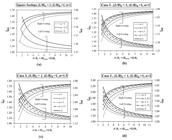
Variation of settlement interaction factors with respect to Δ/BL ratio for two distinct square footings (a) Two distinct square footing with symmetrical loading (n=1) (b) (L/B)L = 1, (L/B)R = 1 and α=1 (c) (L/B)L = 1, (L/B)R = 1 and α=1.5 (d) (L/B)L = 1, (L/B)R = 1 and α=2.
The variation of interference settlement in two distinct square footings placed adjacent to each other with respect to the Δ/BL ratio for asymmetrical loading intensities has been presented in Figures 5b to 5c. The variation patterns of the interference factors ξδL and ξδR are consistent with those observed in the above discussed cases. The percentage increase in settlement for left footing at a lower spacing compared to an isolated footing is 19.25% to 38.50% for α = 1, 37.5% to 75% for α = 1.5, and 58.9% to 117.7% for α = 2. The percentage increase in settlement for right footing ranges from 19.25% to 9.6% for α = 1, 11% to 5.5% for α = 1.5, and 7.0% to 3.5% for α = 2. The percentage increase in settlement is higher for left footing than for right footing for all values of α and n. This is because the left footing is closer to the edge of the soil mass, which makes it more susceptible to settlement. The percentage increase in the settlement also increases with increasing α. This is because α is a measure of the size of the footing.
4.4 Case 4: two distinct rectangular footings ((L/B)L >1 and (L/B)R >1)
The analysis has been carried out for the two distinct rectangular footings found nearby. The geometry of the footings is shown in Figure 1, Case 4. The interference effect has been presented in the form of interference factors of left footing ξδL and right footing ξδR in Figure 6.

Variation of settlement interaction factors with respect to Δ/BL ratio for two distinct rectangular footings (a) Two distinct rectangular footing with symmetrical loading (n=1) (b) Asymmetrical loading for (L/B)L = 2, (L/B)R = 2, and α=1 (c) Asymmetrical loading for (L/B)L = 2, (L/B)R = 2 and α=1.5 (d) Asymmetrical loading for (L/B)L = 2, (L/B)R = 2 and α=2.
The variance of interference factors ξδL and ξδR of two rectangular footings found nearby indicates a similar trend as discussed above. In other words, the interference effect is higher at lower spacing and vice versa for the n value and α value. Figure 6 shows the variance of factors ξδL and ξδR for symmetrically and asymmetrical loaded rectangular footings. The chart depicts that at lower spacing, the interference effect on the smaller footing (left footing) is intensified compared with the larger footing (right footing) as the α increases from 1 to 2. Figures 6b to 6d show the variance of factors ξδL and ξδR with Δ/BL for different n values and α values. These charts also show a similar trend; at lower spacing, the interference factors are greater and decrease as the spacing widens. As the size of the adjacent footing runs up, the interference effect intensifies on a smaller footing for all n values. Similar observations have been made as the α rises to 1 to 2. For n values varying from 1 to 2, the percentage increase in settlement for a left footing at a lower spacing compared to an isolated footing is between 26.7% and 53.5% for α = 1, between 50% and 101% for α = 1.5, and between 77.2% and 154.5% for α = 2. The percentage increase in settlement for a right footing at a lower spacing compared to an isolated footing is between 26.74% and 13.4% for α = 1, between 15.4% and 7.7% for α = 1.5, and between 10.1% and 5.1% for α = 2.
4.5 Impact of interfering settlements due to embedment depth (Df)
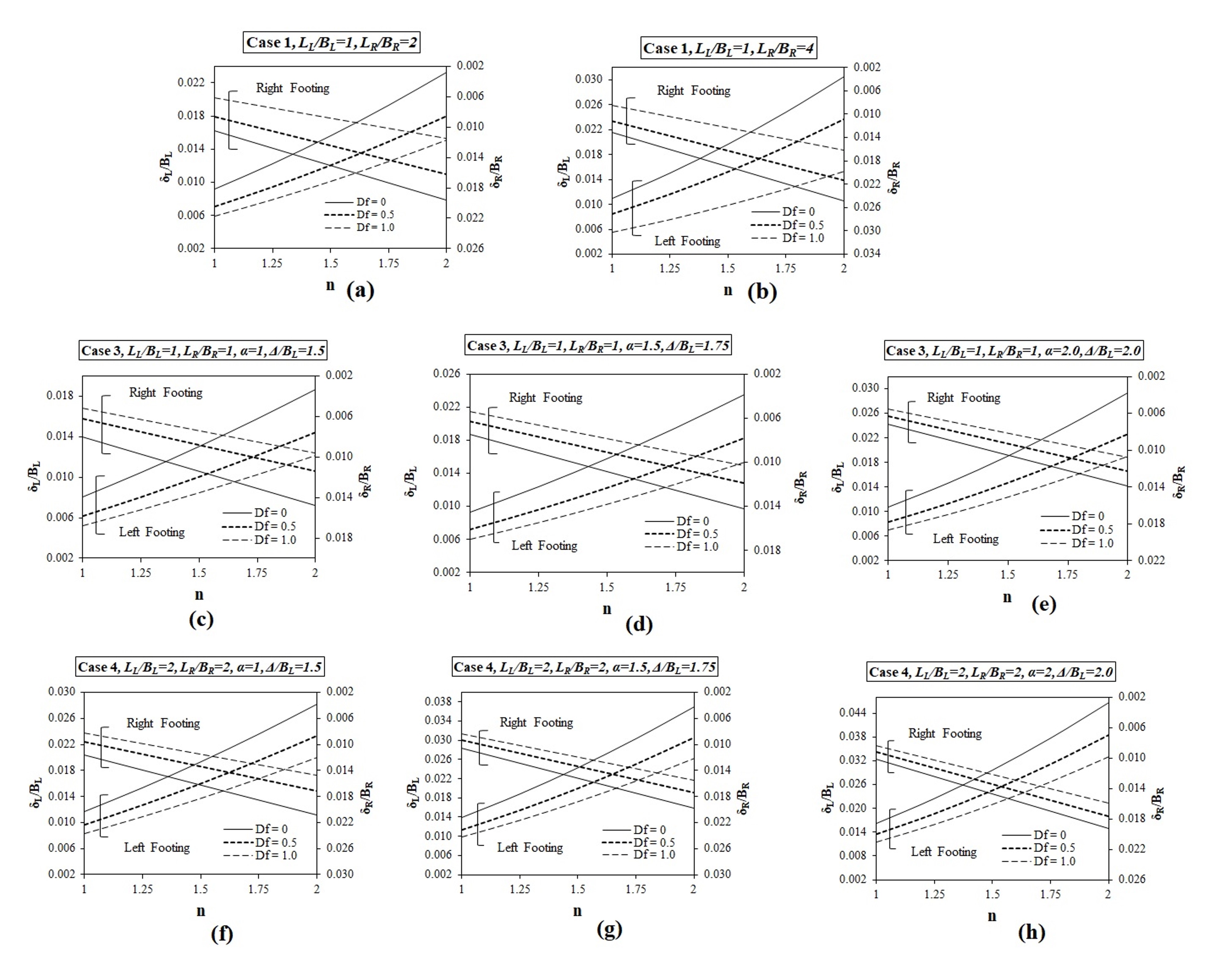
The current method has been extended to assess the impact of embedment depth (Df) on the interfering settlement of two nearby angular footings. The effect of settlement due to embedment depth for all the cases (as shown in Figure 1) was investigated at a lower spacing ratio by varying the aspect ratio (L/B) for α values of 1.0, 1.5, and 2.0, the spacing ratio, and the intensity of load on the right footing, taking into account the left footing, by varying the n values from 1 to 2. The intensity of load on the left footing was constant throughout the analysis. The analysis has been carried out using the predefined parameters in Table 1. The variation of the impact of interfering settlements with embedment depth (Df = 0, 0.5 m and 1.0 m) for the left footing and right footings is presented in Figure 7 as the ratios δL/BL and δR/BR, respectively, for the discussed cases with varying intensity of loading n at lower spacing. Fox (1948) proposed charts that show how embedment depth factors vary for different aspect ratios and Poisson's ratios. Mittal et al. (2019) developed a multivariable non-linear regression model to derive these depth correction factors from Fox’s (1948) charts. The factors were then used in the present analysis to study the impact of embedment depth on settlements. The graphs show that for all the cases, the settlements are more significant at zero embedment depth and decrease as the embedment depth increases. Additionally, at a particular embedment depth, the settlements increase sharply as the intensity of loading increases from n = 1 to 2. For all embedment depths and n values from 1 to 2, the settlements under smaller footings are higher than the larger footings. Additionally, as the aspect ratio increases, the settlements under adjacent footings also increase.
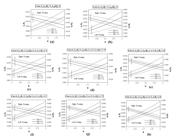
Variation of the impact of settlement due to embedment depth (Df) for the intensity of loading n for (a) Case 1, LL/BL =1, LR/BR =2 and S/BL=0.5; (b) Case 1, LL/BL =1, LR/BR = 4 and S/BL=0.5; (c) Case 3, LL/BL =1 and LR/BR = 1, α=1.0, Δ/BL = 1.5; (d) Case 3, LL/BL =1 and LR/BR = 1, α=1.5, Δ/BL = 1.75; (e) Case 3, LL/BL =1 and LR/BR = 1, α=2.0, Δ/BL = 2.0; (f) Case 4, LL/BL =2 and LR/BR = 2, α=1, Δ/BL = 1.5; (g) Case 4, LL/BL =2 and LR/BR = 2, α=1.5, Δ/BL = 1.75; (h) Case 4, LL/BL =2 and LR/BR = 1, α=2.0, Δ/BL = 2.0.
5. Comparison of the proposed method with existing literature
The proposed method for calculating settlement interaction factors for two square and rectangular footings placed side-by-side on a homogeneous, isotropic, and elastic soil was compared with the results of existing 3D finite element methods (Nainegali et al., 2013) for case 1. Nainegali et al. (2013) conducted a 3D finite element method (FEM) analysis using MATLAB R2008a, employing 8-noded isoparametric brick and rectangular elements. The parameters and assumptions used in their study align closely with those in the current analysis. Specifically, the soil is assumed to be semi-infinite, isotropic, elastic, cohesionless, and dry. Additionally, the assumption of linear soil behavior is considered valid for soils subjected to small strain levels under working loads, and the considered footings are assumed to be rigid in the analysis. Tables 2 to 4 present the percentage difference between the interaction factors obtained from the proposed method and the existing 3D FEM literature. The values obtained from the proposed method are in close agreement with the current literature. For clarity and better understanding, the variation of the settlement interference factor with respect to the spacing ratio is compared with the results from Nainegali et al. (2013) for specific cases (i.e., for n=1, n=1.5, and n=2), as presented in Figure 8a to 8c.
Comparison Table for Case 1: Square (left) and Rectangular (Right) Footing (center line, CL of both the footings coincides) for (L/B)L =1, (L/B)R =2.
Comparison Table for Case 1: Square (left) and Rectangular (Right) Footing (center line, CL of both the footings coincides) for (L/B)L =1, (L/B)R =6.
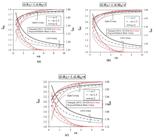
Comparison of interference factors between the Proposed method (black colour lines) and existing literature, i.e., Nainegali (2013) 3D FEM analysis (Red colour) for Case 1, (a) (L/B)L =1, (L/B)R =2 (b) (L/B)L =1, (L/B)R =4 (c) (L/B)L =1, (L/B)R =6.
6. Limitations and future study
The simplified method proposed in this study is based on Terzaghi’s (1943) theory (Equation 1). Terzaghi assumed footings rest on a semi-infinite, perfectly elastic soil medium subjected to vertical loads over a finite area, validating the use of superposition for loads and displacements. Similarly, this study applies the principle of superposition to analyze settlements caused by interference between footings on an elastic, homogeneous, isotropic, and dry granular soil under vertical service loads.
However, the method has limitations. The assumption of perfect elasticity may not reflect real soil behavior, as many soils exhibit plasticity and permanent deformation under load. The semi-infinite model also overlooks variations in soil properties with depth. While superposition is assumed valid, nonlinear soil responses can invalidate it under certain load interactions. Additionally, assuming homogeneity and isotropy may not capture natural variability in soil properties. The model also excludes time-dependent effects like consolidation and creep, which impact long-term settlement.
This study evaluates elastic settlements of two distinct footings placed in close proximity, focusing on interference effects. The settlement of a footing influenced by a nearby footing is compared to that of an isolated footing with similar properties using interference factors, i.e., dimensionless quantities derived under identical soil conditions. As a result, the interference factor remains constant for the given scenario. The study enhances understanding of how interference factors vary when two footings are closely spaced. Although soil property variations may influence the intensity of interference factors, the overall pattern remains consistent under similar conditions.
7. Conclusions
For assessing the interference elastic settlements of two distinct footings found nearby on an elastic soil medium, a quick and easy method has been proposed in the present investigation. The footings are resting on a homogeneous, isotropic, and elastic soil medium. The proposed method has been reviewed in depth by considering the footing size, footing geometry, loading intensity on the footings, and the spacing between the footings. The results are presented in the form of settlement interaction factors. The following are the key findings of the proposed method:
-
For all the cases, despite the symmetrical loads on both the footings, the settlement interference factors of the smaller footing were more pronounced than those of the larger footing. Similarly, the factors of adjacent footing were intensified as the load intensity on the other footings increased (n= 1 to 2). Further, it was observed that the interference factors were higher at a lower spacing and lower at a higher spacing;
-
In Case 1, with lower spacing, the percentage increase in ξδL factor for square footing ranged from 36.5% to 166% as the α increased from 1 to 6. In comparison, the percentage increase in ξδR factor for rectangular footing ranged from 14% to 4.85% as the intensity of loading n varied from 1 to 2;
-
In Case 2, the percentage increase in ξδL and ξδR factors vary from 35% to 70% and 14% to 7%, respectively, at S/B = 0.5 for n values of 1 to 2;
-
In Case 3, for n values ranging from 1 to 2, the percentage increase in ξδL factors for the left footing at lower Δ/BL varies from 19.25% to 38.50% for α = 1, 37.5% to 75% for α = 1.5, and 58.9% to 117.7% for α = 2. For the right footing, the percentage increase in ξδR factors ranges from 19.25% to 9.6% for α = 1, 11% to 5.5% for α = 1.5, and 7.0% to 3.5% for α = 2;
-
In Case 4, for n values ranging from 1 to 2, the percentage increase in ξδL factors for the left footing at lower Δ/BL is between 26.7% and 53.5% for α = 1, 50% and 101% for α = 1.5, and 77.2% and 154.5% for α = 2. For the right footing, the percentage increase in ξδL factors ranges from 26.7% to 13.4% for α = 1, 15.4% to 7.7% for α = 1.5, and 10.1% to 5.1% for α = 2;
-
For all cases, settlement decreases with increasing embedment depth due to the increased soil stiffness. At a particular embedment depth, settlement rises sharply as the intensity of loading increases from n = 1 to 2 due to the increased stress concentration;
-
The present study investigated the settlement interference effect under various conditions. The first and most significant factor was the spacing between the footings, with greater effects observed at lower spacing ratios and diminished effects at higher ratios. The second factor that influenced the outcome was the aspect ratio of the adjacent footing, followed by the intensity of the load applied to the adjacent footing in relation to the other footing;
-
The proposed method provides a practical means for engineers to assess settlement interference between adjacent footings. It is efficient, user-friendly, and suitable for use in densely built environments without the need for specialized equipment or expertise.
List of symbols and abbreviations
c/c Distance between the left and right footings
l1, l2, l3, and l4 Aspect ratios of the rectangular or square region in Figure 2
n Intensity of loading factor
qLand qR Pressure on Left footing and Right footing
B1, B2, B3, and B4 Widths of the rectangular or square region being analysed
BLand LL Width and Length of Left footing
BRand LR Width and Length of Right footing
CL Centre line
E Elastic modulus of the soil
I1 and I2 Influence factors for the considering rectangular portions in Figure 2
Is Steinbrennr’s Influence factor
Nʹ Centre of the square footing (left)
S Clear spacing between the footings
SCR Average settlement of interfering left footing
SiL Average settlement of isolated left footing
SR Average settlement of left square footing due to the interference of right rectangular footing
X1, X2, XL Influence factors for left footing
X3, X4, XR Influence factors for right footing
α Length factor
μ Poisson’s ratio of soil
Settlement interaction factor for the left footing
Settlement interaction factor for the right footing
Elastic settlement at the corner of the footing
Data availability
Some or all data, models, or codes that support the findings of this study are available from the corresponding author upon reasonable request.
-
Discussion open until November 30, 2026.
-
Declaration of use of generative artificial intelligence
This work was prepared without the assistance of generative artificial intelligence (GenAI).
References
-
Berardi, R., & Lancellotta, R. (1991). Stiffness of granular soil from field performance. Geotechnique, 41(1), 149-157. https://doi.org/10.1680/geot.1991.41.1.149
» https://doi.org/10.1680/geot.1991.41.1.149 - Bowles, J.E. (1988). Foundation analysis and design (5th ed.). New York: McGraw Hill.
-
Bowles, J.E. (1987). Elastic foundation settlements on sand deposits. Journal of Geotechnical Engineering, 113(8), 846-860. https://doi.org/10.1061/(ASCE)0733-9410(1987)113:8(846)
» https://doi.org/10.1061/(ASCE)0733-9410(1987)113:8(846) -
Burland, J.B., Burbidge, M.C., & Wilson, E.J. (1985). Settlement of foundations on sand and gravel. Proceedings of the Institution of Civil Engineers, 78(6), 1325-1381. https://doi.org/10.1680/iicep.1985.1058
» https://doi.org/10.1680/iicep.1985.1058 -
Das, B.M., & Larbi-Cherif, S. (1983). Bearing capacity of two closely spaced shallow foundations on Sand. Soil and Foundation, 23(1), 1-7. https://doi.org/10.3208/sandf1972.23.1
» https://doi.org/10.3208/sandf1972.23.1 - Das, B.M., Puri, V.K., & Neo, B.K. (1993). Interference effects between two surface footings on layered soil. Transportation Research Record: Journal of the Transportation Research Board, (1406), 34-40.
- Fox, E.N. (1948). The mean elastic settlement of a uniformly loaded area at a depth below the ground surface. In Proceedings of the 2nd International Conference on Soil Mechanics and Foundation Engineering (Vol. I, pp. 129-132), Rotterdam.
-
Ghosh, P., & Kumar, S.R. (2011). Interference effect of two nearby strip surface footings on cohesionless layered soil. International Journal of Geotechnical Engineering, 5(1), 87-94. https://doi.org/10.3328/IJGE.2011.05.01.87-94
» https://doi.org/10.3328/IJGE.2011.05.01.87-94 -
Ghosh, P., Basudhar, P.K., Srinivasan, V., & Kunal, K. (2014). Experimental studies on interference of two angular footings resting on surface of two-layer cohesionless soil deposit. International Journal of Geotechnical Engineering, 9(4), 422-433. https://doi.org/10.1179/1939787914Y.0000000080
» https://doi.org/10.1179/1939787914Y.0000000080 -
Griffiths, D.V., Fenton, G.A., & Manoharan, N. (2006). Undrained bearing capacity of two-strip footings on spatially random soil. International Journal of Geomechanics, 6(6), 421-442. https://doi.org/10.1061/(ASCE)1532-3641(2006)6:6(421)
» https://doi.org/10.1061/(ASCE)1532-3641(2006)6:6(421) -
Kumar, A., & Saran, S. (2003). Closely spaced footings on geogrid reinforced sand. Journal of Geotechnical and Geoenvironmental Engineering, 129(7), 660-664. https://doi.org/10.1061/(ASCE)1090-0241(2003)129:7(660)
» https://doi.org/10.1061/(ASCE)1090-0241(2003)129:7(660) -
Kumar, J., & Ghosh, P. (2007a). Ultimate bearing capacity of two interfering rough strip footings. International Journal of Geomechanics, 7(1), 53-62. https://doi.org/10.1061/(ASCE)1532-3641(2007)7:1(53)
» https://doi.org/10.1061/(ASCE)1532-3641(2007)7:1(53) -
Kumar, J., & Ghosh, P. (2007b). Upper bound limit analysis for finding interference effect of two nearby strip footings on sand. Geotechnical and Geological Engineering, 25(5), 499-507. https://doi.org/10.1007/s10706-007-9124-9
» https://doi.org/10.1007/s10706-007-9124-9 -
Kumar, J., & Bhoi, M. (2009). Interference of two closely spaced strip footings on sand using model tests. Journal of Geotechnical and Geoenvironmental Engineering, 135(4), 595-604. https://doi.org/10.1061/(ASCE)1090-0241(2009)135:4(595)
» https://doi.org/10.1061/(ASCE)1090-0241(2009)135:4(595) -
Kumar, J., & Bhattacharya, P. (2010). Bearing capacity of interfering multiple strip footings by using lower bound finite elements limit analysis. Computers and Geotechnics, 37(5), 731-736. https://doi.org/10.1016/j.compgeo.2010.05.002
» https://doi.org/10.1016/j.compgeo.2010.05.002 -
Lee, J., & Eun, J. (2009). Estimation of bearing capacity for multiple footings in sand. Computers and Geotechnics, 36(6), 1000-1008. https://doi.org/10.1016/j.compgeo.2009.03.009
» https://doi.org/10.1016/j.compgeo.2009.03.009 -
Lee, J., Eun, J., Prezzi, M., & Salgado, R. (2008). Strain influence diagrams for settlement estimation of both isolated and multiple footings in sand. Journal of Geotechnical and Geoenvironmental Engineering, 134(4), 417-427. https://doi.org/10.1061/(ASCE)1090-0241(2008)134:4(417)
» https://doi.org/10.1061/(ASCE)1090-0241(2008)134:4(417) -
Mabrouki, A., Benmeddour, D., Frank, R., & Mellas, M. (2010). Numerical study of the bearing capacity for two interfering strip footings on sands. Computers and Geotechnics, 37(4), 431-439. https://doi.org/10.1016/j.compgeo.2009.12.007
» https://doi.org/10.1016/j.compgeo.2009.12.007 -
Meyerhof, G.G. (1951). The ultimate bearing capacity of foundations. Geotechnique, 2(4), 301-332. https://doi.org/10.1680/geot.1951.2.4.301
» https://doi.org/10.1680/geot.1951.2.4.301 -
Mittal, R.K., Rawat, S., & Bansal, P. (2019). Multivariable regression model for Fox depth correction factor. Frontiers of Structural and Civil Engineering, 13(1), 103-109. https://doi.org/10.1007/s11709-018-0474-6
» https://doi.org/10.1007/s11709-018-0474-6 - Nainegali, L.S. (2013). Finite element analysis of two symmetric and asymmetric interfering footings resting on linearly and non-linearly elastic soil bed [Doctoral thesis]. IIT Kanpur.
-
Nainegali, L.S., Basudhar, P.K., & Ghosh, P. (2013). Interference of two asymmetric closely spaced strip footings resting on nonhomogeneous and linearly elastic soil bed. International Journal of Geomechanics, 13(6), 840-851. https://doi.org/10.1061/(ASCE)GM.1943-5622.0000290
» https://doi.org/10.1061/(ASCE)GM.1943-5622.0000290 -
Roy, S.S., & Deb, K. (2019). Interference effect of closely spaced footings resting on granular fill over soft clay. International Journal of Geomechanics, 9(1), 1-17. https://doi.org/10.1061/(ASCE)GM.1943-5622.0001324
» https://doi.org/10.1061/(ASCE)GM.1943-5622.0001324 - Saran, S., & Agarwal, V.C. (1974). Interference of surface footings on sand. Indian Geotechnical Journal, 4(2), 129-139.
-
Sarvesh, R., Srinivasan, V., & Patel, A. (2023). Elastic settlements of identical angular footings in close proximity. Geomechanics and Engineering, 32(2), 193-207. https://doi.org/10.12989/gae.2023.32.2.193
» https://doi.org/10.12989/gae.2023.32.2.193 - Schleicher, F. (1926). Zur Theorie des Baurundes. Bauingenieur, 7(48), 931-935.
- Shahein, M., & Hefdhanllah, A. (2013). Effect of neighbouring footing on single footing settlement. In Proceedings of the 7th International Conference on Case Histories in Geotechnical Engineering (pp. 1-9), Chicago. ISSMGE.
-
Srinivasan, V., & Ghosh, P. (2013). Experimental investigation on inter- action problem of two nearby circular footings on layered cohesion- less soil. Geomechanics and Geoengineering, 8(2), 97-106. https://doi.org/10.1080/17486025.2012.695401
» https://doi.org/10.1080/17486025.2012.695401 -
Terzaghi, K. (1943). Theoretical soil mechanics New York: John Wiley & Sons. https://doi.org/10.1002/9780470172766
» https://doi.org/10.1002/9780470172766 -
Vesic, A.S. (1973). Analysis of ultimate loads of shallow foundations. Journal of the Soil Mechanics and Foundations Division, 99(1), 45-73. https://doi.org/10.1061/JSFEAQ.0001846
» https://doi.org/10.1061/JSFEAQ.0001846 - West, J.M., & Stuart, J.G. (1965). Oblique loading resulting from interference between surface footings on sand. In Proceedings of the 6th International Conference on Soil Mechanics and Foundation Engineering (Vol. 2, pp. 214-217), Montreal. University of Toronto Press.
Edited by
-
Editor:
Renato P. Cunha https://orcid.org/0000-0002-2264-9711