
 Studies on the Wear and Corrosion Degradation Resistance of AZ31 Magnesium Alloy through Incremental Addition of Tungsten Carbide Particulates
Abstract
Abstract The understanding of the corrosion mechanisms of magnesium-based alloys is crucial for their utilisation in lightweight engineering, due to their minimal corrosion resistance preventing its widespread application. In this investigation to improve the hardness, corrosive and wear behaviour of a AZ31 by its incorporation of Tungsten Carbide (WC) ceramic reinforcement and wear behaviour with varying levels of reinforcement (2.5, 5.0 and 7.5 wt.%) weight percentage. The alloy and composites were manufactured via liquid metallurgy The microstructure analysis, XRD, hardness, salt spray corrosion analysis varying (2.5 -5.0%) Nacl solutions and dry sliding wear behavior were evaluated using pin-on-disc tests under loads of 10–60 N. The results indicates that fine distribution of reinforcement and free from casting defects through SEM and presence of particles is confirmed with EDS and XRD analysis. The improved hardness up to 78.5% on AZ7.5 as compared to all fabricated samples. The formation of stable Mg (OH)2 as protective layer on AZ5.0 shows a better corrosion resistance in all NaCl conditions. The improved wear resistance on AZ7.5 is attributed to the development of a tribolayer, it improves the resistance to applied load. The SEM micrograph reveals the plastic deformation observed in AZ0 and the mild wear behaviour exhibited by the AZ7.5 composite.
Key-words:
Hard ceramics; SEM; XRD; Squeeze casting; Salt spray corrosion; Wear rate
1. Introduction
Biomaterials are of paramount importance in the overhaul and enhancement of damaged human tissues and organs. In recent years, a diverse array of biomaterials including metals, ceramics, polymers, and composites has been developed and increasingly adopted in medical applications [1]. Metals are primarily selected based on ability to withstand the stress of the components due to their superior strength and fracture toughness. Among these materials, magnesium alloy is the most commonly employed metal biomaterial in various applications [2]. In the human body, mainly adults need approximately 300–400 mg of magnesium per day and also the excess Mg2+ being readily eliminated by urine. The presence of magnesium in bone has been found to increase both growth and strength. Due to their good mechanical and physical properties, Mg alloys are superior to polymers or traditional metallic implants for orthopedic and bone fixation purposes. Unlike many implant materials, their elastic modulus is similar to natural bone. This reduces stress shielding and supports better bone growth and longer implant life [3-5].
AZ31 is widely used in biomedical components because it combines low density, high specific strength, and good castability. The alloy has effectively dissipated mechanical energy, and heat conduction is moderate [6]. This is preferable when considering load-bearing implants, which may be affected by changes in temperature. Although the alloy has superior properties, its long-term usage is still a challenge due to low corrosion resistance. As a result, research has focused mostly on surface treatment. The corrosion properties of AZ91D alloy coated with a micro-arc oxidation (MAO) layer, which was further modified by both graphene oxide and stearic acid, were studied by Wang et al. [7]. This improvement was due to the ceramic-like hardness of the MAO surface and the blocking effect of graphene oxide sheets against electrolyte penetration.
A different strategy was adopted by Krishnan et al. [8], who applied cathodic electrodeposited (CED) epoxy coatings on Mg-9Al-1Zn-xRE alloys containing aluminium powder. A strong and adherent organic barrier was formed by the epoxy coating, which reduced electrolyte ingress. Similar behaviour has been observed in earlier studies on polymer-coated magnesium alloys; with stable coatings under chloride-rich physiological conditions has not yet been fully established. Chloride attack in Mg because protective Mg(OH)2 layer is easily destabilised. As explained by Dhanapal et al. [9], Cl− ions are adsorbed on the surface and gradually convert Mg(OH)2 into soluble MgCl2 during exposure. Pit initiation and growth are thereby accelerated. Although this mechanism is well understood, the actual corrosion rate is strongly influenced by surface condition and alloy composition.
AZ91D composites reinforced with ZnO, MnO, and TiO2 nanoparticles were examined by Gnanavelbabu et al. [10]. After 48 h of immersion, significantly lower corrosion rates were measured for the alloy containing 1 wt.% TiO2 compared with the unreinforced alloy. The improvement was associated with nanoparticles filling surface defects and producing a denser, more stable layer. However, it was not clearly demonstrated whether this beneficial effect persists over longer immersion periods. Similarly, AZ61 composites reinforced with B4C and ZrO2 were studied by Venkatesh et al. [11]. The uniform particle distribution was the primary cause of the reported low corrosion rate of 0.112 mm·yr−1. Although this explanation makes sense, it is challenging to achieve perfect uniformity, and even small particle clustering can affect the behavior of localized corrosion.In their study of AZ91D composites reinforced with Ca2SiO4, Kumaravelu and Kandasamy [12] found a notable decrease in wear rate. Several secondary phases—CaO, SiO, MgO, Mg2Si, and MgAl2O4—acted as hard, stable components throughout the matrix, reducing surface deformation during sliding and offering local load-bearing capacity. They also suggested that these phases could influence the near-surface tribo-oxide layer, although the role of each phase was not fully isolated.
Ahuir-Torres et al. [13] discussed the corrosion study of AZ31- SiC under heat-treated and as-fabricated conditions. The reduce corrosion rate of composite material under heat treated condition due to modification in particle distribution and morphology of phases, stabilising the corrosion film. The SiC particles did not act as a direct barrier but affected how Mg–Al intermetallics evolved during treatment. Jiao et al. [14] investigated AZ31 composites reinforced with nano- and micron-sized Ti via powder metallurgy. Nano-Ti formed a discontinuous mesh that failed to provide an effective corrosion barrier, while micron-sized Ti created more continuous protective regions. The weaker performance of nano-Ti was linked to agglomeration and poor percolation pathways. Thillikkani et al. [15] studied AZ31 reinforced with nano-SiC via stir casting. The 9 wt.% SiC composites showed the highest improvement in mechanical strength and corrosion resistance, driven by grain refinement, load transfer from SiC, and a more stable corrosion layer. Some scatter in corrosion data suggested challenges in achieving uniform particle dispersion.
Kumar et al. [16] analyzed AZ31/SiC-ZrC composites using friction stir welding. It was shown that with increasing amounts of added ZrC, the resulting alloy became less susceptible to heavy adhesive wear, with an oxide layer being promoted on the surface, hence slowing down material loss. However, heavy amounts of added SiC could reduce microhardness. Parkhe Ravindra et al. [17] analyzed AZ31/SiC composite materials prepared using friction stir processing. It was noticed that the added SiC augmentation led to substantial improvement in wear resistance. The wear response was also affected by the distribution of SiC, causing some variability between samples.
Venkatesh et al. [18] examined die-cast AZ31B reinforced with nano-sized ZrO2. They reported that mechanical strength increased with higher ZrO2 content, with 6 wt.% showing the highest strength. The improvement resulted from grain refinement, Orowan strengthening, and restricted dislocation motion, indicating effective interaction between the nanoscale ZrO2 and the AZ31B matrix. Extensive literature reports suggest that hard ceramic particles like SiC, ZrO2, TiB2, B4C, and Al2O3 have mainly been used to reinforce AZ31B to improve its strength and functional properties. The application of tungsten carbide (WC) as a reinforcement in this alloy has not been studied systematically. Specifically, the impact of WC on tribological and corrosive behaviour of AZ31B was not detailed in the factor of passive and tribo layer formation, although potentially very important to high-sought sliding pairs used in biomedical applications.
Magnesium alloys are extensively researched as biodegradable materials, and one of the most common extruded alloys is AZ31, which contains around 3% Al and 1% Zn. It has drawn attention due to its good balance between mechanical strength and biocompatibility for use in prospective applications like bone fixation plates and mini-screw implants. However, the fact that magnesium alloys corrode rapidly in living environments as a key barrier to their use in the clinic [19]. Therefore, to enhance strength of the base material, through addition of strong ceramic particles. Carbide-based ceramics particles offer enhanced strength to increase properties of base material. WC offers exceptional hardness, load-bearing capacity, and microstructural refinement [20].
The role of reinforcement significantly influences the strength of composites, contingent upon the concentration level of the reinforcement. Excess reinforcing may lead to complications, clustering processes, and a rise in porosity levels. Accordingly, the WC particle concentration on the base material is between 2.5 and 7.5 weight percent [21].
The liquid metallurgy technique is implemented to manufactured the AZ31/WC composites. The process parameters were selected to facilitate the production of perfect and durable castings, which are essential for reliable wear, corrosion, and microstructural analyses [22].
2. Testing and Characterization Process
The microstructure in all developed materials is studied using SEM and phase are analysed under XRD to analysis the phases. A micro-Vickers tester examined the value of hardness in all developed alloys and composites. Investigations in corrosion properties included time exposure of 48 hours in addition to salt spray tests conducted with concentrations at 2.5%, 3.5%, and 5.0% from NaCl solutions. While 3.5% NaCl is standard and usually adequate for routine corrosion testing, using 2.5% and 5% NaCl solutions broadens the knowledge of corrosion performance under a larger spectrum of chloride difficulties pertinent to various practical situations, ranging from mild to extreme saline conditions [23]. The study of corroded area was carried out using SEM. Past research has indicated that the sliding speed typically used for testing magnesium-based composites falls within the range of 0.5–2.0 m/s [24]. Surface degradation is accelerated more easily by running at higher speeds and can lead to immense damage to the pin and counter face. Thus, in this study, a velocity of 1.2 m/s as a mid-range and typical condition. The wear test equipment allows for loading between 5 N and 200 N, thus spanning from mild to high wear regimes.
For the current work, 10, 20, 40, and 60 N were selected as the test loads to simulate typical service conditions and sliding distance of 1200 m. In the current experiment, an intermediate-scale distance was employed to ensure that the test specimens have an extended sliding time, allowing the system to reach a steady-state wear regime without unnecessarily expending much testing time.
2.1. Fabrication and characterization process
The AZ31/WC composites are manufactured via stir followed by squeeze casting process. AZ31B ingots were obtained from Exclusive Magnesium Pvt. Ltd. (Hyderabad, India), and WC powder was supplied by Dali Electronics Pvt. Ltd. (Mumbai, India). The SEM image of unreinforced AZ31B as shows in Figure 1(a) a clean surface with no visible casting defects, providing a baseline for later microstructural comparison. The WC particles exhibit an irregular shape Figure 1(b), which can affect melt wetting and interfacial bonding with the Mg matrix. The nominal chemical compositions of AZ31B with varies elements such as Al, Zn, Mn, Si, Cu, Ca, Fe Ni and Mg in the range of (3.5, 1.3,0.20, 0.10, 0.050, 0.30, 0.0050, 0.0050 and balance as respectively in term of wt.% and WC with 95 wt.% of W and 5 wt. % C. Particle-size analysis using a Horiba laser-scattering system shows an average WC particle size of 4.36 µm Figure 1(c). The size distribution is relatively narrow, although slight tailing at larger sizes indicates the presence of a few oversized particles or small clusters.

The composites were made using a squeeze-casting setup commonly used for AZ91D alloys. First, the required amount of AZ91D was placed in a graphite crucible and heated to about 725 °C in an electric resistance furnace. An argon–SF6 gas atmosphere was used to reduce oxidation, although a thin surface film could still form at this temperature. After the alloy fully melted, the temperature was lowered to around 680 °C to obtain a semi-molten slurry suitable for adding particles.
Preheated WC particles were then added using a controlled feeder and during the period stirring carried out at 350 rpm for 5 min to ensure fine mixing and to improves particle wetting and breaks surface oxides. At the same time, the temperature was increased to about 750 °C to improve slurry flow and achieve more uniform particle distribution. After mixing, the slurry was poured into a preheated die and squeeze-cast under a pressure of up to 110 MPa. This pressure reduces shrinkage porosity and helps retain the particles in the solidifying matrix. The cast samples were then heat treated according to the ASTM B661-06 T6 [25] condition, which includes solution treatment, quenching, and ageing to stabilise the Mg–Al phases. The reinforcement contents and corresponding sample labels are given in Table 1.
2.2. Microstructural and XRD analysis
The particle dispersion on alloy and composites was analysed using SEM with EDS. The presence of reinforcement particles and phase analysis are carried out using XRD setup. (Make: Bruker D8 Discover powder diffractometer) where operated at 40 kV and 40 mA (2.2 kW) with Cu Kα radiation (λ = 1.54186 Å). The process scanned at a step size of 0.15°, with a scan rate of 2 steps per second.
2.3. Mechanical strength
To evaluate the effect of WC reinforcement on the base material using Micro-Vickers hardness, using a micro-Vickers hardness tester in accordance with ASTM E384-16 [26]. Indentations were applied at a dead load of 500 g for 15 seconds on the polished surfaces of each sample. Five indentations were made at different locations on each specimen to account for microstructural variability, and the reported hardness corresponds to the average value.
2.4. Corrosion analysis
Corrosion tests were conducted in a salt spray chamber following ASTM B-117 [27]. Specimens were mechanically polished, acetone-degreased, and stabilised in a desiccator for 1 h before exposure. They were then immersed in 2.5, 3.5, and 5.0 wt.% NaCl solutions for 48 h. After testing, weight loss was determined after brief nitric-acid cleaning (~10 s) to remove Mg(OH)2 and loosely adhered products with minimal base-metal dissolution. The cleaned samples were rinsed, dried, reweighed, and the corrosion rate was calculated using the standard mass-loss equation (Equation 1). The corroded surfaces were examined by SEM to observe pit formation and surface degradation.
2.5. Dry sliding wear behaviour
The sliding wear test performed as per ASTM G99 [28], the fabricated test pin ( 8mm diameter and 32 mm length) as slide over EN24 steel disc as a the counterface (110 mm diameter and 10 mm thickness). The test conditions are 1200 m as sliding distance, 1.2 m/s as velocity and 10, 20, 40, and 60 N are applied load. The findings of wear studies were derived from measurements of weight loss. The wear rate was calculated as the volume loss to sliding distance ratio (mm3/m). Volume loss was calculated from the height loss during sliding with known diameter of pin. For the purpose of precision, each composite's density was approximated using the rule of mixtures on the basis of WC reinforcement weight fraction and the AZ31 alloy matrix density [29]. This method considers the variation in density that results from inclusion of high-density WC particles and also an addition of WC increases the density of composites. Each experimental condition was tested in four trials, and results are reported with the corresponding average within 5% to clearly identify trends. The wear mechanism is studied via worn surface and wear debris were analysed using SEM.
3. Results and Discussions
3.1. Microstructural analysis
The microstructure of the AZ0 indicate an α and β phase, in the grain boundaries as shown in Figure 2(a). The most significant effect due to pressure on microstructural refinement arises from enhanced heat transfer between the molten material and the mould surface due to enhanced heat transfer coefficient across the interface [30,31].

The microstructure analysis of the AZ2.5, AZ5.0 and AZ7.5 as shown in Figure 2(bd) respectively; it reveals the distinct features of the grain boundaries. The AZ2.5 and AZ5.0 composition indicates effective grain fine transformation, as lead to uniform distribution of particles in and around the boundaries, thereby confirming Zener pinning effect [32].
The two main properties that significantly enhance the strength of composites are (a) effective grain refinement at rapid liquid to solid state transformation and (b) the formation of a strong bonding among particles and base material [33]. Conversely, at an elevated reinforcement level (AZ7.5), the particles exhibit a tendency to aggregate as respected in Figure 2(d). The EDS analysis indicates the presence of major elements observed as Mg, Al, W, C, Zn in the prepared composite.
3.2. Phase analysis
Figure 3(ad) indicates the phase analysis via XRD of AZ31 and AZ31/WC composites. The distinct observations corresponding to the α-Mg phase (JCPDS 04-012-3405), specifically indexed to the (100), (002), (101), and (110) planes, indicating the presence of the (hcp) Mg matrix. Furthermore, peaks corresponding to the β-Mg17Al12 phase (JCPDS 04-010-7477) indicates a intermetallic precipitates. There are also minor diffraction corresponding to MgZn, Mg2Al3, and Al4Mn3 phases, that result from the alloying elements in base material [34].

3.3. Micro vickers hardness
Table 2 indicates the hardness of fabricated samples as showing a clear increase with higher WC content. The hardness rise is attributed to two factors: WC particles act as nucleation sites, refining grains and reducing slip length, and they hinder grain-boundary movement and dislocation motion where well bonded to the Mg matrix. These effects together increase hardness compared to the unreinforced alloy. Minor variations in measurements likely reflect local differences in particle distribution or microstructure.
3.4. Salt spray corrosion analysis
Figure 4 respects corrosion rate on AZ0 and AZ/WC composites at different Nacl concentration level. AZ31 alloy showed a moderate rate of corrosion in 2.5% NaCl solution, mainly because of continuous β-Mg17Al12 precipitates along the grain boundaries, which are galvanic couples and enhance localized dissolution of the α-Mg matrix. After 24 h in 5.0% NaCl solution, the corrosion rate increased, owing to degradation of the grain boundary integrity and the deposit of corrosion products due to the action of the increased chloride ion concentration [35]. AZ0 exhibits coarse α-Mg grains, with β-Mg17Al12 precipitates serving as cathodic sites, which consequently accelerates micro-galvanic corrosion.
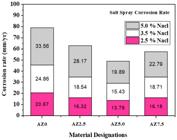
Earlier investigations consistently indicate that grain refinement and a finely distributed β-Mg17Al12 phase reduce restricted micro-galvanic coupling in Mg–Al alloys, thus improving corrosion resistance. In contrast, coarse grains and discontinuous β-phase networks facilitate initial corrosion and propagation [36]. As the basic reference from SEM analysis indicated in Figures 2(ad) shows that the microstructure becomes more uniform, compact and the grains get smaller as the amount of reinforcement increases. Similarly, as indicates in Figure 3 as the formation of β phase.
The corrosion behaviour of AZ31–WC composites is significantly impacted by microstructural evolution, particularly grain refinement, reinforcement distribution, and the crystalline structure. As reported in the literature [37], AZ0 exhibits coarse α-Mg grains, with β-Mg17Al12 precipitates serving as cathodic sites, which consequently accelerates micro-galvanic corrosion.
The incorporation of WC, reaching up to AZ5.0, promotes heterogeneous nucleation and grain refining. This process yields a more uniform distribution phases and reduces corrosion rate of composite due to lower galvanic interaction [38]. The AZ7.5 composite shows slightly higher corrosion rate as compared to AZ5.0 due to clustering of particles as indicated in Figure 4(d). This leads to interfacial discontinuities and improved the cathodic region as results to pit initiation and localized corrosion [39].
3.5. SEM analysis on corroded surface
SEM examination on 5% NaCl environment was selected from the investigated conditions. This concentration was chosen because it produced a suitable level of corrosion, allowing for clear observation of corrosion characteristics without severe surface damage. This was experienced rather than the case with the less aggressive 2.5% NaCl solution or the more aggressive 7.5% NaCl solution [40]. Hence, a medium-level 5% NaCl environment was selected as the basis for conducting the corrosion study.
The corroded surface analysis of samples after exposure to 5.0% NaCl at 48 h are indicated in Figure 5(ad). AZ31 alloy Figure 5a exhibits a larger pits and cracks on the surface, indicating severe localized corrosion.

This behavior is typical of Mg alloys in chloride environments, where Cl− ions destabilize the Mg (OH)2 surface film and promote pit initiation and propagation [41,42].
The incorporation of WC particles (Figure 5bc) demonstrably minimises corrosion loss. The improved corrosion resistance is mainly due to the chemical stability of WC and its inert behaviour in chloride-rich environments. When WC particles are uniformly dispersed in the Mg matrix, they act as physical barriers. Electrolyte pathways are blocked, and localised corrosion is suppressed. As a result, fewer pits form and surface cracking is reduced. This trend agrees with earlier reports by Ahuir-Torres et al. [43] on WC-reinforced Mg alloys. In simple terms, evenly distributed WC particles break the continuity of anodic regions and slow down pit growth.
However, this benefit does not increase continuously with WC content. At higher WC additions (Figure 5d), particle agglomeration was observed. These clusters create microstructural non-uniformity and may introduce weak interfacial zones. In such regions, galvanic effects can become stronger or less stable, which can reduce corrosion resistance. Although the severity varies among samples, the results indicate a clear threshold beyond which additional WC becomes detrimental rather than beneficial. These agglomerated regions act as preferential sites for galvanic corrosion between the WC particles and base material, thereby accelerating localized pit formation. Consequently, the corrosion resistance deteriorates at higher reinforcement levels despite the presence of WC. This behavior is consistent with earlier studies on Mg-based composites, where excessive reinforcement promotes galvanic corrosion due to particle clustering.
3.6. Wear behaviour and sub surface analysis
Figure 6 illustrates the wear rate of the alloy and composites under varying applied loads. It is noted that, irrespective of the stress that is applied, the wear rate of the composite decreases as the weight fraction of the WC particles increases. This signifies that the wear resistance of the composite is directly related to the weight percentage of the reinforcement.
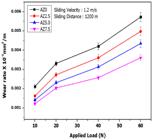
It is observed that there is a distinguishable trend of stabilizing tendency for composites with high WC content (AZ5.0 and AZ7.5) in the load spectrum of 40–60 N, such that the slope of the wear rate vs. load rate curve is less steep compared to AZ0 and AZ2.5. This indicates that the reinforcement provides better ability to counteract further increase in wear rate at greater loads. This flattening suggests that the load-bearing capacity improves with an increased composition of reinforcement. Magnesium composites reinforced by WC demonstrate resistance to oxidation on the surface at ambient temperature. A thin oxide film forms easily under sliding conditions at moderate stresses. The film inhibits metal-to-metal contact directly and together with load support by the WC particles is responsible for decreased wear rates experienced by composites. In low load condition (20 N) the worn surface exhibit smooth surface smooth oxide layer of AZ5.0 composite and it’s no longer for continuous sliding due to lower concertation of WC particles as shown in Figure 7(a). Figure 7(b) shows a fractured surface as third body abrasion due to fractures in the oxide layer and the subsequent detachment of oxide particles from the surface at the applied load of 60 N.

SEM analysis on worn out surface (a) 20 N, (b) 60 N for AZ5.0 Composite SEM analysis on subsurface @ applied load 40 N (c) AZ0, (d) AZ7.5.
Figure 7 (c) indicates the sub-surface analysis of AZ0 at applied load of 40N, it’s revealing that the subsurface area beneath the worn surface exhibits crack initiation and development, an indication of plastic deformation [44]. Figure 7(d) cross-sectional micrographs reveal the development of a tribolayer approximately 24 µm thick beneath the worn surface. The incorporation of approximately 7.5 wt.% tungsten carbide particles promotes the development of this protective tribolayer, thereby minimising direct matrix deformation and resulting in a significantly reduced wear rate. The existence of a tribofilm enriched with tungsten oxide, which is a far stronger tribo film enhances the wear resistance seen in the composites [45,46].
3.7. Wear debris analysis
Figure 8 shows SEM images of wear debris collected during dry sliding wear tests at a load of 40 N. In the AZ0 alloy, large flaky debris larger than 100 µm was observed. This indicates severe adhesive wear and material transfer from the soft magnesium matrix to the steel counterface. Similar behaviour has been reported earlier for magnesium alloys tested under high contact loads [47,48].

In contrast For the AZ2.5 composite, the debris appeared coarse, flaky, and agglomerated. This morphology suggests a shift toward a delamination-dominated wear mechanism [49]. In contrast, the AZ5.0 composite produced plate-like and compacted debris. Fine fragments were seen attached to larger flakes, indicating the combined action of adhesive wear and delamination, along with repeated crushing and re-compaction during sliding [50]. However, In the AZ7.5 composite, much finer and fragmented debris was formed. This behaviour is linked to the presence of hard WC particles, which restrict plastic deformation. As a result, a mild abrasive–oxidative wear regime is indicated, together with the formation of a relatively stable tribolayer [49].
4. Conclusions
A stir-squeeze casting method were used to manufacture AZ31B/WC magnesium composites successfully. A detailed examination conducted for the hardness, microstructure, corrosion resistance, and wear performance. The major results from these investigations are given below.
-
The absence of defects in casting of both the alloy and composites were confirmed by SEM analysis. At AZ2.5 and AZ5.0 uniform distribution of WC particles was attained. But, slight agglomeration occurred in AZ7.5, which is attributed to reduced wettability at higher reinforcement levels and enhanced particle–particle interactions.
-
Existence of WC and Mg17Al12 intermetallic phase within the base material is confirmed by XRD analysis. Variations in peak intensity and slight shifts in peak position with increasing WC content indicate modifications in phase distribution and minor agglomeration effects.
-
The micro-Vickers hardness of the composites increases with WC content, with the AZ7.5 sample indicating a 78.57% improvement against AZ0. This leads to enhanced load-bearing capacity, which is attributed to robust interfacial bonding between WC and the matrix.
-
AZ5.0 composite exhibits superior corrosion resistance, with reduced corrosion rates of 33.3%, 37.93%, and 40.73% in 2.5%, 5.0%, and 7.5% NaCl solutions, respectively. It’s due to uniform WC dispersion, grains refinement and rigid formation of magnesium hydroxide protective medium. SEM observations at 5% NaCl reveal that AZ0, AZ2.5, and AZ7.5 samples exhibit significant pits and surface ruptures with WC agglomeration at AZ7.5, leading to localised corrosion, but at AZ5.0, a smooth surface with minimal pitting.
-
The improved wear rate on AZ7.5 composite as compare to base material and other composites under dry sliding conditions, owing to the development of a protective medium that reduces material removal. SEM analysis of wear debris shows that AZ0 exhibits predominant plastic deformation, whereas the AZ7.5 composite indicates the presence of a protective tribolayer at the subsurface, which improves wear performance however, it shows slightly reduced corrosion resistance.
Statements and declarations
All data supporting the findings of this study are contained within the manuscript.
How to cite:
References
-
1 Chen Q, Thouas GA. Metallic implant biomaterials. Materials Science and Engineering R Reports. 2015;87:1-57. https://doi.org/10.1016/j.mser.2014.10.001
» https://doi.org/10.1016/j.mser.2014.10.001 -
2 Khorasani AM, Gibson I, Goldberg M, Nomani J, Littlefair G. Machinability of metallic and ceramic biomaterials: a review. Science of Advanced Materials. 2016;8(8):1491-1511. https://doi.org/10.1166/sam.2016.2783
» https://doi.org/10.1166/sam.2016.2783 -
3 Vormann J. Magnesium: nutrition and metabolism. Molecular Aspects of Medicine. 2003;24(1-3):27-37. https://doi.org/10.1016/S0098-2997(02)00089-4 PMid:12537987.
» https://doi.org/10.1016/S0098-2997(02)00089-4 -
4 Zreiqat H, Howlett CR, Zannettiono A, Evans P, Schulze-Tanzil G, Knabe C, et al. Mechanisms of magnesium-stimulated adhesion of osteoblastic cells to commonly used orthopaedic implants. Journal of Biomedical Materials Research. 2002;62(2):175-184. https://doi.org/10.1002/jbm.10270 PMid:12209937.
» https://doi.org/10.1002/jbm.10270 - 5 Ajay CV, Manisekar K, Mohammed KT. In vitro degradation and dry sliding wear behaviour of AZ31-Sn/Al2O3 nano metal matrix composites in simulated body fluid for biomedical application. Journal of Materials. 2024;238(1):148-159.
- 6 Mohan M, Radhakrishnan M, Krishnamurthy T, Thirugnanasambandam A. Experimental investigations and process optimisation of the submerged waterjet peening process on AZ31B Mg alloy for biomedical applications. Journal of Materials. 2025;0(0):14644207251396320.
-
7 Wang D, Ma C, Liu J, Li W, Shang W, Peng N, et al. Corrosion resistance and anti-soiling performance of micro-arc oxidation/graphene oxide/stearic acid superhydrophobic composite coating on magnesium alloys. International Journal of Minerals Metallurgy and Materials. 2023;30(6):1128-1139. https://doi.org/10.1007/s12613-023-2596-7
» https://doi.org/10.1007/s12613-023-2596-7 -
8 Krishnan R, Manivannan S, Patel PB, Patil PP, Venkatesh R, Thanappan S. Studies on corrosion behavior of Mg‐Al‐Zn‐RE cast alloy with powder‐coated Al and CED Mg by salt spray test, immersion test, and electrochemical test. International Journal of Chemical Engineering. 2022;2022(1):1891419. https://doi.org/10.1155/2022/1891419
» https://doi.org/10.1155/2022/1891419 -
9 Dhanapal A, Boopathy SR, Balasubramanian V, Chidambaram K, Zaman AT. Experimental investigation of the corrosion behavior of friction stir welded AZ61A magnesium alloy welds under salt spray corrosion test and galvanic corrosion test using response surface methodology. International Journal of Metals. 2013;2013(1):317143. https://doi.org/10.1155/2013/317143
» https://doi.org/10.1155/2013/317143 - 10 Gnanavelbabu A, Vinothkumar E, Prahadeeswaran M. Investigation on corrosion behaviour of metal oxide nanoparticles reinforced magnesium composites by salt spray and immersion corrosion test methods. Advances in Materials and Processing Technologies. 2024;11(4):1958-1982.
-
11 Venkatesh R, Kannan CR, Manivannan S, Vivekanandan M, Krishna JP, Mezni A, et al. Synthesis and experimental investigations of tribological and corrosion performance of AZ61 magnesium alloy hybrid composites. Journal of Nanomaterials. 2022;2022(1):6012518. https://doi.org/10.1155/2022/6012518
» https://doi.org/10.1155/2022/6012518 -
12 Kumaravelu P, Kandasamy J. Effect of load and sliding velocity on wear behaviour of magnesium AZ91D composites reinforced with Ca2SiO4 at ambient temperature. Tribology International. 2024;192:109314. https://doi.org/10.1016/j.triboint.2024.109314
» https://doi.org/10.1016/j.triboint.2024.109314 -
13 Ahuir-Torres JI, Yang X, West G, Kotadia HR. Corrosion behaviour of SiC particulate reinforced AZ31 magnesium matrix composite in 3.5% NaCl with and without heat treatment. Materials Chemistry and Physics. 2024;320:129467. https://doi.org/10.1016/j.matchemphys.2024.129467
» https://doi.org/10.1016/j.matchemphys.2024.129467 -
14 Jiao J, Zhang J, Lian Y, Han S, Zheng K, Pan F. Influence of micro/nano-Ti particles on the corrosion behavior of AZ31-Ti composites. Acta Metallurgica Sinica. 2024;37(3):484-498. https://doi.org/10.1007/s40195-023-01616-6
» https://doi.org/10.1007/s40195-023-01616-6 - 15 Thillikkani S, Kumar NM, King MFL, Soundararajan R, Kannan S. Stir Casting Synthesis and Evaluation of SiC Nanoparticle-Reinforced AZ31 Magnesium Alloy Nanocomposites (No. 2025-01-5013). Warrendale: SAE Technical Paper; 2025.
-
16 Kumar TS, Thankachan T, Shalini S, Čep R, Kalita K. Microstructure, hardness and wear behavior of ZrC particle reinforced AZ31 surface composites synthesized via friction stir processing. Scientific Reports. 2023;13(1):20089. https://doi.org/10.1038/s41598-023-47381-5 PMid:37974019.
» https://doi.org/10.1038/s41598-023-47381-5 -
17 Ravindra P, Kanif M, Kishan F, Vishvesh B. Wear behavior of SiC-Reinforced AZ31B magnesium alloy surface composites fabricated by friction stir processing. Journal of Alloys and Metallurgical Systems. 2025;11:100207. https://doi.org/10.1016/j.jalmes.2025.100207
» https://doi.org/10.1016/j.jalmes.2025.100207 -
18 Venkatesh R, Vignesh Kumar M, Kantharaj I, David R, De Poures MV, Hossain I, et al. Improvement of mechanical performance on zirconium dioxide nanoparticle synthesized magnesium alloy nano composite. Heliyon. 2024;10(9):e29892. https://doi.org/10.1016/j.heliyon.2024.e29892 PMid:38694042.
» https://doi.org/10.1016/j.heliyon.2024.e29892 -
19 Khalili V, Ghaleh H, Asl HN, Ege D, Dikici B, Kaseem M, et al. Assessing the properties of biodegradable magnesium alloy AZ31 protected by a polymer layer on a plasma electrolytic oxidized (PEO) surface. Surface and Coatings Technology. 2024;487:131002. https://doi.org/10.1016/j.surfcoat.2024.131002
» https://doi.org/10.1016/j.surfcoat.2024.131002 -
20 Banerjee S, Poria S, Sutradhar G, Sahoo P. Corrosion behavior of AZ31-WC nano-composites. Journal of Magnesium and Alloys. 2019;7(4):681-695. https://doi.org/10.1016/j.jma.2019.07.004
» https://doi.org/10.1016/j.jma.2019.07.004 -
21 Ahmadian H, Zhou T, Alansari A, Kumar AS, Fathy A, Elmahdy M, et al. Microstructure, mechanical properties and wear behavior of Mg matrix composites reinforced with Ti and nano SiC particles. Journal of Materials Research and Technology. 2024;31:4088-4103. https://doi.org/10.1016/j.jmrt.2024.07.125
» https://doi.org/10.1016/j.jmrt.2024.07.125 -
22 Ayyanar S, Gnanavelbabu A, Rajkumar K, Loganathan P, Vishal K. Investigation on microstructure and tribological performance of zirconium boride reinforced AZ91D magnesium alloy: effect of processing routes. Proceedings of the Institution of Mechanical Engineers. Part C, Journal of Mechanical Engineering Science. 2023;237(3):692-707. https://doi.org/10.1177/09544062221125058
» https://doi.org/10.1177/09544062221125058 -
23 Esmaily M, Svensson JE, Fajardo S, Birbilis N, Frankel GS, Virtanen S, et al. Fundamentals and advances in magnesium alloy corrosion. Progress in Materials Science. 2017;89:92-193. https://doi.org/10.1016/j.pmatsci.2017.04.011
» https://doi.org/10.1016/j.pmatsci.2017.04.011 -
24 Shen M, Zhu X, Han B, Ying T, Jia J. Dry sliding wear behaviour of AZ31 magnesium alloy strengthened by nanoscale SiCp. Journal of Materials Research and Technology. 2022;16:814-823. https://doi.org/10.1016/j.jmrt.2021.12.048
» https://doi.org/10.1016/j.jmrt.2021.12.048 - 25 American Society for Testing and Materials. ASTM B661/B661M-06: standard practice for heat treatment of magnesium alloys. West Conshohocken: ASTM International; 2006.
- 26 American Society for Testing and Materials. ASTM E384-16: standard test method for microindentation hardness of materials. West Conshohocken: ASTM International; 2016.
- 27 American Society for Testing and Materials. ASTM B117-19: standard practice for operating salt spray (fog) apparatus. West Conshohocken: ASTM International; 2019.
- 28 American Society for Testing and Materials. ASTM G99-17: standard test method for wear testing with a pin-on-disk apparatus. West Conshohocken: ASTM International; 2017.
-
29 Selvam B, Marimuthu P, Narayanasamy R, Anandakrishnan V, Tun KS, Gupta M, et al. Dry sliding wear behaviour of zinc oxide reinforced magnesium matrix nano-composites. Materials & Design. 2014;58:475-481. https://doi.org/10.1016/j.matdes.2014.02.006
» https://doi.org/10.1016/j.matdes.2014.02.006 -
30 Wu G, Fan Y, Gao H, Zhai C, Zhu YP. The effect of Ca and rare earth elements on the microstructure, mechanical properties and corrosion behavior of AZ91D. Materials Science and Engineering A. 2005;408(1-2):255-263. https://doi.org/10.1016/j.msea.2005.08.011
» https://doi.org/10.1016/j.msea.2005.08.011 -
31 Zhao Q, Wu Y, Rong W, Wang K, Yuan L, Heng X, et al. Effect of applied pressure on microstructures of squeeze cast Mg–15Gd–1Zn–0.4 Zr alloy. Journal of Magnesium and Alloys. 2018;6(2):197-204. https://doi.org/10.1016/j.jma.2018.04.001
» https://doi.org/10.1016/j.jma.2018.04.001 -
32 Rajendran C, Saiyathibrahim A. Influence of B4C and ZrB2 reinforcements on microstructural, mechanical and wear behaviour of AA 2014 aluminium matrix hybrid composites. Defence Technology. 2024;40:242-254. https://doi.org/10.1016/j.dt.2024.05.009
» https://doi.org/10.1016/j.dt.2024.05.009 -
33 Banerjee S, Poria S, Sutradhar G, Sahoo P. Dry sliding tribological behavior of AZ31-WC nano-composites. Journal of Magnesium and Alloys. 2019;7(2):315-327. https://doi.org/10.1016/j.jma.2018.11.005
» https://doi.org/10.1016/j.jma.2018.11.005 -
34 Wu S, Wang S, Wen D, Wang G, Wang Y. Microstructure and mechanical properties of magnesium matrix composites interpenetrated by different reinforcement. Applied Sciences. 2018;8(11):2012. https://doi.org/10.3390/app8112012
» https://doi.org/10.3390/app8112012 -
35 Liu W, Cao F, Chen A, Chang L, Zhang J, Cao C. Effect of chloride ion concentration on electrochemical behavior and corrosion product of AM60 magnesium alloy in aqueous solutions. Corrosion. 2012;68(4):045001-1. https://doi.org/10.5006/0010-9312-68-4-2
» https://doi.org/10.5006/0010-9312-68-4-2 -
36 Cao F, Song GL, Atrens A. Corrosion and passivation of magnesium alloys. Corrosion Science. 2016;111:835-845. https://doi.org/10.1016/j.corsci.2016.05.041
» https://doi.org/10.1016/j.corsci.2016.05.041 -
37 Song G, Atrens A. Understanding magnesium corrosion: a framework for improved alloy performance. Advanced Engineering Materials. 2003;5(12):837-858. https://doi.org/10.1002/adem.200310405
» https://doi.org/10.1002/adem.200310405 -
38 Li L, Zhang M, Li Y, Zhao J, Qin L, Lai Y. Corrosion and biocompatibility improvement of magnesium-based alloys as bone implant materials: a review. Regenerative Biomaterials. 2017;4(2):129-137. https://doi.org/10.1093/rb/rbx004
» https://doi.org/10.1093/rb/rbx004 -
39 Aung NN, Zhou W. Effect of grain size and twins on corrosion behaviour of AZ31B magnesium alloy. Corrosion Science. 2010;52(2):589-594. https://doi.org/10.1016/j.corsci.2009.10.018
» https://doi.org/10.1016/j.corsci.2009.10.018 -
40 Altun H, Sen S. Studies on the influence of chloride ion concentration and pH on the corrosion and electrochemical behaviour of AZ63 magnesium alloy. Materials & Design. 2004;25(7):637-643. https://doi.org/10.1016/j.matdes.2004.02.002
» https://doi.org/10.1016/j.matdes.2004.02.002 -
41 Sekar P, Panigrahi SK. Understanding the corrosion and bio-corrosion behaviour of Magnesium composites–a critical review. Journal of Magnesium and Alloys. 2024;12(3):890-939. https://doi.org/10.1016/j.jma.2024.02.014
» https://doi.org/10.1016/j.jma.2024.02.014 -
42 Ghio E, Cerri E. Corrosion behaviour of high-pressure die-cast AZ91 alloy in nacl solution: effects of friction stir process at high rotational speed. Materials. 2023;16(20):6620. https://doi.org/10.3390/ma16206620 PMid:37895602.
» https://doi.org/10.3390/ma16206620 -
43 Ahuir-Torres JI, Yang X, West G, Kotadia HR. Corrosion behaviour of SiC particulate reinforced AZ31 magnesium matrix composite in 3.5% NaCl with and without heat treatment. Materials Chemistry and Physics. 2024;320:129467. https://doi.org/10.1016/j.matchemphys.2024.129467
» https://doi.org/10.1016/j.matchemphys.2024.129467 -
44 Shen M, Zhu X, Han B, Ying T, Jia J. Dry sliding wear behaviour of AZ31 magnesium alloy strengthened by nanoscale SiCp. Journal of Materials Research and Technology. 2022;16:814-823. https://doi.org/10.1016/j.jmrt.2021.12.048
» https://doi.org/10.1016/j.jmrt.2021.12.048 -
45 Nasab AM, Ghasemi A, Alipour M. Evaluation of mechanical and microstructural of AlA380 based nanocomposite rein-forced with Tungsten Disulfide nanoparticles. Materials Research Express. 2019;6(8):0850g3. https://doi.org/10.1088/2053-1591/ab27d2
» https://doi.org/10.1088/2053-1591/ab27d2 -
46 Loganathan P, Rajkumar K, Gnanavelbabu A, Vishal K. Aluminium silicate concentration and coordination effect with tungsten sulphide improving dry sliding wear characteristics of AA7075 alloy composites. Silicon. 2022;14(18):12615-12631. https://doi.org/10.1007/s12633-022-01972-5
» https://doi.org/10.1007/s12633-022-01972-5 -
47 Lim SC, Ashby MF. Overview no. 55 wear-mechanism maps. Acta Metallurgica. 1987;35(1):1-24. https://doi.org/10.1016/0001-6160(87)90209-4
» https://doi.org/10.1016/0001-6160(87)90209-4 -
48 An J, Li RG, Lu Y, Chen CM, Xu YC, Chen X, et al. Dry sliding wear behavior of magnesium alloys. Wear. 2008;265(1-2):97-104. https://doi.org/10.1016/j.wear.2007.08.021
» https://doi.org/10.1016/j.wear.2007.08.021 -
49 Aydın F. Tribological aspects of magnesium matrix composites: a review of recent experimental studies. Tribology – Materials, Surfaces and Interfaces. 2023;17(4):363-396. https://doi.org/10.1080/17515831.2023.2246809
» https://doi.org/10.1080/17515831.2023.2246809 - 50 Hutchings I, Shipway P. Tribology: friction and wear of engineering materials. Oxford: Butterworth-Heinemann; 2017.
Editor:
Correspondence
E-mail: logu2685@gmail.com (PL)


