 Branching formation of apple trees grown under contrasting growing conditions in a mild winter region
ABSTRACT
The expansion of apple cultivation into subtropical climates has necessitated effective strategies to ensure high and consistent productivity. Adapting apple trees to mild winter regions involves challenges in lateral sprouting, which is partly related to the accumulation of chill. This study aimed to investigate the budding patterns of different apple tree cultivars in two sites with contrasting environmental cultivation. The study was conducted in two orchards in a mild winter region of Brazil: Horizonte orchard (ideal cultivation environment) and Lovo orchard (marginal cultivation environment). The selected apple cultivars included ‘Eva’, ‘Fuji Suprema’, and ‘Galaxy’. The experimental design involved marking five one-year-old shoots on five plants at each site and cultivar during the winter for two consecutive years. At the onset of the subsequent autumn, the marked branches were collected to assess the development of lateral shoots. In addition, the total number of spurs and shoots was counted in each orchard. The ‘Gala’ cultivar exhibited consistent spurs per plant across both sites. However, the ‘Fuji’ cultivar demonstrated a substantial increase in total spurs per plant in the low chill environment, with no discernible change in the development of lateral spurs, suggesting a high bourse-over-bourse formation. In orchards with higher chill accumulation, both cultivars necessitated high pruning due to excessive long shoots, underscoring the importance of adapted training systems and cultural practices to each growing region. Further research must enhance our understanding of plant architecture in mild winter regions.
Keywords:
acrotony; budburst pattern; dormancy; mild winter region; tree architecture
Introduction
The apple tree (Malus × domestica Borkh.) is one of the most cultivated temperate fruit species worldwide, with a continuous encroachment into marginal regions, such as subtropical and tropical climates. Several studies have focused on the adaptation of this species to subtropical climates, particularly concerning genetic or breeding programs (Hauagge and Tsuneta, 1999; Hauagge and Cummins, 1991a, b, c; Hauagge, 2010), dormancy physiology and budburst (Petri and Leite, 2004; Schmitz et al., 2015; Malagi et al., 2015), as well as orchard management (George et al., 2002; Hawerroth et al., 2009). Achieving high and regular productivity is contingent upon the balanced formation of floral and vegetative structures. Notably, recent studies have documented significant alterations in branch sprouting patterns in subtropical regions (Schmitz et al., 2015; Pertille et al., 2021). These alterations have been linked to factors such as superficial dormancy, short ecodormancy, acrotonic branching, and the inhibition of laterals shoots (Schmitz et al., 2015; Malagi et al., 2015; Pertille et al., 2021). Consequently, the productivity of apple cultivation in these regions is contingent upon the utilization of dormancy-breaking (e.g., hydrogen cyanamide) and vigor control (e.g., prohexadione-calcium) products. Furthermore, the fruiting habits and architectures exhibited by each cultivar vary significantly. For instance, the ‘Gala’ and ‘Fuji’ cultivars exhibit divergent fruiting habits and architectures, as classified by the Lespinasse's typology (Lespinasse, 1977; Lespinasse and Delort, 1986). The ‘Gala’ cultivar is classified as type III, exhibiting a balanced fruiting habit between spurs and terminal buds of bearing shoots. In contrast, the ‘Fuji’ cultivar is classified as type IV, exhibiting a predominant fruiting habit in the terminal buds of bearing shoots (Lespinasse, 1977; Lespinasse and Delort, 1986). Notably, no established Lespinasse typology for the ‘Eva’ cultivar exists. Consequently, effective plant management, training, rootstock selection, and other practical cultivation practices must be adapted to each cultivar type to ensure optimal outcomes.
Many strategies have been developed to assist in achieving a balance between vegetative and reproductive structures. These include the utilization of dwarfing rootstocks (Gjamovski and Kiprijanovski, 2011), the application of growth regulators (Leite et al., 2010; Hawerroth et al., 2012), pruning (Cronjé et al., 2004; Stephan et al., 2007), branch bending (Lauri and Lespinasse, 2001; Han et al., 2007; Zhang et al., 2017), artificial extinction of buds (Lauri et al., 1997; Lauri et al., 2004; Tustin et al., 2011; Breen et al., 2016), and the cultivation of adapted cultivars with genetic improvement (Hauagge and Cummins, 1991a). While these practices are adopted to improve the vegetative-productive balance of the plants, the costs of labor and the chemical products directly affect the profitability of the producer and, in most cases, may not present satisfactory results for the regular production of fruits. A comprehensive understanding of the processes underlying the formation of vegetative and productive structures in apple trees in mild winter regions is imperative to facilitate the development of management practices that mitigate the annual reliance on chemical products and techniques such as excessive pruning and annual arching of branches. The present study aimed to investigate the budding patterns and branch architecture of three distinct apple tree cultivars in two contrasting cultivation environments.
Materials and Methods
Study sites and apple cultivars
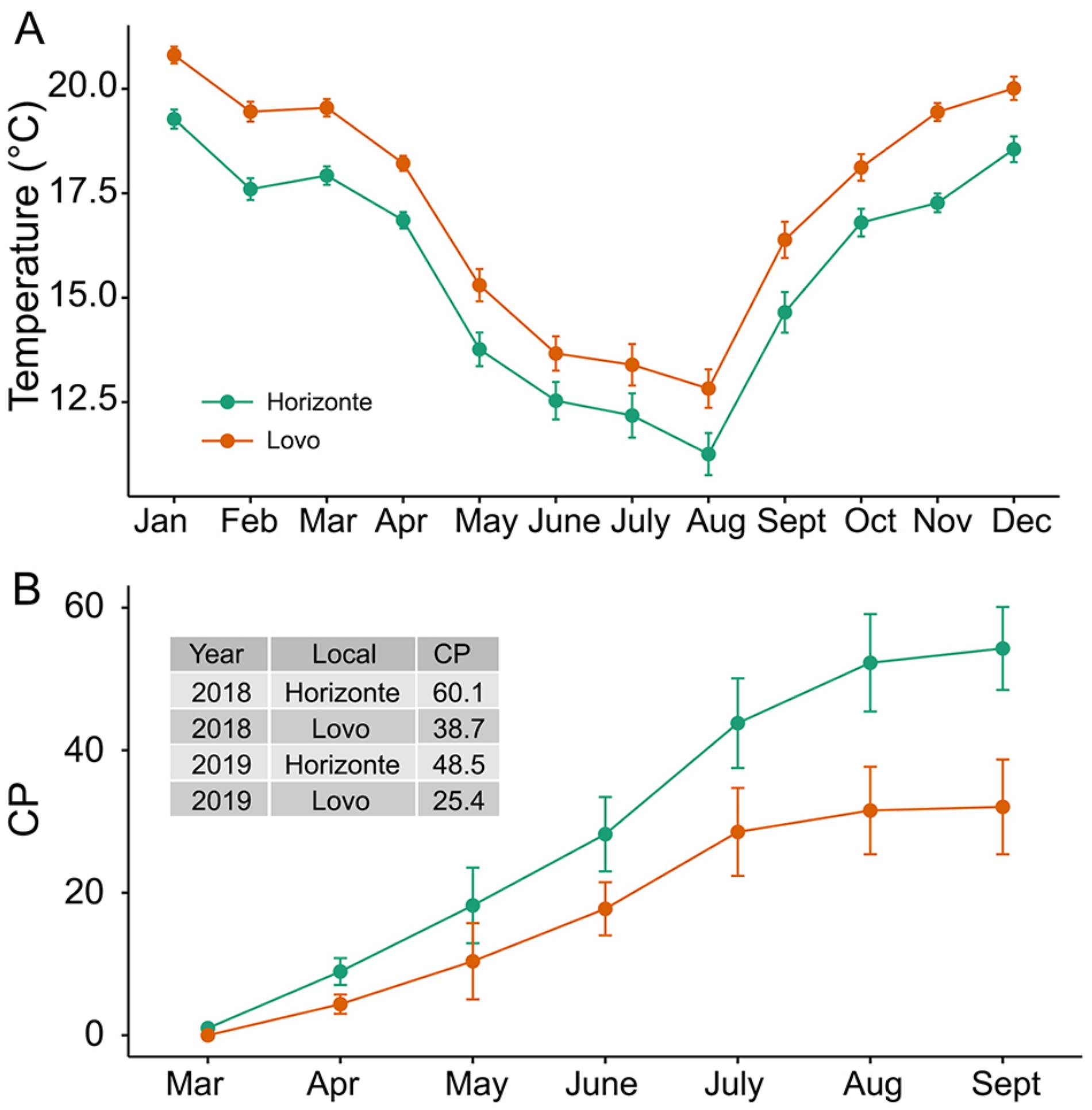
The study was conducted in two commercial orchards located in the municipality of Palmas, Paraná state, Brazil: Lovo orchard (26°31’28" S, 52°00’42" W, altitude 1100 m) and Horizonte orchard (26°33’23" S, 51°36’25" W, altitude 1340 m). The climatic classification of both locations is Cfb, as defined by the Köppen classification (Alvares et al., 2013), indicating a humid subtropical climate with cool summers. The mean annual precipitation recorded in both orchards was 2110 mm. The soil of both orchards was classified as a Humic Cambisol, as designated by the WRB/FAO classification. The Horizonte orchard served as a reference to an orchard with an environment of cultivation close to the ideal in the subtropical conditions, exhibiting higher altitude, a lower mean temperature, and high chill accumulation (Figure 1A and B) and with the application of the dormancy-breaking products. The Lovo orchard served as a reference to an orchard with a marginal environment of cultivation outside the ideal, exhibiting lower altitude, higher mean temperature and lower chill accumulation (Figure 1A and B). For this study, part of the Lovo orchard did not receive any application of dormancy-breaking products. The remaining part received an application of hydrogen cyanamide 0.75 % + mineral oil 3 %, following usual dormancy-breaking practices in the region. Assessments were conducted in these two sites within the Lovo orchard (with and without the application of dormancy-breaking products). In contrast, the Horizonte orchard received annual applications of dormancy-breaking products: 2018 - 0.5 % mineral oil; 2019 - 0.5 % hydrogen cyanamide + 3.5 % mineral oil.

A) Monthly mean temperature and B) chill portions (Fishman et al., 1987a, b) in two sites from contrasting altitudes: Lovo (1100 m) and Horizonte (1340 m) orchards, during 2018 and 2019. The data comprise the means ± standard deviation. CP = chill portion.
The cultivars evaluated in this study included ‘Eva’, ‘Fuji Suprema’, and ‘Galaxy’. The ‘Eva’ has been classified as a low-chilling requirement cultivar (Hauagge and Tsuneta, 1999), while ‘Fuji Suprema’ and ‘Galaxy’ have been designated as high-chilling requirement cultivars (Hauagge and Cummins, 1991a, c). The ‘Eva’ cultivar was grafted on ‘Marubakaido’ with short interstock ‘M.9’, while the ‘Galaxy’ and ‘Fuji Suprema’ cultivars were grafted on ‘M.9’. The cultivars ‘Galaxy’ and ‘Fuji Suprema’ are clones (mutation) of ‘Gala’ and ‘Fuji’, with fruit skin color differentiation only. For brevity, we henceforth refer to them as ‘Gala’ and ‘Fuji’ in this work. The ‘Eva’ cultivar was exclusively evaluated in Lovo orchard and was assessed as a reference cultivar for a cultivar adapted to the mild winter regions (Hauagge and Tsuneta, 1999). All cultivars are cultivated in a high-density system (2857 plants ha–1) in a Vertical Axis training system in both orchards (Lovo and Horizonte). The orchards were established between 1999 and 2005.
Assessment of lateral sprouting of one-year-old shoots
In the winters of 2018 and 2019, five one-year-old shoots (bearing-shoot) with an average length of 30 cm were marked per plant on five plants of the ‘Eva’, ‘Gala’, and ‘Fuji’ cultivars in Lovo orchard, and ‘Gala’ and ‘Fuji’ cultivars in Horizonte orchard, for a total of 50 repetitions of each cultivar and orchard (25 repetitions per year). At the onset of the subsequent autumnal seasons, the marked branches were collected to assess the development of lateral shoots. The presence or absence and the number of bearing-shoots and spurs formed in the terminal, distal, and proximal portions (Figure 2) were assessed and, the length of each bearing-shoot was measured. To understand the distribution of bearing-shoots according to their length, we present some data with the classification of bearing-shoots by length, considering bearing-shoots longer than 30 cm as "long shoot".

Representation of a one-year-old shoot (black color) and its sprouted lateral and apical shoots (spurs and bearing-shoots) in the subsequent growing season (gray color), observed on different shoot portions (terminal, distal, and proximal).
In the winter of 2019, the total spurs and bearing-shoots of five randomly selected trees of the ‘Gala’ and ‘Fuji’ cultivars were counted in each orchard. In the Lovo orchard, trees with and without the application of hydrogenated cyanamide were evaluated (five trees for each group). The number of spurs and bearing-shoots of the plant was divided by the trunk cross-section area (TCSA) 10 cm above the grafting point.
Statistical analysis
The development frequencies of each type of lateral shoot were analyzed using chi-square (X2) statistics to visualize the differences in the binary frequency distributions (presence and absence) of bearing-shoots and spurs in the evaluated set of branches, distinguishing between locations and cultivars. The relative frequencies of each type of lateral shoot were also computed, classifying them by size and type (spurs, bearing-shoots, and long shoots) for each portion of the branch, cultivar, and cultivation location. A comparison between locations was made for the number of bearing-shoots and spurs per linear meter of the branch using the analysis of variance (ANOVA) (p ≤ 0.05), with five repetitions (five plants). The number of bearing-shoots and spurs per TCSA was then compared using the ANOVA, with five repetitions (five plants), followed by Tukey's multiple comparisons of means (p ≤ 0.05). When necessary, data transformations were performed using the Box-Cox method.
The analyses were conducted using the R software (R Core Team, 2022) and the chill accumulation was evaluated through the accumulation of chill portions calculated by the dynamic model (Fishman et al., 1987a; Fishman et al., 1987b) using the ChillModels package (Pertille et al., 2019). The ANOVA was performed using the "car" package (Fox and Weisberg, 2019), and data transformation was carried out using the "MASS" package (Ripley et al., 2002). Data manipulation, exploration, and visualization were performed using the comprehensive "Tidyverse" package collection (Wickham et al., 2019).
Results
The ‘Gala’ cultivar demonstrated altered behaviors between sites, exhibiting a significant increase in the percentage of bearing-shoots in the distal portion and spurs throughout the proximal and distal portions of the branches in the Horizonte orchard (Table 1). The formation of spurs from the terminal bud exhibited a higher frequency in the Lovo orchard compared to the Horizonte orchard. The ‘Fuji’ cultivar exhibited no significant differences between sites in the percentages of bearing-shoot and spur formation along the branches (Table 1). However, a significant difference was observed among cultivars in the frequency of branches with bearing-shoot in the distal portion. Significant differences were found between sites for the frequency of branches with bearing-shoot in the distal portion and spurs in the proximal portion, which were consistently higher for plants cultivated in the Horizonte orchard (Table 1). Among the cultivars in the Lovo orchard, including the growth frequencies of bearing-shoot and spur of the ‘Eva’ cultivar, only the percentage of branches with spurs in the distal portion showed a significant difference (Table 1).
Percentage of branches exhibiting the growth of bearing-shoots and spurs in the terminal, distal, and proximal portions of ‘Gala’, ‘Fuji’, and ‘Eva’ cultivars, cultivated in two orchards with contrasting cultivation environments: Lovo (1100 m) and Horizonte (1340 m).
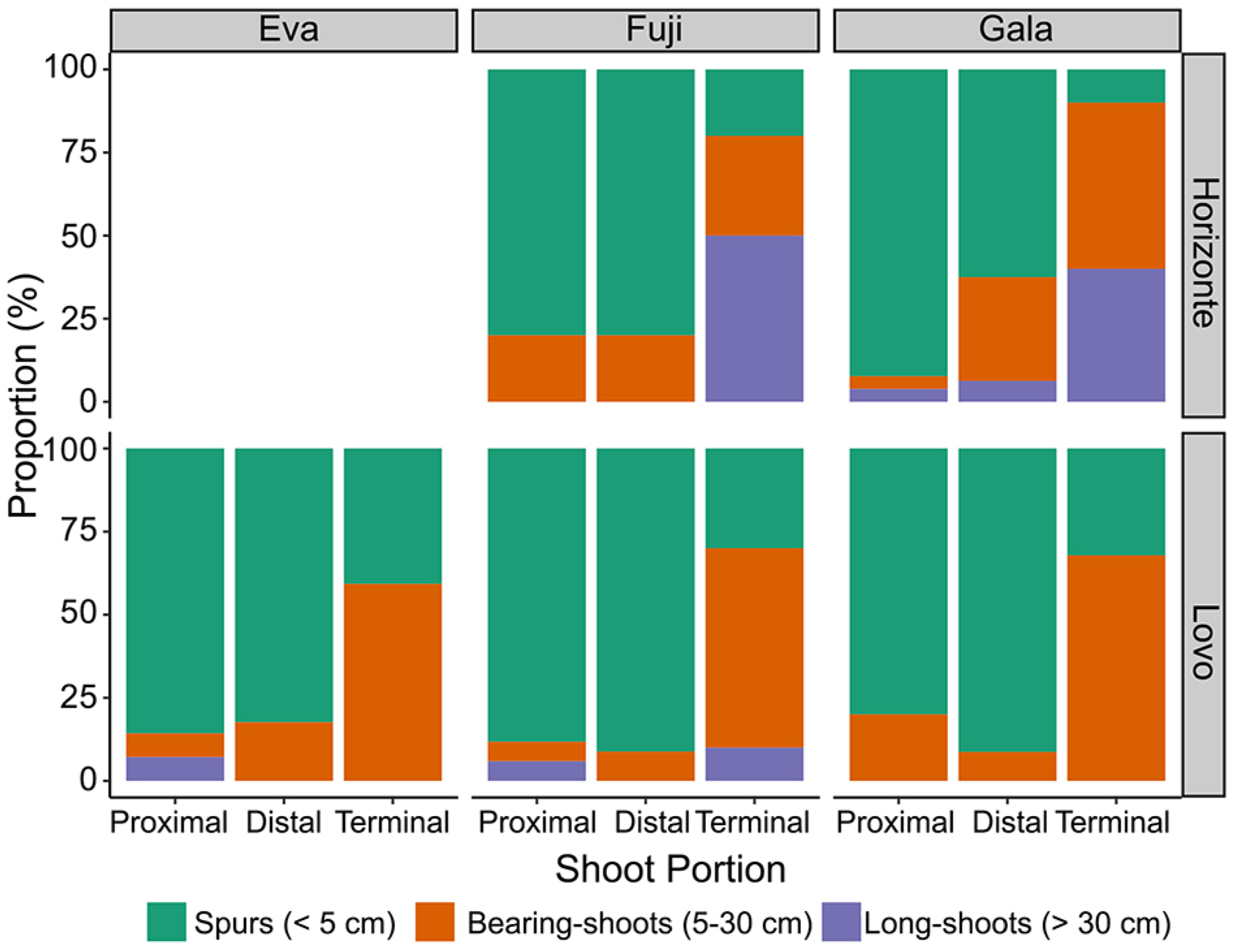
The proportions of bearing-shoots occurrence (Figure 3) were presented by reclassifying bearing-shoots according to their length, considering bearing-shoots longer than 30 cm as "long shoots". The ‘Fuji’ cultivar in the Horizonte orchard exhibited equal proportions of bearing-shoots and spurs in the distal and proximal portions, with a higher percentage of spurs than bearing-shoots. The terminal portion exhibited a higher proportion of long shoots compared to bearing-shoots and spurs. In the Lovo orchard, there was an increase in the percentage of spurs in all three portions, while the percentage of bearing-shoots decreased in the distal and proximal portions compared to the Horizonte orchard. In the terminal portion, there was an increase in the formation of bearing-shoots, but the percentage of long shoots was lower than in the Horizonte orchard.

Proportion of sprouted shoots according to length classes (spurs, bearing-shoots, and long shoots) on terminal, distal, and proximal portions of branches of ‘Eva’, ‘Gala’, and ‘Fuji’ cultivated in two orchards with contrasting cultivation environments: Lovo (1100 m) and Horizonte (1340 m).
The ‘Gala’ cultivar in the Horizonte orchard demonstrated a higher proportion of bearing-shoot and long-shoot formation in the terminal portion compared to than spur formation. In the distal portion, the proportion of spurs increased while the proportion of bearing-shoots and long-shoots decreased. In the proximal portion, there was a significant increase in the proportion of spurs and a decrease in the proportion of bearing-shoots and long shoots. In the Lovo orchard, the ‘Gala’ cultivar did not exhibit long shoots in any portion. The proportion of spurs in the distal and terminal portions increased compared to the Horizonte orchard.
The ‘Eva’ cultivar, cultivated exclusively in the Lovo orchard, demonstrated a proportion of spurs exceeding 80 % in both distal and proximal portions. In contrast, a decrease in the proportion of spurs was observed in the terminal portion. The cultivar exhibited 17.65 % of bearing-shoots in the distal portion and of 59.26 % in the terminal portion. In the proximal portion, the proportions of bearing-shoots and long shoots were both 7.14 %.
The ‘Gala’ cultivar exhibited a notably more significant number of spurs per linear meter of branch in the Horizonte orchard than the Lovo orchard (Table 2). The ‘Gala’ cultivar also exhibited an increase in the number of bearing-shoots per linear meter of the branch when cultivated in the Horizonte orchard, reaching a value of 5.7 bearing-shoots/meter, compared to 2.8 bearing-shoots/meter in the Lovo orchard. Additionally, an increase in the average length of the bearing-shoots was observed when ‘Gala’ was cultivated in the Horizonte orchard, reaching an average length of 24.5 cm. The ‘Fuji’ cultivar exhibited a significant difference between the orchards regarding the average length of the bearing-shoots, with a value of 28.3 cm recorded in the Horizonte orchard and 18.8 cm in the Lovo orchard.
Number of spurs and bearing-shoots per linear meter of branch and average length of bearing-shoots in the ‘Gala’ and ‘Fuji’ cultivars cultivated in two orchards with contrasting cultivation environments: Lovo (1100 m) and Horizonte (1340 m) orchards.
In both cultivars, the application of budbreak agents did not alter the number of spurs or bearing-shoots per TCSA in the Lovo orchard (Table 3). However, when cultivated in the Lovo orchard, the ‘Fuji’ cultivar exhibited a substantial increase in the number of spurs and a significant reduction in the number of bearing-shoots. In contrast, the ‘Gala’ cultivar exhibited no alteration in the number of spurs per TCSA. However, a significant reduction in bearing-shoots per TCSA was observed when this cultivar was cultivated in the Lovo orchard, significantly affecting the spurs-to-bearing-shoots ratio.
Number of spurs, bearing-shoots, and the spur-to-bearing-shoots ratio (S/B) per unit trunk cross-section area in the ‘Gala’ and ‘Fuji’ cultivars cultivated in two orchards with contrasting cultivation environments: Lovo (1100 m) and Horizonte (1340 m), with and without application of hydrogen cyanamide in the Lovo orchard.
Discussion
The ‘Gala’ cultivar demonstrated altered behavior across different sites, exhibiting a significant increase in the percentage of bearing-shoots in the distal portion and spurs throughout the proximal and distal portions of the branches in the Horizonte orchard. In contrast, the ‘Fuji’ cultivar did not exhibit any changes in the occurrence percentages of any structure (bearing-shoots or spurs) in any portion of the branch (terminal, distal, or proximal). In the Lovo orchard, the ‘Eva’ cultivar (a reference for a low chilling requirement and adapted cultivar) did not exhibit remarkable growth compared to the other cultivars. Consequently, the variation in chilling requirements among the cultivars did not significantly influenced on the percentages of shoot development along the branches.
The proportion of long shoots in the terminal portion of the ‘Gala’ and ‘Fuji’ cultivars exhibited the most significant impact on orchards. The robust growth observed in the Horizonte orchard may be associated with a potential absence of floral differentiation in the terminal buds at the conclusion of the growing season. However, further studies employing histological analyses are necessary to ascertain this. When vigorous growth from a vegetative terminal bud is absent, distal buds have been observed sprouting and forming branches with high vigor (Cook and Bellstedt, 2001; Maguylo et al., 2012). However, the presence of reproductive buds in the terminal portion, which typically emerge first on apple branches (Maguylo et al., 2012), has been shown to reduce the vigor of lateral shoots in the distal and proximal portions. This reduction is attributed to the acrotony process (Pertille et al., 2021) and the strong sink caused by the fruits (Maguylo et al., 2012).
Notwithstanding the considerable number of bearing-shoots and long shoots in the terminal portion, the ‘Gala’ cultivar in the Horizonte orchard exhibited a greater propensity for producing spurs and bearing-shoots per linear meter of the branch than in the Lovo orchard, thereby ensuring an adequate number of floral buds. The excessive number of bearing-shoots and long shoots require increased pruning requirements. In contrast, the ‘Fuji’ cultivar exhibited minimal variation in lateral shoot growth under different growing conditions. However, it demonstrated a significant increase in shoot length in the Horizonte orchard, which could also contribute to an elevated pruning requirement.
The capacity for lateral spur production on branches in the Horizonte orchard, primarily in the ‘Gala’ cultivar, may be associated with the microclimate at higher altitudes, including more significant chill accumulation and high diurnal temperatures in the summer, as well as the application of budburst stimulants such as hydrogen cyanamide and mineral oil. However, this factor did not influence the quantity of spurs in the Lovo orchard. Furthermore, the impact of robust primary apical growth on the shoot development along the branches has been shown to induce an acrotonic effect, thereby diminishing the vigor of secondary lateral shoots and fostering the formation of spurs and a few shorter bearing-shoots (Pertille et al., 2021).
A significant formation of autonomous spur complexes may have caused increased spurs per TCSA in the Lovo orchard. These spurs undergo annual renewal, meaning that a spur is formed after the development of an inflorescence, forming structures known as bourse-over-bourse (Lespinasse and Delort, 1993; Lauri, 2002). The autonomy of fruiting of the bourse-over-bourse is essential for regulating plant fruiting (Lauri and Laurens, 2005). A significant correlation has been observed between the abundance of bourse-over-bourse and the absence of alternation in the production of floral structures at the branch level (Lespinasse and Delort, 1993; Lauri et al., 1997; Lauri, 2002; Lauri and Laurens, 2005). Cultivars such as ‘Reine des Reinettes’ and ‘Oregon Spur’ exhibit a low level of fruiting autonomy at the branch level, indicating that they display a low formation of bourse-over-bourse and only fruit on lateral spurs of bearing-shoots, with alternation of production (Lauri and Laurens, 2005).
The ‘Gala’ and ‘Fuji’ cultivars exhibited significant plasticity in their capacity to form structures with floral buds (spurs) in large quantities, as well as a reduction in the quantity and length of bearing-shoots under Lovo orchard conditions (lower altitude, lower chilling accumulation, and no application of break dormancy agents). The presence of plasticity, both in plant architecture and in productive characteristics, is important for expanding apple cultivation to currently considered unsuitable locations, as well as facilitating adaptation to different training systems, rootstocks, and pruning and thinning practices that may arise in the future.
The ‘Gala’ and ‘Fuji’ cultivars exhibit different fruiting habits and architectures, with ‘Gala’ classified as type III and ‘Fuji’ designated as type IV, according to Lespinasse's typology (Lespinasse, 1977; Lespinasse and Delort, 1986). The ‘Fuji’ cultivar exhibits a genetic predisposition for fruiting in the terminal bud. However, in conjunction with the low fruit load in certain years, the excessive growth of shoots, results in a deficiency of apical floral differentiation and a decrease in bourse-over-bourse formation. This phenomenon contributes to the alternation of production over time, a well-documented characteristic of the ‘Fuji’ cultivar (Lauri et al., 1995; Lauri et al., 1997; Lauri and Laurens, 2005). However, the increase in the formation of autonomous fruiting structures (bourse-over-bourse) observed in this study helps regulate production. The regulation of production due to bourse-over-bourse formation has been studied for other type IV cultivars in temperate climates, such as ‘Granny Smith’ and ‘Red Winter’ (Lauri et al., 1997; Lauri and Laurens, 2005; Lauri et al., 2014). The regulation of production and the necessity of reducing pruning costs have led to the development of apple tree training systems focused on increasing bourse-over-bouse formation, mimicking the mechanism found in type IV apple cultivars (Tustin et al., 2011; Tustin et al., 2012; Lauri et al., 2016). The ‘Gala’ cultivar exhibits a balanced architecture and fruiting habit, bearing fruits on lateral spurs and terminal buds. It demonstrates a high formation of bourse-over-bourse on both apical and lateral positions, which can contribute to the plasticity of the cultivar in response to changes in the growing environment (Lespinasse and Delort, 1993). However, despite its ability to form many floral buds and reduce alternate bearing, fruit thinning remains necessary every year of production. The ‘Granny Smith’ cultivar, classified as type IV, shows variations in the growth of floral structures under different management practices, whereas ‘Golden Delicious’, a type III cultivar, does not exhibit such changes according to the management (Stephan et al., 2007). Similar findings were observed in this study for ‘Fuji’ (type IV) and ‘Gala’ (type III) under different environmental conditions. It is imperative to underscore that management practices, such as training and pruning, are cultivar-dependent and should be adapted accordingly to the specific cultivar being produced (Lauri and Laurens, 2005).
The characteristics observed in the Lovo orchard minimize pruning dependency, with only the annual removal of diseased or poorly located branches. Additionally, the formation of smaller lateral shoots and the high volume of bourse-over-bourse, especially for the ‘Fuji’ cultivar, result in a more uniform distribution of flowering throughout the plant without diverting production away from the center of the plant over the years. The orchard's regular production maintains an optimal balance between vegetative growth and productivity, reducing branch vigor, improving floral differentiation, and preserving the specific traits of the cultivar related to the natural formation and shedding of floral and vegetative organs. These characteristics are essential for the plant's adaptation to the cultivation environment.
The modification of the environment impacts the formation of lateral branches, particularly for the ‘Gala’ cultivar. However, the ‘Gala’ cultivar maintains equivalent spurs per TCSA between environments. The ‘Fuji’ cultivar exhibited a substantial increase in spurs per TCSA in the low chill environment (Lovo), suggesting high bourse-over-bourse formation with minimal dependence on developing new bearing shoots. A large number of spurs per TCSA in orchards with lower chill accumulation suggests that regular productivity may be maintained for both cultivars in this mild winter region. Conversely, in the Horizonte orchard conditions, characterized by higher chill accumulation, both cultivars require high pruning due to excessive long shoots. This necessitates the increased use of growth reducers to facilitate the development of reproductive structures in these long shoots. Notably, the ‘Gala’ and ‘Fuji’ cultivars in the Lovo orchard exhibit a remarkably similar architecture to the ‘Eva’ cultivar, which is currently recognized as the best adapted and most productive cultivar in warmer regions.
It is imperative that training systems and cultural practices be adapted to each growing region, given the documented differences in branch development and reproductive structure, even within the same cultivars. The ‘Fuji’ cultivar, in particular, must be trained to take advantage of its acrotonic characteristic, given that the bending of the branches occurs naturally with fruiting at the bearing-shoots. As the plant matures, the increase in bourse-over-bourse and the reduction in long-shoots formation are significant. However, developing strategies is imperative to ensure fruiting in the terminal position of bearing-shoots, thereby achieving the desired outcome. The ‘Gala’ cultivar exhibits an optimal balance between spurs and bearing-shoots in suboptimal conditions for growth (i.e., low chill accumulation and without application of growth stimulators). Nevertheless, the number of long shoots in ideal environment conditions (i.e., higher chill accumulation and the application of growth stimulators) should be reduced by implementing regulatory measures such as fruit loading, pruning, or growth-reducing agents. Intense summer pruning is imperative in years marked by low fruit set and production for both cultivars. Further research is necessary to enhance our understanding of plant architecture in mild winter regions and the interaction with floral differentiation and fruit loading.
Acknowledgments
We want to thank the Conselho Nacional de Desenvolvimento Científico e Tecnológico (CNPq) and the Coordenação de Aperfeiçoamento de Pessoal de Nível Superior (CAPES) for their financial support. We are thankful to Mr. Geraldo Lovo (in memoriam) and Mr. Emilio T. Honda for allowing the conduction of sampling in their orchards. We thank the Sistema de Tecnologia e Monitoramento Ambiental do Paraná (SIMEPAR) for allowing the access to meteorological data.
Data availability statement
Data will be available from the corresponding author upon request.
References
-
Alvares CA, Stape JL, Sentelhas PC, Gonçalves JLM, Sparovek G. 2013. Köppen's climate classification map for Brazil. Meteorologische Zeitschrift 22: 711-728. https://doi.org/10.1127/0941-2948/2013/0507
» https://doi.org/10.1127/0941-2948/2013/0507 -
Breen KC, Palmer JW, Tustin DS, Close DC. 2016. Artificial spur extinction alters light interception by ‘Royal Gala’ apple trees. Acta Horticulturae 1130: 265-272. https://doi.org/10.17660/ActaHortic.2016.1130.39
» https://doi.org/10.17660/ActaHortic.2016.1130.39 -
Cook NC, Bellstedt DU. 2001. Chilling response of "Granny Smith" apple lateral buds inhibited by distal shoot tissues. Scientia Horticulturae 89: 299-308. https://doi.org/10.1016/S0304-4238(00)00246-6
» https://doi.org/10.1016/S0304-4238(00)00246-6 -
Cronjé PJR, Jacobs G, Cook NC. 2004. Pruning affects the development of correlative phenomena among lateral shoots in dormant two-year-old "Royal Gala" apple branches. HortScience 39: 965-968. https://doi.org/10.21273/hortsci.39.5.965
» https://doi.org/10.21273/hortsci.39.5.965 -
Fishman S, Erez A, Couvillon GA. 1987a. The temperature dependence of dormancy breaking in plants: mathematical analysis of a two-step model involving a cooperative transition. Journal of Theoretical Biology 124: 473-483. https://doi.org/10.1016/S0022-5193(87)80221-7
» https://doi.org/10.1016/S0022-5193(87)80221-7 -
Fishman S, Erez A, Couvillon GA. 1987b. The temperature dependence of dormancy breaking in plants: computer simulation of processes studied under controlled temperatures. Journal of Theoretical Biology 126: 309-321. https://doi.org/10.1016/S0022-5193(87)80237-0
» https://doi.org/10.1016/S0022-5193(87)80237-0 - Fox J, Weisberg S. 2019. An R Companion to Applied Regression. Sage, Thousand Oaks, CA, USA.
-
George AP, Broadley RH, Nissen RJ, Ward G. 2002. Effects of new rest-breaking chemicals on flowering, shoot production and yield of subtropical tree crops. Acta Horticulturae 575: 835-840. https://doi.org/10.17660/ActaHortic.2002.575.99
» https://doi.org/10.17660/ActaHortic.2002.575.99 -
Gjamovski V, Kiprijanovski M. 2011. Influence of nine dwarfing apple rootstocks on vigour and productivity of apple cultivar ‘Granny Smith’. Scientia Horticulturae 129: 742-746. https://doi.org/10.1016/j.scienta.2011.05.032
» https://doi.org/10.1016/j.scienta.2011.05.032 -
Han HH, Coutand C, Cochard H, Trottier C, Lauri P-E. 2007. Effects of shoot bending on lateral fate and hydraulics: invariant and changing traits across five apple genotypes. Journal of Experimental Botany 58: 3537-3547. https://doi.org/10.1093/jxb/erm200
» https://doi.org/10.1093/jxb/erm200 -
Hauagge R, Cummins JN. 1991a. Phenotypic variation of length of bud dormancy in apple cultivars and related Malus species. Journal of the American Society for Horticultural Science 116: 100-106. https://doi.org/10.21273/jashs.116.1.100
» https://doi.org/10.21273/jashs.116.1.100 - Hauagge R, Cummins JN. 1991b. Genetics of length of dormancy period in Malus vegetative buds. Journal of the American Society for Horticultural Science 116: 121-126.
-
Hauagge R, Cummins JN. 1991c. Seasonal variation in intensity of bud dormancy in apple cultivars and related Malus species. Journal of the American Society for Horticultural Science 116: 107-115. https://doi.org/10.21273/jashs.116.1.107
» https://doi.org/10.21273/jashs.116.1.107 - Hauagge R, Tsuneta M. 1999. ‘IAPAR 75-Eva’, ‘IAPAR 76-Anabela’ and ‘IAPAR 77-Carícia’-new low chilling requirements apple cultivars. Revista Brasileira de Fruticultura 21: 239-242 (in Portuguese, with abstract in English).
-
Hauagge R. 2010. ‘IPR Julieta’, a new early low chill requirement apple cultivar. Acta Horticulturae 872: 193-196. https://doi.org/10.17660/ActaHortic.2010.872.25
» https://doi.org/10.17660/ActaHortic.2010.872.25 -
Hawerroth FJ, Petri JL, Leite GB, Herter FG, Marafon AC. 2009. Chilling and tipping off pruning effect on budbreak in peach trees. Revista Brasileira de Fruticultura 31: 440-446 (in Portuguese, with abstract in English). https://doi.org/10.1590/s0100-29452009000200018
» https://doi.org/10.1590/s0100-29452009000200018 -
Hawerroth FJ, Petri JL, Fachinello JC, Herter FG, Prezotto ME, Hass LB, et al. 2012. Reduction of winter pruning and fruit production increase in ‘Hosui’ pears by prohexadione calcium use. Pesquisa Agropecuária Brasileira 47: 939-947 (in Portuguese, with abstract in English). https://doi.org/10.1590/S0100-204X2012000700010
» https://doi.org/10.1590/S0100-204X2012000700010 -
Lauri P-E, Térouanne E, Lespinasse J-M, Regnard J-L. 1995. Genotypic differences in the axillary bud growth and fruiting pattern of apple fruiting branches over several years- an approach to regulation of fruit bearing. Scientia Horticulturae 64: 265-281. https://doi.org/10.1016/0304-4238(95)00836-5
» https://doi.org/10.1016/0304-4238(95)00836-5 -
Lauri P-E, Terouanne E, Lespinasse J-M. 1997. Relationship between the early development of apple fruiting branches and the regularity of bearing: an approach to the strategies of various cultivars. Journal of Horticultural Science 72: 519-530. https://doi.org/10.1080/14620316.1997.11515539
» https://doi.org/10.1080/14620316.1997.11515539 -
Lauri P-E, Lespinasse J-M. 2001. Genotype of apple trees affects growth and fruiting responses to shoot bending at various times of year. Journal of the American Society for Horticultural Science 126: 169-174. https://doi.org/10.21273/jashs.126.2.169
» https://doi.org/10.21273/jashs.126.2.169 - Lauri P-E. 2002. From tree architecture to tree training: an overview of recent concepts developed in apple in France. Journal of Korean Society for Horticultural Science 43: 782-788.
-
Lauri P-E, Willaume M, Larrive G, Lespinasse J-M. 2004. The concept of centrifugal training in apple aimed at optimizing the relationship between growth and fruiting. Acta Horticulturae 636: 35-42. https://doi.org/10.17660/ActaHortic.2004.636.3
» https://doi.org/10.17660/ActaHortic.2004.636.3 - Lauri P-E. Laurens F. 2005. Architectural types in apple (Malus x domestica Borkh.). p. 1300-1313. In: Lauri P-E, Laurens F. eds. Crops: growth, quality and biotechnology. WFL, Helsinki, Finland.
-
Lauri P-E, Combe F, Brun L. 2014. Regular bearing in the apple: architectural basis for an early diagnosis on the young tree. Scientia Horticulturae 174: 10-16. https://doi.org/10.1016/j.scienta.2014.05.001
» https://doi.org/10.1016/j.scienta.2014.05.001 -
Lauri P-E, Hucbourg B, Ramonguilhem M, Joannin R. 2016. A step further: optimizing the natural apple tree habit with the Salsa tree training concept. Acta Horticulturae 1130: 151-156. https://doi.org/10.17660/ActaHortic.2016.1130.22
» https://doi.org/10.17660/ActaHortic.2016.1130.22 -
Leite GB, Petri JL, Couto M, Hawerroth FJ. 2010. Increasing apple fruit set on ‘Condessa’ using growth regulators. Acta Horticulturae 884: 537-544. https://doi.org/10.17660/ActaHortic.2010.884.69
» https://doi.org/10.17660/ActaHortic.2010.884.69 - Lespinasse J-M. 1977. La conduite du pommier: types de fructification, incidence sur la conduite de l'arbre. INRA-INVUFLEC, Paris, France (in French).
-
Lespinasse J-M, Delort JF. 1986. Apple tree management in vertical axis: appraisal after ten years of experiments. Acta Horticulturae 160: 139-156. https://doi.org/10.17660/actahortic.1986.160.15
» https://doi.org/10.17660/actahortic.1986.160.15 -
Lespinasse J-M, Delort JF. 1993. Regulation of fruiting in apple role of the bourse and crowned brindles. Acta Horticulturae 349: 239-246. https://doi.org/10.17660/actahortic.1993.349.40
» https://doi.org/10.17660/actahortic.1993.349.40 -
Maguylo K, Cook NC, Theron KI. 2012. Environment and position of first bud to break on apple shoots affects lateral outgrowth. Trees 26: 663-675. https://doi.org/10.1007/s00468-011-0634-y
» https://doi.org/10.1007/s00468-011-0634-y -
Malagi G, Sachet MR, Citadin I, Herter FG, Bonhomme M, Regnard J-L, et al. 2015. The comparison of dormancy dynamics in apple trees grown under temperate and mild winter climates imposes a renewal of classical approaches. Trees 29: 1365-1380. https://doi.org/10.1007/s00468-015-1214-3
» https://doi.org/10.1007/s00468-015-1214-3 -
Pertille RH, Sachet MR, Guerrezi MT, Citadin I. 2019. An R package to quantify different chilling and heat models for temperate fruit trees. Computers and Electronics in Agriculture 167: 105067. https://doi.org/10.1016/j.compag.2019.105067
» https://doi.org/10.1016/j.compag.2019.105067 -
Pertille RH, Citadin I, Patto LS, Oldoni TLC, Scariotto S, Grigolo CR, et al. 2021. High-chilling requirement apple cultivar has more accentuated acrotony than low-chilling one in mild winter region. Trees 35: 1135-1150. https://doi.org/10.1007/s00468-021-02104-z
» https://doi.org/10.1007/s00468-021-02104-z -
Petri JL, Leite GB. 2004. Consequences of insufficient winter chilling on apple tree bud-break. Acta Horticulturae 662: 53-60. https://doi.org/10.17660/actahortic.2004.662.4
» https://doi.org/10.17660/actahortic.2004.662.4 - Ripley B, Venables B, Bates DM, Hornik K, Gebhardt A, Firth D. 2002. Modern Applied Statistics with S. Package MASS. Springer, Berlin, Germany.
-
Schmitz JD, Herter FG, Regnard JL, Leite GB, Bonhomme M, Cochard H, et al. 2015. Is acrotonic budburst pattern in spring a typical behavior of the low-chilling apple cultivar "Eva" in mild winter conditions? An approach combining ex planta single-node cutting test and in planta bud water content during dormancy. Scientia Horticulturae 188: 84-88. https://doi.org/10.1016/j.scienta.2015.03.024
» https://doi.org/10.1016/j.scienta.2015.03.024 -
Stephan J, Lauri P-E, Dones N, Haddad N, Talhouk S, Sinoquet H. 2007. Architecture of the pruned tree: Impact of contrasted pruning procedures over 2 years on shoot demography and spatial distribution of leaf area in apple (Malus domestica). Annals of Botany 99: 1055-1065. https://doi.org/10.1093/aob/mcm049
» https://doi.org/10.1093/aob/mcm049 -
Tustin DS, Dayatilake GA, Henriod RE, Breen KC, Oliver M. 2011. Changes in fruiting behaviour and vegetative development of ‘Scifresh’ apple in response to artificial spur extinction using centrifugal training. Acta Horticulturae 903: 603-610. https://doi.org/10.17660/ActaHortic.2011.903.83
» https://doi.org/10.17660/ActaHortic.2011.903.83 -
Tustin DS, Dayatilake GA, Breen KC, Oliver MJ. 2012. Fruit set responses to changes in floral bud load: a new concept for crop load regulation. Acta Horticulturae 932: 195-202. https://doi.org/10.17660/ActaHortic.2012.932.28
» https://doi.org/10.17660/ActaHortic.2012.932.28 -
Wickham H, Averick M, Bryan J, Chang W, McGowan LD, François R, et al. 2019. Welcome to the Tidyverse. Journal of Open Source Software 4: 1686. https://doi.org/10.21105/joss.01686
» https://doi.org/10.21105/joss.01686 -
Zhang M, Ma F, Shu H, Han M. 2017. Branch bending affected floral bud development and nutrient accumulation in shoot terminals of ‘Fuji’ and ‘Gala’ apples. Acta Physiologiae Plantarum 39: 156. https://doi.org/10.1007/s11738-017-2450-5
» https://doi.org/10.1007/s11738-017-2450-5
Edited by
-
Edited by:
Felipe Klein Ricachenevsky