 Resilience in the rainforest: interregional assessment of adaptation practices in Ecuadorian livestock systems
ABSTRACT:
Climate change presents increasing challenges to livestock systems, particularly in a vulnerable region such as the Ecuadorian Amazon, where small- and medium-scale farmers face greater climatic variability with limited capacity to adapt. This research investigates the effectiveness of adaptation strategies employed by these farmers to evaluate their impact on resilience practices. Utilizing a cross-sectional mixed methods design, this study combined both qualitative and quantitative approaches. A proportional stratified sample of 108 farmers from the six Amazonian provinces of Ecuador was surveyed. The data collection instrument was validated through expert review and a pilot study. The findings indicate that 42.6 % of respondents have observed a prolonged summer season and declining water levels in estuaries, springs, and rivers. In contrast, 43.5 % reported an increase in respiratory diseases among livestock. Notably, 51.9 % of farmers have not implemented adaptation measures, such as fodder banks, and a striking 91.7 % do not take action to safeguard their water resources. Among those who have adopted strategies, the most prevalent practice is the establishment of fodder banks, with 63.9 % reporting their use. However, this strategy did not exhibit a significant correlation with enhanced resilience (p < 0.317) regarding drought-resistant livestock. The results suggest that current adaptation practices, particularly the use of fodder banks, are not significantly improving the resilience of livestock systems in the region. The research underscores the urgent need for the development and implementation of more tailored and contextualized adaptation strategies. The adoption of silvopastoral systems emerges as a promising approach, which could provide multiple benefits in terms of resilience and sustainability.
Keywords:
Climate-change adaptation; Amazonian agriculture; livestock resilience; sustainable farming practices
Introduction
Climate change has a significant impact on agriculture, livestock, and fisheries, directly threatening global food security (Muluneh, 2021; Wiebe et al., 2019; Molotoks et al., 2021). Changes in climatic conditions can adversely affect livestock productivity, posing a considerable risk to small- and medium-scale farmers (Carvajal et al., 2021) and, consequently, to food security in developing countries, particularly in vulnerable regions such as the Ecuadorian Amazon (Michalk et al., 2019; AbuHatab et al., 2019; Farooq et al., 2022). In this region, livestock farming is a primary subsistence activity for rural communities, as it provides essential food and income, supports local economies, and serves as a buffer against economic instability in regions where agricultural diversification is constrained by climatic and geographic factors (Seo et al., 2010). The livestock farming in this region predominantly features small- and medium-scale production systems, primarily focused on cattle (Bos indicus Linnaeus, 1758; Bos taurus Linnaeus, 1758), alongside minor populations of pigs and poultry (Peralta et al., 2024). These production systems typically rely on extensive grazing in both native and introduced pastures, with limited access to supplementary feed and veterinary services. The ecology of the region is characterized by humid tropical forests, high annual rainfall, and a distinct dry season, all of which influence forage availability (Beck et al., 2008; Marengo et al., 2018).
The strategies currently utilized by livestock farmers in the Ecuadorian Amazon are often limited and, in many cases, inadequate for addressing the adverse effects of climate change. While some farmers have adopted practices, such as establishing fodder banks and safeguarding water sources (Kubkomawa et al., 2019; Dev et al., 2022; Bosire et al., 2019), many small- and medium-scale livestock farmers have yet to implement measures to mitigate the impacts of climate change (Ruíz et al., 2019).
In this context, it is essential to examine current adaptation practices and their effectiveness in strengthening the resilience of small and medium livestock farms in the Ecuadorian Amazon. This research aims to assess adaptation and resilience measures on these farms, reviewing existing practices and future proposals in the region. It also seeks to identify the barriers that hinder the adoption of adaptive practices and propose innovative solutions inspired by successful models from other regions. Ultimately, the study aims to support the development of effective policies that enhance the resilience of livestock production systems, while offering specific tools to assist small- and medium-scale livestock farmers in developing strategies to address the challenges posed by climate change in one of the world's most biodiverse and ecologically significant regions.
Material and Methods
Experimental design and study site
This research employed a cross-sectional approach, integrating quantitative and qualitative methods to investigate the adaptation and resilience measures employed by small- and medium-scale livestock farms in the Ecuadorian Amazon. Fieldwork was conducted at the geographic coordinates of 0°5’6" S and 76°53’38" W at an altitude of 335 m. The research was conducted between Jan and Aug 2024, encompassing both current practices and future proposals from livestock farmers who actively engaged in the process. This timeframe encompassed the rainy season (typically from Jan to Apr) and the drier months (May to Aug), providing a comprehensive understanding of how adaptive strategies differ across varying climatic conditions.
This cross-sectional design enabled a specific assessment of the current state of the livestock sector. Additionally, the mixed methodology provided insights into the strategies being employed, which in turn helped establish new alternative measures for adapting to climate change.
Population and sample
The study examined a cohort of 150 small- and medium-scale livestock farmers, both male and female, distributed across six provinces in the Ecuadorian Amazon Region (EAR): Pastaza (n = 24), Zamora Chinchipe (n = 30), Morona Santiago (n = 50), Napo (n = 20), Orellana (n = 15), and Sucumbíos (n = 24). Among these participants, 110 were male, and 40 were female, highlighting the traditionally male-dominated nature of livestock farming in the region. To ensure the relevance and reliability of the collected data, specific inclusion criteria were established. Participants were required to have active livestock operations for a minimum of eight years, reside within the specified provinces, and to express a willingness to participate in the study. Farmers who did not meet these criteria or operated outside the designated provinces were excluded from the research.
To determine the sample size, we employed the formula for finite populations, considering the six provinces of the EAR. We aimed for a 95 % confidence level, an expected proportion of 50 % (a conservative approach), and a 5 % margin of error. This calculation resulted in a representative sample of 108 farmers.
Proportional stratified sampling was employed to ensure equitable representation from each province of the overall study population. The final sample distribution comprised the following: Pastaza (n = 16), Zamora Chinchipe (n = 21), Morona Santiago (n = 33), Napo (n = 12), Orellana (n = 11), and Sucumbíos (n = 15). This sampling approach ensured sufficient representation of small- and medium-scale livestock farmers across all provinces, enhancing the external validity of the study and allowing for a more accurate assessment of climate change adaptation practices within the EAR.
Instrument
The survey comprised 25 questions that explored various aspects, including general information (e.g., name, age), sociodemographic data, and factors related to the impact of climate change, specifically perceptions regarding temperature, rainfall, and observed changes in water availability, on small- and medium-scale livestock production in the EAR. The questionnaire was conducted in Spanish, the respondents' first language of the respondents, and the survey instrument underwent validation through an expert review process to ensure the relevance and appropriateness of its content.
Subsequently, a pilot test was conducted with a diverse group of 30 livestock farmers, selected based on various ages and genders, to facilitate a preliminary evaluation of the questionnaire. This process ensured that the survey was both comprehensible and relevant to a wide range of participants. Next, Cronbach's Alpha coefficient was used to assess the internal consistency of items related to climate change perception and adaptation measures, yielding a value of 0.85. This outcome indicates a high level of reliability for the instrument, thereby meeting the required standards for the study's robustness.
Data analysis
The survey results were digitized into an Excel database, followed by a quality control process to eliminate surveys containing outlier data. A descriptive statistical analysis was conducted, enabling a comprehensive summary of the characteristics of the obtained data (Agresti, 2010). Responses were categorized using an ordinal and categorical classification system based on thematic analysis, which ensured consistency in data interpretation and evaluation. Cluster analysis was utilized to identify patterns in adaptation practices among various farm groups. An analysis of variance (ANOVA) was performed to compare adaptation practices across these groups. Additionally, regression analysis was employed to examine the relationships between current practices and their impact on resilience. Data analysis was conducted using the RStudio 4.4.1 statistical software.
Results
The descriptive analysis revealed that most respondents (69 out of 108) perceived significant climatic changes in the EAR over the past decade. On average, the summer season has extended to seven months, while the winter season has contracted to five months. Notably, 42.6 % of respondents (46 out of 108) reported an intensification of summer conditions, characterized by prolonged dry spells, whereas 30.6 % (33 out of 108) observed an extension of the winter season. Furthermore, 42.6 % (46 out of 108) indicated a decrease in water levels, underscoring the impact of climate change on local water resources.
When analyzing responses by gender, 45 % of male respondents (36 out of 80) and 35.7 % of female respondents (10 out of 28) indicated that they had observed an intensification of summer conditions, specifically prolonged dry periods. Regarding the extension of the winter season, 32.5 % of males (26 out of 80) and 25 % of females (7 out of 28) noted this trend. Additionally, 44 % of male respondents (35 out of 80) and 39.3 % of female respondents (11 out of 28) reported a perception of declining water levels. This suggests that both groups are experiencing the impacts of climate change, with male respondents reporting slightly higher rates of these observations.
Small- and medium-scale livestock farmers in the EAR face a range of challenges associated with global warming, with weight loss in animals being the most frequently reported issue, affecting 36.9 % of respondents (31 out of 84). Additionally, 43.5 % (47 out of 108) reported in increase an respiratory diseases, particularly during periods of heavy rainfall. Despite these challenges, more than half of the respondents (51.9 %) have not adopted any adaptation measures, and a significant majority (91.7 %) does not take steps to protect nearby rivers and streams. This indicates a lack of effective mitigation strategies to address the impacts of climate change.
Of the 108 livestock farmers surveyed, 63.9 % have adopted fodder banks as an adaptation strategy. These fodder banks primarily consist of silvopastoral systems and cultivated forage reserves, including species such as Brachiaria (Trin.) Griseb. spp., Pennisetum purpureum (Schumach) (elephant grass), and legumes like Cratylia argentea (Desv.) Kuntze, which provide essential nutrients during dry periods. However, only 17.6 % of farmers plan to replace natural pastures with improved varieties. These improved varieties typically refer to genetically selected or hybrid forage species bred for higher productivity, enhanced nutritional value, and increased resilience to environmental stressors, such as drought and poor soil conditions. Notable examples include improved cultivars of Brachiaria brizantha (Hochst. ex A. Rich.) Stapf, such as Marandu and Toledo, and Megathyrsus maximus (Jacq.) B.K. Simon & S.W.L. Jacobs, including Mombasa and Tanzania. Regarding animal resilience to drought, the findings are concerning, as 100 % of respondents indicated a lack of drought-resistant livestock, underscoring the significant vulnerability to the EAR to the impacts of climate change.
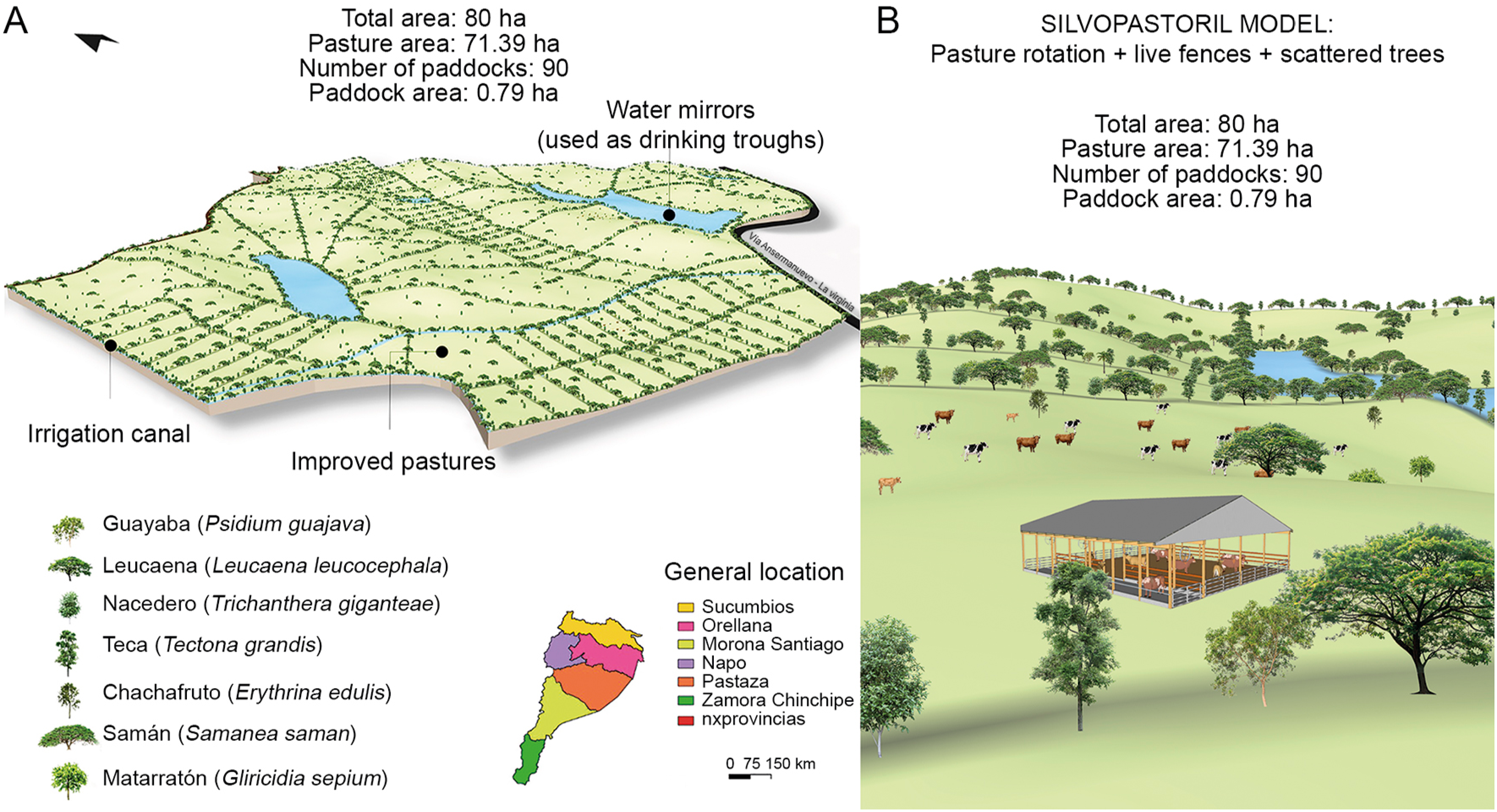
The ANOVA analysis indicated no significant differences in adaptation practices among livestock farmers across the various provinces in the Ecuadorian Amazonia Region (EAR), yielding a p-value of 0.298, which exceeds the nominal threshold of 0.05. This finding suggests that the adaptation strategies adopted by small- and medium-scale livestock farmers in response to climate change are not largely consistent, regardless of the province of origin (Table 1 and Figure 1).

A) Proposed silvopastoral design on an 80-ha farm and B) silvopastoral model with rotational grazing and dispersed trees for enhancing resource efficiency.
The analysis of the relationship between current practices and their impact on resilience revealed important yet inconclusive results. The coefficients obtained for various variables are displayed in Table 2. The implementation of fodder banks demonstrated a positive coefficient (β = 0.6931), indicating a potential beneficial association with drought resilience. This suggests that farms utilizing fodder banks may be better equipped to recover from drought conditions, ensuring feed availability and minimizing productivity losses. However, the corresponding p value (p = 0.317) indicates that this relationship is not statistically significant at the conventional level of β = 0.05. Similarly, the variable concerning the protection of rivers and streams near farms also exhibited a positive coefficient (β = 0.6931); however, its p value (p = 0.317) indicates a lack of statistical significance.
A crucial element is the model constant, which presented a negative value (β = −0.6931), indicating that in the absence of significant practices, the probability of having drought-resistant animals is relatively low. Nevertheless, it is important to note that this result reached statistical significance.
Discussion
The results revealed significant variations in climate change perceptions linked to ongoing local climatic variations and the adaptive capacity of small- and medium-scale farmers by province. These differences can be attributed to unequal access to resources and varying levels of knowledge regarding adaptation practices. However, some findings indicated no significant differences, particularly concerning climate change adaptation practices across provinces (p = 0.298). This lack of variation may be due to the uniformity of livestock practices and the limited availability of specific adaptation measures.
The significant number of farmers who do not protect water resources (91.7 %) and the absence of drought-resistant livestock (100 %) indicate vulnerability and a lack of effective mitigation strategies. Alternatives such as silvopastoral measures could improve resilience (Jose and Dollinger, 2019; Haddad et al., 2021). In this region, fodder banks are typically established in designated plots where high-yielding forages are cultivated and managed for strategic use during drought periods (Winders and Ransom, 2019). These banks act as a buffer against seasonal shortages, ensuring that livestock have access to adequate food even when natural pastures dwindle. Silvopastoral systems, which integrate trees and shrubs with pasture, provide additional benefits, including improved soil fertility, shade for livestock, and increased resilience to extreme climatic conditions (Vizuete-Montero et al., 2024). The current findings underscore the need to adopt agroecological practices and provid training to small- and medium-scale livestock farmers to tackle the impacts of climate change effectively. The proposed design incorporates an irrigation canal that traverses the farm, complemented by two water reservoirs that serve as drinking stations for livestock (Cheng et al., 2022). The design includes three species well-suited for tropical soils: guava (Psidium guajava L.), leucaena (Leucaena leucocephala (Lam.) de Wit), trichanthera (Trichanthera gigantea (Bonpl.) Ness), teak (Tectona grandis L.f), chachafruto (Erythrina edulis Triana ex Micheli), saman (Samanea saman (Jacq.) Merr.), and mata ratón (Gliricidia sepium (Jacq.) Kunth.). These species offer various ecological and nutritional benefits, including creating microclimates through the shade, improving moisture retention, and enhancing soil nutrient content. The proposed design features a silvopastoral system on an 80-ha farm, with 71.39 ha designated for pastures, organized into 90 plots of 0.79 ha each (Figure 1A).
Many cattle are shown grazing in the plot, where a variety of elements, including trees and shrubs, are spatially arranged in an orderly and complex manner (Figure 1B). This configuration promotes an efficient use of resources. The model aims to enhance both the productivity and sustainability of livestock farms within the EAR.
The findings suggest that adaptation strategies, such as the establishment of fodder banks, are essential for maintaining resilience in livestock production systems in the Ecuadorian Amazon. Considering that most cattle in the region are crosses of B. indicus and B. taurus, their capacity to withstand heat stress and variable forage conditions is an important consideration. However, the reliance on extensive grazing in a region with fluctuating rainfall patterns increases the vulnerability of these systems. Future studies should investigate the potential of integrating drought-resistant breeds or enhancing forage diversification to further bolster resilience.
Despite the widespread adoption of improved varieties such as B. brizantha and M. maximus in various tropical livestock systems, attributed to their noted resilience and productivity benefits (Torres et al., 2022), their performance in the Ecuadorian Amazon remains largely underexamined. Some studies indicate that while these varieties may offer enhanced drought tolerance and increased biomass yields compared to indigenous pastures, their success depends on factors such as soil conditions, management practices, and the local climate (Rhodes et al., 2021; Terán-Chaves et al., 2023).
Research on climate change adaptation and resilience strategies for small- and medium-scale livestock farms in the EAR reveals findings that both align with and diverge from recent studies. A study conducted by Bernabucci (2019) highlights the impact of climate change on livestock health and productivity, a concern reflected in the high incidence of respiratory diseases in the Ecuadorian Amazon (43.5 %). The importance of adopting mitigation strategies to reduce greenhouse gas (GHG) emissions, as underscored in the study conducted by Cheng et al. (2022), as well as the necessity to establish resilience-building measures in crops (Romero and Bravo-Benavides, 2022), correspond with the demand for agroecological and silvopastoral practices among small- and medium-scale livestock farmers in the EAR.
It is important to note that, unlike other studies demonstrating significant improvements from the adoption of adaptive practices (Fadina and Barjolle, 2018; Asrat and Simane, 2018; Alders et al., 2021; Vizuete-Montero et al., 2024), this study did not identify significant differences in adaptation practices across provinces. This lack of variation may be attributed to the uniformity in livestock practices and the absence of specific measures to mitigate the impacts of climate change.
Alternatives such as implementing silvopastoral systems, as proposed by Ruíz et al. (2019) and Fischer et al. (2018), indicate potential for improving resilience on small- and medium-scale livestock farms. However, in this study, the use of fodder banks did not show a significant relationship with resilience. The lack of protective measures for water resources and the absence of drought-resistant livestock (100 %) highlight a significant vulnerability, as noted in the findings by Baldassini and Paruelo (2020).
While there is a shared understanding of the challenges faced and the necessity to enhance resilience on livestock farms, differences in the effectiveness of implemented practices underscore the need for more specific approaches that align with the specific circumstances of small- and medium-scale livestock farmers in the EAR (Bartkowski et al., 2022; Sargison, 2020). Although the findings do not demonstrate a significant relationship between these practices among small- and medium-scale livestock farmers in the EAR, it is essential to advocate for agroecological strategies that enhance resilience. Therefore, the adoption of silvopastoral measures is recommended, as this approach can more effectively integrate water and forage management, thereby improving both soil quality and food availability during critical periods.
One of the primary limitations is the lack of longitudinal data, which hinders the assessment of long-term adaptation changes. Furthermore, while the sample was probabilistic, it did not encompass the entire EAR, thereby limiting the generalizability of the findings. The validation of the instrument was conducted solely through expert review, without applying additional statistical methods. Finally, there was no detailed calibration between observers or within the same observer, which could have improved the accuracy of data collection and analysis.
Despite these limitations, the findings of this research are crucial for understanding the adaptive capacities and challenges faced by small- and medium-scale cattle farmers in the EAR. The study highlights that, although initiatives such as fodder banks have been introduced, they have not yet led to in notable improvements in resilience to climate change.
This research concludes that small- and medium-scale cattle farmers in the EAR have adopted limited measures to mitigate the impacts of climate change, such as establishing fodder banks; however, these efforts have not let to significant improvements in resilience. The lack of integration of agroecological practices, such as silvopastoral systems, underscores the urgent need for providing training to farmers and additional resources to effectively address the adverse effects of climate change in this region of Ecuador.
Data availability statement
The data that support the findings of this study are available from the corresponding author upon reasonable request.
References
-
Abu-Hatab A, Cavinato MER, Lagerkvist CJ. 2019. Urbanization, livestock systems and food security in developing countries: A systematic review of the literature. Food Security 11: 279-299. https://doi.org/10.1007/s12571-019-00906-1
» https://doi.org/10.1007/s12571-019-00906-1 - Agresti A. 2010. Analysis of Ordinal Categorical Data. John Wiley & Sons, Hoboken, NJ, USA.
-
Alders RG, Campbell A, Costa R, Guèye EF, Hoque MA, Perezgrovas-Garza R, et al. 2021. Livestock across the world: diverse animal species with complex roles in human societies and ecosystem services. Animal Frontiers 11: 20-29. https://doi.org/10.1093/af/vfab047
» https://doi.org/10.1093/af/vfab047 -
Asrat P, Simane B. 2018. Farmers’ perception of climate change and adaptation strategies in the Dabus watershed, North-West Ethiopia. Ecological Processes 7: 7. https://doi.org/10.1186/s13717-018-0118-8
» https://doi.org/10.1186/s13717-018-0118-8 -
Baldassini P, Paruelo JM. 2020. Sistemas agrícolas y silvopastoriles en el Chaco Semiárido. Impactos sobre la productividad primaria. Ecología Austral 30: 45-62 (in Spanish, with abstract in English). https://doi.org/10.25260/EA.20.30.1.0.961
» https://doi.org/10.25260/EA.20.30.1.0.961 -
Bartkowski B, Schüßler C, Müller B. 2022. Typologies of European farmers: approaches, methods and research gaps. Regional Environmental Change 22: 43. https://doi.org/10.1007/s10113-022-01899-y
» https://doi.org/10.1007/s10113-022-01899-y -
Beck E, Bendix J, Kottke I, Makeschin F, Mosandl R. 2008. Gradients in a Tropical Mountain Ecosystem of Ecuador. 1ed. Springer, Berlin, Germany. https://doi.org/10.1007/978-3-540-73526-7
» https://doi.org/10.1007/978-3-540-73526-7 -
Bernabucci U. 2019. Climate change: impact on livestock and how can we adapt. Animal Frontiers 9: 3-5. https://doi.org/10.1093/af/vfy039
» https://doi.org/10.1093/af/vfy039 -
Bosire CK, Rao EJO, Muchenje V, Van Wijk M, Ogutu JO, Mekonnen MM, et al. 2019. Adaptation opportunities for smallholder dairy farmers facing resource scarcity: Integrated livestock, water and land management. Agriculture, Ecosystems and Environment 284: 106592. https://doi.org/10.1016/j.agee.2019.106592
» https://doi.org/10.1016/j.agee.2019.106592 -
Carvajal MA, Alaniz AJ, Gutiérrez-Gómez C, Vergara PM, Sejian V, Bozinovic F. 2021. Increasing importance of heat stress for cattle farming under future global climate scenarios. Science of The Total Environment 801: 149661. https://doi.org/10.1016/j.scitotenv.2021.149661
» https://doi.org/10.1016/j.scitotenv.2021.149661 -
Cheng M, Mccarl B, Fei C. 2022. Climate Change and Livestock Production: A Literature Review. Atmosphere 13: 140. https://doi.org/10.3390/atmos13010140
» https://doi.org/10.3390/atmos13010140 -
Dev I, Singh R, Garg KK, Ram A, Singh D, Kumar N, et al. 2022. Transforming livestock productivity through watershed interventions: A case study of Parasai-Sindh watershed in Bundelkhand region of Central India. Agricultural Systems 196: 103346. https://doi.org/10.1016/j.agsy.2021.103346
» https://doi.org/10.1016/j.agsy.2021.103346 -
Fadina AMR, Barjolle D. 2018. Farmers’ adaptation strategies to climate change and their implications in the Zou Department of South Benin. Environments 5: 15. https://doi.org/10.3390/environments5010015
» https://doi.org/10.3390/environments5010015 -
Farooq MS, Uzair M, Raza A, Habib M, Xu Y, Yousuf M, et al. 2022. Uncovering the research gaps to alleviate the negative impacts of climate change on food security: A review. Frontiers in Plant Science 13: 927535. https://doi.org/10.3389/fpls.2022.927535
» https://doi.org/10.3389/fpls.2022.927535 -
Fischer SB, Luengas PA, Schlüter S, Antunes LAO. 2018. From Design to Implementation: A Participatory Appraisal for Silvopastoral Systems. p. 87-103. In: Nehren U, Schlϋter S, Raedig C, Sattler D, Hissa H. eds. Strategies and Tools for a Sustainable Rural Rio de Janeiro Springer, Cham, Switzerland. https://doi.org/10.1007/978-3-319-89644-1_7
» https://doi.org/10.1007/978-3-319-89644-1_7 -
Haddad FF, Ariza C, Malmer A. 2021. Building climate-resilient dryland forests and agrosilvopastoral production systems: An approach for context-dependent economic, social and environmentally sustainable transformations. FAO, Rome, Italy. https://doi.org/10.4060/cb3803en
» https://doi.org/10.4060/cb3803en -
Jose S, Dollinger J. 2019. Silvopasture: a sustainable livestock production system. Agroforestry Systems 93: 1-9. https://doi.org/10.1007/s10457-019-00366-8
» https://doi.org/10.1007/s10457-019-00366-8 -
Kubkomawa HI, Kenneth-Chukwu AM, Krumah JL, Yerima IN, Audu Z, Nafarnda WD. 2019. Fodder bank establishment and management for dry season maintenance of small scale livestock industry: a review. Nigerian Journal of Animal Production, 46: 211-221. https://doi.org/10.51791/njap.v46i4.293
» https://doi.org/10.51791/njap.v46i4.293 -
Marengo JA, Souza Jr. CM, Thonicke K, Burton C, Halladay K, Betts RA, et al. 2018. Changes in climate and land use over the Amazon region: current and future variability and trends. Frontiers in Earth Science 6: 228. https://doi.org/10.3389/feart.2018.00228
» https://doi.org/10.3389/feart.2018.00228 -
Michalk DL, Kemp DR, Badgery WB, Wu J, Zhang Y, Thomassin PJ. 2019. Sustainability and future food security - A global perspective for livestock production. Land Degradation & Development 30: 561-573. https://doi.org/10.1002/ldr.3217
» https://doi.org/10.1002/ldr.3217 -
Molotoks A, Smith P, Dawson TP. 2021. Impacts of land use, population, and climate change on global food security. Food and Energy Security 10: e261. https://doi.org/10.1002/fes3.261
» https://doi.org/10.1002/fes3.261 -
Muluneh MG. 2021. Impact of climate change on biodiversity and food security: a global perspective - a review article. Agriculture & Food Security 10: 36. https://doi.org/10.1186/s40066-021-00318-5
» https://doi.org/10.1186/s40066-021-00318-5 -
Peralta AVP, Rivera SAG, Tobar-Ruiz MG, Sánchez-Salazar ME, Oscullo PDC, Ñuste LFM. 2024. Typology and characterization of the agricultural productive units in the NE Amazonian region of Ecuador. Journal of Advanced Veterinary and Animal Research 11: 171-180. https://doi.org/10.5455/javar.2024.k762
» https://doi.org/10.5455/javar.2024.k762 -
Rhodes AC, Plowes RM, Goolsby JA, Gaskin JF, Musyoka B, Calatayud P-A, et al. 2021. The dilemma of Guinea grass (Megathyrsus maximus): a valued pasture grass and a highly invasive species. Biological Invasions 23: 3653-3669. https://doi.org/10.1007/s10530-021-02607-3
» https://doi.org/10.1007/s10530-021-02607-3 -
Romero M, Bravo-Benavides D. 2022. Perception of resilience to climate change: Case study of coffee growers from Zaruma. Revista Económica 10: 44-50 (in Spanish, with abstract in English). https://doi.org/10.54753/rve.v10i2.1464
» https://doi.org/10.54753/rve.v10i2.1464 -
Ruíz ERJ, González WF, Pesantez LP. 2019. Silvopasture systems and climate change: Estimate and prediction of arboreal biomass. La Granja: Revista de Ciencias de la Vida 29: 45-55. http://doi.org/10.17163/lgr.n29.2019.04
» http://doi.org/10.17163/lgr.n29.2019.04 -
Sargison ND. 2020. The critical importance of planned small ruminant livestock health and production in addressing global challenges surrounding food production and poverty alleviation. New Zealand Veterinary Journal 68: 136-144. https://doi.org/10.1080/00480169.2020.1719373
» https://doi.org/10.1080/00480169.2020.1719373 -
Seo SN, McCarl BA, Mendelsohn R. 2010. From beef cattle to sheep under global warming? An analysis of adaptation by livestock species choice in South America. Ecological Economics 69: 2486-2494. https://doi.org/10.1016/j.ecolecon.2010.07.025
» https://doi.org/10.1016/j.ecolecon.2010.07.025 -
Terán-Chaves CA, Mojica-Rodríguez JE, Vega-Amante A, Polo-Murcia SM. 2023. Simulation of crop productivity for Guinea grass (Megathyrsus maximus) using aquacrop under different water regimes. Water 15: 863. https://doi.org/10.3390/w15050863
» https://doi.org/10.3390/w15050863 -
Torres B, Andrade V, Heredia-R M, Toulkeridis T, Estupiñán K, Luna M, et al. 2022. Productive livestock characterization and recommendations for good practices focused on the achievement of the SDGs in the Ecuadorian Amazon. Sustainability 14: 10738. https://doi.org/10.3390/su141710738
» https://doi.org/10.3390/su141710738 -
Vizuete-Montero M, Carrera-Oscullo P, Barreno-Silva NLM, Sánchez M, Figueroa-Saavedra H, Moya W. 2024. Agroecological alternatives for small and medium tropical crop farmers in the Ecuadorian Amazon for adaptation to climate change. Agricultural Systems 218: 103998. https://doi.org/10.1016/j.agsy.2024.103998
» https://doi.org/10.1016/j.agsy.2024.103998 -
Wiebe K, Robinson S, Cattaneo A. 2019. Climate Change, Agriculture and Food Security: Impacts and the Potential for Adaptation and Mitigation. p. 55-74. In: Campanhola C, Pandey S. eds. Sustainable Food and Agriculture: An Integrated Approach. Academic Press, Cambridge, MA, USA. https://doi.org/10.1016/B978-0-12-812134-4.00004-2
» https://doi.org/10.1016/B978-0-12-812134-4.00004-2 -
Winders B, Ransom E. 2019. Global Meat: Social and Environmental Consequences of the Expanding Meat Industry. MIT Press, Cambridge, MA, USA. https://doi.org/10.7551/mitpress/11868.001.0001
» https://doi.org/10.7551/mitpress/11868.001.0001
Edited by
-
Edited by:
Jorge Alberto Marques Rezende https://orcid.org/0000-0002-4425-2758