 Avocado genotypes resistant to Phytophthora cinnamomi in Colombia
ABSTRACT
Root rot caused by the oomycete Phytophthora cinnamomi (Pc) is the main phytosanitary limitation in avocado production in many regions of the world. Management of this disease has been based on epidemiological studies and integrated crop management, where resistant rootstocks are considered one of the main options. This study aimed to evaluate the resistance levels of six avocado genotypes from the Colombian Germplasm Avocado Collection (CCGA) to Pc under nursery conditions, as these genotypes are known to be promising for use as rootstocks. Each genotype was propagated by cloning and evaluated with and without the pathogen in conformity with epidemiological, physiological, and histological parameters in a randomized complete block experimental design with three replicates per treatment, with each replicate being represented by three plants as an experimental unit. The area under the disease progress curve (AUDPC) and the apparent rate of infection (rAUDPC) discriminated against four levels of genetic resistance to the pathogen. The AUDPC in inoculated plants of each genotype was related to the degree of root necrosis (RN), with significant reductions in photosynthetic capacity, stomatal conductance (gs), and biomass loss in root and foliage in the most susceptible genotypes. Histological analysis of roots confirmed the ability of Pc to invade and damage roots in different avocado genotypes. At the same time the formation of tyloses was identified as a mechanism of histological response to infection. The selections CCGA0143, CCGA0080, CCGA0122, and Duke-7 are proposed as elite genotypes resistant to Pc, due to reduced root damage and etiological performance to infection under nursery conditions.
Keywords:
Persea americana; root rot; stomatal conductance; tyloses
Introduction
Avocado, Persea americana Mill. (Lauraceae) is affected by a complex stress-related disease caused by the oomycete Phytophthora cinnamomi (Pc) Rands (Peronosporaceae) commonly known as avocado wilt (Zentmyer, 1980). This pathogen causes fine root rot, which restricts the absorption of water and nutrients and leads to secondary disease symptoms in the foliage (chlorosis and wilting) (Hardham and Blackman, 2018). These symptoms may be closely identified with a reduction in stomatal opening (Ploetz and Schaffer, 1989; Schaffer and Ploetz, 1989), a reduction in photosynthetic processes (Ruiz-Gómez et al., 2018), and the interruption of water flow (formation of tyloses) (Andrade-Hoyos et al., 2015; Neuhaus et al., 2007).
Phytophthora cinnamomi is a Stramenopile recorded in all avocado producing areas in Colombia (Tamayo Molano, 2007). It is estimated that the economic losses generated by this pathogen can exceed 50 %, especially in the nursery stage and during the first two years of crop establishment (Ramírez-Gil et al., 2017). Management of this pathogen has been based on epidemiological and integrated management studies, where one of the main options proposed has been the use of resistant or moderately resistant genotypes (Menge et al., 2012; Sánchez-González et al., 2019).
In Colombia, a program to select Pc-resistant avocado genotypes began in 2006 with the introduction to the Colombian germplasm avocado collection (CCGA) (Corporación Colombiana de Investigación Agropecuaria - AGROSAVIA) of 204 ‘Creole’ accessions. Collections were made in different agroecological regions of Colombia to identify ‘escape trees’ in areas with a high incidence of root rot attributed to Pc (Jimenez et al., 2007), making this genetic resource a valuable collection for the identification of sources of resistance to the pathogen.
Studies conducted by AGROSAVIA between 2016 and 2019 have allowed for the evaluation of 40 % of the CCGA, with the preliminary identification of 15 genotypes resistant to Pc (Henao et al., 2017). However, these avocado genotypes were assessed using an indirect infection method through stem wound inoculation (Gabor and Coffey, 1991), without direct root inoculation to determine the true resistance response to the pathogen. This study aimed to assess the resistance to Pc in plants of six genotypes of the CCGA when inoculated in their roots. The goal was to identify elite genotypes that could serve as rootstocks, contributing to managing the primary phytosanitary challenge affecting avocado crops in Colombia.
Materials and Methods
Location of the experimental site
The work was undertaken between Aug 2019 and Dec 2022 in the facilities of the Palmira Research Center of AGROSAVIA, Valle del Cauca, Colombia, located at 03°30’43.6" N, 76°18’53.5" W, altitude 1001 m.
Genotypes under study
Six CCGA avocado genotypes were evaluated (Table 1). Four regional genotypes with promising resistance to Pc were selected following the results of indirect inoculation by stem wound obtained by Henao et al. (2017) and AGROSAVIA, and two genotypes with different degrees of resistance-susceptibility tested at the root level to Pc: Duke-7 (moderately resistant) (Kellam and Coffey, 1985) and cv. Hass (susceptible) (Sánchez-González et al., 2019). Plants of each avocado genotypes were propagated by cloning and transplanted into plastic pots with a capacity of 8 L of sterilized substrate prepared with peat, rice husk, soil, and sand in the proportion of 3:2:2:1. The experimental phase was implemented under nursery conditions with a plastic cover and black polyshade with 50 % light reduction.
Avocado genotypes selected to evaluate resistance-susceptibility to Phytophthora cinnamomi under nursery conditions.
Inoculation
The reactivation of a highly pathogenic Pc isolate conserved in the working collection of the phytopathology laboratory of AGROSAVIA, Palmira Research Center, was performed. The evaluated pathogenic Pc isolate was Tamb-009 (López-Galé et al., 2024). Plants of each of the six avocado genotypes were evaluated against the pathogen (with inoculum) and without the pathogen (controls - 12 treatments), in a randomized complete block experimental design with three replicates per treatment. Three plants represented each replicate as an experimental unit. Inoculation was administered 18 months after transplanting to plastic pots to ensure adequate root development in the cloned plants. Direct root inoculation followed the infection method with mycelium multiplied in wheat grains (Drenth and Sendall, 2001). An infective load of 80 g of wheat was inoculated per pot with Pc mycelium. The concentration of infectious units of mycelium per gram of wheat was 1.5 × 10⁴ colony forming units. Wheat grains without the pathogen were added to the control plants of each genotype. Plants were watered every 48 h until they reached substrate humidity at field capacity (34 %).
Disease progress
Disease progression by treatment was assessed every 30 days for 14 months. The degree of severity was established on a visual scale of 0 to 5 for symptoms on foliage used by Sánchez-González et al. (2019), whereby category 0 corresponds to a symptomless plant; categories 1, 2, 3, and 4 represent increasing levels of the degree of chlorosis, wilting, and defoliation symptoms; while category 5 corresponds to a dead plant. With the data, the severity index (IS) was determined Eq. (1), the area under the disease progress curve (AUDPC) Eq. (2), and the apparent rate of infection (rAUDPC) were calculated Eq. (3) (Shaner and Finney, 1977).
where n is number of sampling units (plants) in each category (severity scale used), N, the total number of sampling units, v, the value of each category, and V, the highest value of the severity scale used.
where Y is severity at the i-th observation, T the time (days) at the i-th observation, and n, the number of observations.
where Tf is the time (days) of the last post-inoculation evaluation, and Ti, the time (days) of the first post-inoculation evaluation.
Resistance levels to Phytophthora cinnamomi
The average values of AUDPC and rAUDPC were applied to determine each genotype's resistance level or susceptibility to Pc. For categorization, the formula Eq. (4) and susceptibility scale proposed by Sánchez-González et al. (2019) were used.
where Sx is the calculated susceptibility value, Sy, the highest value of the severity scale used, Dx, the rAUDPC value obtained for each genotype, and Dy the rAUDPC value of the genotype used as susceptible control (Hass). Avocado genotypes were classified using the following scale values: 0 to 1.5, highly resistant; 1.6 to 3.0, resistant; 3.1 to 4.5, moderately resistant; 4.6 to 5, susceptible; and > 5, very susceptible.
Relative chlorophyll contents (RCC)
Relative chlorophyll contents (RCC) was evaluated in all plants by genotype (with and without inoculation) every 60 days with a Minolta SPAD® 502 digital chlorophyllometer. Data was taken from four fully developed leaves located in each plant's upper third, and four readings were conducted per leaf in soil plant analysis development units.
Stomatal conductance (gs)
The stomatal conductance (gs) was evaluated by observing that at least one plant for each genotype inoculated with Pc presented symptoms of category two (chlorosis and moderate wilting) (Sánchez-González et al., 2019). The evaluations were done at 8, 10, 12, 14, and 16 h for three consecutive days. Six inoculated plants and four control plants were evaluated for each genotype. Readings were taken on four fully developed leaves in the upper third of each plant with a METER® Group SC-1 Porometer and one reading per leaf. Volumetric water content (VWC) data (m3 m–3) in the substrate were taken with the 5TE sensor coupled with a Decagon Devices® Em50 datalogger and light radiation (LR) data with a WatchDog® 2475 mini weather station installed in the nursery.
Destructive plant sampling
Destructive analysis was performed on all plants by genotype (inoculated and controls) at the end of the study. The dry matter content of roots (DMR) and dry matter content of foliage (DMF) (60 °C; 72 h) and the total leaf area (LA) per plant were determined (LICOR® LI-3100C Meter). The degree of root necrosis (RN) was evaluated with a scale from 0 to 3, proposed by Rodríguez-Padrón et al. (2018), whereby 0 represented plants with symptomless roots, 1: plants with less than 30 % of the root system necrotic, 2: plants where the root system presents between 30 and 70 % necrosis and, 3: plants with more than 70 % of the root system necrotic. By way of treatment, inoculum was recovered from the root and substrate to corroborate the infection or presence of Pc.
Histopathological characterization of roots
At the end of the study, root collections were made from three inoculated plants and three control plants in each genotype. Fractions of 1 cm long roots located in the elongation zone were selected. The histological sections were processed following the method of Andrade-Hoyos et al. (2015). Mycelium (hyphae) and the formation of tyloses at the root level were determined under a Nikon® ECLIPSE Ci-L light microscope at 10 and 40× magnification. Per treatment, ten sections were considered (repetitions), and per section, the two best histological sections with clearly visible vascular tissue (xylem) were selected. In each section, the number of tyloses was quantified in two tissue fragments of 350 µm2, while the presence of Pc mycelium was quantified as presence or absence by section.
Analysis of data
The study variables were analyzed using Analysis of Variance (ANOVA). The Kolmogorov-Smirnov test and Levene test's homogeneity of variance corroborated the data's normality. In the variables RN, DMR, and percentage of mycelium per histological section, data transformation (x + 0.5)1/2 were carried out because the parametric assumptions were not met. Comparisons of means were evaluated using Tukey's test (p ≤ 0.05). Simple correlation analysis was also carried out to determine the relationship between AUDPC and physiological, biometric, and histological variables in each treatment. Statistical analysis was carried out with Statistical Analysis System software v. 9.4 and the PROC GLM procedure.
Results
Disease development
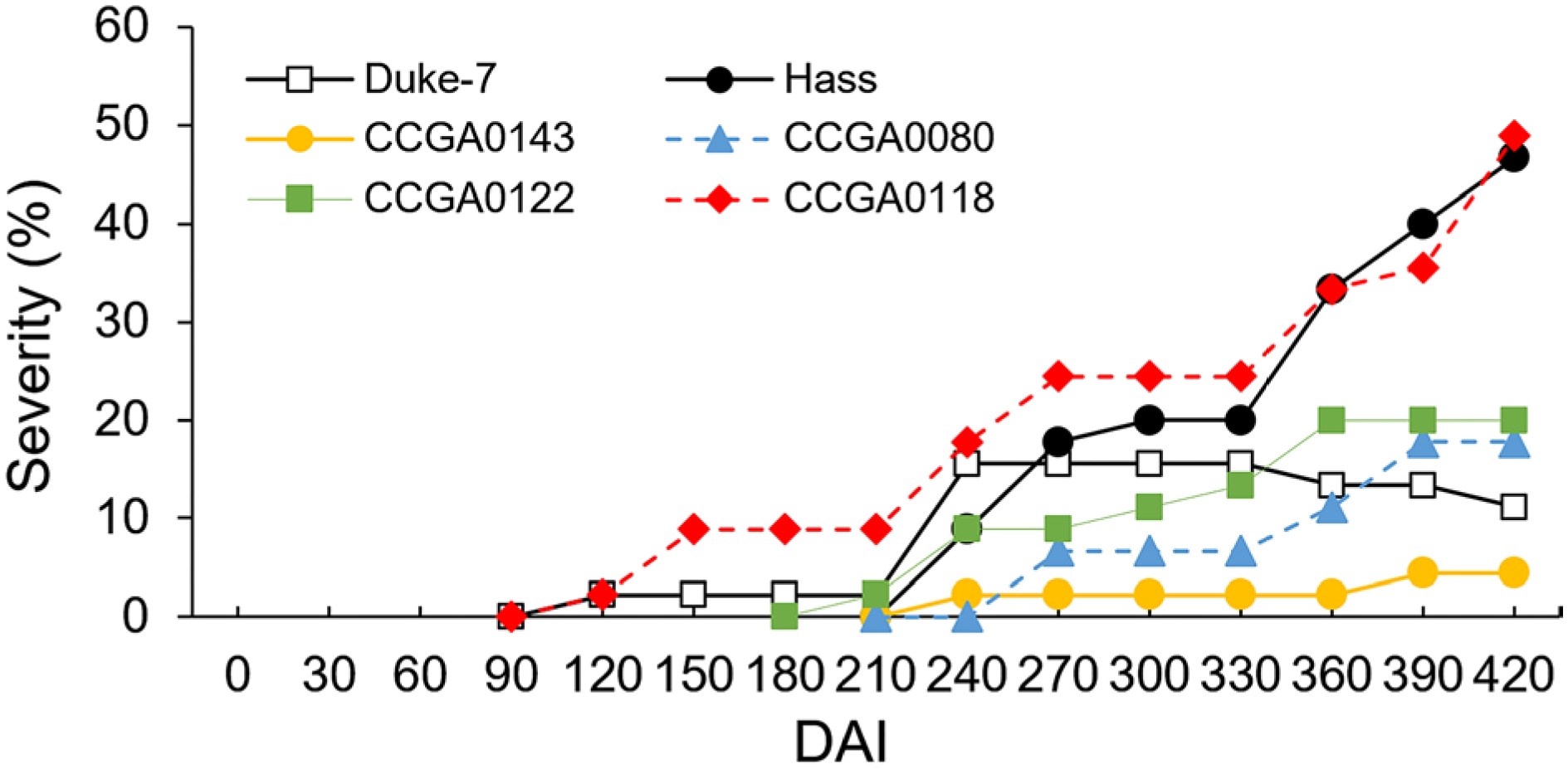
During the experimental development period (14 months), an average temperature of 25.2 °C (16.1-31.8 °C), average relative humidity of 82.3 % (62.9-90.1 %) and average LR of 240.8 µmol m–2 s–1 and maximum of 365 µmol m–2 s–1 were recorded in nursery conditions. Under this scenario, plants the CCGA0118 and Hass genotypes had the highest disease severity, with 48.9 and 46.7 %, respectively (Table 2). CCGA0118 developed symptoms at 120 days after inoculation (DAI), such as the swelling of undifferentiated buds, wilting of leaves and stems, defoliation, descending necrosis of branches, and death of 33.3 % of the inoculated plants. In Hass plants, the incidence was 100 % and the symptoms developed at 240 DAI. The progressive increase in leaf chlorosis, stem wilting, and defoliation were documented starting at 360 DAI (Figure 1). Additionally, necrotic spots on branches and main stems were observed in infected Hass plants.
Epidemiological parameters and average resistance levels in avocado genotypes inoculated with Phytophthora cinnamomi under nursery conditions (Aug 2020 to Sept 2021).

Disease progress curve in plants of avocado genotypes inoculated with Phytophthora cinnamomi under nursery conditions (Aug 2020 to Sept 2021). DAI = days after inoculation.
Plants of the genotypes CCGA0122, CCGA0080, and Duke-7 presented a disease severity of 20, 17.8, and 11.1 %, respectively. The most common disease symptoms were chlorosis in the leaves’ main and secondary veins, as well as the wilting of leaves, and stems. CCGA0080 developed symptoms later (270 DAI), CCGA0122 expressed symptoms at 210 DAI, and Duke-7 at 120 DAI. CCGA0143 presented the lowest percentage of disease severity (4.4 %). Only 22.2 % of the inoculated plants showed symptoms such as chlorosis and wilting at 240 DAI. The behavior over time of the plants in CCGA0143 was stable, with final disease severity percentages that did not exceed 5 % (Figure 1). Control plants in each genotype did not develop disease symptoms or considerable changes in vigor during the study. In all inoculated plants of the different genotypes, Pc recovery was carried out on roots and substrate, which corroborated the interaction between the pathogen and the host.
Resistance-susceptibility levels to Phytophthora cinnamomi
The genotype classification based on the susceptibility scale proposed by Sánchez-González et al. (2019), obtained from the mean values of AUDPC and rAUDPC, allowed us to discriminate four levels of genetic resistance to Pc. CCGA0143 was classified as highly resistant. Duke-7, CCGA0080, and CCGA0122 were classified as resistant, followed by Hass as susceptible (susceptible control), while CCGA0118 was highly susceptible to infection (Table 2).
Root necrosis, dry biomass, and leaf area
According to the ANOVA, root rot was different across the treatments (p < 0.05). Pc affected the root system of all inoculated plants and produced different degrees of necrosis between genotypes (p < 0.05). The development of necrosis was observed in fine roots less than 2 mm in diameter. The roots were deep brown with necrotic spots, peeling bark, and a brittle texture. In Hass plants, inner bark necrosis was identified at the base of the stem. In the controls of each genotype, no radical necrosis was observed.
Plants of the genotypes CCGA0080 and CCGA0143 had the lowest RN percentages, 22.2 and 40.7 %, respectively (Figure 2A). In these, the mean values DMR, DMF, and LA were statistically similar to each control (p > 0.05) (Figure 2B-D), although the bioaccumulation DMF and LA in inoculated plants had a higher average value. In CCGA0118, Hass, Duke-7, and CCGA0122 plants showed RN rates between 55.6 and 63 %. Despite radical damage in the inoculated plants, these were no different from the control compared to DMR, DMF, and LA, but they did present lower average values.

Destructive analysis of plants in avocado genotypes inoculated with Phytophthora cinnamomi under nursery conditions. A) Degree of root necrosis (RN), B) Average dry matter content of roots (DMR), C) Average dry matter content of foliage (DMF), and D) Average total leaf area (LA). Bars with different letters are statistically different (p ≤ 0.05).
Relative chlorophyll contents
All inoculated plants presented reductions in RCC over time compared to their respective control (p < 0.05), except for CCGA0143 (p > 0.05) (Figure 3). Hass plants inoculated with Pc were the first show differences in RCC compared to the control (300 DAI), while CCGA0122 presented the latest difference (420 DAI). At the end of the study, inoculated plants of Hass showed the most significant reduction in RCCs (42.5 %); followed by CCGA0118 (32.4 %), CCGA0122 (31 %), CCGA0080 (30.1 %), and Duke-7 (21.6 %).

Temporal behavior of relative chlorophyll contents (RCC) in avocado seedlings inoculated with Phytophthora cinnamomi under nursery conditions (Aug 2020 to Sept 2021). DAI = days after inoculation. SPAD = soil plant analysis development. Points with different letters for the same sampling period are statistically different (p ≤ 0.05). Red arrows indicate the moment in which the first symptom of the disease was identified.
Stomatal conductance
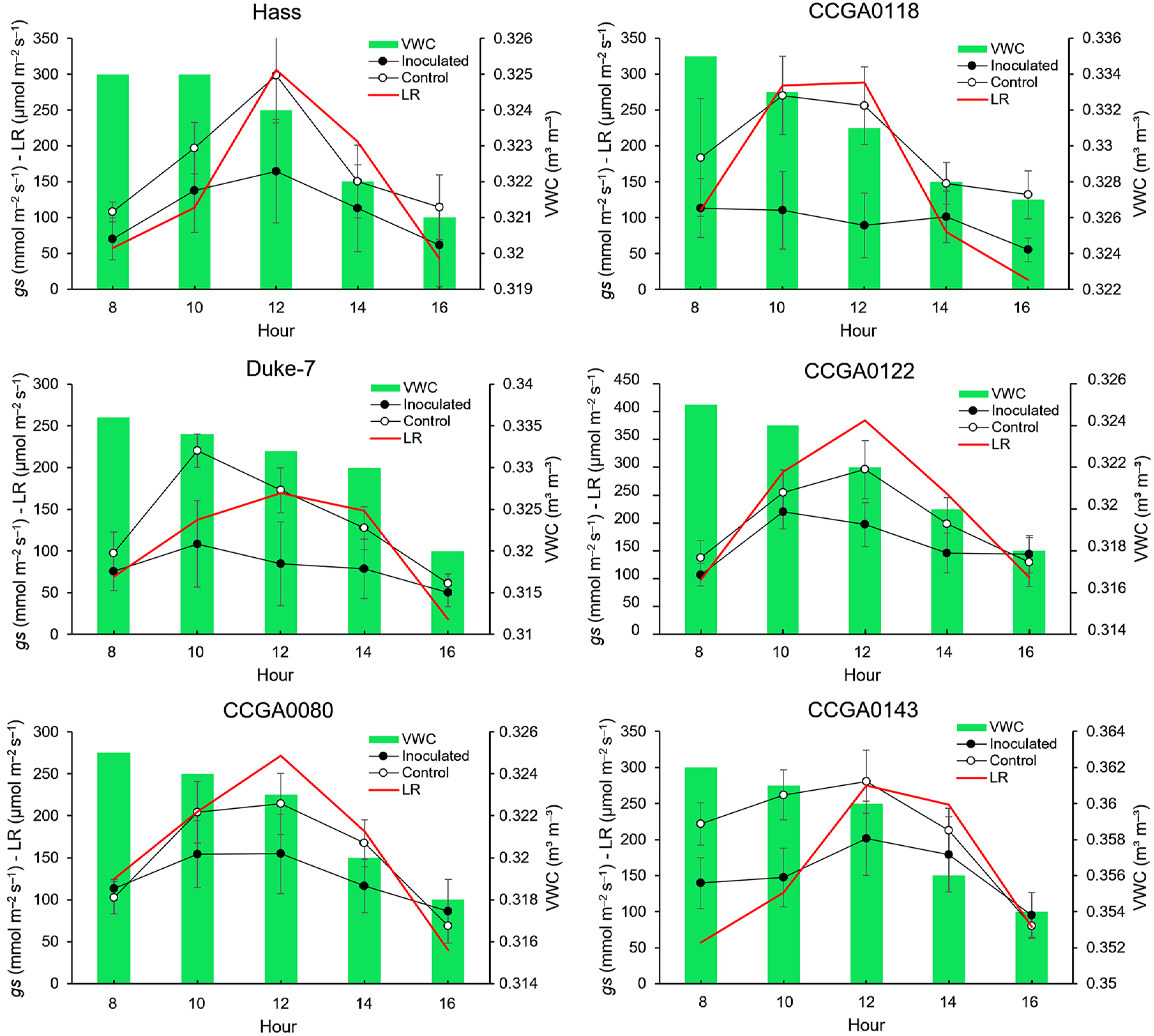
Reductions in gs were obtained in plants of all genotypes when inoculated with Pc. The largest reductions relative to their control were documented in CCGA0118 (52.5 %). In these, stomatal opening was low during different periods of the day (Figure 4). A 44.7 % reduction was documented in Hass, followed by Duke-7 (41.5 %), CCGA0143 (27.8 %), CCGA0122 (19.9 %), and CCGA0080 (17.5 %). Even though Hass, Duke-7, CCGA0143, CCGA0122, and CCGA0080 showed reductions in gs compared to their controls, the temporal behavior of gs, for both treatments (inoculated and controls) was closely related to LA throughout the different periods of the day. It should be noted that inoculated plants of the genotypes CCGA0143, CCGA0122, and CCGA0080 somehow maintain their functionality with gs above 150 mmol m–2 s–1 in hours of high radiation and with a humid substrate (Figure 4). During the development of the experiment, the VWC in the substrate fluctuated between 0.32-0.36 m3 m–3.

Temporal behavior of stomatal conductance (gs) in avocado seedlings inoculated with Phytophthora cinnamomi under nursery conditions and its relationship to light radiation (LR) and volumetric water content (VWC).
Histopathological characterization of roots
At the histological level, radical involvement by Pc was different between treatments (p < 0.05) and between genotypes (p < 0.05). Pc affected the root system of all inoculated plants. Hyphae were observed in the intra- and intercellular matrix of different tissues, including cortex, endodermis, and vascular cylinder. The highest hyphal development was observed in CCGA0118 (15 %), followed by Duke-7 (10 %), CCGA0122 (10 %), and Hass (8.3 %), while in CCGA0080 (5 %) and CCGA0143 (3.3 %) the lowest colonization rates were documented (Figure 5). In the controls of each genotype, no Pc hyphae were found.

Number of tyloses and percentage of mycelium per histological root section in plants of avocado genotypes inoculated with Phytophthora cinnamomi. Points (mycelium) and bars (tyloses) with different letters in each variable are statistically different (p ≤ 0.05).
The formation of tyloses was different between treatments (p < 0.05) and between genotypes (p < 0.05). This response developed as a function of the presence of the pathogen, which induced greater formation of tyloses in inoculated plants compared to controls. CCGA0118 presented the greatest formation of tyloses (Figures 5 and 6A), whereas CCGA0122 had the lowest average value. In controls, the mean values of tyloses per cut were low (0.24 to 0.63) and statistically similar between genotypes (p > 0.05). In CCGA0118 and Hass, Pc hyphae colonized the vascular bundle (Figure 6B), which caused the collapse and destruction of the xylem ducts despite their obstruction by the development of tyloses. In Duke-7, CCGA0143, CCGA0080, and CCGA0122 it was observed that when the pathogen was present, the cells adjacent to the infection had a dark reddish color and lignified walls (Figure 6C). Pc chlamydospore formation was only documented in the roots of CCGA0118 and Hass.

Micrographs of histological sections of avocado roots inoculated with Phytophthora cinnamomi (Pc). A) tyloses in the CCGA0118 genotype (white arrows), B) hyphae (blue arrows) and chlamydospore (red arrows) in CCGA0118 genotype, and C) formation of reddish stains in sections with the presence of Pc (black circle), the yellow arrow indicates the presence of Pc hyphae.
Area under the disease progress curve and its relationship with physiological, biometric, and histological variables
The AUDPC was an epidemiological parameter directly correlated with the percentage of RN in all inoculated genotypes (p < 0.05) (Table 3). The strongest levels of correlation were obtained in plants of with greater susceptibility to infection (CCGA0118 and Hass) and moderate correlation in those classified as having some degree of resistance to Pc (CCGA0143, CCGA0080, CCGA0122, and Duke-7). A strong inverse correlation was obtained between AUDPC and RCC for the different genotypes (p < 0.05), except for CCGA0143 (r = 0.167; p > 0.05). The correlation between the AUDPC and the DMR, DMF, and LA variables was inversely proportional in genotypes with greater susceptibility to the pathogen (CCGA0118 and Hass) (p < 0.05), indicating that the higher the AUDPC, the greater loss of roots, dry crown biomass, and LA (leaf loss). In Duke-7 and CCGA0080, classified as resistant, AUDPC was inversely correlated with DMR. In CCGA0122 the AUDPC was inversely correlated with the DMF and LA. In contrast, the CCGA0143 genotype, with greater resistance, and the CCGA0118 genotype, with greater susceptibility, were the only ones that showed moderate positive correlation between AUDPC and the number of tyloses per histological root section (p < 0.05).
Correlation matrix of the area under the disease progress curve (AUDPC) with physiological, biometric, and histological variables in avocado genotypes inoculated with Phytophthora cinnamomi.
Discussion
The microclimatic conditions of the nursery were favorable for the development of the disease and indicate that the isolate of Pc was highly infectious and capable of inducing root rot and secondary disease symptoms at the foliage level. Thus, a particular incubation period was conditioned in avocado plants in the genotypes with greater susceptibility.
The AUDPC was a parameter related to the degree of root rot in inoculated plants of all genotypes, confirming that this epidemiological measure was adequate for describing the level of root involvement and distinguishing degrees of resistance between genotypes. CCGA0143 was identified as the greatest resistance to infection, showing 78 % of symptomless plants and a degree of disease severity not exceeding 5 %, followed by genotypes CCGA0080 and CCGA0122 with resistance comparable to Duke-7, which has been recognized for many years as the standard rootstock for its moderate resistance to Pc (Kellam and Coffey, 1985). Furthermore, the results of this study confirmed the susceptibility of the Hass cultivar to Pc (Sánchez-Gonzalez et al., 2019).
The selections CCGA0143, CCGA0080, and CCGA0122 are proposed as elite genotypes resistant to Pc due to superior performance against infection in the nursery. The differences in the geographical origin of each genotype can provide some adaptability advantages, given the high edaphoclimatic variability of areas suitable for avocado cultivation in Colombia (Lozano-García et al., 2013), which would support the idea of Berdugo-Cely et al. (2023), who indicated that Colombian avocado populations reflect unique local adaptations that could lead to the selection of new genotypes or cultivars with valuable attributes (e.g. rootstocks).
According to CCGA passport records, selection CCGA0143 comes from Pereira in Risaralda, a municipality located at 1441 m a.s.l., with temperatures between 18 and 28 °C, average relative humidity of 78 % and average annual precipitation of 2750 mm; CCGA0080 comes from the Norcasia region, Caldas, located 551 m a.s.l., with temperatures ranging between 22 and 32 °C, relative humidity of 73 % and average annual precipitation of 2860 mm; whereas the CCGA0122 selection comes from the municipality of Tumaco in Nariño, located at an average altitude of 25 m a.s.l., with temperatures between 22 and 33 °C, average relative humidity of 84 % and average annual precipitation of 2790 mm. The climatic characteristics of the collection areas of these three genotypes are framed within the tropical humid forest life zone (Holdridge, 1978), with heavy rains almost all year round, which promotes the supersaturation of the soil and, with it, adequate conditions for the pathogen to thrive and interact with the host (Hardham and Blackman, 2018). Furthermore, the genetic segregation presented by these genotypes as ‘escape trees’ in areas with high Pc inoculum pressure could corroborate genetic resistance to the pathogen.
The CCGA0118 was a genotype previously identified as resistant to Pc through the stem wound inoculation technique, which has been evaluated as an alternative and rapid method for evaluating indirect resistance to Pc (Gabor and Coffey, 1991; Henao et al., 2017). However, in direct root inoculation evaluations, CCGA0118 was highly susceptible to the pathogen. This shows that the selection of genotypes by indirect methods does not guarantee resistance to infection due to the infective biology of the pathogen that occurs naturally through roots (Hardham and Blackman, 2018). Therefore, clonal propagation and subsequent root evaluation of these selections are essential in selecting elite genotypes with resistance to Pc. Furthermore, these results also confirm the high infective capacity of the Pc isolate Tamb-009 used (López-Galé et al., 2024).
The physiological responses evaluated showed clear trends indicating the high sensitivity of avocado plants of all genotypes to infection with Pc. Some responses included gs reduction, photosynthetic capacity reduction, root and crown biomass loss (Ruiz-Gómez et al., 2018; Schaffer and Ploetz, 1989). These symptoms are produced by the low capacity of the seedlings to absorb water and form chlorophyll (Hardham and Blackman, 2018), coupled with the increase in nitrogen in leaves that limits the movement of phosphorus to other tissues, which may be related to a highly necrotic root system where the pathogen has probably overcome the structural and physiological defense barriers developed by the host (van den Berg et al., 2021).
The stomatal system of avocados is sensitive to water stress (Zuazo et al., 2021), with the reduction in gs being a physiological mechanism associated with protection from deficit (Marchin et al., 2022). The intermediate stomatal opening observed in plants of CCGA0143, CCGA0080, and CCGA0122 inoculated with Pc, indicates that these genotypes can maintain gas exchange rates despite the radical damage induced by the pathogen infection that would prevent adequate water adsorption (Fricker and Willmer, 1996).
Histological analysis of roots confirmed the ability of Pc to invade and damage roots in plants of the different avocado genotypes. The pathogen was recognized through coralloid coenocytic hyphae and by the development of chlamydospores (Hardham and Blackman, 2018). The hyphae were found in xylem ducts, causing detachment and destruction of cells that cover the vascular cylinder and other tissues, possibly due to pectolytic enzymes produced by the pathogen that facilitate its advance and colonization (Brummer et al., 2002). These results are consistent with those reported by Ruiz-Gómez et al. (2015), who found that Pc focuses its growth on the vascular system (xylem) since, through these conduits, it is possible to achieve rapid and convenient root colonization.
Plants of all genotypes inoculated with Pc developed tyloses as a histological response mechanism to infection; however, these responses were heterogeneous between genotypes. The genotype with higher susceptibility CCGA0118 was associated with increased tylose production, unlike Hass, which was also identified as susceptible. On the other hand, CCGA0143, CCGA0122, CCGA0080, and Duke-7 classified as resistant, developed intermediate responses in the production of tyloses, managing mitigate somehow the adverse effects of the pathogen and convenient water adsorption. The tyloses are produced as a structural mechanism of histological resistance to infection to prevent the advancement of the pathogen through the xylem (Agrios, 2004). A study conducted on plants of five avocado genotypes inoculated with Pc, found that the formation of tyloses at the root level was a defense mechanism linked to genotypes highly resistant to the pathogen (Andrade-Hoyos et al., 2015). On the other hand, it has also been reported that these structures can plug the vascular bundles, preventing the efficient absorption of water and nutrients, which can lead to disease symptoms (Neuhaus et al., 2007).
This last condition could explain to a certain extent the high susceptibility presented by CCGA0118 to Pc, since possibly the plants of this genotype upon interacting with the pathogen, could develop a hypersensitive defense response that caused an excess in the formation of tyloses, achieving occlusion of the xylem (Neuhaus et al., 2007). However, it should be noted that CCGA0118 presented the greatest colonization of roots by Pc hyphae, which would confirm that this defense mechanism was insufficient to contain the advance of the pathogen. This result shows that interactions between plants and pathogens can be complex. It suggests that the level of resistance expressed by a genotype is the result of the combination of different defense mechanisms, including structural, physiological, and biochemical responses. These mechanisms aim to limit and reduce the spread of the infection. The effectiveness of these defenses is largely influenced by the pathogenicity of the pathogen and the environmental conditions that favor the development of the disease (van den Berg et al., 2021).
The selections CCGA0143, CCGA0122, CCGA0080, and Duke-7 were considered genotypes with promising attributes of moderate resistance to Pc, due to reduced root damage and etiological performance to infection under nursery conditions. Future studies must determine their resistance to other Pc isolates, adaptability to soils with high inoculum pressure, and agronomic performance under field conditions using commercial scions of interest in Colombia.
Data availability statement
The authors do not have permission to share data.
Acknowledgments
This manuscript is a result of the project: ‘Estrategias de prevención y manejo de enfermedades limitantes en la producción de aguacate en las principales zonas productoras de Colombia’, AGROSAVIA (2019-2022), financed by the Ministerio de Agricultura y Desarrollo Rural de Colombia. Many thanks to anonymous reviewers whose comments helped improve the manuscript. Thanks to the Agrobiodiversity Department of AGROSAVIA for facilitating access to the CCGA.
References
- Agrios GN. 2004. Plant Pathology. 5ed. Academic Press, New York, NY, USA.
-
Andrade-Hoyos P, Molina E, De León C, Espíndola M, Alvarado D, López A. 2015. Defense mechanisms in avocado rootstocks to Phytophthora cinnamomi Rands. Revista Mexicana de Ciencias Agrícolas 6: 347-360. https://doi.org/10.29312/remexca.v6i2.693
» https://doi.org/10.29312/remexca.v6i2.693 -
Berdugo-Cely J, Cortés A, López-Hernandez F, Delgadillo-Durán P, Cerón-Souza I, Reyes-Herrera P, et al. 2023. Pleistocene-dated genomic divergence of avocado trees supports cryptic diversity in the Colombian germplasm. Tree Genetics & Genomes 19: 42. https://doi.org/10.1007/s11295-023-01616-8
» https://doi.org/10.1007/s11295-023-01616-8 -
Brummer M, Arend M, Fromm J, Schlenzig A, Obwald W. 2002. Ultrastructural changes and immunocytochemical localization of the elicitin quercinin in Quercus robur L. roots infected with Phytophthora quercina Physiological and Molecular Plant Pathology 61: 109-120. https://doi.org/10.1006/pmpp.2002.0419
» https://doi.org/10.1006/pmpp.2002.0419 - Drenth A, Sendall B. 2001. Practical Guide to Detection and Identification of Phytophthora CRC for Tropical Plant Protection, Brisbane, Queensland, Australia.
- Fricker M, Willmer C. 1996. Stomata. 2ed. Springer, London, UK.
-
Gabor BK, Coffey MD. 1991. Comparison of rapid methods for evaluating resistance to Phytophthora cinnamomi in avocado rootstocks. Plant Disease 75: 118-120. https://doi.org/10.1094/PD-75-0118
» https://doi.org/10.1094/PD-75-0118 -
Hardham A, Blackman L. 2018. Phytophthora cinnamomi Molecular Plant Pathology 19: 260-285. https://doi.org/10.1111/mpp.12568
» https://doi.org/10.1111/mpp.12568 -
Henao ER, Arana AC, Valencia ALE, Florez JEM. 2017. Evaluation of tolerance to Phytophthora cinnamomi Rands in avocado (Persea americana Mill.) germplasm. Acta Agronómica 66: 128-134. https://doi.org/10.15446/acag.v66n1.50705
» https://doi.org/10.15446/acag.v66n1.50705 - Holdridge L. 1978. Ecología Basada en Zonas de Vida. Instituto Interamericano de Ciencias Agrícolas, San José, Costa Rica (in Spanish).
- Jimenez AM, Villamizar J, Orozco ML, Tohme J, Álvarez E, Gonzáles A, et al. 2007. Collection, Characterization, and Clonal Multiplication of Avocado (Persea americana with Emphasis on Identification of Lines Tolerant to Phytophthora spp. Product Line Pa-1: Markets, Institutions and Livelihoods. Centro Internacional de Agricultura Tropical, Palmira, Valle del Cauca, Colombia.
-
Kellam MK, Coffey MD. 1985. Quantitative comparison of the resistance to Phytophthora root rot in three Avocado rootstocks. Phytopathology 75: 230-234. https://doi.org/10.1094/PHYTO-75-230
» https://doi.org/10.1094/PHYTO-75-230 - López-Galé YD, Martínez MF, Joya LPP, Murcia-Riaño N, García-Dávila MA. 2024. Uniformity in shoot development in avocado grafts and its importance in establishing levels of indirect resistance to Phytophthora cinnamomi Mexican Journal of Phytopathology 42: 31.
- Lozano-García J, Rios-Gallego G, Franco G, Sandoval-Arana AP, Vasquez-Gallo LA. 2013. Atlas: Zonificación de las Tierras para el uso potencial del cultivo de aguacate cv. Hass en Colombia. Corporación Colombiana de Investigación Agropecuaria, Medellín, Colombia (in Spanish).
-
Marchin RM, Backes D, Ossola A, Leishman MR, Tjoelker MG, Ellsworth DS. 2022. Extreme heat increases stomatal conductance and drought-induced mortality risk in vulnerable plant species. Global Change Biology 28: 1133-1146. https://doi.org/10.1111/gcb.15976
» https://doi.org/10.1111/gcb.15976 -
Menge JA, Douhan GW, McKee B, Pond E, Bender GS, Faber B. 2012. Three new avocado rootstock cultivars tolerant to Phytophthora root rot: ‘Zentmyer,’ ‘Uzi,’ and ‘Steddom’. HortScience 47: 1191-1194. https://doi.org/10.21273/HORTSCI.47.8.1191
» https://doi.org/10.21273/HORTSCI.47.8.1191 -
Neuhaus A, Turner DW, Colmer TD, Kuo J, Eastham J. 2007. Drying half the root-zone of potted avocado (Persea americana Mill., cv. Hass) trees avoids the symptoms of water deficit that occur under complete root-zone drying. Journal of Horticultural Science & Biotechnology 82: 679-689. https://doi.org/10.1080/14620316.2007.11512291
» https://doi.org/10.1080/14620316.2007.11512291 -
Ploetz RC, Schaffer B. 1989. Effects of flooding and Phytophthora root rot on net gas exchange and growth of avocado. Phytopathology 79: 204-208. https://doi.org/10.1094/Phyto-79-204
» https://doi.org/10.1094/Phyto-79-204 -
Ramírez-Gil JG, Ramelli EG, Osorio JGM. 2017. Economic impact of the avocado (cv. Hass) wilt disease complex in Antioquia, Colombia, crops under different technological management levels. Crop Protection 101: 103-115. https://doi.org/10.1016/j.cropro.2017.07.023
» https://doi.org/10.1016/j.cropro.2017.07.023 -
Rodríguez-Padrón C, Siverio F, Pérez-Sierra A, Rodríguez A. 2018. Isolation and pathogenicity of Phytophthora species and Phytopythium vexans recovered from avocado orchards in the Canary Islands, including Phytophthora niederhauserii as a new pathogen of avocado. Phytopathologia Mediterranea 57: 89-106. https://doi.org/10.14601/Phytopathol_Mediterr-22022
» https://doi.org/10.14601/Phytopathol_Mediterr-22022 -
Ruiz-Gómez FJ, Navarro-Cerrillo RM, Sánchez-Cuesta R, Pérez-de-Luque A. 2015. Histopathogy of infection and colonization of Quercus ilex fine roots by Phytophthora cinnamomi Plant Pathology 64: 605-616. https://doi.org/10.1111/ppa.12310
» https://doi.org/10.1111/ppa.12310 -
Ruiz-Gómez FJ, Pérez-de-Luque A, Sánchez-Cuesta R, Quero JL, Navarro-Cerrillo RM. 2018. Differences in the response to acute drought and Phytophthora cinnamomi Rands infection in Quercus ilex L. seedlings. Forests 9: 634. https://doi.org/10.3390/f9100634
» https://doi.org/10.3390/f9100634 -
Sánchez-González EI, Gutiérrez-Soto JG, Olivares-Sáenz E, Gutiérrez-Díez A, Barrientos-Priego AF, Ochoa-Ascencio S. 2019. Screening progenies of Mexican race avocado genotypes for resistance to Phytophthora cinnamomi Rands. HortScience 54: 809-813. https://doi.org/10.21273/HORTSCI13552-18
» https://doi.org/10.21273/HORTSCI13552-18 -
Schaffer B, Ploetz RC. 1989. Net gas exchange as a damage indicator for Phytophthora root rot of flooded and nonflooded avocado. HortScience 24: 653-655. https://doi.org/10.21273/HORTSCI.24.4.653
» https://doi.org/10.21273/HORTSCI.24.4.653 -
Shaner G, Finney RE. 1977. The effect of nitrogen fertilization on the expression of slow-mildewing resistance in knox wheat. Phytopathology 67: 1051-1056. https://doi.org/10.1094/PHYTO-67-1051
» https://doi.org/10.1094/PHYTO-67-1051 - Tamayo Molano PJ. 2007. Avocado diseases. Revista Politécnica 3: 51-70 (in Spanish, with abstract in English).
-
van den Berg N, Swart V, Backer R, Fick A, Wienk C, Engelbrecht J, et al. 2021. Advances in understanding defense mechanisms in Persea americana against Phytophthora cinnamomi Frontiers in Plant Science 12: 636339. https://doi.org/10.3389/fpls.2021.636339
» https://doi.org/10.3389/fpls.2021.636339 -
Zentmyer GA. 1980. Phytophthora cinnamomi and the diseases it causes. The American Phytopathological Society, Saint Paul, MN, USA. https://doi.org/10.1016/0038-0717(81)90054-7
» https://doi.org/10.1016/0038-0717(81)90054-7 -
Zuazo VHD, Lipan L, Rodríguez BC, Sendra E, Tarifa DF, Nemś A, et al. 2021. Impact of deficit irrigation on fruit yield and lipid profile of terraced avocado orchards. Agronomy for Sustainable Development 41: 69. https://doi.org/10.1007/s13593-021-00731-x
» https://doi.org/10.1007/s13593-021-00731-x
Edited by
-
Edited by:
Alice Kazuko Inoue-Nagata