
 Music virality on social platforms: A literature review
Abstract:
Online social platforms have amplified content virality, including songs that quickly reach millions of users, making music virality a growing research topic in fields such as computing, music, communication, and marketing. Therefore, this article presents a literature review on music virality on social media to understand and summarize existing research on such a topic from a computing perspective. We provide an overview of key dimensions, including temporal evolution, perspectives on virality, links to musical success, data sources, approaches, and methods. Results highlight the central role of platforms such as YouTube and TikTok, the relationship between virality and success, and the use of both quantitative and qualitative approaches. Overall, this work can be a starting point for research focusing on music virality and its complex dynamics, as it emerges as a relevant topic with connections to the areas of social computing, music information retrieval, and marketing.
Keywords:
music virality; online social platforms; literature review; hit song science.
Resumo:
As plataformas sociais online amplificaram a viralização de conteúdos, incluindo músicas que rapidamente alcançam milhões de usuários, tornando a viralização musical um tema de pesquisa crescente em áreas como computação, música, comunicação e marketing. Diante disso, este artigo apresenta uma revisão da literatura sobre viralidade musical em mídias sociais, com o objetivo de compreender e sintetizar as pesquisas existentes sobre o tema a partir de uma perspectiva computacional. Apresentamos uma visão geral das principais dimensões, incluindo evolução temporal, perspectivas sobre viralidade, relação com o sucesso musical, fontes de dados, abordagens e métodos. Os resultados destacam o papel central de plataformas como YouTube e TikTok, a relação entre viralidade e sucesso, e o uso de abordagens tanto quantitativas quanto qualitativas. De modo geral, este trabalho pode servir como ponto de partida para investigações sobre a viralidade musical e suas dinâmicas complexas, visto que se trata de um tema emergente com conexões relevantes com áreas como computação social, recuperação de informação musical e marketing.
Palavras-chave:
viralização de músicas; plataformas sociais online; revisão da literatura; hit song science.
Every day, people have access to a massive volume of content on the Web, especially on Social Networks. In such platforms, users can share and repost content (i.e., a blog post, a video, or a song) from others at any moment, and some posts get a lot of shares in a short amount of time, reaching several other users. In fact, analyzing this sharing behavior helps not only to understand users' behaviors and interests but also to uncover the content diffusion mechanisms (Firdaus; Ding; Sadeghian, 2018). In 2023, approximately 4.9 billion people around the world used social media platforms, and this number can reach 5.85 billion users by 2027.1 In fact, the popularization and interconnected nature of these platforms transcend geographical boundaries and can define trends and influence behaviors on a global scale.
In social media, “going viral” means that specific content spreads quickly across platforms, being shared by several users in a very short period of time (Guerini; Strapparava; Ozbal, 2021). Content virality is not a new phenomenon, but online social platforms have significantly amplified it, as their inherent nature enables people to share content anytime and anywhere. Therefore, understanding viral spreading in social media may be useful for several tasks, including marketing (Castiglione et al., 2021) and dealing with fake news and other social issues (Jen et al., 2020; Kumar; Jha, 2022; Mathew et al., 2019). For example, Hosseini and Staab (2023) focus on how emotions make misinformation more powerful in a way that it spreads faster than other content. The spread of rumors and other negative content is also addressed in recent studies (Antypas; Preece; Camacho-Collados, 2023; Zareie; Sakellariou, 2022).
Content virality can also be a metric for online popularity. For example, in the late 2000s and early 2010s, YouTube was the main platform on which the viral phenomenon happened. Indeed, research on such a platform predominantly focuses on predicting the popularity of videos (Jiang et al., 2014; Kong et al., 2018). However, the viral phenomenon is not restricted to a single platform, and in recent years, short video platforms such as TikTok have emerged as the main platform for producing viral content. Research works followed this trend, and studies on TikTok analyze distinct aspects of content virality, such as users' personal motivations and behaviors (Le Compte; Klug, 2021) and potential features that influence virality. In particular, the study of Ling et al. (2022) evaluates factors such as content elements, the recommendation system, and the creator's profile to distinguish short videos that will go viral and the ones that will not.
Being more social every day, music is no exception to the effect of viral spreading. Viral songs are widely shared in a short amount of time, and they may (but not necessarily) become successful by reaching the top of the charts with millions of streams and digital sales. Although interconnected, virality and success represent distinct facets of music popularity (Oliveira; Couto da Silva; Moro, 2024a), a broader concept that can be associated with getting noticed by many people (Werber et al., 2023). Indeed, differing viral from successful (or hit) songs has been a trend in the music industry, and several actors have done so. For instance, streaming services and specialized magazines are now producing distinct rankings for these two categories of popular songs (e.g., Billboard Hot 1002 and TikTok Billboard Top 50;3 Spotify Top 200 and Spotify Viral 504).
In this work, we treat both concepts as distinct things to understand the dynamics of music consumption on online social platforms. In short, virality is strictly related to social platforms, being associated with the fast dissemination of content across online platforms and social networks (Guerini; Pepe; Lepri, 2021; Guerini; Strapparava; Ozbal, 2021). In other words, it can relate to phenomena such as appreciation, buzz, and controversiality (Guerini; Strapparava; Ozbal, 2021). In contrast, musical success is mainly associated with music consumption itself, but it does not have a unique metric or definition. However, the most used success definitions can be generalized into three distinct perspectives: top-charts (i.e., song rankings), economy, and engagement (Seufitelli et al., 2023).
Indeed, investigating the factors leading to musical success has been extensively in a field called Hit Song Science (HSS), and Seufitelli et al. (2023) present a comprehensive survey on the subject. In such a work, they review the main studies and present a generic workflow for HSS. Other surveys about the music industry analyze the crowdsourcing phenomenon (Gomes et al., 2012) and music connections with business studies (Pizzolitto, 2024). However, regarding music virality, besides the increase in studies analyzing this subject, there is still no work consolidating such knowledge.
Therefore, this article aims to understand and summarize existing research on music virality on social media from a computer science perspective. More specifically, we aim to discover the main virality perspectives and techniques used to analyze and model such a phenomenon. We do so through a literature review, which presents an overview of the most relevant studies on this subject. Performing such a review offers several advantages for research works, such as comprehensiveness and methodological rigor, ensuring a structured and impartial search for the most relevant studies. In addition, it allows for synthesizing the works by identifying patterns, gaps, and contradictions in them, as well as indicating open research problems for future work.
This article is organized as follows. Section 1 presents the three-phase protocol for performing the review. Then, Sections 2, 3, 4, and 5 present the four analyses of this review: (i) overview and temporal evolution; (ii) virality perspectives and relation with success; (iii) main platforms and data sources; and (iv) approaches and methodologies. Section 6 introduces possible research directions regarding this topic. Finally, Section 7 discusses the results and presents our concluding remarks.
1. Review Protocol
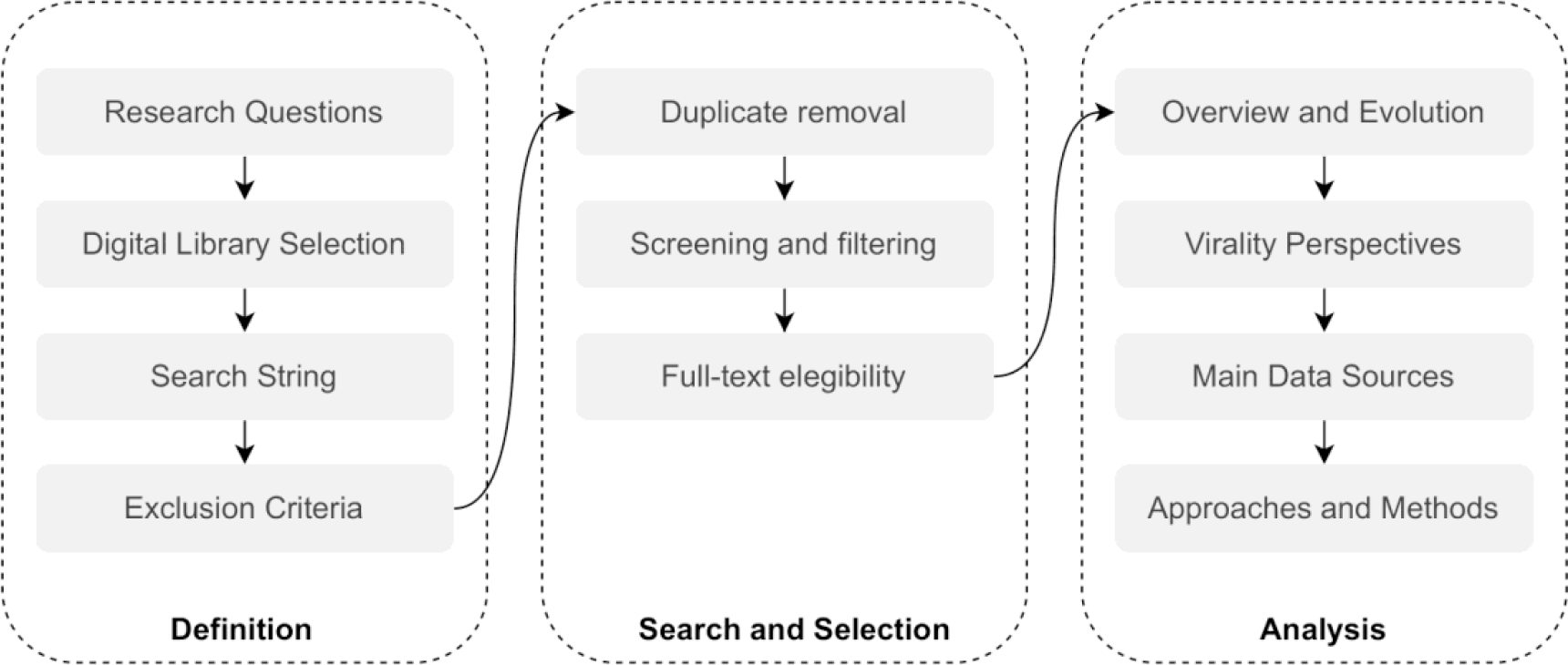
Inspired by the work of Pizzolitto (2024), we employ a three-phase protocol in this literature review. This protocol is illustrated by Figure 1 and allows a rigorous and structured approach to synthesize the existing knowledge on music virality and its implications (i.e., the topic of interest of this work). Next, we describe in detail each of the review phases: definition (Section 1.1), search and selection (Section 1.2), and analysis (Section 1.3).

1.1. Phase 1: Definition
The definition phase of the review comprises all the steps prior to the search and selection of papers themselves. Specifically, we define the research questions, the databases, the search string, and the criteria for exclusion of papers.
Research Questions. The first step of the review involves defining the questions that will guide the research and analysis. Based on the main goal of the review (i.e., to understand the existing research on music virality on social media), we aim to answer the following research questions (RQs):
-
RQ1. How has research on music virality evolved?
-
RQ2. How do music virality processes on social media relate to the concept of mainstream success?
-
RQ3. What are the main domains, i.e., media platforms, in which viralization processes occur?
-
RQ4. What are the main approaches used to understand and model viral processes?
Digital Library Selection. Next, we define the databases from which the articles will be retrieved. Despite being in the field of social computing, this work has a strongly interdisciplinary character, being on the field with other areas of knowledge such as music itself, communication, sociology, among others. Therefore, it is important to analyze not only works from computer science, but also from these other areas, as such works can provide valuable knowledge about the definition and the factors behind the viralization processes. Here, we use four specific digital libraries, comprising works from several areas of knowledge: SCOPUS,5 Web of Science,6 EBSCOHost,7 and DBLP.8
Search String. To retrieve papers on music virality, we use the following search string in the selected databases: viral* AND (music OR song). We use the notation viral* to represent all derived terms of viral, including virality, viralization, and so on. We apply this string to the title, abstract and keywords fields of the works.
Exclusion Criteria. After defining the search string, we define article exclusion criteria (ECs) used in the selection phase (specifically, in the screening and filtering step). Such criteria help to filter the works that are actually related to the objective of the review, and each of them is described below.
-
EC1. The work is not written in English;9
-
EC2. The work has not been published in conference proceedings or journals;
-
EC3. The work is not peer-reviewed;
-
EC4. The work is not about music virality processes in social media (e.g., health, viral diseases, bioinformatics);
-
EC5. The work does not analyze the virality of the songs themselves, but focuses in other aspects (e.g., music-related textual or image memes).
1.2. Phase 2: Search and Selection
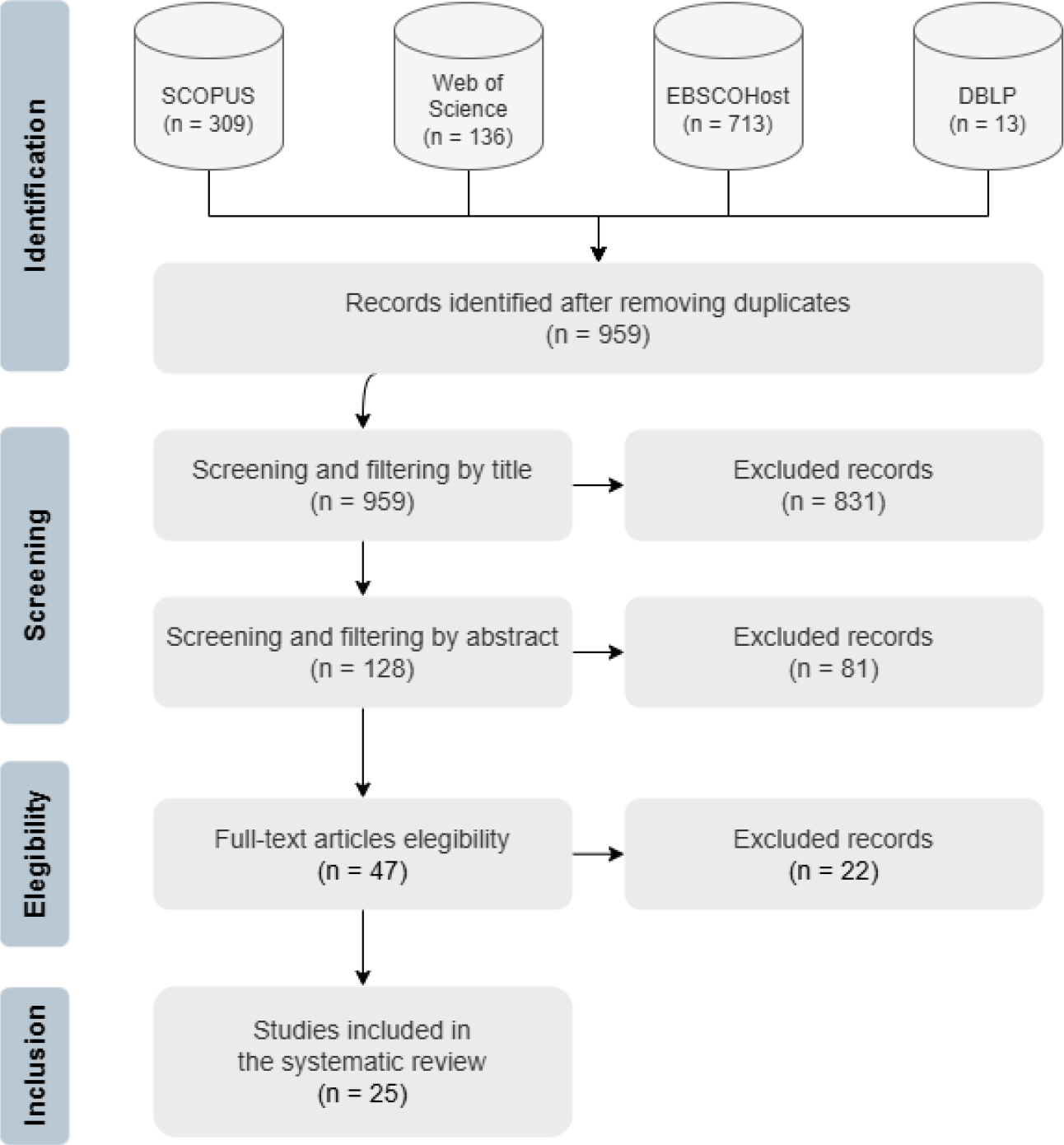
The second phase of the review protocol involves the search and selection of works to be analyzed. In this work, we consider studies published up to June 05, 2025, in peer-reviewed journals or conference proceedings. In total, 1,171 records were identified in the four databases considered (SCOPUS: 309, Web of Science: 136, EBSCOHost: 713, DBLP: 13). From this initial set, we perform four steps to create the final set of studies.
Duplicate Removal. Because we consider more than one database to search papers, there are cases in which the same work is indexed to more than one database. Therefore, we perform a duplicate record removal step through titles and authors.
Screening and Filtering. In this step, we filter the records by reading the title and abstract. While evaluating the studies, we also apply the exclusion criteria defined in the previous phase to exclude works that are not of interest to this research.
Full-text Eligibility. The last stage of the selection is the evaluation of the articles according to the full text, excluding records that do not fit the research goal.
Figure 2 illustrates the execution flow of the search and selection phase based on the PRISMA framework (Page et al., 2021),10 including the number of studies considered in each step. After performing all the steps, our final set includes 25 studies within the review's scope and will be considered in the analysis phase. The complete list of papers is described further in Section 7.

1.3. Phase 3: Analysis
Finally, after selecting the final set of studies, the last phase of the review is the analyses themselves. Each of the analyses performed in this work aims to answer one of the research questions mapped in the definition phase of the review.
Overview and Evolution (RQ1). In this first analysis, we examine the historical development of research on music virality by identifying patterns and trends over time.
Virality Perspectives (RQ2). Next, we detail the definitions used for virality in the music context, in addition to investigating the relationship with music success and analyzing the metrics and criteria that connect these two concepts.
Main Data Sources (RQ3). Here, we discuss the main data sources used in studies on music virality, such as social networks, streaming platforms, and consumer data.
Approaches and Methods (RQ4). Finally, we investigate the approaches and techniques employed to study virality, from quantitative methods, such as statistical modeling and machine learning, to qualitative analyses, such as case studies and interviews.
2. Overview and Temporal Evolution
We start our analyses by assessing RQ1 (“How has research on music virality evolved?”) through an overview of research on music virality. Specifically, we analyze the temporal evolution of research on this subject, tracing how interest in the topic has grown over time and identifying key milestones in the field. We also examine the areas of knowledge where such research is conducted, highlighting interdisciplinary contributions from fields such as communication, musicology, marketing, and computer science. In addition, we consider the impact of technological advancements on the studies, such as the rise of specific social media platforms and streaming services.
Content viralization is not a recent phenomenon, nor is the dissemination of music to the general public. For example, in the 1990s and early 2000s, music videos exhibited on television were one of the main ways for people to get music known (Coulter, 2022). However, with the popularization and democratization of access to the Web, social media platforms have played a major role in this process. Therefore, the study by Tan (2009) is the first to use the expression “going viral” to refer to the dissemination of musical content on social platforms. Specifically, the object of the research is a video containing a rap song produced by the Media Development Authority (MDA) of Singapore. In this context, the author relates the popularity of the video on YouTube to the spread of a computer virus.
Since then, music viralization on social platforms has been a subject of constant research. Figure 3 illustrates the temporal evolution of studies on this phenomenon. As of June 2025, we identified 25 peer-reviewed studies in English that deal exclusively with musical virality, highlighting the relevance of this emerging research topic.

When analyzing the evolution of studies on music virality, there are two specific periods in which there was a research interest in this subject. The first one occurred from 2009 to 2015, which in the music industry corresponds to the transition period from physical sales models to streaming and digital downloads. The consolidation of social networks reshaped how people interact with cultural products, and platforms such as Facebook, Twitter, and especially YouTube were spaces where music could be shared, discussed, and consumed directly. In addition, the meme culture and the growing trend of user-generated content became central to how music was consumed and disseminated. The song “Gangnam Style” by South Korean singer Psy is a good example of the power of platforms to boost music popularity. The song is a cultural phenomenon, having over 5.2 billion views on YouTube11 and being considered by many to be one of the main reasons for the popularization of K-pop worldwide.12
The second period of research on music virality began in 2020 and continues to this day. This period is marked by a new wave of social and technological transformations that have directly influenced music consumption. First, during the COVID-19 pandemic, digital media consumption skyrocketed, and music became a form of escape and social interaction. This period also marked the consolidation of short video platforms, such as TikTok, as the most influential for music discovery and viralization. Their ability to create and share music content easily has driven several tracks to popularity. For example, 13 of the 14 No. 1 songs on the Billboard Hot 100 (i.e., the main music chart in the US) in 2022 were driven by trends on TikTok.13
All these social, economic, and technological aspects make the viralization of music on social networks the subject of studies in the most diverse areas of knowledge. Figure 4 (left) shows the distribution of studies by field of knowledge of the media (i.e., journals and conferences) where they were published. The areas with the largest number of studies are computer science (9), music (3), and communication (3). In addition, there are studies published in inherently multidisciplinary venues, reinforcing the relevance and complexity of this topic. Nevertheless, other aspects of the viralization of music are also the subject of research in areas such as physics, mathematics, politics, business, and information science. The temporal evolution of studies in these areas (Figure 4, right) shows that most studies in computing took place in the first years of research (2009-2015), while studies in multidisciplinary and music venues are more recent.

Number of publications (left) and temporal evolution (right) by venue discipline. Note that there are venues with more than one knowledge field.
3. Virality Perspectives and Connections with Success
After having an overview on the research evolution about music virality, we now address RQ2 (“How do music virality processes on social media relate to the concept of mainstream success?”) by analyzing how the concept of virality is portrayed in the studies considered in this review and how it relates to the concept of success. Despite being a relatively simple concept related to the fast dissemination of content on social platforms (Guerini; Pepe; Lepri, 2021; Guerini; Strapparava; Ozbal, 2021), the concept of virality is described from different perspectives in the studies analyzed. Therefore, we categorize such works into four groups according to their perspective of virality: epidemiological, sociocultural, technological, and marketing. Each of these perspectives is described next.
The first group analyzes musical virality from an epidemiological perspective, treating the phenomenon as a contagion process, in which songs spread rapidly, similar to the spread of a virus (Nika et al., 2015; Tan, 2009). Specifically, the study by Lehman (2021) considers “going viral” as a digital contagion, whose origin in Latin means “touching”. Furthermore, Rosati et al. (2021) argue that a viral song could “infect” people through its dissemination across multiple media and platforms. Based on this analogy with epidemics, at the end of this period of contagion, a large part of the susceptible population would have been “infected” by this song, i.e., this population would recognize the song.
Other studies portray virality as a sociocultural phenomenon, that is, as a process deeply rooted in social and cultural interactions. Audiovisual content is referred to as the one that best represents the viral phenomenon (Cha; Pérez; Haddadi, 2012), and people's engagement in the content disseminated on the platforms is an essential part of such a phenomenon (Baños-González; Tiralaso; Fernández, 2020; Eromosele, 2021).
For example, when analyzing the virality of a music video in the 2008 US presidential campaign, Wallsten (2010) relates virality to the result of a complex and multidirectional interplay between the actions of Internet users, bloggers, campaign members, and journalists. The culture of memes is also mentioned by other works (Tinati; Tiropanis; Carr, 2013), and Freitas (2022) states that “virality, trolling, sharing, and creating are common practices of contemporary media that are not exclusive to memes, and rather symbiotic to all these forms of media”.
The third group of works uses a technological perspective, considering virality as a phenomenon shaped and facilitated by digital platforms and social media. For these studies, the platforms' structure and users' dynamics play a fundamental role in disseminating online content (Li; Shao, 2024; Oliveira; Couto da Silva; Moro, 2024a, 2024c). For example, in the context of music videos, Edmond (2014) cite actions such as tagging, sharing, liking, and using music videos as part of broader social media activities. In this sense, platforms such as YouTube (March, 2024; Sachak-Patwa; Fadai; Van Gorder, 2018) and TikTok (Coulter, 2022; Nwagwu; Akintoye, 2024; Rahardjo et al., 2024) are frequently cited when assessing the viral phenomenon.
Finally, some studies analyze musical virality from a marketing perspective, using concepts such as viral marketing and electronic word-of-mouth. The former is defined as the set of techniques that exploit preexisting social networks and interpersonal influences to increase awareness and achieve commercial objectives (e.g., sales, streams, etc.) (Barbieri; Bonchi, 2014). In contrast, the latter refers to the sharing of opinions on digital platforms to generate awareness about a subject or product among users (Sharma; Morales-Arroyo; Pandey, 2011; Sharma; Pandey, 2011). The works of Kahl (2012) and Kahl and Albers (2013) relate the two concepts by stating that music is inherently viral and that viral marketing strategies aim to stimulate word-of-mouth among consumers to actively propagate musical content, helping to expand its reach.
Virality Mechanism. It is also possible to classify the works according to their propagation mechanisms and underlying intentions. That is, whether the studies work with organic or induced viralization. Most of the works identified in this review consider the first type, which occurs spontaneously, driven by genuine interest and engagement from the public. In this process, the content spreads naturally as people share it because they find it relevant, interesting, or emotionally resonant (Baños-González; Tiralaso; Fernández, 2020; Cha; Pérez; Haddadi, 2012; Edmond, 2014; Eromosele, 2021; Freitas, 2022; Lehman, 2021; March, 2024; Nika et al., 2015; Oliveira; Couto da Silva; Moro, 2024a, 2024c; Rahardjo et al., 2024; Rosati et al., 2021; Sachak-Patwa; Fadai; Van Gorder, 2018; Tinati; Tiropanis; Carr, 2013). However, some works consider what we call induced virality, in which the dissemination of content results from different marketing actions (e.g., use of influencers, hashtags, or advertising campaigns) that aim to stimulate sharing and increase the visibility of the content (Barbieri; Bonchi, 2014; Kahl, 2012; Kahl; Albers, 2013; Li; Shao, 2024; Sharma; Morales-Arroyo; Pandey, 2011; Sharma; Pandey, 2011). Moreover, there are also works that consider both mechanisms in their analyses by investigating the relationship between political campaigns and the viralization of a music video (Wallsten, 2010) and also the relationship between TikTok, music creation, and the industry (Coulter, 2022).
Virality versus Success. As previously mentioned, we consider virality and success as two distinct facets of a song's popularity. In this regard, not all studies differ musical virality with the traditional definition of success. However, those that do, recognize both as inherent processes of songs (Freitas, 2022) and associate success with their frequency of consumption (Barbieri; Bonchi, 2014). In fact, musical success is traditionally measured by tangible metrics such as album sales (Sharma; Morales-Arroyo; Pandey, 2011; Sharma; Pandey, 2011), streams (Biasioli, 2024; Oliveira; Couto da Silva; Moro, 2024a, 2024c), chart positions (Coulter, 2022), and awards at large-scale events such as the Grammys or the MTV Video Music Awards (Edmond, 2014).
Furthermore, virality can also be seen as a stepping stone to mainstream success, but not as a guarantee of it (March, 2024). The symbiotic relationship between virality and success is addressed by Coulter (2022) and Biasioli (2024), who argue that there is a high level of virality spillover between social media and streaming. In other words, viral trends can serve as a way to bring a song to the mainstream. Therefore, the complex and multifaceted relationship between both concepts reflects the changing dynamics of the music industry as a whole, highlighting the need for a deeper understanding of music consumption relationships and the role of social platforms in this process.
4. Main Data Sources
In this section, we delve into the main platforms analyzed in studies on music virality to answer RQ3 (“What are the main domains, i.e., media platforms, in which viralization processes occur?”). As discussed in the previous section, there are studies that consider music virality from a technological perspective, that is, as a phenomenon shaped by platforms and social media. Such platforms, which range from video-sharing sites to social networks and streaming services, offer different mechanisms and characteristics that influence how a song goes viral. Here, we explore some of the main social platforms frequently addressed in the studies considered by this review, highlighting their specificities and impacts on music consumption and the music industry itself.
YouTube. Among the studies included in this review, YouTube is the most studied platform in the context of music viralization. Created in 2005, the platform was a pioneer in democratizing access to video production and consumption by allowing any user to upload content and reach a global audience. One of YouTube's main features is that it allows you to add a visual dimension to music, something that often influences the virality of content (Tan, 2009). Regarding metrics for virality, the number of views on the platform is the most used among the studies considered in this review (Baños-González; Tiralaso; Fernández, 2020; Cha; Pérez; Haddadi, 2012; Li; Shao, 2024; Sachak-Patwa; Fadai; Van Gorder, 2018; Wallsten, 2010), being used as one of the ways to measure the reach of videos in different contexts.
In addition, YouTube allows people to express opinions and thoughts about videos through comments. In this context, Sharma and Pandey (2011) and Sharma, Morales-Arroyo and Pandey (2011) analyze such comments alongside views to identify the impact of the electronic word-of-mouth (eWOM) phenomenon on music sales. Lyrics and other external elements are used by March (2024) to analyze how the music video for “Friday (Remix)” by Rebecca Black rebrands the singer's image and career after her original viral in 2011. Other qualitative studies perform case studies and analysis of other aspects of music videos on the platform to understand the viral phenomenon better (Eromosele, 2021; Freitas, 2022).
Blogs. Before the popularization of social networks, blogs were the main spaces where people could share content and opinions. Indeed, the first studies identified in this review considered blogs important sources for discovering new music and artists and, consequently, for the viralization of such content. For example, reinforces the role of bloggers in political campaigns by convincing people to watch a music video. Similarly, Sharma and Pandey (2011) and Sharma, Morales-Arroyo and Pandey (2011) consider blogs as primary sources of eWOM, thus impacting music sales. Finally, Cha, Pérez and Haddadi (2012) build a network of blog posts for extracting the social relationship between blogs and its relation to music spreading.
TikTok. In recent years (specifically after the COVID-19 pandemic), TikTok emerged as a social network that has significantly boosted the phenomenon of music virality. With its short, highly shareable video format, the platform allows users to create and share content in a quick, easy, and creative way, facilitating the emergence of challenges or viral memes that boost the popularity of songs. As a result, unknown artists can achieve success almost instantly if their songs become the soundtrack to popular trends on the platform. In this sense, Coulter (2022) analyzes in depth how the platform differentiates itself from others in promoting new music releases. In addition, Biasioli (2024) uses a case study to analyze phenomena adjacent to the viralization of a song, such as the removal of meanings from the song by users in favor of their self-expression, the memefication of a certain musical style, and the participation of the author in this process. Furthermore, Rahardjo et al. (2024) investigate how musical variables influence content virality on the platform, including aspects such as artist-related features, beat, and the number of shares.
Music consumption platforms. In addition to the social platforms where music is disseminated, considering how music is distributed and consumed is also a relevant factor when studying the phenomenon of musical virality. Before the popularization of streaming services, downloads were the primary way of obtaining music for consumption. In this regard, Nika et al. (2015) and Rosati et al. (2021) use the number of music downloads on platforms such as BitTorrent and MixRadio to model musical virality (sometimes described as popularity) as an epidemiological phenomenon. As they became more popular, streaming platforms, such as Spotify, started to deal with music viralization, creating specific rankings of the most viral songs. Such rankings are used by Oliveira, Couto da Silva and Moro (2024a, 2024c), who use a quantitative methodology to identify the factors differing viral from hit songs.
Other platforms. Other social networks have also played important roles in music viralization and have been used in several studies to understand this phenomenon. Among these platforms, Myspace was one of the pioneers in promoting music directly to fans, and the studies by Sharma and Pandey (2011) and Sharma, Morales-Arroyo and Pandey (2011) use posts and listening records on the platform as relevant factors to understand the eWOM phenomenon. Similarly, listening data from Last.fm are also considered to model social influence and product adoption by Barbieri and Bonchi (2014). In addition, Tinati, Tiropanis and Carr (2013) use Wikipedia as a primary data source, based on the premise that access to its articles could reflect human activity and can therefore be used to measure trends in the music scene. Finally, publications on other popular social networks, such as Twitter and Facebook, are also considered in some studies on disseminating musical content online (Freitas, 2022; Lehman, 2021).
Figure 5 presents an overview (left) and the temporal evolution (right) of the platforms considered in the studies of this review. Throughout the period analyzed, YouTube was the most used platform in studies of music virality, and it has been constantly used to this day. This reflects that, despite losing space as the main platform for content viralization, it is still highly relevant for online music consumption and is crucial in maintaining its virality. In addition, the temporal evolution of the sources also reflects the adoption and decline of social networks over time. For example, while Myspace was used in the early years of research on music virality, TikTok and Spotify emerged only recently, coinciding with their popularization.

Number of publications (left) and temporal evolution (right) by data source. Note that there are publications that consider more than one data source.
5. Approaches and Methods
We now move into the final research question, RQ4 (“What are the main approaches used to understand and model viral processes?”), in which we analyze the methodology of the works assessing music virality. In this review, we evaluate the works in two dimensions: the approach and the methodology used. The first assesses whether the work uses a more theoretical and conceptual approach or follows a practical and experimental line. In contrast, the latter evaluates explicitly the methods used, classifying the works as either quantitative or qualitative methodology. Figure 6 and Table 1 present the works considered in this review according to the two dimensions mentioned. The joint analysis of such dimensions allows the identification of four categories used in the works' classification. Each of them is detailed next.

Classification of the works considered in this review regarding their approaches (i.e., theoretical or experimental) and methodology (i.e., quantitative or qualitative).
Conceptual Explorations. The first group comprises works that analyze theories and concepts related to musical virality through case studies or content analysis without relying on numerical data. In addition, they can develop theories about qualitative factors regarding this phenomenon, including emotions and other cultural aspects. For example, Kahl (2012) conducts literature research to analyze how the characteristics of digital music relate to viral marketing strategies. In contrast, the works of Edmond (2014), Eromosele (2021) and Biasioli (2024) use case studies to perform conceptual analyses on changes in the music industry, user responses, and the processes behind the circulation of viral content on digital platforms, respectively. Other studies in this category analyze references in popular songs (Lehman, 2021), the structure of specific platforms such as TikTok (Coulter, 2022), and the production of memes (Freitas, 2022) to discuss concepts about the phenomenon of music viralization.
Abstract Models. In the context of musical virality, theoretical studies with a quantitative methodology propose theoretical models or conceptual explanations using metrics to study the phenomenon in question. These studies develop epidemiological models for music viralization based on the premise that such a phenomenon can be interpreted as a contagion process.
For example, Nika et al. (2015) propose a model for the spread of online content as a set of multiple epidemics, combining classic models such as SIR (Susceptible-Infected-Recovered) and IR (Infected-Recovered). Moreover, Sachak-Patwa, Fadai and Van Gorder (2018) develop a SEIRS (Susceptible-Exposed-Infected-Recovered-Susceptible) model to represent the evolution of the popularity of viral videos. Finally, Li and Shao (2024) modify the classic SIR model to incorporate the influences of sharing and advertising in videos that go viral. Although all such studies also present validation with real data, their focus relies on proposing a model, thus justifying their classification as theoretical.
Exploratory Field Studies. This category refers to practical and experimental studies that explore the phenomenon of music virality through qualitative data, such as interviews and observations. For example, Kahl and Albers (2013) use interviews with several people in the music industry to assess the critical factors for the viral marketing of digital music. Furthermore, Nwagwu and Akintoye (2024) interview Nigerian artists to understand how social platforms are used to disseminate their productions. In contrast, the works of Tan (2009) and March (2024) use content and discourse analysis to analyze how the viral phenomenon relates to government bodies and artists' public image, respectively.
Empirical Experiments. The last group comprises research with a practical approach that uses numerical data and clear metrics to test or validate concepts and hypotheses in a real scenario.
Studies in this category use a wide variety of techniques, but statistical approaches are the most common. For example, Wallsten (2010) uses a vector autoregression model and Granger Causality to examine the relationship between variables such as number of views, blog mentions, political campaigns, and media coverage on the viralization of a music video. In contrast, the works of Sharma and Pandey (2011) and Sharma, Morales-Arroyo and Pandey (2011) use the so-called Object-Oriented Theoretical Framework to model the effect of electronic word-of-mouth on music sales. Specifically, both apply multivariate linear regression to correlate consumer actions across platforms with sales rankings.
Furthermore, other studies explore several other methods according to their objective. For instance, Cha, Pérez and Haddadi (2012) model a network to represent the relationship between blogs through HTML links and evaluate the diffusion of musical content through them. The work of Tinati, Tiropanis and Carr (2013) use time series analysis and correlation to measure viral trends from user activity on Wikipedia. In turn, Barbieri and Bonchi (2014) treat the viral adoption process of music as an optimization problem in viral marketing by addressing social influence and product design characteristics. Then, Baños-González, Tiralaso and Fernández (2020) perform a content analysis to explain the viral capacity of music videos, while Rosati et al. (2021) perform a comparative analysis between epidemiological and phenomenological models to explain the viralization of music through downloads, demonstrating the better efficiency of the former. Regarding more recent social platforms, Rahardjo et al. (2024) apply a machine learning approach to identify the most relevant features for content virality on TikTok, finding that the number of shares was the strongest predictor. Such a result suggests that social connections among users play a key role in triggering viral spread. Finally, Oliveira, Couto da Silva and Moro (2024a, 2024c) quantitatively investigate which characteristics are important to differentiate virality and musical success in Global and Brazilian music markets. Their findings emphasize the importance of extrinsic features such as artist-based and temporal for a more accurate definition of hits and virals.
6. Research Directions
Based on the overview of the evolution of the research on music virality, the main data sources, approaches, and methods, we now identify and discuss potential research directions on such a subject. More than open research problems, such topics are relevant for understanding the factors behind music virality on social platforms and can also provide meaningful insights about the viral dynamics of other types of content.
Temporal relationship with success. The symbiotic relationship between musical virality and success supports the hypothesis that virality on social platforms can be a stepping stone for a song's commercial success. Indeed, almost all No. 1 hits in the United States and the United Kingdom in 2022 were driven by viral trends on TikTok.14 Despite the similarity in their definitions, quantitatively studying the temporal connection between these two phenomena can uncover the complex interactions between them, and preliminary studies have already started to delve into such a task (Oliveira; Couto da Silva; Moro, 2024b). However, they are linked to specific platforms, and therefore they may not capture all the underlying dimensions of such phenomena.
Recommendation algorithms. Most of the current social networks are based on a personalized content feed so that people can see content that is more suited to their tastes. Therefore, recommendation algorithms play a central role in the viralization of online content. Studies such as Ivanov et al. (2017) focus on content recommendation itself, but little is known about the impact of recommendation algorithms on popular platforms such as TikTok and Spotify, as well as how recommendation drives the subsequent success of such songs. Therefore, diving into this particular focus could provide more insights into the connection between song virality and commercial success.
Community analysis. Still, regarding content dissemination, the existence of personalized feeds makes specific content go viral in certain niches or user communities. Regarding music, future work can compare the mass viralization of songs with the same process in more segmented groups, for example, analyzing geographic and cultural borders.
Platform influence analysis. Although the phenomenon of music going viral occurs regardless of platform, the unique characteristics of each platform (e.g., public, recommendation algorithm, interaction dynamics, etc.) may influence how and why a given piece of content goes viral. For example, videos on YouTube may go viral differently than songs on TikTok or Spotify. Therefore, studying such dynamics comparatively could help to better understand how different media formats and social interactions impact music dissemination online.
Ethical aspects. Recommendation algorithms play a key role in content virality within social platforms, especially on those in which the user's feed is not only composed of content posted by people they follow but also other relevant recommended content (e.g., “for you” pages). Therefore, it is reasonable to say that music virality can be artificially boosted by bots (i.e., automated accounts) and invasive marketing strategies, which raises questions about authenticity and transparency. Hence, exploring such ethical challenges would contribute to understanding how to balance virality with fair and responsible practices in the music industry.
7. Discussion and Final Considerations
In this article, we performed a literature review on music virality within social platforms. Following a research protocol that defines the research questions, search repositories, and exclusion criteria, we considered 25 peer-reviewed articles in English published in journals and conferences from different areas of knowledge. The research on music virality was then analyzed under four aspects: temporal evolution, perspectives, and relationship with success, platforms considered, and methodology. Table 2 summarizes the works considered in this review and their main characteristics according to the aforementioned analyses.
In relation to RQ1 (How has research on music virality evolved?), research on music virality has been recurrent since the first decade of the 21st century. With the popularization of the Web and social networks, content dissemination has become one of the main phenomena observed on such platforms. As it involves concepts from areas such as music, computing, and communication, analyses of music virality have a strong multidisciplinary character. Despite being relevant to Computing, this is reflected in the diversity of knowledge fields of the venues of the publications in this review. When analyzing the temporal evolution of the research, we also identify two periods of interest on this subject. Such periods coincide with the rise and consolidation of platforms such as YouTube and TikTok as protagonists in music virality. Both platforms have in common the fact that they allow users to share videos quickly and easily.
Regarding RQ2 (How do music virality processes on social media relate to the concept of mainstream success?), music consumption through streaming, downloads, and sales can be one of the ways to measure musical success (Seufitelli et al., 2023). Despite being closely related concepts, in this work, we consider virality and success as distinct yet interconnected facets of musical popularity. Regarding this review, although not all studies make this distinction, a significant part of them contrast the two concepts. Whereas all of them relate virality to rapid sharing on online platforms, success is more solid and linked to music consumption itself. The relationship between both concepts becomes clearer when we consider that the viralization of a song can also be an initial step towards its success, with viral trends potentially causing a considerable increase in streams.
Moving to RQ3 (What are the main domains, i.e., media platforms, in which viralization processes occur?), YouTube is by far the most used, as it is the main place where music videos are posted. The viral effect makes these videos widely disseminated online, reaching millions or even billions of views. In recent years, TikTok has revolutionized video sharing and reshaped the phenomenon of music viralization. Such a platform allows excerpts of songs to go viral as part of challenges and viral trends. However, other platforms and data sources are also relevant to understanding this phenomenon. In particular, blogs were widely used in the early years of research on music virality because they were important places for sharing content and opinions. Download and streaming are also relevant in this context because they represent music consumption itself.
Finally, regarding the main methodologies used (RQ4: What are the main approaches used to understand and model viral processes?), the existing studies are divided between qualitative and quantitative analyses, thus performing conceptual and content analyses, as well as experimental studies. In the field of Computing and other exact sciences, a group of studies stands out for proposing and using contagion models to represent the phenomenon of viralization on social networks. Such studies are based on the definition of virality and the fact that the spread of online content can be understood as an epidemic. The main advantage of these models is the interpretability of their parameters, which is fundamental for understanding this phenomenon.
In conclusion, the emergence of research on music virality is aligned with the increasing relevance of how social platforms shape entertainment and content consumption. Indeed, it is a multidisciplinary research field that uses concepts and techniques from computing, music, communication, business, and other sciences. Therefore, the growing interest in this field not only benefits all such sciences but also other parts of the music ecosystem. For example, understanding users' behavior on social platforms regarding viral songs can help artists, producers, and other music actors plan their next releases and marketing strategies.
In contrast, it can also shed light on algorithmic biases that may drive visibility on digital platforms, offering ways to support independent or marginalized artists. From an artistic perspective, such insights may inspire creative practices that critically engage with or subvert algorithmic logics, increasing the impact of this research beyond market-driven interpretations. Hence, besides summarizing the main studies on music virality, this article can also contribute to new advancements in this emerging field.
ACKNOWLEDGMENT
This work was supported by Fundação de Amparo à Pesquisa do Estado de Minas Gerais (FAPEMIG), Coordenação de Aperfeiçoamento de Pessoal de Nível Superior (CAPES), and Conselho Nacional de Desenvolvimento Científico e Tecnológico (CNPq), Brazil.
-
1
<https://www.forbes.com/advisor/in/business/social-media-statistics/> Acesso em: 07 nov. 2025.
-
2
<https://www.billboard.com/charts/hot-100/> Acesso em: 07 nov. 2025.
-
3
This chart was discontinued after the TikTok and Billboard partnership ended on March 1, 2025.
-
4
<https://charts.spotify.com/> Acesso em: 07 nov. 2025.
-
5
<https://www.scopus.com/> Acesso em: 07 nov. 2025.
-
6
<https://www.webofknowledge.com/> Acesso em: 07 nov. 2025.
-
7
<https://www.ebsco.com/> Acesso em: 07 nov. 2025.
-
8
<https://dblp.org/> Acesso em: 07 nov. 2025.
-
9
We only include papers published in English because it is the primary indexing language of the repositories searched, thus ensuring consistency and comparability of results.
-
10
PRISMA stands for Preferred Reporting Items for Systematic Reviews and Meta-Analyses. It provides a guideline for reporting different types or aspects of systematic reviews.
-
11
As of September 2024: <https://www.youtube.com/trends/records/> Acesso em: 07 nov. 2025.
-
12
<https://www.nme.com/features/opinion/psy-gangnam-style-10-years-anniversary-k-pop-impact-3269841> Acesso em: 07 nov. 2025.
- 13
- 14
-
RESEARCH DATA AVAILABILITY
- Data use not reported; no research data generated or used.
REFERENCES
- ANTYPAS, Dimosthenis; PREECE, Alun; CAMACHO-COLLADOS, Jose. Negativity spreads faster: A large-scale multilingual twitter analysis on the role of sentiment in political communication. Online Social Networks and Media, v. 33, p. 100242, jan. 2023.
- BAÑOS-GONZÁLEZ, Miguel; TIRALASO, Héctor Canorea; FERNÁNDEZ, Mario Rajas. La difusión del vídeo musical en YouTube. Análisis de la capacidad viral del vídeoclip. Revista Latina, n. 77, p. 117-141, 30 jul. 2020.
- BARBIERI, Nicola; BONCHI, Francesco. Influence Maximization with Viral Product Design. In: PROCEEDINGS OF THE 2014 SIAM INTERNATIONAL CONFERENCE ON DATA MINING. Proceedings of the 2014 SIAM International Conference on Data Mining Society for Industrial and Applied Mathematics, 28 abr. 2014. . Acesso em: 27 maio. 2025
- BIASIOLI, Marco. “It wasn’t our song anymore”: Molchat Doma, the death of the reader and the birth of the TikToker. IASPM Journal, v. 14, n. 1, 18 mar. 2024.
- CASTIGLIONE, Aniello et al. Cognitive Analysis in Social Networks for Viral Marketing. IEEE Transactions on Industrial Informatics, v. 17, n. 9, p. 6162-6169, set. 2021.
- CHA, Meeyoung; PÉREZ, Juan Antonio Navarro; HADDADI, Hamed. The spread of media content through blogs. Social Network Analysis and Mining, v. 2, n. 3, p. 249-264, set. 2012.
- COULTER, Andi. Marketing Agile Artists: How Music Labels Can Leverage TikTok’s Virality. Journal of the Music and Entertainment Industry Educators Association, v. 22, n. 1, p. 135-161, 2022.
- EDMOND, Maura. Here We Go Again: Music Videos after YouTube. Television & New Media, v. 15, n. 4, p. 305-320, maio 2014.
- EROMOSELE, Femi. What Happens When a Music Video Goes Viral? Gastrocomedy and Prosumer Recreations of Timaya’s I Can’t Kill Myself Journal of African Cultural Studies, v. 33, n. 4, p. 424-440, 2 out. 2021.
- FIRDAUS, Syeda Nadia; DING, Chen; SADEGHIAN, Alireza. Retweet: A popular information diffusion mechanism - A survey paper. Online Social Networks and Media, v. 6, p. 26-40, jun. 2018.
- FREITAS, Joana. ‘Make Classical Music Great Again’: Contemporary Music, Masculinity, and Virality in Memetic Media in Online Spaces. Contemporary Music Review, v. 41, n. 4, p. 429-444, 4 jul. 2022.
- GOMES, Carlos et al. Crowdsourcing for music: Survey and taxonomy. In: 2012 IEEE INTERNATIONAL CONFERENCE ON SYSTEMS, MAN AND CYBERNETICS (SMC2012). 2012 IEEE International Conference on Systems, Man, and Cybernetics (SMC) Seoul, Korea (South): IEEE, out. 2012. . Acesso em: 30 maio. 2025
- GUERINI, Marco; PEPE, Alberto; LEPRI, Bruno. Do Linguistic Style and Readability of Scientific Abstracts Affect their Virality? Proceedings of the International AAAI Conference on Web and Social Media, v. 6, n. 1, p. 475-478, 3 ago. 2021.
- GUERINI, Marco; STRAPPARAVA, Carlo; OZBAL, Gozde. Exploring Text Virality in Social Networks. Proceedings of the International AAAI Conference on Web and Social Media, v. 5, n. 1, p. 506-509, 3 ago. 2021.
- HOSSEINI, Akram Sadat; STAAB, Steffen. Emotional Framing in the Spreading of False and True Claims. In: WEBSCI ’23: 15TH ACM WEB SCIENCE CONFERENCE 2023. Proceedings of the 15th ACM Web Science Conference 2023 Austin TX USA: ACM, 30 abr. 2023. . Acesso em: 30 maio. 2025
- IVANOV, Sergei et al. Content Recommendation for Viral Social Influence. In: SIGIR ’17: THE 40TH INTERNATIONAL ACM SIGIR CONFERENCE ON RESEARCH AND DEVELOPMENT IN INFORMATION RETRIEVAL. Proceedings of the 40th International ACM SIGIR Conference on Research and Development in Information Retrieval Shinjuku Tokyo Japan: ACM, 7 ago. 2017. . Acesso em: 30 maio. 2025
- JEN, Shiau Chou et al. Constructive Approach for Early Extraction of Viral Spreading Social Issues from Twitter. In: WEBSCI ’20: 12TH ACM CONFERENCE ON WEB SCIENCE. 12th ACM Conference on Web Science Southampton United Kingdom: ACM, 6 jul. 2020. . Acesso em: 30 maio. 2025
- JIANG, Lu et al. Viral Video Style: A Closer Look at Viral Videos on YouTube. In: ICMR ’14: INTERNATIONAL CONFERENCE ON MULTIMEDIA RETRIEVAL. Proceedings of International Conference on Multimedia Retrieval Glasgow United Kingdom: ACM, abr. 2014. . Acesso em: 30 maio. 2025
- KAHL, Christian. Create Attention to Attract Attention - Viral Marketing of Digital Music in Social Networks. In: AMERICAS CONFERENCE ON INFORMATION SYSTEMS. Proceedings of the Americas Conference on Information Systems 2012.
- KAHL, Christian; ALBERS, Andreas. How to Unleash the Virus -- Social Networks as a Host for Viral Music Marketing. In: 2013 IEEE 15TH CONFERENCE ON BUSINESS INFORMATICS (CBI). 2013 IEEE 15th Conference on Business Informatics Vienna, Austria: IEEE, jul. 2013. . Acesso em: 27 maio. 2025
- KONG, Quyu et al. Will This Video Go Viral: Explaining and Predicting the Popularity of Youtube Videos. In: COMPANION OF THE WEB CONFERENCE 2018. Companion of The Web Conference 2018 - WWW ’18 Lyon, France: ACM Press, 2018. . Acesso em: 30 maio. 2025
- KUMAR, Sachin; JHA, Alok Nikhil. Fake News Goes Viral! Determination and Analysis of Virality of Socially Relevant Events in Digital Governance. In: ICEGOV 2022: 15TH INTERNATIONAL CONFERENCE ON THEORY AND PRACTICE OF ELECTRONIC GOVERNANCE. Proceedings of the 15th International Conference on Theory and Practice of Electronic Governance Guimarães Portugal: ACM, 4 out. 2022. . Acesso em: 30 maio. 2025
- LE COMPTE, Daniel; KLUG, Daniel. “It’s Viral!” - A Study of the Behaviors, Practices, and Motivations of TikTok Users and Social Activism. In: CSCW ’21: COMPUTER SUPPORTED COOPERATIVE WORK AND SOCIAL COMPUTING. Companion Publication of the 2021 Conference on Computer Supported Cooperative Work and Social Computing Virtual Event USA: ACM, 23 out. 2021. . Acesso em: 30 maio. 2025
- LEHMAN, Eric T. “Washing Hands, Reaching Out” - Popular Music, Digital Leisure and Touch during the COVID-19 Pandemic. Leisure Sciences, v. 43, n. 1-2, p. 273-279, mar. 2021.
- LI, Yifei; SHAO, Li. Using an epidemiological model to explore the interplay between sharing and advertising in viral videos. Scientific Reports, v. 14, n. 1, p. 11351, 18 maio 2024.
- LING, Chen et al. Slapping Cats, Bopping Heads, and Oreo Shakes: Understanding Indicators of Virality in TikTok Short Videos. In: WEBSCI ’22: 14TH ACM WEB SCIENCE CONFERENCE 2022. 14th ACM Web Science Conference 2022 Barcelona Spain: ACM, 26 jun. 2022. . Acesso em: 30 maio. 2025
- MARCH, Lucy. Coming out online: Memetic authenticity in Rebecca Black’s “Friday (Remix)”. Popular Communication, v. 22, n. 1, p. 33-46, 2 jan. 2024.
- MATHEW, Binny et al. Spread of Hate Speech in Online Social Media. In: WEBSCI ’19: 11TH ACM CONFERENCE ON WEB SCIENCE. Proceedings of the 10th ACM Conference on Web Science Boston Massachusetts USA: ACM, 26 jun. 2019. . Acesso em: 30 maio. 2025
- NIKA, Marily et al. Going Multi-viral: Synthedemic Modelling of Internet-based Spreading Phenomena. In: 8TH INTERNATIONAL CONFERENCE ON PERFORMANCE EVALUATION METHODOLOGIES AND TOOLS. Proceedings of the 8th International Conference on Performance Evaluation Methodologies and Tools Bratislava, Slovakia: ICST, 2015. . Acesso em: 27 maio. 2025
- NWAGWU, Williams E.; AKINTOYE, Ayobola. Influence of social media on the uptake of emerging musicians and entertainment events. Information Development, v. 40, n. 4, p. 667-692, nov. 2024.
- OLIVEIRA, Gabriel P.; COUTO DA SILVA, Ana Paula; MORO, Mirella M. What makes a viral song? Unraveling music virality factors. In: WEBSCI ’24: 16TH ACM WEB SCIENCE CONFERENCE. ACM Web Science Conference Stuttgart Germany: ACM, 21 maio 2024a. . Acesso em: 27 maio. 2025
- OLIVEIRA, Gabriel P.; COUTO DA SILVA, Ana Paula; MORO, Mirella M. Analyzing the temporal relation between virality and success in the Brazilian music market. In: SEMINÁRIO INTEGRADO DE SOFTWARE E HARDWARE. Anais do LI Seminário Integrado de Software e Hardware (SEMISH 2024) Brasil: Sociedade Brasileira de Computação - SBC, 21 jul. 2024b. . Acesso em: 30 maio. 2025
- OLIVEIRA, Gabriel P.; COUTO DA SILVA, Ana Paula; MORO, Mirella M. A quantitative comparison of viral and hit songs in the Brazilian music market. Revista Vórtex, v. 12, p. 1-29, 7 set. 2024c.
- PAGE, Matthew J. et al. The PRISMA 2020 statement: an updated guideline for reporting systematic reviews. BMJ, p. n71, 29 mar. 2021.
- PIZZOLITTO, Elia. Music in business and management studies: a systematic literature review and research agenda. Management Review Quarterly, v. 74, n. 3, p. 1439-1472, set. 2024.
- RAHARDJO, Evelyn Zefanya et al. Viral Melodies: Exploring the Factors Influencing Music Virality in TikTok Engagement. In: 2024 4TH INTERNATIONAL CONFERENCE OF SCIENCE AND INFORMATION TECHNOLOGY IN SMART ADMINISTRATION (ICSINTESA). 2024 4th International Conference of Science and Information Technology in Smart Administration (ICSINTESA) Balikpapan, Indonesia: IEEE, 12 jul. 2024. . Acesso em: 6 jun. 2025
- ROSATI, Dora P. et al. Modelling song popularity as a contagious process. Proceedings of the Royal Society A: Mathematical, Physical and Engineering Sciences, v. 477, n. 2253, p. 20210457, set. 2021.
- SACHAK-PATWA, Rahil; FADAI, Nabil T.; VAN GORDER, Robert A. Understanding viral video dynamics through an epidemic modelling approach. Physica A: Statistical Mechanics and its Applications, v. 502, p. 416-435, jul. 2018.
- SEUFITELLI, Danilo B. et al. Hit song science: a comprehensive survey and research directions. Journal of New Music Research, v. 52, n. 1, p. 41-72, jan. 2023.
- SHARMA, Ravi S.; MORALES-ARROYO, Miguel; PANDEY, Tushar. The Emergence of Electronic Word-of-Mouth as a Marketing Channel for the Digital Marketplace. Journal of Information, Information Technology, and Organizations (Years 1-3), v. 6, p. 041-061, 2011.
- SHARMA, Ravi S.; PANDEY, Tushar. The impact of electronic word-of-mouth in the distribution of digital goods. Webology, v. 8, n. 1, 2011.
- TAN, Shzr Ee. Singapore Takes the ‘Bad’ Rap: A State-Produced Music Video Goes ‘Viral’. Ethnomusicology Forum, v. 18, n. 1, p. 107-130, jun. 2009.
- TINATI, Ramine; TIROPANIS, Thanassis; CARR, Lesie. An approach for using Wikipedia to measure the flow of trends across countries. In: WWW ’13: 22ND INTERNATIONAL WORLD WIDE WEB CONFERENCE. Proceedings of the 22nd International Conference on World Wide Web Rio de Janeiro Brazil: ACM, 13 maio 2013. . Acesso em: 27 maio. 2025
- WALLSTEN, Kevin. “Yes We Can”: How Online Viewership, Blog Discussion, Campaign Statements, and Mainstream Media Coverage Produced a Viral Video Phenomenon. Journal of Information Technology & Politics, v. 7, n. 2-3, p. 163-181, 18 maio 2010.
- WERBER, Niels et al. Getting Noticed by Many: On the Transformations of the Popular. Arts, v. 12, n. 1, p. 39, 17 fev. 2023.
- ZAREIE, Ahmad; SAKELLARIOU, Rizos. Rumour spread minimization in social networks: A source-ignorant approach. Online Social Networks and Media, v. 29, p. 100206, maio 2022.
Edited by
-
Editór: Dr. Felipe de Almeida Ribeiró; Dr. Fabió Guilherme Pólettó.
- Data use not reported; no research data generated or used.

 Source: Authors (2025)
 Source: Authors (2025)
 Source: Authors (2025)
 Source: Authors (2025)
 Source: Authors (2025)
 Source: Authors (2025)