
 Technological arrangements for regulating access to healthcare: experience in the state of São Paulo
OBJECTIVE To describe and analyze the regulatory arrangements used to expand access to beds and health services during Covid-19.
METHODS This study, part of the Research for the SUS Program funded by Fundação de Amparo à Pesquisa do Estado de São Paulo (Fapesp) and the Secretaria de Ciência, Tecnologia, Inovação e Insumos Estratégicos em Saúde do Ministério da Saúde (Sctie-MS) Fapesp/Sctie used mixed methods to investigate the management of network care to face Covid-19 in São Paulo. Data was collected via an electronic questionnaire sent to managers in 645 municipalities between November 2021 and February 2022, with the support of the São Paulo Council of Municipal Health Secretaries (COSEMS-SP). The responses were analyzed quantitatively and qualitatively, with a focus on regulating access to healthcare.
RESULTS 255 valid responses were collected (39.5% of São Paulo municipalities). Most municipalities regulated Covid-19 beds through the state regulation center (58%) and faced difficulties with access (53.7%), insufficient beds and 68.6% difficulties with hospitalization. The creation of new services was reported by 83.1%, and 70.0% implemented specific flows to expand access. In outpatient access, 54.5% used multiple regulation strategies. Financial resources were sufficient for 54.0% of the municipalities and 86.3% faced difficulties in acquiring supplies. Statistically significant associations were observed between municipal size and regulation variables.
CONCLUSION The Covid-19 pandemic has highlighted the importance of bed regulation and the unequal distribution between the public and private sectors. This study identified challenges such as insufficient beds, difficulties in admitting patients, and a reduction in outpatient services. Large municipalities have expanded beds through field hospitals and agreements with private hospitals. Small and medium-sized municipalities adopted regional strategies and multiple protocols. Regional coordination and state regulation were crucial in managing the response, but difficulties with supplies and human resources impacted on access. The incorporation of digital mechanisms and new regulatory strategies was important, despite the structural and political challenges that aggravated the emergency response.
DESCRIPTORS
Effective Access to Health Services; Health Care Coordination and Monitoring; Bed Occupancy; COVID-19
 Thumbnail
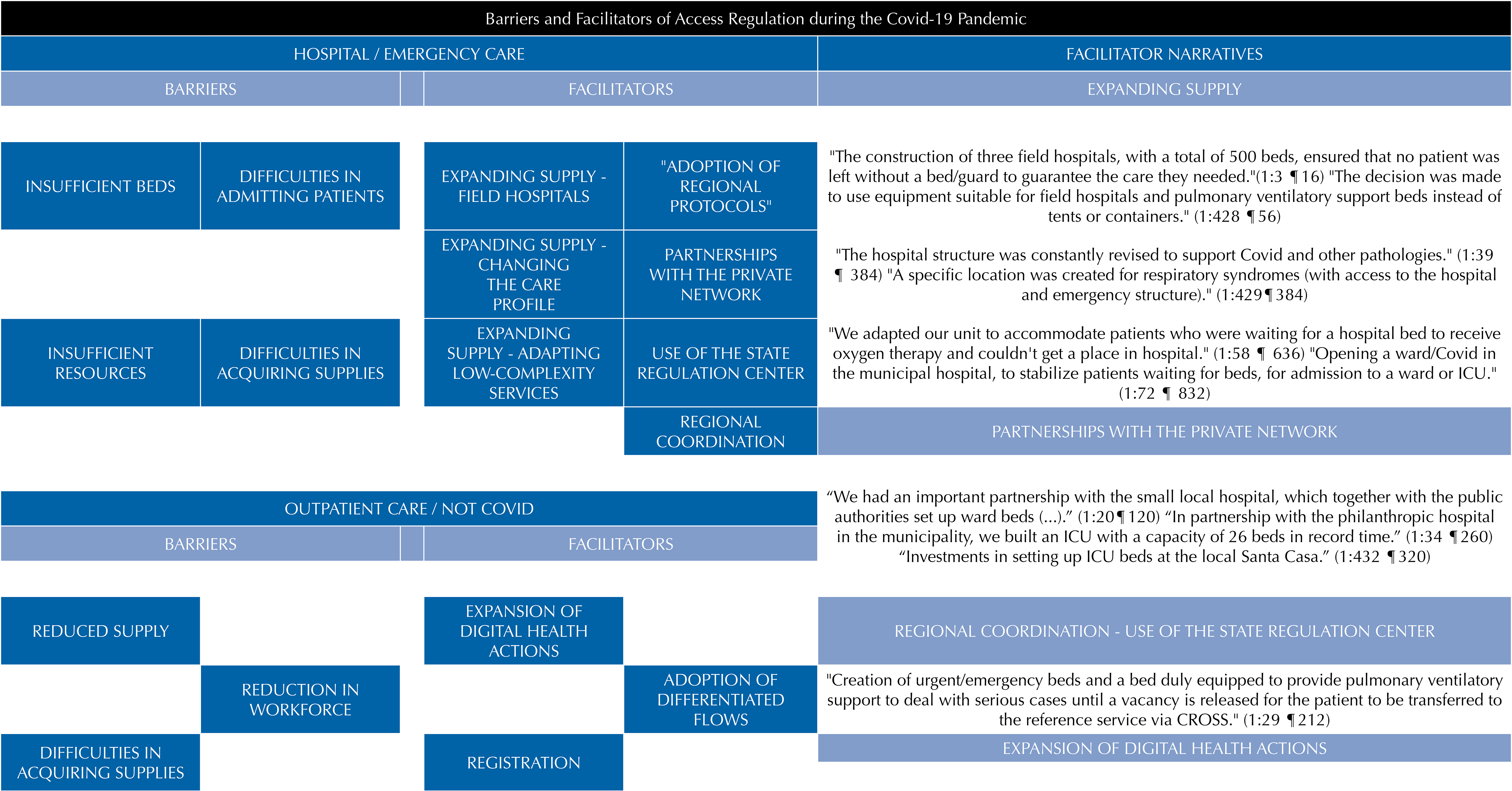 Note: The identification of citations uses the references provided by the AtlasTi software in the format D:C ¶ P D=document number, C=code number and P=paragraph number. ICU: intensive care unit; CROSS: São Paulo State Health Services and Supply Regulation Center.