 First report of immature forms of Anopheles albitarsis s.l. (Diptera: Culicidae) collected in artificial containers in an urban area of the state of Acre, Western Brazilian Amazon
ABSTRACT
Background: This study reports the first documented occurrence of immature forms of Anopheles albitarsis in artificial breeding sites within an urban area of Acre, Brazil.
Methods: Second-instar larvae were collected from a water tank.
Results: The collected larvae were identified as Anopheles albitarsis, representing the first report of this species in artificial breeding sites in an urban area of Acre.
Conclusions: The detection of immature forms in artificial containers suggests potential adaptation of the vector to urban settings and highlights concerns regarding the increased risk of malaria transmission in areas previously regarded as low-risk.
Keywords:
Mosquito-borne diseases; Malaria; Public health
Malaria is a disease caused by protozoa of the genus Plasmodium, transmitted to humans by bites from female mosquitoes of the genus Anopheles1. In 2023, global malaria cases were estimated at 263 million, with an incidence rate of 60.4 cases per 1,000 inhabitants, reflecting an increase of 11 million cases compared to the previous year2. In Brazil, malaria remains a major public health concern, particularly in the Amazon region, where more than 99% of reported cases occur3.
The main malaria vectors in Brazil are members of the subgenera Anopheles (Nyssorhynchus) and Anopheles (Kerteszia), with particular emphasis on Anopheles (Nyssorhynchus) darlingi, the primary vector in the Amazon region4,5. Approximately 103 species of Anophelinae have been documented in Brazil, including 30 yet to be formally named3. Within the Brazilian Legal Amazon, an estimated 49 species have been recorded6,7.
Anopheles albitarsis s.l. (Diptera: Culicidae) represents a complex of cryptic species, comprising five formally described taxa (Anopheles albitarsis s.s., Anopheles marajoara, Anopheles deaneorum, Anopheles janconnae, and Anopheles oryzalimnetes), three of which (A. marajoara, A. deaneorum, and A. oryzalimnetes) have been documented in the state of Acre. Additionally, four other unnamed species -Anopheles albitarsis F, Anopheles albitarsis G, Anopheles albitarsis H, and Anopheles albitarsis I8-have been identified.
This study reports the first detection of immature forms of A. albitarsis s.l. collected from artificial containers in an urban area in the state of Acre, Western Brazilian Amazon. In July 2024, during routine entomological surveillance activities by the Rio Branco Municipal Health Department's entomological surveillance team, as part of the Rapid Index Survey for Aedes aegypti (LIRAa), larvae were collected from urban artificial breeding sites. The samples were obtained from a residence in the São Francisco housing development in Rio Branco, Acre (Lat. 9°56′52.21″S and Long. 9°56′52.21″W), located near a forest fragment and a pond, environments conducive to mosquito development. Larvae were identified in a 500-L water tank adjacent to two 1,000-L tanks (Figure 1).

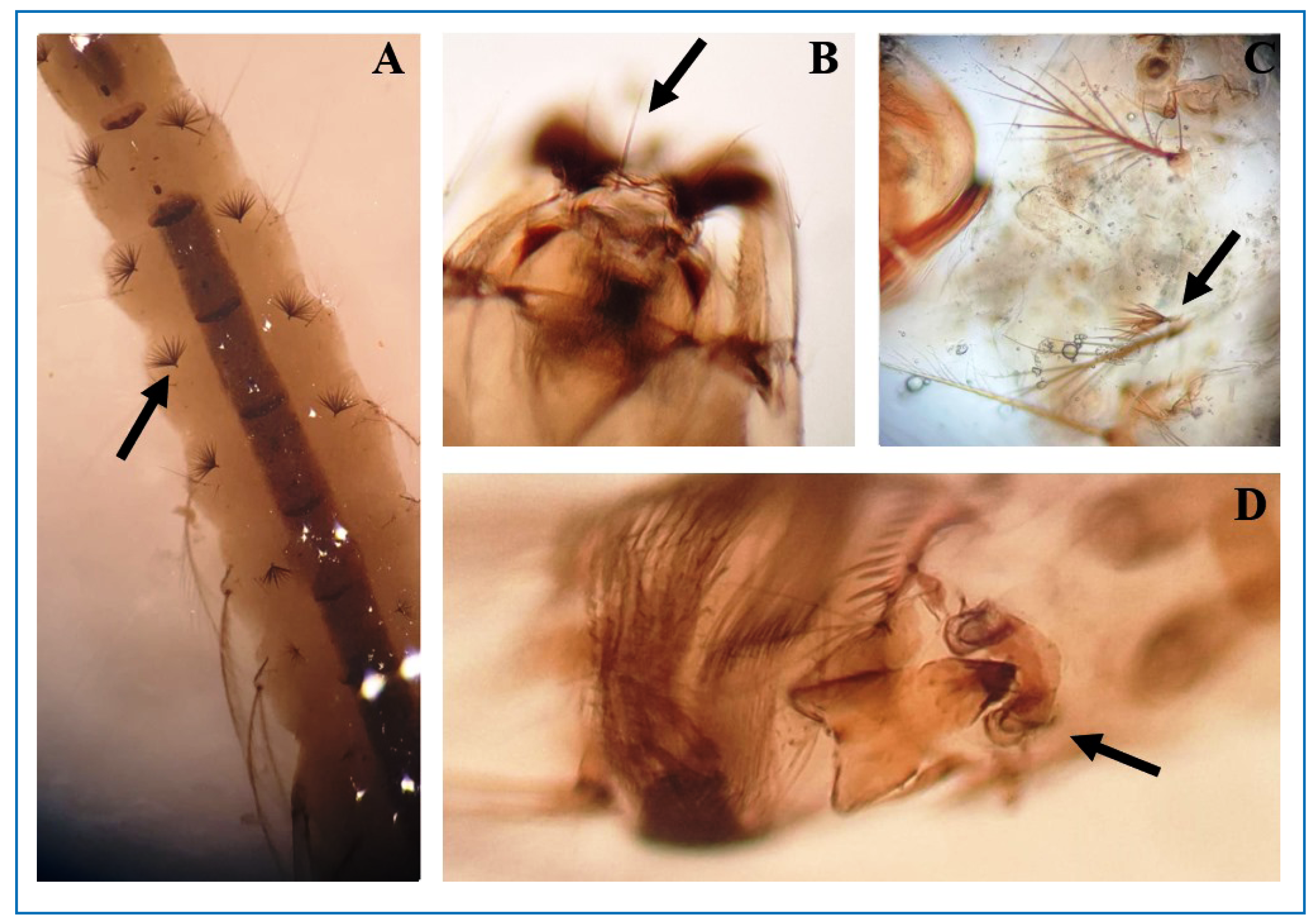
Morphological identification was carried out using the taxonomic keys of Consoli and Oliveira. The larvae were classified as second-instar A. albitarsis s.l. (Figure 2). Specific species determination was precluded due to limitations in infrastructure and molecular analysis resources.

Immature forms of A. albitarsis s.l. collected from artificial containers in an urban area of Rio Branco, Acre. (A) Palmate abdominal setae with smooth branches; (B) Setae 2,3-C smooth and widely spaced; (C) Setae 2,3-P inserted on a common basal tubercle; (D) Spiracular plate.
Adult A. albitarsis exhibit abdominal tergites with postero-lateral tufts of dark scales beginning from segment III, and clear spots along the anterior wing veins, particularly on the costa, composed of pale scales similar in color to those found on posterior tarsi III-V9. Larval characteristics include palmate abdominal setae with smooth branches (A) and widely spaced, smooth setae 2,3-C (B). On the prothorax, setae 2,3-P arise from a common basal tubercle (C), and the presence of a spiracular plate (D)-a diagnostic feature of the genus Anopheles9-was observed.
Research in the Brazilian Amazon has demonstrated that A. albitarsis can be naturally infected by Plasmodium vivax and Plasmodium falciparum, serving as an occasional vector for malaria transmission, particularly in areas where A. darlingi is also present10, such as the municipality of Rio Branco3. This underscores the risk of vector-borne transmission associated with this species.
The identification of immature A. albitarsis s.l. in artificial containers within urban settings suggests behavioral adaptation to climatic conditions, as these forms have previously been noted only in natural breeding habitats. Laporta et al.11 demonstrated that behavioral modifications in malaria vectors correlate with landscape changes in the Amazon. Environments with intermediate forest cover and recent human settlements are associated with increased risk of Plasmodium sp. transmission due to higher vector-human contact11.
Sampling near a forest fragment suggests possible shifts in vector behavior in response to environmental impacts of rapid, unplanned urbanization, mirroring findings from São Paulo12 and Rio de Janeiro13. Previous studies highlight that deforestation due to unregulated human expansion intensifies forest fragmentation and promotes higher vector densities, such as Anopheles, by increasing available breeding sites and facilitating greater human-mosquito interaction11,14.
Mapping breeding sites, particularly those identified in this research, aids in characterizing anopheline development in urban settings and reinforces the need to expand entomological surveillance efforts beyond traditionally recognized risk zones. Such initiatives should also inform vector control strategies, accounting for differences between A. aegypti and Anopheles spp., which pose challenges to integrated management due to their distinct behaviors15.
Reporting A. albitarsis s.l. larvae in urban artificial containers in Rio Branco constitute a novel regional finding, emphasizing the importance of robust entomological surveillance and indicating potential ecological adaptations in the species, potentially driven by environmental changes. Given its established vector competence for Plasmodium spp., the results highlight the need for tailored vector control programs that account for the ecological specificities of different taxonomic groups.
ACKNOWLEDGEMENTS
This work was carried out with support from the Conselho Nacional de Desenvolvimento Científico e Tecnológico (CNPq), process no. 304325/2024-4.
REFERENCES
- 1 Reis IC, Lana RM, Codeço CT, Dal’Asta AP, Barbosa M, Xavier DR. Co-occurrence of malaria and Chagas disease in the Brazilian Amazon: the need for integrated health surveillance. Cad Saude Publica. 2025;41:e00042124.
-
2 World Health Organization. World malaria report 2024: addressing inequity in the global malaria response. Geneva: WHO; 2024. Available from: https://www.who.int/publications/i/item/9789240104440
» https://www.who.int/publications/i/item/9789240104440 - 3 Sallum MAM, Azevedo TS, Conn JE, Lourenço-de-Oliveira R. Distribution of Anophelinae (Diptera: Culicidae) and challenges for malaria elimination in Brazil. Mem Inst Oswaldo Cruz. 2025;120:e240247.
- 4 Baia-da-Silva DC, Brito-Sousa JD, Rodovalho SR, Peterka C, Moresco G, Lapouble OMM, et al. Current vector control challenges in the fight against malaria in Brazil. Rev Soc Bras Med Trop. 2019;52:e20180542.
- 5 Bickersmith SA, Jurczynski JD, Sallum MAM, Chaves LSM, Bergo ES, Rodriguez GAD, et al. Mutations linked to insecticide resistance not detected in the Ace-1 or VGSC genes in Nyssorhynchus darlingi from multiple localities in Amazonian Brazil and Peru. Genes (Basel). 2023;14(10):1892.
- 6 Carlos BC, Rona LD, Christophides GK, Souza-Neto JA. A comprehensive analysis of malaria transmission in Brazil. Pathog Glob Health. 2019;113(1):1-13.
- 7 Meireles ACA, Silva LR, Simplício MF, Lima AA, Rios FGF, Menezes CA, et al. Anopheline diversity in urban and peri-urban malaria foci: comparison between alternative traps and seasonal effects in a city in the Western Brazilian Amazon. Malar J. 2022;21(1):258.
- 8 Zúñiga MA, Rubio-Palis Y, Brochero H. Updating the bionomy and geographical distribution of Anopheles (Nyssorhynchus) albitarsis F: a vector of malaria parasites in northern South America. PLoS One. 2021;16(6):e0253230.
- 9 Consoli RAGB, Oliveira RL. Principais mosquitos de importância sanitária no Brasil. Rio de Janeiro: Editora FIOCRUZ; 1994. 228 p.
- 10 Tadei WP, Dutary-Thatcher B. Malaria vectors in the Brazilian Amazon: Anopheles of the subgenus Nyssorhynchus. Rev Inst Med Trop Sao Paulo. 2000;42(2):87-94.
- 11 Laporta GZ, Ilacqua RC, Bergo ES, Chaves LSM, Rodovalho SR, Moresco GG, et al. Malaria transmission in landscapes with varying deforestation levels and timelines in the Amazon: a longitudinal spatiotemporal study. Sci Rep. 2021;11(1):6477.
- 12 Forattini OP, Kakitani I, Marques GRAM, Brito M. Formas imaturas de anofelíneos em recipientes artificiais. Rev Saúde Pública. 1998;32(2):189-91.
- 13 Carreira-Alves JR. Encontro de anofelinos do subgênero Nyssorhynchus em recipientes artificiais, Maricá, RJ, Brasil. Rev Saúde Pública. 2001;35(4):407-8.
- 14 Barros FS, Honório NA. Deforestation and malaria on the Amazon frontier: larval clustering of Anopheles darlingi (Diptera: Culicidae) determines focal distribution of malaria. Am J Trop Med Hyg. 2015;93(5):939-53.
- 15 Zara ALdSA, Santos SMd, Fernandes-Oliveira ES, Carvalho RG, Coelho GE. Strategies for control of Aedes aegypti: a review. Epidemiol Serv Saude. 2016;25(2):391-404.