 Surveillance Service of Yellow Fever in Non-Human Primates in the Federal District, Brazil, 2008-2022
ABSTRACT
Background: Surveillance of non-human primate (NHP) deaths is vital for the early detection of yellow fever (YF) and prevention of its spread to the human population. This study assessed the YF surveillance system for NHPs in the Brazilian Federal District (FD) from 2008 to 2022.
Methods: A retrospective analysis of the aggregated data from 15 years of outbreak surveillance involving NHP deaths was conducted. The analyzed variables included spatiotemporal distribution, species, sex, age, sample collection, cause of death, and YF test results.
Results: In total, 1,175 outbreaks involving 1,353 NHP deaths were recorded, averaging 1.35 animals per outbreak, in urban and peri-urban areas. Twenty YF-positive outbreaks were confirmed in 2008, 2015, and 2020, affecting 27 animals, mainly adult Callithrix spp., with an overall YF positivity rate of 2%. Surveillance coverage expanded across all administrative regions of FD, with 96.7% of NHP deaths sampled for YF and pathological analysis. Over the last 5 years, the rate of conclusive diagnoses has increased by 60%, with trauma and infectious diseases being the most common causes of death.
Conclusions: The strategic location of FD reinforces the need for ongoing NHP death surveillance as an early warning tool for patients with YF. Continued enhancement of the diagnostic capacity and data integration is essential for strengthening the prevention and control efforts of YF in Brazil.
Keywords:
Marmoset; Callithrix; Outbreak; Disease; Death; Investigation
INTRODUCTION
Epizootic surveillance in non-human primates (NHPs) plays a key role in Brazil's public health system, primarily by enabling early detection of yellow fever virus (YFV) transmission. As part of the National Program for the Control of Yellow Fever by the Brazilian Ministry of Health (BMH), the detection of YF in primates supports official health surveillance services in making timely decisions to protect human populations, thereby reducing the morbidity and mortality associated with YFV, particularly in areas with active or potential transmission1-3.
Historically, YF has emerged during different periods, causing outbreaks in free-ranging NHPs primarily in the Amazon region, but has also spread to other parts of Brazil. These outbreaks typically begin in sylvatic environments and may spill over into vulnerable human populations1,4,5. NHPs are competent hosts for YFV and exhibit both fatal and subclinical infections without any pathological findings1,2,6-9. Non-human primates serve as important sentinels for YF, providing early warnings that enable public health services to implement preventive measures.
The Federal District (FD) is the smallest unit of the Brazilian Federation and is located in Central Brazil (Midwestern Region), a transitional area between the Amazon and the densely populated Southeastern/Southern Regions. In addition, extensive forest fragments of the Savanna biome (Brazilian Cerrado) are interspersed among densely populated urban areas within the FD, providing suitable habitats for the principal YF vector mosquitoes that are abundant in this region10. Therefore, the strategic location of FD makes it crucial to conduct YF surveillance in NHPs to predict the spread of the disease to more populated regions. We evaluated the Surveillance Service of YF in NHPs in the Federal District, Brazil, from 2008 to 2022.
METHODS
A retrospective study was conducted over 15 years (2008-2022) using an aggregated dataset from the surveillance service of outbreaks of death in non-human primates (NHPs) conducted by the Environmental Zoonosis Surveillance Management, Directorate of Environmental Health Surveillance, Secretariat of Health from the Federal District (GVAZ/SES-FD), Brazil. Primary data were retrieved from the Epizootic Notification Forms of the Notifiable Diseases Information System (SINAN, Brazilian Ministry of Health) and notification spreadsheets of deaths in NHPs from the GVAZ/SES-FD, under the authorization of the Directorate of Environmental Health Surveillance, DIVAL/SES-FD.
GVAZ/SES-FD gathered all NHPs found dead in the Federal District, epidemiological reports of deaths were recorded, and tissue samples were collected during necropsies for histological evaluation, immunohistochemistry, and molecular assays (RT-PCR, available since 2017) for YF detection in the reference laboratories of the Brazilian Ministry of Health (BMH), including the Evandro Chagas Institute (IEC), Adolfo Lutz Institute (ADL), and the Veterinary Pathology and Forensic Laboratory of the University of Brasília (VPFL/UnB). The diagnosis of YF in the BMH reference laboratories includes IHC using alkaline phosphatase with a polymer method9,11 and RT-PCR12.
The data analyzed in this study included the spatiotemporal distribution of outbreaks in NHPs; the number of animals involved in outbreaks; species, sex, and age of the animals; the number of samples collected and sent to the BMH Reference Diagnostic Laboratories; primary causes of death; and laboratory results for YF tests. The number of recorded outbreaks with deaths in NHPs was also grouped and compared at 5-year intervals from 2008 to 2012, 2013 to 2017, and 2018 to 2022. The causes of death in the NHPs were classified as traumatic injuries, infectious/parasitic diseases, others, or inconclusive.
Statistical, descriptive, and frequency analyses were performed using Excel 365 and GraphPad Prism 8.0. The QGIS 3.28.10 (Firenze) Geographic Information System (GIS) software was used to standardize the geographic data and create maps. Geographic information was obtained from the GeoPortal-DF and Brazilian Institute of Geography and Statistics (IBGE) websites. This study was conducted with permission from the Secretariat of Health of the Federal District (SEI Process 00060-00452543/2023-90).
RESULTS
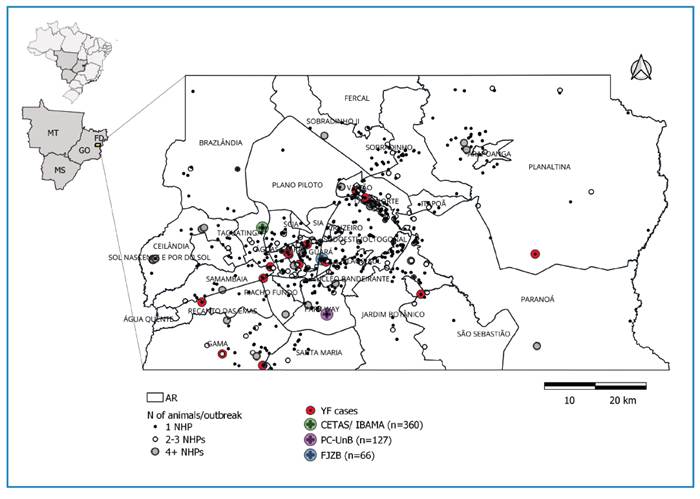
Between January 2008 and December 2022, 1,175 outbreaks were recorded, resulting in the deaths of 1,353 NHPs, representing an average of 1.15 dead animals/outbreak. Individual deaths accounted for 91.3% (n = 1073/1,175) and multiple animal deaths occurred in 8.7% (n = 102/1,175) of the epidemiological investigations (Figure 1). Among the recorded outbreaks, 52.9% (n = 622/1,175) were geolocated deaths caused by free-living NHPs. In comparison, 47.1% (n = 553/1,175) of the captive or free-living animals were collected by local environmental authorities, for which there was no information on the geographic coordinates of the location of death. These animals received or were kept and died at the Wildlife Screening and Rehabilitation Center (FD), 30.6% (n = 360/1,175) (CETAS, Brazilian Institute of Environment and Renewable Natural Resources, IBAMA), Primatology Center UnB, 10.8% (n = 127/1,175) (PC-UnB), and Brasília Zoological Garden Foundation FD, 5.6% (n = 66/1,175) (FJZB) (Figure 1).
Spatial distribution of outbreaks with the death of NHPs and cases of YF in the Federal District, Brazil, 2008-2022.
Of the 1,353 animals evaluated in this study, most NHPs were adults of the Callithrix genus, followed by Sapajus, Alouatta, and other genera kept in captivity at FJZB and CP-UnB (Table 1). The Administrative Regions (ARs) of the Federal District (FD) with the highest number of outbreaks in NHPs were Lago Norte (6.9%, n = 81/1,175), Lago Sul (5.5%, n = 65/1,175), Candangolândia (3.6%, n = 43/1,175), Park Way (3.6%, n = 43/1175), and Guará (3.5%, n = 42/1,175). The ARs with the fewest outbreak notifications in NHPs were Cruzeiro (n = 3/1,175), Riacho Fundo II (0.2%, n = 3/1175), Sol Nascente (0.2%, n = 3/1,175), Riacho Fundo (0.15%, n = 2/1,175), SCIA (0.15%, n = 2/1,175), Varjão (0.1%, n = 1/1,175), and SIA (0.1%, n = 1/1,175). All ARs of FD had at least one death in the NHPs recorded, with 46.0% (n = 540/1175) of outbreaks occurring in peri-urban areas, followed by 36.0% (n = 423/1,175) in urban areas (p < 0.01), and 18.0% (n =212/1,175) in rural areas (Figure 1).
Genus, gender and age range (%) of NHPs found dead in outbreaks in the Federal District, Brazil, 2008 to 2022.
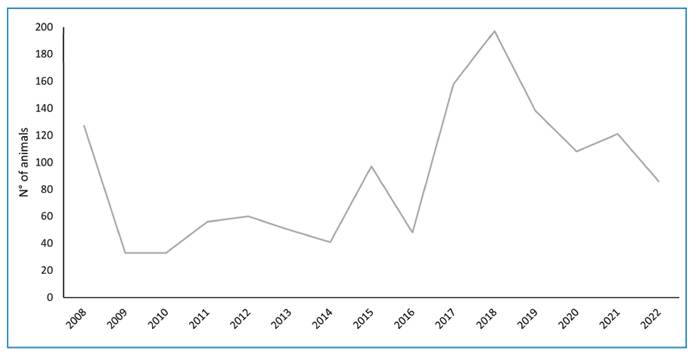
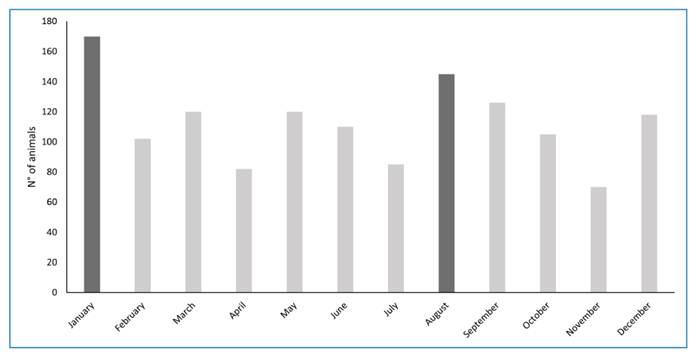
When analyzing the dataset at 5-year intervals, an increase in outbreaks of deaths in NHPs by GVAZ/SES-FD was noted from 2008 to 2012 (22.2%, n = 261/1,175), 2013 to 2017 (30.1%, n = 354/1,175), and 2018 to 2022 (47.7%, n = 560/1,175) across these periods. The highest number of deaths recorded in NHPs was in 2017 and 2018 (Figure 2). January and August had the highest number of outbreaks, followed by November (Figure 3).
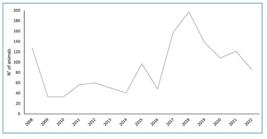
Annual distribution of outbreaks with the death of NHPs in the Federal District, Brazil, 2008-2022.
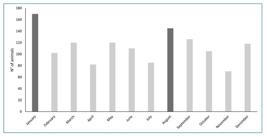
Monthly distribution of outbreaks with the death of NHPs in the Federal District, Brazil, 2008-2022. Months with dark bars showed a high frequency of deaths in the analyzed period.
In 96.7% of deaths evaluated in NHPs (n = 1,308/1,353), samples were collected for pathological evaluation and referred to the official reference laboratories for YFV detection. Laboratory diagnosis of YF could not be performed in 21.3% (n = 288/1,353) of the cases because of inappropriate samples due to advanced decomposition of the carcasses. Diagnosis of causes of death in NHPs was inconclusive in 50.0% (n = 654/1,308) of cases (most tested negative for YF, excepting some animals with no tissue sampling due to advanced carcass decomposition), with a marked reduction of around 40 to 42% of inconclusive diagnoses (p < 0.01) from 2018 to 2022 (36.9%, n = 240/650) compared to 2008-2012 (61.8%, n = 165/267) and 2013-2017 (63.7%, n = 249/391), respectively. Conclusive diagnoses (50.0%, n = 654/1,308) included traumatic injuries (61.3%, n = 401/654), infectious diseases (31.2%, n = 204/654), and other causes of death (7.5%, n = 49/654).
During this study, 20 YF outbreaks were recorded, including 27 animals (1.35 animals detected per outbreak), distributed across three distinct periods: 2008 (positivity of 6.4%, n = 3/47), 2015 (positivity of 15.5%, n = 14/90), and 2020 (positivity of 9.4%, n = 10/106). These outbreaks accounted for 2.5% (n = 27/1065) of all NHP deaths in YF. In 2008 and 2015, and one case in 2020, 66.7% (n = 18/27) showed hepatic YF-associated lesions, such as midzonal to panlobular hepatic necrosis and estatosis with Councilmann bodies2,6,8, and tested positive for YF via IHC assay, whereas 33.3% (n = 9/27) were positive by RT-PCR and showed no liver damage in 2020 (quantification cycles-Cq: 30-37). The genus Callithrix was the most affected by YF in FD, representing 85.2% of all cases (n = 23/27), with the majority being adults (66.7%, n = 18/27).
DISCUSSION
Surveillance of outbreaks involving NHP deaths in Brazil enables early detection of YFV circulation and informs decisions to prevent YF in vulnerable human populations. Notable examples of effective YF and other outbreak surveillance in NHPs have been reported, primarily in the Southeastern and Southern regions of Brazil1,2,3,10, where the implementation of the SISS-GEO application, developed for the geolocation and health surveillance of wild animals, has substantially strengthened disease monitoring, planning of preventive measures, and predictive modeling efforts13. However, this information is lacking for Central Brazil.
Over the 15 years of this study, YF surveillance strategies in FD have resulted in the recording of over 1,100 outbreaks, with an annual average of approximately 80 outbreaks, affecting more than 90 non-human primates (NHPs)14. The number of NHPs per YF outbreak in FD was lower than that recorded between 2008 and 2009 in São Paulo State (1.6 NHPs/outbreak)15, and the national average of 1.8 NHPs detected per outbreak in Brazil from 2007 to 200916. Differences in the genus, density, and distribution of NHP populations, as well as environments and distinct biomes, may explain the differences between FD and other locations.
Despite the surveillance of YF prompting the investigation of NHP outbreaks in FD as an essential component of the National Program for the Prevention of YF, YFV infections accounted for only 2.5% (n = 27/1,065) of all dead animals tested for YF and 13.2% of infectious disease cases. These cases were distributed across three distinct periods of YFV transmission (2008, 2015, and 2020) and primarily affected marmosets, with positivity rates ranging from 6.4% to 15.5%. The low positivity rate for YF in NHPs in this study contrasts with most studies conducted on YF surveillance in Northwestern, Southeastern, and Southern Brazil, where positivity rates can reach over 68%, particularly in areas with a high incidence of Alouatta1,2,6,7,17,18. Therefore, surveillance of outbreaks with deaths in NHPs in FD exhibited significant differences from other regions of Brazil, with relatively low positivity rates in NHPs, even during periods of YFV transmission.
Callithrix (mainly C. penicillata) was the primary genus of free-ranging NHPs involved in FD outbreaks, followed by Sapajus (S. libidinosus) and Alouatta (A. caraya). Most affected individuals were adults without a sexual predisposition. These NHP genera are frequently involved in outbreaks in Brazil, although their proportions vary significantly by region1,2,3,14,15,18. The black-tufted marmoset (C. penicillata) is particularly well adapted to human-altered environments, thrives in urban and peri-urban areas, and is abundant in the Cerrado biome19,20, as observed in the FD.
Outbreaks also involved the deaths of capuchins (S. libidinosus) and howler monkeys (A. caraya), as well as YF cases in these genera, and mainly occurred in environmentally protected and peri-urban areas during the initial years of this study. Over the last 10 years, the marked expansion of urban regions and anthropogenic pressure on natural environments in the FD have likely negatively affected NHP populations. Further studies are needed to investigate the potential causes of the likely population decline of capuchins and howler monkeys, as well as the impact of increased forest fragmentation on FD.
The marked differences in YF positivity in NHPs in FD compared to other locations in Brazil may be related to the higher frequency of black-tufted marmosets and the likely low number of howler monkeys in the region, different environments, and biomes, which may have influenced the dynamics and transmission of YF. Despite the limited number of samples, during the YFV outbreak in 2020, only one in 10 YF-positive Callithrix spp. was detected by histopathological evaluation and IHC assay when RT-PCR tests were used concurrently for YF diagnosis in FD. Marmosets have demonstrated low viral loads and/or low rates of death and positivity in YF outbreaks, possibly due to different susceptibilities to YFV infection compared to Alouatta, which is considered one of the most susceptible NHP genera to YF in Brazil1,6,7,2,8. The low positivity rate of YF in this study, primarily determined using immunohistochemistry (IHC) assays, may be attributed to the majority of the tested animals belonging to the Callithrix genus, as previously reported2,7,8. In addition, this rate would likely be higher if all samples were tested with highly sensitive molecular assays, such as RT-PCR, which have been used in other YF outbreaks in NHPs, mainly involving Callithrix spp. in the Southeast and Northeast regions of Brazil7,17.
The FD is located in Midwestern Brazil and forms part of the ecological corridor for the circulation and propagation of YFV. These spatial corridors originate in the Amazon region and extend along a north-south axis, passing through the Midwest region and continuing toward the southeast and South Brazil5. The FD serves as a transition zone between the Amazon and the Southeast/South regions, which have the highest human population density in Brazil and variable YF vaccination coverage18. Consequently, even with the low positivity rate for YFV, surveillance of outbreaks in NHPs in the Federal District is strategic and crucial because of its geographical location. It plays a key role in raising awareness of new YFV emergence or circulation, and in implementing preventive measures in other Brazilian regions.
The Health Surveillance Agency of the Federal District (GVAZ/SES-FD) achieved a marked increase of 58%-112% in the records of investigated outbreaks in NHPs from 2018 to 2022 (47.7%, n = 560/1175) compared with 2013 to 2017 (30.1%, n = 354/1175) and 2008-2012 (22.2%, n = 261/1175). January and August had the highest number of NHP deaths. Similar seasonal variations have been observed in other studies in Southeast Brazil, showing differences in the number of NHP deaths across years and months15,18.
The marked increase in the records of outbreaks involving NHPs in FD over the last 5 years, even during the SARS-CoV-2 pandemic, which negatively impacted disease surveillance globally, can likely be attributed to a public outcry for YF prevention and control. This heightened concern stemmed from one of Brazil's worst YF outbreaks, with over 2,000 cases and hundreds of human deaths in the southeastern Region between 2017 and 2018, particularly in the state of Minas Gerais4. This public outcry possibly increased the sensitivity of the population and health surveillance services to NHP deaths, including FD. However, from 2019 to 2022, the number of NHPs collected for YF surveillance in the FD gradually decreased, suggesting a weakening of the local health surveillance service, a decrease in the sensitivity of the population to report deaths in NHPs, and the impact of the COVID-19 pandemic on official health services. This study recorded outbreaks involving NHP deaths, with only a few cases related to YFV infection. Therefore, most cases result from other causes of death in NHP, presenting different epidemiologies and indeterminate seasonality, complicating comparisons with other studies investigating YF outbreaks15,18 or hypothesizing the reasons for these variations.
Most outbreaks in NHPs were recorded in urban or peri-urban areas (81.9%, n = 963/1,175), with Lago Norte, Lago Sul, Candangolândia, and Guará being the RAs with the highest number of records in the FD. Favorable environmental conditions for NHP populations, such as vegetation, shelter, and food availability, can enable the establishment of marmoset populations and facilitate their movement in highly urbanized areas21,22. Unfortunately, it was not possible to determine the primary reasons for these findings because of the lack of studies on NHP population dynamics in the urban and peri-urban areas of the FD. In addition, the propensity of residents to report NHP deaths and the higher density of populated regions may increase the likelihood of sick or dead animals being found and reported to the GVAZ/SES-FD, possibly explaining the higher number of NHP deaths recorded in certain areas.
As a health surveillance service, the GVAZ/SES-FD demonstrated consistent results, sampling most NHP deaths for pathological and YF diagnoses (96.7%). Unfortunately, a YF diagnosis was not performed in approximately 21% of the sampled carcasses because of advanced decomposition. In studies on the surveillance of deaths among NHP during severe YF outbreaks, most animals could not be sampled or tested for YFV infection1,14. Poor carcass preservation and difficulties in adequate sampling under field conditions have been identified as the leading causes of improper YF laboratory tests1,3,14. The small territorial extent of the FD, encompassing a large metropolis, such as Brasília, and extensive urban areas, possibly facilitated the reporting of deaths, collection of dead NHPs, and harvesting of samples for YF diagnosis.
The surveillance of NHP outbreaks aimed at preventing YF in FD experienced a significant reduction of approximately 60% in inconclusive diagnoses over the last 5 years (2018-2022) compared to the previous 10 years. Traumatic injuries (61.3%) and infectious diseases (31.2%) accounted for the majority of deaths. Recently, acute toxoplasmosis and electrocution were identified as some of the most important causes of infectious and traumatic deaths in marmosets in this region16,23,24. Other studies investigating the causes of death in NHPs in Pernambuco and Rio Grande do Sul have reported conclusive diagnostic rates ranging from approximately 53% to over 68%, with traumatic injuries and infectious diseases being the most frequent diagnoses25,26. In September 2017, as part of the Brazilian Ministry of Health's program for the decentralization and expansion of its Official Laboratory Network, the Regional Laboratory for the Diagnosis of Outbreaks and YF in NHPs was established at the University of Brasília, Brazil. This initiative resulted in the systematization of necropsies for all collected dead animals, as well as sampling for YF, thereby reducing the rate of inconclusive FD diagnoses.
This study also identified some challenges in the surveillance of NHP outbreaks in FD. Despite the significant increase in sampled animals over the last 5 years, following a peak in 2018, there was a marked reduction in the number of investigations into NHP deaths in subsequent years. Additionally, almost half of the animals had no recorded locations of NHP death, a considerable number of carcasses could not be sampled because of decomposition, and many animals had inconclusive pathological results despite testing negative for YF. These findings suggest a potential decline in NHP outbreak surveillance, which may be attributed to factors such as decreased public sensitivity to reporting animal deaths, a possible decline in NHP populations, the weakening of local health surveillance services, and other undetected causes.
CONCLUSIONS
Systematic surveillance of NHP outbreaks in FD has underscored its strategic importance and unique characteristics, mainly due to the predominance of marmosets and the low positivity rate for YF in the region. Given its strategic location in Central Brazil, the strengths and challenges of YF surveillance in FD demonstrate the need to improve and enhance the surveillance system. Such improvements are essential for better anticipation and development of strategies for YF prevention and population protection.
ACKNOWLEDGMENTS
This research was partly financed by the Coordination for the Improvement of Higher Education Personnel - Brazil (CAPES) - Finance Code 001 (LAC). We thank the National Council for Scientific and Technological Development (CNPq) for the Research Productivity grant (PQ), process n. 307909/2021-2 (MBC).
REFERENCES
-
1 Almeida MA, Cardoso JC, Dos Santos E, da Fonseca DF, Cruz LL, Faraco FJ, et al. Surveillance for yellow fever virus in non-human primates in southern Brazil, 2001-2011: a tool for prioritizing human populations for vaccination. PLoS Negl Trop Dis. 2014;8(3). doi: 10.1371/journal.pntd.0002741.
» https://doi.org/10.1371/journal.pntd.0002741 -
2 Fernandes NCC, Guerra JM, Díaz-Delgado J, Cunha MS, Saad LD, Iglezias SD, et al. Differential Yellow Fever Susceptibility in New World Non-human Primates, Comparison with Humans, and Implications for Surveillance. Emerg Infect Dis. 2021;27(1):47-56. doi: 10.3201/eid2701.191220.
» https://doi.org/10.3201/eid2701.191220 -
3 Silva NIO, Albery GF, Arruda MS, Oliveira GFG, Costa TA, de Mello ÉM, et al. Ecological drivers of sustained enzootic yellow fever virus transmission in Brazil, 2017-2021. PLoS Negl Trop Dis. 2023;17(6). doi: 10.1371/journal.pntd.0011407.
» https://doi.org/10.1371/journal.pntd.0011407 -
4 Garcia-Oliveira GF, Guimarães ACDS, Moreira GD, Costa TA, Arruda MS, de Mello ÉM, et al. YELLOW ALERT: Persistent Yellow Fever Virus Circulation among Non-Human Primates in Urban Areas of Minas Gerais State, Brazil (2021-2023). Viruses. 2023;16(1):31. doi: 10.3390/v16010031.
» https://doi.org/10.3390/v16010031 -
5 Giovanetti M, Pinotti F, Zanluca C, Fonseca V, Nakase T, Koishi AC, et al. Genomic epidemiology unveils the dynamics and spatial corridor behind the Yellow Fever virus outbreak in Southern Brazil. Sci Adv. 2023;9(35). doi: 10.1126/sciadv.adg9204.
» https://doi.org/10.1126/sciadv.adg9204 -
6 Fernandes NCCA, Cunha MS, Guerra JM, Réssio RA, Cirqueira CDS, Iglezias SD, et al. Outbreak of Yellow Fever among Non-human Primates, Espirito Santo, Brazil, 2017. Emerg Infect Dis. 2017;23(12):2038-41. doi: 10.3201/eid2312.170685.
» https://doi.org/10.3201/eid2312.170685 -
7 Mares-Guia MAMM, Horta MA, Romano A, Rodrigues CDS, Mendonça MCL, Dos Santos CC, et al. Yellow fever epizootics in non-human primates, Southeast and Northeast Brazil (2017 and 2018). Parasit Vectors. 2020;13(1):90. doi: 10.1186/s13071-020-3966-x.
» https://doi.org/10.1186/s13071-020-3966-x -
8 Passos PHO, Ramos DG, Romano AP, Cavalcante KRLJ, Miranda LHM, Coelho JMCO, et al. Hepato-pathological hallmarks for the surveillance of Yellow Fever in South American non-human primates. Acta Trop. 2022;231:106468. doi: 10.1016/j.actatropica.2022.106468.
» https://doi.org/10.1016/j.actatropica.2022.106468 -
9 Sousa DER, Wilson TM, Macêdo IL, Romano APM, Ramos DG, Passos PHO, et al. Case report: Urbanized non-human primates as sentinels for human zoonotic diseases: a case of acute fatal toxoplasmosis in a free-ranging marmoset in coinfection with yellow fever virus. Front Public Health. 2023;11:1236384. doi: 10.3389/fpubh.2023.1236384.
» https://doi.org/10.3389/fpubh.2023.1236384 -
10 Lira-Vieira AR, Gurgel-Gonçalves R, Moreira IM, Yoshizawa MA, Coutinho ML, Prado PS, et al. Ecological aspects of mosquitoes (Diptera: Culicidae) in the gallery forest of Brasília National Park, Brazil, with an emphasis on potential vectors of yellow fever. Rev Soc Bras Med Trop. 2013;46(5):566-74. http://dx.doi.org/10.1590/0037-8682-0136-2013
» https://doi.org/10.1590/0037-8682-0136-2013 -
11 Bollweg BC, Silva-Flannery L, Spivey P, Hale GL. Optimization of commercially available Zika virus antibodies for use in a laboratory-developed immunohistochemical assay. J Pathol Clin Res. 2017;4:19-25. doi: 10.1002/cjp2.84.
» https://doi.org/10.1002/cjp2.84 -
12 Domingo C, Patel P, Yillah J, Weidmann M, Méndez JA, Nakouné ER, Niedrig M. Advanced yellow fever virus genome detection in point-of-care facilities and reference laboratories. J Clin Microbiol. 2012;50(12):4054-60. https://doi.org/10.1128/JCM.01799-12.
» https://doi.org/10.1128/JCM.01799-12 -
13 Ministério da Saude. Plano de Contingência para Resposta às Emergências em Saúde Pública: febre amarela. (2ª edição), 2021. Available from: https://www.gov.br/saude/pt-br/centrais-de-conteudo/publicacoes/svsa/febre-amarela/plano_contingencia_emergencias_febre_amarela_2_ed-1.pdf/view
» https://www.gov.br/saude/pt-br/centrais-de-conteudo/publicacoes/svsa/febre-amarela/plano_contingencia_emergencias_febre_amarela_2_ed-1.pdf/view -
14 Hill SC, de Souza R, Thézé J, Claro I, Aguiar RS, Abade L, et al. Genomic Surveillance of Yellow Fever Virus Epizootic in São Paulo, Brazil, 2016 - 2018. PLoS Pathog. 2020;16(8). doi: 10.1371/journal.ppat.1008699.
» https://doi.org/10.1371/journal.ppat.1008699 -
15 Moreno ES, Spinola R, Tengan CH, Brasil RA, Siciliano MM, Coimbra TL, et al. Yellow fever epizootics in non-human primates, São Paulo state, Brazil, 2008-2009. Rev Inst Med Trop Sao Paulo. 2013;55(1):45-50. doi: 10.1590/s0036-46652013000100008.
» https://doi.org/10.1590/s0036-46652013000100008 - 16 Araújo FAA, Ramos DG, Santos AL, Passos PHO, Elkhoury ANSM, Costa ZGA, et al. Epizootias em primatas não humanos durante reemergência do vírus da febre amarela no Brasil, 2007 a 2009. Epidemiol Serv Saúde. 2011;20:527-36.
-
17 Sacchetto L, Silva NIO, Rezende IM, Arruda MS, Costa TA, de Mello ÉM, et al. Neighbor danger: Yellow fever virus epizootics in urban and urban-rural transition areas of Minas Gerais state, during 2017-2018 yellow fever outbreaks in Brazil. PLoS Negl Trop Dis. 2020;14(10). doi: 10.1371/journal.pntd.0008658.
» https://doi.org/10.1371/journal.pntd.0008658 -
18 Guimarães A, Oliveira MC, Kierulff MCM, Mendonça-Furtado O, Baptista MNM, Mendes SL, et al. Epidemiologic profile and histopathological findings in Neotropical Primates during and after the yellow fever outbreak in Espírito Santo, Brazil. An Acad Bras Cienc. 2022;94(suppl 3). doi: 10.1590/0001-3765202220211229.
» https://doi.org/10.1590/0001-3765202220211229 -
19 Duarte MH, Vecci MA, Hirsch A, Young RJ. Noisy human neighbours affect where urban monkeys live. Biol Lett. 2011;7:840-2. doi: 10.1098/rsbl.2011.0529.
» https://doi.org/10.1098/rsbl.2011.0529 -
20 Pereira AABG, Dias B, Castro SI, Landi MFA, Melo CB, Wilson TM, et al. Electrocutions in free-living black-tufted marmosets (Callithrix penicillata) in anthropogenic environments in the Federal District and surrounding areas, Brazil. Primates. 2020;61(2):321-9. doi: 10.1007/s10329-019-00760-x.
» https://doi.org/10.1007/s10329-019-00760-x - 21 Antworth RL, Pike DA, Stevens EE. Hit and run: effects of scavenging on estimates of roadkilled vertebrates. Southeast Nat. 2005;4(4):647-56.
-
22 Rodrigues NN, Martinez RA. Wildlife in our backyard: interactions between Wied's marmoset Callithrix kuhlii (Primates: Callithrichidae) and residents of Ilhéus, Bahia, Brazil. Wildl Biol. 2014;20:91-96. doi: 10.2981/wlb.13057.
» https://doi.org/10.2981/wlb.13057 - 23 Sousa DER, de Macêdo IL, de Albuquerque Cerqueira L, Melanie L, Dos Santos Pessoa VF, da Silva Rocha AS, et al. Insights into the threats of toxoplasmosis for free-ranging black-tufted marmosets living in our neighborhood. Scientific reports. 2025;15(1):16047.
-
24 Barros RM, Macêdo IL, Sousa DER, Cerqueira LA, Fonseca YNG, Sousa ALV, et al. Electrocutions in Free-Ranging Platyrrhine Nonhuman Primates: Diagnostic Features for a Threatening Condition. Am J Primatol. 2025;87(4):e70039. doi: 10.1002/ajp.70039.
» https://doi.org/10.1002/ajp.70039 -
25 Ehlers LP, Slaviero M, Bianchi MV, de Mello LS, De Lorenzo C, Surita LE, et al. Causes of death in neotropical primates in Rio Grande do Sul State, Southern Brazil. J Med Primatol. 2022;51(2):85-92. doi: 10.1111/jmp.12557.
» https://doi.org/10.1111/jmp.12557 -
26 Dias RFF, Gonçalves SRF, Barretto MLM, Albuquerque PPF, Silva VA Jr, Barros MR, et al. Postmortem findings in non-human primates from Pernambuco, Brazil. Res Soc Dev. 2022;11(4). doi: 10.33448/rsd-v11i4.27276.
» https://doi.org/10.33448/rsd-v11i4.27276
-
Data Availability Statement:
Research data is included within this article.
-
Financial Support:
This research was partly financed by the Coordination for the Improvement of Higher Education Personnel - Brazil (CAPES) - Finance Code 001 (LAC). We thank the National Council for Scientific and Technological Development (CNPq) for the Research Productivity grant (PQ), process n. 307909/2021-2 (MBC).
Edited by
-
Editor-in-Chief:
Prof. Dalmo Correia Filho. Orcid: https://orcid.org/0000-0002-2174-5058
Research data is included within this article.