 Outcomes of percutaneous musculotendinous lengthening in children with Cerebral Palsy: a systematic review
Objective: The aim of this study was to analyze the outcomes — joint range of motion, functional aspects, anatomical aspects, and complications — of percutaneous musculotendinous lengthening in children with cerebral palsy.
Data source: In total, six databases were searched (Medline/PubMed, Cochrane Library, Physiotherapy Evidence Database/PEDro, LILACS, Biblioteca Virtual em Saúde/BVS, and SciELO) for publications from 2004 to 2024 on percutaneous musculotendinous lengthening in children with cerebral palsy (0–18 years), with ≥1 year of follow-up, in English or Portuguese. The quality of nonrandomized studies was assessed using the Newcastle-Ottawa Scale, and that of randomized trials using the Cochrane risk-of-bias tool.
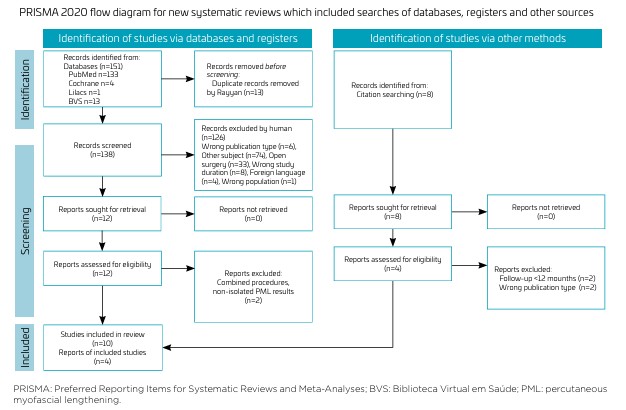
Data synthesis: Of 151 studies identified, 14 met the inclusion criteria, including three randomized trials. Methodological limitations were frequent, including short follow-up periods, demographic heterogeneity, nonuniform evaluation methods, and the lack of confounder control. Only three studies used three-dimensional gait analysis. Notably, seven studies on hamstring percutaneous musculotendinous lengthening showed functional and range-of-motion improvements. Comparisons with open techniques showed no consistent kinematic differences. Evidently, three studies on adductor percutaneous musculotendinous lengthening found increased hip abduction, with no additional benefit from subsequent open procedures. Notably, the literature regarding Achilles issues is limited to three studies; of these, a single long-term clinical trial identified a 43% recurrence rate without calcaneus deformity, whereas the remaining two were restricted to anatomical and compartment pressure-related issues. Significantly, one study confirmed lower costs and blood loss in comparison with open procedures. The use of post-op immobilization and complications — overcorrection, recurrence, nerve and muscle injury, and increased pelvic tilt — were reported.
Conclusions: Percutaneous musculotendinous lengthening may offer benefits, but stronger evidence from high-quality, long-term studies is needed to confirm its effectiveness.
Keywords:
Cerebral palsy; Minimally invasive surgery; Tenotomy; Orthopedic procedures
 Thumbnail