 Flora of Meliaceae in the Upper Paraná Atlantic Forest
Abstract
Meliaceae is an important structural and ecological component that provides multiple ecosystem services, yet it is poorly studied in the Atlantic Forest. This study aims to contribute to the floristic knowledge of Meliaceae in the Iguaçu National Park (Brazil) and the Iguazú National Park (Argentina). A total of five genera and ten species were found, of which eight native species and one exotic species occur in both protected areas, while Trichilia pallens was found only in the Iguaçu National Park. Seven of the native species are widespread in the Neotropics and occur in different vegetation types, including Seasonal Semi-deciduous Forest and the Mixed Ombrophilous Forest: Cabralea canjerana, Cedrela fissilis, Guarea kunthiana, G. macrophylla, T. catigua, T. claussenii and T. elegans. T. pallida occurs only in Seasonal Semi-deciduous Forest, and T. pallens in Mixed Ombrophilous Forest within the protected areas. Both parks represent the most important conservation areas for the Atlantic Forest, which is why local biodiversity surveys are of the utmost importance. An identification key, scientific illustrations or photographs with diagnostic characters, taxonomic comments, geographical distribution, phenology, common names and observations are presented.
Key words:
Iguaçu National Park; Iguazú National Park; Mixed Ombrophilous Forest; Semideciduous Seasonal Forest; Trichilia
Resumen
Meliaceae es un componente estructural y ecológico importante brindando diversos servicios ecosistémicos, pero poco estudiado en el Bosque Atlántico. Este trabajo tiene como objetivo contribuir al conocimiento florístico de Meliaceae en el Parque Nacional do Iguaçu (Brasil) y el Parque Nacional de Iguazú (Argentina). Se encontraron un total de cinco géneros y diez especies, de las cuales ocho especies nativas y una especie exótica están en ambas áreas protegidas, mientras que Trichilia pallens se encontraron solamente en el Parque Nacional do Iguaçu. Siete de las especies nativas que están ampliamente distribuidas en el Neotrópico y se encuentran en diferentes tipos de vegetación, incluídos el Bosque Estacional Semideciduo y el Bosque Umbrófilo Mixto: Cabralea canjerana, Cedrela fissilis, Guarea kunthiana, G. macrophylla, T. catigua, T. claussenii y T. elegans. T. pallida se encuentran solamente en el Bosque Estacional Semideciduo y T. pallens en el Bosque Umbrófilo Mixto en las áreas protegidas. Ambos parques representan las áreas de conservación más importantes para el Bosque Atlántico, por lo que es de suma importancia los relevamientos locales para la biodiversidad. Se presenta una clave de identificación, ilustraciones científicas o fotografías con caracteres diagnósticos de los taxones, comentarios taxonómicos, distribución geográfica, fenología, nombres comunes y observaciones.
Palabras clave:
Parque Nacional do Iguaçu; Parque Nacional Iguazú; Bosque Umbrófilo Mixto; Bosque Estacional Semideciduo; Trichilia
Introduction
Meliaceae comprises 58 genera and ca. 740 species, with a pantropical distribution and some temperate species (Flores et al. 2017; Muellner-Riehl & Rojas Andrés 2021). These plants occur in a variety of habitats, ranging from tropical forests to mangroves and semi-desert environments, with the center of diversity in the Neotropics (Pennington & Styles 1975; Muellner et al. 2003). Some of these species are woody plants with spirally pinnate leaves containing essential oils, their flowers are often unisexual, with a well-developed nectary-disk intrastaminal of receptacular origin (Pennington 1981). Several phylogenetic studies have confirmed the monophyly of this family (Muellner et al. 2003; Koenen et al. 2015), as well as its inter- and intraspecific relationships (Pennington & Clarkson 2013; Clarkson et al. 2016).
This family has an outstanding timber potential (Pennington 1981; Gentry 1986, 1996), wich is economically highlighted by its quality (Klein 1984; Spichiger et al. 1990; Villalobos 2011). For this reason, some species are threatened with extinction due to the intense pressure of extractivist practices (Spichiger et al. 1990; Zapater et al. 2004; Flores et al. 2017). Other uses include urban, ornamental, fruit trees and others as sources of biologically active compounds such as tannins for insecticides, dyes and pharmaceuticals (Spichiger et al. 1990; Muellner et al. 2003). In addition, these species provide some important ecosystem services in the forest, with fleshy structures accompanying the seeds that are used as a food resource by the dispersing fauna (Pennington 1981; Villalobos 2011).
Meliaceae is one of the families that contributes most to the floristic diversity of the Neotropics (Gentry 1988). Cedrela species are typical of seasonal forests throughout the Neotropical region (Pennington et al. 2000), with Cedrela fissilis Vell. being one of the most characteristic trees (Oakley & Prado 2011). In turn, Trichilia clausseni C. DC. and T. elegans A. Juss. belong to a group of sporadic trees of seasonal forest elements of the Paraná-Uruguay basins in a previous climatic period of expansion and later retraction of these forests (Klein 1984). In addition, genera such as Cedrela L. and Guarea F. Allam. also form associations with tree species of Leguminosae, which are common and frequent throughout the entire Atlantic Forest (Pennington 1981; Gentry 1986).
Six genera and 33 species of Meliaceae are recorded for the Atlantic Forest of Brazil (Flora e Funga do Brasil 2025, continuously updated) and four genera and 11 species for Argentina (Zanotti et al. 2020). However, a specific inventory of the family has not yet been carried out for the Upper Paraná Atlantic Forest, where both protected areas are located. From this perspective, the aim of this study was to carry out a floristic survey of the Meliaceae in the Iguaçu National Park (Brazil) and the Iguazú National Park (Argentina).
Material & Methods
Study area
The present study was carried out in the largest protected areas of the Upper Paraná Atlantic Forest: the Iguaçu National Park (ParNa Iguaçu) in Brazil and the Iguazú National Park (ParNa Iguazú) in Argentina. These areas have a mesothermal, humid, subtropical climate, with hot and rainy summers, a high annual precipitation between 1,500 and 2,000 mm, no defined dry season, and little chance of frost (Alvares et al. 2013; IAPAR 2018).
The ParNa Iguaçu is located in 14 municipalities of the state of Paraná, Brazil, extending across 185,262.5 hectares, from 25º05’ to 25º41’S and from 53º40’ to 54º38’W (Souza et al. 2017, 2019). The park is located on the Third Paraná Plateau, with soils classified as Oxisols and elevations ranging from 750-100 m from north to south, limited by the water basin of the Iguazú river (Souza et al. 2017, 2019). El ParNa Iguaçu is mainly Semi-deciduous Seasonal Forest (SSF) in the south and center of the park, where the seasonal climate determines a state of physiological rest (drought due the cold of winter), causing the fall of 20-50% of the foliage of semi-deciduous trees. Further to the north are the Araucaria humid forests or Mixed Ombrophilous Forest (MOF), characterised by Araucaria angustifolia as higher and colder forests with higher rainfall rates (IBGE 2012; Souza et al. 2017).
The ParNa Iguazú, with 67,000 hectares, includes the Iguazú National Reserve and the Iguazú National Park, from 25º58’S to 54º13’W, in the Iguazú Department, Misiones Province, Argentina (Srur et al. 2009). The soils are deep Ultisols with high concentrations of Fe, Al, and Si. The plateau-like relief consists of gentle undulations, with a northern elevation over the western limit at the beginning of the Lower Iguazú river ranging from 125 to 380 m to the southeast over Yacuí creek (Srur et al. 2009). The exclusive vegetation is the Semi-deciduous Seasonal Forest (SSF) (Cabrera 1971; Srur et al. 2009; Zanotti et al. 2020).
For the survey of the two protected areas, the locations were divided into five large areas (Fig. 1). The ParNa Iguaçu had four trails within area 1 of Céu Azul: Rio Butu Farm, Jumelo springs, Araucárias, Cachoeira Rio Azul, Manoel Gomes, and Jacutinga (Fig. 1a-f). Area 2 consisted of the Matelândia/Serranópolis trail. Area 3 of Capanema included the following trails: the Banks of the Iguazú River on the Brazilian side, Cachoeira Rio Silva-Jardim, and Ilha do Sol (Fig. 1h-j). Area 4 of Foz do Iguaçu included the following trails: Poço Preto, Represa São João, Antiga Usina, Escola Parque, Macuco Safari, Bananeiras, Cataratas, and Hidrante (Fig. 1k-r). Finally, the ParNa Iguazú, with an area to the southwest, Area 5, had the following trails: along the Ruta Nacional 12 and the Ruta Provincial 101, way to the Hidrómetro, Camping Ñandú, Garganta del Diablo, Sendero Inferior, Sendero Macuco, Sendero Superior, and Sendero Verde (Fig. 1).
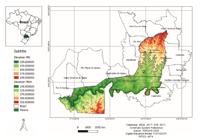
ParNa Iguaçu and ParNa Iguazú areas - Area 1 = Céu Azul, trails A-F. Area 2 = Matelândia / Serranópolis, trail G. Area 3 = Capanema, trails H-J. Area 4 = Foz do Iguaçu, trails K-R. Area 5 = ParNa Iguazú (Modified from Hammes et al. 2021).
Data collection and identification
The floristic survey was performed according to the Walking Method (Filgueiras et al. 1994), with monthly collections from March 2019 to March 2020 and isolated collections from November 2020 to September 2021. The specimens collected in the ParNa Iguaçu were incorporated in EVB (acronyms following Thiers, continuously updated). On the other hand, the specimens collected at the ParNa Iguazú were processed at the Center of Subtropical Ecological Research (CIES), and deposited in CTES and SI. The material was photographed with a Sony DSC hx400v camera and prepared according to the technique described by Gadelha Neto et al. (2013).
The specimens from the CTES, EVB, MBM, SI, UNOP, and UPCB herbaria were analyzed in person. The virtual specimens of Jabot (2021), JSTOR (2021), ReFlora (2021), and speciesLink (2021) were also consulted, as well as the database Documenta Florae Australis (Flora Argentina 2021), which contains an updated checklist of the vascular flora of Argentina and the Southern Cone. The confirmed species have also been revised using the virtual platforms of the following herbaria: ASE, FLOR, FUEL, FURB, HCF, HUCS, HUCP, HUESB, HUFU, RB, SI, SP, U, and US. Information about the duplicates of some specimens at EUC, FHO, K, LIL, NY, MO, U, and US was taken from Pennington (1981).
Species identification was performed using specialised literature such as dissertations, taxonomic reviews, and identification keys (Buchinger & Falcone 1958; Smith 1960; Pennington & Styles 1975; Pennington 1981, 2004, 2009, 2016; Klein 1984; Pastore 2003; Zapater et al. 2004; Patricio & Cervi 2005; Cervi et al. 2008; Mabberley 2011; Villalobos 2011; Pennington & Clarson 2013).
The scientific names and author information were checked in the nomenclatural database The International Plant Names Index (IPNI). Terminologies used agreed with Lindley (1951) and Font Quer (1953) for general terms, Hickey (1973) for morphology and the leaf venation type, Theobald et al. (1979) for trichome types, Wilkinson (1979) for domatia types, Stearn (1992) for Latin terms, and Ellis et al. (2009) for leaf architecture. Species were classified into ecological categories according to Klein (1984): heliophytes and sciophytes; successional categories according to Ríos (2010), Souza et al. (2019), and the specialised bibliography of the family: pioneers, initial secondaries, late secondaries, and climax; and dispersal syndrome following the classification of Van der Pijl (1982): anemochory, autochory, and zoochory. Finally, the conservation status of each species was verified using the CNCFlora (2021) and IUCN (2021) databases.
Results
A total of nine native species were found in the ParNa Iguaçu, including one exotic species. On the other hand, eight native species and one exotic species were found in the ParNa Iguazú (Tab. 1). The genera with more species for both parks is Trichilia, with five species, and Guarea, with two species, the remaining genera had one species each.
Taxonomic treatment
Meliaceae A. Juss., Gen. Pl.: 263. 1789, nom. cons.
Trees; evergreen or deciduous. Dioecious, monoecious, or polygamous. Bark fissured, scaly, or smooth, aromatic. Leaves alternate, pinnate, bipinnate or (1-)3-foliolate; leaflets opposite, sub-opposite, or alternate, blades elliptic, lanceolate to oval-lanceolate, glabrous or pubescent, margin entire, rarely serrate; domatia or absent; glandular-punctate and -striate or absent. Thyrse or panicle, axillary, ramiflorous or cauliflorous. Flowers bisexual or unisexual by abortion, with well-developed staminodes or pistillodes, actinomorphic, cyclic, 4-5-merous; calyx fused or free, open or imbricate; corolla free or partially fused, imbricate or valvate; androecium with stamens diplostemonous, filaments partial to totally united in a staminal tube, rarely free and adnate at the bottom of the androgynophore, androgynophore columnar or absent; anthers included in the margin of the staminal tube or partially exserted; nectary-disk intrastaminal, cyathiform, patelliform, stipitate, or annular, rarely absent; gynoecium with ovary superior, rarely semi-inferior, (2-)3-5(-6)-carpelar, (2-)3-5(-13)-locular, 1-00-ovulate. Capsule loculicidal or septifragal, rarely drupe. Seeds with a fleshy arillode or sarcotesta, or absent and winged.
Key to the genera of Meliaceae in the UPAF
-
1. Leaf bi- to tripinnate, leaflets with margin serrate; flower white-violet; drupe ……….. 4. Melia azedarach
-
1’. Leaf pinnate, leaflets with margin entire; flower not white-violet; capsule ………………………………. 2
2. Leaf with 22 or more leaflets; capsule with 5 valves …………………………………………………... 3
- 2’. Leaf with up to 20 leaflets; capsule with 3 to 4 valves ………………………………………………… 4
3. Bark reddish-brown to grayish-brown and scaly, non-aromatic; leaflets glabrous, scrobicules in the hypophyll; flower with a free calyx, androgynophore absent, 10 anthers included in the staminal tube; capsule loculicidal, fleshy, reddish to dark red; seed apterous, with fleshy arillode, orange to red……………………………………………………………………………….. 1. Cabralea
- 3’. Bark pale grey and fissured, with an alliaceous scent; leaflets pubescent, domatia pocket-shaped in the hypophyll; flower with a fused calyx, androgynophore present, 5 anthers apical in partially free filaments; capsule septifragal, woody, dark brown; seed winged, dry, brown………….. 2. Cedrela
4. Leaf paripinnate, dormant bud present; included anthers in the staminal tube; capsule with 4 valves, seeds with sarcotesta…………………………………………………………. 3. Guarea
4’. Leaf imparipinnate, dormant bud absent; anthers exserted from the staminal tube or apical anthers in partially free filaments; capsule with 3 valves, seed with arillode …………… 5. Trichilia
1. Cabralea A. Juss., Bull. Sci. Nat. Geol. 23: 237. 1830.
Neotropical monotypic genus, with a single variable species, widely distributed from Costa Rica through tropical South America to Brazil and northern Argentina (Pennington 1981), and occurs in BAAP.
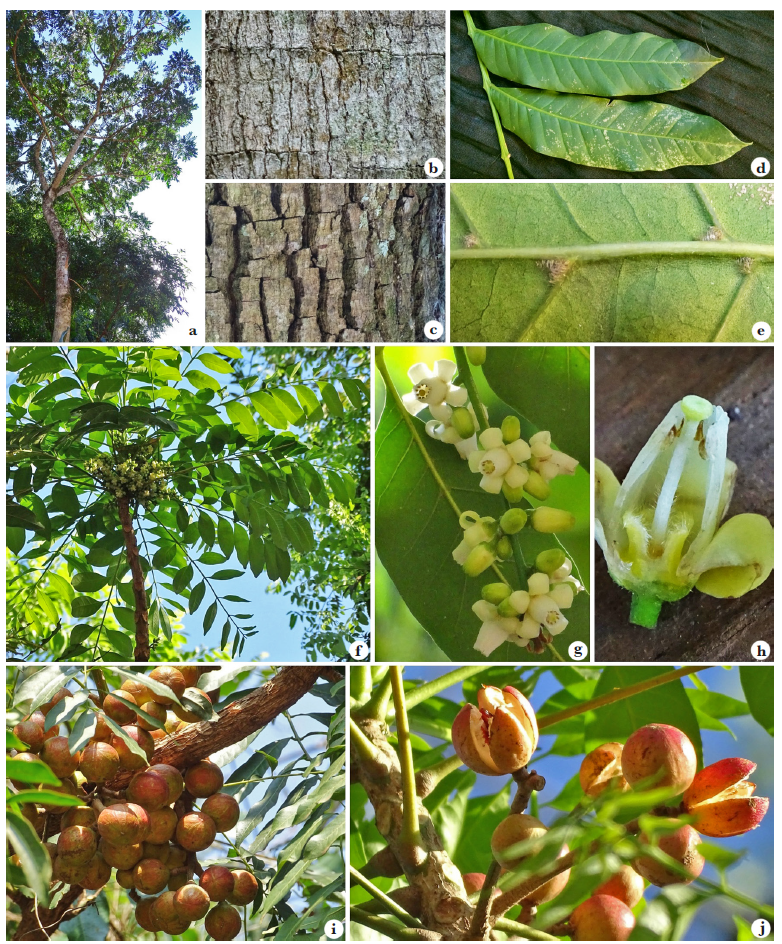
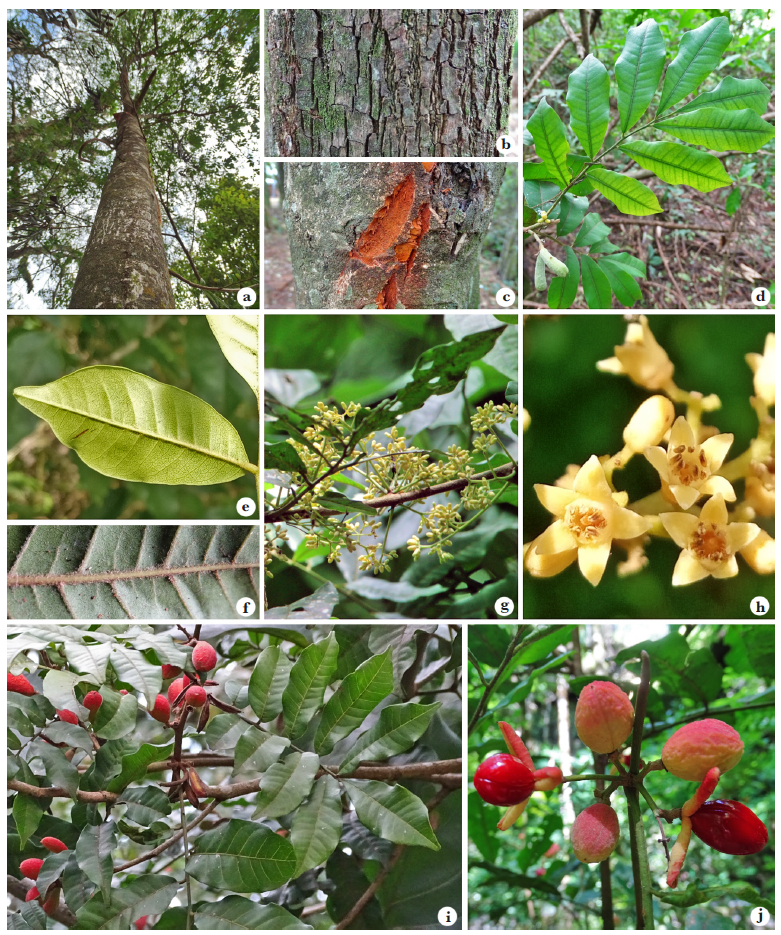
1.1. Cabralea canjerana (Vell.) Mart., Syst. Mat. Med. Veg. Bras. 38. 1843; sub “Cabralia”. Fig. 2a-j
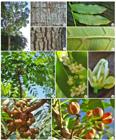
a-j. Cabralea canjerana- a. habit; b-c. bark; d. leaflets (epiphyll); e. detail of the scrobicle in hypophyll of leaflet; f. terminal branch with leaves and axillary inflorescences; g. detail of inflorescence; h. longitudinal section of the flower; i. terminal branch with reddish mature fruits; j. reddish mature fruits open. (Photos: a-j. A.M. Panizza).
Tree up to 40 m high, evergreen. Monoecious. Trunk round, tortuous; with tabular roots; outer bark scaly, forming rectangular scales, reddish-brown to grayish-brown; inner bark white to white-yellowish, becoming pink by oxidation, non-aromatic. Terminal branches brown, sometimes lenticellate, puberulous becoming glabrous. Leaves pinnate, 10-80(-115) cm long, paripinnate, rarely imparipinnate with terminal leaflet reduced or vestigial; cylindrical petiole; dormant bud absent; 22-26 leaflets opposite or sub-opposite. Leaf blade (2.4-)8-16(-22) x (1-)2.5-4.5(-6.5) cm, oblong, falcate, glabrous, entire, base asymmetric, apex acuminate or attenuate; hypophyll with scrobicules in the axils of secondary veins; glandular-punctate and -striate. Panicles axillary, rarely ramiflorous or cauliflorous, (2-)6-40(-90) cm long. Flowers bisexual, 5-merous, white, or rarely yellowish to greenish-whitish, pubescent, pedicel (0.5-)1-3(-4) mm long, non-articulate; calyx free, quincuncial; corolla free, imbricate; androgynophore absent; staminal tube with appendages truncate alternating with 10 anthers included in the staminal tube; nectary-disk cyathiform; ovary semi-inferior, pubescent, 5-locular, 2-ovulate, style-head discoid. Loculicidal capsule with 5 valves opening halfway, globose to ellipsoid, 3-4 cm long, glabrous, smooth, lenticels absent, reddish, fleshy pericarp with a white exudate when young and leathery, dark red when ripe (wrinkled when dry); seeds 1-2 per valve, ellipsoid, black, lustrous, partially covered by an arillode fleshy, orange to red, bright.
Selected specimens examined: ARGENTINA. MISIONES: Iguazú, ParNa Iguazú, Ruta 101, 13.X.1993, fr., S. Tressens et al. 4461 (CTES). BRAZIL. PARANÁ: Céu Azul, ParNa Iguaçu, Ruta BR-277, Puesto de Peaje, 7.I.2020, fr., A.M. Panizza & E. Hentz Junior 156 (EVB). Foz do Iguaçu, ParNa Iguaçu, Trilha das Bananeiras, 13.VII.2019, fr., A.M. Panizza et al. 113 (EVB). Matelândia, ParNa Iguaçu, estrada de Chão de Céu Azul-Serranópolis do Iguaçu, 21.VIII.2015, fl., M. Caxambu et al. 6806 (ASE, HCF, FURB).
From Costa Rica to southern Brazil, Paraguay, and northeastern Argentina (Pennington 1981; Flora Argentina 2021). Species that vary widely in habit, from large trees in tropical forests to small shrubs in Cerrado areas and mountainous regions (Pennington 1981; Flores et al. 2017). Heliophyte or of diffuse light, typical of primary forest but also as pioneer in secondary forest (Klein 1984; Villalobos 2011). This species was found in four of the five areas evaluated in this study, indicating that it is widespread in both protected areas.
Blooms from August to October and bears fruit for most of the year, which may be due to the prolonged ripening of the capsule, in agreement with Zapater et al. (2004).
The vernacular name for this species are acaraya, cancharana, canjerana, cedrahy, cedro macho, cedro-rá, pau-santo and yvyrá pyté pyta (Klein 1984; De La Peña & Pensiero 2011).
Canopy tree, perennial; leaves paripinnate, very long, grouped at the end of the branches, leaflet asymmetrical, shiny dark green, discolored, glabrous, with scrobicules in the hypophyll; panicles lax; flowers white, 5-merous, with a nectary-disk cyathiform and a fleshy loculicidal capsule, red, with 5 valves and black seeds with an orange arillode.
This species can have flowers and fruits simultaneously in the same plant; possible sexual dimorphism (Pennington 1981; Klein 1984; Flores et al. 2017).
2. Cedrela P. Browne, Civ. Nat. Hist. Jamaica: 158, tab. 10, fig. 1. 1756.
Cedrela is a neotropical genus with 17 species, distributed from México to Brazil and north of Argentina (Pennington & Muellner 2010; Muellner-Riehl & Rojas Andrés 2021). With two species in the Atlantic Forest (ReFlora 2025), but only C.fissilis Vell. is recorded in BAAP.
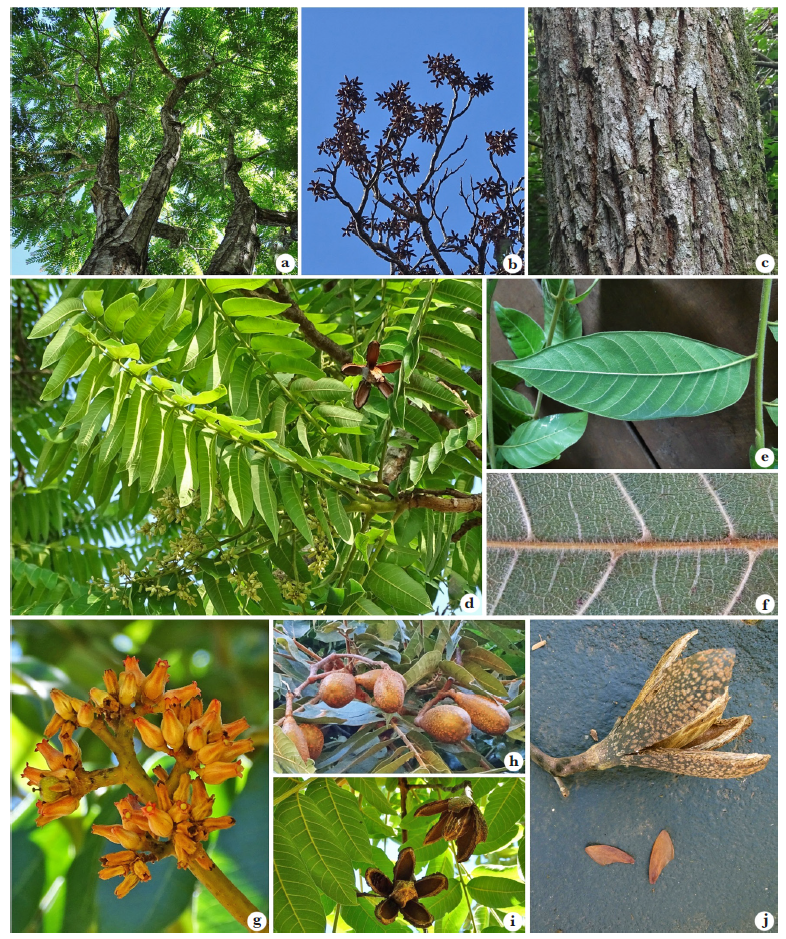
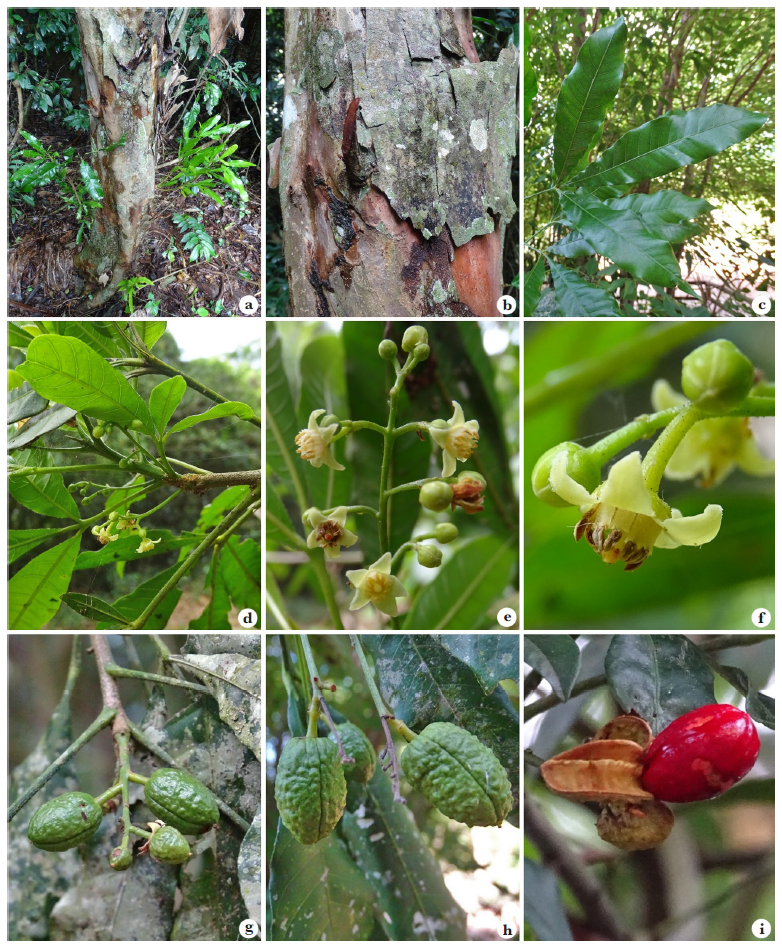
2.1. Cedrela fissilis Vell., Fl. Flumin. 75. 1825 [1829]. Fig. 3a-i
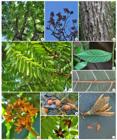
a-j. Cedrela fissilis - a. habit; b. deciduous foliage and mature fruits; c. bark; d. terminal branch with leaves, inflorescences and fruits; e. leaflet (hypophyll); f. detail of domatia in pocket in the hypophyll of leaflet; g. detail of inflorescence; h. inmature fruits; i. mature fruits; j. mature fruit open with winged seeds. (Photos: a-j. A.M. Panizza).
Trees up to 30 m high, deciduous. Monoecious. Trunk round, tortuous; with tabular roots; outer bark longitudinally fissured, pale grey; inner bark fibrous, cream to pink; with an alliaceous scent. Terminal branches brown, lenticellate, glabrous or pubescent becoming glabrous. Leaves pinnate, 15-60(-120) cm long, paripinnate, rarely imparipinnate with terminal leaflet reduced or vestigial; petiole cylindrical; dormant bud absent; 24-36(-48) leaflets opposite or sub-opposite. Leaf blade 5-15 × 2-4.5 cm, lanceolate to oblong-lanceolate, falcate, pubescent, entire, base asymmetric, apex acuminate to acute; hypophyll with pocket domatia in the axils of secondary veins; glandular-punctate and -striate absent. Thyrses lateral or subterminal, 10-35 cm long. Flowers unisexual, 5-merous, white to pink, rarely greenish, pubescent, pedicel (0.5-)1-2 mm long, non-articulate; calyx fused, dome-shaped or irregularly dentate, imbricate; corolla free, imbricate; attached by a keel to the androgynophore, columnar, 5-costate; filaments partly free, appendages absent, 5 anthers apical; ovary superior, glabrous, 5-locular, 8-12-ovulate in two series, style-head discoid. Septifragal capsule with 5 valves and one column with 5 angled partitions, pyriform to obovoid, 5.5-10 cm long, glabrous, smooth, lenticellate, dark brown, pendulate, woody pericarp; seeds numerous, dry, brown, winged.
Selected specimens examined: ARGENTINA. MISIONES: Iguazú, ParNa Iguazú, CIES, 14.IX.1995, fl., J. Herrera & K. Schiaffino 78 (CTES, LIL). BRASIL. PARANÁ: Céu Azul, ParNa Iguaçu, Ruta BR-277, Puesto de Peaje, 7.I.2020, fr., A.M. Panizza & E. Hentz Junior 150 (EVB). Foz do Iguaçu, ParNa Iguaçu, polícia ambiental, 13.II.2017, fr., L.C.P. Lima et al. 890 (EVB). Matelândia, ParNa Iguaçu, entrada de Matelândia a Serranópolis do Iguaçu, 21.II.2020, fr., A.M. Panizza et al. 210 (EVB).
Widely distributed from Panama and Costa Rica to Paraguay, Uruguay, southern Brazil, and northern Argentina (Pennington 1981; Flora Argentina 2021). Can be found in forests as well as in drier areas and tolerates a wide range of environmental variables (Pennington & Muellner 2010). Mostly found in primary forest, but also as a pioneer in clearings (capueras) and secondary forest, forming significant clusters (Villalobos 2011). Heliophyte or of diffuse light, frequent (Klein 1984). This species was found in four of the five areas evaluated in this study, showing an abundant and widespread presence in both protected areas.
Blooms from March to October and bears fruit from January to February. According to Zapater et al. (2004), the species blooms in Argentina from September to December, with more intensity in October, and its fruits ripen during the winter when the plant loses its leaves. However, the fruits remain almost all year round.
The vernacular name for this species are acaiacá, cedrinho, cedro-branco, cedro-da-várzea, cedro misionero, cedro rosado, cedro-roxo, cedro-setim, igary and yapora-izí (Klein 1984; De La Peña & Pensiero 2011).
Canopy tree, deciduous in winter, with paripinnate leaves of great length clustered at the end of the branches, leaflets sessile to subsessile with a petiole up to 5 mm long, asymmetrical, pubescent, opaque dark green, with pocket-shaped domatia in the hypophyll; thyrse congested; flowers 5-merous, ranging from white to pink, pubescent, and a woody septifragal capsule, larger than 3.5 cm long, dark brown, lenticellate, with 5 valves and a central column, and brown winged seeds.
In the study of the material collected by Cervi 3145 (UPCB 47205) and identified by Cervi et al. (2008) as Cedrela odorata L., we found that this identification was incorrect because the specimen lacked diagnostic characteristics such as glabrous leaflets with pinnules 5-15 mm long, lax thyrse, white-greenish glabrous flowers, and capsules 2-5 cm long. Trochez et al. (2017) also mentioned this species for the ParNa Iguaçu, but the present study only confirmed the presence of Cedrela fissilis for both protected areas.
3. Guarea F. Allam., Mant. Pl. Altera 2: 150. 1771, nom. cons.
Trees or treelets, evergreen, dioecious. Leaves paripinnate; dormant apical bud present, with intermittent growth. Leaf blade glabrous, entire; domatia absent. Thyrses axillary, ramiflorous or cauliflorous. Flowers unisexual, 4-merous; calyx fused, open; corolla free, valvate; androgynophore absent; staminal tube, appendages absent, with 8 anthers included in the staminal tube; nectary-disk stipitate, expanded into a collar; ovary superior, 3-5-locular, 1-2-ovulate, style-head discoid. Capsule loculicidal, with 4 valves; seeds 1-2, surrounded completely by a fleshy, thin sarcotesta.
The genus comprises 69 species, exclusively neotropical, from north of Mexico until Brazil and north of Argentina (Pennington & Clarkson 2013), seven occur in the Atlantic Forest (ReFlora 2025) and two of which occur in BAAP.
Identification key of the species of Guarea in the UPAF
-
1. Bark smooth to slightly scaly; leaflet equal to or largest than 8 cm wide; ovary glabrous; capsule glabrous, non-papillose, lenticellate and reddish ………………………………………………. 3.1. Guarea kunthiana
-
1’. Bark reticulate and fissured; leaflet up to 7 cm wide; ovary pubescent; capsule puberulous to pubescent, papillose, lenticels absent and deep purple or burgundy ………………………… 3.2. Guarea macrophylla
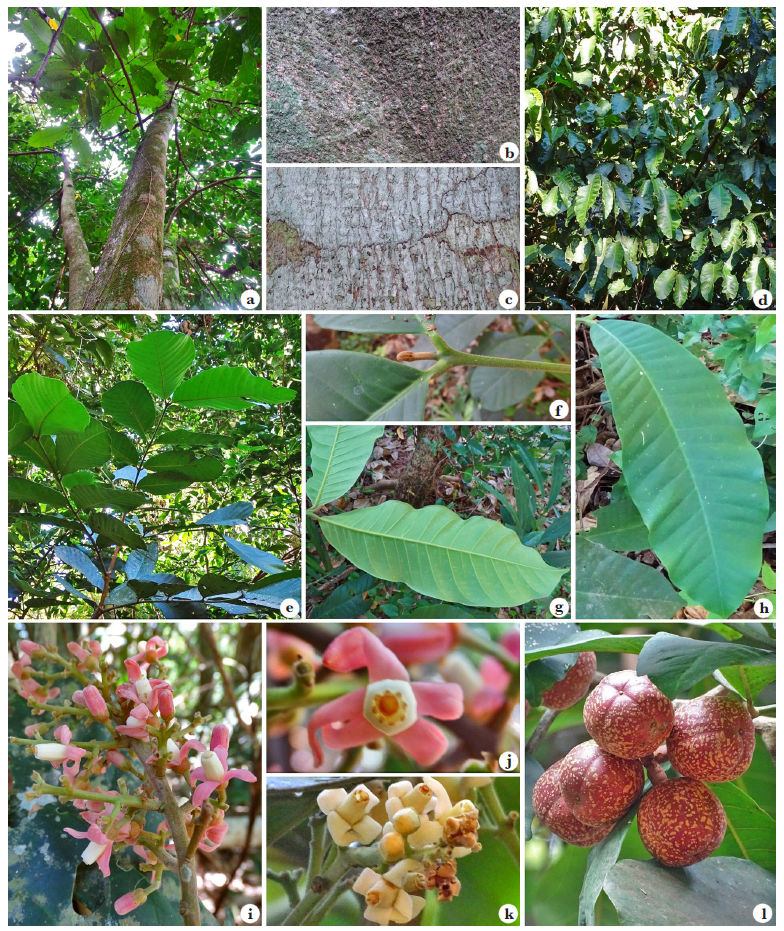
3.1. Guarea kunthiana A. Juss., Bull. Sci. Nat. Geol. 23: 240. 1830. Fig. 4a-i
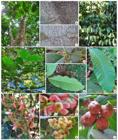
a-l. Guarea kunthiana - a. habit; b-c. bark; d. foliage; e. leaves; f. apical pair of leaflets (epiphyll) and dormant bud; g. apical pair of leaflets (hypophyll) and active dormant bud; h. leaflet; i. inflorescence; j. pinkish flower; k. detail of inflorescence with white flowers; l. mature fruits. (g-h. Panizza & Poszkus 252). (Photos: a-l. A.M. Panizza).
Tree up to 30 m high. Trunk round, short straight; with tabular roots in older specimens; outer bark smooth and lenticellate when young, becoming slightly scaly and densely lenticellate in older specimens, brown-grayish to brown-reddish; inner bark fibrous, yellowish, orange to pink; with a sweet scent. Terminal branches brown to brown-grayish, non-lenticellate, puberulous to pubescent, becoming glabrous. Leaves pinnate, 8-46(-100) cm long; petiole cylindrical, rarely canaliculate; (1-)2-12 leaflets opposite. Leaf blade (7-)15-25(-34) × 8-10(-20) cm, elliptic or oblong-lanceolate, base attenuate, apex acute; hypophyll without domatia; glandular-punctate and -striate not evident. Thyrses (1-)3.5-25(-30) cm long. Flowers pink, rarely white or cream, puberulous, pedicel 2-3 mm long, non-articulate; calyx sub-hemispherical, irregularly lobed; ovary glabrous, 3-4-locular, 2-ovulate. Capsule ellipsoid or globose, slightly constrict between the seeds, 1.5-4.5(-7.5) × 1.5-3.5(-6.5) cm, non-papillose, glabrous, smooth, reddish, lenticellate, fleshy pericarp with a white exudate when young and leathery when ripe; seed 2 superposed per valve, ellipsoid, with a bright orange sarcotesta.
Selected specimens examined: ARGENTINA. MISIONES: Iguazú, ParNa Iguazú, camino ribereño al Hidrómetro, 20.XI.2020, fl., A.M. Panizza & P. Poszkus 252 (CTES, SI). BRASIL. PARANÁ: Capitão Leônidas Marques, próximo ao ParNa Iguaçu, 25.VI.2004, fl., P.H. Labiak et al. 3294 (FUEL, MBM). Céu Azul, ParNa Iguaçu, Cachoeira do Rio Azul, 19.II.2020, fr., A.M. Panizza et al. 192 (EVB). Foz do Iguaçu, ParNa Iguaçu, trilha atrás do Hotel Cataratas, 25.XI.2019, fl. and fr., A.M. Panizza & E. Hentz Junior 131 (EVB). São Miguel do Iguaçu, ParNa Iguaçu, Linha Martins, XI.2010, fl., D. Gris et al. 47 (UNOP).
From Nicaragua across tropical South America to Bolivia, Paraguay, southern Brazil and northern Argentina (Pennington & Clarkson 2013). Characteristic of SSF, occurs in almost all forest formations in Brazil and is restricted to riparian forests in the south (Klein 1984). Typical of older forests, although it also occurs in advanced secondary succession (Villalobos 2011). Sciophyte, frequent, especially in forests with red soils derived from basalt, where it occurs as an indicator species (Klein 1984). Found in four of the five areas evaluated in this study, where it is very common and widespread in both protected areas.
Blooms from October to March and in June and bears fruit all year round, sometimes simultaneously.
The vernacular name for this species are cancharana macho, carayá-bola, cedrillo grande, guará, jatuauba, marinheiro, peloteira and pau-d’arco (Klein 1984; De La Peña & Pensiero 2011).
Tree easily recognisable by its large and few leaflets, which are glabrous and discolored, with a hypophyll light green to yellowish; flowers 4-merous, pink, ovary glabrous; loculicidal capsule with 4 valves, ellipsoid to globose, constricted between the seeds, slightly quadrangular in section, glabrous, smooth, reddish,lenticellate and seeds with a bright orange sarcotesta. Young tree with canaliculate terminal branches and sprouting unifoliate leaves.
3.2. Guarea macrophylla Vahl, Eclog. Amer. 3: 8. 1807 . Fig. 5a-i
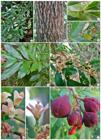
a-i. Guarea macrophylla - a. habit; b. bark; c. dormant bud; d. growing dormant bud; e. leaf; f. inflorescence; g. detail of the flowers; h. flower; i. mature fruits closed and one open with seeds. (f-h. Panizza 247) (Photos: a-i. A.M. Panizza).
Tree up to 20 m high. Trunk round, ramified near the base; non-surface roots; outer bark fissured, deeply reticulate, brown; inner bark fibrous, white to yellowish; with a sweet scent. Terminal branches brown, non-lenticellate, pubescent becoming glabrous. Leaves 12-45 cm long; petiole cylindrical; 4-14(-18) leaflets opposite or sub-opposite. Leaf blade (4-)6-25(-33) × 2.3-7 cm, elliptic, oblong or oblong-lanceolate, base acute, attenuate to cuneate, apex acuminate; hypophyll without domatia; glandular-punctate and -striate not evident or absent. Thyrses (2-)8-35(-55) cm long. Flowers pinkish, rarely white or pink-reddish, puberulous to pubescent, pedicel 2-5 mm long, articulate; calyx sub-hemispherical or irregularly lobate; ovary pubescent, (3-)4(-5)-locular, 1-2-ovulate. Capsule depressed-globose, globose or subpyriform, gradually narrowing towards the base, (0.7-)2.4-3.5 × 1.4-2.1 cm, densely papillose, tuberculate, warty, canaliculate or smooth (wrinkling as it dries), deep purple or burgundy, puberulous to pubescent, lenticels absent, pericarp leathery; seed 1-2 per valve, ellipsoid (solitary) or truncate (2 overlapped seeds), with a sarcotesta reddish to orange.
Selected specimens examined: ARGENTINA. MISIONES: Iguazú, ParNa Iguazú, Área Cataratas, 1.XI.2020, fl., A.M. Panizza 247 (CTES, SI). BRASIL. PARANÁ: Capanema, ParNa Iguaçu, E of road to Capanema, on high bank of Rio Iguaçu, 21.XI.1966, fl. and fr., J.C. Lindeman & J.H. Haas 3323 (CTES, MBM, NY, RB). Capitao Leonidas Marques, ParNa Iguaçu, Rio Iguaçu, 10.IV.2004, fl., O.S. Ribas et al. 6275 (CTES, MBM). Céu Azul, ParNa Iguaçu, Trilha Jacutinga, 24.V.2018, fr., C.R. Rauber et al. 48 (UNOP). PIC, Sendero de Sede Central, 7.XI.2019, fl. and fr, A.M. Panizza et al. 129 (EVB). Foz do Iguaçu, ParNa Iguaçu, entrada a Fazenda Salinet, 24.VIII.2019, fr., A.M. Panizza et al. 118 (EVB).
From Costa Rica and Panamá to southern Brazil and northwestern Argentina (Pennington & Clarkson 2013). In primary and secondary forest and remnant fragments, gregarious species in riparian and/or swamp forests (Villalobos 2011). Sciophyte or of diffuse light, frequent to abundant, subdominant of the middle canopy layer (Klein 1984). The species was found in the five areas evaluated in this study, widespread in both protected areas, where it is common and abundant.
Blooms from October to April and bears fruit almost all year round from March to December, almost simultaneously.
The vernacular name for this species are añá piré, café-bravo, calcanhar-de-cutia, catiguá-morcego, catigua-pora, cedrillo, guaimí-piré, jitó-miúdo, marinheiro de folha larga, pau-d’arco, pau-de-balaio, utuapaca and utuaúba (Klein 1984; De La Peña & Pensiero 2011).
Tree with reticulate bark; terminal branches without lenticels; leaflets longer than wide; flowers 4-merous, pinkish, pedicel 2-5 mm long, articulate; pubescent ovary; capsule with 4 valves, subpyriform, purple or burgundy, densely papillose, puberulous to pubescent, lenticels absent, warty, sometimes ribbed to tuberculate and seeds with a reddish sarcotesta.
Similar to Guarea guidonia(L.) Sleumer in its leaves, but differs in a bark rectangular and scaly; terminal branches lenticellate; flowers cream or white, subsessile or with pedicel 1mm long, non-articulate; ovary strigose and capsule glabrous, non-papillose, lenticellate and brown to brown-reddish (Fig. 6a-e).
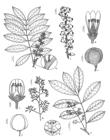
a-e. Guarea guidonia - a. leaf with inflorescence, b. detail of lenticelled terminal branch; c. inflorescence; d. longitudinal cut of the flower; e. mature fruit. f-j. Trichilia pallens- f. leaf with inflorescence; g. detail of domatia in the hypophyll; h inflorescence; i. longitudinal cut of the flower; j. mature fruit. (a-d. Hatschbach 14481; e. Hatschbach & Guimaraes 21728; f-i. Medri et al. 881; j. Lindeman & Haas 4712).
Often confused with Matayba elaeagnoides Radlk. (Sapindaceae), sharing characteristics such as pinnate leaves with oblong-lanceolate leaflets and capsules with arillate seeds; however, what seems to be an apical vestigial structure in the same leaf is an aborted terminal leaflet in M. elaeagnoides and a dormant bud in G. macrophylla. Furthermore, M. eleagnoides has urceolate domatia in the hypophyll, flowers 5-merous, white, downy, capsule apiculate with 3 valves, and dark brown seeds partially surrounded by a white aril.
4. Melia L., Sp. Pl. 1: 384. 1753.
Melia comprises three to five poorly defined species, native to the tropical regions of Africa and Asia (Hua & Mabberley 2008). One introduced species colected in BAAP.
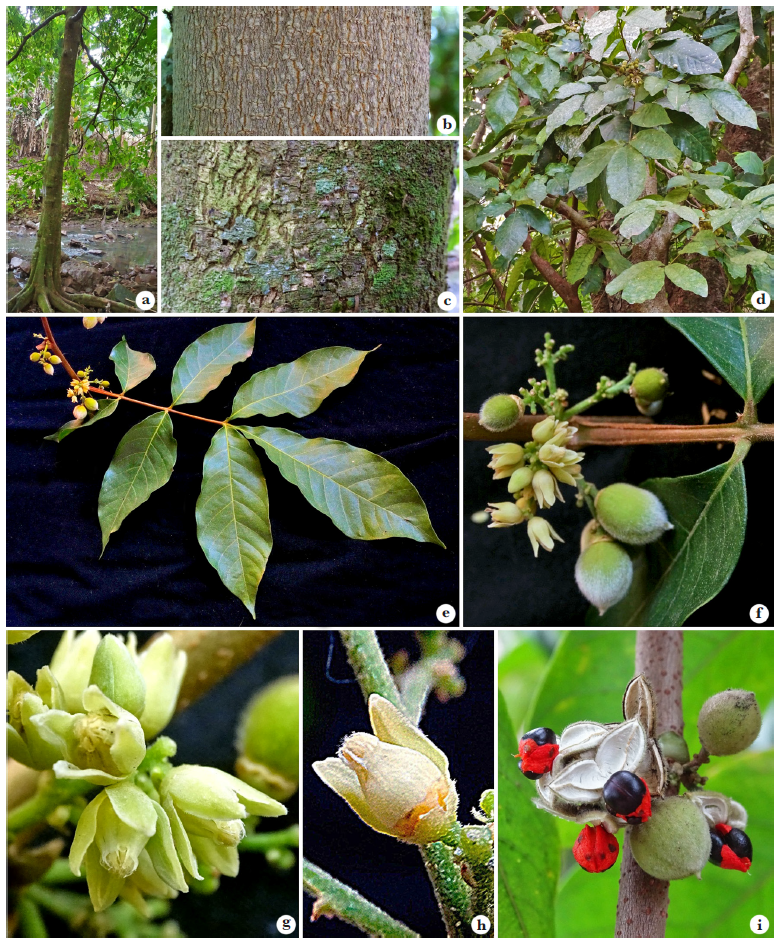
4.1. Melia azeradach L., Sp. Pl. 1: 384-385. 1753. Fig. 7a-i
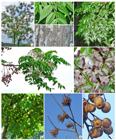
a-i. Melia azedarach - a. habit; b. bark; c. leaf; d. detail of the leaflets; e. terminal branch with inflorescences and old mature fruits; f. detail of the flowers; g. branch with inmature fruits; h. deciduous foliage and mature fruits; i. detail of mature fruits. (Photos: a-i. A.M. Panizza).
Tree up to 20 m high, deciduous. Monoecious or polygamous. Trunk round, long straight; non-surface roots; outer bark smooth and grayish-brown when young, and fissured, anastomosed, and pale grey to brown in older specimens; inner bark white-yellowish to pink; no information about the scent. Terminal branches grey, lenticellate, pubescent becoming glabrous. Leaves bi- to tripinnate, 15-60 cm long, imparipinnate; petiole cylindrical; dormant bud absent; leaflets 5-7 opposite. Leaf blade (2-)3-5.5(-8) × (0.5-)1-2.5(-3) cm, ovate-hypophyll without domatia; glandular-punctate and -striate absent. Panicles axillary, 10-20 cm long. Flowers unisexual or bisexual, 5-merous, white-violet, fragrant, pubescent, pedicel 2-3 mm long, non-articulate; calyx fused, 5-parted, imbricate; corolla free, imbricate; androgynophore absent; staminal tube with 10-12 appendages serrate alternating with 10-12 anthers included in the staminal tube; nectary-disk annular; ovary superior, 4-8-locular, 1-2-ovulate, style-head capitate, 4-8-lobed. Drupe globose, 1.3-2 cm long, smooth, glabrous, yellowish to ocher, fleshy; seeds 4-5, oblong, dark, arillode or sarcotesta absent.
Specimens examined: BRASIL. PARANÁ: Céu Azul, ParNa Iguaçu, Cercanias da BR-277, 12.XI.2015, fr., E.L. Siqueira & M.P. Chagas 1778 (HFC).
From the Himalayan region of Asia; now widely cultivated all around the world and has become naturalised throughout the Neotropic (Pennington 1981). Found in a single area of ParNa Iguaçu. In the ParNa Iguazú, the species has not been found in the reproductive stage. However, trees have been found near the Secc. Hidrómetro, Ruta Nac. 101 and in the area of Cataratas, with GPS records by park rangers as part of the management of invasive exotic species (persistent according to pers. com. CIES). Introduced in Brazil and Argentina as an ornamental, urban tree and forestry species cultivated for industrial purposes, currently adventitious in both countries (Klein 1984; Flora Argentina 2021). Categorized as invasive of the Ombrophilous Subtropical Forest and SSF in the UPAF (Zenni & Ziller 2011), also included in the management plants of exotic species of many countries (I3N Brasil 2021).
No data on blooming, bearing fruit in November. According to Klein (1984), this species blooms in the spring and bears fruit in the autumn and winter, when the leaves fall.
The vernacular name for this species are Árbol de los rosarios, Cinamomo, Falso cinamomo, Jabonero de las Antillas, Jasmim-de-viúva, Lila de la China and Paraíso (Klein 1984; De La Peña & Pensiero 2011).
Deciduous tree in winter; leaves bi- to tri-pinnate, leaflets serrate; flowers white-violet and drupes fleshy, yellowish to ochre.
5. Trichilia P. Browne, Civ. Nat. Hist. Jamaica: 278. 1756, nom. cons.
Trees or treelets, evergreen, dioecious, rarely polygamous. Leaves imparipinnate; dormant bud absent; leaflets entire. Thyrses, panicles or fascicles, axillary, ramiflorous or cauliflorous. Flowers unisexual, (4-)5-merous; calyx fused, rarely free, open or quincuncial; corolla free, rarely fused, imbricate or valvate; androgynophore absent; partially to completely fused filaments in a staminal tube, with appendages alternating with 6-12 anthers, anthers apical or exserted; nectary-disk annular, patelliform or absent; ovary superior, (2-)3(-4)-locular, 1-2-ovulate; style-head capitate, discoid, 3-lobed or columnar. Capsule loculicidal with 3 valves, leathery pericarp; seeds partially to completely surrounded by an arillode.
It is the largest genera of the family, with a total of 103 species, distributed in Africa, Madagascar and the Neotropics (Pennington 2016). In BA, the genus comprises 21 species (ReFlora 2025), and in BAAP is represented by five species.
Identification key of the species of Trichilia in the UPAF
-
1. Leaf 3-foliolate……………………………………………………………………………..5.2. Trichilia claussenii
-
1’. Leaf 5/13-foliolate ………………………………………………………………………………………………2
2. Petiole canaliculate; flowers 4-merous ……………………………………………...5.5. Trichilia pallida
- 2’. Petiole cylindrical; flowers 5-merous …………………………………………………………………..3
3. Leaflets alternate, without domatia in the hypophyll……………………….5.1. Trichilia catigua
- 3’. Leaflets opposite, with pilose domatia in the hypophyll………………………………………4
4. Leaves glandular-punctate and -striate evident; thyrse; capsule ellipsoid, pink to purple …..……………………………………………………………………………5.3. Trichilia elegans
4’. Leaves glandular-punctate and -striate not evident; panicle; capsule broadly ovoid to globose, green to yellowish ……………………………………………….5.4. Trichilia pallens
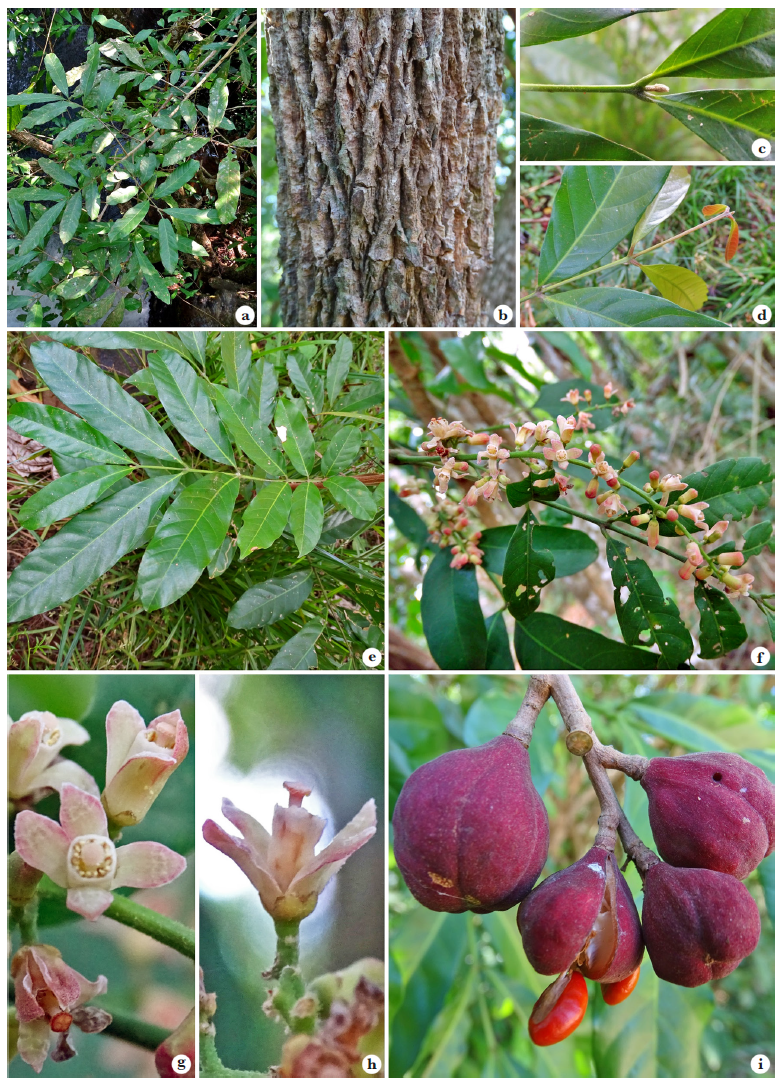
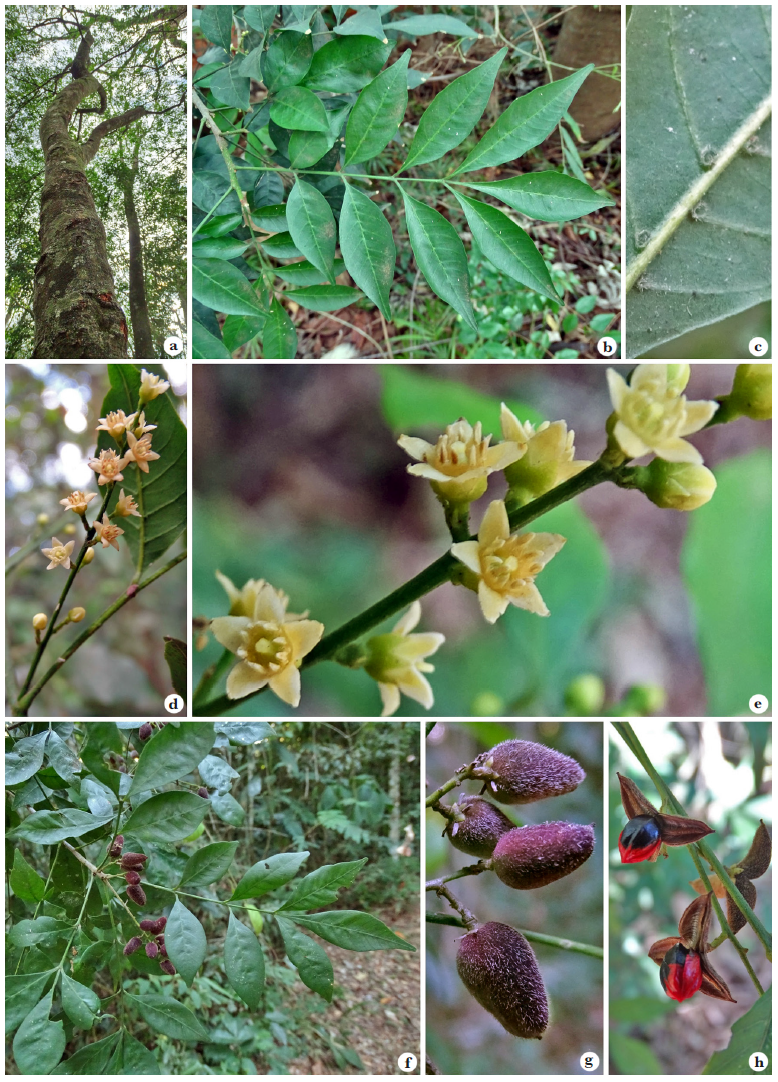
5.1. Trichilia catigua A. Juss., Fl. Bras. Merid. (quarto ed.) 2(12): 77. 1829. Fig. 8a-h
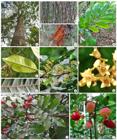
a-j. Trichilia catigua- a. habit; b. bark; c. detail of the inner bark; d. leaf; e. leaflet (hypophyll); f. detail of the hypophyll of the leaflet; g. branch with inflorescence; h. detail of the flowers; i. branch with inmature fruits; j. closed and open mature fruits with arilated seeds. (d-e. Panizza et al. 194; c, f. Panizza 225) (Photos: a-j. A.M. Panizza).
Tree up to 10 m high. Trunk tortuous, irregular, canaliculate; sometimes with tabular roots; outer bark smooth when young, becoming scaly in older specimens, dark grey to brown; inner bark orange to dark pink; no information about the scent. Terminal branches pale grey to grayish-brown, lenticellate, pubescent to sericeous becoming glabrous. Leaves 6-12(-18) cm long; petiole cylindrical; (7-)9-13 leaflets alternate. Leaf blade 5-9(-10) × 3.1 cm, oblong-lanceolate, elliptic or oblong, pubescent, base asymmetric, apex acute to acuminate; hypophyll without domatia; glandular-punctate and -striate absent. Fascicle or thyrses (0.5-)1.5-8(-11) cm long. Flowers 5-merous, cream-yellowish to yellow, appressed-puberulous, pedicel 0.5-1 mm long, non-articulate; calyx fused, 5-lobed, patelliform, open; corolla fused, 5-lobed, valvate; staminal tube, with appendages serrate alternating with (6-)7-8(-9) anthers exserted in the staminal tube; nectary-disk absent; ovary appressed-puberulous, (2-)3(-4)-locular, 2-ovulate collateral, style-head capitate or discoid. Capsule narrowly obovoid or oblong, 1.3-1.5cm long, smooth or warty, appressed-pubescent to sericeous, pink to pinkish-yellow; seeds 1-2, obovoid, brown with a clear reticulate, completely surrounded by an arillode fleshy, thin, bright red.
Selected specimens examined: ARGENTINA. MISIONES: Iguazú, ParNa Iguazú, Sendero Inferior, 13.III.2020, fl., A.M. Panizza 225 (CTES, SI). BRASIL. PARANÁ: Céu Azul, ParNa Iguaçu, Cachoeira do Rio Azul, 19.II.2020, fl., A.M. Panizza et al. 194 (EVB). Foz do Iguaçu, ParNa Iguaçu, Trilha Poço Preto, 11.X.2009, fl., L.G. Temponi et al. 638 (UNOP). Matelândia, ParNa Iguaçu, entrada de Matelândia a Serranópolis do Iguaçu, 21.II.2020, fl., A.M. Panizza et al. 214 (EVB). São Miguel do Iguaçu. ParNa Iguaçu, Linha Martins, 29.III.2011, fl., L.G. Temponi et al. 945 (UNOP).
In Bolivia, Paraguay, south-eastern Brazil, and north-western Argentina (Pennington 2016). Moslty in seasonal deciduous or semi-deciduous forest, riparian forest, and Cerrado (Pennington 2016), as well as in ombrophilous forest and grass-woody steppe (Patricio & Cervi 2005). Sciophyte, frequent (Klein 1984). The species was found in four of the five areas evaluated in this study, being common and widespread in both protected areas.
Blooms predominantly from February to March, but there are records for October and fruits in October and December. According to Patricio & Cervi (2005), the species blooms during all year round and bears fruit from September to December.
The vernacular name for this species are amarelinho, angelim-rosa, aroeirinha, caá-vo-robeí, catiguá puitá, catiguá-vermelho, catihuá-guazú, lagarteiro and mangaltô-catinga (Klein 1984; Pastore 2003; Patricio & Cervi 2005; De La Peña & Pensiero 2011).
Small tree with imparipinnate leaves, 9-12 alternate leaflets, asymmetrical, with sunken prominent veins, densely pubescent in the midrib and in the hypophyll, basal leaflets smaller; flowers yellow; capsule with 3 valves, yellow-pink to pink, sometimes warty and seeds with a completely red arillode.
5.2. Trichilia claussenii C. DC., Fl. bras. 11(1): 207. 1878. Fig. 9a-f

a-i. Trichilia claussenii- a. habit; b. bark; c. leaf; d. terminal branch with inflorescence; e. inflorescence; f. flower; g. terminal branch with inmature fruits; h. inmature fruits; i. open mature fruit with arilated seed(a and c-d. Panizza 291; b and e-f. Panizza & Poszkus 263) (Photos: a-i. A.M. Panizza).
Tree up to 12 m high. Trunk tortuous, irregular, canaliculate; sometimes with tabular roots; outer bark smooth, brown-yellowish with grey spots, scaling in large plaques, irregular; inner bark reddish; no information about the scent. Terminal branches grayish-brown to dark brown, lenticellate, pubescent to sericeous becoming glabrous. Leaves 10-19 cm long; petiole cylindrical; 3-foliolate, rarely unifoliolate. Leaf blade 5.5-13(-17) × 1.3-3.2(-4.7) cm, narrow-elliptic or oblong-lanceolate, glabrous, base attenuate to acute, apex attenuate to acuminate; hypophyll without domatia; glandular-punctate and -striate evident. Thyrses 1.5-12(-16) cm long. Flowers 5-merous, whitish, yellowish, or greenish, glabrous to pubescent, pedicel 1-3 mm long, non-articulate; calyx free or fused, 5-parted, patelliform or cyathiform, open; corolla free, imbricate; partially free filaments, with appendages lanceolate alternanting with 10 anthers apical; nectary-disk annular to patelliform; ovary glabrous, 3-locular, 2-ovulate, collateral, style-head 3-lobed. Capsule ovoid, oblong, or ellipsoid, 0.8 × 2 cm long, slightly warty or tuberculate (warty when dry), glabrous, rarely pubescent, green to reddish-yellow; seed 1, ellipsoid, brown with a clear reticulate, completely surrounded by an arillode, fleshy, thin, red to orange.
Selected specimens examined: ARGENTINA. MISIONES: Iguazú, ParNa Iguazú, Camping Ñandú a Garganta del Diablo, 20.XI.2020, fr., A.M. Panizza & P. Poszkus 263 (CTES, SI). BRASIL. PARANÁ: Foz do Iguaçu, ParNa Iguaçu, Trilha Poço Preto, 13.X.2011, fl., J.A. Lombardi et al. 8761 (HUFU, HUESB). Matelândia, ParNa Iguaçu, entrada de Chão Céu Azul-Serranópolis do Iguaçu, 21.VIII.2015, fl., M. Caxambu et al. 6820 (ASE, FURB, HCF).
Eastern Peru, Bolivia, Paraguay, southern Brazil, and northern Argentina (Pennington 2016). In montane forests, SSF, occasionally in the MOF and along river margins in gallery forest (Pennington 1981; Pennington 2016; Klein 1984). Sciophyte or of diffuse light, frequent to abundant, preferably in primary forest, in the middle layer of the canopy, sometimes dominant (Klein 1984). Found in three of the five areas studied.
Blooms from August to October and bears fruit from November to December. According to Pennington (1981) and Patricio & Cervi (2005), the fruiting can last until May.
The vernacular name for this species are cafeteiro-do-mato, camurin-preto, catiguá-vermelho, goiabeira-brava, quebra-machado and bienenholz (bee stick) in german colonies (Klein 1984; Patricio & Cervi 2005).
Small tree with 3-foliolate leaves, terminal leaflet sometimes larger than the lateral ones, blade wavy, veins prominent and sunken, glandular-punctate and -striate clear and abundant; flowers 5-merous, whitish, yellowish or greenish, style-head 3-lobed; capsule with 3 valves, green, slightly warty, and seed with a completely red arillode.
5.3. Trichilia elegans A. Juss. l. Bras. Merid. (quarto ed.) 2(12): 79, pl. 98. 1829. Fig. 10a-h
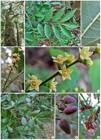
a-h. Trichilia elegans- a. habit; b. leaf; c. detail of the domatia in the hypophyll of the leaflet; d. inflorescence; e. detail of the flowers; f. terminal branch with mature fruits; g. closed mature fruits; h. open mature fruits with arilated seeds. (Photos: a-h. A.M. Panizza).
Tree up to 20 m high. Trunk ramified; non-surface roots; outer bark smooth, grayish-brown, with horizontal lines, scaly in thin strips on older specimens; inner bark pink; no information about the scent. Terminal branches dark brown to grey, lenticellate, pubescent becoming glabrous. Leaves 13-28 cm long; petiole cylindrical; 5-9(-11) leaflets opposite. Leaf blade 3.5-10.5 × 1-5 cm, elliptic, rarely oblong-lanceolate, glabrous, rarely puberulous, base attenuate, apex attenuate or acuminate; hypophyll with pilose domatia in the axils of secondary veins, often in cavities; glandular-punctate and -striate evident. Thyrses 3-10 cm long. Flowers 5-merous, white to white-greenish, glabrous, rarely pubescent, sessile or with pedicel 0.3-1(-1.25) mm long, non-articulate; calyx free or fused, 5-lobed, quincuncial or open; corolla free, imbricate; staminal tube with appendages acute alternating with (9-)10(-11) anthers exserted in the staminal tube; nectary-disk annular; ovary glabrous, 3-locular, 2-ovulate, collateral, style-head capitate, discoid or lobed. Capsule ellipsoid, 0.7-2 × 0.6-1.2(-1.4) cm, smooth, puberulous or pubescent, granular-papillose, pink to purple; seeds 1-3, ellipsoid, black, shiny, partially surrounded by an apical arillode, fleshy, thin, red, rarely red-orange.
Selected specimens examined: ARGENTINA. MISIONES: Iguazú, ParNa Iguazú, camino a Garganta del Diablo, 11.VI.2021, fr., A.M. Panizza 281 (CTES, SI). Brazil. PARANÁ: Capitão Leônidas Marques, próx. ao ParNa Iguaçu, 1.VI.2004, fr., P.H. Labiak et al. 3344 (HUCS, MBM). Céu Azul. ParNa Iguaçu, borda do Parque, 24.V.2018, fr., C.R. Rauber et al. 59 (UNOP). Foz do Iguaçu. ParNa Iguaçu, Sendero Macuco, 18.IV.2019, fr., A.M. Panizza et al. 102 (EVB). São Miguel do Iguaçu, ParNa Iguaçu, Linha Martins, 29.III.2011, fl. and fr., L.G. Temponi et al. 948 (UNOP). Serranópolis do Iguaçu, borde entre Matelandia y Serranopolis, 7.XI.2019, fl. and fr., A.M. Panizza et al. 128 (EVB).
Widespread in South America, more abundant in southern Brazil, Paraguay, and northeastern Argentina, extending westward into Bolivia, Peru, Ecuador, Colombia, Venezuela, and Guyana, but only on the periphery of the Amazon basin (Pennington 2016). It is found in a wide range of habitats, from tropical forests and MOF with a strongly seasonal climate in the south, gallery forests of the Cerrado at the center, savannas in the east, and evergreen forests in the north (Pennington 1981). Sciophyte or of diffuse light, frequent, characteristic of Decidual Seasonal Forests and SSF of the Upper Uruguay and Paraná (Klein 1984). Found in four of the five areas evaluated in this study, very common, widespread in both protected areas.
Blooms from October to December and bears fruit almost all the year round from November to August. According to Patricio & Cervi (2005), both phases can last longer.
The vernacular name for this species are caá-tigoá (caá = foliage or forest, and ataiá = flexible), caá-vo-robeí, canela-do-mato, catiguá blanco, erva-de-cutia and pau-de-ervilha (Klein 1984; Patricio & Cervi 2005; De La Peña & Pensiero 2011).
Small tree with imparipinnate leaves, opposite leaflets, glandular-punctate and -striate evident and abundant, domatia pilose; flower white, capsule ellipsoid, purple, with persistent calyx and black seed with an orange-red partial arillode.
Similar to Trichilia casaretti C.DC. due to the pilose domatia in the axils of secondary veins, but differs in the greater number of domatia pilose close to the margin or dispersed over the leaf blade and glandular-punctate (not -striate) and capsule not papillose.
5.4. Trichilia pallens C. DC., Fl. bras. 11(1): 218. 1878. Fig. 6f-j
Trees up to 10 m high . Trunk straight; non-surface roots; outer bark smooth to rough, pale grey; inner bark not seen; no information about the scent. Terminal branches brown, lenticellate, puberulous to pubescent becoming glabrous. Leaves (7-)13-34 cm long; petiole cylindrical; 5-7(-9) leaflets opposite. Leaf blade 6.9-17 × 2-5 cm, oblong-lanceolate or elliptic, glabrous, base cuneate to attenuate, apex acuminate or attenuate; hypophyll with pilose domatia in the axils of secondary veins; glandular-punctate and -striate not evident. Panicles 5-16 cm long. Flowers 5-merous, white, glabrous to puberulous, pedicel 1-1.5(-2.5) mm long, non-articulate; calyx fused, irregularly lobed, open; corolla free, imbricate; staminal tube with appendages acute alternating with 8-10 anthers exserted in the staminal tube; nectary-disk annular; ovary glabrous, 3-locular, 1(-2)-ovulate, collateral, style-head discoid to columnar. Capsule broadly ovoid to globose, (0.8-)1-1.3(-2) × 0.9-1.5 cm, densely papillose, pubescent, smooth to slightly warty, light green to yellowish; seeds 1-2 per valve, ellipsoid, dark brown, partially surrounded by an apical arillode, fleshy, red.
Examined specimens: Brazil. PARANÁ: Céu Azul, ParNa Iguaçu, VIII.1997, fr., J.A. Jarenkow & M. Sobral 3651 (FLOR). Trilha Jacutinga, 24.V.2018, fr., C.R. Rauber et al. 46 (UNOP).
East coast of Brazil, from Bahia to Rio Grande do Sul, in lowland of tropical forests (Pennington 2016), to northwestern Argentina (Panizza & Keller 2024). Characteristic but discontinuous distribution of the Dense Ombrophilous Forest of the Atlantic coast (Klein 1984), MOF (Patricio & Cervi 2005; Panizza & Keller 2024), SSF, and in the grass-woody steppe (Patricio & Cervi 2005). Sciophyte, frequent in deep lateritic soils, within primary forests, and in the lower canopy layer (Klein 1984; Panizza & Keller 2024). Only found in one area of ParNa Iguaçu.
No data on the blooms, bearing fruit in May and August. According to Patricio & Cervi (2005), the species blooms throughout the year.
The vernacular name for this species are arco-de-peneira, baga de morcego, catiguá, guaçá (Klein 1984; Patricio & Cervi 2005).
Small tree with imparipinnate leaves, opposite leaflets, glandular-punctate and -striate not evident; white flowers 5-merous; capsule ovoid, densely papillose, light green to yellowish, calyx persistent, and seeds with a partially red arillode.
Similar to T. elegans, but differs due to glandular-punctate and -striate not evident in the leaflets and capsule broader than longer.
5.5. Trichilia pallida Sw., Prodr. 67. 1788. Fig. 11a-g
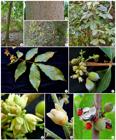
a-i. Trichilia pallida- a. habit; b-c. bark; d. foliage; e. leaf; f. detail of the petiole with axillary inflorescence and immature fruits; g. detail of the inflorescence; h. detail of the intrastaminal nectariferous disk; i. inmature fruits and open mature fruits with arilated seeds. (Photos: a-i. A.M. Panizza).
Tree up to 25 m high. Trunk round, ramified; sometimes with tabular roots; outer bark smooth or dippled, pale grey, lenticellate in young specimens, and scaly, dark brown and lenticellate in large specimens; inner bark fibrous, whitish to whitish-brown; with a sweet scent. Terminal branches pale grey to brown, lenticellate, puberulous to pubescent becoming glabrous. Leaves (4-)11-35(-55) cm long; petiole canaliculate; 5-9 leaflets opposite to sub-opposite. Leaf blade (5-)9-20(-36) × (2-)3-8(-13.5) cm, elliptic or oblong-lanceolate, glabrous to pubescent, base acute or attenuate, apex attenuate or acuminate; hypophyll without domatia; glandular-punctate and -striate absent or not evident. Fascicle 1-3 cm long. Flowers 4-merous, white, pubescent, sessile or with pedicel 0.5(-1) mm long, articulate; calyx free, sub-hemispherical, irregularly lobed, open; corolla free, imbricate; filaments partially free or staminal tube, with appendages filiform alternating with 8 anthers apical or exserted in the staminal tube; nectary-disk annular or patelliform; ovary pubescent, 3-locular, 2-ovulate, obliquely overlapping, style-head capitate. Capsule ovoid to globose, 1-2 × 0.8-1 cm, densely papillose, pubescent, smooth, rarely warty or muricate, green-yellow to gold; seed 1-3, black, shiny, partially surrounded by an apical arillode, fleshy, red-orange.
Selected Specimens Examined: ARGENTINA. MISIONES: Iguazú, ParNa Iguazú, Sendero Superior, 5.II.2020, fl., A.M. Panizza 162 (CTES, SI). Brazil. PARANÁ: Foz do Iguaçu, ParNa Iguaçu, trilha atrás del Hotel Cataratas, 25.XI.2019, fr., A.M. Panizza & E. Hentz Junior 137 (EVB).
A variable species with a very wide distribution from southern Mexico through Central America and some Caribbean islands, to South America until Paraguay, southern Brazil, and northeastern Argentina (Pennington 2016). In lowlands of the tropical forest, montane forests reaching the Andes, and in gallery forest in drier areas of southern Brazil with strongly seasonal climates, showing a discontinuous distribution (Pennington 1981, 2016; Klein 1984). Heliophyte to sciophyte, frequent (Klein 1984). Found in two of the five areas, abundant in both, probably also in area 3 of Capanema along the Iguazú river.
Blooms from February to May and in September, bearing fruit throughout the year; the flowering occurs at the same time as the fruiting throughout the year (personal observation).
The vernacular name for this species are baga-de-morcego, catiguá-graudo, cedrillo, marinheiro, peito-de-pombo, pitombeira and tauvá (Klein 1984; Pastore 2003; Patricio & Cervi 2005; De La Peña & Pensiero 2011).
Small a medium tree with terminal branches, leaves, and capsules covered with a soft golden pubescence; imparipinnate leaves, with 3-9 opposite or sub-opposite leaflets, basal leaflets smaller, domatia and glandular-punctate or -striate absent, petiole canaliculate and quadrangular; fascicle, congested and shorter than the others species; flowers white, staminal tube with filiform appendages equal to or larger than the anthers; nectary-disk bright yellow; capsule ovoid, golden, with a persistent calyx, valves horizontally wrinkled when drying, sometimes strongly reflexed, and seeds with a partial, apical, orange-red arillode.
Discussion
The species found in this study are consistent with those previously reported by Srur et al. (2009), Gris et al. (2014), Gris & Temponi (2017), and Souza et al. (2017). On the other hand, Trochez et al. (2017) cited Cedrela odorata (Cervi & Dunaiski 3145) and T. cassaretti (Temponi 638; Lombardi et al. 8761). However, the specimens were misidentified, being actually C. fissilis (Cervi & Dunaiski 3145), T. catigua (Temponi 638), and T. claussenii (Lombardi et al. 8761). In addition, T. cassaretti (Francisco et al. MBM283080) and T. pallens (Hatschbach 12558 MBM37524) were also cited by Souza et al. (2019), but the specimens were actually collected outside of ParNa Iguaçu. The only record of Guarea guidonia is based on a single historical specimen (Kuhlmann RB57749), sterile, from the ParNa Iguaçu, but it has not been collected again in the region to date. Therefore, in the present study C. odorata, G. guidonia and T. cassaretti were excluded, reducing the number of species cited and confirming T. pallens, but with new specimens from within the ParNa Iguaçu.
Table 1 shows the main characteristics of the Meliaceae species from both protected areas. The results are in agreement with Pennington (1981), Pennington (2016), Klein (1984), and Stehmann et al. (2009), who indicated that C. canjerana, C. fissilis, G. macrophylla, T. claussenii, and T. elegans are present in both the SSF and MOF; and T. pallida only in the SSF. According to Pennington (2016) and Stehmann et al. (2009), T. catigua and G. kunthiana are only in the SSF. However, our study found them in the MOF, confirming Patrício & Cervi (2005) regarding the same species in Paraná, thus highlighting the importance of regional floristic research in order to expand the occurrence of habitats for these species. Some species, such as C. fissilis, which is easy to identify and relatively abundant, have few specimens in general sampling because they are easily discarded in the search for rarer species. On the other hand, the situation of T. claussenii could be due to the fact that it is a less frequent species and occurs in more specific locations, always associated with water.
List of Meliaceae species in ParNa Iguaçu & ParNa Iguazú with status (exotic, native), vegetation type by area (SSF = Seasonal Forest Semideciduous; MOF = Ombrophilous Mixed Forest), ecological group (E = sciophyte; H = heliophyte), successional group (Pi = pioneer; Si = initial secondary; St = late secondary) and conservation status according to CNC and UICN (LC = little concern; NE = not evaluated; NT = near threatened; VU = vulnerable).
According to phytosociological studies in SSF and MOF of Paraná (Gris et al. 2014; Gris & Temponi 2017; Souza et al. 2017, 2019) and SSF of Misiones (Martinez-Crovetto 1963; Srur et al. 2009; Ríos 2010; Ríos et al. 2010; Velazco et al. 2015), Meliaceae is one of the most abundant families with the highest number of species. C. fissilis and C. canjerana are the species with the highest dominance, abundance, and frequency, which could be due to the fact that each species uses different survival strategies in the forest (Holz et al. 2009; Moscovich et al. 2010; Gris & Temponi 2017). In MOF, according to Ríos (2010), C. fissilis is one of the tallest and widest trees and is one of the early secondary species always present in all regeneration stages. On the other hand, C. canjerana is a late secondary species that can become established after disturbances such as fire, and it is large, predominant, and abundant at all strata of the canopy, ranging from the understory seedlings to adult (Ríos 2010; Ríos et al. 2010). Early secondary species, such as C. fissilis, will dominate the area for 20-30 years, until they share it equally with late secondary species, such as C. canjerana, and climax species, such as Trichilia (Ríos 2010). In SSF, however, according to the same author, T. catigua and T. elegans are climax shade species that predominate in the lower and middle strata of mature forests. This scenario highlights that these species are an important part of the Neotropical floristic diversity and fundamental elements of the canopy of the entire Atlantic Forest, characterising both the upper strates with Cedrela and Cabralea and the middle and lower strata with Guarea and Trichilia (Martinez-Crovetto 1963; Cabrera 1971; Pennington 1981; Gentry 1996; Ríos 2010).
Melia azedarach was categorized as invasive in MOF and SSF of the UPAF according to Zenni & Ziller (2011), because it is mainly dispersed by birds and mammals, has a high resprouting capacity, and is difficult to control (I3N Brasil 2021). In addition, as a fast-growing generalist species that produces allelopathic compounds, it competes with native species for the availability of space and food resources for the fauna.
Some species of this family show a prolonged flowering and fruiting period, sometimes simultaneously. In this case, different pollinators, such as bees, moths, and other insects (Villalobos 2011), have abundant nectar sources in the flowers through their nectary-disk. In terms of dispersal syndromes, most Meliaceae species exhibit zoochory due to their attractive seeds with colourful fleshy structures (arillode or sarcotesta) and/or fleshy capsules that are dispersed by birds, monkeys, rodents, and other small mammals (Klein 1984; Gentry 1996; Villalobos 2011). In addition to its abundance, Meliaceae is one of the families that contributes most to frugivore-plant interactions, providing ecosystem stability and dispersing seeds, thus increasing the plant complexity of these forests (Gris & Temponi 2017). Furthermore, Ríos (2010) mentions the importance of dispersal syndromes in remnant trees for natural regeneration.
Five native species were categorized regarding their conservation status, of which C. fissilis was classified as vulnerable, C. canjerana, G. kunthiana, T. elegans, and T. pallens as least-concern species, while the rest of the species remain unclassified. This indicates that information on the conservation status of the family is insufficient and need to improve, both at the local and regional levels. This must be taken into account, since some authors such as Clarkson et al. (2016) highlight the importance of conserving the genetic diversity of species with few populations and recategorising some species which were once widespread that are currently restricted. Historically, Meliaceae is a family of timber importance par excellence; however, illegal extractors target them, and they also face environmental loss due to the advance of the agricultural-livestock frontier. Over the past 20 years, Mohebalian et al. (2022) reveal a loss of vegetation cover of 13-20% in Argentina, Brazil, and Paraguay. This ongoing deforestation is associated with economic growth and the increase in population density. This leads to the lack of any type of management of natural resources. Besides, For this, Holz et al. (2009) mention important aspects such as the low density of adult trees and the low rate of regeneration observed in primary forests, as it happens in the UPAF, highlighting the urgent need to stop the extraction that is still taking place in many forest remnants . According Mohebalian et al. (2022), the designation of protected areas has proven effective in reducing deforestation and habitat degradation with heterogeneous associations between countries.Therefore, it is necessary to conserve as many of the remaining fragments of the UPAF as possible, with integrated community management of natural resources, educational programs on the importance of local biodiversity, and stricter environmental protection laws.
Acknowledgements
This work is part of the Master’s degree thesis from the Post-graduation Program in Neotropical Biodiversity (PPGBN) from the Universidade Federal da Integração Latino-Americana (UNILA), funded by the Coordenação de Aperfeiçoamento de Pessoal de Nível Superior-Brasil (CAPES) and with the financial support from the PPGBN-UNILA (process PRPPG 137/2018, PPGBN 09/2019 and PPGBN 22/2022). We would like to express our gratitude to the curators and technical staff of the following herbaria (CTES, EVB, FLOR, HUESB, HUFU, MBM, SI, UNOP, and UPCB) and to the reviewer and the editor who helped to improve the manuscript quality overall. We also thank the illustrator Martins, as well as the park rangers and staff of both national parks, ICMBio, CIES, and DNEA. We also thanks to Dr. Pennington, for his help; Ing. Gatti, Lic. Zanotti and Dr. Zuloaga, for their permanent support. A special thanks to the extraordinary group of botanists from UNOP & EVB, with whom we shared various days of collection, in addition to determinations, information, and happy moments making science.
References
- Alvares CA, Stape JL, Sentelhas PC & Gonçalves JLM (2013) Modeling monthly mean air temperature for Brazil. Theoretical and Applied Climatology 113: 407-427.
- APG IV - Angiosperm Phylogeny Group (2016) An update of the Angiosperm Phylogeny Group classification for the orders and families of flowering plants: APG IV. Botanical Journal of the Linnean Society 181: 1-20.
- Bridson D & Forman L (2004) The herbarium handbook. The Royal Botanic Gardens, Kew. 346p.
- Buchinger M & Falcone R (1958) Las Meliáceas Argentinas. Revista Argentina de Agronomía 25: 57-63.
- Cabrera ÁL (1971) Fitogeografía de la República Argentina. Boletín de la Sociedad Argentina de Botánica 14: 1-42.
- Cervi AC, von Linsinger L & Patrício PC (2008) The genus Cedrela P. Browne (Meliaceae) in southern Brazil. Acta Biológica Paranaense 37: 105-110.
- Clarkson JJ, Pennington TD, Chase MW, Haynes G, Engstrand R, Kaye M, Michalak I & Muellner-Riehl A (2016) Phylogenetic relationships in Trichilia (Meliaceae) based on ribosomal ITS sequences. Phytotaxa 258: 6-17.
-
CNCFlora (2021) Meliaceae in Lista Vermelha da Flora Brasileira versão 2012.2. Centro Nacional de Conservação da Flora. Available at <http://cncflora.jbrj.gov.br/portal/pt-br/listavermelha/MELIACEAE>. Access on 10 January 2021.
» http://cncflora.jbrj.gov.br/portal/pt-br/listavermelha/MELIACEAE - De Candolle C (1878) Meliaceae. In: Martius CFP (ed.) Flora brasiliensis Fleicher, Liepizig. Vol. 11, pars 1, pp. 207-218.
- De La Peña M & Pensiero J (2011) Catálogo de nombres comunes de la Flora Argentina. Universidad Nacional del Litoral, Santa Fe. 464p.
- Ellis B, Daly DC, Hickey LJ, Johnson KR, Mitchell JD, Wilf P & Wing SL (2009) Manual of Leaf Architecture. Cornell University Press, New York. 220p.
- Filgueiras TS, Nogueira PE, Brochado AL & Guala GF (1994) Caminhamento - um método expedito para levantamentos florísticos qualitativos. Cadernos de Geociências 12: 39-43.
-
Flora Argentina (2021) Catálogo de las Plantas Vasculares del Conosur. Instituto de Botánica Darwinion. Available at <http://www.darwin.edu.ar/Proyectos/FloraArgentina/fa.htm>. Access on 6 September 2021.
» http://www.darwin.edu.ar/Proyectos/FloraArgentina/fa.htm -
Flora e Funga do Brasil (2025) (continuously updated). Jardim Botânico do Rio de Janeiro. Available at <http://floradobrasil.jbrj.gov.br/>. Access on 2 September 2025.
» http://floradobrasil.jbrj.gov.br - Flores TB, Souza VC & Coelho RLG (2017) Flora do Espírito Santo: Meliaceae. Rodriguésia 68: 1693-1723.
- Font Quer P (1953) Diccionario de Botánica. Ed. Labor, Barcelona. 1244p.
- Fontana JL (1996) Los pajonales mesófilos seminaturales de Misiones. Phytocoenologia 26: 179-271.
- Gadelha Neto PC, Lima JR, Barbosa MR, Alencar Barbosa M, Menezes M, Cavalcanti Porto K, Wartchow F & Baptista Gibertoni T (2013) Manual de procedimentos para herbários. Ed. Universitária da UFPE, Recife. 52p.
- Gentry AH (1986) Sumario de patrones fitogeográficos y sus implicaciones para el desarrollo de la Amazonia. Revista de la Academia Colombiana de Ciencias Exactas, Físicas y Naturales 16: 101-116.
- Gentry AH (1988) Changes in plant community diversity and floristic composition on environmental and geographical gradients. Annals of the Missouri Botanical Garden 75: 1-34.
- Gentry AH (1996) A field guide to the families and genera of woody plants of Northwest South America (Colombia, Ecuador, Perú). Conservation International, Washington, DC. Pp. 613-617.
- Giulietti AM, Harley RM, Queiroz LP, Wanderley MGL & Berg C (2005) Biodiversity and conservation of plants in Brazil. Conservation Biology 19: 632-639.
-
González J (2021) Explicación etimológica de las plantas de la selva. Flora Digital de la Selva, Organización para Estudios Tropicales. Pp 1-135. Available at <https://sura.ots.ac.cr/florula4/docs/ETIMOLOGIA.pdf>. Access on 5 January 2021.
» https://sura.ots.ac.cr/florula4/docs/ETIMOLOGIA.pdf - Gris D, Temponi LG, Damasceno J & Alves G (2014) Structure and floristic diversity of remnant semideciduous forest under varying levels of disturbance. Acta Botanica Brasilica 28: 569-576.
- Gris D & Temponi LG (2017) Similaridade florística entre trechos de Floresta Estacional Semidecidual do Corredor de Biodiversidade Santa Maria - PR. Ciência Florestal 27: 1069-1081.
- Hickey LJ (1973) Classification of the architecture of dicotyledonous leaves. American Journal of Botany 60: 17-33.
- Holz S, Placci GP & Quintana RD (2009) Effects of History of use on secondary forest regeneration in the Upper Parana Atlantic Forest (Misiones, Argentina). Forest Ecology and Management 258: 1629-1642.
- Hua P & Mabberley DJ (2008) Melia L. In: Wu ZY & Raven PH (eds.) Flora of China 11: 130-131.
-
IAPAR - Instituto Agronômico do Paraná (2018) Cartas climáticas do Paraná. Available at <http://www.iapar.br/pagina863.html>. Access on 6 September 2021.
» http://www.iapar.br/pagina863.html - IBAMA - Instituto Brasileiro do Meio Ambiente (1999) Plano de manejo do Parque Nacional do Iguaçu. Resumo executivo. Diretoria de Unidades de Conservação e Vida Silvestre, Parque Nacional do Iguaçu, Brasília.
- IBGE - Instituto Brasileiro de Geografia e Estatística (2012) Manual técnico da vegetação brasileira. IBGE, Rio de Janeiro. 271p.
- IUCN - International Union for Conservation of Nature (2012) Directrices para el uso de los Criterios de la Lista Roja de la UICN a nivel regional y nacional: Versión 4.0. UICN, Gland. 43p.
-
IUCN - International Union for Conservation of Nature (2021) Guidelines for using the IUCN Red List categories and criteria, version 14. IUCN Standards and Petitions Subcommittee. Available at <https://www.iucnredlist.org/resources/redlistguidelines>. Access on 10 September 2021.
» https://www.iucnredlist.org/resources/redlistguidelines -
I3N Brasil (2021) Base de datos de especies exóticas invasoras de Brasil. Instituto Hórus de Desenvolvimento e Conservação Ambiental, Florianópolis. Available at <http://bd.institutohorus.org.br>. Access on 10 January 2021.
» http://bd.institutohorus.org.br -
Jabot (2021) Jabot - Banco de Dados da Flora Brasileira. Available at <https://rb.jbrj.gov.br>. Access in September 2021.
» https://rb.jbrj.gov.br -
JSTOR (2021) JSTOR Global Plants. Available at <https://plants.jstor.org/>. Access in September 2021.
» https://plants.jstor.org - Jussieu AHL (1829) Meliaceae. In: Saint-Hilaire (ed.) Flora Brasiliae Meridionalis. 4 ed. vol. 2. París. 77-79.
- Jussieu AHL (1830) Bulletin des sciences naturelles et de geologie 23: 240.
- Klein RM (1984) Meliáceas. In: Reitz R (ed.) Flora ilustrada catarinense. I parte. Ed. Itajaí, Herbário Barbosa Rodrigues. 138p.
- Koenen E, Clarkson J, Pennington T & Chatrou L (2015) Recently evolved diversity and convergent radiations of rainforest mahoganies (Meliaceae) shed new light on the origins of rainforest hyperdiversity. New Phytologist 207: 327-339.
- Lindley J (1951) Glosología o de los términos usados en botánica. Instituto Miguel Lillo de la Universidad Nacional, Tucumán. 123p.
- Linnaeus C von (1753) Species Plantarum. vol. 1. Pp. 384-385, 443.
- Mabberley DJ (2011) Meliaceae. In: Kubitzki K (ed.) Flowering plants. Eudicots. The families and genera of vascular plants. Vol. X. Springer-Verlag, Berlin Heidelberg. Pp. 185-211.
- Martínez-Crovetto R (1963) Esquema fitogeográfico de la Provincia de Misiones (República Argentina). Bonplandia 1: 171-223.
- Martius CFP von (1843) Systema materiae medicae vegetabilis brasiliensis. Frid Fleischer, Lipsiae. 156p.
- Mohebalian P, Lopez L, Tischner A & Aguilar F (2022) Deforestation in South America’s tri-national Paraná Atlantic Forest: trends and associational factors. Forest Policy and Economics 137: 102697.
- Moscovich F, Dummel C, Pinazo M, Knebel O & Alcaraz R (2010) Caracterización fitosociológica de una porción de bosque nativo misionero secundario, con intervención antrópica. Quebracho 18: 24-36.
- Muellner-Riehl A & Rojas Andrés B (2021) Biogeography of Neotropical Meliaceae: geological connections, fossil and molecular evidence revisited. Brazilian Journal of Botany 45: 10.1007.
- Muellner AN, Samuel R, Johnson SA, Cheek M, Pennington TD & Chase MW (2003) Molecular phylogenetics of Meliaceae (Sapindales) based on nuclear and plastid DNA sequences. American Journal of Botany 90: 471-480.
- Panizza AM & Keller HA (2024) Trichilia pallens (Meliaceae) nueva cita para la flora argentina y novedades nomenclaturales para el género. Bonplandia 33: 61-69.
- Pastore JA (2003) Meliaceae. In: Wanderley MGL, Shepherd GJ, Melhem TS, Giulietti AM & Kirizawa M (eds.) Flora fanerogâmica do estado de São Paulo. Instituto de Botânica, São Paulo. Vol. 3, pp. 225-240.
- Patricio PC & Cervi AC (2005) O gênero Trichilia (Meliaceae) no estado do Paraná, Brasil. Acta Biológica Paranaense 34: 27-71.
- Pennington TD (1981) A monograph of Neotropical Meliaceae. The New York Botanical Garden, New York. Flora Neotropica Monographs 28: 1-470.
-
Pennington TD (2009) Neotropical Meliaceae. In: Milliken W, Klitgaard B & Baracat A (2009 onwards) Neotropikey - interactive key and information resources for flowering plants of the Neotropics. Available at <http://www.kew.org/science/tropamerica/neotropikey/families/Meliaceae.htm>. Access on 5 January 2021.
» http://www.kew.org/science/tropamerica/neotropikey/families/Meliaceae.htm - Pennington TD (2016) Systematic treatment of American Trichilia (Meliaceae). Phytotaxa 259: 18-162.
- Pennington TD & Clarkson JJ (2013) A revision of Guarea (Meliaceae). Edinburgh Journal of Botany 70: 179-362.
- Pennington TD & Muellner AN (2010) A monograph of Cedrela (Meliaceae). Ed. dh Books, Milborne Port. 112p.
- Pennington TD & Styles BT (1975) A generic monograph of the Meliaceae. Blumea 22: 419-540.
- Pennington TR, Prado DE & Pendry CA (2000) Neotropical seasonally dry forests and Quaternary vegetation changes. Journal of Biogeography 27: 261-273.
- Prado DE (2000) Seasonally dry forests of tropical South America: from forgotten ecosystems to a new phytogeographic unit. Edinburgh Journal of Botany 57: 437-461.
- Prado DE & Gibbs PE (1993) Patterns of species distributions in the dry seasonal forests of South America. Annals of the Missouri Botanical Garden 80: 902-927.
- Radford AE, Dickison WC, Massey JR & Bell CR (1974) Vascular plant systematics. Harper & Row, New York. 891p.
-
ReFlora (2025) Available at <http://reflora.jbrj.gov.br>. Access on 10 September 2025.
» http://reflora.jbrj.gov.br - Reynel C, Pennington TD, Pennington RT, Flores C & Daza A (2003) Árboles útiles de la Amazonía Peruana y sus usos. Darwin Initiative Project e International Center for Research in Agroforestry, Perú. 509p.
- Reynel C, Pennington TD, Pennington RT, Marcelo JL & Daza A (2007) Árboles útiles de los Andes Peruanos. Darwin Initiative Project, Perú. 462p.
- Ríos RC (2010) Capacidade regenerativa da Floresta Missioneira Argentina frente a distúrbios antrópicos. Tese de Doutorado. Universidade Federal do Paraná, Curitiba. 172p.
- Simpson MG (2006) Plant systematics. Elsevier Academic Press, San Diego. 590p.
- Smith C (1960) A revision of Cedrela (Meliaceae). Fieldiana 29: 295-341.
- Souza RF, Machado S, Galvão F & Filho AF (2017) Fitossociologia da vegetacao arbórea do Parque Nacional do Iguaçu. Ciência Florestal 27: 853-869.
- Souza RF, Machado S, Galvão F, Filho AF & Picoli AC (2019) Forests of the Iguaçu National Park: structure, composition, and richness. Floresta e Ambiente 26: e20150267.
-
speciesLink (2021) speciesLink. Available at <https://specieslink.net/>. Access on 6 September 2021.
» https://specieslink.net - Spichiger R, Méroz J, Loizeau PA & Stutz de Ortega L (1990) Contribución a la Flora de la Amazonía Peruana: Meliaceae. Boissiera 2: 131-150.
- Srur M, Gatti F, Benesovsky V, Herrera J, Melzew R & Camposano M (2009) Los tipos de vegetación y ambientes del Parque Nacional Iguazú y su distribución en el paisaje. In: Carpinetti B, Garciarena M & Almirón M (eds.) Parque Nacional Iguazú, conservación y desarrollo en la Bosque Atlántico de Argentina: Administración de Parques Nacionales, Buenos Aires. Pp. 99-118.
- Stearn WT (1992) Botanical Latim. 4th ed. Timper, Portland. 546.
- Stehmann J, Forzza R, Salino A, Sobral M, Costa D & Kamino L (2009) Diversidade taxonômica na Floresta Atlântica. Plantas da Floresta Atlântica. Instituto de Pesquisas Jardim Botânico do Rio de Janeiro, Rio de Janeiro. 516p.
- Swartz O (1788) Nova Genera et Species Plantarum seu Prodromus. Upsaliæ & Aboæ, in bibliopoliis Acad. M. Swederi, Holmiae. 158p.
-
The Plant List (2020) The Plant List Version 1.1. Available at <http://www.theplantlist.org>. Access on 6 June 2020.
» http://www.theplantlist.org - Theobald WL, Krahulik JL & Rollins RC (1979) Trichome description and classification. In: Metcalfe CR & Chalk L (eds.) Anatomy of the dicotyledons. Vol. 1. Oxford University Press, Oxford. Pp. 40-53.
-
Thiers B (continuously updated) Index Herbariorum: a global directory of public herbaria and associated staff. New York Botanical Garden’s Virtual Herbarium. Available at <http://sweetgum.nybg.org/science/ih/>. Access on 10 October 2020.
» http://sweetgum.nybg.org/science/ih - Trochez LFC, Tasistro IB, Duarte CF, Almeida J, Ferreira LD, Vendruscolo GS & Lima LCP (2017) Checklist de las fanerógamas del Parque Nacional do Iguaçu, Foz do Iguaçu, PR- Brasil. Revista Latino-Americana de Estudos Avançados 1: 71-102.
- Vahl M (1807) Eclogae Americanae 3: 8.
- Van der Pijl L (1982) Principles of dispersal in higher plants. 3 ed. Springer-Verlag, Berlin. 218p.
- Velazco SJE, Galvão F, Keller HA & Bedrij NA (2015) Florística e Fitossociologia de uma Floresta Estacional Semidecidual, Reserva Privada Osununú-Misiones, Argentina. Floresta e Ambiente 22: 1-12.
- Vellozo JMC (1825[1829]) Flora Fluminensis 75: 176.
- Villalobos HM (2011) Tratamiento taxonómico de Meliaceae (Cabralea, Cedrela, Guarea, Ruagea, Swietenia) en la región Madidi, Bolivia. Tesis. Universidad Mayor de San Andrés, La Paz. 138p.
- Wilkinson HP (1979) The plant surface (mainly leaf), part IV domatia. In: Metcalfe CR & Chalk L (eds.) Anatomy of the dicotyledons. Clarendon Press Press, Oxford. Pp. 97-167.
- Zanotti CA, Keller HA & Zuloaga FO (2020) Biodiversidad de la flora vascular de la provincia de Misiones, Región Paranaense, Argentina. Darwiniana, nueva serie 8: 42-281.
- Zapater MA, del Castillo EM & Pennington TD (2004) The genus Cedrela (Meliaceae) in Argentina. Darwiniana 42: 347-356.
- Zenni RD & Ziller SR (2011) An overview of invasive plants in Brazil. Brazilian Journal of Botany 34: 431-46.
-
Data availability statement
In accordance with Open Science communication practices, the authors inform that there is no data sharing of this manuscript.
-
Cite as:
Panizza AM, Temponi LG, Caxambu MG & Lima LCP (2026) Flora of Meliaceae in the Upper Paraná Atlantic Forest. Rodriguésia 77: e00642025. DOI: 10.1590/2175-7860202677018
List of exsiccates
Biloni A 35 (5.5). Cabrera AL 183 (5.5). Cámara Hernández J BAA18679 (5.3). Cardozo AP 2, 3 (3.2). Caxambu MG 6806 (1.1), 6972 (3.1), 7014 (3.2), 6820 (5.2), 6347 (5.3), 6456 (5.5). Cervi AC 3145 (2.1), 3436 (3.1), 2748, 3021, 3439 (5.3), 2740 (5.5). Conceição LHSM 97 (5.1), 63 (5.3), 120, 121 (5.5). Duarte AP 1763 (1.1), 1762 (2.1), 1670 (5.1), 1642 (5.3). Eskuche U 409 (1.1), 411, 1921 (3.1). 1920 (3.2), 419 (5.1), 417, 1922 (5.5). Ferraro L 2451 (5.1), 2450 (5.3). Ferrucci MS 3443 (3.1), 3458 (5.1), 515 (5.3), 3438 (5.5). Gatti FE 13 (3.2). Gris D 12 (1.1), 13, 47 (3.1), 44 (5.1). Guaglianone ER 105 (5.3). Hatschbach G 9408 (1.1), 9754, 10396, 10428 (3.1), 9758, 10421, 10422 (3.2), 21111 (5.1), 9374 (5.2), 49556 (5.3), 49560 (5.5). Herrera J 88 (1.1), 78 (2.1), 63, 103 (3.2). Hunziker JH 11953 (3.1), 11916, 11921, 11936, 11946 (3.2), 11961 (5.1), 2619, 11927 (5.3), 11957 (5.5). Irigoyen J 211 (5.5). Janson C 55 (3.2). Jarenkow JA 3651 (5.4). Kawall MA 31 (3.2). Keller HO 6121 (5.5). Krapovickas A 13687 (3.1), 13389 (5.2). Kuhlmann JG RB57746, RB57747, RB52261 (1.1), RB57748 (2.1), 128 (5.1), 3947 (5.3). Labiak PH 3294 (3.1), 3344 (5.3). Lima LCP 890 (2.1), 813 (3.1), 765 (3.2). Lindeman JC 3398, 3580 (3.1), 3323, 3491, 3535 (3.2), 3375 (5.3), 75 (5.5). Lombardi JA 8776 (3.2), 8761 (5.2). Machado-Silva T 202 (3.1). Mano GB 5, 20 (1.1), 7 (3.1). Morrone O 1189 (1.1), 1172 (2.1). Múlgura ME 4437 (5.5). Nicolau SA 569 (5.3). Panizza AM 113, 156 (1.1), 150, 210 (2.1), 131, 147, 148, 192, 252 (3.1), 118, 129, 247 (3.2), 194, 214, 225 (5.1), 263, 291 (5.2), 102, 107, 117, 128, 205, 281 (5.3), 137, 162 (5.5). Patricio PC 16 (5.2), 18 (5.3). Pereira E 5380, 7819 (3.1), 7806 (3.2), 5308 (5.1). Placci G 196 (3.2), 224 (5.2), 191 (5.3). Rauber CR 48 (3.2), 39 (5.1), 59 (5.3), 46 (5.4), 108 (5.5). Ribas OS 6275 (3.2). Rodolfo AM 48 (1.1), 18 (3.1), 29 (3.2), 26 (5.3). Rodríguez FM 374 (1.1), 455 (2.1), 432 (3.1), 422 (5.5). Romanczuk MC 650 (5.1), 604 (5.3). Schulz AG 16184 (5.2). Siqueira EL 1778 (4), 2109 (5.3). Sobral M 6171 (5.5). Tell Bertoni G 245 (3.1), 127 (5.1), 187 (5.3), 169 (5.5). Temponi LG 564 (1.1), 519, 685 (3.1), 638, 945 (5.1), 948 (5.3). Toderke ML 38 (5.3). Tressens SG 4461 (1.1), 4482 (3.1), 4468 (5.2), 4473 (5.5). Vanni RO 3089, 3177, 3304, 4001 (1.1), 3317 (2.1), 2786, 3178 (3.1), 3345 (5.1), 2715, 2811, 4042 (5.5). Xifreda C 476 (5.1). Zanotti CA 453 (3.1). Zardini E 831, 833 (3.1), 844 (3.2). Ziller SR 1680 (3.2). Zuloaga FO 810 (3.2), 5215, 5625 (5.1), 5623 (5.5).
In accordance with Open Science communication practices, the authors inform that there is no data sharing of this manuscript.