 Far away, so close: urban citizens in a Brazilian metropolis value green areas but prefer exotic species for afforestation
Abstract
We examined the knowledge held by urban residents regarding tree species as well as their preferences and perceptions of green areas within their city. Pedestrians in Fortaleza, Ceará state, Brazil, were interviewed regarding the tree species they know and value, and the tree species present in the square where the interviews were recorded. We expected higher mentions of exotic species and a preference for them over native species, reflecting global urbanization trends and the fact that most trees in the city studied are exotic. We also hypothesized that urban green areas would be positively evaluated by citizens, linked to perceptions of green spaces as beneficial to human well-being and health. The interviewees cited 100 ethnospecies, representing 97 biological species. Participants showed greater familiarity with, and preference for, exotic species. These results aligned with our expectations, as exotic trees are much more common in Fortaleza than native species. The number of species cited was influenced by the interviewee’s age and origin (urban vs. rural). Despite recognizing the importance of urban trees, many interviewees associated them with drawbacks like leaf clutter and infrastructure damage. Our findings suggest that promoting planting native fruit trees and implementing proper management could foster the appreciation of native species in urban settings and help preserve local knowledge and ecosystem services. This underscores the potential for integrating native species into urban green spaces to enhance biodiversity and ecosystem health and to counteract the impacts of urbanization and the loss of traditional ecological knowledge.
Key words:
ethnobotany; local knowledge loss; urban forestry; urban green areas; urban trees
Resumo
O estudo investigou o conhecimento e as preferências dos residentes urbanos sobre as espécies de árvores e suas percepções sobre áreas verdes nas cidades. Pedestres em Fortaleza, Ceará, Brasil, foram entrevistados sobre as espécies de árvores que conhecem e valorizam, além das presentes na praça onde a entrevista foi realizada. Esperava-se uma maior menção a espécies exóticas e uma preferência por elas, refletindo as tendências globais de urbanização. Também se hipotetizou que as áreas verdes urbanas seriam avaliadas positivamente, associadas ao bem-estar e à saúde. Os resultados mostraram 100 etnoespécies citadas, representando 97 espécies biológicas. Os participantes demonstraram maior familiaridade e preferência por espécies exóticas, conforme esperado. O número de espécies foi influenciado pela idade e origem dos entrevistados (urbano vs. rural). Apesar de reconhecerem a importância das árvores urbanas, muitos associaram-nas a inconvenientes, como queda de folhas e danos à infraestrutura. Os achados sugerem que a promoção de árvores frutíferas nativas e um manejo adequado poderiam incentivar a valorização das árvores nativas em áreas urbanas, preservando o conhecimento local e serviços ecossistêmicos. Isso destaca o potencial de integrar espécies nativas em espaços verdes urbanos, melhorando a biodiversidade e a saúde do ecossistema, atenuando os impactos da urbanização e a perda de conhecimento.
Palavras-chave:
etnobotânica; perda de conhecimento local; áreas verdes urbanas; florestas urbana; árvores urbanas
Introduction
Urbanization has severe impacts on natural ecosystems, both locally and globally. Vegetation suppression to make way for urban growth leads to the loss of natural habitats, ecosystem fragmentation, changes in the local climate, increases in air, water, and soil pollution, as well as impacts on the hydrological cycle due to soil sealing (Amato-Lourenço et al. 2016; Cadorin & Mello 2011; Feitosa et al. 2011). Additionally, urbanization often introduces invasive exotic species that can compete with native plants for resources and space, leading to decreased biological diversity and increased impacts to local ecosystems (Mckinney 2002; Harrington et al. 2003; McDonald et al. 2020).
Green areas have been set aside in urban spaces to mitigate some of the negative effects of native vegetation suppression. The importance of these green areas has been widely recognized both for providing ecosystem services (climate regulation, air and water purification, flood control, and pollination) and for benefiting the physical and mental health of human urban populations (Bertram & Rehdanz 2015; Fermino et al. 2017; Jennings et al. 2019; Lima et al. 2019; Bucci et al. 2021; Semeraro et al. 2021). Investigations into perceptions of the value of trees held by urban inhabitants in Northern Brazil, for example, have shown that most people recognize the benefits of urban trees for microclimate amelioration and for providing shade in the city (Malavasi & Malavasi 2001; Munduruku et al. 2019).
Tree planting in streets, squares, and private spaces in Brazil has favored exotic species, however, and tree cover in these areas is therefore qualitatively different from the natural vegetation within and surrounding the city (Moro et al. 2014; Santos et al. 2010; Rufino et al. 2019). In addition to potential ecological impacts resulting from bioinvasions derived from the introduction of exotic species, the replacement of native vegetation with a predominantly exotic ornamental flora in urban areas can promote human disconnects from the native local flora (Mckinney 2006; Moro & Castro 2015).
Urbanization is considered one of the main causes of the loss of traditional ecological knowledge (TEK) throughout the world through globalization and modernization (Ferreira-Júnior et al. 2016; Aswani et al. 2018), affecting the recognition, use, and management of local wild species (Arjona-García et al. 2021) and leading to the loss of traditional ecological knowledge due to increased urban-rural disconnection, alienation from food production, and the neglect of social-ecological perspectives (Elmqvist et al. 2012).
Residents’ mental models (ecological knowledge and perceptions) in more urbanized areas tend to be become homogenized and linear, indicating limited systems thinking. This can reduce the ability of those residents to perceive the complexities of human-environment interactions - and therefore to be able to consciously choose behaviors that could lead to harmony in their human interrelationships and beneficial interactions with their surrounding natural environments (Aminpour et al. 2022). It is therefore essential to investigate the knowledge and perceptions of the urban flora held by city residents in order to design strategies for the conservation of urban biocultural diversity.
In this context, we used Fortaleza (the fourth largest Brazilian city, with the highest population density in the country [IBGE 2023]), as a model to assess the knowledge and preferences of urban residents in terms of tree species, as well as their perceptions of the roles of urban green areas. We hypothesized that interviewees who were born and raised in the countryside (rural areas) would cite more species than those born and raised in urban areas. We also expected that the interviewees would have greater knowledge of, and would prefer, exotic species over locally native species, due to the scarcity of native trees in Fortaleza’s urban landscape and the associated loss of knowledge of the local flora. Regarding perceptions about the importance of urban green areas, we predicted that those areas would receive mostly positive evaluations, as urban green spaces are generally positively recognized for promoting well-being and health.
Material and Methods
Study site
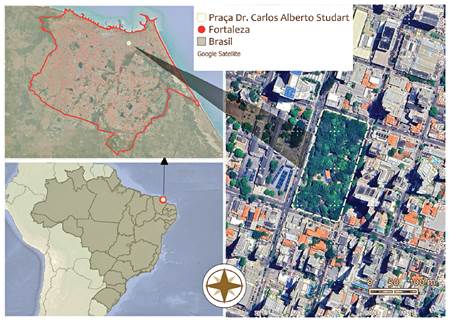
Our research was conducted in the city of Fortaleza, Ceará state, Brazil. Fortaleza encompasses an area of 312 km² and has the fourth largest population in Brazil, with a population density of 7,776 inhabitants/km² (IBGE 2023). These characteristics enabled us to use it as a model system for other urbanized areas in the country. Data collection occurred at the “Doutor Carlos Alberto Studart Square”, commonly referred to as “Praça das Flores” (Fig. 1, 3.739304°S, 38.498699°W). This square has a large number of planted trees and provides shade and opportunities to practice sports and for social interactions. This very green square is an exception in a city that has undergone rapid changes and a transformation towards verticalization, with the substitution of smaller residences with backyards and orchard trees by large buildings without green areas (or only small gardens) (Alves 2013). The Fortaleza Environmental Inventory (Fortaleza 2003) revealed a loss of most of the city’s vegetation cover (from 1968-2002). A recent study revealed that Fortaleza retains only 11.7% of its extent as natural/semi-natural forest cover (Costa et al. 2025). Additionally, urban afforestation and the landscaping of streets, squares, and urban parks has become strongly dominated by exotic trees (Moro et al. 2014, 2015).
Map showing the location map of “Praça das Flores” (Praça Dr. Carlos Alberto Studart), in Fortaleza, Ceará state, Brazil.
Data collection
We interviewed 100 pedestrians who were crossing the Praça das Flores square, and requested their responses to our research questions. We calculated the sample size considering the estimated population of Fortaleza in 2017 (2,428,708 inhabitants) (IBGE 2017), the year in which the interviews were undertaken. We admitted a sampling error of 10%, aimed for a confidence level of 95%, and assumed a heterogeneous population distribution, resulting in a sample size of 97, which was adjusted to 100 people for practicality. This project was previously approved by the Ethics Committee of the Federal University of Ceará (Project number 73375617.8.0000.5054). Sampling was non-probabilistic, using the technique of sampling by accessibility or convenience (Bernard 2006). Information concerning the participant’s profile was solicited at the beginning of the questionnaire, including: (i) age, (ii) city and state in which they were born, and (iii) whether the participants had grown up in contact with rural areas or not.
We asked the interviewees to cite the trees that they could remember, and recorded the common names used by them to refer to the species. We also asked which trees were memorable from their childhood, and which trees they would choose to plant near their homes. The survey also had open as well as multiple-choice questions designed to document the interviewee’s opinion concerning urban trees in general (such as the advantages and disadvantages of having trees in urban spaces), and the importance of those plants to the quality of urban environments.
We consulted the checklist of trees and shrubs of the city of Fortaleza (Moro & Castro 2015) to determine the scientific names of the tree species cited by the participants as well as the main catalogs regarding native and ornamental Brazilian plants to determine the scientific and popular names of native, ornamental, and fruit plants [Lorenzi (1992, 1998, 2009, 2010); Lorenzi et al. (1996, 2003, 2004, 2006); Souza (2001)]. The present authors also have experience with urban trees in Fortaleza and are aware of most names used to refer to species in the city.
To obtain additional information concerning the survey site, we documented all of the trees and shrubs in the square with diameters at breast height of 3 centimeters or more, following usual methods of phytosociology (Moro & Martins 2011). To evaluate if the species present in the square were influencing the interviewee’s responses to the questions, we compared the species recorded in the square with those cited by the subjects interviewed to determine if they were similar.
Data analysis
The data was analyzed using descriptive statistical methods (average, median, standard deviation, and frequency) to determine if there were relationships between the ages and origins of the participants and the numbers of species they mentioned, building generalized linear models using the “glm” function from the stats package of the R programming language (version 4.2.1; R Core Team 2022). We also included the variable “gender” as a predictor, because the ethnobotanical literature has reported sex-related differences in local ecological knowledge in South America (Aswani et al. 2018).
A Poisson distribution curve was expected for the response variable “number of species cited”, as it is a count data. Visual inspection of the histogram indicated that the variable fits this distribution family, and it was therefore used in the creation of GLMs. We generated a null model, plus simple, additive and interaction models among the predictor variables of (I) age, (II) sex, and (III) place of origin, totaling 12 models.
We used Akaike Information Criterion (AIC) to select the best-fitting model, where a lower value indicates a better fit. The difference between each model and the best model (ΔAICc) was estimated, as well as the weight of evidence for each model (wAICc). Models with ΔAICc < 2 and wAICc > 0.1 were considered to have the same data fitting capacity. In the case of a tie, the simplest model was selected as the most explanatory, based on the principle of parsimony. We calculated McFadden’s pseudo R-squared to evaluate the selected model’s fitness to the data. Finally, we grouped the subjects’ answers into similar categories to aid in the interpretation of the data obtained to evaluate the results of the qualitative data.
Results
Profiles of the participants interviewed
Of the 100 interviewees, 49% were female and 51% male. The participants’ ages ranged from 18 to 86 years, with a mean of 44 years and median of 45 years. Regarding educational levels, most of the interviewees had a high level of education, with 33% of the participants having completed high school, 28% had a college degree; only two participants were illiterate. Regarding the origins of the interviewees, most were born in Ceará state (82%), 4% were from Piauí, 3% from Brasília, and 11% were from other states (totaling 12 different states). The majority (64%) of the interviewees grew up in the city of Fortaleza. Most interviewees had grown up in urban areas (77%); only 23% had grown up in rural areas. Among the interviewees born in urban areas, 46% had had some contact with rural environments, such as farms or relatives’ homes in the countryside.
Preferences of plant species
When requested to cite tree species that they could remember, the participants reported a total of 100 ethnospecies (Tab. S1, available on supplementary material <https://doi.org/10.6084/m9.figshare.31846408>), which corresponded to 97 biological species. We could confidently assign scientific names to most species, but a number of names given by the interviewees could not be attributed to a specific species. The majority of the participants cited more species exotic to Brazil (45% of the total) than species native to Ceará state (32%); 13% of the species cited are exotic in Ceará state, but native to Brazil; the origins of 10% of the species could not be determined based on their reported popular names. When the interviewees were asked which species they would consider as “preferred for cultivation”, few species native to Ceará state were prioritized (Tab. 1). Native species were less indicated as preferred trees for planting (only five out of 30 species mentioned) or as trees that they would choose to be planted near their homes (only six native species out of 28 species mentioned) (Tab. 1).
Summary of the results concerning the knowledge and preferences of the interviewees regarding tree species in Fortaleza, Ceará, Brazil.
When the interviewees were questioned about which trees they would prefer to see planted in different spaces (garden, squares, sidewalks), the species most cited were exotic. The Asian mango tree (Mangifera indica L.) was the most-cited species when addressing questions related to the knowledge of flora, although that species was less preferred to be planted along sidewalks, due to its large size. Syzygium malaccense (L.) Merr. & L.M.Perry, another exotic Asiatic fruit tree, was frequently mentioned for planting along sidewalks as well as a favorite tree.
Another species that the interviewees were very familiar with, and frequently mentioned as preferred for urban tree planting, was the invasive exotic species Azadirachta indica A.Juss. (Indian neem), which is a now very commonly planted along streets in Fortaleza (Moro et al. 2014, 2015). Only a few native trees were indicated as preferred species, with the cashew tree Anacardium occidentale L. being the most mentioned by interviewees. It is interesting to note that the principal trees cited by the interviewees all had similar characteristics - such as producing very visible fruits and flowers or a large canopy. These characteristics were also the most cited by the interviewees regarding their preferences for the attributes of a tree to be chosen for planting.
Drivers of plant knowledge and preferences
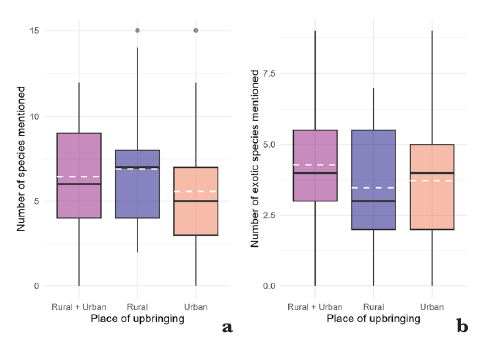
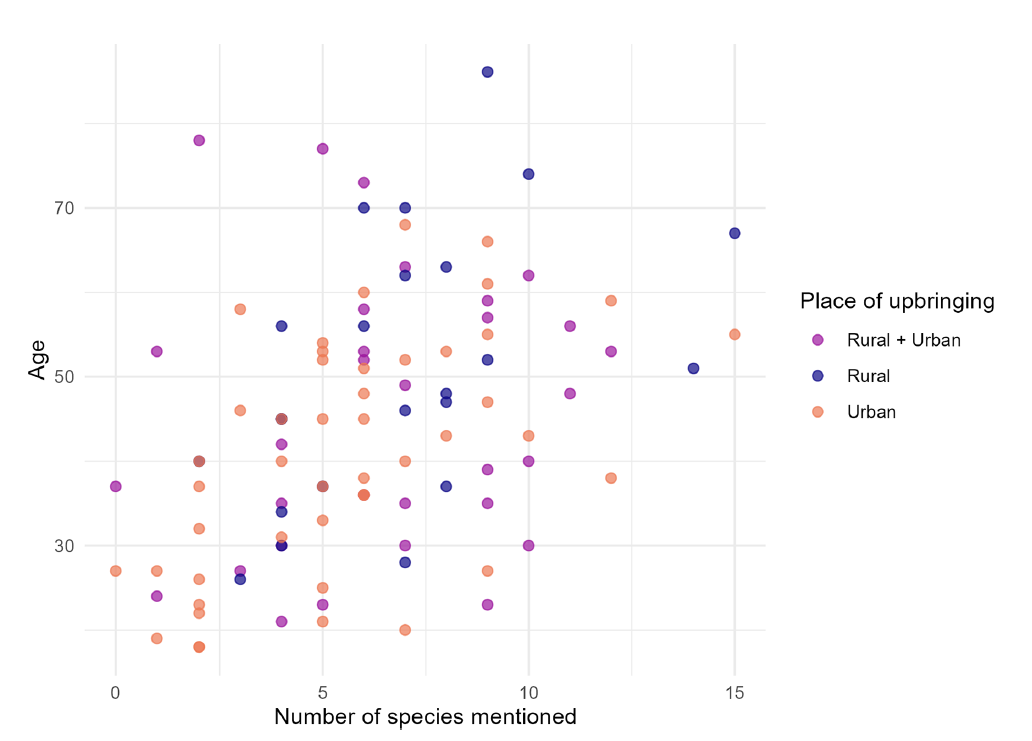
Participants who had grown up in rural areas mentioned higher numbers of species (Fig. 2a) and fewer exotic trees than interviewees who had grown up in urban areas (Fig. 2b). Older people mentioned more species than younger ones (Fig. 3). The average age of the 15 participants that had no memories of any tree associated with their childhood was 30.4 years. People unable to cite a memorable tree from their childhood were generally between 18 and 37 years old; only three of those 15 interviewees were older than 37.
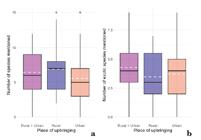
a-b. Relationship between the number of species cited and the place of upbringing (a), and the number of exotic species cited and the place of upbringing (b). The black lines inside the boxplots represent the median, and white lines the mean values.
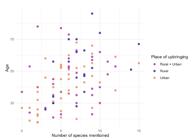
Relationship between the numbers of species cited, the ages of interviewee, and their places of upbringing.
GLM models were built to test the combinations of variables that could best explain the number of species mentioned. The results showed that an interactive model considering age and place of upbringing, but not sex, best fitted the data. In this model, both an urban origin and the interaction between age and an urban origin were significant (Tab. S2, available on supplementary material <https://doi.org/10.6084/m9.figshare.31846408>). The McFadden’s pseudo R-squared value was only 0.21, however, indicating a low fit to the data.
Tree species documented at the study site
Our survey identified 400 individual trees and shrubs as elements of the urban forestry at the study site in the Praça das Flores (Tab. S3, available on supplementary material <https://doi.org/10.6084/m9.figshare.31846408>). The majority of those plants were species exotic to Brazil (58%), 37% were native to Ceará, 3% were dead, and 2% were species exotic to Ceará but native to Brazil. Although the majority of specimens and species registered were exotic, the most abundant species was the native Licania tomentosa (Benth.) Fritsch (45 individuals), followed by the exotic species Gmelina arborea Roxb. (43 individuals), Azadirachta indica (42 individuals), and Terminalia catappa L. (29 individuals) (Tab. S3, available on supplementary material <https://doi.org/10.6084/m9.figshare.31846408>).
Perceptions about the importance of urban green areas
Most of the interviewees considered the presence of trees in an urban environment to be “very important” or “important”, although they stated that trees were more important in squares than along streets and sidewalks. The reasons they cited for trees being important along both sidewalks and squares were similar. The main benefit of urban trees, as perceived by the interviewees, was the “shade provided by the trees” (mentioned by 55 people). Another advantage emphasized by the population was the “improvement of air quality” (cited by 39 people), followed by the reduction of temperature (35 people), beauty (27 people), and presence of edible fruits (15 people).
Despite recognizing the positive attributes of trees, most of the interviewees (55%) expressed the belief that urban trees also posed disadvantages. The main negative attribute mentioned was the litter caused by trees (such as leaf fall), which was mentioned by 31 interviewees. Respondents also considered as negative points the need for constant maintenance, such as pruning and cleaning (14 people), as well as the possibility that a lack of such maintenance could cause damage to urban infrastructure. Seven participants argued that trees are less important along sidewalks due to negative impacts such as disturbing the flow of pedestrians, damage to the sidewalks themselves, and the necessity of constant maintenance.
Statements were also presented to the respondents, such as “trees make the city more beautiful” or “trees make the sidewalk dirty”, to be noted whether they agreed or disagreed (question number 13 of our interview schedule). The affirmative statements presenting the advantages of afforestation were all well accepted by the majority of interviewees. Nonetheless, the majority of the respondents also associated trees with negative factors, such as litter (60%) and problems with utility lines (66%) (Tab. 2) - stating that damage to urban infrastructure would occur if regular pruning was not performed.
Summary of the responses of the interviewees after presenting statements about the advantages and disadvantages of urban trees.
When the participants were invited to evaluate the urban forestry of Fortaleza in relation to its number of trees, 50% of the interviewees rated the city as having a moderate quantity of trees; 36% rated the city as having a small number of trees, while only a minority (14%) viewed the city as having a large number of trees. The levels of dissatisfaction was higher, however, among interviewees in terms of the quantities of trees in the neighborhoods in which they lived, with nearly half (49%) classifying their neighborhoods as having only reduced numbers of trees; 30% reported moderate numbers of trees, while only 14% considered their neighborhood to have large numbers of trees.
Discussion
Preferences for plant species
Half of the species mentioned by the interviewees are exotic to Brazil, with their proportions, as compared to native species, increasing when the interviewees were asked which species they preferred (63% exotic species) and which species they associated with their childhood (57% exotic species) [Tab. 1 and supplementary data (available at <https://doi.org/10.6084/m9.figshare.31846408>)]. These results suggest the strong influence of centuries of landscaping practices that did not value native plants (Ignatieva 2012). In many Brazilian cities, and in Fortaleza in particular (see Moro et al. 2014, 2015), ornamental exotic species are overrepresented in urban afforestation. At the same time, however, exotic plants reflect Brazil’s ethnic and cultural diversity, which has led to the inclusion of exotic species into many aspects of daily life - such as traditional medicine (Rossi-Santos et al. 2018; Zank & Hanazaki 2017), agriculture (Silva et al. 2007; Oliveira et al. 2024), cuisine (Santos et al. 2021), economy (Oliveira et al. 2024), and religious practices (Zank & Hanazaki 2016).
Most of the plants used as ornamentals and for landscaping throughout the world are not native to the places where they are cultivated (Heiden et al. 2006; Barros et al. 2010; Moro & Castro 2015; Paula et al. 2014; Santos et al. 2010; Santos et al. 2011; Souza et al. 2011) - a trend consistent in Fortaleza and other cities in Ceará, where the majority of cultivated trees are exotic (Moro et al. 2014; Moro & Castro 2015; Rufino et al. 2019).
Species cited by the interviewees in our study that were introduced for ornamental purposes, can become invasive, such as the neem tree (Azadirachta indica, Moro et al. 2013). Studies have shown that the introduction of exotic ornamental species, such as the Australian palm (Archontophoenix cunninghamiana (H.Wendl.) H.Wendl. & Drude) in the Atlantic rainforest (Dislich et al. 2002), the Rosy Sandcrocus [Romulea rosea (L.) Eckl.] introduced to the central coast of California (Brusati et al. 2014), and many other species in Brazil (Zenni 2014) can become invasive over time. In fact, invasive species are one of the largest threats to biodiversity worldwide (Roy et al. 2023). These threats could be reduced by prioritizing native plants for urban afforestation.
We found that Mangifera indica and Syzygium malaccense were preferred by many interviewees for planting along sidewalks and were cited as favorite trees. Both species have multiple uses in Northeastern Brazil (culinary, commercial, medicinal, ornamental), but the preference for these species is not limited just to this region. In a study on the perception of urban afforestation in Macapá in Amazonian Brazil (Castro & Dias 2013), these same species were recorded as preferred by most of the interviewees for the afforestation of their neighborhoods.
Many native species were also cited by the interviewees in our study. The cashew tree (Anacardium occidentale) was the second most cited species, and is considered a multipurpose tree (providing ornamentation, fruits, nuts, and income generation). Likewise, Ipê trees (Tabebuia and Handroanthus - Bignoniaceae) are valued for their beautiful and colorful flowers. Some Ipê species are exotic to Ceará or Brazil, but a number of ipê species are native and already used in the city’s forestry (Moro & Castro 2015) - although in lower numbers as compared to exotic trees like the Indian neem. The presence of flowers and fruits is a positive feature for urban afforestation and frequently cited by interviewees (Roppa et al. 2007; Araújo et al. 2010; Rodrigues et al. 2010; Castro & Dias 2013; Camacho-Cervantes et al. 2014; Babalola & Raji 2016). Nonetheless, Ceará has thousands of native plants and hundreds of native trees that were not cited by citizens living in urban areas (and probably not even know to them).
Drivers of plant knowledge and preferences
We recorded higher numbers of species mentioned by participants who had grown up in rural areas, aligning with other studies that detected decreases in floristic knowledge by population from urban environments (Ferreira-Júnior et al. 2016; Reyes-García et al. 2013, but see Vandebroek & Balick 2012 for a distinct perspective). We noted in Fortaleza that interviewees from urban origin reported less species and less native species than those from rural origin. This is in line with the fact that most trees in the city are exotic. Knowledge of the local flora is not generally necessary for livelihoods in urban areas (Gandolfo 2010), but can lead to a loss of knowledge associated with biodiversity (Soares et al. 2017; Aswani et al. 2018). In some situations, however, traditional knowledge is not necessarily being lost - but is rather being reorganized and hybridized with other knowledge systems in dynamic and adaptive manners (Gómez-Baggethun et al. 2013).
There is a certain cultural inertia regarding the use of traditional resources in urban environments, whether due to market pressures for the diffusion of other elements, or because of asymmetries of power and prestige (Ladio & Albuquerque 2016). Additionally, distinct patterns of environmental and resource use emerge as natural and introduced environments articulate and intertwine under urban conditions (Duarte Almada 2010). In this context, we recorded higher numbers of citations of exotic species in the urban environment.
We found that older participants had greater knowledge concerning plants than younger interviewees. This has been a common trend in ethnobotanical studies (Salgado & Guido 2008; Soares et al. 2017), as that kind of knowledge is cumulative and is acquired over decades. On the other hand, the separation of younger generations from local activities (due to their interest in urban oriented activities) has been recognized as a driver of plant knowledge losses (Ferreira-Júnior et al. 2016). As we have already mentioned, tree cover in urban areas is qualitatively different from the surrounding natural vegetation. Such changes in urban landscapes apparently result in changes in the ethnobotanical repertoires of different age groups (Hanazaki et al. 2013). Very little of the native ecosystem remains in Fortaleza (Costa et al. 2025), and young people certainly need more opportunities to make contact with native ecosystems and species and to become more aware of native biodiversity in the city.
Data from a global synthesis of the loss of traditional ecological knowledge revealed that this type of knowledge was largely held by women in South America, but with significant changes being observed mostly in relation to men (Aswani et al. 2018). However, we did not identify any differences in plant knowledge between men and women in Fortaleza. In general, studies reporting differences in local ecological knowledge between genders (considered in a binary manner) associated such differences with occupational or social roles that lead to greater or lesser knowledge about one or more plant use-category (food, timber, medicinal, among others) (Torres-Avilez et al. 2016). Additionally, such studies were predominantly conducted in indigenous or rural communities, whereas the present research was conducted in an urban environment and did not focus on distinct use-categories.
Although our results indicated that age and environment (urban vs. rural) significantly influenced the number and category (native vs. exotic) of species known to the interviewees, the model fit was low. This was expected, however, as local ecological knowledge is known to be influenced by variables beyond those measured here, such as education, ethnicity, and income level (Medeiros et al. 2016), variables that could be examined in future studies in urban environments. Finally, after comparing the species documented in the field with those mentioned by the participants, we noted that although some of the species cited were found at the park site, there was not a clear link between the participants’ responses and the species present in the surrounding square. Many of the species commonly cited by the interviewees are not densely represented in the square, and some of the most common species in the surrounding square (such as Gmelina arborea) were not cited by any interviewee. Therefore, we conclude that our results were not biased by the environment in which the data collection took place, as can happen in other situations (Miranda et al. 2007).
Perceptions about the importance of urban green areas
We found that the interviewees had a broad perception of the value of trees to the urban environment, with the benefits of shadow and the amelioration of urban climate being among the most cited benefits, as reported in other cities (e.g., Malavasi & Malavasi 2001). Although trees can fulfill multiple roles in urban ecosystems, related equally to human well-being (Kweon et al. 1998; Van den Berg et al. 2015) and biodiversity benefits (Silva 2018; Maruyama et al. 2019; Nascimento et al. 2020), most people perceive the amelioration of the urban microclimate as a unique role of urban trees (Malavasi & Malavasi 2001).
This perception is easy to understand in the context of our research, as Fortaleza is a hot, tropical city with high temperatures throughout the year, and it has very high solar radiation indices - creating an uncomfortable urban climate where shade is a desired feature (Repelli et al. 1997). The literature has shown that presence of shade is consistently the most cited benefit of urban trees in other cities (Araújo et al. 2010; Castro & Dias 2013; Ribeiro 2009; Rodrigues et al. 2010). Additionally, the presence of vegetation in a square is one of the main factors that determines how much time people spend there (Oliveira et al. 2013). In addition to shade, improved air quality has also been widely mentioned as a benefit of urban trees. Fully 100% of the participants in our survey agreed that trees improve air quality, and they expressed the feeling of having “cleaner air” when standing near trees; similar responses were recorded by Babalola and Raji (2016) in Nigeria.
Most of the interviewees, however, cited at least one disadvantage of trees, such as their generation of litter and impacting electrical transmission lines. Mentions of litter are probably related to the interpretation that leaves make the city dirty and should be removed (Lee & Shirley 2019), while responses related to suspended electrical lines likely reflect the lack of proper planting and maintenance of the trees due to Brazil’s rapid urban expansion (Milano & Dalcin 2000). This latter factor could also explain why the participants considered trees less important along streets and sidewalks than in squares. Squares are public areas specially designed for leisure and recreation, and therefore spaces where urban trees have less conflict with urban structures such as utility poles, electric wires, and pavements (Rezende & Santos 2010).
The examination of the perception of the quality of the urban forest in Fortaleza by the participants evidenced a contradiction - as the majority of interviewees responded that the urban forestry of Fortaleza had a “moderate number of trees”, but when asked how they viewed their own neighborhood, the majority described them having only a “small numbers of trees”.
This data suggests that the largest numbers of urban trees in the city are located in well-off neighborhoods (such as our sampling site) and that trees are not evenly distributed within the city. Tree distribution is not, in fact, equal in neighborhoods having different socio-economic level. High-income neighborhoods have better environmental conditions and have more access to the environmental services of trees such as shade and temperature reduction, while poorer neighborhoods are more arid and have a reduced number of trees (Pedlowski et al. 2003) - an emblematic example of environmental classism.
Implications for urban biodiversity conservation and policymaking
The conservation of urban biodiversity is a relevant contemporary topic (McDonald et al. 2020). The destruction of the world’s biomes and the many anthropic pressures impacting native species have led thousands of species to the brink of extinction, with severe vegetation cover losses globally (Dinerstein et al. 2017; Royal Botanic Gardens 2016; Vitousek et al. 1997). In this context, urban areas around the world should be considered within broad conservation strategies (Faeth et al. 2011; Gaston et al. 2005; McDonald et al. 2020) as they can deliver important ecosystems services such as soil stability, runoff water regulation, nutrient availability, organic matter decomposition, net primary productivity increases, and pest control (Eldridge et al. 2024).
In terms of biodiversity conservation, biodiversity-focused landscaping in urban areas and the protection of fragments of native vegetation within cities (e.g., Tijuca National Park in Rio de Janeiro, Fontes do Ipiranga State Park in São Paulo, Parque Estadual das Dunas in Rio Grande do Norte, and Cocó State Park in Ceará) are of utmost importance. At the landscape scale, cultivating native plants in cities can increase the knowledge of urban residents and their affection for native biodiversity, prevent the spread of exotic invasive plants, and attract, house, and feed native animals within the urban matrix (Maruyama et al. 2019; Moro et al. 2015; Silva 2018; Nascimento et al. 2020).
One of the major problems related to the introduction and spread of exotic species is precisely the lack of awareness about these issues (Oliveira & Machado 2009). A few decades ago, exotic Indian-neem trees (Azadirachta indica) were unknown to most Brazilians. Now they are one of the most disseminated urban trees in Ceará and neighboring states, and are becoming invasive (Moro et al. 2013; Rufino et al. 2019). Therefore, landscapers, plant breeders, nursery owners, and managers of urban and natural areas should be more careful and should acquire more ecological information about the species they intend to manage (Ziller 2007). Among the many factors to be considered and consulted before landscape interventions are undertaken, are a) which species to use; b) their origins or natural ranges; c) research lists of invasive alien species, and d) determine if the species occurs as an alien invasive species elsewhere, whether in Brazil or in other countries (Ziller 2007).
Regarding society in general, environmental education programs can establish appropriate and horizontal communications concerning exotic invasive plants, explaining their risks to the environment and to society so that they can be avoided (Oliveira & Pereira 2010). Additionally, the dissemination of knowledge regarding native biodiversity is essential to promote an appreciation of native species in a given region. Cultivating native plants within cities would be instrumental to disseminating information about them and their importance.
As our data collection was conducted in a wealthy neighborhood, most of the participants likely had higher formal education levels and incomes than residents of other neighborhoods. Further studies should focus on those other neighborhoods in Fortaleza and other cities. Nevertheless, as our sample involved random people crossing the square, including both lifelong urban citizens and people who grew up in the countryside, we believe that our results express important trends about human/nature relationships in contemporary times.
In conclusion, promoting the awareness and appreciation of native species among urban citizens will become an increasingly important goal for biodiversity management in an increasingly urbanized society, and, as part of our commitment to ethical research practices in ethnobotany, we have developed a local science outreach initiative partially based on the results of this study, entitled EcoBotanical Trails (“Trilhas EcoBotânicas”). The project offers guided nature hikes in green spaces throughout Fortaleza, during which participants are introduced to native species, informed about the risks posed by invasive exotic species, while engaging in discussions concerning biodiversity conservation. These topics are of increasing importance to Fortaleza, as the municipality currently has only 16% of its natural and semi-natural areas remaining, of which only 11.7% represent forests (Costa et al. 2025) - which, unfortunately, are still continuously subjected to destruction. Learning to recognize and appreciate native trees is a way to increase awareness about biodiversity conservation and environmental protection, and to create and maintain greener cities in the future.
Acknowledgements
The authors thank Universidade Federal do Ceará, for its support for this research.
References
- Almada ED (2010) Sociobiodiversidade Urbana: por uma etnoecologia das cidades. In: Silva VA, Almeida ALS & Albuquerque UP (eds.) Etnobiologia e etnoecologia. NUPPEA, Recife. Pp. 39-63.
-
Amato-Lourenço LF, Moreira TCL, Arantes BL, Silva Filho DF & Mauad T (2016) Metrópoles, cobertura vegetal, áreas verdes e saúde. Estudos Avançados 30: 113-130. DOI: 10.1590/S0103-40142016.00100008
» https://doi.org/10.1590/S0103-40142016.00100008 -
Aminpour P, Gray SA, Beck MW, Furman KL, Tsakiri I, Gittman RK, Grabowski JH, Helgeson J, Josephs L, Ruth M & Scyphers SB (2022) Urbanized knowledge syndrome - erosion of diversity and systems thinking in urbanites’ mental models. npj Urban Sustainability 2: 11. DOI: 10.1038/s42949-022-00054-0
» https://doi.org/10.1038/s42949-022-00054-0 -
Araújo JLO, Araújo AC & Araújo AC (2010) Percepção ambiental dos residentes do bairro Presidente Médici em Campina Grande-PB, no tocante à arborização local. Revista da Sociedade Brasileira de Arborização Urbana 5: 67-81. DOI: 10.5380/revsbau.v5i2.66267
» https://doi.org/10.5380/revsbau.v5i2.66267 -
Arjona-García C, Blancas J, Beltrán-Rodríguez L, Binnqüist CL, Bahena HC, Moreno-Calles AI, Sierra-Huelsz JA & López-Medellín X (2021) How does urbanization affect perceptions and traditional knowledge of medicinal plants? Journal of Ethnobiology and Ethnomedicine 17: 48. DOI: 10.1186/s13002-021-00473-w
» https://doi.org/10.1186/s13002-021-00473-w -
Aswani S, Lemahieu A & Sauer WH (2018) Global trends of local ecological knowledge and future implications. PloS One 13: e0195440. DOI: 10.1371/journal.pone.0195440
» https://doi.org/10.1371/journal.pone.0195440 - Babalola FD & Raji IA (2016) Perception of urban trees at main campus of University of Ilorin, Ilorin, Kwara state, Nigeria. Applied Tropical Agriculture 21: 60-67.
-
Barros EFS, Guilherme FAG & Carvalho RS (2010) Arborização urbana em quadras de diferentes padrões construtivos na cidade de Jataí. Revista Árvore 34: 287-295. DOI: 10.1590/S0100-67622010000200011
» https://doi.org/10.1590/S0100-67622010000200011 - Bernard HR (2006) Methods in anthropology: qualitative and quantitative approaches. Rowman & Littlefield, Lanham. 732p.
-
Bertram C & Rehdanz K (2015) The role of urban green space for human well-being. Ecological Economics 120: 139-152. DOI: 10.1016/j.ecolecon.2015.10.013
» https://doi.org/10.1016/j.ecolecon.2015.10.013 -
Brusati E, Johnson D & Ditomaso J (2014) Predicting invasive plants in California. California Agriculture 68: 89-95. DOI: 10.3733/ca.v068n03p89
» https://doi.org/10.3733/ca.v068n03p89 -
Bucci MED, Mesquita CA, Sousa ADE, Silva LF & Botezelli L (2021) Arborização urbana como política de promoção de saúde e de planejamento urbano: um levantamento das capitais brasileiras. Revista Brasileira de Gestão Ambiental e Sustentabilidade 8: 725-738. DOI: 10.21438/rbgas(2021)081905
» https://doi.org/10.21438/rbgas(2021)081905 -
Cadorin DA & Mello NA (2011) Efeitos da impermeabilização dos solos sobre a arborização no município de Pato Branco-PR. Synergismus Scyentifica UTFPR 6: 1-7. Available at <http://revistas.utfpr.edu.br/pb/index.php/SysScy/article/view/1238>. Access on 03 February 2026.
» http://revistas.utfpr.edu.br/pb/index.php/SysScy/article/view/1238 -
Camacho-Cervantes M, Schondube JE, Castillo A & MacGregor-Fors I (2014) How do people perceive urban trees? Assessing likes and dislikes in relation to the trees of a city. Urban Ecosystems 17: 761-773. DOI: 10.1007/s11252-014-0343-6
» https://doi.org/10.1007/s11252-014-0343-6 -
Castro HS & Dias TCA (2013) Percepção ambiental e arborização urbana em Macapá, Amapá. Biota Amazônia 3: 34-44. Available at <https://periodicos.unifap.br/index.php/biota/article/view/709>. Access on 04 May 2022.
» https://periodicos.unifap.br/index.php/biota/article/view/709 -
Costa MLF, Santos JO, Queiroz LR & Moro MF (2025) How much green is left in a metropolis? A study on the remaining vegetation cover in Fortaleza, Ceará, Brazil. Sociedade & Natureza 37: e75295. DOI: 10.14393/SN-v37-2025-75295x
» https://doi.org/10.14393/SN-v37-2025-75295x -
Dinerstein E, Olson D, Joshi A, Vynne C, Burgess ND, Wikramanayake E, Hahn N, Palminteri S, Hedao P, Noss R, Hansen M, Locke H, Ellis EC, Jones B, Barber CV, Hayes R, Kormos C, Martin V, Crist E, Sechrest W, Price L, Baillie JEM, Weeden D, Suckling K, Davis C, Sizer N, Moore R, Thau D, Birch T, Potapov P, Turubanova S, Tyukavina A, Souza N, Pintea L, Brito JC, Llewellyn OA, Miller AG, Patzelt A, Ghazanfar SA, Timberlake J, Klöser H, Shennan-Farpón Y, Kindt R, Lillesø JPB, van Breugel P, Graudal L, Voge M, Al-Shammari KF & Saleem M (2017) An ecoregion-based approach to protecting half the terrestrial realm. BioScience 67: 534-545. DOI: 10.1093/biosci/bix014
» https://doi.org/10.1093/biosci/bix014 -
Dislich R, Kisser N & Pivello VR (2002) A invasão de um fragmento florestal em São Paulo (SP) pela palmeira australiana Archontophoenix cunninghamiana H. Wendl. & Drude. Revista Brasileira Botânica 25: 55-64. DOI: 10.1590/S0100-84042002000100008
» https://doi.org/10.1590/S0100-84042002000100008 -
Eldridge DJ, Cui H, Ding J, Berdugo M, Sáez-Sandino T, Duran J, Gaitan J, Blanco-Pastor JL, Rodríguez A, Plaza C, Alfaro F, Teixido AL, Abades S, Bamigboye AR, Peñaloza-Bojacá GF, Grebenc T, Nahberger TU, Illán JG, Liu YR, Makhalanyane TP, Rey A, Siebe C, Sun W, Trivedi P, Verma JP, Wang L, Wang J, Wang T, Zaady E, Zhou X, Zhou XQ & Delgado-Baquerizo M (2024) Urban greenspaces and nearby natural areas support similar levels of soil ecosystem services. npj Urban Sustainability 4: 15. DOI: 10.1038/s42949-024-00154-z
» https://doi.org/10.1038/s42949-024-00154-z -
Elmqvist T, Redman CL, Barthel S & Costanza R (2013) History of urbanization and the missing ecology. In: Elmqvist T, Fragkias M, Goodness J, Güneralp B, Marcotullio PJ, McDonald RI, Parnell S, Schewenius M, Sendstad M, Seto KC & Wilkinson C (eds.) Urbanization, biodiversity and ecosystem services: challenges and opportunities: a global assessment. Springer, Dordrecht. Pp. 13-30. DOI: 10.1007/978-94-007-7088-1
» https://doi.org/10.1007/978-94-007-7088-1 -
Faeth SH, Bang C & Saari S (2011) Urban biodiversity: patterns and mechanisms. Annals of the New York Academy of Sciences 1223: 69-81. DOI: 10.1111/j.1749-6632.2010.05925.x
» https://doi.org/10.1111/j.1749-6632.2010.05925.x -
Feitosa SMR, Gomes JMA, Moita Neto JM & Andrade CSP (2011) Consequências da urbanização na vegetação e na temperatura da superfície de Teresina - Piauí. Revista da Sociedade Brasileira de Arborização Urbana 6: 58-75. DOI: 10.5380/revsbau.v6i2.66395
» https://doi.org/10.5380/revsbau.v6i2.66395 - Ferreira-Júnior WSF, Santoro FR, Vandebroek I & Albuquerque UP (2016) Urbanization, modernization, and nature knowledge. In: Albuquerque UP & Alves RRN (eds.) Introduction to ethnobiology. Springer, New York. Pp. 251-256.
- Fortaleza (2003) Inventário ambiental de Fortaleza. Prefeitura Municipal de Fortaleza, Fortaleza.
-
Gandolfo ES (2010) Etnobotânica e urbanização: conhecimento e utilização de plantas de restinga no distrito do Campeche (Florianópolis, SC) Dissertação de Mestrado. Universidade Federal de Santa Catarina, Florianópolis. 2010. 107p. Available at <http://repositorio.ufsc.br/xmlui/handle/123456789/94323> Access on 04 February 2026.
» http://repositorio.ufsc.br/xmlui/handle/123456789/94323 -
Gaston KJ, Smith RM, Thompson K & Warren PH (2005) Urban domestic gardens (II): experimental tests of methods for increasing biodiversity. Biodiversity and Conservation 14: 395-413. DOI: 10.1007/s10531-004-6066-x
» https://doi.org/10.1007/s10531-004-6066-x -
Gómez-Baggethun E, Corbera E, Reyes-García V, Editorial G & Corbera E (2013) Traditional ecological knowledge and global environmental change: research findings and policy implications. Ecology & Society 18: art72. DOI: 10.5751/ES-06288-180472
» https://doi.org/10.5751/ES-06288-180472 -
Hanazaki N, Herbst DF, Marques MS & Vandebroek I (2013) Evidence of the shifting baseline syndrome in ethnobotanical research. Journal of Ethnobiology and Ethnomedicine 9: 1-11. DOI: 10.1186/1746-4269-9-75
» https://doi.org/10.1186/1746-4269-9-75 -
Harrington RA, Kujawski R & Ryan HDP (2003) Invasive plants and the green industry. Journal of Arboriculture 29: 42-48. DOI: 10.48044/jauf.2003.006
» https://doi.org/10.48044/jauf.2003.006 -
Heiden G, Barbieri RL & Stumpf ERT (2006) Considerações sobre o uso de plantas ornamentais nativas. Ornamental Horticulture 12: 2-7. DOI: 10.14295/rbho.v12i1.60
» https://doi.org/10.14295/rbho.v12i1.60 -
IBGE - Instituto Brasileiro de Geografia e Estatística (2023) Cidades e estados: Fortaleza. Available at <https://www.ibge.gov.br/cidades-e-estados/ce/fortaleza.html>. Access on 10 March 2023.
» https://www.ibge.gov.br/cidades-e-estados/ce/fortaleza.html - IBGE - Instituto Brasileiro de Geografia e Estatística (2017) Estimativas da população residente para os municípios e para as unidades da federação com data de referência em 1º de julho de 2017. Diário Oficial da União, 31 ago. 2017, seção 1, p. 114.
- Ignatieva M (2012) Plant material for urban landscapes in the era of globalization: roots, challenges and innovative solutions. In: Richter M & Weiland U (eds.) Applied urban ecology: a global framework. Wiley-Blackwell, Hoboken. Pp. 139-151.
-
Jennings V & Bamkole O (2019) The relationship between social cohesion and urban green space: an avenue for health promotion. International Journal of Environmental Research and Public Health 16: 452. DOI: 10.3390/ijerph16030452
» https://doi.org/10.3390/ijerph16030452 -
Kweon B-SS, Sullivan WC & Wiley AR (1998) Green common spaces and the social integration of inner-city older adults. Environment and Behavior 30: 832-858. DOI: 10.1177/001391659803000605
» https://doi.org/10.1177/001391659803000605 - Ladio AH & Albuquerque UP (2016) Urban ethnobiology. In: Albuquerque UP & Alves RAN (eds.) Introduction to ethnobiology. Springer, Cham. Pp. 33-38.
-
Lee J & Shirley R (2019) A walker’s guide to littered landscapes: an exploration of interdisciplinary, imaginative and collaborative modes of attention. Green Letters 23: 306-316. DOI: 10.1080/14688417.2019.1687002
» https://doi.org/10.1080/14688417.2019.1687002 -
Lima LC, Leder SM, Silva LB & Souza EL (2019) Conforto térmico em espaços abertos no clima quente e úmido: estudo de caso em um parque urbano no Bioma Mata Atlântica. Ambiente Construído 19: 109-127. DOI: 10.1590/s1678-86212019000200311
» https://doi.org/10.1590/s1678-86212019000200311 - Lorenzi H (1996) Palmeiras no Brasil: nativas e exóticas. Plantarum, Nova Odessa. 303p.
- Lorenzi H (1992) Árvores brasileiras: manual de identificação e cultivo de plantas arbóreas nativas do Brasil (Vol. 1). Plantarum, Nova Odessa .
- Lorenzi H (1998) Árvores brasileiras: manual de identificação e cultivo de plantas arbóreas nativas do Brasil (Vol. 2). Plantarum, Nova Odessa .
- Lorenzi H (2009) Árvores brasileiras: manual de identificação e cultivo de plantas arbóreas nativas do Brasil (Vol. 3). Plantarum, Nova Odessa. 384p.
- Lorenzi H (2010) Flora brasileira: “Arecaceae” (palmeiras). Plantarum, Nova Odessa. 368p.
- Lorenzi H, Bacher L, Lacerda M & Sartori S (2006) Frutas brasileiras e exóticas cultivadas (de consumo in natura). Plantarum, Nova Odessa. 640p.
- Lorenzi H & Souza H (2001) Plantas ornamentais no Brasil: arbustivas, herbáceas e trepadeiras. Plantarum, São Paulo. 1088p.
- Lorenzi H, Souza HM, Cerqueira LSC, Costa JTM & Ferreira E (2004) Palmeiras brasileiras e exóticas cultivadas. Plantarum, Nova Odessa. 416p.
- Lorenzi H, Souza HM, Torres MAV & Bacher LB (2003) Árvores exóticas no Brasil: madeireiras, ornamentais e aromáticas. Plantarum, Nova Odessa. 368p.
-
Malavasi UC & Malavasi MDM (2001) Avaliação da arborização urbana pelos residentes - estudo de caso em Mal. Cândido Rondon, Paraná. Ciência Florestal 11: 189-193. DOI: 10.5902/19805098504
» https://doi.org/10.5902/19805098504 -
Maruyama PK, Bonizário C, Marcon AP, D’Angelo G, Silva MM, Silva Neto EN, Oliveira PE, Sazima I, Sazima M, Vizentin-Bugoni J, Anjos L, Rui AM & Marçal Júnior O (2019) Plant-hummingbird interaction networks in urban areas: generalization and the importance of trees with specialized flowers as a nectar resource for pollinator conservation. Biological Conservation 230: 187-194. DOI: 10.1016/j.biocon.2018.12.012
» https://doi.org/10.1016/j.biocon.2018.12.012 -
McDonald RI, Mansur AV, Ascensão F, Colbert M, Crossman K, Elmqvist T, Gonzales A, Güneralp B, Haase D, Hamann M, Hillel O, Huang K, Kahnt B, Maddox D, Pacheco A, Pereira HM, Seto KC, Simkin R, Walsh B, Werner AS & Ziter C (2020) Research gaps in knowledge of the impact of urban growth on biodiversity. Nature Sustainability 3: 16-24. DOI: 10.1038/s41893-019-0436-6
» https://doi.org/10.1038/s41893-019-0436-6 -
McKinney ML (2002) Urbanization, biodiversity, and conservation: the impacts of urbanization on native species are poorly studied, but educating a highly urbanized human population about these impacts can greatly improve species conservation in all ecosystems. Bioscience 52: 883-890. DOI: 10.1641/0006-3568(2002)052[0883:UBAC]2.0.CO;2
» https://doi.org/10.1641/0006-3568(2002)052[0883:UBAC]2.0.CO;2 -
McKinney ML (2006) Urbanization as a major cause of biotic homogenization. Biological Conservation 127: 247-260. DOI: 10.1016/j.biocon.2005.09.005
» https://doi.org/10.1016/j.biocon.2005.09.005 -
Medeiros PM, Almeida Campos JL & Albuquerque UP (2016) Ethnicity, income, and education. In: Albuquerque U & Nóbrega Alves R (eds.) Introduction to ethnobiology. Springer, Cham. Pp. 245-249. DOI: 10.1007/978-3-319-28155-1_36
» https://doi.org/10.1007/978-3-319-28155-1_36 -
Miranda TM, Amorozo MCM, Govone JS & Miranda DM (2007) The influence of visual stimuli in ethnobotanical data collection using the listing task method. Field Methods 19: 76-86. DOI: 10.1177/1525822X06295987
» https://doi.org/10.1177/1525822X06295987 -
Moro MF & Castro ASF (2015) A check list of plant species in the urban forestry of Fortaleza, Brazil: where are the native species in the country of megadiversity? Urban Ecosystems 18: 47-71. DOI: 10.1007/s11252-014-0380-1
» https://doi.org/10.1007/s11252-014-0380-1 - Moro MF & Martins FR (2011) Métodos de levantamento do componente arbóreo-arbustivo. In: Felfili JM, Eisenlohr PV, Melo MMRF, Andrade LA & Meira Neto JAA (eds.) Fitossociologia no Brasil: métodos e estudos de caso - Vol. I. Editora da Universidade Federal de Viçosa, Viçosa. Pp. 174-212.
-
Moro MF & Westerkamp C (2013) Naturalization and potential impact of the exotic tree Azadirachta indica A.Juss. in Northeastern Brazil. Check List 9: 153-156. DOI: 10.15560/9.1.153
» https://doi.org/10.15560/9.1.153 -
Moro MF, Westerkamp C & Araújo FS (2014) How much importance is given to native plants in cities’ treescape? A case study in Fortaleza, Brazil. Urban Forestry & Urban Greening 13: 365-374. DOI: 10.1016/j.ufug.2014.01.005
» https://doi.org/10.1016/j.ufug.2014.01.005 -
Munduruku DK, Mesquita NS, Guedes TM, Munduruku IBK, Maestri MP & Sousa SF (2019) Percepção ambiental e arborização urbana na praça do pescador e do parque da cidade, localizadas em Santarém, PA. Revista Natural Resources 9: 1-9. DOI: 10.6008/CBPC2237-9290.2019.003.0001
» https://doi.org/10.6008/CBPC2237-9290.2019.003.0001 -
Nascimento VT, Agostini K, Souza CS & Maruyama PK (2020) Tropical urban areas support highly diverse plant-pollinator interactions: an assessment from Brazil. Landscape and Urban Planning 198: 103801. DOI: 10.1016/j.landurbplan.2020.103801
» https://doi.org/10.1016/j.landurbplan.2020.103801 -
Oliveira AES & Machado CJS (2009) Quem é quem diante da presença de espécies exóticas no Brasil? Uma leitura do arcabouço institucional-legal voltada para a formulação de uma Política Pública Nacional. Ambiente & Sociedade 12: 373-387. DOI: 10.1590/S1414-753X2009000200011
» https://doi.org/10.1590/S1414-753X2009000200011 -
Oliveira AES & Pereira DG (2010) Erradicação de espécies exóticas invasoras: múltiplas visões da realidade brasileira. Desenvolvimento e Meio Ambiente 21: 173-181. Available at <http://revistas.ufpr.br/made/article/view> DOI: 10.5380/dma.v21i0.14618
» https://doi.org/10.5380/dma.v21i0.14618» http://revistas.ufpr.br/made/article/view - Oliveira AS, Callejas IJA & Nogueira MCJA (2013) Relações entre vegetação arbórea e uso de praças públicas: estudo de caso em cidade de clima tropical. In: XII Encontro Nacional de Conforto no Ambiente Construído e VIII Encontro Latino Americano de Conforto no Ambiente Construído, Brasília. 2013. Pp. 268-277.
-
Oliveira W, Colares LF, Porto RG, Viana BF, Tabarelli M & Lopes AV (2024) Food plants in Brazil: origin, economic value of pollination and pollinator shortage risk. Science of the Total Environment 912: 169147. DOI: 10.1016/j.scitotenv.2023.169147
» https://doi.org/10.1016/j.scitotenv.2023.169147 -
Paula L, Duarte MSS, Tostes RB, Oliveira Júnior PR & Ruback SS (2014) Arborização urbana do bairro Centro do município de Cataguases, MG. Revista Agrogeoambiental 7. DOI: 10.18406/2316-1817v7n22015708
» https://doi.org/10.18406/2316-1817v7n22015708 -
Pedlowski M, Adell JJC & Heynen NC (2002) Urban forest and environmental inequality in Campos dos Goytacazes, Rio de Janeiro, Brazil. Urban Ecosystems 6: 9-20. DOI: 10.1023/A:1025910528583
» https://doi.org/10.1023/A:1025910528583 -
Pena JCC, Martello F, Ribeiro MC, Armitage RA, Young RJ & Rodrigues M (2017) Street trees reduce the negative effects of urbanization on birds. Plos One 12: e0174484. DOI: 10.1371/journal.pone.0174484
» https://doi.org/10.1371/journal.pone.0174484 -
Ramírez PC, Camargo DM, Quiroga V, Rios AP, Fermino RC & Sarmiento OL (2017) Quality of public urban parks for physical activity practice in Bucaramanga, Colombia. Revista Brasileira de Cineantropometria e Desempenho Humano 19: 480-492. DOI: 10.5007/19800037.2017v19n4p480
» https://doi.org/10.5007/19800037.2017v19n4p480 - Repelli CA, Alves R, Souza ED, Ubarana VN & Alves JMB (1997) Sensação térmica para Fortaleza-CE. Monitor Climático 11: 8-16.
-
Reyes-Garcia V, Gueze M, Luz AC, Paneque-Gálvez J, Macía MJ, Orta-Martínez M, Pino J & Rubio-Campillo X (2013) Evidence of traditional knowledge loss among a contemporary indigenous society. Evolution and Human Behaviour 34: 249-257. DOI: 10.1016/j.evolhumbehav.2013.03.002
» https://doi.org/10.1016/j.evolhumbehav.2013.03.002 -
Rezende TM & Santos DG (2010) Avaliação quali-quantitativa da arborização das praças do bairro Jaraguá, Uberlândia-MG. Revista da Sociedade Brasileira de Arborização Urbana 5: 139-157. DOI: 10.5380/revsbau.v5i2.66275
» https://doi.org/10.5380/revsbau.v5i2.66275 - Ribeiro FAB (2009) Arborização urbana em Uberlândia: percepção da população. Revista da Católica 1: 224-237.
-
Rodrigues TD, Malafaia G, Queiroz SEE & Rodrigues ASL (2010) Percepção sobre arborização urbana de moradores em três áreas de Pires do Rio - Goiás. Revista de Estudos Ambientais 12: 47-61. DOI: 10.7867/1983-1501.2010v12n2p47-61
» https://doi.org/10.7867/1983-1501.2010v12n2p47-61 -
Roppa C, Falkenberg JR, Stangerlin DM, Brun FGK, Brun EJ & Longhi SJ (2007) Diagnóstico da percepção dos moradores sobre a arborização urbana na vila estação colônia - bairro Camobi, Santa Maria-RS. Revista da Sociedade Brasileira de Arborização Urbana 2: 11-30. DOI: 10.5380/revsbau.v2i2.66303
» https://doi.org/10.5380/revsbau.v2i2.66303 -
Rossi-Santos B, Jacintho JO, Milliken W & Messias MCTB (2018) The role of exotic species in traditional pharmacopeias of the Cerrado: a case study in Southeast Brazil. Economic Botany 72: 38-55. DOI: 10.1007/s12231-018-9406-6
» https://doi.org/10.1007/s12231-018-9406-6 -
Roy HE, Pauchard A, Stoett P, Truong TR, Bacher S, Galil BS, Hulme PE, Ikeda T, Sankaran KV, McGeoch MA, Meyerson LA, Nuñez MA, Ordonez A, Rahlao SJ, Schwindt E, Seebens H, Sheppard AW & Vandvik V (2023) IPBES invasive alien species assessment: summary for policymakers. IPBES, Bonn. DOI: 10.5281/zenodo.10127924
» https://doi.org/10.5281/zenodo.10127924 -
Royal Botanic Gardens Kew (2016) State of the world’s plants 2016. Available at <https://kew.iro.bl.uk/concern/reports/f931f1de-72c7-46b4-b57c-28eb417c53ec> Access on 04 February 2026.
» https://kew.iro.bl.uk/concern/reports/f931f1de-72c7-46b4-b57c-28eb417c53ec -
Rufino MR, Silvino AS & Moro MF (2019) Exóticas, exóticas, exóticas: reflexões sobre a monótona arborização de uma cidade brasileira. Rodriguésia 70: e03562017. DOI: 10.1590/2175-7860201970051
» https://doi.org/10.1590/2175-7860201970051 - Salgado CL & Guido LFE (2008) O conhecimento popular sobre plantas: um estudo etnobotânico em quintais do distrito de Martinésia, Uberlândia-MG. In: Anais do IV Encontro da ANNPAS. IV ENANPPAS - Encontro Nacional da Associação Nacional de Pós-graduação e Pesquisa em Ambiente e Sociedade (ANPPAS). ANPPAS, Brasília. 2008.
-
Santos ACB, Silva MAP & Souza RKD (2011) Levantamento florístico das espécies utilizadas na arborização de praças no município de Crato, CE. Cadernos de Cultura e Ciência 10: 13-18. DOI: 10.14295/cad.cult.cienc.v10i1.266
» https://doi.org/10.14295/cad.cult.cienc.v10i1.266 -
Santos AR, Rocha CFD & Bergallo HG (2010) Native and exotic species in the urban landscape of the city of Rio de Janeiro, Brazil: density, richness, and arboreal deficit. Urban Ecosystems 13: 209-222. DOI: 10.1007/s11252-009-0113-z
» https://doi.org/10.1007/s11252-009-0113-z -
Santos ME, Silva MM, Pereira AF & Silva TTC (2021) Seasonality calendar for non-conventional or neglected horticultural crops. Demetra: Food, Nutrition & Health 16: e48506. DOI: 10.12957/demetra.2021.48506.
» https://doi.org/10.12957/demetra.2021.48506. -
Semeraro T, Scarano A, Buccolieri, R, Santino A & Aarrevaara E (2021) Planning of urban green spaces: an ecological perspective on human benefits. Land 10: 105. DOI: 10.3390/land10020105
» https://doi.org/10.3390/land10020105 -
Silva PA (2018) Bird-flower interactions in an urban area: Ceiba pubiflora provides nectar and promotes biodiversity in the city. Urban Forestry and Urban Greening 36: 42-49. DOI: 10.1016/j.ufug.2018.10.003
» https://doi.org/10.1016/j.ufug.2018.10.003 -
Silva LXD, Figueiredo MDVB, Silva GAD, Goto BT, Oliveira JDP & Burity HA (2007) Fungos micorrízicos arbusculares em áreas de plantio de leucena e sabiá no estado de Pernambuco. Revista Árvore 31: 427-435. DOI: 10.1590/S0100-67622007000300008
» https://doi.org/10.1590/S0100-67622007000300008 -
Soares DTN, Sfair JC, Reyes-García V & Baldauf C (2017) Plant knowledge and current uses of woody flora in three cultural groups of the Brazilian semiarid region: does culture matter? Economic Botany 71: 314-329. DOI: 10.1007/s12231-017-9393-z
» https://doi.org/10.1007/s12231-017-9393-z -
Souza AL, Ferreira RA, Mello AA, Plácido DR, Santos CZA, Graça DAS, Almeida Júnior PP, Barretto SSB, Dantas JDM, Paula JWA, Silva TL & Gomes LPS (2011) Diagnóstico quantitativo e qualitativo da arborização das praças de Aracaju, SE. Revista Árvore 35: 1253-1263. DOI: 10.1590/S0100-67622011000700012
» https://doi.org/10.1590/S0100-67622011000700012 - Torres-Avilez WM, Nascimento ALB, Oliveira Campos LZ, Santos Silva F & Albuquerque UP (2016) Gender and age. In: Albuquerque U & Nóbrega Alves R (eds.) Introduction to ethnobiology. Springer, Cham. Pp. 239-243.
-
Van den Berg M, Wendel-Vos W, Van Poppel M, Kemper M, Van Mechelen W & Maas J (2015) Health benefits of green spaces in the living environment: a systematic review of epidemiological studies. Urban Forest and Urban Greening 14: 806-816. DOI: 10.1016/j.ufug.2015.07.008
» https://doi.org/10.1016/j.ufug.2015.07.008 -
Vandebroek I & Balick MJ (2012) Globalization and loss of plant knowledge: challenging the paradigm. Plos One 7: e37643. DOI: 10.1371/journal.pone.0037643
» https://doi.org/10.1371/journal.pone.0037643 -
Vitousek PM, Mooney HA & Lubchenco J (1997) Human Domination of Earth’s ecosystems. Science 277: 494-499. DOI: 10.1126/science.277.5325.494
» https://doi.org/10.1126/science.277.5325.494 -
Zank S & Hanazaki N (2016) Healing faith: knowledge, learning and social relationships of healers from Araripe plateau, Brazil. Ethnobiology and Conservation 5: 3. DOI: 10.15451/ec2016-6-5.3-1-15
» https://doi.org/10.15451/ec2016-6-5.3-1-15 -
Zank S & Hanazaki N (2017) The coexistence of traditional medicine and biomedicine: a study with local health experts in two Brazilian regions. Plos One 12: e0174731. DOI: 10.1371/journal.pone.0174731
» https://doi.org/10.1371/journal.pone.0174731 -
Zenni RD (2014) Analysis of introduction history of invasive plants in Brazil reveals patterns of association between biogeographical origin and reason for introduction. Austral Ecology 39: 401-407. DOI: 10.1111/aec.12097
» https://doi.org/10.1111/aec.12097 -
Ziller SR, Zenni RD & Dechoum MS (2007) Espécies exóticas invasoras na arborização urbana: problemas e soluções. In: Congresso Brasileiro de Arborização Urbana. 2007. Instituto Hórus, Curitiba. Available at <http://www.institutohorus.org.br/download/revista/altas.pdf>. Access on 04 February 2026.
» http://www.institutohorus.org.br/download/revista/altas.pdf
Supplementary Material
See supplementary material at https://doi.org/10.6084/m9.figshare.31846408
Supplementary PDF
Data availability statement
In accordance with Open Science communication practices, the authors inform that the raw research data, containing the participants’ original responses, as well as the districts and states recorded, the classification of the urban trees of each of the districts, and the entire survey can be accessed through the link: <https://figshare.com/s/481ffd6495c454e40f9e>