 Flora of Rio de Janeiro: Dilleniaceae
Abstract
Dilleniaceae comprises 11 genera and approximately 650 species. It is currently subdivided into four subfamilies, and only Delimoideae and Doliocarpoideae have species distributed in the Neotropics, including Brazil and Rio de Janeiro. Six genera occur in Brazil, Curatella, Davilla, Doliocarpus, Neodillenia and Pinzona circumscribed in Doliocarpoideae, and Tetracera representing Delimoideae. According to the latest Brazilian list published, only three threatened species of Dilleniaceae are recognized at the national level, among them is Davilla glaziovii, a species classified as Endangered (EN), endemic to Rio de Janeiro, and the only one occurring exclusively within the limits of the state. With the aim of surveying the Dilleniaceae in the state of Rio de Janeiro, we made field collections in sites of known occurrence of the species, and studied collections in herbaria in person or through online consultations. The occurrence of 16 species of Dilleniaceae was confirmed for the state of Rio de Janeiro. The most species-rich genera are Davilla and Doliocarpus, with six species each, followed by Tetracera, with four species. In addition to Davilla glaziovii, Doliocarpus sessiliflorus and Doliocarpus littoralis are confirmed as endemic to the state of Rio de Janeiro and six other species are classified as threatened.
Key words:
floristics;
Davilla glaziovii
;
Doliocarpus
; Neotropics;
Tetracera
Resumo
Dilleniaceae compreende 11 gêneros e aproximadamente 650 espécies. Atualmente a família está subdividida em quatro subfamílias e somente Delimoideae e Doliocarpoideae apresentam espécies distribuídas no Neotrópico, bem como no Brasil e Rio de Janeiro. Seis gêneros ocorrem no Brasil, Curatella, Davilla, Doliocarpus, Neodillenia e Pinzona, circunscritas em Doliocarpoideae e Tetracera representando Delimoideae. De acordo com a última lista brasileira publicada, apenas três espécies de Dilleniaceae são ameaçadas de extinção em nível nacional, dentre as quais Davilla glaziovii é endêmica do Rio de Janeiro e enquadrada na categoria Em Perigo (EN) e a única ocorrente exclusivamente nos limites do estado. Com o objetivo de fazer um levantamento da flora de Dilleniaceae do Rio de Janeiro foram realizadas coletas de campo direcionadas em locais de ocorrência já conhecida e estudadas as coleções dos herbários. Foram confirmadas a ocorrência de 16 espécies da família no estado. Os gêneros mais ricos em espécie são Davilla e Doliocarpus com seis espécies cada seguidos de Tetracera com quatro espécies. Além de Davilla glaziovii, Doliocarpus sessiliflorus e Doliocarpus littoralis também foram reconhecidas como endêmicas do estado do Rio de Janeiro e outras seis espécies foram classificadas em alguma categoria de ameaça.
Palavras-chave:
florística;
Davilla glaziovii
;
Doliocarpus
; Neotrópico;
Tetracera
Introduction
Dilleniaceae comprises 11 genera and approximately 650 species pantropically distributed and extending to the temperate region of Australia (Horn 2007; Hassler 2022). The genera Acrotrema, Didesmandra, Dillenia, Hibbertia and Schumacheria are exclusive to the Old World. Alternatively, Curatella, Davilla, Doliocarpus, Neodillenia and Pinzona are exclusive to the Neotropical region, and Tetracera is the only pantropical genus.
The first infrafamilial division (De Candolle 1817) named two tribes divided by morphological characters. The two tribes were Delimeae, which circumscribed the pantropical genus Tetracera, Delima, and the other genera that only occur in the Neotropics, and Dillenieae, which circumscribed the Old World genera.
Horn (2009) performed a phylogeny of the family based on molecular data from plastid genes. He recovered four well-supported clades reflecting the analyzed terminals’ geographic delimitation. These clades are the currently recognized subfamilies: Delimoideae, sister of the remaining lineages and with Pantropical distribution, Doliocarpoideae and Hibbertioideae, both endemic to the Neotropics and Oceania, respectively; and Dillenioideae, distributed throughout Asia and part of Oceania. Furthermore, the Neotropical endemic genera were confirmed as monophyletic in phylogenetic analysis using molecular (nuclear and plastid) and morphological data (Fraga 2012).
Kubitzki (1970, 1971) published important revisions of the genera occurring in the Neotropics. The last compilation of the Neotropical Dilleniaceae was made by Fraga & Stehmann (2010), in which 102 species were recognised, arranged into the genera Curatella (1 sp.), Davilla (31), Doliocarpus (49), Neodillenia (3), Pinzona (1) and Tetracera (17); in Brazil, all six genera are present. After these two works, several other species were described in Brazil, mostly species of Davilla and Doliocarpus (Kubitzki 1973, 1980, 1981; Aymard 1992, 1993, 1994, 1996, 1997a, b, 1998a, b, 2002a, b, 2003, 2007a, b; Aymard & Miller 1994; Fraga & Aymard 2007; Fraga 2008; Fraga & Stehmann 2010, 2018; Fraga et al. 2017; Monzoli et al. 2022), totaling 91 recognized species occurring in the country, the vast majority of them concentrated in the Amazon (42 spp.), in the Atlantic Forest (32) and in the Cerrado (17) (Flora e Funga do Brasil 2023, continuously updated).
Until the present work, Doliocarpus lancifolius Kubitzki, Davilla macrocarpa Eichler, and Davilla glaziovii Eichler were the species of Dilleniaceae recognized as threatened at the national level. Among these, only Davilla glaziovii occurs in the state of Rio de Janeiro, a species classified as Endangered (EN) (Brasil 2022).
The amount of material in herbaria determined only at the genus or family level (13%) and the citation of typical Amazonian species on databases as occurring in the state of Rio de Janeiro indicate that further studies focused on the flora of Dilleniaceae from Rio de Janeiro are necessary. Therefore, the objective of this study was to carry out a qualitative survey, presenting a taxonomic treatment of the species of Dilleniaceae in the state of Rio de Janeiro, followed by a dichotomous key, diagnostic illustrations, and regional conservation assessment.
Material and Methods
We conducted fieldwork mainly in areas of known occurrence of Dilleniaceae species, with an effort to recollect the species at least once during the years 2021 and 2022. The material from the expeditions were pressed following Fidalgo & Bononi (1984), deposited at the RB Herbarium, and the duplicates were forwarded by the curator to other herbaria. The floristic treatment was made based on the material of the following herbaria personally visited: FCAB, HUENF, NIT, R, RB, RBR, RFA, SP, and SPF (acronyms following Thiers, continuously updated). The virtual collections of the B, BR, K, M, OXF, P and W herbaria and the Reflora and speciesLink database collections were also analyzed.
The morphological description of the general parts follows Harris & Harris (2000). Leaf venation and petiole shape are described according to Ellis et al. (2009). Beentje (2012) was used for more specific colours and bark types of stems and branches. Weberling (1989) was used to measure and characterize the type of synflorescence. To shorten the generic names Davilla and Doliocarpus we chose to use “D.” for Davilla and “Do.” for Doliocarpus. In the selected material, samples collected in the state of Rio de Janeiro are presented. In contrast, in the additional material, samples that complement the descriptions or that cover the geographic distribution of the taxa are cited to calculate the extent of occurrence.
Distribution maps were generated with QGIS (2023) using the geographical information on the labels. The conservation status was assessed using the guidelines of IUCN (2012), based on criterion B, estimating the EOO (Extent of Occurrence) and the AOO (Area of Occupation) using the GeoCAT program (Bachman et al. 2011). The distribution data were taken from the collections carried out, and the labels of dried material, available on Reflora and spLink databases, based on analysed material (from Rio de Janeiro state) and additional material (outside Rio de Janeiro state). The locality information of occurrence was added only after analyzing whether the studied name was correctly applied to the specimen analysed. When the conservation status was available from the works of specialists, as in the case of Davilla, and from the national list of CNCFlora, the respective informed status was followed.
Results and Discussion
We found collections representing 20 accepted names for the state of Rio de Janeiro, out of which four (4) species were excluded due to dubious label information. The localities informed on the labels of these specific collections by A. Glaziou or some of his contemporaries are dubious because they refer to species with occurrence for the Amazon (Tetracera willdenowiana Steud.) or Cerrado domains (Curatella americana L., Davilla elliptica A.St.-Hil.), but cultivated in Rio de Janeiro state by their landscaping or medicinal properties; or species with wide geographic distribution, but with no other record for Rio de Janeiro [D. nitida (Vahl) Kubitzki].
Other authors have also noticed locality problems in some of Glaziou’s collections. The main problems are related to changes in the localities of specimens collected in the Amazon region. For example, Lobão & Mello-Silva (2007) pointed out a mislabeling of Glaziou on the typus of Guatteria elliptica R.E.Fr., which is considered a synonym of Guatteria punctata (Aubl.) R.A.Howard by Lobão & Erkens (2021), a species with exclusive occurrence in the Amazon Forest. Before this work, Wurdack (1970) found that the actual collection locality of some Melastomataceae specimens was wrongly cited in Glaziou’s List but was correctly cited by Cogniaux in Flora brasiliensis. In his work, Wurdack discusses the dubious information of Glaziou’s colleagues. These collections of species with dubious locality are deposited mainly in the K and P herbaria and could not be analysed by us to find their actual locality. The specimens held in R have few clues to the actual locality, so the four names cited above were not treated in this taxonomic review.
We accept 16 names with confirmed occurrence for the state of Rio de Janeiro, distributed in the genera Davilla and Doliocarpus, with six (6) species each, and Tetracera, with four (4) species. The taxonomic treatment of these species is presented below.
Identification key of Dilleniaceae from Rio de Janeiro
1. Inflorescence frondulose or bracteo-frondulose, terminal or axillar.
2. Inflorescence thyrsoid, androdioecious, sepals unequal of similar size, carpels 1-5, pyriform, fruits crustaceous follicles not enclosed by sepals (Tetracera).
3. Inner face of the sepals glabrous, carpels completely glabrous 16. Tetracera oblongata
3’. Inner face of the sepals sericeous, carpels with indumentum.
4. Outer face of the sepals glabrate or setulose, hairs fasciculate 13. Tetracera breyniana
4’. Outer face of the sepals sericeous, hairs simple.
5. Carpels 4-6, sericeous, stamens with connective enlarged pushing the thecae away 15. Tetracera lasiocarpa
5’. Carpel 1, tomentose at the base, stamens with connective inconspicuous, thecae close 14. Tetracera empedoclea
2’. Inflorescence panicle, hermaphroditic, flowers with sepals unequal in size, with the two innermost larger, carpels 1-2, conical, fruits membranous follicles enclosed by two inner sepals (Davilla).
6. Innermost sepals overlapping.
7. Carpel 1 5. Davilla rugosa
7’. Carpels 2, free 3. Davilla hirsuticarpa
6’. Innermost sepals not overlapping.
8. Branches and inflorescence glabrous or glabrate 4. Davilla latifolia
8’. Branches and inflorescence hairy.
9. Leaf blade distinctly bullate 1. Davilla glaziovii
9’. Leaf blade sub-bullate or not bullate.
10. Petiole sub-winged, innermost sepals larger than 18 mm 2. Davilla grandifolia
10’. Petiole canaliculate or carinate, innermost sepals up to 13 mm 6. Davilla tintinnabulata
1’. Inflorescence bracteose, cauliflorous or ramiflorous (Doliocarpus).
11. Ovary and fruits glabrous.
12. Domatia absent on the leaves, fruits red 9. Doliocarpus heterophyllus
12’. Domatia present on the leaves, fruits vinaceous 7. Doliocarpus glomeratus
11’. Ovary and fruits hairy.
13. Flowers sessile.
14. Inner face of the sepals glabrous, ovary sericeous and fruit pannose-villous 12. Doliocarpus sessiliflorus
14’. Inner face of the sepals sericeous, ovary and fruit hispid 8. Doliocarpus grandiflorus
13’. Flowers pedicellate.
15. Pedicel puberulent or tomentulose, ovary and fruit setulose, sepals adpressed and accrescent to the fruit 10. Doliocarpus littoralis
15’. Pedicel woolly, ovary sericeous, fruit pilose to villous, sepals reflexed to the fruit 11. Doliocarpus schottianus
Taxonomic treatment
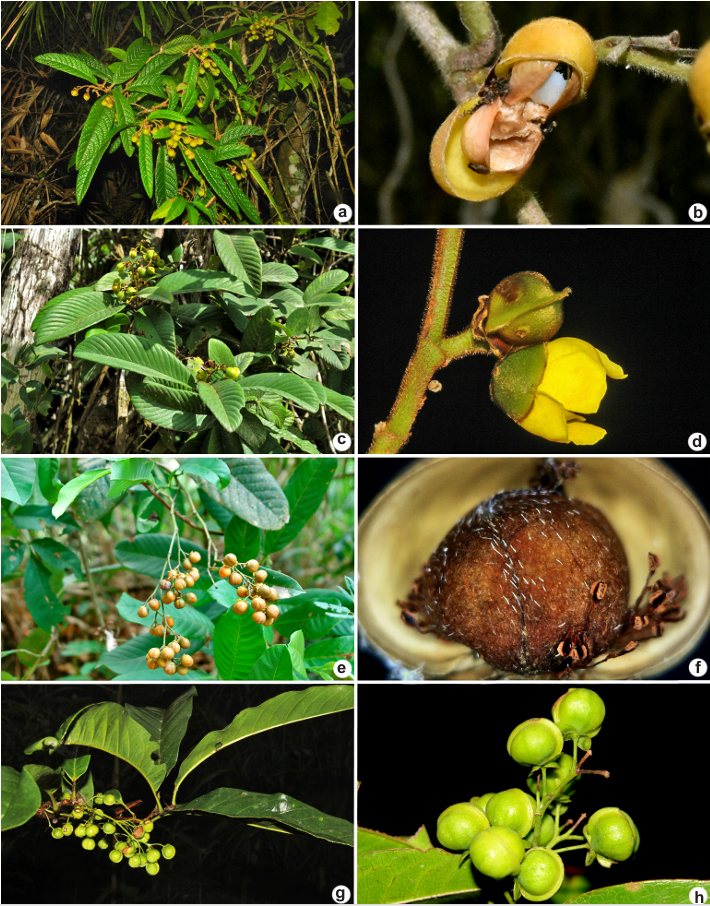
Davilla Vand., Fl. Lusit. Bras. Spec. 35, f. 14. 1788. Figs. 1a-h; 2a-d
Liana, or scandent shrubs. Leaves petiolate, petiole sub-winged, carinate or canaliculate. Hermaphroditic. Inflorescence a panicle, ramified, terminal or axillar. Flowers pedicellate; sepals 5, persistent, unequal in size, with the two innermost larger, pressed on the margin forming a circular wing or, one margin overlapping the other; carpels 1 or 2 free, conical. Fruit a membranous, indehiscent follicle with sepals accrescent overgrowing on fruit; seed 1 per carpel, covered almost until the apex by a white, papyraceous aril (Kubitzki 1971; Fraga 2012).
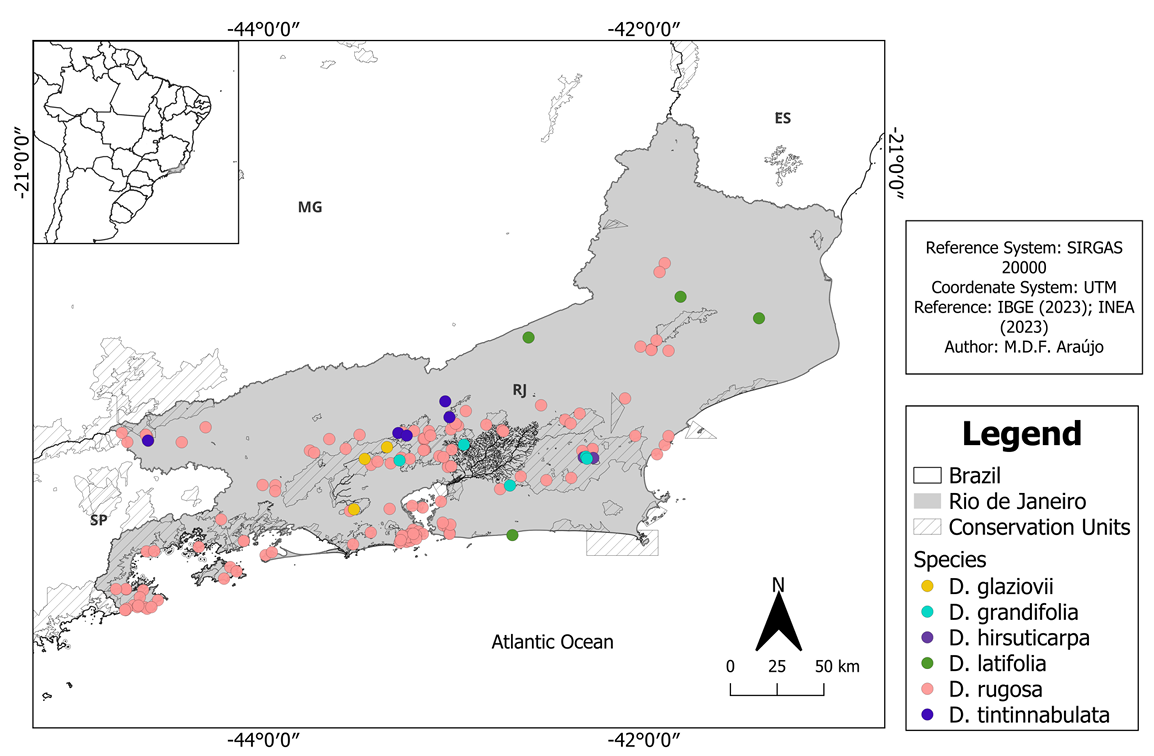
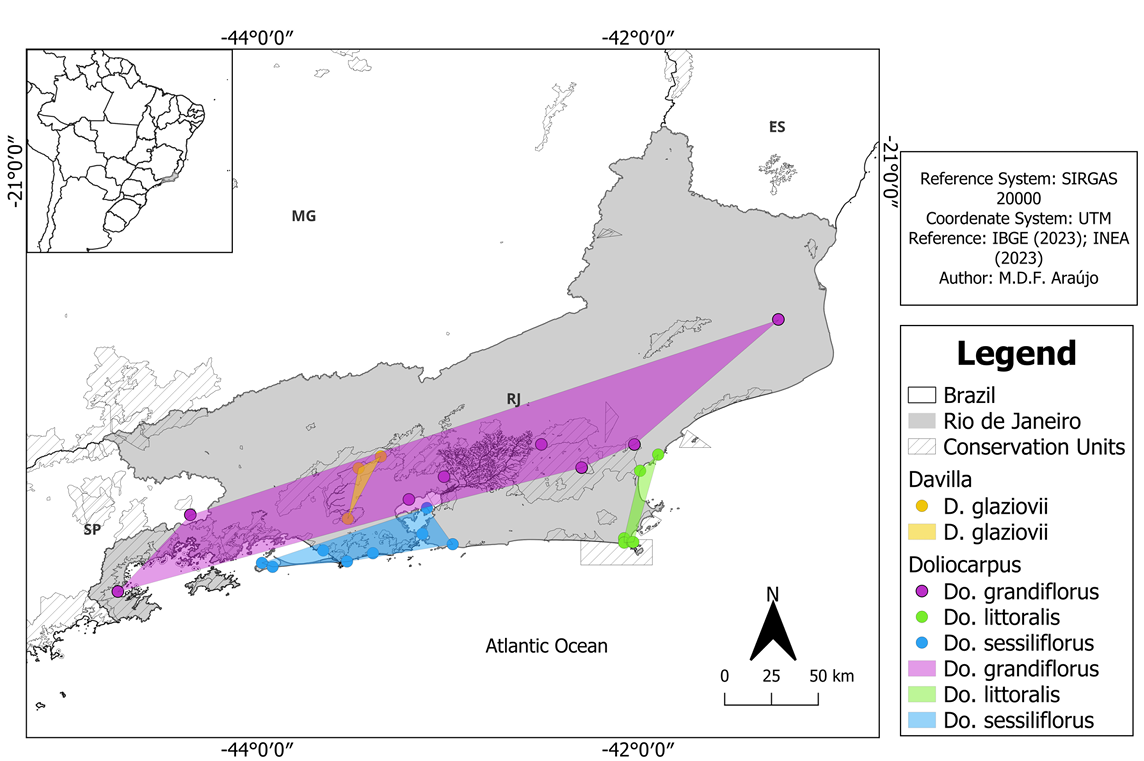
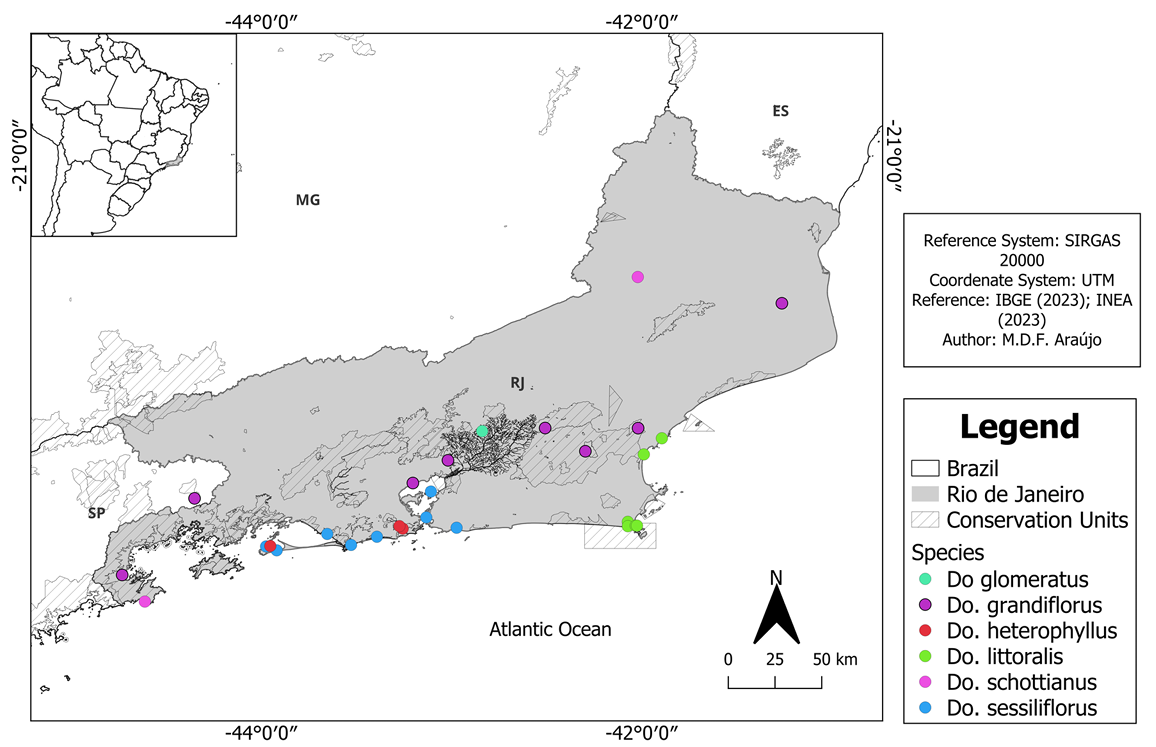
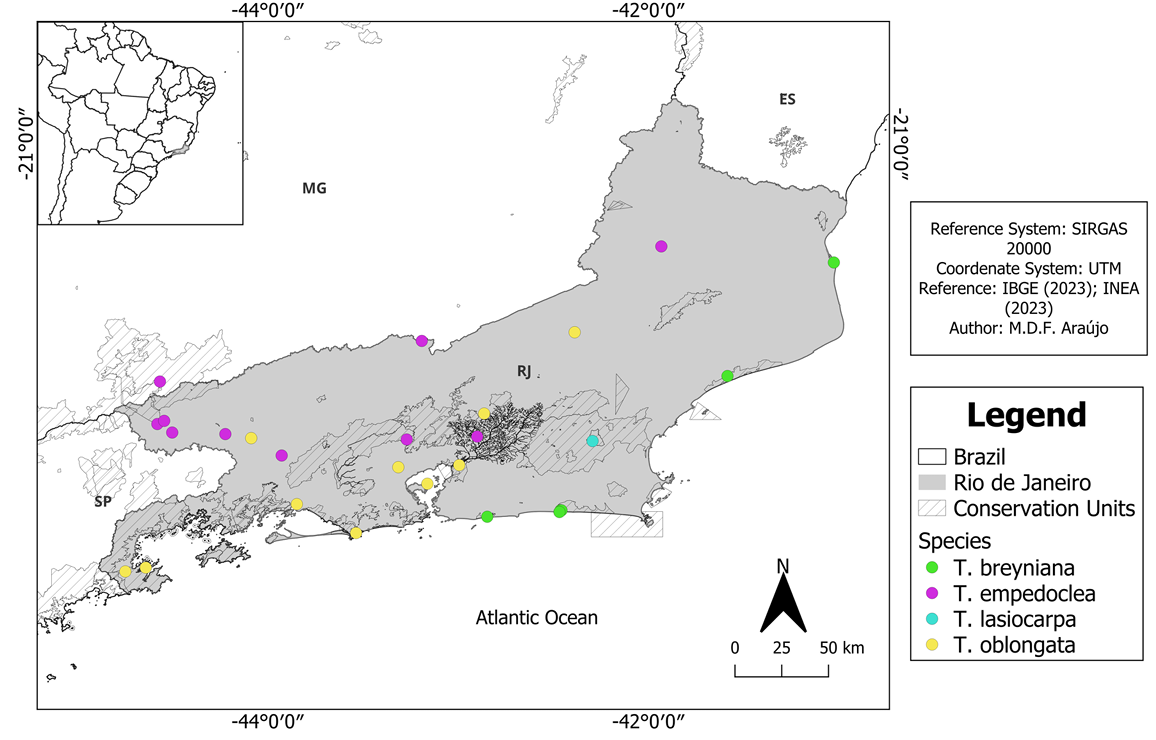
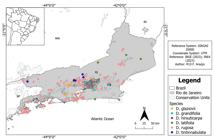
The genus has an occurrence range from southern Mexico to southern Brazil (Horn 2007; Fraga 2012). In Rio de Janeiro, its occurrence is shown in Figure 3.
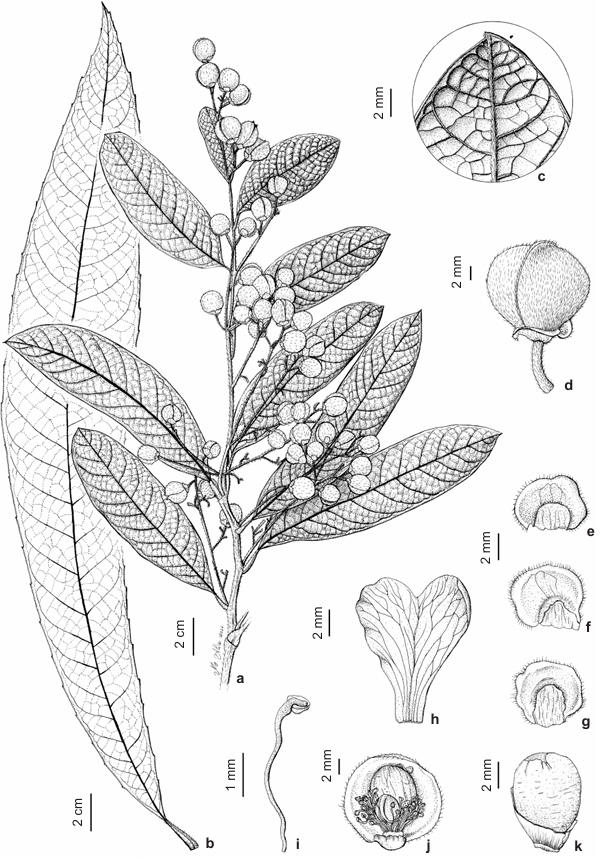
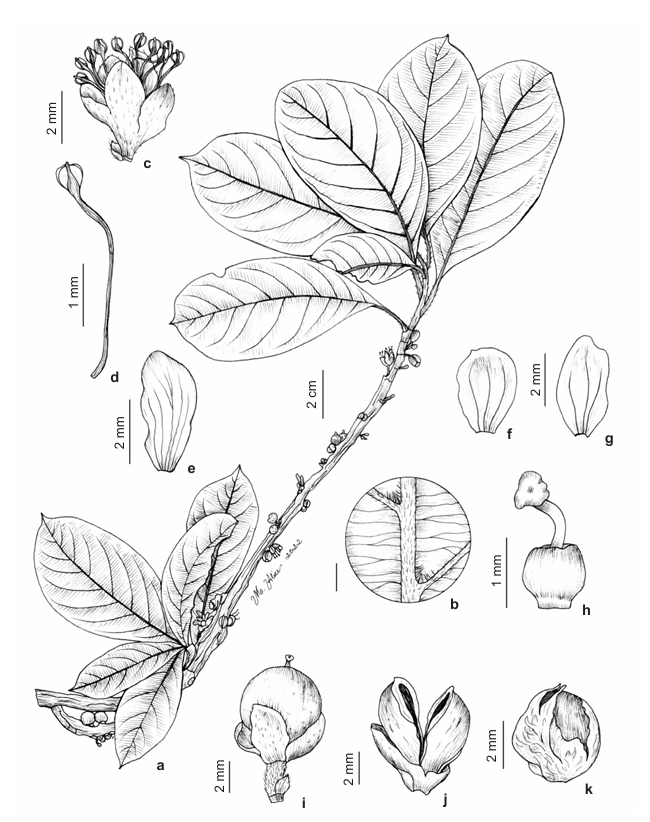
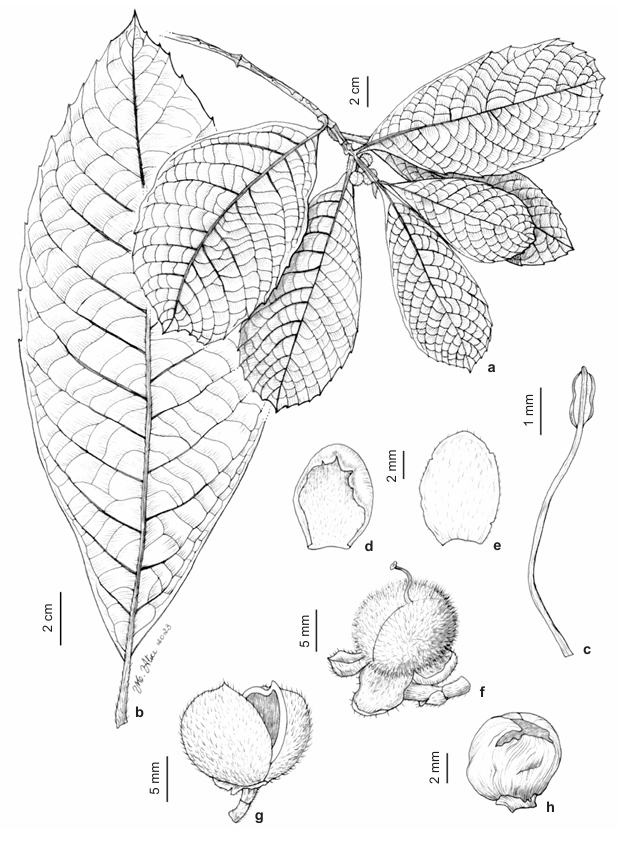
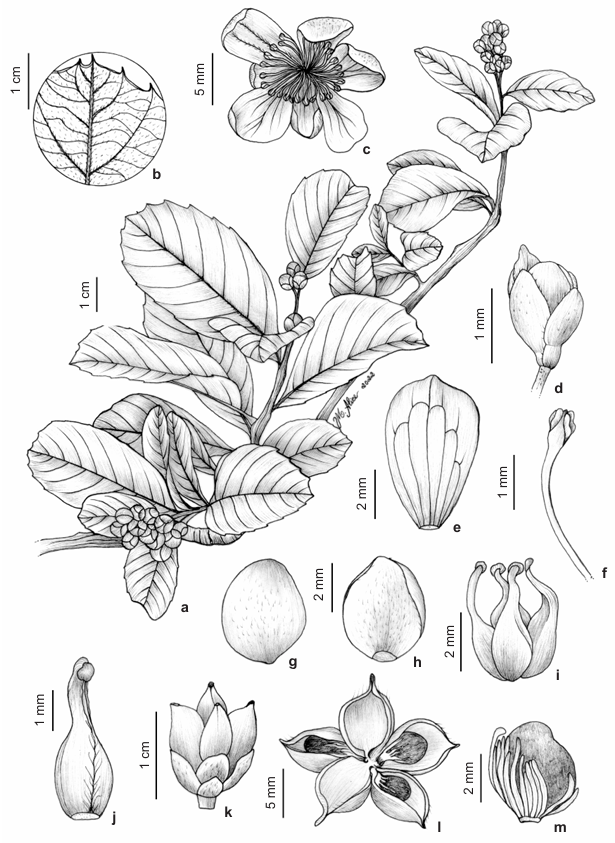
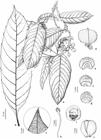
1. Davilla glazioviiEichler, Vidensk. Meddel. Dansk Naturhist. Foren. Kjøbenhavn 7: 178. 1870. Figs. 1a-b; 4a-k
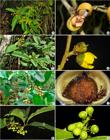
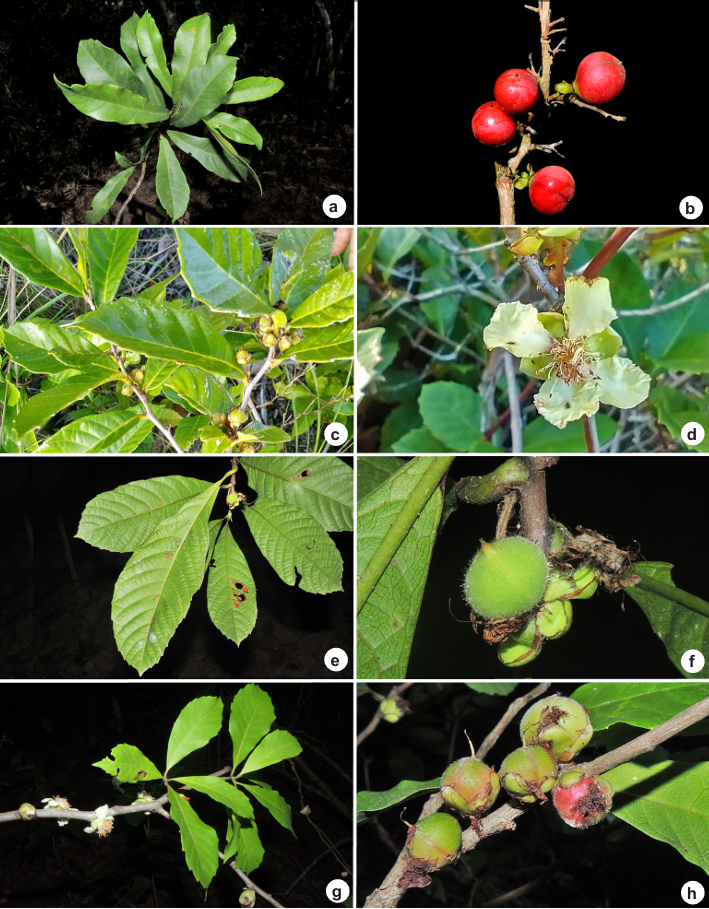
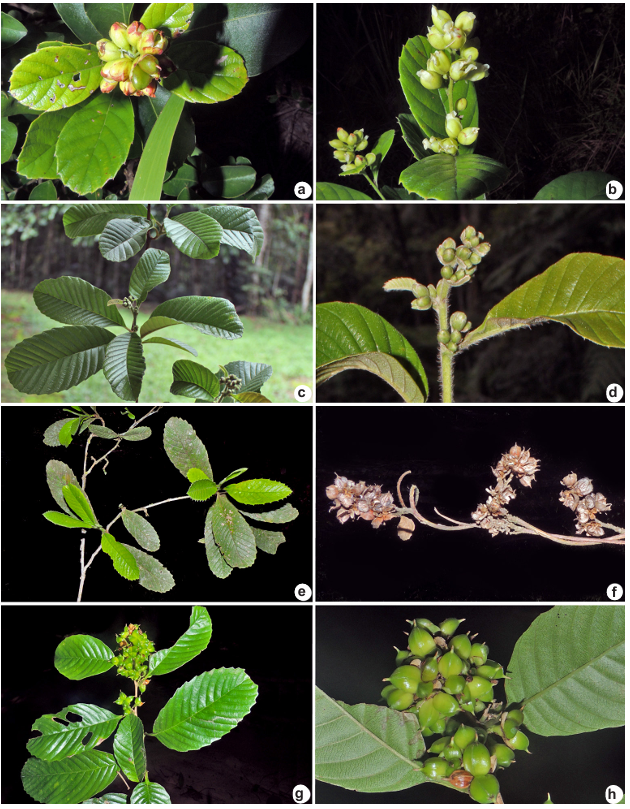
- a-b. Davilla glaziovii; c-d. D. grandifolia; e-f. D. hirsuticarpa; g-h. D. latifolia. (Photos by C.N.Fraga).
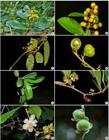
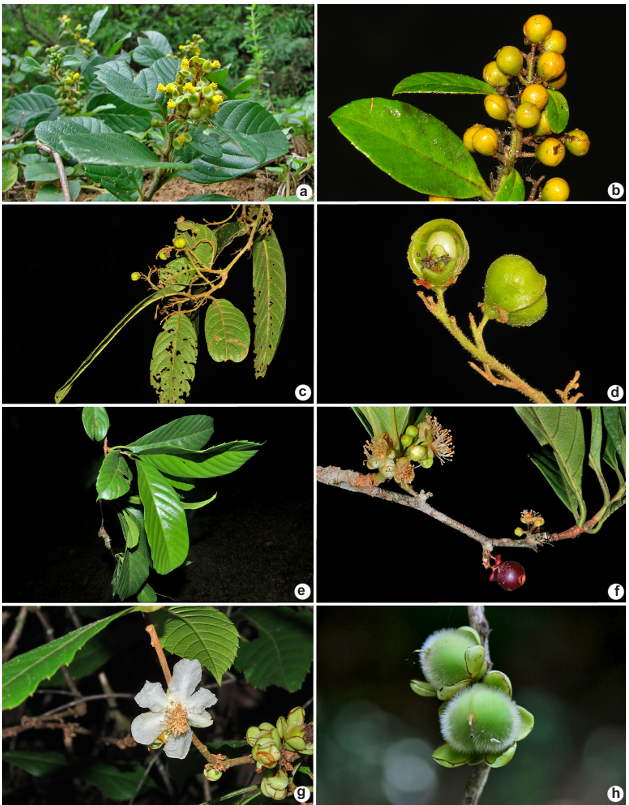
- a-b. Davilla rugosa; c-d. D. tintinnabulata; e-f. Doliocarpus glomeratus; g-h. Do. grandiflorus. (a-d, h. Photos by C.N. Fraga; e-f. Photos by J.V.L. Monzoli; g. Photo by M.D.F. Araújo).
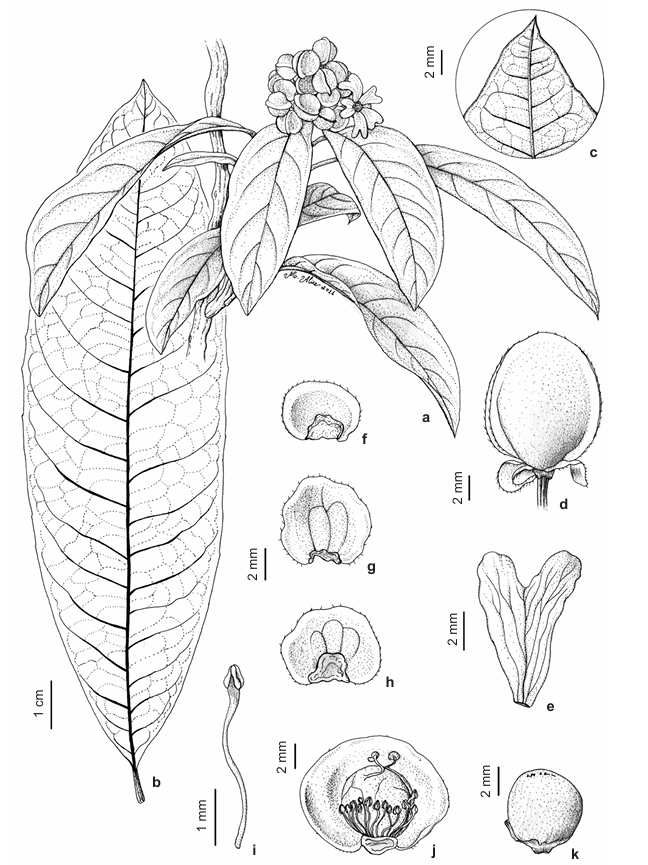
Liana. Stem and branches cylindrical, when young pubescent to tomentose, when mature striate and glabrate, greyish, hair simple, ferruginous. Leaves petiolate; petiole 1-2.8 × 0.1-0.3 cm, carinate, margin ciliate, sometimes lacerate, adaxial surface pannose, abaxial surface pubescent or tomentose, light green; blade 4.5-46.4 × 1.6-7.1 cm, subcoriaceous or coriaceous, elliptic or narrowly elliptic, base cuneate, margin dentate, ciliate and slightly revolute, apex acute or acuminate, adaxial surface glabrate or strigose, bullate, dark green, abaxial surface pubescent or villous, green, hair simple, ferruginous or white; venation semicraspedodromous, midrib grooved or canaliculate, glabrate to tomentulose on adaxial surface, prominent and pubescent on abaxial surface, light green; secondary veins 11-25, grooved and glabrous on adaxial surface, prominent and pubescent on abaxial surface, light green; tertiary veins mixed percurrent, grooved and glabrous on adaxial surface, prominent and pubescent on abaxial surface, light green, domatia absent, hair simple, ferruginous. Inflorescence panicle, 4-34 cm long, terminal or axillary, ramified, lateral ramifications 2-15, flowers 6-100, pilose to pilosulose, hair simple, ferruginous. Flowers pedicellate, basal bracts 0.8-2 × 0.5-0.9 mm, triangle shaped, early deciduous, adaxial surface glabrous, abaxial surface pannose or tomentose, hair simple, ferruginous; pedicels 3.2-11.4 × 0.5-0.9 mm, same diameter from base to apex, pannose or pilosulose, hair simple, ferruginous; sepals 5, 3 externals smaller and unequal in size, outer 2.3-3.9 × 4.2-4.5 mm when blooming, 3.2-4.4 × 4.4-5.1 mm when fruiting, medial 2.8-4.1 × 4.8-5.5 mm when blooming, 3.8-4.6 × 4.7-5.2 mm when fruiting, inner 3.9-4.8 × 4.7-5.1 mm when blooming, 4.3-5.5 × 4.4-5.5 mm when fruiting, crustaceous, suborbicular, base hippocrepiform, margin ciliate, apex rounded, externally sericeous, internally glabrous and smooth, 2 innermost larger, equal in size, 6.4-8.2 × 5.4-7.3 mm when blooming, 10.3-12.2 × 9.8-11.5 mm when fruiting, crustaceous, suborbicular, base truncate, margin ciliate, pressed against each other forming circular wings, not overlapping, apex rounded, externally sericeous, internally glabrous and smooth, green or vinaceous when blooming, saffron when fruiting, hair simple, ferruginous; petals 5, 8.7-10.6 × 4.9-5.7 mm, membranous, spatulate-obovate, base cuneate, margin entire, apex bifid, glabrous on both surfaces, sometimes 1 or 2 externally tomentulose on the center, early deciduous, yellow; stamens 100-110, arranged in a circle around the carpels, inserted; filaments 3.6-4.5 × 0.05-0.1 mm, cylindrical, expanded only near the apex, glabrous, cream; anthers 0.4-0.6 × 0.3 mm, elliptical, glabrous, basifixed, connective reduced near the base, cream; carpels 2, free, glabrous; ovaries ca. 1.8 × 1.1 mm, conical; ovules 2, basal. 0.6-0.7 × 0.3-0.5 mm; style 1.8-4.3 × 0.1-0.4 mm, sinuous or erect, glabrous, stigma capitate, discoid, verrucose, cream. Fruit 5.5-6.4 × 4.5-4.8 mm, membranous, follicle, indehiscent, globose, glabrous, innermost sepals outgrowing on fruit; seeds 1, rare 2, per carpel, 4.5-6.2 × 3.6-5.8 mm, obovoid, rugose, glabrous, covered by the aril almost up to the apex, black; aril papyraceous, dentate on the apex, white.
Selected material: Serra do Couto, perto de Petrópolis, 26.III.1869, fl., A.F.M. Glaziou 2916 (Type; BR, C, K, P, R). Nova Iguaçu, Reserva Biológica do Tinguá, Tinguá, Estrada do Comércio, 22°33’30’’S, 43°28’4’’W, 18.IX.2022, fl., M.D.F. Araújo et al. 160 (RB). Rio de Janeiro, Parque Natural Municipal do Mendanha, Campo Grande, Serra do Mendanha, estrada para torre da light, acima da entrada da rampa de voo livre, 22°49’19’’S, 43°31’29’’W, 5.VI.2010, fr., C.N. Fraga & M.M. Saavedra 2903 (ALCB, B, BHCB, BR, C, CEN, CEPEC, HUEFS, INPA, K, M, MBM, MBML, MG, NY, P, PORT, UFP, RB, WU).
Davilla glaziovii is similar to D. tintinnabulata due to their branches covered with soft trichomes and inner sepals velutinous, but they can be separated by the leaves bullate and elliptic (versus leaves sub-bullate and oval or ovate) and indumentum of the leaves glabrate or strigose on the adaxial surface (vs. glabrate or sparsely tomentose) and pubescent on the abaxial surface (vs. velutinous to touch).

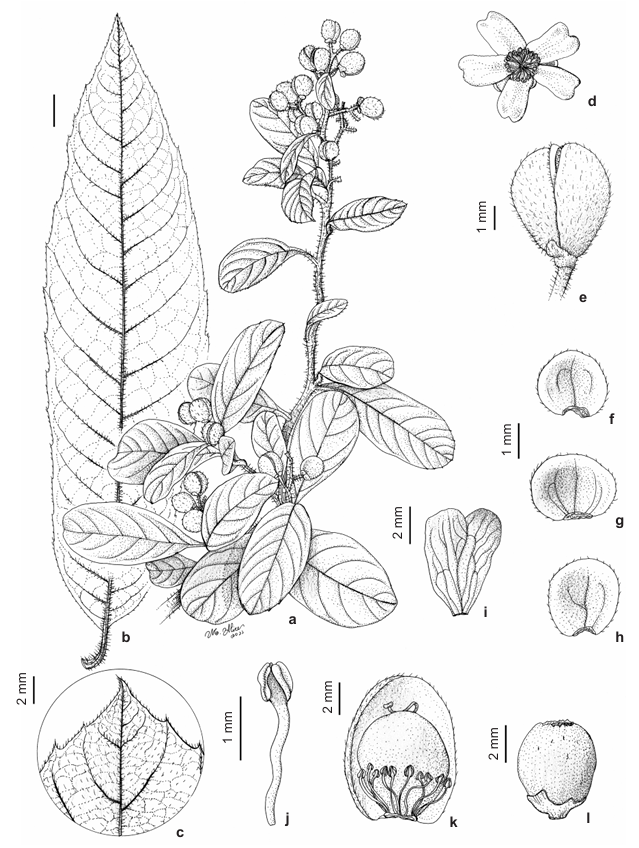
- a-k. Davilla glaziovii - a. habit; b. adaxial face of the sheet; c. detail of the leaf apex on the abaxial face; d. sepals covering the fruit; e-g. external sepals; h. petal; i. stamens; j. fruit in frontal view, without an inner sepal and petals; k. seed covered by aril. (a-h. C.N. Fraga 2903).
Davilla glaziovii is endemic to the state of Rio de Janeiro, probably restricted to regions of Dense Ombrophilous Forest in elevations varying from 600 to 700 meters, in the Baixada Fluminense and Serra do Tinguá, and in the ascent to Serra dos Órgãos. Until recently, the species was known only from a population located in the Serra do Mendanha, among the municipalities of Campo Grande, Mesquita, Nilópolis and Nova Iguaçu (Fraga 2012).
Davilla glaziovii is the only species of the genus with occurrence for the state of Rio de Janeiro which has been included since 2008 in the national list of threatened species, when it was included in Annex I of the list of endangered species of the Brazilian flora, published through the Normative Ruling 6 of September 23, 2008, by the Ministry of the Environment (MMA), but not complying with the statutes established by the IUCN. Its inclusion was not only due to the species restricted distribution to the peri-urban area but also because of the threats concerning the area of the Municipal Park of Serra do Mendanha, where the only known population was recorded at that time. The area has been transformed into an area of relevant social interest, and there is an increasing expansion of farms and holiday houses. In addition, the species is subject to direct threats because its stems are used for medicinal purposes and are traded in neighbouring regions as cipó-de-santa-luzia (Fraga 2012; Fraga et al. 2013). In Ordinance 443 of December 17, 2014, published by the MMA, the species was listed in the Critically Endangered (CR) category, as indicated by Fraga et al. (2013). With the publication of the Ordinance 148 of June 7, 2022, which amends the annexes of the 2014 ordinance, an updated list of the endangered species was published, in which D. glaziovii was reclassified as Endangered (EN).
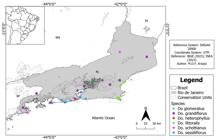
With the recent records of the species in the Tinguá Biological Reserve, the extent of occurrence (EOO) of the species increased from less than 100 km2 to 158 km2, while the area of occupancy (AOO) increased from less than 10 km2 to 12 km2 (Figs. 3; 5). Even with these new records of the species in a conservation unit, few forest fragments remain in the range of occurrence of the species, all surrounded by the urban area of the second largest city in Brazil. However, the status indicated by Fraga (2012) and ratified in Fraga et al. (2013) was Critically Endangered, according to the scores obtained. Thus, the species is classified here as Endangered [EN B1ab(i,iii,iv)c(i,iii)+2ab(ii,iii,iv)c(ii,iii)].
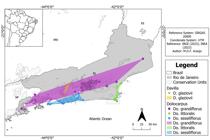
- Map with the polygons formed by the extent of occurrence (EOO) of Davilla glaziovii, Doliocarpus grandiflorus, Do. littoralis and Do. sessiliflorus.
2. Davilla grandifolia Moric. exEichler, Fl. bras. 13(1): 99, t. 20, f. 1. 1863.
= Davilla macroclada Moric. exEichler, Fl. bras. 13(1): 98. 1863.
= Davilla papyraceaAymard, Kew Bull. 57(2): 487-488, f. 1. 2002.
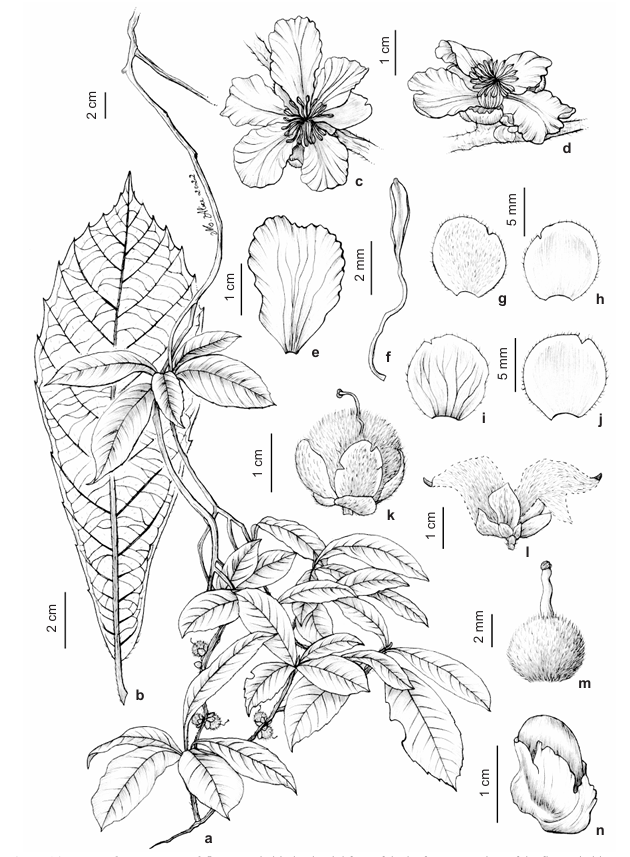
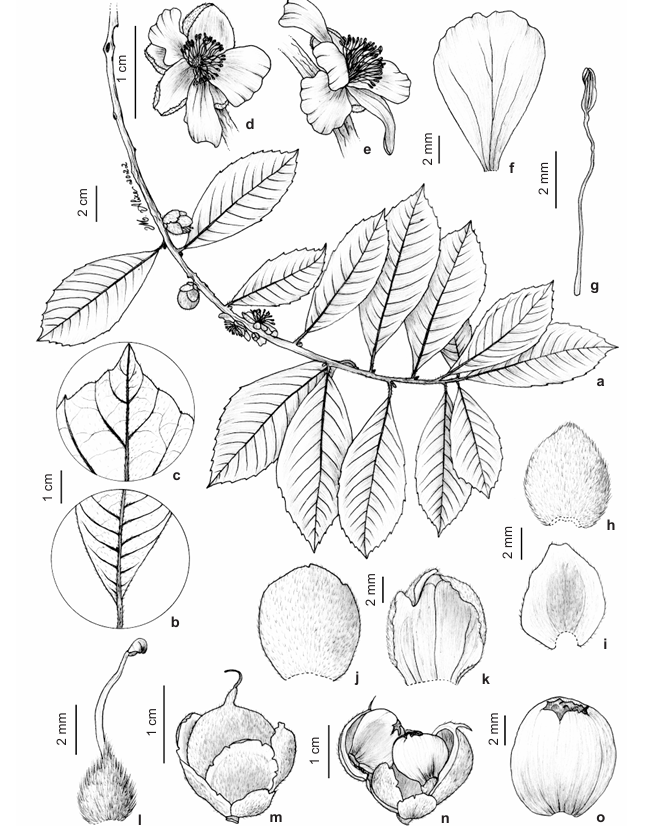
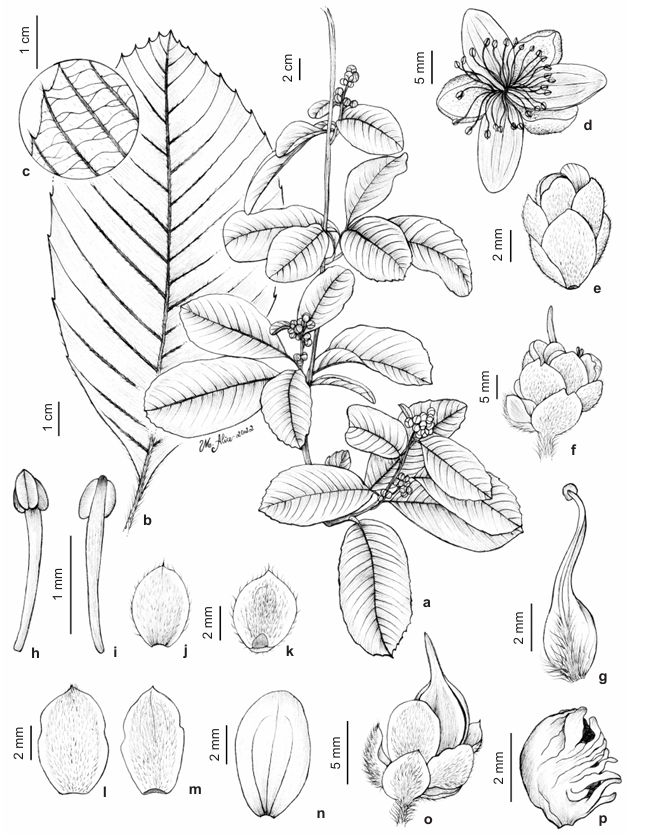
= Davilla bilobataAymard, Novon 17(3): 284, f. 2. 2007. Figs. 1c-d; 6a-l
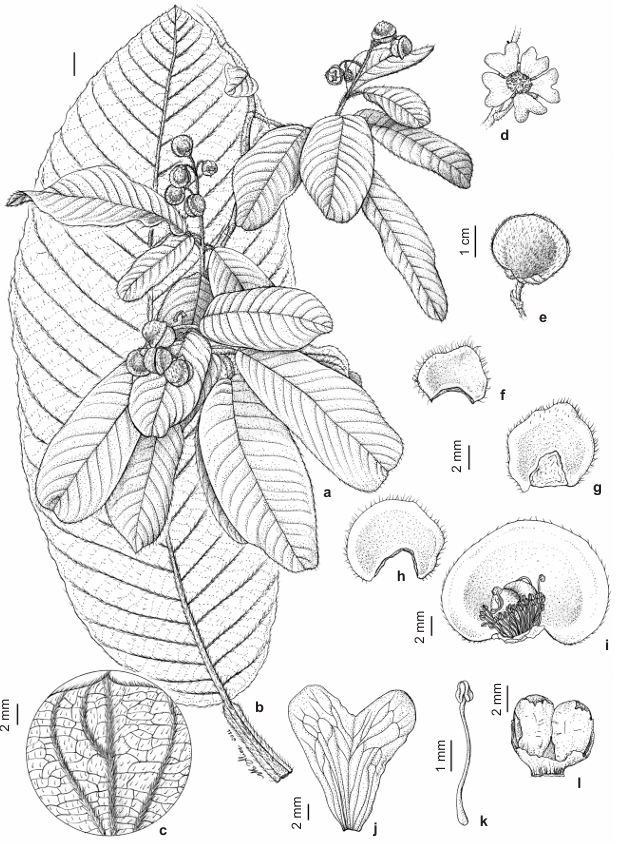
Liana. Stem and branches cylindrical, when young pubescent to tomentose, when mature peeling and glabrate, greyish, hair simple, white. Leaves petiolate; petiole 1.2-3.2 × 0.1-0.3 cm, carinate, margin ciliate, sometimes lacerate, adaxial surface glabrescent or tomentulose, abaxial surface tomentose or pubescent, light green; blade 9.4-27.2 × 3.3-11.2 cm, chartaceous or subcoriaceous, oval or elliptic, base cuneate or rounded, margin entire or dentate, apex acute or rounded, adaxial surface glabrate or tomentose, dark green, abaxial surface woolly or lanulose, green, hair simple, white; venation eucamptodromous or semicraspedodromous, midrib grooved or canaliculate, glabrate to tomentulose or puberulent on adaxial surface, prominent and tomentose on abaxial surface, light green; secondary veins 8-23, slightly grooved and glabrous on adaxial surface, prominent and tomentose to villous on abaxial surface, light green; tertiary veins mixed percurrent, plain and glabrous on adaxial surface, slightly prominent or plain and woolly on abaxial surface, light green, domatia absent, hair simple, white. Inflorescence panicle, 4-14 cm long, terminal or axillary, ramified, lateral ramifications 2-5, flowers 8-40, pilose or villous, hair simple, white or yellowish. Flowers pedicellate, basal bracts ca. 3.1 × 1.2 mm, triangle shaped, early deciduous, adaxial surface glabrous, abaxial surface woolly or villous to tomentose, hair simple, white or yellowish; pedicels 6.6-16.7 × 0.9-1.7 mm, same diameter from base to apex, villous or lanulose, hair simple, white; sepals 5, 3 externals smaller and unequal in size, outer ca. 4.8 × 7.6 mm when blooming, 4.7-5.4 × 5.1-6.9 mm when fruiting, medial ca. 5.6 × 10 mm when blooming, 5.1-6.4 × 6.3-6.7 mm when fruiting, inner ca. 7.2 × 8.3 mm when blooming, 7.6-8.3 × 5.6-7 mm when fruiting, crustaceous, suborbicular, base hippocrepiform, margin ciliate, apex rounded, externally sericeous, internally glabrous and smooth, 2 innermost larger, equal in size, ca. 10.1 × 5.2 mm when blooming, 19.2-21 × 19.7-24.3 mm when fruiting, crustaceous, suborbicular, base truncate, margin ciliate, pressed against each other forming circular wings, not overlapping, apex rounded, externally pannose, internally glabrous and smooth, green or vinaceous when blooming, saffron when fruiting; hair simple, white or yellowish; petals 5, 18.4-19.4 × 13.2-15.7 mm, membranous, spatulate-obovate, base cuneate, margin entire, apex bifid, glabrous on both surfaces, rarely pannose or sericeous on the center of the external surface, early deciduous, yellow; stamens 215-317, arranged in a circle around the carpels, inserted; filaments 2.9-6.1 × 0.05-0.1 mm, cylindrical, expanded only near the apex, glabrous, cream; anthers 0.8-0.9 × 0.5-0.8 mm, elliptical, glabrous, basifixed, connective reduced near the base, cream; carpels 2, free, glabrous; ovaries ca. 1 × 1.1 mm, conical; ovules 2, basal, 0.5-0.6 × 0.3-0.4 mm; style 4-7.3 × 0.2 mm, sinuous or erect, glabrous, stigma capitate, discoid, verrucose, cream. Fruit 8.4-8.7 × 5.6-6.3 mm, membranous follicle, indehiscent, globose, glabrous, innermost sepals outgrowing on fruit; seeds 1, or 2, per carpel, 7.4-8 × 5.5-6 mm, obovoid, rugose, glabrous, covered by the aril almost up to the apex, black; aril papyraceous, dentate on the apex, white.
Selected material: Guapimirim, Serra dos Órgãos, Caneca Fina, XII.1974, fr., P. Occhioni 6511 (RFA). Duque de Caxias, Reserva da Petrobras, Garrão, Sítio Riacho dos Beija Flores próximo à Barragem de Saracuruna, 27.VII.2000, fr., W.G. Lima et al. 22 (NY, RB). Rio Bonito, Braçanã, Fazenda das Cachoeiras, 24.VI.1973, fr., R 240878 (R). Silva Jardim, Reserva Biológica de Poço das Antas, estrada principal 1, margem da trilha, 22°33’26’’S, 42°17’57’’W, 7.XI.2022, fr., M.D.F. Araújo et al. 154 (RB).
Additional Material: BRAZIL. ESPÍRITO SANTO: Cariacica, Reserva Biológica Duas Bocas, floresta na beira da estrada para a localidade de Alegre, 20°18’9’’S, 40°28’55’’W, 10.IV.2009, fl., C.N. Fraga et al. 2471 (CEPEC, MBML, RB, UPCB).
Fraga (2012) compares Davilla grandifolia with D. alata and D. steyermarkii, which occur in the Guiana Shield. This species has a carinate petiole, which is almost sub-winged (versus winged petiole), and a ferruginous indumentum (vs. gold or copper indumentum). The species can be easily distinguished among the Davilla from Rio de Janeiro by its distinct inner sepals, far longer than the others, reaching more than 19 mm when fruiting, and its broad leaf, distinct from the others of the genus occurring on the state. The indumentum of the collections from other states are distinctly ferruginous, which contrast with the white-yellowish indumentum of the collections from Rio de Janeiro.
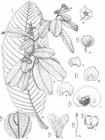
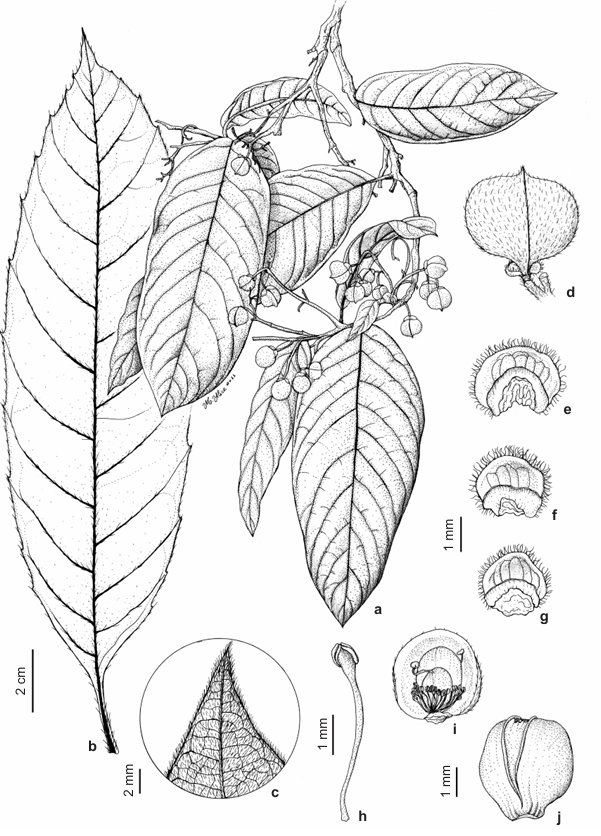
- a-l. Davilla grandifolia - a. habit; b. abaxial face of the leaf; c. detail of the leaf apex on the abaxial face; d. flower in top view; e. sepals covering the fruit; f-h. external sepals; i. flower in frontal view, without an inner sepal and petals; j. petal; k. stamen; l. fruit with two seeds. {a, d. Photo (C.N. Fraga); b. C.N. Fraga 1841; c, e-h, j-k. C.N. Fraga 2016; i. C.N. Fraga 2471}.
Nationally, Davilla grandifolia occurs from the state of Alagoas to the north of Rio de Janeiro, in different phytophysiognomies of the Atlantic Forest. In Rio de Janeiro, D. grandifolia was collected in the Poço das Antas Biological Reserve, municipality of Silva Jardim, in Duque de Caxias, in the Petrobras reserve, and in Serra dos Órgãos (Fig. 3). In all these regions the species is commonly found in low forest areas, usually in the border of forests.
The distribution of D. grandifolia has an estimated extent of occurrence (EOO) of more than 20,000 km2. Although the region of occurrence is very fragmented due to the growth of cities, the presence of many holiday homes and tourism hotels, and because the species inhabits disturbed environments, Fraga (2012) includes it in the Least Concern (LC) category. Considering that Rio de Janeiro represents the southern limit of the taxon’s distribution, we prefer to maintain the preliminary status indicated by Fraga (2012).
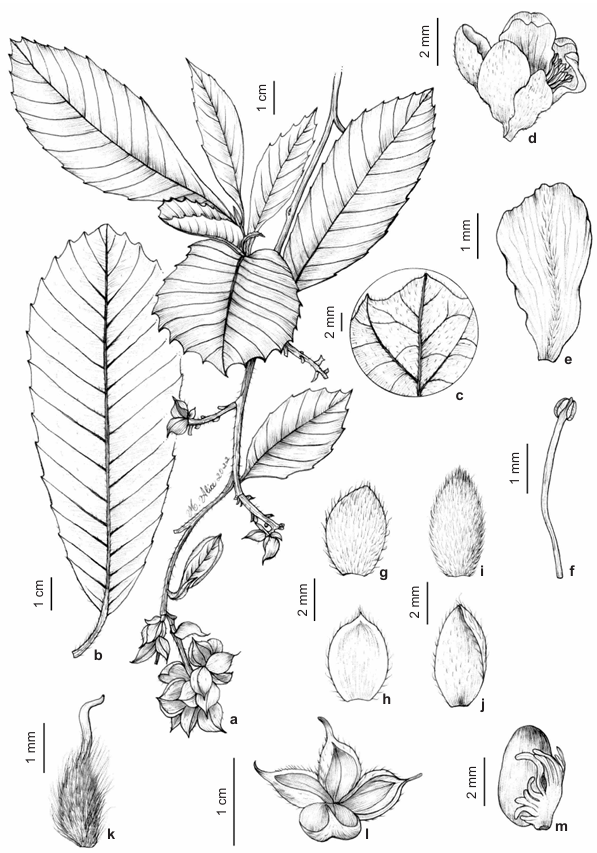
3. Davilla hirsuticarpaFraga & Aymard, Pl. Ecol. Evol. 150(3): 368. 2017. Figs. 1e-f; 7a-l
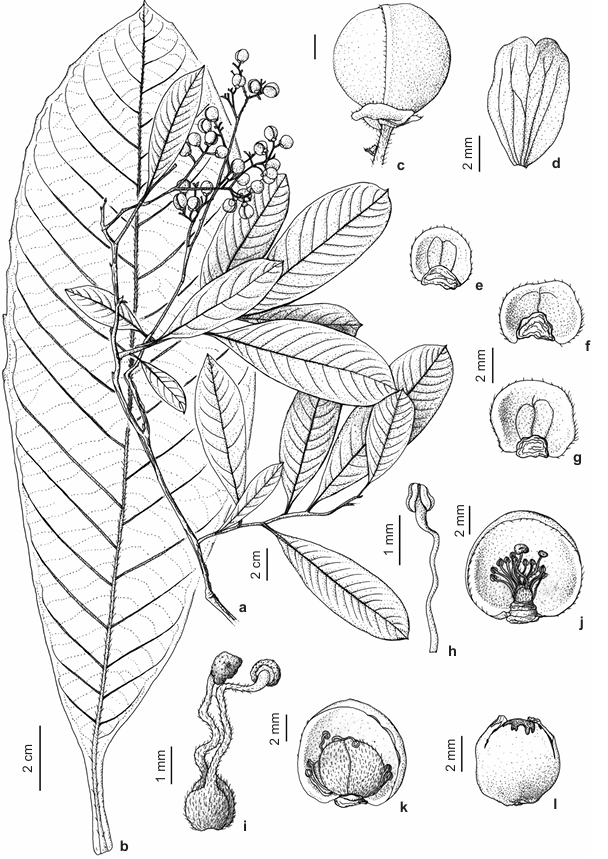
Liana. Stem and branches cylindrical, when young glabrate or strigillose, when mature scaly and glabrous, castaneous, hair simple white or yellowish. Leaves petiolate; petiole 0.9-2.2 × 0.1-0.3 cm, semiterete, margin not ciliate, frequently lacerate, adaxial surface glabrous, abaxial surface tomentose, light green; blade 4.7-22 × 1.8-7.1 cm, coriaceous, oblanceolate or elliptic rarely obelliptic, base cuneate, margin entire, slightly revolute, apex acute or obtuse, rarely rounded, adaxial surface glabrous or glabrate, dark green, abaxial surface glabrate, green, hair simple, white or yellowish; venation eucamptodromous, midrib grooved, pubescent or tomentulose on adaxial surface, prominent and tomentose on abaxial surface, light green; secondary veins 7-13, impressed or plain and glabrous on adaxial surface, prominent and glabrate or sparsely tomentose on abaxial surface, light green; tertiary veins mixed percurrent, plain and glabrous on adaxial surface, plain or slightly prominent and glabrous on abaxial surface, light green, domatia absent, hair simple, white or yellowish. Inflorescence panicle, 4.6-23 cm long, terminal or axillary, ramified, lateral ramifications 2-10, flowers 10-70, sparsely tomentulose or puberulent to hirsutulous, hair simple, yellowish. Flowers pedicellate, basal bracts 2.5 × 1.2 mm, triangle shaped, early deciduous, adaxial surface glabrous, abaxial surface tomentose or glabrate, hair simple, yellowish; pedicels 2-11.3 × 0.5-0.9 mm, same diameter from base to apex, glabrate or tomentulose to hirsutulous, hair simple, yellowish; sepals 5, 3 externals smaller and unequal in size, outer ca. 2.6 × 3.3 mm when blooming, 1.9-3 × 2.8-3.5 mm when fruiting, medial 3-3.3 × 4-4.2 mm when blooming, 2.3-3.3 × 3.5-4 mm when fruiting, inner 3.3-3.6 × 4-4.2 mm when blooming, 3.1-4.2 × 3.7-5.3 mm when fruiting, crustaceous, suborbicular, base hippocrepiform, margin ciliate, apex rounded, externally glabrate, internally glabrous and smooth, 2 innermost larger, equal in size, 4.4-5 × 3.5-3.9 mm when blooming, 7.7-12 × 8-11.8 mm when fruiting, crustaceous, suborbicular, base truncate, margin ciliate, overlapping one another, the innermost margin reflex and the outermost margin superimposed on the inner one, apex rounded, externally glabrous or glabrate, internally glabrous and smooth, green when blooming, saffron when fruiting, hair simple, dark yellow; petals 5, 8.1-9.3 × 6.5-7.9 mm, membranous, spatulate, base cuneate, margin entire, apex emarginate, glabrous on both surfaces, early deciduous, yellow; stamens 100-140, arranged in a circle around the carpels, exserted; filaments 2-3.5 × 0.05-0.1 mm, cylindrical, expanded only near the apex, glabrous, color not seen; anthers 0.3-0.6 × 0.3-0.6 mm, elliptical, glabrous, basifixed, connective reduced near the base, cream; carpels 2, free, hirsute; ovaries ca. 0.8 × 0.8 mm, conical; ovules 2, basal, ca. 0.3 × 0.3 mm; style 1.8-2.4 × 0.2 mm, sinuous or erect, proximally hirsute, distally glabrous, stigma peltate, discoid, verrucose, cream. Fruit ca. 4.4 × 4.5 mm, membranous follicle, indehiscent, globose, sparsely hirsute, innermost sepals outgrowing on fruit; hair simple, white or yellowish; seeds 1, rare 2, per carpel, 3.5-3.9 × 3.3-3.9 mm, obovoid, rugose, glabrous, covered by the aril almost up to the apex, black; aril papyraceous, dentate on the apex, white.
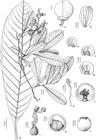
- a-l. Davilla hirsuticarpa - a. habit; b. abaxial face of the leaf; c. sepals covering the fruit; d. petal; e-g. external sepals; h. stamens; i. ovaries; j. flower in frontal view, without an inner sepal and petals; k. fruit in frontal view, without an inner sepal and petals; l. seed involved by aril. (a-l. C.N. Fraga 3411).
Selected material: Silva Jardim, Reserva Biológica de Poço das Antas, estrada para Juturnaíba, próx. à casa da Cintia, 22°33’00’’S, 42°19’00’’W, 17.VI.1994, fr., D.S. Farias et al. 277 (RB, SPF); trilha Barro Branco, 22°33’11’’S, 42°15’58’’W, 11.XII.2021, fr., M.D.F. Araújo et al. 59 (MBML, RB, SP, SPF).
Additional Material: BRAZIL. BAHIA: Mucuri, assentamento Paulo Freire, Núcleo Sapucaia, Mata do Antônio Brito, 18°03’44’’S, 39°39’31’’W, 22.XI.2018, fl. and fr., G. Martinelli et al. 20529 (RB). ESPÍRITO SANTO: Água Doce do Norte, morro da torre de celular, 18°34’11’’S, 40°59’7’’W, elev. 624 m, 22.IV.2013, fl., M.O.O. Pellegrini et al. 368 (MBML, RB). Águia Branca, Rochedo, propr. Arlindo Breda, 18°56’45”S, 40°48’10”W, 16.V.2007, fl., V. Demuner et al. 3909 (MBML, RB). Governador Lindemberg, Pedra de Santa Luzia, propr. Firmino Sottele, 19°16’54”S, 40°27’43”W, 26.IV.2007, fl., V. Demuner et al. 3889 (MBML, RB).
When publishing Davilla hirsuticarpa, its authors compared it with D. cuspidulata and D. bahiana, but none occur in Rio de Janeiro. Among the species that occur in the state, D. hirsuticarpa may resemble D. rugosa by their innermost sepals overlapping but can be easily separated by the two hirsute ovaries (versus one glabrous ovary) and branches and inflorescence glabrate or sparsely tomentulose (vs. branches and inflorescence pilose or pilosulose usually patents).
Davilla hirsuticarpa occurs along the Brazilian Atlantic Forest, in areas of Tertiary Tablelands (tabuleiros) of the Barreiras Formation in Bahia and northern of Espírito Santo states (Pedro Canário), in granitic hills in areas of Seasonal Semideciduous Forest at Espírito Santo. In Rio de Janeiro the species is known from only one location, an area of Lowland Rainforest in the Poço das Antas Biological Reserve, municipality of Silva Jardim (Fig. 3). (Fraga 2012).
According to Fraga et al. (2017) the estimated extent of occurrence (EOO) of Davilla hirsuticarpa exceeds the 20,000 km2 upper limit for Vulnerable status under the criterion B1. In contrast, its minimal area of occupancy (AOO) is estimated at 52 km2, which is within the limits for Endangered status under criterion B2. The forested areas in the southeastern Bahia, northern Espírito Santo and northern Rio de Janeiro are severely fragmented due to real estate speculation, crop and livestock farming, and intensive Eucalyptus plantations. Granite strip mining, with its negative environmental impact, is also common in northwestern Espírito Santo. Furthermore, because this species is known from six localities (within the limit for the Vulnerable status), it was assigned the preliminary status of Vulnerable (VU). Considering that D. hirsuticarpa was collected only in the Poço das Antas Biological Reserve in Rio de Janeiro, a locality that represents the southern limit of the taxon’s distribution, we prefer to maintain the preliminary status indicated by Fraga et al. (2017).
4. Davilla latifolia Casar., Nov. Stirp. Bras. Decades 2: 19. 1842.
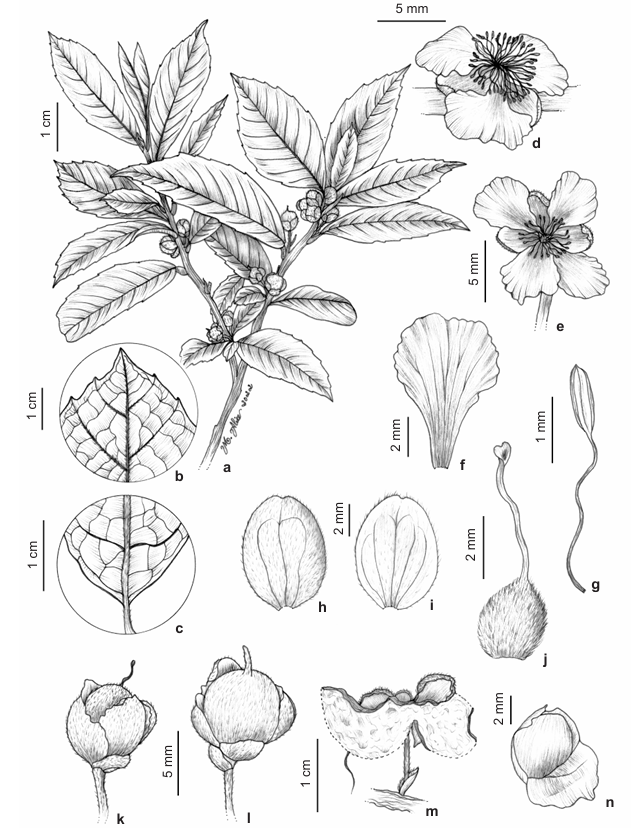
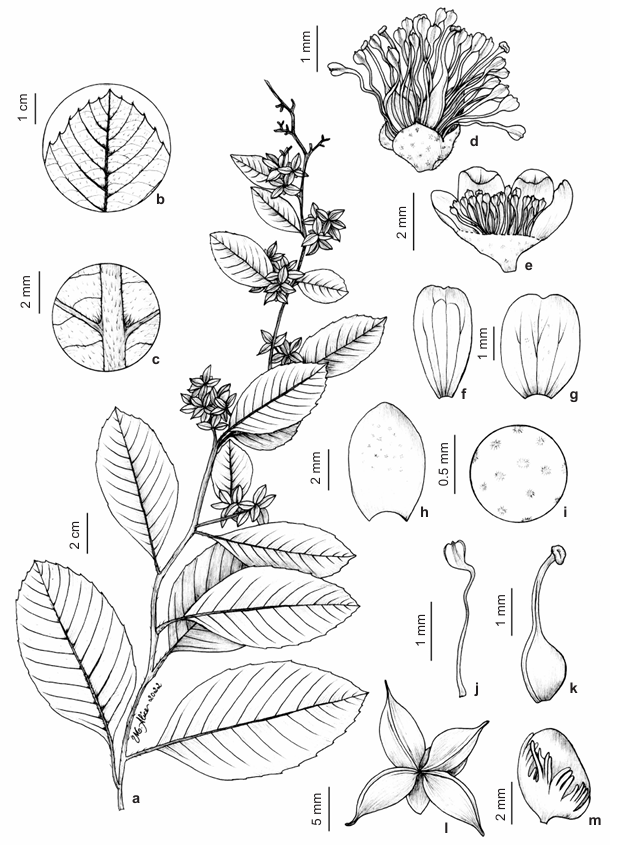
= Davilla glabrata Mart. exEichler, Fl. bras. 13(1): 97. 1863. Figs. 1g-h; 8a-k
Liana. Stem and branches cylindrical, when young glabrous, when mature striate and glabrous, chestnut or fuscous. Leaves petiolate; petiole 1-3.1 × 0.1-0.2 cm, canaliculate, margin not ciliate, usually lacerate, adaxial surface glabrous, abaxial surface glabrous or glabrate, light green; blade 5.7-27 × 1.8-6.5 cm, chartaceous or subcoriaceous, elliptic or oblanceolate, base cuneate or rounded, margin entire, repand, apex acute, adaxial surface glabrous, dark green, abaxial surface glabrous, green; venation festooned brochidodromous or eucamptodromous, midrib slightly grooved or impressed, glabrous on adaxial surface, prominent and glabrous on abaxial surface, light green; secondary veins 9-14, slightly prominent and glabrous on adaxial surface, slightly prominent and glabrous on abaxial surface, light green; tertiary veins composite admedial, slightly prominent and glabrous on adaxial surface, slightly prominent or plain and glabrous on abaxial surface, light green, domatia absent. Inflorescence panicle, 5.5-19 cm long, terminal or axillary, ramified, lateral ramifications 1-5, flowers 15-65, glabrous. Flowers pedicellate, basal bracts 2.9 × 1.5 mm, triangle shaped, early deciduous, adaxial surface glabrous, abaxial surface glabrate or pannose, hair simple, white; pedicels 2.9-10.6 × 0.4-0.7 mm, same diameter from base to apex, glabrous or glabrate; sepals 5, 3 externals smaller and unequal in size, outer 1.8-2.3 × 1.9-2 mm when blooming, 2.1-2.7 × 2.8-3.4 mm when fruiting, medial 2.1-2.7 × 2.8-2.9 mm when blooming, 2.3-3 × 3.1-3.4 mm when fruiting, inner 2.4-2.7 × 2.7-2.9 mm when blooming, 3.4-4.4 × 3.4-3.6 mm when fruiting, crustaceous, suborbicular, base hippocrepiform, margin ciliate, apex rounded, externally glabrous or glabrate, internally glabrous and smooth, 2 innermost larger, equal in size, ca. 4.9 × 4.7 mm when blooming, 7.8-8.7 × 7.4-11.9 mm when fruiting, crustaceous, suborbicular, base truncate, margin ciliate, pressed against each other forming circular wings, not overlapping, apex rounded, externally glabrous, internally glabrous and smooth, green when blooming, saffron when fruiting, hair simple, white; petals 5, 6.5-10.1 × 3.7-4.7 mm, membranous, spatulate-obcordate, base cuneate, margin entire, apex bifid, glabrous on both surfaces, early deciduous, yellow; stamens 67-75, arranged in a circle around the carpels, inserted; filaments ca. 3.2 × 0.07 mm, cylindrical, expanded only near the apex, glabrous, color not seen; anthers ca. 0.5 × 0.4 mm, elliptical, glabrous, basifixed, connective reduced near the base, color not seen; carpels 2, free, glabrous; ovaries 1-1.1 × 0.6-0.7 mm, conical; ovules 2, basal, ca. 0.5 × 0.3 mm; style 2.3 × 0.2-0.3 mm, sinuous or erect, glabrous, stigma capitate, discoid, verrucose, color not seen. Fruit ca. 5.1 × 5 mm, membranous follicle, indehiscent, globose, glabrous, innermost sepals outgrowing on fruit; seeds 1, or 2, per carpel, 4.7 × 4.8 mm, obovoid, rugose, glabrous, covered by the aril almost up to the apex, black; aril papyraceous, dentate on the apex, white.
Selected material: Campos dos Goytacazes, Ururaí, IV.1880, fr., RFA 1231 (RFA). Carmo, II.1889, fr., A.F. Neves Armond 55 (R). Maricá, Ponta Negra, descida para Ilha de Pedra, acesso pela Rua Diamantina, logo abaixo do Farol de Ponta Negra, 22°57’34’’S, 42°41’28’’W, 9.IX.2022, fr., D.N.S. Machado 2993 (RB, RFFP). São Fidélis, Fazenda Santa Rita, Serra da Vista, em afloramento rochoso no interior da mata, 25.VI.2016, fr., I.G. Costa 808 (NY, RB).
Additional Material: BRAZIL. ESPÍRITO SANTO: Águia Branca, assentamento 16 de abril, fragmento à esquerda do campo, 18°54’15’’S, 40°44’05’’W, 16.III.2006, fl., V. Demuner et al. 2013 (MBML, RB). Nova Venécia, Área de Proteção Ambiental da Pedra do Elefante, serra de baixo, estrada para Pedra do Elefante, 18°46’00’’S, 40°26’00’’W, 10.V.2008, fr., C.N. Fraga et al. 2081 (BHCB, CEPEC, MBML, NY, RB, UPCB).
Davilla latifolia resembles D. glaziovii due to their leaves being longer than 20 cm, lanceolate or ovate, with a petiole shorter than 3 cm, distinctly canaliculate, carinate, but can be separated by the glabrous leaves on both sides (versus glabrous on the adaxial surface, pubescent or villous on the abaxial surface), festooned brochidodromous or eucamptodromous venation (vs. semicraspedodromous venation), tertiary veins flat and glabrous on the adaxial surface (vs. distinctly bullate) and 67-75 stamens (vs. 100-110). Unlike the other materials, one of the analysed collections from Espírito Santo has hispidulous stem and branches and inflorescence glabrate, showing more trichomes than those other analysed, which apparently have no trichomes. This may be an exception to the average that the species has. However, it is not enough to separate it since this variation is common among Davilla, as with D. nitida, which either has some trichomes on the ovary or does not, according to Fraga (2012).
Davilla latifolia occurs from the state of Bahia to the northern coast of São Paulo in Seasonal Semideciduous and Ombrophilous Montane Forests in the states of São Paulo, Rio de Janeiro (Fig. 3) and Espírito Santo, but also in Tabuleiro Forests on the coast of Bahia. In this region, the species inhabits open woods or forest border areas. In the regions of Minas Gerais and Espírito Santo, the species is usually associated with areas of seasonal forest close to granite inselbergs or in flatter seasonal forests (Fraga 2012).
Although this region is highly fragmented due to the growth of cities, various agricultural practices, mining and other forms of land use, the species has an estimated extent of occurrence (EOO) of more than 20,000 km2, with stable populations in the different fragments. In addition, the species seems to have the ability to persist in disturbed areas or areas of recent regeneration, being included in the Least Concern (LC) category by Fraga (2012). Even though the species is only known from a few samples in Rio de Janeiro, we prefer to maintain the same category indicated by this author.
5. Davilla rugosa Poir., Encycl., Suppl. 2: 457. 1812.
= Davilla brasiliana DC., Syst. Nat. 1: 405. 1818[1817]. Nom. illeg.
= Davilla pilosa Miquel, in Linnaea 19: 134. 1847[1846].
= Hieronia scabra Vellozo, Fl. Flumin. 234. 1825[1829].
= Davilla rugosa var. kunthiiEichler, Fl. bras. 13(1): 106. 1863.
= Davilla rugosa var. luschnathiiEichler, Fl. bras. 13(1): 106. 1863
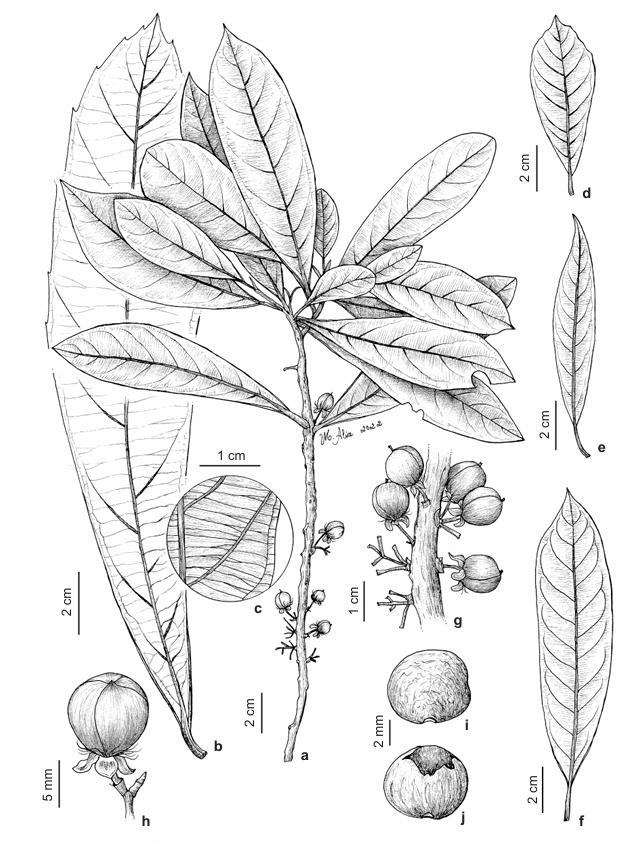
= Davilla rugosa var. sellowiiEichler, Fl. bras. 13(1): 106. 1863. Figs. 2a-b; 9a-l
Liana. Stem and branches cylindrical, when young sparsely pilosulose or tomentose, when mature peeling, outer scales tomentose or strigillose, fuscous, inner scales glabrous, chestnut, hair simple, yellowish. Leaves petiolate; petiole 0.6-1.8 × 0.1-0.2 cm, canaliculate or semiterete, margin not ciliate, sometimes lacerate, adaxial surface tomentose or tomentulose, abaxial surface tomentose or pilose, light green; blade 3.4-24.8 × 1.8-6.5 cm, chartaceous, oblanceolate or elliptic sometimes obovate or oblong, base cuneate, margin dentate, apex acute, rarely obtuse, adaxial surface rugose and glabrate or sparsely setulose, dark green, abaxial surface tomentose or pilose, green, hair simple, yellowish; venation semicraspedodromous, midrib slightly grooved, pubescent or setulose on adaxial surface, prominent and tomentose or pilosulose on abaxial surface, light green; secondary veins 7-17, grooved or impressed and glabrous or glabrate on adaxial surface, prominent and glabrate or sparsely tomentose to pubescent on abaxial surface, light green; tertiary veins mixed percurrent, plain and glabrous on adaxial surface, plain or slightly prominent and glabrate or sparsely pubescent on abaxial surface, light green, domatia absent, hair simple, yellowish. Inflorescence panicle, 3-13 cm long, terminal or axillary, ramified, lateral ramifications 1-7, flowers 6-50, pilose or pilosulose, hair simple, yellowish. Flowers pedicellate, basal bracts 2.1-3.1 × 1-1.6 mm, triangle shaped, early deciduous, adaxial surface glabrous, abaxial surface tomentose, hair simple, yellowish; Pedicels 1.6-3.6 × 0.3-0.6 mm, same diameter from base to apex, pilosulose, hair simple, yellowish; sepals 5, 3 externals smaller and unequal in size, outer 1.1-2.3 × 1.3-2.3 mm when blooming, 1.1-2.1 × 1.2-2.1 mm when fruiting, medial 1.8-2.7 × 1.8-2.7 mm when blooming, 1.6-2.5 × 1.4-2.5 mm when fruiting, inner 2-2.9 × 1.9-2.8 mm when blooming, 1.8-2.4 × 1.4-2.7 mm when fruiting, crustaceous or coriaceous, suborbicular, base hippocrepiform, margin ciliate, apex rounded, externally tomentose, internally glabrous and smooth, 2 innermost larger, equal in size, 3.9-5.6 × 2-4.7 mm when blooming, 6.6-9.7 × 5.3-8.2 mm when fruiting, crustaceous, suborbicular, base truncate, margin ciliate, overlapping one another, the innermost margin reflexed and the outermost margin overlapping the inner one, apex rounded, externally tomentose or tomentulose, internally glabrous and smooth, green or reddish when blooming, saffron when fruiting, hair simple, yellowish; petals 5, 4.4-7.1 × 2.9-4.8 mm, membranous, spatulate-obovate, base cuneate, margin entire, apex rounded or emarginate, glabrous on both surfaces, early deciduous, yellow; stamens 48-56, arranged in a circle around the carpels, exserted; filaments 2-3.3 × 0.1 mm, cylindrical, expanded only near the apex, glabrous, light green; anthers 0.3-0.5 × 0.3-0.7 mm, elliptical, glabrous, basifixed, connective reduced near the base, yellow; carpels 1, free, glabrous; ovaries 0.9-1.1 × 0.7-0.9 mm, conical; ovules 2, basal, 0.5-0.6 × 0.4 mm; style 2.1-2.8 × 0.2-0.3 mm, sinuous or erect, glabrous, stigma peltate, discoid, verrucose, light green. Fruit 3.7-5.3 × 2.7-4.4 mm, membranous follicle, indehiscent, globose, glabrous, innermost sepals outgrowing on fruit; seeds 1, rare 2, per carpel, 2.7-5.6 × 3.5-5.2 mm, obovoid, rugose, glabrous, covered by the aril almost up to the apex, black; aril papyraceous, dentate on the apex, white.
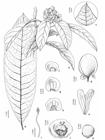
- a-k. Davilla latifolia - a. habit; b. adaxial face of the leaf; c. detail of the abaxial face of the leaf; d. sepals covering the fruit; e. petal; f-h. external sepals; i. stamen; j. fruit in frontal view, without an inner sepal and petals; k. seed involved by aril. {a. Photo (C.N. Fraga); b-i. M.G. Bovini et al. 2641; j-k. C.N. Fraga et al. 2081}.
Selected material: Duque de Caxias, próximo a Xerém, leito da antiga estrada de ferro, 30.IV.1979, fl., H.C. Lima & O. Valverde 935 (RB). Itaboraí, margem do Parque Municipal do Barbosão, 22°43’01’’S, 42°45’21’’W, 23.III.2022, fr., M.D.F. Araújo et al. 107 (RB). Itatiaia, Parque Nacional do Itatiaia, estrada para o Complexo do Maromba, 22°26’24’’S, 44°36’42”W, 21.I.2022, fr., M.D.F. Araújo et al. 82 (RB). Mangaratiba, Ilha da Marambaia, 1.IV.2000, fl., L.F.T. Menezes et al. 524 (RBR). Niterói, Parque Estadual da Serra da Tiririca, Córrego dos Colibris, sobre a pedra do pau brasil, 30.VII.1999, fr., M.C.F. dos Santos et al. 385 (RB, RFFP). Nova Friburgo. Área de Proteção Ambiental de Macaé de Cima, Lumiar, Zona Rural de Galdinópolis, beira da estrada, 21.X.2017, fr., S. Coutinho et al. 10 (NIT). Nova Iguaçu, Reserva Biológica do Tinguá, Estrada do Ouro, Rio das Galinhas, beira da estrada, 30.IX.2002, fr., G.V. Somner & M.V.L. Pereira 1040 (RB). Paraty, Área de Proteção Ambiental Cairuçu, 13.VI.1994, fr, M.G. Bovini 485 (RB). Petrópolis, Bairro Amoedo, XII.1943, fl., O.C. Góes & D. Constantino 1048 (RB). Rio das Ostras, Entre Macaé e Rio das Ostras, 22°26’18”S, 41°52’14”W, 15.VI.1993, fl., J.R. Pirani & R.M. Silva 2876 (K, MO, NY, SPF). Rio de Janeiro, Campo Grande, Serra do Mendanha, 4.IV.1978, fl., H.C. Lima 329 (RB). Santa Maria Madalena, Morro da Antena, Mata do Criminoso, propriedade do Sr. João Batista Bizzo, 21°58’03’’S, 42°01’03”W, 21.IV.2008, fl. and fr., M.M. Saavedra & C.N. Fraga 706 (BHCB, K, MBML, NY, PORT, RB). Silva Jardim, Reserva Biológica de Poço das Antas, estrada interna da reserva em direção à Barragem de Juturnaíba, próximo à trilha do Morro do Calcário, 22°30’58’’S, 42°19’26’’W, 10.I.2012, fr., M.M. Saavedra et al. 1041 (RB, SPF).
Davilla rugosa resembles D. nitida for the overlapping internal sepals and one glabrous ovary, but they differ mainly by the patent trichomes on inflorescence and branches of D. rugosa (versus adpressed trichomes on D. nitida) and by the semicraspedodromous venation (vs. eucamptodromous).
Davilla rugosa has a wide distribution in South America, with most of the records made in Brazil and a few records in French Guiana and Venezuela. In the Southern, Southeastern and Northeastern regions of Brazil the species occupies several areas of the Atlantic Forest (Ombrophilous Montane Forests, Seasonal Semideciduous Forests, Lowland Rainforest, Tabuleiro Forest and Coastal Plain Vegetation). In the Northern region of Brazil, as well as in French Guiana and Venezuela, the species is common in the Amazon rainforest, where it prefers open environments close to rivers (Fraga 2012). D. rugosa can be found in several environments throughout the state of Rio de Janeiro (Fig. 3).
The extent of occurrence (EOO) of the species was estimated at more than 20,000 km2. Furthermore, several herbarium labels inform the ability of the species to live in disturbed areas or areas of recent regeneration. The species was included in the Least concern (LC) category by Fraga (2012) and maintained here in the same category.
6. Davilla tintinnabulata Schltdl., Linnaea 8: 178. 1833. Figs. 2c-d; 10a-j
Liana. Stem and branches cylindrical, when young tomentose to woolly, when mature scaly and glabrate, castaneous or greyish, hair simple, ferruginous. Leaves petiolate; petiole 0.6-2.5 × 0.1-0.2 cm, canaliculate, margin ciliate, frequently lacerate, adaxial surface tomentulose to glabrate or glabrous, abaxial surface densely tomentose, light green; blade 4-29 × 2-11.3 cm, coriaceous, oval, ovate or elliptic, base rounded, margin entire, or dentate on the upper third, apex acute or acuminate, adaxial surface glabrate or sparsely tomentose, subulate, dark green, abaxial surface lanulose or villous, velutinous to touch, green, hair simple, ferruginous or greenish; venation semicraspedodromous, midrib grooved, pubescent on adaxial surface, prominent and pilose or villous on abaxial surface, light green; secondary veins 10-18, slightly grooved and glabrous on adaxial surface, prominent and villous on abaxial surface, light green; tertiary veins mixed percurrent, impressed and glabrous on adaxial surface, prominent and pubescent or villous on abaxial surface, light green, domatia absent, hair simple, ferruginous or greenish. Inflorescence panicle, 6-24 cm long, terminal or axillary, ramified, lateral ramifications 2-9, flowers 12-60, pilose to pilosulose, hair simple, ferruginous or greenish. Flowers pedicellate, basal bracts 1.5-3.5 × 0.7-2.2 mm, triangle shaped, early deciduous, adaxial surface glabrous, abaxial surface tomentose or pannose, hair simple, ferruginous or greenish; pedicels 2.7-10.8 × 0.3-1 mm, same diameter from base to apex, pilosulose to villous, hair simple, ferruginous or greenish; sepals 5, 3 externals smaller and unequal in size, outer 2.1-2.9 × 3.4-4 mm when blooming, 2.7-4.1 × 3.1-3.9 mm when fruiting, medial 2.5-3.1 × 3.5-4.2 mm when blooming, 3-3.9 × 3-4.8 mm when fruiting, inner 3.2-5.4 × 3.7-6.7 mm when blooming, 3.6-5 × 3.6-4.6 mm when fruiting, coriaceous, suborbicular, base hippocrepiform, margin ciliate, apex rounded, externally sericeous, internally glabrous and smooth, 2 innermost larger, equal in size, 7.4-7.7 × 7.4-8.1 mm when blooming, 10.2-12.7 × 9.5-13.4 mm when fruiting, crustaceous, suborbicular, base truncate, margin ciliate, pressed against each other forming circular wings, not overlapping, apex rounded, externally tomentose or subsericeous, internally glabrous and smooth, green when blooming, saffron when fruiting, hair simple, ferruginous or greenish; petals 5, 9.2-10.8 × 5.5-9.5 mm, membranous, spatulate-obovate, base cuneate, margin entire, apex bifid, glabrous on both surfaces, early deciduous, yellow; stamens 90-96, arranged in a circle around the carpels, inserted; filaments 3.6-4.7 × 0.05-0.06 mm, cylindrical, expanded only near the apex, glabrous, cream; anthers 0.5-0.7 × 0.3-0.8 mm, elliptical, glabrous, basifixed, connective reduced near the base, cream; carpels 2, free, glabrous; ovaries 1.2-1.3 × 0.9-1.1 mm, conical; ovules 2, basal, 0.5 × 0.3-0.4 mm; style ca. 2.3 × 0.2 mm, sinuous or erect, glabrous, stigma peltate, discoid, verrucose, cream. Fruit 6-7.2 × 3.7-5.7 mm, membranous follicle, indehiscent, globose, glabrous, innermost sepals outgrowing on fruit; seeds 1, rare 2, per carpel, 4.9-6.3 × 4.5-5.6 mm, obovoid, rugose, glabrous, covered by the aril almost up to the apex, black; aril papyraceous, dentate on the apex, white.
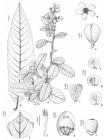
- a-l. Davilla rugosa - a. habit; b. abaxial face of the leaf; c. detail of the leaf apex on the abaxial face; d. flower in top view; e. sepals covering the fruit; f-h. external sepals; i. petal; j. stamen; k. fruit in front view, without an inner sepal and petals; l. seed surrounded by aril. (a, d. Photo; b. M.M. Saavedra et al. 580; c, e. C.N. Fraga & L.S.R. Freire 2872; f-j. M.M. Saavedra & C.N. Fraga 686; k-l. C.N. Fraga et al. 2297).
Selected material: Itatiaia, Parque Nacional do Itatiaia, trilha Barbosa Rodrigues, Vale do Último Adeus, elevação 670 m, 22°27’46”S, 44°36’21’’W, 20.V.2010, fl., C.N. Fraga et al. 2897 (BHCB, MBML, PORT, RB); trilha para o Rio Campo Belo, saindo da Pousada Aldeia dos Pássaros em direção ao Vale do Último Adeus, 22°27’42’’S, 44°36’26’’W, 20.I.2022, fl., M.D.F. Araújo et al. 80 (CEPEC, MBM, NY, RB, SPF). Petrópolis, Araras, Pedra do Cuca, subida para a Pedra do Cuca, antes da primeira pedra grande, na beira da trilha, 22°25’19’’S, 43°17’27’’W, 17.VI.2018, fr., L.J. Sauthier et al. 92 (RB, SPF); Reserva Biológica de Araras, cume da Pedra do Oratório, 22°26’08’’S, 43°14’48’’W, 25.VII.2017, fr., M.S. Wängler & B.A. Arruda 2044 (RB); trilha para o Morro do Cuca, campo de altitude, 22°25’19’’S, 43°17’28’’W, 11.X.2017, fr., T.M. Portugal 51 (MBM, RB); Teresópolis. Paquequer, fl., T. da Rocha (R 34454).
Additional Material: BRAZIL. MINAS GERAIS: Rio Preto, Funil, trilha da ponte em direção ao Serrote de São Gabriel, 2.VI.2006, fr., F. Salimena et al. 1351 (CESJ, RB). SÃO PAULO: Cotia, IV.1941, fr., D. Constantino 158 (RB). Cunha, Distrito de campos Novos, estrada entre Campos Novos e a localidade de Sete Cabeças, 17.XI.2006, fr., E.J. Lucas et al. 449 (K, RB). Mogi das Cruzes, 21.IV.1889, fr., C.A.W. Schwacke 6611 (RB); Vila S. Geraldo, 25.III.1938, fr., G. Hashimoto 114 (RB).
- a-j. Davilla tintinnabulata - a. habit; b. adaxial face of the leaf; c. detail of the apex on the abaxial face of the leaf; d. sepals covering the fruit; e-g. external sepals; h. stamen; i. fruit in frontal view, without an inner sepal and petals; j. seed involved by aril within an open fruit. (a, d. Photo (C.N. Fraga); b-c. C.N. Fraga et al. 2897; e-j. W.D. Barros 993).
Davilla tintinnabulata can be distinguished by the indumentum on the leaves and branches, velutinous to the touch, with ferruginous trichomes, plus the two ovaries wrapped by the innermost sepals not overlapping but pressed against each other and reaching on average 11 cm when fruiting. It resembles D. glaziovii due to its branches covered with soft trichomes and inner sepals velutinous. However, they can be separated by the leaves sub-bullate and oval or ovate (versus leaves bullate and elliptic) and indumentum of the leaves glabrate or sparsely tomentose on the adaxial surface (vs. glabrate or strigose) and velutinous to touch on the abaxial surface (vs. pubescent).
Davilla tintinnabulata occurs only in areas of altitude close to 1,000 m in the Atlantic Forest in the states of Rio de Janeiro, São Paulo, and Minas Gerais, preferentially occupying wetter environments close to riverbeds (Fraga 2012). In Rio de Janeiro, the species is found in elevated areas of the National Parks of Itatiaia and Serra dos Órgãos (Petrópolis and Teresópolis), which represent the northern limit of the taxon’s distribution (Fig. 3).
The EOO of D. tintinnabulata was estimated at less than 20,000 km2. The species has samples indicating past occurrences around the current city of São Paulo, and part of its range of occurrence includes habitats altered due to historical logging exploration in forests and the growth of the two largest cities in Brazil. Currently, some regions in the interior of these states have different economic purposes, from agriculture to agrotourism, and for this reason Fraga (2012) included the species in the Vulnerable (VU) category. Considering that Rio de Janeiro represents the northern limit of the taxon’s distribution, we prefer to maintain the preliminary status indicated by Fraga (2012).
Doliocarpus Rol., Kongl. Svenska Vetensk. Acad. Handl. 17: 260-261. 1756. Figs. 2e-h; 11a-h
Liana, sometimes scandent shrub. Leaves petiolate. Hermaphroditic. Inflorescences reduced to few flowers, sometimes solitary and sessile, cauliflorous or in the axil of (usually) fallen leaves. Flowers with sepals persistent; petals white, early deciduous; usually one single carpel, globose. Fruits berry-like, sepals persistent, reflexed or adpressed to the fruit; seeds 1 or 2 per fruit, covered entirely by a white, fleshy aril (Kubitzki 1971).
The genus occurs from southern Mexico to southern Brazil (Horn 2007). In Rio de Janeiro its occurrence is shown in Figure 12.
7. Doliocarpus glomeratusEichler, Fl. bras. 13(1): 77, t. 18, f. 2. 1863. Figs. 2e-f; 13a-k
Liana. Stem and branches cylindrical, when young tomentose to glabrate, chestnut, when mature scaly, glabrous, scaly plates greyish, hair simple, white. Leaves petiolate; petioles 0.7-2 × 0.1-0.2 cm, carinate, margin often lacerate, not ciliate, adaxial surface glabrous or glabrate, abaxial surface tomentose, light green; blade 6.2-13.8 × 1.8-5.2 cm, subcoriaceous or coriaceous, obelliptic, base attenuate, margin entire, apex acuminate or cuspidate, adaxial surface glabrous, green, abaxial surface glabrous or sparsely tomentose, green; venation eucamptodromous, midrib impressed, sometimes slightly grooved, glabrous on the adaxial surface, prominent and tomentose on the abaxial surface, light green; secondary veins 8-10, slightly impressed and glabrous on the adaxial surface, slightly prominent and tomentose or tomentulose on the abaxial surface, light green; tertiary veins straight opposite percurrent, plain, sometimes not apparent and glabrous on the adaxial surface, plain, and glabrous on the abaxial surface, light green, domatia present on the axil between secondary and primary veins, hairs simple, white. Inflorescence panicle, reduced, 0.3-0.5 cm long, inserted on the axil of fallen (or not) leaves, ramified, lateral ramifications 3-5, flowers 3-5. Flowers pedicellate; basal bracts, 1, 1.5-2.3 × 0.9-1.1 mm, coriaceous, lanceolate, persistent, glabrous on the adaxial surface, margin ciliate, tomentulose on the abaxial surface, hair simple, white; pedicels 1.3 × 0.5-0.7 mm, same diameter from base to apex, tomentulose or tomentose, light green, hairs simple, white; sepals 4; 2.3-3.8 × 1.4-2.5 mm when blooming, 2.8-4.2 × 1.7-3.3 mm when fruiting, size subequal, coriaceous, obelliptic and cucullate, base truncate, margin entire, apex rounded, externally tomentulose to the center, internally glabrous, light green, hairs simple, white; petals 3, 2-4.2 × 1.1-1.9 mm, membranaceous, spatulate, base cuneate, margin entire, apex obtuse, glabrous on both surfaces, early deciduous, white; stamens 45-48, arranged in a circle around the carpel, exserted; filaments 3.4-4.3 × 0.05-1 mm, cylindrical, glabrous; anthers 0.2 × 0.3-0.4 mm, elliptic, glabrous, basifixed, connective reduced near the base, color not seen; carpels 1, free, glabrous; ovaries 0.8-1.2 mm diam., globose; ovules 2, basal, 0.3-0.4 × 0.3 mm, obovoid; style 0.9-1 × 0.3 mm, erect, glabrous, stigma peltate orbicular, white. Fruit 5.1-7.9 mm diam., berry, fleshy, globose, vinaceous or burgundy when mature, externally glabrous, sepals persistent, accrescent and adpressed to the fruit; seeds 1 per carpel, 3.8-4.4 × 3.2-4 mm, subreniform or obovate, rugose, glabrous, covered by the aril up to the apex, black; aril papyraceous, entire or lacerate on the apex, white.
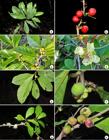
- a-b. Doliocarpus heterophyllus; c-d. Do. littoralis; e-f. Do. schottianus; g-h. Do. sessiliflorus. (a-b; e-h. Photos by J.V.L. Monzoli; c-d. Photos by M.D.F. Araújo).
Selected material: Cachoeiras de Macacu, Ad Serra de Macacu, fr., H. Schott 4403 (Type; W).
Additional Material: BRAZIL. MINAS GERAIS: Delfinópolis, 20.VI.1999, fr., A.C.B. Silva 103 (SPF). PARANÁ: km 7 in silva primaribus, 25º28’37”S, 48º50’03”W, 14.VII.1911, fr., P.K.H. Dusén 11952 (NY); Volta Grande, 10.VIII.1911, fr., P.K.H. Dusén 12029 (US). Diamante do Norte, Rio Paranapanema, 6.IX.1998, fr., J.M. Silva 2502 (MBM, US). Guaraqueçaba, Caminho do Paruquara, 16.III.1990, fr., G. Hatschbach 54098 (MBM, US). Guaratuba, Colônia Limeira, 12.IV.1989, fr., G. Hatschbach 52754 (MBM); Ibiporã, Fazenda Doralice, 17.VII.1989, fr., P.C. Lobo (MBM 189336). Loanda, 22º55’41”S, 53º05’55”W, 31.VII.2014, fr., E.L. Siqueira et al. 1089 (HCF). Paranaguá, 28.IV.1997, fr., G. Gatti et al. 86 (HCF). Pontal do Paraná, Balneário de Canoas, 25º40’27”S, 48º28’20”W, 19.V.2012, fr., E.L. Siqueira 540 (HCF, MBM). SANTA CATARINA: Apiúna, Morro Dom Bosco, 27º03’01”S, 49º22’00”W, 1.V.2017, fr., L.A. Funez 6412 (FURB). Botuverá, Reserva Biológica Canela Preta, 27º16’12”S, 49º08’24”W, 30.III.2010, fr., A. Stival-Santos 2276 (FURB, RB). Florianópolis, Pântano do Sul, Parque Municipal da Lagoinha do Leste, 27°46’31’’S, 48°29’33’’W, 16.III.2010, fl. and fr., T.J. Cadorin et al. 1681 (FURB, RB). Paulo Lopes, Sertão do Campo, 27°52’44’’S, 48°45’43’’W, 1.II.2010, fl., J.L. Schimitt et al. 1274 (FURB, RB); 5.VI.2010, fr., J.L. Schimitt et al. 2645 (FURB, RB). Porto Belo, Margem da BR-101, 27°08’58”S, 48°36’07”W, 5.II.2010, fl., J.L. Schimitt et al. 1343 (FURB). Presidente Nereu, Braço do Salão - Fazenda Sabiá, 27°10’53”S, 49°13’53”W, 16.III.2010, fr., J.L. Schimitt et al. 1695 (FURB, RB). Santo Amaro da Imperatriz, Parque Estadual do Tabuleiro, 27°43’12”S, 48°46’48”W, 21.V.2010, fr., A. Stival-Santos 2846 (FURB, IBGE, MBM, RB, SPF, US). SÃO PAULO: São Paulo, Jardim Botânico, 23°39’16”S, 46°37’19”W, 10.IV.1933, fr., O. Handro 317 (MBM, NY, SPF).
Doliocarpus glomeratus is similar to D. heterophyllus by their tertiary veins opposite percurrent (straight), the inflorescence pedicellate and fruit glabrous, but can be separated by the domatia present on the axil of the primary and secondary veins on the abaxial surface of the leaf (versus domatia absent), sepals 5, adpressed and accrescent to fruit (vs. sepals 4, reflexed and not accrescent to fruit) and vinaceous or burgundy fruit when mature (vs. red fruit when mature).
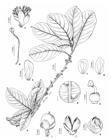
- a-k. Doliocarpus glomeratus - a. habit; b. detail of the domatia on the axis of the venation on the abaxial surface; c. flower with sepals; d. stamen; e. petal; f-g. sepals; h. ovary; i. closed fruit with adpressed sepals; j. open fruit; k. seed surrounded by aril. (a-k. T.J. Cadorin et al. 1681).
Doliocarpus glomeratus has a wide distribution throughout the Brazilian Atlantic Forest in Southern Brazil (Paraná and Santa Catarina) and part of the Southeastern region (Minas Gerais, Rio de Janeiro and São Paulo).
Considering that in Rio de Janeiro (Fig. 12) the species is only known from the type record (Cachoeiras de Macacu), and given that this locality represents the northern limit of distribution, there is uncertainty about the occurrence of the species in the areas among the known records, which comprises a wide geographic distribution. Thus, it is more cautious to include the species in the Data Deficient (DD) category.
8. Doliocarpus grandiflorusEichler, Fl. bras. 13(1): 73. 1863.
≡ Othlis castaneifolia Schott, Syst. Veg. [Sprengel], editio decima sexta 4(2): App. 407. 1827.
≡ Delima castaneifolia (Schott) G.Don, Gen. Hist. 1: 71. 1831.
≡ Doliocarpus castaneifolius (Schott) Gilg, Nat. Pflanzenfam. 3(6): 115. 1893 (non Mart. ex Eichler), nom. illeg.
= Doliocarpus grandiflorus var. pubensEichler, Fl. bras. 13(1): 73. 1863. Figs. 2g-h; 14a-n
Liana. Stem and branches cylindrical, when young tomentose to glabrate, when mature striate, glabrous, bark greyish, hair simple, white. Leaves petiolate; petioles 0.4-1.6 × 0.1-0.2 cm, canaliculate, margin entire, sometimes lacerate, abaxial surface tomentose, adaxial surface pubescent to glabrate, green; blade 7-21.3 × 2.5-8.5 cm, subcoriaceous, elliptic or oblanceolate, base cuneate to attenuate, margin ciliate, entire on the base and dentate on the apical 2/3, apex acuminate or cuspidate, adaxial surface tomentose when young and glabrate when mature, dark green, abaxial surface tomentose, light green; hair simple, white; venation brochidodromous on the basal 1/3, semicraspedodromous on the apical 2/3, midrib slightly grooved, tomentose or glabrate on the adaxial surface, prominent and tomentose on the abaxial surface, light green; secondary veins 10-18, plain and glabrous on the adaxial surface, prominent and sparsely tomentose on the abaxial surface, light green; tertiary veins mixed percurrent, plains and glabrous on the adaxial surface, slightly prominent and tomentose or pubescent on the abaxial surface, light green, domatia absent, hair simple, white. Inflorescence reduced to solitary flowers. Flowers sessile or subsessile; basal bracts, 2-3, 2.7-4.6 × 2.6-3.7 mm, subcoriaceous, suborbicular, persistent, pannose or tomentose on the adaxial surface, glabrous or pubescent on the abaxial surface, hair simple, white; sepals 7, rarely 8; 3.8-11.9 × 5.7-8.2 when blooming, 8.2-15 × 5.6-10.5 mm when fruiting, size subequal, coriaceous, 3 externals suborbicular and cucullate, 4 inners spatulate and cucullate, base cuneate, margin ciliate, apex obtuse or rounded, externally sericeous, internally sericeous on the center, to the margin glabrous and smooth, green, hair simple, white; petals 5, 13-19.2 × 9.1-13 mm, membranaceous, spatulate-obovate, base cuneate, margin crisped, apex obtuse or emarginate, glabrous on both surfaces, early deciduous, white; stamens 105-125, arranged in a circle around the carpel, exserted; filaments 3.2-6.7 × 0.1-0.2 mm, cylindrical, glabrous; anthers 1.6-3 × 0.3-0.5 mm, oblong, glabrous, basifixed, connective reduced on the base, cream; carpels 1, rare 2, free, hispid; ovaries 2.7-3.9 mm diam., globose; ovules 2, basal, 0.7-1 × 0;5-0.6 mm, obovoid; style 4.3-7.5 × 0.3-0.5 mm, sinuous to erect, glabrous, stigma foliaceous, cream; hair simple ferruginous on herbaria material and white to ferruginous on fresh material. Fruit 10.5-15.2 mm diam., berry, fleshy, globose, externally hispid, sepals persistent, adpressed and accrescent to fruit, red when mature, hair simple, stinging, white when young and ferruginous when mature; seeds 2 per carpel, 8-9.7 × 7.4-8 mm, obovoid, rugose, glabrous, covered by the aril up to the apex, black; aril papyraceous, entire, or rarely lacerate on the apex, white.
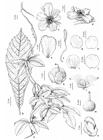
- a-n. Doliocarpus grandiflorus - a. habit; b. abaxial face of the leaf; c. upper view of the flower in bloom; d. side view of the flower; e. petal; f. stamen; g. external face of a sepal; h-j. inner face of sepals; k. fruit closed; l. fruit open; m. ovary; n. seed partially surrounded by aril. {a. Photo (J.V.L. Monzoli); b, k. J.V.L. Monzoli et al. 415; c-j, m. M.D.F. Araújo et al. 153 (RBspirit 2850); l, n. C.M.B. Correia et al. 323}.
Selected material: fl., H.W. Schott 5920 (Type; BP, W). Estrada Angra dos Reis - Paraty, 11.IV.1969, fr., D. Sucre 4886 (RB). Campos dos Goytacazes, Martins Lage, Solar dos Airizes (Fazenda Ayrizes), Mata do Mergulhão, km 7 da BR-356, cerca de 1 km do Rio Paraíba do Sul, 21°46’37’’S, 41°15’48’’W, 7.VI.2000, fr., J.M.A. Braga 6003 (HUENF, R, RB). Casimiro de Abreu, BR-101, cerca de 3 km após sede do parque, em direção a Campos dos Goytacazes, entrada a direita em frente ao cemitério de Rocha Leão, Estrada da Mucuca rumo a Rio das Ostras, 22°26’10’’S, 42°01’34’’W, 9.I.2012, fl., A. Lobão et al. 1795 (RB, SPF). Magé, Distrito de Citrolândia, 10.III.1984, fr., R. Guedes & L.P. Gonzaga 692 (RB, SPFR). Silva Jardim, Reserva Biológica de Poço das Antas, Estrada principal 1, margem da trilha, em terra firme, próximo a mata alagada, 22°33’34’’S, 42°17’54’’W, 7.XI.2022, fl., M.D.F. Araújo et al. 153 (RB); entre as duas entradas para a Casa dos Morcegos, 22°33’19’’S, 42°17’47’’W, 11.XII.2021, fr., J.V.L. Monzoli et al. 415 (RB, SJRP).
Additional Material: BRAZIL. SÃO PAULO: Bananal, Socarão, 1.II.1883, fl., R 78449.
Doliocarpus grandiflorus is similar to Do. sessiliflorus by the leaves elliptic or oblanceolate, inflorescence sessile, and sepals externally sericeous but can be differentiated by the size of the leaves reaching 21 cm long (versus 12 cm long), sepals internally sericeous on the centre (vs. sepals internally glabrous) and fruit externally hispid (vs. fruit externally pannose-villous).
Doliocarpus grandiflorus occurs in the Lowland Rainforest in Rio de Janeiro and in the Montane Ombrophilous Forests in the state of São Paulo (Bananal), which represents the only known locality outside of Rio de Janeiro (Fig. 12).
The species has an extent of occurrence of 6,643 km2 and an area of occupancy of 40 km2 (within the limits of the Endangered category), probably due to the low sampling effort employed for collecting this species in the field. Consequently, we prefer to use only the B1 criterion for the analysis (Fig. 5). Furthermore, the species is known from ten locations (within the limits of the Vulnerable category). Thus, the species is classified here in the Vulnerable [VU B1ab(iii)] category.
9. Doliocarpus heterophyllusMonzoli & D.Sampaio, Systematic Botany 47(4): 953-956. 2022. Figs. 11a-b; 15a-j
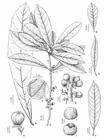
- a-j. Doliocarpus heterophyllus - a. habit; b, d-f. leaf variation; c. detail of the abaxial face of the leaf; g. detail of the infructescence; h. fruit with sepals reflexed; i. seed without aril; j. seed surrounded by aril. (a, g-j. J.G. Jardim et al. 278; b, c. J.V.L. Monzoli et al. 438; d. G.S. Siqueira 559; e. L.A.M. Silva et al. 1031; f. J.V.L. Monzoli et al. 398).
Liana. Stem and branches cylindrical, when young tomentose to glabrate, maroon, when mature scaly, glabrous or glabrate, scaly plates greyish or fuscous. Leaves petiolate; petioles 0.3-1.5 × 0.1-0.2 cm, canaliculate, margin entire or lacerate, ciliate, adaxial surface glabrous or glabrate, rarely tomentulose, abaxial surface tomentose to tomentulose, light green; blade 3-19.7 × 1.6-3.8 cm, chartaceous or subcoriaceous, narrowly elliptic, oblanceolate, narrowly oblanceolate, base attenuate, margin entire, rarely dentate on the apical 1/3, subrevolute, sometimes undulate, apex acute or acuminate, adaxial surface glabrous, green, rarely with a white macula along the midrib, abaxial surface glabrous, sometimes sparsely tomentose, green; venation brochidodromous, sometimes semicraspedodromous on the apical 1/3, midrib grooved, sometimes slightly grooved, glabrous on the adaxial surface, prominent and tomentose or tomentulose on the abaxial surface, light green; secondary veins 5-11, impressed and glabrous on the adaxial surface, slightly prominent and sparsely tomentulose or glabrate on the abaxial surface, light green; tertiary veins opposite percurrent (straight), plain, sometimes not apparent and glabrous on the adaxial surface, plain, and glabrous on the abaxial surface, light green, domatia absent, hair simple, white. Inflorescence panicle, reduced, inserted on the axil of fallen (or not) leaves, simple or ramified, 1-3 lateral ramifications, 1-4 flowers. Flowers pedicellate; basal bracts, 1, 0.8-1.2 × 0.5-1 mm, coriaceous, lanceolate, persistent, glabrous on the adaxial surface, margin ciliate, pannose or lanulose on the abaxial surface, hair simple, white; pedicels 0.3-0.8 × 0.4-0.7 mm, same diameter from base to apex, lanulose to tomentulose or tomentose, light green, hairs simple, white; sepals 4; not seen when blooming, 1.5-3.2 × 1.3-2.6 mm when fruiting, size subequal, coriaceous, ovate and cucullate, base truncate, margin entire, apex rounded, externally glabrous, internally glabrous, light green; petals, not seen; stamens arranged in a circle around the carpel, exserted; filaments ca. 2.7 × 0.1 mm, cylindrical, glabrous; anthers ca. 0.3 × 0.4 mm, elliptic, glabrous, basifixed, connective enlarged pushing the thecae away, colour not seen; carpels 1, free, glabrous; ovaries 1.1 mm diam., globose; ovules 2, basal; not seen; style ca. 1 × 0.3 mm, sinuous to erect, glabrous, stigma peltate orbicular, colour not seen. Fruit 5.7-12.2 mm diam., berry, fleshy, globose, pinky red when mature, glabrous, sepals persistent, reflexed and not accrescent to fruit; seeds 1 or 2 per carpel, 4.7-6.1 × 4.8-6.6 mm, subreniform or obovate, rugose, glabrous, covered by the aril up to the apex, black; aril papyraceous, entire or lacerate on the apex, white.
Selected material: Morro do Queimado, 26.VII.1973, fr., D. Sucre et al. 10054 (RB). Mangaratiba, Ilha da Marambaia, subida da estrada para Praia da Armação, 24.IX.1991, fr., G.V. Somner et al. 671 (RB, RBR). Rio de Janeiro, Parque Nacional da Tijuca, morro do queimado, +/- a 50 m da placa “morro do queimado” partindo em direção oposta à pedra da proa, 22°57’44’’S, 43°15’24’’W, 12.X.2021, fr., J.V.L. Monzoli et al. 398 (Type; RB, SJRP).
Doliocarpus heterophyllus resembles Do. glomeratus by the inflorescence pedicellate, fruit glabrous, tertiary veins opposite percurrent (straight), but differs by leaf blade narrowly elliptic, oblanceolate or narrowly oblanceolate (versus leaf blade oblong, elliptic or obovate-elliptic), absence of domatia (vs. presence of domatia), sepals 4, reflexed and not accrescent to fruit (vs. sepals 5, adpressed and accrescent to fruit), fruit when mature pinky red (vs. fruit when mature vinaceous).
Doliocarpus heterophyllus is distributed in the Atlantic Forest of Southeastern and Northeastern Brazil, known from the municipalities of Rio de Janeiro and Mangaratiba (coast of the state of Rio de Janeiro, Figure 12, in Dense Ombrophilous Forest and coastal lowland open vegetation, respectively), in Linhares, Espírito Santo, in Tabuleiro Forest, in Caratinga, Minas Gerais, in Semideciduous Seasonal Forest, and Una and Valença, Bahia, in Tabuleiro Forest. The species have been recorded so far from seven localities, resulting in an estimated extent of occurrence of 135 km2 and a minimal area of occupancy of 36 km2.
According to Monzoli et al. (2022), the forested areas are severely fragmented by farms. They are threatened by disorderly real estate speculation, which can lead to a continuous decline in the area of occupancy, the quality of habitat of the species, and the region’s associated highly endemic plant diversity. For these reasons, the species was included in the Endangered category [EN B2ab(ii,iii)]. Thus, we prefer to maintain the preliminary status indicated by Monzoli et al. (2022).
10. Doliocarpus littoralis (Kubitzki) Fraga & Stehmann, Rodriguésia 61(Sup.): 53. 2010.
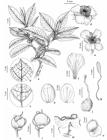
- a-n. Doliocarpus littoralis - a. habit; b-c. detail of the abaxial face of the leaf; d. side view of a flower with three petals; e. front view of a flower with four petals; f. petal; g. stamen; h-i. external and internal face of a sepal; j. ovary; k-l. fruits with adpressed sepals; m. open fruit; n. seed partially enclosed by the aril. {a, d, e. Photo (M.D.F. Araújo; J.F. Oliveira); b-c, m. A. Lobão & L. Pangaio 444; f-l. M.D.F. Araújo et al. 130 (RBspirit 2847); n. C. Farney et al. 4665}.
≡ Doliocarpus major subsp. littoralisKubitzki, Mitt. Bot. Staatssamml. München 9: 65. 1971. Figs. 11c-d; 16a-n
Liana. Stem and branches cylindrical, when young glabrous, maroon, when mature striate, glabrous, greyish. Leaves petiolate; petioles 0.2-0.6 × 0.1-0.26 cm, semiterete, margin entire, sometimes lacerate and rarely ciliate, adaxial surface glabrous, abaxial surface glabrous or sometimes sparsely tomentose, light green; blade 2.5-11.5 × 1-5.7 cm, coriaceous, elliptic or oblanceolate, base cuneate to attenuate, margin revolute, entire on the base and dentate on the apical 2/3, apex acuminate or cuspidate, adaxial surface glabrous, green, abaxial surface glabrous, light green; venation brochidodromous on the basal 1/3, semicraspedodromous on the apical 2/3, midrib slightly grooved, glabrous on the adaxial surface, prominent and sparsely tomentose or glabrate on the abaxial surface, light green or vinaceous; secondary veins 5-9, plain and glabrous on the adaxial surface, prominent and sparsely tomentose or glabrate on the abaxial surface, light green, sometimes vinaceous; tertiary veins mixed percurrent, plain, sometimes not apparent and glabrous on the adaxial surface, slightly prominent, sometimes plain, and glabrous on the abaxial surface, light green, domatia absent, hair simple, white. Inflorescence reduced, panicle, inserted on the axil of fallen (or not) leaves, ramified, 1-florous, or 1-2 lateral ramifications, flowers 1-3. Flowers pedicellate; basal bracts, 1, 1.9-2.7 × 2-2.5 mm, subcoriaceous, suborbicular, persistent, glabrous or tomentulose on the adaxial surface, margin ciliate, pannose or glabrate on the abaxial surface, hair simple, white; pedicels 0.3-1.1 × 0.4-1.2 mm, same diameter from base to apex, puberulent or tomentulose, light green or vinaceous, hairs simple, white; sepals 5, 3.6-7.6 × 4.3-6.1 when blooming, 4-7.2 × 3.8-6.5 mm when fruiting, size subequal, coriaceous, 2 externals suborbicular and cucullate, 3 inners oblong and cucullate, base truncate, margin ciliate, apex obtuse, externally tomentulose or slightly pannose, internally puberulent or tomentulose on the center, to the margin glabrous and smooth, light green, apex vinaceous, hair simple, white; petals 3-4, 8.7-10.6 × 7.7-10.1 mm, membranaceous, obovate to obdeltoid, base cuneate, margin crisped, apex obtuse, glabrous on both surfaces, early deciduous, white; stamens 91-101, arranged in a circle around the carpel, exserted; filaments 1.6-4.2 × 0.1 mm, cylindrical, glabrous; anthers ca. 0.7 × 0.5 mm, oblong, glabrous, basifixed, connective reduced on the base, white; carpels 1, free, densely setulose; ovaries 1.8 mm diam., globose; ovules 2, basal, 0.5-0.6 × 0.7-0.8 mm, obovoid; style 2.8-4.2 × 0.2 mm, sinuous to erect, glabrous, stigma capitate, foliaceous, white, hair simple, white. Fruit 5.7-10.6 mm diam., berry, fleshy, globose, red when mature, externally setulose, sepals persistent, adpressed and accrescent to fruit; hair simple, white; seeds 1 or 2 per carpel, 4.8-6.5 × 4.1-6.6 mm, obovoid, rugose, glabrous, covered by the aril up to the apex, black; aril papyraceous, entire, or rarely lacerate on the apex, white.
Selected material: Arraial do Cabo, Restinga da Praia grande, 22°56’45’’S, 42°04’29’’W, 14.V.2022, fl. and fr., M.D.F. Araújo et al. 130 (CEPEC, HUENF, MBM, NY, RB, RBR, SJRP, SPF, VIES). Cabo Frio, Arraial do Cabo, Pontal Beach, 22°56’48’’S, 42°1’54’’W, 10.VIII.1953, fr., F. Segadas-Vianna et al. Restinga I - 781 (NY, R); Ponta do Gabriel, estrada próximo à ponta do gabriel, 22°56’48’’S, 42°01’30’’W, 17.IV.1952, fl., L.B. Smith et al. 6664 (Type; K, NY, R, US). Casimiro de Abreu, Barra de São João, near barra de são joão village, 22°34’19”S, 41°59’21”W, 5.IX.1953, fr., F. Segadas-Vianna et al. Restinga I - 961 (NY, R). Rio das Ostras, Restinga de Itapebussus, restinga arbustiva, 19.VIII.1999, fr., A. Lobão & L. Pangaio 444 (RB).
Doliocarpus littoralis may resemble Do. sessiliflorus by their oblanceolate leaves serrate on the upper 2/3, sepals adpressed and accrescent to fruit, and trichomes inclined on fruit. They differ by the leaf blade glabrous on both surfaces (versus leaf blade sparsely tomentose on the adaxial surface and pubescent or tomentulose on the abaxial surface), flowers pedicellate (vs. flowers sessile), sepals externally tomentulose or pannose (vs. sepals externally sericeous), fruit setulose (vs. fruit pannose-villous).
Doliocarpus littoralis has known occurrence from Arraial do Cabo to Rio das Ostras in areas of coastal plain vegetation (restinga) (Fig. 12). Although Fraga & Stehmann (2010) cited the occurrence of the taxon for the coastal plain vegetation of Espírito Santo, those specimens were updated to a different species, recently described as Doliocarpus serrulatusMonzoli & Fraga (Monzoli et al. 2022).
The species distribution has an estimated extent of occurrence of 304 km2 and an area of occupancy of 20 km2 (Fig. 5). Both metrics fall into the Endangered category following criterion B. Although there are apparently stable populations in two locations, they are separated by a region highly fragmented by the growth of cities and the presence of holiday homes and tourism hotels. In addition, the species is known from only five (5) locations. Thus, the species is classified here as Endangered [EN B1ab(i,iii,iv)+B2ab(ii,iii,iv)].
11. Doliocarpus schottianusEichler, Fl. bras. 13(1): 74. 1863.
= Doliocarpus lasiogyne Benoist, Notul. Syst. (Paris) 2: 337. 1913. Figs. 11e-f; 17a-h
Liana. Stem and branches cylindrical, when young tomentose or puberulent to glabrate, maroon, when mature striate, glabrous, greyish. Leaves petiolate; petioles 0.7-2.4 × 0.15-0.36 cm, semiterete, margin entire, ciliate, rarely lacerate, abaxial surface tomentose or pubescent, adaxial surface pubescent, light green; blade 8.5-24.8 × 3.2-9.6 cm, chartaceous or subcoriaceous, elliptic or oblanceolate, base cuneate to attenuate, margin entire on the base and dentate on the apical 1/3, apex acute or cuspidate, adaxial surface pubescent or glabrate, green, abaxial surface tomentose to pubescent, light green; venation brochidodromous on the basal 2/3, semicraspedodromous on the apical 1/3, midrib slightly grooved, tomentose to lanulose or glabrate on the adaxial surface, prominent and tomentose to pubescent on the abaxial surface, light green; secondary veins 10-13, impressed and pubescent or glabrate on the adaxial surface, slightly prominent and tomentose on the abaxial surface, light green; tertiary veins mixed percurrent, plain, sometimes not apparent and sparsely pubescent or glabrate on the adaxial surface, slightly prominent, sometimes plain, and tomentulose on the abaxial surface, light green, domatia absent, hair simple, white. Inflorescence panicle, reduced, inserted on the axil of fallen (or not) leaves, simple or ramified, lateral ramifications 1-2, flowers 1-3. Flowers pedicellate; basal bracts, 1, 3.4-3.7 × 2.3-2.6 mm, subcoriaceous, suborbicular or rotund, persistent, tomentulose or rarely glabrate on the adaxial surface, margin ciliate, pannose or lanuginous on the abaxial surface, hair simple, white; pedicels 0.5-1.7 × 0.8-1.5 mm, same diameter from base to apex, woolly, light green, hairs simple, white; sepals 6-7, 5.9-10.6 × 5-6.4 when blooming, 6.7-9.7 × 6.9-7.3 mm when fruiting, size subequal, coriaceous, 2 externals rotund and cucullate, 5 inners oblong and cucullate, base truncate, margin ciliate, apex obtuse, externally velutinous, internally pannose to velutinous, to the margin glabrous and smooth, light green, hair simple, white; petals 6, 4.8-12.7 × 4.3-8.4 mm, membranaceous, obovate, base cuneate, margin crisped, apex obtuse, glabrous on both surfaces, early deciduous, white; stamens ca. 195, arranged in a circle around the carpel, exserted, extrorse; filaments 5-7 × 0.04-0.06 mm, cylindrical, glabrous; anthers ca. 1.3 × 0.4 mm, oblong, glabrous, basifixed, connective reduced, white; carpels 1, free, densely pannose; ovaries ca. 3.3 mm diam., globose; ovules 2, basal, ca. 0.6 × 0.3 mm, obovoid; style ca. 3 × 0.3 mm, sinuous to erect, glabrous, stigma peltate foliaceous, color not seen, hair simple, white. Fruit 8.3-10 mm diam., berry, fleshy, globose, red when mature, externally pilosulose to villous, sepals persistent, reflexed, accrescent on fruit, hair simple, white; seeds 2 per carpel, 6.3-7 × 6-6.7 mm, obovoid, rugose, glabrous, covered by the aril up to the apex, black; aril papyraceous, entire, or rarely lacerate on the apex, white.
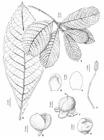
- a-h. Doliocarpus schottianus - a. habit; b. abaxial face of the leaf; c. stamen; d-e. Internal and external face of the sepal; f. fruit with sepals reflexed; g. fruit open; h. seed enclosed by the aril. (a. Photo (J.V.L. Monzoli); b-h. M.D.F. Araújo 145).
Selected material: Aldea da Pedra [Itaocara], fr., H.W. Schott 5916 (Type; BP, W). Itaocara, área conhecida como pantanal, próximo à Ilha Capixete, margem do Rio Paraíba do Sul, 21°38’20’’S, 42°01’15’’W, 29.V.2022, fr., M.D.F. Araújo et al. 145 (RB). Paraty, Área de Proteção Ambiental Cairuçu, Ponta negra, subindo o Rio da Barra desde a Praia da Ponta Negra, 8.VI.1994, fr., R. Reis 162 (RB).
Additional Material: BRAZIL. ESPÍRITO SANTO: Estrada de Nanuque, 23.II.1965, fl., A.P. Duarte 8871 (RB). Pinheiros, Reserva Biológica Córrego do Veado, estrada à esquerda da sede da REBIO, que vai para o Córrego da Água Limpa, 15.VIII.2010, fr., I.R. Oliveira et al. 52 (SAMES). Santa Leopoldina, Fazenda Caioaba, propriedade de Virloni, trilha da divisa, 20º03’33”S, 40º28’14”W, 9.VIII.2006, fr., L.F.S. Magnago et al. 1252 (MBML, RB). PARANÁ: Antonina, Cachoeira, 15.I.1976, fr., G. Hatschbach 37948 (MBM, NY, UPCB). Guaraqueçaba, 25º10’51”S, 48º23’08”W, 24.III.2014, fr., M.G. Caxambu et al. 5102 (HCF). Morretes, Colônia Floresta, 23.I.1969, fr., G. Hatschbach & C. Koczicki 20883 (MBM). Paranaguá, Parque Estadual do Palmito, 26.III.2003, fr., A.L.V. Vieira & A.C. Cervi 4 (HUCP, MBM, UPCB). SANTA CATARINA: Blumenau, Parque Natural Municipal São Francisco de Assis, trilha Caminho das Águas, 26º55’20”S, 49º04’45”W, 30.III.2014, fr., F. Bittencourt et al. 39 (FURB). Iatajaí, Morro da Fazenda, 17.II.1954, fl., R. Reitz & R.M. Klein 1547 (US). Joinville, Linha de transmissão elétrica, 26º11’15”S, 48º53’56”W, 30.VIII.2012, fr., M. Augusto-Silva 89 (MBM). Porto Belo, margem da BR-101, 27º08’58”S, 48º36’07”W, 5.II.2010, fr., J.L.Schimitt et al. 1343 (RB). São Francisco do Sul, Ilha Grande, 26º16’06”S, 48º42’30”W, 29.IV.2005, fr., F.C.S. Vieira 1078 (FURB). SÃO PAULO: Ilhabela, 1990, fl., V.C. Souza 9469 (ESA, RB). Itanhaém, Rio Preto, 12.III.2005, fr., R.J.F. Garcia, et al. 2455 (PMSP). Pariquera-Açu, propriedade de Antonio Povinski, 24°40’33’’S, 47°52’37’’W, 18.XII.1995, fl., N.M. Ivanauskas 637 (ESA, HRCB, UEC). Santos, 1.II.1875, fl., C.W.H. Mosén 3336 (P, S); 1.IV.1875, fr., C.W.H. Mosén 3336 (P, S).
Doliocarpus schottianus resembles Do. grandiflorus by the leaves chartaceous or subcoriaceous and branches striate, greyish when mature, but differs by the flowers pedicellate (versus flowers sessile), sepals reflexed to fruit (vs. sepals adpressed to fruit) and fruit externally pilosulose to villous (vs. fruit externally hispid).
Doliocarpus schottianus occurs in the states of Espírito Santo, Rio de Janeiro, São Paulo, Paraná and Santa Catarina. In Rio de Janeiro, the species is known only from its type locality, the municipality of Itaocara, in the northwestern portion of the state, on the banks of the Paraíba do Sul River, and in the southern portion of the state in Paraty, on the banks of the Barra River (Fig. 12).
The known distribution of D. schottianus extends to more than 20,000 km2. The species seems frequently associated with watercourses and acclimatized to disturbed areas, such as roadsides. Thus, it is here classified in the Least Concern (LC) category.
12. Doliocarpus sessiliflorus Mart., Flora 24 (2, Beibl.1841): 7. 1841. Figs. 11g-h; 18a-o
Liana or scandent shrub. Stem and branches cylindrical, when young tomentose or puberulent, fuscous or castaneous, when mature striate or scaly, glabrate, scaly plates greyish, hair simple, white. Leaves petiolate; petioles 0.4-1.7 × 0.1-0.16 cm, semiterete, margin entire, ciliate, adaxial surface pubescent or puberulent, abaxial surface tomentose or puberulent, light green; blade 4.4-12.3 × 1.8-5.7 cm, subcoriaceous, oblanceolate, rarely elliptic, base cuneate or attenuate, margin entire on the base and dentate on the apical 2/3, sometimes 1/2, apex acuminate or acute, adaxial surface sparsely tomentose, rarely glabrate, green, abaxial surface pubescent or tomentulose, light green, hair simple, white or ferruginous; venation brochidodromous on the basal 1/3 or 1/2, craspedodromous on the apical 2/3 or 1/2, midrib plain, tomentose to pubescent, rarely glabrate, on the adaxial surface, prominent and tomentose, rarely puberulent, on the abaxial surface, light green; secondary veins 6-11, plain and glabrate on the adaxial surface, prominent and tomentose, rarely tomentulose, on the abaxial surface, light green; tertiary veins mixed percurrent, plain, sometimes not apparent and glabrous on the adaxial surface, slightly prominent, sometimes plain, and puberulent on the abaxial surface, light green, domatia absent, hair simple, white or ferruginous. Inflorescence reduced, inserted on the axil of fallen (or not) leaves, 1-3 flowers. Flowers sessile; basal bracts, 2 or 3, 2.3-4.7 × 2.2-5 mm, subcoriaceous, suborbicular, persistent, glabrous or tomentulose on the adaxial surface, margin ciliate, sericeous on the abaxial surface, hair simple, white; sepals 6-7; 3.4-9.8 × 3.5-7.7 when blooming, 6.3-14.3 × 4.8-9.3 mm when fruiting, size subequal, coriaceous, 2 or 3 externals suborbicular or rotund and cucullate, inners oblong and cucullate, base truncate, margin ciliate, apex obtuse, externally sericeous, internally glabrous, and smooth, rarely tomentulose on the base, light green; hair simple, white; petals 5-6, rare 4, 8.5-12.1 × 5.3-10.6 mm, membranaceous, obovate to obdeltoid, base cuneate, margin crisped, apex obtuse, rarely emarginate, glabrous on both surfaces, rarely 1 externally sericeous on the center, early deciduous, white; stamens 115-215, arranged in a circle around the carpel, exserted, extrorse; filaments 5.9-7.8 × 0.06 mm, cylindrical, glabrous; anthers ca. 1.3 × 0.4 mm, oblong, glabrous, basifixed, connective reduced on the base, white; carpels 1, free, densely sericeous; ovaries 1.7-3 mm diam., globose; ovules 2, basal, 0.4-0.5 × 0.6 mm, obovoid; style 4.3-6.1 × 0.3-0.5 mm, sinuous to erect, glabrous, stigma capitate - foliaceous, white, hair simple, white, or ferruginous. Fruit 7.7-13.2 mm diam., berry, fleshy, globose, dehiscent, externally pannose-villous, sepals persistent, accrescent and adpressed to the fruit, when mature, externally red and light green, internally pinky-red, hair simple, white, ferruginous on herbarium material; seeds 1 or 2 per carpel, 7.4-9.9 × 8-9.2 mm, reniform, rugose, glabrous, covered by the aril up to the apex, black; aril papyraceous, entire, or rarely lacerate on the apex, white.
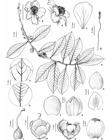
- a-o. Doliocarpus sessiliflorus - a. habit; b. detail of the base on the abaxial surface of the leaf; c. detail of the apex on the abaxial surface of the leaf; d-e. front and side view of a flower; f. petal; g. stamen; h, j. external surface of the sepals; i, k. internal surface of the sepals; l. ovary; m. fruit entire; n. open fruit; o. seed involved by aril. (a-l. J.V.L. Monzoli et al. 447; m-o. M.D.F. Araújo et al. 105).
Selected material: Praia Grande, 14.XII.1890, fl., A.F.M. Glaziou 18122 (P). Maricá, Itaipuaçu, 27.I.1935, fl., A.C. Brade 14148 (RB). Mangaratiba, Ilha da Marambaia, Praia da Armação, 29.V.1999, fr., L.F.T. Menezes et al. 369 (RBR). Rio de Janeiro, Área de Proteção Ambiental das Brisas, Guaratiba, 22°59’25’’S, 43°39’12’’W, 18.I.2022, fl., J.V.L. Monzoli et al. 447 (RB, SJRP); Ilha de Paquetá, 30.I.1946, fl., E. Pereira 469 (RB); Restinga da Tijuca, 1946, fl., O. Machado (RB 75674) (RB); Sebastianopolitanae [Rio de Janeiro]: Inter frutices, 1839, fl., C.F.P. Martius Hb. Fl. 417 (Type; BR, G, MO).
Doliocarpus sessiliflorus resembles Do. littoralis because the sepals are adpressed and accrescent on fruit, and trichomes are inclined on fruit. However, they can be separated by the sepals internally glabrous (versus sepals internally puberulent or tomentose), fruit externally pannose-villous (vs. fruit externally setulose). It is also similar to Do. grandiflorus by the leaves elliptic or oblanceolate, inflorescence sessile, and sepals externally sericeous, but can be differentiated by the size of the leaves reaching 21 cm long (vs. leaves maximum 12 cm long), sepals internally glabrous (vs. sepals internally sericeous on the centre) and fruit externally pannose-villous (vs. fruit externally hispid).
Doliocarpus sessiliflorus seems to have a distribution restricted to the coast of Rio de Janeiro, between the island of Marambaia and the region of Itaipuaçu on the municipality of Maricá, usually occurring in the forested area of coastal plain vegetation (restingas) (Fig. 12).
The species is encountered only in fragments of conserved vegetation surrounding the metropolitan area of the city of Rio de Janeiro. Some of these fragments may not exist in a few decades due to the city’s rapid growth. The species’ extent of occurrence is estimated at 1,349 km2, and the area of occupancy at 36 km2 (Fig. 5). Thus, the species is classified here as Endangered [EN B1ab(i,iii,iv)c(i,iii) + 2ab(ii,iii,iv)c(ii,iii)].
Tetracera L., Sp. Pl. 1: 533. 1753.Fig. 19a-h
Liana, sometimes scandent shrubs. Leaves petiolate. Andro-dioecious. Inflorescence thyrsoid, ramified, terminal or axillar. Flowers pedicellate; sepals 5-8, persistent, accrescent; petals white, early deciduous; carpels 1 to 5 free, pyriform, up to 6 ovules per carpel. Fruits crustaceous follicle, rostrate; 1 seed per follicle covered by a red, fimbriate, membranaceous aril (Kubitzki 1970).
The genus has a pantropical occurrence. In the Neotropics, it occurs from southern Mexico to southern Brazil (Horn 2007). In Rio de Janeiro, its occurrence is shown in Figure 20.
13. Tetracera breyniana Schltdl., Linnaea 8: 174. 1833.
= Tetracera breyniana var. plumbea Moric. exEichler, Fl. bras. 13(1): 89. 1863.
= Tetracera sellowiana Schltdl., Linnaea, 8: 175. 1833. syn. nov.Figs. 19a-b; 21a-m
Liana or decumbent shrub. Stem and branches cylindrical, when young, setose or glabrate, fuscous, when mature, striate, glabrous, scaly plates greyish, hair, simple and fasciculate, white. Leaves petiolate; petioles 0.3-1 × 0.07-0.2 cm, semiterete, margin entire, rarely lacerate, ciliate, adaxial surface pannose, rarely glabrate, green, abaxial surface sparsely tomentose, rarely glabrate, green; blade 2.7-9.3 × 1.9-5.5 cm, chartaceous to subcoriaceous, obelliptic or obovate, base cuneate or attenuate, margin serrate, apex rounded or obtuse rarely subacute, adaxial surface strigose, rarely glabrate, green, abaxial surface pubescent to glabrate, light green, hair, simple or fasciculate, white; venation craspedodromous, midrib slightly grooved, setulose to setose, rarely glabrate, on the adaxial surface, green, prominent and sparsely tomentose on the abaxial surface, green; hairs simple and fasciculate, white; secondary veins 4-8, slightly impressed, glabrous or glabrate on the adaxial surface, green, prominent and setose to glabrate on the abaxial surface; hairs simple or fasciculate, white; tertiary veins mixed percurrent, or rarely reticulate, not apparent, glabrous on adaxial surface, slightly prominent and sparsely hirsutulous to glabrate on abaxial surface, domatia visible on the axil between primary and secondary veins on abaxial surface, sometimes absent, hair simple and fasciculate, white. Inflorescence 2-12.5 cm long, thyrse, terminal or axillary, ramified, lateral ramifications 1-7, flowers 6-35, rachis sparsely setose, sometimes glabrate, covered with simple and fasciculate hair, green; paraclades hirsutulous, rarely glabrate, covered with fasciculate hairs, rarely simple, green, hairs white. Flowers pedicellate; basal bracts 0.9-2.2 × 0.6-2.8 mm, coriaceous, lanceolate, persistent, adaxial surface glabrate or pannose, covered with simple hair, green, margin ciliate, abaxial surface tomentose, covered with simple and fasciculate hairs, green, hairs white; pedicels 0.5-3.4 × 0.4-0.7 mm, same diameter from base to apex, hirsutulous or glabrate, covered with fasciculate hairs, green; hairs white; sepals 6, rarely 5, 3.2-6.6 × 2.4-5 mm when blooming, green, 2.5-7.9 × 1.9-5.2 mm when fruiting, green, size subequal, coriaceous, rotunds, base truncate, margin entire, ciliate, apex obtuse, externally setulose, sometimes glabrate, internally sericeous; hairs externally fasciculate, internally simple, white; petals 3, rarely 5, 3.2-6 × 1.4-3.6 mm, membranous, spatulate-obovate, base cuneate, margin entire, apex obtuse or truncate, 1 or 2 external petals externally setulose and internally sericeous on the center, the others glabrous on both surfaces, early deciduous, white, hairs externally fasciculate, internally simple, white; stamens 28-36, number on staminate flower not seen, arranged in a circle around the carpels, included; filaments 1.5-2.9 × 0.05-0.06 mm, cylindrical, expanded only near the apex, glabrous, cream; anthers 0.3-0.4 × 0.3-0.5 mm, elliptic, glabrous, basifixed, connective enlarged pushing the thecae away, cream; carpels 4-5, rarely 6, free, basal and ventrally tomentose, green; ovaries 1.9-2.6 × 1-1.2 mm, pyriform, green, hairs simple and fasciculate, white; ovules 4-6 per carpel, axi-basal, ca. 0.3 × 0.4 mm, ovoid; style 1.2-2.1 × 0.2-0.3 mm, erect, glabrous, stigma irregularly peltate with jagged margin, green. Fruits 8.4-12.9 × 3.9-5.7 mm, follicle, 1 seed per carpel, crustaceous, pyriform, opening ventrally by a longitudinal slit, basal and ventrally woolly to tomentose, rostrate, when fresh, green with vinaceous spots, when dry, castaneous; rostrum 0.9-1.6 mm, stinging; seeds 3.5-4.1 × 2.2-3.6 mm, rugose, glabrous, 2/3 covered by the aril, black; aril papyraceous, apex fimbriate, red.
Selected material: Carapebus, estrada para a praia de Carapebus, 1 km da casa de Jorge Inacio Barcelos, 26.VII.1995, fr., J.M.L. Silva et al. 11 (RB, UFF). Maricá, Barra de Maricá, 3.VI.1987, fr., A. Souza et al. 1683 (R). São João da Barra, Restinga, 23.I.1976, fl., A.L. Peixoto & O.L. Peixoto 823 (RB). Saquarema, estrada da reserva, 22°55’35’’S, 42°27’41’’W, 9.XII.2021, fl., M.D.F. Araújo et al. 40 (RB); Reserva Natural de Massambaba, interior da reserva, 22°55’38’’S, 42°27’25’’W, 22.III.2019, fr., J. Kulkamp et al. 771 (K, MBL, RB, SPF).
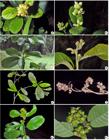
- a-b. Tetracera breyniana; c-d. T. empedoclea; e-f. T. lasiocarpa; g-h. T. oblongata. (a-b; e-h. Photos by J.V.L. Monzoli; c-d. Photos by D.F. Silva).
Additional Material: BRAZIL. ALAGOAS: Piaçabuçu, Várzea da Marituba, 10°24’26”S, 36°25’53”W, 21.VIII.2012, fr., C.B.L. Araújo et al. 39 (MAC). BAHIA: Jandaíra, Litoral Norte, Dunas de São Francisco do Conde, 11°33’00”S, 37°46’60”W, 20.VII.2013, fl., M.L. Guedes et al. 20998 (ALCB). CEARÁ: Paraipaba, Área de Proteção Ambiental das Dunas de Lagoinha, 30.X.2004, fr., D.V. Azevedo (EAC 34633) (EAC). ESPÍRITO SANTO: Atilio Vivacqua, Estrada Vicinal a 7 km da ponte do Rio Muqui do Norte, 21°00’00”S, 41°12’12”W, 10.II.2011, fl., D.P. Saraiva et al. 76 (RB). Linhares, Reserva Natural Vale, 14.IX.2005, fr., D.A. Folli 5097 (CVRD, RB). PARAÍBA: Pilões, Serra do Espinho, 06°53’47”S, 35°37’39”W, 7.III.2012, fl., M.L. Guedes et al. 19502 (ALCB). PARANÁ: Guaratuba, 9.XII.1971, fl., P.L. Krieger 11058 (RB). PERNAMBUCO: Igarassu, Usina São José, Mata do Pezinho, 07°47’45”S, 35°01’20”W, 9.V.2007, fr., A.A. Araújo et al. 249 (RB). RIO GRANDE DO NORTE: Natal, Ponta Negra, Morro do Careca, 19.VIII.1995, fr., G. Nogueira (EAC 23133). (EAC). SANTA CATARINA: Itapoá, Rodovia Guaratuba - Itapoá, 18.I.2002, fl., J.M. Silva & E. Barbosa 3502 (ALCB). SÃO PAULO: Caraguatatuba, a 3 km do Rio Casqueiro e a 23 km do Rio Escuro, 9.XII.1961, fl., J. Fontella 117 (US). Cubatão, Ilha de Cananéia, 15.IV.1987, fr., O.J. Pereira & D.S.D. Araújo 884 (VIES). SERGIPE: Pirambu, Reserva Biológica de Santa Isabel, Fazenda Traíras, 10°41’58”S, 36°49’46”W, 15.VI.2012, fr., E.S. Ferreira & E.V.S. Oliveira 19 (ASE).
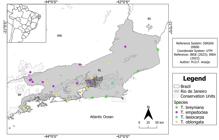
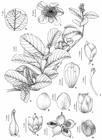
- a-m. Tetracera breyniana - a. habit; b. detail of the apex on the abaxial surface of the leaf; c. staminate flower; d. perfect flower; e. petal; f. stamen; g-h. sepal; i. ovaries; j. ventral view of a single ovary; k. fruits closed; l. fruits open; m. seed involved by aril. (a-b, d-k. M.D.F. Araújo et al. 40; c. R. Marquete et al. 3291; l-m. H.C. Lima & G.P. Lewis 2834).
Tetracera breyniana resembles T. oblongata by the leaves harsh with margin dentate and the presence of domatia. Both have an inflorescence reaching over 12 cm long, paraclades hirsutulous and more than one carpel. They differ by leaves obelliptic or obovate (versus leaves elliptic or oblong), sepals 6, externally setulose or glabrate and internally sericeous (vs. sepals 5, externally glabrous and internally glabrous), stamens 28-36 (vs. 65-81), carpels 4 or 5, basal and ventrally tomentose (vs. 3 or 4, entirely glabrous). The synonymy of T. sellowiana in T. breyniana adopted here was only possible after locating and examining the type material of T. breyniana, with the help of the Oxford herbarium curatorship and comparing many materials available in herbarium RB of the two species. The observed differences are only variations in the density of trichomes. For Dilleniaceae and Tetracera, this difference is not enough to keep them as distinct species.
Tetracera breyniana occurs along the coast of the states of Ceará, Rio Grande do Norte, Paraíba, Pernambuco, Alagoas, Sergipe and Bahia, in the northeastern, Espírito Santo, Rio de Janeiro and São Paulo, in the southeastern, and Paraná and Santa Catarina, in the southernmost portion of its range of distribution, mainly in areas of shrub by sandbanks on coastal plain vegetation. In Rio de Janeiro the species is recorded from the northernmost coast of the state, in the municipality of São João da Barra, to the south, in the municipality of Saquarema (Fig. 20).
Considering that the species has a wide distribution, with an occurrence range of more than 20,000 km2, and occurs in regenerating areas, it is classified here in the Least Concern (LC) category.
14. Tetracera empedocleaGilg, Nat. Pflanzenfam. 3(6): 111, f. 53H, f. 55C, f. 56G. 1893.
≡ Empedoclea alnifolia A.St.-Hil., Fl. Bras. Merid. (quarto ed.) 1(1): 19, pl. 3. 1825 [1824].
= Tetracera forzzae Fraga & Aymard, Novon, 17: 433-436. 2007. syn. nov.Figs. 19c-d; 22a-p
Liana. Stem and branches cylindrical, when young, tomentose to manicate or rarely glabrate, fuscous, when mature, peeling, outer scales strigose or glabrate, fuscous, inner scales glabrous, castaneous rarely fuscous, hair simple and fasciculate, white. Leaves petiolate; petioles 0.7-3 × 0.1-0.2 cm, canaliculate, margin entire, sometimes lacerate, ciliate, adaxial surface pannose to sericeous, green, abaxial surface tomentose to pilose, green; blade 3.5-14.2 × 2-7.8 cm, membranaceous to chartaceous, elliptic to obovate, base cuneate to attenuate, margin serrate, apex rounded or obtuse, sometimes apiculate, adaxial surface strigose or setulose, green, abaxial surface stellate, light green, hair, simple and fasciculate, white; venation craspedodromous, midrib slightly grooved, setulose to setose on the adaxial surface, green, prominent and tomentose on the abaxial surface, green, hairs simple and fasciculate, white; secondary veins 6-17, impressed, strigose or glabrate on the adaxial surface, green, prominent and tomentose on the abaxial surface, hairs simple and fasciculate, white; tertiary veins mixed percurrent, not apparent, glabrous on adaxial surface, slightly prominent and sparsely stellate on abaxial surface, domatia visible on the axil between primary and secondary veins on abaxial surface, sometimes absent, hair fasciculate, white. Inflorescence 1.5-30 cm long, thyrse, terminal or axillary, ramified, lateral ramifications 1-17, flowers 5-150, rachis tomentose to lanate, covered with simple and fasciculate hair, green; paraclades densely tomentose to lanuginous, covered with simple, sometimes also fasciculate hairs, green, hairs white. Flowers pedicellate rarely subsessile; basal bracts 1.9-4.4 × 0.7-2.8 mm, coriaceous, lanceolate, persistent, adaxial surface pannose to sericeous on the center, covered with simple hair, green, margin ciliate, abaxial surface tomentose, covered with simple hairs, green, hairs white; pedicels 1.2-3 × 0.6-0.8 mm, same diameter from base to apex, pilose, covered with simple hairs, green, hairs white; sepals 7, 3 minors, outermost 2.9-4.4 × 1.7-3.6 mm, green, coriaceous, orbicular to rotund, 4 larger, innermost, 4.5-6.8 × 2-3.8 mm, green, coriaceous, rotund to oblong, base cuneate-truncate, margin entire, ciliate, apex obtuse, externally pannose, internally sericeous, hairs externally simple and fasciculate, internally simple, white; petals 3 or 4, 4.2-7.1 × 2-3.9 mm, membranous, oblong-spatulate, base cuneate-truncate, margin entire, apex obtuse, glabrous on both surfaces, sometimes 1 or 2 petals externally and internally sericeous on the center, early deciduous, white, hairs simple, white; stamens 34-53 on perfect flowers, 135-167 on staminate flowers, arranged in a circle around the carpels, included; filaments 1.8-3 × 0.05-0.08 mm, cylindrical, expanded only near the apex, glabrous, cream; anthers 0.3 × 0.3-0.4 mm, elliptic, glabrous, basifixed, connective inconspicuous, cream; carpels 1, free, green; ovaries 1.6-2.4 × 0.5-2 mm, pyriform, basally villous, green, hairs simple, white; ovules, 5-6, rarely 7, per carpel, axi-basal, 0.7-0.8 × 0.7-1.2 mm, ovoid, white; style 3.2 × 0.3-0,5 mm, erect, glabrous, stigma irregularly peltate with jagged margin, green. Fruits 8.8-10.4 × 3.7-4.5 mm, follicle, 1 seed per carpel, crustaceous, pyriform, opening ventrally, basally minutely villous, rostrate, when fresh, green, when dry, castaneous; rostrum 0.9-3.4 mm, stinging; seeds 3.3-4.3 × 2.7-3.7 mm, rugose, glabrous, 2/3 to completely covered by the aril, black; aril papyraceous, apex fimbriate, red.
Selected material: Barra Mansa, Fragmento 50 (TAV) 22°31’34’’S, 44°13’23”W, 26.II.2013, fl., V.C. Souza et al. 35571 (ESA, RB). Cambuci, estrada para serra verde, 21°32’22’’S, 41°55’56’’W, 12.III.2013, fl., M. Nadruz et al. 2777 (MBML, RB). Comendador Levy Gasparian, Fazenda Amazonas, mata Boa Vista, fr., V.L.A. Garcia 63 (R). Duque de Caxias, Reserva da Petrobras, trilha em direção ao morro que é circundado pelo lago, 22°33’00’’S, 43°16’00’’W, 4.V.1999, fr., C.H.R. de Paula et al. 166 (RB). Guapimirim, Fazenda do Portinho, 22°32’21’’S, 42°53’59’’W, 26.II.2000, fl., F.M.B. Pereira et al. 98 (RFA). Itatiaia, Caminho para o Parque Nacional do Itatiaia, 22°28’24’’S, 44°34’49’’W, 19.I.2022, fl., M.D.F. Araújo et al. 75 (RB); Parque Estadual da Pedra Selada, Fazenda Campo Belo, 22°27’24’’S, 44°32’40’’W, 5.II.2015, fl., L.J.T. Cardoso et al. 1255 (RB). Piraí, estrada antiga Rio-São Paulo, km 89. 89001 Sítio Monteiro, 20.VII.2011, fr., J. Monteiro 142 (NIT, RB).
Additional Material: BRAZIL. MINAS GERAIS: Belmiro Braga, 4 km de Fortaleza na estrada para Belmiro Braga, 21°55’33’’S, 43°27’00’’W, 8.III.2004, fl., R.C. Forzza et al. 2985 (NY, RB). Descoberto, Reserva Biológica da Represa do Grama, 2.III.2002, fl., R.C. Forzza et al. 2077 (CESJ, RB). Diamantina, Parque Estadual do Rio Preto, estrada do rodrigues para Serraria, 18°7’36’’S, 43°22’45’’W, 21.III.2016, fl., G. Martinelli et al. 19202 (RB). SÃO PAULO: Queluz, Fragmento 44 (TAV), 22°31’29’’S, 44°42’45’’W, 25.II.2013, fl., V.C. Souza et al. 35572 (ESA, RB).
Tetracera empedoclea resembles T. lasiocarpa in vegetative characters and differs mainly by their carpels, one and tomentose only on the base (versus 4 to 6 sericeous carpels). When we observe individuals with only staminate flowers, it can be hard to separate both; hence, in this work, we used the character of the stamen to separate the species by the anther close together, connective inconspicuous (vs. anther separated, connective conspicuous). Further studies to separate these species are needed, especially when it comes to individuals with staminate flowers.
Tetracera empedoclea was described by Auguste de St.-Hilaire, based on his own collection during his time in Brazil. He writes that the new species has fruits with trichomes restricted to the dorsal part of the ovary. This name has been applied to specimens with only one completely tomentose ovary. After identifying the difference between the description of Saint-Hilaire and the current use of the name, a request was made to P for a high-resolution picture of the ovary on the typus deposited there. The image clearly showed that Saint-Hilaire’s name was being misapplied, and T. forzzae was published describing the same species as T. empedoclea.
In our understanding, this species occurs in Ombrophilous and Lowland Forest areas in Minas Gerais, Rio de Janeiro and São Paulo. In Rio de Janeiro, it is more common in forests near the formations of Itatiaia and Serra dos Órgãos Parks, although it does not occur in the latter (Fig. 20).
The species distribution is estimated at more than 20,000 km2 in extent of occurrence. Considering that the species occurs in well-preserved areas, such as the National Park of Itatiaia, it is here classified in the Least Concern (LC) category.
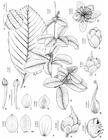
- a-p. Tetracera empedoclea - a. habit; b. abaxial face of a leaf; c. detail of the leaf on the abaxial surface; d. staminate flower; e-f. perfect flower; g. ovary, ventral view; h. stamen, ventral view; i. stamen dorsal view; j-m. sepals; n. petal; o. fruit; p. seed involved by aril. (a. Photo by D.S. Ferreira; b, d-n. M.D.F. Araújo et al. 89; d. R.C. Forzza et al. 2077; o-p. C.H.R. de Paula et al. 166).
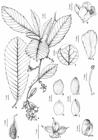
- a-m. Tetracera lasiocarpa - a. habit; b. abaxial face of a leaf; c. detail of the apex on the abaxial surface; d. perfect flower; e. petal; f. stamen; g-j. sepal; k. ovary, side view; l. fruit open; m. seed involved by aril. (a-c, l-m. M.D.F. Araújo et al 58; d-k. J.M.A. Braga et al. 1881).
15. Tetracera lasiocarpaEichler, Fl. bras. 13(1): 84, pl. 21. 1863. Figs. 19e-f; 23a-m
Liana. Stem and branches cylindrical, when young, pilose or strigillose sometimes floccose, fuscous, when mature, peeling, glabrous, scaly plates castaneous, hair simple and fasciculate, white. Leaves petiolate; petioles 0.7-1.8 × 0.1-0.2 cm, canaliculate, margin entire, ciliate, adaxial surface pannose, green, abaxial surface pilose or tomentose, green; blade 3.9-12.8 × 2-5.5 cm, chartaceous, obelliptic, oblanceolate or spatulate, base cuneate or attenuate, margin serrate, apex subacute or obtuse, adaxial surface hispidulous, green, abaxial surface pubescent, green, hair simple or fasciculate, white; venation craspedodromous, midrib slightly grooved, hispidulous, on the adaxial surface, green, prominent and pilose on the abaxial surface, green, hairs simple and fasciculate, white; secondary veins 5-15, slightly impressed, hispidulous on the adaxial surface, green, prominent and pilose on the abaxial surface, hairs simple or fasciculate, white; tertiary veins percurrents, not apparent, hispidulous on adaxial surface, slightly prominent and pilosulose on abaxial surface, domatia visible on the axil between primary and secondary veins on abaxial surface, hair fasciculate, white. Inflorescence 3-8.5 cm long, thyrse, terminal or axillary, ramified, lateral ramifications 1-7, flowers 10-40, rachis villous, covered with simple and fasciculate hair, green; paraclades pannose to lanulose, covered with simple and fasciculate hairs, green, hairs white. Flowers pedicellate; basal bracts 1.5-2 × 0.8-1 mm, coriaceous, lanceolate, persistent, adaxial surface sericeous to glabrate, covered with simple hair, green, margin ciliate, abaxial surface tomentose, covered with simple and fasciculate hairs, green, hairs white; pedicels 0.8-2.7 × 0.5-0.8 mm, same diameter from base to apex, woolly, covered with fasciculate hairs, green, hairs white; sepals 6-8, 2.2-4.9 × 2.5-3.8 mm when blooming, green, 3.2-6.7 × 2.3-4.3 mm when fruiting, green, 3 or 4 externals smaller, orbicular, 3 or 4 inners longer, rotund or oblong, coriaceous, base truncate, margin entire, ciliate, apex obtuse, externally pannose or sericeous, internally sericeous, hairs externally simple and fasciculate, internally simple, white; petals 4, 3.7-5.3 × 1.8-3 mm, membranous, spatulate-obovate, base cuneate, margin entire, apex obtuse, glabrous on both surfaces, early deciduous, white; stamens 30-36, number in staminate flower not seen, arranged in a circle around the carpels, included; filaments 2.1-2.8 × 0.05-0.08 mm, cylindrical, expanded only near the apex, glabrous, color not seen; anthers 0.3-0.4 × 0.3-0.5 mm, elliptic, glabrous, basifixed, connective enlarged pushing the thecae away, color not seen; carpels 4-6, free, green; ovaries 1.3-2.8 × 0.6-1.2 mm, pyriform, sericeous, green, hairs simple, white; ovules 4 per carpel, axi-basal, ca. 0.3 × 0.5 mm, ovoid; style 1.6-1.9 × 0.1-0.3 mm, erect, glabrous, stigma irregularly peltate with jagged margin, color not seen. Fruits 8.7-11 × 3.6-3.1 mm, follicle, 1 seed per carpel, crustaceous, pyriform, opening ventrally by a longitudinal slit, tomentose, rostrate, castaneous; rostrum 1.3-2.7 mm, stinging; seeds ca. 3.8 × 2 mm, rugose, glabrous, 2/3 covered by the aril, black; aril papyraceous, apex fimbriate, red.
Selected material: Silva Jardim, Reserva Biológica de Poço das Antas, Juturnaíba, entre a estrada de ferro e a Represa de Juturnaíba, 2.II.1995, fl., J.M.A. Braga & S.J. da Silva Neto 1881 (RB, SP); Trilha Principal 1, depois da segunda entrada da trilha da Casa dos Morcegos, 22°33’46’’S, 42°17’37’’W, 11.XII.2021, fr., M.D.F. Araújo et al. 58 (RB).
Additional Material: BRAZIL. BAHIA: Serra do Sincorá, 3-13 km W of Barra da Estiva on the road to Jussiape, 13°40’00’’S, 41°25’00’’W, 23.III.1980, fr., R.M. Harley et al. 20828 (SPF). ESPÍRITO SANTO: Rio Doce, IV.1816, fl., M. Wied-Neuwied (BR 659334) (Type; BR). Cachoeiro de Itapemirim, Burarama, Barra Alegre, 20°50’56’’S, 41°06’45’’W, 16.III.2008, fl., G.R. de Souza 27 (VIES). Conceição da Barra, Área de Proteção Ambiental Conceição da Barra, ponto de amostragem 2, 18°40’40”S, 39°44’54”W, 12.III.2020, fl., A.D. Firmino & R.T. Valadares 1641 (VIES). Pinheiros, Reserva Biológica Córrego do Veado, trilha percorrendo o Córrego do Veado, 18°37’03’’S, 40°21’33”W, 23.VII.2013, fr., R. Coelho & L.A. Valfré 346 (VIES). MINAS GERAIS: Lagoa Santa, 1870, fl., E. Warming (NY 972422) (NY, W).
Tetracera lasiocarpa resembles T. empedoclea by their leaves texture, adaxially harsh and abaxially soft, sepals sericeous internally and externally, but can be separated by the number of carpels 4 to 6 and entirely tomentose (versus 1, tomentose on the base), and the anthers separated, connective conspicuous (vs. anthers approximated, connective inconspicuous).
Tetracera lasiocarpa occurs in the states of Bahia, Espírito Santo, Minas Gerais and Rio de Janeiro. In Rio de Janeiro, it has been only registered in the municipality of Silva Jardim, in Poço das Antas Biological Reserve (Fig. 20).
The estimated extent of occurrence of the species is over 20,000 km2. Thus, it is here classified in the Least Concern (LC) category.
16. Tetracera oblongata DC., Syst. Nat., 1: 399. 1818.
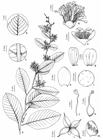
- a-m. Tetracera oblongata - a. habit; b. detail of the apex of a leaf on the abaxial surface; c. detail of the domatia; d. perfect flower, without the sepals; e. staminate flower, without the front sepals; f-g. petal; h. sepal; i. detail of the external surface of the sepal; j. stamen; k. ovary, side view; l. fruit; m. seed involved by aril. {a-c, k-l. M.D.F. Araújo & J.V.L. Monzoli 132; d-j. M.A.B.M. Monte (RB73088); m. D. Sucre 3505}.
= Davilla radula Mart. Flora 21(2, Beibl. 4): 64. 1838. = Tetracera radula (Mart.) Eichler. Fl. bras. 13(1): 91. 1863.
= Tetracera gardneriEichler. Fl. bras. 13(1): 91. 1863.
= Tetracera carpinifoliaEichler. Fl. bras. 13(1): 92. 1863. Figs. 19g-h; 24a-m
Liana. Stem and branches cylindrical, when young, setose, fuscous, when mature, striate, glabrous, scaly plates brownish, hair simple, white. Leaves petiolate; petioles 0.6-2.5 × 0.07-0.16 cm, canaliculate, margin entire, sometimes lacerate, ciliate, abaxial surface setose, green, adaxial surface glabrous, green; blade 2.1-11.2 × 2-5.2 cm, chartaceous, elliptic or oblong, base cuneate to rounded, margin serrate, apex acute or rounded, adaxial surface setose, green, abaxial surface sparsely setose, light green, hair simple, white; venation craspedodromous, midrib slightly grooved, glabrate to sparsely setose on the adaxial surface, green, prominent and setose on the abaxial surface, green, hairs simple, white; secondary veins 8-14, slightly impressed, glabrous on the adaxial surface, green, prominent and glabrate to setose on the abaxial surface, hairs simple, white; tertiary veins opposite convex percurrents, not apparent, glabrous on adaxial surface, slightly prominent and glabrous on abaxial surface, domatia visible on the axil between primary and secondary veins on abaxial surface, green, hair simple and fasciculate, white. Inflorescence 1.8-13 cm long, thyrse, terminal or axillary, ramified, lateral ramifications 3-8, flowers 10-40, rachis setose, covered with simple hair, green; paraclades hirsutulous or rarely setose, covered with fasciculate hairs, rarely simple, green, both trichomes white. Flowers pedicellate; basal bracts 1.2-2.8 × 0.6-1.3 mm, coriaceous, triangle shaped, persistent, adaxial surface setose to glabrate, covered with simple hair, green, abaxial surface setose, covered with simple and fasciculate hairs, green, hairs white; pedicels 1-2.3 × 0.4-0.6 mm, same diameter from base to apex, hirsutulous to setose, covered with fasciculate hairs, green, hairs white; sepals 5, 2.2-3.9 × 1.4-2.6 mm when blooming, green, 3-5.1 × 2.2-3.6 mm when fruiting green, size subequal, coriaceous, rotunds, base truncate, margin entire not ciliate, apex obtuse, externally glabrous and rugose, internally glabrous, or rarely glabrate, and smooth, green, rare hairs fasciculate, white; petals 4, 4.4-5 × 1.5-3.2 mm, membranous, spatulate-obovate, base acute, margin entire, apex obtuse, glabrous on both surfaces, early deciduous, color not seen; stamens 65-81, number in staminate flower not seen, arranged in a circle surround the carpels, inserted; filaments 1.7-2.2 × 0.05-1 mm, cylindrical, expanded only near the apex, glabrous, white; anthers 0.2-0.3 × 0.3-0.4 mm, elliptic, glabrous, basifixed, connective enlarged pushing the thecae away, white; carpels 3 or 4, rarely 5, free, green; ovaries ca. 1.7 × 0.8 mm, pyriform, glabrous, green; ovules 3 per carpel, axi-basal, ca. 0.5 × 0.4 mm, reniform, green; style ca. 0.7 × 0.4 mm, erect, glabrous, stigma irregularly peltate with jagged margin, green. Fruits 4.7-9.7 × 3.7-5 mm, follicle, 1 seed per carpel, crustaceous, pyriform, opening ventrally from the apex to the base by a longitudinal slit, glabrous, rostrate, green or castaneous; rostrum 1.1-2.2 mm, stinging; seeds 3.2-4.4 × 2.8-4.1 mm, rugose, glabrous, 2/3 covered by the aril, black; aril papyraceous, apex fimbriate, red.
Selected material: Cantagalo, Fazenda da Batalha, propriedade de José Regino, 21°59’27”S, 42°23’15”W, 18.IV.2010, fr., C.N. Fraga & L.S.R. Freire 2871 (RB). Duque de Caxias, Camboaba, 17.V.1938, fr., A. Passrelli & B. Lutz 70 (R). Itaguaí, à margem da estrada de Itaguaí a Itacurussá, 21.II.1950, fl., H. Monteiro 2857 (RBR). Magé, Vale das Pedrinhas, 8.IX.1975, fr., P. Ochioni 7726 (RFA). Paraty, Paraty-mirim, Ilha da Cotia, 8.I.1989, fl., G. Martinelli et al. 13299 (RB). Rio de Janeiro, Restinga de Grumari, 23°02’41’’S, 43°32’16’’W, 22.V.2022, fr., M.D.F.Araújo & J.V.L. Monzoli 132 (RB). Rio de Janeiro, restinga de Grumari, 14.VIII.1968, fr., D. Sucre 3505 (RB). Saquarema, Massambaba, 18.II.1869, fl., R 34381 (R). Teresópolis, Serra dos Orgãos, 21-31.III.1883, fl., R 78442 (R). Volta Redonda, Floresta da Cicuta, 22°32’51’’S, 44°05’14’’W, 16.II.2014, fl., G.R. Souza 1612 (RB, VOLRE).
Additional Material: BRASIL. MINAS GERAIS: Marliéria, Parque Estadual do Rio Doce, estrada para o restaurante, 20.I.1998, fl., M.G. Bovini 1278 (RB). PARANÁ: Céu Azul, Parque Nacional do Iguaçu, trilha Manoel Gomes, 25°09’16”S, 53°50’30”W, 2.III.2017, fl., M.G. Caxambú et al. 7753 (HCF, IBGE). SANTA CATARINA: Florianópolis, Pântano do Sul, 4.IV.2015, fr., C. Mondin 3694 (LUSC). SÃO PAULO: Angatuba, Estação Ecológica de Angatuba, 22.IV.1987, fr., R.B. Torres 175 (CEN).
Tetracera oblongata resembles T. breyniana by the leaves harsh with margin dentate and the presence of domatia. Both have an inflorescence reaching over 12 cm long, paraclades hirsutulous and more than one carpel. They differ by leaves elliptic or oblong (versus obelliptic or obovate), sepals 5, externally and internally glabrous (vs. sepals 6, externally setulose or glabrate and internally sericeous), stamens 65 -81 (vs. 28 -36), carpels 3 or 4, entirely glabrous (vs. 4 or 5, basal and ventrally tomentose).
Tetracera oblongata occurs in the states of Minas Gerais, Rio de Janeiro, São Paulo, Paraná and Santa Catarina. In Rio de Janeiro, the species is found along the coast, in the municipalities of Saquarema, Grumari and Paraty, and also in forested areas in Duque de Caxias and Cantagalo (Fig. 20).
The distribution of the species is estimated at more than 20,000 km2. It has a wide distribution, occurring both in forested and anthropized areas, as well as in shrub sandbanks. Thus, it is here classified in the Least Concern (LC) category.
Acknowledgements
We thank the curators and employees of the visited herbaria and the curators and employees of the international herbaria, for their help and for providing access to and details of the materials of Dilleniaceae. We also thank João Victor L. Monzoli, Lara S. J. Deccache, Pablo Feliz and Gabriel S. Guimarães, for their support on field works and the first in this group work to improve the knowledge of the Neotropical Dilleniaceae. Thanks to Carla P. Bruniera, for her comments on an early version of this manuscript. This work is part of the Master’s thesis of MDFA and financed by Fundação Carlos Chagas Filho de Amparo à Pesquisa do Estado do Rio de Janeiro - FAPERJ (process number 200.380/2021). CNF’s biodiversity research is supported by grants from Fundação Carlos Chagas Filho de Amparo à Pesquisa do Estado do Rio de Janeiro - FAPERJ (JCNE Fellowship, Jovem Cientista do Nosso Estado Program, grant number 201280/2022) and CNPq (Edital Universal, grant number 422191/2021-3).
Data availability statement
In accordance with Open Science communication practices, the authors inform that there is no data sharing of this manuscript
References
- 1 Aymard G (1992) Dilleniaceae Novae Neotropicae. I. Dos nuevas especies y una nueva subespecie de Doliocarpus de La Guyana Venezoelana. Anales del Jardín Botánico de Madrid 49: 195-200.
- 2 Aymard G (1993) Dilleniaceae Novae Neotropicarum. II. Tres nuevas especies y dos nuevas subspecies del género Doliocarpus (Dilleniaceae). Novon 3: 317-320.
- 3 Aymard G (1996) Dilleniaceae Novae Neotropicae: VI. A new species of Tetracera from Panama. Novon 6: 325-327.
- 4 Aymard G (1997a) Dilleniaceae Novae Neotropicae IX. Neodillenia a new genus from Amazon basin. Harvard Papers in Botany 10: 121-131.
- 5 Aymard G (1997b) Dilleniaceae Novae Neotropicae, V. El gênero Doliocarpus en Colômbia. Anales del Jardín Botánico de Madrid 55: 17-30.
- 6 Aymard G (1998a) Dilleniaceae novae neotropicae VIII. Two new species of Davilla from Brazil. Brittonia 50: 51-55.
- 7 Aymard G (1998b) Four new species of Dolicarpus (Dilleniaceae) from Brazilian Amazonian region. Kew Bulletin 53: 713-721.
- 8 Aymard G (2002a) Davilla papyracea (Dilleniaceae), a new species from Brazil. Kew Bulletin 57: 487-490.
- 9 Aymard G (2002b) A new species of Davilla (Dilleniaceae) amongst the flora of São Paulo, Brazil. Acta Botánica Venezuelica 25: 153-159.
- 10 Aymard G (2003) A new species of Doliocarpus and a new species of Tetracera (Dilleniaceae) from Brazil. Novon 13: 1-4.
- 11 Aymard G (2007a) Three new species of Davilla (Dilleniaceae) from Brazil. Novon 17: 282-287.
- 12 Aymard G (2007b) Two new species of Doliocarpus (Dilleniaceae) from Colombia. Novon 17: 288-293.
- 13 Aymard GA & Miller J (1994) Dilleniaceae Novae Neotropicae. III. Sinopsis y adiciones a las Dilleniaceae del Perú. Candollea 49: 169-182.
- 14 Bachman S, Moat J, Hill AW, la Torre J & Scott B (2011) Supporting Red List threat assessments with GeoCAT: geospatial conservation assessment tool. ZooKeys 150: 117-126.
- 15 Beentje H (2012) Plant Glossary: an illustrated dictionary of plant terms. Revised ed. Kew Publishing, Royal Botanic Gardens, Kew. 164p.
- 16 Benoist R (1911) Doliocarpus lasiogyne. Notulae Systematicae 2: 337.
- 17 Brasil (2022) Portaria MMA Nº148, de 7 de Junho de 2022. Altera os Anexos da Portaria nº 443, de 17 de dezembro de 2014, da Portaria nº 444, de 17 de dezembro de 2014, e da Portaria nº 445, de 17 de dezembro de 2014, referentes à atualização da Lista Nacional de Espécies Ameaçadas de Extinção. Ed. 108, 8 jun. 2022, seção 1. Diário Oficial da União, Brasilia. 74p.
- 18 Casaretto G (1842) Novarum stirpium brasiliensium decades. Typis Joannis Ferrandi, Genuae. 96p.
- 19 De Candolle AP (1817) Regni Vegetabilis Systema Naturale, sive Ordines, Genera et Species Plantarum Secundum Methodi Naturalis Normas Digestarum et Descriptarum. Vol. 1. Treuttel & Würtz, Paris. Pp. 395-438.
-
20 Dilleniaceae in Flora e Funga do Brasil (continuously updated) Jardim Botânico do Rio de Janeiro. Available at https://floradobrasil.jbrj.gov.br/FB103 Access on 16 January 2023.
» https://floradobrasil.jbrj.gov.br/FB103 -
21 Doliocarpus in Flora e Funga do Brasil (continuously updated) Jardim Botânico do Rio de Janeiro. Available at https://floradobrasil.jbrj.gov.br/FB7356 . Access on 16 January 2023.
» https://floradobrasil.jbrj.gov.br/FB7356 - 22 Eichler AW (1863) Dilleniaceae. In: Martius CFP & Eichler AW (eds.) Flora brasiliensis. Frid. Fleischer, Leipzig. Vol. 13, pars 1, pp. 65-120.
- 23 Eichler AW (1870) Symbolae ad floram Brasilia centralis congnoscendam. Videnskabelige Meddelelser fra Dansk Naturhistorisk Forening i Kjøbenhavn 7: 175-210.
- 24 Ellis B, Daly DC, Hickey LJ, Johnson KR, Mitchell JD, Wilf P & Wing SL (2009) Manual of leaf architecture. Cornell University Press, New York. 190p.
- 25 Fidalgo O & Bononi VLR (1984) Técnicas de coleta, preservação e herborização de material botânico. Instituto de Botânica, São Paulo. 61p.
-
26 Fraga CN (2020) Davilla in Flora e Funga do Brasil. Jardim Botânico do Rio de Janeiro. Available at https://floradobrasil.jbrj.gov.br/FB7338 . Access on 16 January 2023.
» https://floradobrasil.jbrj.gov.br/FB7338 - 27 Fraga CN (2008) Three new species of Davilla (Dilleniaceae) from Bahia, Brazil. Brittonia 60: 355-361.
- 28 Fraga CN (2012) Filogenia e revisão taxonômica de Davilla VAND. (Dilleniaceae). Tese de Doutorado. Universidade Federal de Minas Gerais, Belo Horizonte. 425p.
- 29 Fraga CN, Judice DM & Penedo TSA (2013) Dilleniaceae. In: Martinelli G & Moraes MA (eds.) Livro vermelho da flora do Brasil. Instituto de Pesquisas Jardim Botânico do Rio de Janeiro & Andrea Jakobsson Estúdio, Rio de Janeiro. Pp. 479-480.
- 30 Fraga CN, Aymard G & Stehmann JR (2017) Davilla hirsuticarpa (Dilleniaceae), a new species from the atlantic forest of Brazil. Plant Ecology and Evolution 150: 367-373.
-
31 Fraga CN & Aymard GAC (2007) Tetracera forzzae (Dilleniaceae), uma nova espécie para a Zona da Mata de Minas Gerais, Brasil. Novon 17: 433-436. DOI: 10.3417/1055-3177(2007)17[433:TFDUNE]2.0.CO;2.
» https://doi.org/10.3417/1055-3177 - 32 Fraga CN & Stehmann JR (2010) Novidades taxonômicas para Dilleniaceae brasileiras. Rodriguésia 61: S01-S06.
- 33 Fraga CN & Stehmann JR (2018) Wrongly identified material of Davilla macrocarpa (Dilleniaceae) represents two new species from Brazil. Plant Ecology and Evolution 151: 423-433.
- 34 Gilg E (1893) Dilleniaceae. In: Engler A & Prantl K (eds.) Die Natürlichen Pflanzenfamilien, Leipzig. Pp. 100-128.
- 35 Glaziou AFM (1908) Dilléniacées. In: Plantae Brasiliae centralis a Glaziou lectae. Liste des plantes du Bresil Central recueillies en 1861-1895. Mémoires de la Société Botanique de France 3: 8-9.
- 36 Harris JG & Harris MW (2000) Plant identification terminology: an ilustrated glossary. 2nd ed. Spring Lake Publishing, Spring Lake. 216p.
-
37 Hassler M (2022) Synonymic checklists of the vascular plants of the World (version 14.3, Nov 2022). In: Bánki O, Roskov Y, Döring M, Ower G, Vandepitte L, Hobern D, Remsen D, Schalk P, DeWalt RE, Keping M, Miller J, Orrell T, Aalbu R, Adlard R, Adriaenssens EM, Aedo C, Aescht E, Akkari N, Alexander S et al. (eds.) Catalogue of Life Checklist (version 2023-01-12). Available at https://doi.org/10.48580/dfqt-3dd . Access in January 2023.
» https://doi.org/10.48580/dfqt-3dd - 38 Horn JW (2007) Dilleniaceae. In: Kubitzki K (ed.) The families and genera of vascular plants. Vol. 9. Flowering plants Eudicots: Berberidopsidales et al. Springer, Berlin. Pp. 132-154.
-
39 Horn JW (2009) Phylogenetics of Dilleniaceae using sequence data from four plastid loci (rbcL, infA, rps4, rpl16 INTRON). International Journal of Plant Sciences 170: 794-813. DOI: 10.1086/599239
» https://doi.org/10.1086/599239 -
40 IUCN (2012) IUCN red list categories and criteria version 3.1. Ed. 2. IUCN, Gland and Cambridge. Available at http://www. iucnredlist.org/documents/RedListGuidelines.pdf Access in January 2023.
» http://www. iucnredlist.org/documents/RedListGuidelines.pdf - 41 Kubitzki K (1970) Die Gattung Tetracera (Dilleniaceae). Mitteilungen der Botanischen Staatssammlung München 8: 1-98.
- 42 Kubitzki K (1971) Doliocarpus, Davilla und Verwandte Gattungen (Dilleniaceae). Mitteilungen der Botanischen Staatssammlung München 9: 1-105.
- 43 Kubitzki K (1973) Neue und bemerkenswerte Neotropische Dilleniaceen. Mitteilungen der Botanischen Staatssammlung München 9: 707-720.
- 44 Kubitzki K (1980) Eine neue Davilla - arten aus Venezuela. Mitteilungen der Botanischen Staatssammlung München 16: 501-502.
- 45 Kubitzki K (1981) Zwei neue Doliocarpus - arten aus Venezuela. Mitteilungen der Botanischen Staatssammlung München 17: 237-238.
-
46 Lobão AQ & Erkens RHJ (2020) Guatteria in Flora e Funga do Brasil (continuously updated). Jardim Botânico do Rio de Janeiro. Available at https://floradobrasil.jbrj.gov.br/FB110373 . Access on 4 January 2023.
» https://floradobrasil.jbrj.gov.br/FB110373 -
47 Lobão AQ & Mello-Silva R (2007) Guatteria (Annonaceae) do estado do Rio de Janeiro, Brasil. Rodriguésia 58: 859-884. https://doi.org/10.1590/2175-7860200758410 .
» https://doi.org/10.1590/2175-7860200758410 - 48 Martius CFP (1841) Herbarium Florae brasiliensis, Centuria Prima. Florae 20 (2), Beiblat: 73-97.
-
49 Monzoli JVL, Araújo MDF, Fraga CN & Silveira DS (2022) Two new species of Doliocarpus (Dilleniaceae) from Eastern Brazil, with an emended key for species of Brazilian Atlantic Forest. Systematic Botany 47: 952-961. DOI: 10.1600/036364422X16674053033949
» https://doi.org/10.1600/036364422X16674053033949 - 50 Poiret JLM (1812) Davilla rugosa. Encyclopedie Methodique. Vol. 2. Agasse, Paris. 457p.
-
51 QGIS Development Team (2023) QGIS Geographic Information System. Open Source Geospatial Foundation Project. Available at http://qgis.osgeo.org Access in January 2023.
» http://qgis.osgeo.org - 52 Saint-Hilaire A (1825) Flora Brasiliae Meridionalis: accedunt tabulae delineataea Turpinio aerique incisae. Tomos primus. Bibliopolam, Paris, Apud A. Belin. 480p.
- 53 Schlechtendal DFL (1833) Dilleniaceae. In: Schlechtendal DFL (org.) De plantis in expeditione speculatoria romanzoffiana et in herbarii regis observatis dicere pergitur. Linnaea 8: 172-180.
-
54 Thiers B (continuously updated) Index Herbariorum: a global directory of public herbaria and associated staff. New York Botanical Garden’s Virtual Herbarium. Available at http://sweetgum.nybg.org/science/ih/ . Access on 18 September 2022.
» http://sweetgum.nybg.org/science/ih/ - 55 Vandelli D (1788) Florae Lusitanicae et Brasiliensis specimen: et epistolae ab eruditis viris Carolo a Linné, Antonio de Haen ad Dominicum Vandelli scriptae. Ex Typographia Academico-Regia, Conimbricae. 35p.
- 56 Vellozo JMC (1829 [1825]) Florae Fluminensis. Typographia Nacional of Rio de Janeiro, Rio de Janeiro. 352p.
- 57 Weberling F (1989) Morphology of flowers and inflorescences. Cambridge University Press, New York. 405p.
- 58 Wurdack JJ (1970) Erroneous data in Glaziou collections of Melastomataceae Published. Taxon 19: 911-913.