 A new species of Capparidastrum (Capparaceae) from the Atlantic Forest of Brazil
Abstract
During the analysis of herbarium collections from northeastern Brazil, and fieldwork to study the Capparaceae flora of Rio Grande do Norte state, a new species of Capparidastrum was discovered. Capparidastrum atlanticum sp. nov. is recognized by the leaves usually clustered in sets of three with very short internodes between them and a long internode to the next cluster of three leaves, less frequently a single leaf along the branches, short petioles (0.5-1 cm long), lacking pulvini, a long pedicel (2.5-3 cm long), long gynophore in fruit (3.5-5.5 cm long), and filaments white, purple or purple at base and whitish at apex. Descriptions, illustrations, distribution map, and comments about the affinities of this species with similar taxa are provided.
Key words:
Brassicales; flora; northeastern Brazil; taxonomy
Resumo
Durante uma análise de coleções de herbário do nordeste do Brasil e trabalho de campo para estudar a flora de Capparaceae do estado do Rio Grande do Norte, uma nova espécie de Capparidastrum foi descoberta. Capparidastrum atlanticum sp. nov. é reconhecida pelas folhas geralmente agrupadas em conjuntos de três com internós muito curtos entre elas e um internó longo para o próximo conjunto de três folhas, menos frequentemente uma única folha ao longo dos ramos, pecíolos curtos (0,5-1 cm compr.), pulvino ausente, pedicelo longo (2,5-3 cm compr.), longo ginóforo em fruto (3,5-5,5 cm compr.), filamentos brancos, roxos ou roxos na base e brancos no ápice. Descrições, ilustrações, mapa de distribuição e comentários sobre as afinidades desta espécie com táxons semelhantes são fornecidos.
Palavras-chave:
Brassicales; flora; nordeste do Brasil; taxonomia
Introduction
Capparidastrum (DC.) Hutchison (1967: 310) is a Neotropical genus of Capparaceae comprising 24 species distributed from Southern Mexico to Northern Argentina and the West Indies (Cornejo & Iltis 2008; Cornejo & Vargas 2020; Cornejo et al. 2021). Its greatest diversity occurs in Colombia (11 spp.), Ecuador, Peru (7 spp. each), Mexico and Brazil (6 spp. each), from sea level to an altitude of 1,600 m (Cornejo & Iltis 2008; Cornejo & Vargas 2020; Soares Neto & Luber 2025).
The circumscription of Capparidastrum has followed a trend to lump and split the taxonomic classification based on morphological and molecular evidence (Cornejo & Iltis 2008; Cornejo 2017; Cornejo & Vargas 2020; Mercado-Gómez & Morales-Puentes 2020). Initially, Capparidastrum included 15 species and two subspecies, under three subgenera: C. subgen. Capparidastrum, C. subgen. Pachycarpum Cornejo & Iltis and C. subgen. Pulviniglans Cornejo & Iltis (Cornejo & Iltis 2008; Cornejo & Vargas 2020). Over the past few years, new species and subspecies have been published (Cornejo & Iltis 2010a, 2010b, 2012; Cornejo et al. 2014); however, morphological and molecular phylogenetic studies have demonstrated that the genus was not monophyletic (Briceño et al. 2015; Cardinal-McTeague et al. 2016), leading to a new taxonomic reorganization and splitting the species under C. subgen. Pachycarpum into a new genus: NeocapparisCornejo (2017: 113), comprising two species and four subspecies (Cornejo 2017). The phylogeny that was presented to corroborate the description of a new species for Colombia, Capparidastrum dugandiiMercado-Gómez & Morales-Puentes (2020: 280), showed that this infrageneric classification is not supported, since the subgenera do not form clades supporting its monophyly (Mercado-Gómez & Morales-Puentes 2020).
The species of Capparidastrum are shrubs to/or trees [subshrub, woody at base as in C. humile (Hassler) Cornejo & Iltis (2008: 234)], usually glabrous or covered by simple trichomes. The leaves are simple, spirally arranged; the petioles often of different lengths, and usually pulvinate; the inflorescence racemose, usually terminal, often with small triangular bracts at or near the base of peduncle. The flowers are tetramerous; the calyx with open aestivation. The stamens 18-130, exserted. Ovary 1-4-locular. The fruits are pendulous, capsules or usually pepos.
There are currently six species recorded for Brazil: Capparidastrum coimbranum (Cornejo & Iltis) Cornejo & Iltis (2008: 233), C. frondosum (Jacquin) Cornejo & Iltis (2008: 232), C. humile, C. macrophyllum (Kunth) Hutchison (1967: 310), C. osmanthum (Diels) Cornejo & Iltis (2008: 234), C. solum (Macbride) Cornejo & Iltis (2008: 233), which are distributed mainly in the Amazon, Caatinga, and Atlantic Forest biomes, less frequently in the Brazilian savannas of the Cerrado and Pantanal (Soares Neto & Luber 2025). They occur in the seasonally semideciduous and deciduous forest, wet forest, terra firme, riverbanks, rocky outcrops, anthropic areas, including the forest located in the Fernando de Noronha Archipelago (Soares Neto & Luber 2025). None of the mentioned species are endemic to Brazil until then (Soares Neto & Luber 2025). The description of the seventh and new species of Capparidastrum for Brazil is presented here, complemented by ink illustration, photographs, and geographic distribution maps.
Material and Methods
To perform this study, we carried out field expeditions, analysis of herbaria specimens, analysis of the protologues of the species occurring in Brazil (including all the synonyms), type specimens visualized on JSTOR Plants (<https://plants.jstor.org/>) and the literature available (Cornejo & Iltis 2008; Cornejo 2017; Cornejo & Vargas 2020; Mercado-Gómez & Morales-Puentes 2020). The field expeditions were carried out in Rio Grande do Norte state, in the municipalities of Baía Formosa, Natal and Tibau do Sul. The description was based on the specimens from the JPB, RN, UFRN and PEUFR herbaria, acronyms following Thiers (continuously updated). Morphological terms are according to Radford et al. (1974) and Stearn (2004).
Geographic distribution maps were prepared based on the geographic coordinates present in the specimens examined, using only the material that presented this information. We performed a geospatial conservation assessment analysis for the species based on IUCN criteria using the GeoCAT tool (Bachman et al. 2011; IUCN Standards and Petitions Committee 2024). To perform this analysis, we used only the original distribution data, and only the distribution data for Rio Grande do Norte, since the only coordinates recorded for the state of Paraíba are imprecise, always plotted at sea and biasing the proposed analysis.
Results and Discussion
Taxonomic treatment
Capparaceae - Capparidastrum Hutch., Gen. Fl. Pl. 2: 310, adnot. (1967).
1. Capparidastrum atlanticum Soares Neto & J.G. Jardim, sp. nov. Type: BRAZIL. RIO GRANDE DO NORTE: Baía Formosa, 06°21’46’’S, 35°01’27’’W, 15.XII.2013, fl. and fr., R.L. Soares Neto et al. 66 (holotype: UFRN!). Figs. 1,2,3
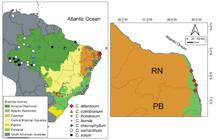
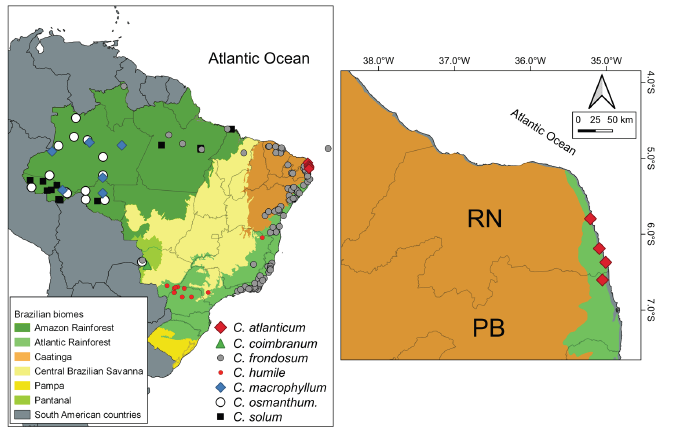
Geographic distribution map of Capparidastrum species occurring in Brazil, with emphasis on C. atlanticum.

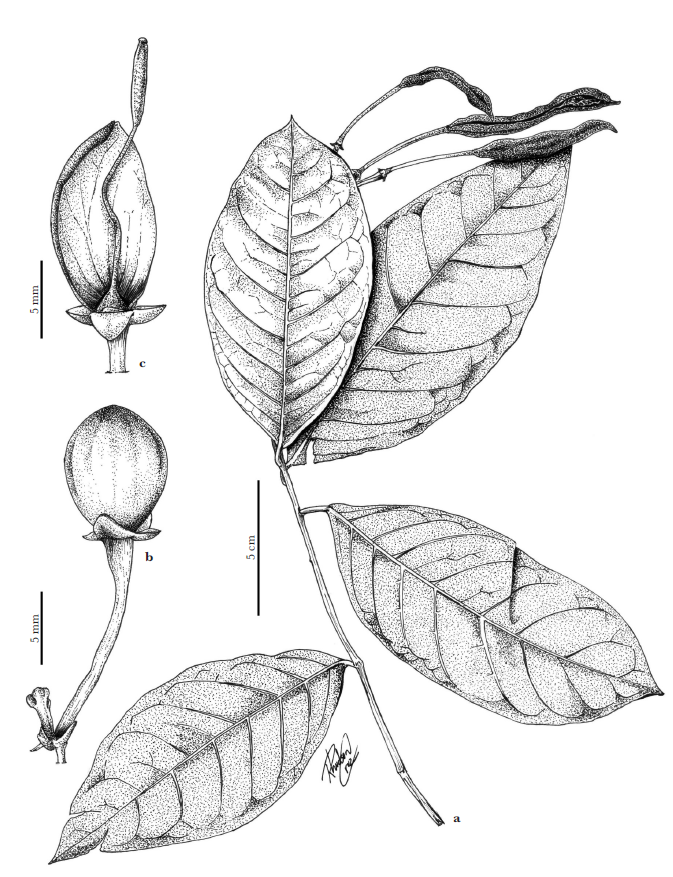
a-c. Capparidastrum atlanticum (Holotype: Soares Neto et al. 66) - a. fruiting branch; b. flower bud; c. detail of flower; showing only one petal and missing stamens to highlight the nectariferous disk and gynophore. Illustration by Rhudson Cruz.
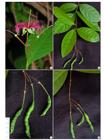
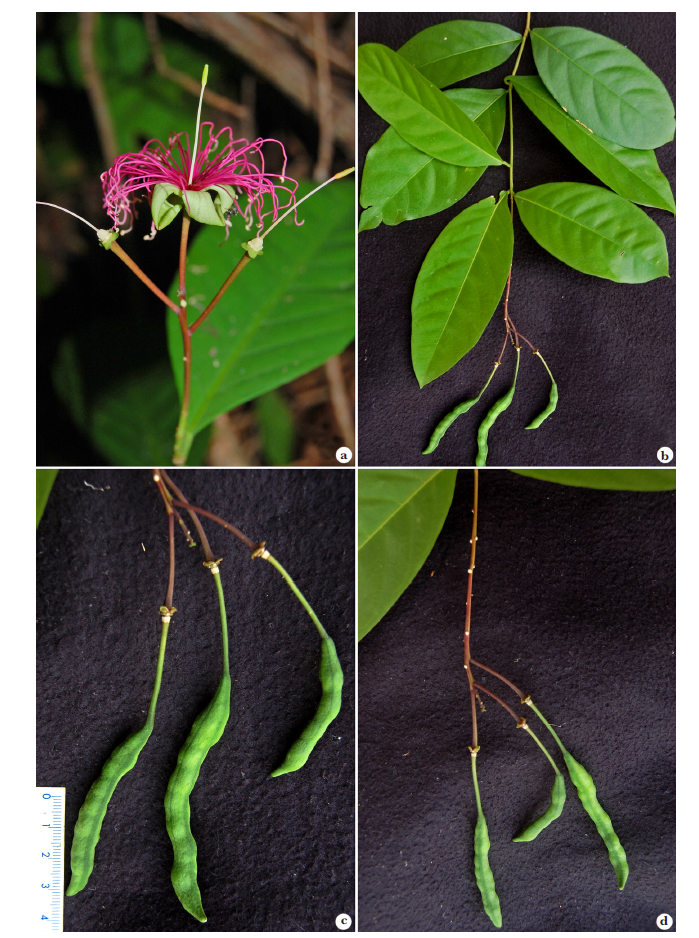
a-d. Capparidastrum atlanticum - a. flower at anthesis; b. phyllotaxy and infructescence; c-d. fruits. Photos: J.G. Jardim.
Capparidastrum atlanticum is similar to C. humile by the petioles smaller than 1 cm long, leaves clustered along the axis or branches, terminal inflorescence arranged in racemes, differing by the height (1‒3 m tall) and habit scandent subshrub to shrub (vs. woody only at base reaching up to 1 m tall), filaments 1.2‒1.7 cm long (vs. c. 2.5 cm long), white, purple or purple at base and whitish at apex (vs. always white).
Scandent subshrub to shrub, 1‒3 m tall, sparsely branched; stems scandent and slender, glabrous, with lenticells throughout. Stipules triangular, intrapetiolar, 0.5‒1 × 0.5 mm. Leaves simple, alternate to subopposite, leaves clustered in groups of three along the stems, with large spaces between the internodes of each set of 3 leaves, rarely a single leaf along the branches, petiole pubescent to glabrescent, 0.5‒1 cm long, pulvinus absent, the leaf blade coriaceous, lanceolate to oblong-elliptic, 8.5‒12.5(-20.4) × 4.5‒5.8(-10.3) cm, acute to cuneate at base, attenuate to acuminate at apex, the margin entire; surfaces glabrous on both sides; venation brochidodromous, lateral veins 10‒14 on each side. Inflorescence of terminal racemes, flowers easily caducous with few persistent flowers in dry specimens; bracts sessile, lanceolate, c. 1 mm long, glabrous. Flower buds capitate, c. 3 × 1 cm, greenish. Flowers tetramerous, with pedicels 2.5‒3 cm long, glabrous; calyx with open aestivation, sepals widely ovate, 2‒3 × 2‒3 mm, greenish, with four nectaries on the base of receptacle; petals obovate-elliptic, 0.8‒1.1 × 0.4‒0.7 cm, apex and base rounded, reflexed, cream to ivory colored. Nectariferous disk conical-annular, c. 2 mm diam. Stamens not counted; filaments purple at base and whitish at apex, totally white or purple, 1.2‒1.7 cm long; anthers yellow, c. 3 mm long. Ovary c. 5 mm long, glabrous; stigma sessile, discreetly capitate. Fruit capsular oblong to cylindric, slightly torulose, 4.5-9 × 1-1.3 cm, glabrous, greenish when immature, not seen mature; gynophore in fruit 3.5‒5.5 cm long, glabrous. Seeds reniform, 0.7‒1 × 0.5 cm, greenish, covered by a white aril.
Additional specimens examined (paratypes): BRASIL. PARAÍBA: Mataraca, Millennium Inorganic Chemicals Mineração Ltda, 06°29’45’’S, 34°52’00’’W, 27.VIII.2008, fl., P.C. Gadelha-Neto et al. 2433A (JPB); 06°29’45’’S, 34°52’00’’W, 20.X.2011, fl., P.C. Gadelha Neto et al. 3089 (JPB). RIO GRANDE DO NORTE: Baía Formosa, Mata Estrela, 06°22’40’’S, 35°01’22’’W, 9.III.2012, fl., W.M.B. São-Mateus et al. 100 (UFRN); 29.III.2008, fr., (RN3456). Natal, Parque Estadual das Dunas de Natal, trilha da Peroba, 05°42’20’’S, 35°12’43’’W, 16.II.2012, fl., W.M.B. São-Mateus et al. 45 (UFRN); área do bairro Mãe Luiza, 05°48’47”S, 35°11’31”W, 27.XI.1980, fl. and fr., Equipe do Projeto Parque das Dunas 243 (RN); Trilha Romana, 05°48’47”S, 35°11’31”W, 21.X.2016, fl., A.H. Ribeiro & L.A. Gomes Neto (RN708); área do bairro Nova Descoberta, 05°48’33”S, 35°11’36”W, 4.XI.2020, fl., M.A.J. Sertão 44 (RN); Trilha da Perobinha, 05°48’47”S, 35°11’31”W, 4.XII.2018, fr., A.A. Roque et al. 2527 (RN); Parque da Cidade Dom Nivaldo Monte, 05°51’01”S, 35°13’36”W, 13.II.2016, fr., A.A. Roque 1740 (UFRN); UFRN, Mata dos Saguis, trilha no interior do fragmento, 05°50’34”S, 35°12’4”W, 1.X.2017, fl., M.B. Nascimento 78 (UFRN). Tibau do Sul, Santuário Ecológico de Pipa, 23.IV.2001, fl., E.B. Almeida et al. 222 (PEUFR); Parque Estadual da Mata de Pipa-PEMPI, trilha a partir do povoado de Pipa, 06°14’45’’S, 35°03’20’’W, 7.XII.2014, fl., J.G. Jardim et al. 6776 (UFRN); Pipa, 06°14’33”S 35°02’28”W, 13.X.2019, fl. V.P. Moreira 535 (UFRN).
The species is only known from semideciduous forests and the understory of restinga forests in the states of Paraíba and Rio Grande do Norte, in Northeastern Brazil (Fig. 1). The species is distributed in the northernmost part of Northeastern Brazil and exhibits a distribution pattern similar to other new species recently described such as Pradosia restingae Terra-Araujo (in Terra-Araujo et al. 2013: 437), Eugenia pipensis A.R. Lourenço & B.S. Amorim (in Lourenço et al. 2013: 31), and Passiflora natalensis G.L. Silva & Mezzonato (in Silva et al. 2024: 38-e20230282).
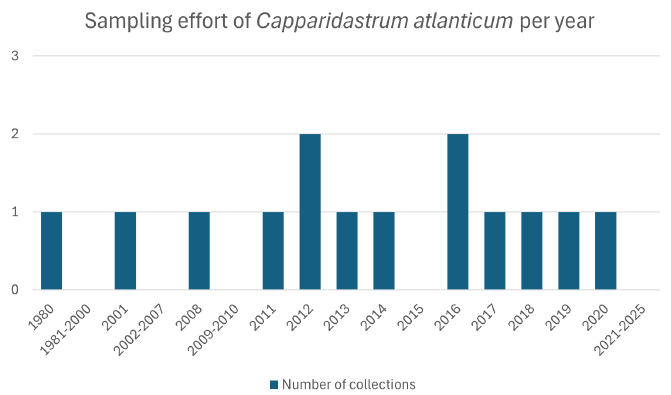
The first record of Capparidastrum atlanticum dates back to 1980 (specimen Equipe do Projeto Parque das Dunas 243), with a twenty-year interval between new records, showing that its most regular collection took place in the 2010s (Fig. 4). The species is known from few records and is restricted to small fragments near the coast of the states of Paraíba and Rio Grande do Norte. Although it is present in three protected areas: (Dunas do Natal State Park, Mata da Pipa State Park and Estrela Private Reserve), it is not known if these areas are enough to effectively preserve the species. Most of the areas where the species occurs, a coastal habitat known as restinga, suffer from intense pressure by mining activities and real-estate development. In addition, the known area of occurrence of this species is highly fragmented by agricultural activities, beaches and general construction. Moreover, the species has an extent of occurrence (EOO) of 312,203 km2 and area of occupancy (AOO) of 36,000 km2. According to the IUCN (2024) criteria, we assessed Capparidastrum atlanticum as Endangered (EN B2ab + ii, iii).
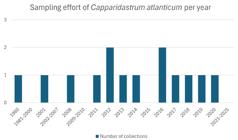
Bar graph showing the number of collection records (sampling effort) of Capparidastrum atlanticum from its first collection to the present day.
Capparidastrum atlanticum is the only species of the genus that is endemic to Brazil so far. Its distribution is considered restricted here, as its northern distribution limit is the municipality of Natal, in the state of Rio Grande do Norte, and its southern limit is the municipality of Mataraca, in the state of Paraíba, which are slightly over 100 km apart, in Northeastern Brazil (Fig. 1).
The epithet is a reference to the Atlantic Forest biome where the species occurs.
Capparidastrum atlanticum was collected with flowers from January to April, and in August, October and December; with fruits in December. It shows nocturnal anthesis, with flowers that persist to the early hours of the day (based on authors’ observation during field expedition). Ants were observed foraging on the leaf blades, suggesting there might be glands in the leaf mesophyll (J.G. Jardim, personal observation).
Capparidastrum atlanticum was first identified as a possible new species by the last author based on a population initially restricted to seasonally semideciduous forest from Rio Grande do Norte State, Northeastern Brazila. The specimens deposited at the UFRN herbarium, at the Universidade Federal do Rio Grande do Norte, were initially identified as Capparidastrum frondosum using Flora of Rio Grande do Norte (Soares Neto & Jardim 2015), but the authors highlighted the morphological differences among the individuals of this species occurring in the state (Soares Neto & Jardim 2015, Figs. 1a; 2a), such as the difference in petiole length and the absence/presence of pulvini among the specimens of the Caatinga (C. frondosum) and Atlantic Forest (C. atlanticum).
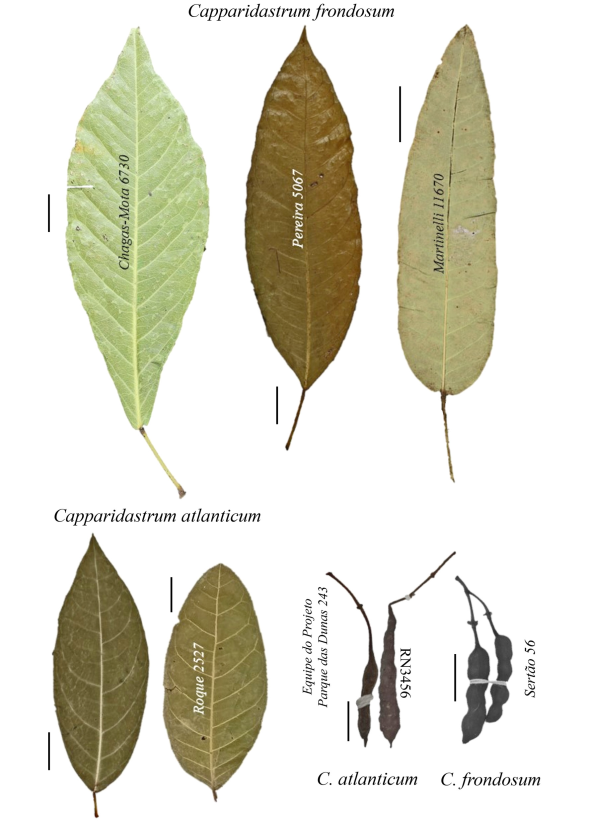
This misunderstanding can be expected because C. frondosum is a widely distributed species, with specimens exhibiting high morphological variability, mainly in the leaves and fruits (Fig. 5), which leads to the name being applied to identify specimens of the genus, resulting in confusion regarding the correct taxonomic identity. As mentioned earlier, the oldest specimen collected of C. atlanticum dates back to 1980 (see paratypes), and its specimens have been identified ever since in the herbaria as C. frondosum or synonyms.

a-c. Comparison of the morphological characters of Capparidastrum frondosum and C. atlanticum - a. leaf variation in C. frondosum; b. leaves of C. atlanticum; c. comparison of the dimensions and morphology of C. frondosum and C. atlanticum.
Capparidastrum atlanticum is also similar to C. humile since both have petioles smaller than 1 cm long. The leaves of both species are clustered along the axis or branches, and the inflorescences are terminal, arranged in racemes with few and deciduous flowers. The remarkable difference between these species is in the habit and height of their individuals, as C. atlanticum is a subshrub to shrub that can reach up to 3 m tall, markedly scandent, while C. humile is woody only at base and reaches between 0.20‒1 m in height. The petals of C. atlanticum are cream to ivory, 0.8‒1.1 × 0.4‒0.7 cm (vs. white, 1‒1.2 × 0.5‒0.6), and filaments purple at base and whitish at apex, totally white or purple, 1.2‒1.7 cm long (vs. always white, c. 2.5 cm long). Also, the species occur in distinct and distant environments, where C. atlanticum is restricted to the northern coast of the Atlantic Forest and C. humile is associated with the Pantanal and the extreme south of the Atlantic (Soares Neto & Luber 2025).
Identification key for Capparidastrum species occurring in Brazil
-
1. Petioles ≤ 1 cm long.
-
2. Subshrub to shrub up to 1 m tall, woody only at base; petals white; filaments c. 2.5 cm long, always white Capparidastrum humile
-
2’. Scandent subshrub to shrub 1-3 m tall; petals cream to ivory; filaments 1.2-1.7 cm long, purple at base and whitish at apex, totally white or purple Capparidastrum atlanticum
-
1’. Petioles ≥1.1 cm long.
-
3. Only the base of the petiole pulvinate; sepal orbicular; stamens 50-80; gynophore 0.4-1 cm long Capparidastrum frondosum
-
3’. Petiole pulvinate at both base and apex; sepal semi-orbicular or ovate-triangular; stamens 30-50; gynophore 2-12 cm long 4
-
4. Leaf blade glabrous on the upper surface and covered with velutinous indumentum on the lower surface; nectaries fleshy; fruit oblong Capparidastrum coimbranum
-
4’. Leaf blade completely glabrous in both surfaces; nectaries non-fleshy; fruit cylindrical or globose 5
-
5. Pedicels puberulent, 5-10 mm long Capparidastrum solum
-
5’. Pedicels glabrous, 20-30 mm long 6
-
6. Leaf blade broadly ovate to broadly elliptic; 17-37 × 11-18 cm; petal c. 25 × 5 mm; fruit cylindrical; gynophore 10-12 cm long Capparidastrum macrophyllum
-
6’. Leaf blade oblong-elliptic to elliptic; 15-20 × 5-10 cm; petal c. 8 × 6 mm; fruit globose; gynophore 2-2.5 cm long Capparidastrum osmanthum
Acknowledgements
This study was initiated while the first author was pursuing his Master’s degree. We would like to thank the Coordenação de Aperfeiçoamento de Pessoal de Nível Superior (CAPES), for the scholarship granted to RLSN during the completion of his Master’s degree in the Postgraduate Program in Systematics and Evolution (UFRN); the curators M.R.V. Barbosa, M.E.B. Pedroza, A. Roque and L.M. Versieux and their team, for their assistance in visiting the herbaria; and Rhudson Cruz, for the illustrations. JGJ (311696/2022-8) thanks CNPq, for the research grants.
Data availability statement
In accordance with Open Science communication practices, the authors inform that there is no data sharing of this manuscript.
References
-
Bachman S, Moat J, Hill AW, de la Torre J & Scott B (2011) Supporting Red List threat assessments with GeoCAT: geospatial conservation assessment tool. Zookeys 150: 117-126. DOI: 10.3897/zookeys.150.2109
» https://doi.org/10.3897/zookeys.150.2109 - Briceño M, Carrión JF & Cinea W (2015) Análisis filogenético de Capparis sensu lato (Capparaceae) en Costa Rica. In: Blanco MA & Majure LC (eds.) Memoria del curso sistemática de plantas tropicales, 30 June-3 August. Organización para Estudios Tropicales, San José. Pp. 132-137.
-
Cardinal-McTeague WM, Sytsma KJ & Hall JC (2016) Biogeography and diversification of Brassicales: a 103 million year tale. Molecular Phylogenetics and Evolution 99: 204-224. DOI: 10.1016/j.ympev.2016.02.021
» https://doi.org/10.1016/j.ympev.2016.02.021 -
Cornejo X (2017) Neocapparis: generic status and new name for Capparidastrum subgenus Pachycarpum (Capparaceae). Harvard Papers in Botany 22: 113-119. DOI: 10.3100/hpib.v22iss2.2017.n3
» https://doi.org/10.3100/hpib.v22iss2.2017.n3 -
Cornejo X & Iltis HH (2008) The reinstatement of Capparidastrum (Capparaceae). Harvard Papers in Botany 13: 229-236. DOI: 10.3100/1043-4534-13.2.229
» https://doi.org/10.3100/1043-4534-13.2.229 -
Cornejo X & Iltis HH (2010a) Three new species of Capparidastrum (Capparaceae) from Colombia, Venezuela, and Ecuador. Harvard Papers in Botany 15: 155-163. DOI: 10.3100/025.015.0109
» https://doi.org/10.3100/025.015.0109 -
Cornejo X & Iltis HH (2010b) Capparidastrum tuxtlense (Capparaceae), a new Mexican endemic. Brittonia 62: 120-125. DOI: 10.1007/s12228-009-9101-0
» https://doi.org/10.1007/s12228-009-9101-0 - Cornejo X & Iltis HH (2012) Capparaceae. In: Flora de Jalisco y áreas colindantes. Fasc. 25. Universidad de Guadalajara - CUCBA, Guadalajara. 65p.
-
Cornejo X, Iltis HH & Cerón CE (2014) Capparidastrum tafallanum (Capparaceae), a new species from the northwestern Andean slopes of Ecuador. Harvard Papers in Botany 19: 189-191. DOI: 10.3100/hpib.v19iss2.2014.n4
» https://doi.org/10.3100/hpib.v19iss2.2014.n4 -
Cornejo X & Vargas W (2020) Capparidastrum alboannulatum: a new species and new records of Capparaceae from Colombia. Harvard Papers in Botany 25: 39-41. DOI: 10.3100/hpib.v25iss1.2020.n3
» https://doi.org/10.3100/hpib.v25iss1.2020.n3 -
Cornejo X, Mejía-Pazos N & Soto MA (2021) Notes on the genus Capparidastrum (Capparaceae) and the description of C. estrellae, a new species from Northwestern Ecuador. Harvard Papers in Botany 26: 101-104. DOI: 10.3100/hpib.v26iss1.2021.n4
» https://doi.org/10.3100/hpib.v26iss1.2021.n4 -
IUCN Standards and Petitions Committee (2024) Guidelines for using the IUCN Red List categories and criteria. Version 16. <Available at https://www.iucnredlist.org/documents/RedListGuidelines.pdf >. Access on 4 March 2025.
» https://www.iucnredlist.org/documents/RedListGuidelines.pdf - Hutchinson J (1967) The genera of flowering plants (Angiospermae) Dicotyledones. Vol. 2. Claredon Press, Oxford. 659p.
-
Lourenço ARL, Amorim BS & Alves M (2013) Eugenia pipensis, a new species of Eugenia sect. Umbellatae (Myrtaceae) from northeastern Brazil. Phytotaxa 104: 30-34. DOI: 10.11646/phytotaxa.104.1.4
» https://doi.org/10.11646/phytotaxa.104.1.4 -
Mercado-Gómez JD & Morales-Puentes ME (2020) A new species of Capparidastrum (Capparaceae Juss.) from the Cauca inter Andean valley of Colombia. Phytotaxa 439: 276-286. DOI: 10.11646/phytotaxa.439.3.9
» https://doi.org/10.11646/phytotaxa.439.3.9 - Radford AE, Dickson WC, Massey JR & Bell CR (1974) Vascular plant systematics. Harper & Row, New York. 891p.
-
Silva GL, Roque AA, Queiroz RT & Mezzonato-Pires AC (2024) Passiflora natalensis, a new species of Passiflora (Passifloraceae sensu stricto) from the Atlantic Forest of northeastern Brazil. Acta Botanica Brasilica 38: e20230282. DOI: 10.1590/1677-941X-ABB-2023-0282
» https://doi.org/10.1590/1677-941X-ABB-2023-0282 -
Soares Neto RL & Jardim JG (2015) Capparaceae no Rio Grande do Norte, Brasil. Rodriguésia 66: 847-857. DOI: 10.1590/2175-7860201566312
» https://doi.org/10.1590/2175-7860201566312 -
Soares Neto RL & Luber J (2025) Capparaceae in Flora e Funga do Brasil (continuously updated). Jardim Botânico do Rio de Janeiro. <Available at https://floradobrasil.jbrj.gov.br/FB105584 >. Access on 4 March 2025
» https://floradobrasil.jbrj.gov.br/FB105584 - Stearn WT (2004) Botanical Latin. 4th ed. David & Charles Book, Devon. 546p.
-
Terra-Araujo MH, Faria AD, Alves-Araujo A & Alves M (2013) Pradosia restingae sp. nov. from the Atlantic Forest, Brazil. Nordic Journal of Botany 31: 347-441. DOI: 10.1111/j.1756-1051.2012.01724.x
» https://doi.org/10.1111/j.1756-1051.2012.01724.x -
Thiers B (continuously updated) Index Herbariorum: a global directory of public herbaria and associated staff. New York Botanical Garden’s Virtual Herbarium. <Available at http://sweetgum.nybg.org/science/ih/ >. Access on 15 January 2025.
» http://sweetgum.nybg.org/science/ih/