 How are seed banks and seed rain affected after 30 years of exotic grass cultivation?
Abstract
The conversion of different forest formations into pastures with exotic grasses leads to irreversible damage over time. However, the dispersal of diaspores from adjacent areas and the formation of seed banks can influence regeneration processes. This study aimed to assess natural regeneration in a pasture cultivated over a 30-year period with Urochloa brizantha. To accomplish this, seed rain and seed bank were sampled, and vegetation composition, species richness, and beta diversity were evaluated. Overall, 114 species were identified with more abundance in seed rain (74) than in seed bank (41). The community was composed of small seeds, herbaceous plants, as well as autochorous and pioneer species. Species composition varied between seed bank and seed rain. No difference was observed in total beta diversity. Species turnover was higher in the seed bank, while nestedness was higher in seed rain. The results show a high dominance of U. brizantha in the seed bank. Greater species turnover in the seed bank and the differentiation in composition compared to seed rain could be attributed to seed bank depletion processes and limited dispersal in both mechanisms, which may confer low resilience potential to this community.
Key words:
natural regeneration; pasture; secondary vegetation; seed dispersal
Resumo
A conversão de diferentes formações florestais em pastagens com gramíneas exóticas leva a danos irreversíveis ao longo do tempo. A dispersão de diásporos de áreas adjacentes e a formação de bancos de sementes podem influenciar nos processos de regeneração. Este estudo objetivou verificar a regeneração natural em uma pastagem que teve 30 anos de cultivo de Urochloa brizantha. Para isto, foi amostrada a chuva e o banco de sementes, onde foi avaliada a composição da vegetação, riqueza de espécies e diversidade beta. No geral, foram encontradas 114 espécies, mais abundantes na chuva de sementes (74) do que no banco de sementes (41). A comunidade foi composta por sementes pequenas, herbáceas, autocóricas e espécies pioneiras. A composição de espécies variou entre o banco e chuva de sementes. Não houve diferença na diversidade beta total. A substituição de espécies foi maior no banco, enquanto o aninhamento foi maior na chuva de sementes. Os resultados mostram alta dominância de U. brizantha no banco de sementes. A maior substituição de espécies no banco e a diferenciação da composição em relação à chuva de sementes podem ser devido aos processos de esgotamento do banco de sementes e dispersão limitada em ambos os sistemas, o que pode conferir potencial de resiliência a essa comunidade.
Palavras-chave:
regeneração natural; pastagem; vegetação secundária; dispersão de sementes
Introduction
Cultivated pastures are significant contributors to environmental degradation, and their restoration can be particularly challenging owing to their resistance to the re-establishment of native vegetation (Bocchese et al. 2008). Cultivated species, often exotic, may exhibit high invasion potential, thus posing substantial challenges to restoration (Pyšek et al. 2009; Driscoll et al. 2014). These traits are frequently linked to functional attributes that increase the capacity of a species for colonization and persistence, such as seed dispersal, seed bank formation, and underground systems (Pyšek et al. 2009). Furthermore, environmental factors like soil type and surface characteristics (Czarniecka-Wiera et al. 2020), combined with natural or anthropogenic disturbances (e.g., fire, flooding, agriculture) (Diez et al. 2012), play a pivotal role in facilitating invasion. Therefore, the process of biological invasion involves overcoming geographical and environmental barriers to establish populations of invasive species (Diez et al. 2012; Czarniecka-Wiera et al. 2020).
Native grasslands possess inherent adaptive capacities that enable them to resist and recover from disturbances. Regeneration processes, such as seed banks and bud banks, are critical to this recovery (Bao et al. 2014; Ott et al. 2019) since they facilitate initial recolonization and help minimize potential invasion by exotic species (Ott et al. 2019). For instance, while seed banks have been extensively studied and shown to be effective mechanisms for vegetation recovery in grasslands (Bao et al. 2014), additional research is needed to understand the ability of invasive species to establish persistent seed banks under varying conditions over time and space (Gloria et al. 2021).
Seed banks can be influenced by land-use history and types of plant formations in surrounding areas (Aide et al. 2000; Chazdon 2003; Holl 2007). Neighboring areas contribute to seed input through dispersal mechanisms. In grasslands, the absence of geographic barriers makes seed rain a crucial factor in the arrival of diaspores, affecting succession stages, genetic variability, abundance, and species richness (Muller-Landau et al. 2002; Nathan et al. 2002). Seed sizes also play a key role in the regeneration process and can impact the dynamics of plant communities (Wenny 2000). For instance, annual herbaceous plants produce small seeds (approximately 1 mm) that tend to remain close to the parent plant (Thompson & Grime 1979). In contrast, tree and shrub species typically have larger seeds (over 5 cm in diameter) that take longer to enter the seed bank, increasing predation chances (Wenny 2000). These seeds are often dispersed over long distances by biotic agents (Kadmon & Benjamini 2006). Additionally, larger seeds are more prone to dehydration, which can lead to embryo death-factors that hinder germination and seedling emergence (Coomes et al. 2002).
The natural regeneration of an environment depends on multiple factors, including plant fecundity, seed dispersal mechanisms (Guariguata & Pinard 1998), the behavior of frugivorous vertebrates (Clark et al. 2004), predation, temperature, light availability, germination, and seedling mortality (Holl et al. 2000; Poschlod et al. 2005). These drivers directly influence the composition and dynamics of the seed bank. Predominantly composed of herbaceous-shrubby species, the seed bank includes persistent and transient seeds with higher viability (Cavieres et al. 2014; Mendes et al. 2015). These species not only modify the soil, creating favorable conditions for the recruitment of other organisms (Cavieres et al. 2014), but also contribute to the regeneration process by rapidly germinating during initial colonization. This rapid germination can protect seedlings and young woody plants from later successional stages (Santos et al. 2013; Golos & Dixon 2014), ensuring continuous vegetation renewal through species maintenance and exchange (Poschlod et al. 2005).
Additionally, the seed bank functions as a critical regeneration strategy. Seeds deposited in the soil that remain viable over time contribute to significant changes in species composition, increasing beta diversity within the community (Plue & Cousins 2018). This diversification expands niche-filling opportunities during regeneration (Anderson et al. 2006), revealing patterns of vegetation renewal or stagnation (Chaideftou et al. 2009). Therefore, the interaction between regenerative drivers and seed bank composition highlights its central role in sustaining and promoting ecosystem recovery.
In Brazil, the Cerrado region has experienced extensive habitat loss and fragmentation owing to the conversion of native vegetation into cultivated pastures and agricultural areas (Sano et al. 2010). This transformation not only results in scattered and fragmented plant formations but also introduces significant challenges for ecological restoration, including the dominance of invasive exotic species, such as African grasses, and their impact on native biodiversity and ecosystem functionality (Driscoll et al. 2014). Cultivated pastures dominated by Urochloa brizantha (Hochst. ex A.Rich.) R.D.Webster present a particularly complex problem because these grasses can alter soil conditions and suppress native vegetation. Recent studies highlight the importance of understanding the interaction of these grasses with native species and the seed bank to develop effective restoration strategies, especially in regions like the Cerrado where the history of degradation poses significant barriers to recovery (e.g., Giles et al. 2021; Mazzochini et al. 2024).
In this context, our study aimed to investigate the natural regeneration dynamics of a grassland cultivated for 30 years with Urochloa brizantha, focusing on the composition and richness of species in both seed bank and seed rain. We propose to examine the extent to which native species can compose the seed bank and seed rain under such conditions. Given the long history of degradation, it is expected that certain functional groups will dominate these components, such as species with small seeds, effective dispersal mechanisms, and soil longevity. By investigating the beta diversity and persistence of specific functional traits within the seed bank and seed rain, we aim to understand how these dynamics influence regeneration outcomes and provide insights into potential restoration pathways for degraded grasslands.
Material and Methods
Study area
The study was conducted in a 35-hectare private area (20°28’23”S; 55°44’07”W) in Aquidauana City, which is located northwest of Mato Grosso do Sul, a Brazilian state situated within the Paraguay River depression also known as the Pantanal. The climate is seasonal (Köppen subtype Aw) (Monteiro 1963), with temperatures ranging from 20.7 °C to 24.5 °C from April to September and from 25.8 °C to 29.9 °C from October to March (Sant’Anna Neto 1989). The area is surrounded by Cerrado biome physiognomies, including seasonal deciduous forest, semi-deciduous forest, and savannah (Vila da Silva et al. 2022). Before the introduction of cultivated species, the area was dominated by seasonal deciduous and semi-deciduous forests. For three decades, the area had been used for cattle ranching with pasture primarily cultivated with the African grass Urochloa brizantha. Now, however, no cattle were grazing during the collection period, and the vegetation consisted of an herbaceous stratum dominated by U. brizantha, along with a sparse tree-shrub stratum in the early regeneration stage. To characterize seed rain and seed bank, a floristic survey was conducted within plots using random walks, during which all species were recorded and identified.
Seed rain assessment
Twenty transects were established within the designated sampling area. Each transect was 30 meters in length and positioned at 15-meter intervals. Along each transect, a 1 m2 plot was installed at intervals of 10 m, resulting in 4 plots/transects for a total of 80 plots. In each plot, vegetation and leaf litter were removed to expose the bare soil. For 12 months (August/2016 to July/2017), every 30 days, diaspores reaching the demarcated surface were collected using a soft nylon bristle brush. After each monthly survey, the plots were kept clean and free of obstructions for the arrival of new diaspora. The materials were placed in plastic bags and transported to the Federal University of Mato Grosso do Sul (UFMS) for identification. A stereomicroscope, brushes, and tweezers were used to sort, identify and quantify diaspores from seed rain. They were placed in Eppendorf tubes filled with 70% alcohol. All seeds larger than 1 mm were included in the sample and were identified to the lowest possible taxonomic resolution.
Seed bank assessment
To assess the seed bank, we collected a 20 × 20 cm monthly soil sample (5 cm deep), which was situated next to each of the 80 seed rain plots during the same period (12 months - August/2016 to July/2017). The collected soil was also placed in /*plastic bags and transported to the plant biology laboratory (UFMS). To assess the seed bank, soil samples were divided into two parts (1,000 cm³ each) and evaluated using two methods: seedling emergence, which makes it possible to assess which seeds are viable and not dormant, and direct counting, which made it possible to measure the size of seeds (Bao et al. 2021).
For the seedling emergence method in the greenhouse, samples were placed in plastic trays (36 × 20 × 6 cm). To drain irrigation water, a 2 cm layer of sterilized sand was added to the tray bottoms. The final soil layer within the trays was between 1.5 and 2 cm, discounting the layer of sand, and emergence was observed over six months, noting the germination stabilization period. Seedlings that emerged were kept in trays until identification. Once identified, they were counted and removed to prevent competition. In each count, the top 2 cm of soil layer was turned over to release the seeds from the bottom, following Bao et al. (2021). For direct seed counting, soil was washed under running water using sieves with a mesh size of 0.25 mm. Material that remained after washing was placed in vials filled with 70% alcohol. Seeds larger than 1 mm were separated by morphospecies, quantified using brushes, tweezers, and a stereomicroscope, and identified, also following Bao et al. (2021).
All species were classified according to functional traits: successional group - pioneer (PI), early secondary (ES), late secondary (LS) (Budowski, 1965); dispersal syndromes - autochory (AUT), anemochory (ANE), zoochory (ZOO), considering primary dispersal according to van der Pijl (1982); and growth habit - herbaceous (HER), trees (TRE), shrubs (SHR) and climbers (CLI) (Guedes-Bruni et al. 2002). The seeds were categorized by size: small (0.3-1 mm), medium (1.8-6 mm), and large (7-70 mm). To achieve this, the seeds were photographed (Leica Application Suite 3.8.0 [Build:878] 2003-2011) and measured under a stereomicroscope (LEICA M205C).
Data analysis
To assess differences in species richness between seed bank and seed rain, a rarefaction curve analysis was performed based on the number of sampling units with extrapolation up to twofold (Chao et al. 2014). Variation in richness and abundance within each functional characteristic (growth habit, successional stage and dispersal syndrome) was analysed using Generalized Linear Mixed Models (GLMMs). For richness, we applied Poisson distribution, while for abundance, we used the negative binomial owing to residuals over-dispersion (Zuur et al. 2009). To check validity of the models, we used diagnostic plots (residuals vs. fitted, Q-Q residuals and scale-location plots). To test pairwise differences within each functional group, we used estimated marginal means with Bonferroni adjustment for p-values throughout the estimated marginal means (EMMs) “emmeans” package, R Project (Lenth 2024).
To explore patterns of variation in species composition between seed bank and seed rain, we conducted a Non-Metric Multidimensional Scaling (NMDS) ordination using Bray-Curtis distance based on the relative abundance matrix of species per plot. To examine differences in species composition between seed bank and seed rain, we applied an analysis of similarity (ANOSIM) using the same abundance matrix with Bray-Curtis distance and 999 permutations. Given the paired nature of seed bank and seed rain samples, we ran the ANOSIM with an adjusted permutation structure to minimize potential dependency problems. The permutation structure was defined to permute within pairs. This preserved the paired structure, while also testing for significance. To define the permutation structure, we used the how() function from the “permute” R package. (Simpson 2022). A chi-squared test was used to analyse the association among seed size classes and their origin (seed bank or seed rain) for both abundance and richness.
To investigate differences in beta diversity within seed banks and seed rain, each transect was treated as a sampling unit (n = 20). We used the beta.pair() function from the betapart package (Baselga et al. 2023) on presence/absence matrices (transects in rows; species in columns) for seed bank and seed rain separately. With that, we calculated three distance matrices (Sorensen dissimilarity) that represent beta diversity, including turnover, nestedness and total dissimilarity (i.e., the sum of turnover and nestedness components) between the transects of each treatment (seed bank and seed rain) separately. Therefore, beta diversity was calculated between the transects within each treatment. To test for differences in each component of beta diversity between seed bank and seed rain, we used pairwise values from the dissimilarity value matrices of each beta diversity component (n = 190). We tested the data for normality and heteroscedasticity by using Shapiro-Wilk and Levene tests, respectively. Whenever data did not meet the assumptions, or whenever using random factors and proportion data (like a quasibinomial distribution) in a Generalized Linear Mixed Model (GLMM) introduced complexity, primarily in the estimation of random effects, we opted for using a Mann-Whitney test (Sheskin 2003) with paired permutations to test the differences of each component of beta diversity between seed bank and seed rain. With this test, we could add random factors implicitly (the sample pairs) and thus maintain the dependency structure of paired data. For this, we used the wilcox_test() function from the “coin” package (Hothorn et al. 2008). All analyses were conducted using R software, version 4.3.1 (R Core Team 2024).
Results
Richness
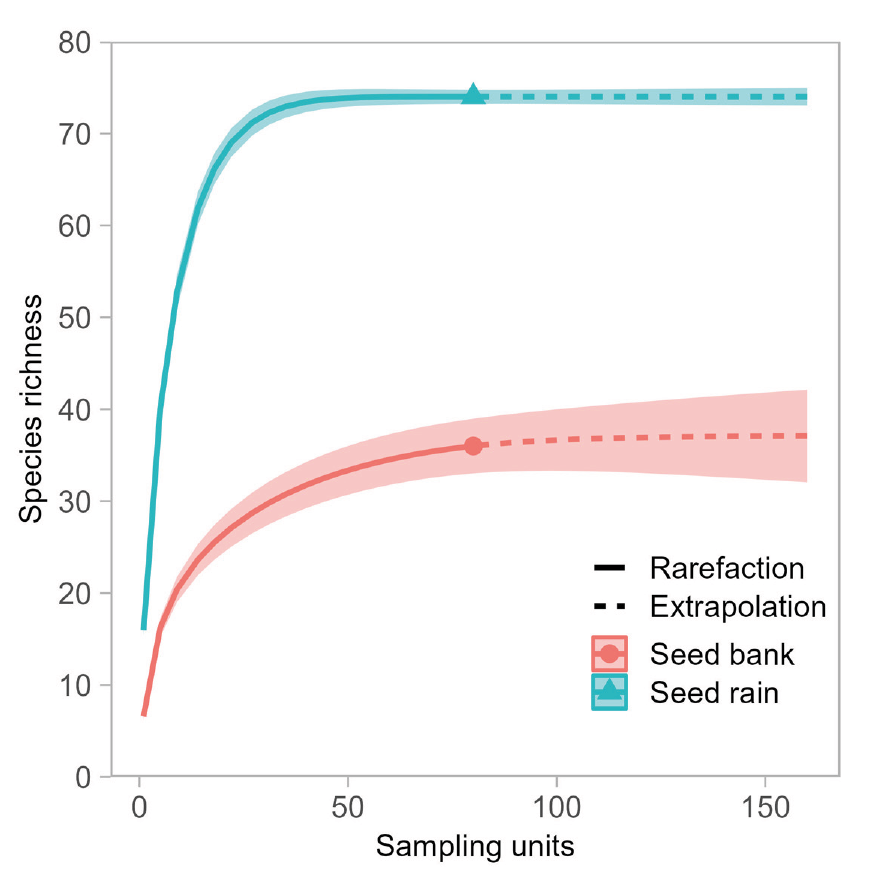
We identified a total of 119 species distributed across 36 families (Tab. S1, available on supplementary material <https://doi.org/10.6084/m9.figshare.30005152.v1>). The most representative families were Fabaceae (35 species), Malvaceae (11 species), and Asteraceae (10 species). Species richness was higher in seed rain (74 species) than that in seed bank (41 species) (Fig. 1; Tab. S1, available on supplementary material <https://doi.org/10.6084/m9.figshare.30005152.v1>). No species were exclusive to the seed bank. However, 25 species occurred exclusively in seed rain. More than 50% of both seed rain and seed bank were composed of small-seeded, herbaceous, autochorous, and pioneer species.

Rarefaction and extrapolation of the species richness of the seed bank and seed rain in grassland (Central-West, Brazil).
Abundance
A total of 23,030 seeds were recorded, with 5,049 seeds (1,009.8 seeds/m²) from the seed bank and 17,981 seeds (224.76 seeds/m²) from seed rain (Fig. 1). The most abundant species in the seed bank were Urochloa brizantha (1,310 seeds), Centratherum punctatum Cass. (859 seeds), and Cyperus aggregatus (Willd.) Endl. (467 seeds), while in seed rain, the most abundant species were U. brizantha (2,379 seeds), Synedrellopsis grisebachii Hieron. & Kuntze (2,100 seeds), and Sida spp. (1,245 seeds).
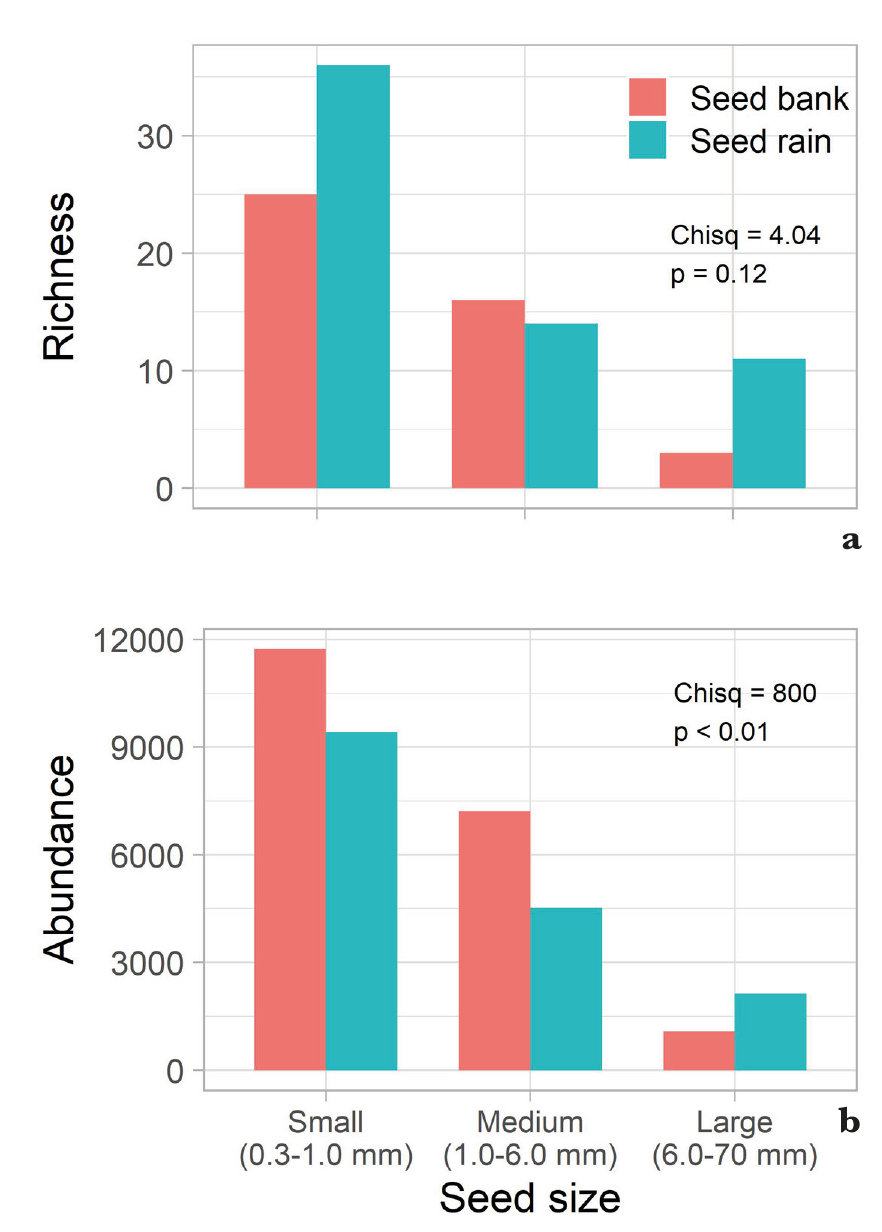
Both seed bank and seed rain showed greater abundance and species richness of small seeds (55.8%, 43 species), followed by medium seeds (34.6%, 20 species), and then large seeds (9.5%, 11 species) (Fig. 2). For abundance, a significant association was observed among seed size classes and their origin (χ2 = 800; p < 0.05), with a greater abundance of a) small and medium seeds in seed bank vs. seed rain, and b) large seeds in seed rain vs. seed bank (Fig. 2). For richness, no association was noted among seed size classes and their origin (χ2 = 4; p = 0.12).

a-b. Species richness (a) and seed abundance (b) in the seed bank and in the seed rain, distributed in small, medium and large seeds.
Functional groups
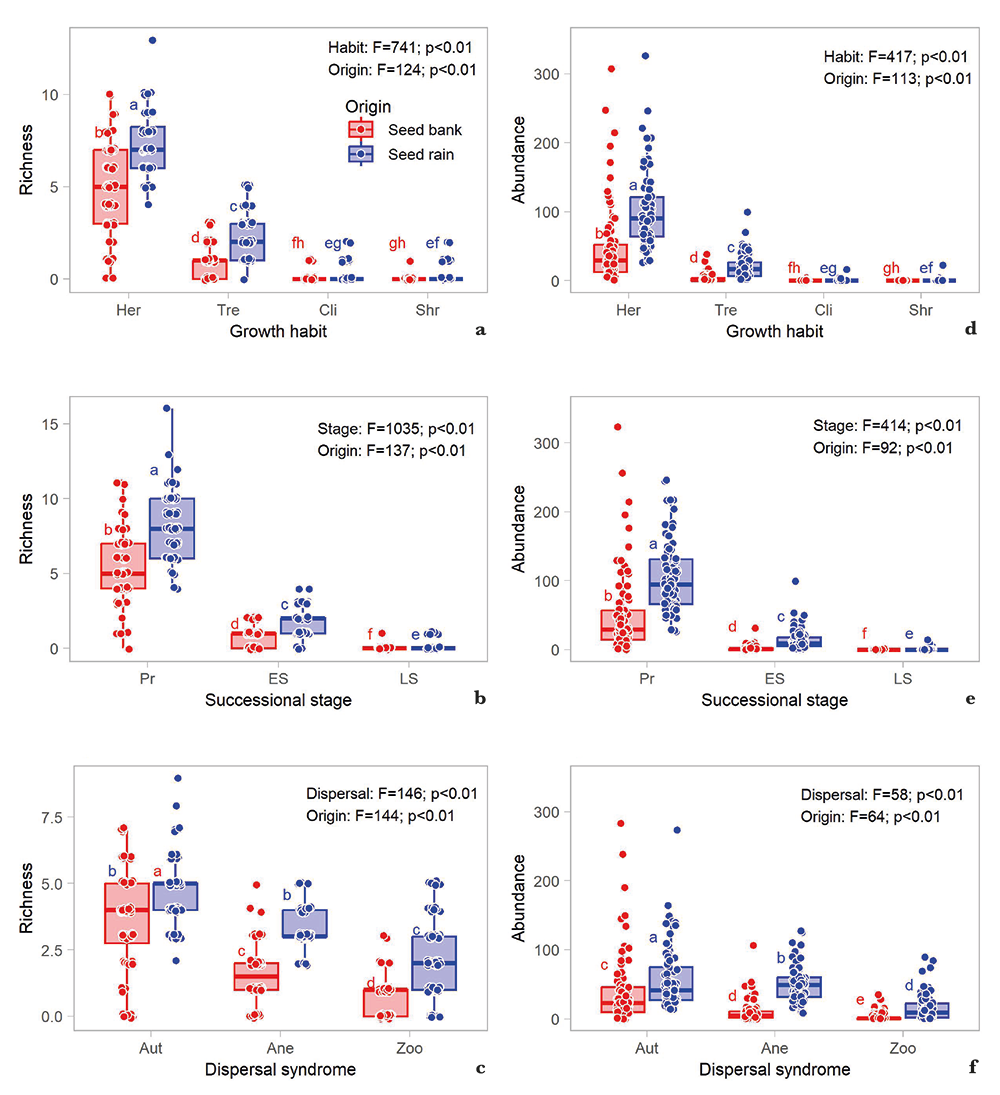
Herbaceous growth habit was the most representative functional group in terms of species richness with 42 species in both seed rain (23 species) and seed bank (Fig. 3a). For the other growth habits, no significant difference was found between seed rain and seed bank although seed bank had a lower number of tree species than that in seed rain (Fig. 3a-d).

a-f. Species richness and abundance in the seed rain and seed bank, by functional group - a-d. growth habit (Her = herbaceous; Tre = trees; Cli = climbers; Shr = shrubs); b-e. successional stage (PI = pioneers; ES = early secondary; LS = late secondary); c-f. dispersal syndrome (Aut = autochoric; Ane = anemochorous; Zoo =zoochoric).
For successional stages, pioneer species exhibited the greatest richness (Fig. 3b) and abundance (Fig. 3e) with 71 species and 18,452 seeds overall, including 33 species and 4,642 seeds in the seed bank and 38 species and 13,810 seeds in seed rain. The other groups were minimally represented and were similar in both seed bank and seed rain, with early secondary species comprising only 9.5% (1,744 seeds in seven species) and late secondary species comprising only 0.3% (61 seeds in one species) of the total (Fig. 3c-e).
Three main dispersal syndromes were recorded: autochorous (nine species), anemochorous (seven), and zoochorous (eight species) in the seed bank and seven, ten, and thirteen species in the seed rain, respectively (Fig. 3c-f). The most abundant species were autochorous and anemochorous, comprising 85.2% of the total, while zoochorous species accounted for only 14.8% (Fig. 3c-f).
Species composition
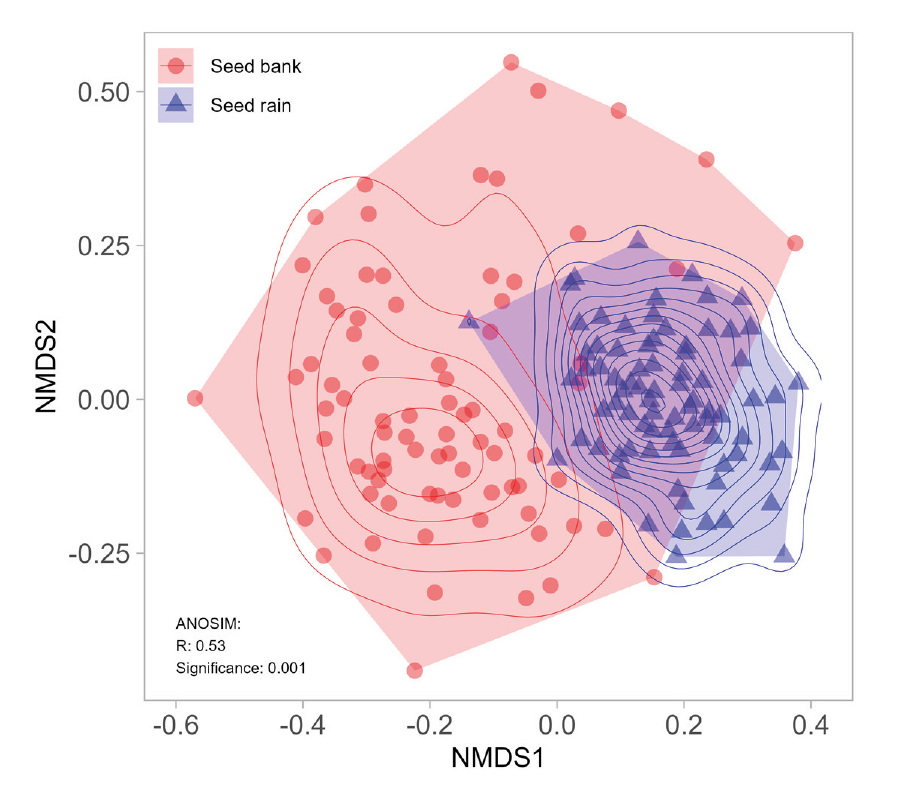
We found a significant difference in species composition between seed bank and seed rain (ANOSIM: 0.53; p < 0.001). NMDS stress was 0.21 (Fig. 4). Additionally, we observed that the dissimilarity between plots in seed bank composition was greater than that in seed rain composition.

Non-Metric Multidimensional Scaling (NMDS) of seed bank and seed rain species in grasslands (Central-West, Brazil).
Beta diversity
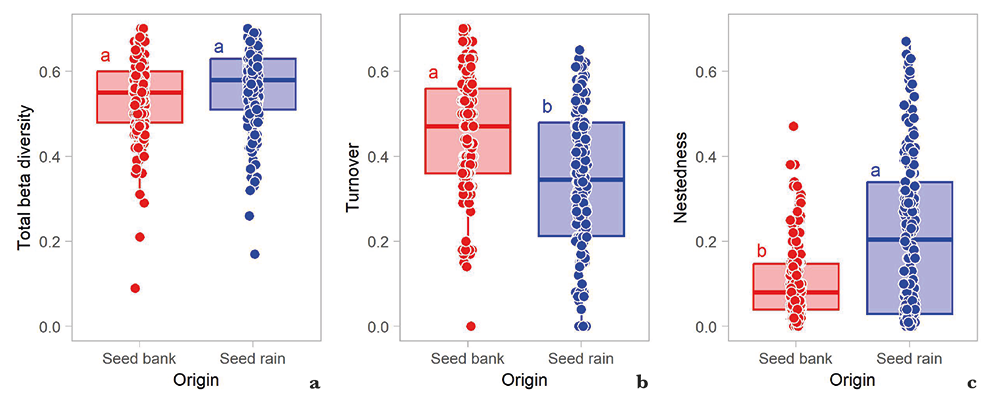
The species turnover component was 13% higher in the seed bank than that in seed rain (Z = 5.6; p < 0.05), and the nestedness component was 36% higher in the seed rain than that in the seed bank (Z = 4.7; p < 0.05). We found that seed rain was just 0.9% higher than seed bank with no significant difference between the two (Z = 1.8; p = 0.07) (Fig. 5).
a-c. Total beta diversity (a), Turnover (b) and Nestedness (c), for the seed bank and seed rain in grasslands (Central-West, Brazil).
Discussion
Vegetation composition and functional groups
Urochloa brizantha dominated both seed bank and seed rain. No native grasses were present in the vegetation (field observation) or in the seed bank, indicating a strong dominant potential for U. brizantha in this grassland. The high species richness of the Fabaceae, Malvaceae, and Asteraceae families may be attributed to invasive grasses altering the dynamics of the local vegetation, creating opportunities for species with highly competitive abilities to establish themselves (Shea & Chesson 2002).
Some native species have functional traits (e.g., rhizome and high seed production) like those of the exotic species used in cultivated grasslands, particularly Chamaecrista nictitans, Mimosa pudica L., Riedeliella graciliflora (Mart. ex Benth.) H. S. Irwin & Barneby, e Senna occidentalis (L.) Link, which are shrubs with high dominance in Cerrado areas (Alves Albuquerque et al. 2017). From this perspective, the impact and dominance of U. brizantha are amplified when considering the abundance of seeds from Chamaecrista nictitans and Mimosa pudica, which, together, exceed the seed count of the exotic grass, thus increasing the number of locally invasive species. This abundance, along with other life history traits of these species, such as dormancy and short life spans (annuals or biennials), contributes to their rapid colonization with exotic species (Loreau 2010). Additionally, we found a predominance of Centratherum punctatum, Cyperus aggregatus, Synedrellopsis grisebachii, and Sida spp. These species produce high quantities of seeds and have efficient dispersal mechanisms, increasing their chances of colonization (Eriksson 2000).
In general, the observed composition is typical of regenerating areas, especially grasslands, which promote the establishment of pioneer species tolerant to the challenges of disturbed environments (Cavieres et al. 2014). Secondary species showed lower richness than pioneers in both seed rain and seed bank. Secondary species are typically arboreal and more sensitive to disturbances. However, the composition found in seed bank and seed rain samples revealed a consistent pattern within the evaluated functional groups: small seeds, herbaceous growth habit, anemochory, and pioneer status. While seed banks in early-stage forest regeneration are generally dominated by annual herbaceous species (Ferreira et al. 2015), this is not the case for the Cerrado where the vegetation is naturally more open, and annual species are less common. Ruderal species, which are often associated with highly disturbed environments, play a crucial role in this context. In the Cerrado, ruderal species are predominantly herbaceous and contribute to rapid colonization, yet their dominance may be less pronounced as a result of the biome’s unique ecological traits, such as its fire-adapted flora and high proportion of perennials. The regenerative strategies expected for tropical forests may not be directly applicable to the Cerrado, particularly for non-arboreal species (Silva et al. 2023). Colonizing species, especially herbaceous ones, modify the environment, acting as facilitators for subsequent successional stages (Cavieres et al. 2014).
Species richness, which was also higher among pioneer species, may be related to stratification of the vegetation, which is in an early regeneration phase and does not support the establishment of secondary species. Additionally, seed rain is autochthonous, meaning that the secondary diaspores dispersed in the area originate from remaining species (Dalling & Brown 2009). It is typical for annual and biennial species to produce smaller seeds that are easily dispersed (Munhoz & Felfili 2006), as reflected in the main dispersal methods observed, i.e., anemochory and autochory, which can be attributed to the predominantly autochthonous nature of seed rain.
Furthermore, grassland areas offer limited opportunities for frugivorous dispersers as a consequence of low food supply and increased predation risks (Duncan & Chapman 2002). Some plant species depend on biotic dispersers, vertebrates and/or invertebrates, which increase the chances of seed and seedling survival and establishment by reducing predation and competition for resources (Cordeiro & Howe 2003; Pizo 2004). The low abundance of zoochoric species in both seed rain and seed bank may reflect their dependence on remnant trees as seed sources. This pattern could also indicate a lack of seed arrival if these species are absent in the surrounding vegetation, highlighting the importance of landscape connectivity for zoochoric dispersal. Finally, tree species generally produce fewer diaspores which are larger (7-70 mm) and more susceptible to predation or desiccation under disturbed conditions characterized by water loss and high light exposure (Adler et al. 2014).
Species composition between seed rain and seed bank
The community exhibited low structural heterogeneity overall. Differences in the proportions of functional traits and species composition were key factors contributing to the dissimilarity between seed bank and seed rain. Environmental, spatial, and temporal factors, such as the distribution of seed rain diaspores and phenological differences between species, can influence these results (Santos et al. 2010).
Greater abundance and richness in seed rain compared to the seed bank
This difference may be attributed to the presence of annual or biennial species, species with recalcitrant seeds, or those subject to predation (Alvarez-Buylla & Martinez-Ramos 1990). The heterogeneity of species and functional traits between seed bank and seed rain is crucial for areas undergoing regeneration. Colonizing species contribute to the seed bank, and because of their regenerative abilities, they also play a significant role in species establishment in the seedling bank, which is composed of secondary species (Jacquemyn et al. 2011).
Based on species composition and the occurrence of species exclusive to seed rain, we can assume that seed rain contributes to formation of the seed bank, particularly with herbaceous pioneer species. The dissimilarity between seed bank and seed rain, especially in terms of species composition and varied characteristics, is significant. This enables greater opportunities to occupy niches with species from diverse functional groups, thereby improving the regenerative capacity of native vegetation (Adler et al. 2014). Such dissimilarity can lead to the emergence of vegetation with different degrees of stratification and progress to other levels of succession (Pruchniewicz et al. 2016). Both seed rain and seed bank had few exclusive species. Among them, those exclusive to seed rain were primarily shrubs or trees with medium to large seeds, which are more challenging to establish in the seed bank.
Beta diversity
While variation in composition between seed banks and seed rain is a positive factor for regeneration, variation within each of these systems also reflects the community’s regeneration capacity. The equivalence of total beta diversity between seed banks and seed rain indicates that species composition in both systems is influenced by similar levels of spatial heterogeneity. However, the greater nestedness observed in seed rain indicates that less diverse samples tend to be subsets of more diverse ones (Almeida-Neto et al. 2008). This may result from differentiated dispersal whereby different sites (sets of samples) exhibit varying levels of homogeneity (Cadotte 2006).
Conversely, higher species turnover in the seed bank suggests it is more dynamic and influenced by local environmental variations or ecological processes that drive species substitution. The heterogeneity of tropical ecosystems likely promotes this turnover since different environmental filters in microenvironments favor various species, while maintaining seed viability (Larson & Funk 2016). Limited dispersal can also lead to greater differentiation between sites, with distinct species colonizing separate areas (Cadotte 2006). Additionally, the seed bank may act as a more restrictive reservoir where seeds embedded in the soil are subject to predation, desiccation, and prolonged dormancy, further filtering species and contributing to the observed turnover (Brown & Venable 1991).
However, this dynamic nature of the seed bank has practical implications, particularly for restoration efforts. That is, a higher beta diversity in the seed bank could bolster community resilience by providing a diverse set of species capable of colonizing and adapting to varying conditions (Wisnoski & Shoemaker 2022). Nevertheless, the observed low regeneration potential raises concerns about the capacity of the seed bank to support the recovery of native species. This highlights the importance of integrating seed dispersal and seed rain management into comprehensive restoration strategies that will ensure the arrival and establishment of a broader spectrum of functional groups to guarantee ecosystem recovery.
We conclude that the seed bank in this area is dominated by Urochloa brizantha and several native species with high colonization potential, highlighting the need for a careful assessment of natural regeneration. The high abundance of native plants represents a significant challenge for the recruitment of species from neighboring fragments through seed rain. Although the seed bank contains species adapted to disturbed environments, it offers limited contribution to the regeneration of a structurally more complex and functionally diverse plant community. These findings have crucial implications for the restoration and conservation of Brazilian ecosystems. Effective restoration strategies should address the management of invasive species and consider interventions, such as the introduction of native propagules, to increase the representation of secondary and arboreal species. Furthermore, improving landscape connectivity to support seed rain from native vegetation may help overcome the limitations of the current seed bank and promote more diverse and sustainable successional trajectories.
Acknowledgements
To the Brazilian agencies CAPES (Coordenação de Aperfeiçoamento de Pessoal de Nível Superior), for scholarship to the first author; CNPq (Conselho Nacional de Pesquisas e Desenvolvimento Científico e Tecnológico e Inovação), for the Postdoctoral grant to the third author and Programa de Pós-Graduação em Biologia Vegetal of UFMS (Universidade Federal de Mato Grosso do Sul), for facilities.
References
- Adler PB, Salguero-Gomez R, Compagnoni A, Hsu JS, Ray-Mukherjee J, Mbeau-Ache C & Franco M (2014) Functional traits explain variation in plant life history strategies. Proceedings of the National Academy of Sciences 111: 740-745.
-
Aide TM, Zimmerman JK, Pascarella JB, Rivera L & Marcano-Vega H (2000) Forest regeneration in a chronosequence of tropical abandoned pastures: implications for restoration ecology. Restoration Ecology 8: 328-338. DOI: 10.1046/j.1526-100x.2000.80048.x
» https://doi.org/10.1046/j.1526-100x.2000.80048.x - Almeida-Neto M, Guimaraes P, Guimaraes Jr PR, Loyola RD & Ulrich W (2008) A consistent metric for nestedness analysis in ecological systems: reconciling concept and measurement. Oikos 117: 1227-1239.
- Alvarez-Buylla ER & Martinez-Ramos M (1990) Seed bank versus seed rain in the regeneration of a tropical pioneer tree. Oecologia 84: 314-325.
- Alves Albuquerque JAA, Santos TS, Santiago Castro T, Oliveira Evangelista M, Arcanjo Alves JM, Bernades Soares MB & Menezes PHS (2017) Floristic study of weeds in watermelon crops in the Savannah of Roraima, Brazil. Scientia Agropecuaria 8: 12-18.
- Anderson MJ, Ellingsen KE & McArdle BH (2006) Multivariate dispersion as a measure of beta diversity. Ecology Letters 9: 683-693.
- Bao F, Pott A, Ferreira FA & Arruda R (2014) Soil seed bank of floodable native and cultivated grassland in the Pantanal wetland: effects of flood gradient, season and species invasion. Brazilian Journal of Botany 37: 239-250.
- Bao F, Assis MA & Pott A (2021) Applicability of seed bank assessment methods in wetlands: advantages and disadvantages. Oecologia Australis 25: 22-33.
-
Baselga A, Orme D, Villeger S, De Bortoli J, Leprieur F, Logez M, Martinez-Santalla S, Martin-Devasa R, Gomez-Rodriguez C & Crujeiras R (2023) betapart: Partitioning beta diversity into turnover and nestedness components. R package version 1.6. Available at <https://CRAN.R-project.org/package=betapart>. Access on 02 april 2023.
» https://CRAN.R-project.org/package=betapart - Bocchese AR, Oliveira AKM, Favero S, Garnés SJS & Lauro VA (2008) Seed rain and seedling establishment from the use of isolated trees and artificial perches by seed-dispersing birds in a Cerrado area, Mato Grosso do Sul, Brazil. Revista Brasileira de Ornitologia 16: 207-213.
- Brown JS & Venable LD (1991) Life history evolution of seed-bank annuals in response to seed predation. Evolutionary Ecology 5: 12-29.
- Budowski G (1965) Distribution of tropical American rain forest species in the light of successional processes. Van Nostrand, New York. Pp. 79-96.
- Cadotte MW (2006) Dispersal and species diversity: a meta-analysis. The American Naturalist 167: 913-924.
- Cavieres LA, Brooker RW, Butterfield BJ, Cook BJ, Kikvidze Z, Lortie CJ, Michalet R, Pugnaire FI, Schöb C & Xiao S (2014) Facilitative plant inter-actions and climate simultaneously drive alpine plant diversity. Ecological Letters 17: 193-202.
- Chaideftou E, Thanos CA, Bergmeier E, Kallimanis A & Dimopoulos P (2009) Seed bank composition and above-ground vegetation in response to grazing in sub-Mediterranean oak forests (NW Greece). Forest Ecology: Recent Advances in Plant Ecology 5: 255-265.
- Chazdon RL (2003) Tropical Forest recovery: legacies of human impact and natural disturbances. Perspectives in Plant Ecology, Evolution and Systematics 6: 51-71.
- Clark CJ, Poulsen JR, Connor EF & Parker VT (2004) Fruiting trees as dispersal foci in a semi-deciduous tropical forest. Oecologia 139: 66-75.
- Coomes DA, Rees M, Grubb PJ & Turnbull L (2002) Are differences in seed mass among species important in structuring plant communities? Evidence from analyses of spatial and temporal variation in dune-annual populations. Oikos 96: 421-432.
- Cordeiro NJ & Howe HF (2003) Forest fragmentation severs mutualism between seed dispersers and an endemic African tree. Proceedings of the National Academy of Sciences 100: 14052-14056.
- Czarniecka-Wiera M, Szymura TH & Kącki Z (2020) Understanding the importance of spatial scale in the patterns of grassland invasions. Science of the Total Environment 727: 138669.
- Dalling JW & Brown TA (2009) Long-term persistence of pioneer species in tropical rain forest soil seed banks. The American Naturalist 173: 531-535.
- Diez JM, D’Antonio CM, Dukes JS, Grosholz ED, Olden JD, Sorte CJ & Miller LP (2012) Will extreme climatic events facilitate biological invasions? Frontiers in Ecology and the Environment 10: 249-257.
- Driscoll DA, Catford JA, Barney JN, Hulme PE, Inderjit Martin TG, Pauchard A, Pyšek P, Richardson DM, Riley S & Visser V (2014) New pasture plants intensify invasive species risk. Proceedings of the National Academy of Sciences 111: 16622-16627.
- Duncan RS & Chapman CA (2002) Limitations of animal seed dispersal for enhancing forest succession on degraded lands. CABI International, Wallingford. Pp. 437-450.
- Eriksson O (2000) Seed dispersal and colonization ability of plants-assessment and implications for conservation. Folia Geobotanica 35: 115-123.
- Ferreira CM, Walter MTB & Vieira LMD (2015) Topsoil translocation for Brazilian Savanna restoration: propagation of herbs, shrubs and trees. Restoration Ecology 23: 723-728.
- Giles AL, Costa PB, Rowland L, Abrahão A, Lobo L, Verona L, Silva MC, Monge M, Wolfsdorf G, Petroni A, D'Angioli AM, Sampaio AB, Schimidt IB & Oliveira RS (2022) How effective is direct seeding to restore the functional composition of neotropical savannas?. Restoration Ecology 30: e13474.
- Gloria M, Carta A, Baskin CC, Dawson W, Franz Essl, Kreft H, Pergl J, van Kleunen M, Weigelt P, Winter M & Pysek P (2021) Persistent soil seed banks promote naturalisation and invasiveness in flowering plants. Ecology Letters 24: 1655-1667.
- Golos JP & Dixon WK (2014) Waterproofing topsoil stockpiles minimizes viability decline in the soil seed bank in an arid environment. Restoration Ecology 22: 495-501.
- Guariguata MR & Pinard MA (1998) Ecological knowledge of regeneration from seed in neotropical forest trees: Implications for natural forest management. Forest Ecology and Management 12: 87-99.
- Holl KD (2007) Old field vegetation succession in the Neotropics. In: Cramer VA & Hobbs RJ (eds.) Old fields: dynamics and restoration of abandoned farmland. Island Press, Washington. Pp. 93-118.
- Holl KD, Loik ME, Lin EHV & Samuels IA (2000) Tropical montane forest restoration in Costa Rica: overcoming barriers to dispersal and establishment. Restoration Ecology 8: 339-349.
-
Hothorn T, Hornik K, van de Wiel MA & Zeileis A (2006) A Lego system for conditional inference. The American Statistician 60: 257-263. DOI: 10.1198/000313006X118430
» https://doi.org/10.1198/000313006X118430 - Jacquemyn H, van Mechelen C, Brys R & Honnay O (2011) Management effects on the vegetation and soil seed bank of calcareous grasslands: an 11-year experiment. Biological Conservation 144: 416-422.
- Kadmon R & Benjamini Y (2006) Effects of productivity and disturbance on species richness: a neutral model. American Naturalist 167: 939-946.
- Larson JE & Funk JL (2016) Regeneration: an overlooked aspect of trait-based plant community assembly models. Journal of Ecology 104: 1284-1298.
-
Lenth R (2024) emmeans: Estimated marginal means, aka least-squares means. R package version 1.10.2 Available at <https:/CRAN.R-project.org/package=emmeans>. Access on 05 september 2024.
» https:/CRAN.R-project.org/package=emmeans - Loreau M (2010) Linking biodiversity and ecosystems: towards a unifying ecological theory. Philosophical Transactions of the Royal Society B 365: 49-60.
- Mazzochini GG, Lira-Martins D, Barros FV, Oliveira ACC, Xavier RO, Furtado MN, Verona LS, Viani RAG, Rowland L & Oliveira RS (2024) Effects of grass functional diversity on invasion success by exotic grasses in Cerrado grasslands. Journal of Applied Ecology 61: 271-280.
- Mendes BL, Silva AK, Santos MD, Santos FFMJ, Albuquerque PU & Araújo LE (2015) What happens to the soil seed bank 17 years after clear cutting of vegetations? Journal Tropical Biology 63: 321-332.
- Monteiro JM (1963) Clima do estado de Mato Grosso do Sul. Empresa Brasileira de Pesquisa Agropecuária (EMBRAPA), Campo Grande. 72p.
- Muller-Landau HC, Wright JC, Calderon O, Hubbell SP & Foster RB (2002) Assessing recruitment limitation: concepts, methods and case-studies from a tropical forest. In: Levey DJ, Silva WR & Galetti M (eds.) Seed dispersal and frugivory: ecology, evolution and conservation. CAB International, Wallingford. Pp. 35-53.
- Munhoz CBR & Felfili JM (2006) Phytosociology of the herbaceous-subshrub stratum of a campo sujo area in the Federal District, Brazil. Acta Botanica Brasilica 20: 671-685.
- Nathan R, Horn HS, Chave J & Levin SA (2002) Mechanistic models for tree seed dispersal by wind in dense forests and open landscapes. In: Levey DJ, Silva WR & Galetti M (eds.) Seed dispersal and frugivory: ecology, evolution and conservation. CABI International, Oxfordshire. Pp. 69-82.
- Ott JP, Klimešová J & Hartnett DC (2019) The ecology and significance of below-ground bud banks in plants. Annals of botany 123: 1099-1118.
- Pizo AM (2004) Frugivory and habitat use by fruit: eating birds in a fragmented landscape on southeast Brazil. Ornitologia Neotropical 15: 117-126.
- Plue J & Cousins SA (2018) Seed dispersal in both space and time is necessary for plant diversity maintenance in fragmented landscapes. Oikos 127: 780-791.
- Poschlod P, Tackenberg O & Bonn S (2005) Plant dispersal potential and its relation to species frequency and coexistence. In: van der Maarel E (ed.) Vegetation ecology. Blackwell, Oxford. Pp. 68-76.
- Pruchniewicz D, Donath TW, Otte A, Żołnierz L & Eckstein RL (2016) Effect of expansive species on seed rain and soil seed bank of mountain mesic meadows. Tuexenia 36: 81-96.
- Pyšek P, Křivánek M & Jarošík V (2009) Planting intensity, residence time, and species traits determine invasion success of alien woody species. Ecology 90: 2734-2744.
-
R Core Team (2024) R: a language and environment for statistical computing. R Foundation for Statistical Computing, Vienna. Available at <http://www.R-project.org>. Access on 10 july 2025.
» http://www.R-project.org -
Sano EE, Rosa R, Brito JLS & Ferreira LG (2010) Land cover mapping of the tropical savanna region in Brazil. Environmental Monitoring and Assessment 166: 113-124. DOI: 10.1007/s10661-009-0988-4
» https://doi.org/10.1007/s10661-009-0988-4 - Sant’Anna Neto JL (1989) Some considerations on the climatic dynamics of the southeastern portion of the Pantanal of Mato Grosso. Boletim Paulista de Geografia 67: 75-88.
- Santos DM, Silva KA, Albuquerque UP, Santos JMFF, Lopes RGC & Araújo EL (2013) Can spatial variation and inter-annual variation in precipitation explain the seed density and species richness of the germinable soil seed bank in a tropical dry forest in north-eastern Brazil? Flora 208: 445-452.
- Santos DM, Silva KA, Santos JMFF, Lopes CGR, Pimentel RMM & Araújo EL (2010) Spatio-temporal variation of the seed bank in an area of tropical dry forest (Caatinga) and Pernambuco. Revista de Geografia 27: 234-253.
- Shea K & Chesson P (2002) Community ecology theory as a framework for biological invasions. Trends in Ecology & Evolution 17: 170-176.
- Sheskin DJ (2003) Handbook of parametric and nonparametric statistical procedures. Chapman and Hall/CRC, Boca Raton. 816 p.
- Silva TR, Rodrigues SB, Azevedo Bringel JB, Sampaio AB, Sano EE & Vieira DLM (2023) Factors affecting savanna and forest regeneration in pastures across the cerrado Journal of Environmental Management 330: 117-185.
-
Simpson G (2022) permute: functions for generating restricted permutations of data. R package version 0.9-7. Available at <https://CRAN.R-project.org/package=permute>. Access on 02 april 2023.
» https://CRAN.R-project.org/package=permute - Thompson K & Grime JP (1979) Seasonal variation in the seed banks of herbaceous species in ten contrasting habitats. The Journal of Ecology 2: 893-921.
- Van der Pijl L (1982) Principles of dispersal. SpringerVerlag, Berlin. 248p.
- Vila da Silva J, Pott A & Chaves JVB (2022) Classification and mapping of the vegetation of the Brazilian Pantanal. Flora and vegetation of the Pantanal wetland. Springer International Publishing, Cham. Pp. 11-38.
- Wenny DG (2000) Seed dispersal, seed predation, and seedling recruitment of a neotropical montane tree. Ecological monographs 70: 331-351.
- Wisnoski NI & Shoemaker LG (2022) Seed banks alter metacommunity diversity: the interactive effects of competition, dispersal and dormancy. Ecology Letters 25: 740-753.
- Zuur AF, Ieno EN, Walker NJ, Saveliev AA & Smith G (2009) Mixed effects models and extensions in ecology with R. Springer, New York. 574p.
Data availability statement
In accordance with Open Science communication practices, the authors inform that data will be made available on request.