 Flora of Ceará, Brazil: Meliaceae
Abstract
We present here the floristic diversity and distribution of Meliaceae species in the state of Ceará, Brazil, as part of the project “Flora of Ceará: from Knowledge to Conservation”. This study was based on the analysis of morphological characters of samples obtained in the field, in collections deposited in national and international herbaria (EAC, HCDAL, HST, HTSA, HUEFS, HUVA, HVASF, INPA, JPB, MBM, NY, RB, TEPB, UEC), and from consulting specialized literature, protologues and images of type-collections available on online platforms. In the state of Ceará, the family is represented by three genera and seven species: Cedrela fissilis Vell., C. odorata L., Guarea guidonea (L.) Sleumer, Trichilia elegans A. Juss, T. emarginata (Turcz) C.DC., T. hirta L. and T. ramalhoi Rizzini. Most species were registered predominantly in the Steppic Savanna (Caatinga). Cedrela odorata is the most widely distributed species, occurring in Steppic Savanna, Lowland Semideciduous Seasonal Forest (Mata de Tabuleiro) and Semideciduous Seasonal Forest. Populations of four species have been recorded in Conservation Units. Identification keys, morphological descriptions, comments on distribution, ecology, phenology and uses, maps and illustrations of the species are presented.
Key words:
Cedrela
; diversity; floristic; Steppic Savanna
Resumo
Apresentamos aqui a diversidade florística e a distribuição de espécies de Meliaceae no estado do Ceará, Brasil, como parte do projeto “Flora do Ceará: conhecer para conservar”. Este estudo foi baseado na análise de caracteres morfológicos de amostras obtidas em campo, em coleções depositadas em herbários nacionais e internacionais (EAC, HCDAL, HST, HTSA, HUEFS, HUVA, HVASF, INPA, JPB, MBM, NY, RB, TEPB, UEC), consulta a literaturas especializadas, protólogos e imagens de coleções-tipo disponíveis em plataformas online. No estado do Ceará, a família é representada por três gêneros e sete espécies: Cedrela fissilis Vell., C. odorata L., Guarea guidonea (L.) Sleumer, Trichilia elegans A. Juss, T. emarginata (Turcz) C.DC., T. hirta L. e T. ramalhoi Rizzini. A maioria das espécies foi registrada predominantemente em Savana Estépica (Caatinga). Cedrela odorata é a espécie mais amplamente distribuída, ocorrendo em Savana Estépica, Floresta Estacional Semidecídua de Terras Baixas (Mata de Tabuleiro) e Floresta Estacional Semidecídua. Populações de quatro espécies foram registradas em Unidades de Conservação. Chaves de identificação, descrições morfológicas, comentários sobre distribuição, ecologia, fenologia e usos, mapas e ilustrações das espécies são apresentados.
Palavras-chave:
Cedrela
; diversidade; florística; Savana
Introduction
Meliaceae comprises approximately 50 genera and 550 cosmopolitan species, with diversity concentrated in the Neotropical region (Pennington et al. 1981; Flores et al. 2017). In Brazil, 11 genera and 101 species are recognized, of which 25 are endemic (Flores 2023). Although there are records in all Brazilian states, the Meliaceae species they occur preferentially in the Amazon, Caatinga and Atlantic Forest domains (Flores 2023). Trichilia P. Browne is the genus with the greatest number (53) of species (Flores 2023).
Morphollogical, this family can be recognized by its arboreal habit, rarely shrubby, compound leaves, alternate to opposite, pinate, without stipulates, axillary inflorescence, terminals rare, unisexual or bisexual flowers (monoecious, dioecious or polygamous plants), stamens partially or completely united by a tube, intra-staminal nectary, gamosepalous or dialysepalous calyx, gamopetalous or dialipetalous corolla, fruit loculicidal capsule, drupe or berry, winged or not winged seeds, covered totally or partially by sarcotesta or aril (Pennington et al. 1981; Flores 2023).
Several representatives of Meliaceae have economic value and stand out for producing good quality wood used especially in the furniture industry (Lorenzi et al. 2003). In Brazil, “mahogany” (Swietenia macrophylla King), “cedro” (Cedrela spp.) and “canjerana” [Cabralea canjerana (Vell.) Mart.] are the tree species that receive greatest prominence in wood production, being recommended for sculptures, civil construction, decorative objects, and furniture, among others (Lorenzi et al. 2003). Some species such as the “santa bárbara tree” (Melia azadirachta L.) and “nim” (Azadirachta indica A. Juss.) are cultivated as ornamental plants and used as insecticide and fungicide (Carvalho 2010). Cedrela fissilis Vell. has antibacterial properties (Cortez et al. 1998).
In the most comprehensive study of Meliaceae, which was carried out in the Neotropical region, 120 species were recognized (Pennington et al. 1981). Subsequently, taxonomic revisions were published for the genera Cedrela (Pennington & Muellner 2010), Carapa (Kenfack 2011), Guarea (Pennington & Clarkson 2013) and Trichilia (Pennington 2016). In Brazil, the most detailed study of Meliaceae was published in Flora brasiliensis (De Candolle 1878). After this study, the family’s knowledge in the country is restricted to floristic studies in the states of Paraná (Patrício & Cervi 2005; Cervi et al. 2008); Acre (Daly & Silveira 2008); Alagoas (Lemos et al. 2010); Amazonas (Pennington 2006); Espírito Santo (Flores et al. 2017) and local floras such as Serra do Cipó/Minas Gerais (Pirani 1992) and Serra dos Carajás/Pará (Fernandes-Júnior et al. 2017).
In the Northeastern region, the family is represented by nine genera and 34 species (Flores 2023). In the state of Ceará, representatives of Meliaceae were only mentioned in floristic lists such as those carried out in Chapada do Araripe (Silva et al. 2012; Loiola et al. 2015); in Ubajara National Park (Silveira et al. 2020a); in Serra de Baturité (Silveira et al. 2020b), and in the general inventory of angiosperms in Ceará territory (Loiola et al. 2020). Despite this, knowledge about the diversity and distribution of Meliaceae for this state is still scarce, and it is essential for the development of strategies for the conservation of areas/species. It is noteworthy that Cedrela fissilis and C. odorata are classified as Vulnerable (VU), T. ramalhoi as Near Threatened (NT) and Trichilia emarginata and T. hirta as Least Concern (LC), according to CNCFlora (2013).
This study, part of the “Flora do Ceará: from Knowledge to Conservation” Project, aims to provide a floristic-taxonomic inventory of representatives of Meliaceae, promoting knowledge about the diversity and geographic distribution of this family that makes up the flora of Ceará.
Material and Methods
Study area
The state of Ceará, with a total area of 148,825.6 km² and 184 municipalities, is located in the Northeastern region of Brazil, intervals of 02° to 08° South latitude and 37° to 42° West longitude (Governo do Ceará 2020). It borders the Atlantic Ocean to the North; to the South with Pernambuco; to the East with the states of Rio Grande do Norte and Paraíba and to the West with Piauí (Governo do Ceará 2020). In Ceará, a Hot Tropical Semi-Arid climate regime predominates (Nimer 1972), with an average annual temperature varying between 24° and 26 °C. The predominant soils are Neosols and Argisols, covering 36% and 25% of the state’s area, respectively (Governo do Ceará 2022).
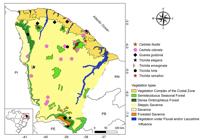
Two large geological domains are recognized for Ceará (Moro et al. 2015): one of sedimentary origin divided into five relief units called Coastal Plain, Fluvial Plain, Chapada do Araripe, Chapada do Apodi, and Serra da Ibiapaba; and another of crystalline origin divided into two relief units known as Depression Sertaneja and Massif Residual. According to Figueiredo (1997) and the Technical Manual of Brazilian Vegetation (IBGE 2012) the main types of vegetation occurring in the state are: Vegetation Complex of the Coastal Zone (comprises the Pioneer Psamophilous Vegetation, Forest behind Dunes and Lowland Semideciduous Forest = Mata de Tabuleiro), Semideciduous Seasonal Forest (Mata Seca), Dense Ombrophilous Forest (Mata Úmida), Steppic Savanna (Caatinga/Carrasco), and Vegetation under Fluvial and/or Lacustrine Influence (Mata Ripária).
Among these, the Caatinga predominates (with its various physiognomic variations, from shrubby to arboreal), occupying the broad areas of the sertaneja depression that are distributed across most of the state. In the sedimentary plateaus that surround Ceará, Carrasco and patches of Cerrado and Cerradão predominate (Costa et al. 2004; Ribeiro-Silva et al. 2012). In the coastal region, a complex of vegetation formations mixes, ranging from pioneer species on the beachfront to patches of coastal savannas and other savanna formations (Moro et al. 2011; Castro et al. 2012). In the mountains that occur close to the coast (for example, the Baturité and Maranguape mountains), orographic rains result in higher precipitation and patches of humid and sub-humid forests occur on the windward side, while dry forests are located on the leeward side of the same mountains (Oliveira & Araújo 2007).
Morphological and distribution studies
The study was based on samples obtained from field expeditions carried out between 2012 and 2023, morphological analyses of collections deposited in herbaria EAC, HCDAL, HST, HTSA, HUEFS, HUVA, HVASF, INPA, JPB, MBM, NY, RB, TEPB and UEC, (acronyms according to Thiers, continuously updated), consultation of specialized literature (Pennington & Styles 1975; Pennington et al. 1981), protologues, images of samples [(CRIA 2023a; Flora e Funga do Brasil (Flores 2023)] and type collections available on online platforms ( https://plants.jstor.org/ ).
The specimens were collected and herborized according to the usual procedures in plant taxonomy (Mori et al. 1989) and deposited in the EAC Herbarium of the Federal University of Ceará. Specimen identifications were carried out with the help of specialized literature (Pennington et al. 1981; Flores et al. 2017) and confirmed by analyzing images of type collections available on online platforms ( https://plants.jstor.org/ ). The names of the species and main works are in accordance with the IPNI (2023). The morphological descriptions were standardized according to Harris & Harris (2001). Information on occurrence, popular names, flowering and fruiting periods was obtained from exsiccate labels and/or field observations.
Data on geographic distribution in the world and in Brazil were obtained from specialized literature (Pennington & Muellner 2010; Pennington & Clarkson 2013; Pennington 2016) and the Flora e Funga do Brasil website (Flores 2023), respectively. The geographic distribution maps were created using ArcGIS software, version 7.4, based on records with geographic coordinates. For non-georeferenced records, the municipality coordinates were determined using the “geoLoc” tool (CRIA 2023b).
Results and Discussion
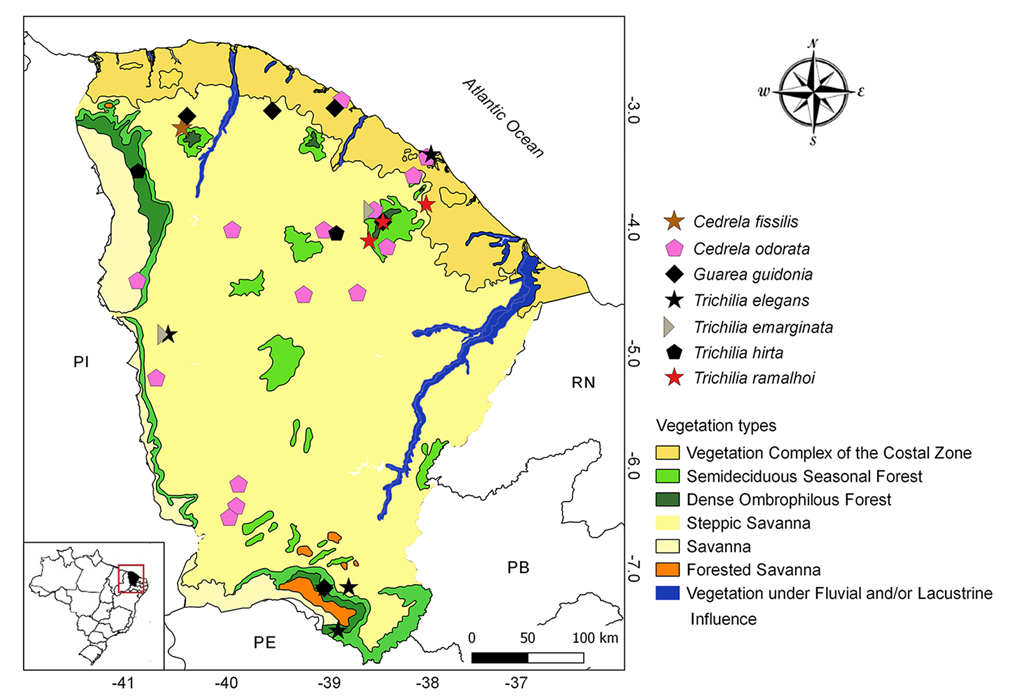
A total of seven species of Meliaceae were registered for Ceará, representing three genera: Cedrela fissilis Vell., C. odorata L., Guarea guidonea (L.) Sleumer, Trichilia elegans A. Juss, T. emarginata (Turcz) C.DC., and T. hirta L., T. ramalhoi Rizzini. Most species occur in the Steppic Savanna (Caatinga/Carrasco).
Trichilia emarginata and T. ramalhoi are endemic from Brazil. The taxa with the highest number of records were Cedrela odorata and Trichilia elegans, which occurred in 11 and seven municipalities, respectively. The species were recorded in different phytophysiognomies, but preferentially occur in the Steppic Savanna (Caatinga/Carrasco), in Dense Ombrophilous Forest, in Lowland Semideciduous Forest (Mata de Tabuleiro) and in Semideciduous Seasonal Forest (Mata Seca).
Four species were registered in Conservation Units: Ubajara National Park (Cedrela fissilis), Ceará Botanical State Park (Trichilia elegans), Aiuaba Ecological Station (Cedrela odorata), Araripe-Apodi National Forest Trichilia elegans) and Private Natural Heritage Reserve (PNHR) Serra das Almas (Trichilia emarginata).
Regarding conservation status, Cedrela fissilis and C. odorata are classified as Vulnerable (VU), T. ramalhoi as Near Threatened (NT) and Trichilia emarginata and T. hirta as Least Concern (LC), according to CNCFlora (2023).
Taxonomic treatment
Meliaceae Juss., Gen. Pl. 263. 1789, nom. cons.
Trees, shrubs or subshrubs, stipulate absent. Leaf paripinnate, imparipinnate or trifoliolate; foliole entire, rare lobed, serrated, crenate or with thorn. Inflorescence in axillary or terminal thyrse, determined or indetermined, simples or composed. Flowers unisexual or bisexual (monoecious, dioecious or polygamous plants), well-developed staminodes or pistillodes. Calyx dialysepalous or gamosepalous. Corolla dialipetalous or gamopetalous, preflowering imbricate, quincuncial, convolute or valvate. Stamens with partially joined fillets or joined almost to the apex or completely joined forming a tube; stamens 5-8, glabrous or hairy, inserted in the fillets, on the margin or inside the staminal tube. Intra-staminal nectary stipitate, columnar or absent, free or partially attached to the base of the staminal tube or to the ovary. Ovary 1-2-locular, locules with 1-2 ovules or multiovulated; stigma capitate, conical, columnar, lobed or discoid, pistilodes on slender male flowers. Loculicidal or septifragal capsule fruit. Dry seeds, winged or not, covered totally or partially by sarcotesta or aril.
Identification key of the species of Meliaceae occurring in Ceará
1. Androgynophore present; ovary with multiovulated locules; septifragal capsule, 5-valve.
2. Leaflets with pubescent abaxial face, with trichomes concentrated on the veins; gamopetalous corolla; capsule 5-7.5 cm long, pericarp 2-3 mm thick 1.1. Cedrela fissilis
2’. Leaflets with glabrous abaxial surface; dialipetalous corolla; capsule 3-4.5 cm long, pericarp 1 mm thick 1.2. Cedrela odorata
1’. Androgynophore absent; ovary with locules 1-2 ovulated; capsule loculicidal, 2-4-valve.
3. Branches with lenticels; capsule glabrous and lenticellate 2.1. Guarea guidonia
3’. Branches without lenticels; capsule velutinous or tomentose, without lenticels.
4. Staminal tube with fully joined fillets.
5. Leaflets with emarginate apex; dialipetalous corolla 3.2. Trichilia emarginata
5’. Leaflets with acuminate apex; gamopetalous corolla 3.4. Trichilia ramalhoi
4’. Staminal tube with fillets partially joined or almost to the apex.
6. Leaflets with a glabrous abaxial face, with tufts of trichomes restricted to the axils of the secondary veins (domatia); sepals persistent on the fruit; ellipsoid to cylindrical capsule 3.1. Trichila elegans
6’. Leaflets with pubescent to glabrous abaxial surface; sepals deciduous on the fruit; wide-ovoid or trigone capsule 3.3. Trichila hirta
1. Cedrela P. Browne, Civ. Nat. Hist. Jamaica 158, pl. 10, f. 1. 1756.
Trees, leaves paripinnate, opposite to alternate. Thyrse with first and second order branches. Bisexual flowers with columnar androgynophore; calyx gamosepalous, lobed, pubescent; dialipetalous or gamopetalous corolla, tubular, external surface pubescent; stamens 5, united at the base of the androgynophore; ovary ca. 1 mm long, pentalocular, with multiovulate locules. Septifragal Capsule, 5-valvular, obovoid to oblong, pendulous, glabrous, lenticellate; numerous, winged seeds.
Representatives of the genus Cedrela can be easily recognized by the presence of a columnar androgynophore, an ovary with multiovulate locules and a septifragal, 5-valvular capsule. The genus is represented by 17 species with distribution concentrated in the Neotropical region (Pennington 1981) while in Brazil, only the species C. fissilis Vell occurs. and C. odorata L., recorded in the Amazon, Caatinga, Cerrado, Atlantic Forest, Pampa and Pantanal domains (Flores 2023). Both species were recorded in Ceará in Dense Ombrophilous Forest, Lowland Semideciduous Seasonal Forest, Steppic Savanna and Forested Savanna.
1.1. Cedrela fissilis Vell., Fl. Flumin. 75. 1825. Figs. 1; 2a-d
Trees 8-12 m tall. Leaves 21-33 cm long; petiole 6-7.5 cm long, dense tomentose to sparse pubescent; 20-24 leaflets, 6-11.5 × 2.5-3 cm, lanceolate to oblong, apex acute to shortacuminate, base subacute or rounded, abaxial surface densely pubescent with trichomes concentrated on the veins; petiole 1-2 mm long. Thyrse 7-22 cm long; pedicel 0.5-1.5 mm long; calyx 1-2 longitudinal slits; gamopetalous corolla, 8-10 × 1-1.5 mm, external and internal surfaces tomentose; stamens 2-3 mm long; androgynophore 4-4.5 mm long. Capsule 5-7.5 × 2-2.5 cm, obovoid, pericarp 2-3 mm thick.
Examined material: Nova Olinda, IBAMA/FLONA Araripe-Apodi, 3.VII.1997, fr., J.L.S. Lima 2049 (HTSA). Ubajara, sede do ICMBio, 03°50’10”S, 40°56’44”W, 13.III.2014, fr., M.I.B. Loiola & F.R.S. Tabosa 2240 (EAC); 1.IX.1979, fl., F.J.A. Matos (EAC 6897, TEPB). Tianguá, margem da estrada, 03°43’05”S, 40°57’33”W, 27.VIII.2012, fr., M.I.B. Loiola et al. 1972 (EAC).
Additional material: BRAZIL. PERNAMBUCO: Bezerros, Serra Negra, 16.IV.1995, fl., L.P. Félix & M. de Paula (HCDAL 10229, JPB 53778, UEC 102933).
Cedrela fissilis differs from C. odorata by the leaflets with a pubescent abaxial face with trichomes concentrated on the veins (vs. glabrous), gamopetalous corolla (vs. dialipetalous), capsule measuring 5-7.5 × 2-2.5 cm (vs. 3-4.5 × 1.8-2.5 cm) and pericarp 2-3 mm thick (vs. ca. 1 mm).
Cedrela fissilis is a species with wide geographic distribution, it extends from Costa Rica to northern Argentina (Styles 1981). In Brazil, it occurs in the Northern, Northeastern, Mid-Western and Southeastern regions in the Amazon, Caatinga, Cerrado, Atlantic Forest, Pampa and Pantanal phytogeographic domains (Flores 2023). In the state of Ceará, the species was recorded in only three municipalities in Dense Ombrophilous Forest at up to 897 m altitude. This species occurs in Ubajara National Park and is classified as Vulnerable (CNCFlora 2013).
The species is collected with flowers in April and September and with fruits from March to August.
Cedrela fissilis wood is recommended for civil and naval construction, decorative items, production of fine furniture, picture frames and musical instruments (Franco & Fontana 1997). The bark is used in folk medicine, in the form of tea, as a tonic for weakened people and to combat fever (Franco & Fontana 1997).
The vernacular name for this species is Cedro.

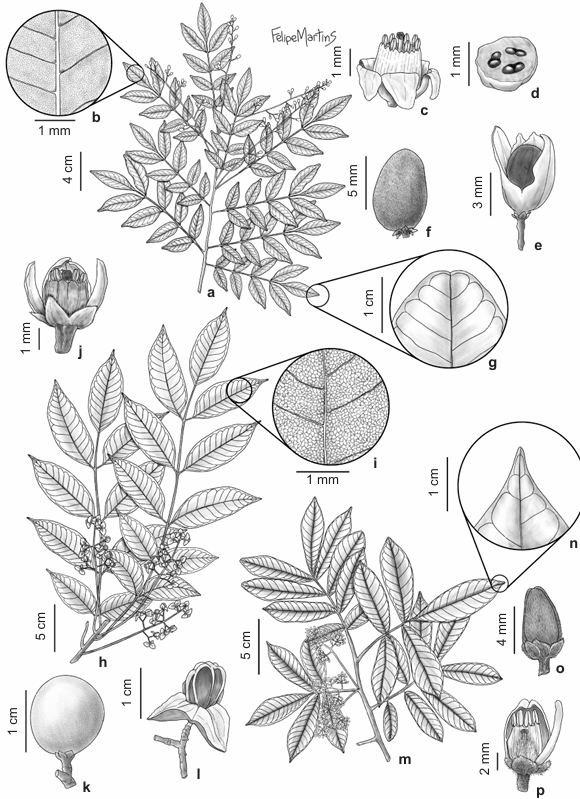
- a-d. Cedrela fissilis - a. branch with flowers; b. leaflet, trichomes in the abaxial surface; c. flower, external view; d. fruit. e-j. Cedrela odorata - e. branch with flowers; f. leaflet, glabrous in the abaxial surface; g. flower, external view; h. flower, longitudinal view; i. ovary, transversal view; j. immature fruit. k-o. Guarea guidonia - k. branch with flowers and fruits; l. lenticel branch; m. flower, staminal tube; n. ovary, transversal view; o. immature fruit. {a-c. Matos (EAC 6897, TEPB); d. M.I.B. Loiola et al. 1972 (EAC); e-i. M.E.S. Barros 01 (EAC); j. P. Souza et al. 11000 (EAC); k-o. M.E.S. Barros 03 (EAC)}.
1.2. Cedrela odorata L., Syst. Nat. (ed. 10), 2: 940. 1759. Figs. 1; 2e-j; 3a-f
Trees 5-15 m tall. Leaves 17-40 cm long; petiole 4-5 cm long, glabrous to sparse puberule; 10-12 leaflets, 7.5-14 × 3-4.5 cm, falcate to lanceolate, oblong or ovate, apex acuminate, base truncated, acute or rounded, abaxial surface glabrous; petiole 1-5 mm long. Thyrse ca. 30 cm long; pedicel 1-3 mm long; calyx with 1 longitudinal slit; dialipetalous corolla, 6-7 × 1-2 mm, external and internal surface pubescent; stamens 2.5-3 mm long; androgynophore 3.6-4 mm long. Capsule 3-4.5 × 1.8-2.5 cm, oblong, pericarp ca. 1 mm thick.
Examined material: Aiuaba, Estação Ecológica, 06°39’58”S, 40°10’54”W, 12.XII.1996, fl., M.I.B. Loiola et al. 252 (EAC). Capistrano, Serra de Baturité, 5.VIII.1993, fr., J.B.L. de Pontes Medeiros (EAC 21523). Fortaleza, Campus do Pici, 03º74’18”S, 38°57’61”W, 28.II.2023, fl., M.E.S. Barros 01 (EAC); 6.VI.2023, fr., M.E.S. Barros 02 (EAC). Madalena, Serrinha dos Paulinos, 12.XI.2008, fr., R.G. Ferreira 02 (EAC). Maranguape, 22.II.2001, fl., G.N. Maia (EAC 30458). Mulungu, Sítio Jardim, 04°17’07”S, 39°00’38”W, 19.I.2003, A. Silveira & R.F. Oliveira 635 (EAC). Novo Oriente, Planalto da Ibiapaba, 10.VII.1990, fr., F.S. Araújo 105 (EAC). Poranga, Ibiapaba do Norte, 21.V.1997, M.A. Figueiredo & José Augusto (EAC 25854). Quixeramobim, Serra Alta, 6.V.1997, fr., M.A. Figueiredo (EAC 25493). Santa Quitéria, Serra dos Quirino ou dos Pajeú, 04°33’36”S, 39°41’28”W, 26.IV.2012, fr., J.P. Souza et al. 11000 (EAC). Trairi, Gameleira, 27.II,2001, fl., A.S.F. Castro 945 (EAC).
Cedrela odorata differs from C. fissilis by having leaflets with a glabrous abaxial face (vs. pubescent with trichomes concentrated on the veins), dialipetalous corolla (vs. gamopetalous), capsule measuring 3-4.5 × 1.8-2.5 cm (vs. 5-7.5 × 2-2.5 cm) and pericarp ca. 1 mm thick (vs. 2-3 mm).
The species has a wide distribution in the Neotropical region. It occurs from Central America, the Caribbean and into South America, reaching as far as northern Argentina (Carvalho 2010). In Brazil, it occurs in the Northern, Northeastern, Mid-Western and Southeastern regions in the Amazon, Caatinga, Cerrado and Atlantic Forest phytogeographic domains (Flores 2023). In the state of Ceará, the species was recorded in 11 municipalities in the Coastal Zone Vegetation Complex (Mata de Tabuleiro), Semideciduous Seasonal Forest and Steppic Savanna. The species occurs in the Aiuaba Ecological Station and has high commercial value, being excessively exploited throughout its distribution, which has caused a decline of 30% over three generations, indicating the species as Vulnerable (CNCFlora 2013).
Cedrela odorata is collected with flowers from February to December and with fruits from April to November.
Cedrela odorata wood is one of the best in Brazil for use in joinery, carpentry, interior decoration, luxury furniture or export (Carvalho 2010). The seeds are sought after by artisans to make jewelry and ornaments (Carvalho 2010). The leaves and bark have astringent, anti-rheumatic and antimalarial properties, being used medicinally to relieve body aches, cure colds and flu, and reduce fevers. In some locations, the bark is boiled to treat bruises (Carvalho 2010).
The vernacular name for this species is Cedro.
2.1. Guarea guidonia (L.) Sleumer, Taxon 5(8): 194. 1956. Figs. 1; 2k-o; 3g-i

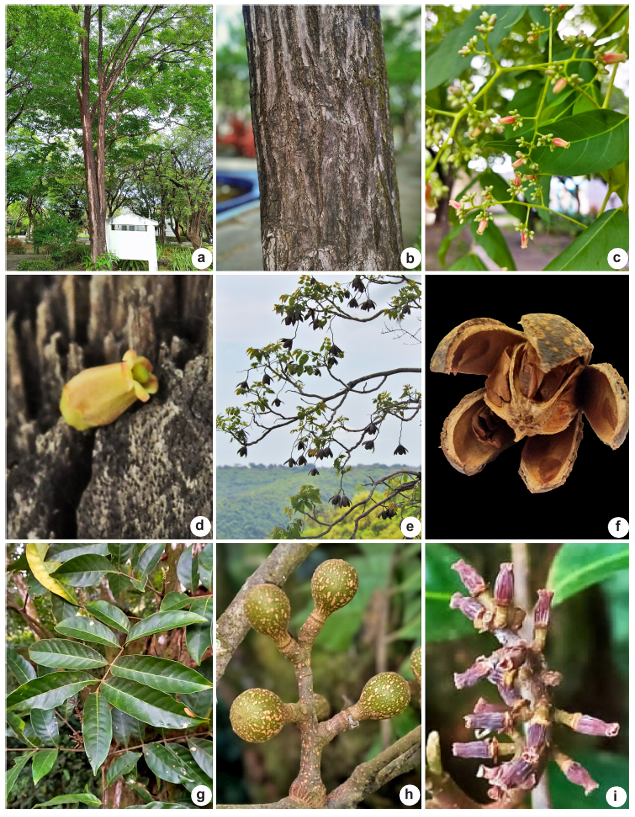
- a-f. Cedrela odorata - a. habit; b. stem detail; c. inflorescence; d. flower; e. branches with leaves and fruits; f. fruit. g-i. Guarea guidonia - g. leaf; h. immature fruits; i. inflorescence. (Photos: a-c, f, g, i. M.E.S. Barros; d, e. R.T.Queiroz; h. M.I.B. Loiola).
Trees 5-10 m tall, branches with conspicuous lenticels. Leaves 17-35 cm long, spotless; petiole 3.5-8.5 cm long, semi-cylindrical; 12-18 leaflets, 7.5-20 × 4-7.5 cm, opposite to subopposite, elliptical, oblong, or lanceolate, apex acute or acuminate, base cuneate or attenuated, abaxial surface glabrous; petiole 3-7 mm long, canaliculate. Thyrse 11-17 cm long, axillary, narrow to wide pyramidal, pubescent; pedicel 0.4-1 mm long; calyx 3-7 lobes; valvate corolla, 4-5 petals, 4.5-7 × 1-2 mm, external surface puberulate to pubescent, internal surface glabrous or papillose; stamens 8, completely fused into the staminal tube; stipitate nectary; ovary ca. 1.2 mm long, 4-locular, 1 ovule per locule, abortive ovule. Loculicidal capsule, 3-4-valve, 1.4-2.2 × 1.5-2 cm, globose to obovate, glabrous and lenticellate; seeds with a thin sarcotesta.
Examined material: Crato, Granjeiro, 25.III.1936, fr., P. Luetzelburg 25873A (EAC). Frecheirinha, Sítio Cangote, 03°40’58”S, 40°52’40”W, 6.VI.2012, fl. and fr., M.I.B. Loiola et al. 1841 (EAC). Graça, Sítio Santa Clara, 03°57’19.5”S, 40°49’14.7”W, 18.VI.2017, fl. and fr., F.F. Araújo 225 (EAC, HUEFS). Guaramiranga, Serra de Baturité, 04°15’53”S, 38°55’54”W, 8.VII.2023, fl. and fr., M.E.S. Barros 03 (EAC); 9.IX.1989, fr., M.A. Figueiredo et al. (EAC 17029). Itapipoca, Comunidade Quilombola de Nazaré, 03°34’01”S, 39°32’49”W, 10.XII.2017, fl. and fr., J.C.M.S.M. Sobczak 764 (EAC).
Guarea guidonia is an easily recognized species and its striking characteristics are branches with conspicuous lenticels, stamens 8, ovary with 1 ovule per locule, loculicidal capsule, 3-4-valvar, glabrous and lenticellate.
The species has records in Nicaragua, Costa Rica and Panama, Paraguay, northern Argentina and the Greater Antilles (Pennington et al. 2013). In Brazil, it occurs from the Amazon region to Rio de Janeiro, Minas Gerais, São Paulo and Mato Grosso do Sul, in various forest formations, in the Amazon, Caatinga, Cerrado and Atlantic Forest phytogeographic domains (Flores 2023). In the state of Ceará, Guarea guidonia was recorded in five municipalities in Semideciduous Seasonal Forest, Dense Ombrophilous Forest and Steppic Savanna.
Guarea guidonia is collected with flowers from June to December and with fruits from March to December.
Guarea guidonia wood is used in civil and naval construction and carpentry (Lorenzi 1992). The species is ornamental and used in rural and urban landscaping (Lorenzi 1992). The leaves are considered toxic to livestock, and the fruits are sought after by several species of fauna, facilitating dissemination (Lorenzi 1992).
The vernacular names for this species are Jitó or Cedrão.
3. Trichilia P. Browne, Civ. Nat. Hist. Jamaica 278. 1756.
Trees or shrubs, leaves imparipinnate, paripinnate or trifoliate, opposite, subopposite or alternate and compound. Axillary tyrse. Unisexual flowers, dioecious plants, dialipetalous; gamosepalous calyx, lobed; corolla with 4-5 free or partially united petals, valvate or imbricate prefloration; stamens 8-10, free or forming a staminal tube, partially or completely united threads, inserted between the lobes of the calyx or at the margin of the staminal tube; anther without dehiscence and without pollen; ring nectary surrounding the base of the ovary; trilocular ovary, locules 1-2 ovulate. Loculicidal capsule, 2-3-valve, cylindrical or trigone, smooth, velutinous or tomentose; fleshy seeds, partially or completely surrounded by aril.
Trichilia species can be recognized by the presence of a staminal tube with partially or completely joined fillets and a loculicidal, with 2-3-valve, smooth, velutinous, or tomentose capsule. The greatest occurrence of the genus is in the Neotropical region with more than 100 species (Pennington 2016). There are 53 species of Trichilia in Brazil, four of which were recorded in Ceará: T. elegans A. Juss, Trichilia emarginata (Turcz) C. DC., Trichilia hirta L. and Trichilia ramalhoi Rizzini (Flores 2023) occurring in Semideciduous Seasonal Forest, Dense Ombrophilous Forest, Steppic Savanna and Vegetation under Fluvial and/or Lacustrine Influence. Trichilia ramalhoi is classified as vulnerable (VU) according to CNCFlora (2013).

- a-f. Trichilia elegans - a. branch with flowers; b. leaflet, domatia in the abaxial surface; c. flower, staminal tube; d. ovary, transversal view; e-f. immature fruits. g. Trichilia emarginata - apex of leaflet; h-l. Trichilia hirta - h. branch with fruits; i. leaflet, glabrous in the abaxial surface; j. flower, staminal tube; k-l. fruits. m-p. Trichilia ramalhoi - m. branch with flowers; n. apex of leaflet; o. flower, external view; p. flower, internal view. {a-d. E.M.P. Lucena et al. 233 (EAC); e-f. E.M.P. Lucena et al. 82 (EAC); g. V. Gomes & A. Xavier 2009 (EAC); h-i, k-l. A.S.F. Castro 2765 (EAC); j. A. Fernandes & P. Bezerra (EAC 5009); m-p. M.R. Oliveira (EAC 20973)}.
3.1. Trichilia elegans A. Juss. Fl. bras. Merid. 2(12): 79, pl. 98. 1829. Figs. 1; 4a-f; 5a-c
Shrub 2 m tall. Leaves 15-30 cm long, unpaired, paripinnate or trifoliate; petiole 2-5 cm long; 5-7 leaflets, 4.5-8 × 1.8-4 cm, opposite to subopposite, lanceolate, oblong or elliptical, obtuse or rounded acuminate apex, acute, cuneate or attenuated base, glabrous abaxial surface with tufts of trichomes restricted to the axils of the secondary veins (domatia); petiole 2-11 mm long. Thyrse 8-14 cm long; pedicel 2-3 mm long; calyx with free sepals at the apex; imbricate corolla, petals 5, with 2-3.5 × 0.8-1.6 mm, external and internal surfaces papillose; stamens 10, with fillets joined almost to the apex of the stamen tube; ring nectary fused to the base of the ovary; ovary ca. 1 mm long, with 2 ovules per locule. Capsule 0.4-0.8 × 0.7-1.2 cm, ellipsoid to cylindrical, velutinous; persistent sepals on the fruit; seeds partially surrounded by aril.
Examined material: Barbalha, Flona do Araripe, ICMBio, 07°23’01”S, 39°21’15”W, 13.X.2014, fl., V.M. Mascena 224 (EAC). Caucaia, Parque Estadual Botânico do Ceará, 03°42’31”S, 38°38’33”W, 20.IV.2018, fr., E.M.P. Lucena et al. 82 (EAC); 03°42’49”S, 38°38’31”W, 24.VIII.2018, fl., E.M.P. Lucena et al.233 (EAC). Crateús, RPPN Serra das Almas, 28.II.2005, fr., J.R. Lima 31 (EAC). Crato, Flona do Araripe, 18.I.2005, fr., F.S. Cavalcanti 933 (EAC). Fortaleza, Campus do Pici, 21.X.1976, fl., L. de Almeida (EAC 2933). Jardim, Horizonte, Cacimbas, 7.I.2010, fr., A.S.F. Castro 2245 (EAC). Novo Oriente, Planalto da Ibiapaba, Estrondo, 3.VIII.1990, fr., F.S. Araújo 140 (EAC).
Trichilia elegans is similar to T. hirta in that it shares a staminal tube with partially joined fillets and a velutinous capsule. However, it differs from this species in that it has leaflets with an abaxial face with tufts of trichomes restricted to the axils of the secondary veins (domatia) (vs. leaflets with a pubescent to glabrescent abaxial face), persistent sepals on the fruit (vs. deciduous) and ellipsoid to cylindrical capsule (vs. wide-ovoid, trigone).
The species occurs in Peru, Colombia, Venezuela, Ecuador, Bolivia, and Guyana (Pennington 2016). In Brazil, there are records in all regions in the Amazon, Caatinga, Cerrado and Atlantic Forest phytogeographic domain (Flores 2023). In the state of Ceará, Trichilia elegans was recorded in seven municipalities in Lowland Semideciduous Seasonal Forest, Dense Ombrophilous Forest, Semideciduous Seasonal Forest and Steppic Savanna. The species occurs in the Ceará Botanical State Park, Private Natural Heritage Reserve (PNHR) Serra das Almas and Araripe-Apodi National Forest.
Trichilia elegans is collected with flowers in August and October and with fruits from January to August.
The species is historically used in carpentry and joinery, as it has resistant and durable wood, and its bark is also used as a colorant in dyeing processes (Pott & Pott 1994).
There is no vernacular name registered for this species.
3.2. Trichilia emarginata (Turcz.) C. DC., in Mart., Fl. bras. 11(1): 212. 1878. Figs. 1; 4g
Trees or shrubs, 2.5-13 m tall. Leaves 8-13 cm long, unpaired or paripinnate; petiole 0.5-1.2 cm long; 5-11 leaflets, 4-7.5 × 1.5-3 cm, alternate to opposite, elliptical, oblong or obovate, apex emarginate, base attenuated, abaxial surface glabrescent, with trichomes concentrated on the veins, central vein prominent on both sides; petiole 2-14 mm long. Thyrse 3.5-11 cm long; pedicel 0.5-1 mm long; gamosepalous calyx; dialipetalous, valvate corolla, 4-5 petals, 2-3.5 × 1-1.5 mm, external and internal surfaces subglabrous; stamens 8-10, with fillets fully joined together forming a tube; nectary absent; ovary ca. 0.8 mm long, with 2 ovules per locule. Capsule 1.5-1.8 × 0.7-1 cm, tomentose; deciduous sepals on the fruit; seeds completely covered by an aril.
Examined material: Mulungu, Sítio Jardim, 04°17’10”S, 39°00’38”W, 20.IX.2004, V. Gomes & A. Xavier 2009 (EAC). Crateús, RPPN Serra das Almas, 19.IX.2002, fl., F.S. Araújo & L.C. Girão 1598 (EAC, HUEFS).
Additional material: BRAZIL. PERNAMBUCO: Calumbi, Serra das Areias, 08°06’40”S, 38°00’43”W, 23.IV.2019, fr., A.P. Fontana & P.R.A. Souza (HUEFS 237859); Serrolândia, Ipubi, 21.V.2018, fr., W.B. Santos 5322 (HST).
Trichilia emarginata is similar to T. ramalhoi in that it shares a staminal tube with fully united fillets, differing from the latter in its leaflets with an emarginate apex (vs. acuminate) and dialipetalous corolla (vs. gamopetalous).
The species occurs in Bahia, Ceará, Espírito Santo, Maranhão, Minas Gerais, Paraíba, Pernambuco, Rio de Janeiro, and São Paulo, in the Caatinga, Cerrado and Atlantic Forest phytogeographic domains (Flores 2023). In the state of Ceará, Trichilia emarginata was recorded in two municipalities in Semideciduous Seasonal Forest. The species occurs in the PNHR Serra das Almas and is classified as Least Concern (CNCFlora 2013).
The species is collected with flowers in September and with fruits in April and May.
Trichilia emarginata has medicinal properties, being used in folk medicine to treat respiratory diseases, such as bronchitis, asthma, and gastrointestinal disorders, such as diarrhea and worms (Lorenzi & Matos 2002). Anti-inflammatory, healing and antirheumatic action is also attributed to this species (Lorenzi & Matos 2002).
There is no vernacular name registered for this species.
3.3. Trichilia hirta L., Syst. Nat. 2: 1020. 1759. Figs. 1; 4h-l; 5d-f
Tree or subshrub 3.5-4 m tall. Leaves 18-37 cm long, spotless; petiole 2-8 cm long; 7-15 leaflets, 4-10 × 1.5-4 cm, opposite to subopposite, oblong, elliptical or lanceolate, apex attenuated to long acuminate, base cuneate, obtuse or acute, abaxial surface pubescent to glabrous on the veins; petiole 1-23 mm long. Thyrse 2-21 cm long; pedicel 0.4-3 mm long; gamosepalous calyx, glabrous sepals; dialipetalous corolla, imbricate, petals 5, with 3-5 × 0.8-1.5 mm, external and internal surfaces glabrous to rarely pubescent; stamens 10, with fillets partially joined together forming a tube; small ring nectary; ovary ca. 1 mm long, 1-2 ovules per locule. Capsule 0.5-1.2 × 0.6-0.8 cm, wide-ovoid or trigone, velutinous; deciduous sepals on the fruit; seeds surrounded by a thin aril.
Examined material: Canindé, 8.IX.2013, fr., A.S.F. Castro 2765 (EAC). Madalena, Gruta Casa de Pedra, 04°44’42”S, 39°42’11”W, 10.VI.2018, fr., E.D. Lozano et al. 4186 (EAC, MBM, RB). Quixadá, Fazenda Palmeira, 05°03’12”S, 39°06’50”W, 5.IX.2017, fr., E.D. Lozano et al. 3789 (EAC, MBM). Ubajara, sede do Parque Nacional, 23.IX.1978, fl., A. Fernandes & P. Bezerra (EAC 5009).
Additional material: BRAZIL. PERNAMBUCO: Saco do Romão, Tacaratu, 09°06’57”S, 38°10’50”W, 20.I.2010, fl. and fr., M. Oliveira et al. 4618 (HVASF); São Lourenço da Mata, Estação Ecológica do Tapacurá, 08°00’46”S, 34°57’01”W, 6.V.2000, fr., K. Almeida & L. Figuirêdo 46 (NY).
Trichilia hirta differs from T. elegans by having leaflets with a pubescent to glabrous abaxial face (vs. abaxial face with tufts of trichomes restricted to the axils of the secondary veins - domatia), deciduous sepals on the fruit (vs. persistent) and wide-ovoid or trigone capsules (vs. ellipsoid to cylindrical).
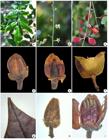
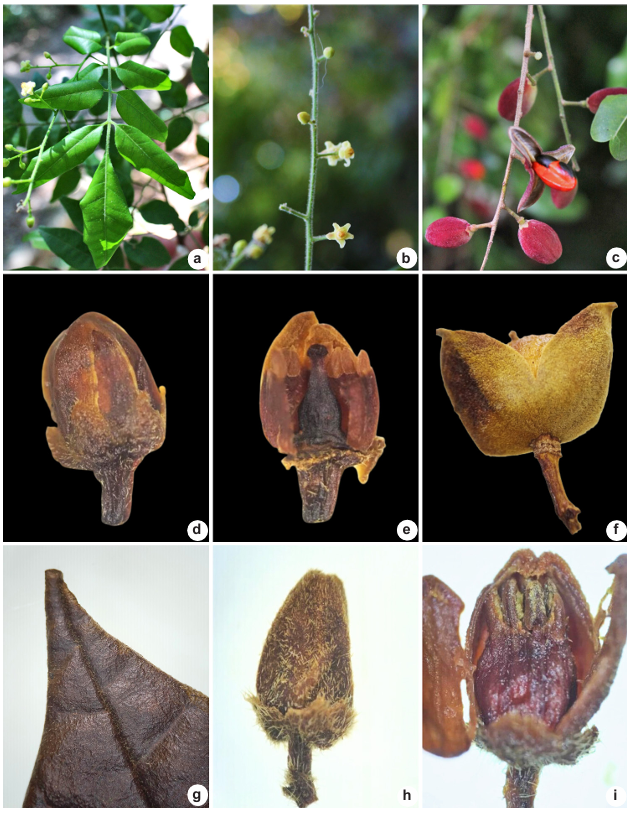
- a-c. Trichilia elegans - a. leaf; b. inflorescence; c. fruit; d-f. T. hirta - d. flower bud, external view; e. staminal tube, internal view; f. fruit; g-i. T. ramalhoi - g. apex of leaflet; h. flower; staminal tube, external view; i. staminal tube with fillets fully joined. {Photos: a-c. V.S. Sampaio; d-e. A. Fernandes & P. Bezerra (EAC 5009); f. A.S.F. Castro 2765 (EAC); g-i. M.A. Figueiredo 521 (EAC)}.
The species occurs from Central America, the Caribbean and into South America (Pennington 2016). In Brazil, it occurs in the Northeastern, Mid-Western, Southeastern and Southern regions, in the Amazon, Caatinga, Cerrado and Atlantic Forest (Flores 2023). In the state of Ceará, Trichilia hirta was recorded in two municipalities in Dense Ombrophilous Forest and Steppic Savanna, classified as Least Concern (CNCFlora 2013).
Trichilia hirta is collected with flowers in January and September and with fruits from January to September.
According to Lorenzi (1992), Trichilia hirta wood is used in external building work, carpentry and carpentry, and the fruits are avidly consumed by several species of birds. Also, according to this author, it is an ornamental species, used in landscaping, mainly in street afforestation and recommended for planting in degraded areas.
There is no vernacular name registered for this species.
3.4. Trichilia ramalhoiRizzini, Leandra 4/5: 11. 1974. Figs. 1; 4m-p; 5g-i
Trees 7-9 m tall. Leaves 5-18 cm long, spotless; petiole 2-5 cm long; 5-9 leaflets, 5-13 × 2-5 cm, 1 pair of leaflets reduced at the base of the petiole, alternate to opposite, oblong, elliptical or oblanceolate, apex acuminate to rounded mucronate, base acute to attenuate, abaxial surface tomentose, margin revolute, main and secondary ribs grooved on the adaxial surface and prominent on the abaxial surface; petiole 0-5 mm long. Thyrse 3.5-9 cm long; pedicel 2-3.3 mm long; gamosepalous calyx; gamopetalous, valvate corolla, external surface tomentose, internal surface papillose; stamens 9-10, with fillets fully joined together forming a tube; nectary absent; ovary ca. 0.9 mm long, tomentose, with 2 ovules per locule. Capsule 0.7-2.5 × 1.2-1.4 cm, globose to ovoid, tomentose; deciduous sepals on the fruit; seeds almost surrounded by a fleshy aril.
Examined material: Aratuba, Sítio Brejo, 14.V.1980, fl., E. Nunes & P. Martins (EAC 8613, JPB 43189). Guaramiranga, Sítio Cana Brava, 30.IV.1994, fl., M.R. Oliveira (EAC 20973); 17.IV.1994, fr., M.A. Figueiredo 521 (EAC); Serra de Baturité, Pico Alto, 17.VIII.1908, fr., A. Ducke (INPA 12106).
Trichilia ramalhoi is similar to T. emarginata in that they share a staminal tube with fully united fillets, but it differs from the latter in having leaflets with main and secondary ribs grooved on the adaxial surface (vs. prominent central vein on both sides), leaflets with an acuminate apex (vs. prominent central vein on both sides), leaflets with an acuminate apex (vs. emarginate) and gamopetalous corolla (vs. dialipetalous).
Trichila ramalhoi is endemic to Brazil and is recorded in the Northeastern and Southeastern regions of the Atlantic Forest (Flores 2023). In Ceará, this species was recorded in only two municipalities in Dense Ombrophilous Forest, classified as Near Threatened (CNCFlora 2013).
The species is collected with flowers in April and May and with fruits in April and August.
The species has insecticidal, antimicrobial, antidiarrheal, antifungal and antiviral activity (Arantes 2021).
The vernacular name for this species is Jitó preto.
Acknowledgements
We are grateful for the funding grant awarded by CNPq to the first author. LMS is grateful to CAPES (Coordenação de Aperfeiçoamento de Pessoal de Nível Superior), for the schorlaship (Financial Code 001). FDSS thanks FUNCAP, for the postdoc scholarship granted (Process 150120/2023-0). MIBL thanks CNPq, for the research productivity scholarship granted (Process 306723/2023-9) and FUNCAP (Edital Mulheres na Ciência - Process MLC-0191-00147.01.00/22).
Data availability statement
In accordance with Open Science communication practices, the authors inform that all data are available within the manuscript.
References
- 1 Arantes MBS (2021) Constituintes químicos e atividade inseticida de Trichilia ramalhoi Rizzini (Meliaceae). Dissertação de Mestrado. Universidade Estadual do Norte Fluminense Darcy Ribeiro, Rio de Janeiro. 151p.
-
2 Browne P (1756) The civil and natural history of Jamaica. T. Osborne and J. Shipton, London. 237p. Available at https://www.biodiversitylibrary.org/page/11267509 Access on 13 January 2023.
» https://www.biodiversitylibrary.org/page/11267509 - 3 Candolle AC (1878) Meliaceae. In: Martius CFP & Urban I (eds.) Flora brasiliensis. Fleischer, Liepizig. Vol. 11, pars 1, pp. 165-228, t. 50-65.
- 4 Carvalho PER (2010) Espécies arbóreas brasileiras. Vol. 4. Embrapa Florestas, Colombo. Pp. 163-174.
- 5 Castro ASF, Moro MF & Menezes MOT (2012) O complexo vegetacional da zona litorânea no Ceará: Pecém, São Gonçalo do Amarante. Acta Botanica Brasilica 26: 108-124.
- 6 Cervi AC, Von Linsingen L & Patrício PC (2008) O gênero Cedrela P. Browne (Meliaceae) no sul do Brasil. Acta Biológica Paranaense 37: 105-110.
-
7 CNCFlora - Centro Nacional de Conservação da Flora (2013) Meliaceae in Lista Vermelha da flora brasileira. Versão 2012.2. Available at http://www.cncflora.jbrj.gov.br/portal/pt-br/listavermelha/MELIACEAE . Access on 3 March 2023.
» http://www.cncflora.jbrj.gov.br/portal/pt-br/listavermelha/MELIACEAE - 8 Cortez DAG, Cortez LER, Nakamura TU & Nakamura CV (1998) Atividade antibacteriana de extratos do caule de Cedrela fissilis (Meliaceae). Acta Scientiarum 20: 243-245.
- 9 Costa IR, Araújo FS & Lima-Verde LW (2004) Flora e aspectos auto-ecológicos de um encrave de cerrado na chapada do Araripe, nordeste do Brasil. Acta Botanica Brasilica 18: 759-770.
-
10 CRIA - Centro de Referência em Informação Ambiental (2023a) speciesLink. Available at https://specieslink.net/search/ . Access on 3 February 2023.
» https://specieslink.net/search/ -
11 CRIA - Centro de Referência em Informação Ambiental (2023b) Geoloc. Available at http://splink.cria.org.br/geoloc?criaLANG=pt Access on 23 march 2023.
» http://splink.cria.org.br/geoloc?criaLANG=pt - 12 Daly DC & Silveira M (2008) Primeiro catálogo da flora do Acre, Brasil. Ed. EDUFAC, Rio Branco. 261p.
- 13 Fernandes-Júnior AJ, Nunes CS & Gil ASB (2017) Flora das Cangas da Serra dos Carajás, Pará, Brasil: Meliaceae. Rodriguésia 68: 1035-1039.
- 14 Figueiredo MA (1997) A cobertura vegetal do Ceará: unidades fitoecológicas. In: Governo do Ceará (ed.) Atlas do Ceará. Vol. 1. Edições IPLANCE, Fortaleza. Pp. 28-29.
- 15 Flores TB, Souza CV & Coelho RLG (2017) Flora do Espírito Santo: Meliaceae. Rodriguésia 68: 1694-1696.
-
16 Flores TB (2023) Meliaceae in Flora e Funga do Brasil (continuously updated). Jardim Botânico do Rio de Janeiro. Available at https://floradobrasil.jbrj.gov.br/FB9995 Access on 1 March 2023.
» https://floradobrasil.jbrj.gov.br/FB9995 - 17 Franco IJ & Fontana VL (1997) Ervas & plantas: a medicina dos simples. Imprimax, Erechim. 177p.
-
18 Governo do Ceará (2020) Ceará em números 2020. Fortaleza, Instituto de Pesquisa e Estratégia Econômica do Ceará. Available at https://www.ceara.gov.br/2010/03/13/ceara-em-numeros/#:~:text=Das%20mais%20de%208%20milh%C3%B5es,t%C3%AAm%20acesso%20%C3%A0%20%C3%A1gua%20tratada . Access on 20 May 2024.
» https://www.ceara.gov.br/2010/03/13/ceara-em-numeros/#:~:text=Das%20mais%20de%208%20milh%C3%B5es,t%C3%AAm%20acesso%20%C3%A0%20%C3%A1gua%20tratada -
19 Governo do Ceará (2022) Ceará em números 2022. Fortaleza, Instituto de Pesquisa e Estratégia Econômica do Ceará. Available at https://www.ipece.ce.gov.br/wp-content/uploads/sites/45/2023/12/Ceara_em_Numeros_2022.pdf Access on 20 May 2024.
» https://www.ipece.ce.gov.br/wp-content/uploads/sites/45/2023/12/Ceara_em_Numeros_2022.pdf - 20 Harris JG & Harris MV (2001) Plant identification terminology: an illustrated glossary. 2nd ed. Spring Lake Publishing, Spring Lake. 216p.
-
21 IBGE - Instituto Brasileiro de Geografia e Estatística (2012) Manual técnico da vegetação brasileira. 2nd ed. Available at ftp://geoftp.ibge.gov.br/documentos/recursos _naturais/manuais_tecnicos/manual_tecnic_vegetacao_brasileira.pdf Access on 22 December 2022.
» ftp://geoftp.ibge.gov.br/documentos/recursos _naturais/manuais_tecnicos/manual_tecnic_vegetacao_brasileira.pdf -
22 IPNI - International Plant Names Index (2023). International Plant Names Index. Available at http://www.ipni.org Access on 26 March 2023.
» http://www.ipni.org -
23 Jussieu AL (1789) Genera Plantarum secundum ordines naturales disposita, juxta methodum in Horto regio parisiensi exaratam. Theophilum Barrois, Paris. Pp. 263. Available at https://www.biodiversitylibrary.org/item/7125#page/1/mode/1up . Access on 1 March 2023.
» https://www.biodiversitylibrary.org/item/7125#page/1/mode/1up - 24 Kenfack D (2011) A synoptic revision of Carapa (Meliaceae). Harvard Paper in Botany 16: 171-231.
- 25 Lemos RPL, Mota MCS, Chagas ECO & Silva FC (2010) Checklist Flora de Alagoas: Angiospermas. Instituto do Meio Ambiente de Alagoas, Maceió. 65p.
- 26 Linnaeus C (1759) Systema Naturae per Regna Tria Naturae. 10 ed. Vol. 2. Lauent Salvii, Stockholm. Pp. 1020.
- 27 Loiola MIB, Araújo FS, Lima-Verde LW, Souza SSG, Matias LQ, Menezes MOT, Silva MAP, Souza MMA, Mendonça CAM, Macedo MS, Oliveira SF, Sousa RS, Balcázard AL, Crepaldi CG, Campos LZO, Nascimento LGS, Cavalcanti MCBT, Oliveira RD, Silva TC & Albuquerque UP (2015) Flora da Chapada do Araripe. In: Albuquerque UP & Meiado MV (orgs.) Sociobiodiversidade na Chapada do Araripe. Vol. 1. NUPEEA, Recife. Pp. 103-148.
-
8 Loiola MIB, Ribeiro RTM, Sampaio VS & Souza EB (2020) Diversidade de angiospermas do Ceará. Edições HUVA, Sobral. 257p. Available at https://ww2.uva.ce.gov.br/apps/common/documentos_uva/ebook_4f67b7b91bb5b9c8d95c217a.pdf . Access on 9 November 2021.
» https://ww2.uva.ce.gov.br/apps/common/documentos_uva/ebook_4f67b7b91bb5b9c8d95c217a.pdf - 29 Lorenzi H (1992) Árvores brasileiras: manual de identificação e cultivo de plantas arbóreas nativas do Brasil. Ed. Plantarum, Nova Odessa. 242p.
- 30 Lorenzi H & Matos FJA (2002) Plantas medicinais no Brasil: nativas e exóticas cultivadas. Vol. 1. Instituto Plantarum, Nova Odessa. 542p.
- 31 Lorenzi H, Souza HM, Torres MAV & Bacher LB (2003) Árvores exóticas no Brasil - madeireiras, ornamentais e aromáticas. Ed. Plantarum, Nova Odessa. 385p.
- 32 Mori AS, Silva LAM, Lisboa G & Coradin L (1989) Manual de Manejo do Herbário Fanerogâmico. Centro de Pesquisas do Cacau, Itabuna. 97p.
- 33 Moro MF, Castro ASF & Araújo FS (2011) Composição florística e estrutura de um fragmento de vegetação savânica sobre os tabuleiros pré-litorâneos na zona urbana de Fortaleza, Ceará. Rodriguésia 62: 407-423.
- 34 Moro MF, Macedo MB, Moura-Fé MM, Castro ASF & Costa RC (2015) Vegetação, unidades fitoecológicas e diversidade paisagística do estado do Ceará. Rodriguésia 66: 717-743.
- 35 Nimer E (1972) Climatologia da Região Nordeste do Brasil: subsídios à geografia regional do Brasil. Revista Brasileira de Geografia 34: 5-51.
- 36 Oliveira TS & Araújo FS (2007) Diversidade e conservação da biota na Serra de Baturité, Ceará. Editora da Universidade Federal do Ceará, COELCE, Fortaleza. 465p.
- 37 Patrício PC & Cervi AC (2005) O gênero Trichilia P. Browne (Meliaceae) no estado do Paraná, Brasil. Acta Biológica Paranaense 34: 27-71.
- 38 Pennington TD & Styles BT (1975) A generic monograph of the Meliaceae. Blumea 22: 419-540.
- 39 Pennington TD, Styles BT & Taylor DAH (1981) Meliaceae. In: Flora Neotropica (org.) Monograph 28. New York Botanical Garden, New York. 470p.
- 40 Pennington TD (2006) Flora da Reserva Ducke, Amazonas, Brasil: Meliaceae. Rodriguésia 57: 207-246.
- 41 Pennington TD & Muellner AN (2010) A monograph of Cedrela (Meliaceae). Ed. DH Books. Milborne Port. 112p.
- 42 Pennington TD & Clarkson JJ (2013) A revision of Guarea (Meliaceae). Edinburgh Journal of Botany 70: 179-362.
- 43 Pennington TD (2016) Systematic treatment of American Trichilia (Meliaceae). Phytotaxa 259: 18-162.
- 44 Pirani JR (1992) Flora da Serra do Cipó, Minas Gerais: Meliaceae. Boletim de Botânica da Universidade de São Paulo 13: 219-233.
- 45 Pott A & Pott VJ (1994) Plantas do Pantanal. Embrapa-SPI, Embrapa-CPAP, Brasília. 320p.
- 46 Ribeiro-Silva S, Medeiros MB, Gomes BM, Naiana E, Seixas C & Silva MAP (2012) Angiosperms from the Araripe National Forest, Ceará, Brazil. Check List 8: 744-751.
-
47 Rizzini CT (1974) Leandra 4/5: 11. Available at https://www.ipni.org/n/579620-1 Access on 13 March 2023.
» https://www.ipni.org/n/579620-1 -
48 Saint-Hilaire A, Jussieu A & Cambessedes J (1829) Flora Brasiliae Meridionalis. Vol. 2. A. Belin Biopolam, Paris. 79p. Available at https://objdigital.bn.br/objdigital2/acervo_digital/div_obrasraras/or269508/or269508.pdf . Access on 1 March 2023.
» https://objdigital.bn.br/objdigital2/acervo_digital/div_obrasraras/or269508/or269508.pdf - 49 Silva SR, Medeiros MB, Gomes BM, Seixas ENC & Silva MAP (2012) Angiosperms from the Araripe National Forest, Ceará, Brazil. Check List 8: 744-751.
- 50 Silveira AP, Menezes BS, Loiola MIB, Lima-Verde LW, Zanina DN, Carvalho ECD, Souza BC, Costa RC, Mantovani W, Menezes MOT, Flores LMA, Nogueira FCB, Matias LQ, Barbosa LS, Gomes FM, Cordeiro LS, Sampaio VS, Batista MEP, Soares Neto RL, Silva MAP, Campos NB, Oliveira AA & Araújo FS (2020a) Flora and annual distribution of flowers and fruits in the Ubajara National Park, Ceará, Brazil. Floresta e Ambiente 27: e20190058.
- 51 Silveira AP, Loiola MIB, Gomes VS, Lima-Verde LW, Oliveira TS, Silva EF, Otutumi AT, Ribeiro K, Xavier FAS, Bruno MMA, Souza SSG & Araújo FS (2020b) Flora of Baturité, Ceará: a wet island in the Brazilian semiarid. Floresta e Ambiente 27: e20180320.
-
52 Sleumer HO (1956) Note on the genus Guidonia. Taxon 5: 192-194. Available at https://www.ipni.org/n/578618-1 Access on 13 January 2023.
» https://www.ipni.org/n/578618-1 - 53 Styles BT (1981) Meliaceae, Swietenioideae. In: TD Pennington (ed.) Flora Neotropica 28: 359-449.
-
54 Thiers B (continuously updated) Index Herbariorum: a global directory of public herbaria and associated staff. New York Botanical Garden’s Virtual Herbarium. Available at http://sweetgum.nybg.org/science/ih/ . Access on 23 March 2023.
» http://sweetgum.nybg.org/science/ih/ - 55 Vellozo JMC (1825) Florae Fluminensis. Vol. 1. Flumine Januario, Rio de Janeiro. 75p.