 Orchidaceae on the islands of Belém, Eastern Amazon, Brazil
Resumo
As ilhas amazônicas desempenham um papel fundamental na conservação de fragmentos florestais. Belém, capital do estado brasileiro do Pará, situada na Amazônia Oriental, é composta por 39 ilhas, que representam 66,6% de seu território e abrigam 67,4% dos fragmentos florestais da cidade. Neste estudo, realizamos um levantamento taxonômico de Orchidaceae em cinco ilhas (Caratateua, Cotijuba, Combu, Mosqueiro e Tatuoca) com base em expedições de campo realizadas de julho de 2024 a dezembro de 2025, complementadas pela análise de coleções de herbários (HBRA, HCP, HF, HIFPA, HSTM, IAN, MFS, e MG) e bancos de dados online. Apresentamos descrições das espécies, notas taxonômicas e ecológicas, dados de distribuição geográfica, fotografias e uma chave de identificação para as espécies. Registramos 23 gêneros e 34 espécies, sendo Maxillaria (cinco spp.) e Epidendrum (quatro spp.) os gêneros mais ricos em espécies. A riqueza de espécies foi maior na floresta de terra firme (29 spp.). Entre as ilhas, Mosqueiro apresentou a maior riqueza (25 espécies), seguida por Cotijuba (19 spp.), Combu (12 spp.), Caratateua (dez spp.) e Tatuoca (sete spp.). Destacamos que a expansão da monocultura de Euterpe oleracea (açaí) e o aumento do desmatamento ameaçam a vegetação nativa e podem levar à diminuição da riqueza de espécies nessas ilhas.
Palavras-chave:
biodiversidade; epífitas; região insular; orquídeas; taxonomia
Abstract
Amazonian islands play a key role in the conservation of forest fragments. Belém, the capital of the Brazilian state of Pará, located in the Eastern Amazon, comprises 39 islands, which account for 66.6% of its territory and harbor 67.4% of the city’s forest fragments. In this study, we conducted a taxonomic survey of Orchidaceae on five islands (Caratateua, Cotijuba, Combu, Mosqueiro, and Tatuoca) based on field expeditions carried out from July 2024 to December 2025 and complemented by the examination of herbarium collections (HBRA, HCP, HF, HIFPA, HSTM, IAN, MFS, and MG) and online databases. We provide species descriptions, taxonomic and ecological notes, geographic distribution data, photographs, and an identification key for the species. We recorded 23 genera and 34 species, with Maxillaria (five spp.) and Epidendrum (four spp.) as the most species-rich genera. Species richness was highest in terra firme forest (29 spp.). Among the islands, Mosqueiro showed the greatest richness (25 spp.), followed by Cotijuba (19 spp.), Combu (12 spp.), Caratateua (ten spp.) and Tatuoca (seven spp.). We highlight that the expansion of Euterpe oleracea (açaí) monoculture and increasing deforestation threaten native vegetation and may lead to declines in species richness on these islands.
Key words:
biodiversity; epiphytes; insular region; orchids; taxonomy
Introduction
Islands are environmentally, historically, scientifically, economically, and culturally important to Amazonian peoples (Silveira et al. 2012; Alencar & Carvalho 2019). They also play a key role in the conservation and protection of forest remnants and regional biodiversity (Silva et al. 2021; Llorente-Culebras et al. 2024). The state of Pará, located mostly within the Amazon phytogeographic domain, has the largest number of islands and islets in Brazil: 150 and 427, respectively (Marchesi et al. 2024). In Belém, the state capital and one of the largest metropolises in the Amazon, islands account for 66.6% of the territory and encompass 67.4% of the city’s forest fragments (Ferreira et al. 2012).
Despite the territorial extent and forest cover of Belém islands compared to the continental region, biodiversity studies remain limited and taxonomically restricted, focusing primarily on bryophytes, ferns, and fungi (Castro et al. 2012; Ferreira et al. 2012; Quaresma & Jardim 2012; Santos Junior & Jardim 2017). Notably, comprehensive studies on Orchidaceae in these islands are lacking, and the family Orchidaceae is generally underrepresented in floristic surveys. This is so mainly because many species are epiphytic, making access and identification challenging (Medeiros et al. 2009; Koch et al. 2014).
In Pará, Orchidaceae is represented by 98 genera and 434 species, many of them with ornamental value (Luz et al. 2024) or potential to be used as indicators of ecological integrity and conservation or anthropization of environments, given their sensitivity to environmental changes (Castellanos-Castro & Torres-Morales 2018; Mirioba et al. 2024). Among the islands of Belém, Combu Island - designated as an Environmental Protection Area - is the most well studied. Although several Orchidaceae species lists have been presented for the island (Cardoso et al. 1995; Medeiros et al. 2009; Medeiros & Jardim 2011; Medeiros et al. 2013), corresponding voucher specimens were not located in herbaria, precluding the confirmation of these occurrence records.
Thus, considering the fundamental importance of islands in the conservation and maintenance of Amazonian biodiversity and anthropogenic pressures from vegetation loss, disorderly land use, tourism, and climate change (Silva et al. 2021), we present a floristic-taxonomic study of Orchidaceae of the five main islands of Belém: Caratateua, Cotijuba, Combu, Mosqueiro, and Tatuoca. We provide an identification key, morphological descriptions, photographs, geographic distribution data, and information on habitat and phenology of the species, thereby contributing to a more comprehensive understanding of the biodiversity of Islands of Belém.
Materials and Methods
Study area
Belém is located in the state of Pará, Brazil, in the Eastern Amazon, and comprises 39 islands (Silva et al. 2012). The islands of Caratateua, Cotijuba, Combu, Mosqueiro, and Tatuoca were selected for the present study by their environmental, scientific, cultural, and historical importance for regional development (Fig. 1a-e) (Ferreira et al. 2012). The five represent 44% of the insular territory of Belém. They share a similar geomorphological origin associated with glacial periods, as evidenced by barrier and post-barrier sedimentation (Silva et al. 2012). The predominant vegetation types in these islands are terra firme forest, várzea forest, igapó forest, flooded fields, Amazonian campinarana, and mangroves (Fig. 2a-f).

a-e. Location map of the five islands studied in Belém, state of Pará, Eastern Amazon - a. Cotijuba Island; b. Tatuoca Island; c. Mosqueiro Island; d. Combu Island; e. Caratateua Island.

a-f. Vegetation of the islands of Belém, state of Pará, Eastern Amazon - a. Terra firme forest; b. Várzea forest; c. Igapó forest; d. Mangrove; e. Flooded field; f. Amazonian campinarana. Photographs by M.C. Oliveira.
Data collection and processing
Field expeditions were carried out from June 2024 to December 2025 using the walking method (Filgueiras et al. 1994). Herbarium collections were examined in person at HBRA, HCP, HF, HIFPA, HSTM, IAN, MFS, and MG (acronyms according to Thiers, continuously updated), as well at INPA, RB and UB through online databases (CRIA 2026; Reflora 2026). Fertile specimens were collected, herborized, and deposited in the HF, IAN and MG herbaria. Sterile specimens were kept under cultivation at the Botany Department of the Museu Paraense Emílio Goeldi until flowering, after which they were processed for herbarium deposition. Morphological descriptions were standardized using the DELTA software (DEscription Language for TAxonomy; Dallwitz et al. 2020). Morphological characters were described based on examined material and specialized literature [vegetative: Harris & Harris (1995) and Beentje (2010); reproductive: Dressler (1981; 1993) and Pridgeon et al. (1999)]. Accepted nomenclature for species, authorship, and geographic distribution follow Flora e Funga do Brasil 2026 (continuously updated) and POWO (2026).
Results and Discussion
Orchidaceae is represented by 23 genera and 34 species across the five studied islands of Belém (Fig. 3). The most species-rich genera were Maxillaria Ruiz & Pav. (five spp.) and Epidendrum L. (four spp.), followed by Catasetum Rich. ex Kunth, Encyclia Hook., Polystachya Hook. and Vanilla Mill., each with two species. The other 17 genera were represented by a single species each. Regarding the substrate, most species were exclusively epiphytic (29 spp.), whereas two were terrestrial, two were nomadic climbers, and one exhibited both terrestrial and epiphytic habits. Twenty-two species are formally recorded here for the first time for Belém (Brito et al. 2019; Ferreira et al. 2022; Araújo & Barberena 2026) (Fig. 3).

Occurrence of orchid species on the islands of Belém, Pará, Eastern Amazon, and vegetation types where they were recorded. Islands: CA = Caratateua; CT = Cotijuba; CM = Combu; MS = Mosqueiro; TA = Tatuoca. Vegetation: TM = Terra firme forest; AN = Anthropized Areas; VZ = Várzea forest; IG = Igapó forest; AC = Amazonian campinarana; MG = Mangrove.
Species richness was highest in terra firme forest (29 spp.), with 11 species restricted to this vegetation type, followed by várzea forest (13 spp.), anthropized areas (nine spp.), Amazonian campinarana (four spp.), igapó forest (three spp.), and mangroves (two spp.). The high orchid richness in terra firme forest on the studied islands is consistent with findings from other terra firme areas in the Amazon, although species richness in this type of vegetation may be influenced by sampling gaps, particularly regarding epiphytes (Benzing 1990; Quaresma et al. 2022). Terra firme forests harbor a significant diversity of vascular epiphytes due to factors such as the stratified canopy and the greater availability of substrates that favor colonization by epiphytes (Quaresma et al. 2022). Conversely, the mangrove structure, salinity, flood pulses (locally known as marés), unconsolidated soil and lower environmental heterogeneity are limiting factors that hinder orchid establishment in mangroves (Tomlinson 1986; Benzing 1990). Orchid epiphytic species are found primarily on the roots and stems of mangrove plants (as observed in this study), given the limited availability of substrates and phorophytes in these environments (Quaresma et al. 2022; García-Luna et al. 2024).
Catasetum roseoalbum (Hook.) Lindl. and Dimerandra emarginata (G.Mey.) Hoehne occurred in the broadest distribution in vegetation types. The former was found in anthropized areas, terra firme forest, igapó forest, and Amazonian campinarana, the latter occurred in terra firme forest, anthropized areas, várzea forest, and mangroves (Fig. 3). The occurrence of D. emarginata and C. roseoalbum in different vegetation types on the islands may be related to their growth and survival strategies (Zotz 1998; Romero-González & Carnevali 2009). Dimerandra emarginata invests in vegetative growth; larger individuals tend to produce more flowers annually, resulting in a greater quantity of fruits (Zotz 1998). In addition, the mortality rate of D. emarginata is partly linked to substatre durability, indicating greater persistence success on long-lived phorophytes (Zotz 1998). Catasetum roseoalbum has robust pseudobulbs capable of storing water and nutrients, favoring persistence under temporary limiting conditions (Dressler 1993; Romero-González & Carnevali 2009). The two species are anemochorous, which increases the likelihood of population growth (Dressler 1993; Zotz 1998).
In addition to the identified specimens, individuals of Trichocentrum Poepp. & Endl., Pleurothallis R.Br., Stelis Sw., Octomeria R.Br. and Vanilla were collected and are currently under cultivation for subsequent identification at the species level. This suggests that the Orchidaceae flora of the Belém islands remains incompletely known. Among the islands, Mosqueiro showed the greatest species richness (25 spp.), followed by Cotijuba (19 spp.), Combu (12 spp.), Caratateua (10 spp.), and Tatuoca (seven spp.). The orchid richness found on Mosqueiro Island can be attributed primarily to the island’s size (approximately 21,192.32 ha) (Fapespa 2024a) and the diversity of vegetation types (terra firme forest, várzea forest, igapó forest, flooded fields, Amazonian campinarana, and mangroves), which ensure greater habitat heterogeneity for the orchids. In contrast, Tatuoca Island, which showed the lowest species richness, consists mainly of terra firme forests, and small, isolated patches of mangroves; it also has the smallest area (approximately 6.34 ha) (Fapespa 2024b), a factor that further explains the low number of Orchidaceae species found there. The most commonly recorded species were Catasetum macrocarpum Rich. ex Kunth, D. emarginata, Epidendrum carpophorum Barb.Rodr., E. strobiliferum Rchb.f., Polystachya foliosa (Hook.) Rchb.f., and Scaphyglottis prolifera (R.Br.) Cogn. Of the 34 species collected, ten are endemic to the Brazilian Amazon.
We highlight the occurrence of Lankesteriana barbulata (Lindl.) Karremans and Platystele ovalifolia (H.Focke) Garay & Dunst., which are poorly documented in Pará, with only five and ten collections, respectively. Their limited records likely reflect their small size (about < 3 cm in length) that hinders their detection and identification in the field. Both species were found in well-preserved areas and often associated with bryophyte-rich phorophytes that also supported higher orchid richness and abundance than other sampled sites. These patterns of occurrence may reflect ecological specialization and indicate that these species serve as indicators of suitable habitats for epiphytic orchids.
During our field expeditions, we observed the expansion of Euterpe oleracea Mart. (açaí) monoculture over native vegetation, mainly in várzea areas of Caratateua, Cotijuba, and Mosqueiro. Furthermore, previously isolated regions with remnants of primary vegetation - such as the northeastern region of Caratateua Island and some areas of Mosqueiro - are undergoing clearing for settlement purposes or for the extraction of natural resources such as timber and white sand. Although most of the species recorded in our survey were found in relatively well-preserved sites, there is the possibility that these sites are affected by inadequate resource management, which may lead to declines in species richness across the islands.
Taxonomic treatment
Key for Orchidaceae species of the islands of Belém, Pará, Eastern Amazon
-
1. Monopodial growth.
-
2. Leaf blades ≤ 1.7 cm long, lip ≤ 0.6 cm long................................5. Dichaea picta
-
2’. Leaf blades ≥ 6.9 cm long, lip ≥ 3.2 cm long.
-
3. Sepals and petals yellowish; lateral sepals obovate, margin entire; central lobe of the lip obovate, apex truncate, margin entire.........................................31. Vanilla cribbiana
-
3’. Sepals and petals olive green; lateral sepals oblanceolate, margin undulate; central lobe of lip orbicular, apex rounded, margin undulate.....................32. Vanilla mexicana
-
1’. Sympodial growth.
-
4. Caulome inconspicuous or not thickened into a pseudobulb.
-
5. Terrestrial mycoheterotrophic herb; leaf blade absent ..........................................34. Wullschlaegelia calcarata
-
5’. Epiphytic herb; leaf blade present.
-
6. Herb ≤ 2.6 cm tall.
-
7. Lip trilobed, white, lobes with erose margin........................................2. Caluera surinamensis
-
7’. Lip entire, yellow or vinaceous, margin ciliate or entire.
-
8. Leaf blades oblanceolate, apex obtuse; sepals and petals vinaceous with yellow-green macules; lateral sepals adnate to each other; lip linear-lanceolate, margin ciliate.............................................15. Lankesteriana barbulata
-
8’. Leaf blades ovate, apex rounded; sepals and petals yellow without macules; lateral sepals free from each other; lip lanceolate, margin entire.......................................................24. Platystele ovalifolia
-
6’. Herb ≥ 3.75 cm tall.
-
9. Lip entire.
-
10. Caulome branched...............................................12. Epidendrum strobiliferum
-
10’. Caulome unbranched.
-
11. Leaf blades conduplicate; lip green without macules, fleshy, adnate to the column, orbicular, margin entire.................11. Epidendrum rigidum
-
11’. Leaf blades plicate; lip white with a yellowish macule at the base, membranaceous, free from the column, obovate, margin crisped ..................................................................30. Sobralia macrophylla
-
9’. Lip trilobed.
-
12. Inflorescence terminal; sepals yellowish-green....... 9. Epidendrum carpophorum
-
12’. Inflorescence axillary; sepals yellow.
-
13. Leaf blades lanceolate, apex acute..................................13. Erycina pusilla
-
13’. Leaf blades triangular, apex rounded .............................16. Lockhartia imbricata
-
4’. Caulome thickened into a pseudobulb.
-
14. Pseudobulb superposed........................................29. Scaphyglottis prolifera
-
14’. Pseudobulb non-superposed.
-
15. Inflorescence terminal.
-
16. Lip entire.
-
17. Pseudobulb cylindrical; flowers resupinate; lip pink with a white and a yellow macule, obovate, apex emarginate................................6. Dimerandra emarginata
-
17’. Pseudobulb ellipsoid; flowers non-resupinate; lip white with purplish stripes, orbicular, apex acuminate.................................27. Prosthechea aemula
-
16’. Lip trilobed.
-
18. Pseudobulb heteroblastic.
-
19. Lip adnate to the column; lateral lobes with fimbriate margin...................................................................................10. Epidendrum ciliare
-
19’. Lip free from the column; lateral lobes with entire margin.
-
20. Pseudobulb 3-5.2 cm long; central lobe of lip orbicular, apex truncate .......................................................................................7. Encyclia conchaechila
-
20’. Pseudobulb 1.1-1.6 cm long; central lobe of lip elliptical to rhomboid; apex apiculate........................................................................8. Encyclia thienii
-
18’. Pseudobulb homoblastic.
-
21. Lateral sepals adnate to each other up to 1/2 at the basal portion; lateral lobes oblong, apex obtuse...................................................25. Polystachya concreta
-
21’. Lateral sepals adnate to each other up to 1/3 at the basal portion; lateral lobes rounded, apex rounded............................................................................26. Polystachya foliosa
-
15’. Inflorescence lateral or axillary.
-
22. Flowers non-resupinate; lip fleshy.
-
23. Pseudobulb ovoid; petals yellow with red macules; lateral lobes with serrate margin .......................................................................................................................3. Catasetum macrocarpum
-
23’. Pseudobulb ellipsoid; petals greenish-white without macules; lateral lobes with fimbriate margin....................................................................4. Catasetum roseoalbum
-
22’. Flowers resupinate; lip membranaceous.
-
24. Leaf blades plicate.
-
25. Inflorescence pendulous; floral bracts triangular; sepals and petals red, lateral sepals ovate..............................................................14. Gongora quinquinervis
-
25’. Inflorescence erect; floral bracts lanceolate; sepals and petals greenish-yellow; lateral sepals oblanceolate....................................................34. Zygosepalum labiosum
-
24’. Leaf blades conduplicate.
-
26. Lateral sepals adnate up to 1/2 at the basal portion or completely adnate to each other.
-
27. Sepals pink; petals without macules; lip trilobed .........................................28. Rodriguezia lanceolata
-
27’. Sepals greenish-yellow; petals with two yellowish macules; lip entire ..........................................................................................................22. Notylia fragrans
-
26’. Lateral sepals free from each other.
-
28. Lip entire.
-
29. Sepals and petals orange....................18. Maxillaria crassifolia
-
29’. Sepals and petals white.
-
30. Pseudobulb ellipsoid; leaf blades subcoriaceous; lip oblanceolate, apex acute......................................................17. Maxillaria alba
-
30’. Pseudobulb cylindrical; leaf blades fleshy; lip oblong, apex rounded .............................................................................................21. Maxillaria uncata
-
28’. Lip trilobed.
-
31. Leaf blades linear-lanceolate.
-
32. Leaves 2 per caulome; inflorescence 2-8-flowered; sepals and petals white .............................................................................................19. Maxillaria lutescens
-
32’. Leaves 1 per caulome; inflorescence 1-flowered; sepals and petals yellow-orange..........................................20. Maxillaria subrepens
-
31’. Leaf blades oblanceolate.
-
33. Terrestrial herb; 1 leaf per caulome; leaf blade green with dark green macules; central lobe of lip oblong, margin entire..............................23. Oeceoclades maculata
-
33’. Epiphytic herb; 2 leaves per caulome; leaf blades green to purplish without macules; central lobe of lip obovate, margin erose ..............1. Aspasia variegata
1. Aspasia variegata Lindl., Edwards’s Bot. Reg. 22: t. 1907. 1836. Fig. 4a

a-h. Orchidaceae of the islands of Belém, state of Pará, Eastern Amazon - a. Aspasia variegata; b. Catasetum macrocarpum, i. floral parts; c. Catasetum roseoalbum; d. Dimerandra emarginata; e-f. Encyclia thienii; g. Epidendrum carpophorum; h. Epidendrum ciliare. Photographs by M.C. Oliveira (a, b, c, d, e, g, h) and L.E. Paixão Jr. (f).
Epiphytic herb with sympodial growth, 9.2-19.8 cm tall. Caulome 2.1-6 × 0.8-1.1 cm, thickened into a heteroblastic pseudobulb, ellipsoid, non-superposed. Leaves 2, apical; leaf blades 4.1-16.7 × 0.5-1.7 cm, green to purplish, without macules, conduplicate, semi-coriaceous, oblanceolate, apex rounded. Inflorescence ca. 5 cm long, racemose, lateral, 1-5-flowered, erect, lax. Peduncle ca. 2.5 cm long. Bracts ca. 2.5 × 0.5 cm, lanceolate, apex acute. Floral bracts ca. 1.5 × 0.7 cm, lanceolate, apex acute. Flowers membranaceous, bisexual, resupinate. Pedicel + ovary 1.9-2.1 cm long. Dorsal sepal 2-2.4 × 0.4-0.5 cm, green, with brown macules and stripes, membranaceous, linear-lanceolate, apex acuminate, margin entire. Lateral sepals 1.8-2.3 × 0.4-0.5 cm, green, with brown macules and stripes, membranaceous, free from each other, linear-lanceolate, apex acuminate, margin entire. Petals 1.7-2 × 0.45-0.65 cm, yellowish-green, with brown macules and stripes, membranaceous, oblanceolate, apex acuminate, margin entire. Lip 1.6-2.3 × 1.2-1.8 cm, trilobed, yellowish-white, with purplish macules, membranaceous, adnate to the column. Lateral lobes 0.5-0.7 × 0.3-0.5 cm, oblong, apex rounded, margin erose. Central lobe 0.6-1 × 0.8-1.2 cm, obovate, apex emarginate, margin erose. Column 1.3-1.44 cm long, yellowish-white. Capsule 5.8 × 0.4 cm, fusiform.
Material examined: Ilha de Cotijuba, Praia Funda, 01°14’19.2”S, 48°33’37.8”W, 25.V.2025, fl. and fr., M.C. Oliveira et al. 183 (IAN).
Aspasia variegata is characterized by its ellipsoid pseudobulbs, and sepals and petals with brown macules and stripes. It may be confused with Zygosepalum labiosum (Rich.) C.Schweinf. at the vegetative stage due to the heteroblastic pseudobulbs and lateral inflorescence. However, A. variegata is distinguished by its conduplicate leaves (vs. plicate leaves in Z. labiosum). Aspasia variegata was collected on Cotijuba Island near estuarine beaches, growing on Mangifera indica L. (mango; Anacardiaceae). Flowering was recorded in May, September, and October and fruiting in May.
2. Caluera surinamensis Dodson & Determann, Amer. Orchid Soc. Bull. 52: 377. 1983.
Epiphytic herb with sympodial growth, 2-2.6 cm tall. Caulome 0.3-0.4 × 0.05-0.08 cm, not thickened into a pseudobulb, cylindrical. Leaves 3-5, distributed along the caulome; leaf blades 0.8-2 × 0.4-0.56 cm, green, without macules, conduplicate, fleshy, oblanceolate, apex acute. Inflorescence 1.5-1.9 cm long, racemose, terminal, 2-4-flowered, erect, congested. Peduncle 0.9-1.2 cm long. Bracts inconspicuous. Floral bracts 0.09-0.23 × 0.13-0.16 cm, lanceolate, apex acute. Flowers membranaceous, bisexual, non-resupinate. Pedicel + ovary 0.26-0.44 cm long. Dorsal sepal 0.32-0.42 × 0.09-0.1 cm, white, without macules, membranaceous, lanceolate, apex acute, margin entire. Lateral sepals 0.34-0.46 × 0.12-0.13 cm, white, without macules, membranaceous, free from each other, lanceolate, apex acute, margin entire. Petals 0.29-0.45 × 0.17-0.21 cm, white, without macules, membranaceous, lanceolate, apex acute, margin entire. Lip 0.2-0.3 × 0.19-0.24 cm, trilobed, white, without macules, membranaceous, free from the column. Lateral lobes 0.03-0.1 × 0.07-0.13 cm, reniform, apex rounded, margin erose. Central lobe 0.08-0.14 × 0.08-0.13 cm, oval, apex truncate, margin erose. Column 0.3-0.32 cm long, white. Capsule not seen.
Material examined: Ilha do Combu, II.1993, fl., A.L.R. Cardoso & A.L.I. Borges 421, 422 (IAN).
Additional material examined: BRASIL. PARÁ: Castanhal, Boa Vista, mata de igapó do Rio Apeú, V.1994, fl., M.F. Silva & M.F.F. Silva 36 (MG).
Caluera surinamensis can be easily recognized by its membranaceous, nearly hyaline white flowers. The inflorescence bears 2-4 non-resupinate flowers with a trilobed lip. Vegetatively, it resembles Erycina pusilla (L.) N.H.Williams & M.W.Chase due to the small leaf blades (≤ 5 cm long), but C. surinamensis has oblanceolate leaf blades (vs. lanceolate in E. pusilla). The examined specimen dates from 1993; despite our sampling efforts, the species was not relocated in situ on the islands of Belém. Flowering was recorded in February.
3. Catasetum macrocarpum Rich. ex Kunth, Syn. Pl. 1: 331. 1822. Fig. 4b
Epiphytic herb with sympodial growth, ca. 24.5 cm tall. Caulome ca. 15.5 × 4 cm, thickened into a homoblastic pseudobulb, ovoid, non-superposed. Leaves 2-8, apical; leaf blades 37.6-38.5 × 5-7.1 cm, yellowish-green, without macules, plicate, subcoriaceous, oblanceolate, apex acute. Inflorescence ca. 27.5 cm long, racemose, lateral, 6-flowered, erect, lax. Peduncle 24.2-24.6 cm long. Bracts 1.3-1.6 × 1-1.2 cm, lanceolate, apex acuminate. Floral bracts 1.7-2 × 0.5-0.8 cm, ovate-lanceolate, apex acute. Flowers membranaceous to fleshy, unisexual, non-resupinate. Pedicel + ovary 3.1-3.4 cm long. Dorsal sepal 5.5-5.7 × 1.8-2.3 cm, yellowish-green, without macules, coriaceous, lanceolate, apex acute, margin entire. Lateral sepals 5.8-6.1 × 2.7-3.1 cm, yellowish-green, without macules, coriaceous, free from each other, lanceolate, apex acute, margin entire. Petals 5.4-6.1 × 2.7-2.9 cm, yellow, with red macules, coriaceous, lanceolate, apex acute, margin entire. Lip 4.5-4.7 × 5.5-7 cm, trilobed, yellowish-green, with internal rounded purplish macules, fleshy, free from the column. Lateral lobes 1.9-3 × 1.6-1.8 cm, circular, apex rounded, margin serrate. Central lobe 4.5-4.7 × 1.8-2.7 cm, obovate, apex acuminate, margin entire. Column 2.7-3.2 cm long, creamy-yellow. Capsule not seen.
Material examined: Ilha de Caratateua, Sítio da Dona Sônia, 01°16’12.5”S, 48°26’03.5”W, 24.VI.2024, fl., M.C. Oliveira 212 (MG); Ilha de Cotijuba, Praia Funda, 01°14’19.3”S, 48°33’38.0”W, 25.V.2025, fl., M.C. Oliveira et al. 192 (MG); Ilha de Tatuoca, Observatório Magnético de Tatuoca, 01°12’06.8”S, 48°30’20.9”W, 16.VII.2024, fl., M.C. Oliveira & J.R.V Pacheco 59 (MG).
In the study area, C. macrocarpum is distinguished by the homoblastic, ovoid pseudobulbs; yellowish-green, coriaceous sepals; and yellow petals with red macules. It typically bears 2-8 leaves, although older pseudobulbs lose leaves and become leafless. The species was observed in terra firme forests, near estuarine beaches, and growing on fallen trunks in várzea forests on Caratateua, Cotijuba and Tatuoca. Flowering was recorded from May to August.
4. Catasetum roseoalbum (Hook.) Lindl., Edwards’s Bot. Reg. 26(Misc.): 65. 1840. Fig. 4c
Epiphytic or terrestrial herb with sympodial growth, 10-29.1 cm tall. Caulome 2-10 × 0.3-0.7 cm, thickened into a homoblastic pseudobulb, ellipsoid, non-superposed. Leaves 6, distributed along the caulome; leaf blades 33 × 1.1-2.1 cm, green, without macules, plicate, subcoriaceous, oblanceolate, apex acute. Inflorescence ca. 15 cm long, racemose, lateral, 6-flowered, erect, lax. Peduncle ca. 13.5 cm long. Bracts 0.8-0.9 × 0.1-0.2 cm, lanceolate, apex acute. Floral bracts ca. 0.8 × 0.2 cm, linear-lanceolate, apex acute. Flowers membranaceous to fleshy, unisexual, non-resupinate. Pedicel + ovary ca. 1.5 cm long. Dorsal sepal ca. 1 × 0.5 cm, greenish-white, without macules, membranaceous, oblanceolate, apex acute, margin entire. Lateral sepals 1.4-1.5 × 0.3-0.4 cm, greenish-white, without macules, membranaceous, free from each other, oblanceolate, apex acute, margin entire. Petals ca. 1.5 × 0.5 cm, greenish-white, without macules, membranaceous, linear-lanceolate, apex acute, margin entire. Lip ca. 1.5 × 1 cm, trilobed, greenish, with pink macules, fleshy, free from the column. Lateral lobes ca. 0.5 × 0.5 cm, orbicular, apex rounded, margin fimbriate. Central lobe ca. 1.5 × 0.5 cm, obovate, apex acuminate, margin entire. Column ca. 0.5 cm long, purplish. Capsule not seen.
Material examined: Ilha de Cotijuba, Vai Quem Quer, 01°13’21.2”S, 48°32’35.3”W, 27.VI.2025, fl., M.C. Oliveira et al. 191 (MG); vegetação sobre areia branca na comunidade do Seringal, 01°13’25.9”S, 48°31’33.4”W, 24.VI.2025, fl., M.C. Oliveira et al. 182 (IAN); Ilha de Mosqueiro, 14.VII.1971, E. Oliveira 5729 (IAN); Sucurijuquara, 01°05’06.2”S, 48°23’10.6”W, 27.IX.2025, fr., M.C. Oliveira & P.H.S. Natividade 222 (IAN).
The circumscription of the species in this study follows Barberena (2021), with Catasetum ciliatum Barb.Rodr. treated as a synonym of C. roseoalbum. Herbarium identifications were accordingly updated. Catasetum roseoalbum may be confused with C. macrocarpum at the vegetative stage, but differs in habit (terrestrial or epiphytic vs. epiphytic in C. macrocarpum), in the smaller, narrower (2-10 × 0.3-0.7 cm), and ellipsoid pseudobulbs (vs. ovoid pseudobulbs measuring ca. 15.5 × 4 cm in C. macrocarpum). Identification of C. roseoalbum is facilitated by its non-resupinate flowers with greenish-white sepals and petals and a trilobed greenish lip with pink macules and lateral lobes with fimbriate margins. There are previous records of the species on Mosqueiro Island in terra firme forest. In the present study, the species was further recorded on Amazonian campinarana on Mosqueiro and Cotijuba islands, growing on soil, mainly in small vegetated islets formed by Cyperaceae and Poaceae individuals, or on the litter layer beneath Humiria balsamifera Aubl. (Humiriaceae). On Cotijuba Island, C. roseoalbum was recorded as terrestrial, forming dense populations on litter in white sand vegetation. In the igapó forest of Cotijuba Island, it was observed on fallen trunks, and in terra firme forest, individuals were found growing on phorophytes from 3 m above the ground, mainly on Attalea maripa (Aubl.) Mart. (Arecaceae). Flowering was recorded in June, July, and September.
5. Dichaea picta Rchb.f., Refug. Bot. 2: t. 84. 1869.
Epiphytic herb with monopodial growth, 3.4-9.1 cm tall. Caulome 3.2-7.8 × 0.07-0.1 cm, not thickened into a pseudobulb, dorsiventrally flattened. Leaves 10-22, distributed along the caulome; leaf blades 1.2-1.7 × 0.23-0.38 cm, green, without macules, conduplicate, membranaceous, linear-lanceolate, apex acute. Inflorescence 0.8-1.2 cm long, solitary, axillary, 1-flowered, pendent, lax. Peduncle inconspicuous. Bracts inconspicuous. Floral bracts inconspicuous. Flowers membranaceous, bisexual, resupinate. Pedicel + ovary 0.09-0.1 cm long. Dorsal sepal 0.41-0.5 × 0.22-0.24 cm, white, with purplish macules, membranaceous, oblanceolate, apex acute, margin entire. Lateral sepals 0.46-0.58 × 0.24-0.28 cm, white, with purplish macules, membranaceous, free from each other, lanceolate, apex acute, margin entire. Petals 0.44-0.46 × 0.18-0.22 cm, white, with purplish macules, membranaceous, lanceolate, apex acute, margin entire. Lip 0.5-0.6 × 0.2-0.5 cm, entire, white, with purplish macules, membranaceous, free from the column, triangular, apex acute, margin entire. Column 0.09-0.1 cm long, purplish. Capsule not seen.
Material examined: Ilha de Mosqueiro, trilha do Mari-Mari 2, 01°9’0” S, 48°22’44” W, 6.IV.2018, fl., R. Sousa 63, 64 (MG).
Dichaea picta is characterized by white sepals and petals with purplish macules and a triangular, entire lip. Dichaea picta was recorded in terra firme forest on Mosqueiro Island. Flowering was observed in April.
6. Dimerandra emarginata (G.Mey.) Hoehne, Bol. Agric. (São Paulo) 34: 618. 1934. Fig. 4d
Epiphytic herb with sympodial growth, 10.2-22.7 cm tall. Caulome 1.3-6.3 × 0.3-0.5 cm, thickened into a homoblastic pseudobulb, cylindrical, non-superposed. Leaves 2-7, distributed along the caulome; leaf blades 2.4-10.3 × 0.4-1.3 cm, olive green, without macules, conduplicate, coriaceous, linear-lanceolate, apex rounded or emarginate. Inflorescence 0.5-0.9 cm long, racemose, terminal, 3-flowered, suberect, congested. Peduncle 0.3-0.7 cm long. Floral bracts ca. 0.3 × 0.3 cm, triangular. Flowers membranaceous, bisexual, resupinate. Pedicel + ovary 2.1-3.3 cm long. Dorsal sepal 0.9-1.9 × 0.6-0.7 cm, pink, without macules, membranaceous, lanceolate, apex acuminate, margin entire. Lateral sepals 0.4-1.4 × 0.6-1.1 cm, pink, without macules, membranaceous, free from each other, lanceolate, apex acuminate, margin entire. Petals 0.9-1.9 × 0.5-1.3 cm, pink, without macules, membranaceous, lanceolate, apex acuminate, margin entire. Lip 1-1.2 × 1-1.1 cm, entire, pink, with a white and a yellow macule, adnate to the column, obovate, apex emarginate, margin entire. Column 0.5-3.2 cm long, pink. Capsule ca. 3 × 0.5 cm, fusiform.
Material examined: Ilha de Caratateua, Comunidade do Fidélis, Sítio da Dona Sônia, 01°16’12.5”S, 48°26’03.5”W, 23.VI.2024, fl. and fr., M.C. Oliveira 52 (MG); Ilha do Combu, 01°29’52.2”S, 48°26’32.2”W, 1.X.2025, fl., M.C. Oliveira 220 (MG); Ilha de Cotijuba, Comunidade da Pedra Branca, 01°13’04.8”S, 48°32’27.1”W, 24.V.2025, fl., M.C. Oliveira et al. 189 (IAN); Ilha de Mosqueiro, Baía de Santa Cruz, 01°14’19.3”S, 48°33’38.0”W, 25.I.2025, fl., M.C. Oliveira 223 (IAN); Ilha de Tatuoca, Observatório Magnético de Tatuoca, 01°12’06.8”S, 48°30’20.9W, 16.VII.2024, fl., M.C. Oliveira & J.R.V. Pacheco 54 (MG).
Dimerandra emarginata is distinguished from other species recorded on the islands of Belém by its homoblastic, cylindrical pseudobulbs; pink sepals, petals, and lip; and the lip bearing a white and a yellow macule. Specimens were found in anthropized areas on Caratateua Island, while on Combu, Cotijuba, Mosqueiro, and Tatuoca islands, the species was recorded in terra firme forest. Flowering was observed in January, April, May, June, July, and October, and fruiting in June.
7. Encyclia conchaechila (Barb.Rodr.) Porto & Brade, Rodriguésia 1(2): 28. 1935.
Epiphytic herb with sympodial growth, 17.4-40.2 cm tall. Caulome 3-5.2 × 0.45-1.8 cm, thickened into a heteroblastic pseudobulb, ovoid, non-superposed. Leaves 1-2 per caulome, apical; leaf blades 10.5-34.8 × 0.6-0.9 cm, green, without macules, conduplicate, coriaceous, linear-lanceolate, apex rounded. Inflorescence 5.25-25.8 cm long, racemose-paniculiform, terminal, 1-9-flowered, erect, lax. Peduncle 4.5-24.3 cm long. Bracts 0.7-1 × 0.24-0.6 cm, triangular, apex acute. Floral bracts 0.2-0.3 × 0.12-0.3 cm, triangular, apex acute. Flowers membranaceous, bisexual, resupinate. Pedicel + ovary 1-1.5 cm long. Dorsal sepal ca. 1.2 × 0.45 cm, yellowish, without macules, membranaceous, oblanceolate, apex acute, margin entire. Lateral sepals ca. 1 × 0.3-0.38 cm, yellowish, without macules, membranaceous, free from each other, oblanceolate, apex acute, margin entire. Petals 1-1.2 × 0.3-0.45 cm, yellowish, without macules, membranaceous, lanceolate, apex acute, margin entire. Lip ca. 1.2 × 0.9 cm, trilobed, yellow, without macules, membranaceous, free from the column. Lateral lobes 0.75-0.9 × 0.45-0.6 cm, ensiform, apex acute, margin entire. Central lobe ca. 0.5 × 0.5 cm, orbicular, apex truncate, margin undulate. Column ca. 0.75 cm long, yellowish-green. Capsule not seen.
Material examined: Ilha de Mosqueiro, Praia do Murumbeiro, II.1983, fl., L.O.A. Teixeira 1586 (INPA).
Additional material examined: BRAZIL. AMAZONAS: São Sebastião do Uatumã, RDS Uatumã, Campinarana, próximo à Torre de Observação da Amazônia - ATTO, 02°18’46”S, 59°01’93”W, 20.VIII.2017, fl., V.P. Klein 204 (INPA); 19.IX.2017, fl., A.C. Quaresma 41 (INPA); Campinarana Atto, 00°81’79”S, 00°81’79”W, 7.IX.2019, fl., V.P. Klein 343 (INPA).
Encyclia conchaechila is vegetatively similar to E. thienii Dodson but with larger pseudobulbs (3-5.2 cm long vs. 1.1-1.6 cm long in E. thienii) and larger leaf blades (10.5-34.8 cm long vs. 7.9-9.1 cm long in E. thienii). The species is characterized by yellowish sepals and petals and an orbicular central lip lobe. It was recorded in terra firme forest on Mosqueiro Island. This represents the second record of the species in the state of Pará. Flowering was observed in February.
8. Encyclia thienii Dodson, Icon. Pl. Trop., ser. 2, 5: t. 458. 1989. Fig. 4e-f
Epiphytic herb with sympodial growth, 14.8-22.4 cm tall. Caulome 1.1-1.6 × 0.4-0.6 cm, thickened into a heteroblastic pseudobulb, ovoid, non-superposed. Leaves 1-2, apical; leaf blades 7.9-9.1 × 0.7-1 cm, green to vinaceous, without macules, conduplicate, coriaceous, oblanceolate, apex acute. Inflorescence 14-20.9 cm long, racemose, terminal, 1-3-flowered, erect, lax. Peduncle 13.2-20.3 cm long. Bracts 0.3-0.5 × 0.3-0.4 cm, lanceolate, apex acute. Floral bracts 0.18-0.25 × 0.1-0.25 cm, triangular, apex acute. Flowers membranaceous, bisexual, resupinate. Pedicel + ovary 2.2-2.3 cm long. Dorsal sepal ca. 1.3 × 0.4 cm, yellow or greenish, without macules, membranaceous, lanceolate, apex acute, margin entire. Lateral sepals ca. 1.3 × 0.4 cm, yellow or greenish, without macules, membranaceous, free from each other, lanceolate, apex acute, margin entire. Petals ca. 1.2 × 0.34-0.35 cm, yellow or greenish, without macules, membranaceous, oblanceolate, apex acute, margin entire. Lip ca. 1.1 × 1.3 cm, trilobed, yellow, sometimes with purplish macules on the central lobe, membranaceous, free from the column. Lateral lobes ca. 0.6 × 0.2 cm, ensiform, covering the column, apex acute, margin entire. Central lobe ca. 0.7 × 0.6 cm, elliptical to rhomboid, apex apiculate, margin undulate. Column ca. 0.5 cm long, greenish. Capsule not seen.
Material examined: Ilha de Caratateua, Baía de Santa Cruz, 01°05’02.4”S, 48°24’48.1”W, 20.IX.2024, fl., M.C. Oliveira & J.R.V. Pacheco 160 (MG); Ilha de Mosqueiro, Ponta do Marahú, 01°05’02.4”S, 48°24’48.1”W, 27.IX.2025, fl., M.C. Oliveira et al. 224 (IAN).
Encyclia thienii is recognized by ovoid pseudobulbs; one or two apical conduplicate leaves; yellow or greenish sepals and petals; a yellow lip (sometimes with purplish macules on the central lobe) with lateral lobes covering the column and an elliptical to rhomboid central lobe with an apiculate apex. Variation in coloration and morphology of flowers of E. thienii was observed in situ specimens and ex situ cultivated specimens, demonstrating phenotypic plasticity (Oliveira et al. 2025). In the islands of Belém, the species was recorded in the northeast of Caratateua, considered the most preserved portion of the island. However, field observations indicate increasing anthropogenic pressure in this area, particularly due to wood extraction, which may affect the species’ local distribution and population size. On Mosqueiro Island, it was collected on Chrysobalanus icaco L. (Chrysobalanaceae), near Amazonian campinarana formations. Flowering was recorded in September.
9. Epidendrum carpophorum Barb.Rodr., Gen. Sp. Orchid. 2: 148. 1882. Fig. 4g
Epiphytic herb with sympodial growth, 16.8-47 cm tall. Caulome 14.9-23.8 × 0.3-0.5 cm, not thickened into a pseudobulb, cylindrical. Leaves 4-6, distributed along the caulome; leaf blades 2.9-11.6 × 0.6-2.1 cm, dark green, without macules, conduplicate, coriaceous, oblanceolate, apex acute. Inflorescence 3.5-5 cm long, racemose, terminal, 2-4-flowered, erect, congested. Peduncle 2.4-2.8 cm long. Bracts ca. 0.4 × 0.3 cm, lanceolate, apex acute. Floral bracts ca. 0.4 × 0.5 cm, lanceolate, apex acute. Flowers membranaceous, bisexual, resupinate. Pedicel + ovary ca. 6 cm long. Dorsal sepal ca. 5 × 0.5 cm, yellowish-green, without macules, membranaceous, linear-lanceolate, apex acute, margin entire. Lateral sepals 4.7-4.8 × 0.4-0.5 cm, yellowish-green, without macules, membranaceous, free from each other, lanceolate, apex acute, margin entire. Petals 4.6-4.7 × 0.1-0.2 cm, yellowish-green, without macules, membranaceous, linear-lanceolate, apex acute, margin entire. Lip ca. 3.3 × 1.2 cm, trilobed, white, without macules, membranaceous, adnate to the column. Lateral lobes ca. 1 × 0.2 cm, oblanceolate, apex rounded, margin undulate. Central lobe ca. 2.5 × 0.05 cm, linear, apex acute, margin entire. Column ca. 1.5 cm long, white. Capsule not seen.
Material examined: Ilha de Caratateua, Baía de Santa Cruz, 01°13’01.2”S, 48°26’11.9”W, 20.IX.2024, fl., M.C. Oliveira 210 (IAN); Ilha do Combu, 01°29’59.1”S, 48°27’28.7”W, 1.X.2025, fl., M.C. Oliveira 219 (IAN); Ilha de Cotijuba, Praia da Saudade, 01°14’54.4”S, 48°33’45.6”W, 25.V.2025, fl., M.C. Oliveira et al. 188 (IAN); Ilha de Mosqueiro, Baía de Santa Cruz, 01°11’37.7”S, 48°25’48.2”W, 25.I.2025, fl., M.C. Oliveira 225 (MG); Praia de São Francisco, beira de um córrego na praia, 14.V.1971, fl., E.C. Oliveira 5489, 5490 (IAN); Ilha de Tatuoca, Observatório Magnético, 01°12’05.4”S, 48°30’20.8”W, 17.VII.2024, fl., M.C. Oliveira & J.R.V. Pacheco 214 (MG).
Epidendrum carpophorum is distinguished from the other species in this study by the yellowish-green sepals and petals. Diagnostic features include the white and trilobed lip; linear central lobe; and the oblanceolate lateral lobes with undulate margins. Epidendrum carpophorum was one of the most common species on the islands of Belém, found on Caratateua, Mosqueiro, Cotijuba, and Tatuoca, in terra firme and várzea forests, but mainly in anthropized areas, suggesting high adaptability to different microclimatic conditions. Flowering was recorded in January, May, July, September, October, and December.
10. Epidendrum ciliare L., Syst. Nat., ed. 10, 2: 1246. 1759. Fig. 4h
Epiphytic herb with sympodial growth, 12-16.4 cm tall. Caulome 4.4-5 × 0.5-0.6 cm, thickened into a heteroblastic pseudobulb, ellipsoid, non-superposed. Leaves 1-2, apical; leaf blades 5.3-7.7 × 1.8-2.8 cm, green, without macules, conduplicate, fleshy, oblanceolate, apex rounded. Inflorescence ca. 6.5 cm long, racemose, terminal, 2-flowered, suberect, lax. Peduncle ca. 3.5 cm long. Bracts ca. 1.5 × 0.5 cm, lanceolate, apex acute. Floral bracts 1.6-1.8 × 0.3-0.8 cm, lanceolate, apex acute. Flowers membranaceous, bisexual, resupinate. Pedicel + ovary 3.8-4 cm long. Dorsal sepal 4.4-4.6 × ca. 0.5 cm, yellow-green, without macules, membranaceous, oblanceolate, apex acute, margin entire. Lateral sepals 4.4-4.5 × 0.4-0.5 cm, yellow-green, without macules, membranaceous, free from each other, oblanceolate, apex acute, margin entire. Petals 3.8-4.3 × 0.2-0.27 cm, yellow-green, without macules, membranaceous, linear-lanceolate, apex acute, margin entire. Lip ca. 4.3 × 0.9 cm, trilobed, white, without macules, membranaceous, adnate to the column. Lateral lobes 2.4-2.6 × 0.3-0.4 cm, oblanceolate, apex acute, margin fimbriate. Central lobe ca. 3 × 0.05 cm, linear, apex acute, margin entire. Column 1.4-1.6 cm long. Capsule not seen.
Material examined: Ilha de Cotijuba, Comunidade da Pedra Branca, 01°12’52.0”S, 48°32’13.9”W, 25.V.2025, fl., M.C. Oliveira et al. 184 (IAN).
Epidendrum ciliare is characterized by the yellow-green sepals and petals and the lip’s oblanceolate lateral lobes with fimbriate margins. It can be confused with E. carpophorum due to the morphological similarity of their flowers, but E. ciliare is distinguished by having a caulome thickened into a pseudobulb with one to two apical leaves and the lip’s lateral lobes with fimbriate margins (vs. caulome not thickened into a pseudobulb, leaves distributed along the caulome, and lip’s lateral lobes with undulate margins in E. carpophorum). In the study area, E. ciliare was found in anthropized areas of Cotijuba Island, where specimens are preserved by the local community. Flowering was recorded in May.
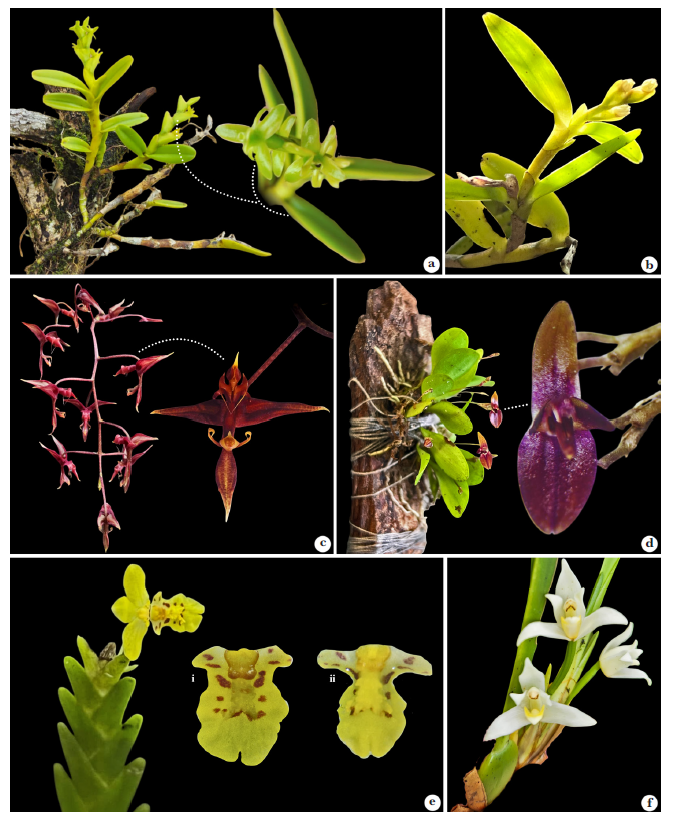
11. Epidendrum rigidum Jacq., Enum. Syst. Pl.: 29. 1760. Fig. 5a

a-f. Orchidaceae of the islands of Belém, state of Pará, Eastern Amazon - a. Epidendrum rigidum; b. Epidendrum strobiliferum; c. Gongora quinquenervis; d. Lankesteriana barbulata; e. Lochkartia imbricata, i-ii. morphological variations of the lip; f. Maxillaria alba. Photographs by M.C. Oliveira (a, b, d, e), M.E.L. Costa (c) and E.T.S. Castro (f).
Epiphytic herb with sympodial growth, 12-26.6 cm tall. Caulome 9.2-17.6 × 0.4-0.6 cm, not thickened into a pseudobulb, cylindrical, unbranched. Leaves 1-6, distributed along the caulome; leaf blades 3-5.1 × 1.1-1.4 cm, olive green, without macules, conduplicate, coriaceous, oblanceolate, apex rounded. Inflorescence 5.1-6.7 cm long, racemose, terminal, 3-8-flowered, erect, congested. Peduncle 3-4.7 cm long. Bracts ca. 1.5 × 1 cm, lanceolate, apex acute. Floral bracts 1.2-1.5 × 1-1.3 cm, oval-lanceolate, apex acute. Flowers fleshy, bisexual, resupinate. Pedicel + ovary 1-1.1 cm long. Dorsal sepal 0.5-0.6 × 0.2-0.3 cm, green, without macules, fleshy, lanceolate, apex acute, margin entire. Lateral sepals 0.5-0.6 × 0.2-0.3 cm, green, without macules, fleshy, free from each other, oblanceolate, apex acute, margin entire. Petals 0.5-0.6 × 0.06-0.1 cm, green, without macules, fleshy, linear, apex acute, margin entire. Lip 0.4-0.6 × 0.3-0.5 cm, entire, green, without macules, fleshy, adnate to the column, orbicular, apex rounded, margin entire. Column 0.2-0.3 cm long, green. Capsule not seen.
Material examined: Ilha do Combu, 01°29’50.9”S, 48°26’31.4”W, 1.X.2025, fl., M.C. Oliveira 218 (IAN); Ilha de Cotijuba, Praia da Saudade, 01°14’54.9”S, 48°33’50.7”W, 26.V.2025, fl., M.C. Oliveira & E.T.S. Castro 197 (IAN).
Epidendrum rigidum is distinguished mainly by the coriaceous leaf blades; green and fleshy sepals and petals; and an entire and orbicular lip. It was found in terra firme forest, near estuarine beaches, forming dense populations on dead phorophytes on Combu Island and Cotijuba Island. Flowering was recorded in May and October.
12. Epidendrum strobiliferum Rchb.f., Ned. Kruidk. Arch. 4: 333. 1859. Fig. 5b
Epiphytic herb with sympodial growth, 9.8-23.2 cm tall. Caulome 9.8-10.6 × 0.14-0.2 cm, not thickened into a pseudobulb, cylindrical, branched. Leaves 5-15, distributed along the caulome; leaf blades 1.1-2.2 × 0.25-0.6 cm, green to vinaceous, without macules, conduplicate, coriaceous, obovate, apex rounded. Inflorescence 1.1-1.5 cm long, racemose, terminal, 3-5-flowered, suberect, congested. Peduncle 0.7-0.9 cm long. Bracts 0.4-0.9 × 0.2-0.4 cm, obovate, covering the inflorescence, apex acute. Flowers membranaceous, bisexual, resupinate. Pedicel + ovary ca. 0.15 cm long. Dorsal sepal ca. 0.2 × 0.1 cm, white, without macules, membranaceous, lanceolate, apex acute, margin entire. Lateral sepals 0.18-0.2 × 0.09-0.1 cm, white, without macules, membranaceous, free from each other, oblanceolate, apex acute, margin entire. Petals ca. 0.2 × 0.05 cm, white, without macules, membranaceous, linear-lanceolate, apex acute, margin entire. Lip ca. 0.2 × 0.1 cm, entire, white, membranaceous, free from the column, obovate, apex rounded, margin entire. Column ca. 0.12 cm long, greenish. Capsule 0.5-0.7 × 0.2-0.3 cm, ovoid.
Material examined: Ilha de Mosqueiro, Praia do Marahú, 8.XII.2009, fl. and fr., A.K. Koch et al. 175 (MG); Ilha de Caratateua, Baía de Santa Cruz, 01°12’46.6”S, 48°26’03.0”W, 20.IX.2024, fl., M.C. Oliveira 202 (IAN); Ilha de Cotijuba, Praia da Flexeira, 01°13’48.9”S, 48°33’26.0”W, 25.V.2025, fl., M.C. Oliveira & E.T.S. Castro 199 (IAN); Ilha de Tatuoca, Observatório Magnético, 01°12’05.5”S, 48°30’20.9”W, 26.VI.2024, fl., M.C. Oliveira & J.R.V. Pacheco 76 (IAN).
Epidendrum strobiliferum vegetatively resembles E. rigidum due to the coriaceous leaf blades, but differs by having branched caulomes, smaller and narrower leaf blades (1.1-2.2 × 0.25-0.6), and white flowers (vs. unbranched caulome, 3-5.1 × 1.1-1.4 cm leaf blades, and green flowers in E. rigidum). Epidendrum strobiliferum is also characterized by producing inflorescences covered by bracts; white flowers; and an entire lip. The species was found on Caratateua, Cotijuba, Mosqueiro, and Tatuoca, in terra firme forests, forming dense populations on phorophytes often covered by bryophytes. Flowering was recorded in May, June, September, and December.
13. Erycina pusilla (L.) N.H. Williams & M.W.Chase, Lindleyana 16: 136. 2001.
Epiphytic herb with sympodial growth, 3.75-6.7 cm tall. Caulome 0.44-0.61 × 0.32-0.43 cm, not thickened into a pseudobulb, dorsiventrally flattened. Leaves 4-6, distributed along the caulome; leaf blades 2.3-5 × 0.3-0.8 cm, green, without macules, conduplicate, membranaceous, lanceolate, apex acute. Inflorescence 2.5-3.3 cm long, racemose, axillary, 1-2-flowered, suberect, lax. Peduncle 1.37-1.65 cm long. Bracts ca. 0.6 × 0.3 cm, lanceolate, apex acute. Floral bracts ca. 0.25 × 0.13 cm, triangular, apex acute. Flowers membranaceous, bisexual, resupinate. Pedicel + ovary 0.24-0.7 cm long. Dorsal sepal ca. 0.4 × 0.3 cm, yellow, without macules, membranaceous, oblanceolate, apex acuminate, margin entire. Lateral sepals ca. 0.4 × 0.1 cm, yellow, with vinaceous macules, membranaceous, free from each other, lanceolate, apex acuminate, margin entire. Petals ca. 0.6 × 0.4 cm, yellow, with vinaceous macules, membranaceous, oblanceolate, apex acuminate, margin entire. Lip ca. 0.16 × 0.15 cm, trilobed, yellow, with vinaceous macules, membranaceous, free from the column. Lateral lobes 0.16-0.29 × 0.15-0.83 cm, obovate, apex rounded, margin entire. Central lobe ca. 0.36 × 0.43 cm, orbicular, apex emarginate-rounded, margin entire. Column ca. 0.35 cm long, yellowish. Capsule 0.84-1 × 0.72-0.8 cm, ellipsoid.
Material examined: Ilha de Mosqueiro, Murubira, 13.IX.1953, fl., P. Ledoux 292 (IAN).
Additional material examined: BRAZIL. PARÁ: Bragança, terreno na Avenida dos Bragançanos, nº 17, em frente ao portão do Instituto Federal do Pará, 01°03’23.8”S, 46°47’10.6”W, 5.XII.2020, U. Mehlig 1918 (HBRA); Vitória do Xingu, UHE Belo Monte, Sítio Canais e Diques, 11.XI.2011, fl., PSACF 17 (MG).
Erycina pusilla is characterized by lanceolate leaf blades distributed along the caulome; yellow lateral sepals and petals; and a lip with vinaceous macules. In Pará, there are records of only two species of Erycina Lindl.: E. pusilla and E. glossomystax (Rchb.f.) N.H. Williams & M.W.Chase. The latter was not found in the present study area. The two species are morphologically similar, but E. glossomystax has a ciliate callus, whereas E. pusilla has a glabrous callus. Erycina pusilla was recorded on Mosqueiro Island, in anthropized areas. Flowering was recorded in September.
14. Gongora quinquenervis Ruiz & Pav., Syst. Veg. Fl. Peruv. Chil.: 227. 1798. Fig. 5c
Epiphytic herb with sympodial growth, ca. 43 cm tall. Caulome 4.8-7 × 1-1.8 cm, thickened into a heteroblastic pseudobulb, ellipsoid, non-superposed. Leaves 1-2, apical; leaf blades 24-37.5 × 5-8 cm, green, without macules, plicate, subcoriaceous, oblanceolate, apex acuminate. Inflorescence ca. 65 cm long, racemose, lateral, 11-17-flowered, pendent, lax. Peduncle ca. 60 cm long. Bracts 1-1.3 × 0.2-0.3 cm, lanceolate, apex acute. Floral bracts 0.28-0.34 × 0.09-0.1 cm, triangular, apex acute. Flowers membranaceous, bisexual, resupinate. Pedicel + ovary 3.6-3.9 cm long. Dorsal sepal 1.4-1.7 × 0.5-0.6 cm, red, with vinaceous macules, membranaceous, oblanceolate, margin entire. Lateral sepals 1.8-2.1 × 1-1.2 cm, red, with vinaceous macules, membranaceous, free from each other, ovate, apex acuminate, margin entire. Petals 0.8-0.9 × 0.09-0.12 cm, red, with vinaceous macules, membranaceous, linear, apex acute, margin entire. Lip 1.4-1.5 × 0.4-0.5 cm, trilobed, red, with vinaceous macules, membranaceous, free from the column. Lateral lobes 0.6-0.8 × 0.03-0.04 cm, subulate, apex acute, margin entire. Central lobe 0.8-1 × 0.3-0.5 cm, lanceolate, apex acute, margin entire. Column 1.4-1.5 cm long, reddish. Capsule not seen.
Material examined: Ilha do Combu, 29.I.1994, fl., P. Magalhães s.n. (MG 0147817); Ilha de Mosqueiro, Ponta do Marahú, 01°03’23.8”S, 46°47’10.6”W, 27.IX.2025, fl., M.C. Oliveira et al. 206 (IAN).
Gongora quinquenervis was collected on Combu and Mosqueiro Islands. It is easily identified by its conspicuous pseudobulbs; a pendent inflorescence with 11-17 red flowers with vinaceous macules; and lip with subulate lateral lobes. Flowering was recorded in January and September.
15. Lankesteriana barbulata (Lindl.) Karremans, Lankesteriana 13: 326. 2014.Fig. 5d
Epiphytic herb with sympodial growth, 0.6-1.1 cm tall. Caulome ca. 0.9 × 0.05 cm, not thickened into a pseudobulb, cylindrical. Leaf 1, apical; leaf blade 0.7-1.2 × 0.18-0.24 cm, green, without macules, fleshy, oblanceolate, apex obtuse. Inflorescence 1-1.2 cm long, cincinnal, lateral, 3-5-flowered, erect, congested. Peduncle 0.7-0.8 cm long. Bracts inconspicuous. Floral bracts inconspicuous. Flowers membranaceous, bisexual, resupinate. Pedicel + ovary ca. 0.1 cm long. Dorsal sepal 0.29-0.33 × 0.11-0.16 cm, vinaceous, with yellow-green macules at the apex, membranaceous, lanceolate, apex acute, margin entire. Lateral sepals 0.31-0.34 × 0.19-0.24 cm, vinaceous, with yellow-green macules, membranaceous, adnate to each other, ovate, apex acute, margin entire. Petals 0.2-0.22 × 0.07-0.09 cm, vinaceous, with yellow-green macules, membranaceous, lanceolate, apex acute, margin entire. Lip 0.17-0.24 × 0.05-0.08 cm, entire, vinaceous, without macules, membranaceous, free from the column, linear-lanceolate, apex rounded, margin ciliate. Column 0.13-0.24 cm long, vinaceous. Capsule not seen.
Material examined: Ilha de Cotijuba, Praia da Saudade, 01°14’55.0”S, 48°33’51.3”W, 25.V.2025, fl., M.C. Oliveira & E.T.S. Castro 194 (IAN).
We followed the nomenclature proposed by Karremans (2014), and POWO (2026), treating Anathallis barbulata (Lindl.) Pridgeon & M.W.Chase as a synonym of Lankesteriana barbulata. Lankesteriana barbulata is recognized by its fleshy, oblanceolate leaf blades; vinaceous sepals and petals with yellow-green macules; lateral sepals adnate to each other; and a linear-lanceolate lip with rounded apex and ciliate margin (trichomes). It was recorded on Cotijuba Island, near the estuarine beach. Flowering was observed in May.
16. Lockhartia imbricata (Lam.) Hoehne, Arq. Bot. Estado São Paulo, n.s. 2: 139. 1952. Fig. 5e
Epiphytic herb with sympodial growth, 6-17 cm tall. Caulome 6-17 × 0.3-0.5 cm, not thickened into a pseudobulb, dorsiventrally flattened. Leaves 14-28, distributed along the caulome; leaf blades 0.7-2.2 × 0.12-0.8 cm, green, without macules, conduplicate, membranaceous, triangular, apex rounded. Inflorescence 1.7-2.2 cm long, cincinnal, axillary, 1-3-flowered, suberect, lax. Peduncle 0.27-0.73 cm long. Bracts 0.27-0.34 × 0.24-0.3 cm, lanceolate, apex acuminate. Floral bracts 0.27-0.3 × 0.12-0.22 cm, obovate, apex acuminate. Flowers membranaceous, bisexual, resupinate. Pedicel + ovary 0.7-0.9 cm long. Dorsal sepal 0.34-0.4 × 0.22-0.26 cm, yellow, without macules, membranaceous, oblanceolate, apex acute, margin entire. Lateral sepals 0.34-0.41 × 0.19-0.27 cm, yellow, without macules, membranaceous, free from each other, lanceolate, apex acute, margin entire. Petals 0.34-0.46 × 0.17-0.27 cm, yellow, without macules, membranaceous, lanceolate, apex acute, margin entire. Lip 0.43-0.5 × 0.33-0.41 cm, trilobed, yellow with vinaceous macules, membranaceous, free from the column. Lateral lobes 0.06-0.13 × 0.08-0.1 cm, oblong, apex rounded, margin entire. Central lobe 0.02-0.4 × 0.07-0.22 cm, rounded, apex rounded, margin undulate. Column 0.14-0.22 cm long, green. Capsule not seen.
Material examined: Ilha do Combu, 01°29’50.9”S, 48°26’31.4”W, 1.X.2025, fl., M.C. Oliveira 216 (IAN); Ilha de Cotijuba, Praia da Flexeira, 01°13’34.0”S, 48°33’25.6”W, 25.V.2025, fl., M.C. Oliveira & E.T.S. Castro 181 (IAN); Ilha de Mosqueiro, Ponta do Marahú, 01°05’04.0”S, 48°24’45.4”W, 27.IX.2025, fl., M.C. Oliveira & D.L.L. Costa 231 (MG); Ilha de Tatuoca, Baía do Guajará, em frente à Vila do Icoaraci, 27.X.1991, fl., P.R. Oliveira 2 (HF).
Lockhartia imbricata is distinguished by its triangular leaf blades with rounded apex and yellow sepals and petals. It was collected on Cotijuba Island, in anthropized areas, and on Mosqueiro, Tatuoca and Combu Islands, in terra firme forest. Flowering was observed in September and October.
17. Maxillaria alba (Hook.) Lindl., Gen. Sp. Orchid. Pl.: 143. 1832. Fig. 5f
Epiphytic herb with sympodial growth, ca. 37 cm tall. Caulome 2.7-3.5 × 1-1.4 cm, thickened into a heteroblastic pseudobulb, ellipsoid, non-superposed. Leaves 2-4, distributed along the caulome; leaf blades 16.3-22.5 × 0.9-1.1 cm, green, without macules, conduplicate, subcoriaceous, linear-lanceolate, apex acute. Inflorescence 5.8-7.2 cm long, racemose, lateral, 3-flowered, arching, lax. Peduncle 3-3.3 cm long. Bracts 2.2-2.7 × 0.6-1 cm, lanceolate, apex acute. Floral bracts ca. 1.5 × 0.2 cm, linear-lanceolate, apex acute. Flowers membranaceous, bisexual, resupinate. Pedicel + ovary ca. 2.2 cm long. Dorsal sepal ca. 2 × 0.5 cm, white, without macules, membranaceous, lanceolate, apex acute, margin entire. Lateral sepals 1.3-1.6 × 0.4-0.47 cm, white, without macules, membranaceous, free from each other, lanceolate, apex acute, margin entire. Petals 1.3-1.4 × 0.2-0.3 cm, white, without macules, membranaceous, lanceolate, apex acute, margin entire. Lip ca. 1 × 0.5 cm, entire, yellowish-white, without macules, membranaceous, free from the column, oblanceolate, apex acute, margin entire. Column ca. 0.8 cm long, yellowish-white. Capsule not seen.
Material examined: Ilha de Cotijuba, Praia da Saudade, 01°14’54.5”S, 48°33’51.4”W, 25.V.2025, fl., M.C. Oliveira et al. 196 (MG).
Maxillaria alba is vegetatively similar to Maxillaria lutescens (Lindl.) Rchb.f. since both have caulomes thickened into a heteroblastic pseudobulb and linear-lanceolate leaf blades. However, M. alba differs by its entire, yellowish-white lip (vs. trilobed, yellow lip with reddish macules in M. lutescens). Maxillaria alba was found on Cotijuba Island, close to the estuarine beach, and near populations of M. lutescens. Flowering was recorded in May.
18. Maxillaria crassifolia (Lindl.) Rchb.f., Bonplandia (Hannover) 2: 16. 1854.
Epiphytic herb with sympodial growth, 25.2-38.5 cm tall. Caulome 3-5.7 × 0.9-1.3 cm, thickened into a heteroblastic pseudobulb, fusiform, non-superposed. Leaf 1, apical; leaf blade 17.8-34.5 × 1.2-2 cm, green, without macules, conduplicate, coriaceous, oblanceolate, apex rounded. Inflorescence 6-6.4 cm long, solitary, lateral, 1-flowered, erect, lax. Peduncle 3.4-4.8 cm long. Bracts ca. 1.3 × 0.38 cm, lanceolate, apex acute. Floral bracts ca. 1.7 × 0.4 cm, linear-lanceolate, apex acute. Flowers membranaceous, bisexual, resupinate. Pedicel + ovary ca. 3 cm long. Dorsal sepal ca. 1.65 × 0.45 cm, orange, with vinaceous macules, membranaceous, lanceolate, apex acute, margin entire. Lateral sepals 1.5-1.6 × 0.3-0.45 cm, orange, with vinaceous macules, membranaceous, free from each other, lanceolate, apex acute, margin entire. Petals 1.35-1.5 × 0.15-0.3 cm, orange with vinaceous macules, membranaceous, lanceolate, apex acute, margin entire. Lip ca. 1.5 × 1.35 cm, entire, orange with vinaceous macules, membranaceous, free from the column, oblanceolate, apex acute. Column ca. 1.6 cm long, yellowish. Capsule not seen.
Material examined: Ilha de Mosqueiro, Furo das Marinhas, Pico 1, Quadra 9, 11.III.1971, fl., E. Oliveira 5418 (IAN).
Additional material examined: BRAZIL. AMAZONAS: São Sebastião de Uatumã, RDS Uatumã, campinarana, próximo à Torre de Observação Amazônia - ATTO, 02°1’45.8”S, 59°02’32.5”W, 16.II.2017, fl., V.P. Klein 103 (INPA). PARÁ: Belém, cultivado no IAN, 13.V.1961, fl., J.M. Pires 7813 (UB); Oriximiná, Viveiro da Mineração Rio do Norte, Orchidário, V.1993, fl., D. Fonseca s.n. (HSTM 007342).
Maxillaria crassifolia is distinguished by its orange sepals and petals with vinaceous macules, and an entire, oblanceolate lip. It was recorded on Mosqueiro Island, in terra firme forest, near anthropized areas. Flowering was recorded in March.
19. Maxillaria lutescens (Lindl.) Rchb.f., Allg. Gartenzeitung 7: 145. 1839. Fig. 6a

a-g. Orchidaceae of the islands of Belém, state of Pará, Eastern Amazon - a. Maxillaria lutescens; b. Maxillaria subrepens, i. flower; c. Maxillaria uncata; d. Notylia fragrans; e. Oeceoclades maculata; f. Platystele ovalifolia, i. flower, ii. immature fruits; g. Polystachya concreta, i. lip. Photographs by M.C. Oliveira (a, b, c, d, e, f, g) and L.F. Lima (b[i]).
Epiphytic herb with sympodial growth, 18-38 cm tall. Caulome 1.2-5.8 × 0.6-1.8 cm, thickened into a heteroblastic pseudobulb, ovoid, non-superposed. Leaves 2, apical; leaf blades 5.3-16.2 × 0.5-1.1 cm, green, without macules, conduplicate, coriaceous, linear-lanceolate, apex rounded. Inflorescence ca. 5 cm long, racemose, axillary, 2-8-flowered, suberect, congested. Bracts ca. 3 × 0.5 cm, lanceolate, apex acute. Floral bracts ca. 1.5 × 1 cm, lanceolate, apex acute. Flowers membranaceous, bisexual, resupinate. Pedicel + ovary ca. 1.5 cm long. Dorsal sepal ca. 3 × 1 cm, white, without macules, membranaceous, oblanceolate, apex acute, margin entire. Lateral sepals 2.3-2.4 × 0.9-1 cm, white, without macules, membranaceous, free from each other, oblanceolate, apex acute, margin entire. Petals 2.2-2.3 × 0.6-0.66 cm, white, without macules, membranaceous, lanceolate, apex acute, margin entire. Lip ca. 1 × 1.5 cm, trilobed, yellow with reddish macules, membranaceous, free from the column. Lateral lobes ca. 1 × 0.5 cm, oblong, apex rounded, margin entire. Central lobe ca. 1 × 0.5 cm, ovate, apex rounded, margin entire. Column ca. 0.5 cm long, white. Capsule ca. 1.5 × 1 cm, ovoid.
Material examined: Ilha de Caratateua, Bairro do Fama, 01°13’42.3”S, 48°25’49.9”W, 14.VIII.2024, fl., M.C. Oliveira 230 (MG); Ilha de Cotijuba, Praia da Saudade, 01°14’54.1”S, 48°33’51.6”W, 26.V.2025, fl. and fr., M.C. Oliveira et al. 198 (MG); Ilha de Tatuoca, 27.X.1991, fl., P.R. Oliveira 2 (HF).
Maxillaria lutescens is recognized by its trilobed, yellow lip with reddish macules. The species usually forms dense populations on adult M. indica trees. Other orchid species such as E. carpophorum, M. alba, and Polystachya concreta (Jacq.) Garay & H.R.Sweet were collected among clumps of M. lutescens, suggesting that these species share microhabitats. Maxillaria lutescens was recorded on Caratateua, Cotijuba, and Tatuoca, mostly in várzea forest, on fallen Angiosperm trees, and on M. indica in terra firme forest.
20. Maxillaria subrepens (Rolfe) Schuit. & M.W.Chase, Phytotaxa 225: 73. 2015. Fig. 6b
Epiphytic herb with sympodial growth, 14-31 cm tall. Caulome 2.3-3.6 × 1.2-3.1 cm, thickened into a heteroblastic pseudobulb, ovoid, non-superposed. Leaf 1, apical; leaf blade 10-25.2 × 1-1.3 cm, green, without macules, conduplicate, subcoriaceous, linear-lanceolate, apex rounded. Inflorescence 10.3-16.1 cm long, solitary, lateral, 1-flowered, erect, lax. Peduncle 6.5-14 cm long. Bracts 1.5-2 × 0.4-0.6 cm, lanceolate, apex acute. Floral bracts ca. 2.6 × 0.6 cm, lanceolate, apex acuminate. Flowers membranaceous, bisexual, resupinate. Pedicel + ovary ca. 2.4 cm long. Dorsal sepal ca. 2.3 × 0.3 cm, yellow-orange, without macules, membranaceous, oblanceolate, apex acute, margin entire. Lateral sepals 2.4-2.6 × 0.5-0.6 cm, yellow-orange, without macules, membranaceous, free from each other, oblanceolate, apex acute, margin entire. Petals 0.9-1.1 × 0.2-0.3 cm, yellow-orange, without macules, membranaceous, lanceolate, apex acute, margin entire. Lip ca. 0.5 × 0.2 cm, trilobed, yellow-orange, without macules, membranaceous, free from the column. Lateral lobes 0.2-0.3 × 0.09-0.11 cm, lanceolate, apex rounded, margin entire. Central lobe ca. 0.2 × 0.1 cm, elliptical, apex rounded, margin undulate. Column ca. 0.3 cm long, yellow-orange. Capsule not seen.
Material examined: Ilha do Combu, 01°29’48.5”S, 48°26’32.2”W, 1.X.2025, fl., M.C. Oliveira 232 (IAN); Ilha de Mosqueiro, Ponta do Marahú, 01°05’02.8”S, 48°24’47.4”W, 27.IX.2025, fl., M.C. Oliveira et al. 205 (IAN).
Maxillaria subrepens is distinguished in the study area for its yellow-orange sepals and petals and lanceolate lateral lobes of the lip. It was recorded on Mosqueiro Island in Amazonian campinarana, and on Combu Island in terra firme forest. Flowering was observed in September and October.
21. Maxillaria uncata Lindl., Edwards’s Bot. Reg. 23: t. 1986. 1837. Fig. 6c
Epiphytic herb with sympodial growth, 10.3-15.2 cm tall. Caulome 0.9-1.3 × 0.2-0.3 cm, thickened into a heteroblastic pseudobulb, cylindrical, non-superposed. Leaf 1, apical; leaf blade 4.5-5.8 × 0.2-0.3 cm, green, without macules, conduplicate, fleshy, lanceolate, apex acute. Inflorescence 1.2-1.4 cm long, fascicle, lateral, 1-flowered, suberect, lax. Peduncle ca. 0.9 cm long. Bracts ca. 0.6-0.7 × 0.2 cm, lanceolate, apex acute. Floral bracts 0.6-0.7 × 0.1-0.2 cm, lanceolate, apex acute. Flowers membranaceous, bisexual, resupinate. Pedicel + ovary 0.6-0.7 cm long. Dorsal sepal 0.6-0.7 × 0.1-0.2 cm, white, without macules, membranaceous, oblanceolate, apex acute, margin entire. Lateral sepals 1-1.1 × 0.2-0.3 cm, white, without macules, membranaceous, free from each other, oblanceolate, apex acute, margin entire. Petals 0.5-0.7 × 0.2-0.27 cm, white, without macules, membranaceous, lanceolate, apex acute, margin entire. Lip 0.8-0.9 × 0.2-0.27 cm, entire, white, without macules, membranaceous, free from the column, oblong, apex rounded, margin undulate. Column 0.3-0.5 cm long, white. Capsule not seen.
Material examined: Ilha do Combu, 01°29’48.5”S, 48°26’32.2”W, 1.X.2025, fl., M.C. Oliveira 215 (IAN); Ilha de Mosqueiro, Praça do Carananduba, 01°05’38.1”S, 48°24’35.9”W, 26.V.2025, fl., M.C. Oliveira 204 (IAN)
Maxillaria uncata differs from the other species by its cylindrical pseudobulbs; fleshy and lanceolate leaf blades; white sepals and petals; and an entire, oblong lip. It was collected in anthropized areas on Mosqueiro Island and in terra firme forest on Combu Island. Flowering was recorded in May and October.
22. Notylia fragrans Wullschl. ex H.Focke, Bot. Zeitung (Berlin) 11: 342. 1853. Fig. 6d
Epiphytic herb with sympodial growth, 9.6-15.3 cm tall. Caulome 3-4 × 0.6-0.8 cm, thickened into a heteroblastic pseudobulb, fusiform, non-superposed. Leaf 1, apical; leaf blade 12.7-16.8 × 4.2-4.5 cm, green, without macules, conduplicate, coriaceous, oblanceolate, apex acute. Inflorescence 10.4-35 cm long, racemose, lateral, 10-26-flowered, pendent, lax. Peduncle 9.5-28 cm long. Bracts 0.6-0.8 × 0.2-0.4 cm, triangular, apex acute. Floral bracts 0.2-0.3 × 0.04-0.1 cm, triangular, apex acuminate. Flowers membranaceous, bisexual, resupinate. Pedicel + ovary 0.3-0.6 cm long. Dorsal sepal 0.5-0.6 × 0.08-0.1 cm, greenish-yellow, without macules, membranaceous, oblanceolate, apex acute, margin entire. Lateral sepals 0.4-0.65 × 0.08-0.12 cm, greenish-yellow, without macules, membranaceous, adnate to each other up to 1/2 at the basal portion, lanceolate, apex acute, margin entire. Petals 0.3-0.5 × 0.09-0.1 cm, white, with two yellow macules, membranaceous, linear-lanceolate, apex acute, margin entire. Lip 0.4-0.5 × 0.1-0.2 cm, entire, yellowish-white, without macules, membranaceous, deltate, apex acute, margin entire, free from the column. Column 0.32-0.35 cm long, yellowish-white. Capsule not seen.
Material examined: Ilha de Mosqueiro, Praia do Maraú, 8.XII.2009, fl., A.K. Koch et al. 176 (MG); Ponta do Marahú, 01°05’05.4”S, 48°24’47.7”W, 27.IX.2025, fl. and fr., M.C. Oliveira et al. 228 (IAN); Sucurijuquara, 01°05’30.9”S, 48°23’19.0”W, 28.IX.2025, fl., M.C. Oliveira & P.H.S. Natividade 229 (IAN).
We adopted the circumscription of N. fragrans presented by Oliveira et al. (2026). The species is characterized by an entire, deltate lip, which may show slight variation in shape but always retaining the deltate morphology. It was collected on Mosqueiro Island, growing on C. icaco near estuarine beaches and on M. indica in anthropized areas. Flowering was recorded in September and December.
23. Oeceoclades maculata (Lindl.) Lindl., Gen. Sp. Orchid. Pl.: 237. 1833. Fig. 6e
Terrestrial herb with sympodial growth, 13.4-17.2 cm tall. Caulome 2.1-3.3 × 1.4-2.3 cm, thickened into a heteroblastic pseudobulb, fusiform, non-superposed. Leaf 1, apical; leaf blade 15-21 × 3.2-4.5 cm, green, with dark green macules, conduplicate, coriaceous, oblanceolate, apex acute. Inflorescence ca. 19 cm long, racemose, lateral, 2-4-flowered, erect, lax. Peduncle ca. 18 cm long. Bracts 0.2-0.4 × 0.1-0.2 cm, triangular, apex acute. Floral bracts 0.3-0.4 × 0.09-0.1 cm, triangular, apex acute. Flowers membranaceous, bisexual, resupinate. Pedicel + ovary 0.7-0.9 cm long. Dorsal sepal 0.9-1 × 0.1-0.2 cm, brownish, without macules, membranaceous, oblanceolate, apex acute, margin entire. Lateral sepals 0.8-0.9 × 0.1-0.2 cm, brownish, without macules, membranaceous, free from each other, lanceolate, apex acute, margin entire. Petals 0.8-0.9 × 0.1-0.2 cm, brownish, without macules, membranaceous, oblanceolate, apex acute, margin entire. Lip 0.7-0.8 × 0.7-0.8 cm, trilobed, white with linear lilac macules, membranaceous, free from the column. Lateral lobes 0.2-0.3 × 0.1-0.2 cm, obovate, apex rounded, margin entire. Central lobe 0.3-0.4 × 0.6-0.7 cm, oblong, apex emarginate, margin entire. Column 0.3-0.4 cm long, white. Capsule not seen.
Material examined: Ilha de Cotijuba, Praia da Flexeira, 01°13’31.6”S, 48°33’27.7”W, 25.V.2025, fl., M.C. Oliveira et al. 200 (MG).
Oeceoclades maculata is distinguished by the terrestrial habit and the green leaf blades bearing dark green macules. In the vegetative stage, it may be confused with Dracaena trifasciata (Prain) Mabb. (Asparagaceae) due to their maculated leaves. The species was recorded in anthropized areas on Cotijuba Island. Flowering was recorded in May.
24. Platystele ovalifolia (H.Focke) Garay & Dunst., Venez. Orchids Ill. 2: 268. 1961. Fig. 6f
Epiphytic herb with sympodial growth, 0.6-1.4 cm tall. Caulome 0.6-1.4 × 0.03-0.04 cm, not thickened into a pseudobulb, cylindrical. Leaves 4-10, distributed along the caulome; leaf blades 0.4-0.5 × 0.18-0.23 cm, olive-green, without macules, conduplicate, membranaceous, ovate, apex rounded. Inflorescence 0.6-0.8 cm long, racemose, lateral, 1-flowered, erect, congested. Peduncle 0.4-0.6 cm long. Bracts 0.07-0.1 × 0.05-0.07 cm, lanceolate, apex acute. Floral bracts ca. 0.01 × 0.01 cm, lanceolate, apex acute. Flowers membranaceous, bisexual, resupinate. Pedicel + ovary 0.05-0.1 cm long. Dorsal sepal ca. 0.14 × 0.09 cm, yellow, without macules, membranaceous, lanceolate, apex acute, margin entire. Lateral sepals 0.13-0.14 × 0.04-0.05 cm, yellow, without macules, membranaceous, free from each other, lanceolate, apex acute, margin entire. Petals 0.1-0.14 × 0.04-0.05 cm, yellow, without macules, membranaceous, lanceolate, apex acute, margin entire. Lip ca. 0.07 × 0.05 cm, entire, yellow, without macules, lanceolate, apex acute, margin entire, free from the column. Column ca. 0.06 cm long, greenish. Capsule ca. 0.2 × 0.1 cm, fusiform.
Material examined: Ilha de Cotijuba, Praia da Saudade, 01°14’55.4”S, 48°33’51.1”W, 25.V.2025, fl., M.C. Oliveira et al. 193 (IAN); Ilha de Mosqueiro, Praia arenosa, 22.V.1971, fl., J.M. Pires 12162 (IAN); Ilha de Mosqueiro, Ponta do Marahú, 01°05’02.7”S, 48°24’47.7”W, 27.IX.2025, fl. and fr., M.C. Oliveira et al. 221 (IAN).
Platystele ovalifolia is the smallest orchid species recorded on the islands. It is 0.6-1.4 cm tall and is characterized by ovate leaf blades; yellow sepals and petals; and an entire, yellow and lanceolate lip. Platystele ovalifolia was recorded in anthropized areas on Cotijuba Island, growing associated with L. barbulata on individuals of M. indica covered by bryophytes; on Mosqueiro Island, it was collected in terra firme forest and near estuarine beaches, on individuals of C. icaco. Flowering was observed in May and September and fruiting in September.
25. Polystachya concreta (Jacq.) Garay & H.R.Sweet, Orquideologia 9: 206. 1974. Fig. 6g
Epiphytic herb with sympodial growth, 7.8-15 cm tall. Caulome 0.6-2.3 × 0.2-0.6 cm, thickened into a homoblastic pseudobulb, fusiform, non-superposed. Leaves 2-3 per caulome, distributed along the caulome; leaf blades 2.2-11.6 × 0.7-1.9 cm, green, without macules, conduplicate, coriaceous, oblanceolate, apex acuminate. Inflorescence ca. 4 cm long, paniculate, terminal, 5-10-flowered, erect, lax. Peduncle ca. 3.6 cm long. Bracts 0.4-0.8 × 0.2-1.6 cm, lanceolate, apex acute. Floral bracts 0.15-0.23 × 0.1-0.22 cm, triangular, apex acuminate. Flowers membranaceous, bisexual, non-resupinate. Pedicel + ovary 0.37-0.47 cm long. Dorsal sepal 2.1-2.9 × 0.18-0.2 cm, green, without macules, membranaceous, oblanceolate, apex acute, margin entire. Lateral sepals 0.2-0.3 × 0.04-0.07 cm, yellowish-white, without macules, membranaceous, adnate to each other up to 1/2 at the basal portion, linear-lanceolate, apex rounded, margin entire. Petals 0.2-0.4 × 0.3-0.4 cm, greenish, without macules, membranaceous, oval, apex acute, margin entire. Lip 0.3-0.4 × 0.2-0.3 cm, trilobed, whitish-green, without macules, membranaceous, free from the column. Lateral lobes 0.14-0.16 × 0.06-0.07 cm, oblong, apex obtuse, margin entire. Central lobe 0.2-0.27 × 0.1-0.19 cm, obovate, apex rounded, margin entire. Column 0.1-0.2 cm long, greenish. Capsule 0.7-0.8 × 0.01-0.02 cm, fusiform.
Material examined: Ilha de Caratateua, Bairro do Fama, 01°13’44.2”S, 48°25’51.8”W, 14.VIII.2024, fl. and fr., M.C. Oliveira 235 (IAN); Ilha de Cotijuba, Seringal, 01°12’54.2”S, 48°31’20.0”W, 25.V.2025, fl., M.C. Oliveira et al. 186 (IAN); Ilha de Mosqueiro, Praia de São Francisco, 9.V.1971, fl., E. Oliveira 5473 (IAN).
Polystachya concreta is characterized by its inflorescence in panicle; non-resupinate flowers; lateral sepals adnate to each other up to 1/2 at the basal portion; and the oblong lateral lobes of the lip. It was recorded on Caratateua, Cotijuba, and Mosqueiro Islands, mainly in terra firme forests, on dead angiosperm trees, and in anthropized areas near rivers. Flowering was recorded in May and August and fruiting in August.
26. Polystachya foliosa (Hook.) Rchb.f. in Walp., Ann. Bot. Syst. 6: 640. 1863. Fig. 7a

a-g. Orchidaceae of the islands of Belém, state of Pará, Eastern Amazon - a. Polystachya foliosa, i. lip; b. Prosthechea aemula; c. Rodriguezia lanceolata; d. Scaphyglottis prolifera; e. Sobralia macrophylla; f. Vanilla mexicana; g. Zygosepalum labiosum. Photographs by M.C. Oliveira (a, b, c, d, f, g) and D.L.L. Costa (e).
Epiphytic herb with sympodial growth, 7.8-49 cm tall. Caulome 0.3-1 × 0.12-0.8 cm, thickened into a homoblastic pseudobulb, ovoid, non-superposed. Leaves 2-4, distributed along the caulome; leaf blades 2.1-14.4 × 0.4-2.5 cm, green, without macules, conduplicate, coriaceous, linear or lanceolate, apex acute. Inflorescence 4.4-42 cm long, paniculate, terminal, 32-86-flowered, erect, lax. Peduncle 3.4-38 cm long. Bracts 1-6 × 0.14-0.9 cm, cylindrical, apex acute. Floral bracts 0.15-0.2 × 0.1-0.2 cm, triangular, apex acute. Flowers membranaceous, bisexual, non-resupinate. Pedicel + ovary 0.4-0.6 cm long. Dorsal sepal 0.2-0.3 × 0.13-0.19 cm, yellowish-green, without macules, membranaceous, lanceolate, apex acute, margin entire. Lateral sepals 0.2-0.36 × 0.23-0.3 cm, green, without macules, membranaceous, adnate to each other up to 1/3 at the basal portion, lanceolate or ovate, apex acute, margin entire. Petals 0.19-0.25 × 0.04-0.09 cm, yellowish-green, without macules, membranaceous, oblong, apex acute, margin entire. Lip 0.26-0.32 × 0.26-0.35 cm, trilobed, yellowish-green, without macules, membranaceous, free from the column. Lateral lobes 0.1-0.12 × 0.08-0.1 cm, rounded, apex rounded, margin entire. Central lobe 0.2-0.32 × 0.13-0.16 cm, rounded, apex acuminate, margin entire. Column ca. 0.1 cm long, green. Capsule 0.6-0.8 × 0.1-0.2 cm, fusiform.
Material examined: Ilha de Caratateua, Bairro do Fama, 01°13’44.2”S, 48°25’51.8”W, 14.VIII.2024, fl. and fr., M.C. Oliveira 234 (IAN); Ilha de Cotijuba, Praia da Flexeira, 01°13’33.5”S, 48°33’27.5”W, 24.V.2025, fl., M.C. Oliveira et al. 185 (IAN); Ilha de Mosqueiro, Praia do Farol, 14.X.2025, fl. and fr., E.C. Oliveira 5897 (IAN); Ilha de Tatuoca, 01°12’05.8”S, 48°30’21.5”W, 26.VII.2024, fl., M.C. Oliveira 68 (MG).
Polystachya foliosa is morphologically similar to P. concreta but differs by the lateral sepals that are adnate up to 1/3 of the basal portion and the rounded lateral lobes of the lip. Polystachya foliosa was recorded on Caratateua, Cotijuba, Mosqueiro, and Tatuoca Islands, mainly in anthropized areas and terra firme forests, near estuarine beaches. Flowering was recorded in May, July, August, and October and fruiting in August and October.
27. Prosthechea aemula (Lindl.) W.E.Higgins, Phytologia 82: 376. 1998 (“1997”). Fig. 7b
Epiphytic herb with sympodial growth, 20.2-25.2 cm tall. Caulome 2.7-5.2 × 0.7-1.4 cm, thickened into a heteroblastic pseudobulb, ellipsoid, non-superposed. Leaf 1, apical; leaf blade 12-18.5 × 1.4-2.8 cm, green, without macules, conduplicate, subcoriaceous, oblanceolate, apex rounded. Inflorescence 6.2-9.2 cm long, racemose, terminal, 3-4-flowered, erect, congested. Peduncle 5-6.8 cm long. Bracts 1.1-2.6 × 0.2-1.4 cm, obovate, apex acute. Floral bracts 0.2-0.4 × 0.2-0.23 cm, triangular, apex acuminate. Flowers membranaceous, bisexual, non-resupinate. Pedicel + ovary 0.8-1 cm long. Dorsal sepal 1.8-2 × 0.3-0.4 cm, white, without macules, membranaceous, lanceolate, apex acute, margin entire. Lateral sepals 1.6-1.8 × 0.3-0.4 cm, white, without macules, membranaceous, free each other, oblanceolate, apex acute, margin entire. Petals 1.5-1.7 × 0.3-0.5 cm, white, without macules, membranaceous, obovate, apex acuminate, margin entire. Lip 1.4-1.5 × 1.1-1.3 cm, entire, white, with purplish linear stripes, membranaceous, adnate to the column, orbicular, apex acuminate, margin entire. Column 0.4-0.5 cm long, green. Capsule not seen.
Material examined: Ilha do Combu, 01°14’54.0”S, 48°33’43.5”W, 1.X.2025, fl., M.C. Oliveira et al. 227 (IAN); Ilha de Mosqueiro, Baía de Santa Cruz, 01°11’46.6”S, 48°25’42.5”W, 26.VII.2024, fl., M.C. Oliveira 164 (IAN); Ilha de Tatuoca, Observatório Magnético de Tatuoca, 01°12’05.3”S 48°30’20.6”W, 26.VII.2024, fl., M.C. Oliveira et al. 74 (MG).
Prosthechea aemula is recognized by ellipsoid pseudobulbs containing a single apical leaf; non-resupinate flowers; white sepals and petals; and a white, orbicular lip with purplish linear stripes. It was found on Combu Island (várzea forest), Mosqueiro Island (várzea forest and mangrove) and Tatuoca Island (terra firme forest, near estuarine beaches). Flowering was recorded in July and October.
28. Rodriguezia lanceolata Ruiz & Pav., Syst. Veg. Fl. Peruv. Chil.: 219. 1798. Fig. 7c
Epiphytic herb with sympodial growth, 2.9-19.4 cm tall. Caulome 0.5-6 × 0.8-1.5 cm, thickened into a heteroblastic pseudobulb, ellipsoid, non-superposed. Leaf 1, apical; leaf blade 4.2-6 × 0.13-1.5 cm, green, without macules, conduplicate, coriaceous, linear-lanceolate, apex acute. Inflorescence 8.3-9.5 cm long, racemose, lateral, 2-20-flowered, arching, lax. Peduncle 4.8-6.6 cm long. Bracts 0.27-0.58 × 0.07-0.08 cm, lanceolate, apex acute. Floral bracts 0.3-0.5 × 0.13-0.15 cm, lanceolate, apex acute. Flowers membranaceous, bisexual, resupinate. Pedicel + ovary 1.3-1.4 cm long. Dorsal sepal 1.1-1.2 × 0.4-0.6 cm, pink, without macules, membranaceous, oblanceolate, apex acute, margin entire. Lateral sepals 1.1-1.2 × 0.48-0.5 cm, pink, without macules, membranaceous, completely adnate to each other, lanceolate, apex acute, margin entire. Petals 1-1.1 × 0.4-0.56 cm, pink, without macules, membranaceous, oblanceolate, apex acute, margin entire. Lip 1.3-1.4 × 0.45-0.56 cm, trilobed, pink with a yellowish macule, membranaceous, free from the column. Lateral lobes 0.16-0.19 × 0.11-0.16 cm, deltate, apex rounded, margin crisped. Central lobe 0.63-0.77 × 0.5-0.6 cm, obcordate, apex emarginate, margin entire. Column 0.28-0.4 cm long, white. Capsule not seen.
Material examined: Ilha do Combu, 01°14’54.0”S, 48°33’43.5”W, 1.X.2025, fl., M.C. Oliveira 233 (IAN); Ilha de Mosqueiro, XII.2013, fl., T.E.C. Meneguzzo s.n. (RB 757702).
Rodriguezia lanceolata is morphologically similar to N. fragrans at the vegetative state. Both have a single leaf on each heteroblastic pseudobulb but R. lanceolata is distinguished by having pink sepals and petals, lateral sepals completely adnate to each other, and a trilobed lip (vs. greenish-yellow sepals and petals, lateral sepals adnate to each other up to 1/2 at the basal portion, and an entire lip in N. fragrans). It was recorded in terra firme forest areas on Combu and Mosqueiro Islands. Flowers were observed in October and December.
29. Scaphyglottis prolifera (R.Br.) Cogn., in Mart., Fl. bras. 3(5): 15. 1898. Fig. 7d
Epiphytic herb with sympodial growth, 4.9-15.9 cm tall. Caulome 0.8-7.7 × 0.1-0.5 cm, thickened into a heteroblastic pseudobulb, cylindrical, superposed. Leaves 2, apical; leaf blades 1-5.5 × 0.2-0.7 cm, green, without macules, conduplicate, subcoriaceous, linear, apex rounded. Inflorescence 0.3-0.9 cm long, capitate-racemose, terminal, 6-flowered, pendulous, congested. Peduncle inconspicuous. Bracts inconspicuous. Floral bracts 0.5-0.7 × 0.3-0.4 cm, oblong, apex acute. Flowers membranaceous, bisexual, resupinate. Pedicel + ovary 0.2-0.3 cm long. Dorsal sepal 0.4-0.6 × 0.2-0.3 cm, white, without macules, membranaceous, elliptical, apex acute, margin entire. Lateral sepals 0.6-0.7 × 0.2-0.3 cm, white, without macules, membranaceous, free from each other, elliptical, apex acute, margin entire. Petals 0.4-0.6 × 0.07-0.1 cm, white, without macules, membranaceous, linear-lanceolate, apex acute, margin entire. Lip 0.5-0.7 × 0.032-0.038 cm, trilobed, white with vinaceous macules on the central lobe, membranaceous, free from the column. Lateral lobes ca. 0.01 × 0.01 cm, orbicular, apex rounded, margin entire. Central lobe ca. 0.1 × 0.03 cm, obovate, apex acuminate, margin entire. Column 0.2-0.4 cm long, vinaceous. Capsule 0.5-0.7 × 0.2-0.3 cm, fusiform.
Material examined: Ilha de Cotijuba, Praia da Flexeira, 01°13’49.3”S, 48°33’25.4”W, 25.V.2025, fl. and fr., M.C. Oliveira et al. 187 (MG); Ilha de Mosqueiro, Sucurijuquara, 01°05’03.9”S, 48°23’11.5”W, 27.IX.2025, fl. and fr., M.C. Oliveira & P.H.S. Natividade 201 (IAN); Ilha de Tatuoca, Observatório Magnético de Tatuoca, 01°12’06.8”S, 48°30’20.9W, 26.VII.2024, fl. and fr., M.C. Oliveira et al. 77 (MG).
Scaphyglottis prolifera is primarily characterized by a white lip with vinaceous macules on the central lobe, and a vinaceous column. Among the orchid species recorded on the islands, S. prolifera is the only one with superposed pseudobulbs, suggesting vegetative propagation. The species was found on Cotijuba, Mosqueiro, and Tatuoca islands, in Amazonian campinarana, várzea forest, and terra firme forest. Flowering and fruiting were recorded in May, July, and September.
30. Sobralia macrophylla Rchb.f., Bot. Zeitung (Berlin) 10: 713. 1852. Fig. 7e
Epiphytic herb with sympodial growth, ca. 57 cm tall. Caulome 47.7 × 0.3-0.6 cm, not thickened into a pseudobulb, cylindrical, unbranched. Leaves ca. 7, distributed along the caulome; leaf blades 10.8-13.5 × 3-4.5 cm, olive-green, without macules, plicate, coriaceous, lanceolate, apex acute. Inflorescence ca. 9.7 cm long, racemose, terminal, 2-4-flowered, slightly woody, congested. Peduncle inconspicuous. Bracts ca. 4.7 × 3.7 cm, obovate, apex acute. Floral bracts inconspicuous. Flowers membranaceous, bisexual, resupinate. Pedicel + ovary 2-2.7 cm long. Dorsal sepal ca. 7.0 × 1-1.2 cm, white-yellowish, without macules, membranaceous, linear-lanceolate, apex acute, margin entire. Lateral sepals 6.4-6.9 × 0.8-1.6 cm, white-yellowish, without macules, membranaceous, free from each other, linear-lanceolate, apex acute, margin entire. Petals 6.5-7.1 × 0.9-1.2 cm, white-yellowish, without macules, membranaceous, oblanceolate, apex acute, margin entire. Lip 6.7-6.8 × 3.7-4.6 cm, entire, white with a yellowish macule at the base, membranaceous, free from the column, obovate, apex rounded, margin crisped. Column 3-3.4 cm, white. Capsule not seen.
Material examined: Ilha de Cotijuba, Praia Funda, 01°14’19.5”S, 48°33’38.0”W, 26.V.2025, fl., M.C. Oliveira et al. 195 (MG); Ilha de Mosqueiro, Baía de Santo Antônio, 01°11’43.5”S, 48°25’46.8”W, 21.I.2025, fl., M.C. Oliveira 180 (MG).
Sobralia macrophylla was the largest species recorded (to 57 cm tall) in the islands. Besides its size, the species is recognized by its white-yellowish flowers and an entire lip with crisped margin. The species was found on Cotijuba and Mosqueiro islands, in terra firme and várzea forests. Flowering was recorded in January and May.
31. Vanilla cribbiana Soto Arenas, Lankesteriana 9: 300. 2010.
Nomadic climber herb with monopodial growth, 300-500 cm tall. Caulome 300-500 × 0.3-0.5 cm, not thickened into a pseudobulb, cylindrical. Leaves 18-25, distributed along the caulome; leaf blades 6.9-16.3 × 2.1-5.2 cm, green, without macules, conduplicate, fleshy, ovoid, apex acute. Inflorescence 9.4-15.9 cm long, racemose, terminal, 7-8-flowered, suberect, lax. Peduncle 4.4-12.1 cm long. Bracts 1.3-2.2 × 0.6-1.2 cm, ovate, apex acute. Floral bracts ca. 0.7 × 0.3 cm, ovate-lanceolate, apex acuminate. Flowers membranaceous, bisexual, resupinate. Pedicel + ovary 2.5-3 cm long. Dorsal sepal ca. 4.7 × 0.7 cm, yellowish, without macules, membranaceous, oblanceolate, apex acute, margin entire. Lateral sepals 4.7-5 × 0.5-0.6 cm, yellowish, without macules, membranaceous, free from each other, obovate, apex acute, margin entire. Petals 4.5-5 × 0.4-0.6 cm, yellowish, without macules, membranaceous, oblanceolate, apex acute, margin entire. Lip ca. 4 × 2 cm, trilobed, yellowish, with an intense yellow macule internally, membranaceous, free from the column. Lateral lobes 1.4-1.6 × 0.6-0.7 cm, obovate, apex rounded, margin undulate. Central lobe ca. 2.5 × 0.8 cm, obovate, apex truncate, margin entire. Column ca. 2.2 cm long, white-yellowish. Capsule ca. 10.3 × 0.6 cm, fusiform.
Material examined: APA Ilha do Combu, 01°29’29.6”S, 48°27’38.2”W, 20.I.2009, fl. and fr., T.D.S. Medeiros 1 (MG); 8.V.2010, fl., T.D.S. Medeiros & A.K. Koch 2 (MG).
Vanilla cribbiana is vegetatively similar to Vanilla mexicana Mill., but differs by having yellowish flowers and a lip with an obovate central lobe with a truncate apex (vs. olive green flowers and an orbicular central lobe with rounded apex). Flowering was recorded in January and May.
32. Vanilla mexicana Mill., Gard. Dict., ed. 8.: n.° 1. 1768. Fig. 7f
Nomadic climber herb with monopodial growth, 300-1,300 cm tall. Caulome 300-1,300 × 1.8-2.2 cm, not thickened into a pseudobulb, cylindrical. Leaves 10-28, distributed along the caulome; leaf blades 13-16 × 5-5.8 cm, green, without macules, conduplicate, membranaceous, oblanceolate, apex acuminate. Inflorescence 7.5-15.2 cm long, racemose, terminal, 5-flowered, pendulous, lax. Peduncle 2.5-4 cm long. Bracts 0.6-1.1 × 0.4-0.6 cm, lanceolate, apex acute. Floral bracts 1.3-1.7 × ca. 0.7 cm, obovate, apex acute. Flowers fleshy, bisexual, resupinate. Pedicel + ovary 3.7-5 cm long. Dorsal sepal ca. 6 × 1.4-1.5 cm, olive-green, without macules, fleshy, oblanceolate, apex rounded, margin undulate. Lateral sepals 4.1-5.2 × 1.4-1.7 cm, olive green, without macules, fleshy, free from each other, oblanceolate, apex rounded, margin undulate. Petals 4.5-5.8 × 0.7-0.9 cm, olive green, without macules, fleshy, linear-lanceolate, apex acute, margin undulate. Lip 3.2-3.7 × 3.3-3.5 cm, trilobed, white with a yellow macule in the central region, fleshy, adnate to the column. Lateral lobes 2.5-2.9 × 3.3-3.5 cm, rounded, apex rounded, margin entire. Central lobe 3.2-3.5 × 1.6-1.7 cm, orbicular, apex rounded, margin undulate. Column 2.2-2.3 cm long, green. Capsule ca. 8 × 0.9 cm, fusiform.
Material examined: Ilha do Combu, 01°14’54.0”S, 48°33’43.5”W, 1.X.2025, fl., M.C. Oliveira et al. 217 (IAN); Ilha de Cotijuba, Praia da Flexeira, 01°13’43.5”S, 48°33’10.9”W, 24.V.2025, fl. and fr., M.C. Oliveira et al. 190 (IAN); Ilha de Mosqueiro, Baía de Santa Cruz, 01°12’06.8”S, 48°30’20.9W, 26.VII.2024, fl., M.C. Oliveira 170 (MG).
Vanilla mexicana differs from other species recorded on the islands by its olive green sepals and petals with undulate margin. It was recorded on Combu, Cotijuba, and Mosqueiro islands, in várzea forest areas, climbing on individuals of Mauritia flexuosa L.f. (Arecaceae) and Rhizophora L. (Rhizophoraceae) species. Flowering was recorded in May, July, and October and fruiting in May.
33. Wullschlaegelia calcarata Benth., J. Linn. Soc., Bot. 18: 342. 1881.
Terrestrial mycoheterotrophic herb with sympodial growth, 29.3-30 cm tall. Caulome 1.3-1.6 × 0.3-0.5 cm, inconspicuous, cylindrical, achlorophyllous, leafless. Inflorescence 10-26.7 cm long, racemose, terminal, 10-13-flowered, erect, lax. Peduncle ca. 245 cm long. Bracts ca. 0.2 × 0.2 cm, lanceolate, apex acute. Floral bracts ca. 0.3 × 0.05 cm, triangular, apex acute. Flowers membranaceous, bisexual, resupinate. Pedicel + ovary ca. 0.35 cm long. Dorsal sepal ca. 0.1 × 0.1 cm, white, without macules, membranaceous, lanceolate, apex acute, margin entire. Lateral sepals ca. 0.32 × 0.1 cm, white, without macules, membranaceous, adnate to each other up to 1/2 at the basal portion, oblanceolate, apex acute, margin entire. Petals ca. 0.16 × 0.05 cm, white, without macules, membranaceous, lanceolate, apex acute, margin entire. Lip ca. 0.4 × 0.15 cm, entire, white with black macules, membranaceous, free from the column, oblong, apex rounded, margin entire. Column ca. 0.1 cm long, white. Capsule ca. 0.1 × 0.09 cm, fusiform.
Material examined: Ilha de Mosqueiro, XII.2013, 01º08’0”S, 48º’23’00”W, fl., T.E.C Meneguzzo (RB 757703).
Additional material examined: BRAZIL. PARÁ: Igarapé-Miri, PA-151, km 77, 01°57’23.84”S, 48°54’21.88”W, 15.X.2019, fl. and fr., R.L. Ferreira Filho 280 (MG).
Wullschlaegelia calcarata is characterized by being mycoheterotrophic, leafless, and achlorophyllous. It frequently occurs in areas covered by leaf litter with low light. Flowering was recorded in December.
34. Zygosepalum labiosum (Rich.) Garay, Mem. New York Bot. Gard. 14(3): 184. 1967. Fig. 7g
Epiphytic herb with sympodial growth, ca. 31.5 cm tall. Caulome 4.2-5.8 × 0.8-1 cm, thickened into a heteroblastic pseudobulb, fusiform, non-superposed. Leaves 2, apical; leaf blades 10.9-28.9 × 1.8-2.9 cm, green, without macules, plicate, membranaceous, oblanceolate, apex acuminate. Inflorescence 13.6-15.3 cm long, racemose, lateral, 1-flowered, erect, lax. Peduncle 12.1-13 cm long. Bracts 2.6-3.3 × 0.4-0.5 cm, lanceolate, apex acuminate. Floral bracts ca. 3 × 1.5 cm, lanceolate, apex acute. Flowers membranaceous, bisexual, resupinate. Pedicel + ovary ca. 2.7 cm long. Dorsal sepal ca. 5 × 1 cm, greenish-yellow with a white base, without macules, membranaceous, lanceolate, apex acute, margin entire. Lateral sepals 4.8-5.1 × 1.1-1.2 cm, greenish-yellow with a white base, without macules, membranaceous, free from each other, oblanceolate, apex acute, margin entire. Petals 4.3-4.4 × 0.6-0.7 cm, greenish-yellow with a white base, without macules, membranaceous, oblanceolate, apex acute, margin entire. Lip ca. 4 × 3.9 cm, trilobed, white with lilac, linear stripes at the base, membranaceous, free from the column. Lateral lobes ca. 2 × 1.5 cm, obovate, apex rounded, margin entire. Central lobe ca. 3.9 × 2.2 cm, oblanceolate, apex acute, margin entire. Column ca. 1.7 cm long, white. Capsule not seen.
Material examined: Ilha de Caratateua, Baía de Santa Cruz, 01°12’51.1”S, 48°26’04.8”W, 20.IX.2024, fl., M.C. Oliveira & J.R.V. Pacheco 226 (IAN).
Zygosepalum labiosum differs from the other orchid species by its greenish-yellow sepals and petals; a white lip with lilac linear stripes at the base; and a white column. It was found on Caratateua, in terra firme forest. Flowering was recorded in September.
Acknowledgements
MCO thanks the Brazilian Federal Agency for Support and Evaluation of Graduate Education (CAPES), for the Master’s scholarship granted (process n° 88887.957136/2024-00) - This study was financed in part by the Coordenação de Aperfeiçoamento de Pessoal de Nível Superior - Brasil (CAPES) - Finance Code 001. We are grateful to the National Observatory, for the license granted to conduct research on Tatuoca Island; to the collaborators Paulo H.S. Natividade, Ellen T.S. Castro, Josélia R.V. Pacheco, and Inaê V. Souza, for their support in the field expeditions; to the residents and boatmen of the islands who contributed to this research; and Lisi Alvarenga, for revising the English.
References
-
Alencar RM & Carvalho KL (2019) O Observatório Nacional do Rio de Janeiro e a estação magnética de Tatuoca no estado do Pará (1933-1972): a implantação de uma estação magnética internacional. Caderno Brasileiro de Ensino de Física 36: 859-884. DOI: 10.5007/2175-7941.2019v36n3p859
» https://doi.org/10.5007/2175-7941.2019v36n3p859 -
Araújo JF & Barberena FFVA (2026) Composition and abundance of vascular epiphytic flora in contrasting forest environments in the Eastern Amazon. Floresta e Ambiente 33: e20250030. DOI: 10.1590/2179-8087-FLORAM-2025-0030
» https://doi.org/10.1590/2179-8087-FLORAM-2025-0030 -
Barberena FFVA (2021) Taxonomic notes on Catasetum roseoalbum (Orchidaceae: Epidendroideae): reaffirming Catasetum ciliatum as a synonym. Phytotaxa 529: 171-173. DOI: 10.11646/phytotaxa.529.1.13
» https://doi.org/10.11646/phytotaxa.529.1.13 - Beentje H (2010) The Kew plant glossary: an illustrated dictionary of plant terms. Kew Royal Botanic Gardens, Kew. 160p.
- Benzing DH (1990) Vascular epiphytes: general biology and related biota. Cambridge University Press, Cambridge. 354p.
-
Brito EG, Sousa JS, Carvalho WV & Gurgel ESC (2019) Estudo taxonômico das angiospermas epífitas de Belém, Pará, Brasil. Boletim do Museu Paraense Emílio Goeldi, Ciências Naturais 14: 363-390. DOI: 10.46357/bcnaturais.v14i3.222
» https://doi.org/10.46357/bcnaturais.v14i3.222 - Cardoso ALR, Ilkiu-Borges AL & Suemitsu C (1995) Flora orquidológica da Ilha do Combu, Acará-Pará. Boletim do Museu Paraense Emílio Goeldi, Série Botânica 11: 231-238.
- Castellanos-Castro C & Torres-Morales G (2018) Orquídeas de Cundinamarca: conservación y aprovechamiento sostenible. Instituto de Investigación de Recursos Biológicos Alexander von Humboldt; Pontificia Universidad Javeriana; Jardín Botánico “José Celestino Mutis”; Corporación Colombiana de Investigación Agropecuaria (Corpoica); Gobernación de Cundinamarca, Bogotá. 328p.
-
Castro CC, Hernández-Gutiérrez A & Sotão HMP (2012) Fungos conidiais em Euterpe oleracea Mart. (açaizeiro) na Ilha do Combu, Pará-Brasil. Acta Botanica Brasilica 26: 761-771. DOI: 10.1590/S0102-33062012000400005
» https://doi.org/10.1590/S0102-33062012000400005 -
CRIA - Centro de Referência e Informação Ambiental (2026) speciesLink - busca. Campinas, SP. Available at <https://specieslink.net/search/> . Access on 30 April 2026.
» https://specieslink.net/search/ -
Dallwitz MJ, Paine TA & Zurcher EJ (2020) User’s guide to the DELTA System: a general system for processing taxonomic descriptions. Available at <https://www.delta-intkey.com/www/uguide.pdf>. Access on 9 June 2024.
» https://www.delta-intkey.com/www/uguide.pdf - Dressler RL (1981) The orchids: natural history and classification. Harvard University Press, Cambridge. 332p.
- Dressler RL (1993) Phylogeny and classification of the orchid family. Cambridge University Press, Cambridge. 314p.
- Fapespa - Fundação Amazônia de Amparo a Estudos e Pesquisas (2024a) Boletim da Sustentabilidade das Ilhas de Belém/PA: Ilha de Cotijuba, Belém, Pará (Junho 2024). CET/DIPEA, Belém. 39p.
- Fapespa - Fundação Amazônia de Amparo a Estudos e Pesquisas (2024b) Boletim da Sustentabilidade das Ilhas de Belém/PA: Ilha de Mosqueiro e Adjacentes, Belém, Pará (Setembro 2024). CET/DIPEA, Belém. 53p.
-
Ferreira LV, Miranda AMS, Gurgel ESC, Santos JU, Brito EG & Maia APM (2022) A importância do Parque Estadual do Utinga Camilo Viana para a conservação das espécies de plantas e fungos da região metropolitana de Belém, Pará, Brasil. Boletim do Museu Paraense Emílio Goeldi. Ciências Naturais 17: 165-205. DOI: 10.46357/bcnaturais.v17i1.779
» https://doi.org/10.46357/bcnaturais.v17i1.779 - Ferreira LV, Parolin P, Muñoz SH & Chaves PP (2012) O efeito da fragmentação e isolamento florestal das áreas verdes da Região Metropolitana de Belém. Pesquisas, Botânica 63: 357-367.
- Filgueiras TS, Nogueira PE, Brochado AL & Guala GF (1994) Caminhamento: um método expedito para levantamentos florísticos qualitativos. Cadernos de Geociências 12: 39-43.
-
Flora e Funga do Brasil 2026 (continuously updated) Orchidaceae. Jardim Botânico do Rio de Janeiro. Available at <https://floradobrasil.jbrj.gov.br/FB179>. Access on 10 January 2026.
» https://floradobrasil.jbrj.gov.br/FB179 -
García-Luna C, Carrillo-Bastos A, Cutz-Pool LQ & González-Salvatierra C (2024) Composición de las epífitas vasculares asociadas al manglar ribereño en la comunidad de Ramonal, Quintana Roo, México. Madera y Bosques 30: e3042616. DOI: 10.21829/myb.2024.3042616
» https://doi.org/10.21829/myb.2024.3042616 - Harris JG & Harris MW (1995) Plant identification terminology: an illustrated glossary. Spring Lake Publishing, Spring Lake. 198p.
-
Karremans AP (2014) Lankesteriana, a new genus in the Pleurothallidinae (Orchidaceae). Lankesteriana 13: 321-339. DOI: 10.15517/lank.v13i3.14368
» https://doi.org/10.15517/lank.v13i3.14368 -
Koch AK, Santos JUM & Ilkiu-Borges AL (2014) Sinopse das Orchidaceae holoepífitas e hemiepífitas da Floresta Nacional de Caxiuanã, Pará, Brasil. Hoehnea 41: 129-148. DOI: 10.1590/S2236-89062014000100012
» https://doi.org/10.1590/S2236-89062014000100012 -
Llorente-Culebras S, Carmona CP, Carvalho WD, Menegotto A, Molina-Venegas R, Ladle RJ & Santos AMC (2024) Island biodiversity in peril: anticipating a loss of mammals’ functional diversity with future species extinctions. Global Change Biology 30: e17375. DOI: 10.1111/gcb.17375
» https://doi.org/10.1111/gcb.17375 -
Luz AL, Costa DLL, Pacheco JRV & Barberena FFVA (2024) Orchidaceae in the state of Pará, Brazilian Amazon: an updated checklist reveals underestimated species richness. Acta Botanica Brasilica 38: e20240011. DOI: 10.1590/1677-941X-ABB-2024-0011
» https://doi.org/10.1590/1677-941X-ABB-2024-0011 -
Marchesi MDT, Couto EV & Gomes UAF (2024) Ilhas marítimas brasileiras: lacunas de geoinformação e a importância para a gestão territorial. Caminhos de Geografia 25: 324-336. DOI: 10.14393/RCG259870109
» https://doi.org/10.14393/RCG259870109 - Medeiros TDS & Jardim MAG (2011) Distribuição vertical de orquídeas epífitas na Área de Proteção Ambiental (APA) Ilha do Combu, Belém, Pará, Brasil. Revista Brasileira de Biociências 9: 33-38.
- Medeiros TDS, Jardim MAG & Quaresma AC (2013) Composição florística e estrutura da comunidade de orquídeas epífitas na APA Ilha do Combu, Pará, Brasil. Biota Amazônia 3: 23-33.
- Medeiros TDS, Quaresma AC & Silva JBF (2009) As orquídeas. In: Jardim MAG (org.) Diversidade biológica das áreas de proteção ambiental Ilhas do Combu e Algodoal-Maiandeua, Pará, Brasil. Museu Paraense Emílio Goeldi, Belém. Pp. 41-60.
-
Mirioba JN, Emitaro W, Obwanga B, Gaya H, Leley N, Otuoma J, Maina JM & Kawaka F (2024) Orchid species diversity across a forest disturbance gradient in West Mau Forest, Kenya. PLoS ONE 19: e0307887. DOI: 10.1371/journal.pone.0307887
» https://doi.org/10.1371/journal.pone.0307887 -
Oliveira MC, Pacheco JRV & Barberena FFVA (2025) Taxonomic notes on Encyclia (Orchidaceae, Epidendroideae): providing clarification about the small Encyclia bohnkiana Phytotaxa 734: 264-268. DOI: 10.11646/phytotaxa.734.3.2
» https://doi.org/10.11646/phytotaxa.734.3.2 -
Oliveira MS, Meneguzzo TEC, Pessoa E, Ferreira AWC & Viana PL (2026) Taxonomic revision of Brazilian species of Notylia Lindl. (Orchidaceae: Oncidiinae). Phytotaxa 742: 105-137. DOI: 10.11646/phytotaxa.742.2.1
» https://doi.org/10.11646/phytotaxa.742.2.1 -
POWO - Plants of the World Online (2026) Orchidaceae. Facilitated by the Royal Botanic Gardens, Kew. Available at <https://powo.science.kew.org>. Access on 18 January 2026.
» https://powo.science.kew.org - Pridgeon AM, Cribb PJ, Chase MW & Rasmussen FN (1999) Genera Orchidacearum. Volume 1: General introduction, Apostasioideae and Cypripedioideae. Oxford University Press, Oxford. 197p.
-
Quaresma A, Zartman CE, Piedade MTF, Wittmann F, Jardim MAG, Irume MV, Benavides AM, Freitas L, Toledo JJ, Boelter CR, Obermüller F, Duque AJ, Klein VP, Mari MLG, Schöngart J, Arenas E, Pos ET, Vasco A, Ek R, Plantenga FDM, Duivenvoorden JF, Biesmeijer K, Bender IMA & ter Steege H (2022) The Amazon Epiphyte Network: a first glimpse into continental-scale patterns of Amazonian vascular epiphyte assemblages. Frontiers in Forests and Global Change 5: 828759. DOI: 10.3389/ffgc.2022.828759
» https://doi.org/10.3389/ffgc.2022.828759 -
Quaresma AC & Jardim MAG (2012) Diversidade de bromeliáceas epífitas na Área de Proteção Ambiental Ilha do Combu, Belém, Pará, Brasil. Acta Botanica Brasilica 26: 290-294. DOI: 10.1590/s0102-33062012000200006
» https://doi.org/10.1590/s0102-33062012000200006 -
Reflora - Herbário Virtual (2026) Jardim Botânico do Rio de Janeiro, Rio de Janeiro. Available at <http://reflora.jbrj.gov.br/reflora/herbarioVirtual>. Access on 28 April 2026.
» http://reflora.jbrj.gov.br/reflora/herbarioVirtual - Romero-González GA & Carnevali G (2009) Catasetum In: Pridgeon AM, Cribb PJ, Chase MW & Rasmussen FN (eds.) Genera Orchidacearum. Vol. 5: Epidendroideae (Part Two). Oxford University Press, Oxford. Pp. 13-18.
-
Santos Junior HBS & Jardim MAG (2017) Epífitas e lianas em palmeiras amazônicas. Biota Amazônia 7: 13-16. DOI: 10.18561/2179-5746/biotaamazonia.v7n4p13-16
» https://doi.org/10.18561/2179-5746/biotaamazonia.v7n4p13-16 -
Silva EKD, Almeida AS & Gama LHM (2021) Ilhas ameaçadas com o desflorestamento: análise da fragmentação florestal da ilha de Cotijuba, Belém, Pará, Brasil. Boletim do Museu Paraense Emílio Goeldi, Ciências Naturais 16: 203-213. DOI: 10.46357/bcnaturais.v16i2.467
» https://doi.org/10.46357/bcnaturais.v16i2.467 - Silva JMP, Silva CN, Chagas CAN & Barbosa EJS (2012) Percursos geográficos: pesquisa e extensão no distrito de Outeiro, Belém-Pará (2008-2011). GAPTA/UFPA, Belém. 204p.
-
Silveira MI, Bezerra M, Oliveira ER & Marques FLT (2012) Polidores-afiadores na Amazônia: um estudo de caso na Ilha de Mosqueiro, Pará, Brasil. Revista de Arqueologia 25: 90-104. DOI: 10.24885/sab.v25i1.341
» https://doi.org/10.24885/sab.v25i1.341 -
Thiers B (continuously updated) Index Herbariorum: a global directory of public herbaria and associated staff. New York Botanical Garden’s Virtual Herbarium. Available at <http://sweetgum.nybg.org/science/ih/>. Access on 20 January 2026.
» http://sweetgum.nybg.org/science/ih/ - Tomlinson PB (1986) The botany of mangroves. Cambridge University Press, Cambridge. 413p.
-
Zotz G (1998) Demography of the epiphytic orchid Dimerandra emarginata Journal of Tropical Ecology 14: 725-741. DOI: 10.1017/S0266467498000534
» https://doi.org/10.1017/S0266467498000534
Data availability statement
In accordance with Open Science communication practices, the authors inform that all data are available within the manuscript.