 Marketing with (or without) research and development: strategic investment drivers of sustained firm performance
Abstract
Purpose How can companies balance marketing and research and development (R&D) to sustain competitive advantage through performance? Although these resources are widely recognized as key strategic investments, it remains unclear under what conditions and time frames they generate sustained impacts on firm performance. This study aims to examine the individual and combined impacts of marketing and R&D on market share and profitability over time, while accounting for prior performance levels.
Design/methodology/approach Using 18 years of panel data, the authors examine how marketing and R&D investments affect market share and return on assets over a four-year period and under four distinct prior performance conditions.
Findings Marketing yields rapid market-share gains but loses strength over time, whereas R&D offers slow yet steady improvements in market share and profitability. Joint investments yield modest but consistent profit gains, particularly when firms previously had low market power and high profit efficiency. Marketing, either alone or in combination with R&D, enhances future profitability for firms that previously had weak market power and efficiency, whereas firms strong in both dimensions face diminishing returns.
Research limitations/implications The evidence clarifies how marketing and R&D investments dynamically shape firm performance, offering a more precise understanding of their interaction and sustainability.
Practical implications Managers can use these insights to allocate financial resources strategically, thereby optimizing both short-term and long-term performance.
Social implications Empowering companies to harness sources of competitive advantage improves sustained performance, thereby enhancing firm-level competitiveness and the persistence of profitability over time.
Originality/value This research uniquely integrates marketing and R&D investment strategies, demonstrating how their interplay, contingent on prior performance, sustains long-term competitive advantage.
R&D investment; Marketing-finance interface; Resource allocation; Profitability; Competitive advantage
Introduction
In highly competitive and rapidly evolving markets, firms must make critical decisions about how to allocate financial resources to sustain competitiveness and performance. Among these, marketing and research and development (R&D) investments are particularly relevant, as they are aimed, respectively, at driving demand and renewing offerings (Morgan, 2012; Capon, Farley, & Hoenig, 2012). While some firms pursue visibility and market penetration through branding, others focus on technical innovation for long-term differentiation (Tavassoli & Karlsson, 2015). A third strategy combines both to enhance market share and profitability (Davcik & Sharma, 2016; Drechsler, Natter, & Leeflang, 2013).
Nevertheless, these alternative paths raise a fundamental question that remains underexplored: Under what conditions does each resource strategy or their combination, truly enhance firm performance? Although balancing marketing and R&D is widely viewed as essential for sustaining competitive advantage (Davcik & Grigoriou, 2019; Maury, 2018), its effectiveness, conceived as a sustained performance pattern (Powell, 2001), still depends on contextual and temporal factors that remain poorly understood. Most analyses focus on immediate impacts, overlooking delayed effects and their dependence on prior performance (Chakravarty & Grewal, 2011; Chen, Chan, Hung, Hsiang, & Wu, 2016). Marketing and R&D frequently respond reactively to underperformance (Chen & Habibi, 2023; Srinivasan, Lilien, & Sridhar, 2011), meaning that ignoring prior performance obscures how firms convert resources into value under varying initial conditions (Porto & Foxall, 2019; 2020).
Marketing may yield fast but short-lived returns (Katsikeas, Morgan, Leonidou, & Hult, 2016), while R&D can produce innovations that fail to gain market traction (Grimpe, Sofka, Bhargava, & Chatterjee, 2017). Combined, these investments can create valuable synergies when aligned with financial history and strategic context (Chen et al., 2016), particularly because their effects often depend on performance trajectories and sometimes emerge with a delay (Chakravarty & Grewal, 2011; Chen et al., 2016; Porto & Foxall, 2019; 2020). Underperforming firms may therefore benefit most from bold, combined reallocations (Srinivasan et al., 2011; Chen & Habibi, 2023).
Despite this potential, empirical research still treats marketing and R&D as largely separate domains. Most studies focus exclusively on either marketing (Hughes, Hughes, Yan, & Sousa, 2019; Kumar, Sriram, Luo, & Chintagunta, 2011) or R&D (Lantz & Sahut, 2005) or limit joint analyses to new product development (Grimpe et al., 2017; Leenders & Wierenga, 2008), thus overlooking broader outcomes such as market share or profitability. Few examine their relative or interactive effects on key financial results (Chen et al., 2016; Katsikeas et al., 2016).
This study addresses these limitations by examining the individual and combined impacts of marketing and R&D on market share and profitability over time, while accounting for prior performance levels. Using a contextualized, dynamic lens, grounded in the Marketing Firm theory and informed by behavioral economic perspectives on resource allocation, this research refines our understanding of when and how financial resources are transformed into sustainable advantage.
Strategic resource allocation within the firm
The Marketing Firm theory (Foxall, 2021) is an operant behavioral-economic framework (Foxall, 2020; Foxall, Oliveira-Castro, & Porto, 2025) that explains why, how and when firms exist (Coase, 1937), linking organizational and consumer behavior through reciprocal reinforcement histories that shape how firms learn to allocate resources and how consumers respond. Firms operate through two paths (Foxall, Oliveira-Castro, & Porto, 2021): direct resource expenditures, which can yield losses if not used well and a mediated path through consumers, whose purchases generate surplus when resources meet demand efficiently.
Marketing and R&D allocations influence market share and profitability, depending on how consumer choices reinforce the firm’s actions over time. Marketing expenditures are reinforced when they boost sales and market share (Porto & Oliveira-Castro, 2015), while profits arise when revenues exceed costs (Porto & Foxall, 2019). Thus, firms act as learning systems shaped by prior performance and contextual stimuli, with marketing and innovation functioning as interdependent drivers.
Financial outcomes may appear immediately or be delayed, depending on the timing of reinforcements and punishments (Hantula, 2001; Jablonsky & DeVries, 1972; Porto & da Silva, 2013). Marketing often produces rapid earnings through consumers’ behavioral responses shaped by history and competitive context (Porto & Foxall, 2020), whereas R&D may take longer to generate returns. Because market share and return on Assets (ROA) reflect distinct behavioral-economic outcomes, both are treated separately in the empirical analysis.
Three complementary theoretical perspectives help explain how these investments affect performance over time and under different starting conditions. The logic of diminishing marginal returns (Boulding & Staelin, 1990) suggests that incremental performance gains weaken as resources accumulate, a pattern increasingly confirmed in digital contexts (Sklenarz, Edeling, Himme, & Wichmann, 2024). The composition-based view argues that firms with scarce resources can “catch up” by creatively recombining marketing and innovation (Luo & Child, 2015), making their joint use especially effective when launched from a disadvantaged position. Finally, the behavioral theory of the firm interprets resource allocation as a response to unsatisfactory outcomes (Cyert & March, 1963; Gavetti, Greve, Levinthal, & Ocasio, 2012), meaning that increases in marketing or R&D, alone or in combination, often reflect strategic responses to performance gaps.
Viewed through the lens of the marketing firm theory, these perspectives show that marketing and R&D investments, separately or together, produce asymmetric performance paths shaped by historical learning and competitive contexts. Marketing tends to enhance market share more quickly, while R&D strengthens long-run profitability and their synergy supports sustained trajectories when resources are strategically applied.
Marketing and research and development as drivers of sustained firm performance
Defining appropriate marketing budgets is critical because these allocations require sustained effort and consumer understanding (Rubera, Ordanini, & Calantone, 2012). Despite incurring costs, branding, advertising and sales generate future returns by reinforcing purchase behavior (Chen, 2012; Porto & Foxall, 2019). R&D enhances innovation, efficiency and value creation, strengthening competitiveness (Chen et al., 2016; Pathak, Sen, Jayaram, & Miller, 2019). Firms allocating more to both resources must therefore explore and exploit opportunities simultaneously (Cowling, Liu, & Vorley, 2024; Rubera et al., 2012).
R&D investments support profitability by enabling sustainable advantages rooted in valuable, rare, inimitable and non-substitutable innovations (Barney, 1991; Saranga, George, Beine & Arnold, 2018). However, their financial impact is difficult to measure due to time lags between investment and returns (Ehie & Olibe, 2010). Although R&D creates value, its direct effects depend on the criteria used to evaluate performance, often obscuring causal inference (Bouaziz, 2016). Cumulative investments generally foster long-term profitability (Rubera & Tellis, 2014), with short-term losses and later gains (Karna, Mavrovitis, & Richter, 2022; Rađenović, Krstić, Janjić, & Vujatović, 2023) or immediate returns (Mubarok, Sultan, Wibowo, & Wongsuwatt, 2023). These inconsistencies may reflect the fact that short-term studies emphasize gross R&D expenditure, while long-term analyses focus on capitalized R&D assets measured relative to total assets rather than raw spending. Absolute spending and longitudinal evaluation often provide more unmistakable evidence of R&D’s contribution.
R&D can produce short- and long-term market-share growth (Uysal, 2021) by driving innovation, brand differentiation and consumer alignment (Sharma, Davcik, & Pillai, 2016). Innovations also reinforce utilitarian buying patterns through value-enhancing responses (Foxall et al., 2021). Accordingly, we propose the following hypotheses:
H1.Increased R&D investments have a sustained positive impact on market share.
H2.Increased R&D investments have a sustained positive impact on profitability.
The impact of marketing investment on firm performance is well documented (Krasnikov & Jayachandran, 2008). High marketing spending creates competitive advantages by raising entry barriers, differentiating brands and stabilizing market share, thereby improving profitability (Maury, 2018). Porto and Foxall (2022) show that marketing has direct, positive and immediate effects on market share across countries, though these effects dissipate within a year. Because market share tends to display long-run stationarity (Dekimpe & Hanssens, 1995; Pauwels & Hanssens, 2007), marketing yields only temporary gains (Dekimpe & Hanssens, 1999) and faces diminishing returns (Boulding & Staelin, 1990; Hanssens, Wang, & Zhang, 2016; Sklenarz et al., 2024). Therefore:
H3.Increases in marketing investment positively and directly boost immediate market share, with the rate of increase diminishing over time.
Investing in R&D and marketing jointly enhances performance by combining technological innovation and market responsiveness, thereby supporting product development and sustained superior outcomes (Griffin & Hauser, 1996; Hughes et al., 2019; Powell, 2001; Vorhies, Orr, & Bush, 2011). This alignment is essential to the success of innovation (Stock & Reiferscheid, 2014). However, while individual effects are well established, the persistence of their joint impact remains uncertain. Koshksaray, Quach, Trinh, Keivani, and Thaichon (2023) show that marketing improves R&D outcomes by aligning them with consumer needs, whereas R&D strengthens marketing via distinctive products. Such complementarities may yield limited immediate effects on market share but contribute to profitability when reinforced over time (Huang, 2015; Krishnan, Tadepalli, & Park, 2009; Griffin & Hauser, 1996; Foxall, 1988, 2021). Thus:
H4.Simultaneous increases in R&D and marketing investments have a sustained positive effect on profitability.
Market share and profitability represent distinct dimensions of performance: the former signals competitiveness, while the latter reflects efficiency (Farris, Bendle, Pfeifer, & Reibstein, 2010; Morgan, 2012). A higher market share can enhance pricing power and profits (Bhattacharya, Morgan, & Rego, 2022), although these effects vary with timing (Edeling & Himme, 20182018). According to Maury (2018), sustained levels of market share and prior profitability foster profitability persistence, as both resources and outcomes, such as past performance, contribute to superior future results.
Assessing both market share and profitability over time reveals how financial history shapes the marginal value of marketing and R&D resources, signaling efficiency and market power (Bhattacharya et al., 2022). It also shows how allocations anchored in historical gains and losses influence performance outcomes (Wang & Lou, 2020; Porto & Foxall, 2019). Firms with weak performance are more likely to invest in marketing or combine it with innovation to overcome inefficiencies (Gavetti et al., 2012; Luo & Child, 2015; Porto & Foxall, 2020; Sharma et al., 2016). In contrast, high-profit firms sustain advantages through synergies and efficient allocations (Maury, 2018; Saranga et al., 2018), while those with high profitability but low market share tend to reinvest in marketing and R&D for future gains (Lee, 2014). Therefore:
H5.Past performance achievements (profit efficiency and market power) moderate the effectiveness of separate and joint marketing and R&D investments, stimulating subsequent profitability.
These prior outcomes generate distinct resource-response patterns, leading to the following sub-hypotheses:
H5a.For firms with low profit efficiency and low market power, marketing investments, alone or in combination with R&D, will have a positive impact on future profitability.
H5b.For firms with high profit efficiency and low market power, the combination of R&D and marketing investments will have a stronger positive effect on future profitability than that observed in firms with both low efficiency and low market power.
H5c.For firms with low profit efficiency and high market power, the isolated investment in marketing will be the sole resource to generate incremental gain in profitability.
H5d.For firms with high profit efficiency and high market power, additional marketing and R&D investments will have a diminishing or no effect on future profitability.
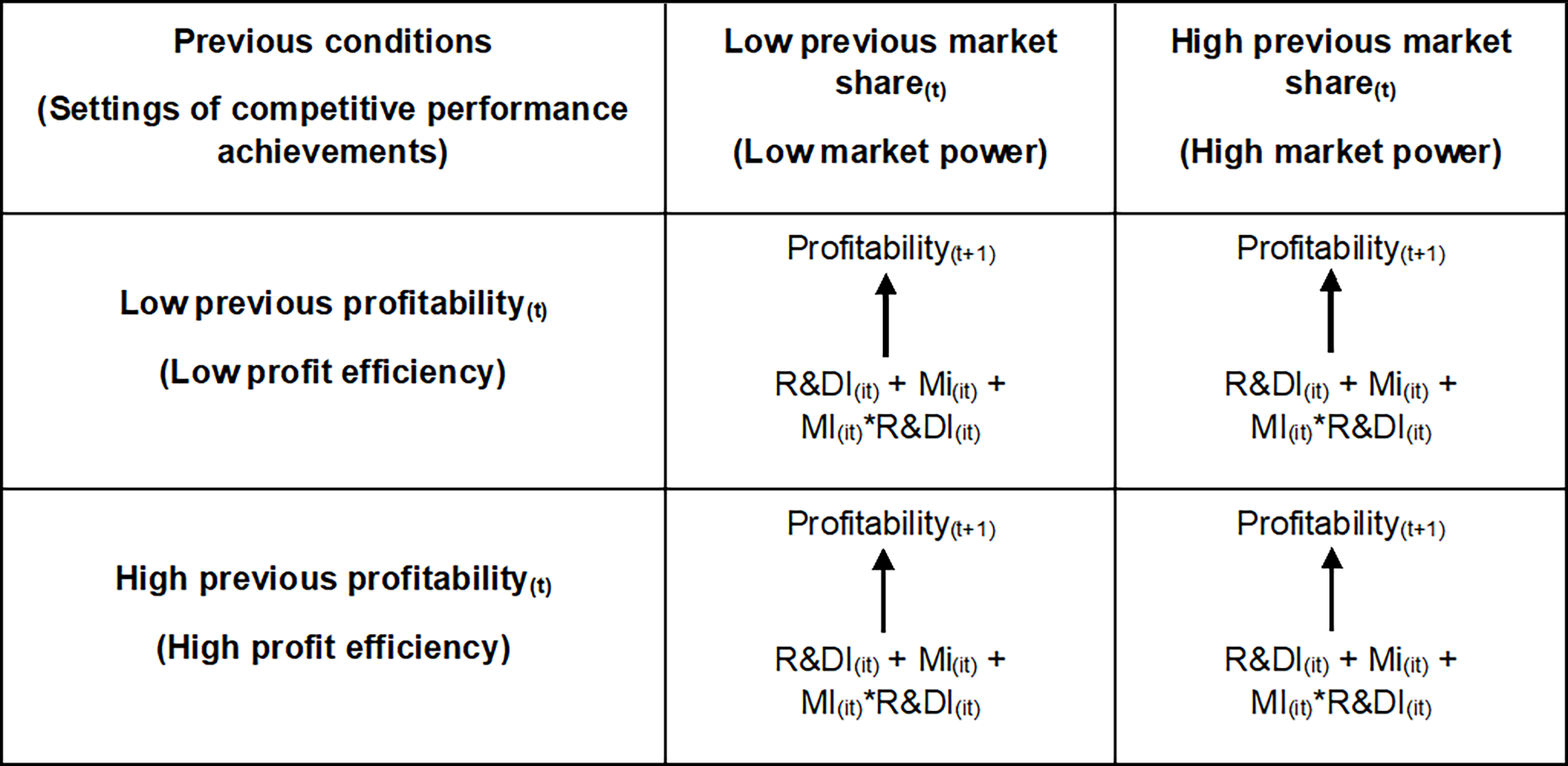
This study evaluates these hypotheses using two empirical models (Figure 1). The first model estimates the direct and moderating effects of marketing and R&D on market share and profitability (ROA) from t to t + 3, thereby addressing H1–H4. The second model tests H5a–H5d, incorporating prior performance as a moderator. This design captures how these resources influence performance over time.

Method
The study used secondary data (2000–2017) from S&P Capital IQ, covering 1,030 publicly traded firms in the USA (91.3%) and the UK (8.7%). We estimated 24 models: 16 tested H1–H4 using market share and ROA from t to t + 3, with and without interactions and eight tested H5a–H5d on ROA at t + 1, segmented by prior performance. Firms operate in information technology (48.4%), healthcare (25.9%), industrials (8.4%), consumer discretionary (8.2%), staples (3.5%), materials (3.0%), energy (1.0%), financials (0.9%) and telecom (0.7%), with 177–6,989 observations per variable.
Unweighted marketing and R&D expenditures were used to avoid endogeneity with asset- or revenue-based dependent variables. Market share and ROA were retained in their original metrics and all continuous variables were log-transformed to estimate elasticities and reduce variance. Definitions and descriptive statistics are provided in Supplementary material Table S1 and correlations using raw and log-transformed variables are reported in Supplementary material Table S2 and Supplementary material Table S3. Log-transformed correlations were adopted to address nonlinearity in the original variables, thereby improving the linearity of multivariate estimation.
Control variables followed marketing–finance standards (Memon, Thurasamy, Ting, Cheah, & Chuah, 2024), including firm size, industry competitiveness, GDP growth and country, as well as time and sector dummies. These controls capture structural and contextual factors affecting both competitiveness (market share) and profitability (ROA). Panel diagnostics supported the use of generalized estimating equations (GEE), which estimate population-average effects and accommodate within-firm dependence through a working correlation with robust errors (Ziegler, 2011). All diagnostic tests (stationarity, autocorrelation, multicollinearity, Lagrange multiplier test, Hausman, White and variance inflation factor) are reported in Supplementary material (Diagnostics_S4). Using Quasi-likelihood under the independence model criterion for selection, an auto-regressive(1) structure minimized model error for H1–H4, whereas an unstructured correlation was optimal for H5a–H5d. The detailed criteria are provided in Supplementary material (ModelCriteria_S5).
The first models assess the lead effects of resource allocation at time t on market share and ROA from t + 1 to t + 3, with and without interaction terms, to determine whether effects persist or decay over time. The remaining eight models evaluate how prior performance influences the impact of current marketing and R&D on future profitability (t + 1). Prior performance was classified using z-scores of market share and ROA relative to industry-year means (z = 0), enabling quadrants that represent competitive achievement conditions and symmetric sample distribution (Davcik & Sharma, 2016). Figure 2 depicts these quadrants and equations (1)–(4) model the effects:
While (i,t + 1, t + 2, t + 3) indicates the performance outcome metric (market share or ROA) of firm i across time, equations (1) and (2) are repeated across years (t to t + 3). bR&DI(i,t) represents the R&D investment variables of firm i in time t. bMI(i,t) indicates the marketing investment variables of firm i in time t. bR&DI(i,t)∗MI(i,t) represents both the R&D and marketing investment variables together of firm i in time t. CVi,t indicates the control variables of firm i in time t. bMI(i,t) is the constant term and ri, t is the working residual. For equations (3) and (4), Y(i,t+1) represents the return-on-assets variable for firm i at time t + 1, given a cluster of prior performance outcomes. k indicates the parameter for a prior cluster’s performance.
Results
The results are divided into three sections: the first examines marketing and R&D effects on market share across time (t, t + 1, t + 2, t + 3), testing H1 and H3; the second evaluates their impact on return on assets (ROA) over the same periods, testing H2 and H4; finally, the third assesses ROA in t + 1, considering prior performance achievements, testing H5a–d.
Dynamic effects of marketing and research and development on market share
The results in Table 1 indicate that marketing and R&D investments have a positive impact on market share over time. The log of marketing investment consistently yields a positive and significant result (p ≤ 0.01), with a strong immediate effect at t (B = 0.27; p ≤ 0.01) that declines at t + 2 and t + 3 (B = 0.14; p ≤ 0.01), supporting H3. Likewise, the log of R&D investment remains positive and significant (p ≤ 0.01), with coefficients of 0.11 at t, 0.08 at t + 1, 0.12 at t + 2 and 0.14 at t + 3, indicating stable yet variable effects.
The Wald test shows a significant drop in the marketing effect from t to t + 2 (z = 3.06; p ≤ 0.05), followed by stability at t + 2 and t + 3 (z = 0.00; p > 0.05). R&D effects did not significantly increase over time, though they remained low, significant and stable (e.g. t + 1 to t + 3: z = −1.20; p > 0.05), supporting H1. The marketing–R&D interaction was non-significant, with near-zero coefficients and high errors, indicating no synergy on market share.
Other variables also show notable effects: total assets positively affect market share (B = 0.51), while industry competition negatively affects market share (B = −0.61). UK firms outperform US firms (B = 1.02) and the effect on GDP growth is not statistically significant. Model fit is strong (R2: 58.0%–60.9%) and QICC is much lower than that for null models (e.g. 31,318 vs 1,023,613 at t).
Figure 3 illustrates a significant positive effect of marketing investment on market share, which peaks at t and declines significantly by t + 2. R&D remains significant but shows slight variation over time.

Dynamic effects of marketing and research and development on return on assets
Table 2 shows that marketing investments have no significant impact on ROA, with coefficients near zero across all coefficients. R&D investments are positive and significant from t (0.08; p ≤ 0.05) to t + 2 (0.11; p ≤ 0.01), peaking at t + 1 (0.13; p ≤ 0.01) and becoming non-significant at t + 3 (0.07; p > 0.05). The Wald test (z = −0.53; p > 0.05) confirms no significant variation, supporting H2.
The interaction between marketing and R&D is significant (p ≤ 0.01), with a stable coefficient of 0.02 across all periods, indicating a consistent synergistic effect on ROA. Wald tests show no significant change over time (z = 0.80; p > 0.05 from t + 1 to t + 3), supporting H4. Control variables reveal that total assets reduce ROA (e.g. B = −0.13 at t + 1; −0.15 at t + 2, p ≤ 0.01), indicating diminishing returns for larger firms. Country effects are minor and non-significant, while competition and GDP growth are mostly irrelevant, except for GDP at t + 1 (B = −0.02; p ≤ 0.10).
The models show moderate explanatory power (R2: 8.9%–11.1%). Lower QICC values – from 3,762 at t to 2,867 at t + 3 – indicate a better fit than null models. Findings underscore the importance of R&D and its synergy with marketing in enhancing ROA, while firm size and market context have nuanced effects.
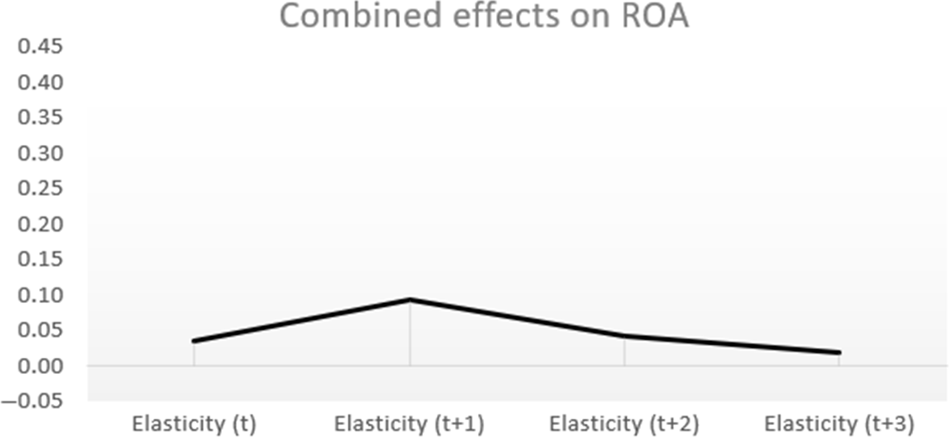
Figure 4 shows that the overall joint effect of marketing and R&D investments on return on assets is low but significantly positive, despite fluctuations.

Performance-contingent effects of marketing and research and development investments
Table 3 models demonstrate high explanatory power (R2: 50.8%–72.2%) and an improved fit (lower QICC) compared to intercept-only models. While interaction models raise R2, they reduce parsimony. Results confirm that marketing, R&D and their interaction differ in effectiveness across firms’ prior performance, supporting H5.
For firms with low prior market share and ROA, marketing investment significantly increases ROA at t + 1 (B = 0.48; p ≤ 0.01), whereas R&D investment has a negative effect (B = −0.46; p ≤ 0.01). In the presence of the interaction term, these effects persist and a significant synergy emerges (B = 0.05; p ≤ 0.01). For firms with low market share and high ROA, marketing (B = 0.11; p ≤ 0.10) and R&D (B = 0.09; p ≤ 0.10) exhibit modest positive effects; however, these effects lose significance when the variables interact. Still, the interaction is significant (B = 0.08; p ≤ 0.01), showing synergy.
Marketing investments moderately affect firms with high prior market share and low ROA (B = 0.23; p ≤ 0.05), while R&D and interaction terms are not significant. For firms with high market share and ROA, neither investment is significant in isolation, but their interaction indicates marginal synergy (B = 0.02; p ≤ 0.05), indicating modest gains from combined strategies.
Discussion
The evidence confirms the impact of marketing and R&D investments on firm performance over time and across varying prior performance conditions. By validating the proposed hypotheses, the findings advance the literature and emphasize the strategic relevance of these investments for practice. Some results may seem expected, but they clarify how and when these investments yield returns.
Contributions to understanding the dynamics of marketing and research and development impacts
The evidence for H1 supports a sustained, context-sensitive effect of R&D on market share, consistent with its role in innovation-driven competitive advantage (Rubera & Tellis, 2014). While prior studies (Karna et al., 2022; Ehie & Olibe, 2010) emphasize the long-term benefits, our findings indicate that R&D already contributes to market share in the current year. This reinforces the importance of aligning R&D with both short- and long-term strategic goals.
For profitability, H2 supports the notion that R&D investments consistently improve ROA over time, thereby addressing debates about their short-term versus long-term effects (Karna et al., 2022; Mubarok et al., 2023). By showing returns in both periods, the study reconciles opposing views and reinforces the value of innovation-driven strategies (Capon et al., 2012). This sustained effect emerged from using unweighted R&D data, indicating that the absolute investment volume itself reveals this prolonged impact.
The validation of H3 extends prior research by empirically supporting the transient impact of marketing on market share (Dekimpe & Hanssens, 1999; Hanssens et al., 2016). While marketing generates substantial initial gains, its influence tends to fade within a few years, underscoring the need for continuous reinvestment to sustain competitiveness, particularly for top-performing firms, where further gains become increasingly marginal.
Additionally, H4 supports the synergistic effect of combining marketing and R&D, demonstrating that their joint impact on profitability exceeds the sum of their isolated contributions. Though classified as operating expenses, these outlays should be seen as strategic investments in competitiveness and profitability. They provide key resources for building sustainable advantage (Davcik & Sharma, 2016) and long-term returns (Maury, 2018). This result complements earlier findings (Huang, 2015; Koshksaray et al., 2023; Krishnan et al., 2009) by showing that even modest synergy persists over time, reinforcing the value of integrating marketing and innovation-based strategies.
Contributions to the efficiency and market power discussion and the theory of the marketing firm
The analysis of prior achievements – combining profit efficiency (ROA) and market power (market share) – demonstrates how historical performance shapes the effectiveness of marketing and R&D, supporting the moderation hypothesis (H5). These results align with Foxall’s (2021) Marketing Firm theory, which asserts that a firm’s learning history guides resource allocation and outcomes. In this view, market share and profit efficiency reflect competitive advantage derived from aggregate consumer choice and influence future performance. The theory also links past resource expenditure to future behavior, framing marketing and R&D as consumer-oriented investments aimed at boosting future profitability and overall performance.
For firms with low profit efficiency and market power, results underscore the corrective role of marketing and its synergy with R&D. Marketing acts as an immediate tool to re-engage consumers and address competitive gaps. At the same time, R&D adds value by aligning innovation with demand. These findings extend those of Maury (2018) and Bhattacharya et al. (2022), demonstrating that even disadvantaged firms can enhance profitability persistence, thereby supporting the catch-up view (Luo & Child, 2015). They support H5a by demonstrating that marketing, either alone or in conjunction with R&D, significantly enhances future profitability in structurally weak firms.
Firms with high profit efficiency but low market power show a distinct pattern: financial surplus enables increased marketing and R&D investments, efficiently expanding profitability. These findings support H5b, as this group achieved the most significant profitability gains from combining both investments. This supports prior research (Katsikeas et al., 2016; Maury, 2018), emphasizing profit efficiency as a key condition for aligning innovation with consumer-oriented behavior (Foxall, 2021).
Firms with low profit efficiency but a high level of market power improved profitability only through marketing investments, with R&D and interaction effects showing no significance. This supports H5c, suggesting that even with operational inefficiencies, firms can convert structural advantages into financial gains via market-oriented strategies. This finding supports prior evidence that marketing alone can enhance profitability, particularly by leveraging market presence and responsiveness (Katsikeas et al., 2016), even in the absence of internal efficiency gains.
For firms with high profit efficiency and strong market power, results support H5d: neither marketing nor R&D alone impacts future profitability, whereas their combination has a modest but significant effect. This aligns with the notion of diminishing returns – firms with high strategic maturity may have already exhausted core resource benefits, with additional investments yielding limited value (Boulding & Staelin, 1990; Edeling & Himme, 2018; Bhattacharya et al., 2022). The finding refines marketing firm theory by showing that prior success moderates the marginal utility of further resource deployment (Foxall, 2021; Porto & Foxall, 2019).
Managerial implications
Managers should tailor their marketing and R&D investments according to their firm’s strategic profile. Firms that invest heavily in marketing tend to see immediate gains in market share, but these effects typically fade after two years. Those investing primarily in R&D experience modest yet sustained improvements in profitability and competitiveness over three years. Firms that increase both simultaneously benefit from synergy effects that enhance long-term profitability.
Resource allocation should reflect prior profit efficiency and market power to generate further profitability. Firms with low levels in both dimensions benefit from marketing alone and its integration with R&D. Firms with high efficiency but low market power gain the most from synergy. In contrast, those with low efficiency and high market power should focus solely on marketing. Firms already performing well in both dimensions experience only marginal returns from synergies.
The key message is that the payoff of marketing and R&D depends on the firm’s existing strategic position. These differentiated patterns underscore the importance of aligning investment strategies not only with general principles of innovation and marketing but also with the firm’s performance history. Ultimately, understanding how firm history conditions the payoffs of strategic investments enables both scholars and practitioners to move beyond linear assumptions and embrace a more dynamic, context-sensitive view of sustained performance.
Limitations and future research
Although this study offers valuable insights, it presents limitations. The focus on US and UK firms may limit generalizability, suggesting the need for broader samples in future research. While GEE captures population-level effects, stationary time-series models may be better suited for assessing temporal stability. The 2000–2017 data set may not accurately reflect recent advances in digital marketing and innovation, underscoring the value of more recent data. Future studies should also investigate how industry context, firm size and regulatory environments influence marketing – R&D synergies, particularly in emerging markets, where instability and resource scarcity present unique challenges to strategic allocation and performance outcomes.
Supplementary material
Supplementary material
Data availability statement
Data are available in a public, open access repository.
References
-
Barney, J. (1991). Firm resources and sustained competitive advantage. Journal of Management, 17(1), 99–120, 10.1177/014920639101700108.
» https://doi.org/10.1177/014920639101700108 -
Bhattacharya, A., Morgan, N. A., & Rego, L. L. (2022). Examining why and when market share drives firm profit. Journal of Marketing, 86(4), 73–94, 10.1177/00222429211031922
» https://doi.org/10.1177/00222429211031922 -
Bouaziz, Z. (2016). The impact of R&D expenses on firm performance: Empirical witness from the bist technology index. Journal of Business Theory and Practice, 4(1), 51–60, 10.22158/jbtp.v4n1p51
» https://doi.org/10.22158/jbtp.v4n1p51 -
Boulding, W., & Staelin, R. (1990). Environment, market share, and market power. Management Science, 36(10), 1160–1177, 10.1287/mnsc.36.10.1160
» https://doi.org/10.1287/mnsc.36.10.1160 - Capon, N., Farley, J. U., & Hoenig, S. (2012). Toward an integrative explanation of corporate financial performance, Springer Science & Business Media.
-
Chakravarty, A., & Grewal, R. (2011). The stock market in the driver’s seat! Implications for R&D and marketing. Management Science, 57(9), 1594–1609, 10.1287/mnsc.1110.1317
» https://doi.org/10.1287/mnsc.1110.1317 -
Chen, J. L. (2012). The synergistic effects of IT-enabled resources on organizational capabilities and firm performance. Information & Management, 49(3-4), 142–150, 10.1016/j.im.2012.01.005
» https://doi.org/10.1016/j.im.2012.01.005 -
Chen, S., & Habibi, M. (2023). A temporal approach to innovation management in recessionary times. Industrial Marketing Management, 113, 215–231, 10.1016/j.indmarman.2023.06.007
» https://doi.org/10.1016/j.indmarman.2023.06.007 -
Chen, P. C., Chan, W. C., Hung, S. W., Hsiang, Y. J., & Wu, L. C. (2016). Do R&D expenses matter more than those of marketing to company performance? The moderating role of industry characteristics and investment density. Technology Analysis & Strategic Management, 28(2), 205–216, 10.1080/09537325.2015.1093107
» https://doi.org/10.1080/09537325.2015.1093107 -
Coase, R. (1937). The nature of the firm. Economica, 4(16), 386–405, 10.1111/j.1468-0335.1937.tb00002.x
» https://doi.org/10.1111/j.1468-0335.1937.tb00002.x -
Cowling, M., Liu, W., & Vorley, T. (2024). Who has an R&D investment opportunity? Who goes ahead? How much do they invest? R&D Management, 55(2), 326–340, 10.1111/radm.12700
» https://doi.org/10.1111/radm.12700 - Cyert, R. M., & March, J. G. (1963). A behavioral theory of the firm, Prentice-Hall. [Database]
-
Davcik, N., & Grigoriou, N. (2019). How an unequal intra-firm resources distribution affect market share. Marketing Intelligence & Planning, 38(2), 167–180, 10.1108/MIP-03-2019-0170
» https://doi.org/10.1108/MIP-03-2019-0170 -
Davcik, N. S., & Sharma, P. (2016). Marketing resources, performance, and competitive advantage: A review and future research directions. Journal of Business Research, 69(12), 5547–5552, 10.1016/j.jbusres.2016.04.169
» https://doi.org/10.1016/j.jbusres.2016.04.169 -
Dekimpe, M. G., & Hanssens, D. M. (1995). Empirical generalizations about market evolution and stationarity. Marketing Science, 14(3_supplement), G109–G121, 10.1287/mksc.14.3.G109
» https://doi.org/10.1287/mksc.14.3.G109 -
Dekimpe, M. G., & Hanssens, D. M. (1999). Sustained spending and persistent response: A new look at long-term marketing profitability. Journal of Marketing Research, 36(4), 397–412, 10.1177/002224379903600401
» https://doi.org/10.1177/002224379903600401 -
Drechsler, W., Natter, M., & Leeflang, P. S. H. (2013). Improving marketing’s contribution to new product development. Journal of Product Innovation Management, 30(2), 298–315, 10.1111/j.1540-5885.2012.01010.x
» https://doi.org/10.1111/j.1540-5885.2012.01010.x -
Edeling, A., & Himme, A. (2018). When does market share matter? New empirical generalizations from a meta-analysis of the market share–performance relationship. Journal of Marketing, 82(3), 1–24, 10.1509/jm.16.0250
» https://doi.org/10.1509/jm.16.0250 -
Ehie, I. C., & Olibe, K. (2010). The effect of R&D investment on firm value: An examination of US manufacturing and service industries. International Journal of Production Economics, 128(1), 127–135, 10.1016/j.ijpe.2010.06.005
» https://doi.org/10.1016/j.ijpe.2010.06.005 - Farris, P., Bendle, N., Pfeifer, P., & Reibstein, D. (2010). Marketing metrics: The definitive guide to measuring marketing performance, Pearson Education.
-
Foxall, G. R. (1988). Marketing new technology: Markets, hierarchies, and user‐initiated innovation. Managerial and Decision Economics, 9(3), 237–250, 10.1002/mde.4090090309
» https://doi.org/10.1002/mde.4090090309 -
Foxall, G. R. (2020). The theory of the marketing firm. Managerial and Decision Economics, 41(2), 164–184, 10.1002/mde.3047
» https://doi.org/10.1002/mde.3047 - Foxall, G. R. (2021). The theory of the marketing firm: Responding to the imperatives of consumer-orientation, Springer Nature.
-
Foxall, G. R., Oliveira-Castro, J. M., & Porto, R. B. (2021). Consumer behavior analysis and the marketing firm: Measures of performance. Journal of Organizational Behavior Management, 41(2), 97–123, 10.1080/01608061.2020.1860860
» https://doi.org/10.1080/01608061.2020.1860860 -
Foxall, G. R., Oliveira-Castro, J. M., & Porto, R. B. (2025). Consumer behavior analysis as a foundation of operant behavioral economics, in Reed, D. B., Kaplan, S. Gilroy, Handbook of operant behavioral economics: Demand, discounting, method, and application, Academic Press, 323–345, 10.1016/B978-0-323-95745-8.00012-2
» https://doi.org/10.1016/B978-0-323-95745-8.00012-2 -
Gavetti, G., Greve, H. R., Levinthal, D. A., & Ocasio, W. (2012). The behavioral theory of the firm: Assessment and prospects. Academy of Management Annals, 6(1), 1–40, 10.5465/19416520.2012.656841
» https://doi.org/10.5465/19416520.2012.656841 -
Griffin, A., & Hauser, J. R. (1996). Integrating R&D and marketing: A review and analysis of the literature. Journal of Product Innovation Management, 13(3), 191–215, 10.1111/1540-5885.1330191
» https://doi.org/10.1111/1540-5885.1330191 -
Grimpe, C., Sofka, W., Bhargava, M., & Chatterjee, R. (2017). R&D, marketing innovation, and new product performance: A mixed methods study. Journal of Product Innovation Management, 34(3), 360–383, 10.1111/jpim.12366
» https://doi.org/10.1111/jpim.12366 -
Hanssens, D. M., Wang, F., & Zhang, X. P. (2016). Performance growth and opportunistic marketing spending. International Journal of Research in Marketing, 33(4), 711–724, 10.1016/j.ijresmar.2016.01.008
» https://doi.org/10.1016/j.ijresmar.2016.01.008 - Hantula, D. A. (2001). Schedules of reinforcement in organizational performance, 1971–1994: Application, analysis, and synthesis, in Johnson, C. W., Redmon, T. Mawhinney, Handbook of organizational performance: Behavior analysis and management, Routledge, 139–166.
-
Huang, J. (2015). Effects of advertising and R&D expense on enterprise performance. Proceedings of the 2015 Joint International Social Science, Education, Language, Management and Business Conference Atlantis Press, pp. 111-119, 10.2991/jisem-15.2015.24
» https://doi.org/10.2991/jisem-15.2015.24 -
Hughes, M., Hughes, P., Yan, J., & Sousa, C. M. P. (2019). Marketing as an investment in shareholder value. British Journal of Management, 30(4), 943–965, 10.1111/1467-8551.12284
» https://doi.org/10.1111/1467-8551.12284 -
Jablonsky, S. F., & DeVries, D. L. (1972). Operant conditioning principles extrapolated to the theory of management. Organizational Behavior and Human Performance, 7(2), 340–358, 10.1016/0030-5073(72)90021-9
» https://doi.org/10.1016/0030-5073(72)90021-9 -
Karna, A., Mavrovitis, C., & Richter, A. (2022). Disentangling reciprocal relationships between R&D intensity, profitability, and capital market performance: A panel VAR analysis. Long Range Planning, 55(5), 102247, 10.1016/j.lrp.2022.102247
» https://doi.org/10.1016/j.lrp.2022.102247 -
Katsikeas, C. S., Morgan, N. A., Leonidou, L. C., & Hult, G. T. M. (2016). Assessing performance outcomes in marketing. Journal of Marketing, 80(2), 1–20, 10.1509/jm.15.0287
» https://doi.org/10.1509/jm.15.0287 -
Koshksaray, A. A., Quach, S., Trinh, G., Keivani, S. B., & Thaichon, P. (2023). Brand competitiveness antecedents: The interaction effects of marketing and R&D expense. Journal of Retailing and Consumer Services, 75(11), 103532, 10.1016/j.jretconser.2023.103532
» https://doi.org/10.1016/j.jretconser.2023.103532 -
Krasnikov, A., & Jayachandran, S. (2008). The relative impact of marketing, research-and-development, and operations capabilities on firm performance. Journal of Marketing, 72(4), 1–11, 10.1509/jmkg.72.4.1
» https://doi.org/10.1509/jmkg.72.4.1 - Krishnan, H. A., Tadepalli, R., & Park, D. (2009). R&D intensity, marketing intensity, and organizational performance. Journal of Managerial Issues, 21(2), 232–244.
-
Kumar, V., Sriram, S., Luo, A., & Chintagunta, P. K. (2011). Assessing the effect of marketing investments in a business marketing context. Marketing Science, 30(5), 924–940, 10.1287/mksc.1110.0661
» https://doi.org/10.1287/mksc.1110.0661 - Lantz, J. S., & Sahut, J. M. (2005). R&D investment and the financial performance of technological firms. International Journal of Business, 10(3), 251–270.
-
Lee, S. (2014). The relationship between growth and profit: Evidence from firm-level panel data. Structural Change and Economic Dynamics, 28(3), 1–11, 10.1016/j.strueco.2013.08.002
» https://doi.org/10.1016/j.strueco.2013.08.002 -
Leenders, M. A. A. M., & Wierenga, B. (2008). The effect of the marketing – R&D interface on new product performance : The critical role of resources and scope. International Journal of Research in Marketing, 25(1), 56–68, 10.1016/j.ijresmar.2007.09.006
» https://doi.org/10.1016/j.ijresmar.2007.09.006 -
Luo, Y., & Child, J. (2015). A composition-based view of firm growth. Management and Organization Review, 11(3), 379–411, 10.1017/mor.2015.29
» https://doi.org/10.1017/mor.2015.29 -
Maury, B. (2018). Sustainable competitive advantage and profitability persistence: Sources versus outcomes for assessing advantage. Journal of Business Research, 84(3), 100–113, 10.1016/j.jbusres.2017.10.051
» https://doi.org/10.1016/j.jbusres.2017.10.051 -
Memon, M. A., Thurasamy, R., Ting, H., Cheah, J., & Chuah, F. (2024). Control variables: A review and proposed guidelines. Journal of Applied Structural Equation Modeling, 8(2), 1–14, 10.47263/JASEM.8(2)01
» https://doi.org/10.47263/JASEM.8(2)01 -
Morgan, N. A. (2012). Marketing and business performance. Journal of the Academy of Marketing Science, 40(1), 102–119, 10.1007/s11747-011-0279-9
» https://doi.org/10.1007/s11747-011-0279-9 -
Mubarok, F., Sultan, Z., Wibowo, M., & Wongsuwatt, S. (2023). Unlocking the secrets of profitability: Investigating the role of research and development. Jurnal Manajemen Teori Dan Terapan, 16(2), 356–367, 10.20473/jmtt.v16i2.44958
» https://doi.org/10.20473/jmtt.v16i2.44958 -
Pathak, S., Sen, P. K., Jayaram, J., & Miller, J. M. (2019). “Like poles repel while unlike poles attract”: contextual performance effects of supply base R&D, focal firm R&D, and commercialization. Decision Sciences, 50(5), 985–1030, 10.1111/deci.12360
» https://doi.org/10.1111/deci.12360 -
Pauwels, K., & Hanssens, D. M. (2007). Performance regimes and marketing policy shifts. Marketing Science, 26(3), 293–311, 10.1287/mksc.1060.0267
» https://doi.org/10.1287/mksc.1060.0267 -
Porto, R. B., & Foxall, G. (2019). The marketing firm as a metacontingency: Revealing the mutual relationships between marketing and finance. Journal of Organizational Behavior Management, 39(3-4), 115–144, 10.1080/01608061.2019.1666774
» https://doi.org/10.1080/01608061.2019.1666774 -
Porto, R. B., & Foxall, G. R. (2020). Marketing firm performance: When does marketing lead to financial gains? Managerial and Decision Economics, 41(2), 191–202, 10.1002/mde.3046
» https://doi.org/10.1002/mde.3046 -
Porto, R. B., & Foxall, G. R. (2022). The marketing‐finance interface and national well‐being: an operant behavioral economics analysis. Managerial and Decision Economics, 43(7), 2941–2954, 10.1002/mde.3574
» https://doi.org/10.1002/mde.3574 - Porto, R. B., & Oliveira-Castro, J. M. (2015). Consumer purchase and brand performance: The basis of brand market structure, in Foxall, G. (Eds), The routledge companion to consumer behavior analysis, Routledge, 175–201.
-
Porto, R. B., & da Silva, J. B. (2013). Encadeamento comportamental que incentiva o tempo de contrato com clientes de academia de ginástica. Revista Brasileira de Marketing, 12(4), 64–84, 10.5585/remark.v12i4.2554
» https://doi.org/10.5585/remark.v12i4.2554 -
Powell, T. C. (2001). Competitive advantage: Logical and philosophical considerations. Strategic Management Journal, 22(9), 875–888, 10.1002/smj.173
» https://doi.org/10.1002/smj.173 -
Rađenović, T., Krstić, B., Janjić, I., & Vujatović, M. J. (2023). The effects of R&D performance on the profitability of highly innovative companies. Strategic Management, 28(3), 34–45, 10.5937/StraMan2200034R
» https://doi.org/10.5937/StraMan2200034R -
Rubera, G., & Tellis, G. J. (2014). Spinoffs versus buyouts : Profitability of alternate routes for commercializing innovations. Strategic Management Journal, 35(13), 2043–2052, 10.1002/smj.2206
» https://doi.org/10.1002/smj.2206 -
Rubera, G., Ordanini, A., & Calantone, R. (2012). Whether to integrate R&D and marketing: The effect of firm competence. Journal of Product Innovation Management, 29(5), 766–783, 10.1111/j.1540-5885.2012.00936.x
» https://doi.org/10.1111/j.1540-5885.2012.00936.x -
Saranga, H., George, R., Beine, J., & Arnold, U. (2018). Resource configurations, product development capability, and competitive advantage: An empirical analysis of their evolution. Journal of Business Research, 85(4), 32–50, 10.1016/j.jbusres.2017.11.045
» https://doi.org/10.1016/j.jbusres.2017.11.045 -
Sharma, P., Davcik, N. S., & Pillai, K. G. (2016). Product innovation as a mediator in the impact of R&D expense and brand equity on marketing performance. Journal of Business Research, 69(12), 5662–5669, 10.1016/j.jbusres.2016.03.074
» https://doi.org/10.1016/j.jbusres.2016.03.074 -
Sklenarz, F. A., Edeling, A., Himme, A., & Wichmann, J. R. (2024). Does bigger still mean better? How digital transformation affects the market share–profitability relationship. International Journal of Research in Marketing, 41(4), 648–670, 10.1016/j.ijresmar.2024.01.004
» https://doi.org/10.1016/j.ijresmar.2024.01.004 -
Srinivasan, R., Lilien, G. L., & Sridhar, S. (2011). Should firms spend more on research and development and advertising during recessions? Journal of Marketing, 75(3), 49–65, 10.1509/jmkg.75.3.49
» https://doi.org/10.1509/jmkg.75.3.49 -
Stock, R. M., & Reiferscheid, I. (2014). Who should be in power to encourage product program innovativeness, R&D or marketing? Journal of the Academy of Marketing Science, 42(3), 264–276, 10.1007/s11747-013-0354-5
» https://doi.org/10.1007/s11747-013-0354-5 -
Tavassoli, S., & Karlsson, C. (2015). Persistence of various types of innovation analyzed and explained. Research Policy, 44(10), 1887–1901, doi: 10.1016/j.respol.2015.06.001
» https://doi.org/10.1016/j.respol.2015.06.001 -
Uysal, M. (2021). Analysis of the relationship between market share and technological development regarding companies: An application on Turkey, in Dinçer, H & Yüksel, S. (Eds), Financial strategies in competitive markets, Contributions to Finance and Accounting Springer, 123–135, 10.1007/978-3-030-68612-3_9
» https://doi.org/10.1007/978-3-030-68612-3_9 -
Vorhies, D. W., Orr, L. M., & Bush, V. D. (2011). Improving customer-focused marketing capabilities and firm financial performance via marketing exploration and exploitation. Journal of the Academy of Marketing Science, 39(5), 736–756, 10.1007/s11747-010-0228-z
» https://doi.org/10.1007/s11747-010-0228-z -
Wang, X., & Lou, T. (2020). The effect of performance feedback on firms’ unplanned marketing investments. Journal of Business Research, 118(9), 441–451, 10.1016/j.jbusres.2020.07.015
» https://doi.org/10.1016/j.jbusres.2020.07.015 -
Ziegler, A. (2011). Generalized estimating equations, Springer. 10.1007/978-1-4614-0499-6
» https://doi.org/10.1007/978-1-4614-0499-6
Edited by
-
ASSOCIATE EDITOR:
Otavio Freire
History
-
Received
18 July 2024 -
Reviewed
06 Dec 2024 -
Reviewed
21 June 2025 -
Reviewed
20 Sept 2025 -
Reviewed
25 Nov 2025 -
Accepted
16 Dec 2025