
 Factors influencing the prioritization of rival public value positions in Brazilian digital government initiatives
Abstract
Purpose This study aims to identify factors influencing the prioritization of rival public values, with Brazilian state governments as locus. The paper also proposes a conceptual model comprising the intervening factors and their relationships with the public and the value positions.
Design/methodology/approach This exploratory study used a qualitative cross-sectional design. A focus group was used as the method of data collection, with 27 civil servants from 13 Brazilian states, representing all geographic regions, serving as respondents. Data analysis was based on the rhetoric of public managers’ discourses in counterpoint to their practical actions regarding decisions on prioritizing public value positions.
Findings The government side was analyzed; however, the quantitative validation of the theoretical model remains to be conducted in further research.
Research limitations/implications The data analysis revealed that political issues are the primary variable influencing digital government decisions. Therefore, political leadership is the decisive factor driving the choices regarding digital initiatives. It may also indicate why the values adopted differ from those defended by political agents and explain the imperative of efficiency, as political decision-making can interfere with internal factors. The media was the only external factor identified.
Practical implications This research contributes to understanding the factors and variables that influence decision-making regarding digital government projects.
Social implications The study can help in understanding public value positions, promoting transparency, inclusion and improving governance. Government social media efforts are key in cultivating digital participation and engagement. This digital transformation in government is vital, aligning with the growing expectations of digital experiences, thus empowering citizens and enhancing the relationship between government and citizens.
Originality/value The proposed conceptual model makes a relevant theoretical contribution by illustrating the dynamics of prioritizing rival public value positions.
Public value; Value positions; Digital government; e-government; Digital services; Public services
Introduction
Constant societal changes have challenged governments worldwide to adapt and transform their relationships with their citizens. Today, citizens are increasingly using information and communication technologies (ICTs) in their daily lives. Moreover, they are demanding the transformation of public services as their expectations regarding digital government continue to grow (Chan, Thong, Brown, & Venkatesh, 2025). Although digital government solutions have expanded considerably and are more mature (Busch & Henriksen, 2018), their real impacts are being questioned (Pedersen, 2018). There is a paradox because, despite high investments, the real benefits are not yet impacting citizens as intended (Scholta et al., 2018). The extensive public investments in digital government have generated insufficient public value (Soe & Drechsler, 2018). For instance, evidence of the positive impact on citizens’ lives differs (Criado & Gil-Garcia, 2019), and citizens’ confidence in governments is not increasing (Sundberg, 2016). It is noteworthy that in this study, digital government is understood through the broad view defined by Janowski (2015), encompassing digitization; internal institutional change, engagement or changes in the relationships among stakeholders; and contextualization.
The intensive use of repertoires from private companies, borrowed from the New Public Management (NPM), is cited as a reason for the limited results of digital government (Cordella & Bonina, 2012). A primary focus on efficiency can lead to ineffective governments (Rose et al., 2015a), resulting in fragmentation within government agencies due to silos, which in turn enlarge hierarchical and bureaucratic structures (Sundberg, 2016). A techno-centered vision and the prioritization of automating rational objects (Busch & Henriksen, 2018), prevail. However, the purpose of transformation in the public sector is not merely to be effective or provide digital services but to ensure public value (Sundberg, 2016). Public value is the value created through government actions that produce a net benefit for society (Stoker, 2006). This definition aligns with the moral imperative for governments to act in the public interest, representing multiple stakeholder groups (Moore, 1995).
The normative core of the public sector – what it must do and how it should do so – cannot be taken for granted (Rose & Flak, 2018). However, defining the public interest is a complex and notoriously contentious issue (Xanthopoulou, 2020). Thus, in practice, the strategies, investments, design and implementation of digital government are influenced by three leading value positions: administrative efficiency, service improvement and citizen engagement. These positions are deeply rooted in the discourse and actions of public managers and, in turn, depend on the traditions of public management (Rose et al., 2015a). Public value position is seen as the “general objective, motivation and goals shared by the group of stakeholders that form part of the digital government project, which may also represent the primary criterion for the perception or failure of initiatives” (Rose & Flak, 2018, p. 364). Therefore, these value positions warrant study because they relate to a specific form of digital government implementation.
Furthermore, exploring the value positions reflected in digital government initiatives can offer valuable insights into the motivations and purposes of the research field, which is deeply rooted in the project objectives (Persson & Goldkuhl, 2010). Overall, value positions express a general purpose, as their motivation and common objectives are largely coherent and synergistic. However, there may be rivalry between the different value positions, understood as a competition to reach each position, with the incompatibility between values or positions being the most important reason for this rivalry. Conceptually, all values are equally important; however, rivalry can arise during the decision-making process regarding which initiative will be privileged over others. If public managers interpret efficiency solely as cost reduction, this may be incompatible with the value of providing better services to citizens, as better services can be costly (Rose et al., 2015a). This is the theoretical gap that this research addresses, discussing not only the values that should be addressed but also why they are addressed or not.
In attempting to understand the logic behind choosing among rival public values, this study aims to identify the factors that influence prioritizing rival value positions and to understand how they emerge in governmental decision-making. Subsequently, a conceptual model encompassing these factors and their relationships was developed. To achieve these results, three focus group sessions were conducted involving 27 Brazilian civil servants from 13 Brazilian states. This study may contribute to describing the public value construct and to a better understanding of the variables that influence the choice of a specific public value position. Given Brazil’s status as both a developing country and a country with a focus on digital government initiatives, these findings may be of interest to countries in similar contexts.
2.Theoretical framework
Digital government studies are advocating for the multiplicity of values that guide the actions and strategies of public managers (Cordella & Bonina, 2012). Some authors have used the term public values and developed taxonomies to categorize and explain public value as an enabler of public administration reforms (Ranerup & Henriksen, 2019). Values are plural and overlapping (Van der Wal & van Hout, 2009), and are highly intertwined with political processes in a public sector context (Twizeyimana & Andersson, 2019). Moreover, they must be legitimized and validated by all stakeholders (Rose & Flak, 2018).
The framework of public value positions in digital government, as presented by Rose et al. (2015a) and illustrated in Figure 1, represents a comprehensive synthesis of the various paradigms in the literature of public administration and digital government (Persson, Ohn, Touby, et al., 2017). The framework is the result of an empirical research project in the government of Denmark, and four studies deserve attention in this context: Rose & Persson (2012); Rose et al. (2015a); Rose et al. (2015b) and Rose & Flak (2018). These studies navigate the traditions of public administration in a didactic and orderly manner, culminating in the categorization of values into three positions of value for digital government, ranging from electronic government automation to the rhetoric of transformation. Moreover, they also explore the distinction between values advocated in speeches and values effectively practiced. Now, the greatest wealth seems to be the understanding of the rivalry and competition between the positions of value (Ranerup & Henriksen, 2019) and, especially, the clarity on how public managers resolve this rivalry.
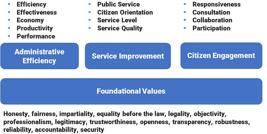
The three public value positions in digital government considered here are administrative efficiency, service improvement and citizen engagement. In digital government, administrative efficiency is a key value proposition that addresses the impact of automation on government operations. Service improvement focuses on the use of ICT to enhance the citizen’s experience by expanding access to information and services, facilitating accessibility and usability through digital services, reducing response time, cutting costs for the citizen, automating payments, supporting minorities, providing specialized services for disabled people (Rose & Flak, 2018), and acting as a strategic planner and promotor of the innovation process (Durst & Leyer, 2022). Each position of value represents dominant value choices (or ideals) embedded in each tradition of public administration. Each position groups a complementary set of representative values. Thus, within each position, the values are largely synergistic and complementary. However, there may be rivalry or competition between the positions of value (Rose & Flak, 2018).
The high number of citations of Rose’s works in high-impact international journals consolidates the relevance of these four studies. Based on the citations of these Rose studies on Google Scholar as of April 2023, which totaled 479 articles, we conducted a systematic literature review. A set of criteria was applied to select papers, with searches conducted in an integrated manner through the CAPES Journal Portal, using the Web of Science and Scopus databases. The searches were performed using the following keywords: (“Public value” or “Value positions” and “Digital government” or “e-government” or “Digital services” or “Public services”). The refinement criteria used for document selection included peer reviewed articles published in academic journals and open-access journals. Below, in chronological order, are some studies and their applications.
Persson, Ohn, Touby et al. (2017) noted that the application of the framework was beneficial because it facilitated an easier analysis of government strategy documents. Users of the strategies were able to perceive the underlying positions of value, even in these dense documents that are difficult to comprehend, revealing non apparent values. Hoffman et al. (2019) consider the framework useful, among other reasons, because it establishes categories of value position associated with technological frameworks and also focuses on how digital technologies and innovations benefit and impact (or not) good governance.
Distel & Lindgren (2019) build on Rose et al. (2015b) to explore value paradigms in digital government, focusing on the motivators behind the implementation of digital public services. They note that their framework reflects the ideals of public sector managers but excludes the roles of citizens in the process. In a Finnish online tax declaration experiment with 40,000 users, Hyytinen, Tuimala, & Hammar (2022) applied Distel and Lindgren’s user roles and examined public value positions, also addressing stakeholder alignment challenges.
Ranerup & Henriksen (2019) view Rose et al. (2015b) framework as simplistic yet helpful in identifying and discussing empirical value positions and related paradoxes, which helps in understanding the complex responsibility structure in digitalization projects. Sundberg (2016) highlights two advantages: the framework’s solid theoretical basis and its exploration of the role of digital government. Toll et al. (2020) consider it significant, citing both theoretical and empirical support and apply it in the Swedish context.
Madsen, Lindgren, & Melin (2022) study on citizens’ experiences with digital self-service in social services and benefits used Rose’s work to demonstrate that digitization should not only be viewed as a means to achieve cost savings for the government but also as a means to improve public services for citizens and businesses. Wilson (2022) examines the decision-making processes of public managers and artificial intelligence governance, highlighting the divergence and juxtaposition of underlying values from Rose’s three positions of value.
Ju et al.’s research (2023) examines the design of a trustworthy government chatbot’s interaction mode through a framework, concluding that the application’s focus remains technocentric, relying on existing technologies and processes rather than end user preferences, particularly those of citizens. On the other hand, Roth et al. (2023), in a study on blockchain implementation, cite Rose et al. (2015b) to highlight that technology selection can be challenging due to the complexity of decision-making systems and responsibilities in the public sector.
3.Methodology
Based on a positivist epistemological position, this exploratory study adopts a qualitative cross-sectional approach. Focus group sessions were performed with 27 civil servants from 13 state governments in Brazil as respondents. The perspective of public managers was chosen because of the government’s role as the guarantor of creating public value (Sundberg, 2016). Empirical validation is grounded in the rhetoric of public managers’ discourses as a counterpoint to their practical actions regarding the prioritization of public value positions in digital government initiatives. Three focus group sessions were conducted from November 2019 to June 2020, comprising two face-to-face sessions and one online session due to the social distancing measures implemented during the COVID-19 pandemic. Each session lasted an average of two hours. The research design is outlined in Figure 2.

The content analysis (Bardin 1970) served as the basis for qualitative analysis, enabling the identification and organization of participants’ statements from the focus groups into analytical categories. This approach ensured that the findings were grounded in a robust methodology and aligned with the research objectives.
3.1Participant profile
The selection of focus group participants was based on three criteria:
-
(1) being a civil servant in state governments for at least five years;
-
(2) having worked in digital government programs in the last 24 months; and
-
(3) being from states with varying levels of digital government maturity.
A total of 27 state government civil servants working on digital government projects participated in the focus group sessions. While 22 participants were more related to digital government departments, involved in discussing and modeling digital government solutions, five were more related to strategic areas and interacted with political agents. These civil servants work in 13 state governments across all five Brazilian geographic regions and are considered by their peers to be experts in digital government. Importantly, the fact that the participants represented all Brazilian geographic regions allowed access to different levels of capacity for the digital government.
Regarding educational level, all participants hold a bachelor’s degree, and additionally, 13 have an MBA or a similar qualification and 13 hold a master’s degree. Regarding experience, 13 participants had between 6 and 15 years of experience as civil servants, eight had between 16 and 25 years of experience and six had more than 26 years of experience working as civil servants. This indicates that these focus group participants were suitable for the research goals and that all three selection criteria were met.
3.2Data collection processes
The focus group design facilitated a mediated debate between the public managers, with each participant having the opportunity to express their views. The four steps of the focus group were as follows:
-
Step 1 – leveling of concepts
Presentation of general rules (including consent for recording and warm-up discussions of practical experiences), followed by the presentation of the concept of digital government adopted in the research.
-
Step 2 – individual map
Participants were asked to classify the degree of importance of the public value positions prioritized in the digital government initiatives in which they had participated in the previous 12 months. This period was chosen because it covered the first year in office of the Brazilian new state governments. For this, each participant received 13 cards, each naming one of the 13 public values listed by Rose et al. (2015a) and presented in Figure 1. Foundational values were not considered because, according to Rose et al. (2015a), they do not generate rivalry with other positions.
Figure 3 shows an example of a map completed by a focus group participant. All discussions were in Portuguese.
To reduce bias, neither the concept of public value nor associations with value positions were presented to the participants. The researchers informed participants that each of the 13 cards represented an expected goal or result in the context of digital government initiatives. Each participant was then asked, based on their practical experience, to classify the 13 cards according to their degree of importance to the government (ranging from 1 – “less important,” to 5 – “most important” and “not important” in cases where that value was not considered). Researchers emphasized that participants should classify the cards based on their perception of the government’s stated objectives and their experience in implementing digital government initiatives rather than on their opinion of how they should be prioritized.
-
Step 3 – collective maps
Using the information from the individual maps, the researchers compiled a collective map that represented prioritizations in terms of frequency, objectives and motivations, with varying degrees of importance or absence of importance. Figure 4 shows an example of a collective map.
-
Step 4 – group debate
Finally, researchers asked the focus group participants to analyze the explanation for the overall result of the map based on their experience. The objective was to shed light on the tensions, pressures and possible contradictions existing in the prioritization decisions. This debate gave rise to numerous exchanges and dialogues, particularly regarding their perceptions based on practical experiences as they implement digital government initiatives in Brazilian states.


Data analysis
Content analysis was used to identify data categories and their corresponding frequencies. The analysis identified repeated themes related to the three value positions and categorized them using a coding system developed from the literature review. The subcategories represent a group of public values about each category. Content analysis was conducted by counting the frequency of statements made by participants, and subsequently, the tensions and contradictions between value positions were identified and evaluated. The analysis of the categorical data involved thoroughly examining the material through a careful reading of the statements, followed by classification and coding according to predefined categories. New categories were created based on the data collected from the analysis and a more in-depth examination of the data was conducted. A three-step encoding process using NVivo Software resulted in 17 nodes and 30 sub-nodes.
The categories found and operationalized in the study are closely tied to the theories of public value and public management. Moore’s (1995) theory of public value creation provides context for understanding how political leadership and ideology drive government decision-making. In addition, the framework by Rose et al. (2015a) on public value positions in digital government serves as a basis for categorizing and comprehending the rivalries between different values, such as efficiency, service improvement and citizen engagement. The analysis of these variables and their interrelations deepen the understanding of the factors shaping digital government initiatives in Brazil.
4.Results
4.1The political factor is predominant in the current map of digital government in Brazilian states
Participants noted that policymakers do not understand the impact of technology: “Policymakers do not recognize IT as the driving force behind change” (E9). The “lack of a digital mindset” (E14) and “lack of comprehension of the merger of ICT with business” (E12) were identified as relevant aspects of the current digital government implementation framework in Brazilian states. In addition, policymakers do not focus on the preferences and needs of citizens when prioritizing digital government initiatives: “They feel legitimized by the vote” (E11) and “do not recognize technology as a factor driving voting” (E27). In most cases, protagonism came from business managers. Technical managers often feel pressured to respond; however, the strategic level does not typically lead to initiatives or focus solely on the depletion of public resources. Amidst all of this, society’s necessities are often overlooked; the focus is sometimes on obtaining and maintaining legitimacy.
4.2The administrative efficiency imperative
Table 1 presents the frequency analysis derived from the classification made by the focus group participants based on their perception of the degree of importance of public values in implementing digital government in their states over the previous 12 months.
Administrative efficiency emerges as the dominant value position, followed by service improvement. Meanwhile, citizen engagement had the lowest frequency and was the value position most frequently reported as being unimportant. Thus, it was not considered or prioritized in the digital government initiatives to which the participants belonged. When asked about the reasons why the administrative efficiency position was attributed such importance, the participants reported that the focus is “within the government” (E13), where “ICT is seen as a lever of performance” (E1), within the logic of rationalization of government – both respondents do not mention any disagreement with these positioning. One possible explanation reported by participants is the “low maturity in digital government” (E22), which yields efficiency as the primary outcome of the “doing more with less” mantra. Even service improvements or migrations to digital channels are understood by the participants as institutional pressure for rationalization and administrative simplification. The internal structure of governments appears to be under pressure, particularly due to staff shortages, which lead to delayed projects. Civil servants want to be innovative, but they do not know the codes of operation without the efficacy imperative: they are afraid of not being able to explain themselves, to be understood and to be legitimated without the efficacy discourse.
4.3The financial criterion is the focus of administrative efficiency
Within administrative efficiency, the public value economy was repeatedly highlighted in the digital initiatives and was prioritized 16 times. Several examples of implemented projects mentioned by the participants focused on cost reduction.
The leading cause was the fiscal crisis: “The fiscal crisis forces the economy and the reduction of costs” (E5). The size and cost of the Brazilian administration are no longer sustainable with state revenues. The desired path, where workers are needed, is the efficiency of the public machinery, with improvements in public management and cost reduction: “Even in cases where digital government projects intended to improve the provision of services, for the government, the goal is still to economize/still the economy” (E15). The ideology of the party in government was seen as a reason for the focus on savings: “In my state, the political party currently in power has a philosophy that prioritizes efficiency, cost reduction, and economy” (E6). It is as if they have only one repertoire, which is already highly tested by media players, and it works because they are not bothered and can even be legitimized if the results are well received.
4.4Service improvement is a political marketing tool
When asked why they perceived improving services as important, the participants pointed to a strong discourse among politicians and political agents regarding citizen-oriented goals. However, they do not see those goals as driving the practice as “there is only discourse and little practice” (E12). One explanation is that politicians do not associate the vote they receive with the voice of the citizens. For them, their permanence in power is linked to the citizens’ vote, not to the delivery of digital services. Moreover, disbelief in government generates little social pressure for digital services: “The government delivers awful services, generating a feeling among citizens that there is nothing else to do, that the government does not work” (E24). Another participant noted, “… society does not connect innovative actions with the government. The government is still synonymous with paper” (E13).
According to the participants, politicians have incorporated the idea of digital government into their discourses as a form of marketing, being more concerned with appearance than practice. One of the participants suggested that the enactment of Federal Law 13,460 of 2017, known as the Public Service Users’ Defense Code, which provides for the participation, protection and defense of the rights of public service users, has led Brazilian governments to attribute greater value to citizen orientation. However, in fact, concrete actions so far have only included some implementations of public ombudsman channels. The participant added that the law has an internal chapter with 15 guidelines for the level of service. Another participant reported that “the government does not meet service levels because it suffers no sanction” (E14) and that it “lacks the maturity to establish and measure service level” (E4). Service improvement is pursued when it is coordinated with the efficiency discourse, so it is as if the first two positions of the public value are indeed one, considering service improvement is dependent on the efficiency value.
4.5Media is the only external factor to exert relevant pressure
The media emerges as a relevant intervening factor that pressures service improvement through digital government. One participant noted: “The media interferes a lot, especially with the young/new digital-age reporters, which provokes and pressures the government” (E23). Another participant noted: “The focus of the media has been the availability of the service and not the participation of the citizen, since the media’s interest does not always represent the collective interest” (E19). Moreover, media players are self-interested and think that, under the NPM paradigm, they are more appreciative when private companies’ ideas drive government initiatives. The conflict between public and private values may lead to the erosion of public value, especially in complex scenarios (Naveed, Farooqi, & Salman, 2025). This observation is consistent with Tangi, et al. (2020), who noted that transformation is not driven by internal organizational needs but rather by external pressures, which, according to the authors, are the primary drivers of transformation in governments.
4.6Citizen engagement has low priority
One of the factors highlighted concerns how politicians perceive the legitimacy of the vote: “Politicians see themselves as self-sufficient and magnanimous since they are validated by the vote” (E18). The representativeness of the vote leads politicians to believe that they already know the citizens’ needs and, therefore, do not need to listen to them any longer. A participant noted, “Citizens are not seen as stakeholders. Their opinions are not considered during decision-making” (E4). Governments’ lack of structure, preparation and knowledge were also suggested as reasons for the lack of importance attributed to values related to citizen engagement.
The cultural and political aspects of the government, which for years has made its own decisions, also play a role. “For 30 years, I have worked with ICT in the government, and it has always digitized and continues to digitize services without asking the citizen anything” (E7). It reveals a culture of low participation or co-creation of services, with a focus on internal knowledge and expertise. In the same vein, others noted that society does not organize itself to express its interests and needs effectively, especially given its limited understanding of the power of its collective voice. Others suggested that governments might fear amplifying negative criticism within society and drawing attention to historical deficits regarding their failure to deliver digital services. The government recognizes that simple actions, such as making services available through new channels, can already create value for citizens.
A lack of staff knowledge to engage citizens was also pointed out as an inhibiting factor: “I think the technical staff itself does not know how to do it” (E15). Another participant (E26) argued, “The state is not organized to meet the demands, so there is no point in opening for consultation because if it does so, there will be no feedback.”
5.Discussion
Data show that rivalry exists. The many years of fiscal crises and the necessary efforts to reduce administrative burdens and corruption have pressed governments to give administrative efficiency the top priority. The conflict between media pressure, a lack of personnel, internal and external cultural issues, a discourse on citizen orientation without effective practice and the need for fiscal adjustment generates incompatibilities between values and public value positions. Increased skepticism among the population regarding the government tends to reduce social pressure. This occurs because the real benefits have not yet been felt by citizens (Gupta & Suri, 2017), and the results of the digital government are limited (Pedersen, 2018), which generates distrust in the government. Without external pressure from citizens, politicians perceive a greater sense of legitimacy and representativeness of the vote. Consequently, digital initiatives that focus on citizen engagement are not being prioritized, perhaps because they are not even understood.
Similarly, a study on the Danish government found that public managers resolve such rivalries by prioritizing administrative efficiency (57%). Their commitment to improving services is the second most important (30%) and while citizen engagement is recognized as important (13%), it is not prioritized (Rose, et al., 2015a). We find similar results: administrative efficiency has the highest priority at 49%, followed by service improvement at 36% and citizen engagement at 15%. Notably, the context in Brazil differs significantly from that in Denmark, where the government is a parliamentary monarchy with a strong focus on promoting social welfare, society is more equitable and public services are highly digitized. This generates greater confidence in the Danish government among its citizens and fewer social demands, reducing the need for government openness and citizen participation. Thus, the similarity in the results may be due to the role of leadership. Leadership plays a crucial role in this process; public managers must respond to a diverse range of objectives and challenges expressed by multiple stakeholders.
Clearly, the adopted values differ from those defended in the discourse. Political actors often resolve tensions between positions. The importance attributed to improving services was seen as a response to media pressure or the trend toward digital transformation rather than as a result of the political will to provide better public services for citizens. Our analysis reveals which factors influence the priorities adopted in the use of ICTs in public management at the state level in Brazil. Table 2 summarizes these factors.
Figure 5 illustrates the conceptual model constructed based on the study findings, which are described as follows.

First, administrative efficiency has the highest priority, primarily due to internal government issues. Political aspects derived from the ideology of the party in power and the perceived legitimacy afforded by the electoral process, as well as the high representativeness understood from the vote, lead to a greater focus on public values typical of this position, such as simplification and rationalization. Allied with these are economic factors, such as the need for fiscal consolidation as previous administrations had increased spending, particularly on staff, beyond the government’s capacity to collect revenue. This situation has led to a shortage of resources, thereby hindering the provision of better services to citizens. Among the external factors, media pressure for increased productivity and improved government performance was significant.
Second, service improvement was also affected by internal political factors. Digitization is primarily undertaken for political convenience rather than for the benefit of the de facto citizens. The lack of staff and economic issues influence the implementation of service improvements through digital means. Citizens discredit the government and no longer pay for services, resulting in a lack of external interference that contributes to the reduction of services in digital media. The behavior of civil servants, who are too focused on legal aspects, contributes to the idea that citizens are unable to participate in discussions, decisions, or the modeling of new services. The enactment of Law 13,460 suggests a movement toward citizen-centricity.
Meanwhile, as an external factor, the media has substantial influence by offering negative criticism, forcing the government to digitize public services. The media reinforces the modern paradigm of society and the digital world, which pressures governments to transform. In the case of Brazilian states, this tends to generate more political discourse than an effective practical transformation.
Third, regarding citizen engagement, practicing popular consultation, collaboration and participation through ICTs requires a suitable culture and internal structure for the readiness for an open government. However, Brazilian political agents do not have a culture of listening to citizens and no political will to do so mainly because they feel that their position is legitimized by the vote. The historical relationship between the state and decision-making power over prioritization also means that the political factor gives low to almost nonexistent weight to the desires and needs of citizens. It also stems from the long period under low democratic standards, which creates a culture where the government itself should decide what is better for the population. Meanwhile, external cultural factors in society have limited influence due to low social pressure. Even when values associated with citizen engagement appear, they are only present in the rhetoric of the “government in the palm of your hand” political discourse and have less practical application as a digital government initiative. In the conceptual model proposed here, structural factors encompass government aspects related to political, economic, personal and legal issues. Cultural factors encompass aspects related to the internal culture of the government and the broader societal culture. Finally, media factors refer to aspects of all types of media external to the government.
6.Conclusions
This study investigated the factors that influence the prioritization of competing public values in digital initiatives of Brazilian state governments, proposing a conceptual model that encompasses these factors and their relationships with public value positions. Through a focus group with 27 public servants from 13 Brazilian states, it was possible to identify that political issues emerge as the predominant variables shaping decisions about digital government.
Political leadership is a decisive factor in the choice of digital initiatives, with a significant emphasis on administrative efficiency. A combination of internal factors, such as the need for rationalization and fiscal pressure and external factors, including media influence, drives this priority. The research highlighted that, although administrative efficiency is often presented as a legitimate goal, it can obscure the true intention of meeting citizens’ needs. Participants reported that political rhetoric often does not translate into concrete actions, resulting in a disconnect between the rhetoric of citizen engagement and actual practice.
The media, as an external factor, plays a crucial role in the dynamics of prioritizing public values. Media coverage often focuses on the availability of services rather than fostering meaningful dialogue between the government and its citizens. This complex relationship suggests that the media not only shapes public perception but can also influence governmental priorities, albeit often in a superficial manner.
This result presents theoretical contributions, specifically the identification and understanding of variables that influence prioritizing public value positions, the development of a relationship model and a contribution to the description of the public value positions construct. The identification and understanding of the network of influences that contribute to the choice of specific public value positions contributes to a deeper understanding of the variables that influence public value position choice. The proposed conceptual model makes a relevant theoretical contribution by illustrating the dynamics of prioritizing rival public value positions. It also highlights the complexity of digital government decision-making scenarios, offering a less technocentric perspective on digital government, which is frequently simplified as a technical domain. Research originality is related to the relevance of deeply understanding public position choices and describing this still-too-high-level construct in a manner that both practitioners and researchers can understand.
The practical implications of the results are significant. The interpretation of public value concepts in a more objective context can provide valuable insights for public servants involved in digital government initiatives. This understanding can create opportunities for a more profound economic and social impact, encouraging an approach that is not limited to efficiency but also considers citizen and stakeholders engagement. Furthermore, the research provides a comprehensive understanding of the purposes of digital government initiatives, shedding light on the attitudes, values and priorities that underlie the use of public resources. The practical implications of the results of this research for policymakers in the field of digital government highlight the importance of systematically embedding public value generation into both daily decision-making and long-term strategic planning. This can be achieved by balancing programs and projects according to the value they are expected to create, while continuously identifying and addressing processes that may inadvertently undermine public value. Such an approach encourages ongoing reflection on public value, enabling its integration as a core consideration in routine policy and management practices.
Further research can take several different directions. First, it would be valuable to include a broader analysis that considers the perspective of other stakeholders, such as political agents, media representatives and citizens, for data triangulation and a more holistic understanding of the dynamics at play. In addition, the empirical validation of the proposed model can be conducted in various contexts, allowing for a comparison of digital government practices across countries with distinct social and political realities. Investigating the impact of significant global or local disruptions on digital government initiatives also presents a fertile field for exploration, given that the global crisis accelerated the adoption of digital technologies and altered citizens’ expectations regarding public services. The impact of the type of public and service governance that occurs, as recommended by Thabit, Sancino, & Mora (2024), can yield insightful data.
Acknowledgements
The present study was financed in part by the Coordenação de Aperfeiçoamento de Pessoal de Nível Superior - Brasil (CAPES) - Finance Code 001.
Data availability statement
Data are available on request due to privacy or other restrictions.
References
- Bardin, L. (1970). Análise de Conteúdo São Paulo: Edições. 70, 1070.
-
Busch, P. A., & Henriksen, H. Z. (2018). Digital discretion: A systematic literature review of ICT and street-level discretion. Information Polity, 23(1), 3–28, 10.3233/ip-170050.
» https://doi.org/10.3233/ip-170050 -
Chan, F. K., Thong, J. Y., Brown, S. A., & Venkatesh, V. (2025). Design characteristics and service experience with e-government services: a public value perspective. International Journal of Information Management, 80, 102834, 10.1016/j.ijinfomgt.2024.102834.
» https://doi.org/10.1016/j.ijinfomgt.2024.102834 -
Cordella, A., & Bonina, C. M. (2012). A public value perspective for ICT enabled public sector reforms: a theoretical reflection. Government Information Quarterly, 29(4), 512–520, 10.1016/j.giq.2012.03.004.
» https://doi.org/10.1016/j.giq.2012.03.004 -
Criado, J. I., & Gil-Garcia, J. R. (2019). Creating public value through smart technologies and strategies: from digital services to artificial intelligence and beyond. International Journal of Public Sector Management, 32(5), 438–450, 10.1108/IJPSM-07-2019-0178.
» https://doi.org/10.1108/IJPSM-07-2019-0178 - Distel, B., & Lindgren, I. (2019). “Who are the users of digital public services? A critical reflection on differences in the treatment of citizens as ‘users’ in e-government research”. Proceedings of the 11th IFIP WG 8.5 International Conference, ePart 2019, Springer International Publishing, p. 117–129.
-
Durst, S., & Leyer, M. (2022). The influence of institutional conditions on firms’ process innovation – evidence from firms based on a multicountry analysis. The Bottom Line, 35(4), 161–184, 10.1108/bl-11-2021-0105.
» https://doi.org/10.1108/bl-11-2021-0105 -
Gupta, J., & Suri, P. (2017). Measuring public value of e-governance projects in India: Citizens’ perspective, Transforming Government: People, Process and Policy, 10.1108/TG-07-2016-0043.
» https://doi.org/10.1108/TG-07-2016-0043 - Hofmann, S., Sæbø, Ø., Braccini, A.M., Liu, L., & Za, S. (2019). The public sector's roles in the sharing economy and the implications for public values. Government Information Quarterly, 36(4), 101399.
-
Hyytinen, A., Tuimala, J., & Hammar, M. (2022). Enhancing the adoption of digital public services: Evidence from a large-scale field experiment. Government Information Quarterly, 39(3), 101687, 10.1016/j.giq.2022.101687.
» https://doi.org/10.1016/j.giq.2022.101687 -
Janowski, T. (2015). Digital government evolution: from transformation to contextualization. Government Information Quarterly, 32(3), 221–236, 10.1016/j.giq.2015.07.001.
» https://doi.org/10.1016/j.giq.2015.07.001 -
Ju, J., Meng, Q., Sun, F., Liu, L., & Singh, S. (2023). Citizen preferences and government chatbot social characteristics: evidence from a discrete choice experiment. Government Information Quarterly, 40(1), 101785, 10.1016/j.giq.2022.101785.
» https://doi.org/10.1016/j.giq.2022.101785 -
Madsen, C. Ø., Lindgren, I., & Melin, U. (2022). The accidental caseworker – how digital self-service influences citizens’ administrative burden. Government Information Quarterly, 39(1), 101653, 10.1016/j.giq.2021.101653.
» https://doi.org/10.1016/j.giq.2021.101653 - Moore, M. H. (1995). Creating public value: Strategic management in government, Harvard University Press.
-
Naveed, S., Farooqi, M. R., & Salman, Y. (2025). Wicked problems and value co-destruction in service ecosystems: navigating the tension between public and private value. International Journal of Public Sector Management, 10.1108/IJPSM-11-2023-0319.
» https://doi.org/10.1108/IJPSM-11-2023-0319 -
Pedersen, K. (2018). E-government transformations: Challenges and strategies. Transforming Government: People, Process and Policy, 12(1), 84–109, 10.1108/tg-06-2017-0028.
» https://doi.org/10.1108/tg-06-2017-0028 -
Persson, A., & Goldkuhl, G. (2010). Government value paradigms—bureaucracy, new public management, and e-government. Communications of the Association for Information Systems, 27, 10.17705/1cais.02704.
» https://doi.org/10.17705/1cais.02704 - Persson, J., Ohn, S., Touby, et al (2017). “Value positions in e-government strategies: Something is (not) changing in the state of Denmark”. Proceedings of the 25th European Conference on Information Systems. The Association for Information Systems (AIS), 904–917.
-
Ranerup, A., & Henriksen, H. Z. (2019). Value positions viewed through the lens of automated decision-making: the case of social services. Government Information Quarterly, 36(4), 101377, 10.1016/j.giq.2019.05.004.
» https://doi.org/10.1016/j.giq.2019.05.004 -
Rose, J., & Flak, L. S. (2018). Stakeholder theory for the e-government context: framing a value-oriented normative core. Government Information Quarterly, 35(3), 362–374, 10.1016/j.giq.2018.06.005.
» https://doi.org/10.1016/j.giq.2018.06.005 - Rose, J., & Persson, J. (2012). E-government value priorities of Danish local authority managers”. Rose, K., Nielsen, L., IT management in local government: the DISIMIT project, Software Innovation, Aalborg University. In (Eds), 27–56.
-
Rose, J. (2015a). How e-government managers prioritize rival value positions: The efficiency imperative. Information Polity, 20(1), 35–59, 10.3233/ip-150349.
» https://doi.org/10.3233/ip-150349 -
Rose, J. (2015b). Managing e‐government: value positions and relationships: Value paradigms for e-government. Information Systems Journal, 25(5), 531–571, 10.1111/isj.12052.
» https://doi.org/10.1111/isj.12052 -
Roth, T. (2023). Blockchain as a driving force for federalism: A theory of cross-organizational task-technology fit. International Journal of Information Management, 68(102476), 102476, 10.1016/j.ijinfomgt.2022.102476.
» https://doi.org/10.1016/j.ijinfomgt.2022.102476 -
Scholta, H. (2018). From one-stop shop to no-stop shop: An e-government stage model. Government Information Quarterly, 36(1), 11–26, 10.1016/j.giq.2018.11.010.
» https://doi.org/10.1016/j.giq.2018.11.010 -
Soe, R.-M., & Drechsler, W. (2018). Agile local governments: Experimentation before implementation. Government Information Quarterly, 35(2), 323–335, 10.1016/j.giq.2017.11.010.
» https://doi.org/10.1016/j.giq.2017.11.010 -
Stoker, G. (2006). Public value management: A new narrative for networked governance? The American Review of Public Administration, 36(1), 41–57, 10.1177/0275074005282583.
» https://doi.org/10.1177/0275074005282583 - Sundberg, L. (2016). Risk and decision in collaborative e-government: An objective-oriented approach. Electronic Journal of e-Government, 14(1), 35–46.
-
Tangi, L., et al. (2020). Barriers and drivers of digital transformation in public organizations: Results from a survey in the Netherlands. Proceedings of the 12th IFIP WG 8.5 International Conference, ePart 2020, 42–56, 10.1007/978-3-030-57599-1_4.
» https://doi.org/10.1007/978-3-030-57599-1_4 -
Thabit, S., Sancino, A., & Mora, L. (2024). Strategic public value (s) governance: A systematic literature review and framework for analysis. Public Administration Review, 85(3), 885–906, 10.1111/puar.13877.
» https://doi.org/10.1111/puar.13877 -
Toll, D. (2020). Values, benefits, considerations, and risks of AI in government: A study of AI policies in Sweden. JeDEM – e-Journal of e-Democracy and Open Government, 12(1), 40–60, 10.29379/jedem.v12i1.593.
» https://doi.org/10.29379/jedem.v12i1.593 -
Twizeyimana, J., & Andersson, A. (2019). The public value of e-government: A literature review. Government Information Quarterly, 36(2), 10.1016/j.giq.2019.01.001.
» https://doi.org/10.1016/j.giq.2019.01.001 -
Van der Wal, Z., & van Hout, E. T. J. (2009). Is public value pluralism paramount? The intrinsic multiplicity and hybridity of public values. International Journal of Public Administration, 32(3–4), 220–231, 10.1080/01900690902732681.
» https://doi.org/10.1080/01900690902732681 -
Wilson, C. (2022). Public engagement and AI: a values analysis of national strategies. Government Information Quarterly, 39(1), 101652, 10.1016/j.giq.2021.101652.
» https://doi.org/10.1016/j.giq.2021.101652 -
Xanthopoulou, P. (2020). From e-government to public value creation”. International journal of science and research (IJSR), (3), 10.21275/SR20316155905.
» https://doi.org/10.21275/SR20316155905
Authors contributions: Gonçalves da Cruz, Marcus Vinicius Lopes, Karen Writing – original draft (Lead) Mezzomo Luciano, Edimara Mezzomo Writing – review & editing (Equal) Wiedenhöft, Guilherme Costa Corresponding Author Formal analysis (Supporting) Methodology (Supporting).
Edited by
-
ASSOCIATE EDITOR:
Gonçalves da Cruz
History
-
Received
06 Nov 2023 -
Reviewed
10 Jan 2025 -
Reviewed
11 July 2025 -
Reviewed
05 Aug 2025 -
Accepted
12 Aug 2025

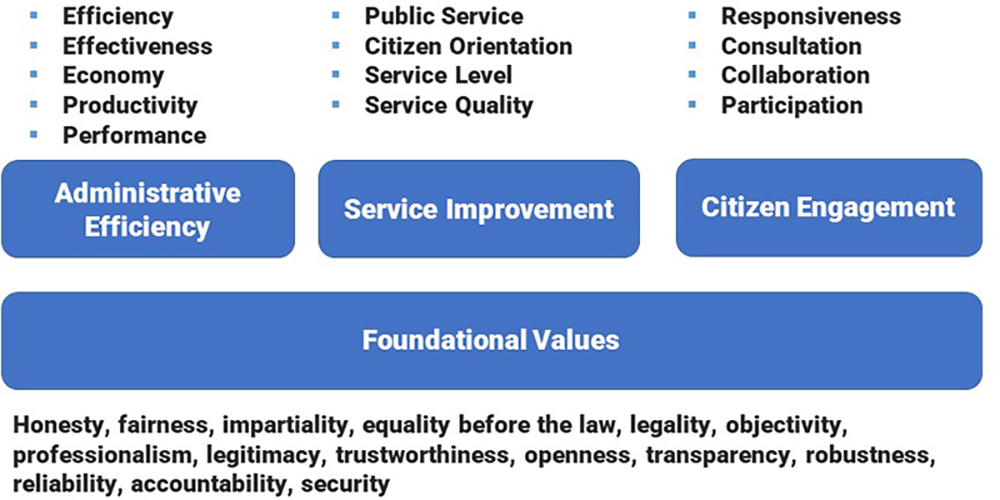 The image consists of a structured layout that categorizes key concepts into four main areas: Administrative Efficiency, Service Improvement, Citizen Engagement, and Foundational Values. The first three areas are presented within rounded rectangles and list various subcategories that relate to each main topic. Under Administrative Efficiency, terms such as Efficiency, Effectiveness, Economy, Productivity, and Performance are listed. Service Improvement includes Public Service, Citizen Orientation, Service Level, and Service Quality. Citizens' Engagement encompasses Responsiveness, Consultation, Collaboration, and Participation. The Foundational Values section is displayed below these categories and includes a comprehensive list of principles: Honesty, fairness, impartiality, equality before the law, legality, objectivity, professionalism, legitimacy, trustworthiness, openness, transparency, robustness, reliability, accountability, and security. Each section is clearly delineated, and the use of bold rectangles for main categories enhances visual organization.
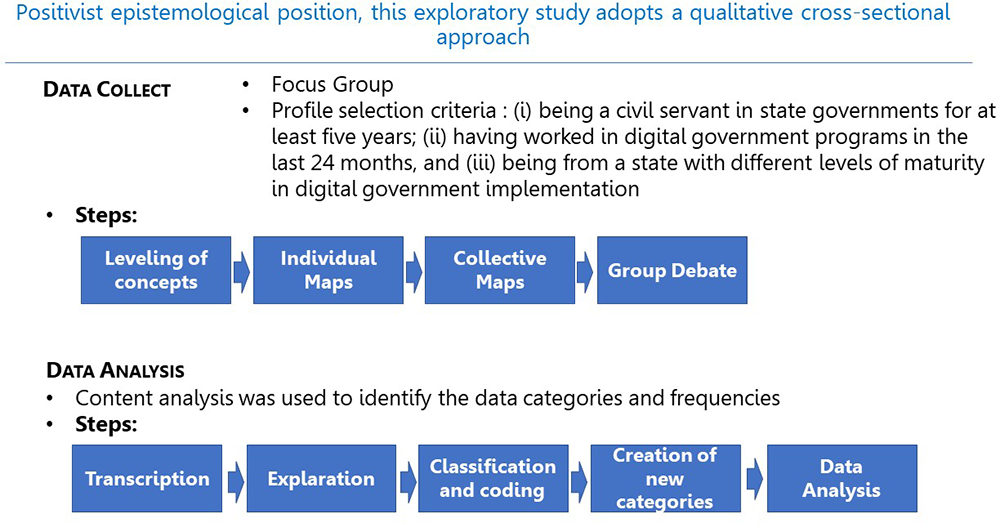 The flowchart illustrates the research design of a qualitative cross-sectional study based on a positivist epistemological position. Data collection involves focus groups, with participants selected as civil servants who have worked in digital government programs within the past 24 months and represent states with varying levels of implementation maturity. The collection steps include levelling of concepts, creation of individual maps, development of collective maps, and group debate. Data analysis follows a structured process involving transcription, exploration, classification and coding, creation of new categories, and final data analysis to identify patterns and frequencies.
 The matrix chart displays five numbered categories and one marked as non-important. Category 1 includes economy; category 2 lists performance and productivity; category 3 includes effectiveness, service level, and efficiency; category 4 lists consultation and service quality; and category 5 includes citizen orientation, public service, and responsiveness. The non-important group, labelled N I, contains collaboration and participation.
 The dot matrix chart lists twelve performance dimensions on the left, including efficiency, effectiveness, economy, productivity, performance, public service, citizen orientation, service level, service quality, responsiveness, consultation, collaboration, and participation. Each row contains a series of coloured dots representing varying levels of intensity or importance across multiple assessment categories. Efficiency and effectiveness show consistently high dot densities, while collaboration and participation exhibit moderate to high variation across the scale. The arrangement visually conveys comparative emphasis on different service performance factors in a structured, multi-category evaluation framework.
 This diagram illustrates various factors influencing public value positions, organized into four main categories: structural factors, public value positions, media factors, and cultural factors. Under structural factors, the elements include political factors, economic factors, personnel factors, and legal factors, depicted in ovals aligned vertically on the left. Public value positions feature three key elements: administrative efficiency, service improvement, and citizen engagement, represented in diamond shapes in the centre. Media factors include a single item, media influences, within an oval on the right, while cultural factors are presented with two items: intraorganizational culture and interorganizational culture, each in oval shapes below media influences. Arrows connecting the elements indicate relationships and interactions among the factors.