 Understanding organizational changing behavior for enhancing sustainability performance
Abstract
Purpose The purpose of this paper is to identify and assess the influence of behavioral change agents for adopting green innovation to enhance sustainability performance.
Design/methodology/approach This paper employed a quantitative approach by disseminating a structured questionnaire to 141 supply chain professionals of manufacturing firms who are familiar with green innovation, operating in the metropolitan city of Pakistan, i.e. Karachi. Later, exploratory and confirmatory factor analyses were performed to evaluate the reliability and validity of the model. Lastly, SmartPLS was used to test the proposed hypotheses in the study.
Findings The findings revealed that green transformational leadership, acceptance of change and work culture showed a significant impact on green innovation leading toward sustainable performance.
Research limitations/implications The authors suggest that green innovation is a prime factor for enhancing a firm’s sustainability in the market and supply chain, requiring continuous improvement efforts from supply chain professionals.
Practical implications The findings can help decision-makers to increase the efficiency and production of the organization and provide support to green policy-makers. It also empowers employees and fosters green awareness, ultimately generating benefits that serve the company’s best interests.
Social implications The study supports a shift toward sustainable behavior, encouraging organizations to contribute positively to society and the environment. Empowering change agents can catalyze pro-environmental attitudes and behaviors, ultimately encouraging organizations to adopt eco-friendly innovations for broader societal and environmental well-being.
Originality/value This paper is an initial effort to assess organizational behavioral change on green innovation for enhancing the sustainable performance of manufacturing firms in Pakistan.
Change agents; Green innovation; Sustainable performance; NRBV theory
Introduction
In this competitive world, organizations must keep up with the continuous innovation in their products and services. According to the traditional definition of innovation, it is not a development or an invention, but a revised version of a technical change. Green innovation is defined as the processes, products and innovations related to management that reduce environmental burdens (De Medeiros, Vidor, & Ribeiro, 2018; Hojnik & Ruzzier, 2016). The concept of green innovation is eye-catching for firms, and a large number of manufacturing companies focus on achieving cost and waste reductions. In developing countries like Pakistan, the significance of green innovation is a growing concept in academia and industry. It has been observed that green innovation plays a significant role in gaining a competitive edge (Ren & Mia, 2025; Tu & Wu, 2021), indicating its importance in the prevailing industries of the world, especially in developing countries.Green innovation exerts its impact on the companies’ financial, social and environmental performance. With the spread of knowledge, the government and society exert pressure on the industries to decrease those practices and procedures that are hazardous to the environment. However, according to Ortas, Moneva, and Álvarez, (2014), company capacity plays a significant role in reducing asset utilization and identifying ways to become more eco-friendly by improving supply chain management, resulting in sustainable green supply chain performance through the application of green innovation.
As indicated by Murray (2000), Green, Zelbst, Meacham, and Bhadauria (2012), manufacturing organizations have started to implement green supply chain management (GSCM) practices to cater to customers’ needs. Pakistan is among world’s emerging economies with several green supply chain challenges (Huma, Ahmed Siddiqui, & Ahmed, 2023; Ahmed, Najmi, Arif, & Younus, 2019). The growing concerns of global issues like pollution, lack of resources and environmental challenges have raised many questions about the sustainability of organizations. In response, organizations have been pressured to seek sustainable approaches, emphasizing environmentally friendly practices to generate economic benefits. Sustainable performance refers to the capability of a company to meet the demands of the present without harming the resources for the future (Norman & MacDonald, 2004). In this study, the antecedents of sustainability based on social, environmental and economic factors are evaluated under the lens of green innovation.
In developing countries like Pakistan, (Abdullah, Mahmood, Fauadi, Ab Rahman, & Jali, 2015; Hussain, Rigoni, & Orij, 2018), creating sustainability in manufacturing organizations has become the main issue that requires new ideas and strong practices to meet the economic, social and environmental demands (Hariyani, Hariyani, Mishra, & Sharma, 2025). The existing body of literature suggests that describing the determinants of effective innovation that minimize adverse impacts on the environment remains challenging and lacks a well-defined conceptual framework (Arici & Uysal, 2022; Oduro, Maccario, & De Nisco, 2022). Similarly, the understanding of employees regarding the sustainable environment is also critical to a firm’s long-term sustainability (Süßbauer & Schäfer, 2018). One of the significant issues with the organizations lies in their failure to recognize the importance and role of human factors and the external factors affecting GSCM (Muduli et al., 2020). Therefore, it is important to explore and explain crucial change agents that enable green innovative transformation to bring a significant impact on a firm’s performance.
In the 21st century, the concept of green innovation and sustainable practices has become imperative for the continuous existence of organizations. As a result, new concepts have emerged to bring productive changes in the organizations, including green transformational leadership, acceptance of change and work culture. These behavioral factors, also known as change agents, have gained increasing attention and scholars have investigated these factors to predict green innovation, as highlighted by Cui, Wang, and Zhou, (2023). Firstly, green transformational leadership, which focuses on the behavior of leaders motivating their subordinates to accomplish organizational goals and expecting outstanding performance, is emphasized by Chen and Chang (2013). Various pieces of research advocate that a transformational style of leadership is crucial in cultivating an eco-innovative culture (Begum, Ashfaq, Xia, & Awan, 2022; Singh, Del Giudice, Chierici, & Graziano, 2020). Therefore, it is urged that transformational leadership needs to be further explained in the context of green innovation (Luo, Zaman, Jamil, & Khan, 2025; Cui et al., 2023). Secondly, acceptance of change plays a major role in shaping one’s mindset to welcome productive innovations for the successful implementation of sustainable practices. Thirdly, work culture plays a crucial role in increasing employee productivity that fosters teamwork (Usman, Liu, Zhang, Ghani, & Gul, 2022), aiming to enhance overall well-being and implement green initiatives.
According to Kumar, Bervell, Annamalai, and Osman, (2020), there is little work on behavioral factors that help to achieve better performance. Jemai, Chung, and Sarkar, (2020) noted that, in growing markets, many companies are still in the initial phase of implementing GSCM practices; however, behavioral performance remains overlooked (Kumar et al., 2019) when implementing green initiatives. Moreover, there is a rich literature on large-scale organization’s sustainability and its application rather than small and medium firms (Fassin, Van Rossem, & Buelens, 2011). However, firms with small and medium-sized enterprises that create a significant portion of business activities and environmental impacts are still under-researched in the past literature (Singh et al., 2020; Boiral, Heras-Saizarbitoria, & Brotherton, 2019). Prior studies have also explored environmental performance (Ardito & Dangelico, 2018; Hong, Kwon, & Roh, 2009), yet there is a limited number of studies specifically focusing on the combination of behavioral factors, green innovation and sustainable performance in Pakistani industries.
Henceforth, in light of the arguments mentioned above, this study aims to explore and explain the organizational green change agents to enhance green innovation for enhancing sustainable performance in Pakistani manufacturing industries. This research will help the policy-makers to develop effective and swift green transformation.
2.Theoretical background and hypotheses development
2.1Natural resource-based view theory
From a theoretical perspective, this research framework is developed on the foundations of the resource-based view (RBV) theory, which states that sustainable performance and competitive advantage are achieved through the efficient utilization of organizational resources that are limited and difficult to replicate (Barney, 1991). The natural resource-based view theory (NRBV) views the usage of environmental concerns as a strategic means to strengthen the firm’s output (Choi & Hwang, 2015). This lies in the difficulty of capturing experience and knowledge in GSCM practices and green innovation by competitors of the firm. A company’s reputation is an example of such resources and can be differentiated based on its credentials for environmental activities. The present study constructs a model for sustainable performance, placing significant emphasis on the importance of green innovation. Therefore, it is necessary to check the impact of environmental activities on a firm’s competitiveness and sustainable performance.
The integration of green innovation, either in process or product, can enhance sustainable performance (El-Kassar & Singh, 2019). However, the RBV theory has identified that sustainable advantage cannot be created on its own; thus, it necessitates the development of organizational capabilities by using their tangible and intangible competencies and resources (Kazmi & Ahmed, 2022). Competencies may include conducive work culture, acceptance of change and transformational leadership. Leaders and their vision motivate employees to confront unforeseen obstacles, seeing them as opportunities for growth. Such practices will ultimately promote innovative work culture, encouraging employees to embrace changes and adopt green practices.
2.2Green transformational leadership and green innovation
Leadership refers to managing employees at work, and it plays an imperative role in motivating employees and achieving performance (Chen, Chen, Zhang, & He, 2025; Leroy, Segers, Van Dierendonck, & Den Hartog, 2018). Transformational leadership influences and helps the management and employees to achieve the firm’s desired goals. However, in previous research, while transformational leadership has been shown to have an important impact on a firm’s performance (Henricks, Young, & Kehoe, 2020; Zuraik & Kelly, 2019). Green transformational leadership focuses on a range of behaviors that are linked to improving the environment and sustainable performance. Moreover, it motivates subordinates to enhance green innovation capabilities, aiming to achieve environmental objectives (Chen et al., 2025). Transformational leadership accelerates innovation within the organization by exerting a positive influence on the innovation in processes through effective motivation leading to improved performance (Cui & Song, 2022). It has been seen that green transformational leadership symbolizes the higher management’s beliefs, attitudes, values and actions in embracing and implementing green innovation (Xie, Hoang, & Zhu, 2022). In the light of the arguments mentioned above, the following hypothesis has been developed:
H1.Green transformational leadership has a significant impact on green innovation.
2.3Acceptance of change and green innovation
It is common to observe acceptance of change in the operating environment (Muduli et al., 2020) while initiating innovation. To bring a change regarding green innovation within the organization, acceptance from employees across all hierarchical levels is essential. Therefore, it is necessary to convince those employees who take part directly in the strategic execution for the successful implementation of change (Olugu, Wong, & Shaharoun, 2011). Most employees opposed those programs for environmental improvement due to a lack of knowledge and behavioral attitudes. Acceptance of change is a commonly used term in the implementation of GSCM (Govindan, Muduli, Devika, & Barve, 2016) and green innovation. It is said that the more resistance in an organization, the more it will negatively influence the impact of green innovation. However, less resistance is a common practice among employees (Sadiq, Adil, & Paul, 2021). In addition, it is often inferred that this component can have a significant impact, and it is essential to assess its effect on the implementation of green innovation practices. Accordingly, the following hypothesis is suggested:
H2.Acceptance of change has a significant impact on green innovation.
2.4Work culture and green innovation
According to Porter, Gallagher, and Lawong (2016), green work culture encompasses a set of assumptions symbols, and ideas within an organization that shows interest in conducting operations in an environmentally sustainable manner. The organization’s work culture reflects its foundation, and it may have been explored later by the group of members in the learning process, which helps to address internal issues and deal with external concerns (Armenakis, Brown, & Mehta, 2011; Jabbour, Santos, & Nagano, 2008). The work culture is a significant factor affecting the employees’ productivity. It can be said that the organization’s work culture encourages the team’s efforts toward the betterment of the environment and the proper execution of green initiatives while focusing on the welfare of society. Kumar et al. (2019) stated that an organization’s culture is an essential internal factor that motivates employees and management commitment toward the organization’s objectives of executing green innovative ideas. Organizations that have a well-established green organizational culture may support green innovation (Al-Ayed, 2024; Qasim, Ahmed, & Frooghi, 2023). Therefore, the following hypothesis is developed:
H3.Work culture has a significant impact on green innovation.
2.5Green innovation and sustainable performance
Green innovation is vital in being eco-friendly, satisfying customers and stakeholders and resulting in a firm’s better performance. A business’s sustainable performance can be achieved by following environmental guidelines and delivering constant value to the stakeholders (Mubeen, Nisar, Patwary, Rehman, & Ahmad, 2024; Brent & Labuschagne, 2004). Therefore, it is believed that to protect the firm’s sustainable performance, it is mandatory to consider the environmental working and concerns within and outside the organization while considering innovative practices. According to Adegbile, Sarpong, and Meissner, (2017), green innovation encourages environmental performance. Green innovation practices revise the processes and systems, which help to bring positive changes to the environment. Moreover, as Weng, Chen, and Chen, (2015) indicated, green innovation also helps to improve social and economic performance by controlling wastage and expenses for cost reduction. In several industries, some researchers have found a positive relationship between green practices and business performance (Zhu, Feng, & Choi, 2017; Gimenez, Sierra, & Rodon, 2012). These environmental concerns necessitate the proper implementation of green practices, which cannot be achieved without considering the significance of behavioral factors within the organization.
Implementing green innovation strategies require compliance and understanding at all levels to achieve a green sustainable performance. According to Mathiyazhagan, Govindan, NoorulHaq, and Geng, (2013) and Mutingi, Mapfaira, and Monageng, (2014), the usage and implementation of green manufacturing practices like waste reduction and waste minimization help to reduce the purchasing cost and other resource consumption, which positively influence the financial performance of the firm by decreasing cost and increasing market reputation, growth and profit. The strategy is based on such specific environmental practices across the whole value chain process, promoting environmental innovation and works as a valuable instrument for the firm’s environmental and economic performance (Pishvaee, Razmi, & Torabi, 2012). Thus, the following hypothesis was developed:
H4.Green innovation has a significant impact on sustainable performance.
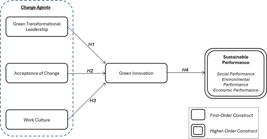
Figure 1 depicts this study’s conceptual framework.
3.
Materials and methods
3.1Research design
The study was carried out using a survey method of quantitative research as it helps create a numerical link between independent and dependent variables (Amaratunga, Baldry, Sarshar, & Newton, 2002). The purpose of this research is explanatory, aiming to study the relationship between factors affecting GI to ensure proper utilization of the means. In addition, a correlational research design was used to examine the statistical relationship between the items. Borden and Abbots (2002) state that the research helps determine the relationship’s scope between latent variables.
3.2Target population and sampling
A close-ended survey questionnaire based on a five-point Likert scale was developed. Before administering the questionnaire to the intended participants, it was first tested by both supply chain and language experts to identify any necessary corrections. After their feedback, modifications were made accordingly, and the questionnaire was finalized for distribution. Given the COVID circumstances, we decided that the online Google Forms procedure for dissemination among the target audience should be preferred.
The data were collected using a purposive sampling technique, in which the respondents are selected from within the target population. Following a non-probability sampling approach, this study used purposive sampling, targeting professionals specifically from the supply chain departments of manufacturing firms operating in the metropolitan city of Karachi, Pakistan. A total of 170 questionnaires were distributed, out of which 141 were returned, resulting in a response rate of 82.9%. The employees were involved in green practices to some extent and were aiming to boost sustainable performance in their organizations. A cover letter was attached to the questionnaire to obtain permission for data usage and to ensure the anonymity of the respondent’s individuality.
3.3Measures
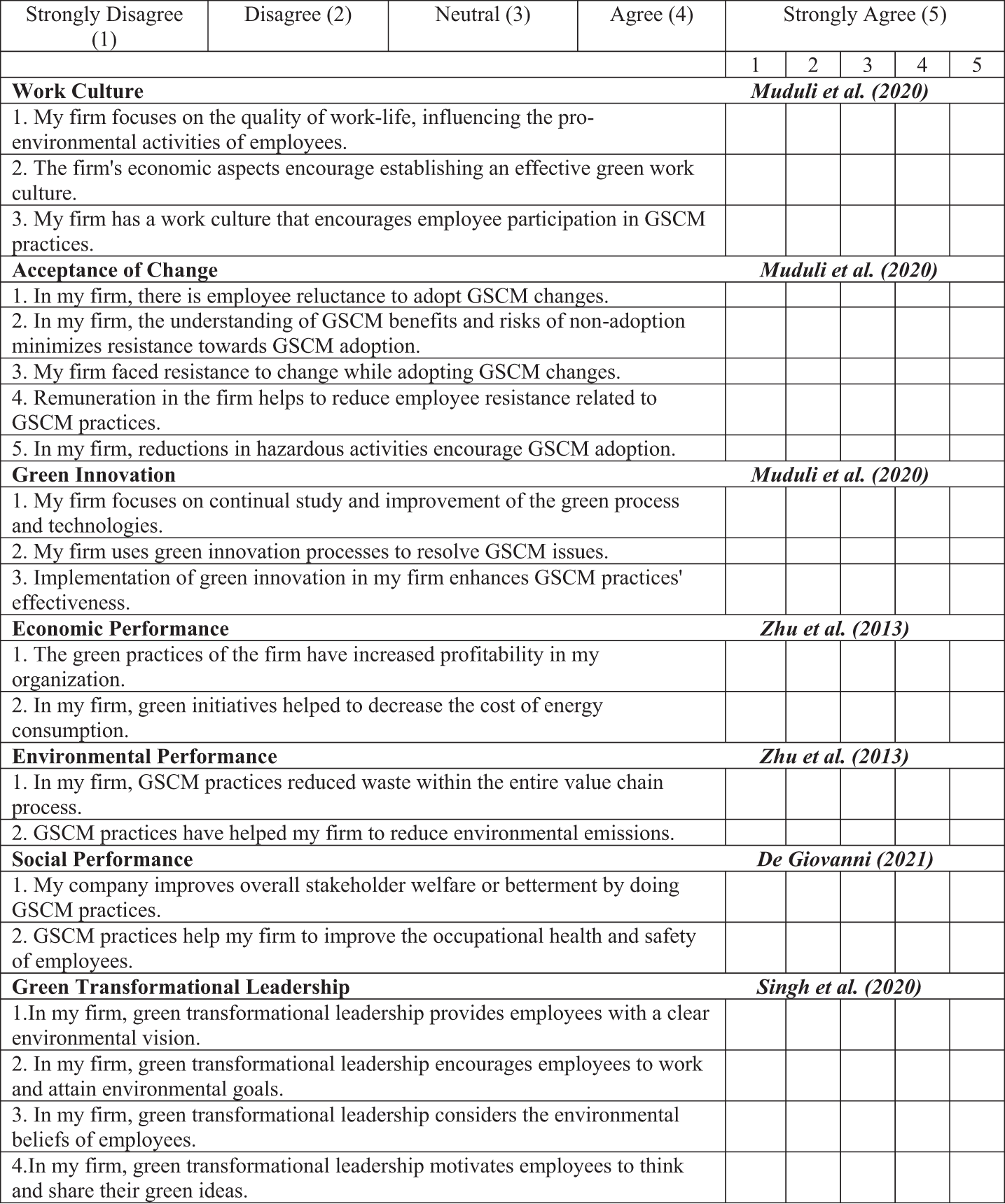
The study used a survey questionnaire based on a five-point Likert scale (ranging from strongly disagree to strongly agree) comprising 28 items. All items were self-reported and responded to in a non-contrived field study setting. The five-point Likert scale was preferred to measure the effect of the items since it is used to increase the reliability and originality of the data.
The items of acceptance of change, green innovation and work culture were adopted from the study of Muduli et al., (2020), while a total of four items of green transformational leadership were taken from the study of Singh et al., (2020). Similarly, four items of social performance were adopted from De Giovanni (2021), and the items of environmental and economic performance were taken from Zhu, Sarkis, and Lai, (2013)’s study. The questionnaire is attached in the Appendix Figure A1 section.
4.Data analysis
On a set of 141 valid responses, the descriptive analysis was run to determine the statistical representation of the data.
4.1Respondents profile
The respondent’s profile for this study includes education, designation, industry type and employee count. The majority of them were postgraduates and graduates (44% and 39%, respectively), attaining middle-level positions in their organizations (64%). Moreover, most professionals were from firms with an employee count of less than 1000. The detailed profile of the respondents is reported in Table 1.
4.2Statistical tool
After running the data screening test, Smart PLS was used to perform the hypothesis testing on the valid data. This software is a good choice for a compound model with a small sample size, as Henseler (2011) suggested.
4.3Validity of outer measurement model
The outer measurement model is related to the convergence of the construct at two levels of measurement that need to be linked theoretically. It is also known as the measurement model in the Smart PLS Software version 3.2. It includes the evaluation of reliability and validity. The reliability involves the measurement of internal consistency which is called composite reliability. However, according to Hair, Ringle, and Sarstedt, (2011), validity represents the measurement of convergent [average variance extracted (AVE)] and discriminant validity based on Fornell–Larcker criteria and HTMT validity.
To determine the content validity, we analyzed the factors and cross-loadings of the data. The convergent validity indicates the extent to which the variables are related to one another (Neuman, 2007), and it is tested through three estimations. First, factor loading is highly loaded, with values over 0.7 being statistically significant. Second, the composite reliability (CR) was tested to check the degree to which the items of a particular variable define the latent variable, which should be 0.7 or above (Hair et al., 2011). Third, the AVE was tested to check the degree of variance common among the latent indicators, whose value should be more than 0.5 to be considered an acceptable edge. Table 2 explains that all the values are above the parameters that meet convergent validity benchmarks.
The discriminant validity occurs due to the differentiation of the group of items under one variable from those under other variables (Ahmed et al., 2019), which is validated by three elements. First, the difference between the loadings of all items should be greater than 0.1 within or outside the variable (Gefen & Straub, 2005). Second, as suggested by Fornell and Larcker (1981), a correlational matrix method has been used and reported in Table 3. This matrix is the square root of AVE with accurate correlational values in rows and columns. Moreover, this test suggested that the diagonal value of each item (square root of AVE) should be higher than its row and column (representing correlation among items).
Third, the Heterotrait-Monotrait ratio of correlation (HTMT) test was used. Hair, Matthews, Matthews, and Sarstedt, (2017) state that all the items’ values should be less than 0.9, is reported in Table 4. Taken together, all the values are above the parameters that meet the benchmarks, thus establishing good discriminant validity.
4.4Validity of inner structural model
The inner structural model is used to estimate the relationship between the variables. This can be measured by evaluating the predictive relevance of the model, followed by testing the proposed hypotheses. It is also known as the structural model in the Smart PLS Software version 3.2. According to Hair, Sarstedt, Hopkins, and Kuppelwieser, (2014), R2 refers to the change in the ratio of independent variables concerning the change in the ratio of the dependent variable. All the values were greater than 0.20 (Cohen, 1988), ranging between 0.61 and 0.86. Similarly, Q2, known as the coefficient of determinant, was also tested to check the model’s relevance. The value of Q2 should be greater than zero (Hair et al., 2011). All the values ranged between 0.48 and 0.77, hence predicting the high relevance of the studied model.
Sustainable performance was measured by the triple-bottom-line, which encompasses environmental performance, economic performance and social performance. The results of this study, as shown in Table 5 endorse that Economic performance, Environmental performance and sustainable performance (SP) are making a higher-order reflective construct of sustainable performance with high, even and significant loadings.
The current study consists of four hypotheses; each of them has been examined using PLS-SEM to estimate complex models, as recommended by Hair et al., (2011). For testing the path coefficients, the t-statistics and p-value should be greater than 1.96 with a 5% significance level, respectively. Referring Table 6, it can be seen that all values fulfill the criteria and all hypotheses are significantly accepted.
5.Discussion
The goal of this study was to understand the driving agents related to organizational change management that can trigger green innovation to accelerate and enhance sustainable performance. An extensive literature review reveals that transformational leadership, the flexibility of employees to accept change and work culture are a few crucial factors that lead to green innovation. In the post-COVID era, where the new entrants and veteran competitors aggressively use disruptive technologies and innovative techniques, green innovation is critical for business sustainability. This research empirically explains these factors as per the developed hypotheses.
The finding of this study empirically endorsed that all green innovation initiatives have a significant and positive influence (β = 0.811, p < 0.05) on organizational sustainable performance. With the continuous advancement in technology at a rapid pace and the emergence of new ways of doing things, organizations that can incorporate these technologies and innovate their processes have a sustainable competitive advantage. This result was aligned with a few researchers who advocate that eco-innovation is crucial in enhancing the firm’s environmental, social and financial performance (Arici & Uysal, 2022; Baig et al., 2022; Sezen & Cankaya, 2013; Zhang, Sun, Yang, & Wang, 2020).
This research provides empirical evidence of a few critical antecedents that can assist in developing green innovation, namely, transformational leadership, acceptance of change and working culture. The findings of this research reveal that green transformational leadership (β = 0.303, p < 0.05), acceptance of change (β = 0.224, p < 0.05) and work culture (β = 0.364, p < 0.05) have a significant effect on green innovation. Hence, it can be inferred that these elements contribute de facto to the implementation of green innovation. Previous research is overwhelmed with highlighting the role of transformational leadership in creating an innovation culture (Chen et al., 2025; Arici & Uysal, 2022; Henricks et al., 2020). Second, acceptance of change among the employees is another crucial element that is seldom analyzed empirically. As we know change is constant, and only those who are flexible and adaptable can effectively embrace change and innovation. Proper communication of vision and organizational strategies can help avoid resistance. Finally, working culture has a significant role to play in bringing green innovation (Qasim et al., 2023; Roespinoedji, Afghan Prawira, Solihin, Saudi, & Alaeddin, 2019). However, there is limited evidence available on the link between work culture and green innovation (Yang, Sun, Zhang, & Wang, 2017). This research has provided empirical significance and endorsement for all the change agents mentioned above in cultivating an innovative culture. Thus, to deliver the best offerings in the eco-friendly products and processes industry, firms need to proceed with the advancement of green innovation, increasing competitiveness and delivering services to fulfill the market necessities. Firms that are quality-conscious typically invest money and effort in developing green innovations, considering customer preferences as their top priority. Therefore, green innovation is crucial for organizations seeking to develop a sustainable competitive advantage and survive in this dynamic market environment.
5.1Managerial implications
The findings of the study suggest some managerial implications. First, it is recommended for organizational ecologists to inculcate an innovative culture in their work environment. It will provide a positive and significant impact on the firm’s triple bottom line. Green innovation not only focuses on waste reduction and enhances productivity and cost efficiency, but it also attracts customers and sustains market share with quality, speed and variety (Ahmed et al., 2020a, Ahmed, Najmi, & Ikram, 2020b). Therefore, it can be said that green innovation is a crucial factor in enhancing the firm’s sustainability in the market; therefore, supply chain professionals need to concentrate on it.
Second, it is recommended that the policy-makers adopt transformational leadership. This type of leadership is charismatic and not only empowers the employees but also stimulates intellectual activity. That, in turn, will help develop a culture of innovation and eco-innovation. Therefore, we can affirm that effective green transformational leadership is crucial for the successful implementation of new advancements in green innovation.
Third, change managers and innovation implementers need to understand the importance of avoiding resistance to foster innovative thinking. Empowering employees to accept change for the betterment of organizational goals is a crucial competitive edge. Proper training and two-way communication are always crucial to bring employees on board to accept any change. It is recommended that managers and line managers identify areas that can facilitate the diffusion of innovation within their organization. Finally, it is advised that managers at all levels foster a working culture that promotes innovative ideas by appreciating the efforts that bring positive change to the environment. At the same time, they are expected to support those who are struggling to accept the change. Therefore, this research provides a framework for strategy makers to consider these drivers diligently to steer green innovation for effective and efficient implementation and performance improvement.
5.2Theoretical and social contribution
This research also extends a few theoretical and social contributions. First, using the NRBV, it established that green change agents are intangible competencies of the firm that lead to the sustainability of an organization. Second, during the literature review, it was found that organizational change agents and the factors explored in this research framework have not been studied in the recent post-COVID scenario. Past academics did not focus on these factors when implementing green initiatives; on the contrary, only the impact of green innovation on environmental performance was studied in the previous research. This study conducted a comprehensive literature review to develop a research framework aimed at facilitating change management and promoting innovative business practices across various organizational levels. The framework identifies three key change agents: transformational leadership, workplace culture and employee readiness for change.
Transformational leadership plays a vital role in guiding stakeholders to embrace changes aligned with management objectives. In addition, a supportive workplace environment and culture are essential for fostering teamwork and enabling a smooth transition from the current state to the desired future state. Finally, individual readiness and willingness to accept change are critical for successful transformation. This can be achieved through clear communication, transparency and targeted training initiatives. Thus, this green innovation behavior yields better sustainable performance.
In developing countries like Pakistan, this study serves as a valuable starting point for implementing green transformation to foster a sustainable and innovative environment. Therefore, this study provides insight that may help future researchers build their foundation for comparative research. Finally, this study benefits organizations by helping them understand and develop a good environment that fosters a positive work culture and leadership among employees.
5.3Limitations and recommendations for future studies
This study has some limitations. First, the data was reduced due to the unavailability of any organized database of experts in this area. Second, research on specific sectors could provide further insights related to the specific needs. Thus, future studies may gather extensive data to enrich the sample size. Third, this research was focused on various manufacturing industries. The outcomes vary due to the nature of the work and its scope; therefore, it is recommended to work in a specialized industry, which keeps the target population more diversified. Finally, the behavioral roles are discussed within the Pakistani context; future studies may contribute to the theory by explaining other factors in different geographical regions reflecting diverse cultures and working environments.
Acknowledgements
Funding: The authors did not receive any financial support from any organization for the submitted work.
Data availability statement
Data are available on request due to privacy or other restrictions.
References
-
Abdullah, I., Mahmood, W. H. W., Fauadi, M. H. F. M., Ab Rahman, M. N., & Jali, F. A. A. (2015). Sustainability in Malaysian palm oil: A review on manufacturing perspective. Polish Journal of Environmental Studies, 24(4), 10.5840/beq200414211.
» https://doi.org/10.5840/beq200414211 -
Adegbile, A., Sarpong, D., & Meissner, D. (2017). Strategic foresight for innovation management: A review and research agenda. International Journal of Innovation and Technology Management, 14(04), 1–34, 10.1142/S0219877017500195.
» https://doi.org/10.1142/S0219877017500195 -
Ahmed, W., Najmi, A., & Ikram, M. (2020b). Steering firm performance through innovative capabilities: A contingency approach to innovation management. Technology in Society, 63, 101385, 10.1016/j.techsoc.2020.101385.
» https://doi.org/10.1016/j.techsoc.2020.101385 -
Ahmed, W., Najmi, A., Arif, M., & Younus, M. (2019). Exploring firm performance by institutional pressures driven green supply chain management practices. Smart and Sustainable Built Environment, 8(5), 415–437, 10.1108/SASBE-04-2018-0022.
» https://doi.org/10.1108/SASBE-04-2018-0022 -
Ahmed, W., Ashraf, M. S., Khan, S. A., Kusi-Sarpong, S., Arhin, F. K., Kusi-Sarpong, H., & Najmi, A. (2020a). Analyzing the impact of environmental collaboration among supply chain stakeholders on a firm’s sustainable performance. Operations Management Research, 13(1-2), 4–21, 10.1007/s12063-020-00152-1.
» https://doi.org/10.1007/s12063-020-00152-1 -
Al-Ayed, S. (2024). Green innovation influenced by employee innovative work behavior via moderating role of innovative leaderships. Cogent Business & Management, 11(1), 2393741, 10.1080/23311975.2024.2393741.
» https://doi.org/10.1080/23311975.2024.2393741 -
Amaratunga, D., Baldry, D., Sarshar, M., & Newton, R. (2002). Quantitative and qualitative research in the built environment: Application of “mixed” research approach. Work Study, 51(1), 17–31, 10.1108/00438020210415488.
» https://doi.org/10.1108/00438020210415488 -
Ardito, L., & Dangelico, R. M. (2018). Firm environmental performance under scrutiny: The role of strategic and organizational orientations. Corporate Social Responsibility and Environmental Management, 25(4), 426–440, 10.1002/csr.1470.
» https://doi.org/10.1002/csr.1470 -
Arici, H. E., & Uysal, M. (2022). Leadership, green innovation, and green creativity: A systematic review. The Service Industries Journal, 42(5–6), 280–320, 10.1080/02642069.2021.1964482.
» https://doi.org/10.1080/02642069.2021.1964482 -
Armenakis, A., Brown, S., & Mehta, A. (2011). Organizational culture: Assessment and transformation. Journal of Change Management, 11(3), 305–328, 10.1080/14697017.2011.568949.
» https://doi.org/10.1080/14697017.2011.568949 -
Barney, J. (1991). Firm resources and sustained competitive advantage. Journal of Management, 17(1), 99–120, 10.1177/014920639101700108.
» https://doi.org/10.1177/014920639101700108 -
Begum, S., Ashfaq, M., Xia, E., & Awan, U. (2022). Does green transformational leadership lead to green innovation? The role of green thinking and creative process engagement. Business Strategy and the Environment, 31(1), 580–597, 10.1002/bse.2911.
» https://doi.org/10.1002/bse.2911 - Boiral, O., Heras-Saizarbitoria, I., & Brotherton, M. C. (2019). Assessing and improving the quality of sustainability reports: The auditors’ perspective. Journal of Business Ethics, 155(3), 703–721.
-
Chen, X., Chen, Y., Zhang, X., & He, Q. (2025). Green transformational leadership and green innovation in megaprojects: Is green knowledge sharing a missing link? Engineering, Construction and Architectural Management, 32(1), 194–213, 10.1108/ECAM-02-2023-0117.
» https://doi.org/10.1108/ECAM-02-2023-0117 - Chen, Y. S., & Chang, C. H. (2013). The determinants of green product development performance: Green dynamic capabilities, green transformational leadership, and green creativity. Journal of Business Ethics, 116(1), 107–119.
- Choi, D., & Hwang, T. (2015). The impact of green supply chain management practices on firm performance: The role of collaborative capability. Operations Management Research, 8(3-4), 69–83.
-
Cohen, J. (1988). Set correlation and contingency tables. Applied Psychological Measurement, 12(4), 425–434, 10.1177/014662168801200410.
» https://doi.org/10.1177/014662168801200410 -
Cui, F., & Song, J. H. (2022). Impact of entrepreneurship on innovation performance of Chinese SMEs: Focusing on the mediating effect of enterprise dynamic capability and organizational innovation environment. Sustainability, 14(19), 12063, 10.3390/su141912063.
» https://doi.org/10.3390/su141912063 -
Cui, R., Wang, J., & Zhou, C. (2023). Exploring the linkages of green transformational leadership, organizational green learning, and radical green innovation. Business Strategy and the Environment, 32(1), 185–199, 10.1002/bse.3124.
» https://doi.org/10.1002/bse.3124 -
De Giovanni, P. (2021). Smart supply chains with vendor managed inventory, coordination, and environmental performance. European Journal of Operational Research, 292(2), 515–531, 10.1016/j.ejor.2020.10.049.
» https://doi.org/10.1016/j.ejor.2020.10.049 -
De Medeiros, J. F., Vidor, G., & Ribeiro, J. L. D. (2018). Driving factors for the success of the green innovation market: a relationship system proposal. Journal of Business Ethics, 147(2), 327–341.10.1007/s10551-015-2927-3.
» https://doi.org/10.1007/s10551-015-2927-3 -
El-Kassar, A. N., & Singh, S. K. (2019). Green innovation and organizational performance: The influence of big data and the moderating role of management commitment and HR practices. Technological Forecasting and Social Change, 144, 483–498, 10.1016/j.techfore.2017.12.016.
» https://doi.org/10.1016/j.techfore.2017.12.016 - Fassin, Y., Van Rossem, A., & Buelens, M. (2011). Small-business owner-managers’ perceptions of business ethics and CSR-related concepts. Journal of business ethics, 98(3), 425–453.
-
Fornell, C., & Larcker, D. F. (1981). Evaluating structural equation models with unobservable variables and measurement error. Journal of Marketing Research, 18(1), 39–50, 10.1177/002224378101800104.
» https://doi.org/10.1177/002224378101800104 -
Gefen, D., & Straub, D. (2005). A practical guide to factorial validity using PLS-Graph: Tutorial and annotated example. Communications of the Association for Information Systems, 16(1), 5, 10.17705/1CAIS.01605.
» https://doi.org/10.17705/1CAIS.01605 -
Gimenez, C., Sierra, V., & Rodon, J. (2012). Sustainable operations: Their impact on the triple bottom line. International Journal of Production Economics, 140(1), 149–159, 10.1016/j.ijpe.2012.01.035.
» https://doi.org/10.1016/j.ijpe.2012.01.035 -
Govindan, K., Muduli, K., Devika, K., & Barve, A. (2016). Investigation of the influential strength of factors on adoption of green supply chain management practices: an Indian mining scenario. Resources, Conservation and Recycling, 107, 185–194, 10.1016/j.resconrec.2015.05.022.
» https://doi.org/10.1016/j.resconrec.2015.05.022 -
Green, K. W., Jr, Zelbst, P. J., Meacham, J., & Bhadauria, V. S. (2012). Green supply chain management practices: Impact on performance. Supply Chain Management: An International Journal, 17(3), 290–305, 10.1108/13598541211227126.
» https://doi.org/10.1108/13598541211227126 -
Hair, J., Jr, Sarstedt, M., Hopkins, L., & Kuppelwieser, V. (2014). Partial least squares structural equation modeling (PLS-SEM) an emerging tool in business research. European Business Review, 26(2), 106–121, 10.1108/EBR-10-2013-0128.
» https://doi.org/10.1108/EBR-10-2013-0128 -
Hair, J. F., Jr, Matthews, L. M., Matthews, R. L., & Sarstedt, M. (2017). PLS-SEM or CB-SEM: Updated guidelines on which method to use. International Journal of Multivariate Data Analysis, 1(2), 107–123, 10.1504/IJMDA.2017.087624.
» https://doi.org/10.1504/IJMDA.2017.087624 -
Hair, J. F., Ringle, C. M., & Sarstedt, M. (2011). PLS-SEM: Indeed, a silver bullet. Journal of Marketing Theory and Practice, 19(2), 139–152, 10.2753/MTP1069-6679190202.
» https://doi.org/10.2753/MTP1069-6679190202 -
Hariyani, D., Hariyani, P., Mishra, S., & Sharma, M. K. (2025). A review of the structured framework for sustainability audits in manufacturing organizations. Green Technologies and Sustainability, 3(3), 100170, 10.1016/j.grets.2025.100170.
» https://doi.org/10.1016/j.grets.2025.100170 -
Henricks, M. D., Young, M., & Kehoe, E. J. (2020). Attitudes toward change and transformational leadership: a longitudinal study. Journal of Change Management, 20(3), 202–219, 10.1080/14697017.2020.1758529.
» https://doi.org/10.1080/14697017.2020.1758529 -
Hojnik, J., & Ruzzier, M. (2016). What drives eco-innovation? A review of an emerging literature. Environmental Innovation and Societal Transitions, 19, 31–41, 10.1016/j.eist.2015.09.006.
» https://doi.org/10.1016/j.eist.2015.09.006 -
Hong, P., Kwon, H. B., & Roh, J. J. (2009). Implementation of strategic green orientation in the supply chain. European Journal of Innovation Management, 12(4), 512–532, 10.1108/14601060910996945.
» https://doi.org/10.1108/14601060910996945 -
Huma, S., Ahmed Siddiqui, D., & Ahmed, W. (2023). Understanding the impact of green supply chain management practices on operational competitive capabilities. The TQM Journal, 35(3), 796–815, 10.1108/TQM-08-2021-0246.
» https://doi.org/10.1108/TQM-08-2021-0246 -
Hussain, N., Rigoni, U., & Orij, R. P. (2018). Corporate governance and sustainability performance: Analysis of triple bottom line performance. Journal of Business Ethics, 149(2), 411–432, 10.1007/s10551-016-3099-5.
» https://doi.org/10.1007/s10551-016-3099-5 -
Jabbour, C. J. C., Santos, F. C. A., & Nagano, M. S. (2008). Environmental management system and human resource practices: Is there a link between them in four Brazilian companies? Journal of Cleaner Production, 16(17), 1922–1925, 10.1016/j.jclepro.2008.02.004.
» https://doi.org/10.1016/j.jclepro.2008.02.004 -
Jemai, J., Chung, B. D., & Sarkar, B. (2020). Environmental effect for a complex green supply-chain management to control waste: A sustainable approach. Journal of Cleaner Production, 277, 1–20, 10.1016/j.jclepro.2020.122919.
» https://doi.org/10.1016/j.jclepro.2020.122919 -
Kazmi, S. W., & Ahmed, W. (2022). Understanding dynamic distribution capabilities to enhance supply chain performance: A dynamic capability view. Benchmarking: An International Journal, 29(9), 2822–2841, 10.1108/BIJ-03-2021-0135.
» https://doi.org/10.1108/BIJ-03-2021-0135 -
Kumar, A., Zavadskas, E. K., Mangla, S. K., Agrawal, V., Sharma, K., & Gupta, D. (2019). When risks need attention: Adoption of green supply chain initiatives in the pharmaceutical industry. International Journal of Production Research, 57(11), 3554–3576, 10.1080/00207543.2018.1543969.
» https://doi.org/10.1080/00207543.2018.1543969 -
Kumar, J. A., Bervell, B., Annamalai, N., & Osman, S. (2020). Behavioral intention to use mobile learning: Evaluating the role of self-efficacy, subjective norm, and WhatsApp use habit. IEEE Access, 8, 208058–208074, 10.1109/ACCESS.2020.3037925.
» https://doi.org/10.1109/ACCESS.2020.3037925 -
Leroy, H., Segers, J., Van Dierendonck, D., & Den Hartog, D. (2018). Managing people in organizations: Integrating the study of HRM and leadership. Human Resource Management Review, 28(3), 249–257, 10.1016/j.hrmr.2018.02.002.
» https://doi.org/10.1016/j.hrmr.2018.02.002 -
Luo, J., Zaman, S. I., Jamil, S., & Khan, S. A. (2025). The future of healthcare: Green transformational leadership and GHRM’s role in sustainable performance. Benchmarking: An International Journal, 32(3), 805–837, 10.1108/BIJ-08-2023-0523.
» https://doi.org/10.1108/BIJ-08-2023-0523 -
Mathiyazhagan, K., Govindan, K., NoorulHaq, A., & Geng, Y. (2013). An ISM approach for the barrier analysis in implementing green supply chain management. Journal of Cleaner Production, 47, 283–297, 10.1016/j.jclepro.2012.10.042.
» https://doi.org/10.1016/j.jclepro.2012.10.042 -
Mubeen, A., Nisar, Q. A., Patwary, A. K., Rehman, S., & Ahmad, W. (2024). Greening your business: Nexus of green dynamic capabilities, green innovation and sustainable performance. Environment, Development and Sustainability, 26(9), 22747–22773. 10.1007/s10668-023-03574-6.
» https://doi.org/10.1007/s10668-023-03574-6 -
Muduli, K. K., Luthra, S., Kumar Mangla, S., Jabbour, C. J. C., Aich, S., & de Guimarães, J. C. F. (2020). Environmental management and the “soft side” of organisations: Discovering the most relevant behavioural factors in green supply chains. Business Strategy and the Environment, 29(4), 1647–1665, 10.1002/bse.2459.
» https://doi.org/10.1002/bse.2459 -
Murray, J. G. (2000). Effects of a green purchasing strategy: the case of Belfast city council. Supply Chain Management. An International Journal, 5(1), 37–44, 10.1108/13598540010312954.
» https://doi.org/10.1108/13598540010312954 -
Mutingi, M., Mapfaira, H., & Monageng, R. (2014). Developing performance management systems for the green supply chain. Journal of Remanufacturing, 4(1), 6, 10.1186/s13243-014-0006-z.
» https://doi.org/10.1186/s13243-014-0006-z - Neuman, L. W. (2007). Social research methods, 6th ed., Pearson Education India.
-
Norman, W., & MacDonald, C. (2004). Getting to the bottom of “triple bottom line”. Business Ethics Quarterly, 14(2), 243–262, 10.5840/beq200414211.
» https://doi.org/10.5840/beq200414211 -
Oduro, S., Maccario, G., & De Nisco, A. (2022). Green innovation: A multidomain systematic review. European Journal of Innovation Management, 25(2), 567–591, 10.1108/EJIM-10-2020-0425.
» https://doi.org/10.1108/EJIM-10-2020-0425 -
Olugu, E. U., Wong, K. Y., & Shaharoun, A. M. (2011). Development of key performance measures for the automobile green supply chain. Resources, Conservation and Recycling, 55(6), 567–579, 10.1016/j.resconrec.2010.06.003.
» https://doi.org/10.1016/j.resconrec.2010.06.003 -
Ortas, E. M., Moneva, J., & Álvarez, I. (2014). Sustainable supply chain and company performance: A global examination. Supply Chain Management: An International Journal, 19(3), 332–350, 10.1108/SCM-12-2013-0444.
» https://doi.org/10.1108/SCM-12-2013-0444 -
Pishvaee, M. S., Razmi, J., & Torabi, S. A. (2012). Robust possibilistic programming for socially responsible supply chain network design: a new approach. Fuzzy Sets and Systems, 206, 1–20, 10.1016/j.fss.2012.04.010.
» https://doi.org/10.1016/j.fss.2012.04.010 -
Porter, T. H., Gallagher, V. C., & Lawong, D. (2016). The greening of organizational culture: Revisited fifteen years later. American Journal of Business, 31(4), 206–226, 10.1108/AJB-04-2016-0011.
» https://doi.org/10.1108/AJB-04-2016-0011 -
Qasim, S., Ahmed, W., & Frooghi, R. (2023). Influence of employees’ beliefs and values on shaping green work culture for boosting firm’s environmental performance. International Journal of Ethics and Systems, 10.1108/IJOES-06-2022-0120.
» https://doi.org/10.1108/IJOES-06-2022-0120 - Ren, X., & Mia, M. A. (2025). The determinants of green innovations in manufacturing industries: a systematic literature review. Future Business Journal, 11(1), 42.
- Roespinoedji, D., Afghan Prawira, E. P., Solihin, I., Saudi, M. H. M., & Alaeddin, O. (2019). Determinants of supply chain performance: Moderating role of firm size in tourism hotel industry in Indonesia. International Journal of Supply Chain Management, 8(1), 219–230.
-
Sadiq, M., Adil, M., & Paul, J. (2021). An innovation resistance theory perspective on purchase of eco-friendly cosmetics. Journal of Retailing and Consumer Services, 59, 102369, 10.1016/j.jretconser.2020.102369.
» https://doi.org/10.1016/j.jretconser.2020.102369 -
Sezen, B., & Cankaya, S. Y. (2013). Effects of green manufacturing and eco-innovation on sustainability performance. Procedia – Social and Behavioral Sciences, 99, 154–163, 10.1016/j.sbspro.2013.10.481.
» https://doi.org/10.1016/j.sbspro.2013.10.481 -
Singh, S. K., Del Giudice, M., Chierici, R., & Graziano, D. (2020). Green innovation and environmental performance: The role of green transformational leadership and green human resource management. Technological Forecasting and Social Change, 150, 119762, 10.1016/j.techfore.2019.119762.
» https://doi.org/10.1016/j.techfore.2019.119762 -
Süßbauer, E., & Schäfer, M. (2018). Greening the workplace: Conceptualising workplaces as settings for enabling sustainable consumption. International Journal of Innovation and Sustainable Development, 12(3), 327–349, 10.1504/IJISD.2018.091521.
» https://doi.org/10.1504/IJISD.2018.091521 -
Tu, Y., & Wu, W. (2021). How does green innovation improve enterprises’ competitive advantage? The role of organizational learning. Sustainable Production and Consumption, 26, 504–516, 10.1016/j.spc.2020.12.031.
» https://doi.org/10.1016/j.spc.2020.12.031 -
Usman, M., Liu, Y., Zhang, J., Ghani, U., & Gul, H. (2022). Why do employees struggle to thrive in the workplaces? A look at the impact of abusive supervision. Personnel Review, 51(1), 77–97, 10.1108/PR-04-2019-0213.
» https://doi.org/10.1108/PR-04-2019-0213 -
Weng, H. H. R., Chen, J. S., & Chen, P. C. (2015). Effects of green innovation on environmental and corporate performance: A stakeholder perspective. Sustainability, 7(5), 4997–5026, 10.3390/su7054997.
» https://doi.org/10.3390/su7054997 -
Xie, X., Hoang, T. T., & Zhu, Q. (2022). Green process innovation and financial performance: The role of green social capital and customers’ tacit green needs. Journal of Innovation & Knowledge, 7(1), 100165, 10.1016/j.jik.2022.100165.
» https://doi.org/10.1016/j.jik.2022.100165 -
Yang, Z., Sun, J., Zhang, Y., & Wang, Y. (2017). Green, green, it’s green: A triad model of technology, culture, and innovation for corporate sustainability. Sustainability, 9(8), 1369, 10.3390/su9081369.
» https://doi.org/10.3390/su9081369 -
Zhang, Y., Sun, J., Yang, Z., & Wang, Y. (2020). Critical success factors of green innovation: Technology, organization, and environment readiness. Journal of Cleaner Production, 264, 121701, 10.1016/j.jclepro.2020.121701.
» https://doi.org/10.1016/j.jclepro.2020.121701 -
Zhu, Q., Feng, Y., & Choi, S. B. (2017). The role of customer relational governance in environmental and economic performance improvement through green supply chain management. Journal of Cleaner Production, 155, 46–53, 10.1016/j.jclepro.2016.02.124.
» https://doi.org/10.1016/j.jclepro.2016.02.124 -
Zhu, Q., Sarkis, J., & Lai, K. H. (2013). Institutional-based antecedents and performance outcomes of internal and external green supply chain management practices. Journal of Purchasing and Supply Management, 19(2), 106–117, 10.1016/j.pursup.2012.12.001.
» https://doi.org/10.1016/j.pursup.2012.12.001 -
Zuraik, A., & Kelly, L. (2019). The role of CEO transformational leadership and innovation climate in exploration and exploitation. European Journal of Innovation Management, 22(1), 84–104, 10.1108/EJIM-10-2017-0142.
» https://doi.org/10.1108/EJIM-10-2017-0142
Further reading
-
Ahmad, S., Omar, R., & Quoquab, F. (2019). Corporate sustainable longevity: Scale development and validation. Sage Open, 9(1), 2158244018822379. 10.1177/2158244018822379.
» https://doi.org/10.1177/2158244018822379 -
Cuthbertson, R., & Piotrowicz, W. (2008). Supply chain best practices–identification and categorisation of measures and benefits. International Journal of Productivity and Performance Management, 57(5), 389–404, 10.1108/17410400810881845.
» https://doi.org/10.1108/17410400810881845 -
Damanpour, F., Walker, R. M., & Avellaneda, C. N. (2009). Combinative effects of innovation types and organizational performance: A longitudinal study of service organizations. Journal of Management Studies, 46(4), 650–675, 10.1111/j.1467-6486.2008.00814.x.
» https://doi.org/10.1111/j.1467-6486.2008.00814.x -
De Guimarães, J. C. F., Severo, E. A., Dorion, E. C. H., Coallier, F., & Olea, P. M. (2016). The use of organizational resources for product innovation and organizational performance: a survey of the Brazilian furniture industry. International Journal of Production Economics, 180, 135–147, 10.1016/j.ijpe.2016.07.018.
» https://doi.org/10.1016/j.ijpe.2016.07.018 - GRI. (2002). Global reporting initiative. Sustainability Reporting Guidelines.
- Labuschagne, C., & Brent, A. C. (2005). Sustainable Life Cycle Management: Development of social indicators for technology management in the process industry of South Africa. Portland International Conference for the Management of Engineering and Technology (PICMET).
-
Lozano, R., & Barreiro-Gen, M. (2021). Disrupting the brave new world: COVID-19 effects on organisations’ sustainability efforts. Journal of Organizational Change Management, 34(3), 613–628, 10.1108/JOCM-09-2020-0276.
» https://doi.org/10.1108/JOCM-09-2020-0276 - Oreg, S. (2003). Resistance to change: Developing an individual differences measure. Journal of Applied Psychology, 88(4), 680–693.
- Sanjay, S. S. (2019). Safe nano is green nano. In Green synthesis, characterization and applications of nanoparticles, Elsevier, 27–36.
-
Sarkis, J., Zhu, Q., & Lai, K. H. (2011). An organizational theoretic review of green supply chain management literature. International Journal of Production Economics, 130(1), 1–15, 10.1016/j.ijpe.2010.11.010.
» https://doi.org/10.1016/j.ijpe.2010.11.010 -
Sarstedt, M., Henseler, J., & Ringle, C. M. (2011). Multigroup analysis in partial least squares (PLS) path modeling: Alternative methods and empirical results. In Measurement and research methods in international marketing, Emerald Group Publishing, 195–218, 10.1108/S1474-7979(2011)0000022012.
» https://doi.org/10.1108/S1474-7979(2011)0000022012 -
Svensson, G., Ferro, C., Høgevold, N., Padin, C., Varela, J. C. S., & Sarstedt, M. (2018). Framing the triple bottom line approach: Direct and mediation effects between economic, social, and environmental elements. Journal of Cleaner Production, 197, 972–991, 10.1016/j.jclepro.2018.06.226.
» https://doi.org/10.1016/j.jclepro.2018.06.226 -
Testa, F., Annunziata, E., Iraldo, F., & Frey, M. (2016). Drawbacks and opportunities of green public procurement: An effective tool for sustainable production. Journal of Cleaner Production, 112, 1893–1900, 10.1016/j.jclepro.2014.09.092.
» https://doi.org/10.1016/j.jclepro.2014.09.092 -
Uysal, F. (2012). An integrated model for sustainable performance measurement in the supply chain. Procedia - Social and Behavioral Sciences, 62, 689–694, 10.1016/j.sbspro.2012.09.117.
» https://doi.org/10.1016/j.sbspro.2012.09.117 -
Wang, C. H. (2019). How organizational green culture influences green performance and competitive advantage. Journal of Manufacturing Technology Management, 30(4), 666–683, 10.1108/JMTM-09-2018-0314.
» https://doi.org/10.1108/JMTM-09-2018-0314 -
Wernerfelt, B. (1984). A resource‐based view of the firm. Strategic Management Journal, 5(2), 171–180, 10.1002/smj.4250050207.
» https://doi.org/10.1002/smj.4250050207
History
-
Received
27 Apr 2023 -
Reviewed
07 Feb 2024 -
Reviewed
02 Jan 2025 -
Reviewed
31 July 2025 -
Reviewed
22 Aug 2025 -
Accepted
25 Aug 2025

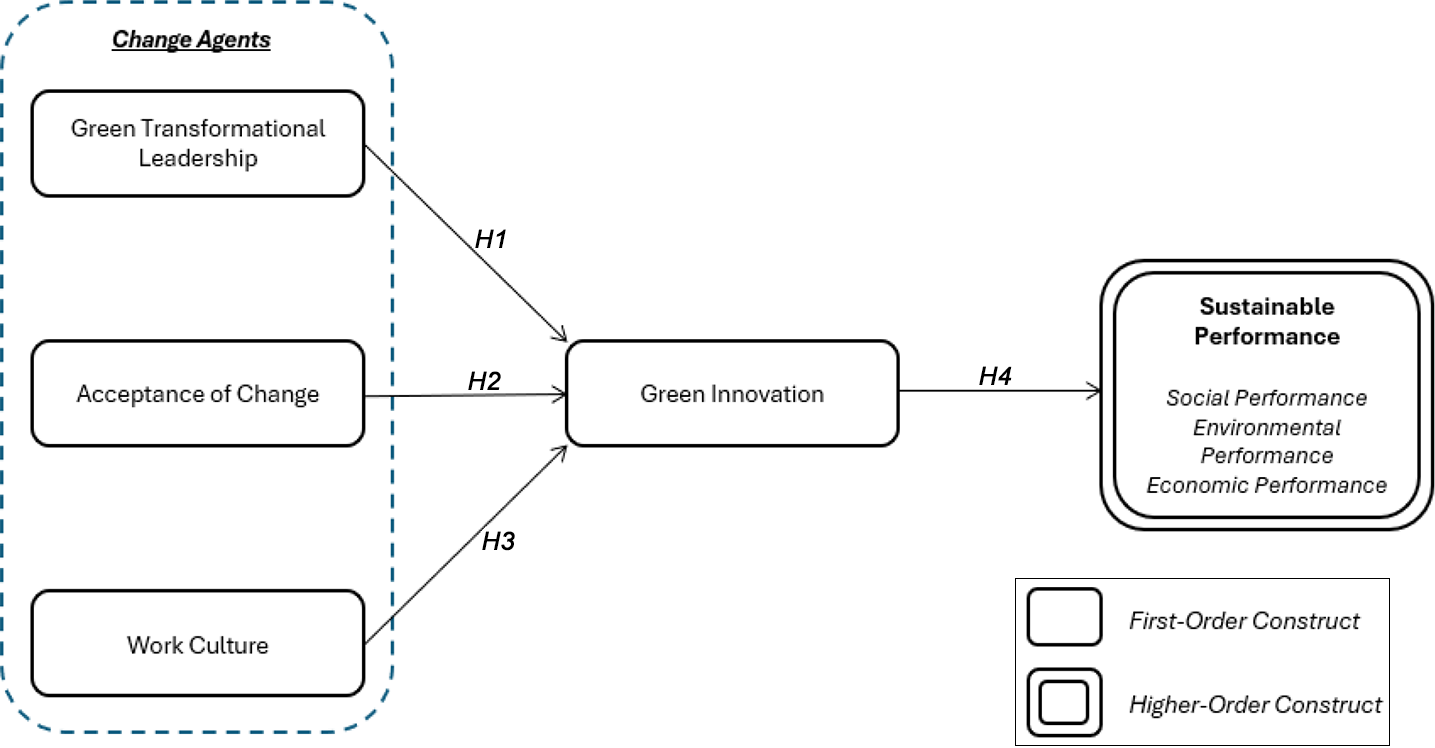 The conceptual model illustrates relationships between change agents, green innovation, and sustainable performance. Green transformational leadership, acceptance of change, and work culture act as change agents. Hypotheses are indicated as H1 from leadership to green innovation, H2 from acceptance of change to green innovation, and H3 from work culture to green innovation. Green innovation then connects through H4 to sustainable performance. Sustainable performance is explained through social performance, environmental performance, and economic performance. First order and higher order constructs are distinguished by different outlines in the diagram.
 The conceptual model illustrates relationships between change agents, green innovation, and sustainable performance. Green transformational leadership, acceptance of change, and work culture act as change agents. Hypotheses are indicated as H1 from leadership to green innovation, H2 from acceptance of change to green innovation, and H3 from work culture to green innovation. Green innovation then connects through H4 to sustainable performance. Sustainable performance is explained through social performance, environmental performance, and economic performance. First order and higher order constructs are distinguished by different outlines in the diagram.