 Predicting compressive strength of ultra-high-performance concrete using ensemble machine learning models with SHAP and PDP interpretations
ABSTRACT
This study compiles and analyzes 376 UHPC mixtures comprising cement, fine and coarse aggregates, silica fume, fly ash, water, superplasticizer, and steel fiber to develop reliable, data-driven compressive strength (CS) predictors with reduced environmental footprint. Six ensemble models— CatBoost, Extra Trees (ETR), XGBoost, Gradient Boosting (GB), Histogram Gradient Boosting (HistGB), and Random Forest (RF) were trained and evaluated using coefficient of correlation (R2), RMSE, MAE, and mean absolute percentage error (MAPE) on stratified train/test splits. Model behavior was further examined with Taylor diagrams and radar plots, while Shapley Additive Explanations (SHAP) and partial-dependence plots (PDPs) were used to interpret variable effects and interactions. CatBoost delivered the best overall performance, attaining the highest test R2 (0.863) and the lowest test RMSE. Extra Trees ranked second with competitive accuracy (test R2 = 0.854) and the lowest MAPE in training/testing. XGBoost was close behind (test R2 = 0.836), while GB, RF and HistGB showed comparatively larger errors. SHAP revealed superplasticizer and cement as the most influential features, followed by silica fume and coarse aggregate; fly ash and fine aggregate had smaller, context-dependent effects. This study highlights the potential of supervised ML-based prediction for sustainable manufacturing of concrete with optimized performance.
Keywords:
Machine learning; Compressive Strength; SHAP; UHPC; PDP
1. INTRODUCTION
In recent decades, concrete technology has undergone a major transformation with the development of advanced materials tailored to modern construction needs [1, 2]. Among these, ultra-high-performance concrete (UHPC) has emerged as a breakthrough material, offering remarkable strength, ductility, and durability [3]. Unlike conventional concrete, UHPC is produced through carefully designed combinations of cementitious materials, supplementary binders, ultra-fine powders, fibers, and high-range water reducers [4]. This unique formulation provides exceptional mechanical and durability properties, with compressive strength often exceeding 120–150 MPa, tensile strength surpassing 8 MPa, and flexural strength greater than 50 MPa [5,6,7]. In addition, UHPC exhibits excellent self-compacting ability—up to 16 times higher than that of normal concrete—and outstanding resistance to aggressive environments [8]. These superior characteristics allow for lighter and more efficient structural designs by reducing member sizes, optimizing spacing, and minimizing overall material consumption [9]. Although UHPC requires a higher initial investment, its long-term benefits, such as reduced maintenance, extended service life, and lower carbon dioxide emissions, make it a cost-effective and sustainable choice [10]. More recently, ultra-high-performance fiber-reinforced concrete (UHPFRC) has gained attention for its ability to limit crack formation and propagation, further enhancing structural resilience and seismic performance [11,12,13].
UHPC is composed of a variety of constituents, including cement, superplasticizers, silica fume, slag, fly ash, steel fibers, limestone powder, aggregates, and water [14, 15]. Mix design plays a crucial role in achieving its superior performance. MENG et al. [16] proposed a cost-effective approach by optimizing binder combinations, water-to-cementitious material ratios, fiber content, sand gradation, and binder-to-sand ratios. The properties of UHPC are influenced by multiple interdependent factors such as cementitious material type, aggregate characteristics, curing conditions, admixtures, and fiber content [17]. This complexity makes predicting compressive strength (CS) challenging [18]. To address this, researchers have explored reducing the use of cement and silica fume through partial replacement with supplementary materials like fly ash [19, 20]. For example, GHAREEB et al. [21] incorporated recycled glass powder and lime powder to produce ultra-high-performance self-compacted concrete (UHPSCC). While these sustainable approaches show promise, they often require extensive experimental testing to validate strength performance, which is time-consuming and costly [22, 23]. As a result, there is growing interest in developing analytical models that can accurately predict compressive strength values based on mix constituents, thereby reducing reliance on repeated physical testing.
The extraordinary strength and durability of UHPC stem from its distinctive mix proportions [24]. Typical formulations employ high cement dosages, often up to 800 kg/m3, combined with very low water-to-binder ratios (below 0.20), high-range water-reducing admixtures (HRWRs), and ultra-fine powders such as silica fume, nanosilica, and crushed quartzite [25,26,27]. The addition of steel or polyethylene fibers further enhances tensile strength and crack resistance. Together, these ingredients create a material capable of meeting the demands of critical infrastructure applications where superior mechanical properties and long-term durability are essential. However, the benefits of UHPC must be balanced against its sustainability challenges. The high cement content significantly increases carbon dioxide emissions, since cement manufacturing is both energy-intensive and a major contributor to global CO2 output [28]. To mitigate these effects, researchers have incorporated supplementary cementitious materials (SCMs) such as fly ash, silica fume, and ground granulated blast-furnace slag (GGBFS) into UHPC mixtures [29,30,31,32]. These substitutions not only reduce the environmental footprint but can also enhance mechanical and durability performance [33, 34].
Another barrier to wider UHPC adoption is its high initial production cost. The reliance on ultra-fine powders, HRWRs, fibers, and specialized curing processes requires more resources and energy compared to conventional concrete. Nonetheless, the long-term advantages—such as fewer repairs, reduced maintenance, and extended service life—help offset these initial costs. Looking forward, further research is needed to promote the sustainable use of UHPC, focusing on three key directions: (i) optimizing mix designs with eco-friendly and recycled materials, (ii) developing low-carbon cement alternatives, and (iii) evaluating the life-cycle environmental impacts of UHPC in large-scale applications.
The design of UHPC mixtures traditionally relies on extensive experimental testing, often requiring multiple batches of trials with substantial material and financial costs. Despite these efforts, predicting CS with high precision remains difficult due to the complex interactions among mixture constituents. This challenge has highlighted the need for analytical and data-driven models capable of directly correlating UHPC composition with strength values, thereby reducing dependence on costly experiments. Over the past decades, a variety of statistical approaches—including linear, nonlinear, and multilinear regression—have been applied to predict the mechanical behavior of concrete. More recently, machine learning (ML) has gained momentum in concrete research because of its ability to capture nonlinear relationships in large datasets and provide accurate predictions of material performance [35, 36]. Among the popular ML methods, artificial neural networks (ANN) and decision trees (DT) have shown strong potential for predicting CS with high accuracy [37]. Furthermore, ensemble learning techniques have demonstrated superior predictive capability compared to single models, driving their increasing adoption in cementitious material studies [18, 38]. In addition, numerical modeling and simulation-based studies also play significant role in recent time to predict the behavior of various materials and structures [39,40,41,42].
A number of studies have underscored the value of ML for concrete strength prediction. YEH et al. [38] analyzed a large dataset and found ANN to be more effective than traditional regression analysis. SONG et al. [43] reported that the Bagging Regressor outperformed Gene Expression Programming (GEP), ANN, and DT, while GEP itself performed better than both ANN and DT. KABIRU et al. [44] showed that support vector machines (SVM) delivered higher accuracy and stability than ANN. In another study, ZHANG et al. [45] used ANN to assess the combined influence of fly ash and silica fume on UHPC compressive strength, relying on 78 data points with 11 input variables. NGUYEN et al. [46] applied XGBoost (XGB) to a dataset of 931 samples, achieving strong results (R2 = 0.8922, RMSE = 7.860 MPa, MAE = 5.930 MPa). Similarly, SHEN et al. [47] compared XGB, AdaBoost, and Bagging for UHPC prediction, with XGB emerging as the most accurate (R2 = 0.90). Although several ML methods have been evaluated, ensemble techniques such as AdaBoost, CatBoost (CAT), XGB, and Gradient Boosting Machines (GBM) have not been systematically tested against one another for UHPC prediction. The present study addresses this gap by conducting a comparative evaluation of these models to determine which algorithm achieves the highest predictive accuracy and robustness in handling UHPC’s diverse mix constituents.
Beyond strength prediction, ML has been widely adopted in civil engineering for applications such as structural damage detection, traffic management, water resource assessment, and construction material optimization [48, 49]. In the context of concrete, ML techniques have been used to model the behavior of structural elements and predict the properties of different concretes, including high-performance concrete (HPC), self-healing concrete [30], recycled aggregate concrete (RCA), self-consolidating concrete (SCC), and phase-change-material-integrated concrete [50,51,52,53]. Neural networks, tree-based algorithms, boosting methods, and other supervised approaches have been widely implemented for such tasks [54,55,56,57,58]. For UHPC specifically, ML models have been applied not only to predict compressive strength but also to optimize mix ratios. For example, LEE et al. [59] used neural networks with a harmonic search algorithm, while CHENG et al. [60] combined support vector regression (SVR) with genetic algorithms to optimize concrete mix design. SALEH et al. [61] introduced a Gaussian process framework with Bayesian optimization for UHPC mix design, and SHEN et al. [47] applied boosting-based models to capture UHPC’s nonlinear behavior. In a sustainability-focused approach, MAHJOUBI et al. [62] developed an AI-driven optimization framework to minimize carbon footprint, energy use, and cost while maximizing compressive and flexural strength. Similarly, GHAFARI et al. [63] used ANN on 53 experimental samples to predict UHPC strength and flowability, while DINGQIANG et al. [64] applied polynomial regression to predict packing density. ABELLÁN-GARCÍA and GUZMÁN-GUZMÁN [65] developed random forest models using 600 experimental data points to predict energy absorption and ultimate strain capacity in UHPC.
In addition to conventional ML applications, researchers have proposed data-driven approaches specifically tailored to UHPC mix design. QU et al. [66] applied ANN to 162 data points considering water-to-binder ratio and fiber content, while ABUODEH et al. [67] used Sequential Feature Selection with ANN to identify key mix components from 110 test results. LIU [68] predicted UHPC CS using support vector regression trained on 165 published datasets, whereas WU et al. [69] developed a quadratic regression model with only 12 samples to predict flexural strength. While promising, these models often suffer from small datasets, limited scope, and poor generalization, leading to overfitting and reduced prediction accuracy. To address these shortcomings, researchers have turned to hybrid machine learning models that integrate optimization techniques or ensemble learning to improve prediction robustness. For instance, SADROSSADAT et al. [70] applied Particle Swarm Optimization (PSO) to design optimized mixtures of steel fiber-reinforced UHPC. MARANI et al. [71] introduced a generative adversarial network (GAN)-based framework to generate synthetic data for training ML models, with Gradient Boosting Regressor (GBR) outperforming other algorithms.
UHPC’s properties are highly nonlinear and governed by complex interactions among its constituents, making strength prediction a challenging multivariate problem. To overcome these challenges, the present research employs hybrid ensemble ML methods to improve predictive accuracy and generalization. Specifically, three hybrid models—CatBoost, GB, XGBoost, HistGB, RF, Extreme Tree Regressor—were developed and compared. The study contributes to the literature in three key ways: (i) introducing AI-driven hybrid approaches for UHPC CS prediction and (ii) integrating Shapley Additive Explanations (SHAP) and Partial Dependence Plots (PDP) to assess the contribution of mix constituents to strength development. This integrated approach provides practical insights for designing sustainable UHPC mixes, ultimately supporting the development of more durable, cost-effective, and eco-friendly construction materials.
2. MATERIALS AND METHODS
An extensive dataset including eight significant input parameters was used for predicting the compressive strength of UHPC in this study. These parameters are cement, coarse aggregate, fine aggregate (sand), silica fume, fly ash, water, steel fiber, and superplasticizer. The output variable, or dependent variable, is the compressive strength (CS). Individual and interaction effects of mixture constituents are considered, as each component plays a crucial role in determining the UHPC microstructure and mechanical properties. The joint dataset is available from the corresponding author upon reasonable request. The dataset used for the conducted research consists of experimental studies on ultra-high-performance concrete (UHPC) and ultra-high-performance fiber-reinforced concrete (UHPFRC) previously published. From each selected study, the UHPC mixture proportions and resulting compressive strength results were extracted and compiled into a single database (n = 376). Records that knew all the variables required to calculate the value of treatment were included. The resultant database comprises eight input variables that characterize a mixture component: cement, coarse aggregate, fine aggregate (sand), silica fume, fly ash, water, steel fiber, and superplasticizer; and one output variable: compressive strength (CS). Before modelling, all variables were harmonized to a common unit (kg/m3 for components of the mixture and MPa for compressive strength) and inspected for transcription errors, duplicates, and non-physical values. For transparency and reproducibility, detailed information about the original data sources and the number of records extracted from each source is reported in Appendix/Supplementary Table 1.
The dataset (n = 376) was shuffled randomly and split into training and test sets at an 80/20 ratio. To account for UHPC mixture heterogeneity, stratified sampling was performed by compressive-strength bins (established from quantiles of the compressive-strength distribution) such that the strength-range distribution of the test set matched that of the full dataset. We used a fixed random seed to guarantee reproducibility, and the same training/test split was used for all models.
2.1. Machine learning (ML) models
Machine learning (ML) techniques learn from data the relationship between a set of input variables and a target output while being capable of identifying complex nonlinear interactions among UHPC mix constituents. The eight mixture variables, cement, coarse aggregate, fine aggregate (sand), silica fume, fly ash, water, steel fiber, and superplasticizer, were the predictors used to predict UHPC compressive strength in this study. The data set was arranged, partitioned into training and testing sets, then six different tree-based ensemble regression models were implemented and assessed (CatBoost, XGBoost, HistGB, Gradient Boosting, Random Forest & Extra Trees). Figure 1 displays the overall modelling workflow [72].

2.1.1. Categorical boosting (CatB)
CatB is an advanced machine learning algorithm developed for gradient boosting on decision trees, distinguished by its efficient handling of categorical variables without the need for extensive preprocessing or manual encoding [73]. A key innovation of CatBoost is its use of ordered boosting, a sequential data processing technique that prevents information leakage and reduces overfitting. Unlike conventional boosting methods that train on the entire dataset simultaneously, CatBoost builds each tree using carefully chosen subsets of data, enabling stronger generalization. The algorithm optimizes predictions by minimizing a loss function—such as logarithmic loss for classification or mean squared error for regression—and iteratively refines its outputs through successive training rounds. This intelligent data processing framework allows CatBoost to deliver high predictive accuracy while ensuring robustness and computational efficiency.
where yi is the actual target value, yi is the predicted value, and l(.) represents the specific loss metric (e.g., log loss for classification: . CatBoost is designed for efficient computation and rapid inference, making it highly suitable for large-scale datasets [74]. It frequently surpasses traditional boosting algorithms such as XGBoost (XGB) and LightGBM (LGBM), particularly in cases involving a large number of categorical features. With advanced capabilities like built-in handling of missing values and effective hyperparameter optimization, CatBoost stands out as a powerful and versatile tool for a wide range of predictive modeling applications.
2.1.2. Xtreme gradient boosting (XGBoost)
XGBoost, a state-of-the-art supervised machine learning algorithm introduced by TRAN et al. [75], has gained prominence for its exceptional efficiency and reduced training time [46]. It operates on a boosting framework, where multiple weak learners are sequentially combined to form a strong and highly accurate predictive model. Through iterative refinement, XGB improves upon previous models by correcting their errors, thereby enhancing overall performance. A key innovation of XGB lies in its use of second-order Taylor expansion, which leverages both first- and second-order derivatives of the loss function at each iteration to achieve greater predictive accuracy. Additionally, the algorithm optimizes performance by computing the reverse gradient of the error function in successive stages until the desired accuracy is met. To further guard against overfitting, XGB employs regularization techniques by incorporating penalty terms into the weights and biases of individual trees. Model accuracy is then evaluated using objective functions formulated through specific mathematical expressions, ensuring reliable and precise predictions.
Here and presents the result of prediction at phase p and p – 1 as well as xi denotes input parameter.
Here, l presents the loss function, n denotes the observation number and σ shows the term of regularization which is derived by Equation 3.
Here, ω represents the vector scores in leaves, λ presents the parameter of regularization and γ denotes the lowest loss to divide the leaf node further.
2.1.3. HistGradientBoosting (HistGB)
HistGB is an advanced machine learning algorithm built on the gradient boosting framework, designed to deliver high computational efficiency and scalability [76]. Unlike conventional gradient boosting methods that rely on exact feature values for tree construction, HistGB accelerates training by discretizing continuous features into bins, thereby transforming numerical inputs into integers. This histogram-based strategy not only reduces memory consumption but also significantly shortens training time, making it well-suited for large-scale datasets, such as those used in predicting concrete properties. Capable of handling both numerical and categorical features, as well as managing missing values internally, HistGB offers enhanced adaptability for practical engineering applications. In specific areas of concrete modeling, it is very efficient in representing complex nonlinear interactions between unique constituents in UHPC mixture on compressive strength together with their contribution of mixing components such as cement, fine and coarse aggregates, silica fume, fly ash, steel fiber and superplasticizer. By balancing predictive accuracy with computational efficiency, HistGB provides an optimal solution for scenarios that demand both speed and precision.
2.1.4. Gradient boosting (GB)
Gradient Boosting is a widely used machine learning technique that excels in both regression and classification tasks [77]. It operates by constructing an ensemble of weak learners—most often decision trees—in a sequential process, where each new tree is trained to reduce the errors made by its predecessors. Through this iterative refinement, the algorithm progressively minimizes the loss function, enhancing the model’s accuracy and robustness with each step. By incorporating gradient descent to optimize predictions, Gradient Boosting is especially effective for handling complex datasets with intricate, nonlinear patterns, making it a powerful tool for advanced predictive modeling.
2.1.5. Random forest (RF)
RF, as presented by YOUSSEF et al. [78], is an advanced ensemble learning method that builds upon traditional decision trees by combining them with the bagging technique. This approach improves predictive performance by generating a large collection of randomized decision trees, each trained on different subsamples of the dataset. The final prediction is obtained by aggregating the outputs of these trees, often through averaging or majority voting, which helps minimize overfitting and enhances overall reliability. By leveraging this ensemble strategy, RF delivers robust, accurate, and consistent predictions, making it a powerful tool for both classification and regression tasks [79].
2.1.6. Extra tree regressor
The Extra Trees Regressor (Extremely Randomized Trees) is an ensemble learning algorithm that extends the concept of decision trees by introducing additional randomness into the model-building process [80]. Similar to Random Forest, it constructs a large collection of decision trees and aggregates their predictions; however, Extra Trees differ in two key ways: (i) they use the entire training dataset rather than bootstrapped samples, and (ii) they split nodes by selecting cut-points at random, rather than searching for the most optimal thresholds. This high degree of randomization reduces variance and computational cost, while still maintaining strong predictive power, particularly on large and high-dimensional datasets. The final prediction of the model is typically obtained by averaging the outputs of all trees in the ensemble, expressed mathematically as:
where T is the total number of trees, and ht(x) represents the prediction from the tth tree for input x. By balancing bias and variance through randomization, the Extra Trees Regressor provides a fast, efficient, and robust approach for regression tasks, making it especially useful for modeling complex nonlinear relationships such as those found in material property prediction.
2.1.7. Performance evaluation
This study assesses the performance of both individual and hybrid machine learning models using a set of established statistical evaluation metrics. These include the coefficient of determination (R2), root mean square error (RMSE), mean absolute error (MAE), and mean absolute percentage error (MAPE). The R2 value, which ranges from 0 to 1, indicates how well the model explains the variability in the observed data, with values approaching 1 signifying higher predictive accuracy [81]. On the other hand, RMSE, MAE, and MAPE are error-based metrics that quantify the difference between predicted and actual values. These metrics are always non-negative, and smaller values denote better model performance and closer alignment between predictions and observed outcomes. The specific formulas used to calculate these indicators are presented in Equations 5 through 8. Figure 2 provides a visual overview of the entire process, from model development to performance evaluation, for predicting the compressive strength of concrete using machine learning techniques.

2.2. SHapley additive exPlanations (SHAP)
SHAP is a robust tool in machine learning that interprets model predictions by quantifying the importance of each feature [81]. In this study, SHAP analysis was utilized to evaluate the influence of individual input features on the predictions generated by the machine learning models. This approach provides valuable insights into the role of different features in shaping the model’s outcomes. By estimating the optimal contribution of each input to the prediction, SHAP enables a comprehensive understanding of which variables have the most significant impact on the model’s decision-making process. The equations used for SHAP analysis, represented by Equations 10 and 11, further support this interpretation.
Here, ϕi represents the Shapley values associated with the coefficients of the Logistic Regression (LR) model. x' denotes the generalized input vector corresponding to the actual input xxx. The explanation model is symbolized by g. F refers to the set of input features, while S is a subset of F where the features corresponding to index i are excluded.
2.3. Partial dependence plots (PDP)
PDP visually represents the relationship between a set of input parameters and the corresponding predictions made by a machine learning model. It highlights how variations in the input parameters can influence the predictions to varying degrees. PDPs effectively showcase the impact of each parameter on the expected outcomes of the algorithm, providing an insightful overview of the overall relationship between a specific feature and the predicted results [75]. These plots offer meaningful visualizations of the relative contribution of each input variable to the predicted outcome. Additionally, one-dimensional dependency plots (PDPs-1D) are employed to illustrate the correlation between a single input parameter and the projected result.
3. RESULTS AND DISCUSSION
3.1. Analysis of dataset
The statistical summary of the dataset shown in Table 1 highlights the variability and distribution of the input parameters and CS values. Cement content ranged from 341.50 to 1200.00 kg/m3, with a mean of 794.51 kg/m3 and a relatively low coefficient of variation (COV = 0.224), indicating consistent usage across mixes. FA exhibited wider variability, with values between 173.00 and 2000.00 kg/m3 and a higher dispersion (COV = 0.386), while coarse aggregate (CA) showed an even greater spread (0.00–1715.00 kg/m3, COV = 0.453), reflecting significant diversity in aggregate proportions. Supplementary cementitious materials such as SF and FA presented contrasting distributions: SF averaged 160.86 kg/m3 (COV = 0.573) with a slightly positive skewness (0.219), whereas fly ash demonstrated high variability (COV = 2.120) and strong positive skewness (2.877), suggesting its use was limited in many mixes but substantial in others. Water content was more stable (mean = 177.03 kg/m3, COV = 0.186), while steel fiber additions varied considerably (0.00–470.00 kg/m3, COV = 0.892), reflecting differences in design strategies for strength enhancement. Superplasticizer (SP) usage also showed moderate variability (mean = 40.35 kg/m3, COV = 0.577). The compressive strength of the concrete mixes ranged between 61.30 and 223.80 MPa, with an average of 153.96 MPa and low variability (COV = 0.189), indicating overall consistency in performance. Skewness values across variables suggest a mix of symmetric and moderately skewed distributions, with fly ash and steel fiber showing the most pronounced asymmetry. Overall, the dataset captures a wide spectrum of mix proportions and performance outcomes, offering a robust foundation for predictive modeling of UHPC strength.
The hexbin plots in Figure 3 provide valuable insights into the relationship between mix design variables and the CS of UHPC. Each subplot highlights how changes in material dosage affect strength outcomes, with denser clusters of darker hexagons indicating regions of higher data concentration.

Relationship between mix design parameters and compressive strength of UHP (a) cement, (b) FA, (c) CA, (d) FA, (e) SF, (f) SP, (g) steel fiber, (h) water.
For cement, Figure 3(a) show that compressive strength generally increases with cement content, clustering strongly in the range of 800–1000 kg/m3, which aligns with previous studies reporting that high cement dosages are a key contributor to UHPC’s superior strength [82]. Similarly, in Figure 3(b) FA exhibit a notable influence, with peak strength values observed when FA content is concentrated between 900–1100 kg/m3. This corresponds with existing literature emphasizing that optimized fine aggregate gradation enhances packing density, thereby improving matrix strength [83].
CA distributions in Figure 3(c) are more scattered, suggesting a less direct relationship with compressive strength compared to finer constituents. Studies by WILLE et al. [84] confirm that UHPC often reduces CA content to promote homogeneity, which may explain the weaker correlation. In contrast, silica fume in Figure 3(d) demonstrates a positive association with strength, especially in the range of 100–250 kg/m3, reflecting its role as a pozzolanic material that enhances microstructural densification. Fly ash in Figure 3(e) shows a more complex trend, with strength clustering near low replacement levels, supporting earlier findings that excessive fly ash substitution can dilute binder reactivity and reduce early strength.
The influence of admixtures such as superplasticizer and steel fibers are also evident. Higher dosages of superplasticizer (60–80 kg/m3) are associated with strength values exceeding 180 MPa, consistent with its role in reducing water demand and enhancing workability (Figure 3(f)). Steel fiber content shows clustered strength improvements at lower ranges (0–100 kg/m3), which agrees with studies reporting that moderate fiber inclusion enhances tensile resistance and crack control without negatively impacting workability (see Figure 3(g)). Water content in Figure 3(h), on the other hand, reveals an inverse relationship, where higher dosages tend to reduce strength, supporting the well-established principle that a lower water-to-binder ratio is critical for UHPC.
Overall, the visual patterns from these plots align with prior literature, reinforcing the importance of optimizing binder content, fine aggregate proportion, and admixture dosage to maximize compressive strength. They also highlight the nonlinear and interactive effects of variables, underscoring the need for machine learning models to capture these complex relationships in UHPC mix design.
3.2. Correlation between input parameters
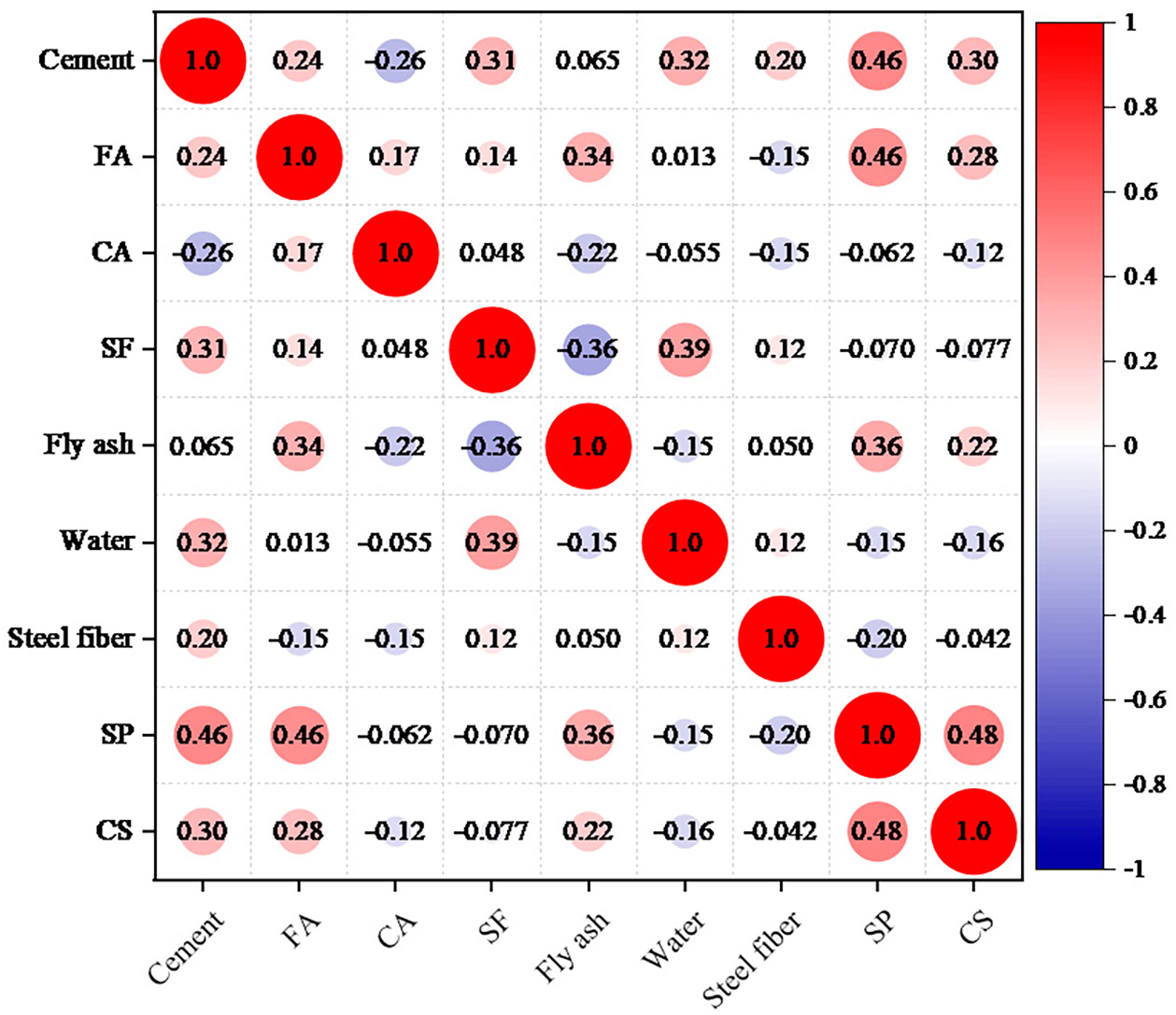
The correlation matrix of input variables and compressive strength (CS) of ultra-high-performance concrete (UHPC) is shown in Figure 4. Values range from −1 to +1; positive correlations are colored red, while negative correlations are blue, and the larger the circle, the stronger the correlation. Cement content has a moderately strong positive correlation to CS (0.46), consistent with the known influence of increased cement dosage on hardness development. The correlations of fine aggregate (0.46) and superplasticizer (0.48) with CS are also relatively strong and positive, which is consistent with the previous studies that determine optimizing the aggregate gradation, such as a grain uniformity degree and admixture dosage, would improve packing density and workability, contributing to strength. However, water had a weak negative correlation with CS−0.16 – higher water content diminishes compressive strength, in line with the principle that a low water-binder ratio is important for UHPC performance.

3.3. Performance evaluation of ML models
3.3.1. ML models
The comparison plots in Figure 5 illustrate the predictive performance of six ensemble-based machine learning models for estimating the compressive strength (CS) of UHPC. Each scatter plot compares predicted and observed values for both training and testing datasets, with the solid line representing perfect prediction and the dashed lines indicating ±20% error margins.

Regression plots of ML models (a) CatBoost, (b) Extra tree, (c) GB, (d) HistGB, (e) RF, (f) XGBoost.
The CatBoost model (Figure 5(a)) achieved the highest coefficient of determination (R2 = 0.882), indicating strong alignment between predicted and actual CS values. The clustering of points close to the diagonal line suggests that CatBoost effectively captured nonlinear interactions among input variables, consistent with its ability to handle categorical data and reduce overfitting through ordered boosting. The Extra Trees model (Figure 5(b)) also performed well (R2 = 0.874), benefiting from its randomized tree splits, which enhanced generalization and reduced variance, although a few outliers beyond the ±20% margin suggest sensitivity to extreme data points.
Gradient Boosting (Figure 5(c)) and HistGB (Figure 5(d)) both produced reliable predictions, with R2 values of 0.854 and 0.843, respectively. While their performance was slightly lower than CatBoost and Extra Trees, they maintained reasonable accuracy. HistGB, in particular, demonstrated efficiency in handling large datasets by discretizing continuous features, though its predictions exhibited greater scatter compared to CatBoost. Random Forest (Figure 5(e)) achieved an R2 of 0.842, comparable to HistGB, but showed broader dispersion around the ideal line, reflecting its averaging approach that can sometimes smooth out extreme values.
XGBoost (Figure 5(f)), with an R2 of 0.864, outperformed both Random Forest and HistGB. Its use of second-order optimization enabled it to better capture complex patterns, although slight deviations from the diagonal line suggest challenges in predicting higher-strength mixes consistently. Overall, CatBoost and Extra Trees emerged as the most accurate models in this study, while Gradient Boosting and XGBoost offered balanced performance between accuracy and computational efficiency. These findings align with recent literature that highlights the superior predictive ability of boosting-based algorithms, particularly CatBoost and XGBoost, for modeling nonlinear material behavior in concrete mix design.
3.3.2. Comparison of ML models
Table 2 presents the comparative performance of six ensemble machine learning models XGBoost, Gradient Boosting, CatBoost, HistGB, Extra Trees Regressor, and Random Forest, for predicting the compressive strength (CS) of UHPC. The evaluation metrics include the coefficient of determination (R2), root mean square error (RMSE), mean absolute error (MAE), and mean absolute percentage error (MAPE) for both training and testing datasets.
Among all models, CatBoost achieved the best overall performance, with the highest R2 values (0.882 for training and 0.863 for testing) and the lowest testing RMSE (11.700 MPa), indicating superior predictive accuracy and strong generalization capability. The Extra Trees Regressor also performed competitively, yielding an R2 of 0.874 (train) and 0.854 (test), along with the lowest MAPE in both training (4.442) and testing (5.551), suggesting consistent and reliable predictions. XGBoost demonstrated balanced performance, with good accuracy (R2_test = 0.836) and relatively low errors, making it robust though slightly less precise than CatBoost and Extra Trees.
In contrast, Random Forest and HistGB recorded lower R2 values (0.827 and 0.811 for testing, respectively) and higher MAE and MAPE, highlighting their limitations in capturing the nonlinear relationships within the UHPC dataset compared to boosting-based methods. Gradient Boosting achieved moderate performance (R2_test = 0.838), but its higher MAE (9.678) reflects reduced predictive sharpness compared to CatBoost and XGBoost.
The radar charts provide a comparative visualization of model performance across multiple evaluation metrics, allowing a holistic understanding of the strengths and weaknesses of each algorithm. Figure 6(a) highlights the MAPE values across models, where the blue-shaded regions (testing) consistently cover a larger area than the red (training), suggesting slightly higher error during testing. CatBoost and Extra Trees demonstrated the lowest MAPE values, reinforcing their superior generalization, while Random Forest and HistGB recorded higher errors, indicating weaker predictive stability. Figure 6(b) focuses on MAE values, showing clearer differences among models. CatBoost again outperformed others with balanced training and testing errors, while Gradient Boosting exhibited higher MAE, pointing to less precision in capturing variations in compressive strength. The larger spread in the Random Forest section emphasizes its tendency to smooth predictions, leading to larger absolute errors. Figure 6(c) illustrates RMSE performance, where CatBoost and Extra Trees achieved the most compact zones, confirming their ability to minimize large deviations between predicted and observed values. XGBoost performed competitively, but HistGB and Random Forest displayed more expanded regions, reflecting their relatively higher prediction errors. Figure 6(d) compares R2 values, where the training performance of all models appears strong, but notable reductions occur in testing datasets. CatBoost maintained the highest consistency between training and testing phases, followed closely by Extra Trees and XGBoost. In contrast, HistGB showed the largest drop in R2, reflecting its limitations in capturing the nonlinear complexity of UHPC data compared to boosting-based approaches. Studies conducted by ABDELLATIEF et al. [85] applied multiple artificial intelligence models, including SVR, RF, ANN, GB, and Gaussian Process Regression (GPR), to predict the early-age compressive strength of UHPFRC and found that the GPR model demonstrated the highest predictive accuracy (R2 > 0.90) compared with the other models.

3.3.3. Taylor diagram based evaluation of ML model performance
The Taylor diagram Figure 7 provides a comprehensive comparison of the six machine learning models in terms of their correlation coefficient, standard deviation, and RMSE relative to the reference training dataset. All models are clustered closely together, indicating generally consistent performance in capturing the compressive strength behavior of UHPC. CatBoost and ETR appear closest to the reference point, reflecting their strong agreement with observed values and balanced variance representation. XGBoost also shows competitive alignment, demonstrating its capability to capture nonlinear trends effectively. Gradient Boosting, HistGB, and RFare positioned slightly farther from the reference, suggesting comparatively higher deviations and lower correlation accuracy. Nonetheless, the differences among the models are subtle, with all maintaining correlation coefficients above 0.8, reinforcing their reliability. The diagram highlights that while multiple ensemble techniques provide acceptable predictions, CatBoost and ETR stand out as the most effective models due to their optimal balance of correlation and variance reproduction.

3.4. SHAP analysis
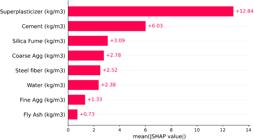
The SHAP bar plot Figure 8 highlights the relative contributions of mix design parameters to the prediction of UHPC compressive strength using the XGBoost model. Superplasticizer dosage emerged as the most influential factor (+12.84), aligning with findings by MENGESHA [86], who reported that high-range water-reducing admixtures (HRWRs) are critical in achieving ultra-low water-to-binder ratios while maintaining workability and strength. Cement content (+6.03) was the second most impactful variable, consistent with established knowledge that high binder dosages (up to 800 kg/m3) are essential for achieving ultra-high strength. Silica fume (+3.09) also showed a significant contribution, reflecting its well-documented role in densifying the microstructure through pozzolanic reactions, a trend similarly observed in studies by ABBAS et al. [19]. Among aggregates, coarse aggregate (+2.78) had a stronger influence than fine aggregate (+1.33), which agrees with recent UHPC mix optimization studies showing that coarse aggregate gradation strongly affects packing density and strength. Steel fibers (+2.52) were also notable, reinforcing their role in enhancing crack-bridging capacity and post-peak ductility, a finding supported by Wille and Naaman (2011). The contribution of water (+2.38) indicates the critical balance in water-to-binder ratios, while fly ash (+0.73) had the least impact, which is consistent with literature noting its slower pozzolanic activity compared to silica fume [84]. Overall, these results confirm that admixtures and binder composition dominate compressive strength predictions, while aggregates and SCMs play complementary roles, in line with trends reported in recent UHPC sustainability and optimization studies.
This SHAP summary plot Figure 9 illustrates the individual contribution and direction of influence of each input parameter on the predicted compressive strength of UHPC. The superplasticizer content shows the strongest positive impact, with higher dosages (red points) consistently driving the predictions toward higher strength values. This observation is consistent with prior studies, which emphasized that superplasticizers enable ultra-low water-to-binder ratios while maintaining workability, leading to higher strength development. Cement content also exhibits a strong positive effect, as higher binder dosage promotes hydration and densification, corroborating findings ABBAS et al. [19]. For silica fume, the SHAP values confirm its beneficial role, as higher amounts increase compressive strength through pozzolanic activity and microstructural refinement, in line with previous UHPC studies. Aggregates, particularly coarse aggregates, demonstrate a mixed influence: while optimal gradation contributes positively, excessive amounts can negatively impact packing density, echoing NGUYEN et al. [46]. Steel fibers show a balanced distribution of influence, reflecting their role in enhancing tensile capacity and crack resistance rather than directly governing compressive strength, consistent with findings by WILLE et al. [84]. Water content illustrates the expected dual role, where moderate amounts are essential for hydration, but excess leads to strength reduction—supporting the importance of low water-to-binder ratios emphasized across UHPC literature. In contrast, fine aggregate and fly ash show relatively smaller impacts. The limited role of fine aggregate aligns with research suggesting that coarse-to-fine ratios are more influential in UHPC packing density. The minimal contribution of fly ash reflects its slower reactivity compared to silica fume, consistent with sustainability-focused studies that show partial replacement with fly ash improves eco-friendliness but may lower early strength. Overall, this SHAP analysis validates established knowledge from UHPC literature, while quantitatively ranking the significance of mix parameters in compressive strength prediction.

3.4.1. SHAP heat map
Figure 10 shows the SHAP heatmap of per-sample (instance-wise) feature contributions for the best-performing model. The instance index is an arbitrary enumeration of mixtures and has no natural ordering. The figure is there to show how feature contributions can vary across mixtures; for a quantitative interpretation, refer to SHAP dependence plots and PDPs. This SHAP heatmap provides a detailed visualization of how individual input features contribute to the prediction of compressive strength across different instances. The superplasticizer content shows the most consistent and dominant influence, with strong red regions indicating a positive contribution toward higher predicted strengths, especially at higher dosages. This aligns with literature, where superplasticizers were identified as the primary enabler of low water-to-binder ratios, resulting in improved mechanical performance. Cement also displays a strong positive effect, particularly in the early instances (bright red zones), underscoring its role in providing the primary binder matrix, consistent with RICHARD and CHEYREZY [87], who noted that cement dosage above 800 kg/m3 is key to achieving UHPC’s high strength. Silica fume exhibits moderate but widespread contributions, both positive and negative, reflecting its dual role: improving microstructural density at optimal levels while potentially reducing workability at higher dosages. This observation supports WILLE et al. [84], who highlighted the balance between pozzolanic reactivity and practical workability. Aggregates—particularly coarse aggregate—show a more scattered pattern of influence, with alternating red and blue regions, indicating that their effect on strength is highly instance-dependent and influenced by gradation and packing density. The role of steel fibers appears as smaller but localized contributions, confirming that fibers mainly enhance ductility and crack control rather than directly dictating compressive strength. Water content demonstrates both positive and negative effects, highlighting the delicate balance of hydration versus strength dilution—an outcome well documented in UHPC mix design literature. In contrast, fly ash and fine aggregates show relatively weaker impacts, aligning with sustainability-focused studies where fly ash improved eco-efficiency but had limited influence on early-age strength.

Figure 11 illustrates the SHAP dependence plots for the primary UHPC mix constituents, showing how each variable and its interactions contribute to compressive strength prediction.In Figure 11(a), cement content demonstrates a clear positive influence on strength, with contributions increasing sharply at higher dosages (>800 kg/m3). For Figure 11(b), contributions fluctuate between positive and negative values, particularly at higher replacement levels, indicating that excess coarse aggregate disrupts matrix homogeneity. Similar findings were reported by NGUYEN et al. [46], who observed reduced packing density and efficiency at higher coarse aggregate contents. Figure 11(c) reveals minimal influence, with SHAP values remaining close to zero. This suggests that fine aggregate primarily serves as a filler rather than a major strength-contributing factor, consistent with prior UHPC mix optimization studies. Figure 11(d) shows comparatively weaker impacts, with SHAP values clustered around zero and occasional negative contributions at higher dosages. This reflects fly ash’s lower reactivity, corroborating KARIM et al. [49], who reported limited early-age strength enhancement despite its sustainability benefits. In Figure 11(e), SHAP values show both positive and negative contributions. At moderate dosages, silica fume enhances compressive strength through pozzolanic activity and micro-filling effects; however, higher dosages introduce variability due to reduced workability. Figure 11(f) displays the most dominant role, with strongly positive SHAP values at higher dosages. This confirms the critical function of superplasticizers in enabling very low water-to-binder ratios while maintaining workability, echoing the conclusions of ABBAS et al. [19]. Figure 11(g) highlights modest but scattered effects. While steel fibers improve post-cracking behavior and ductility, their direct influence on compressive strength is limited, consistent with WILLE et al. [84], who emphasized their structural rather than strength-enhancing contribution. Finally, Figure 11(h) demonstrates a clear negative impact at higher dosages, as increasing water reduces matrix density and dilutes binder efficiency. This pattern is strongly aligned with established UHPC design principles, which stress the necessity of extremely low water-to-binder ratios for achieving ultra-high compressive strength.

Interaction plot for all input parameters used in this study (a) cement, (b) fine aggregate (sand), (c) coarse aggregate, (d) fly ash, (e) silica fume, (f) superplasticizer, (g) steel fiber, (h) water.
In order to provide actionable guidance for UHPC mix design, the SHAP dependence results (Figure 11) were quantified by summarizing SHAP contributions over practical dosage ranges. SHAP values are in the same unit as the model output (MPa), so these summaries directly show how making a change to a constituent moves the predicted compressive strength. The median SHAP contribution and the observed range for each interval are reported in Table 3. For superplasticizer, the median SHAP contribution monotonically increases with dosage: it is strongly negative at low dosages (<20 kg/m3; median −11.6 MPa), weakly negative at moderate dosages (20–40 kg/m3; median −5.3 MPa), positive at 40–60 kg/m3 (median +7.5 MPa), and strongly positive at ≥60 kg/m3 (median +28.1 MPa). That is, the median contribution increases by about 39.7 MPa as density transitions from <20 to ≥60 kg/m3, signifying that superplasticizer presents the most actionable strength optimization target in the observed data range. Cement displays a notable high-dosage effect: the median SHAP contribution is near neutral at <600 kg/m3 (median +2.9 MPa) and 600–800 kg/m3 (median +1.0 MPa), slightly negative at 800–950 kg/m3 (median −4.7 MPa), and then sharply positive when examining ≥950 kg/m3 (median +35.2 MPa), confirming that very high binder contents can greatly elevate predicted strength alongside advantageous accompanying constituents. Silica fume shows a threshold-type response: median SHAP is negative for <100 kg/m3 (median −3.0 MPa), positive for 100–200 kg/m3 (median +2.0 MPa), near neutral to negative for 200–300 kg/m3 (median −1.0 MPa; with one-off large negatives from interactions) and positively clear at ≥300 kg/m3 (median +9.8 MPa); in summary, higher silica fume contents generally yield measurable tensile strength benefits across the dataset in this example. Steel fiber provides the most robust positive contributions in the 200–300 kg/m3 range (median +8.1 MPa); negative-to-near-zero contributions are observed at <100 kg/m3 (median −2.8 MPa) and at 100–200 kg/m3 (median −0.5 MPa). Indeed, this shows that only when the reached value for added fiber exceeds 0.2 m3 kg/m3 does it seem to have a positive effect on the expected destructive strength within the presented data.
3.5. PDP analysis
Figure 12 presents the partial dependence plots (PDPs) illustrating the marginal effects of key UHPC constituents on compressive strength prediction. In Figure 12(a), the partial dependence curve indicates that compressive strength generally rises with cement content, particularly beyond 800 kg/m3. Figure 12(b) shows modest variation, with compressive strength largely unaffected except at extreme dosage levels. This indicates that fine aggregate plays more of a filler role rather than directly governing compressive strength. The response in Figure 12(c) displays non-linear variations, with compressive strength slightly declining at higher aggregate contents. This behavior is attributable to reduced binder volume and disrupted matrix homogeneity, supporting NGUYEN et al. [46], who reported similar reductions in packing density with excessive coarse aggregate. Figure 12(d) shows only minor fluctuations, with strength remaining relatively stable across the range of fly ash dosages. This finding reflects the lower reactivity of fly ash in early-age hydration, aligning with studies such as KAREEM [88], which reported limited direct improvements in compressive strength despite its long-term durability benefits. In Figure 12(e), the PDP reveals a sharp increase in compressive strength at higher dosages (>350 kg/m3), reflecting the strong pozzolanic reactivity and filler effects of silica fume. Figure 12(f) demonstrates the most pronounced positive effect, with strength increasing steeply once superplasticizer content exceeds ~40 kg/m3. This confirms the critical role of superplasticizers in facilitating ultra-low water-to-binder ratios, consistent with ABBAS et al. [19], who highlighted their essential function in UHPC workability and strength. Figure 12(g) shows incremental gains in compressive strength at higher fiber dosages, though the effect is less significant than binders or admixtures. This pattern supports WILLE et al. [84], who argued that fibers primarily improve post-cracking toughness and ductility, with only marginal effects on compressive strength. Finally, Figure 12(h) reveals an inverse relationship, with strength declining noticeably at higher water dosages. This observation directly aligns with UHPC design principles, where extremely low water-to-binder ratios are critical for achieving ultra-high compressive strength.

Partial dependency of all parameters (a) cement, (b) fine aggregate (sand), (c) coarse aggregate, (d) fly ash, (e) silica fume, (f ) Superplasticizer, (g) steel fiber, (h) water.
Although one-dimensional PDPs and SHAP dependence plots illustrate marginal effects, the compressive strength of UHPC is also governed by interactions between constituents. To assess interactions between pairs of features, SHAP interaction values were calculated from the final CatBoost model that performed best. Interaction analysis reveals that superplasticizer and water, cement, and silica fume have the strongest interactions in confirming the coupled nature of workability control (through superplasticizer) with water/binder efficiency and synergy from high binder content and highly reactive micro-fillers. The superplasticizer × water interaction indicates that the positive effect of superplasticizer is strongest when low amounts of water are present and diminishes at high levels of water, since excess water results in dilution effects that reduce binder efficacy (i.e., lowering strength) and increase porosity. This cross-talk is evident in the two-dimensional PDP surface, which also indicates that maximum predicted compressive strengths were achieved for mixtures on higher superplasticizer dosage and lower water content. The cement × silica fume interaction shows that the strength benefit from silica fume is clearest when cement content is high, because good particle packing and pozzolanic densification are more effectively achieved in a binder-rich system. At low cement contents, the impact of replacing cement with silica fume is less evident, which reveals decreasing benefit unless there exists enough binder phases to give rise to a dense matrix. Links of weaker strength (for example, cement × water and silica fume × water) also corroborate that reduced water contents yield a superior benefit to high-binder and silica fume levels.
In this study, a systematic comparison of six tree-based ensemble learners and their corresponding interpretable insights (SHAP/PDP) for UHPC compressive-strength prediction is presented utilizing a previously literature-compiled dataset. Finally, though baseline (linear/polynomial) regressions and empirical formulas per se were avoided in the analysis since ensemble-to-ensemble benchmarking and interpretability for non-linear mix–strength relationships is indeed the main contribution. Conclusions are limited solely to the model family assessed and do not imply superiority over all other modelling approaches.
4. CONCLUSIONS
-
Among six ensemble learners trained on 376 UHPC mixtures, CatBoost achieved the best generalization (test R2 = 0.863, RMSE MPa), followed by Extra Trees (test R2 = 0.854) which also yielded the lowest MAPE (train/test 4.44% / 5.55%). XGBoost performed competitively (test R2 = 0.836); Gradient Boosting, Random Forest, and HistGB were less accurate under the same protocol.
-
Taylor-diagram and radar-plot assessments confirmed consistent correlations (>0.8) across models, with CatBoost and Extra Trees lying closest to the reference point, indicating the best joint balance of correlation, variability reproduction, and error.
-
SHAP analysis established superplasticizer as the dominant driver of predicted CS, followed by cement and silica fume; coarse aggregate exerted a moderate effect, while fine aggregate and fly ash contributed weakly and nonlinearly. Water showed mixed local effects but generally reduced CS at higher dosages.
-
PDPs indicated monotonic or threshold-type gains with increasing superplasticizer and cement, benefits from silica fume at moderate-to-high contents, and strength penalties at elevated water contents—patterns consistent with UHPC packing-density and low w/bw/bw/b design principles.
-
The combination of CatBoost prediction with SHAP/PDP interpretation provides a transparent decision aid for UHPC mix design, enabling rapid screening of mixtures and reducing experimental iterations while aligning with sustainability goals through informed use of binders, SCMs, and admixtures.
Expanding the database (e.g., broader curing regimes, additional SCMs/nanoparticles) and coupling models with multi-objective optimization will further enhance generalization and support strength–cost–carbon trade-off design for UHPC.
5. ACKNOWLEDGMENTS
The authors are thankful to the Deanship of Graduate Studies and Scientific Research at Najran University for funding this work under the Student Research Funding Program grant code (NU/SRP/SERC/14/3349-1).
6. BIBLIOGRAPHY
-
[1] ZENG, H., JIN, M., LI, W., et al, “Thermal-fatigue challenges in the Interfacial Transition Zone (ITZ) of concrete: how fly ash modulates degradation?”, Cement and Concrete Composites, v. 168, pp. 106500, 2026. doi: https://doi.org/10.1016/j.cemconcomp.2026.106500.
» https://doi.org/10.1016/j.cemconcomp.2026.106500 -
[2] HAO, X.-K., ZHANG, H.-Y., DENG, T., et al, “Experimental and theoretical investigation of low-shrinkage alkali-activated materials permanent formwork reinforced concrete prisms under axial load”, Construction & Building Materials, v. 500, pp. 144156, 2025. doi: https://doi.org/10.1016/j.conbuildmat.2025.144156.
» https://doi.org/10.1016/j.conbuildmat.2025.144156 -
[3] AMRAN, M., MURALI, G., MAKUL, N., et al, “Sustainable development of eco-friendly ultra-high performance concrete (UHPC): cost, carbon emission, and structural ductility”, Construction & Building Materials, v. 398, pp. 132477, 2023. doi: https://doi.org/10.1016/j.conbuildmat.2023.132477.
» https://doi.org/10.1016/j.conbuildmat.2023.132477 -
[4] ARORA, A., YAO, Y., MOBASHER, B., et al, “Fundamental insights into the compressive and flexural response of binder- and aggregate-optimized ultra-high performance concrete (UHPC)”, Cement and Concrete Composites, v. 98, pp. 1–13, 2019. doi: https://doi.org/10.1016/j.cemconcomp.2019.01.015.
» https://doi.org/10.1016/j.cemconcomp.2019.01.015 -
[5] ULLAH, R., QIANG, Y., AHMAD, J., et al, “Ultra-high-performance concrete (UHPC): a state-of-the-art review”, Materials, v. 15, n. 12, pp. 4131, 2022. doi: https://doi.org/10.3390/ma15124131. PubMed PMID: 35744190.
» https://doi.org/10.3390/ma15124131. -
[6] SHAO, Y., TICH, K.L., BOARO, S.B., et al, “Impact of fiber distribution and cyclic loading on the bond behavior of steel-reinforced UHPC”, Cement and Concrete Composites, v. 126, pp. 104338, 2022. doi: https://doi.org/10.1016/j.cemconcomp.2021.104338.
» https://doi.org/10.1016/j.cemconcomp.2021.104338 -
[7] ABDULLAH, M.A.H., RASHID, R.S.M., AMRAN, M., et al, “Recent trends in advanced radiation shielding concrete for construction of facilities: materials and properties”, Polymers, v. 14, n. 14, pp. 2830, 2022. doi: https://doi.org/10.3390/polym14142830. PubMed PMID: 35890605.
» https://doi.org/10.3390/polym14142830. -
[8] YOO, D.-Y., BANTHIA, N., “Mechanical properties of ultra-high-performance fiber-reinforced concrete: a review”, Cement and Concrete Composites, v. 73, pp. 267–280, 2016. doi: https://doi.org/10.1016/j.cemconcomp.2016.08.001.
» https://doi.org/10.1016/j.cemconcomp.2016.08.001 -
[9] ZHOU, M., LU, W., SONG, J., et al, “Application of Ultra-High Performance Concrete in bridge engineering”, Construction & Building Materials, v. 186, pp. 1256–1267, 2018. doi: https://doi.org/10.1016/j.conbuildmat.2018.08.036.
» https://doi.org/10.1016/j.conbuildmat.2018.08.036 -
[10] YUAN, H., LIN, W.-L., YOU, X.-M., et al, “A cost-efficient UHPC incorporated with coarse aggregates and macro fibres recycled from waste GFRP”, Journal of Building Engineering, v. 73, pp. 106786, 2023. doi: https://doi.org/10.1016/j.jobe.2023.106786.
» https://doi.org/10.1016/j.jobe.2023.106786 -
[11] SHAFIEIFAR, M., FARZAD, M., AZIZINAMINI, A., “Experimental and numerical study on mechanical properties of Ultra High Performance Concrete (UHPC)”, Construction & Building Materials, v. 156, pp. 402–411, 2017. doi: https://doi.org/10.1016/j.conbuildmat.2017.08.170.
» https://doi.org/10.1016/j.conbuildmat.2017.08.170 -
[12] YANG, J., CHEN, B., SU, J., et al, “Effects of fibers on the mechanical properties of UHPC: a review”, Journal of Traffic and Transportation Engineering, v. 9, n. 3, pp. 363–387, 2022. doi: https://doi.org/10.1016/j.jtte.2022.05.001.
» https://doi.org/10.1016/j.jtte.2022.05.001 -
[13] AKHNOUKH, A.K., BUCKHALTER, C., “Ultra-high-performance concrete: Constituents, mechanical properties, applications and current challenges”, Case Studies in Construction Materials, v. 15, e00559, 2021. doi: https://doi.org/10.1016/j.cscm.2021.e00559.
» https://doi.org/10.1016/j.cscm.2021.e00559 -
[14] KHAN, M.I., ABBAS, Y.M., FARES, G., et al, “Strength prediction and optimization for ultrahigh-performance concrete with low-carbon cementitious materials – XG boost model and experimental validation”, Construction & Building Materials, v. 387, pp. 131606, 2023. doi: https://doi.org/10.1016/j.conbuildmat.2023.131606.
» https://doi.org/10.1016/j.conbuildmat.2023.131606 -
[15] RANDL, N., STEINER, T., OFNER, S., et al, “Development of UHPC mixtures from an ecological point of view”, Construction & Building Materials, v. 67, pp. 373–378, 2014. doi: https://doi.org/10.1016/j.conbuildmat.2013.12.102.
» https://doi.org/10.1016/j.conbuildmat.2013.12.102 -
[16] MENG, W., VALIPOUR, M., KHAYAT, K.H., “Optimization and performance of cost-effective ultra-high performance concrete”, Materials and Structures, v. 50, n. 1, pp. 29, 2016. doi: https://doi.org/10.1617/s11527-016-0896-3.
» https://doi.org/10.1617/s11527-016-0896-3 -
[17] WANG, D., SHI, C., WU, Z., et al, “A review on ultra high performance concrete: part II. Hydration, microstructure and properties”, Construction & Building Materials, v. 96, pp. 368–377, 2015. doi: https://doi.org/10.1016/j.conbuildmat.2015.08.095.
» https://doi.org/10.1016/j.conbuildmat.2015.08.095 -
[18] KHAN, M., LAO, J., DAI, J.-G., “Comparative study of advanced computational techniques for estimating the compressive strength of UHPC”, Journal of Asian Concrete Federation, v. 8, n. 1, pp. 51–68, 2022. doi: https://doi.org/10.18702/acf.2022.6.8.1.51.
» https://doi.org/10.18702/acf.2022.6.8.1.51 -
[19] ABBAS, S., NEHDI, M.L., SALEEM, M., “Ultra-high performance concrete: Mechanical performance, durability, sustainability and implementation challenges”, International Journal of Concrete Structures and Materials, v. 10, n. 3, pp. 271–295, 2016. doi: https://doi.org/10.1007/s40069-016-0157-4.
» https://doi.org/10.1007/s40069-016-0157-4 -
[20] SOLIMAN, N.A., TAGNIT-HAMOU, A., “Using glass sand as an alternative for quartz sand in UHPC”, Construction & Building Materials, v. 145, pp. 243–252, 2017. doi: https://doi.org/10.1016/j.conbuildmat.2017.03.187.
» https://doi.org/10.1016/j.conbuildmat.2017.03.187 -
[21] GHAREEB, K.S., AHMED, H.E., EL-AFFANDY, T.H., et al, “The novelty of using glass powder and lime powder for producing UHPSCC”, Buildings, v. 12, n. 5, pp. 684, 2022. doi: https://doi.org/10.3390/buildings12050684.
» https://doi.org/10.3390/buildings12050684 -
[22] GHAFARI, E., BANDARABADI, M., COSTA, H., et al, “Prediction of fresh and hardened state properties of UHPC: comparative study of statistical mixture design and an artificial neural network model”, Journal of Materials in Civil Engineering, v. 27, n. 11, pp. 04015017, 2015. doi: https://doi.org/10.1061/(ASCE)MT.1943-5533.0001270.
» https://doi.org/10.1061/(ASCE)MT.1943-5533.0001270 - [23] LEE, H.-P., CHAK, W.-F., TEOW, K.-L., et al., “Investigation of catalyzed biomass thermoelectric concrete with palm oil fuel ash”, In: Proceedings of the International Conference on Sustainable Civil Engineering Structures and Construction Materials, pp. 451–463, 2020.
-
[24] YANG, G., CAO, Q., ZHAO, H., et al, “New insights into linear-nonlinear tensile creep mechanisms of UHPC: stress level-dependent creep-active site transitions”, Cement and Concrete Research, v. 198, pp. 107988, 2025. doi: https://doi.org/10.1016/j.cemconres.2025.107988.
» https://doi.org/10.1016/j.cemconres.2025.107988 -
[25] AMERI, F., DE BRITO, J., MADHKHAN, M., et al, “Steel fibre-reinforced high-strength concrete incorporating copper slag: mechanical, gamma-ray shielding, impact resistance, and microstructural characteristics”, Journal of Building Engineering, v. 29, pp. 101118, 2020. doi: https://doi.org/10.1016/j.jobe.2019.101118.
» https://doi.org/10.1016/j.jobe.2019.101118 -
[26] BARIŞ, K.E., TANAÇAN, L.., “Earth of Datça: development of pozzolanic activity with steam curing”, Construction & Building Materials, v. 139, pp. 212–220, 2017. doi: https://doi.org/10.1016/j.conbuildmat.2017.02.069.
» https://doi.org/10.1016/j.conbuildmat.2017.02.069 -
[27] AHMAD, S., AL-FAKIH, A., BAHRAQ, A.A., et al, “Fracture toughness of UHPC mixtures: effects of w/b ratio, cement and silica fume contents”, Construction & Building Materials, v. 417, pp. 135327, 2024. doi: https://doi.org/10.1016/j.conbuildmat.2024.135327.
» https://doi.org/10.1016/j.conbuildmat.2024.135327 - [28] LEE, H.-P., JUSLI, E., LING, J.H., et al, “Concrete Paving Blocks incorporating palm oil boiler ash and palm oil clinker as substitute concrete materials”, Journal of Engineering Science and Technology, v. 18, n. 6, pp. 75–81, 2023.
-
[29] JATURAPITAKKUL, C., KIATTIKOMOL, K., SATA, V., et al, “Use of ground coarse fly ash as a replacement of condensed silica fume in producing high-strength concrete”, Cement and Concrete Research, v. 34, n. 4, pp. 549–555, 2004. doi: https://doi.org/10.1016/S0008-8846(03)00150-9.
» https://doi.org/10.1016/S0008-8846(03)00150-9 -
[30] SANKAR, L.P., SIVASANKAR, S., SHUNMUGASUNDARAM, M., et al, “Investigation on binder and concrete with fine grinded fly ash and silica fume as pozzolanic combined replacement”, Materials Today: Proceedings, v. 27, pp. 1157–1162, 2020. doi: https://doi.org/10.1016/j.matpr.2020.01.607.
» https://doi.org/10.1016/j.matpr.2020.01.607 -
[31] NOCHAIYA, T., WONGKEO, W., CHAIPANICH, A., “Utilization of fly ash with silica fume and properties of Portland cement–fly ash–silica fume concrete”, Fuel, v. 89, n. 3, pp. 768–774, 2010. doi: https://doi.org/10.1016/j.fuel.2009.10.003.
» https://doi.org/10.1016/j.fuel.2009.10.003 -
[32] MAGUDEASWARAN, P., ESWARAMOORTHI, P., “Experimental investigations of mechanical properties on micro silica (silica fume) and fly ash as partial cement replacement of high performance concrete”, IOSR Journal of Mechanical and Civil Engineering, v. 6, n. 4, pp. 57–63, 2013. doi: https://doi.org/10.9790/1684-645763.
» https://doi.org/10.9790/1684-645763 -
[33] SONG, Y., DIAO, X., XU, R., et al, “A comprehensive review of mineral carbonation of civil engineering materials: a bibliometric analysis”, Environmental Science & Technology, v. 59, n. 50, pp. 26917–26944, 2025. doi: https://doi.org/10.1021/acs.est.5c03561. PubMed PMID: 41347683.
» https://doi.org/10.1021/acs.est.5c03561. -
[34] HUANG, H., HUANG, M., ZHANG, W., et al, “Experimental study of predamaged columns strengthened by HPFL and BSP under combined load cases”, Structure and Infrastructure Engineering, v. 17, n. 9, pp. 1210–1227, 2021. doi: https://doi.org/10.1080/15732479.2020.1801768.
» https://doi.org/10.1080/15732479.2020.1801768 -
[35] LONG, X., MAO, M.-H., SU, T.-X., et al, “Machine learning method to predict dynamic compressive response of concrete-like material at high strain rates”, Defence Technology, v. 23, pp. 100–111, 2023. doi: https://doi.org/10.1016/j.dt.2022.02.003.
» https://doi.org/10.1016/j.dt.2022.02.003 -
[36] NIU, Y., WANG, W., SU, Y., et al, “Plastic damage prediction of concrete under compression based on deep learning”, Acta Mechanica, v. 235, n. 1, pp. 255–266, 2024. doi: https://doi.org/10.1007/s00707-023-03743-8.
» https://doi.org/10.1007/s00707-023-03743-8 -
[37] SONG, H., AHMAD, A., OSTROWSKI, K.A., et al, “Analyzing the compressive strength of ceramic waste-based concrete using experiment and artificial neural network (ANN) approach”, Materials, v. 14, n. 16, pp. 4518, 2021. doi: https://doi.org/10.3390/ma14164518. PubMed PMID: 34443041.
» https://doi.org/10.3390/ma14164518. -
[38] YEH, I.-C., LIEN, C.-H., PENG, C.-H., et al, “Modeling concrete strength using genetic operation trees”, In: Proceedings of the 2010 International Conference on Machine Learning and Cybernetics, v. 3, IEEE, pp. 1572-1576, 2010. doi: https://doi.org/10.1109/ICMLC.2010.5580800.
» https://doi.org/10.1109/ICMLC.2010.5580800 -
[39] HUANG, H., GUO, M., ZHANG, W., et al, “Numerical investigation on the bearing capacity of RC columns strengthened by HPFL-BSP under combined loadings”, Journal of Building Engineering, v. 39, pp. 102266, 2021. doi: https://doi.org/10.1016/j.jobe.2021.102266.
» https://doi.org/10.1016/j.jobe.2021.102266 -
[40] SUN, L., WANG, X., ZHANG, C., “Three-dimensional high fidelity mesoscale rapid modelling algorithm for concrete”, Structures, v. 70, pp. 107561, 2024. doi: https://doi.org/10.1016/j.istruc.2024.107561.
» https://doi.org/10.1016/j.istruc.2024.107561 -
[41] CHEN, X., ZHANG, H., ZHOU, C., et al, “Tests and theoretical prediction model for RH evolution in recycled aggregate concrete accounting for the porous physical properties of recycled aggregates”, Journal of Materials in Civil Engineering, v. 37, n. 4, pp. 04025053, 2025. doi: https://doi.org/10.1061/JMCEE7.MTENG-19321.
» https://doi.org/10.1061/JMCEE7.MTENG-19321 -
[42] QI, Q., JIANG, L., SHAO, C., et al, “Hysteretic behavior modeling of RC walls considering axial-flexure-shear interaction”, Journal of Building Engineering, v. 111, pp. 113628, 2025. doi: https://doi.org/10.1016/j.jobe.2025.113628.
» https://doi.org/10.1016/j.jobe.2025.113628 -
[43] SONG, H., AHMAD, A., FAROOQ, F., et al, “Predicting the compressive strength of concrete with fly ash admixture using machine learning algorithms”, Construction & Building Materials, v. 308, pp. 125021, 2021. doi: https://doi.org/10.1016/j.conbuildmat.2021.125021.
» https://doi.org/10.1016/j.conbuildmat.2021.125021 -
[44] KABIRU, O.A., OWOLABI, T.O., SSENNOGA, T., et al, “Performance comparison of SVM and ANN in predicting compressive strength of concrete”, IOSR Journal of Computer Engineering, v. 16, n. 5, pp. 88–94, 2014. doi: https://doi.org/10.9790/0661-16518894.
» https://doi.org/10.9790/0661-16518894 -
[45] ZHANG, J., ZHAO, Y., LI, H., “Experimental investigation and prediction of compressive strength of ultra‐high performance concrete containing supplementary cementitious materials”, Advances in Materials Science and Engineering, v. 2017, n. 1, pp. 4563164, 2017. doi: https://doi.org/10.1155/2017/4563164.
» https://doi.org/10.1155/2017/4563164 -
[46] NGUYEN, N.-H., ABELLÁN-GARCÍA, J., LEE, S., et al, “Efficient estimating compressive strength of ultra-high performance concrete using XGBoost model”, Journal of Building Engineering, v. 52, pp. 104302, 2022. doi: https://doi.org/10.1016/j.jobe.2022.104302.
» https://doi.org/10.1016/j.jobe.2022.104302 -
[47] SHEN, Z., DEIFALLA, A.F., KAMIŃSKI, P., et al, “Compressive strength evaluation of ultra-high-strength concrete by machine learning”, Materials, v. 15, n. 10, pp. 3523, 2022. doi: https://doi.org/10.3390/ma15103523. PubMed PMID: 35629548.
» https://doi.org/10.3390/ma15103523. -
[48] SUN, C., WANG, K., LIU, Q., et al, “Machine-learning-based comprehensive properties prediction and mixture design optimization of ultra-high-performance concrete”, Sustainability, v. 15, n. 21, pp. 15338, 2023. doi: https://doi.org/10.3390/su152115338.
» https://doi.org/10.3390/su152115338 -
[49] KARIM, R., ISLAM, M.H., DATTA, S.D., et al, “Synergistic effects of supplementary cementitious materials and compressive strength prediction of concrete using machine learning algorithms with SHAP and PDP analyses”, Case Studies in Construction Materials, v. 20, e02828, 2024. doi: https://doi.org/10.1016/j.cscm.2023.e02828.
» https://doi.org/10.1016/j.cscm.2023.e02828 -
[50] ABD, A.M., ABD, S.M., “Modelling the strength of lightweight foamed concrete using support vector machine (SVM)”, Case Studies in Construction Materials, v. 6, pp. 8–15, 2017. doi: https://doi.org/10.1016/j.cscm.2016.11.002.
» https://doi.org/10.1016/j.cscm.2016.11.002 -
[51] DEIFALLA, A., SALEM, N.M., “A machine learning model for torsion strength of externally bonded FRP-reinforced concrete beams”, Polymers, v. 14, n. 9, pp. 1824, 2022. doi: https://doi.org/10.3390/polym14091824. PubMed PMID: 35566992.
» https://doi.org/10.3390/polym14091824. -
[52] SALEM, N.M., DEIFALLA, A., “Evaluation of the strength of slab-column connections with FRPs using machine learning algorithms”, Polymers, v. 14, n. 8, pp. 1517, 2022. doi: https://doi.org/10.3390/polym14081517. PubMed PMID: 35458270.
» https://doi.org/10.3390/polym14081517. -
[53] MARANI, A., NEHDI, M.L., “Machine learning prediction of compressive strength for phase change materials integrated cementitious composites”, Construction & Building Materials, v. 265, pp. 120286, 2020. doi: https://doi.org/10.1016/j.conbuildmat.2020.120286.
» https://doi.org/10.1016/j.conbuildmat.2020.120286 - [54] TAHWIA, A.M., HENIEGAL, A., ELGAMAL, M.S., et al., “The prediction of compressive strength and non-destructive tests of sustainable concrete by using artificial neural networks”, Computers and Concrete, An International Journal, v. 27, n. 1, pp. 21–28, 2021.
-
[55] ZHANG, J., LI, D., WANG, Y., “Toward intelligent construction: Prediction of mechanical properties of manufactured-sand concrete using tree-based models”, Journal of Cleaner Production, v. 258, pp. 120665, 2020. doi: https://doi.org/10.1016/j.jclepro.2020.120665.
» https://doi.org/10.1016/j.jclepro.2020.120665 -
[56] HAN, Q., GUI, C., XU, J., et al, “A generalized method to predict the compressive strength of high-performance concrete by improved random forest algorithm”, Construction & Building Materials, v. 226, pp. 734–742, 2019. doi: https://doi.org/10.1016/j.conbuildmat.2019.07.315.
» https://doi.org/10.1016/j.conbuildmat.2019.07.315 -
[57] DUAN, J., ASTERIS, P.G., NGUYEN, H., et al, “A novel artificial intelligence technique to predict compressive strength of recycled aggregate concrete using ICA-XGBoost model”, Engineering with Computers, v. 37, n. 4, pp. 3329–3346, 2021. doi: https://doi.org/10.1007/s00366-020-01003-0.
» https://doi.org/10.1007/s00366-020-01003-0 -
[58] LI, Y., ZHANG, Q., KAMIŃSKI, P., et al, “Compressive strength of steel fiber-reinforced concrete employing supervised machine learning techniques”, Materials, v. 15, n. 12, pp. 4209, 2022. doi: https://doi.org/10.3390/ma15124209. PubMed PMID: 35744270.
» https://doi.org/10.3390/ma15124209. -
[59] LEE, J.-H., YOON, Y.-S., KIM, J.-H., “A new heuristic algorithm for mix design of high-performance concrete”, KSCE Journal of Civil Engineering, v. 16, n. 6, pp. 974–979, 2012. doi: https://doi.org/10.1007/s12205-012-1011-0.
» https://doi.org/10.1007/s12205-012-1011-0 -
[60] CHENG, M.-Y., PRAYOGO, D., WU, Y.-W., “Novel genetic algorithm-based evolutionary support vector machine for optimizing high-performance concrete mixture”, Journal of Computing in Civil Engineering, v. 28, n. 4, pp. 06014003, 2014. doi: https://doi.org/10.1061/(ASCE)CP.1943-5487.0000347.
» https://doi.org/10.1061/(ASCE)CP.1943-5487.0000347 -
[61] SALEH, E., TARAWNEH, A., NASER, M.Z., et al, “You only design once (YODO): Gaussian Process-Batch Bayesian optimization framework for mixture design of ultra high performance concrete”, Construction & Building Materials, v. 330, pp. 127270, 2022. doi: https://doi.org/10.1016/j.conbuildmat.2022.127270.
» https://doi.org/10.1016/j.conbuildmat.2022.127270 -
[62] MAHJOUBI, S., BARHEMAT, R., MENG, W., et al, “AI-guided auto-discovery of low-carbon cost-effective ultra-high performance concrete (UHPC)”, Resources, Conservation and Recycling, v. 189, pp. 106741, 2023. doi: https://doi.org/10.1016/j.resconrec.2022.106741.
» https://doi.org/10.1016/j.resconrec.2022.106741 -
[63] GHAFARI, E., COSTA, H., JÚLIO, E., “Statistical mixture design approach for eco-efficient UHPC”, Cement and Concrete Composites, v. 55, pp. 17–25, 2015. doi: https://doi.org/10.1016/j.cemconcomp.2014.07.016.
» https://doi.org/10.1016/j.cemconcomp.2014.07.016 -
[64] DINGQIANG, F., YU, R., KANGNING, L., et al, “Optimized design of steel fibres reinforced ultra-high performance concrete (UHPC) composites: towards to dense structure and efficient fibre application”, Construction & Building Materials, v. 273, pp. 121698, 2021. doi: https://doi.org/10.1016/j.conbuildmat.2020.121698.
» https://doi.org/10.1016/j.conbuildmat.2020.121698 -
[65] ABELLÁN-GARCÍA, J., GUZMÁN-GUZMÁN, J.S., “Random forest-based optimization of UHPFRC under ductility requirements for seismic retrofitting applications”, Construction & Building Materials, v. 285, pp. 122869, 2021. doi: https://doi.org/10.1016/j.conbuildmat.2021.122869.
» https://doi.org/10.1016/j.conbuildmat.2021.122869 -
[66] QU, D., CAI, X., CHANG, W., “Evaluating the effects of steel fibers on mechanical properties of ultra-high performance concrete using artificial neural networks”, Applied Sciences, v. 8, n. 7, pp. 1120, 2018. doi: https://doi.org/10.3390/app8071120.
» https://doi.org/10.3390/app8071120 -
[67] ABUODEH, O.R., ABDALLA, J.A., HAWILEH, R.A., “Assessment of compressive strength of Ultra-high Performance Concrete using deep machine learning techniques”, Applied Soft Computing, v. 95, pp. 106552, 2020. doi: https://doi.org/10.1016/j.asoc.2020.106552.
» https://doi.org/10.1016/j.asoc.2020.106552 -
[68] LIU, B., “Estimating the ultra-high-performance concrete compressive strength with a machine learning model via meta-heuristic algorithms”, Multiscale and Multidisciplinary Modeling, Experiments and Design, v. 7, n. 3, pp. 1807–1818, 2024. doi: https://doi.org/10.1007/s41939-023-00302-5.
» https://doi.org/10.1007/s41939-023-00302-5 -
[69] WU, Z., SHI, C., KHAYAT, K.H., “Investigation of mechanical properties and shrinkage of ultra-high performance concrete: influence of steel fiber content and shape”, Composites. Part B, Engineering, v. 174, pp. 107021, 2019. doi: https://doi.org/10.1016/j.compositesb.2019.107021.
» https://doi.org/10.1016/j.compositesb.2019.107021 -
[70] SADROSSADAT, E., BASARIR, H., KARRECH, A., et al, “Multi-objective mixture design and optimisation of steel fiber reinforced UHPC using machine learning algorithms and metaheuristics”, Engineering with Computers, v. 38, n. S3, pp. 2569–2582, 2022. doi: https://doi.org/10.1007/s00366-021-01403-w.
» https://doi.org/10.1007/s00366-021-01403-w -
[71] MARANI, A., JAMALI, A., NEHDI, M.L., “Predicting ultra-high-performance concrete compressive strength using tabular generative adversarial networks”, Materials, v. 13, n. 21, pp. 4757, 2020. doi: https://doi.org/10.3390/ma13214757. PubMed PMID: 33114394.
» https://doi.org/10.3390/ma13214757. -
[72] ADITTO, F.S., SOBUZ, M.H.R., SAHA, A., et al, “Fresh, mechanical and microstructural behaviour of high-strength self-compacting concrete using supplementary cementitious materials”, Case Studies in Construction Materials, v. 19, e02395, 2023. doi: https://doi.org/10.1016/j.cscm.2023.e02395.
» https://doi.org/10.1016/j.cscm.2023.e02395 -
[73] KULKARNI, C., “Advancing gradient boosting: a comprehensive evaluation of the CatBoost algorithm for predictive modeling”, Journal of Artificial Intelligence, Machine and Data Science, v. 1, n. 5, pp. 54–57, 2022. doi: https://doi.org/10.51219/JAIMLD/chinmay-shripad-kulkarni/29.
» https://doi.org/10.51219/JAIMLD/chinmay-shripad-kulkarni/29 -
[74] IBRAHIM, A.A., RIDWAN, R.L., MUHAMMED, M.M., et al, “Comparison of the CatBoost classifier with other machine learning methods”, International Journal of Advanced Computer Science and Applications, v. 11, n. 11, pp. 738–748, 2020. doi: https://doi.org/10.14569/IJACSA.2020.0111190.
» https://doi.org/10.14569/IJACSA.2020.0111190 -
[75] TRAN, M., PHAM-HI, D., BUI, M., “Optimizing automated trading systems with deep reinforcement learning”, Algorithms, v. 16, n. 1, pp. 23, 2023. doi: https://doi.org/10.3390/a16010023.
» https://doi.org/10.3390/a16010023 - [76] MAFTOUN, M., SHADKAM, N., KOMAMARDAKHI, S.S.S., et al “Malicious URL detection using optimized Hist Gradient Boosting Classifier based on grid search method”, arXiv, v. 2023, pp. 2406.10286, 2024.
-
[77] ALSHBOUL, O., SHEHADEH, A., ALMASABHA, G., et al, “Extreme gradient boosting-based machine learning approach for green building cost prediction”, Sustainability, v. 14, n. 11, pp. 6651, 2022. doi: https://doi.org/10.3390/su14116651.
» https://doi.org/10.3390/su14116651 -
[78] YOUSSEF, A.M., POURGHASEMI, H.R., POURTAGHI, Z.S., et al, “Landslide susceptibility mapping using random forest, boosted regression tree, classification and regression tree, and general linear models and comparison of their performance at Wadi Tayyah Basin, Asir Region, Saudi Arabia”, Landslides, v. 13, n. 5, pp. 839–856, 2016. doi: https://doi.org/10.1007/s10346-015-0614-1.
» https://doi.org/10.1007/s10346-015-0614-1 -
[79] JABIN, J.A., KHONDOKER, M.T.H., SOBUZ, M.H.R., et al, “High-temperature effect on the mechanical behavior of recycled fiber-reinforced concrete containing volcanic pumice powder: An experimental assessment combined with machine learning (ML)-based prediction”, Construction & Building Materials, v. 418, pp. 135362, 2024. doi: https://doi.org/10.1016/j.conbuildmat.2024.135362.
» https://doi.org/10.1016/j.conbuildmat.2024.135362 -
[80] YOUSEFI, M., OSKOEI, V., ESMAELI, H.R., et al, “An innovative combination of extra trees within adaboost for accurate prediction of agricultural water quality indices”, Results in Engineering, v. 24, pp. 103534, 2024. doi: https://doi.org/10.1016/j.rineng.2024.103534.
» https://doi.org/10.1016/j.rineng.2024.103534 -
[81] LI, Z., “Extracting spatial effects from machine learning model using local interpretation method: an example of SHAP and XGBoost”, Computers, Environment and Urban Systems, v. 96, pp. 101845, 2022. doi: https://doi.org/10.1016/j.compenvurbsys.2022.101845.
» https://doi.org/10.1016/j.compenvurbsys.2022.101845 - [82] GRAYBEAL, B.A., Structural behavior of ultra-high performance concrete prestressed I-girders, Washington D.C., Department of Transportation, Federal Highway Administration, 2006.
-
[83] YU, R., SPIESZ, P., BROUWERS, H.J.H., “Mix design and properties assessment of Ultra-High Performance Fibre Reinforced Concrete (UHPFRC)”, Cement and Concrete Research, v. 56, pp. 29–39, 2014. doi: https://doi.org/10.1016/j.cemconres.2013.11.002.
» https://doi.org/10.1016/j.cemconres.2013.11.002 - [84] WILLE,K., NAAMAN, A.E., PARRA-MONTESINOS, G.J., “Ultra-high performance concrete with compressive strength exceeding 150 MPa (22 ksi): a simpler way”, ACI Materials Journal, v. 108, n. 1, pp. 46–54, 2011.
-
[85] ABDELLATIEF, M., HAMLA, W., HAMOUDA, H., “AI driven prediction of early age compressive strength in ultra high performance fiber reinforced concrete”, Scientific Reports, v. 15, n. 1, pp. 20316, 2025. doi: https://doi.org/10.1038/s41598-025-06725-z. PubMed PMID: 40571697.
» https://doi.org/10.1038/s41598-025-06725-z. -
[86] MENGESHA, G., “Redefining structural boundaries: a critical review of ultra-high-performance concrete in contemporary design and Engineering Practice”, SSRN, v. 5218656, pp. 1–26, 2025. doi: https://doi.org/10.2139/ssrn.5218656.
» https://doi.org/10.2139/ssrn.5218656 -
[87] RICHARD, P., CHEYREZY, M., “Composition of reactive powder concretes”, Cement and Concrete Research, v. 25, n. 7, pp. 1501–1511, 1995. doi: https://doi.org/10.1016/0008-8846(95)00144-2.
» https://doi.org/10.1016/0008-8846(95)00144-2 -
[88] KAREEM, A., “Fluctuating wind loads on buildings”, Journal of the Engineering Mechanics Division, v. 108, n. 6, pp. 1086–1102, 1982. doi: https://doi.org/10.1061/JMCEA3.0002892.
» https://doi.org/10.1061/JMCEA3.0002892