 Valorization of ornamental stone waste in adhesive mortars: mechanical and microstructural insights
ABSTRACT
This study evaluates the incorporation of ornamental stone processing waste into adhesive mortars as a partial substitute for natural fine aggregate. Mortar formulations were produced with 0%, 10%, 20%, and 30% replacement levels, using a standard 1:2 cement-to-aggregate mass ratio. Comprehensive fresh-state (air content, density, water retention, slip) and hardened-state (open time, tensile adhesion strength under varied curing regimes) characterizations were performed. Results showed significant reductions in entrained air and improved density with increasing waste content. A 30% replacement yielded the highest tensile adhesion strength (0.97 MPa) under normal curing, surpassing the 0.5 MPa thresholds defined by Brazilian standards for AC I and AC II mortars. The findings support the sustainable reuse of siliceous-rich residues, aligning material performance with environmental benefits. This work contributes to the circular economy and enhances structure-property correlations in eco-efficient cementitious systems.
Keywords:
Mechanical Properties; Ornamental Stone Waste; Adhesive Mortar
1. INTRODUCTION
Mortars have wide application in civil construction and can be produced on-site or purchased as pre-mixed products, making the appropriate choice essential according to their compatibility with other building elements [1]. They are used in coatings, subfloors, renders, masonry laying, and grouting, with adhesive mortars for ceramic tiles and stones standing out. These mortars are composed of hydraulic binders, mineral aggregates, and additives, and are applied in thin layers using notched trowels, in accordance with ABNT NBR 14081-1 [2], which classifies them into AC I, AC II, and AC III depending on properties such as open time, adhesion, and slip [3, 4].
The incorporation of polymers is a common practice to improve water retention, workability, mechanical strength, durability, and to reduce maintenance [5, 6]. The demand for these mortars has grown with urban verticalization, where ceramic claddings ensure durability and aesthetics, although they are subject to physical stresses that can cause tile detachment [7].
New methodologies have been investigated to enhance mortar performance and reduce environmental impacts, considering that the construction industry generates large volumes of solid waste. One alternative to mitigate such impacts is the reuse of ornamental stone waste, which, after drying, becomes a fine powder that poses environmental and health risks [8,9,10]. Brazil is among the world’s largest producers of this material, with an output ranging from 8 to 9 million tons in 2018 and 2019, mainly concentrated in the states of Espírito Santo and Minas Gerais [11].
Intense productive activity results in the significant generation of solid waste, mainly originating from the cutting and processing of ornamental stones, which initially appears in the form of slurry and, after drying, as fine particulate material. The improper disposal of these residues can cause considerable environmental impacts, including pollution of water resources, contamination of soil and air, as well as risks to human health [8, 9].
In view of this scenario, the reuse of ornamental stone waste in the construction industry has proven to be a sustainable and technically feasible alternative. Studies indicate that the partial replacement of fine aggregate with ornamental stone waste in mortar production contributes to the reduction of environmental impacts and can provide mechanical performance and durability comparable to those of conventional materials [12, 13]. Furthermore, research shows that sand is a finite natural resource and that its extraction causes significant impacts on watercourses, such as siltation and environmental degradation [11].
In this context, the use of ornamental stone waste in adhesive mortars emerges as a sustainable alternative, reducing environmental impacts while potentially improving the material’s properties. The present study evaluated the technical feasibility of partially replacing natural sand with ornamental stone processing waste at levels of 10%, 20%, and 30%, compared with a reference mortar. Tests were carried out in the fresh state (entrained air content, density [14]; water retention [15]; slip [16] and in the hardened state (open time [17]; tensile bond strength [18], in addition to microstructural analyses to relate internal composition with mechanical properties.
Given the environmental risks and volume of ornamental stone waste generated in Brazil, this study aims to explore its potential as a sustainable fine aggregate in adhesive mortars. By establishing correlations between physical, mechanical, and microstructural properties, it seeks to validate its technical feasibility and environmental viability within the scope of circular construction practices.
2. MATERIALS AND METHODS
Figure 1 illustrates the structured sequence of experimental activities conducted in this study, starting with the sourcing, preparation, and granulometric adjustment of raw materials. The subsequent stages involved the formulation of adhesive mortar mixes with varying proportions of ornamental stone waste, followed by systematic evaluation of their fresh-state properties (such as density, air content, water retention, and slip) and hardened-state performance (open time and tensile bond strength), all carried out in accordance with Brazilian standard protocols.

2.1. Experimental design
The experimental program was designed to evaluate the influence of partial replacement of natural quartz aggregate with ornamental stone waste on the performance of adhesive mortars. Four formulations were developed, varying the substitution levels at 0%, 10%, 20%, and 30% by mass, with the waste material sourced from the industrial processing of granite slabs (Santa Alice Granitos, Brazil). All tests were conducted in accordance with the procedures established by Brazilian standards, as detailed in Table 1, ensuring reproducibility and methodological consistency throughout the study.
2.2. Description of materials
The mortars were produced using high early strength Portland cement (CP V-ARI) and natural quartz sand, with ornamental stone waste originating from the cutting and polishing of granite slabs from Santa Alice Granitos used as a partial replacement for the fine aggregate. Prior to incorporation, the waste underwent a beneficiation process, which included sun drying, oven drying for 24 hours, disaggregation, and sieving through # 200 sieve (0.085 mm), in order to obtain a fine fraction suitable for application in mortars.
Two additives were used at constant dosages: hydroxyethylcellulose (HEC), acting as a rheological modifier and water retention agent, and polyvinyl alcohol (PVA), employed as a redispersible polymer to improve adhesion and workability. The cement-to-aggregate ratio was fixed at 1:2 by mass, with a water-to-cement ratio of 0.9, and the waste was incorporated as a partial replacement for natural sand at levels of 10%, 20%, and 30%. The mixtures were prepared by homogenizing the dry materials, followed by the gradual addition of water, with the water content adjusted to achieve a consistency index of 255 ± 10 mm, in accordance with Brazilian standard NBR 13276 [19], ensuring adequate plasticity for use as an adhesive mortar.
2.2.1. Test caracterization
The granulometric analyses of the sand and the ornamental stone residue were performed in accordance with the procedures established by ABNT NBR 17054 [20].
The chemical composition analysis of the ornamental stone residue was carried out by energy-dispersive X-Ray Spectroscopy (EDX), using a Shimadzu EDX-700 instrument.
2.3. Tests performed
2.3.1. Fresh-state properties
The tests evaluated bulk density, air content [14], water retention [15], and slip behavior [16], allowing the analysis of mortar compactness, retained moisture, and stability. The Figures 2 and 3 show the equipment for the water retention tests in mortar and the incorporated air content, respectively.


2.3.2. Hardened-state properties
The mechanical performance of the mortars in the hardened state was evaluated through tensile bond strength tests conducted after 28 days of curing, in accordance with the procedures established by ABNT NBR 14081 [21] and ABNT NBR 14081-4 [22]. Standard ceramic tiles measuring 100 × 100 mm were used as substrates. After mortar preparation, the material was applied onto the substrate using a notched trowel, as prescribed by the standard, and the ceramic tiles were then placed, properly identified, and assigned to their respective curing regimes.
The specimens were subjected to three different curing conditions, as specified in ABNT NBR 14081-4 [22]. Under normal curing, the assemblies remained for 28 days under laboratory environmental conditions, with a temperature of 23 ± 2 °C and relative humidity of 60 ± 4%, without air flow. For water immersion curing, the specimens were initially kept for 7 days under laboratory conditions and subsequently immersed in water at 23 ± 2 °C for an additional 21 days. In the oven curing regime, the specimens remained for 14 days under laboratory conditions and were then subjected to oven drying at 70 ± 2 °C for a further 14 days, completing the curing cycle.
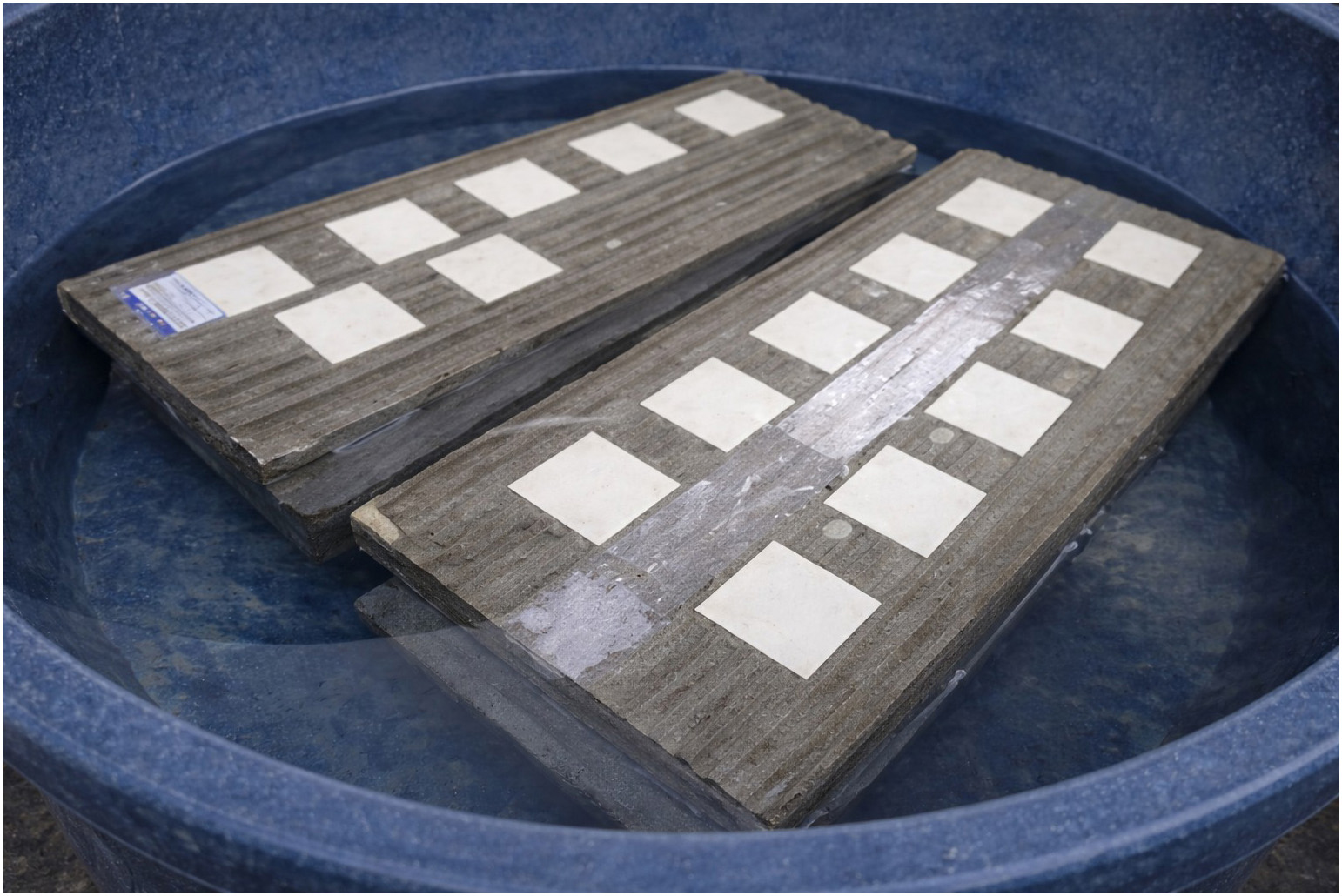
Open time and tensile bond strength tests were carried out in accordance with the criteria established in ABNT NBR 14081-4 [22], ensuring the standardization of procedures and the reliability of the results obtained. Figures 4 and 5 show the mortar with two types of curing: wet curing and air curing, respectively.


2.4. Statistical analysis
All experimental results were analyzed using descriptive and inferential statistical techniques to ensure the reliability and reproducibility of the findings. The data sets obtained for each property—such as consistency index, bulk density, air content, water retention, slip, open time, and tensile bond strength—were composed of triplicate measurements to capture variability within each formulation.
Inferential analysis was performed through one-way analysis of variance (ANOVA), aiming to assess whether the variation in the percentage of ornamental stone waste replacement had a statistically significant effect on each of the evaluated mortar properties. The use of ANOVA is justified given the need to compare multiple independent samples means under the assumption of normal distribution and homogeneity of variances.
When the ANOVA results indicated significant differences among the groups (p < 0.05), Tukey’s Honestly Significant Difference (HSD) post-hoc test was applied to identify which specific pairs of formulations differed from each other. This allowed for a detailed interpretation of the influence of each substitution level.
All statistical analyses were carried out using specialized software (Origin), adopting a 95% confidence level. The coefficient of variation (CV) was also calculated for key mechanical tests to evaluate experimental precision and repeatability.
3. RESULTS AND DISCUSSION
3.1. Caracterization of materials
The granulometric analysis of the natural quartz sand indicated that approximately 67% of the material corresponds to the medium sand fraction, while 15% is classified as fine sand and 18% as coarse sand. This distribution is consistent with typical commercial aggregates used in adhesive mortars and ensures an adequate granular skeleton for mechanical performance.
In contrast, the ornamental stone residue exhibited a significantly finer particle-size distribution. Sedimentation analysis revealed a predominance of the silt fraction (87%), followed by clay (10%) and fine sand (2%). Most particles fall within the 0.002–0.075 mm range, confirming the ultrafine nature of the residue. This granulometric profile supports its behavior as a filler material rather than a structural aggregate component. This granulometric behavior supports the classification of marble and granite sludge residues as materials with characteristics similar to silty clay [23].
It can be observed that the ornamental stone residue has a high silicon dioxide (SiO2) content of 84.45%. Table 2 presents the chemical composition results of the ornamental stone residue.
3.2. Test state assay
Initially, a concrete substrate was executed. Subsequently, the mortar produced with the incorporation of ornamental stone waste was applied. Thereafter, the mortar was spread and leveled using a trowel, and finally, the ceramic tile was bonded. The Figure 6 shows the mortar with the ceramic tile.

The bulk density and entrained air content of the adhesive mortars were determined following the procedures outlined in NBR 13278 [14]. The results for entrained air content are shown in Figure 7.

A progressive reduction in air content was observed with increasing levels of ornamental stone waste, with the AC30 formulation exhibiting the lowest value (21%), compared to 32% in the reference mixture (ACR). This behavior is attributed to the incorporation of a finer particle fraction, which enhances particle packing and reduces internal voids. The corresponding bulk density results are presented in Figure 8.

The observed reduction in air content was inversely proportional to the increase in bulk density, indicating improved compactness of the mortar matrix. This phenomenon reinforces the influence of finer particles from the ornamental stone waste in filling microvoids and enhancing packing density, which can positively impact the mechanical behavior discussed in subsequent sections.
The apparent bulk density results showed a progressive increase with the incorporation of ornamental stone waste, with formulation AC30 standing out by presenting the highest value (1,520 kg/m3) and the lowest incorporated air content. This behavior indicates that the presence of finer particles favors void filling, promoting greater compactness of the mortar matrix [24].
Water retention, evaluated according to NBR 13277 [15], remained relatively stable among the different formulations, with no significant changes observed. However, the lowest values were recorded for the ACR and AC10 mixtures, while the AC20 and AC30 formulations exhibited slightly higher values, indicating greater water retention. This effect is associated with the finer granulometric profile of the ornamental stone waste, which increases the specific surface area and absorption capacity of the particles, favoring moisture retention during the curing process [25].
The microstructural refinement promoted by improved particle packing reduces interstitial voids, increases capillary continuity, and enhances mechanical anchorage between the mortar and the ceramic substrate, also contributing to the higher adhesion strength observed for the AC30 formulation. Similar results were reported by BOTELHO et al. [25], who highlighted that smaller particles exhibit higher specific surface area, resulting in a finer pore system with greater absorption and lower permeability. Likewise, BUYUKSAGIS et al. [26] observed an increase in water retention in tile adhesive mortars with partial replacement of dolomite by stone waste, particularly at replacement levels of 20% and 40%, compared to the reference mortar.
The results obtained from the bulk density test show that there was a gradual increase in bulk density values from the reference mortar (ACR) to the AC10, AC20, and AC30 mixtures. It was observed that AC30 presented the highest bulk density, reaching 1,520 kg/m3; conversely, this mixture exhibited the lowest incorporated air content.
After analyzing the results, it was possible to observe a correlation between the outcomes of both tests conducted on the adhesive mortars studied. The results of the analyzed properties can be attributed to the increase in finer-grained material, which fills previously existing voids, thereby leading to an increase in the bulk density of the mixtures. The results obtained in this study are consistent with those reported by other researchers, such as KHERRAF et al. [24], who evaluated the performance of mortars based on sand and residues from marble, tiles, and concrete blocks. The authors produced mortars using marble waste sand and identified a reduction in the incorporated air content compared to the reference mortar. The reductions reported by the authors ranged from 5% to 29% for natural sand replacement rates of 5% and 20% by marble waste sand, respectively.
According to the authors, this behavior can be explained by the plasticizing capacity of marble, which enhances adhesion between particles and thus reduces the amount of incorporated air present in the mortar Kherraf et al., [24]. The incorporated air content in the mortars ranged between 5% and 20%, respectively. Indeed, the behavior observed in these experimental results indicates that the addition of fine-grained material is capable of filling the voids present in mortars, which correlates with the results of the bulk density test, in which the mortars exhibited an increase in bulk density with increasing percentages of incorporated residue. Therefore, it can be concluded that residue incorporation led to improvements in material properties, particularly those related to the hardened state.
The incorporated air content of mortars is an important property that is directly related to residual sands, replacement rates, and bonding capacity with respect to the amount of fine particles present [24].
Water retention was evaluated in accordance with NBR 13277 [15], and the results are shown in Figure 9. The densification effect observed is directly associated with the finer granulometric profile of the ornamental stone waste, which promotes improved particle packing and a reduction in interstitial voids. This microstructural refinement increases capillary continuity and strengthens the mechanical anchorage between the mortar and the ceramic substrate. The improved packing not only enhances matrix compactness but also plays a critical role in the superior bond strength observed for the AC30 formulation.

Water retention values remained relatively stable across the different mixtures, with slightly higher values recorded for AC20 and AC30. This behavior can be attributed to the increased surface area and absorption capacity associated with the finer particles, which favor moisture retention during the curing process [25].
Slip performance was assessed according to the procedure established in NBR 14081-5 [16], and the results are presented in Figure 10. The sliding test revealed that none of the formulations exceeded the 2 mm limit established by NBR 14081-4 [18]. The AC30 formulation exhibited the best result, with a displacement of 2.11 mm—very close to the normative threshold and equivalent to 77.86% of the displacement measured for the reference mix (ACR). In contrast, ACR showed the highest slip value (2.71 mm). These results indicate that the inclusion of ornamental stone waste significantly reduced the slip behavior of the mortars.

The results obtained indicate that no significant changes occurred in this property. It was observed that the lowest water retention values were obtained for ACR and AC10; however, the water retention values for AC20 and AC30 remained constant, showing only a slight increase when compared to ACR and AC10. Therefore, it can be identified that AC20 and AC30 mortars retain a greater amount of water.
This behavior can be explained by the incorporation of fine particles into the mortar, which consequently increases the specific surface area, causing the mixture to retain a greater amount of water.
BOTELHO et al. [25] emphasize in their research that smaller particles have a higher specific surface area. This results in a finer pore system, leading to greater absorption and lower permeability.
BUYUKSAGIS et al. [26], in their study, evaluated the reuse of ornamental stone processing waste for the production of adhesive mortars, replacing dolomite with stone waste at percentages of 0%, 20%, 30%, 40%, 60%, and 100%. The researchers observed an increase in water retention at substitution levels of 20% and 40% when compared to the reference mortar. The results obtained in this test corroborate the expected behavior of mixtures containing significant proportions of fine residues and show results similar to those reported by [26].
The results obtained from the slip test indicate that none of the mortars tested met the level required by NBR 14081-4 [18], which establishes that slip must be less than or equal to 2 mm. GADO [27] investigated the feasibility of using marble and granite sludge waste for the production of adhesive mortars at substitution levels of 0%, 5%, 10%, 15%, 20%, 25%, and 30%. The results obtained by the author indicate that, with the increase in marble and granite powder in the mixtures, an increase in slip resistance of the studied mortars occurred at substitution levels between 10% and 15%. According to the author, the reduction in slip resistance occurs due to the increase in the amount of mixing water, which negatively affects the flow characteristics of the formulation applied on vertical walls.
3.3. Test in the hardened state
The open time of the adhesive mortars was evaluated in accordance with the procedure defined in NBR 14081-3 [17], and the results are presented in Figure 11. This test assesses the retention of adhesive properties over time after mortar application, simulating practical conditions where the tile may be applied minutes after the mortar has been spread.

The tensile bond strength results indicated that the AC20 and AC30 mixtures outperformed the reference formulation (ACR), confirming the positive influence of ornamental stone waste incorporation particularly in the case of AC30, which exhibited the highest adhesion values. This enhancement is attributed to the improved particle packing, reduced porosity, and better interfacial contact promoted by the finer waste particles. Conversely, the AC10 formulation did not show a statistically significant improvement, suggesting that a minimum substitution threshold may be required to achieve performance gains.
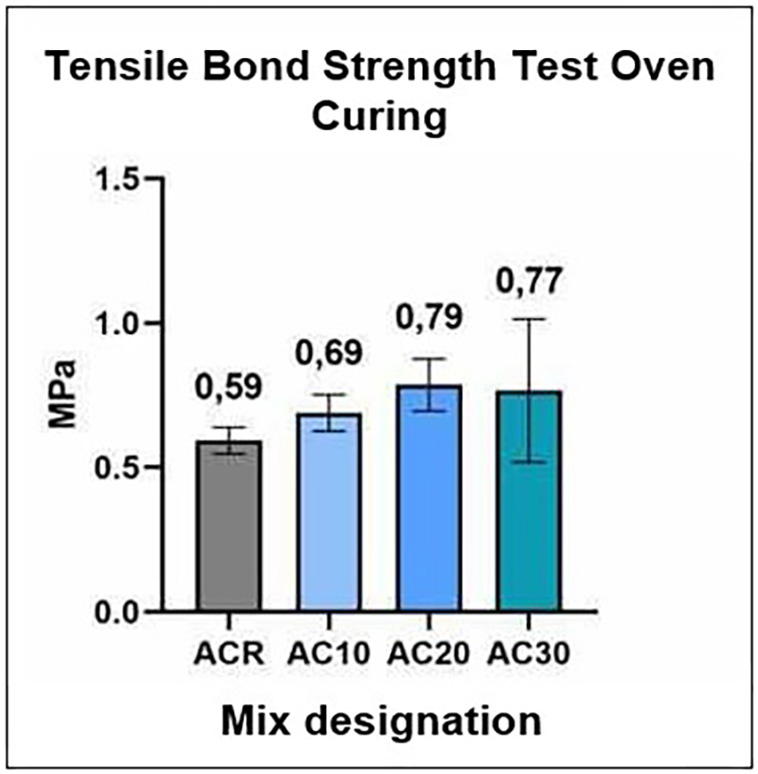
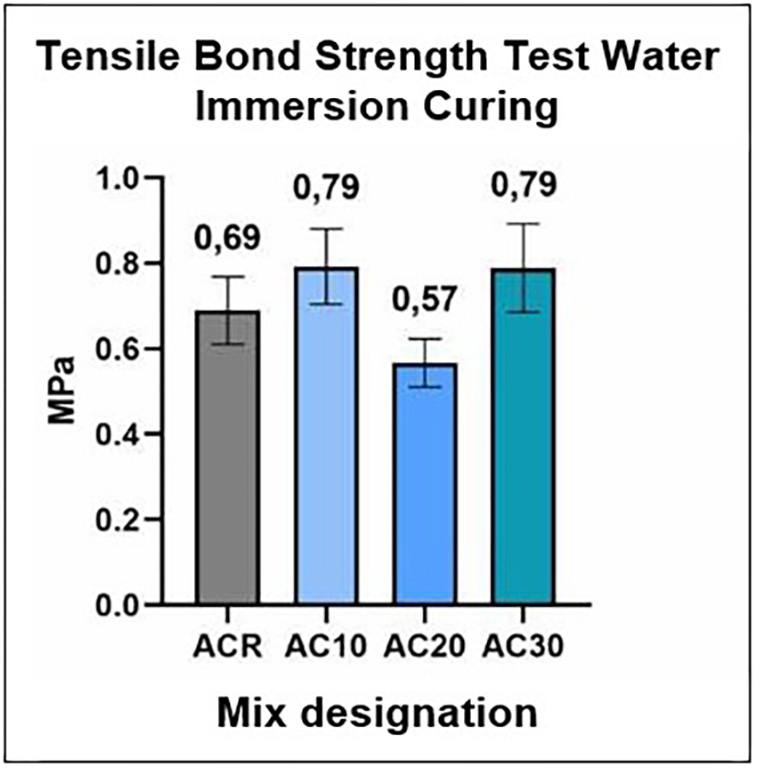
The results obtained under the three curing conditions normal, oven-dried, and water immersion—are presented in Figures 12, 13, and 14, respectively. These tests allow for a comparative assessment of mortar performance under different environmental exposures and highlight the robustness of the AC30 formulation across varying conditions.


According to GADO [27], who evaluated the feasibility of using marble and granite sludge residues in the production of tile adhesives with substitution levels of 0%, 5%, 10%, 15%, 20%, 25%, and 30%, the open time properties were analyzed at 5, 10, 20, and 30 minutes after application. The author observed that tensile bond strength was affected by the incorporation of the residue, with mixtures containing up to 10% replacement meeting the normative requirements. For higher replacement levels, the mortars did not achieve the required strength. This behavior was mainly attributed to an increase in the cement hydration rate, resulting from the greater availability of nucleation sites provided by the incorporated sludge, which is characterized by high specific surface area and setting acceleration effects.
KÜRKLÜ et al. [28] investigated the use of quarry dust in the production of fly ash–based tile adhesives, employing stone powder as a total replacement of the powder fraction, mixed with siliceous sand at a ratio of 1:3. The results of the tensile bond strength tests showed that increasing the stone powder content led to a gradual increase in strength. The authors concluded that the incorporation of fine-grained stone powder not only improved the fresh-state rheology of the mortar but also contributed to the enhancement of mechanical strength as the material incorporation rate increased.
Overall, the results obtained from the tensile bond strength tests used to evaluate open time parameters were satisfactory. These findings indicate that the partial replacement of sand with ornamental stone residues does not compromise the open time of tile adhesives, thereby reinforcing the technical feasibility of this alternative
The results obtained after carrying out the tests indicate that, for all substitution levels evaluated and under the different curing conditions adopted, the mortars met the minimum tensile bond strength value established by the Brazilian standard, corresponding to 0.5 MPa for adhesive mortars.
It is noteworthy that the AC20 and AC30 mortars subjected to normal curing exhibited the highest tensile bond strength values, reaching 0.92 MPa and 0.97 MPa, respectively. As expected, the lowest strength values were observed for the mortars subjected to oven curing at 70 °C for a period of 14 days. Nevertheless, even under these adverse conditions, the incorporation of the residue contributed to strength development, with the AC30 mortar presenting the highest value (0.77 MPa), whereas the reference mortar (ACR) showed a tensile bond strength of 0.59 MPa.
In the tensile bond strength test under oven curing conditions, the results indicated strength gains for the AC10 and AC30 mortars, both reaching 0.79 MPa. In contrast, the AC20 mortar exhibited tensile bond strength values lower than those of the reference mortar, with values of 0.57 MPa and 0.69 MPa, respectively. Overall, it can be observed that, in most cases, the incorporation of ornamental stone residue contributed to an increase in mechanical strength, except for the AC10 mixture subjected to normal curing and the AC20 mixture subjected to immersion curing, in which the strength values were lower than those of the reference mortar.
As discussed, oven curing led to a reduction in the strength of the mortars. However, the AC30 mortar presented the best strength performance when subjected to the three different curing conditions analyzed. This behavior is consistent with the results previously observed in the analyses of fresh-state properties and open time.
These findings are in agreement with previous studies reported in the literature. Jo (2020) evaluated the tensile bond strength of polymer-modified mortars under different curing conditions normal curing, drying curing, immersion curing, and oven curing and found that exposure to high temperatures tends to reduce the tensile bond strength of adhesive mortars. The author also concluded that, regardless of the type or amount of polymer incorporated, normal curing provided the highest tensile strength values.
Similarly, GADO [27] reported that the best tensile bond strength results were obtained under normal curing, followed by immersion curing. The author also identified that the mortar containing 10% marble and granite residue was the only one to fully meet the standard strength requirements. In addition, it was observed that the predominant failure mode in the tested mortars occurred at the interface between the tile and the mortar or within the mortar itself.
Furthermore, BUYUKSAGIS et al. [26], when evaluating the tensile bond strength of adhesive mortars incorporating ornamental stone residues after 28 days under normal curing conditions, reported satisfactory tensile strength results for all incorporation levels, including the reference mortar. The authors also highlighted a significant strength gain for residue incorporation levels ranging from 60% to 100%.
The ANOVA test using the Tukey method revealed statistically significant differences among the mortars, except between ACR and AC30, and between AC10 and AC30. The combinations AC10 and AC20 showed greater significance when compared to ACR, while the performance of AC30 indicates strong potential for use as a substitute in the production of adhesive mortars, as evidenced by the analyzed property.
The one-way ANOVA test showed significant differences among the mortars (p < 0.05). The Tukey post-hoc analysis confirmed that the AC20 and AC10 formulations differed significantly from the ACR mix, with AC30 not showing statistical significance due to its high variability. Despite this, the mean tensile bond strength of AC30 remained higher than that of the reference. Standard deviations were below 0.10 MPa in most cases, indicating acceptable repeatability. The results are consistent with previous studies using recycled or mineral residues in adhesive mortars [24, 25].
The statistical analysis revealed that differences in tensile bond strength were significant at the 95% confidence level (ANOVA, p < 0.05). The Tukey test showed significant pairwise differences between ACR and AC10/AC20 (p < 0.01), while differences involving AC30 were not statistically significant, possibly due to its larger standard deviation (±0.08 MPa). These findings suggest that although AC30 showed the highest mean values, its variability may have masked statistical significance. The coefficient of variation (CV) remained below 12% for all mixes, ensuring the reliability of the experimental protocol.
A clear correlation was observed between the physical and mechanical properties of the mortars. As the proportion of ornamental stone waste increased, entrained air content decreased while bulk density increased. These physical modifications had a direct impact on mechanical performance: denser mortars with lower porosity exhibited higher tensile bond strength. This behavior consists of enhanced particle packing and improved interfacial contact, attributed to the finer granulometry of stone waste. Specifically, the AC30 formulation achieved the highest bulk density (1,520 kg/m3), the lowest air content (21%), and the highest tensile bond strength (0.97 MPa), confirming the positive relationship between microstructural compactness and adhesion performance.
4. CONCLUSION
This study demonstrated that the partial replacement of natural quartz sand with ornamental stone residue significantly influences the physical and mechanical behavior of adhesive mortars. Increasing residue content resulted in reduced entrained air and increased bulk density, confirming the filler effect promoted by the ultrafine particle-size distribution of the residue (87% silt fraction). The improved particle packing contributed directly to enhanced tensile bond strength.
The 30% replacement formulation (AC30) achieved the highest tensile bond strength under normal curing conditions (0.97 MPa), exceeding the minimum requirement of 0.5 MPa established for AC I and AC II mortars. Statistical analysis (ANOVA, p < 0.05) confirmed significant differences among mixtures, reinforcing the reliability of the observed mechanical improvements.
However, none of the evaluated formulations met the normative slip requirement (≤ 2 mm) defined by NBR 14081-4. Although the incorporation of ornamental stone waste progressively reduced slip values, this parameter represents a limitation under the tested formulation conditions. Therefore, while the mechanical feasibility of the residue is supported, adjustments in mixture design—particularly in polymer dosage and water content—are necessary to achieve full normative compliance.
From a mechanistic standpoint, the results establish a clear correlation between granulometric refinement, matrix densification, and interfacial adhesion performance. The ornamental stone residue acts predominantly as a fine siliceous filler, enhancing packing density and microstructural compactness, which translates into improved bond strength.
Within the experimental scope adopted (fixed cement type, constant water-to-cement ratio, and controlled curing conditions), the findings provide robust evidence that ornamental stone residue can be technically incorporated into adhesive mortars, contributing to material efficiency and resource circularity. Further studies focusing on rheological optimization and durability assessment are recommended to consolidate its applicability in industrial-scale formulations.
5. BIBLIOGRAPHY
-
[1] TRAVINCAS, R., TORRES, I., FLORES-COLEN, I., et al., “The influence of the substrate type on the performance of an industrial cement mortar for general use”, Journal of Building Engineering, v. 73, pp. 106784, 2023. doi: https://doi.org/10.1016/j.jobe.2023.106784.
» https://doi.org/10.1016/j.jobe.2023.106784 - [2] ASSOCIAÇÃO BRASILEIRA DE NORMAS TÉCNICAS, NBR 14081-1: Industrialized adhesive mortar for ceramic tile installation – Part 1, Rio de Janeiro, ABNT, 2012. (In Portuguese).
- [3] FIORITO, A.J.S.I., Manual of Mortars and Coatings: studies and execution procedures, 2 ed., São Paulo, PINI, 2010. (In Portuguese).
-
[4] MODLER, L.E.A., MOHAMAD, G., LUBECK, A., “Hardening process of polymeric adhesive mortars: Approach by phase angle analysis from oscillatory rheometry”, Construction & Building Materials, v. 271, pp. 121521, 2021. doi: https://doi.org/10.1016/j.conbuildmat.2020.121521.
» https://doi.org/10.1016/j.conbuildmat.2020.121521 -
[5] INCEOGLU, F., MERMER, N.K., KIRMIZI, V., et al., “Influence of cement with different calcium sulfate phases on cementitious tile adhesive mortars: Microstructure and performance aspects”, International Journal of Adhesion and Adhesives, v. 104, pp. 102744, 2021. doi: https://doi.org/10.1016/j.ijadhadh.2020.102744.
» https://doi.org/10.1016/j.ijadhadh.2020.102744 -
[6] NICOLINI, A., RODRIGUES, A.V., BRAGANÇA, S.R., et al., “Evaluation of Latex Polymeric mortar properties for laying bricks in non-structural masonry”, Journal of Building Engineering, v. 59, pp. 105080, 2022. doi: https://doi.org/10.1016/j.jobe.2022.105080.
» https://doi.org/10.1016/j.jobe.2022.105080 -
[7] RIBEIRO, R.P., SICHIERI, E.P., ALVES, D.T., et al., “Adherence of Brazilian dimension stones by mortar adhesion: influence of temperature”, Journal of Materials Research and Technology, v. 24, pp. 8547–8557, 2023. doi: https://doi.org/10.1016/j.jmrt.2023.05.042.
» https://doi.org/10.1016/j.jmrt.2023.05.042 -
[8] AYDIN, G., KAYA, S., KARAKURT, I., “Utilization of solid-cutting waste of granite as an alternative abrasive in abrasive waterjet cutting of marble”, Journal of Cleaner Production, v. 159, pp. 241–247, 2017. doi: https://doi.org/10.1016/j.jclepro.2017.04.173.
» https://doi.org/10.1016/j.jclepro.2017.04.173 -
[9] SILVA, M.A., PAES JUNIOR, H.R., HOLANDA, J.N.F., “Reuse of ornamental rock-cutting waste in aluminous porcelain”, Journal of Environmental Management, v. 92, n. 3, pp. 936–940, 2011. doi: https://doi.org/10.1016/j.jenvman.2010.10.060. PubMed PMID: 21074931.
» https://doi.org/10.1016/j.jenvman.2010.10.060 -
[10] MEDINA, G., SÁEZ DEL BOSQUE, I.F., FRÍAS, M., et al., “Granite quarry waste as a future eco-efficient supplementary cementitious material (SCM): Scientific and technical considerations”, Journal of Cleaner Production, v. 148, pp. 467-476, 2017. doi: https://doi.org/10.1016/j.jclepro.2017.02.048.
» https://doi.org/10.1016/j.jclepro.2017.02.048 - [11] MONTANI, C., Dossiê Brasil 2019, Brasília, Associação Brasileira da Indústria de Rochas Ornamentais, 2019.
-
[12] BAEZA, F., PAYÁ, J., GALAO, O., et al., “Blending of industrial waste from different sources as partial substitution of Portland cement in pastes and mortars”, Construction & Building Materials, v. 66, pp. 645–653, 2014. doi: https://doi.org/10.1016/j.conbuildmat.2014.05.089.
» https://doi.org/10.1016/j.conbuildmat.2014.05.089 -
[13] RANA, A., KALLA, P., VERMA, H.K., et al., “Recycling of dimensional stone waste in concrete: A review”, Journal of Cleaner Production, v. 135, pp. 312–331, 2016. doi: https://doi.org/10.1016/j.jclepro.2016.06.126.
» https://doi.org/10.1016/j.jclepro.2016.06.126 - [14] ASSOCIAÇÃO BRASILEIRA DE NORMAS TÉCNICAS, NBR 13278: Mortar for laying and coating walls and ceilings – Determination of bulk density and air content, Rio de Janeiro, ABNT, 2005. (In Portuguese).
- [15] ASSOCIAÇÃO BRASILEIRA DE NORMAS TÉCNICAS, NBR 13277: Mortar for laying and coating walls and ceilings – Determination of water retention, Rio de Janeiro, ABNT, 2005. (In Portuguese).
- [16] ASSOCIAÇÃO BRASILEIRA DE NORMAS TÉCNICAS, NBR 14081-5: Industrialized adhesive mortar for ceramic tile installation – Part 5: Determination of slip, Rio de Janeiro, ABNT, 2012. (In Portuguese).
- [17] ASSOCIAÇÃO BRASILEIRA DE NORMAS TÉCNICAS, NBR 14081-3: Industrialized adhesive mortar for ceramic tile installation – Part 3: Determination of open time, Rio de Janeiro, ABNT, 2012. (In Portuguese).
- [18] ASSOCIAÇÃO BRASILEIRA DE NORMAS TÉCNICAS, NBR 14081-4: Industrialized adhesive mortar for ceramic tile installation – Determination of tensile bond strength, Rio de Janeiro, ABNT, 2012. (In Portuguese).
- [19] ASSOCIAÇÃO BRASILEIRA DE NORMAS TÉCNICAS, NBR 13276: Mortar for laying and coating walls and ceilings – Determination of consistency index, Rio de Janeiro, ABNT, 2016. (In Portuguese).
- [20] ASSOCIAÇÃO BRASILEIRA DE NORMAS TÉCNICAS, NBR 17054: Determinação da composição Granulométrica– Método de Ensaio, Rio de Janeiro, ABNT, 2022.
- [21] ASSOCIAÇÃO BRASILEIRA DE NORMAS TÉCNICAS, NBR 14081-1: Argamassa colante industrializada para assentamento de placas cerâmicas, Rio de Janeiro, ABNT, 2012
- [22] ASSOCIAÇÃO BRASILEIRA DE NORMAS TÉCNICAS, NBR 14081-4: Argamassa colante industrializada para assentamento de placas cerâmicas– Determinação a resistência de aderência à tração, Rio de Janeiro, ABNT, 2012.
-
[23] GADO, R.A., “The feasibility of recycling marble & granite sludge in the polymer-modified cementitious mortars Part A: In polymer-modified cementitious adhesive mortar”, Process Safety and Environmental Protection, v. 159, pp. 978–991, 2022. doi: https://doi.org/10.1016/j.psep.2022.01.059.
» https://doi.org/10.1016/j.psep.2022.01.059 -
[24] KHERRAF, L., HEBHOUB, H., ABDELOUAHED, A., et al., “Comparative study on the performance of sand-based mortars from marble, floor tile and cinder block waste”, Journal of Building Engineering, v. 45, pp. 103433, 2022. doi: https://doi.org/10.1016/j.jobe.2021.103433.
» https://doi.org/10.1016/j.jobe.2021.103433 -
[25] BOTELHO, L.C.G., XAVIER, G.C., PAES, A.L.C., et al., “Lime replacement by finely ground clay from the north fluminense region of RJ in mortar for coating walls and ceilings”, Journal of Materials Research and Technology, v. 23, pp. 5105–5114, 2023. doi: https://doi.org/10.1016/j.jmrt.2023.02.058.
» https://doi.org/10.1016/j.jmrt.2023.02.058 -
[26] BUYUKSAGIS, I.S., UYGUNOGLU, T., TATAR, E., “Investigation on the usage of waste marble powder in cement-based adhesive mortar”, Construction & Building Materials, v. 154, pp. 734–742, 2017. doi: https://doi.org/10.1016/j.conbuildmat.2017.08.014.
» https://doi.org/10.1016/j.conbuildmat.2017.08.014 -
[27] GADO, R., “The feasibility of recycling marble & granite sludge in the Polymer modified cementitious mortars Part A: In polymer-modified cementitious adhesive mortar”, Process Safety and Environmental Protection, v. 159, pp. 978–991, 2022. doi: https://doi.org/10.1016/j.psep.2022.01.059.
» https://doi.org/10.1016/j.psep.2022.01.059 -
[28] KÜRKLÜ, G., GORHAN, G., “Investigation of usability of quarry dust waste in fly ash-based geopolymer adhesive mortar production”, Construction & Building Materials, v. 217, pp. 498–506, 2019. doi: https://doi.org/10.1016/j.conbuildmat.2019.05.104.
» https://doi.org/10.1016/j.conbuildmat.2019.05.104