
 Non-destructive evaluation of residual strength and bond performance in recycled coarse aggregate concrete with deformed bars of varying diameters and strengths
ABSTRACT
This study investigates the use of Recycled Coarse Aggregates (RCA) as a partial or full replacement for Natural Aggregates (NA) in structural concrete, addressing the rising Construction and Demolition (C&D) waste in India. Although environmentally beneficial, RCA use in structural applications is limited due to concerns over strength and durability. To assess its feasibility, bond strength between RCA concrete and steel reinforcement was tested using the RILEM pull-out method and simulated in ANSYS Workbench. Non-Destructive Testing (NDT), particularly Ultrasonic Pulse Velocity (UPV), was used to evaluate compressive strength, dynamic elastic modulus, and durability indicators. Results showed that M30 concrete with 25% RCA outperformed conventional concrete in strength. A 2.3% reduction in bond strength was observed with 16 mm bars, while 100% RCA with 20 mm bars showed a 1.25% improvement. In M50 concrete, up to 50% RCA retained adequate strength, with bond performance influenced by bar diameter. The dynamic elastic modulus was 48% higher than the static value. Acid exposure caused visible surface deterioration, indicating possible durability concerns. Overall, RCA can be effectively used in structural concrete with proper design and quality control. The study also emphasizes the relevance of NDT methods in assessing the performance of RCA concrete.
Keywords:
Recycled coarse aggregate; Pull-out test; Dynamic young’s modulus; Ultrasonic pulse velocity; and Durability
1. INTRODUCTION
India’s construction industry, the second-largest in the country, has expanded rapidly in response to urbanisation and economic growth. This development has led to a significant increase in Construction and Demolition (C&D) waste, estimated at nearly 750 million tonnes annually in urban areas [1]. The depletion of natural aggregates and growing environmental concerns have encouraged the adoption of Recycled Coarse Aggregate (RCA) as a sustainable alternative. Although RCA offers environmental advantages, its structural use remains limited due to uncertainties regarding its mechanical performance and long-term durability when compared with Natural Aggregate Concrete (NAC) [2].
One of the key concerns in RCA concrete is the bond behaviour between steel reinforcement and the surrounding concrete, which governs load transfer and overall structural performance [3]. Several parameters, including the gripping pressure from hardened concrete, abrasion and surface interaction, rebar diameter, strength of tension and compression zones, mechanical anchorage at bar ends, and frictional resistance along the interface influence bond strength [4,5,6,7,8]. Additional studies have highlighted the influence of concrete compressive strength, modulus of elasticity, ITZ quality, and aggregate surface morphology on bond performance [9,10,11]. For RCA concrete, the presence of adhered mortar, increased porosity, and a weaker interfacial transition zone further complicate the bond mechanism, as reported by several researchers [8, 12, 13].
Although numerous studies have examined the mechanical properties of RCA concrete, gaps remain in understanding how RCA replacement levels, concrete grade, and reinforcement diameter collectively affect bond behaviour. Furthermore, there is limited utilisation of advanced modelling techniques to simulate the complex steel–concrete interaction in RCA systems. Finite Element Modelling (FEM) offers the capability to analyse stress transfer, debonding, and slip behaviour with greater accuracy, yet only a few studies have applied FEM specifically to RCA concrete. Similarly, the application of non-destructive testing (NDT) methods such as Ultrasonic Pulse Velocity (UPV) to assess the internal quality and durability of RCA concrete, especially under aggressive environments, remains underexplored.
To address these research gaps, this study investigates the mechanical properties, bond strength, and durability of RCA concrete through a combined experimental and numerical approach. Pull-out tests on M30 and M50 concrete with varying RCA contents are supported by FEM simulations to analyses bond–slip behaviour. Additionally, UPV measurements and dynamic modulus evaluation are used to assess internal integrity before and after sulfuric acid exposure. This integrated approach contributes to a more comprehensive understanding of the structural performance of RCA concrete and supports its potential use in sustainable construction.
2. MATERIALS AND METHODS
2.1. Experimental materials and design
In this study, manufactured sand (M-sand) with a fineness modulus of 2.8 was used as the fine aggregate. The coarse aggregate comprised a blend of natural aggregate (NA) and recycled coarse aggregate (RCA), with their physical properties presented in Table 1. Since RCA contains adhered mortar and exhibits significantly higher water absorption than NA, appropriate moisture correction was necessary. In line with IS 10262:2019, the RCA was conditioned to a saturated surface dry (SSD) state, and its measured absorption was used to adjust the mixing water to maintain a constant effective water–cement ratio and prevent water withdrawal from the fresh cement paste. Coarse aggregate replacement was carried out on an absolute-volume basis using the measured specific gravities of NA (2.70) and RCA (2.90), ensuring that the total coarse-aggregate volume per cubic metre remained constant across all mixes, even though the corresponding masses in kg/m3 varied. Ordinary Portland Cement (OPC) of 53 MPa grade served as the binder, and a polycarboxylate ether-based superplasticiser (specific gravity 1.1) was added to improve workability. Concrete mixes were designed according to IS 10262:2019 [14] and IS 456:2019 [15], with proportions provided in Table 2, while the particle size distribution curves for NA and RCA are shown in Figure 1. This experimental program includes the following:
-
Demolition waste replaced in increments of 0%, 25%, 50%, and 100% for M30 and M50 concrete grades, with mixes labeled M1–M4 for M30 and M11–M44 for M50. The performance of these mixes underwent evaluation and comparison with conventional concrete to explore their viability as sustainable alternatives.
-
Mechanical testing employed cubic specimens (100 × 100 × 100 mm) to determine compressive strength (fck) and splitting tensile strength (fsp), while flexural strength was assessed using prismatic specimens.
-
For pull-out tests, 150 × 150 × 150 mm cubic specimens with deformed bars of 20 mm and 16 mm diameters were utilised for M30 and M50.
-
Cylindrical specimens (100 × 200 mm) determined the static elastic modulus (Ec), which was then applied in the theoretical analysis of pull-out behaviour.
-
150 × 150 × 150 mm cubes facilitated the measurement of ultrasonic wave velocity (Vu) through NDT and enabled the determination of the dynamic elastic modulus (Ed) of the specimens, considering pre- and post-exposure to sulfuric acid.

The specimens were moulded and removed from the moulds after 24 hours. They were then cured in a standard curing chamber for 28 days for mechanical and pull-out testing, followed by immersion in sulfuric acid for 90 days for NDT testing.
2.2. Testing program for the mechanical and pull-out properties
2.2.1. Mechanical properties
IS 456:2019 [15], which serves as the Code of Practice for Plain and Reinforced Concrete, outlines methods for determining the static elastic modulus of concrete. Over time, extensive research has led to the development of new formulas that adapt to the evolution of concrete types outlined in Table 3. Different countries and regulatory frameworks offer empirical techniques to estimate the elastic modulus based on compressive strength. The dynamic elastic modulus, according to ASTM C 597 (2014) [16], is determined using the formula:
Where, v-pulse velocity, μ-Poisson’s ratio, and ρ-concrete unit weight.
The splitting tensile strength (fst), cube compressive strength (fck), and flexure strength (fr) were determined following the guidelines provided in IS 516 (Part 5/Sec 1): Hardened Concrete — Methods of Test, 2018 [17] employing a Computerised Universal Testing Machine (UTM) a machine as the loading apparatus.
2.2.2. Pull-out test setup
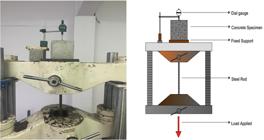
A pull-out test assessed the anchorage capacity of concrete and rebar in accordance with RILEM standards, as shown in Figure 2. The test investigated the influence of rebar diameter, concrete mix proportions, and the interface slip between the rebar and concrete. Specimens incorporating 16 mm and 20 mm rebars, with specifications detailed in Table 4, were cast in 150 mm cross-sectional cube moulds, with the reinforcement positioned 10 mm below the bottom face. A dial gauge measured displacement, and a 1000 mm bar facilitated loading in the Universal Testing Machine (UTM). The test followed the guidelines of IS 2770 (Part 1) [24], with 24 cubes tested for each rebar combination, as illustrated in Figure 3 and Figure 4. The experimental test setup for the pull-out test is displayed in Figure 5.


Using the formula (2), the bond stress (τ) was assessed as the stress created across an analogous surface area.
Where, d – rebar diameter (mm), l – embedment length (mm), and P – load (N).
The maximum bond stress in concrete is predicted using Equation (3), which is applicable to both natural and recycled aggregate concretes. This formula, derived from pull-out test data, was proposed by Siempu and Pancharthi [25] to calculate τmax when RCA is used as the coarse aggregate.
Where, ɸ – diameter of rod, k1–6·32 for NA and 6·38 for RA; k2–0·26 for NA and 0·44 for RA; k3–0·21 for NA and −0·5 for RA.
2.2.3. Numerical calculations
The Numerical calculations were performed using ANSYS Workbench 2022 R1. For the pull-out model, three-dimensional elements were discretised for both concrete and rebar, and these elements were modelled using SpaceClaim, a 3D data store integrated within ANSYS.
The bond stress created in the reinforced concrete was computed using the FE analysis. The model is created using the properties mentioned in Table 5.
In the FEM model, RCA concrete was treated as an equivalent homogeneous material because the adhered mortar and ITZ variability cannot be explicitly represented in ANSYS. The experimentally measured mechanical strengths and elastic modulus were used to reflect mix-specific behaviour, but local heterogeneity and weak ITZ zones are not captured, which may contribute to the differences between numerical and experimental bond values. This modelling assumption is acknowledged as a limitation.
Two methods were employed to determine displacement: the first involved applying a load and measuring the resulting displacement, while the second used displacement to determine the corresponding load, based on experimental data. The first method was selected for this study, where the applied load resulted in measured displacement. These findings provide valuable insights for enhancing sustainable construction using recycled materials and improving the performance of concrete with recycled aggregates.
2.3. Dynamic modulus of elasticity using NDT method
The interfacial bond between aggregates and cement paste is integral to concrete’s efficacy as a structural material, established when the cement paste, composed of water and hydrated cement particles, adheres to the aggregate surfaces, forming a cohesive composite matrix, as noted in the study conducted by LOTHENBACH et al. [26]. Various factors, including aggregate surface morphology, cement paste chemical composition, water-to-cement ratio, curing conditions, and the nature of the aggregates, influence the strength and quality of this bond. A robust bond ensures aggregates are securely integrated within the matrix, facilitating effective load transfer and enhancing the concrete’s structural performance. Conversely, a weakened bond results in vulnerable interfacial transition zones (ITZs) susceptible to microcracking, diminished bond strength, and an overall reduction in structural integrity. These interactions occur across three main sub-systems: the interface zone, the cement paste (comprising cement, water, air bubbles, and chemical additives), and the aggregate, as visualised in Figure 6. Together, these sub-systems synergistically contribute to concrete’s overall strength performance. However, recycled coarse aggregates and recycled aggregate concrete present challenges in this context due to inconsistent data and varying conclusions regarding their performance [27, 28].

A significant issue lies in assessing the quality of the bond between the cement paste and the aggregate, as there is no standardised testing protocol for evaluating this bond, as highlighted by NEDELJKOVIĆ et al. [29]. In light of this, the study investigates the interface between aggregate and cement mortar using pulse velocity techniques, particularly focusing on the reuse of aggregates in concrete. To provide a more reliable approach for evaluating the performance of recycled aggregates, this study compares the dynamic elastic modulus (Ed) using Ultrasonic Pulse Velocity to assess the internal damage and overall integrity of concrete, especially for recycled aggregates.
The dynamic elastic modulus of concrete (Ed) containing RCA is pivotal in evaluating its stiffness and structural integrity under dynamic loads. This modulus quantifies the material’s resistance to deformation under stress, critical for assessing its performance in seismic or impact-prone environments. RCA incorporation typically results in reduced modulus values due to the inherent characteristics of recycled aggregates, such as adhered old mortar, altered particle shape, and increased porosity. Consequently, understanding the dynamic modulus is essential for accurately predicting the material’s behaviour under real-world dynamic conditions, ensuring the structural reliability and longevity of RCA-based concrete in construction. Measured through techniques such as UPV, it assists in assessing the concrete’s resistance to deformation, optimizing mix designs, and ensuring long-term durability. Ed indicates material degradation, such as cracking or diminished bond strength, while UPV identifies localised deficiencies, such as inadequate aggregate-matrix bonding or microcracks, by measuring sound wave velocity [30, 31]. Integrating both methods provides a comprehensive assessment of the concrete’s structural integrity, enabling precise monitoring and promoting sustainable construction practices.
The dynamic elastic modulus damage degree (Ded), derived from changes in Ed, quantifies the overall extent of damage within the concrete specimen. Conversely, the UPV measurements highlight specific regions of weakness [30, 32]. Together, these methods offer a thorough assessment of the material’s condition. This combined approach is particularly valuable in evaluating RA, where variability in the quality of recycled aggregates and bonding strength with the cement paste can lead to performance inconsistencies.
This study presents a novel approach for evaluating the bond strength and performance of recycled aggregate concrete by combining Ed and UPV techniques. This dual method provides a comprehensive assessment of both global and localized damage in RCA, improving understanding of its structural integrity. Additionally, a bond stress equation for both natural and recycled aggregates is introduced, optimizing recycled material use.
For the ultrasonic pulse velocity test, the IS 13311-1992 [33] standard was followed. Concrete cubes measuring 150 × 150 × 150 mm were divided into several zones, with ultrasonic wave velocities measured at five points in each core zone, as displayed in Figure 7. The average UPV for each zone was calculated, and the results were used to assess the integrity of different regions of the concrete. This approach allows for a detailed evaluation of the concrete internal structure, which is crucial for understanding the performance of recycled aggregate concrete and improving its application in construction.

This section outlines the materials, procedures, and methodologies employed in both the experimental and theoretical aspects of the study. It includes a comprehensive explanation of the techniques used for data collection, sample preparation, testing protocols, and analytical methods. In cases where detailed descriptions of experimental setups, fabrication processes, or mathematical formulations are necessary, supplementary information is provided in the appendices.
Additionally, depending on the structure of the paper, a review of relevant literature may be included between the introduction and this section to establish the context and rationale for the chosen approach.
3. RESULTS AND DISCUSSIONS
3.1. Mechanical properties
For the M30 and M50 grades, the mechanical properties of mixes M1–M44 were evaluated as shown in Figure 8, with M2 performing best in M30 and M33 showing superior behaviour in M50. The stress–strain curves (Figure 9 and Figure 10) further support these results: in M30, mixes M1 and M2 exhibit higher peak stresses and steeper initial stiffness, while increased RCA content in M3 and M4 leads to reduced strength and stiffness. In contrast, the M50 mixes show overall higher stiffness and lower peak strain due to the denser matrix characteristic of high-strength concrete, with M22 and M33 achieving the most favourable responses. In the M50 grade, the richer binder content and lower w/c ratio densify the ITZ and refine the pore structure, reducing the impact of RCA’s weaker adhered mortar. Under these conditions, the fine mortar particles attached to RCA act as micro-fillers, improving packing density and stress transfer, which explains why the 50% RCA mix (RCA-M33) outperforms mixes with lower RCA replacement. This behaviour aligns with ITZ densification mechanisms previously reported in our earlier work [34]. Across all mixes, the gradual post-peak softening observed indicates ductile behaviour governed by microcracking rather than sudden brittle failure.


Based on these observations, RCA-M2 in M30 and RCA-M33 in M50 were identified as the optimal mixes because they offered the most balanced overall performance among all replacement levels. RCA-M2 maintained higher compressive strength, superior stiffness in the stress–strain response, and stable post-peak behaviour compared to other M30 mixes. Similarly, RCA-M33 demonstrated the best combination of strength, stiffness, and reduced degradation in the M50 series, where the richer binder matrix effectively compensated for the weaker ITZ associated with RCA. These mixes therefore provided the most favourable mechanical and bond behaviour while preserving durability, making them the most structurally efficient blends within their respective grades.
3.2. Pull-out test
The pull-out test for recycled coarse aggregate (RCA) concrete is conducted to evaluate the bond strength between the embedded steel reinforcement and the surrounding RCA matrix. In this test, a steel rod is inserted into the concrete specimen, and tensile force is gradually applied until failure occurs. This test provides a measure of bond strength, reflecting the interface’s ability to resist separation under tensile loading. Bond slip refers to the relative movement between the steel rod and the adjacent concrete as the applied tensile stress increases. Improved bond strength, along with reduced bond slip, indicates stronger adhesion between the aggregate and cement matrix. This enhanced interfacial behavior contributes to better mechanical performance and improved durability, particularly under cyclic or dynamic loading conditions [35].
3.2.1. Bond-slip relationship
The pullout curve obtained from the RCA pullout test, as illustrated in Figure 11(a) delineates the load-displacement relationship during the extraction of RCA from a cementitious matrix, consisting of three distinct stages: OA (elastic deformation and debonding), AB (complete debonding), and BC (RCA pullout). In stage OA, the load is transferred from the rebar to the matrix, inducing debonding once critical shear stress is attained. Stage AB is characterized by a sharp decline in load, signalling the transition from a combined chemical and frictional debonding mechanism to one dominated by friction-controlled pullout. During stage BC, the pullout process may occur via constant slip, slip hardening, or slip softening, contingent upon the interaction between the rebar and the matrix. Key parameters, including peak debond load (Pa), peak pullout load (Pb), and the various types of slip behaviour (constant slip, slip hardening, or slip softening), are employed to characterize the interfacial properties of the rebar. Energy dissipation, along with peak debond and pullout loads is quantified by calculating the areas under the relevant segments of the curve. Moreover, the bond stress versus slip response of RCA in Figure 11 concrete exhibits a two-stage behaviour, wherein bond stress initially decreases sharply until maximum strength is achieved, followed by a sudden and complete bond failure. As slip progresses, initial adhesion is supplanted by friction, leading to a reduction in bond strength, which reflects the inherently brittle fracture behaviour of concrete. The study also underscores the detrimental influence of RCA on bond strength between the cement paste and aggregates, with the bond stress versus slip response of concrete specimens revealing a characteristic two-stage behaviour. Regardless of RCA content, bond stress increases with slip due to the initial adhesion between the cement paste and aggregate, but as slip advances, the mechanical interlocking between the aggregate and paste deteriorates, and friction predominates, further diminishing bond strength and reinforcing the brittle fracture characteristics of concrete. The findings corroborate studies such as those by WANG et al. [36] and ZHENG and XIAO [37]. Several factors that affect bond strength are discussed here.

3.2.2. Strength of concrete
The bond-slip curve for M30 specimens displayed considerable variability in bond strength, particularly as strength increased, which led to a reduction in displacement and an associated enhancement in bond strength when compared to NA specimens. However, the M30 RCA M2 mix exhibited superior performance relative to other variants, with an average slip ranging between 4 and 6 mm and a peak slip of 7 mm. In contrast, the M50 RCA-M33 specimens demonstrated more stable bond strength, marked by a steeper curve and a peak slip of 4 mm, reflecting an 18% improvement over the M30 specimens.
3.2.3. Presence of RCA
Recycled Concrete Aggregates (RCA) generally result in a reduction in bond strength compared to natural aggregates (NA), primarily due to the lower compressive strength of RCA. Additionally, the irregular shapes and rougher surfaces of recycled aggregates impede the bond between the concrete and steel reinforcement, amplifying the decline in bond performance. As shown in Figure 11(d), concrete with 25%(M2) RCA replacement in the M30 mix performed well relative to other RCA specimens, though bond stress was reduced by up to 12% when compared to NA concrete. Concrete with 50% (M33) RCA replacement in M50 exhibited promising results but experienced an 18% decrease in bond strength when compared to NA concrete.
3.2.4. Diameter of steel rod
HONG et al. [38] highlighted the critical influence of steel reinforcement bar diameter on bond strength. Larger-diameter rods increase the available surface area for bonding, thereby enhancing bond strength. In M30-grade concrete, a 20 mm diameter steel rod augmented bond strength by 12.8% relative to a 16mm rod, whereas in M50-grade concrete, it elevated bond stress by 11.1% in comparison as seen in Table 6. The expanded surface area facilitates a more effective interaction between the steel and concrete; however, this larger area may also lead to a reduction in bond stress, as the applied force is distributed over a broader region.
3.3. Comparison of available code and literature formulas
Numerous studies propose various formulas for calculating the bond strength between natural aggregate (NA) concrete and steel reinforcement. However, no specific code has been established for the bond strength of RCA. Despite this, a comparative analysis can still utilize the existing equations for both RCA and NA concrete.
The equations from different standards, as summarized in Table 7, were utilized to compare the experimental results with the values recommended by codes and other existing research formulas. The comparison reveals that the bond strength measured in the current experimental study is significantly higher than the values proposed by the respective codes, as illustrated in Table 7.
3.4. Finite element analysis
The maximum pull-out strength and rod diameter from previous studies are presented in Table 8. Additionally, the bond strength obtained was used to calculate the final load value. A comparison of selected evaluated values is shown in Table 9.
This study presents a comparison between the experimental bond stress–displacement behavior and the finite element model (FEM) developed in ANSYS, with a focus on the bond performance of concrete made with recycled coarse aggregate (RCA) and natural aggregate (NA). The findings indicate that the FEM simulation for RCA concrete incorporating 20 mm reinforcement closely replicates the experimental outcomes in terms of initial stiffness, peak bond stress, and the displacement corresponding to peak stress, as shown in Figure 11. The enhanced accuracy of the simulation under higher loading conditions is attributed to the use of 20 mm diameter rebar. The FEM results also revealed tearing at the rebar-concrete interface, closely resembling the failure patterns observed in experimental pull-out tests, as illustrated in Figure 12.

(a) 3D image of 20 mm rebar, (b) mesh used in FEA, (c) equivalent stress, (d) Maximum principle stress, (e) Pull out failure in FEA (f) Pull out failure in experimental test both the analytical study and the M30 concrete grade, M50 concrete exhibited higher bond strength than M30, as shown in Figure 11.
Optimal bond strength requires adequate confinement around the reinforcement, which was achieved in this study through the appropriate selection of rebar diameter and embedment length. Experimental observations confirmed the absence of visible fractures or cracks, as the surrounding concrete effectively resisted the shear stresses transferred along the deformed bar surface. Consequently, bond performance was primarily governed by the concrete’s compressive strength and confinement. Since no macro-level cracking or splitting occurred in any pull-out test, a representative failure image is provided in the Figure 12(f) to illustrate the typical behaviour. The circular steel ring and short embedment length limited radial stresses and surface damage, resulting in gradual interfacial debonding and bar slip, with no additional failure surfaces observed.
The ultimate bond stress values for the RCA mixes were obtained from both analytical predictions and experimental results, in conjunction with formulas proposed by previous researchers. Table 9 presents the ratios between the experimental and estimated bond stress values. The analytical predictions tended to exceed the experimental values but aligned well with the findings of ESFAHANI and RANGAN [53] and HARAJLI [10]. Meanwhile, the experimental bond strengths significantly exceeded the values recommended by design codes such as AS 3600-2001 [40] and ACI 408R-03 [18].
4. RESULTS AND ANALYSIS OF UPV AND DYNAMIC MODULUS OF ELASTICITY
This research utilises the Ed and UPV to evaluate internal damage and overall concrete integrity, focusing on recycled coarse aggregate concrete (RCAC). The Ed measures the material stiffness under dynamic loading, with reductions indicating damage such as cracking or bond degradation [42]. Conversely, UPV is a non-destructive testing method that evaluates localised damage by measuring the speed of sound waves that ingress through the concrete. Weakened aggregate-matrix bonding or microcracks typically lead to lower UPV values. By employing these methods, a thorough assessment of both global and localised damage is achieved. This is particularly beneficial for RCA applications, where fluctuations in the quality of recycled aggregates and bond strength can influence the performance of the material damage degree, for both Ed and UPV are quantified using the formulas given in equations (4) and (5), as referred to [54].
Where Ed0 is the initial dynamic elastic modulus before acid exposure, and Edn is the modulus after 90 days of sulfuric acid attacks.
Where Vi0 is the initial ultrasonic velocity, and Vin is the velocity after 90 days of acid attacks.
Additionally, this study investigates the impact of specimen size on concrete damage using 150 × 150 × 150 mm prismatic specimens, divided into 25 sections: peripheral, intermediate, and core regions, Color-coded as blue, grey, and red, as illustrated in Figure 7. Estimated ultrasonic pulse velocities in the peripheral (Vpn), intermediate (Vmn), and core (Vcn) regions illustrate the deterioration of concrete due to H2SO4 exposure. By analyzing the dynamic modulus and UPV, the research enhances the understanding of concrete degradation and structural integrity under acid exposure, providing valuable insights into the durability of concrete in severe exposure conditions Figure 13.

The study investigates the relationship between the Ed and UPV testing for concrete as represented in Figure 7. It is noteworthy that, on average, the dynamic modulus exhibited a 48% increase compared to the static modulus (Ec), with similar trends observed in both NAC and RCAC. Concrete mixes M2 and M11, fabricated with RCA, manifested dynamic elasticity moduli of 57.52 (MPa) and 80.01 (MPa). According to IS 516 (Part 5/Sec 1): 2018 – Hardened concrete, Concrete quality is assessed using UPV values. Mixes M1–M4 are categorised as medium quality, signifying moderate damage in the periphery of the concrete. Alternatively, mixes M11–M44 were classified as high-grade concrete, indicating overall superior quality. The study also highlights that the peripheral region (Figure 13) of the concrete showed greater damage compared to the core and intermediate regions, indicating a higher prevalence of surface cracks and defects as illustrated in Figure 14. A UPV value below 1.5 km/s indicates substandard concrete, with defects like increased porosity, cracks, or reduced density, especially in areas prone to acid attacks. Through the use of ultrasonic wave velocity measurements, the damage levels (Dvi) in various regions are assessed, with Dpn representing the peripheral region, Dcn the core, and Dmn the intermediate region, while Davg denotes the average damage degree, as depicted in Figure 15. The findings reveal that the inclusion of RCA further reduces the UPV, particularly in the M3 and M4 peripheral regions, thus deteriorating the overall quality of the concrete.


(a) Damage degrees for the dynamic elastic modulus, (b) Ed and ultrasonic wave velocity V.
4.1. Relationship between static and dynamic modulus of elasticity and compressive strength of concrete
The relationship between the static and dynamic modulus of elasticity and compressive strength is crucial for understanding concrete’s mechanical behaviour and assessing its performance in structural applications. In both normal and RCA, static compressive strength (fck) and static elastic modulus (Ec) are positively correlated, signifying that with an increase in compressive strength, the static modulus also elevates and is expressed as
In RCA, the relationship between compressive strength (fck) and dynamic elastic modulus (Ed) is weaker due to the lower quality of recycled aggregates, which have higher porosity and weaker properties. Despite this, the overall trend remains valid, with compressive strength and dynamic modulus generally being positively correlated [32]. This relationship is typically expressed as (reduced)
Where k2 and m are empirical constants. In RCA, the reduction in dynamic properties compared to conventional concrete is less pronounced, as dynamic tests are less sensitive to imperfections in the recycled aggregates.
In RCA, static properties are generally lower than in conventional concrete, but dynamic properties are more resilient, with a higher dynamic-to-static ratio. Aggregate quality, curing conditions, and mix design influence these properties. Understanding these relationships is essential for designing RCA for structural applications under static and dynamic loads.
Understanding the relationship between static and dynamic modulus of elasticity and compressive strength is essential for evaluating the structural performance of both conventional and RCA concrete. While RCA concrete generally exhibits lower static and dynamic moduli due to the lower quality of recycled aggregates, the correlation with compressive strength remains notably strong. In particular, the regression analysis for RCA concrete shows a high coefficient of determination (R2 = 0.98) between static modulus and compressive strength, indicating a strong linear relationship and reinforcing the reliability of compressive strength as a predictor of elastic behavior. Similarly, the dynamic modulus also demonstrates a strong correlation with compressive strength, with an R2 value of 0.94, as depicted in Figure 16.

R2 values, such as 0.98 and 0.94, represent the proportion of variance in the dependent variable (elasticity modulus) that can be explained by the independent variable (compressive strength). In this case, an R2 of 0.98 signifies that 98% of the variation in the static modulus of elasticity is attribute to changes in compressive strength, while 94% of the variation in the dynamic modulus is explained by the compressive strength. These high R2 values indicate strong linear relationships, implying that compressive strength is a reliable predictor of both static and dynamic modulus in RCA design.
Practically, these strong correlations suggest that RCA design can be optimized with a high degree of confidence, ensuring value that increases by 52.30% and an Ec value, demonstrating superior performance compared to other RCA concretes. This underscores their appropriateness for structural applications, particularly in the context of both static and dynamic loading conditions. That performance predictions are accurate. This is crucial for structural integrity, durability, and cost-effectiveness in construction applications. Comprehending these interrelationships is pivotal for optimising the design of Recycled Aggregate Concrete. Consequently, the RCA M2 mix, which exhibits a compressive strength of 32.76 MPa and an Ed value that shows a 44% increase relative to its Ec value, and the RCA-M33 mix, possessing a compressive strength of 57.60 MPa along with an Ed.
5. LIMITATIONS IN THE PRESENT STUDY
The FEM model assumes RCA concrete to be an equivalent homogeneous material because adhered mortar, weak ITZ zones, and microstructural variability cannot be explicitly represented in ANSYS. Although experimentally measured strengths and elastic modulus were used to reflect mix-specific behaviour, this simplification does not capture local heterogeneity and contributes to the differences between numerical and experimental bond values. Durability assessment was restricted to 90-day sulfuric acid exposure, which does not represent long-term or multi-environmental degradation; therefore, extended testing under chloride exposure, carbonation, and freeze–thaw cycles is needed. Additionally, only untreated RCA was used, although proven treatments such as mechanical grinding, pre-soaking, accelerated carbonation, chemical modification, and slurry coating have been shown to reduce adhered mortar and improve mechanical and durability performance of RCA, as reported in recent studies [55].
6. CONCLUSION
The outcomes of 8 NA-RCA blended concrete mixes of M30 and M50 grades to assess fresh concrete characteristics, mechanical attributes, and structural bond behaviour by conducting pull-out test have been thoroughly examined. The subsequent deductions are made.
-
RCA concrete exhibited a decrease in strength with an increase in RCA percentage. However, mixes containing 25% RCA in M30 grade concrete and 50% RCA replacement showed an improvement in strength compared to other RCA mixtures, making these two combinations the most optimized.
-
Every model in the pull-out test continuation failed in pull-through mode.
-
Increasing rebar diameter improves bond strength, with 20 mm rods showing up to 9.3% higher bond stress than 16 mm rods, enhancing concrete performance.
-
In M30-grade concrete, a 20 mm diameter steel rod increased bond strength by 12.8% compared to a 16 mm rod, while in M50-grade concrete, the bond stress improved by 11.1%. Larger rebar diameters, particularly 20 mm, consistently enhance bond strength, improving performance.
-
The bond stress values predicted by FEM models in the study were observed to be lower than the experimental bond stress values.
-
The dynamic elastic modulus of concrete is 52% higher than its static counterpart, reflecting the material’s greater resilience and ability to withstand dynamic loading conditions. This discrepancy highlights the enhanced responsiveness of concrete under transient forces as opposed to static stresses.
-
The damage induced by sulfuric acid attacks was notably more severe in the peripheral region of the concrete specimen, as identified through Non-Destructive Testing (NDT) methods. This localized degradation highlights the vulnerability of the outer layers of concrete to chemical exposure.
-
The strong correlation, reflected by the high R2 values of 0.98 and 0.94, suggests that compressive strength can effectively guide the design and performance assessment of RCA. This relationship enhances the accuracy of structural predictions, providing valuable insights for optimising RCA in construction applications and ensuring structural integrity, durability, and cost-effectiveness.
As the construction industry increasingly looks for sustainable alternatives, the use of Recycled Coarse Aggregates (RCA) in concrete presents significant potential. However, further studies are necessary to address the current gaps and enhance the understanding of RCA concrete’s performance.
-
Improve Finite Element Modelling with more detailed material properties and extend durability tests to include long-term exposure to environmental conditions such as chloride and freeze-thaw cycles.
-
Conduct field studies and explore different mix designs and reinforcement types to assess the performance of RCA concrete in practical, large-scale applications.
7. BIBLIOGRAPHY
-
[1] CENTRE FOR SCIENCE AND ENVIRONMENT, “India manages to recover and recycle only about 1 percent of its construction and demolition (C&D) waste”, 2020, available online, https://www.cseindia.org/india-manages-to-recover-and-recycle-only-about-1-per-cent-of-its-construction-and-demolition-10326, accessed Jan. 2026.
» https://www.cseindia.org/india-manages-to-recover-and-recycle-only-about-1-per-cent-of-its-construction-and-demolition-10326 -
[2] JAIN, M.S., “A mini review on generation, handling, and initiatives to tackle construction and demolition waste in India”, Environmental Technology & Innovation, v. 22, pp. 101490, 2021, https://doi.org/10.1016/j.eti.2021.101490.
» https://doi.org/10.1016/j.eti.2021.101490 - [3] SPARTALI, H., BAKTHEER, A., ALSHABAB, S.S., et al., “Behavior of bond between concrete and steel reinforcement under push-in loading considering tip-bearing effect”, Proceedings of the 5th International Conference on Bond in Concrete, Stuttgart, Germany, pp. 872–882, 2022.
-
[4] KHAN, Q.S., AKBAR, H., QAZI, A.U., et al., “Bond stress behavior of a steel reinforcing bar embedded in geopolymer concrete incorporating natural and recycled aggregates”, Infrastructures, v. 9, n. 6, pp. 93, 2024, https://doi.org/10.3390/infrastructures9060093.
» https://doi.org/10.3390/infrastructures9060093 - [5] ZORIYEH, H., YILDIRIM, A.K., ALIGHOLI, H.Z., “Properties of recycled aggregates and their effects on concrete”, International Journal of Engineering Science and Application, v. 7, 2023.
- [6] SINGH, P., “Application of emerging artificial intelligence methods in structural engineering—A review”, International Research Journal of Engineering and Technology, v. 5, n. 11, pp. 841–844, 2018.
-
[7] SINGH, S., SINGH, S.K., MAHGoub, M., et al., “Evaluating recycled concrete aggregate and sand for sustainable construction performance and environmental benefits”, CivilEng, v. 5, n. 2, pp. 461–481, 2024, https://doi.org/10.3390/civileng5020023.
» https://doi.org/10.3390/civileng5020023 -
[8] AMAN, A.M.N., SELVARAJOO, A., CHONG, S., et al., “Comparative life cycle assessment of pervious concrete production in Malaysia with natural and recycled aggregate”, Innovative Infrastructure Solutions, v. 7, n. 3, pp. 211, 2022, https://doi.org/10.1007/s41062-022-00801-3.
» https://doi.org/10.1007/s41062-022-00801-3 -
[9] HASHIM, A.A., ANAEE, R., NASR, M.S., “Improving the mechanical, corrosion resistance, microstructural and environmental performance of recycled aggregate concrete using ceramic waste powder as an alternative to cement”, Ceramics, v. 8, n. 1, pp. 11, 2025, https://doi.org/10.3390/ceramics8010011.
» https://doi.org/10.3390/ceramics8010011 - [10] HARAJLI, M.H., “Development/splice strength of reinforcing bars embedded in plain and fiber reinforced concrete”, ACI Structural Journal, v. 91, n. 5, pp. 511–520, 1994.
- [11] KEMP, E.L., “Bond in reinforced concrete: behavior and design criteria”, ACI Journal Proceedings, v. 83, n. 1, pp. 50–57, 1986.
-
[12] HASHIM, A.A., ANAEE, R., NASR, M.S., “Enhancing the sustainability, mechanical and durability properties of recycled aggregate concrete using calcium-rich waste glass powder”, Sustainable Chemistry and Pharmacy, v. 44, pp. 101985, 2025, https://doi.org/10.1016/j.scp.2025.101985.
» https://doi.org/10.1016/j.scp.2025.101985 -
[13] HOSSAIN, K.M.A., AMETRANO, D., LACHEMI, M., “Bond strength of GFRP bars in ultra-high strength concrete using RILEM beam tests”, Journal of Building Engineering, v. 10, pp. 69–79, 2017, https://doi.org/10.1016/j.jobe.2017.02.005.
» https://doi.org/10.1016/j.jobe.2017.02.005 - [14] BUREAU OF INDIAN STANDARDS, IS 10262: Concrete Mix Proportioning—Guidelines, New Delhi, BIS, 2019.
- [15] BUREAU OF INDIAN STANDARDS, IS 456: Plain and Reinforced Concrete—Code of Practice, New Delhi, BIS, 2019.
- [16] ASTM INTERNATIONAL, ASTM C597-09: Standard Test Method for Pulse Velocity through Concrete, West Conshohocken, ASTM, 2014.
- [17] BUREAU OF INDIAN STANDARDS, IS 516 (Part 5/Sec 1): Hardened Concrete—Methods of Test, New Delhi, BIS, 2018.
- [18] AMERICAN CONCRETE INSTITUTE, ACI 408R-03: Bond and Development of Straight Reinforcing Bars in Tension, Farmington Hills, ACI, 2003.
- [19] EUROPEAN COMMITTEE FOR STANDARDIZATION, EN 1992-1-1 Eurocode 2, Brussels, CEN, 2004.
- [20] BRITISH STANDARDS INSTITUTION, BS 8110-1: Structural Use of Concrete, London, BSI, 1997.
- [21] CSA GROUP, CSA A23.3: Design of Concrete Structures, CSA Group, 2019.
-
[22] DANHA, S., KHALIL, W.I., AL-HASSANI, H.M., “Mechanical properties of reactive powder concrete”, Engineering and Technology Journal, v. 31, pp. 3090–3108, 2013, https://doi.org/10.30684/etj.31.16A.8.
» https://doi.org/10.30684/etj.31.16A.8 -
[23] KADHEM, E., ALI, A., TOBEIA, S., “Experimental comparative study of reactive powder concrete”, MATEC Web of Conferences, v. 162, pp. 04004, 2018, https://doi.org/10.1051/matecconf/201816204004.
» https://doi.org/10.1051/matecconf/201816204004 - [24] BUREAU OF INDIAN STANDARDS, IS 2770 (Part 1): Methods of Testing Bond in Reinforced Concrete, New Delhi, BIS, 1967.
-
[25] SIEMPU, R., PANCHARTHI, R.K., “Bond characteristics of concrete made of recycled aggregates from building demolition waste”, Magazine of Concrete Research, v. 69, n. 13, pp. 665–682, 2017, https://doi.org/10.1680/jmacr.16.00400.
» https://doi.org/10.1680/jmacr.16.00400 -
[26] LOTHENBACH, B., LE SAOUT, G., GALLUCCI, E., et al., “Influence of limestone on the hydration of Portland cements”, Cement and Concrete Research, v. 38, n. 6, pp. 848–860, 2008, https://doi.org/ 10.1016/j.cemconres.2008.01.002.
» https://doi.org/10.1016/j.cemconres.2008.01.002 -
[27] HASHIM, A.A., ANAEE, R., NASR, M.S., et al., “Mechanical properties of recycled aggregate concrete with ceramic waste”, Journal of Materials Research and Technology, v. 36, pp. 627–640, 2025, https://doi.org/10.1016/j.jmrt.2025.03.154.
» https://doi.org/10.1016/j.jmrt.2025.03.154 -
[28] BISWAS, R., RAI, B., SAMUI, P., “Compressive strength prediction of high-strength concrete”, Innovative Infrastructure Solutions, v. 6, n. 2, pp. 65, 2021, https://doi.org/10.1007/s41062-020-00447-z.
» https://doi.org/10.1007/s41062-020-00447-z -
[29] NEDELJKOVIĆ, M., VISSER, J., ŠAVİJA, B., et al., “Use of fine recycled concrete aggregates in concrete: a critical review”, Journal of Building Engineering, v. 38, pp. 102196, 2021, https://doi.org/10.1016/j.jobe.2021.102196.
» https://doi.org/10.1016/j.jobe.2021.102196 -
[30] IVANCHEV, I., “Experimental determination of dynamic modulus of elasticity of concrete using UPV”, IOP Conf. Series: Materials Science and Engineering, v. 1252, pp. 012018, 2022, https://doi.org/10.1088/1757-899X/1252/1/012018.
» https://doi.org/10.1088/1757-899X/1252/1/012018 -
[31] BOLBOREA, B., BAERA, C., DAN, S., et al., “Concrete compressive strength using UPV and elastic moduli”, Materials, v. 14, n. 22, pp. 7018, 2021, https://doi.org/10.3390/ma14227018.
» https://doi.org/10.3390/ma14227018 - [32] NEVILLE, A.M., Properties of Concrete, 5th ed., Pearson, Harlow, UK, 2014.
- [33] BUREAU OF INDIAN STANDARDS, IS 13311-1: Non-destructive Testing of Concrete—Ultrasonic Pulse Velocity, 1992.
-
[34] ARUMUGAM, S., RAVICHANDRAN, P.T., KANNAN RAJKUMAR, P.R., “Comparative life cycle assessment of concrete with natural and recycled aggregates”, Iranian Journal of Science and Technology – Civil Engineering, 2025, https://doi.org/10.1007/s40996-025-01909-z.
» https://doi.org/10.1007/s40996-025-01909-z -
[35] TSOUMANI, A.A., BARKOULA, N.M., MATIKAS, T.E., “Recycled aggregate as structural material”, Waste and Biomass Valorization, v. 6, n. 5, pp. 883–890, 2015, https://doi.org/10.1007/s12649-015-9385-0.
» https://doi.org/10.1007/s12649-015-9385-0 -
[36] WANG, W., WANG, Y., LI, D., et al., “Bond-slip behavior of FRP bars in recycled aggregate concrete”, Construction and Building Materials, v. 302, pp. 124360, 2021, https://doi.org/10.1016/j.conbuildmat.2021.124360.
» https://doi.org/10.1016/j.conbuildmat.2021.124360 -
[37] ZHENG, Y., XIAO, Y., “Bond-slip performance of geopolymer recycled brick aggregate concrete”, Construction and Building Materials, v. 366, pp. 130257, 2023, https://doi.org/10.1016/j.conbuildmat.2022.130257.
» https://doi.org/10.1016/j.conbuildmat.2022.130257 -
[38] HONG, S., YOON, S., KIM, J., et al., “Evaluation of concrete using UPV”, Applied Sciences, v. 10, n. 2, pp. 706, 2020, https://doi.org/10.3390/app10020706.
» https://doi.org/10.3390/app10020706 - [39] AMERICAN CONCRETE INSTITUTE, ACI 318-95: Building Code Requirements for Structural Concrete, Farmington Hills, ACI, 1995.
- [40] STANDARDS AUSTRALIA, AS 3600-2001 Concrete Structures, Sydney, 2001.
- [41] FÉDÉRATION INTERNATIONALE DU BÉTON, Model Code 2010, Lausanne, FIB, 2010.
- [42] AL-JAHDALI, F.A., XU, W.F., YIN, S.S., “Development length for straight deformed bars in high-strength concrete”, ACI SP-149, pp. 507–522, 1994.
- [43] CHAPMAN, R.A., SHAH, S.P., “Early-age bond strength in reinforced concrete”, ACI Materials Journal, v. 84, n. 6, pp. 501–510, 1987.
-
[44] ORANGUN, C.O., JIRSA, J.O., BREEN, J.E., “Reevaluation of test data on development length and splices”, ACI Journal Proceedings, v. 74, n. 3, pp. 114–122, 1977, https://doi.org/10.14359/10993.
» https://doi.org/10.14359/10993 -
[45] YAN, F., LIN, Z., YANG, M., “Bond mechanism and bond strength of GFRP bars”, Composites Part B, v. 98, pp. 56–69, 2016, https://doi.org/10.1016/j.compositesb.2016.04.068.
» https://doi.org/10.1016/j.compositesb.2016.04.068 -
[46] NAIK, D.L., SHARMA, A., CHADA, R.R., et al., “Modified pullout test for interface characterization”, Construction and Building Materials, v. 208, pp. 381–393, 2019, https://doi.org/10.1016/j.conbuildmat.2019.03.021.
» https://doi.org/10.1016/j.conbuildmat.2019.03.021 -
[47] PRINCE, M.J.R., SINGH, B., “Bond behaviour of steel bars in recycled aggregate concrete”, Construction and Building Materials, v. 49, pp. 852–862, 2013, https://doi.org/10.1016/j.conbuildmat.2013.08.031.
» https://doi.org/10.1016/j.conbuildmat.2013.08.031 -
[48] MAREE, A.F., HILAL, R.K., “Bond behaviour of lightweight concrete”, Engineering Structures, v. 58, pp. 1–11, 2014, https://doi.org/10.1016/j.engstruct.2013.10.015.
» https://doi.org/10.1016/j.engstruct.2013.10.015 -
[49] HADI, M.N.S., “Bond of high strength concrete with high strength reinforcing steel”, The Open Civil Engineering Journal, v. 2, pp. 143–147, 2008, https://doi.org/10.2174/1874149500802010143.
» https://doi.org/10.2174/1874149500802010143 - [50] CHOWDHURY, S.H., Early Age Bond Strength of Reinforcing Bars in High Strength Concrete, PhD Thesis, University of Melbourne, Australia, 1997.
-
[51] KIM, J., YI, Y., LEE, J., “Bond strength of deformed bars embedded in concrete with recycled aggregates”, Construction and Building Materials, v. 25, n. 8, pp. 3335–3342, 2011, https://doi.org/10.1016/j.conbuildmat.2011.03.038.
» https://doi.org/10.1016/j.conbuildmat.2011.03.038 -
[52] CHEN, X., LI, X., SONG, X., “Structural design and performance optimization of green concrete”, Applied Sciences, v. 14, n. 8, pp. 3372, 2024, https://doi.org/10.3390/app14083372.
» https://doi.org/10.3390/app14083372 - [53] ESFAHANI, M.R., RANGAN, B.V., “Bond between normal strength and high-strength concrete and reinforcing bars”, ACI Structural Journal, v. 95, n. 2, pp. 215–221, 1998.
-
[54] LI, Z., YANG, H., TANG, Z., et al., “Non-destructive evaluation of residual strength distribution of RCA concrete after freeze–thaw”, Case Studies in Construction Materials, v. 20, e03347, 2024, https://doi.org/10.1016/j.cscm.2024.e03347.
» https://doi.org/10.1016/j.cscm.2024.e03347 -
[55] MANHANPALLY, N., NAGARAJAN, P., SAHA, S., et al., “Influence of treated recycled coarse aggregates on geopolymer concrete”, Scientific Reports, v. 15, pp. 26649, 2025, https://doi.org/10.1038/s41598-025-12105-4.
» https://doi.org/10.1038/s41598-025-12105-4


