 Expanding the scope of the LODECI method for criteria weight determination
ABSTRACT
Determining the weights of criteria is an essential task when ranking alternative options, especially in contexts where multiple criteria are used to characterize each alternative. The LOgarithmic DEcomposition of Criteria Importance (LODECI) is a weighting methodology known for its advantage of analyzing criterion importance based on the intensity of contrast among all alternatives with respect to each criterion. Nevertheless, the existing data normalization technique utilized within the original LODECI method-specifically, the Linear normalization method, becomes infeasible in certain scenarios. This limitation effectively prevents the use of the LODECI method for criteria weight calculation in those specific cases. To broaden the applicability of this methodology, the present research was undertaken to identify suitable alternative data normalization techniques that can be successfully integrated with LODECI, replacing the standard Linear method. Three normalization methods were considered for combination with LODECI: the Vector normalization method, the Weitendorf method, and the Enhanced accuracy method. The investigation into which of these three normalization methods could replace the Linear method for integration with LODECI was carried out using four distinct examples. The results unequivocally verified that the Vector normalization method is a viable substitute for the Linear method when coupled with LODECI.
Keywords:
LODECI weight method; Weight method; MCDM; Data normalization
1. INTRODUCTION
The process of ranking alternative options that must consider multiple, and sometimes conflicting, criteria is inherently complex [1, 2]. Multi-Criteria Decision Making (MCDM) is a widely adopted technique utilized to tackle this complicated task [3,4,5]. Within the execution of MCDM, the assignment of weights to criteria plays a critical role, significantly influencing the final ranking of the alternatives [6,7,8].
A criterion’s weight is a quantitative measure reflecting its relative importance when multiple criteria are concurrently used to characterize the set of alternatives. Criteria weights are generally categorized into subjective, objective, and integrated (combined) weights [9]. Among these, objective weighting methods constitute a substantial proportion of the techniques available [10, 11]. Objective weighting methods calculate criteria weights using distinct mathematical formulations, which consequently leads to considerable variations in the weights produced by different methods [12, 13]. This phenomenon stems from the fact that each method adopts a unique conceptual approach to assess criterion significance. For instance, the Entropy method calculates weights based on an entropy measure, assigning a larger weight to criteria whose values across the alternatives exhibit greater dispersion [14]. The MEREC method employs the effect of removing each criterion on the overall performance of the alternatives to determine weights, where criteria with a greater impact on performance receive a larger weight [15]. The Standard Deviation (SD) weighting method determines weights based on the criteria’s standard deviation, assigning higher importance to criteria with larger standard deviations [16]. While the LOPCOW method also utilizes criteria standard deviation, its underlying algorithm differs from that of the SD method [17]. The CRITIC method calculates weights by considering the inter-criteria correlation coefficient [18]. The PSC method determines criteria weights based on the criterion symmetric point, or the criterion symmetric modulus, to quantify its influence on the weights [19], among others.
This brief overview of existing weighting methods illustrates that each approach calculates criterion weights based on a different philosophy. Currently, there is no consensus or published evidence suggesting that one method is universally superior to the others. Consequently, this study does not focus on analyzing or comparing the characteristics of these established methods. Instead, this research is dedicated to expanding the application scope of a more recently developed objective weighting method: the LOgarithmic DEcomposition of Criteria Importance (LODECI) method. LODECI is recognized for its advantage of analyzing criterion importance based on the intensity of contrast between all alternatives with respect to each individual criterion. This approach effectively mitigates the risk of over-emphasizing a single criterion, thereby generating criterion weights with a desirable level of stability within an appropriate range [20]. Several studies have applied this method to determine criteria weights across various applications, such as commercial insurance selection [21], sustainable tractor selection for green landscapes [22], and green supplier selection [23]. However, the data normalization technique employed in this approach is the Linear method. This method becomes inapplicable if, among the benefit criteria (the-higher-the-better), there is at least one criterion where the maximum value across all alternatives is zero, or if any value equals zero within the cost criteria (the-lower-the-better). This limitation will be further elucidated in Section 2 of this paper. Such scenarios can occur in various contexts. For instance, in manufacturing, the pollutant content—a lower-the-better criterion—may be zero for eco-friendly materials. Similarly, in the banking sector, criteria such as non-performing loan ratios or account maintenance fees can be completely eliminated for preferential entities. In another case involving emerging business models, the profit growth rate—a higher-the-better criterion—may equal zero during the initial stages. Furthermore, in the field of engineering material selection, this situation frequently arises for criteria such as magnetism, water permeability, or corrosion rates in specific material lines. For example, when comparing high-grade polymers or insulating materials, the electrical conductivity value (a lower-the-better criterion) can be zero; likewise, for non-magnetic alloys, the magnetic susceptibility (a higher-the-better criterion) may also reach zero. This practical limitation is the impetus behind the current research, which aims to identify suitable alternative data normalization methods to combine with LODECI, thereby broadening its effective range of application. Identifying a data normalization technique to substitute the Linear normalization method involves more than merely finding a formula capable of functioning where Linear formulas fail; more crucially, it requires a rigorous investigation into whether the alternative normalization method is compatible with the LODECI approach. This is substantiated by numerous studies asserting that while certain normalization methods are well-suited for integration with specific weighting or MCDM methods, others have been identified as inherently incompatible [24,25,26].
The remainder of this paper is structured as follows: Section 2 provides a concise overview of the steps involved in determining criteria weights using the LODECI method. This section also addresses scenarios in which the default Linear normalization method within LODECI is inapplicable and proposes viable alternative normalization techniques. Section 3 presents an investigation into the suitability of these normalization methods when coupled with LODECI through four distinct illustrative examples. These findings are further validated in Section 4 via sensitivity analyses. Finally, the paper concludes with a summary of key findings and suggestions for future research directions.
2. MATERIALS AND METHODS
The standard procedure for determining criteria weights using the LODECI method, as outlined in the foundational work, is as follows [20]:
Construct a decision matrix X with m rows and n columns, where m and n denote the number of alternatives to be ranked and the number of criteria used for assessment, respectively. Let xij represent the value of criterion j for alternative i, where i = 1/m and j = 1/n.
The data is initially normalized using the Linear normalization method, denoted here as N1, based on Equations (1) and (2). In these equations, B and C denote the set of benefit criteria (larger is better) and cost criteria (smaller is better), respectively.
Determine the decomposition value of each element using Equation (3).
Compute the logarithmic analysis value for each criterion using Equation (4).
The final weights for the criteria are calculated using Equation (5).
Observations of formulas (1) and (2) reveal that if at least one criterion in category B (benefit) has a maximum value of zero across all alternatives, or if any value in category C (cost) equals zero, the N1 normalization cannot be utilized. Consequently, the LODECI method becomes inapplicable for determining criteria weights. This necessitates identifying alternative data normalization techniques to replace the N1 method.
In practice, a diverse range of data normalization techniques has been implemented across various MCDM frameworks, including Sum linear, Linear, Stop, Logarithmic, Max linear, Jüttler-Körth, Peldschus, Min linear, Vector, Weitendorf, and Enhanced accuracy normalization [27].
However, these normalization techniques are not universally applicable. Specifically, Sum linear normalization fails if the sum of values for a given criterion across all alternatives is zero. The Linear and Stop methods are inapplicable if the maximum value of a benefit criterion is zero or if any value within the cost criteria equals zero. Logarithmic normalization cannot be used if the decision matrix contains non-positive elements. Furthermore, the Max linear, Jüttler-Körth, and Peldschus methods are invalid if the maximum value of any criterion is zero, while Min linear normalization is restricted if any alternative value equals zero. In contrast, Vector, Weitendorf, and Enhanced accuracy are three normalization techniques capable of functioning under all the aforementioned conditions. Comprehensive details regarding these methods can be found in [27]. For this reason, these three techniques will be employed in this study to investigate their compatibility when integrated with the LODECI method.
Vector Normalization (N2): This method, denoted as N2, normalizes the data using Equations (6) and (7). This normalization technique ensures the preservation of the geometric proportions among alternatives by dividing each value by the Euclidean length of the entire criterion column. Concurrently, it facilitates the alignment of preference directions, transforming lower-the-better criteria into the same orientation as higher-the-better criteria.
Weitendorf Normalization (N3): This technique, designated as N3, normalizes the data using Equations (8) and (9). This normalization technique utilizes boundary values (the maximum and minimum) to establish a scale, facilitating the complete elimination of measurement unit effects while preserving both the ranking order and the relative gaps among the alternatives.
Enhanced Accuracy Normalization (N4): This method, referred to as N4, normalizes the data using Equations (10) and (11). This normalization technique is predicated on the sum of deviations from the ideal values, defined as the maximum for benefit criteria and the minimum for cost criteria, and subsequently employs the complement (1 - ratio) to derive the normalized scores. This approach effectively amplifies the disparities between high-performing and low-performing alternatives, thereby engendering a pronounced differentiation within the decision matrix. Consequently, this enhances the sensitivity of the weighting process to subtle fluctuations in the input data.
The distinction among these three normalization methods N2, N3, and N4 lies in the reference denominator and the mechanism of data distribution within the decision space. While N2 utilizes the Euclidean length to preserve the geometric relationships and relative proportions among alternatives, N3 relies on boundary values to constrain the data precisely within the [0, 1] interval. This latter approach completely eliminates the influence of measurement units and generates maximum contrast between the best- and worst-performing alternatives. In contrast, N4 focuses on the aggregate distances to the ideal value to determine scores, thereby magnifying the disparities of alternatives with superior performance relative to the sample mean, which enhances the computational sensitivity. By investigating the compatibility of integrating N2, N3, and N4 with the LODECI method, this study further bolsters the objectivity of the attained results.
It must be emphasized that while N2, N3, and N4 are technically usable in the cases where N1 fails, their suitability to replace N1 when combined with the LODECI weight calculation algorithm requires specific empirical investigation. The investigation in this research was executed in two distinct phases:
Stage I: Weight Similarity Assessment. This phase involves comparing the criterion weights calculated by LODECI when combined with N1, N2, N3, and N4. The goal is to identify which of the three proposed alternatives (N2, N3, or N4), when integrated with LODECI, yields criterion weights that are most analogous to those obtained using the original LODECI-N1 combination.
Stage II: Ranking Consistency Evaluation. The set of criteria weights identified as promising in Phase I (those similar to LODECI-N1 weights) are then employed to rank the alternatives using various MCDM methods. The consistency in the resulting alternative rankings generated by the LODECI combinations (LODECI-N2, LODECI-N3, or LODECI-N4) compared to the ranking generated by the original LODECI-N1 is the ultimate basis for determining which method can successfully replace N1.
Based on the preceding analysis, the block diagram illustrating the investigation process for evaluating the suitability of the replacement normalization methods with LODECI is presented in Figure 1. The notations LODECI-N1, LODECI-N2, LODECI-N3, and LODECI-N4 represent the combinations of the LODECI method with the normalization techniques N1, N2, N3, and N4, respectively.

As illustrated in Figure 1, the investigation into the suitability of integrating the data normalization methods N2, N3, and N4 with the LODECI approach for determining criteria weights is conducted in two stages. The first stage involves a comparative analysis of the criteria weights derived from the LODECI-N2, LODECI-N3, and LODECI-N4 methods against those obtained via the original LODECI-N1 combination. The weighting data produced by these four methods are subsequently employed in the second stage of the investigation, which utilizes various MCDM methods to rank the alternatives. The rank correlation coefficients between the applied MCDM methods serve as the fundamental basis for evaluating the compatibility or incompatibility of coupling N2, N3, and N4 with the LODECI framework.
3. RESULTS AND DISCUSSION
3.1. Case 1
This case study considers a problem requiring the ranking of seven alternatives, denoted from A1 to A7. Each alternative is characterized by seven criteria, denoted from C1 to C7. For this specific scenario, all seven criteria are assumed to be of the Cost type (smaller is better). This dataset was constructed to generate scenarios characterized by conflicting values, facilitating the verification of the algorithm’s classification performance within a volatile data environment. Evidence indicates that no single alternative exhibits absolute dominance over the others; specifically, while criterion C1 reaches its minimum at A5 and A6, C2 is minimized at A3, C3 at A1, C4 at A2, C5 at A4, C6 at A5, and C7 at A4. Consequently, to establish a definitive ranking of alternatives A1 through A7, it is imperative to determine the criteria weights to serve as a rigorous basis for the evaluation process. The dataset for this case is summarized in Table 1.
Table 2 presents the calculated criterion weights when using the LODECI method combined with the four different normalization techniques: N1, N2, N3, and N4.
An initial inspection of the data in Table 2 suggests a noticeable similarity in the criterion weight values calculated using the LODECI-N1 and LODECI-N2 combinations. This phenomenon can be attributed to the fact that transitioning from linear normalization (N1) to vector normalization (N2) merely alters the scaling factor without distorting the inherent informational characteristics held by each criterion. Consequently, this leads to a convergence of the final weighting values. Similarly, the weights derived from the LODECI-N3 and LODECI-N4 methods also exhibit a degree of mutual resemblance. This can be explained by the fact that both N3 and N4 fall under the category of linear scale transformation. LODECI performs calculations based on logarithmic distances, which remain invariant under changes to the divisor factor. To provide a clearer visual assessment of this observation, the criterion weight distribution is illustrated in the bar chart in Figure 2.

The visualization in Figure 2 confirms that the trend in weight values calculated by LODECI-N1 is closely aligned with the trend observed for LODECI-N2. Conversely, the weights produced by LODECI-N3 and LODECI-N4 show similarity amongst themselves, with the values for individual criteria being very close, implying that the weights are nearly equal in these two methods. Therefore, using LODECI-N1 as the baseline for comparison, LODECI-N2 demonstrates a high degree of concordance in this example. The weight deviations for criteria C1 through C7 when employing the LODECI-N2 method compared to the LODECI-N1 method are 0.0112, 0.0090, 0.0025, 0.0447, 0.0138, 0.0152, and 0.0154, respectively, with a mean deviation of only 0.0161. In contrast, the average deviation between the criteria weights calculated using LODECI-N3 relative to LODECI-N1 is 0.0536, while the discrepancy between LODECI-N4 and LODECI-N1 stands at 0.0560. The subsequent step involves utilizing the criteria weights calculated by LODECI-N1 and LODECI-N2 to rank the alternatives using a variety of different MCDM methods.
Six well-established MCDM methods were employed for this purpose: SAW, MOORA, ROV, PIV, RAM, and COCOSO. The resulting alternative rankings are summarized in Table 3. In this table, the notations N1 and N2 represent the cases where the criteria weights were calculated using the LODECI-N1 and LODECI-N2 methods, respectively. The final row of Table 3 also presents the Spearman Rank Correlation Coefficient between the rankings obtained using LODECI-N1 and LODECI-N2 for each respective MCDM method.
For every MCDM method utilized, the Spearman coefficient between the LODECI-N1 and LODECI-N2 rankings is exceptionally high. Specifically, the coefficient equals 1 when using the SAW and ROV methods, and it equals 0.9643 when using the MOORA, PIV, RAM, and COCOSO methods. These high correlation values strongly indicate that whether LODECI-N1 or LODECI-N2 is used for criteria weighting, the resulting alternative rankings exhibit a very high level of stability and consistency. In other words, for this specific case, the N2 normalization method can be conclusively identified as equivalent to N1 when integrated with the LODECI weight determination method.
3.2. Case 2
This case examines a ranking problem involving five alternatives, denoted from A1 to A5. Each alternative is characterized by six criteria, C1 to C6. In this particular scenario, all six criteria are assumed to be of the Benefit type (larger is better). In this instance, the dataset was also constructed to generate scenarios involving conflicting values, thereby facilitating the verification of the algorithm’s classification performance within a volatile data environment. The evidence demonstrates that no single alternative exhibits absolute dominance over the others. Specifically, while criteria C1, C4, and C5 reach their maximum values at A4, C2 is maximized at A2, C3 at A1, and C6 at A5. The dataset for this case is aggregated in Table 4.
Figure 3 presents the bar chart illustrating the criteria weights calculated using the four combinations: LODECI-N1, LODECI-N2, LODECI-N3, and LODECI-N4.

In this case, a consistent observation is made: the trend of change in criteria weights calculated by LODECI-N1 is highly similar to that calculated by LODECI-N2. Regarding LODECI-N3 and LODECI-N4, the resulting weights also show mutual correspondence and are close to an equal distribution (i.e., criteria weights are nearly uniform). These findings can be interpreted similarly to the explanation provided in Example 1. The mean deviation in the weights of criteria C1 through C6 when employing the LODECI-N2 method, compared to the LODECI-N1 approach, is 0.0153. In contrast, the average weight deviation when using LODECI-N3 relative to LODECI-N1 is 0.0449, while the discrepancy between LODECI-N4 and LODECI-N1 stands at 0.0615. Consequently, these results fundamentally demonstrate that, in this instance, calculating criteria weights via the LODECI-N2 framework is virtually equivalent to the results obtained using the LODECI-N1 method.
To provide a quantitative assessment of this visual observation, Table 5 summarizes the rankings of the alternatives obtained using the six MCDM methods (SAW, MOORA, ROV, PIV, RAM, and COCOSO). The Spearman Rank Correlation Coefficient between the rankings derived from LODECI-N1 and LODECI-N2 is calculated and compiled in the final row of the table for each respective MCDM method.
The results indicate that for every MCDM method utilized, the Spearman coefficient between the LODECI-N1 and LODECI-N2 rankings is consistently equal to 1. This finding definitively confirms that, in this case, the N2 normalization method can completely replace N1 when integrated with the LODECI method for determining criteria weights.
3.3. Case 3
This case study investigates a problem involving the ranking of ten alternatives, denoted from A1 to A10. Each alternative is characterized by eight criteria, C1 to C8. Criteria C1 through C5 are of the Benefit type, while C6 through C8 are of the Cost type. Once again, the dataset in this instance was constructed to generate scenarios involving conflicting values, thereby facilitating the verification of the algorithm’s classification performance within a volatile data environment. The evidence further confirms that no single alternative exhibits absolute dominance over the others. Specifically, alternative A1 possesses the optimal values for criteria C3 and C8 among all candidates; A2 is superior in C5, A4 in C4, A6 in C6, A7 in C7, A8 in C2, and A9 in C1. This distribution implies that determining the criteria weights is an essential prerequisite to provide a rigorous basis for ranking the alternatives from A1 to A10. The data for this mixed-type criteria example is summarized in Table 6.
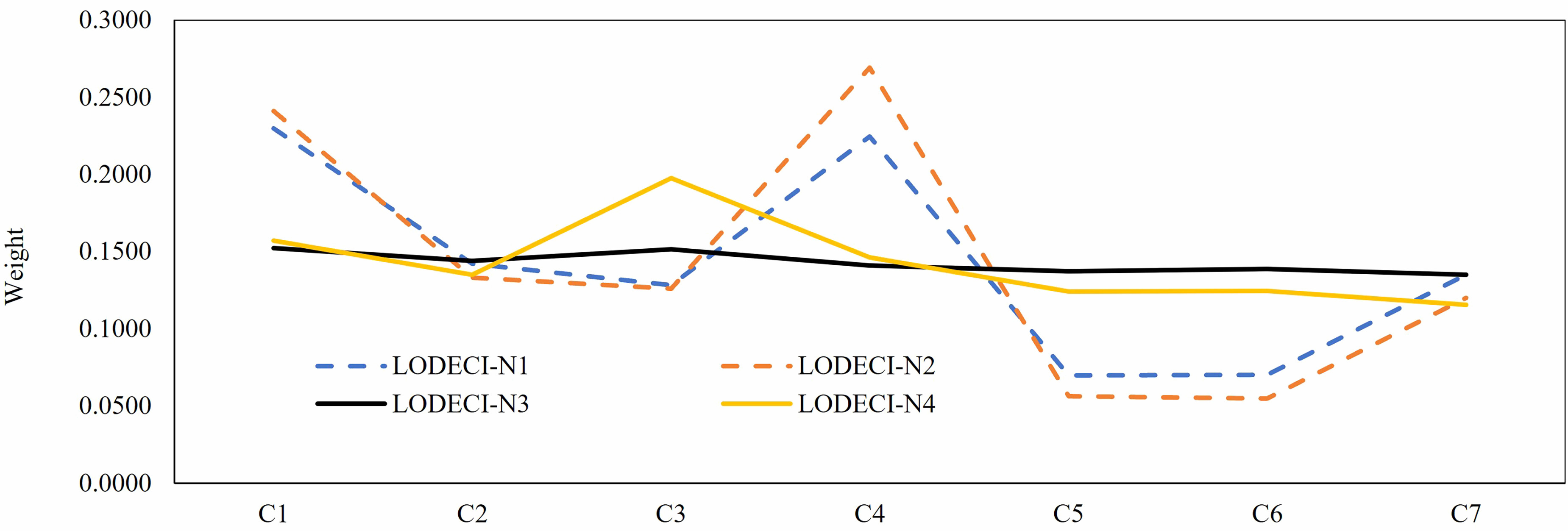
Figure 4 illustrates the criteria weights calculated using the four combinations: LODECI-N1, LODECI- N2, LODECI-N3, and LODECI-N4.

Once again, it is observed that the criterion weights are nearly uniform and exhibit a close similarity when calculated using the LODECI-N3 and LODECI-N4 methods. More significantly, the weights derived from LODECI-N1 and LODECI-N2 also show substantial resemblance.
These findings can be interpreted in a similar manner to the explanation provided in Example 1. The mean weight deviations for the criteria when utilizing the LODECI-N2, LODECI-N3, and LODECI-N4 methods compared to the LODECI-N1 approach are 0.0195, 0.0361, and 0.0318, respectively. Consequently, these results further corroborate that N2 can serve as a viable substitute for N1 in this particular scenario.
To draw precise conclusions, the ranking of alternatives was performed using the various MCDM methods, and the results are compiled in Table 7. As before, the Spearman Rank Correlation Coefficient between the rankings obtained from LODECI-N1 and LODECI-N2 is summarized in the final row of the table.
The results demonstrate a high degree of consistency in the alternative rankings when either LODECI-N1 or LODECI-N2 is used to determine the criteria weights for each MCDM method. The Spearman coefficient between LODECI-N1 and LODECI-N2 is consistently 1 when using SAW and COCOSO; it is 0.9879 when using MOORA, PIV, and RAM; and it is 0.9636 when using ROV. These values provide strong evidence to conclusively affirm that N2 is completely equivalent to N1 when integrated with LODECI for criterion weight determination.
3.4. Case 4
The three preceding cases involved decision matrices constructed from random number sets. The fourth example addresses a real-world case study concerning the selection of ten different dielectric materials for application in Multilayer Ceramic Capacitors (MLCCs). Determining criteria weights through diverse methodologies and ranking alternatives via various Multi-Criteria Decision-Making (MCDM) methods have been extensively applied in the field of material selection across numerous applications. In [28], the AHP method was utilized to compute criteria weights, followed by the application of the TOPSIS method to rank artificial sand suppliers. Similarly, research in [29] assigned predefined weights to criteria before employing the TOPSIS method to rank aluminum-based composite materials. Furthermore, the VIKOR, TOPSIS, and PROMETHEE methods have been deployed to rank alternatives in various contexts, including materials for cryogenic storage tanks, high-speed naval vessel hulls, lightweight freight car sidewalls, high-temperature environments, and flywheels; in these cases, criteria weights were determined based on the subjective preferences of decision-makers [30]. The Entropy method was adopted for weight calculation, while five distinct methods COPRAS, VIKOR, ELECTRE I, ARAS, and MOORA were implemented to rank materials for light SUV brake discs [31]. It is also noteworthy that recent research has identified MCDM as an increasingly prevalent approach for resolving the complex trade-offs inherent in material selection [32]. Consequently, in this example, calculating the weights for dielectric material criteria in capacitor applications not only reinforces the assertion that N2 is a perfectly suitable substitute for N1 when integrated with the LODECI method but also aligns with contemporary research trends regarding material ranking using multifaceted methodologies. An ideal dielectric material for MLCCs must simultaneously meet several crucial criteria: possessing a high dielectric constant, low dielectric loss, and a wide, stable operating temperature range. These factors determine the capacitor’s energy storage capacity, efficiency, and reliability under harsh environmental conditions. The ten dielectric materials considered are labeled as: BT-NBT-BMZ-BFN, KNN-14SZ, NB51T-20CZ, NBT-NN-BT-CZ, BT–BMT–NN, BT-BZY, NBT-10BA-30NN, 0.2La–0.75BT–0.25BMT, 0.5BT–0.25BMT–0.25NN, and KNN–0.175BLN. Each alternative is characterized by five criteria, denoted C1 through C5. Among these, C1, C3, and C5 are Benefit criteria (larger is better), while C2 and C4 are Cost criteria (smaller is better). The data for this example is compiled in Table 8. Based on the data presented in this table, it is observed that no single alternative possesses optimal values across all five criteria simultaneously. Specifically, KNN-14SZ exhibits the maximum value for C1 among the alternatives, while BT–BMT–NN records the highest value for C5. Furthermore, NBT-10BA-30NN demonstrates the minimum values for both C2 and C4, alongside the maximum value for C3. This lack of a clear dominant alternative necessitates the determination of weights for criteria C1 through C5 to provide a robust foundation for the subsequent ranking of these alternatives.
Figure 5 shows the bar chart illustrating the criteria weights calculated using the four methods: LODECI- N1, LODECI-N2, LODECI-N3, and LODECI-N4.

The results again show that the criteria weights are nearly identical and similar when using LODECI-N3 and LODECI-N4. Conversely, the weights calculated by LODECI-N1 and LODECI-N2 demonstrate a high degree of quantitative similarity. Once again, these findings can be interpreted in a similar fashion to the explanation provided in Example 1. In this instance, the mean weight deviations for the criteria calculated using the LODECI-N2, LODECI-N3, and LODECI-N4 methods relative to the LODECI-N1 approach are 0.0723, 0.1529, and 0.1411, respectively. This further demonstrates that N2 can effectively serve as a substitute for N1 in this particular case. Qualitatively, this suggests N2 can replace N1 in this practical scenario. To reach a precise conclusion, the ranking of alternatives using the different MCDM methods was performed, with results summarized in Table 9. The Spearman Rank Correlation Coefficient between LODECI-N1 and LODECI-N2 rankings is included in the final row.
For every MCDM method utilized, the alternative rankings demonstrate high consistency when either LODECI-N1 or LODECI-N2 is used for weight determination. The minimum value of the Spearman coefficient between LODECI-N1 and LODECI-N2 is 0.8788, which occurred when the ROV method was used for ranking. All calculated values strongly support the conclusion that using LODECI-N2 to determine criteria weights yields equivalent effectiveness to using LODECI-N1. Thus, in this real-world example, N2 is definitively confirmed as suitable to replace N1 for combination with LODECI.
Significant differences were present across the four conducted examples: Case 1, 7 alternatives, 7 Cost criteria. Case 2, 5 alternatives, 6 Benefit criteria. Case 3, 10 alternatives, a mix of 5 Benefit and 3 Cost criteria. Case 4, 10 dielectric materials, a real-world problem with a mix of 3 Benefit and 2 Cost criteria. Despite these wide variations in the type and number of alternatives and criteria across all cases, every single instance confirmed that the N2 (Vector) normalization method is entirely suitable to replace N1 (Linear normalization) when combined with the LODECI method for determining criteria weights. This finding is of paramount importance as it significantly expands the scope of application of the LODECI method in situations where its native N1 normalization method is rendered unusable. To further consolidate this assertion across various scenarios, a sensitivity analysis is presented in the subsequent section of this paper. Naturally, this analysis is confined to two specific methods, LODECI-N1 and LODECI-N2.
4. SENSITIVITY ANALYSIS
Sensitivity analysis requires the generation of diverse scenarios, which can be achieved by modifying criteria weights, varying the number of alternatives, or adjusting the quantity of evaluation criteria, among other factors [33]. In this study, scenarios were constructed by randomly removing one criterion from the evaluation list in each example. Specifically, C7 was excluded in Example 1, C1 in Example 2, C4 in Example 3, and C2 in Example 4. The calculation of criteria weights using both LODECI-N1 and LODECI-N2, as well as the ranking of alternatives via various MCDM methods, followed the same procedure detailed in Section 3.
Tables 10 and 11 summarize the criteria weights calculated by the two methods and the resulting rankings across different MCDM approaches for Example 1 after the removal of C7. Similarly, Tables 12 and 13, Tables 14 and 15, and Tables 16 and 17 present the corresponding weight distributions and rankings for Examples 2, 3, and 4, following the exclusion of C1, C4, and C2, respectively.
Data from Tables 10, 12, 14, and 16 reveal that the mean deviations between the criteria weights derived from LODECI-N2 and LODECI-N1 are consistently negligible, recorded at 0.0181, 0.0193, 0.0226, and 0.0209 for Examples 1, 2, 3, and 4, respectively. This reinforces the finding that the weights produced by LODECI-N2 closely align with those from LODECI-N1. In other words, N2 is confirmed to be highly compatible with the LODECI framework.
Furthermore, the Spearman correlation coefficients between LODECI-N1 and LODECI-N2 rankings across all applied MCDM methods, as shown in Tables 11, 13, 15, and 17, are remarkably high. The average Spearman coefficients for Examples 1, 2, 3, and 4 are 0.9762, 0.9967, 0.9779, and 0.9933, respectively. These substantial values provide a robust basis to reaffirm that N2 maintains equivalent effectiveness to N1 when integrated with the LODECI method for criteria weighting.
In summary, the empirical results obtained in Sections 3 and 4 lead to the conclusion that N2 is a suitable normalization technique for integration with the LODECI method in criteria weighting processes.
5. CONCLUSION
The LODECI (LOgarithmic DEcomposition of Criteria Importance) method determines criteria weights by analyzing their importance based on the contrast intensity among all alternatives across every criterion. A key advantage of this method is its ability to mitigate the over-emphasis on any single criterion, resulting in criteria weights that possess a suitable degree of stability.
However, the native Linear normalization (N1) technique embedded within the original LODECI method can become unusable under certain data conditions. The findings of this study conclusively demonstrate that the Vector normalization (N2) method can be effectively adopted as a direct replacement for the Linear normalization technique. This discovery significantly expands the scope of application of the LODECI method beyond its original formulation.
Both the original LODECI method and its expanded version which utilizes N2 as a substitute for N1 for data normalization are fundamentally objective methods for criteria weighting. This inherently means they do not account for the decision-maker’s subjective opinions regarding the relative importance of the criteria. For future research, combining either the original or the expanded LODECI method with subjective weighting methods to create integrated weighting techniques would be a valuable endeavor. Such integration would provide a more balanced approach to criteria weighting, encompassing both subjective and objective factors.
It is also noteworthy that in the N2 normalization method, the denominator involves squared terms (refer to formulas (6) and (7)). Consequently, should an outlier an alternative with an exceptionally large value be present, the denominator will be significantly inflated. This causes the normalized values of the remaining alternatives to become extremely small and nearly indistinguishable. Such a phenomenon flattens the dataset, making it difficult for the LODECI method to determine accurate weights as the preference levels are effectively neutralized. Addressing this inherent limitation of the N2 method represents a critical research direction that warrants investigation in the near future.
6. BIBLIOGRAPHY
-
[1] DO, D.T., DUDIĆ, B., NGUYEN, N.T., et al., “Data normalization for root assessment methodology”, International Journal of Industrial Engineering and Management, v. 15, n. 2, pp. 156–168, 2024. doi: https://doi.org/10.24867/IJIEM-2024-2-354.
» https://doi.org/10.24867/IJIEM-2024-2-354 -
[2] DO, D.T., “Development of data normalization methods for multi-criteria decision making: applying for MARCOS method”, Manufacturing Review, v. 9, n. 22, pp. 1–15, 2022. doi: https://doi.org/10.1051/mfreview/2022019.
» https://doi.org/10.1051/mfreview/2022019 -
[3] ALTINTAS, F.F., “A new approach for the measurement of criterion weights in the scope of multi-criteria decision making: spearman Rank Correlation-based Expanded CRITIC Method (SRCBECM)”, Journal of Statistics & Applied Sciences, n. 10, pp. 10–34, 2024. doi: https://doi.org/10.52693/jsas.1495843.
» https://doi.org/10.52693/jsas.1495843 -
[4] MANEENGAM, A., “Multi-objective optimization of the multimodal routing problem using the adaptive ε-constraint method and modified TOPSIS with the D-CRITIC Method”, Sustainability (Basel), v. 15, n. 15, pp. 12066, 2023. doi: https://doi.org/10.3390/su151512066.
» https://doi.org/10.3390/su151512066 -
[5] ZAVADSKAS, E.K., ANTUCHEVICIENE, J., CHATTERJEE, P., “Multiple-Criteria Decision-Making (MCDM) techniques for business processes information management”, Information (Basel), v. 10, n. 4, 2019. doi: https://doi.org/10.3390/info10010004.
» https://doi.org/10.3390/info10010004 -
[6] DO, D.T., NAZLI, E., TRAN, V.D., et al., “A comparative evaluation of data normalization techniques using different metrics: practical application to a MCDM method”, Manufacturing Review, v. 12, no. 19, pp. 1–14, 2025. doi: https://doi.org/10.1051/mfreview/2025013.
» https://doi.org/10.1051/mfreview/2025013 -
[7] NGUYEN, T.D.L., NGUYEN, H.S., DANG, X.T., “Evaluating the impact of weighting methods on the stability of scores for alternatives in multi-criteria decision-making problems”, Engineering, Technology & Applied Science Research, v. 15, n. 1, pp. 19998–20004, 2025. doi: https://doi.org/10.48084/etasr.9518.
» https://doi.org/10.48084/etasr.9518 -
[8] TRAN, V.D., DUONG, V.D., NGUYEN, C.B., et al., “Integration of objective weighting methods for criteria and MCDM methods: application in material selection”, EUREKA: Physics and Engineering, v. 2, pp. 131–148, 2024. doi: https://doi.org/10.21303/2461-4262.2024.003171.
» https://doi.org/10.21303/2461-4262.2024.003171 -
[9] GOPISETTY, Y.B., SAMA, H.R., “Skewness impact through distributional evaluation (SITDE) method: a new method in multi-criteria decision-making”, Journal of the Operational Research Society, v. 76, n. 6, pp. 1204–1224, 2024. doi: https://doi.org/10.1080/01605682.2024.2416910.
» https://doi.org/10.1080/01605682.2024.2416910 -
[10] ALTINTAŞ, F.F., “A novel approach to measuring criterion weights in multiple Criteria Decision Making: Cubic Effect-Based Measurement (CEBM)”, Journal of Quantitative Sciences, v. 5, n. 2, pp. 151–195, 2023. doi: https://doi.org/10.51541/nicel.1349382.
» https://doi.org/10.51541/nicel.1349382 -
[11] HU, Q., LIU, Y., HU, C., et al., “Fuzzy multi-attribute group decision-making method based on weight optimization models”, Symmetry, v. 17, n. 8, pp. 1305, 2025. doi: https://doi.org/10.3390/sym17081305.
» https://doi.org/10.3390/sym17081305 -
[12] DO, D.T., “Assessing the impact of criterion weights on the ranking of the top ten universities in Vietnam”, Engineering, Technology & Applied Science Research, v. 14, n. 4, pp. 14899–14903, 2024. doi: https://doi.org/10.48084/etasr.7607.
» https://doi.org/10.48084/etasr.7607 -
[13] NABILA, W.R, ZAHEDI, “A study comparative of PSI, PSI-TOPSIS, and PSI-MABAC methods in analyzing the financial performance of state-owned enterprises companies listed on the INDONESIA stock exchange”, Yugoslav Journal of Operations Research, v. 35, n. 2, pp. 313–330. doi: https://doi.org/10.2298/YJOR240115017W.
» https://doi.org/10.2298/YJOR240115017W -
[14] KATOCH, S., CHAUHAN, S.S., KUMAR, V., “A review on genetic algorithm: past, present, and future”, Multimedia Tools and Applications, v. 80, n. 5, pp. 8091–8126, 2021. doi: https://doi.org/10.1007/s11042-020-10139-6. PMid:33162782.
» https://doi.org/10.1007/s11042-020-10139-6 -
[15] GHORABAEE, K.M., AMIRI, M., ZAVADSKAS, E.K., et al., “Determination of objective weights using a new method based on the Removal Effects of Criteria (MEREC)”, Symmetry, v. 13, n. 4, pp. 525, 2021. doi: https://doi.org/10.3390/sym13040525.
» https://doi.org/10.3390/sym13040525 -
[16] LEE, D.K., IN, J., LEE, S., “Standard deviation and standard error of the mean”, Korean Journal of Anesthesiology, v. 68, n. 3, pp. 220–223, 2015. doi: https://doi.org/10.4097/kjae.2015.68.3.220. PMid:26045923.
» https://doi.org/10.4097/kjae.2015.68.3.220 -
[17] ECER, F., PAMUCAR, D., “A novel LOPCOW-DOBI multi-criteria sustainability performance assessment methodology: an application in developing country banking sector”, Omega, v. 112, pp. 102690, 2022. doi: https://doi.org/10.1016/j.omega.2022.102690.
» https://doi.org/10.1016/j.omega.2022.102690 -
[18] ADAL, E.A., ISIK, A.T., “Critic and maut methods for the contract manufacturer selection problem”, European Journal of Multidisciplinary Studies, v. 2, n. 5, pp. 88–96, 2017. doi: https://doi.org/10.26417/ejms.v5i1.p93-101.
» https://doi.org/10.26417/ejms.v5i1.p93-101 -
[19] GLIGORIĆ , Z., GLIGORIĆ, M., MILJANOVIĆ, I., et al., “Assessing Criteria Weights by the Symmetry Point of Criterion (Novel SPC Method)–application in the efficiency evaluation of the mineral deposit multi-criteria partitioning algorithm”, Computer Modeling in Engineering & Sciences, v. 136, n. 1, pp. 955–979, 2023. doi: https://doi.org/10.32604/cmes.2023.025021.
» https://doi.org/10.32604/cmes.2023.025021 -
[20] PALA, O., “Assessment of the social progress on European Union by logarithmic decomposition of criteria importance”, Expert Systems with Applications, v. 238, n. Pt B, pp. 121846, 2024. doi: https://doi.org/10.1016/j.eswa.2023.121846.
» https://doi.org/10.1016/j.eswa.2023.121846 -
[21] YALÇIN, G.C., KARA, K., SENAPATI, T., “A hybrid spherical fuzzy logarithmic decomposition of criteria importance and alternative ranking technique based on Adaptive Standardized Intervals model with application”, Decision Analytics Journal, v. 11, pp. 100441, 2024. doi: https://doi.org/10.1016/j.dajour.2024.100441.
» https://doi.org/10.1016/j.dajour.2024.100441 -
[22] YALÇIN, G.C., “Development of a fuzzy-based decision support system for sustainable tractor selection in green ports”, Facta Universitatis: Mechanical Engineering, v. 23, n. 3, pp. 579–604, 2025. doi: https://doi.org/10.22190/FUME250610029Y.
» https://doi.org/10.22190/FUME250610029Y -
[23] ULUTAŞ, A., TOPAL, A., YÜRÜYEN, A.A., et al., “An innovative fuzzy multi-criteria decision-making approach for solving green supplier selection”, Journal of Intelligent & Fuzzy Systems, pp. 18758967251381582, 2025. doi: https://doi.org/10.1177/18758967251381582.
» https://doi.org/10.1177/18758967251381582 -
[24] HA, L.D., “Selection of suitable data normalization method to combine with the CRADIS method for making multi-criteria decision”, Applied Engineering Letters, v. 8, n. 1, pp. 24–35, 2023. doi: https://doi.org/10.18485/aeletters.2023.8.1.4.
» https://doi.org/10.18485/aeletters.2023.8.1.4 -
[25] BAYDAŞ, M., EREN, T., İYIBILDIREN, M., “Normalization technique selection for MCDM methods: a flexible and conjunctural solution that can adapt to changes in financial data types”, Necmettin Erbakan Üniversitesi Siyasal Bilgiler Fakültesi Dergisi, v. 5, pp. 148–164, 2023. doi: https://doi.org/10.51124/jneusbf.2023.54.
» https://doi.org/10.51124/jneusbf.2023.54 -
[26] AYTEKIN, A., “Comparative analysis of the normalization techniques in the context of MCDM problems”, Decision Making: Applications in Management and Engineering, v. 4, n. 2, pp. 1–25, 2021. doi: https://doi.org/10.31181/dmame210402001a.
» https://doi.org/10.31181/dmame210402001a -
[27] DO, D.T., TRAN, V.D., DUONG, V.D., et al., “Investigation of the appropriate data normalization method for combination with preference selection index method in MCDM”, Operational Research in Engineering Sciences: Theory and Applications, v. 6, n. 1, pp. 44–64, 2023. doi: https://doi.org/10.31181/oresta101122091d.
» https://doi.org/10.31181/oresta101122091d -
[28] SEKAR, D., SUBBAIYAN, A., VIJAY, D., et al., “Optimizing M-Sand material supplier selection in construction: a fuzzy multi-criteria decision-making approach”, Matéria (Rio de Janeiro), v. 29, n. 4, pp. 202, 2024. doi: https://doi.org/10.1590/1517-7076-rmat-2024-0488.
» https://doi.org/10.1590/1517-7076-rmat-2024-0488 -
[29] KANMANI, G., UPADHYAY, V.V., KANNAN, S., et al., “Enhancing hardness and wear behaviour of AA6061 reinforced with zirconium nitride through TOPSIS approach”, Matéria (Rio de Janeiro), v. 30, pp. e20240803, 2025. doi: https://doi.org/10.1590/1517-7076-rmat-2024-0803.
» https://doi.org/10.1590/1517-7076-rmat-2024-0803 -
[30] CHAKRABORTYA, S., CHATTERJEE, P., “Selection of materials using multi-criteria decision-making methods with minimum data”, Decision Science Letters, v. 2, pp. 135–148, 2013. doi: https://doi.org/10.5267/j.dsl.2013.03.005.
» https://doi.org/10.5267/j.dsl.2013.03.005 -
[31] MARTÍNEZ-GÓMEZ, J., NICOLALDE, J.F., “Brake disc material selection based on MCDM and simulation”, Processes (Basel, Switzerland), v. 13, n. 5, pp. 1287, 2025. doi: https://doi.org/10.3390/pr13051287.
» https://doi.org/10.3390/pr13051287 -
[32] SAHOO, S.K., CHOUDHURY, B.B., DHAL, P.R., “A bibliometric analysis of material selection using MCDM methods: trends and insights”, Spectrum of Mechanical Engineering and Operational Research, v. 1, n. 1, pp. 189–205, 2. doi: https://doi.org/10.31181/smeor11202417.
» https://doi.org/10.31181/smeor11202417 -
[33] BOZANIC, D., MILIC, A., TESIC, D., et al., “D numbers–FUCOM–fuzzy RAFSI model for selecting the group of construction machines for enabling mobility”, Facta Universitatis. Series: Mechanical Engineering, v. 19, n. 3, pp. 447–471, 2021. doi: https://doi.org/10.22190/FUME210318047B.
» https://doi.org/10.22190/FUME210318047B