 Study on preparation of dispersed co-polymer micro-particle gels for deep profile control in bohai bay offshore oilfield
ABSTRACT
To achieve effective in-depth control of injection water for the heterogeneous reservoir of offshore oilfields, a new profile control agent is developed. The co-polymer is prepared by using the cross-linking method with AM and the cross-linker. After the polymer is treated by grinding control technology, the dispersed co-polymer micro-particle gel (DMG) is prepared. Results show that DMG is made of pseudo-spherical particles, and sizes can be controlled from nm to μm by adjusting shearing rates, and thus indicating a good injectivity. The preparation is easy-handling, economical, heat-resistant, and environmental-friendly. When the concentration of monomer (5%) and AM/MBA mass ratio (250:1) are fixed, the effect of shearing rates and time on the viscosity and particle sizes is tested. Results show that the grinding rate and time have great influence on particle sizes. The experimental results of the plugging effect under simulated formation conditions show that the dispersed co-polymer micro-particle gel has good injectivity, deep migration ability and plugging performance. Under the same dosage, the plugging effect of the dispersed co-polymer micro-particle gel is significantly better than that of polymer gel. The dispersed co-polymer micro-particle gel has great application value in profile adjustment of offshore oilfield in middle and high water cut stage.
Keywords:
Dispersed co-polymer micro-particle gel; Preparation; Performance test; Profile control; Offshore oilfield
1. INTRODUCTION
Long-term water injection development in offshore oilfields in Bohai Bay leads to the intensification of formation heterogeneity, which causes injection water to flow to the high permeability zones and reduce oil productions. Therefore, how to achieve stable production in medium and high water cut reservoirs is an important task facing oil fields. Deep profile control in water injection well is one of the important technical measures to stabilize and increase oil production, but it requires suitable profile control agents [1,2,3,4,5,6,7]. Polymer gel with its adjustable gelling time, high gel strength, and low price, have been widely applied in oil fields. However, due to the influence of mechanical shearing, chromatographic separation, formation water dilution and other factors in the process of gel injection into the formation, it is difficult to control the gelling time, gel strength and its depth into the formation, resulting in the actual gelling effect of the gel in the formation becoming worse, affecting the profile control effect and validity period to a certain extent [8,9,10,11,12,13,14]. In order to solve the above problems, pre crosslinked particles were developed, which solved the problem of uncontrollable underground gelling effect [15,16,17,18,19,20,21,22,23,24]. However, its large initial particle size and complex preparation process affected its application in profile control and flooding in offshore oil fields. In recent years, polymer microsphere profile control and flooding technology has been developed to solve the above problems, but it is prepared by emulsion polymerization, which requires too precise initiation time, polymerization time and polymerization temperature, high requirements for preparation equipment, relatively complex preparation process, and can not meet online injection requirements, and the synthetic raw materials contain surfactants, which increases the preparation cost [25,26,27,28,29,30,31,32,33,34,35,36].
In view of the existing problems in the use of gel, pre crosslinked particles and polymer microspheres, a new profile control agent, dispersed co-polymer micro-particle gel, was prepared by mechanical shear method. The agent not only has the characteristics of gel, and also avoids the influence of surface shear, dilution, chromatographic separation and other factors. It can enter the deep formation through deformation, and carry out effective plugging of large pores in the formation and adjustment of water flooding profile, so as to achieve the effect of in-depth fluid diversion. At the same time, the preparation process is explored and optimized, which lays a foundation for the field application of dispersed co-polymer micro-particle gel.
2. MATERIALS AND METHODS
2.1. Materials
Acrylamide, industrial products, a polymer factory in Daqing; Acrylic acid, industrial products, a polymer factory in Daqing; N, N methylene bisacrylamide (MBA), analytically pure, zhengzhou chemical; AMPS, analytical pure, zhengzhou chemical. Other components include NaCl (99.9%), and distilled water produced by Aladdin (Shanghai, China).
The brines water with salinity of 9000 mg·L⁻1 was prepared according to the injection water from Block B in the Bohai Bay Oilfield. The composition of the injection and the formation brines are shown in Table 1.
Quanta 200F field emission environmental scanning electron microscope, freeze dryer (FD-1A-50, Beijing Boyikang Experimental Instrument Co., Ltd.), electromagnetic stirrer (JB-3, Shanghai Leici Chuangyi Instrument Co., Ltd.), analytical balance and constant temperature box, Anton Paar MCR 503 rheometer, Multiscale Light Scattering Analyzer (Turbiscan AGS, Microtrac), and sand filling displacement model (One dimensional displacement model, Hai’an Petroleum Scientific Research Instrument Co., Ltd).
Figure 1 shows the schematic diagram of sand pack flow experimental apparatus with multi-point pressure taps used to determine the oil displacement performance of the wormlike micelle. The sand pack (φ2.5 cm × 50 cm) used in this article were all packed with sand (200 mesh) from Block B in Bohai Bay oilfield formation.

Diagram of the sand pack flow process. 1-Plunger pump; 2-container; 3-pressure taps; 4-analysis computer; 5-sandpack; 6-measuring cylinder; 7-oven.
2.2. Methods
2.2.1. Preparation of copolymer
Using acrylamide as the primary raw material, other additives are added in proportion, dissolved in water, and then placed in a constant temperature water bath at 65°C. The polymer undergoes cross-linking reactions to form a highly viscous macromolecular polymer.
2.2.2. Micro image of copolymer
After the copolymer is formed, place the test liquid on a liquid nitrogen freeze dryer and dry for 8 hours to prepare a dried sample for later use; The prepared dry copolymer is surface treated and put into scanning electron microscope for observation.
2.2.3. DMG preparation
Acrylamide was used as the main raw material, proportionally mixed with other control additives, dissolved in water and then placed in a constant temperature water bath. With the help of temperature, the polymer crosslinking reaction occurred to form a high viscosity polymer. The homogeneous dispersed aqueous solution with different particle size distribution was prepared by grinding control technology. The grinding time is 3–5 min, and the grinding speed is 1000 r/min.
2.2.4. Rheological test of DMG
The rheometer is used to test the strength and viscosity of copolymer during the synthesis process. The viscosity changes of the system are measured during the preparation of dispersion samples, and the viscosity changes are also recorded during the aging process. The apparent viscosity of various DMG solutions as a function of the shear rate (γ) is measured using a RS-6000 rheometer (HAKKE) with coaxial cylinder. The shear rate range is 0.1–1000 s−1; this range encompasses the shear rates of the injected fluid encountered near the wellbore and in the reservoir away from the wellbore (0.1–10 s−1).
2.2.5. Particle size distribution of DMG
Use Malvern 3000 to observe the particle size distribution of dispersion. Before measurement, the dispersion sample was diluted to 0.04% by using distilled water. Three parallel samples were tested for each sample to be tested.
2.2.6. Plugging and migration tests of DMG
The sand pack displacement device is adopted, and the permeability measured by water is about 5000 mD. The plugging and migration of DMG and polymer gel systems in porous media were tested.
The injection speed of the flooding agent solution is 2 mL/min. At simulated formation temperature, the injection pressure and permeability changes were collected by injecting 1 PV flooding agent solution. After water flooding, corresponding changes of permeability and pressure in subsequent water flooding stage were recorded when the pressure was stable.
3. RESULTS AND DISCUSSION
3.1. Preparation of copolymer
Dispersed co-polymer micro-particle gel adopts certain crosslinking and dispersing technology, and the uniform dispersed aqueous solution with different particle size distribution is prepared by grinding control technology of the polymer formed on the ground. In view of the short preparation time and stable gelation of AM/MBA dispersed micro-particle system, this system was selected in the experiment. The monomer AM concentration was 3%~6%, and the concentration ratio between AM and MBA was 250:1-100:10. Table 2 shows the synthesis time, viscosity and strengths of some AM/MBA copolymer samples after synthesis.
3.2. Preparation of co-polymer
From Figure 2, it can be seen that the copolymer forms a three-dimensional network structure, where the networks intertwine and form pores of varying sizes. The pores are mostly stable hexagons or approximately circular, with pore sizes ranging from 1 to 5 μm. The molecular chains of polyacrylamide are interwoven in a woven pattern, with thick main branches and thin branches. The diameter of the thick skeleton is about an order of magnitude thicker than that of the thin branches. The network space structure is relatively uniform, with layers and obvious connections between chains, which is similar to the structure of polyacrylamide chains. The three-dimensional network structure of gel is clear, the single-layer network is obviously interwoven and distributed, the structure is thin, the layer to layer connection is tight, and the layer to layer stacking structure is more regular and compact. It is no longer a single entanglement between chains, but the superposition between layers, pieces to pieces, and the holes in the network structure are reduced. The overall microstructure of copolymers is stronger than that of polymers, which is consistent with macroscopic observations.

3.3. Preparation of DMG
In order to better understand the factors influencing the preparation of AM/MBA dispersed micro-particle system, the changes of the microstructure, viscosity and particle size distributions of the system were tested during the preparation process.
3.3.1. Viscosity change during preparation of DMG
In the preparation process of the dispersed system, the viscosity change of the system is an important part that can fully explain the phenomenon in the whole preparation process (Table 3). It can be seen from Table 3 that AM/MBA polymer is polymerized within 2 h, and the viscosity of the system rises to 15320 mPa.s. The polymer is added into the colloid mill for high-speed grinding, and the viscosity drops rapidly to below 10 mPa.s within 5 min, and then the AM/MBA dispersed co-polymer micro-particle gel is obtained. According to the viscosity change, the whole preparation process can be divided into two stages: the gel formation stage and copolymer dispersion preparation stage.
-
(1)
Polymer formation stage. This stage can be divided into initiation stage, fast crosslinking stage and stable stage. The intial stage is within the first 40 minutes, and the viscosity increases from 2 mPa.s to 315 mPa.s. When it reaches 60 minutes, the viscosity rises to 5980 mPa.s. From 60–100 minutes, the viscosity rapidly increases from 5980 mPa.s to 15186 mPa.s. From 100–120 minutes, the viscosity changes very little and reaches 15320 mPa.s at 120 minutes. After gel forming, a three-dimensional gel network structure is formed, and the viscosity does not increase any more.
-
(2)
The formation stage of dispersed particles. Table 3 shows the viscosity change at this stage. The viscosity of the system decreases rapidly when being grinded at high speed for 1 min. The preparation process can be divided into three stages: crushing stage, subsequent grinding stage and particle size stabilization stage.
① Crushing stage: It can be seen from Table 3 that the viscosity of the system decreases from 15 320 mPa.s to 10 mPa.s when the colloid mill is used for high-speed grinding at the speed of 1000 r/min for 1 min. At the initial stage of grinding, the polymer is colloidal and has poor fluidity. After high speed shear, the polymer is broken into fine particles with rough surface, thus greatly reducing the viscosity of the system.
② Subsequent grinding stage: After grinding for 3–5 min, due to continuous wall friction applied to the system, the shape of dispersed particles changes from a relatively rough structure to a relatively uniform polygon, and the particle size distribution range of the system becomes narrower. In addition, the continuous high speed mechanical shear force further destroys the interaction forces between particles, resulting in a slight decrease in viscosity of the system (Table 3).
③ Stable stage: When the shear time continues to increase, the viscosity of the system decreases very little. Because the mechanical shear limit has been reached. Even after a long time of shearing, the system has been relatively uniform. It is difficult to further reduce the viscosity and particle size distribution of the system, showing good shear performance.
3.3.2. Particle size distribution
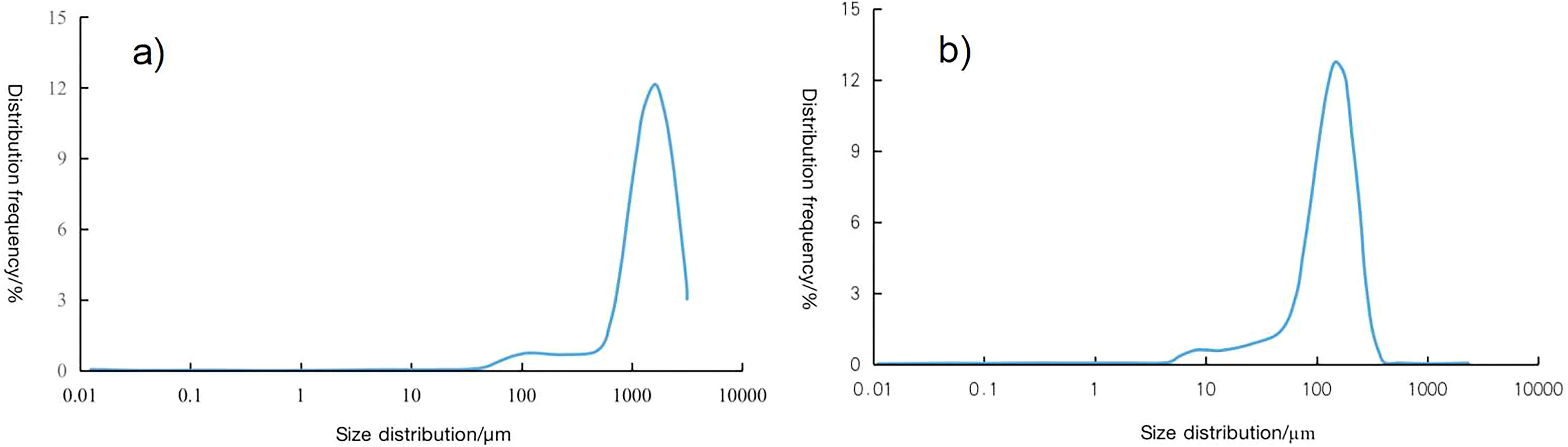
Use Malvern 3000 laser particle size analyzer to test the particle size distribution of the dispersed copolymer particle solution. Before measurement, use distilled water to dilute the dispersed copolymer particle solution to 400 mg/L. Test 3 parallel samples for each sample to get the results of the impact of grinding time on the particle size distribution of the system, as shown in Figure 3 and Table 4.

Change of particle size distribution of DMG with grinding time. (a) The particle size distribution of the system after grinding for 1 minute. (b) The particle size distribution of the system after grinding for 5 minutes.
It can be seen from Figure 3 that the particle size distribution range of the system is wide when grinding for 1 min, and the average particle size is 1520 μm; After continuous grinding for 5 min, the particle size distribution of the system narrows, and the average particle size drops to 135 μm. It shows that the particle size distribution of dispersed copolymer is more uniform with the increase of grinding time during the preparation process. In addition, it can be seen from Table 4 that the ratio of maximum particle size to minimum particle size decreases with the increase of grinding time, which further verifies the above results.
3.4. Rheological test
The double slit model was used, and the shear rate ranged from 1 to 1000 s⁻1. The viscosity of the dispersed copolymer particle solution with 3% mass fraction was tested as a function of the shear rate. The test adopts the injected water of simulated B Oilfield, with a total salinity of 9047 mg/L, calcium and magnesium ion content of 797 mg/L, and pH value of 7.34. The rheological properties of dispersed copolymer particle solution at 65°C were measured with HAKKE rheometer, and the results are shown in Figure 4. It can be seen from Figure 4 that at low shear rate, the viscosity of dispersed copolymer particle solution decreases with the increase of shear rate; At the medium shear rate, the viscosity of the solution is not affected by the shear rate, showing the properties of Newtonian fluid; In the high shear flow state, the solution viscosity increases slightly with the increase of shear rate. The analysis shows that at high shear rate, the DMG solution are constantly rearranged and collided with each other to form a network structure, resulting in a slight increase in viscosity. When the shear rate is 1~1000 s⁻1, the viscosity of 3% dispersed copolymer particle solution is lower than 6.0 mPa·s; When the shear rate is 7.34 s⁻1, the solution viscosity is 1.1 mPa·s, slightly higher than that of water.

3.5. Dispersion stability test
Turboscan multiple light stability analyzer is used to test the stability of the DMG solution. Put 3% dispersed copolymer particle solution into the analyzer and scan the test sample from bottom to top every 15 min, test its backscattered light intensity and transmitted light intensity, and directly calculate the stability dynamics index of the test sample. The stability dynamics index accumulates all light intensity changes of the test sample, reflecting the stability of the test sample. The larger the stability dynamics index is, the more unstable the test sample is; When the stability dynamics index is less than 3.0, the stability of the test sample is good. The advanced analysis module is used to calculate the stability dynamics index of the DMG solution, and the change of its stability dynamics index with time is obtained, as shown in Figure 5.

It can be seen from Figure 5 to Figure 8 that the stability dynamics index of the DMG solution of different temperature points (60°C, 70°C, 80°C, and 90°C) is less than 3.0, and the performance is relatively stable. The DMG solution can maintain good dispersion stability after injecting from the wellhead and migrating to the wellbore and near wellbore zone, without sedimentation and aggregation.


3.6. Plugging and migration evaluation
3.6.1. Plugging test of the DMG solution under simulated formation conditions
The plugging effect of the DMG solution and the polymer gel system in porous media under the same dosage is tested. Under the simulated formation temperature, the 1.0 PV DMG system and polymer gel system were injected at the injection rate of 2.0 mL/min, and the injection pressure changes were recorded. After the subsequent water flooding, the pressure is stable, and the pressure response in the subsequent water flooding stage is recorded, as shown in Figure 9.

It can be seen from Figure 6 that under the same dosage, when the 1.0 PV polymer gel system was injected, the injection pressure rises to 0.1 MPa; When the 1.0 PV DMG system was injected, the injection pressure rises to 0.5 MPa. In the subsequent water flooding stage, both systems showed high residual resistance coefficient, in which the injection pressure of polymer gel system rose to 0.9 MPa, and the injection pressure of DMG system rose to 2.8 MPa.
Therefore, when profile adjustment is carried out for high permeability reservoirs with permeability higher than 5000 mD, the dispersed copolymer particle gel system has lower injection pressure under the same dosage of profile control agent. That is, it has better injection performance and stronger plugging capacity.
3.6.2. Migration test of the DMG solution under simulated formation conditionss
The results of sand pack plugging test show that the DMG system has good plugging performance. In order to more truly reflect its migration performance, the plugging migration test under the condition of long sand pack model was carried out. The 10.00 m sand pack model is used for long-distance migration test. The permeability of the model is 6009 mD. Five pressure measuring points are uniformly distributed along the sand pack model to evaluate its deep migration and plugging performance.
During the test, first inject formation water at the injection rate of 1.5 mL/min until the internal pressure of the model is stable; Then, the 1.0 PV dispersed copolymer particle gel system was injected into the long sand pack model at an injection rate of 1.5 mL/min; Close the injection end and production end, place them in a 65 °C incubator for 10 days, and then inject subsequent water into the sand pack model at an injection rate of 1.5 mL/min, and record the pressure changes during displacement. Results is shown in Figure 10, which indicate satisfied migation property of the DMG solution system.

4. CONCLUSIONS AND SUGGESTIONS
A dispersed co-polymer micro-particle gel is developed by using a two-step procedure, including the special cross-linking technology and the dispersion technology. The prepared high viscosity polymer is grounded to obtain a uniform dispersed co-polymer micro-particle gel solution for deep profile control in high water-cut.
By adjusting the mass fraction of AM and the mass ratio of AM/MBA, the dispersed copolymer particle gel solutions with different particle size distributions can be obtained; Its initial viscosity can be controlled within 10 mPa.s, with good injectivity, deep migration and effective plugging performance for high permeability reservoirs; After high-speed shearing, the viscosity and the particle size of the prepared dispersed copolymer particle gel solution changed little, showing good shear resistance. Dispersion stability test results show that within the temperature range of 60 °C–90 °C, the dispersed co-polymer micro-particle gel solution maintains good stability for over 2 hours, which is beneficial for the injection performance during the injection of the profile control agent.
The viscosity of the dispersed copolymer particle gel system is controllable, and online injection can be realized in the process, which can enter the deep formation. It indicates good plugging effect on the high permeability formation, and can realize deep profile control in high water-cut offshore oilfields.
5. ACKNOWLEDGMENTS
The authors wish to express their appreciation for the funding provided by National Science and Technology Major Project of China (2025ZD1407400); Science & Technology Foundation of CNOOC (E-23267023); Important Science & Technology Foundation of China Oilfield Service Limited, CNOOC (E-23267016).
6. DATA AVAILABILITY
The datasets generated during this study are fully available within the article.
7. BIBLIOGRAPHY
-
[1] ZHANG, H., CHALLA, R.S., BAI, B., et al., “Using screening test results to predict the effective viscosity of swollen superabsorbent polymer particles extrusion through an open fracture”, Industrial & Engineering Chemistry Research, v. 49, n. 23, pp. 12284–12293, 2010. doi: https://doi.org/10.1021/ie100917m.
» https://doi.org/10.1021/ie100917m - [2] QING, Y., TANG, Y., DAI, C., et al., “A study on the morphology of a dispersed particle gel used as a profile control agent for improved oil recovery”, Journal of Chemistry, v. 2014, pp. 150256, 2014.
-
[3] LAKATOS, I., LAKATOS-SZABÓ, J., KOSZTIN, B., et al., “Application of silicate/polymer water shut-off treatment in faulted reservoirs with extreme high permeability”, In: SPE European Formation Damage Conference and Exhibition, pp. SPE-144112, 2011. doi: https://doi.org/10.2118/144112-MS.
» https://doi.org/10.2118/144112-MS -
[4] FANG, J., WANG, J., WEN, Q., et al., “Research of phenolic crosslinker gel for profile control and oil displacement in high temperature and high salinity reservoirs”, Journal of Applied Polymer Science, v. 135, n. 14, pp. 46075, 2018. doi: https://doi.org/10.1002/app.46075.
» https://doi.org/10.1002/app.46075 -
[5] WU, Y., CHEN, W., HU, M., et al., “Application of dispersed particle gel to inhibit surfactant adsorption on sand”, Journal of Surfactants and Detergents, v. 20, n. 4, pp. 863–871, 2017. doi: https://doi.org/10.1007/s11743-017-1965-5.
» https://doi.org/10.1007/s11743-017-1965-5 -
[6] YANG, H., KANG, W., WU, H., et al., “Stability, rheological property and oil-displacement mechanism of a dispersed low-elastic microsphere system for enhanced oil recovery”, RSC Advances, v. 7, n. 14, pp. 8118–8130, 2017. doi: https://doi.org/10.1039/C6RA26849H.
» https://doi.org/10.1039/C6RA26849H -
[7] LIU, Y., DAI, C., WANG, K., et al., “Investigation on preparation and profile control mechanisms of the dispersed particle gels (DPG) formed from phenol-formaldehyde cross-linked polymer gel”, Industrial & Engineering Chemistry Research, v. 55, n. 22, pp. 6284–6292, 2016. doi: https://doi.org/10.1021/acs.iecr.6b00055.
» https://doi.org/10.1021/acs.iecr.6b00055 -
[8] LIE, Z., LI, Y., LENG, R., et al., “Effects of pore structure on surfactant/polymer flooding-based enhanced oil recovery in conglomerate reservoirs”, Petroleum Exploration and Development, v. 47, n. 1, pp. 134–145, 2020. doi: https://doi.org/10.1016/S1876-3804(20)60012-X.
» https://doi.org/10.1016/S1876-3804(20)60012-X -
[9] ZHU, D., HOU, J., MENG, X., et al., “Effect of different phenolic compounds on performance of organically cross-linked terpolymer gel systems at extremely high temperatures”, Energy & Fuels, v. 31, n. 8, pp. 8120–8130, 2017. doi: https://doi.org/10.1021/acs.energyfuels.7b01386.
» https://doi.org/10.1021/acs.energyfuels.7b01386 -
[10] MAURAN, S., RIGAUD, L., COUDEVYLLE, O., “Application of the Carman-Kozeny correlation to a high‐porosity and anisotropic consolidated medium: the compressed expanded natural graphite”, Transport in Porous Media, v. 43, n. 2, pp. 355–376, 2001. doi: https://doi.org/10.1023/A:1010735118136.
» https://doi.org/10.1023/A:1010735118136 -
[11] SHARMA, T., KUMAR, G.S., CHON, B.H., et al., “Viscosity of the oil-in-water Pickering emulsion stabilized by surfactant-polymer and nanoparticle-surfactant-polymer system”, Korea-Australia Rheology Journal, v. 26, n. 4, pp. 377–387, 2014. doi: https://doi.org/10.1007/s13367-014-0043-z.
» https://doi.org/10.1007/s13367-014-0043-z -
[12] CAO, W., XIE, K., LU, X., et al., “Effect of profile-control oil-displacement agent on increasing oil recovery and its mechanism”,Fuel, v. 237, pp. 1151–1160, 2019. doi: https://doi.org/10.1016/j.fuel.2018.10.089.
» https://doi.org/10.1016/j.fuel.2018.10.089 -
[13] SHEN, Y., HAO, S., SUONAN, A., et al., “Controllable synthesis of nano-micro calcium carbonate mediated by additive engineering”, Crystals, v. 13, n. 10, pp. 1432, 2023. doi: https://doi.org/10.3390/cryst13101432.
» https://doi.org/10.3390/cryst13101432 -
[14] SONDI, I., SALOPEK-SONDI, B., “Influence of the primary structure of enzymes on the formation of CaCO3 polymorphs: a comparison of plant (Canavaliaensiformis) and bacterial (Bacilluspasteurii) ureases”, Langmuir: The ACS Journal of Surfaces and Colloids, v. 21, n. 19, pp. 8876–8882, 2005. doi: https://doi.org/10.1021/la051129v. PubMed PMID: 16142973.
» https://doi.org/10.1021/la051129v -
[15] SONG, Z.J., LI, M., ZHAO, C., et al., “Gas injection for enhanced oil recovery in two-dimensional geology-based physical model of Tahe fractured-vuggy carbonate reservoirs: karst fault system”, Petroleum Science, v. 17, n. 2, pp. 419–433, 2020. doi: https://doi.org/10.1007/s12182-020-00427-z.
» https://doi.org/10.1007/s12182-020-00427-z -
[16] GUO, Z., DONG, M., CHEN, Z., et al., “A fast and effective method to evaluate the polymer flooding potential for heavy oil reservoirs in Western Canada”, Journal of Petroleum Science Engineering, v. 112, pp. 335–340, 2013. doi: https://doi.org/10.1016/j.petrol.2013.11.023.
» https://doi.org/10.1016/j.petrol.2013.11.023 -
[17] MAHANI, H., KEYA, A.L., BERG, S., et al., “Driving mechanism of low salinity flooding in carbonate rocks”, In: SPE Europec featured at EAGE Conference and Exhibition, pp. SPE-174300, 2015. doi: https://doi.org/10.2118/174300-MS.
» https://doi.org/10.2118/174300-MS -
[18] BARDON, C., LONGERON, D.G., “Influence of very low interfacial tensions on relative permeability”, Society of Petroleum Engineers Journal, v. 20, n. 05, pp. 391–401, 1980. doi: https://doi.org/10.2118/7609-PA.
» https://doi.org/10.2118/7609-PA -
[19] ZHANG, S., SUN, X., LUO, Q., et al., “The Ce-modified biochar for efficient removal of methylene blue dye: Kinetics, isotherms and reusability studies”, Chinese Journal of Chemical Engineering, v. 77, pp. 57–65, 2025. doi: https://doi.org/10.1016/j.cjche.2024.10.004.
» https://doi.org/10.1016/j.cjche.2024.10.004 -
[20] NAMBAM, J.S., PHILIP, J., “Competitive adsorption of polymer and surfactant at a liquid droplet interface and its effect on flocculation of emulsion”, Journal of Colloid and Interface Science, v. 366, n. 1, pp. 88–95, 2012. doi: https://doi.org/10.1016/j.jcis.2011.07.100. PubMed PMID: 22018623.
» https://doi.org/10.1016/j.jcis.2011.07.100 -
[21] SCHABES, B.K., ALTMAN, R.M., RICHMOND, G.L., “Come together: molecular details into the synergistic effects of polymer-surfactant adsorption at the oil/water interface”, The Journal of Physical Chemistry. B, v. 122, n. 36, pp. 8582–8590, 2018. doi: https://doi.org/10.1021/acs.jpcb.8b05432. PubMed PMID: 30113831.
» https://doi.org/10.1021/acs.jpcb.8b05432 -
[22] XIE, K., WU, Z., LI, X., et al., “A review of research progress of in situ polyacrylamide gel for profile control and water plugging”, Physics of Fluids, v. 37, n. 9, pp. 37, 2025. doi: https://doi.org/10.1063/5.0277891.
» https://doi.org/10.1063/5.0277891 -
[23] YU, M., XU, G., LI, L., et al., “A preliminary evaluation of inorganic composite profile control and oil displacement agent for high water cut oil fields”, Matéria (Rio de Janeiro), v. 30, pp. e20250198, 2025. doi: https://doi.org/10.1590/1517-7076-rmat-2025-0198.
» https://doi.org/10.1590/1517-7076-rmat-2025-0198 -
[24] ZHANG, J., WANG, X., LIANG, Q., et al., “Effect of the surfactant type on the demulsification of the W/O crude oil emulsion produced by surfactant-polymer flooding”, ACS Omega, v. 9, n. 24, pp. 26673–26682, 2024. doi: https://doi.org/10.1021/acsomega.4c03549. PubMed PMID: 38911792.
» https://doi.org/10.1021/acsomega.4c03549 -
[25] SHAOWEI, P.A.N., BO, Y.A.N.G., SHUKAI, W.A.N.G., et al., “Oil well production prediction based on CNN-LSTM model with self - attention mechanism”, Energy, v. 284, pp. 128701, 2023. doi: https://doi.org/10.1016/j.energy.2023.128701.
» https://doi.org/10.1016/j.energy.2023.128701 -
[26] ALVARADO, J.G., BULLÓN, J., SALAZAR-RODRÍGUEZ, F., et al., “n-C7 Asphaltenes characterization as surfactants and polar oil from the HLDN model perspective”, Industrial & Engineering Chemistry Research, v. 62, n. 30, pp. 11872–11884, 2023. doi: https://doi.org/10.1021/acs.iecr.3c01387.
» https://doi.org/10.1021/acs.iecr.3c01387 -
[27] CUSANO, I., AZARPOUR, A., LAUGENI, L., et al., “Exploring the onset of the nonlinear start-up response of wormlike micelles through rheology and rheo-microscopy: banding & scission”, Journal of Colloid and Interface Science, v. 696, pp. 137725, 2025. doi: https://doi.org/10.1016/j.jcis.2025.137725. PubMed PMID: 40373422.
» https://doi.org/10.1016/j.jcis.2025.137725 -
[28] CHEN, L., ZHANG, Z., ZENG, H., et al., “Preparation and performance of high-temperature-resistant, degradable inorganic gel for steam applications”, SPE Journal, v. 29, n. 8, pp. 4266–4281, 2024. doi: https://doi.org/10.2118/219775-PA.
» https://doi.org/10.2118/219775-PA -
[29] SERIGHT, R.S., WANG, D., “Polymer flooding: current status and future directions”, Petroleum Science, v. 20, n. 2, pp. 910–921, 2023. doi: https://doi.org/10.1016/j.petsci.2023.02.002.
» https://doi.org/10.1016/j.petsci.2023.02.002 -
[30] MARQUEZ, R., ANTÓN, R., VEJAR, F., et al., “New interfacial rheology characteristics measured using a spinning drop Rheometer at the optimum formulation. Part 2. Surfactant-oil-water systems with a high volume of middle‐phase microemulsion”, Journal of Surfactants and Detergents, v. 22, n. 2, pp. 177–188, 2019. doi: https://doi.org/10.1002/jsde.12245.
» https://doi.org/10.1002/jsde.12245 -
[31] MARQUEZ, R., FORGIARINI, A.M., LANGEVIN, D., et al., “Instability of emulsions made with surfactant-oil-water systems at optimum formulation with ultralow interfacial tension”, Langmuir: The ACS Journal of Surfaces and Colloids, v. 34, n. 31, pp. 9252–9263, 2018. doi: https://doi.org/10.1021/acs.langmuir.8b01376. PubMed PMID: 29986590.
» https://doi.org/10.1021/acs.langmuir.8b01376 -
[32] LUAN, H., ZHOU, Z., XU, C., et al., “Study on the synergistic effects between petroleum sulfonate and a nonionic- anionic surfactant for enhanced oil recovery”, Energies, v. 15, n. 3, pp. 1177, 2022. doi: https://doi.org/10.3390/en15031177.
» https://doi.org/10.3390/en15031177 -
[33] LI, G., ZHOU, Z., FAN, J., et al., “Study on microscopic oil displacement mechanism of alkaline-surfactant-polymer ternary flooding”, Materials (Basel), v. 17, n. 18, pp. 4457, 2024. doi: https://doi.org/10.3390/ma17184457. PubMed PMID: 39336198.
» https://doi.org/10.3390/ma17184457 -
[34] EL-BATANONEY, M., ABDEL-MOGHNY, T., RAMZI, M., “The effect of mixed surfactants on enhancing oil recovery”, Journal of Surfactants and Detergents, v. 2, n. 2, pp. 201–205, 1999. doi: https://doi.org/10.1007/s11743-999-0074-7.
» https://doi.org/10.1007/s11743-999-0074-7 -
[35] BENKŐ, M., PUSKÁS, S., KIRÁLY, Z., “Application of mass spectrometry for study of the adsorption of multicomponent surfactant mixtures at the solid/solution interface”, Adsorption, v. 19, n. 1, pp. 71–76, 2013. doi: https://doi.org/10.1007/s10450-012-9419-x.
» https://doi.org/10.1007/s10450-012-9419-x -
[36] GUO, Y., LIU, J., ZHANG, X., et al., “Solution property investigation of combination flooding systems consisting of gemini-non-ionic mixed surfactant and hydrophobically associating polyacrylamide for enhanced oil recovery”,Energy & Fuels, v. 26, n. 4, pp. 2116–2123, 2012. doi: https://doi.org/10.1021/ef202005p.
» https://doi.org/10.1021/ef202005p