
 Study on recycling rate evaluation and multi-factor influence of reclaimed asphalt based on mixing-separation and performance characterization
ABSTRACT
To explore the effects of various factors on the recycling rate of reclaimed asphalt in reclaimed asphalt mixtures and optimize their production processes and mix design, the optimal type and content of rejuvenator through performance tests on the reclaimed asphalt were first determined. Subsequently, an evaluation method for measuring the recycling rate of reclaimed asphalt was proposed based on the performance indicators obtained from a dynamic shear rheometer (DSR). Finally, the effects of reclaimed asphalt content, heating temperature, and mixture mixing time on the recycling rate were analyzed using orthogonal experimental design. The results indicate that an appropriate rejuvenator content can effectively improve the performance of reclaimed asphalt, while excessive content adversely affects its high-temperature performance; consequently, the optimal content of Rejuvenator A is determined to be 10.1% for the evaluation of the recycling rate; the content of reclaimed asphalt has a significant inverse effect on the recycling rate, where a higher content leads to a lower rate; in addition, heating temperature is identified as the second most influential factor, with the recycling rate increasing progressively as the temperature rises. Furthermore, sufficient mixing time significantly enhances the recycling rate, whereas excessive mixing time reduces it.
Keywords:
Road engineering; Hot reclaimed asphalt mixture; Reclaimed asphalt recycling rate; Dynamic shear rheological test; Orthogonal test
1. INTRODUCTION
In China, over 160 million tons of reclaimed asphalt pavement (RAP) is generated annually. However, the recycling rate of RAP remains below 30%, which incurs enormous disposal costs, occupies vast amounts of land, and seriously pollutes the ecological environment. Consequently, the application of RAP in asphalt pavements has become one of the hot research directions in the current highway industry [1,2,3]. Hot recycling technology is one of the effective methods for RAP recycling [4,5,6]. In current Chinese specifications for thermal recycling mix design (e.g., Technical Specifications for Highway Asphalt Pavement Recycling), it is assumed that all reclaimed asphalt from RAP fully blends with new asphalt to function as binder [7]. However, extensive researches [8,9,10,11] demonstrate that only partial blending occurs in reclaimed asphalt mixtures. Specifically, only a portion of reclaimed asphalt in RAP becomes “activated”, blending with new asphalt to form recycling binder, while the rest remains attached to RAP aggregates and no longer participates as binder material. The discrepancy between design assumptions and actual “activation” ratios of reclaimed asphalt in RAP leads to the determination of suboptimal asphalt content in final designs, which adversely affects the performance of reclaimed asphalt mixtures and severely limits the content of RAP. Therefore, to investigate the “activation” ratio of reclaimed asphalt in RAP, i.e., the recycling rate of reclaimed asphalt, holds paramount significance for enhancing the performance of recycling asphalt mixture and increasing the utilization of RAP.
DING [12] employed the fluorescent microscopy to obtain the average gray value of asphalt-coated aggregate particles, and quantitatively evaluated the recycling rate of RAP, thereby establishing a relationship between the content of reclaimed asphalt and the average gray value of the new-reclaimed asphalt mixture and calculating the activation rate of reclaimed asphalt based on the surface area proportions of aggregates with different particle sizes. CHEN et al. [13] also utilized the fluorescence microscopy and dynamic shear rheometer (DSR) to conduct a quantitative evaluation on the interfacial fusion between the aged and new asphalts in RAP. SHI et al. [14] studied the miscible variation law of new and reclaimed asphalt by microscopic test, and found that the content of new asphalt had a significant influence on the fusion degree of the mixture. GUO et al. [15] obtained the size and distribution of molecular weight of the asphalt by the stratified extraction of the mixed new and reclaimed asphalt, and quantitatively analyzed its fusion degree. CHEN [16] combined the extraction and rotary evaporation to obtain the miscible asphalt with different hot-mixing time, and used the image analysis and fluorescence tracing to explore the dispersion of RAP under different mixing specimens and the fusion degree of new and reclaimed asphalt.
Currently, most researchers have proposed macro and micro scale methods for evaluating the recycling rate of reclaimed asphalt. However, the research on the influencing factors of recycling rate remains limited, with insufficient comparative analysis of their relative influencing levels. Therefore, this study proposed an evaluation method for the recycling rate of reclaimed asphalt based on the DSR performance indicators, and explored the effect of reclaimed asphalt content, heating temperature, and mixing time on the recycling rate of RAP, which provided references for the rational determination of production processing for reclaimed asphalt mixtures and the content of new asphalt.
2. MATERIALS AND METHODS
2.1. Test materials
2.1.1. RAP
In this study, two types of milled RAP materials were selected: RAP1 and RAP2. RAP1 originally contained SBS-modified asphalt with AC-13 design gradation; RAP2 used 70# base asphalt with AC-16 design gradation and an optimal asphalt-aggregate ratio of 4.5% (i.e., an optimal asphalt content of 4.3%). The asphalt content of milled RAP2 was determined as 4.0% using the trichloroethylene solvent extraction method by centrifuge method in accordance with the standard JTG 3410-2025 (Test Method T0722) [17], with its gradation analyzed through the ignition method. Both AC-16 specifications and RAP gradation results were presented in Table 1.
To ensure the gradation stability of RAP, the crushed RAP was screened into three types (0–5 mm, 5–10 mm, and 10–15 mm) for blending, with 5.4%, 3.7%, and 3.4% of asphalt, respectively. The aggregate gradation composition was illustrated in Table 2.
Based on the aggregate gradation composition of RAP and new aggregates, the proportions of each fraction of new aggregates were adjusted to ensure that the gradation of reclaimed asphalt mixtures with 20%, 30%, and 40% of RAP met AC-16 gradation specifications. The gradations were summarized in Table 3.
2.1.2. New asphalt and aggregate
The SBS-modified asphalt (Grade I-D) and 70# base asphalt were selected as the asphalt binder. To differentiate and separate new and reclaimed aggregates, magnetite (a magnetic mineral) was chosen as the new aggregate additive.
2.1.3. Rejuvenator
Three types of rejuvenators were selected for this study: Rejuvenator A, Rejuvenator B, and Rejuvenator C. Rejuvenator A was categorized as an RA-type rejuvenator with a recommended content range of 6%–12%; Rejuvenator B is a plant oil-based rejuvenator with a recommended content range of 4%–12%; Rejuvenator C is a commercially available AR2000 asphalt rejuvenator produced by Company X, with a recommended content range of 5%–10%. The technical indicators of these rejuvenators were tested, and the test results were summarized in Table 4.
2.2. Test method
2.2.1. Bending beam rheometer (BBR)
In this study, the BBR test was employed to evaluate the low-temperature performance of different asphalt binders. A three-point bending creep loading test was conducted on asphalt beam specimens to measure the stiffness modulus S and creep rate m of the asphalt material at low temperatures. The stiffness modulus S reflects the load-bearing resistance of the asphalt, where a lower S value indicates greater deformation capacity and superior crack resistance under low-temperature conditions, whereas a higher S value suggests increased brittleness. The creep rate m represents the stress relaxation capability of the asphalt at low temperatures, with a higher m value signifying faster stress dissipation in response to pavement contraction, thereby reducing the likelihood of internal thermal stress accumulation and improving the low-temperature crack resistance.
2.2.2. DSR
A DSR test was carried out to measure the complex shear modulus G⁎ and phase angle δ of modified asphalt binders. The rutting resistance factor G⁎/sinδ, proposed by the Strategic Highway Research Program (SHRP), was applied to characterize the high-temperature rutting resistance of asphalt. The complex shear modulus G⁎, defined as the ratio of maximum shear stress to maximum shear strain, quantifies the material’s total resistance to deformation under repeated shear loading. The phase angle δ reflects the viscoelastic properties of the material, where a smaller δ value indicates stronger elastic behavior.
2.2.3. Asphalt extraction test
Centrifugal extraction tests were performed on reclaimed asphalt mixtures in accordance with standard protocols to determine their asphalt content. Subsequently, the rotary evaporation method was adopted to purify the asphalt-containing solution obtained from the extraction process, followed by the solvent removal to recover the reclaimed asphalt.
2.2.4. Preparation of reclaimed asphalt and new-reclaimed asphalt mixture
Firstly, the reclaimed SBS-modified asphalt and the reclaimed base asphalt were separately heated to a molten state at 150°C. Subsequently, predetermined amounts of the three rejuvenators (at room temperature) were added to the respective molten reclaimed asphalt. The mixtures were then subjected to high-speed shearing using a high-shear mixer at 2000 rpm and 150 ± 5°C for 10 minutes. This process produced a series of reclaimed asphalt samples, each consisting of 100% reclaimed asphalt blended with a specific type and content of rejuvenator. The rejuvenator contents (Rejuvenator A: 6%, 8%, 10%, 12%; Rejuvenator B: 3%, 6%, 9%, 12%; Rejuvenator C: 4%, 6%, 8%, 10%) were calculated by mass relative to the reclaimed asphalt.
Both types of reclaimed asphalt (SBS-modified and base) were separately heated to a molten state with the new asphalt and blended at their respective predetermined ratios. The blend was also treated using a high-shear mixer at 2000 rpm and 150 ± 5°C for 10 min, producing new-reclaimed asphalts with 0%, 10%, 20%, 30%, 40%, 50%, 60%, 70%, 80%, 90%, and 100% of reclaimed asphalt.
3. RESULTS AND DISCUSSION
In this study, the road performance of reclaimed asphalt was systematically evaluated through conventional tests (penetration, softening point, ductility) and rheological tests (BBR and DSR). The effects of reclaimed asphalt type, rejuvenator type, and rejuvenator content were analyzed. Furthermore, the recycling rate of reclaimed asphalt was investigated based on these performance indicators.
3.1. Aging performance of reclaimed asphalt
The conventional properties (penetration, softening point, ductility) and rheological performance of four asphalt binders—new base asphalt, new SBS-modified asphalt, reclaimed asphalt, and reclaimed SBS-modified asphalt — were tested and compared. The performance test results were presented in Figures 1 and 2. The BBR and DSR test temperature is −12°C and 76°C, respectively.


As shown in Figures 1 and 2, compared with new asphalt, reclaimed asphalt exhibits a significant decrease in penetration, and a notable increase in softening point and rutting resistance factor, indicating the hardness and high-temperature performance of the asphalt are enhanced. This phenomenon is attributed to the conversion of light components into heavy components during the asphalt aging process [18]. During the service life of pavement, the asphalt is aged under the combined effects of high temperature, ultraviolet radiation, and oxygen, resulting in gradual hardening and enhanced high-temperature performance of reclaimed asphalt [19, 20].
In addition, the reclaimed asphalt significantly increases in creep stiffness modulus compared with new asphalt. Specifically, the base asphalt increases from 98.2 MPa to 345.6 MPa, accompanied by a sharp reduction in ductility. Notably, the 5°C ductility of reclaimed SBS-modified asphalt drops to zero, indicating that reclaimed asphalt is more prone to low-temperature cracking and exhibits insufficient cohesive properties [21]. Hence, the content of RAP should be carefully selected in recycled asphalt mixtures to mitigate the adverse effects of reclaimed asphalt on their low-temperature performance. During the pavement aging, the asphalt gradually becomes brittle, resulting in the substantial deterioration of its low-temperature performance.
3.2. Recycling rate of reclaimed asphalt
The performance test results of reclaimed asphalt were shown in Figures 3–6. The test temperature of BBR and DSR is −12°C and 76°C, respectively.

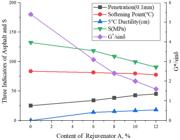


Under identical content conditions, Rejuvenator A exhibits superior comprehensive rejuvenation performance compared to Rejuvenator B and Rejuvenator C. When the rejuvenator content increases from 0% to 10%, the penetration of the reclaimed base asphalt treated with Rejuvenator A increases from 3.25 mm to 6.73 mm, and its softening point decreases from 63.8°C to 48.1°C. In contrast, for the sample treated with Rejuvenator C, the penetration increases to 6.72 mm while the softening point decreases to 43.5°C. This indicates that compared to Rejuvenator C, Rejuvenator A more effectively preserves the high-temperature stability of the reclaimed asphalt. At a content of 12%, the penetration of the reclaimed base asphalt treated with Rejuvenator A increases to 7.24 mm (an increase of 123%), and its softening point decreases to 45.2°C (a decrease of 29%). Under the same content, the asphalt treated with Rejuvenator B shows an increase in penetration to 6.24 mm (an increase of 92%) and a decrease in softening point to 47.8°C (a decrease of 25%). It can be concluded that compared to Rejuvenator B, Rejuvenator A significantly enhances the low-temperature crack resistance of the aged asphalt.
Within a reasonable content range of rejuvenators, the key performance indicators of the reclaimed asphalt were significantly improved, with most (except ductility) reaching the performance level of new asphalt of the same grade. As shown in Figures 4–6, with the increase in rejuvenator content, the penetration and ductility gradually increases, while the rutting resistance factor G*/sinδ, creep stiffness modulus S, and softening point progressively decreases. When the content is 8% for Rejuvenator C, 10% for Rejuvenator A, and 12% for Rejuvenator B, the corresponding penetration and softening point of the reclaimed asphalt meet the specification requirements (JTG F40-2004) [22]. Further increasing the rejuvenator content made it difficult to comply with the specification limits. Furthermore, at a content of 10% for Rejuvenator A, the penetration of the reclaimed asphalt reaches 6.73 mm and the softening point is 48.1°C, approaching the values of the new 70# asphalt (6.78 mm and 48.6°C, respectively). However, its ductility is only 70.2 cm, which is substantially lower than that of the new 70# asphalt (108.2 cm) and fails to meet the specification requirement of being greater than 100 cm [22]. This discrepancy is attributed to the substantial influence of residual mineral filler on ductility. LI [23] found that even 1% of mineral filler reduced the ductility of asphalt by 76 cm, demonstrating the sensitivity of this parameter to trace the content of filler. Moreover, standard methods such as AASHTO D1856 permit the presence of up to 1% fine mineral filler. This implies that our ductility test data essentially reflect the properties of an “asphalt-mineral filler composite” rather than the pure rheological performance of the reclaimed asphalt itself. Using an index severely interfered by uncontrollable impurities as an optimization basis would introduce significant errors and misleading conclusions. Therefore, the ductility of reclaimed asphalt was excluded from the determination of the optimal content of rejuvenator.
Excessive content of rejuvenator adversely affects the high-temperature performance of reclaimed asphalt. As shown in Figure 4, when the content reaches 12%, the softening point of reclaimed asphalt with Rejuvenator A drops to 45.4°C, which is lower than that of new 70# asphalt (48.6°C). This suggests that excessive softening of reclaimed asphalt, caused by the rejuvenator, significantly compromises the high-temperature performance of reclaimed asphalt mixtures. Therefore, the content of rejuvenator must be carefully optimized to balance the performance restoration and thermal stability.
To restore all performance indicators to those of new 70# base asphalt, the optimal contents of rejuvenators were calculated using linear interpolation. For the reclaimed asphalt with Rejuvenator A, the optimal contents determined by various indicators (excluding ductility) were 10.2%, 9.8%, 10.2%, and 10%, respectively, resulting in a final optimal content of 10.1%. However, the reclaimed asphalt with Rejuvenators B and C failed to restore the penetration to new asphalt levels, and significant discrepancies were observed in optimal contents determined by different parameters. Specifically, for the Rejuvenator C, the optimal contents based on softening point and creep stiffness modulus were 7.3% and 9.3%, respectively. Therefore, Rejuvenator A was identified as the optimal rejuvenator, with its content ultimately determined as 10.1%.
3.3. Evaluation method of recycling rate of reclaimed asphalt
Using the recycling rate of reclaimed asphalt as the evaluation indicator, this study defined as the ratio of activated reclaimed asphalt to the total content of reclaimed asphalt, which was derived by calculating the content of reclaimed asphalt in the blended reclaimed-new asphalt that contributed to cohesive bonding. Furthermore, extensive research has demonstrated a significant correlation between performance indicators of reclaimed-new asphalt mixtures and reclaimed-new asphalt compositional ratios [24]. This study established a relationship between performance indicators and contents of reclaimed-new asphalt, and then determined the content of reclaimed asphalt through performance testing, thereby calculating the recycling rate of reclaimed asphalt.
3.3.1. Relationship between reclaimed asphalt contents and performance indicators
In this study, new-reclaimed asphalt mixtures with various reclaimed asphalt contents were sampled and used for DSR testing. The rutting resistance factor G⁎/sinδ of the mixture with different contents of reclaimed asphalt at 76°C was summarized in Table 5.
The high-temperature performance of reclaimed-new asphalt mixture gradually increases as the content of reclaimed asphalt increases, demonstrating a significant linear correlation. As shown in Figure 7, the rutting resistance factor G⁎/sinδ of different types of mixture increases progressively with higher reclaimed asphalt content. The linear relationships are defined as G⁎/sinδ = 0.02531c + 1.27091 (base asphalt) and G⁎/sinδ = 0.03516c + 1.71091 (SBS-modified asphalt), with correlation coefficients R2 reaching 0.9891 and 0.9901, respectively.

3.3.2. Evaluation method of recycling rate
The reclaimed asphalt on new aggregates after mixing was extracted and used to conduct DSR temperature sweep tests to obtain G⁎, δ, and G⁎/sinδ. The content c of reclaimed asphalt was then inversely calculated using the linear relationship G⁎/sinδ = 0.0259c + 1.2427. Finally, the recycling rate R of reclaimed asphalt was determined by the Equation 1. In this study, the content of reclaimed and new asphalts under different contents of RAP was denoted as cold and cnew respectively.
The evaluation method of recycling rate was illustrated in Figure 8. Specifically, RAP at predetermined contents was preheated for 1 h under different temperature levels, then placed in a mixing pot and blended with rejuvenator for 10 s. Magnet and aggregates (new aggregates) were subsequently mixed for 60 s, followed by the addition of new asphalt with continued mixing for a specified time. Finally, the mineral filler was incorporated and mixed for 90 s. After mixing, magnet was used to absorb aggregates, and the asphalt adhering to them was extracted and used for DSR temperature sweep testing. The recycling rate R of reclaimed asphalt under various production processes was ultimately calculated using the Equation 1. The recycling rate R of reclaimed asphalt under various production processes was ultimately calculated using Equation 1, wherein the parameters cnew and cold are fixed values influenced by the RAP content, as shown in Table 6.

3.4. Orthogonal test
Orthogonal experimental design is an efficient multi-factor experimental method based on Orthogonal Arrays [25]. Its core principle lies in using a subset of representative experiments characterized by “uniform dispersion” and “balanced comparability” to replace time-consuming and resource-intensive full factorial experiments. The content and heating temperature of RAP, and the mixing time of mixture were selected as influencing factors. Three levels were chosen for each factor to design an L9(34) orthogonal test. The rutting resistance factor G*/sinδ, content c, and recycling rate R of reclaimed asphalt were determined by the recycling rate evaluation method. The test results were presented in the Table 7.
3.4.1. Analysis of variance
Variance analysis was used to judge the influence degree of each influencing factor on asphalt recycling rate, among which *p < 0.05, **p < 0.01.
Based on the F-value in Table 8, the most significant factor influencing the rutting factor (G*/sinδ), reclaimed asphalt content (c), and reclaimed asphalt recycling rate (R) is the RAP content, followed by the heating temperature, and then mixing time.
3.4.2. Analysis of mean
According to Table 7, a single variable was fixed and the average value at different levels was taken, as shown in Figure 9 below.

As shown in Figure 9(a), the recycling rate of reclaimed asphalt decreases significantly as the content of RAP increases. Specifically, when the content of RAP increases from 20% to 40%, the recycling rate decreases by 18.7%. Higher content of RAP leads to lower recycling rate of reclaimed asphalt in the mixture, which has the most significant influence on it. This phenomenon can be attributed to insufficient mixing efficiency at elevated RAP contents, where partial RAP agglomeration persists, limiting effective contact and diffusion between reclaimed asphalt, new aggregates, and new asphalt. Furthermore, the results reveal a discrepancy between the asphalt-aggregate ratio derived from the Marshall design method and the actual recycling rate of reclaimed asphalt in the mixture. Notably, further increasing the RAP content exacerbates the insufficiency of new asphalt content, severely compromising the performance of reclaimed asphalt mixtures.
In Figure 9(b), when the heating temperature of RAP increases from 110°C to 140°C, the recycling rate of reclaimed asphalt rises from 70.8% to 73.5%, which has a moderate influence on the recycling rate, that is, higher temperatures gradually enhance the recycling rate. This can be attributed to the thermal softening of reclaimed asphalt at elevated temperatures, which improves its fluidity and facilitates migration. Concurrently, increasing the temperature accelerates the diffusion rate between reclaimed and new asphalts, promoting the interfacial blending. However, excessive heating may induce secondary aging of reclaimed asphalt, leading to an overestimation of the calculated recycling rate. This interference factor needs further investigation and methodological refinement.
From Figure 9(c), it can be seen that when the mixing time increases from 220 s to 280 s, the recycling rate of reclaimed asphalt rises from 69.9% to 72.4%. However, extending the mixing time to 340 s cause to only a marginal improvement in recycling rate (72.6%). Adequate mixing time effectively improves the recycling rate, while excessive one provides minimal enhancement, indicating that the mixing time significantly affects the recycling rate. Therefore, a mixing time (280 s) is recommended to balance the recycling rate with production costs.
Notably, compared with the conventional laboratory mixing time (180 s) for standard asphalt mixtures, the mixing time for reclaimed asphalt mixtures increases by 100 s (55.6% increment); moreover, to optimize the performance, the total mixing time for recycled mixtures should be extended by 10–30 s (22.2%–66.7% increment). Therefore, it is essential to appropriately extend the mixing time in practical production of reclaimed asphalt mixtures.
4. CONCLUSIONS
This study determined the optimal rejuvenator type and content by the performance tests of reclaimed asphalt, proposed a DSR-based evaluation method for reclaimed asphalt recycling rate, and investigated the effects of RAP content, RAP heating temperature, and mixture mixing time on the recycling rate.
-
Appropriate rejuvenator content effectively improves the performance of reclaimed asphalt, when most indicators (except ductility) reaches the level of new asphalt with the same gradation. However, excessive rejuvenator content adversely impacts the high-temperature performance of recycled asphalt. Therefore, it is necessary to carefully select the content of rejuvenator.
-
A significant linear correlation exists between the high-temperature performance of reclaimed-new asphalt mixtures and the reclaimed asphalt contents. The content of reclaimed asphalt can be inversely calculated by using the rutting resistance factor G⁎/sinδ of reclaimed asphalt adhering on fresh aggregates after mixing, thereby determining the recycling rate of reclaimed asphalt.
-
The content of RAP has the most significant influence on the recycling rate of reclaimed asphalt, followed by RAP heating temperature, and then mixing time. Therefore, it is critical rationally select the content and heating temperature of RAP during the recycling process.
5. ACKNOWLEDGEMENTS
This study was jointly founded by the Guangxi Key Research and Development Program on “Key Technologies for Development and Application of Micro-Modified Rubber Asphalt” [grant number Gui Ke AB25069168], “Key Construction Technologies of High-Dosage Activated Rubber Powder Modified Asphalt Pavement” [grant number Gui Ke AB23075202], the “Yongjiang Program” Youth Talent Special Project of Nanning City “Research on Development and Application of Key Technologies for Multi-source Waste Tire Rubber Powder Modified Asphalt” [grant number RC20250106], and Guangxi Transportation Science and Technology Achievements Promotion Project “Key Laboratory of Highway Carbon Peak and Carbon Neutrality in Guangxi Transportation Industry” [grant number GXJT-ZDSYS-2023-03-01]. All authors of the following references are much appreciated, Finally, the authors would like to thank the reviewers for their time and insightful comments.
6. BIBLIOGRAPHY
-
[1] YE, W., CHEN, M., GAO, C., et al., “Sustainable asphalt concrete containing RAP and RCA: volumetrics, mechanical properties, and economic analysis”, Matéria, v. 30, pp. e20250161, 2025. doi: https://doi.org/10.1590/1517-7076-rmat-2025-0161.
» https://doi.org/10.1590/1517-7076-rmat-2025-0161 -
[2] CENTOFANTE, R., SPECHT, L.P., ALMEIDA JÚNIOR, P.O.B., et al., “Avaliação do comportamento de misturas asfálticas recicladas a quente com inserção de material fresado”, Matéria, v. 23, n. 3, pp. e12178, 2018. doi: https://doi.org/10.1590/s1517-707620180003.0512.
» https://doi.org/10.1590/s1517-707620180003.0512 -
[3] HUANG, X., XIE, C., CHEN, J., et al., “Study on preparation of light oil regenerant and performance of cold recycled mixture”, Matéria, v. 28, n. 2, pp. e20230101, 2023. doi: https://doi.org/10.1590/1517-7076-rmat-2023-0101.
» https://doi.org/10.1590/1517-7076-rmat-2023-0101 -
[4] WU, Z., CAI, H., WU, X., et al., “Study on the factors affecting temperature and workability during the mixing process of hot in-place recycled asphalt mixtures (RHMA)”, Matéria, v. 30, pp. e20240816, 2025. doi: https://doi.org/10.1590/1517-7076-rmat-2024-0816.
» https://doi.org/10.1590/1517-7076-rmat-2024-0816 -
[5] OLIVEIRA, M.S., FARIAS, M.M., “Hot recycled asphalt mixtures with the incorporation of milled material: analysis of the mechanical performance and economic presumption in the applicability of the technique”, Matéria, v. 27, n. 4, pp. e20220217, 2022. doi: https://doi.org/10.1590/1517-7076-rmat-2022-0217.
» https://doi.org/10.1590/1517-7076-rmat-2022-0217 -
[6] YU, D., FANG, S.D., YANG, Y.Y., et al., “Fracture toughness of basalt fiber-reinforced hot recycled asphalt mixtures: a study based on DIC technology”, Matéria, v. 31, pp. e20250683, 2026. doi: https://doi.org/10.1590/1517-7076-rmat-2025-0683.
» https://doi.org/10.1590/1517-7076-rmat-2025-0683 - [7] MINISTRY OF TRANSPORT OF THE PEOPLE’S REPUBLIC OF CHINA, Technical Specifications for Highway Asphalt Pavement Recycling (JTG/T 5521—2019), Beijing, People’s Communications Publishing House, 2019.
-
[8] MA, Y., ZHENG, K.P., DING, Y.J., et al., “Binder availability and blending efficiency of reclaimed asphalt: a state-of-the-art review”, Construction & Building Materials, v. 357, pp. 129334, 2022. doi: https://doi.org/10.1016/j.conbuildmat.2022.129334.
» https://doi.org/10.1016/j.conbuildmat.2022.129334 -
[9] BOWERS, B.F., HUANG, B., SHU, X., et al., “Investigation of reclaimed asphalt pavement blending efficiency through GPC and FTIR”, Construction & Building Materials, v. 50, pp. 517–523, 2014. doi: https://doi.org/10.1016/j.conbuildmat.2013.10.003.
» https://doi.org/10.1016/j.conbuildmat.2013.10.003 -
[10] ABDELAZIZ, A., MARTIN, A.E., MERCADO, E.A., et al., “Study of the quantification of recycled binder activity in asphalt mixtures with RAP”, Construction & Building Materials, v. 309, pp. 125189, 2021. doi: https://doi.org/10.1016/j.conbuildmat.2021.125189.
» https://doi.org/10.1016/j.conbuildmat.2021.125189 -
[11] DING, Y.J., HUANG, B.S., SHU, X., et al., “Use of molecular dynamics to investigate diffusion between virgin and aged asphalt binders”, Fuel, v. 174, pp. 267–273, 2016. doi: https://doi.org/10.1016/j.fuel.2016.02.022.
» https://doi.org/10.1016/j.fuel.2016.02.022 -
[12] DING, Y.J., HUANG, B.S., SHU, X., “Blending efficiency evaluation of plant asphalt mixtures using fluorescence microscopy”, Construction & Building Materials, v. 161, pp. 461–467, 2018. doi: https://doi.org/10.1016/j.conbuildmat.2017.11.138.
» https://doi.org/10.1016/j.conbuildmat.2017.11.138 - [13] CHEN, L., CHEN, H.B., LI, P., et al., “Quantitative evaluation on interfacial diffusion behavior of asphalt with high percentage of RAP”, Journal of Building Materials, v. 24, n. 4, pp. 811–819, 2021.
- [14] SHI, P.C., SHEN, J.N., WEI, W., “The fusion change rule of new and old asphalt based on atomic force microscope and infrared spectrometer”, Highway, v. 64, n. 3, pp. 225–230, 2019.
- [15] GUO, P., LU, C.H., XIE, F.Z., et al., “Study on interfacial fusion characteristics of new and aged asphalt of warm mix recycled mixture at micro scale”, China Journal of Highway Transport, v. 34, n. 10, pp. 89–97, 2021.
- [16] CHEN, T.J., “Multi-scale analysis on RAP dispersion in recycled hot mix asphalt mixture”, Journal of Highway and Transportation Research and Development, v. 39, n. 12, pp. 17–26, 2022.
- [17] MINISTRY OF TRANSPORT OF THE PEOPLE’S REPUBLIC OF CHINA, JTG 3410-2025 Standard Test Methods of Asphalt and Asphalt Mixture for Highway Engineering, Beijing, People’s Communications Publishing House, 2025.
-
[18] ZHANG, H., CHEN, Z., XU, G., et al., “Evaluation of aging behaviors of asphalt binders through different rheological indices”, Fuel, v. 221, n. 1, pp. 78–88, 2018. doi: https://doi.org/10.1016/j.fuel.2018.02.087.
» https://doi.org/10.1016/j.fuel.2018.02.087 -
[19] YUAN, J., LI, H.Y., LI, T.H., et al., “Evolution of asphalt performance under the coupled aging of ultraviolet, high temperature and water”, Case Studies in Construction Materials, v. 20, pp. e03220, 2024. doi: https://doi.org/10.1016/j.cscm.2024.e03220.
» https://doi.org/10.1016/j.cscm.2024.e03220 -
[20] XU, Y.L., NIU, K.M., ZHU, H.Z., et al., “Generation and evolution mechanisms of asphalt aging under the combined effects of intense UV radiation and large temperature variations”, Construction & Building Materials, v. 438, pp. 136786, 2024. doi: https://doi.org/10.1016/j.conbuildmat.2024.136786.
» https://doi.org/10.1016/j.conbuildmat.2024.136786 - [21] LI, J., LIU, Y., ZHANG, X.N., “Microscopic analysis on the aging mechanism of asphalt”, Bulletin of the Chinese Ceramic Society, v. 33, n. 6, pp. 1275–1281, 2014.
- [22] MINISTRY OF TRANSPORT OF THE PEOPLE’S REPUBLIC OF CHINA, JTG F40-2004 Technical Specifications for Construction of Highway Asphalt Pavements, Beijing, People’s Communications Press, 2004.
- [23] LI, S.Q., Study on road performance of plant mix hot recycled asphalt mixture, Chongqing, Chongqing Jiaotong University, 2009.
-
[24] YAO, Y.Q., YANG, J.G., GAO, J., et al., “Blending behavior of reclaimed asphalt and virgin asphalt in recycled asphalt mixtures: a comprehensive analysis on material composition and mixing process”, Construction & Building Materials, v. 465, pp. 140229, 2025. doi: https://doi.org/10.1016/j.conbuildmat.2025.140229.
» https://doi.org/10.1016/j.conbuildmat.2025.140229 -
[25] ZHANG, Y., ZHU, W., CHU, X., et al., “The mechanical behavior of designing recycled hot-mix asphalt containing fine RAP particles with multiple parameters using orthogonal experimental approach”, Construction & Building Materials, v. 458, pp. 139654, 2025. doi: https://doi.org/10.1016/j.conbuildmat.2024.139654.
» https://doi.org/10.1016/j.conbuildmat.2024.139654


