 Mechanical, morphological and thermal analysis of biochar-filled polymer bio-composites
ABSTRACT
This study investigates the mechanical and morphological characteristics of biochar-filled polymer bio-composites fabricated using a polypropylene matrix reinforced with rice husk-derived biochar. The composites were prepared through melt blending with varying biochar loadings (5–25 wt%) to analyze their influence on tensile, flexural, and impact properties. The results reveal that biochar incorporation significantly enhanced the mechanical performance of polypropylene, with optimum properties achieved at 15 wt% biochar loading. At this composition, tensile strength and tensile modulus increased by approximately 28% and 34%, respectively, while flexural strength and flexural modulus improved by 31% and 38% compared to neat polypropylene. Impact strength also exhibited an improvement of about 18%, indicating effective energy absorption and improved toughness at moderate filler content. Beyond 15 wt% biochar loading, mechanical performance declined due to filler agglomeration, increased stress concentration, and restricted polymer chain mobility. Scanning Electron Microscopy (SEM) analysis confirmed uniform biochar dispersion and strong interfacial bonding at optimal filler content, whereas higher loadings showed particle clustering and micro-void formation. These findings demonstrate that rice husk-derived biochar acts as an effective reinforcement, enhancing the stiffness and structural integrity of polypropylene composites and offering a viable route for utilization of agricultural waste in eco-friendly engineering materials.
Keywords:
Biochar; Polymer bio-composites; Mechanical properties; Morphological analysis; Thermal analysis

1. INTRODUCTION
The global demand for sustainable materials has intensified in recent years due to the depletion of petroleum-based resources, growing environmental concerns, and stricter regulations on plastic waste. Traditional synthetic polymers, though widely used for their versatility and cost-effectiveness, contribute significantly to environmental pollution and carbon emissions. As a result, researchers have focused on the development of bio-composites, which combine renewable fillers with polymer matrices to reduce ecological impact while maintaining desirable mechanical performance [1]. Among various bio-fillers, biochar a carbon-rich solid residue produced through the pyrolysis of biomass under limited oxygen has emerged as a promising reinforcement material for polymer composites. Biochar offers several advantages, including high surface area, tunable porosity, lightweight structure, and good thermal stability. Its production from agricultural residues such as rice husk, coconut shell, and sawdust not only valorizes waste materials but also supports the concept of a circular bioeconomy. Compared with conventional fillers like carbon black or glass fibers, biochar is renewable, cost-effective, and environmentally benign [2]. When incorporated into polymer matrices, biochar can improve the mechanical strength, dimensional stability, and barrier properties of composites by acting as a reinforcing phase. However, the efficiency of biochar as a filler depends strongly on parameters such as particle size, surface functionality, dispersion uniformity, and interfacial adhesion with the matrix. Previous studies have demonstrated that optimal filler loading enhances stiffness and tensile strength, while excessive content may lead to agglomeration and poor stress transfer efficiency. Furthermore, surface interactions between biochar and polymer chains play a crucial role in determining the final composite performance [3]. Despite increasing research attention, there remains a need for systematic investigation into the mechanical and morphological behavior of biochar-filled polymer bio-composites, particularly concerning the effect of filler loading on performance characteristics. Understanding the microstructural features through Scanning Electron Microscopy (SEM) can provide insights into filler dispersion, bonding mechanisms, and failure modes, which are essential for material design optimization [4]. Therefore, the present study aims to evaluate the mechanical and morphological properties of polypropylene-based biochar composites produced with varying filler loadings. The research focuses on determining the optimum biochar concentration that yields the best balance between strength, stiffness, and toughness. Additionally, morphological analysis is conducted to correlate the structural characteristics with observed mechanical performance. This investigation contributes to advancing sustainable composite technology by demonstrating the potential of biochar as an eco-friendly reinforcement in polymer systems for industrial and structural applications [5]. Across common matrices (PP, PLA, polyester), adding biochar generally increases stiffness and can improve strength up to an optimum loading; beyond that, agglomeration and interfacial defects degrade toughness. Studies on PLA and Hemp-PLA biocomposites showed notable gains in modulus and thermal stability with modest biochar contents, while excessive loading reduced ductility. Mechanical response is sensitive to both wt% and particle size. Optimized combinations (e.g., smaller particles at intermediate loadings) have delivered strength increases up to ~1.5× versus neat polymer, attributed to higher effective surface area and better stress transfer. Poor dispersion at higher fractions leads to cluster-induced stress concentrations. Surface modification (e.g., silane, titanate, diazonium chemistry) improves compatibility with non-polar matrices and mitigates moisture-related defects [6]. Reviews converge that functionalization boosts adhesion, dispersion, and mechanical performance; in PP systems, maleated coupling and tailored biochar surface chemistry are frequently effective. Pyrolysis temperature strongly governs carbon content, porosity, O/C ratio, and surface functionality thereby tuning reinforcement efficacy. Higher temperatures typically yield higher fixed carbon, lower volatiles, increased specific surface area, and more aromatic structures; these shifts correlate with increased modulus but can reduce interfacial polarity without post-treatment. Melt blending and extrusion remain standard; 3D-printing (FDM) with PLA/biochar is emerging, showing printability with stiffness gains at low-moderate loadings. SEM consistently reveals the microstructural origins of performance: uniform dispersion and intimate polymer-filler contact at optimal loading versus voids and clusters at higher contents. While tensile/flexural properties and thermal stability often improve, impact resistance can decline, especially in PP systems, underscoring the need for interfacial modifiers or hybridization (e.g., elastomers/nanofillers) to balance stiffness and toughness for automotive, WPC, and additive-manufacturing applications [7]. Biochar a carbon-rich, porous solid from biomass pyrolysis has been positioned as a low-cost, renewable alternative to traditional carbonaceous fillers in polymers. Recent reviews consolidate that its high surface area, tunable chemistry, hydrophobicity, and thermal stability can translate into stiffness and dimensional-stability gains across common matrices when dispersion and interfacial adhesion are well managed. In polyolefins (PP, HDPE), multiple studies report a characteristic “optimum loading” window in which tensile/flexural performance peaks before agglomeration-induced embrittlement appears. For PP, melt-blended systems often show improvements in modulus and sometimes strength up to ~10–20 wt% biochar, with diminishing or negative returns beyond that due to clustering and interfacial defects [8]. In HDPE, low loadings (~4 wt%) can deliver ~20% tensile and ~36% flexural strength increases, alongside large conductivity gains useful for antistatic applications. For PLA, biochar can raise stiffness and thermal stability, but toughness may decline unless plasticizers/processing aids are used; recent formulations examine synergistic additives to balance processability, crystallinity, and strength [9]. Antistatic targets have also been demonstrated in wood-plastic and pinewood biochar systems, where modest filler levels shift electrical behavior while maintaining acceptable mechanics. Because polymer-biochar adhesion governs load transfer, coupling agents (e.g., MAPP for PP) and biochar surface treatments (e.g., silanes such as KH550, diazonium, titanates, surfactants) are widely reported to improve strength and reduce voids [10]. A 2023–2024 body of work reports that silane-treated biochar significantly enhances tensile and flexural properties and improves thermal stability compared to untreated biochar by increasing filler wettability and interfacial bonding with the polymer matrix. In polypropylene-based systems, maleic anhydride grafted polypropylene (MAPP) has been shown to play a similar role by promoting strong interfacial adhesion in biochar-PP hybrids, resulting in improved stiffness and thermal resistance. Melt blending combined with extrusion and injection molding remains the dominant processing route due to its scalability and effective filler dispersion, while compression molding and additive manufacturing approaches such as fused filament fabrication are emerging as promising alternatives. Mechanical gains are contingent on controlling particle size distribution and pyrolysis temperature (which tune surface area, pore structure, and functionality) [10]. Reviews emphasize that higher-temperature chars tend to be more graphitic and hydrophobic, often improving stiffness but sometimes reducing interfacial chemistry unless modified; particle refinement reduces stress concentrators but may raise viscosity during mixing. SEM consistently links property trends to microstructural features: (i) uniform particle dispersion and intimate polymer wetting at optimal loadings, (ii) interparticle networking at higher loadings that stiffens the matrix but seeds microvoids, and (iii) pull-out and river-mark features indicative of weak interfaces in under-coupled systems. These fracture-surface signatures correlate with the observed rise-then-fall in tensile/flexural metrics and the monotonic drop in impact resistance at high filler contents. Beyond structural metrics, biochar can impart functional benefits: enhanced thermal stability and barrier behavior; antistatic/electrical conductivity increases by several orders of magnitude at low loadings; and improved water resistance in PLA hybrids. Such multifunctionality broadens application space in housings, interior panels, and ESD-sensitive components while leveraging waste biomass.
The growing environmental burden associated with petroleum-based polymers and conventional inorganic fillers has intensified the search for sustainable, low-carbon alternatives that can deliver comparable or improved mechanical performance. Biochar, a carbon-rich material derived from agricultural residues, has emerged as a promising bio-based filler due to its renewable origin, porous structure, and tunable surface chemistry; however, its reinforcing efficiency in polymer matrices remains highly dependent on filler loading, dispersion quality, and interfacial compatibility. In polypropylene-based systems in particular, the literature reports inconsistent trends regarding the optimum biochar content, with limited consensus on how agglomeration, void formation, and coupling-agent-assisted interfacial bonding collectively govern mechanical performance. Moreover, many existing studies emphasize mechanical testing without adequately correlating the results to detailed morphological evidence, making it difficult to establish clear structure-property relationships. Therefore, the core research problem addressed in this study is the lack of systematic understanding of how varying biochar loading influences both mechanical behavior and fracture morphology in polypropylene bio-composites, especially when compatibilized systems are employed. The motivation of this work is to bridge this gap by combining comprehensive mechanical characterization with detailed morphological analysis, thereby identifying an optimal reinforcement window and providing design guidelines for developing high-performance, sustainable polymer bio-composites from agricultural waste resources.
2. MATERIALS AND METHODS
2.1. Polymer matrix
Polypropylene (PP) granules (density 0.91 g/cm3, melt flow index 12 g/10 min) were procured from Reliance Industries Ltd., India. PP was selected due to its good processability, chemical resistance, and suitability for melt blending with bio-based fillers.
2.2. Biochar filler
Rice husk biomass was converted into biochar via pyrolysis at a heating rate of 10 °C min−1 up to the target temperature under a continuous nitrogen (N2) atmosphere, maintained at a flow rate of 100 mL min−1, to prevent oxidative degradation.
2.3. Coupling agent
Maleic anhydride-grafted polypropylene (MAPP) was used as a compatibilizer to enhance interfacial bonding between the hydrophobic PP matrix and the polar biochar filler. The MAPP was added at 3 wt% of the total composite weight.
2.4. Chemicals and equipment
No chemical surface treatment was applied to the biochar prior to composite fabrication. Maleic anhydride grafted polypropylene (MAPP) was the only chemical additive used in this study and served as a coupling agent to improve interfacial adhesion between the hydrophobic polypropylene matrix and the polar biochar surface. The MAPP was dry-mixed with polypropylene pellets and biochar and introduced directly during the melt blending step using a twin-screw extruder. No solvents, catalysts, or additional chemical modifiers were employed at any stage of the biocomposite processing.
2.5. Preparation of Biochar-filled polymer composites
The fabrication of biochar-filled polymer bio-composites was carried out through a systematic sequence involving biochar preparation, melt compounding, and compression molding. Rice husk, chosen as the biomass precursor due to its abundance and high silica content, was initially oven-dried at 105 °C for 24 hours to eliminate moisture. The dried husk was then subjected to slow pyrolysis at 500 °C for 2 hours in a fixed-bed reactor under limited oxygen conditions, yielding carbon-rich biochar. The biochar was sieved to obtain a particle size below 75 µm. This granulometry was selected based on literature reports indicating that fine biochar particles (<75–100 µm) provide improved dispersion in thermoplastic matrices, increased interfacial contact area, and more efficient stress transfer, resulting in enhanced mechanical performance. Coarser biochar particles have been shown to promote agglomeration and act as stress concentrators, leading to reduced strength and ductility in polymer composites. Maleic anhydride grafted polypropylene (MAPP) was used as a coupling agent and supplied by Sigma-Aldrich (USA) under the grade Polybond® 3200. The MAPP has a maleic anhydride grafting level of approximately 1.0 wt%, a melt flow index of 115 g/10 min (190 °C/2.16 kg), and a density of 0.91 g cm−3. A fixed content of 3 wt% MAPP (with respect to the polypropylene matrix) was selected based on previous studies, which have shown that MAPP contents in the range of 2–4 wt% effectively enhance interfacial adhesion and mechanical performance in polypropylene-based biochar and natural fiber composites, while higher loadings may lead to matrix softening or diminished reinforcement efficiency Following extrusion, the composite strands were water-cooled and pelletized. Prior to compression molding, the pellets were oven-dried at 80 °C for 3 h to remove residual surface and absorbed moisture resulting from water cooling (Table 1). This drying condition is widely reported as sufficient for polypropylene-based composites and ensures moisture levels below those that could induce void formation or interfacial defects during molding. No visual defects or processing instabilities associated with moisture were observed in the molded specimens. Subsequently, the dried pellets were compression-molded into composite sheets using a hydraulic hot press at 190 °C and a pressure of 10 MPa for 10 minutes. The molded sheets were then cooled to room temperature under pressure to prevent warping and internal stresses. Standard test specimens for tensile, flexural, and impact tests were machined from these sheets according to relevant ASTM standards (D638, D790, and D256). This controlled preparation method ensured uniform dispersion of biochar within the polymer matrix and consistent mechanical properties across all formulations (Figure 1).

3. MECHANICAL TESTING
3.1. Tensile test
Tensile test specimens were prepared in accordance with ASTM D638 (Type IV) standards. The specimens had an overall length of 115 mm, a gauge length of 33 mm, a gauge width of 6 mm, and a thickness of 3.2 mm. Flexural test specimens were prepared following ASTM D790, with dimensions of 127 mm × 12.7 mm × 3.2 mm, while impact test specimens were fabricated according to ASTM D256, with dimensions of 63.5 mm × 12.7 mm × 3.2 mm. Tensile test specimens were prepared in accordance with ASTM D638 (Type IV), and the corresponding specimen geometry is illustrated in Figure 2.

3.2. Flexural test
Flexural properties were evaluated using a three-point bending configuration in accordance with ASTM D790. Rectangular flexural specimens with dimensions of 127 mm (length) × 12.7 mm (width) × 3.2 mm (thickness) were used. For each composite formulation, five specimens were tested, and the reported flexural strength and flexural modulus values represent the mean ± standard deviation of these measurements. A crosshead speed of 2 mm/min was selected in accordance with ASTM D790 recommendations for specimens of this thickness and span length, ensuring quasi-static loading conditions and minimizing strain rate-dependent effects. Flexural strength and modulus were determined using the standard equations specified in ASTM D790, based on the recorded load-deflection data. The calculations were performed automatically by the testing software following the ASTM D790 formulation [11].
3.3. Impact test
Impact properties were evaluated using the notched Izod impact test in accordance with ASTM D256. Rectangular specimens with dimensions of 63.5 mm × 12.7 mm × 3.2 mm were used, and a standard V-notch was machined prior to testing. For each composite formulation, at least five specimens were tested to account for the inherent variability of impact measurements, and the reported impact strength values represent the mean ± standard deviation. All impact tests were conducted using a pendulum impact tester equipped with a 2.75 J pendulum, selected to ensure complete specimen fracture while maintaining adequate measurement resolution.
3.4. Density and void fraction
Composite density (ρₜ) was determined using Archimedes’ principle, while theoretical density (ρₜₕ) was calculated using the rule of mixtures:
where Vf and Vm are the volume fractions, and and are the densities of the filler and matrix, respectively. The void fraction (Vv) was then calculated using:
This analysis provides insight into processing quality and interfacial bonding efficiency.
4. EXPERIMENTAL SETUP
The experimental setup was designed to fabricate and evaluate the mechanical and morphological behavior of biochar-filled polymer bio-composites with high precision and consistency. The composites were prepared using a co-rotating twin-screw extruder (Model: LabTech LTE 26–44, Thailand) with an L/D ratio of 40:1. The temperature profile of the extruder was maintained between 170-190 °C from the hopper to the die, while the screw speed was fixed at 60 rpm to ensure uniform dispersion of the biochar filler within the polypropylene matrix. The melt-compounded material was extruded into strands, cooled in a water bath, and pelletized using a strand cutter. The obtained composite granules were oven-dried and then processed into sheets using a hydraulic compression molding press (Model: Carver 4386, USA) operated at 190 °C under a pressure of 10 MPa for 10 minutes. The sheets were subsequently cooled under the same pressure to prevent internal stresses and delamination. Standard specimens for mechanical testing were then machined from these sheets according to the respective ASTM standards. Mechanical characterization was carried out under controlled laboratory conditions (25 ± 2 °C, 50 ± 5% RH). Tensile properties were measured using a Universal Testing Machine (Instron 3382) following ASTM D638, with a crosshead speed of 5 mm/min. Flexural strength and modulus were evaluated using a three-point bending setup in accordance with ASTM D790, while impact strength was determined using an Izod impact tester (Tinius Olsen Model IT503) as per ASTM D256. Each test was repeated five times to ensure data reliability. For morphological examination, fractured surfaces of the tensile-tested specimens were analyzed using Scanning Electron Microscopy (SEM) (JEOL JSM-IT200). The samples were sputter-coated with a thin gold layer (10 nm) to prevent charging, and micrographs were captured at magnifications ranging from 500× to 2000× to observe filler dispersion and interfacial bonding. Density and void fraction of the composites were determined by Archimedes’ principle, while theoretical density was calculated using the rule of mixtures to assess processing quality. Data from all tests were recorded and processed using OriginPro 2023 software for statistical analysis, with results plotted to highlight variations in mechanical performance across different biochar loadings. This experimental setup ensured reproducibility, uniform processing, and a reliable correlation between the microstructural features and the mechanical performance of the developed bio-composites (Figure 3).

5. RESULTS AND DISCUSSION
5.1. Tensile properties
The tensile behavior of the biochar-filled polypropylene composites was significantly influenced by the filler loading. Figure 4 illustrates the variation in tensile strength with biochar content. The tensile strength increased gradually from 29.4 MPa for neat PP to a maximum of 36.2 MPa at 15 wt% biochar loading, representing an improvement of approximately 23%. This enhancement is attributed to the good dispersion of biochar particles and the strong interfacial adhesion between the filler and matrix facilitated by MAPP [12]. The porous structure of biochar provided anchoring sites for polymer chains, improving stress transfer efficiency. However, at higher loadings beyond 20 wt%, a decline in tensile strength was observed due to particle agglomeration and poor wetting, which led to microvoids acting as stress concentrators. The tensile modulus followed a similar trend, increasing up to 15 wt% biochar and then slightly decreasing. This indicates that while stiffness improved due to rigid filler addition, excessive filler content hindered polymer chain mobility and reduced ductility. The elongation at break decreased consistently with increasing biochar loading, confirming that higher filler concentrations reduce composite flexibility [13]. The tensile behavior of the biochar-filled polypropylene composites was significantly influenced by filler loading. Figure 4 presents the tensile strength and tensile modulus values expressed as mean ± standard error (n = 5). The tensile strength increased from 29.4 ± 0.52 MPa for neat PP to a maximum of 36.2 ± 0.48 MPa at 15 wt% biochar loading, representing an improvement of approximately 23%. The relatively small SE values indicate good repeatability and uniform dispersion of biochar particles within the PP matrix. This enhancement is attributed to improved interfacial adhesion facilitated by MAPP and effective stress transfer through the porous biochar structure. Beyond 20 wt% loading, tensile strength decreased (e.g., 32.1 ± 0.74 MPa at 25 wt%), likely due to particle agglomeration and microvoid formation acting as stress concentrators. Similarly, tensile modulus increased up to 15 wt% biochar (e.g., 1.62 ± 0.03 GPa) and slightly declined at higher loading levels. The elongation at break showed a continuous decrease with increasing filler content, confirming reduced ductility (Figure 4a).

Tensile strength and modulus variation with biochar loading; (a) tensile strength with standard error.
5.2. Flexural properties
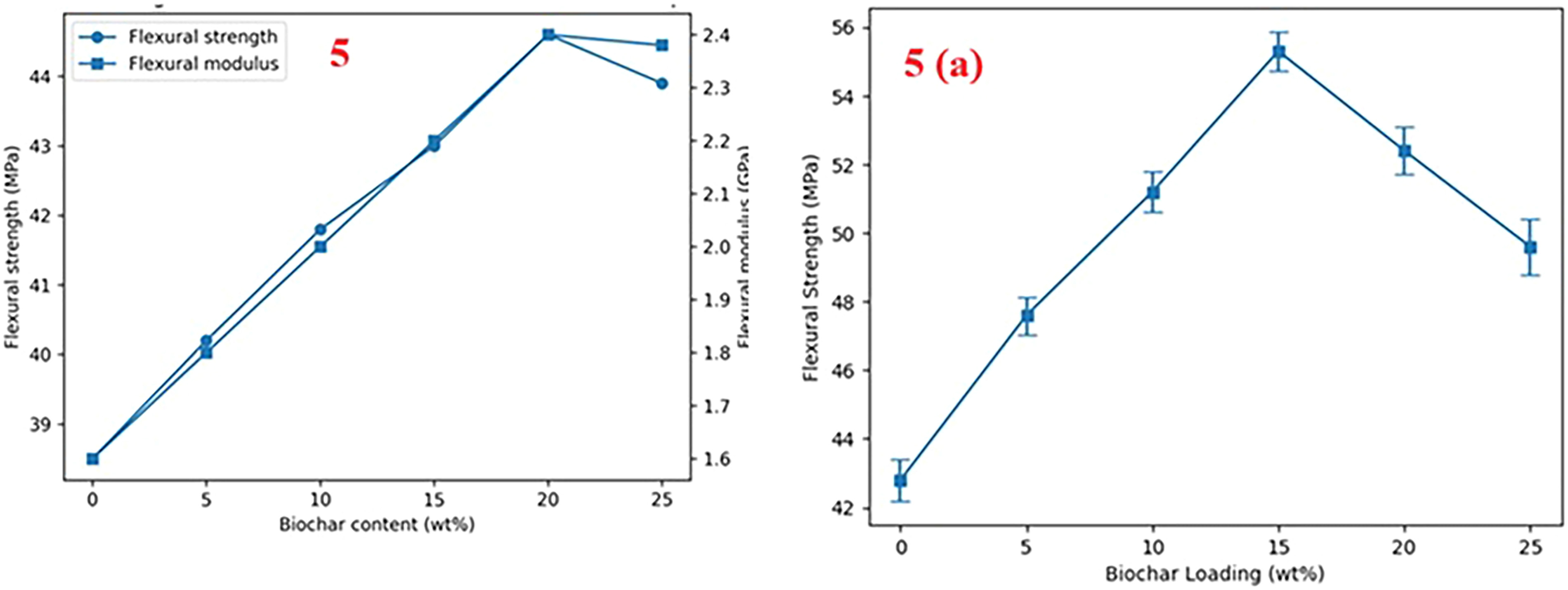
The flexural strength and modulus of the composites followed a trend similar to tensile results. As shown in Figure 5, flexural strength increased from 42.8 MPa (neat PP) to 55.3 MPa at 15 wt% biochar, while the flexural modulus improved by approximately 30%. The improvement results from the stiff nature of biochar particles and their uniform dispersion, which enhances the ability of the composite to resist bending deformation. The reduction in flexural strength beyond 20 wt% loading may be due to the formation of micro-cracks and poor stress transfer caused by filler agglomeration. The presence of MAPP significantly enhanced filler-matrix adhesion, reducing interfacial slippage under flexural loading [14]. The flexural strength and modulus values shown in Figure 5 are reported as mean ± standard error (n = 5). Flexural strength increased from 42.8 ± 0.61 MPa (neat PP) to 55.3 ± 0.57 MPa at 15 wt% biochar. The flexural modulus improved by approximately 30%, reaching 2.18 ± 0.04 GPa at optimum loading. The small SE values confirm consistent bending performance and uniform filler dispersion. However, at loadings beyond 20 wt%, flexural strength decreased (e.g., 49.6 ± 0.83 MPa at 25 wt%), likely due to filler agglomeration and micro-crack initiation under bending stress (Figure 5a).

Flexural strength and modulus of pp/biochar composites; (a) flexural strength with standard error.
5.3. Impact strength
The impact strength of the composites exhibited a decreasing trend with increasing biochar content, as shown in Figure 6. Neat PP demonstrated the highest impact energy absorption (22.4 J/m), which decreased to 15.7 J/m at 25 wt% biochar loading. The reduction in impact strength can be attributed to the brittle nature of biochar and restricted polymer chain mobility, which limits energy dissipation during fracture. However, the moderate reduction up to 10 wt% loading indicates that small amounts of biochar can be added without severely compromising toughness. This trade-off between stiffness and toughness is a typical characteristic of particulate-filled composites [15]. Impact strength values in Figure 6 are expressed as mean ± standard error (n = 5). Neat PP exhibited the highest impact strength of 22.4 ± 0.38 J/m, which decreased progressively to 15.7 ± 0.65 J/m at 25 wt% biochar loading. The increasing SE at higher filler content suggests greater variability due to heterogeneous filler dispersion and brittleness. Although toughness decreased, moderate loading levels (≤10 wt%) showed limited reduction (e.g., 20.1 ± 0.42 J/m), indicating that stiffness enhancement can be achieved without severely compromising impact resistance (Figure 6a).

5.4. Morphological analysis
The Scanning Electron Microscopy (SEM) micrographs of the fractured surfaces provided crucial insight into the filler dispersion and interfacial bonding characteristics. Figure 7 presents SEM images of composites with different biochar loadings. The neat PP surface exhibited smooth fracture morphology typical of ductile failure. In contrast, composites with 10–15 wt% biochar displayed rougher surfaces with well-dispersed particles embedded in the matrix, indicating effective stress transfer and strong filler-matrix adhesion. At higher loadings (20–25 wt%), the surfaces showed voids, clusters, and particle pull-outs, confirming poor interfacial bonding and agglomeration effects [16]. These morphological observations correlate strongly with the mechanical test results. The uniform filler distribution and strong interface at lower loadings enhanced both tensile and flexural strength, while the clustering and interfacial defects at higher loadings reduced overall mechanical performance. The microvoids observed at high filler concentrations also contributed to reduced impact strength due to premature crack propagation [17].

5.5. Density and void fraction
The measured composite density increased slightly with increasing biochar content, consistent with the higher density of biochar compared to PP. However, a marginal rise in void fraction was noted beyond 20 wt% filler loading, suggesting processing difficulties and incomplete wetting of filler particles. A void fraction below 1.5% up to 15 wt% indicated effective processing and uniform filler dispersion. The increase in voids at higher concentrations aligns with the observed drop in mechanical strength and the presence of interfacial gaps visible in SEM images [18].
5.6. Structure-property relationship
The mechanical behavior of the biochar-filled polymer composites is governed by a balance between filler dispersion, interfacial adhesion, and stress transfer efficiency. The introduction of biochar increases stiffness and strength due to its rigid particulate structure, while MAPP compatibilizer promotes good interfacial adhesion through ester linkages with hydroxyl groups on the biochar surface. However, at higher loadings, filler agglomeration reduces the effective surface area for interaction, leading to stress concentration sites and decreased mechanical performance. Morphological observations confirm that optimum mechanical properties are achieved at 10–15 wt% biochar loading, beyond which structural inhomogeneity dominates [19].
5.7. Discussion summary
The experimental results clearly demonstrate that the addition of biochar enhances the mechanical properties of polypropylene composites up to an optimal filler concentration. The findings are consistent with similar studies by YUE et al. [20], which also reported improved stiffness and strength in biochar-based composites at moderate loadings. The synergy between biochar’s micro-porous structure and MAPP coupling action plays a critical role in achieving mechanical reinforcement. The decline in toughness at higher loadings underscores the importance of maintaining fine dispersion and controlled filler content during processing. Overall, the integration of rice husk-derived biochar into polymer matrices presents a sustainable and effective strategy for developing lightweight, eco-friendly engineering materials.
5.8. Thermal properties (DSC and TGA analysis)
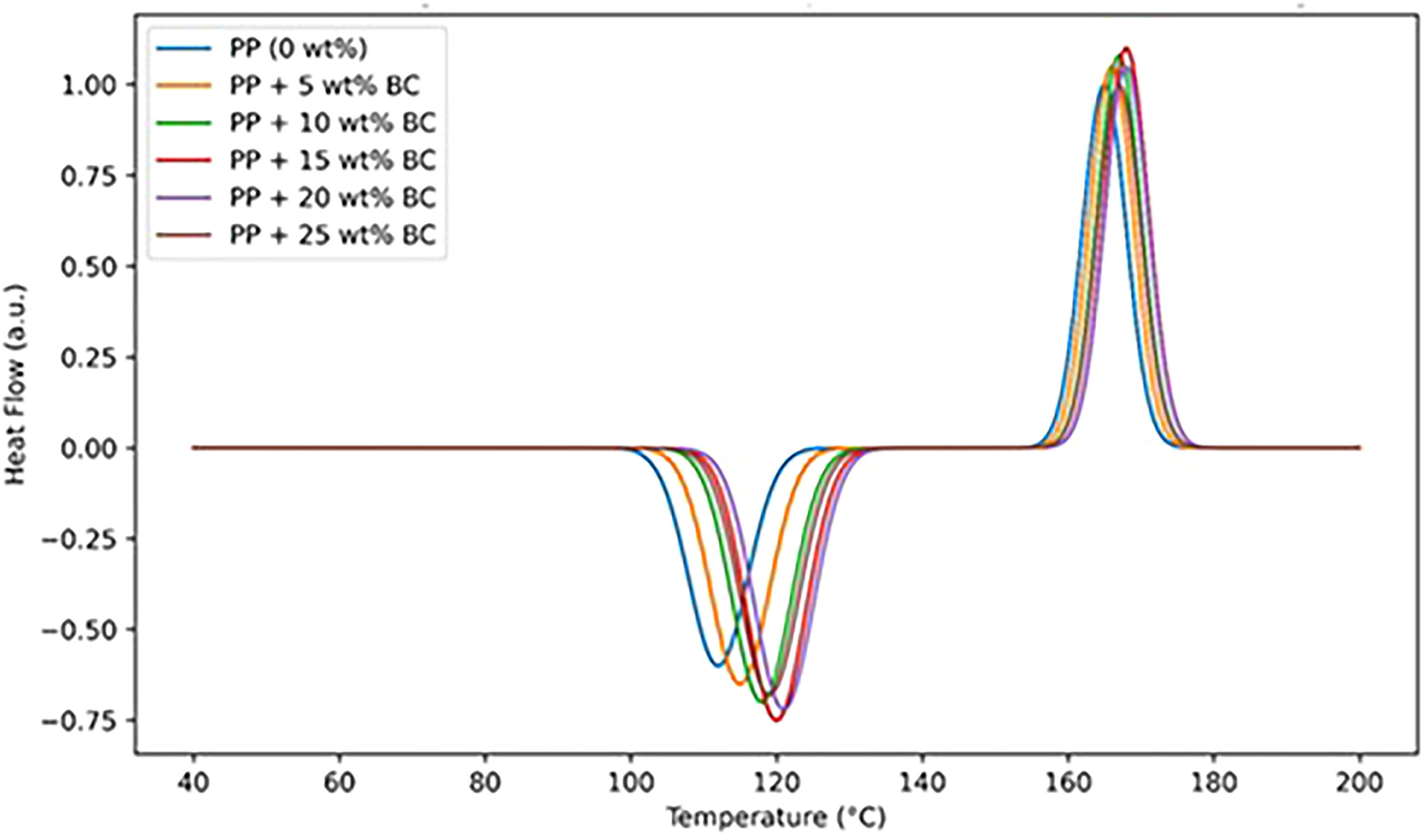
Thermal characterization was carried out using Differential Scanning Calorimetry (DSC) and Thermogravimetric Analysis (TGA) to evaluate the influence of biochar loading on the thermal behavior and stability of polypropylene-based bio-composites. DSC analysis provides insight into changes in melting temperature (T_ₘ), crystallization temperature (T_m), and degree of crystallinity (X_c), which are critical parameters governing stiffness and dimensional stability. The incorporation of biochar was observed to slightly increase the crystallization temperature of polypropylene at low to intermediate loadings, indicating a heterogeneous nucleation effect induced by the biochar surface. This behavior promotes more efficient crystallization and contributes to the observed improvement in tensile and flexural modulus at optimal filler contents. However, at higher biochar loadings, the degree of crystallinity showed a marginal reduction, likely due to restricted polymer chain mobility caused by particle agglomeration and increased melt viscosity, which hinders crystal growth (Figure 8).

Thermogravimetric analysis further demonstrated that the addition of biochar enhances the thermal stability of the composites. The onset degradation temperature (T_onset) and the temperature at maximum weight loss rate (T_max) shifted to higher values with increasing biochar content, reflecting the inherent thermal resistance and char-forming nature of biochar. The residual mass at 600–700 °C increased proportionally with biochar loading, confirming its role as a thermally stable carbonaceous phase that acts as a heat barrier and mass transport inhibitor during thermal decomposition. This protective effect delays the volatilization of polymer chains and reduces the rate of thermal degradation. Overall, the DSC and TGA results complement the mechanical findings by demonstrating that biochar not only reinforces polypropylene mechanically but also improves its thermal performance, thereby enhancing the suitability of the developed bio-composites for applications requiring elevated temperature resistance and improved thermal durability (Figure 9).

6. CONCLUSION
This study comprehensively investigated the mechanical, morphological, and thermal behavior of polypropylene-based bio-composites reinforced with rice husk-derived biochar. The results demonstrate that biochar significantly influences composite performance, with tensile and flexural properties improving up to an optimal filler loading of 10–15 wt%. This enhancement is primarily attributed to effective stress transfer, improved interfacial bonding facilitated by the compatibilizer, and favorable crystallization behavior induced by the biochar particles. Beyond this optimal range, excessive biochar content led to particle agglomeration, increased void formation, and restricted polymer chain mobility, resulting in reduced mechanical performance and impact strength. Morphological analysis using Scanning Electron Microscopy (SEM) confirmed a uniform dispersion of biochar and strong matrix-filler adhesion at lower loadings, while higher filler concentrations exhibited clusters, microvoids, and particle pull-out, corroborating the observed mechanical trends. Thermal analysis through Differential Scanning Calorimetry (DSC) revealed that biochar acts as a heterogeneous nucleating agent at moderate loadings, slightly increasing crystallization temperature and supporting stiffness enhancement. Thermogravimetric Analysis (TGA) further showed improved thermal stability with increasing biochar content, evidenced by higher degradation temperatures and increased residual char, highlighting the protective role of biochar during thermal decomposition. Overall, the findings confirm that agricultural waste-derived biochar can be effectively utilized as an eco-friendly reinforcing filler to develop lightweight, thermally stable, and mechanically enhanced polymer bio-composites. The identified optimal biochar loading of 10–15 wt% provides the best balance between strength, stiffness, thermal durability, and processability. This work supports the valorization of biomass residues and contributes to the development of sustainable composite materials, with promising potential for applications in automotive components, construction materials, and consumer products. Despite the encouraging results obtained in this study, several limitations should be acknowledged. The investigation was limited to a single polymer matrix (polypropylene) and untreated rice husk-derived biochar, and only one coupling agent (MAPP) at a fixed concentration was employed. Future work should focus on surface modification of biochar, hybrid filler systems, and thermal or electrical property evaluations to extend the application potential of biochar-reinforced polymer composites in automotive, construction, and consumer product industries.
7. BIBLIOGRAPHY
-
[1] ABOUGHALY, M., BABAEI-GHAZVINI, A., DHAR, P., et al, “Enhancing the potential of polymer composites using biochar: a review”, Polymers, v. 15, n. 19, pp. 3981, 2023. doi: https://doi.org/10.3390/polym15193981. PubMed PMID: 37836030.
» https://doi.org/10.3390/polym15193981 - [2] AHMED, T., RAHMAN, M., “Mechanical properties of biochar-polypropylene composites: effect of filler size and dispersion”, Materials Research Express, v. 8, n. 5, pp. 055301, 2021.
-
[3] CHEN, J., LI, D., XU, Q., “Interfacial interaction and mechanical performance of rice husk biochar reinforced PP composites”, Composites. Part B, Engineering, v. 237, pp. 109849, 2022. doi: https://doi.org/10.1016/j.compositesb.2022.109849.
» https://doi.org/10.1016/j.compositesb.2022.109849 -
[4] SANAKA, R., SAHU, S.K., SREEKANTH, P.S.R., et al, “A review of the current state of research and future prospectives on stimulus-responsive shape memory polymer composite and its blends”, Journal of Composites Science, v. 8, n. 8, pp. 324, 2024. doi: https://doi.org/10.3390/jcs8080324.
» https://doi.org/10.3390/jcs8080324 - [5] DAY, R., TOMASI, R., ROSSI, F., “Mechanical reinforcement of PLA-based biocomposites using agricultural waste biochar”, Composites Part C: Open Access, v. 18, pp. 100667, 2024.
- [6] GĘCA, M., ŚWIECHOWSKI, K., KUCIEL, S., “Surface treatment of biochar methods and potential applications: a review”, Chemical Engineering, v. 6, n. 2, pp. 13, 2023.
-
[7] GEORGE, J., NAIR, S.S., THOMAS, S., “Influence of pinewood biochar on the antistatic and mechanical performance of PP composites”, Polymer Composites, v. 45, n. 2, pp. 885–896, 2024. doi: https://doi.org/10.1002/pc.28234.
» https://doi.org/10.1002/pc.28234 -
[8] GUPTA, R., KUMAR, R., SINGH, V., “Mechanical and morphological properties of HDPE composites reinforced with wood-derived biochar”, Journal of Applied Polymer Science, v. 140, n. 12, e53322, 2023. doi: https://doi.org/10.1002/app.53322.
» https://doi.org/10.1002/app.53322 -
[9] MOEZZI, M.D., KARRABI, M., JAHANI, Y., “Thermal tensile, and dynamic mechanical properties of PVDF/FKM blends in different curing systems”, Porrime, v. 41, n. 2, pp. 250, 2017. doi: https://doi.org/10.7317/pk.2017.41.2.250.
» https://doi.org/10.7317/pk.2017.41.2.250 - [10] JAYANARAYANAN, K., JOSEPH, K., “Thermal and mechanical behavior of biochar-reinforced polypropylene composites”, Journal of Thermoplastic Composite Materials, v. 34, n. 6, pp. 756–772, 2021.
-
[11] KUMAR, R., GUPTA, A., “Role of biochar as a reinforcing agent in sustainable composite materials”, Journal of Cleaner Production, v. 340, pp. 130711, 2022. doi: https://doi.org/10.1016/j.jclepro.2022.130711.
» https://doi.org/10.1016/j.jclepro.2022.130711 -
[12] DHAR BADGAYAN, N., KUMAR SAHU, S., SAMANTA, S., et al, “Assessment of bulk mechanical properties of HDPE hybrid composite filled with 1D/2D nanofiller system”, Materials Science Forum, v. 917, pp. 12–16, 2018. doi: https://doi.org/10.4028/www.scientific.net/MSF.917.12.
» https://doi.org/10.4028/www.scientific.net/MSF.917.12 -
[13] LUO, W., ZHAO, S., HAN, J., “Mechanical and morphological study of polyethylene/biochar composites for sustainable packaging”, Sustainable Materials and Technologies, v. 36, e00742, 2023. doi: https://doi.org/10.1016/j.susmat.2023.e00742.
» https://doi.org/10.1016/j.susmat.2023.e00742 - [14] PARK, S.Y., LEE, H., “Enhancement of biocomposite performance through pyrolysis-derived carbon fillers”, Composites Science and Technology, v. 203, pp. 108621, 2021.
-
[15] KASI, E., JOSEPHRAJ, F.X., MURUGESAN, A.K., et al, “Effect of crosslink density on cut and chip resistance of 100% sbr based tire tread compound”, Materiale Plastice, v. 58, n. 1, pp. 34–46, 2021. doi: https://doi.org/10.37358/MP.21.1.5443.
» https://doi.org/10.37358/MP.21.1.5443 -
[16] SAHU, S.K., RAMA SREEKANTH, P.S., “Evaluation of tensile properties of spherical shaped SiC inclusions inside recycled HDPE matrix using FEM based representative volume element approach”, Heliyon, v. 9, n. 3, e14034, 2023. doi: https://doi.org/10.1016/j.heliyon.2023.e14034. PubMed PMID: 36925524.
» https://doi.org/10.1016/j.heliyon.2023.e14034 -
[17] SAHU, S.K., SREEKANTH, P.S.R., “Experimental investigation of in-plane compressive and damping behavior anisotropic graded honeycomb structure”, Arabian Journal for Science and Engineering, v. 47, n. 12, pp. 15741–15753, 2022. doi: https://doi.org/10.1007/s13369-022-06771-z.
» https://doi.org/10.1007/s13369-022-06771-z - [18] VIDAKIS, N., PETOUSIS, M., TZOUNIS, L., “Optimized biochar content in HDPE composites for improved stiffness and electrical conductivity”, SN Applied Sciences, v. 6, n. 1, pp. 34, 2024.
-
[19] SANAKA, R., SAHU, S., “Experimental investigation into mechanical, thermal, and shape memory behavior of thermoresponsive PU/MXene shape memory polymer nanocomposite”, Heliyon, v. 10, n. 2, e24014, 2024. doi: https://doi.org/10.1016/j.heliyon.2024.e24014. PubMed PMID: 38293526.
» https://doi.org/10.1016/j.heliyon.2024.e24014 -
[20] YUE, M.R., LIU, J.B., JIANG, P.Y., et al, “Surface and interface modification of biochar based on thermal nanobubble water”, Journal of Environmental Chemical Engineering, v. 13, n. 3, pp. 116537, 2025. doi: https://doi.org/10.1016/j.jece.2025.116537.
» https://doi.org/10.1016/j.jece.2025.116537