 Comparison of torsional, bending, and buckling resistances of different nickel-titanium glide path files
Abstract
Aim: This study aims to provide information about the mechanical characteristics of the files by comparing the torsional, bending and torsion strengths of glide path files with different properties.
Method: WaveOne Gold (WOG)(15/v), ROTATE (15/.04), TruNatomy (17/.02), and Scope (17/.03) glide path files were used in this study. Torsional, bending, and buckling strength tests were performed using standard test methods according to ISO 3630-1 specifications (n = 12 from each group for each test). One-way analysis of variance was used to compare normally distributed data, and multiple comparisons were examined with Tukey’s honestly significant difference (HSD) and Tamhane’s T2 tests. The significance level was p < 0.050.
Results: No statistically significant difference was found between the torsional strengths. The highest angular deviation value occurred in TruNatomy, while Scope had the highest bending and buckling strengths.
Conclusion: The glide path instruments tested had different behaviours on bending, buckling and torsional resistance. Production methods and design features affect the mechanical properties of glide path files. For clinical use, the glide path file should be selected on a case-by-case basis.
Keywords:
Glide path; torsional; bending; buckling; nickel titanium
1. INTRODUCTION
The glide path is defined as a straight tunnel from the root canal orifice to the apical foramen [1]. The glide path is highly important because it reduces the “taper lock” effect on files and prevents them from fracturing [2], preserves the original root canal anatomy [3], and reduces the risk of apical transportation [4], ensuring the successful completion of mechanical shaping in root canal treatments [5].
Root canals are narrow and have irregular dentin walls before preparation (7, 8). The most common mistakes made during root canal shaping with NiTi rotary systems are apical transportation and flattening of root curvature [1]. Both the apical transportation and the loss of working length have been directly associated with mechanical properties of NiTi files [6].
Glide path files are the first files to the working length so the files must have a certain hardness and fracture resistance to open blockages, as well as certain bending and buckling resistance to bypass the curvatures [7]. Torsional and bending properties reduce the risk of errors during shaping. The files with high torsional and bending resistance must effectively navigate curved canals while resisting deformation or fracture. Bending resistance directly affect the flexibility of glidepath files. Files with higher flexibility can better adapt to the complex anatomy of the root canal system, facilitating smoother navigation and reducing the risk of canal transportation or ledging [8]. Both the apical transportation and the loss of working length have been directly associated with bending resistance of NiTi files [6]. Buckling strength reflects the ability of a file to resist lateral deflection when subjected to compressive loads; this is particularly important in narrow and often calcified root canals. High buckling strength of glide path files allows them to effectively penetrate narrow root canal openings and pass through obstructed passages [9].
Mechanical properties, material composition, design and geometry (cross-section, taper, core mass volume, cross-section etc.) and heat treatment affect the performance of the files used in root canal treatment, including cyclic fatigue, torsion, bending, and buckling resistance [7, 8]. Therefore, the mechanical properties of files need to be evaluated and different mechanical properties need to be examined to determine their clinical performance.
The WaveOne Gold (WOG) (Dentsply Sirona, Ballaigues, Switzerland) reciprocal glide path file is made of “gold” heat treated alloy. It is a parallel-edge cross-section file with two cutting edges, a tip diameter of 0.15 mm, and a variable taper increasing by 2%–6%. It exhibits increased flexibility and fracture resistance with the special process applied during the production phase [10].
VDW ROTATE (RT) (VDW, Munich, Germany) is a glide path file with a tip diameter of 0.15 mm and a taper of 4%, driven by continuous rotation. The file system has a lower breakage incidence and greater flexibility with the “blue-wire” heat treatment. The cutting efficiency is increased and the screwing effect is reduced with the double-bladed adapted S-shaped section design [11].
The TruNatomy (TruN) (Dentsply Sirona, Ballaigue, Switzerland) rotational glide path file is a parallel-edge cross-section file with a tip diameter of 0.17 mm and a taper of 2% [12]. The file system has high elasticity and fatigue resistance produced with a new heat treatment procedure [13].
The Scope RS (SC) (ScopeEndo, Yozgat, Turkey) rotational glide path file has a tip diameter of 0.17 mm and a taper of 3%. Its cutting edge is increased with a rectangular cross-sectional area, and its fracture strength and flexibility are enhanced with the application of “gold” heat treatment [14].
The shaping ability of glide path files is affected by a variety of factors, including section design, alloy type, heat treatment, tip geometry, and operator skill [15]. Manufacturers produce files with different designs and properties, working with various techniques and kinematics. The properties that affect the mechanical performance of the file, such as torsional, bending and bending strength, can be measured and compared with standard setups (ISO 3630-1, 2019) that mimic the stresses experienced by glide path files during shaping. This study aims to provide information about the mechanical characteristics of the files by comparing the torsional, bending and torsion strengths of glide path files with different properties and kinematics with standard mechanisms.
2. MATERIALS AND METHODS
This study was supported by the Trakya University Scientific Research Projects Coordination Unit (Project Number 2021/92).
2.1. Sample preparation
In this study, four different glide path files with distinct properties were used. All files were examined with a stereomicroscope under ×200 magnification, and the files with defects or irregularities on the surface that may have resulted from production were excluded from the study. Three different mechanical tests were available for four different glide path files. In the power analysis made by examining the sample literature, the plan was to include 12 samples in each group when the power was 90%, the probability of error was α: 0.05, and the effect size was d = 1.249. 144 files, 36 from each file system, were subjected to three different mechanical tests. The cross section designs and the D0-1-3 values of each file are shown in Table 1.
2.2. Torsional strength test
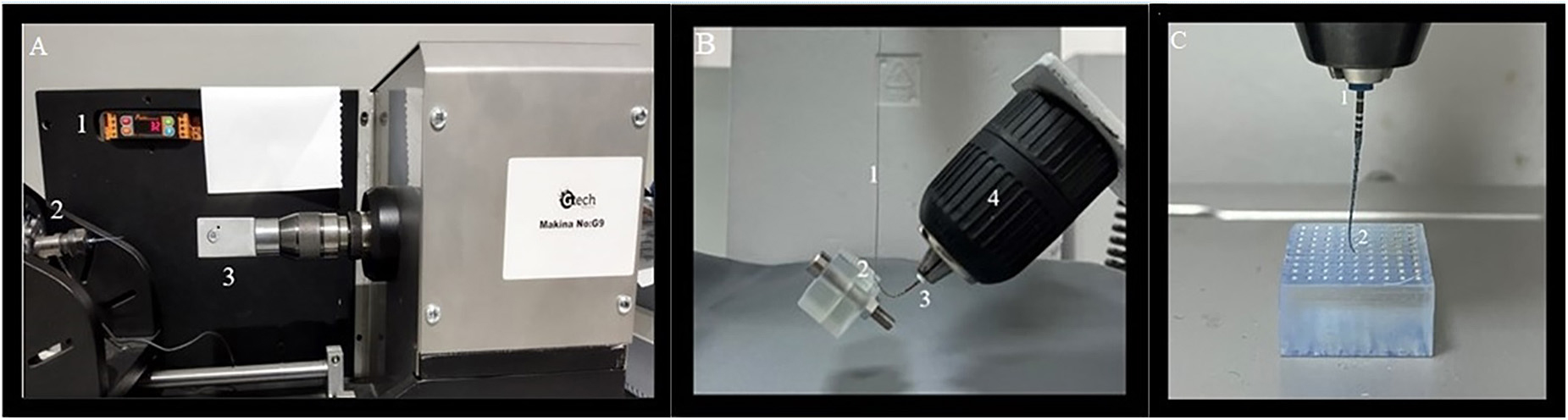
Torsional strength testing was performed according to ISO 3630-1 specifications (2019) and previous studies (14). A computer-assisted torsiometer device was used for the tests. The shaft of the files was fixed to the torsiometer, and the 3 mm tip was fixed with an apparatus (Figure 1A). The test was performed clockwise for TruNatomy, ROTATE, and Scope and counterclockwise for WOG at 2 rpm. Maximum torque and angular deviation in degrees were recorded until fracture occurred.
A: Torsional resistance test assembly. The instrument is affixed to a Jacobs mandrel by thecable and clamped 3 mm from their tips using a Chuck (1: Torque display screen, 2: Fixation area of shaft 3: Fixation area of the 3 mm tip of the file.), B: Bending test setup: (1: Wire used to pull the instrument, 2: Clamps to fix the instrument tip, 3: Jacobs chunk), C: Buckling test setup (1: Jacobs chunk, 2: base assembled to perform the buckling test).
2.3. Bending test
The bending strength test was performed using a universal test according to the ISO 3630-1 (2019) specifications (14). The 3 mm tip of the files was fixed with the help of a special holder printed on a 3D resin printer (Formlabs Form 3 SLA printer, Berlin, Germany) produced with computer-aided 3D solid modeling and design software (SolidWorks, 2020). A wire was attached to the fixed point. The files were fixed at a 45° slope using a “Jacobs chuck.” A 50 N force was applied to the tip of the file with the aid of a wire at a speed of 15 mm/min and continued until an elastic displacement of 45° (the point where the fixed 3 mm tip of the file is aligned with the shaft part) was obtained (Figure 1B). The values obtained in “gf” unit were recorded.
2.4. SEM analysis
SEM Analysis were used for two purposes: to visualise the surface quality of new instruments and to observe fracture surfaces. First, all new instruments were examined at x200 magnification. The aim was to highlight instrument surface roughness and the presence of irregularities or defects before testing. In a second step, five fractured instruments per group were randomly selected. They were cleaned in an ultrasonic bath before observation. These fractured surfaces were examined at up to 600x magnification to determine topography and fatigue failure.
2.5. Buckling test
In the buckling test, the load was applied parallel to the long axis for each file using a universal testing device. Maximum buckling load (elastic lateral deformation) was performed according to published studies (7, 14). The shaft of the file was connected to the test device with the help of a chuck. The tip of the file was placed in a 0.5-mm-deep and 1-mm-diameter groove made on an acrylic surface printed on a 3D resin printer (Formlabs Form 3B+ SLA printer, Berlin, Germany). A 50 N force was applied at a rate of 1 mm/min, and the force was recorded when a compression of 1 mm occurred in the file (Figure 1C).
2.6. Statistical analysis
Data were analyzed with IBM SPSS V23. One-way analysis of variance was used to compare normally distributed bending strength, buckling strength, torque, and angle values according to the files, and multiple comparisons were examined with Tukey’s honestly significant difference (HSD) and Tamhane’s T2 tests. Analysis results were presented as mean ± standard deviation. The significance level was p < 0.050.
3. RESULTS
The maximum torque values with torsional fracture according to the files are shown in Table 2. No statistically significant difference was observed between the torque values (p > 0.05).
Mean and standard deviation of torque (Ncm) and angle deviation (°), bending resistance (gf), buckling resistance (gf) of tested instruments.
A statistically significant difference was found between the angular rotation values according to the files (Table 2) (p < 0.05). TruN had the highest average angular rotation value. The lowest mean angular rotation value was observed in SC and RT. No statistically significant difference was observed between the two file groups (p > 0.05). The mean angular rotation value of the WOG was lower than the TruNatomy but higher than the RT and SC. However, no statistically significant difference was found between them (p > 0.05).
A statistically significant difference was observed between the mean values of bending strength according to the files (Table 2) (p < 0.05). The highest mean bending strength was obtained from SC, while the lowest mean value was obtained from TruN.
A statistically significant difference was found between the torsional strength values according to the files (Table 2) (p < 0.05). The highest mean buckling strength was obtained from SC, while the lowest mean value was obtained from WOG.
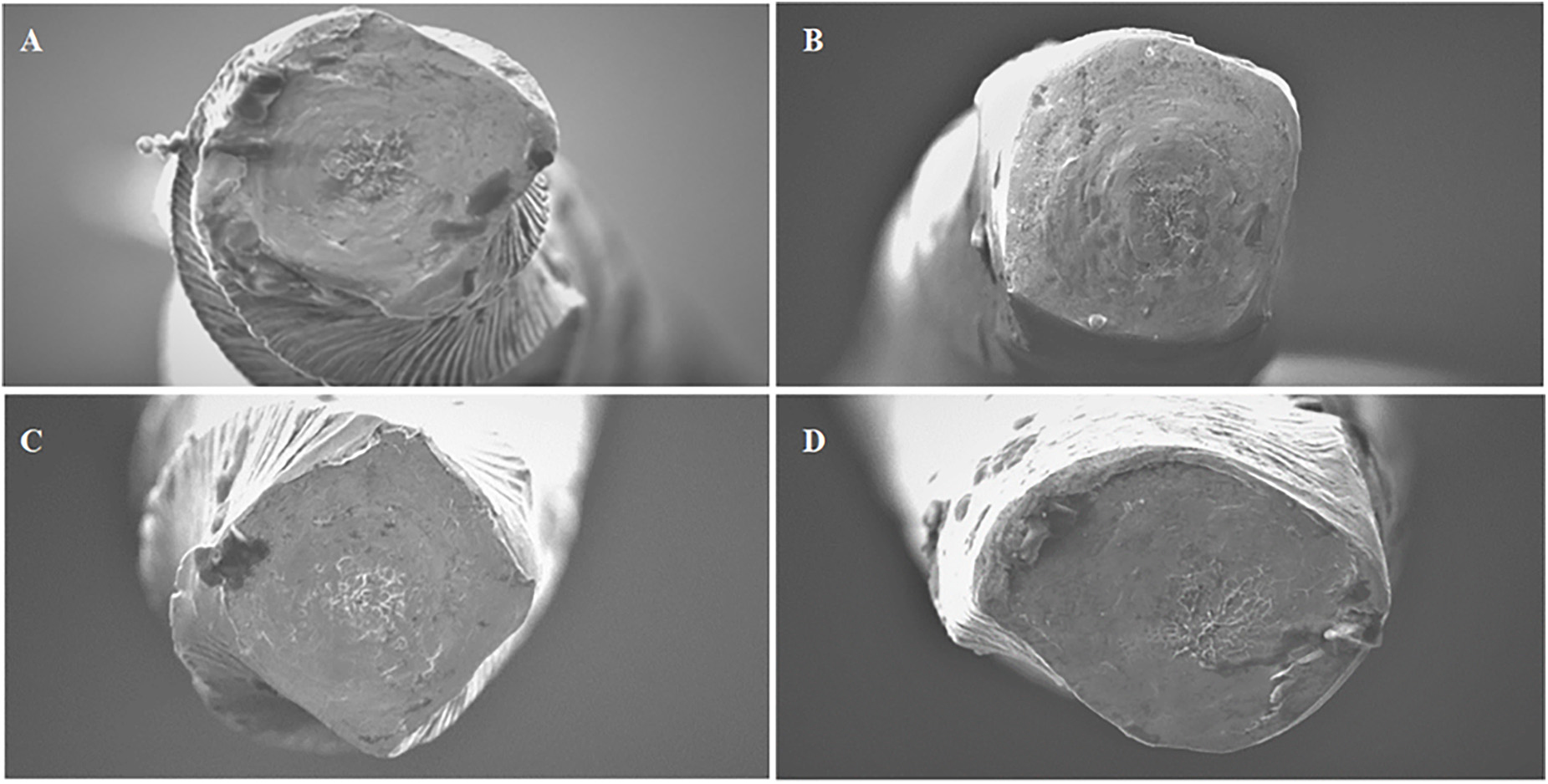
Given that fractographic analysis was performed on the SEM images, it was determined that the files were broken by torsional stress. In torsional fractures, plastic deformation must occur in the material before the fracture like ductile fracture. This often results in a stable and predictable mode of fracture in which crack growth can only occur under an increasing applied load; when the load is reduced the crack stops growing [16] Torsional fractures occur because of stresses that the NiTi alloy cannot resist due to plastic deformation. The small cracks formed by the compression of the tip of the file and the continuation of the rotation of the shaft part coalesce and spread slowly over the entire surface, unlike cyclic fractures. Due to this spread, a dull and fibrous appearance is formed on the fracture surface [17] (Figure 2). When the SEM analyses of the fractured surfaces were evaluated, although the files had different technical and design features, similar defects were revealed, including simultaneous wear marks and pitted areas in the rotation center. The abrasion marks and dimples in the center are typical features of torsional fracture [16, 18]

SEM images (x600) fractured fragments; (A) WOG, (B) ROTATE, (C) TruNatomy, (D) Scope. The red arrows show fibrous appearance on the torsional fracture surface.
4. DISCUSSION
One of the considerations to reduce the incidence of file fractures is to prepare a glide path before shaping with NiTi rotary files (14, 52). Although glide path files are produced in smaller diameters and tapered, their mechanical performance should be at least as good as the files used for shaping [7, 15, 19]. High flexibility, high buckling resistance, and high torque and angular deflection values are expected in the mechanical tests [20].
One of the main difficulties in testing dental materials is the repetition of simple and complex clinical conditions. Mechanical tests, although limited by their ability to simulate clinical situations, allow the replacement of various devices through the assessment of their response to specific types of stress (23). This is an important factor in setting up test conditions that mimic complex clinical conditions. The complexities of clinical conditions are difficult, if not impossible, to reproduce accurately in a laboratory environment. In particular, the effect of thermal and irrigation solutions to which the files are exposed while working in their canals is an additional factor that increases file fatigue [21]. However, no single method can fully capture the complexity of the clinical situation due to the versatile nature of NiTi files. Therefore, a more promising approach involving the careful combination of multiple methods has recently been proposed to provide a comprehensive and nuanced understanding of their behaviour [22]. Whereas many different test mechanisms can be established for cyclic fatigue testing, there are not many alternative mechanisms for torsional testing. The bending test is a test related to the flexibility of the file and plays an important role, particularly in curvature canals [23]. The evaluation of the torsional behavior of the files under a high torsional force differed from their clinical use, and higher torsional strength was applied to the files in the standard test method than in clinical use [24].
Two parameters have generally been measured to evaluate tool mechanical properties: time to failure during cyclic fatigue testing (or number of revolutions to failure if the manufacturer recommends different speeds) and maximum torque sustained during torsion. The first shows the ability of the tool to withstand rotational stress in a curved canal and to withstand repeated cycles of compressive and tensile forces [22]. Glide path files are less exposed to cyclic fatigue stresses since they generally aim to reach the apex in narrow and calcified canals. The second measures the ability of the tip of the instrument to withstand bending stress, similar to the compressive pressure against the root canal wall [22]. To measure and compare the torsional strength of glide path files, it is important to evaluate all file systems with standardized test methods that mimic the clinical environment [24].
In this study, the torsional test was performed using a standard test method according to ISO 3630-1 (2019) specifications [20]. The tips of the files were fixed at 3 mm in the experimental setup, and rotation force was applied until fracture occurred. In another study, the tips of the files were fixed at 5 mm [25]. The torsional resistance increased as the metal mass of the files increased. In this study, 3 mm was preferred because 5 mm files are more resistant to breakage [26]. WOG shapes were produced with 170° counterclockwise and 50° clockwise motion [10]. A continuous rotational force was applied to the WOG files to ensure that test standardization is not suitable for clinical use and to obtain data comparable to previous studies [18].
In this study, two different data were examined in the torsional strength test. The first is the maximum amount of torque applied until the files break, and the second is the angular deviation until breakage occurs. Maximum torque is the maximum torsional resistance before failure, while angular deflection is the angle of rotation along the long axis before failure [19]. The torsional strength decreases as the flexibility of the NiTi alloy increases [27]. In other studies, torsional strength increases when the core diameter-tip diameter-taper values of the files increase [18, 20]. The files used in this study have different geometrical and metallurgical properties. Some features provide an advantage over torsional strength, while others pose a disadvantage. The fact that there was no significant difference between the files according to the results of the torsional strength test can be explained by balancing the features.
Angular deflection is the most important factor when evaluating torsional strength [19, 28]. Angular deflection shows the moment of highest elastic and plastic deformation before a fracture occurs. This is referred to as the “safety factor” for files [24]. The “safety factor” is characterized by the opening in the grooves of the file because of continuously applied torsional stress. This deformation alerts the clinician to the risk of file fracture because of applied forces [19]. The file with high angular deflection has greater flexibility and deformation capacity [29]. TruN had statistically higher flexibility than WOG, but the angular deviation value was not significantly higher.
Another important feature of the files is “flexibility.” Flexibility can be defined as the elastic bending of an endodontic file because of a force applied perpendicular to its long axis (26). Preserving the original form of root canal anatomy in canals with curvature in shaping procedures in endodontic treatment is difficult (27). The first file to the working length proceeds in the most curvature of the canal, and the curvature improves as the canal is widened. For this reason, glide path files must have high flexibility, which can be evaluated through the bending resistance test (2).
Other relevant parameters include the flexibility parameters represented by the angle of rotation under torsion, which reflects the ability of the instrument to withstand deformation before fracture under torsional stress, and the maximum bending load, where lower values indicate greater flexibility. This characteristic can improve root canal shaping procedures by reducing the chance of deviation from the original canal path. Furthermore, the maximum bending load may be an indication of the instrument’s ability to withstand light apical pressure without deformation during the root canal preparation procedure, while microhardness may influence the tensile strength and cutting efficiency of the instruments [22].
The difference between angular deflection and flexibility is due to the application of force in different directions to the files in the bending and torsion resistance test. Moreover, the files are exposed to different stresses. The type of heat treatment of the files and the design differences may have led to the different resistance values to the forces applied in different directions.
“Buckling” is defined as a sudden bending of the file to one side, which occurs when a compressive force exceeds the resistance of the file [7]. Buckling differs from flexibility because flexibility is related to the application of a load perpendicular (non-parallel) to the axis of the file [30]. The buckling resistance is an important feature that allows the file to reach the apical in narrow and calcified canals [7]. The file is advanced apically until it is compressed between the walls of the narrow root canals, followed by a clocking or reaming motion with light apical pressure. The repetition of the movements allows the file to advance through the narrow calcified canal [7]. Glide path files with sufficient buckling strength can facilitate both the finding of canals and the advancement of the file in the apical direction [31]. High buckling resistance indicated better deflection resistance during pecking. The greatest upward force was observed when the NiTi glide path instrument with the higher buckling resistance reached the most apical level and then moved towards the coronal region. The upward and downward forces that occur may influence the risk of NiTi glide path files becoming embedded in fractures [32].
No significant difference was observed in flexibility between WOG and RT in the bending strength test. WOG is made of M-Wire alloy, is gold heat-treated, and has a parallel-section design, whereas RT is made of Blue-Wire alloy and has an S-section design. The M-Wire has higher torsional stiffness and lower flexibility than Blue Wire [27]. In another study, the torsional strength of the R-pilot glide path file with M-Wire was found to be higher than that of the RT glide path file [24]. Considering that flexibility affects torsional strength and that more flexible files have lower torsional strength [33], Blue-Wire alloys can be considered more flexible than M-Wire alloys, although not all parameters can be isolated. The gold heat treatment in WOG imbues it with more flexibility than other M-Wire alloys [20]. WOG and RT show similar flexibility resistance as the advantages created by some features and the disadvantages caused by other features balance each other, although flexibility resistance is affected by various factors.
The difference in the results of the buckling resistance test can be explained by the different sizes and thinness of the files used and the mechanical behavior of the NiTi alloy [7]. In previous studies, files with higher bending strength and larger diameter and taper have higher buckling resistance [7]. The diameter of the files at the thin tip and rigidity are important factors affecting the buckling resistance of the file [7, 20, 28]. In LOPES et al.’s [7] study, ProFile (PF) showed the highest buckling resistance in C+ and the lowest buckling resistance. The result is due to the high taper of C+ in the first 4 mm and the high flexibility of the PF, which was made of NiTi alloy. Similar to the results of their study, the Scope, which had the least flexibility and the largest diameter at 3 mm, had the highest buckling resistance in our study. Although they had similar flexibility, RT had a higher buckling resistance than WOG due to its larger tip diameter because WOG had the lowest diameter in the first 3 mm of the file length. In the same region, the average diameter of RT was larger than that of TruN. The difference between our study and theirs is that TruN, which is more flexible than the others, has a higher buckling resistance than WOG, which may be due to the fact that the tip diameter is higher than that of WOG and its special heat treatment. HA et al. [34] reported that the WOG file has the lowest buckling resistance, which is due to the flexibility gained from the golden heat treatment of the file. This result is partially compatible with our study. Files with higher apical diameter and size show greater buckling resistance [7].
ELNAGHY and ELSAKA [2] reported that the M-Wire alloy has superior flexibility and fracture strength compared with conventional alloys. The small martensite grain size observed in M-Wire alloys contributes to its mechanical properties, especially torque and wear resistances [35]. No statistically significant difference was observed between the two files in terms of sprain strength. This similarity was thought to be related to the similar thinness and dimensions of the files. Although both were gold heat-treated in our study, the WOG produced from the M-Wire alloy had higher flexibility values than the Scope produced from traditional alloy. Although the M-Wire has higher torsional strength, no statistically significant difference was found between the torsional strength of WOG and SC, which may be attributed to the difference in the tip diameter and taper of the files.
LOPES et al. [20] reported that WOG has lower bending strength, that is, it is more flexible. In their study, similar to ours, the diameter of the files at D4, D8, and D16 points was measured. The file with a larger diameter and cross-section had greater bending strength. The WOG with a parallel section design and the ProtaperGlider (PG) with a rectangular-section design had a larger section design than the Reciproc (RP) with an S-fraction design. Files designed with smaller cross-sectional geometry, like those with an “S” shape, are typically more flexible and can better adapt to the curvature of root canals [36]. In our study, RT was more flexible than SC, despite having a similar diameter, which may be due to the cross-section. In our study, the file with the highest bending strength is the most rigid, as SC is one of the files with the largest taper and core diameter. A file with a smaller taper can navigate more effectively in curved canals because it puts less stress on the canal walls and has a better ability to conform to the shape of the canal. Conversely, files with a larger taper may be more rigid, making them less flexible and more adaptable to curved canals. The interaction between taper and overall cross-sectional geometry also plays a role in determining flexibility, as a well-designed file can improve performance in complex canal systems [36]. Since the files used in the study had different properties and the variables could not be isolated, interpreting this result was stated as the limitation of the study. However, the greater flexibility of WOG may be due to its gold heat treatment. In our study, the gold heat-treated Scope file has the least flexibility, suggesting that the file diameter is vital in flexibility, contrary to this view. In addition, in their study, it was suggested that although the cross-section design is larger, the PG is more flexible than the RP because it has a smaller diameter along the length of the file [20]. Similarly, in our study, although TruNatomy had a parallel section design, its flexibility was attributed to its smaller diameter along the length of the file. Therefore, the results could not be interpreted clearly in our study due to similar limitations.
The most serious limitation of our study is that it cannot clearly mimic clinical situations. There are other factors that clinically influence the mechanical properties assessed by standart test methods in this study. On the one hand, it is important to note that the tests were performed in static mode, which is different from clinical use. On the other hand, the conditions of the root canal (calsifications, inclination, irregularities in the canal, etc.), the experience of the physician, The presence and temperature of the irrigation solution can also be considered among the factors affecting the mechanical strength of the files. Although studies suggest performing these tests at intra-canal temperature to mimic the clinical situation.
The brief time in which the file is in clinical contact with the root canal walls is not likely to raise and stabilize the temperature to the point that will induce crystal changes that could affect the results evaluated [37]. The irrigating solution used at room temperature and the thermal insulation efficiency of the dentin would probably prevent the file from reaching clinical body temperature [20]. In addition, the standard test methods ISO 3630-1 do not mention the use of intra-canal temperature during the tests. Another limitation of our study is that due to the different wire properties, tip diameter, taper and design features of the glide path files used, it is not possible to clearly interpret the mechanical superiority because different parameters cannot be isolated.
In future studies, it is important to use test setups that better mimic clinical situations and to use glide path files with more similar characteristics to obtain more accurate results.
5. CONCLUSIONS
Within the limitations of this study, no statistically significant difference was observed between the torsional strength of the files. Although a file must have high flexibility to shape curvature canals while preserving the canal anatomy, high buckling resistance and high rigidity may be required to advance in calcified and narrow canals. Given the clinicians’ results from the aforementioned studies, we recommend selecting the appropriate glide path file for clinical use on a case-by-case basis.
6. ACKNOWLEDGMENTS
This study was supported by the Trakya University Scientific Research Projects Coordination Unit (Project Number 2021/92).
7. BIBLIOGRAPHY
-
[1] CHEUNG, G.S., LIU, C.S., “A retrospective study of endodontic treatment outcome between nickel-titanium rotary and stainless steel hand filing techniques”, Journal of Endodontics, v. 35, n. 7, pp. 938–943, 2009. doi: http://doi.org/10.1016/j.joen.2009.04.016. PubMed PMID: 19567311.
» https://doi.org/10.1016/j.joen.2009.04.016 -
[2] ELNAGHY, A., ELSAKA, S., “Evaluation of the mechanical behaviour of PathFile and ProGlider pathfinding nickel-titanium rotary instruments”, International Endodontic Journal, v. 48, n. 9, pp. 894–901, 2015. doi: http://doi.org/10.1111/iej.12386. PubMed PMID: 25266920.
» https://doi.org/10.1111/iej.12386 -
[3] D’Amario, M., BALDI, M., PETRICCA, R., et al, “Evaluation of a new nickel-titanium system to create the glide path in root canal preparation of curved canals”, Journal of Endodontics, v. 39, n. 12, pp. 1581–1584, 2013. doi: http://doi.org/10.1016/j.joen.2013.06.037. PubMed PMID: 24238451.
» https://doi.org/10.1016/j.joen.2013.06.037 -
[4] ELNAGHY, A.M., ELSAKA, S.E., “Evaluation of root canal transportation, centering ratio, and remaining dentin thickness associated with ProTaper Next instruments with and without glide path”, Journal of Endodontics, v. 40, n. 12, pp. 2053–2056, 2014. doi: http://doi.org/10.1016/j.joen.2014.09.001. PubMed PMID: 25301350.
» https://doi.org/10.1016/j.joen.2014.09.001 -
[5] GUNES, B., YETER, K.Y., “Effects of different glide path files on apical debris extrusion in curved root canals”, Journal of Endodontics, v. 44, n. 7, pp. 1191–1194, 2018. doi: http://doi.org/10.1016/j.joen.2018.04.012. PubMed PMID: 29884338.
» https://doi.org/10.1016/j.joen.2018.04.012 -
[6] SOBRINO, M., FOSCHI, F., ESTÉVEZ, R., et al, “Effects of continuous chelation on the instrumentation of curved canals with a martensitic NiTi file system: an ex vivo micro-CT evaluation”, Odontology, v. 111, n. 1, pp. 123–131, 2023. doi: http://doi.org/10.1007/s10266-022-00727-3. PubMed PMID: 35798914.
» https://doi.org/10.1007/s10266-022-00727-3 -
[7] LOPES, H.P., ELIAS, C.N., SIQUEIRA JUNIOR, J.F., et al, “Mechanical behavior of pathfinding endodontic instruments”, Journal of Endodontics, v. 38, n. 10, pp. 1417–1421, 2012. doi: http://doi.org/10.1016/j.joen.2012.05.005. PubMed PMID: 22980191.
» https://doi.org/10.1016/j.joen.2012.05.005 -
[8] ESKIBAĞLAR, M., ERDEM, S., KAMAN, M.O., et al, “Finite element analysis of bending and torsional loading of two different endodontic rotary files with different off-center geometric sections”, Materialprüfung (Munchen), v. 65, n. 11, pp. 1707–1712, 2023. doi: http://doi.org/10.1515/mt-2023-0070.
» https://doi.org/10.1515/mt-2023-0070 -
[9] OH, S., KIM, T.-H., CHANG, S.W., “Mechanical properties of NiTi Rotary files fabricated through gold-wire, CM-Wire, T-Wire, and R-Phase heat treatment”, Applied Sciences (Basel, Switzerland), v. 13, n. 6, pp. 3604, 2023. doi: http://doi.org/10.3390/app13063604.
» https://doi.org/10.3390/app13063604 -
[10] DENTISPLY, DENTISPLY, Suf the canal with confidence, https://www.dentsplysirona.com/content/dam/dentsply/pim/en_GB/Endodontics/Obturation/Paper_Points/WaveOne_Gold_Absorbent_Points/WaveOne%20GOLD%20Brochure%202015.pdf, accessed in September, 2024.
» https://www.dentsplysirona.com/content/dam/dentsply/pim/en_GB/Endodontics/Obturation/Paper_Points/WaveOne_Gold_Absorbent_Points/WaveOne%20GOLD%20Brochure%202015.pdf -
[11] VDW, VDW Rotate Step by Step, https://www.vdw-dental.com/fileadmin/Dokumente/Sortiment/Aufbereitung/Rotierende-Aufbereitung/ROTATE/VDW-Dental-ROTATE-Step-by-Step-Card-EN.pdf, accessed in September, 2024.
» https://www.vdw-dental.com/fileadmin/Dokumente/Sortiment/Aufbereitung/Rotierende-Aufbereitung/ROTATE/VDW-Dental-ROTATE-Step-by-Step-Card-EN.pdf -
[12] TRUNATOMY, A total solution to respect the true, natural anatomy, https://www.dentsplysirona.com/content/dam/master/ecom/regions-countries/north-america/product-procedure-brand/endodontics/brands/trunatomy/END-Brochure-TruNatomy-EN.pdf, accessed in September, 2024.
» https://www.dentsplysirona.com/content/dam/master/ecom/regions-countries/north-america/product-procedure-brand/endodontics/brands/trunatomy/END-Brochure-TruNatomy-EN.pdf -
[13] USLU, G., GUNDOGAR, M., ÖZYUREK, T., et al, “Cyclic fatigue resistance of reduced-taper nickel-titanium (NiTi) instruments in doubled-curved (S-shaped) canals at body temperature”, Journal of Dental Research, Dental Clinics, Dental Prospects., v. 14, n. 2, pp. 111–115, 2020. doi: http://doi.org/10.34172/joddd.2020.024. PubMed PMID: 32908652.
» https://doi.org/10.34172/joddd.2020.024 -
[14] SCOPE, https://scopeendo.com.tr/en/pathfile-2/, accessed in September, 2024.
» https://scopeendo.com.tr/en/pathfile-2/ -
[15] ALLEN, M.J., GLICKMAN, G.N., GRIGGS, J.A., “Comparative analysis of endodontic pathfinders”, Journal of Endodontics, v. 33, n. 6, pp. 723–726, 2007. doi: http://doi.org/10.1016/j.joen.2007.02.001. PubMed PMID: 17509414.
» https://doi.org/10.1016/j.joen.2007.02.001 -
[16] ROCHA, E.G., CAMARINHA, M.G.G., REIS, D.A.P., “Fractographic analysis of the AA 7075-T6 alloy subjected to fatigue in the RRA treatment condition and plasma nitride”, Matéria (Rio de Janeiro), v. 28, pp. e20220305, 2023. doi: http://doi.org/10.1590/1517-7076-rmat-2022-0305.
» https://doi.org/10.1590/1517-7076-rmat-2022-0305 -
[17] GONZÁLEZ-VELÁZQUEZ, J.L., Fractography and failure analysis, Cham, Springer, 2018. doi: http://doi.org/10.1007/978-3-319-76651-5.
» https://doi.org/10.1007/978-3-319-76651-5 -
[18] KIM, H.-C., KWAK, S.-W., CHEUNG, G.S.-P., et al, “Cyclic fatigue and torsional resistance of two new nickel-titanium instruments used in reciprocation motion: reciproc versus WaveOne”, Journal of Endodontics, v. 38, n. 4, pp. 541–544, 2012. doi: http://doi.org/10.1016/j.joen.2011.11.014. PubMed PMID: 22414846.
» https://doi.org/10.1016/j.joen.2011.11.014 -
[19] LOPES, H.P., ELIAS, C.N., AMARAL, G., et al, “Torsional properties of pathfinding instruments”, Oral Surgery, Oral Medicine, Oral Pathology, Oral Radiology, and Endodontics, v. 112, n. 5, pp. 667–670, 2011. doi: http://doi.org/10.1016/j.tripleo.2011.04.032. PubMed PMID: 21831676.
» https://doi.org/10.1016/j.tripleo.2011.04.032 -
[20] LOPES, W., VIEIRA, V., SILVA, E.L., et al, “Bending, buckling and torsional resistance of rotary and reciprocating glide path instruments”, International Endodontic Journal, v. 53, n. 12, pp. 1689–1695, 2020. doi: http://doi.org/10.1111/iej.13385. PubMed PMID: 32767775.
» https://doi.org/10.1111/iej.13385 -
[21] MARTINS, J.N., SILVA, E.J., MARQUES, D., et al, “Unveiling the performance of nickel-titanium endodontic instruments through multimethod research: a review”, Applied Sciences (Basel, Switzerland), v. 13, n. 12, pp. 7048, 2023. doi: http://doi.org/10.3390/app13127048.
» https://doi.org/10.3390/app13127048 -
[22] MARTINS, J.N., SILVA, E.J., BARUWA, A.O., et al, “Comparative analysis of reciprocating and flat‐side heat‐treated rotary single‐file systems: Design, metallurgical characteristics, and mechanical performance”, International Endodontic Journal, v. 56, n. 7, pp. 896–908, 2023. doi: http://doi.org/10.1111/iej.13920. PubMed PMID: 37029571.
» https://doi.org/10.1111/iej.13920 -
[23] MARTINS, J.N., SILVA, E.J.N.L., MARQUES, D., et al, “Characterization of four heat‐treated reciprocating instruments: design, metallurgy, mechanical performance, and irrigation flow patterns”, International Endodontic Journal, v. 56, n. 11, pp. 1412–1428, 2023. doi: http://doi.org/10.1111/iej.13971. PubMed PMID: 37698946.
» https://doi.org/10.1111/iej.13971 -
[24] YILMAZ, Ö.S., KESKIN, C., AYDEMIR, H., “Comparison of the torsional resistance of 4 different glide path instruments”, Journal of Endodontics, v. 47, n. 6, pp. 970–975, 2021. doi: http://doi.org/10.1016/j.joen.2021.02.009. PubMed PMID: 33640424.
» https://doi.org/10.1016/j.joen.2021.02.009 -
[25] ELNAGHY, A., ELSAKA, S., “Torsional resistance of XP‐endo Shaper at body temperature compared with several nickel‐titanium rotary instruments”, International Endodontic Journal, v. 51, n. 5, pp. 572–576, 2018. doi: http://doi.org/10.1111/iej.12815. PubMed PMID: 28700083.
» https://doi.org/10.1111/iej.12815 -
[26] CAPAR, I.D., KAVAL, M.E., ERTAS, H., et al, “Comparison of the cyclic fatigue resistance of 5 different rotary pathfinding instruments made of conventional nickel-titanium wire, M-wire, and controlled memory wire”, Journal of Endodontics, v. 41, n. 4, pp. 535–538, 2015. doi: http://doi.org/10.1016/j.joen.2014.11.008. PubMed PMID: 25510316.
» https://doi.org/10.1016/j.joen.2014.11.008 -
[27] SILVA, E.J.N.L., HECKSHER, F., DOS SANTOS ANTUNES, H., et al, “Torsional fatigue resistance of blue-treated reciprocating instruments”, Journal of Endodontics, v. 44, n. 6, pp. 1038–1041, 2018. doi: http://doi.org/10.1016/j.joen.2018.03.005.
» https://doi.org/10.1016/j.joen.2018.03.005 -
[28] KWAK, S.-W., HA, J.-H., LEE, W., et al, “Buckling resistance, bending stiffness, and torsional resistance of various instruments for canal exploration and glide path preparation”, Restorative Dentistry & Endodontics, v. 39, n. 4, pp. 270–275, 2014. doi: http://doi.org/10.5395/rde.2014.39.4.270. PubMed PMID: 25383345.
» https://doi.org/10.5395/rde.2014.39.4.270 -
[29] ALCALDE, M., DUARTE, M.A.H., BRAMANTE, C.M., et al, “Torsional fatigue resistance of pathfinding instruments manufactured from several nickel‐titanium alloys”, International Endodontic Journal, v. 51, n. 6, pp. 697–704, 2018. doi: http://doi.org/10.1111/iej.12879. PubMed PMID: 29171880.
» https://doi.org/10.1111/iej.12879 - [30] SERENE, T.P., Nickel-titanium instruments applications in endodontics, St. Louis, Ishiyaku EuroAmerica Inc,1995
-
[31] JAFARZADEH, H., ABBOTT, P.V., “Ledge formation: review of a great challenge in endodontics”, Journal of Endodontics, v. 33, n. 10, pp. 1155–1162, 2007. doi: http://doi.org/10.1016/j.joen.2007.07.015. PubMed PMID: 17889681.
» https://doi.org/10.1016/j.joen.2007.07.015 -
[32] KIM, Y., CHANG, S.W., OH, S., “Buckling resistance, torque, and force generation during retreatment with D-RaCe, HyFlex Remover, and Mtwo retreatment files”, Restorative Dentistry & Endodontics, v. 48, n. 1, pp. e10, 2023.doi: http://doi.org/10.5395/rde.2023.48.e10. PubMed PMID: 36875815.
» https://doi.org/10.5395/rde.2023.48.e10 -
[33] LOPES, H.P., GAMBARRA-SOARES, T., ELIAS, C.N., et al, “Comparison of the mechanical properties of rotary instruments made of conventional nickel-titanium wire, M-wire, or nickel-titanium alloy in R-phase”, Journal of Endodontics, v. 39, n. 4, pp. 516–520, 2013. doi: http://doi.org/10.1016/j.joen.2012.12.006. PubMed PMID: 23522548.
» https://doi.org/10.1016/j.joen.2012.12.006 -
[34] HA, J.-H., KWAK, S.W., VERSLUIS, A., et al, “Buckling resistance of various nickel-titanium glide path preparation instruments in dynamic or static mode”, Journal of Endodontics, v. 46, n. 8, pp. 1125–1129, 2020. doi: http://doi.org/10.1016/j.joen.2020.05.006. PubMed PMID: 32497655.
» https://doi.org/10.1016/j.joen.2020.05.006 -
[35] GAO, Y., GUTMANN, J.L., WILKINSON, K., et al, “Evaluation of the impact of raw materials on the fatigue and mechanical properties of ProFile Vortex rotary instruments”, Journal of Endodontics, v. 38, n. 3, pp. 398–401, 2012. doi: http://doi.org/10.1016/j.joen.2011.11.004. PubMed PMID: 22341083.
» https://doi.org/10.1016/j.joen.2011.11.004 -
[36] GOUÉDARD, C., PINO, L., PETIT, S., et al, “Elements for understanding the bending and cyclic fatigue behavior of endodontic instruments”, Journal of Materials Engineering and Performance, v. 31, n. 5, pp. 3943–3952, 2022. doi: http://doi.org/10.1007/s11665-021-06501-w.
» https://doi.org/10.1007/s11665-021-06501-w -
[37] THOMPSON, S., “An overview of nickel-titanium alloys used in dentistry”, International Endodontic Journal, v. 33, n. 4, pp. 297–310, 2000. doi: http://doi.org/10.1046/j.1365-2591.2000.00339.x. PubMed PMID: 11307203.
» https://doi.org/10.1046/j.1365-2591.2000.00339.x