 Research on a novel citrus pectin-bentonite composite with enhanced rheological properties
ABSTRACT
Conventional calcium bentonite suffers from poor rheological properties and poor static stability.To address these challenges, this study developed a novel sodium-activated bentonite composite modified with natural citrus pectin (CP) through chemical intercalation, termed Na-BT-CP. Under optimized conditions (0.8 wt% CP), the composite demonstrated a synergistic enhancement in rheological properties at 80°C, with a 44% increase in apparent viscosity and a remarkable 175% surge in the yield point-to-plastic viscosity ratio (YP/PV). The material exhibited exceptional thermal stability, maintaining viscosity fluctuations below 1.3% within the 25–100°C range, and outstanding static stability with less than 2.6% performance attenuation after 24 hours. XRD and FT-IR analyses confirmed the successful intercalation of CP into the bentonite interlayers, forming a synergistic bonding network via Na+ bridging and hydrogen bonding. This work provides a new pathway for developing high-performance, environmentally friendly drilling fluid materials using renewable resources.
Keywords:
Pectin; Bentonite; Rheological properties; Time-dependent stability; Green composite material
1. INTRODUCTION
Bentonite serves as the core colloidal component in water-based drilling fluids. Its layered silicate structure forms a spatial network skeleton crucial for suspending drill cuttings and stabilizing wellbores, accounting for over 60% of the global drilling fluid market [1]. However, traditional calcium bentonite (Ca-BT) suffers from limited expansion capacity (<10 mL/g) and a near-zero yield point due to strong hydration bridging by interlayer Ca2+ ions, failing to meet modern drilling demands. Commercially available sodium bentonite (Na-BT) faces a triple challenge under high-temperature (>80°C) or prolonged static conditions: rapid viscosity degradation, YP/PV ratios falling below API standards, and the environmental toxicity of synthetic polymer modifiers [2]. These limitations severely hinder deep-well drilling efficiency and ecological sustainability.
Recent advances have demonstrated the significant potential of agricultural waste and biosynthesized nanomaterials in developing eco-friendly drilling fluid additives [3]. For instance, FARAJI et al. pioneered the use of peanut shell powder (CSP) with optimized particle sizes (224 μm) to reduce fluid loss by 65% through enhanced filter cake impermeability [4]. LIU et al. utilized a soy protein isolate (SPI) and citrus pectin (CP) conjugate to fabricate composite hydrogels [5]. Similarly, ALI et al. validated ultra-fine potato particles (PP) as effective filtration reducers, achieving 43% fluid loss reduction and 70% thinner filter cakes [6]. Nanomaterials further expand this potential, as evidenced by ABDULLAH et al. utilizing hydrophobic nanosilica (HNS) to suppress shale swelling by 36% while enhancing rheological stability at 70°C [7]. Most biomass additives act as physical sealing agents (LCMs) rather than chemical rheological modifiers, failing to concurrently optimize YP/PV ratios.Studies on nanomaterials like zinc nanorods (ZNRs) with gundelia seed waste and potato particles lack in-depth intercalation analysis [8]. Even promising additives like Tahr’s bentonite-polymer models exhibit viscosity fluctuations >5% at >100°C, with no reported 24-hour static stability [9].
While previous studies have explored various biomass materials as green additives, a fundamental understanding of the chemical interaction between pectin and bentonite to form a stable composite structure is still lacking (Table 1). Therefore, the novelty of this work is the chemical intercalation of citrus pectin into bentonite, which enables detailed structural characterization and leads to a synergistic enhancement in rheological and filtration properties.
Comparative analysis of previous studies on eco-friendly materials for drilling fluid modification.
To address these limitations,this study innovatively proposes the “Citrus Pectin-Bentonite Chemical Coupling Method.” Citrus pectin (CP), a plant-derived anionic polysaccharide, possesses unique structural designability due to its β-(1-4) glycosidic bond backbone and high-density carboxyl (-COOH) groups. Unlike prior work, our approach focuses on creating a stable intercalated structure (Na-BT-CP), which is thoroughly characterized by XRD, FT-IR, and SEM. The rheological and filtration properties of the composite are rigorously evaluated against API standards. Systematically evaluate the rheological properties of the modified bentonite. It includes a detailed analysis of the effects of synthesis time, synthesis temperature, CP concentration and standing time on the rheological performance of the modified material.
2. EXPERIMENTAL MATERIALS AND METHODS
2.1. Materials
Tests employed one calcium bentonite (Ca-BT) and three sodium bentonites (Na-BT1, Na-BT2, Na-BT3). The Ca-BT, sourced from Jianping Cuican Bentonite Co., Ltd. (Shijiazhuang, Hebei Province), appeared as a light brown powder. Na-BT1 was obtained from Hangzhou Jiegao Bentonite Technology Development Co., Ltd., Na-BT2 from Liaoning Jianping Wanxing Bentonite Co., Ltd., and Na-BT3 from Chaoyang City, Liaoning Province. The physicochemical properties of the four bentonite samples are presented in Table 2.
As shown in Table 2, Ca-BT exhibits low-grade characteristics: methylene blue absorption of 22 g/100g, montmorillonite content of 51.00%, and cation exchange capacity (CEC) of 41.00 mmol/100g. Na-BT1, with methylene blue absorption of 25 g/100g, montmorillonite content of 64.00%, and CEC of 60.00 mmol/100g, is classified as low-to-medium grade sodium bentonite. Na-BT2 (methylene blue absorption: 32 g/100g, montmorillonite: 72.00%, CEC: 77.00 mmol/100g) and Na-BT3 (methylene blue absorption: 40 g/100g, montmorillonite: 83.00%, CEC: 90.00 mmol/100g) also fall into the low-to-medium grade sodium bentonite category. Food-grade citrus pectin (CP), sourced from Henan Zhongchen Technology Co., Ltd. (Zhengzhou, Henan Province), appeared as an off-white powder, odorless and tasteless, readily soluble in water.
2.2. Synthesis of Na-BT-CP composite material
2.2.1. Preliminary preparation
(1) Sodium Activation of Ca-BT
First, 350 mL of deionized water was measured and poured into a high-speed variable-speed stirring reaction cup. Na2CO3 was added and dissolved under stirring, followed by Na4P2O7·١٠H2O. The mixture was stirred at 1000 rpm until complete dissolution. Subsequently, 22.5g of calcium bentonite was slowly added to the sodium activator solution while stirring continuously to prevent agglomeration. The reaction proceeded under continuous stirring for 0.5 hours to ensure sufficient exchange of Ca2+ with Na+. After reaction completion, the pH of the slurry was tested using pH test paper and adjusted to between 9 and 10 to ensure optimal dispersion of bentonite layers and facilitate the sodium exchange process, as a highly alkaline environment promotes the ionization of edge groups and reduces face-to-face aggregation [20].The slurry was transferred to centrifuge tubes and centrifuged at 6000 rpm for 10 minutes; the supernatant was discarded. The precipitate was resuspended in 350 mL deionized water, and the centrifugation/washing step was repeated three times. The washed bentonite was transferred to a culture dish and dried at 105°C for 8 hours to constant weight. The dried product was ground using a grinder and stored sealed for later use. The sodium-activated bentonite was designated Na-BT.
(2) Pre-dissolution of CP
CP solutions were prepared according to target concentrations. The required amount of CP powder was weighed and dissolved in 50 mL deionized water. The powder was slowly sprinkled into water preheated to 40°C while rapidly stirring with a glass rod to avoid lump formation. The pH was adjusted to 4.5. The solution was then placed in a 40°C constant temperature water bath and stirred continuously for approximately 45 minutes, or until the solution became transparent and particle-free. Upon complete dissolution, the solution was immediately transferred to room temperature to cool to 25–30°C, then sealed and stored protected from light for later use.
2.2.2. Synthesis of Na-BT-CP
The Na-BT-CP composite was synthesized using solution polymerization under specific conditions. Initially, 22.5 g of Na-BT was weighed, added to 300 ml deionized water, and stirred in a high-speed variable-speed stirrer for 30 min until fully dispersed. Simultaneously, a 50 ml CP solution with pH = 7 was prepared. The completely dispersed Na-BT slurry was then mixed with a pre-dissolved CP solution. The reaction proceeded under vigorous stirring in a constant temperature water bath maintained at 50 °C for 1.5 hours [21]. After the complete addition of the CP solution, the mixture was diluted to 350 ml and continuous stirred to ensure thorough mixing. Subsequent steps followed Section 2.2.1 (centrifugation, washing, drying, grinding), yielding a grey-brown powdery Na-BT-CP composite material. The detailed preparation process of Na-BT-CP composite is illustrated in Figure 1.

2.3. Rheological testing
Plastic viscosity (PV) and yield point (YP) were calculated using the Bingham plastic model (Eq. 1) based on measurements obtained with a ZNN-D68 digital six-speed rotational viscometer (Qingdao Hongxiang Petroleum Machinery Manufacturing Co., Ltd.). Initial and 10-minute gel strengths were determined according to standard procedures. API fluid loss tests were conducted using a ZNS-2A medium-temperature medium-pressure filter press (Shandong Meike Instrument Co., Ltd.) under a pressure of 0.69 MPa (100 psi) for 30 minutes.
The relationship between shear stress (τ) and shear rate (γ) is given by:
(where τy: Yield Point (YP), units Pa or lb/100ft2; μp: Plastic Viscosity (PV), units Pa·s or cP; γ: Shear Rate, units s−1)
Gel strength measurements followed API 13B-1: after stirring at 600 rpm for 10 sec, the fluid stood quiescent for 10 sec (for initial gel) or 10 min (for 10-min gel). The maximum dial reading at 3 rpm was recorded and converted to Pa using:
(where θ is the dial reading in lb/100ft2)
3. RESULTS AND DISCUSSION
3.1. Rheological properties
3.1.1. Effect of sodium activator dosage
The effectiveness of sodium carbonate (Na2CO3) and sodium pyrophosphate (Na4P2O7) in modifying Ca-BT was investigated, with results shown in Table 2. The untreated Ca-BT exhibited an expansion capacity of only 8.0 mL/g and an apparent viscosity (AV) of 11.0 mPa·s, indicating that the strong hydration bridging by interlayer Ca2+ ions in Ca-BT leads to tightly packed layers and restricted hydration expansion, resulting in extremely low colloidal particle density [22]. The optimal dual activator (1.0g Na2CO3 + 0.5g Na4P2O7) modification yielded a peak expansion capacity of 28.0 mL/g, representing a 250% increase over Ca-BT, compared to a 100% increase using Na2CO3 alone. This confirms that the sodium activators disrupt interlayer attractive forces by replacing Ca2+, while the pyrophosphate anions (P2O74−) disperse and exfoliate the montmorillonite layers, facilitating sufficiency hydration and expansion [23]. The resulting surge in colloidal particle density increased the AV to 26.0 mPa·s, indicating the strongest cuttings-carrying capacity. Excess pyrophosphate caused attenuation of expansion capacity and AV due to double-layer compression from high ionic strength [24]. The dual activators (1.0g Na2CO3 + 0.5g Na4P2O7) enhanced the swelling capacity by 250%, whereas Na2CO3 alone only resulted in a 100% improvement, indicating that the pyrophosphate enhances hydration by dispersing montmorillonite layers [25], as shown in Table 3.
3.1.2. Effect of reaction time on the synthesis of Na-BT-CP
The influence of synthesis time (0.5h, 1h, 1.5h, 2h) on the rheological properties of Na-BT-CP is presented. Under constant temperature and concentration conditions, extending the synthesis time from 0.5 hours to 2 hours resulted in YP increasing from approximately 8 Pa to 15 Pa before stabilizing. AV rose from 56 mPa·s to 78 mPa·s and plateaued, representing a 45% increase. YP/PV showed significant improvement, rising from 0.40 to 0.63, indicating a substantial enhancement in colloidal structure strength. Fluid loss (FL) decreased continuously from 14 mL to around 8 mL, reflecting improved filter cake compactness. At a reaction time of 1.5 hours, the rheological properties of the Na-BT-CP slurry stabilized. Core parameters, including apparent viscosity (AV = 78 mPa·s), yield point-to-plastic viscosity ratio (YP/PV = 0.63), and fluid loss (FL = 8.6 mL), remained unchanged with further reaction time extension. The AV at 2h was nearly identical to that at 1.5h, indicating that the intercalation reaction between pectin and bentonite reached chemical equilibrium by 1.5h. Consequently, 1.5h was selected as the optimal synthesis time. Extending the synthesis time from 0.5 h to 1.5 h increased the Gel10min from 4.1 Pa to 9.3 Pa, demonstrating that the CP molecules significantly enhanced the structural stability through hydrogen bond network reorganization(as evidenced by the FT-IR peak shift at 3620 cm−1) in Table 4.
3.1.3. Effect of CP concentration
Gradient experiments were conducted to investigate the effect of CP dosage on the rheological properties of the Na-BT slurry under constant temperature conditions, CP addition demonstrated a regulatory effect.The base Na-BT slurry, while meeting the basic API standard for apparent viscosity (AV ≥ 15 mPa·s), exhibits a critically low yield point (YP = 2 Pa) and yield point-to-plastic viscosity ratio (YP/PV = 0.22), failing the API specification (YP/PV ≥ 0.48) [26] and indicating poor colloidal structure and inadequate cuttings suspension capacity. The incorporation of CP, however, induces a dramatic improvement. As the CP concentration increases from 0.5% to 1.0%, all key parameters are significantly enhanced. while the 1.0% CP sample exhibited the highest yield point (YP), its anomalous decrease in plastic viscosity (PV) and the concomitant surge in thixotropy (YP/PV ratio) are consistent with pore-blocking by excess pectin molecules. This microstructural clogging directly explains the inferior filter cake structure observed in SEM analysis and the consequent increase in API fluid loss compared to the optimal 0.8% CP formulation, as shown in Table 5.
Effect of citrus pectin concentration on bentonite slurry properties. Values are presented as mean ± standard deviation (n = 3).
3.1.4. Effect of reaction time on the synthesis of Na-BT-CP
Temperature gradient experiments were performed to further assess the influence of temperature on the Na-BT-CP slurry. The rheological properties of slurries containing Na-BT and 0.8% CP were tested at different temperatures. Figure 2 illustrates the rheological property and filtration performance of the citrus pectin-modified sodium bentonite (Na-BT-CP) slurry as a function of temperature. The composite chart, plotting apparent viscosity (left Y-axis) and API fluid loss (right Y-axis) against temperature (X-axis), demonstrates the material’s exceptional thermal stability. The apparent viscosity curve remains remarkably stable, fluctuating within a narrow range of 78–79 mPa·s (±1 mPa·s) across the entire temperature spectrum from 25 to 100°C, indicating that the intercalated pectin-bentonite network effectively maintains its structural integrity against thermal degradation. In contrast, the API fluid loss curve exhibits a non-monotonic trend, initially decreasing to an optimal minimum of approximately 8.6 mL at 80 °C, which is attributed to the enhanced formation of a compact, low-permeability filter cake facilitated by thermally improved polymer flexibility, before a slight increase is observed at 100 °C, likely due to minor thermal degradation. Fluid loss was lowest at 80°C, suggesting that elevated temperature promotes synergistic interaction between pectin molecules and bentonite particles, forming a denser filter cake structure that effectively impedes fluid penetration (Figure 3). Consequently, 80°C was identified as the optimal synthesis temperature for achieving the best rheological performance of Na-BT-CP. Furthermore, the utilization of CP, a natural renewable material, and the straightforward modification process align with green material development trends. Collectively, this figure underscores the synergistic enhancement of the Na-BT-CP composite, successfully achieving stable viscosity and superior filtration control under high-temperature conditions.

Rheological properties of CP-modified Na-BT slurry at different temperatures. Values are presented as mean ± standard deviation (n = 3).

As shown in Figure 3, the macroscopic structure of the filter cake is significantly influenced by the combined effects of CP concentration and temperature. These morphological differences are highly consistent with and corroborated by the microstructures observed via scanning electron microscopy (SEM).Optimal Performance (0.8% CP, 80°C): A smooth, dense, and thin ideal filter cake was obtained under these parameters (Figure 3). This macroscopic feature directly corresponds to the continuous and uniform network of pectin-bentonite composite fibers revealed in its SEM images. This three-dimensional network effectively seals the pores within the filter cake, resulting in excellent fluid loss control performance. Performance Degradation (1.0% CP, 80°C): At excessive CP concentration, the filter cake shows signs of clogging with incomplete pectin reaction (Figure 3). This is directly explained by its SEM image: aggregated excess pectin molecules can be seen clogging the interlayer channels of the bentonite. This defect in the microstructure leads to increased cake permeability and inferior filtration performance.
3.1.5. The stability of standing time
The effect of standing time on the rheology of the synthesized product was systematically evaluated. Six slurry systems were standed at room temperature (25°C ± 3°C) for 0h, 3h, 6h, 12h, and 24h, followed by rheological assessment. Ca-BT exhibited poor suspension stability: AV decreased sharply from 25.0 mPa·s to 15.0 mPa·s, and YP/PV dropped from 0.04 to 0.01. While the commercial Na-BT3 displayed a higher initial AV, it suffered a 28.3% attenuation after 24 hours, coupled with a significant reduction in YP/PV. In contrast, the CP-modified system (Na-BT-0.8%CP) performed exceptionally: AV fluctuations were less than 2.6% (76.0~78.0 mPa·s), and YP/PV remained stable between 0.60~0.63 (significantly higher than the API standard of 0.48), confirming its superior anti-settling capability and 24-hour stability. The high-concentration modified system (Na-BT-1.0%CP) was excluded due to anomalous parameter fluctuations. Therefore, 0.8% CP addition was determined as the optimal formulation. The slurry has met the engineering performance requirements at 0 hours after the product is synthesized, and can be directly pumped into the wellbore after slurry. If the on-site operation is delayed, the performance of the system will fluctuate by ≤3% within 24 hours, and it can be safely stored for later use. The system solves the bottleneck of conventional bentonite slurry that needs to be “prepare and use immediately”, and the stability within 24 hours can cover unexpected working conditions such as drilling operation interruption and equipment maintenance, and greatly improve the on-site response capacity. The Na-BT-0.8%CP system exhibited a viscosity fluctuation of less than 2.6% after static aging for 24 hours, as shown in Figure 4(e). Its YP/PV ratio remained stable within the range of 0.60–0.63, significantly outperforming the commercial Na-BT3 (which showed a 28.3% decrease), as demonstrated in Figure 4(d).

3.2.1. SEM analysis
SEM images of Na-BT-CP slurry samples prepared at 80°C with different CP concentrations are presented in Figure 5.

SEM images of bentonite slurry samples (0.5% CP for a and b, 0.6% CP for c and d, 0.8% CP for e and f, 1.0% CP for g and h).
Figure 5b, 5e, and 5g reveal white/grayish particles covered with a network of white fibrous material, Maybe as CP molecular chains adsorbed onto the Na-BT surface. Increasing CP dosage led to densification and reorganization of the CP fibrous network, increasing crosslinking point density per unit area and forming a finer mesoporous structure (Figure 5c, 5d). “Burr-like” protrusions appeared at the edges of lamellae (Figure 5c, 5d), likely indicating morphological changes resulting from CP-Na-BT complexation. Hierarchical pore structures are visible in Figure 5a and 5f, potentially arising from diversified pore channel structures formed by CP molecules intercalating into the bentonite interlayers. At a CP addition of 0.8%, significantly larger lamellar areas and improved montmorillonite dispersion were observed (Figure 5e, 5f), correlating with enhanced slurry viscosity. Figure 5g (Red Box B) shows partial blockage of interlayer channels, possibly due to the CP addition approaching the intercalation saturation threshold at 1.0%. Figure 5h (Red Box A) reveals the emergence of a novel “coral-like” interlocked structure, likely originating from the entanglement of CP molecular chains.
3.2.2. XRD and FT-IR analysis
XRD patterns of slurry samples with different CP concentrations are shown in Figure 6.

XRD plots of slurry samples with different citrus pectin concentrations (BX represents pectin concentration).
XRD results (Figure 6) indicate a Ca-BT d(001) basal spacing of only 1.040 nm, attributed to its compact structure caused by strong hydration bridging of interlayer Ca2+ ions [27]. Sodium activation expanded the d(001) spacing of Na-BT to 1.071 nm, a 3.0% increase, resulting from weakened interlayer forces due to Na+ exchange [28]. Upon CP addition, d(001) progressively increased with concentration: 1.114 nm for 0.5% CP (7.1% increase over Ca-BT), 1.165 nm for 0.6% CP (12.0% increase over Ca-BT). At the critical concentration of 0.8% CP, d(001) jumped to 1.181 nm, representing a 13.6% increase over Ca-BT. This continuous expansion of the interlayer spacing provides direct evidence of pectin intercalation into the montmorillonite layers. Furthermore, the significant rightward shift of the characteristic peak at 0.8% concentration suggests the formation of a saturated “particle-polymer” three-dimensional network phase. This confirms successful CP intercalation and the formation of a composite 3D network.
FT-IR spectra of slurry samples with different CP concentrations are presented in Figure 6. This data further confirms the generation of a new Na-BT-CP phase upon adding 0.8% CP.
Analysis of the FT-IR data (Figure 7) indicates characteristic peaks for the reference Na-BT sample: the Si-O-H bond at 3628.5 cm−1 and the Si-O-Si bond at 1027.7 cm−1. After modification with 0.8% CP (Na-BT-B0.8), the Si-O-H peak significantly shifted to 3606.9 cm−1 (Δ = –21.6 cm−1), while the Si-O-Si peak shifted to 1016.9 cm−1 (Δ = –10.8 cm−1). Concurrently, a new strong peak emerged at 2508.5 cm−1, confirming the presence of COOH vibrations from CP [29]. These three spectral shifts collectively verify that CP inserts into the montmorillonite interlayers via COO− binding to interlayer cations, simultaneously reconstructing the hydrogen bonding network. This FT-IR evidence corroborates the crystal expansion phenomenon observed by XRD (d(001) expansion to 1.181 nm), mutually confirming the completion of the intercalation process. In summary, the combined effects of surface cross-linking and interlayer penetration between CP and Na-BT successfully resulted in the synthesis of the novel Na-BT-CP material.

3.2.3. Mechanism analysis summary
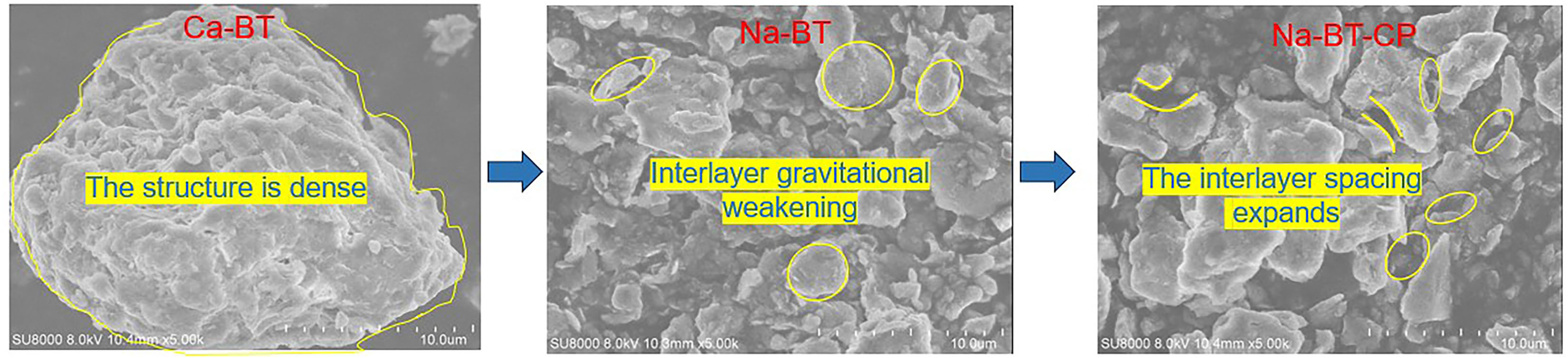
Sodium activator replacement of Ca2+ expanded the interlayer spacing, while pyrophosphate anions dispersed the lamellae, providing the spatial foundation necessary for pectin intercalation [30]. XRD analysis confirmed the progressive increase in d(001) with CP concentration. FT-IR revealed the bridging of -COO− groups with Na+ ions and the reconstruction of O-H and Si-O-Si hydrogen bonding networks. SEM observations demonstrated the formation of surface fibrous networks, edge coordination structures, and hierarchical pore structures resulting from CP molecular surface cross-linking and penetration into the bentonite interlayers. Notably, at the optimal 0.8% CP concentration, a significant increase in lamellar area and improved montmorillonite dispersion were observed, as illustrated in Figure 8. The synthesis of this novel material endows it with several key functional attributes: the network structure enhances water-trapping capacity, ensuring superior suspension stability; dynamic hydrogen bond reorganization facilitates shear-thinning behavior; and strengthened bonding interactions at elevated temperatures maintain effective fluid loss control [31, 32]. The observed ‘clogging’ effect and performance degradation at 1.0% CP concentration can be attributed to the saturation of intercalation sites within the bentonite layers. Excess, unbound pectin molecules subsequently block the pore channels, as corroborated by the SEM image (Figure 5g), which clearly shows aggregated pectin clogging the interlayer spaces. This microstructural defect directly leads to the increased fluid loss and compromised macroscopic filtration performance.

The viscosity-enhancing mechanism of CP in bentonite drilling mud is elucidated as follows:
Upon addition of pectin, the negatively charged carboxyl groups (-COO−) of pectin electrostatically bind to positively charged sites at the edges of bentonite particles, forming pectin-bentonite complexes. The hydroxyl groups (-OH) of pectin establish hydrogen bonding networks with water molecules on the bentonite surface or within the interlayer spaces, reinforcing inter-particle connections. Pectin molecules adsorb onto bentonite particle surfaces, forming a polymeric coating layer that inhibits particle aggregation, maintains a dispersed state, and indirectly increases the system viscosity. Sodium ions (Na+) residing within the bentonite interlayers interact with the carboxyl groups (-COO−) of pectin [33], establishing a three-dimensional cross-linked network of “bentonite–cation–pectin”. The long-chain pectin molecules entangle with bentonite particles, creating a continuous viscoelastic network that impedes fluid flow. Pectin molecules adsorb significant amounts of water molecules via their carboxyl and hydroxyl groups, forming a hydration layer that increases solution viscosity. The synergistic interaction between the water-absorbing and swelling sodium-activated bentonite and the hydration layers of pectin further enhances the overall water retention capacity and viscosity of the system. The formation and mechanism of action of the CP-Na-BT composite for drilling fluid base mud is illustrated in Figure 9.

4. CONCLUSION
This study successfully pioneered the modification of sodium-activated bentonite (Na-BT) using natural and renewable citrus pectin (CP), leading to the preparation of a novel composite material designated Na-BT-CP. The rheological properties of this material as a water-based drilling fluid base slurry and its underlying modification mechanisms were systematically investigated.
-
(1)
The Na-BT-CP composite exhibits significantly superior rheological performance compared to conventional bentonites. Under optimized synthesis conditions (0.8 wt% CP, 80°C, 1.5 hours), the composite achieved a synergistic enhancement in rheological properties, marked by a 44% increase in apparent viscosity and a remarkable 175% surge in the yield point-to-plastic viscosity ratio (YP/PV) at 80°C. The material exhibits exceptional thermal stability, with viscosity fluctuations below 1.3% across a 25–100°C range, and outstanding static stability, showing less than 2.6% performance attenuation after 24 hours. Comprehensive characterization via XRD and FT-IR confirmed the successful intercalation of CP into the bentonite interlayers, forming a stable three-dimensional network via Na+ bridging and hydrogen bonding, which directly explains the superior filtration control (API fluid loss of 8.6 mL).
-
(2)
Comprehensive characterization using XRD, FT-IR, and SEM elucidated the key mechanism of CP modification on Na-BT. XRD confirmed the successful intercalation of CP molecules into the Na-BT interlayers, expanding the d(001) spacing significantly from 1.071 nm in Na-BT to 1.181 nm. FT-IR analysis revealed shifts in the O-H bond at 3620 cm−1 and the emergence of characteristic carboxylate double peaks at 1602/1408 cm−1, indicating modification involving Na+-bridged electrostatic bonding and synergistic hydrogen bonding networks formed between CP and the bentonite lamellar surface (Si-O-Si). SEM observations showed increased lamellar area, improved dispersion of modified bentonite, the formation of a CP fibrous network on the surface, and the development of a finer mesoporous structure along with a “particle-polymer” three-dimensional network at the 0.8% concentration.
-
(3)
The limitations of this study lie in the exclusive use of citrus pectin as the modifying agent, whose performance is significantly influenced by fruit variety and extraction processes. Although food-grade citrus pectin was used, the batch-to-batch variability from different sources (e.g., pomelo/orange) was not evaluated. The experimental temperature was limited to 100°C, which, while sufficient for conventional drilling applications, does not cover HPHT scenarios encountered in ultra-deep wells. Furthermore, its practical application has not yet been conducted. Future work focus on scaling up the synthesis process and evaluating the composite’s performance under simulated high-pressure, high-temperature (HPHT) well conditions to assess its commercial viability.
5. ACKNOWLEDGMENTS
This work is supported by the Key Research Project of Department of Science and Technology of Liaoning, No. 2024JH2/102500100.
6. BIBLIOGRAPHY
-
[1] LI, Q., ZHOU, Y., CAO, P., et al., “Research progress and challenges of montmorillonite application in drilling fluids”, Kexue Jishu Yu Gongcheng, v. 25, n. 23, pp. 9649–9658, 2025. doi: http://doi.org/10.1007/s11356-025-49623-4.
» https://doi.org/10.1007/s11356-025-49623-4 -
[2] LI, B.Z., “Design and performance evaluation of an environmentally friendly water-based drilling fluid system”, Contemporary Chemical Industry, v. 53, n. 06, pp. 1363–1367, Jun. 2024. doi: http://doi.org/10. 1016/ j.contchemind.2024.1363.
» https://doi.org/10.1016/j.contchemind.2024.1363 -
[3] WANG, J.T., LI, J.P., SHAO, Z.H., et al., “Study on kinetic inhibition effect of biopolymers on methane hydrate”, Fei Changgui Youqi, v. 11, n. 01, pp. 136–142, 2024. doi: https://doi.org/10.19901/j.fcgyq.2024.01.17.
» https://doi.org/10.19901/j.fcgyq.2024.01.17 -
[4] FARAJI, F., ABDALQADIR, M., REZAEI-GOMARI, S., et al., “Biodegradable eco-friendly drilling fluid: a study on the use of peanut shell with different particle sizes as sustainable additives”, Chemické Zvesti, v. 79, n. 7, pp. 4213–4228, 2025. doi: https://doi.org/10.1007/s11696-025-04052-1.
» https://doi.org/10.1007/s11696-025-04052-1 -
[5] LIU, X., SU, S., YAO, J., et al., “Research advance about plant polysaccharide prebiotics, benefit for probiotics on gut homeostasis modulation”, Food Bioscience, v. 59, pp. 103831, 2024. doi: https://doi.org/10.1016/j.fbio.2024.103831.
» https://doi.org/10.1016/j.fbio.2024.103831 -
[6] ALI, J.A., ABDALQADIR, M., NAJAT, D., et al., “Application of ultra-fine particles of potato as eco-friendly green additives for drilling a borehole: A filtration, rheological and morphological evaluation”, Chemical Engineering Research & Design, v. 206, pp. 89–107, 2024. doi: https://doi.org/10.1016/j.cherd.2024.04.051.
» https://doi.org/10.1016/j.cherd.2024.04.051 -
[7] ABDULLAH, A.D., ALI, J.A., ABDALQADIR, M., “Exploring the role of hydrophobic nanofluids in reducing shale swelling during drilling: A step towards eco-friendly and sustainable practices”, Colloids and Surfaces. A, Physicochemical and Engineering Aspects, v. 694, pp. 134164, 2024. doi: https://doi.org/10.1016/j.colsurfa.2024.134164.
» https://doi.org/10.1016/j.colsurfa.2024.134164 -
[8] ALI, J.A., GAILANI, R., ABDULLAH, A.D., et al., “Performance evaluation of the nano-biodegradable drilling fluid using the greenly synthesized zinc nanorods and gundelia seed waste”, Environmental Science and Pollution Research International, v. 31, n. 39, pp. 51381–51400, 2024. doi: https://doi.org/10.1007/s11356-024-34561-7. PubMed PMID: 39112894.
» https://doi.org/10.1007/s11356-024-34561-7 -
[9] TAHR, Z., MOHAMMED, A., ALI, J.A., “Surrogate models to predict initial shear stress of clay bentonite drilling fluids incorporated with polymer under various temperature conditions”, Arabian Journal of Geosciences, v. 15, n. 17, pp. 1449, 2022. doi: https://doi.org/10.1007/s12517-022-10720-3.
» https://doi.org/10.1007/s12517-022-10720-3 -
[10] ZHANG, J.J., ZHANG, J., CHEN, G., “Study on preparation and performance of green water-based drilling fluid treatment agent from orange peel”, Fine Petrochemicals, v. 31, n. 01, pp. 9–14, 2014. doi: https://doi.org/10.3969/j.issn.1003-9384.2014.01.002.
» https://doi.org/10.3969/j.issn.1003-9384.2014.01.002 -
[11] LI, D.D., WEI, H.Y., QI, J.R., “Physicochemical properties, structure and gel properties of different citrus pectin molecules”, Nongye Gongcheng Xuebao, v. 40, n. 14, pp. 240–249, 2024. doi: http://doi.org/10.11975/j.issn.1002-6819.2024.14.027.
» https://doi.org/10.11975/j.issn.1002-6819.2024.14.027 -
[12] MAJID, F.F.N., KATENDE, A., ISMAIL, I., et al., “A comprehensive investigation on the performance of durian rind as a lost circulation material in water based drilling mud”, Petroleum, v. 5, n. 3, pp. 285–294, 2019. doi: https://doi.org/10.1016/j.petlm.2018.10.004.
» https://doi.org/10.1016/j.petlm.2018.10.004 - [13] DUAN, W.G., GE, N., CHI, C.R., et al., “Study on pomelo peel as a green drilling fluid additive”, Technology & Development of Chemical Industry, v. 47, n. 1, pp. 1–6, 2018.
-
[14] GUO, X.B., WU, Z., LU, Z., et al., “Preparation and characterization of chitosan-modified bentonite hydrogels and application for tetracycline adsorption from aqueous solution”, Gels, v. 10, n. 8, pp. 549, 2024. doi: https://doi.org/10.3390/gels10080503. PubMed PMID: 39195032.
» https://doi.org/10.3390/gels10080503 -
[15] CHEN, G., ZHANG, J., ZHANG, J., et al., “Comprehensive experiment on preparing green drilling fluid additives from waste fruit peels”, Chinese Journal of Chemical Education, v. 36, n. 8, pp. 58–60, 2015. doi: https://doi.org/10.13884/j.1003-3807hxjy.2014070046.
» https://doi.org/10.13884/j.1003-3807hxjy.2014070046 -
[16] HADADI, M., KAMALI, F., MIRHOSSEININIA, J., et al., “Experimental investigation of biopolymers influences on rheology and filtration properties of water-based drilling fluids”, Heliyon, v. 10, n. 23, pp. e40780, 2024. doi: https://doi.org/10.1016/j.heliyon.2024.e40780. PubMed PMID: 39737007.
» https://doi.org/10.1016/j.heliyon.2024.e40780 -
[17] WANG, J.T., LI, J.P., SHAO, Z.H., et al., “Study on kinetic inhibition effect of biopolymers on methane hydrate”, Journal of Unconventional Oil & Gas, v. 11, n. 01, pp. 136–142, Jan. 2024. doi: https://doi.org/10.19901/j.fcgyq.2024.01.17.
» https://doi.org/10.19901/j.fcgyq.2024.01.17 -
[18] AKPAN, U.E., “Utilizing environmentally friendly polymers as rheological control and fluid loss additives in water-based drilling muds”, Journal of Geoenergy Science and Engineering, v. 242, pp. 213195, 2024. doi: https://doi.org/10.1016/j.geoen.2024.213195.
» https://doi.org/10.1016/j.geoen.2024.213195 -
[19] LI, Y.Q., ZHANG, Y.Z., DONG, L.Z., et al., “Fermentation of Lactobacillus fermentum NB02 with feruloyl esterase production increases the phenolic compounds content and antioxidant properties of oat bran”, Food Chemistry, v. 437, n. Pt 1, pp. 137834, 2024. doi: https://doi.org/10.1016/j.foodchem.2023.137834. PubMed PMID: 37897817.
» https://doi.org/10.1016/j.foodchem.2023.137834 -
[20] LIU, Y., DONG, L., LI, Y., et al., “Soy protein isolate-citrus pectin composite hydrogels induced by TGase and ultrasonic treatment: Potential targeted delivery system for probiotics”, Food Hydrocolloids, v. 143, pp. 108901, 2023. doi: https://doi.org/10.1016/j.foodhyd.2023.108901.
» https://doi.org/10.1016/j.foodhyd.2023.108901 -
[21] WANG, H., ZHANG, P., ZHANG, Q., et al., “Novel eco-friendly microemulsion-based drilling fluid”, Journal of Contemporary Chemical Industry, v. 53, n. 07, pp. 1625–1629, Jul. 2024. doi: http://doi.org/10.13840/j.cnki.cn21-1457/tq.2024.07.042.
» https://doi.org/10.13840/j.cnki.cn21-1457/tq.2024.07.042 -
[22] CHEN, Z.H., XIA, H.Y., LI, H.B., et al., “Research and application of environmental friendliness evaluation standard for water-based drilling fluid”, Journal of Guangdong Chemical Industry, v. 49, n. 15, pp. 56–58, 2022. doi: https://doi.org/10.3969/j.issn.1007-1865.2022.15.018.
» https://doi.org/10.3969/j.issn.1007-1865.2022.15.018 -
[23] WANG, Y., YU, X., ZHAO, L., et al., “Insights into structure-rheology relationships in Pickering emulsions stabilized by gliadin-citrus pectin complex particles”, Food Research International, v. 218, pp. 116928, 2025. doi: https://doi.org/10.1016/j.foodres.2025.116928. PubMed PMID: 40790709.
» https://doi.org/10.1016/j.foodres.2025.116928 -
[24] FENG, X.Y., YAO, T.B., ZHANG, Q., et al., “Proline drives cross-linking between extensins and pectin in the cell wall to combat hexavalent chromium stress in rice plants”, Chemical and Biological Technologies in Agriculture, v. 12, n. 1, pp. 121, 2025. doi: https://doi.org/10.1186/s40538-025-00846-3.
» https://doi.org/10.1186/s40538-025-00846-3 -
[25] MOMENI, A., NEZHAD, T.A.S., MORADI, T.S.S., et al., “Experimental evaluation of an environmentally friendly drilling fluid for clay stabilization in shale formations”, Scientific Reports, v. 15, n. 1, pp. 30088, 2025. doi: https://doi.org/10.1038/s41598-025-07888-5. PubMed PMID: 40820018.
» https://doi.org/10.1038/s41598-025-07888-5 -
[26] AL-HAMEEDI, T.T.A., ALKINANI, H.H., DUNN-NORMAN, S., et al., “Experimental investigation of environmentally friendly drilling fluid additives (mandarin peels powder) to substitute the conventional chemicals used in water-based drilling fluid”, Journal of Petroleum Exploration and Production Technology, v. 10, n. 2, pp. 407–417, 2020. doi: https://doi.org/10.1007/s13202-019-0725-7.
» https://doi.org/10.1007/s13202-019-0725-7 -
[27] MADU, C., FARAJI, F., ABDALQADIR, M., et al., “Feasibility study of biodegradable coffee ground waste and watermelon rind as water-based drilling fluid additives”, Journal of Gas Science and Engineering, v. 125, pp. 205322, 2024. doi: https://doi.org/10.1016/j.jgsce.2024.205322.
» https://doi.org/10.1016/j.jgsce.2024.205322 -
[28] YAN, L., LI, Q., GUO, X., et al., ““Environmentally friendly bio-based additives in oil-based drilling fluids: Efficient synthesis, well-ordered self-assembly, exceptional ultra-high-temperature resistance, and excellent anti-settling properties”, Journal of Colloids and Surfaces A, Physicochemical and Engineering Aspects, v. 719, pp. 137014, 2025. doi: https://doi.org/10.1016/j.colsurfa.2025.137014.
» https://doi.org/10.1016/j.colsurfa.2025.137014 -
[29] EKWE, O.A., UDOH, J.A., GIDEON, M.A., et al., “Potentials of waste seashells as additives in drilling muds and in oil well cements”, Journal of Cleaner Engineering and Technology, v. 1, pp. 100003, 2020. doi: https://doi.org/10.1016/j.clet.2020.100003.
» https://doi.org/10.1016/j.clet.2020.100003 -
[30] NWIYORONU, J.K., ONOJAKE, M.C., ORIJI, G.O., et al., “Evaluation of shell powders of bush mango and hamburger bean as eco-friendly fluid loss control additives in water-based drilling mud”, Discover Applied Sciences, v. 6, n. 10, pp. 544, Oct. 2024. doi: https://doi.org/10.1007/s42452-024-06130-7.
» https://doi.org/10.1007/s42452-024-06130-7 -
[31] ALI, J.A., GAILANI, R., ABDULLAH, A.D., et al., “Performance evaluation of the nano-biodegradable drilling fluid using the greenly synthesized zinc nanorods and gundelia seed waste”, Environmental Science and Pollution Research International, v. 31, n. 39, pp. 51381–51400, 2024. doi: https://doi.org/10.1007/s11356-024-34561-7. PubMed PMID: 39112894.
» https://doi.org/10.1007/s11356-024-34561-7 -
[32] ABDULLAH, A.D., ALI, J.A., ABDALQADIR, M., “Exploring the role of hydrophobic nanofluids in reducing shale swelling during drilling: A step towards eco-friendly and sustainable practices”, Colloids and Surfaces. A, Physicochemical and Engineering Aspects, v. 694, pp. 134164, 2024. doi: https://doi.org/10.1016/j.colsurfa.2024.134164.
» https://doi.org/10.1016/j.colsurfa.2024.134164 -
[33] ZHANG, J.J., ZHANG, J., CHEN, G., “Study on preparation and performance of green water-based drilling fluid treatment agent from pomelo peel”, Advances in Fine Petrochemicals, v. 14, n. 6, pp. 10–15, 2013. doi: http://doi.org/10.3969/j.issn.1674-8080.2013.06.002.
» https://doi.org/10.3969/j.issn.1674-8080.2013.06.002