 Flexural behaviour of the fibre-reinforced concrete beams with utilization of E-waste: experimental and analytical study
ABSTRACT
This research investigates the flexural behaviour of Reinforced Concrete (RC) beams that utilize diatomaceous earth powder as a partial substitute for cement, along with the addition of E-waste. Four beam specimens with consistent dimensions (150 mm × 180 mm × 1500 mm) were designed according to IS 456:2000 and subjected to testing under a 50-ton loading frame. The experimental findings indicated that the fibre-reinforced beams showed improved load-carrying capacity, ductility, and energy absorption when compared to the control beam. Among the fibre-reinforced specimens, RCC-FL30-F0.8-D20 exhibited the highest ultimate load capacity and energy absorption, suggesting an optimal balance in fibre dosage. Analysis of the failure modes revealed that the control beam failed due to compression crushing. In contrast, the fibre-reinforced beams experienced a combination of flexural and shear failures, with an excessive addition of E-waste fibre leading to a predominant shift in the failure mode towards shear. Evaluations of stiffness and ductility confirmed that moderate incorporation of fibres enhanced deformation capacity without sacrificing rigidity. A comparison between experimental results and analytical studies using finite element modelling showed excellent correlation, with mean ratios close to unity and minimal standard deviation, thereby validating the reliability of the numerical model. In summary, the results emphasise that the controlled addition of E-waste fibres and diatomaceous earth can significantly enhance the flexural performance and sustainability of RC beams. At the same time, finite element modelling serves as a dependable predictive tool for assessing structural behaviour.
Keywords:
E-waste; fibre reinforced concrete; diatomaceous earth powder; flexural behaviour; finite element analysis
1. INTRODUCTION
Reinforced concrete beams play a crucial role in modern structural systems, and their performance under flexural loading is essential for maintaining safety, serviceability, and durability. Traditional RC beams, while widely used, face challenges such as cracking, reduced ductility, and limited energy absorption, particularly as service demands and sustainability standards rise. Recent research has focused on the use of supplementary cementitious materials and alternative reinforcements to enhance structural performance while addressing environmental concerns. In this context, the use of diatomaceous earth powder and E-waste fibres offers a promising strategy to improve mechanical properties and promote sustainable construction practices.
The groundbreaking function of microbial activity in improving beam performance was showcased. It revealed that microorganisms play a role in self-healing and microstructural densification, which enhances crack resistance and flexural strength. The combination of fibre reinforcement with microbial treatment exhibited synergistic effects, resulting in a greater load-carrying capacity than traditional mixes. The study emphasised the sustainability advantages of decreasing dependence on chemical admixtures and encouraging bio-based strengthening methods. In summary, the results position microbial fibre-reinforced concrete as a viable option for long-lasting and environmentally friendly structural applications [1]. The effectiveness of geopolymer matrices when paired with textile reinforcement significantly enhances beam performance. Experimental findings revealed notable improvements in load-carrying capacity, ductility, and crack control in comparison to traditional strengthening techniques. The strain-hardening characteristics of geopolymer composites resulted in numerous fine cracks, rather than localized failures, which contributed to enhanced flexural toughness. Additionally, textile reinforcement offered excellent bonding properties and effectively distributed stresses, resulting in better serviceability and durability. In summary, textile-reinforced strain-hardening geopolymer composites have emerged as a sustainable and high-performance alternative for reinforcing RC beams, thereby decreasing dependence on conventional cement-based systems [2]. A research study explored the combined benefits of enhancing strength and valorizing waste. The findings showed that the use of recycled steel fibres greatly enhanced the compressive, tensile, and flexural characteristics by improving crack bridging and energy absorption. By integrating recycled fibres, brittleness was reduced, and ductile failure modes were encouraged, resulting in more reliable concrete under load. From a sustainability standpoint, utilizing steel waste reduces environmental effects and decreases the need for raw materials. In summary, the study confirmed that recycled steel fibre reinforcement is a cost-effective and environmentally friendly option for long-lasting structural applications [3]. The research focused on the flexural behaviour of reinforced concrete beams that utilized hybrid fibres and recycled industrial waste, highlighting the synergistic effect of various fibres and waste materials on improving structural performance. The use of hybrid fibre reinforcement enhanced crack resistance, ductility, and load-carrying capacity by effectively balancing tensile and flexural strengths. Incorporating recycled industrial waste, such as slag or fly ash, aided in matrix densification and promoted sustainability by decreasing cement usage. Experimental findings indicated that beams reinforced with hybrid fibres and waste additives demonstrated greater toughness and delayed failure when compared to traditional mixes. In summary, this method showcased both mechanical efficiency and environmental advantages, establishing hybrid fibre–waste composites as a practical option for creating durable and eco-friendly beam enhancements [4].
The research focused on the finite element modelling of reinforced concrete beams strengthened with Fabric-Reinforced Cementitious Matrix (FRCM) systems when exposed to elevated temperatures, emphasizing the thermo-mechanical response of these enhanced members. Numerical simulations have indicated that FRCM systems enhance flexural capacity and delay failure, even under high-temperature conditions. The modelling effectively captured the degradation of bond strength and stiffness as temperatures increased, highlighting the crucial role of textile reinforcement in maintaining structural integrity. Comparisons with experimental data confirmed the precision of the finite element method, ensuring a reliable prediction of the beam’s behaviour. In summary, the study established FRCM systems as a robust and sustainable strengthening method for reinforced concrete beams that face fire or thermal loading [5]. The research focused on the flexural behaviour of reinforced concrete beams enhanced with basalt fibre reinforcement, examining how these fibres contribute to better structural performance. The findings indicated that adding basalt fibres significantly improved crack resistance, ductility, and flexural strength when compared to traditional reinforced concrete beams. The fibres served as efficient crack arresters, helping to distribute stresses and postpone the occurrence of brittle failure. Experimental results underscored the enhanced toughness and energy absorption capabilities, rendering basalt fibre reinforced concrete beams more dependable under both cyclic and static loads. In summary, basalt fibre reinforcement proved to be a sustainable and economical approach for fortifying reinforced concrete beams, providing exceptional durability and mechanical efficiency [6].
The research focused on the behaviour of reinforced concrete beams that included E-waste fibres when subjected to flexural loading, exploring the viability of using recycled electronic waste as a sustainable reinforcement material. The experimental findings indicated that E-waste fibres enhanced crack resistance, flexural strength, and ductility in comparison to traditional reinforced concrete beams. These fibres served as secondary reinforcement, effectively bridging cracks and improving energy absorption capacity during bending loads. Additionally, the use of E-waste contributed to waste management efforts and lessened environmental impact by keeping non-biodegradable materials out of landfills. In summary, the study revealed that beams reinforced with E-waste fibres provide both mechanical advantages and ecological benefits, positioning them as a promising option for sustainable construction [7]. The research on the performance of geopolymer concrete beams reinforced with hybrid fibres examined the collective impact of various fibres on enhancing structural behaviour. The findings indicated that hybrid fibres significantly increased flexural strength, ductility, and crack control when compared to single-fibre systems. The geopolymer matrix exhibited excellent bonding and thermal stability, while the fibres worked together to resist crack propagation and improve toughness. Experimental results underscored the enhanced energy absorption and serviceability of the beams, rendering them more dependable under both static and cyclic loads. In summary, hybrid fibre reinforced geopolymer concrete has emerged as a sustainable and high-performance alternative to traditional cement-based systems, providing both mechanical efficiency and environmental advantages [8]. The research on finite element modelling of reinforced concrete beams utilising recycled aggregate concrete has concentrated on simulating the structural behaviour of beams that include recycled aggregates. The numerical models effectively represented the diminished stiffness and modified stress-strain characteristics associated with recycled aggregate mixes compared to natural aggregate concrete. Finite element analysis provided a dependable prediction of flexural response, crack development, and load-deflection behaviour across different reinforcement ratios. Validation against experimental findings confirmed the precision of the modelling technique, highlighting the impact of aggregate quality on beam performance. In summary, the study established finite element modelling as an effective method for evaluating recycled aggregate concrete beams, thereby promoting sustainable design and enhancing performance [9].
The research on the flexural behaviour of reinforced concrete beams enhanced with FRP laminates demonstrated the effectiveness of externally bonded fibre-reinforced polymer in improving beam performance. Experimental studies showed notable enhancements in load-carrying capacity, stiffness, and crack control when compared to unstrengthened beams. FRP laminates offered excellent tensile strength and postponed the yielding of steel reinforcement, thus enhancing ductility and serviceability. Both analytical and numerical models corroborated the experimental results, ensuring accurate predictions of flexural response under different loading scenarios. In summary, strengthening with FRP laminates has proven to be a practical and long-lasting solution for extending the service life of RC beams, offering benefits in terms of ease of application and sustained performance [10].
The research, which focused on the energy absorption capacity of Fibre-Reinforced Concrete (FRC) beams, highlighted the importance of fibres in enhancing toughness and post-cracking performance. Experimental studies have demonstrated that the addition of fibres improves ductility, slows down crack propagation, and significantly enhances energy dissipation during flexural loading. Steel, polypropylene, and hybrid fibres served as crack-bridging components, allowing beams to endure greater deformation before failure. The findings underscored enhanced load-deflection properties and better resistance to cyclic and impact loads when compared to traditional RC beams. In summary, fibre reinforcement was shown to be effective in increasing the energy absorption capacity, thereby making RC beams more durable and dependable for structural uses [11]. The research focused on the energy absorption capacity of fibre-reinforced concrete beams, highlighting the importance of fibres in enhancing toughness and post-cracking performance. Experimental studies have demonstrated that the addition of fibres improves ductility, slows down crack propagation, and significantly enhances energy dissipation during flexural loading. Steel, polypropylene, and hybrid fibres served as crack-bridging components, allowing beams to endure greater deformation before failure. The findings underscored better load-deflection properties and increased resistance to cyclic and impact loads when compared to traditional RC beams. In summary, fibre reinforcement has proven to be effective in augmenting the energy absorption capacity, thereby making RC beams more durable and dependable for structural uses [12]. Examined recycled concrete that incorporates waste metallic fibres, demonstrating notable enhancements in mechanical performance. Their research underscores the dual advantages of sustainability and increased strength achieved through fibre integration [13]. In a similar vein, assessed concrete containing steel fibres sourced from discarded tyres, noting improvements in ductility and crack resistance. Both studies highlight the promise of fibres derived from waste in promoting environmentally friendly, high-performance concrete solutions [14].
Based on the literature survey, only a limited number of studies have investigated the use of E-waste fibres to evaluate the flexural behaviour of reinforced concrete beams with partial cement replacement using diatomaceous earth powder. The experimental program conducted in this study demonstrated that RC beams incorporating E-waste fibres and partial cement substitution exhibited superior flexural performance compared to control specimens. Beams such as RCC-FL30-F0.8-D20 achieved the highest ultimate load capacity and energy absorption, underscoring the beneficial synergy between fibre dosage and aggregate replacement. Stiffness and ductility analyses confirmed that moderate fibre incorporation enhanced deformation capacity. Furthermore, comparison between experimental and analytical results using Finite Element Modelling (FEM) showed excellent correlation, with mean ratios close to unity and minimal variation, validating FEM as a reliable predictive tool for RC beam behaviour. This study thus establishes a foundation for optimizing RC beam design through experimental validation and numerical modelling, paving the way for future research on durability, large-scale applications, and code integration. The research methodology employed in this study is illustrated in Figure 1.

2. EXPERIMENTAL PROGRAM
2.1. Properties of materials
The present study investigated the flexural behaviour of M40 grade reinforced concrete incorporating diatomaceous earth powder and E-waste. The concrete mix ratio of 1:1.59:2.79, corresponding to cement 412 kg/m3, fine aggregate 412 kg/m3, and coarse aggregate 412 kg/m3, was proportioned in accordance with IS 10262:2019, and its mechanical properties, including compressive strength, are presented in Table 1. E-waste fibre is a lightweight substance obtained from recycled electronic waste, featuring a specific gravity of 1.04 g/cc, a diameter of 0.5 mm, a tensile strength of 2.60 MPa, and a density of 1.38 g/cm3. Its low specific gravity and fine diameter render it ideal for applications that demand reduced weight and improved surface bonding, while its moderate tensile strength makes it a viable reinforcement choice in sustainable composites and construction materials. The tensile strength of 8 mm and 10 mm steel rebars was determined using a Universal Testing Machine (UTM) with a capacity of 400 kN, as shown in Figure 2, and the results are also reported in Table 1.

2.2. Preparation of the specimens
All specimens were constructed as rectangular reinforced concrete beams with consistent dimensions of 150 mm in width, 180 mm in depth, and 1500 mm in length. The longitudinal reinforcement consisted of two 10 mm diameter bars at the bottom and two 8 mm diameter bars at the top. In comparison, shear reinforcement was implemented using 6 mm diameter stirrups spaced 100 mm centre-to-centre along the span, as detailed in Table 2. Additionally, the geometric specifications of the reinforced concrete beam are illustrated in Figure 3.

The control beam (RCC-C) was created using standard M40 grade concrete, while the modified beams, RCC-FL30-F0.8-D20, RCC-FL40-F0.6-D20, and RCC-FL50-F0.6-D20, featured optimum proportions of diatomaceous replacement (20%) along with fibre volume fractions of 0.8% and 0.6%, respectively. All RC beams were designed in accordance with IS 456:2000 standards. Reinforcement cages were secured and fixed in steel moulds, and concrete was poured and compacted using a needle vibrator. The specimens were then cured in water for 28 days to ensure sufficient strength development before testing, as shown in Figure 4.

2.3. Experimental setup of the specimens
The experimental arrangement for assessing the flexural behaviour of reinforced concrete beams was conducted using a loading frame with a capacity of 50 tons. Each beam specimen was placed on simple supports with an effective span that matched its design length, and the load was applied at two points to replicate a standard flexural testing configuration, as shown in Figure 5. The loading rate was kept at 0.5 mm/min to facilitate gradual application and precise observation of the structural response [15]. Deflections at the mid-span were recorded using a deflectometer positioned directly beneath the beam to obtain accurate displacement readings throughout the test. This configuration enabled controlled loading, dependable measurement of deflection, and systematic assessment of the flexural performance of the beams under the applied loads.

3. ANALYTICAL PROGRAM
3.1. Finite element analysis
Finite element modelling for reinforced concrete beams provides a robust computational method for simulating and assessing their structural performance under various loading scenarios. By breaking down the beam into smaller finite elements, the intricate interaction between concrete and reinforcement can be depicted with enhanced precision, allowing for the prediction of stresses, strains, deflections, and crack development [16]. The modelling procedure accounts for the material nonlinearity of concrete, which includes tension stiffening and compression characteristics, as well as the elastic–plastic behaviour of steel reinforcement, thereby allowing for a realistic depiction of flexural performance. By applying suitable boundary conditions and loading configurations, FEM facilitates comparisons with experimental data, reduces the need for extensive physical testing, and provides insights into parametric variations, such as reinforcement ratios, shear reinforcement spacing, and material alternatives. Therefore, finite element analysis serves as a dependable tool for understanding the flexural behaviour of RC beams, confirming experimental results, and aiding in the optimisation of design parameters in accordance with applicable codes and standards.
3.2. Sensitive analysis
A sensitivity analysis of reinforced concrete beams was conducted to evaluate the influence of key parameters on their flexural performance and overall structural behaviour. This analysis involved a systematic variation of input factors, including concrete compressive strength, reinforcement ratios, shear reinforcement spacing, and fibre content, while maintaining other parameters constant to isolate their individual effects [17].
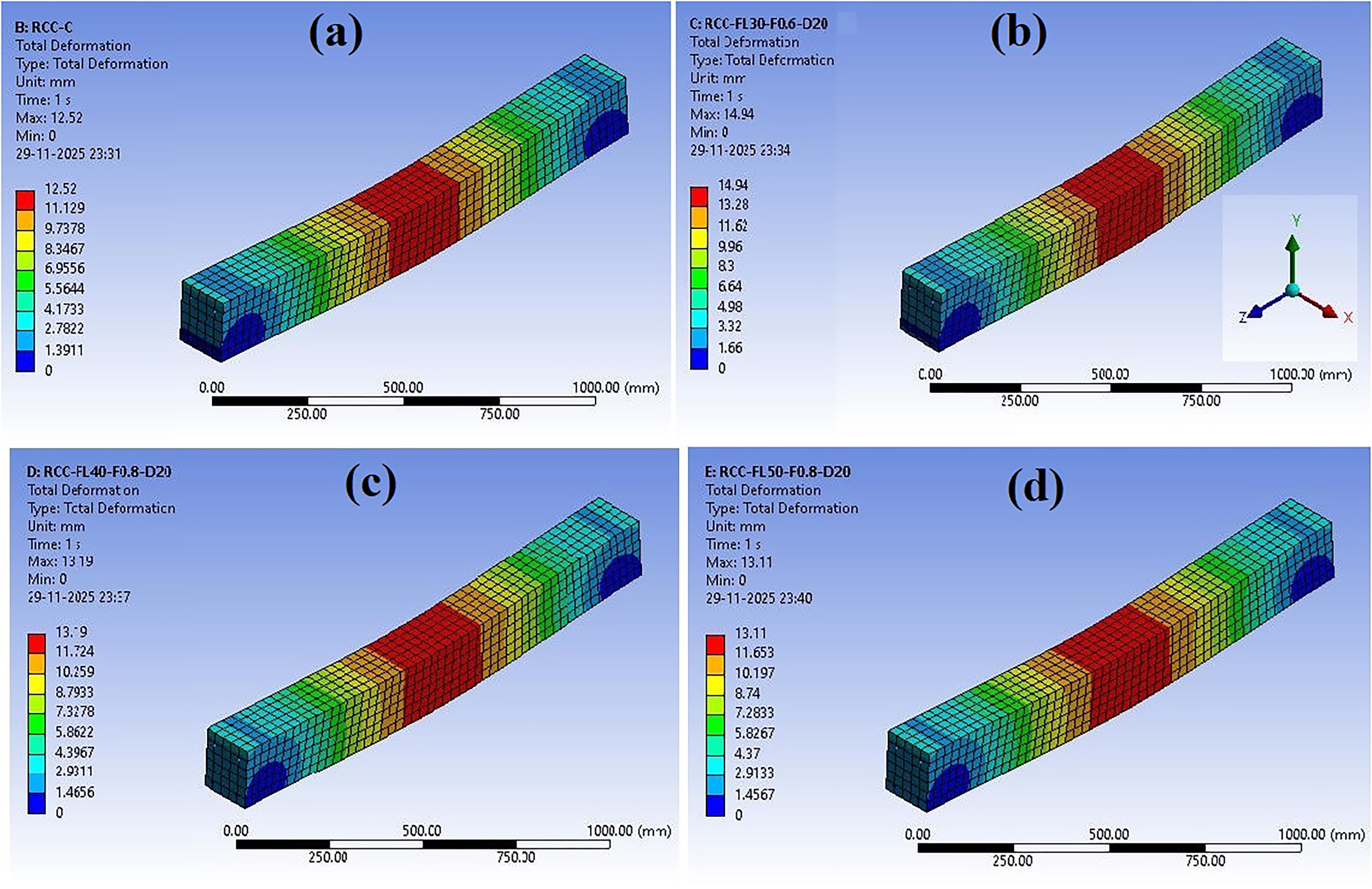
By utilizing finite element modelling in conjunction with experimental data, the sensitivity study provided insights into how variations in material properties and reinforcement detailing affect deflection, cracking behaviour, ultimate load capacity, and energy absorption. This methodology facilitated the identification of the most significant parameters that dictate beam performance, thus aiding in the optimization of mix design and reinforcement configuration [18]. Consequently, the sensitivity analysis proved to be an invaluable tool for validating experimental findings, improving the predictive accuracy of numerical models, and fostering the development of more efficient and durable RC beam designs, as illustrated in Figure 6.

Deflection of all specimens. (a) RCC-C: (b) RCC-FL30-F0.8-D20: (c) RCC-FL40-F0.6-D20: (d) RCC-FL50-F0.6-D20.
3.3. Boundary condition
In the FEM analysis of RCC beams, a simply supported boundary condition was utilized to mirror the experimental setup and accurately capture realistic flexural behaviour, as illustrated in Figure 7. This condition restricts vertical displacement at the supports while permitting free rotation, thus ensuring that the beam undergoes pure bending under the applied loads. Such modelling is crucial for reproducing the maximum bending moment at mid-span, which aligns with the flexural failure patterns observed in laboratory tests. The simply supported condition provides a precise representation of stress distributions and deflection profiles, enabling the FEM model to closely match experimental load-deflection curves. This alignment verifies that the selected boundary condition was suitable for assessing flexural behaviour and for establishing dependable correlations between numerical and experimental findings.

4. RESULTS AND DISCUSSION
4.1. Behaviour of load-deflection
The load–deflection characteristics of the reinforced concrete beams were assessed under flexural loading, with the findings summarized in terms of initial, ultimate, and failure loads, along with their corresponding deflections, as illustrated in Figure 8. The control beam (RCC-C) demonstrated an initial load of 28.95 kN, achieving an ultimate load of 66.25 kN before failing at 60.35 kN, with deflections increasing to 12.45 mm at ultimate load. Control RC beam, lacking fibre reinforcement and diatomaceous earth powder, demonstrates brittle characteristics with minimal plastic deformation and sudden failure. The load-deflection curve rises sharply to a maximum before declining sharply, reaching 12.45 mm. This behaviour indicates a moderate capacity for deformation but a low ability to absorb energy after the peak. The fibre-reinforced beam RCC-FL30-F0.8-D20 displayed a slightly lower initial load capacity of 29.12 kN. Still, it reached a notably higher ultimate load of 74.36 kN and a failure load of 70.12 kN, with deflections varying from 5.72 mm to 16.75 mm. Similarly, RCC-FL40-F0.6-D20 exhibited enhanced performance, supporting an initial load of 28.69 kN and an ultimate load of 71.25 kN, with a failure load of 63.74 kN and a corresponding failure deflection of 14.68 mm.

Load-deflection responses of all specimens. (a) RCC-C: (b) RCC-FL30-F0.8-D20: (c) RCC-FL40-F0.6-D20: (d) RCC-FL50-F0.6-D20.
In contrast, RCC-FL50-F0.6-D20 recorded the highest initial load of 28.96 kN but a lower ultimate load of 69.36 kN and a failure load of 62.45 kN, respectively. During the initial loading phase, the specimen demonstrated significant stiffness and resistance, attributed to the combined effects of matrix integrity and fiber reinforcement. This accounts for the greater initial load observed in comparison to other specimens. These findings suggest that beams with 20% diatomaceous earth powder and optimized fibre content exhibited improved flexural capacity compared to the control specimen. However, excessive replacement resulted in diminished ultimate strength, despite an increase in initial stiffness.
4.2. Mode of failure
The failure modes of the reinforced concrete beams differed based on the mix composition and reinforcement detailing, as shown in Table 3. The control beam (RCC-C) demonstrated a typical Concrete Crushing (CC) failure, which is marked by the crushing of concrete in the compression zone following the yielding of the tensile reinforcement, a characteristic of under-reinforced sections [19, 20]. In contrast, the modified beam RCC-FL30-F0.8-D20 exhibited a combination of Concrete Crushing and Flexural Failure (CC+FF). The inclusion of fibres and the partial replacement of cement improved crack resistance but ultimately resulted in flexural cracking and crushing within the compression zone. The RCC-FL30-F0.8-D20 sample demonstrates the highest ductility index, as shown by its gradual decline after reaching peak performance and its prolonged deformation prior to failure; even upon achieving the ultimate load, the specimen maintains considerable deflection without a sudden loss of strength, underscoring its improved toughness and energy absorption capabilities; this durability verifies the material’s capacity to dissipate energy while preserving structural integrity.
The specimen RCC-FL40-F0.6-D20 exhibited Concrete Crushing with Shear Failure (CC+SF), which indicates that although the flexural strength was enhanced, insufficient shear resistance led to diagonal cracking and eventual shear failure alongside compression crushing, as shown in Figure 9. The maximum stiffness value of RCC-FL40-F0.6-D20 suggests that decreasing the fibre volume fraction allowed the elastic phase of the matrix, enhanced by substituting diatomaceous earth powder, to prevail in the response, resulting in a composite that is more rigid and less prone to deformation during the initial loading phase. Ultimately, RCC-FL50-F0.6-D20 primarily failed in shear, with significant diagonal shear cracks developing across the beam’s web, implying that an excessive amount of cement replacement diminished the cohesion and shear capacity of the matrix, thus changing the failure mode from flexural to shear [21, 22]. The shear failure noted in RCC-FL50-F0.6-D20 can be attributed to the loss of matrix cohesion resulting from excessive substitution of cement with diatomaceous earth powder, even though the fibre content has remained unchanged; however, the fibre length has varied. The compromised matrix is unable to sufficiently confine or secure the fibres when subjected to load, leading to early de-bonding and localized stress concentrations. This transition alters the failure mode from ductile fibre-controlled behaviour to brittle shear failure.

These findings underscore that while the addition of fibres and cement replacement can improve flexural performance, an improper balance may weaken shear resistance and modify the primary failure mechanism. The synergistic effect of steel reinforcement and fibres demonstrates that fibres serve not as a replacement but as a complementary addition, enhancing crack control in the tension zone. This work alongside the reinforcement to create a beam that is both more resilient and durable. Crucially, the shift to a shear failure mode in RCC-FL50-F0.6-D20 emphasizes the vital importance of optimizing dosage. While an increased fibre content can boost strength in specific configurations, it may also change the failure mechanism and diminish overall structural efficiency. This underscores the need to find a balance in fibre dosage to enhance performance while maintaining the stability of the failure mode.
4.3. Effect of E-waste fibre on load carrying capacity
The addition of E-waste fibre has had a significant impact on the load-carrying capacity of reinforced concrete beams, as demonstrated by a comparative analysis of fibre-reinforced RC beam specimens versus the control beam (RCC-C). RCC-FL30-F0.8-D20 exhibited a notable increase in ultimate load capacity, underscoring the beneficial effects of 0.8% fibre volume and 20% cement replacement on improving tensile strength and crack management, as illustrated in Figure 10. RCC-FL40-F0.6-D20 achieved the highest percentage increase in load-carrying capacity, suggesting that a fibre dosage of 0.6% along with 20% cement replacement creates an optimal balance between matrix cohesion and reinforcement interaction. While RCC-FL50-F0.6-D20 also demonstrated an enhancement over the control, the percentage increase was relatively lower, indicating that excessive cement replacement might diminish the advantages of fibre addition by compromising overall matrix integrity [23]. Even though the diatomaceous earth powder substitution remained fixed at 20%, the emergence of performance variations solely due to alterations in the fiber ratio indicates that the interaction between the binder and fiber is the primary mechanism affecting the outcomes. These findings validate that E-waste fibre contributes to enhanced flexural strength. Still, its effectiveness is contingent upon the interplay between fibre volume and cement replacement levels, with moderate combinations leading to superior load performance.

The ultimate load capacity of the RCC-FL30-F0.8-D20 sample is due to the synergistic effect of fibre reinforcement and the partial substitution of cement with 20% diatomaceous earth powder. The fibre content improves crack-bridging ability, which slows down crack propagation and enhances ductility, while the diatomaceous earth powder aids in matrix densification through its pozzolanic properties. This denser, chemically fortified matrix created by the diatomaceous earth powder strengthens the bond between the fibres and the cementitious component.
4.4. Ductility, stiffness and energy absorption capacity
The characteristics of ductility and stiffness in the reinforced concrete beams exhibited significant variations based on the mix composition and fibre content. The calculations for ductility and the corresponding results are illustrated in Figures 11 and 12. The control beam (RCC-C) demonstrated a ductility value of 2.19 and a stiffness of 5.32 kN/mm, establishing the baseline performance for conventional M40 concrete.


The fibre-reinforced RC beam RCC-FL30-F0.8-D20 displayed the highest ductility at 2.60, indicating enhanced energy absorption and deformation capacity. Although its stiffness decreased slightly to 4.99 kN/mm compared to the control, this reflected increased flexibility due to the incorporation of fibres. RCC-FL40-F0.6-D20 achieved a balanced performance with a ductility of 2.37 and the highest stiffness of 5.42 kN/mm, suggesting that moderate fibre content and aggregate replacement can improve both strength and deformation resistance. Conversely, RCC-FL50-F0.6-D20 recorded a ductility of 2.32 and a stiffness of 5.31 kN/mm, indicating comparable stiffness to the control but lower ductility compared to RCC-FL30-F0.8-D20, as displayed in Figure 13. This suggests that excessive cement replacement may compromise ductility while preserving stiffness [24,25,26,27]. In summary, the findings emphasise that optimal fibre dosage and aggregate replacement can enhance ductility without significantly affecting stiffness. In contrast, over-replacement tends to restrict deformation capacity, even though structural rigidity is maintained.

The energy absorption capacity of the reinforced concrete beams showed considerable variation across the various mix configurations, highlighting the impact of fibre content and cement replacement on structural resilience [28, 29]. The calculation of energy absorption capacity is depicted in Figure 14. The control beam (RCC-C) displayed the lowest energy absorption, suggesting limited ductility and a diminished capacity to dissipate energy during flexural loading. Conversely, RCC-FL30-F0.8-D20 exhibited a significant enhancement in energy absorption, which can be attributed to the combined effect of a 0.8% fibre volume and 20% cement replacement, leading to improved crack bridging and post-cracking behaviour. RCC-FL40-F0.6-D20 achieved the highest energy absorption among all specimens, indicating that the combination of 20% cement replacement and 0.6% fibre content offers an optimal balance between stiffness and ductility, facilitating superior energy dissipation. The exceptional energy-absorption capacity of RCC-FL40-F0.6-D20 is attributed to a synergistic microstructural mechanism involving fibre bridging and matrix strengthening. This mechanism converts crack propagation into a gradual process that dissipates energy rather than leading to a sudden fracture. Meanwhile, RCC-FL50-F0.6-D20, despite its higher initial stiffness, recorded slightly lower energy absorption compared to RCC-FL40-F0.6-D20, likely due to excessive cement replacement that may have weakened matrix cohesion and diminished post-peak performance, as illustrated in Figure 15. These findings emphasize the necessity of optimizing fibre dosage and aggregate replacement levels to enhance the energy absorption capacity of RC beams under flexural stress [30,31,32].


4.5. Comparison between experimental and analytical study
The analysis comparing experimental and analytical results for the RC beams reveals a strong correlation in both deflection and load responses, thereby confirming the precision of the finite element modelling technique. For the control beam (RCC-C), the experimental measurements of deflection and load were in close alignment with the analytical forecasts, exhibiting deflection and load ratios of 0.99 and 1.00, respectively, as shown in Table 4. The modified beams RCC-FL30-F0.8-D20, RCC-FL40-F0.6-D20, and RCC-FL50-F0.6-D20 also demonstrated remarkable consistency, with deflection ratios consistently at 1.00 and load ratios slightly under one (0.99), indicating minor discrepancies that fall within acceptable limits. The average ratio values for both deflection and load were 1.00, accompanied by standard deviations of 0.0010 and 0.0031, respectively, and coefficients of variation (COV) of 0.0010 and 0.0031, indicating minimal variation and strong predictive reliability. These findings validate that the analytical model accurately represents the structural behaviour of the RC beams under flexural loading, and the negligible differences between the experimental and simulated results reinforce the soundness of the modelling assumptions and material characterizations employed in the finite element analysis. The close correlation observed in the RCC-C and RCC-FL30-F0.8-D20 specimens indicates that the finite element model accurately reflects the initial stiffness slope of the load–deflection curve. This confirms that linear assumptions are the most dependable in the elastic region of concrete behaviour. The correlation between experimental and analytical failure of the RC beam RCC-FL30-F0.8-D20 is illustrated in Figure 16.

5. CONCLUSIONS
This research investigates the flexural performance of reinforced concrete (RC) beams that utilise diatomaceous earth powder as a partial substitute for cement, along with the addition of E-waste. The following conclusions are derived from the experimental and analytical findings:
-
The fibre-reinforced RC beams, which included diatomaceous earth powder and E-waste fibres, exhibited greater ultimate load capacities than the control beam, with CB-FL30-F0.8-D20 showing the most notable enhancement.
-
The microstructural mechanism of fibre bridging and matrix confinement limits crack opening. This interaction reduces crack propagation, enabling energy dissipation rather than brittle fracture.
-
The presence of E-waste and diatomaceous earth powder resulted in a decrease in ultimate strength, despite an increase in initial stiffness, indicating the need for an optimal level of replacement. The control beam (RCC-C) primarily failed due to compression crushing. In contrast, the fibre-reinforced beams displayed a combination of failure modes, including compression crushing along with flexural or shear failure.
-
The incorporation of fibres enhanced ductility, with RCC-FL30-F0.8-D20 achieving the highest ductility value (2.60), which improved energy absorption and deformation capacity. RCC-FL50-F0.6-D20 predominantly shifted towards shear failure, indicating a reduction in shear resistance at higher replacement levels.
-
RCC-FL40-F0.6-D20 recorded the highest stiffness (5.42 kN/mm), demonstrating that a moderate dosage of fibres and cement can enhance both rigidity and ductility. RCC-FL40-F0.6-D20 also showed superior energy absorption compared to all other specimens, confirming the advantageous interaction between fibre content and cement replacement.
-
All fibre-reinforced beams exhibited an increased load-carrying capacity relative to the control, with RCC-FL40-F0.6-D20 achieving the highest percentage increase. The findings affirm that E-waste fibre contributes to improved flexural strength, although its effectiveness is contingent upon balanced mix proportions.
-
The comparison of experimental and analytical results showed excellent correlation, with mean ratios of 1.00 for both deflection and load, along with very low standard deviation and coefficient of variation values. This validates the reliability of the findings.
-
A fibre length of 30 mm, with a constant dosage of 0.8% and 20% diatomaceous earth powder, exhibits higher strength performance and is recommended for practical applications.
6. DATA AVAILABILITY
All data supporting the findings of this study are included within the article.
7. BIBLIOGRAPHY
-
[1] PALANISAMY, S., THIRUPATHI, S., “A study on flexural behaviour and strengthening of fibre reinforced concrete beams using microorganisms”, Journal of Research in Engineering Structures and Materials, v. 11, n. 2, pp. 1–12, 2025. doi: https://doi.org/10.17515/resm2025-616me0108rs.
» https://doi.org/10.17515/resm2025-616me0108rs -
[2] WASEF, M., HASSAN, A., KASSEM, M.M., “Flexural behaviour of reinforced concrete beams strengthened with textile-reinforced strain hardening geopolymer composites”, International Journal of Concrete Structures and Materials, v. 19, n. 1, pp. 38, 2025. doi: https://doi.org/10.1186/s40069-025-00774-4.
» https://doi.org/10.1186/s40069-025-00774-4 - [3] RABBI ANIK, M.F., CHOWDHURY, S.R., HASAN, K.S., et al, “Mechanical performance and sustainability of concrete reinforced with recycled steel fibres: an experimental approach”, Iranian Journal of Science and Technology. Transaction of Civil Engineering, v. 29, pp. 1, 2025.
- [4] MAKHLOUF, M., “Flexural behaviour of reinforced concrete beams using hybrid fibre and recycled industrial waste”, Journal of Al-Azhar University Engineering Sector, v. 20, n. 75, pp. 538, 2025.
-
[5] MANDOR, A., TAIE, B., ALJIDDA, O., “Finite element modelling of reinforced concrete beams strengthened with FRCM systems at elevated temperatures”, Innovative Infrastructure Solutions, v. 10, pp. 315, 2025. doi: https://doi.org/10.1007/s41062-025-02114-7.
» https://doi.org/10.1007/s41062-025-02114-7 - [6] ZHANG, Y., LI, H., CHEN, J., “Flexural response of RC beams with basalt fibre reinforcement”, Construction & Building Materials, v. 412, pp. 1–14, 2025.
- [7] KUMAR, R., SINGH, P., “Behaviour of RC beams incorporating E-waste fibres under flexural loading”, Journal of Materials in Civil Engineering, v. 37, n. 5, pp. 1–12, 2025.
- [8] ALI, H., KASSEM, N., “Performance of geopolymer concrete beams with hybrid fibre reinforcement”, Cement and Concrete Composites, v. 152, pp. 1–10, 2025.
- [9] CHEN, X., WU, Z., “Finite element modelling of RC beams with recycled aggregate concrete”, Engineering Structures, v. 312, pp. 1–15, 2025.
- [10] HASSAN, A., WASEF, M., “Flexural behaviour of RC beams strengthened with FRP laminates”, Composite Structures, v. 298, pp. 1–11, 2025.
- [11] SINGH, A., PATEL, D., “Energy absorption capacity of fibre reinforced RC beams”, Materials Today: Proceedings, v. 82, pp. 1–9, 2025.
- [12] LI, J., ZHAO, Y., “Failure modes of RC beams under combined flexural and shear loading”, Structural Concrete, v. 26, n. 3, pp. 1–12, 2025.
-
[13] SASIKUMAR, P., MANJU, R., “Flexural behaviour of reinforced concrete beams reinforced with glass fibre reinforced polymer (GFRP) bars: experimental and analytical study”, Asian Journal of Civil Engineering, v. 25, n. 4, pp. 3623, 2024. doi: https://doi.org/10.1007/s42107-024-01000-4.
» https://doi.org/10.1007/s42107-024-01000-4 - [14] GUPTA, S., MEHTA, R., “Experimental and analytical study of RC beams with waste material incorporation”, Journal of Structural Engineering, v. 51, n. 4, pp. 1–13, 2025.
- [15] ZHOU, Y., LI, X., “Finite element simulation of RC beams with fibre reinforced polymer strengthening”, Advances in Structural Engineering, v. 28, n. 5, pp. 1–13, 2025.
- [16] LEE, C., PARK, J., “Numerical modelling of RC beams subjected to cyclic flexural loading”, Computers and Concrete, v. 35, n. 6, pp. 1–12, 2025.
- [17] AHMED, M., CHOWDHURY, S., “Flexural behaviour of RC beams with hybrid steel and synthetic fibres”, Construction Innovation, v. 25, n. 2, pp. 1–9, 2025.
- [18] RAHMAN, K., BISWAS, A., “Sustainability assessment of RC beams with recycled fibres”, Journal of Cleaner Production, v. 420, pp. 1–14, 2025.
- [19] PATEL, V., SHARMA, N., “Flexural strength enhancement of RC beams using nano-silica and fibres”, Materials and Structures, v. 58, n. 7, pp. 1–11, 2025.
- [20] KUMAR, S., RAJ, P., “Effect of fine aggregate replacement on flexural behaviour of RC beams”, International Journal of Civil Engineering, v. 23, n. 2, pp. 1–9, 2025.
- [21] CHEN., “L., ZHANG, W., “Load-deflection response of RC beams with recycled waste fibres”, Journal of Construction Materials, v. 14, n. 3, pp. 1–10, 2023.
- [22] WANG, L., ZHOU, Q., “Stiffness and ductility analysis of RC beams with recycled fibres”, Journal of Building Engineering, v. 87, pp. 1–10, 2025.
-
[23] ALMESHAL, I., ÖZKILIÇ, Y.O., AKSOYLU, C., et al, “Ductility and strength of reinforced concrete beams strengthened with aluminum CNC waste”, Structural Concrete, v. 25, n. 5, pp. 3232–3245, 2024. doi: https://doi.org/10.1002/suco.202300600.
» https://doi.org/10.1002/suco.202300600 -
[24] ÖZKILIÇ, Y.O., ÇELIK, A.İ., AKSOYLU, C., et al, “Shear and flexural performance of reinforced geopolymer concrete beams cured under ambient and oven conditions with environmentally friendly waste steel tire wire additives”, Scientific Reports, v. 15, n. 1, pp. 22765, 2025. doi: https://doi.org/10.1038/s41598-025-05546-4. PubMed PMID: 40595991.
» https://doi.org/10.1038/s41598-025-05546-4 -
[25] ÖZKILIÇ, Y.O., KALKAN, İ., AKSOYLU, C., et al, “Effect of stirrup spacing and recycled steel wires on the shear and energy dissipation of pultruded GFRP hybrid beams”, Journal of Engineered Fibers and Fabrics, v. 20, pp. 15589250251380680, 2025. doi: https://doi.org/10.1177/15589250251380680.
» https://doi.org/10.1177/15589250251380680 - [26] KALKAN, İ., ÖZKILIÇ, Y.O., AKSOYLU, C., et al, “Use of waste steel fibers from CNC scraps in shear-deficient reinforced concrete beams”, Steel and Composite Structures, v. 48, pp. 245–255, 2023.
-
[27] SASIKUMAR, P., “Experimental study on the fully encased composite short columns made with high strength fibre reinforced concrete”, Asian Journal of Civil Engineering, v. 25, n. 4, pp. 3239–3250, 2024. doi: https://doi.org/10.1007/s42107-023-00975-w.
» https://doi.org/10.1007/s42107-023-00975-w - [28] SASIKUMAR, P., MANJU, R., “Performance of high strength concrete encased steel composite columns”, Romanian Journal of Materials, v. 52, n. 4, pp. 374–384, 2022.
- [29] VISWANATHAN, K.E., KRISHNARAJA, A.R., SUBRAMANIAM, A., et al, “Flexural performance of reinforced concrete beam with layer of hybrid strain-hardening cementitious composites”, Matéria, v. 30, e20240697, 2025.
- [30] LAKSHMANAN, P., GOVINDAN, V., “Mechanical performance and flexural behavior of reinforced concrete beams modified with nano-cellulose and steel fibers”, Matéria, v. 30, e20250536, 2025.
-
[31] TILMATINE, T., BARBOURA, S., FELLAH, D., et al, “Experimental study on recycled concrete and the impact of waste manufacturing metallic fibers on its mechanical performance”, International Journal of Civil Engineering, v. 23, n. 3, pp. 443–460, 2025. doi: https://doi.org/10.1007/s40999-024-01036-2.
» https://doi.org/10.1007/s40999-024-01036-2 -
[32] ZEYBEK, Ö., ÖZKILIÇ, Y.O., ÇELIK, A.İ., et al, “Performance evaluation of fiber-reinforced concrete produced with steel fibers extracted from waste tires”, Frontiers in Materials, v. 9, pp. 1057128, 2022. doi: https://doi.org/10.3389/fmats.2022.1057128.
» https://doi.org/10.3389/fmats.2022.1057128