
 Evaluation of the mechanical, thermal, and morphological properties of PP and ABS composites reinforced with sugarcane fiber
ABSTRACT
Studies involving composites with recycled polymer matrices have attracted the attention of several researchers as an alternative to reduce the high volume of polymeric materials discarded into the environment. In this context, composites reinforced with natural fibers stand out as a sustainable option, in addition to contributing to the improvement of the mechanical properties of these materials. The objective of this work was to develop composites using sugarcane fibers as filler for the production of extruded polypropylene (PP) and polyacrylonitrile-butadiene-styrene (ABS) sheets. Formulations containing 5% and 10% by mass of sugarcane fiber in PP and ABS matrices were evaluated. The samples were characterized by differential exploratory calorimetry (DSC), tensile and elongation tests, as well as morphological analyses performed by scanning electron microscopy (SEM) and optical microscopy. The results showed that the addition of fiber increased the maximum stress for both polymer matrices. For ABS, increases of 7.3% and 9.4% were observed for composites containing 5% and 10% fiber, respectively, while for PP the increases were 2.1% and 4.8%. Conversely, a reduction in specific deformation was observed in all composites, being more pronounced with increasing fiber content, indicating a loss of ductility in the reinforced materials.
Keywords:
Extrusion; Polymer; Polypropylene; ABS; Natural fibers
1. INTRODUCTION
Polymeric materials are widely applied across multiple industrial sectors—including packaging, medical devices, automotive components, and thermal insulation—due to their durability, versatility, and low production cost [1, 2]. However, the improper disposal of these materials has caused considerable environmental impact, encouraging the search for alternatives that minimize their life-cycle effects [3, 4]. Reprocessing and modifying polymers generally require less energy than manufacturing virgin polymers, which helps reduce overall environmental impact [5,6,7].
One promising strategy for improving the sustainability of polymeric materials is the incorporation of natural fibers as fillers or reinforcements in thermoplastic matrices [8]. Agricultural residues such as coconut husk, sisal, jute, banana, wood, and sugarcane bagasse have shown potential as cost-effective and environmentally friendly reinforcements, offering favorable mechanical properties and reducing dependence on synthetic fibers [9, 10]. These fibers, being abundant and renewable, enhance the strength-to-weight ratio of composites and expand their applicability in furniture, construction, packaging, and automotive sectors [11, 12].
Among these agro-industrial residues, sugarcane fiber stands out because of its high availability and excellent reinforcement potential. As the world’s largest producer of sugarcane, Brazil generates over 716 million tons annually, creating vast amounts of by-products from industrial processing [13]. Although part of this material is used for energy generation, a significant portion remains underutilized. Due to its lignocellulosic composition rich in cellulose, hemicellulose, and lignin, sugarcane fiber provides favorable stiffness and elastic modulus properties [14, 15].
Economically, the plastics sector remains highly significant in Brazil, generating approximately R$123 billion in revenue in 2023, with notable growth in flexible packaging production [16]. The development of polymeric composites incorporating biomass aligns with sustainable development principles and enables the creation of materials that can compete technically with conventional polymers in multiple applications [17]. In the aerospace field, composites made from inorganic fibers, such as carbon fiber, glass and Kevlar [18], with thermoset compounds [19] are mainly used.
However, what has attracted scientists is the use of natural fibers in thermoplastic resins due to the material’s structure as well as cost issues. It is also worth noting that fibers are very abundant materials from renewable sources and greatly assist in the strength-to-weight ratio [20]. Due to these factors, these mixtures are being increasingly studied, as they have great applicability in various areas, such as furniture components, flooring, pallets, and even car panels and interiors.
Despite the growing number of studies on polymer composites reinforced with natural fibers, there are still gaps related to the comparative understanding of the mechanical, thermal, and morphological behavior of different polymer matrices when reinforced with the same agro-industrial residue due to the fact that vegetable fibers exhibit great heterogeneity, which is justified by their different chemical structures, as they depend on climatic conditions, type of harvest, leaves, fruits, and even fertilizers used. These factors directly influence their physical properties [21]. In particular, investigations that simultaneously evaluate widely used polymers, such as polypropylene (PP) and acrylonitrile-butadiene-styrene (ABS), considering the influence of fiber content and processing conditions, remain limited in the literature.
Therefore, this study investigates the influence of incorporating sugarcane fiber as a filler in PP and ABS polymer matrices. It aims to evaluate how fiber addition affects their mechanical, thermal, and morphological properties and to contribute to the understanding of their technical feasibility as sustainable materials derived from agro-industrial waste.
2. MATERIALS AND METHODS
2.1. Materials
The materials used in this study included polypropylene (PP), acrylonitrile–butadiene–styrene (ABS), and sugarcane fiber as filler. The formulations and proportions of each component are presented in Table 1.
The maximum fiber content of 10 wt% was selected based on preliminary processing considerations, as higher fiber loadings can significantly increase compound viscosity, impair dispersion, and compromise processability, especially under the mixing conditions employed in this study.
Sugarcane fibers were dried in ovens at 100 °C for 12 hours to remove all moisture. Then, the fibers were crushed in a knife mill and sieved through a 16-mesh sieve to homogenize the particle size. This process is necessary for better incorporation of the reinforcement into the polymer matrix for the fabrication of the proposed composites. The fragments of fibrous material (with lengths varying by a few millimeters) were used to make the composite.
2.2. Preparation of test specimens
Six composite formulations were produced at the processing laboratory of the company Artecola, according to the compositions described in Table 1.
Processing was carried out using an EB-DRC 22 co-rotating twin-screw extruder (Extrusão Brasil, Brazil) with a screw diameter of 22 mm and an L/D ratio of 40. The parameters were defined based on the thermal and rheological properties of each polymer to ensure adequate plasticization and homogenization while avoiding thermal degradation.
For PP-based composites, a temperature profile of 55 °C, 90 °C, 140 °C, 180 °C, 190 °C, and 200 °C was used along the extruder. For ABS-based composites, temperatures were set at 80 °C in the feed zone and 200 °C in the compression and metering zones.
After extrusion, the samples were characterized by differential scanning calorimetry (DSC), scanning electron microscopy (SEM), and optical microscopy. The remaining material was ground and used for injection molding of specimens for mechanical testing.
2.3. Preparation of mechanical test specimens
The preparation of specimens varied according to the type of test performed. For thermal and microstructural analyses (DSC, SEM, and optical microscopy), the extruded material was used directly. Mechanical testing (tensile and elongation) required grinding of the material, followed by injection molding into standardized dumbbell-shaped molds. The fracture surfaces of broken specimens were later analyzed by SEM.
2.3.1. Injection molding process
The injection process began by feeding granulated material into the injection molding machine. The polymer was plasticized through heating by electrical resistors and shear generated by screw rotation. Once the material reached the appropriate viscosity, it was injected under pressure into a closed mold.
Inside the mold, the molten material filled the cavity and adopted the required geometry, cooled by circulating coolant through internal channels. Once solidified, the mold was opened, and the specimens were ejected.
The specimens were molded using a Bonmaq injection molding machine (Himaco Group, Brazil). For PP-based materials, a temperature gradient of 160–180 °C (nozzle at 172 °C) was used, while for ABS-based materials, a gradient of 220–250 °C was adopted. These parameters ensured proper material flow and prevented degradation.
2.4. Sample characterization
Thermal characterization was conducted using differential scanning calorimetry (DSC) to determine the melting (Tm) and crystallization (Tc) temperatures. Approximately 5 mg of each sample was sealed in aluminum pans. Heating was performed from 25 °C to 250 °C at 25 °C/min, followed by a 3-minute isothermal hold to remove the material’s thermal history. The sample was then cooled to −80 °C at 10 °C/min and reheated to 200 °C at the same rate.
Mechanical properties were evaluated through tensile and elongation tests conducted at a crosshead speed of 10 mm/min until failure. All tests were performed in triplicate. Prior to testing, specimens were conditioned for at least 3 hours in a climate-controlled environment (20–25 °C, 50–60% RH) as described by LOVISON et al. [22]. The presence of outliers was evaluated using the Grubbs test at a significance level of α = 0.05 (95% confidence interval), and no statistically significant outliers were identified in the analyzed data.
Morphological characterization was carried out by scanning electron microscopy (SEM) to evaluate fiber dispersion and interfacial adhesion between the sugarcane fiber and polymer matrix. Micrographs were obtained at magnifications of 100× and 500× using a JEOL JSM-6510LV microscope. Samples were gold-coated before imaging.
Optical microscopy was also used to examine surface morphology. Analyses were conducted using a Stemi 508 stereoscopic microscope at 64× magnification, providing complementary observations of surface uniformity and fiber distribution.
3. RESULTS AND DISCUSSION
3.1. Thermal properties of the obtained materials
The graphs presented in Figure 1 correspond to the DSC curves of the samples that use ABS as a polymer matrix. The results show the variation in the thermal behavior of the material as a function of the concentration of filler incorporated into the composites.

The addition of sugarcane fiber caused a slight increase in the glass transition temperature (Tg) of the composites. This behavior suggests a restriction in the mobility of the polymer chains, implying greater resistance to segmental motion of the matrix. Consequently, a higher amount of thermal energy was required for the material to reach the molecular mobility associated with the glass transition.
Figure 2 shows the DSC curves of the PP-based composites. Similar to the behavior observed for ABS, small variations in the thermal transitions were identified in PP composites as fiber content increased, indicating a modest rise in thermal resistance. According to MENG et al. [23] and AHMAD et al. [24], such slight shifts are attributed to partial restriction of chain mobility due to dispersed natural fibers.

According to MENG et al. [23], the glass transition temperature (Tg) is directly related to the mobility of polymer chains, such that greater structural restrictions result in lower segmental mobility. AHMAD et al. [24] reports that the addition of natural fibers does not cause significant changes in the transition temperatures of the composites. Based on these studies and the results obtained, it can be inferred that the slight displacements observed in the thermal transitions of PP composites are associated with the partial restriction of the mobility of the polymer chains, resulting from the presence of sugarcane fiber.
3.2. Tensile and elongation properties
For the mechanical tests, specimens of all the formulations studied were injected. Figures 3 and 4 show the results of maximum stress and specific deformation for the ABS and PP-based composites, respectively.


For both polymer matrices, a progressive increase in maximum stress is observed as the content of sugarcane fiber incorporated into the material increases. Conversely, a reduction in specific deformation is observed, indicating a decrease in the ductility of the composites. This behavior is typical of fiber-reinforced polymer materials, in which the fibrous phase acts as a mechanical reinforcement element, increasing the load-bearing capacity but restricting the mobility of the polymer chains.
According to PRAMANIK et al. [25], the incorporation of fibrous materials into polymer matrices favors an increase in tensile strength due to the transfer of stresses from the matrix to the fibers, provided there is adequate interaction at the fiber-matrix interface. Similar results were reported by RANA et al. [26], who observed a significant increase in the tensile strength of PP composites reinforced with jute fibers, especially at higher fiber contents.
According to LIGOWSKI et al. [27], a higher proportion of fiber made the composites more resistant to bending, giving the composite greater stiffness; this fact is observed for both HDPE and PS. The increase in fiber content provides a better distribution of stresses, and the material exhibits greater resistance to bending.
In addition to variations in stress and strain values, changes were observed in the fracture mode of the specimens were observed, both in tensile specimens made of ABS (Figure 5) and in tensile specimens made of PP (Figure 6).


The pure materials exhibited necking before rupture, characteristic of ductile behavior. The reinforced composites, however, displayed a more abrupt fracture, indicating a reduction in the material’s toughness. This effect is associated with the presence of fibers, which act as barriers to the sliding of the polymer chains and to the plastic deformation of the matrix.
According to MARCOVICH et al. [28], the reduction in elongation compared to the pure matrix may indicate a good level of interfacial interaction between the lignocellulosic reinforcement and the polymer, regardless of the fiber surface treatment. Similar results were described by VIGNESH et al. [29], who reported that the addition of sugarcane fiber increases tensile strength but reduces plastic deformation due to the limitation of the relative movement of the polymer chains.
Thus, the results obtained indicate that sugarcane fiber acted as a nucleating agent, promoting greater stiffness and mechanical strength to the composites, at the cost of reduced ductility, a behavior consistent with that observed for polymer composites reinforced with natural fibers.
3.3. Morphological analysis and fiber dispersion
The morphological characterization of the composites was performed by SEM on samples collected at two processing stages: after extrusion and after injection. This approach was adopted due to the differences observed in the visual aspect of the materials throughout the processing. Prior to the analysis of the composites, the pure sugarcane fiber was evaluated by microscopy, as shown in Figure 7, in order to establish a visual reference for the interpretation of the images obtained.

It is noted that the raw fibers (Figure 7) are composed of microfibers aligned longitudinally in a bundle that also appears to have a spongy structure. Figure 7 shows that the fibers have pores, also called “pits,” in their structure. These are small orifices distributed along the surface of natural fibers and are responsible for the transport of water and nutrients, as well as aiding in adhesion with the polymer.
Initially, a comparative analysis was performed between the materials with and without fiber addition, still in the post-extrusion condition. Figure 8 shows the micrographs of the ABS-based composites. It can be observed that the materials containing fiber presented the formation of cavities, attributed to the release of volatiles, mainly residual moisture present in the fiber. Despite the presence of these cavities, it is noted that the interface between the polymer matrix and the fiber is preserved, without significant evidence of interfacial delamination.

The morphology of the PP-based composites is shown in Figure 9. Unlike what was observed for ABS, no cavities associated with bubble formation were identified. The micrographs indicate good interaction between the sugarcane fiber and the polymer matrix, with adequate filler dispersion and absence of visible interfacial spaces, suggesting that the PP allowed the release of volatiles during processing.

Results similar to those observed for ABS-based composites were reported by HOSOKAWA et al. [30], who associated bubble formation with the combination of volatile generation and the sealing provided by the polymer matrix, hindering their release. In PP-based composites, the absence of these cavities indicates greater ease of escape of volatiles, resulting in an apparently more compact structure.
After the injection molding stage of the test specimens, a significant improvement in the morphological aspect of the materials was observed. Figure 10 shows a comparison between ABS composites containing fiber before and after injection molding. The micrographs show the elimination of the cavities observed in the post-extrusion condition, indicating greater compaction of the material after injection molding.

The morphological improvement is associated with the fusion and pressure injection process, which promotes the closing of previously formed voids. Since residual moisture had already been removed in previous steps, the molten material exhibited greater structural cohesion upon re-solidification, resulting in a more homogeneous microstructure.
Similar behavior was observed in the PP-based composites, as shown in Figure 11. The post-injection samples exhibited a more continuous and aligned structure, in contrast to the more spongy morphology observed before injection. This structural reorganization indicates greater compaction and better interaction between the composite constituents.

The improvement in morphology after the injection process can be explained by the structural rearrangement promoted by the recrystallization of the material as described by PADILHA and SICILIANO JUNIOR [31]. During this process, the redistribution of polymer chains occurs, which contributes to the reduction of internal defects and to obtaining a more uniform microstructure.
3.4. Optical microscopy analysis
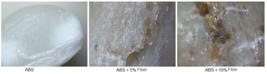
Optical microscopy was employed to evaluate the surface morphology and fiber dispersion in the polymer composites. Figure 12 presents a comparison between virgin ABS and composites containing sugarcane fiber. The formation of bubbles in the polymer matrix is again observed, attributed to the presence of volatiles, but without evidence of compromised interaction between the matrix and the filler.
For the PP-based composites, optical microscopy analysis indicated good fiber dispersion in the polymer matrix, without the presence of apparent surface defects, as shown in Figure 13. This behavior is consistent with the SEM results, which also indicated a more homogeneous structure for the PP-based materials.

Optical microscopy allowed for the evaluation of the surface structure characteristics of the materials, while scanning electron microscopy provided more detailed information about the internal microstructure of the composites. Additionally, the observations made in this study are in agreement with the results reported by HOSOKAWA et al. [30], who described similar morphological behavior for polymer composites reinforced with natural fibers, although with differences in the visualization scale between the techniques employed.
For future studies, it would be interesting to analyze the pretreatment of vegetable fibers, such as sugarcane, through the steam explosion process in order to significantly increase the surface area of the fibers [32]. The use of this treatment, combined with the application of appropriate composite processing techniques, as well as the use of compatibilizing agents, can result in the generation of polymer composites with vegetable fibers that can reach the maximum performance potential of their properties and with attractive production costs for the market.
4. CONCLUSION
Based on the performance of the developed samples and the results obtained from thermal, mechanical, and morphological analyses, it was possible to establish relevant considerations regarding the effect of incorporating sugarcane fiber into ABS and PP polymer matrices.
The addition of fiber resulted in an increase in maximum stress for both polymer matrices. For ABS, increases of 7.3% and 9.4% were observed for composites containing 5% and 10% fiber, respectively, while for PP the increases were 2.1% and 4.8%. Conversely, a reduction in specific deformation was observed in all composites, being more pronounced with increasing fiber content, indicating a loss of ductility in the reinforced materials.
This reduction in deformation capacity was corroborated by the analysis of the fracture mode of the specimens, which went from a ductile behavior, characterized by necking in virgin polymers, to a more brittle fracture in the composites. This behavior is in agreement with the results of the DSC analysis, which showed slight increases in transition temperatures, associated with the restriction of the mobility of the polymer chains due to the presence of the fibrous phase.
Morphological characterization by SEM indicated good interfacial interaction between the sugarcane fiber and the polymeric matrices before and after the injection molding process. However, in the ABS-based composites analyzed after extrusion, cavities attributed to residual fiber moisture were observed. These defects were eliminated after injection molding, demonstrating that processing conditions play a determining role in the final quality of the material, with the injection molding stage being essential for obtaining composites with a more homogeneous microstructure.
Therefore, in general, the results indicate that sugarcane fiber can be used as a filler in ABS and PP matrices, promoting gains in mechanical strength, although accompanied by a reduction in ductility. Furthermore, the valorization of a renewable and abundant agro-industrial residue reinforces the potential of these composites from the perspective of sustainability and the circular economy. Future studies could explore higher fiber contents and the use of compatibilizing agents or surface treatments, aiming to optimize interfacial adhesion and balance mechanical strength, ductility, and processability of the materials.
5. ACKNOWLEDGEMENTS
This work was supported by the company Artecola and the National Council for Scientific and Technological Development (CNPq). The authors also acknowledge the financial support of the Brazilian agencies Coordination for the Improvement of Higher Education Personnel (CAPES), Foundation for Research Support of the State of Rio Grande do Sul (FAPERGS), and Financing Agency for Studies and Projects (FINEP).
6. DATA AVAILABILITY
All the data supporting the results of this study were published in the article itself.
7. BIBLIOGRAPHY
-
[1] MUTHUKUTTI, G.P., SINGH, M., PALANIAPPAN, S.K., et al, “Value-added polymer composites using non-metallic industrial waste: a concise review”, Chemical Engineering Journal, v. 512, pp. 162344, 2025. doi: https://doi.org/10.1016/j.cej.2025.162344.
» https://doi.org/10.1016/j.cej.2025.162344 -
[2] WANG, J., QIAN, W., HE, Y., et al, “Reutilization of discarded biomass for preparing functional polymer materials”, Waste Management, v. 65, pp. 11–21, 2017. doi: https://doi.org/10.1016/j.wasman.2017.04.025. PubMed PMID: 28431803.
» https://doi.org/10.1016/j.wasman.2017.04.025 - [3] UNITED NATIONS ENVIRONMENT PROGRAMME, Biodegradable plastics and marine litter: misconceptions, concerns and impacts on marine environments, Nairobi, UNEP, 2015.
-
[4] KAMMANN, U., NOGUEIRA, P., WILHELM, E., et al, “Abandoned, lost or otherwise discarded fishing gear (ALDFG) as part of marine litter at the seafloor of the Baltic Sea: characterization, quantification, polymer composition and possible impact”, Marine Pollution Bulletin, v. 194, pp. 115348, 2023. doi: https://doi.org/10.1016/j.marpolbul.2023.115348.
» https://doi.org/10.1016/j.marpolbul.2023.115348 -
[5] GHOLIZADEH, M.R., ROGHANI-MAMAQANI, H., HADDADI-ASL, V., “Sustainable polymers: Recycling and reprocessing mechanisms using reversible and dynamic covalent bonds”, Materials Science and Engineering R Reports, v. 168, pp. 101174, 2026. doi: https://doi.org/10.1016/j.mser.2025.101174.
» https://doi.org/10.1016/j.mser.2025.101174 -
[6] CUI, Y., LEE, S., NORUZIAAN, B., et al, “Fabrication and interfacial modifications of wood/recycled plastic composite materials”, Composites. Part A, Applied Science and Manufacturing, v. 39, n. 4, pp. 655–661, 2008. doi: https://doi.org/10.1016/j.compositesa.2007.10.017.
» https://doi.org/10.1016/j.compositesa.2007.10.017 -
[7] SIDDIQUE, R., KHATIB, J., KAUR, I., “Use of recycled plastic in concrete: a review”, Waste Management, v. 28, n. 10, pp. 1835–1852, 2008. doi: https://doi.org/10.1016/j.wasman.2007.09.011. PubMed PMID: 17981022.
» https://doi.org/10.1016/j.wasman.2007.09.011 -
[8] MOHSEN, T.N., BDAIWI, W., “Enhanced mechanical and thermal properties of epoxy composites reinforced with date palm seed particles”, Matéria, v. 31, e20250412, 2026. doi: https://doi.org/10.1590/1517-7076-rmat-2025-0412.
» https://doi.org/10.1590/1517-7076-rmat-2025-0412 -
[9] SANCHEZ, E.M.S., CAVANI, C.S., LEAL, C.V., et al, “Compósito de resina de poliéster insaturado com bagaço de cana-de-açúcar: influência do tratamento das fibras nas propriedades”, Polímeros, v. 20, n. 3, pp. 194, 2010. doi: https://doi.org/10.1590/S0104-14282010005000034.
» https://doi.org/10.1590/S0104-14282010005000034 -
[10] RAJA, T., “Innovative lightweight materials using sugarcane ash and neem fiber epoxy matrix composite for sustainable applications”, Results in Engineering, v. 25, pp. 103720, 2025. doi: https://doi.org/10.1016/j.rineng.2024.103720.
» https://doi.org/10.1016/j.rineng.2024.103720 -
[11] MULENGA, T.K., RANGAPPA, S.M., LAI, C.W., et al, “Synergistic performance in natural fiber hybrid composites: a review of weathering, thermal, and mechanical properties through filler integration”, Journal of Materials Research and Technology, v. 40, pp. 662–678, 2026. doi: https://doi.org/10.1016/j.jmrt.2025.12.077.
» https://doi.org/10.1016/j.jmrt.2025.12.077 -
[12] RAJA, T., “Innovative lightweight materials using sugarcane ash and neem fiber epoxy matrix composite for sustainable applications”, Results in Engineering, v. 25, pp. 103720, 2025. doi: https://doi.org/10.1016/j.rineng.2024.103720.
» https://doi.org/10.1016/j.rineng.2024.103720 -
[13] UNIÃO DA INDÚSTRIA DE CANA-DE-AÇÚCAR E BIOENERGIA, Histórico de produção de cana de açucar, www.unicadata.com.br, accessed in April, 2026.
» www.unicadata.com.br - [14] PEREIRA, C.L., “Aproveitamento de resíduo de coco verde para produção de compósitos destinados à construção rural”, Tese de D.Sc., Universidade de São Paulo, Pirassununga, 2012. doi: https://doi.org/10.11606/T.74.2012.tde-04072012-105220.
-
[15] LIGOWSKI, E., SANTOS, B.C., FUJIWARA, S.T., “Materiais compósitos a base de fibras da cana-de-açúcar e polímeros reciclados obtidos através da técnica de extrusão”, Polímeros, v. 25, n. 1, pp. 70–75, 2015. doi: https://doi.org/10.1590/0104-1428.1605.
» https://doi.org/10.1590/0104-1428.1605 -
[16] ASSOCIAÇÃO BRASILEIRA DA INDÚSTRIA DO PLÁSTICO, https://www.abiplast.org.br/noticias/perfil-2023-industria-do-plastico-impulsiona-economia-brasileira-gerando-mais-de-370-mil-empregos/, accessed in April, 2026.
» https://www.abiplast.org.br/noticias/perfil-2023-industria-do-plastico-impulsiona-economia-brasileira-gerando-mais-de-370-mil-empregos/ -
[17] SANYANG, M.L., SAPUAN, S.M., JAWAID, M., et al, “Recent developments in sugar palm (Arenga pinnata) based biocomposites and their potential industrial applications: a review”, Renewable & Sustainable Energy Reviews, v. 54, pp. 533–549, 2016. doi: https://doi.org/10.1016/j.rser.2015.10.037.
» https://doi.org/10.1016/j.rser.2015.10.037 -
[18] MOHAN, A.M.A., KALIAPPAN, S., NATRAYAN, L., et al, “TiO2 nanoparticle-enhanced kevlar fiber epoxy composites: development, characterization, and performance analysis”, Matéria, v. 31, e20250796, 2026. doi: https://doi.org/10.1590/1517-7076-rmat-2025-0796.
» https://doi.org/10.1590/1517-7076-rmat-2025-0796 -
[19] TAMIMI, A., ERDIWANSYAH, E., SYAHIR, A.Z., et al, “Future perspectives on multiscale and green manufacturing of carbon-based composites for next-generation aerospace systems: a review”, Additive Manufacturing Frontiers, pp. 200313, 2026. doi: https://doi.org/10.1016/j.amf.2026.200313.
» https://doi.org/10.1016/j.amf.2026.200313 -
[20] SALIM, M.Y., RIZAL, M.A.M., NORDIN, A.H., et al, “Natural fibre-reinforced thermoplastic composites: a bibliometric analysis and review of eco-friendly solutions in exterior automotive componentes”, Journal of Materials Research and Technology, v. 39, pp. 6755–6774, 2025. doi: https://doi.org/10.1016/j.jmrt.2025.10.230.
» https://doi.org/10.1016/j.jmrt.2025.10.230 -
[21] TROALEN, W., DUIGOU, A.L., BALEY, C., “Size effect of natural fibre reinforcement on mechanical performance for the development of thin bio-composite laminates: do fibre bundles represent a limitation?”, Composites. Part A, Applied Science and Manufacturing, v. 199, pp. 109245, 2025. doi: https://doi.org/10.1016/j.compositesa.2025.109245.
» https://doi.org/10.1016/j.compositesa.2025.109245 - [22] LOVISON, V.M.H., BRITO, K.J.S., PACHECO, G.S., Metrologia e ensaios básicos na indústria da borracha, 2 ed., São Leopoldo, Centro Tecnológico de Polímeros SENAI, 2008.
-
[23] MENG, Y., SIMON, S.L., “Relation between mobility factor and diffusion factor for thermoset cure”, Thermochimica Acta, v. 437, n. 1–2, pp. 179–189, 2005. doi: https://doi.org/10.1016/j.tca.2005.06.032.
» https://doi.org/10.1016/j.tca.2005.06.032 -
[24] AHMAD, M.N., ISHAK, M.R., YASIR, A.S.H.M., et al, “Mechanical, thermal and physical properties of natural fiber reinforced composites for 3D printer – fused deposition modeling: a review”, Journal of Materials Research and Technology, v. 39, pp. 4063–4078, 2025. doi: https://doi.org/10.1016/j.jmrt.2025.10.104.
» https://doi.org/10.1016/j.jmrt.2025.10.104 - [25] PRAMANIK, T.J., RAFIQUZZAMAN, M.D., KARMAKAR, A., et al, “Evaluation of mechanical properties of natural fiber based polymer composite”, BenchCouncil Transactions on Benchmarks, Standards and Evaluations, v. 4, n. 3, pp. 100183, 2024.
-
[26] RANA, A.K., MANDAL, A., BANDYOPADHYAY, S., “Short jute fiber reinforced polypropylene composites: effect of compatibiliser, impact modifier and fiber loading”, Composites Science and Technology, v. 63, n. 6, pp. 801–806, 2003. doi: https://doi.org/10.1016/S0266-3538(02)00267-1.
» https://doi.org/10.1016/S0266-3538(02)00267-1 -
[27] LIGOWSKI, E., SANTOS, B.C., FUJIWARA, S.T., “Materiais compósitos a base de fibras da cana-de-açúcar e polímeros reciclados obtidos através da técnica de extrusão”, Polímeros, v. 25, n. 1, pp. 70–75, 2015. doi: https://doi.org/10.1590/0104-1428.1605.
» https://doi.org/10.1590/0104-1428.1605 -
[28] MARCOVICH, N.E., ARANGUREN, M.I., REBOREDO, M.M., “Modified woodflour as thermoset fillers. Part I. Effect of the chemical modification and percentage of filler on the mechanical properties”, Polymer, v. 42, n. 2, pp. 815–825, 2001. doi: https://doi.org/10.1016/S0032-3861(00)00286-X.
» https://doi.org/10.1016/S0032-3861(00)00286-X -
[29] VIGNESH, P., VENKATACHALAM, G., SHANKAR, A.G., et al, “Studies on tensile strength of sugarcane fiber reinforced hybrid polymer matrix composite”, Materials Today: Proceedings, v. 5, n. 5, pp. 13347–13357, 2018. doi: https://doi.org/10.1016/j.matpr.2018.02.327.
» https://doi.org/10.1016/j.matpr.2018.02.327 -
[30] HOSOKAWA, M.N., DARROS, A.B., MORIS, V.A.S., et al, “Polyhydroxybutyrate Composites with Random Mats of Sisal and Coconut Fibers”, Materials Research, v. 20, n. 1, pp. 279–290, 2016. doi: https://doi.org/10.1590/1980-5373-mr-2016-0254.
» https://doi.org/10.1590/1980-5373-mr-2016-0254 - [31] PADILHA, A.F., SICILIANO JUNIOR, F., Encruamento, recristalização, crescimento de grão e textura, São Paulo, Associação Brasileira de Metalurgia e Materiais, 1996.
-
[32] GANDARA, M., GONÇALVES, A.R., SARON, C., “Compósitos de PET reciclado com fibra de cana-de-açúcar tratada por explosão a vapor”, Matéria, v. 22, n. 4, e11890, 2017. doi: https://doi.org/10.1590/s1517-707620170004.0224.
» https://doi.org/10.1590/s1517-707620170004.0224


