
 Characterization of sisal (Agave sisalana) fibers
ABSTRACT
The search for sustainability has led to the increased use of natural fibers, such as sisal. This study aimed to analyze the physical, mechanical, and thermal properties of sisal fibers from Brazil’s semi-arid region, enhancing their use as reinforcement in biocomposites. Tests were performed on density, diameter, moisture content, water absorption, tensile strength, thermogravimetric analysis (TGA), scanning electron microscopy (SEM), X-ray diffraction (XRD), and Fourier transform infrared spectroscopy (FTIR). The fibers had an average density of 1.15 g/cm3, a maximum tensile strength of 242 MPa, a modulus of elasticity of 5,399 MPa, and a maximum deformation of 0.08 mm/mm. Thermogravimetric analysis (TGA/DTG) indicated good thermal stability of the fibers up to approximately 230ºC. The high-water absorption of the fibers highlighted the need for surface treatments to optimize fiber-matrix adhesion. The findings were essential for understanding the properties of sisal grown in northeastern Brazil, highlighting its potential as a reinforcement in biocomposites for developing new biodegradable, environmentally friendly, and high-performance products.
Lignocellulosic fibers; Mechanical properties; Thermal analysis; Sustainability
1. INTRODUCTION
The growing global demand for more sustainable practices has driven the development of products using natural raw materials to promote waste recycling and reduce environmental impacts [1]. Natural fibers can be utilized in various applications, including consumer goods, automotive parts, and construction materials, among others. Therefore, these materials stand out as a promising alternative to conventional materials due to their biodegradability, recyclability, and sustainability. Plant fibers are widely available in nature, non-toxic, low-cost, and have physical, mechanical, and thermal properties comparable to synthetic fibers. They are also environmentally friendly throughout their life cycle [2].
Sisal (Agave sisalana Perrine ex Engelm.) fibers are essential from both economic and environmental perspectives. Vegetable fibers are among the most widely used in the world, with Brazil being the largest producer. These fibers are primarily cultivated in semi-arid regions characterized by a dry tropical climate, limited and irregular rainfall, and high evaporation rates. These climatic conditions present challenges for agriculture, affecting both productivity and water availability [3]. Sisal is cultivated in several regions, including India, Haiti, East Africa, and Indonesia, primarily for the extraction of its leaves [4]. The fibers obtained from sisal not only possess valuable properties but also have a significant social and economic impact in semi-arid areas. These regions typically have an abundant labor force engaged in various processing phases, which provides income opportunities for the rural population [5]. Traditionally, they are used in the artisanal production of ropes and carpets. They can be applied in composites for the production of automotive components and construction materials, contributing to their added value [4]. The main challenge associated with incorporating these fibers as reinforcement in polymer composites is the low compatibility between the fiber and the matrix. The hydrophilic properties of sisal fibers are not compatible with the hydrophobic properties of most conventional polymers [6].
The use of natural and renewable polymers as composite matrices also represents a breakthrough in the development of more sustainable and environmentally friendly materials [7]. The most commonly used matrices in composite materials are polymeric ones, such as epoxy and polyester resins. A significant disadvantage of using these polymers is their unsustainability. A sustainable alternative to replace these products is biodegradable polymers, such as vegetable-based polyurethane. This category of polymers combines the characteristics of conventional polyurethane with renewable sources from plants [8]. While conventional polyurethanes are often produced from petroleum-based derivatives, vegetable-based polyurethanes aim to incorporate renewable raw materials. Common vegetable oils, such as soybean oil, castor oil, and sunflower oil, are used as sources in the production of these polymers [9]. Understanding and analyzing the properties of raw materials is crucial for developing composites with desirable characteristics and high durability.
This research aims to demonstrate the potential of sisal fibers from the Brazilian semi-arid region as reinforcement in sustainable biocomposites. The properties of these fibers can vary due to regional climatic factors. A detailed characterization of the fibers is essential to guide their application, allowing for the selection of appropriate processing parameters and enhancing our understanding of their performance in polymeric composites.
2. MATERIALS AND METHODS
2.1. Preparation of sisal fibers
Sisal fibers (Figure 1) were obtained commercially from Sisal Nordeste, a company located in Retirolândia, Bahia state, Brazil. They were initially subjected to a manual paralleling process, using a steel brush to separate them from each other and eliminate impurities. They were then cut into 35 cm lengths to facilitate handling and sample preparation.

2.2. Determination of apparent density
To determine the density of sisal fibers, the method described in ASTM D3800-22 [10] was employed. Four samples, each weighing approximately 3 g, were used for each treatment. For the tests, canola oil was used as the immersion fluid, whose density was determined using a 50 ml pycnometer. A metal support with a suspension hook was made to keep the fibers immersed without contact with the container containing the oil. First, 150 ml of oil was added to a beaker, which was then positioned on an analytical scale. Next, the support with the suspension hook submerged in the oil, without the fiber, was weighed (Figure 2a). Afterward, the sisal sample was attached to the hook and weighed while submerged in the oil (Figure 2b).

Determination of sisal fibers density according to the procedures of the ASTM D3800-22 standard: (a) weighing the support without sisal sample; (b) weighing the support with sisal sample.
The weight values obtained through the method were recorded, and the fiber density for each treatment was calculated using the equation provided by the standard (1).
Where: ρf – fiber density; ρl – liquid density; M1 – Fiber mass in air; M2 – Mass of the support in the liquid; M3 – Support mass with fiber immersed in liquid.
2.3. Measuring the diameter of sisal fibers
Sisal fiber diameters were determined using an optical microscope with a 5× magnification lens located in the metallography laboratory at UFERSA. Due to the significant variation in natural fiber diameters, both between different fibers and within a single monofilament, 20 sisal fiber samples were selected for diameter measurement. Average diameters were obtained from images captured by an optical microscope at 5× resolution (Figure 3a). Images were taken along the length of each fiber (Figure 3b).
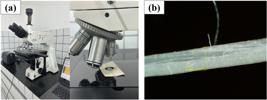
Measurement of average fiber diameters: (a) detailing the optical microscope with 5× resolution and (b) image taken along the length of the sisal fiber.
2.4. Moisture content
The NBR 14810-3 standard [11] was used to perform fiber moisture content tests. Four sets of sisal fibers were prepared for analysis. To measure the wet mass of the samples, they were weighed on an analytical scale (Figure 4a). Then, the samples were subjected to a drying process (Figure 4b) in a drying and sterilization oven with forced air circulation (model Solab SL-100) for 24 hours, at a temperature of 50 ± 2 °C. After this period, the samples were transferred to a desiccator until they reached room temperature. Finally, to determine the dry mass, the samples were weighed again (Figure 4c).

Sequence of procedures employed for moisture content determination: (a) weighing the wet fibers sample; (b) drying the fibers in a laboratory oven; (c) weighing the fibers sample after drying.
After obtaining the values for wet and dry weight of the fibers, the moisture content was calculated using the equation provided in the standard (2).
Where: U – Residual moisture of the sample (%); m_u – wet weight of the sample (g); m_s – dry weight of the sample (g).
2.5. Water absorption
To determine the water absorption of the fibers, tests were performed according to standard NBR 14810-3 [11].Four sets of sisal fibers were prepared for analysis. Initially, the samples were placed in a drying oven for 24 hours at a temperature of 50 ± 2 °C (Figure 5a). After this period, the samples were transferred to a desiccator until they reached room temperature (Figure 5b). They were then weighed on an analytical scale, and their dry mass values were determined (Figure 5c).

Tests for determining the water absorption of the sisal fibers: (a) oven drying; (b) fibers in the desiccator; (c) determination of the fibers’ dry weight; (d) fibers immersed in water; (e) weighing after 2 hours of immersion; and (f) weighing after 24 hours of immersion.
The samples were then immersed in distilled water at room temperature for 2 hours (Figure 5d). After this immersion, they were removed, dried with paper towels, and weighed again to record the wet mass values (Figure 5e). The procedure was repeated, increasing the immersion time to 24 hours (Figure 5f). The water absorption of the fibers was calculated using the equations provided by the standard, based on the data obtained during the tests.
2.6. Tensile strength
Tensile tests were performed on sisal fibers to characterize and evaluate their mechanical properties. These were determined according to ASTM C1557 [12]. Based on the standard, the 20 sisal samples were aligned and glued to the center of A4 paper cutouts (Figure 6). To perform the tests, the samples were clamped in the pressure grips of the EMIC model DL10000 testing machine, with a 5 kN load cell (Figure 6a). At the end of the assembly, the sides of the guide were cut so that only the fiber remained between the grips (Figure 6b). Then, the test continued until the fiber ruptured (Figure 6c). The speed used was 0.027 mm/s. At the end of the test, the values of maximum stress, modulus of elasticity, and maximum deformation were obtained.

Tensile strength test of sisal fibers: (a) EMIC DL10000 testing machine with 5kN Z model load cell; (b) sisal fiber specimen in tensile test; (c) broken fiber after test.
2.7. Scanning Electron Microscope (SEM)
To analyze the surface morphology of the sisal fibers, they were observed using scanning electron microscopy (SEM). The samples were previously cut to suitable dimensions for placement in the equipment supports. Initially, the samples were oven-dried at 50 ± 2 °C for 24 h to remove residual moisture. Due to the non-conductive nature of natural fibers, the dried samples were fixed to a metal support (Figure 7a) and subjected to the metallization process (Figure 7b). The process lasted 8 minutes, resulting in the deposition of a thin layer of gold on the sample surface, with a thickness of approximately 9 nm (Figure 7c). The prepared samples were inserted into the SEM analysis chamber, where a vacuum was established. Characterization was conducted using an accelerating voltage of 10 kV, a suitable working distance, and variable magnification, as needed to observe the morphological details of the fiber surfaces (Figure 7d). The images obtained were digitally recorded for analysis and interpretation.

Scanning electron microscopy (SEM) analysis on sisal fibers: (a) fixing of samples on a metal support for metallization; (b) sample metallization process; (c) samples after deposition of the gold layer; (d) obtaining images in the scanning electron microscope.
2.8. X-ray diffraction (XRD)
The crystalline phases of the materials were identified by X-ray diffraction (XRD). For this analysis, a Bruker AXS D2 Phaser (A26-X1-A2A0B4C0) with Cu Kα radiation (λ = 1.54 Å) was used. The previously pulverized materials were placed individually in a circular sample holder (Figure 8a), which was then positioned in the equipment (Figure 8b). The XRD configuration was adjusted for a 2θ range of 5° to 80°, with a step size of 0.05 ° and an integration time of 4 seconds per step. Each analysis lasted approximately 1 hour and 40 minutes (Figure 8c). The data obtained in the experiments were organized into spreadsheets, and graphs of the results were generated using the Origin software.

X-ray diffraction analysis (XRD): (a) powdered material in the sample holder; (b) sample in the equipment; (c) analysis of the result.
2.9. Fourier Transform Infrared Spectroscopy (FTIR)
For Fourier Transform Infrared Spectroscopy (FTIR) analyses, an infrared spectrometer (ALFA - Bruker) was used. The equipment was initially calibrated and set to a range of 4000 to 400 cm−1. Then, the samples were individually inserted into the device, and a silicon crystal ATP support was placed on the surface of the material (Figure 9a). The analysis lasted 5 minutes. The generated data underwent baseline correction and smoothing (Figure 9b). Finally, the wavenumber versus transmittance curves were plotted using the Origin software.

Fourier transform infrared spectroscopy (FTIR) analysis: (a) sample in the spectrometer; (b) execution of the experiment analysis.
2.10. Thermogravimetric analysis (TGA)
The behavior of sisal fibers under increasing temperature was evaluated through thermogravimetric analysis (TGA) to identify the ranges associated with the decomposition of their main constituents. The test was performed using a Perkin Elmer thermal analyzer (STA6000) under a controlled nitrogen atmosphere. To ensure greater stability of the curves during the material decomposition process, a control analysis was performed using alumina (Al2O3) as the reference material. Initially, a ceramic crucible was inserted into the equipment, and its mass value was recorded. Then, approximately 5 mg of alumina was added to the crucible, and a new weighing was performed. The equipment was configured to operate over a temperature range of 30 to 900 °C, with a heating rate of 10 °C/min and a continuous nitrogen flow of 20 mL/min. After the experiment, the data were saved and used as a reference for analyzing sisal fiber. The heating program adopted for the samples was identical to that used for the reference analysis. Approximately 12 mg of the sample (Figure 10a) was added to the crucible for the test. The sample was inserted into the equipment (Figures 10b and 10c), and the experiment was initiated. After the time specified by the equipment, the experiment was completed. Afterwards, the data provided by the equipment (Figure 10d) were organized into spreadsheets, and the TG (mass variation) and DTG (derived from mass variation) curves were generated using the Origin software.

Thermogravimetric analysis (TGA) procedures: (a) positioning the material in the sample holder; (b) and (c) inserting the sample into the equipment; (d) performing the thermogravimetric analysis.
2.11. Statistical analysis
Previously, the data were evaluated using the Shapiro-Wilk normality test and Levene’s test for homogeneity of variances. Subsequently, analysis of variance (ANOVA) was performed and, when significant differences between the means were identified, Tukey’s test was applied (p < 0.05).
3. RESULTS AND DISCUSSION
3.1. Physical properties: apparent density, diameter, moisture content, and water absorption
The results of the physical tests of the sisal fibers are presented in Table 1. The fibers showed an average density of 1.15 g/cm3, a value characteristic of lignocellulosic materials and lower than that of synthetic fibers. This value is within the range reported for sisal (0.76–1.58 g/cm3) and is comparable to that of other natural fibers used as reinforcement in composites: bamboo (approximately 0.91 g/cm3), jute (1.30–1.46 g/cm3) and kenaf (1.31–1.50 g/cm3) [13].
This comparison shows that sisal from the Brazilian semi-arid region has a lower density than some vegetable fibers, making it more competitive for the production of lighter composites. It can be associated with climatic conditions in the northeastern semi-arid region and regional processing practices, which tend to reduce moisture content and apparent specific mass. In contrast, glass fibers, widely used as structural reinforcement, have a significantly higher density, around 2.5 g/cm3, reinforcing the advantage of sisal in applications that demand weight reduction, such as in the automotive, aerospace and civil construction sectors, as well as lower energy consumption during transport and processing, essential aspects for sustainable development [6, 14].
The average diameter of the sisal fibers analyzed was 0.28 mm, a value that falls within the range reported for Moroccan sisal by SAMOUH et al. [15] (0.12–0.41 mm). On the other hand, this value is higher than the dimensions observed for Tanzanian sisal by FODE et al. [16] (0.05–0.18 mm) and the ranges consolidated in the review by KARIMAH et al. [13] (0.05–0.20 mm). This variation between producing regions is typical of lignocellulosic fibers and is influenced by climate, soil, agricultural practices, and extraction methods, reinforcing the idea that sisal from the Brazilian semi-arid region has its own characteristics resulting from its specific cultivation conditions. The higher diameter reduces the surface area-to-fiber volume ratio, which tends to decrease the quality of interfacial adhesion and the efficiency of stress transfer [17]. Thus, although the value obtained is consistent with the natural variability of sisal, this larger diameter may lead to composites with inferior mechanical performance when compared to those reinforced with finer fibers, which usually exhibit better anchorage in the matrix.
The moisture content of the sisal fibers was 4.67%. Natural fibers readily absorb water due to the presence of hemicellulose, which endows them with hydrophilic properties [18]. This characteristic impairs compatibility with hydrophobic polymeric matrices, potentially leading to delamination or loss of adhesion in composites. The results of the water absorption tests confirmed this behavior. After 2 hours of immersion, the fibers showed an absorption of 83.57%, and after 24 hours, this percentage increased to 90.96%. These values indicate high porosity and the presence of hydroxyl groups available for binding with water molecules.
Moisture absorption is responsible for dimensional variation in fibers, leading to microcracks at the fiber-matrix interface and poor interfacial adhesion [19]. To mitigate these problems, it is recommended to subject the fibers to chemical or physical treatments that modify their chemical composition and/or surface properties. These treatments aim to achieve a more stable fiber structure with improved adhesion, thereby optimizing fiber-matrix contact and enhancing composite properties [20].
3.2. Fourier Transform Infrared Spectroscopy (FTIR)
Figure 11 shows the FTIR spectrum of sisal fiber, which provides relevant information about its chemical composition and allows the identification of its main constituents. The broad band between 3200 and 3500 cm−1 corresponds to O–H stretching vibrations associated with hydrogen bonds between cellulose and hemicellulose. The band’s amplitude reinforces the presence of available hydroxyl groups, which are directly related to the high-water absorption discussed in Section 3.1. This characteristic contributes to the fiber’s low compatibility with hydrophobic polymeric matrices [15].

Fourier transform infrared spectroscopy (FTIR) curve of sisal fibers from Brazilian semi-arid region.
The band near 2900 cm−1, attributed to C–H vibrations, confirms the predominance of cellulose and hemicellulose, and its relatively smooth shape suggests the coexistence of ordered and amorphous regions, typical of natural fibers subjected to minimal processing [21]. The C–O stretch observed between 1500 and 1600 cm−1 indicates the presence of lignin, whose aromatic structure contributes to the fiber’s rigidity and thermal stability. The band around 1030 cm−1, corresponding to the characteristic C–O–C stretch of cellulose, reflects the molecular organization of polysaccharides [15]. In general, the band set confirms the lignocellulosic nature of sisal. It explains its high tendency to absorb moisture, due to the high content of hydroxyl groups in cellulose and hemicellulose.
3.3. X-ray diffraction (XRD) analysis
X-ray diffraction (XRD) analysis, as shown in Figure 12, was used to evaluate the crystallographic structure of the sisal fibers. The two main diffraction peaks at approximately 15° and 22° (2θ), associated with the (110) and (002) planes of type I cellulose, indicate the preservation of the native crystalline structure of the cell wall [22]. The low-intensity peak around 35º indicates the presence of amorphous fiber constituents, including lignin, hemicellulose, pectins, and amorphous cellulose [23]. The semicrystalline structure observed in sisal fibers is typical of lignocellulosic fibers. Crystalline regions offer increased stiffness, tensile strength, and thermal stability, whereas amorphous regions are more susceptible to moisture absorption and exhibit greater mechanical variability. Additionally, a higher amorphous content can weaken interfacial adhesion in composites, necessitating treatments to enhance fiber-matrix compatibility [24].

3.4. Fibers’ properties of tensile strength
Tensile tests on sisal fibers yielded a maximum tensile strength of 242 MPa, a modulus of elasticity of 5,399 MPa and a deformation of 0.08 mm/mm (Table 2). KARIMAH et al. [13] reported strengths ranging from 274 to 855 MPa and moduli of elasticity ranging from 9 to 38 GPa for sisal fibers. The analysis of the dimensional characteristics and mechanical properties of fibers is fundamental for their use in applications, since there is significant variability in the properties of individual fibers, even within the same species. This variability can be attributed to natural plant factors, irregular fiber geometry, soil type where they are cultivated, plantation location and climatic conditions [25].
The mechanical performance of sisal is inferior to that of conventional synthetic fibers, such as glass fiber, whose average strength is approximately 2500 MPa and modulus of elasticity of 72 GPa [26]. Even so, sisal from the Brazilian semi-arid region stands out among natural reinforcements, valued for lightweight structural applications where factors such as low cost, biodegradability, and low density become decisive in its selection. MOHAMMED et al. [18] highlight that even moderate strengths allow sisal to contribute significantly to stress transfer at the fiber-matrix interface in composites, while THYAVIHALLI et al. [27] reinforce that its stiffness and durability justify its wide use in various industries, such as automotive and maritime, for the manufacture of ropes and yarns, in civil construction, as well as in mattresses and carpets.
The tensile mechanical behavior of sisal fibers is illustrated in the stress-strain diagram shown in Figure 13. The mechanical properties of these fibers are heavily influenced by their chemical composition, which includes cellulose, hemicellulose, lignin, and a small amount of other soluble substances [18]. The main structural component of the fiber, responsible for providing strength, stiffness, and structural stability, is cellulose. The tensile strength and modulus of elasticity of fibers increase with increasing cellulose content [28].

Mechanical behavior (stress × strain) of sisal fiber samples from the Brazilian semi-arid region.
The longitudinal surface morphology of sisal fibers was analyzed by Scanning Electron Microscopy (SEM) at different magnifications, as shown in Figure 14. The images showed structural characteristics typical of lignocellulosic fibers, evidencing the surface structure of the untreated fiber. The fibers were observed to have an ordered structure, with bundles of cellulose microfibrils aligned parallel to the longitudinal axis (Figure 14a). Microcracks and discontinuities on the fiber surface were also observed, likely caused during the sample preparation process, such as mechanical cutting or drying, which can cause ruptures in the cell wall (Figure 14b). The sisal surface was noted to have a rough surface, with the presence of residual particles, possibly composed of wax, lignin, and hemicellulose (Figure 14c). These substances are typical of the surface layer of plant fibers and can compromise adhesion and interfacial interaction in polymer composites. Removing these constituents through chemical treatments, such as alkaline treatment, improves the fiber surface roughness, thereby generating greater fiber-matrix adhesion in composites and enhancing their mechanical properties [29].

Images obtained by scanning electron microscopy (SEM) of sisal fiber at different magnifications (a) 200×; (b) 500×; (c) 2,000×.
3.5. Thermal properties
The analysis of the thermogravimetric (TGA/DTG) curves for sisal fiber (see Figure 15) identified three distinct stages of degradation related to its composition. The initial mass loss of about 9.6% occurring up to 100 °C is attributed to the removal of water from the fiber structure, emphasizing its hydrophilic nature. This characteristic can negatively affect dimensional stability and interfacial adhesion in composites. The main degradation stage, which accounts for a mass loss of 60.3%, takes place between 250 °C and 385 °C. This stage features DTG peaks at 293 °C and 346 °C, corresponding to the decomposition of hemicellulose and cellulose, respectively.

The lower thermal stability of hemicellulose reflects its amorphous nature, while cellulose, being more crystalline, resists higher temperatures. This sequence limits the fiber’s processing temperature range to below approximately 230 °C, restricting its application to low-melting-point polymer matrices or thermoset systems [15]. The last stage of thermal degradation extended to approximately 856 °C, with an additional 29.2% mass loss. This process involves oxidizing carbonized residues from previous stages and degrading the remaining lignin. In general, the thermal behavior of sisal from the Brazilian semi-arid region is compatible with its use as reinforcement in biocomposites. Still, it imposes limitations in applications that require high thermal stability or processing at elevated temperatures.
4. FINAL CONSIDERATIONS
Sisal fibers from Brazil’s semi-arid region have physical, mechanical, and thermal properties that make them suitable for reinforcement in sustainable composites. Thermal stability up to approximately 230 °C indicates potential for processing with low-temperature polymeric matrices, such as vegetable polyurethane. However, the high-water absorption rate confirms the need for surface treatments to improve fiber-matrix adhesion. The results obtained reinforce the relevance of sisal cultivation in the Brazilian semi-arid region as a viable and strategic alternative for sectors such as automotive, packaging, and civil construction, thereby increasing the added value of this abundant crop. For future perspectives, it is recommended to explore chemical modifications, such as alkaline treatment, and to integrate these fibers into biocomposites to assess the mechanical performance and durability of the developed materials.
5. BIBLIOGRAPHY
-
[1] RAJESHKUMAR, L., KUMAR, P.S., RAMESH, M., et al., “Assessment of biodegradation of lignocellulosic fiber-based composites – a systematic review”, International Journal of Biological Macromolecules, v. 253, n. Pt 5, pp. 127237, 2023. DOI: https://doi.org/10.1016/j.ijbiomac.2023.127237. PubMed PMID: 37804890.
» https://doi.org/10.1016/j.ijbiomac.2023.127237 -
[2] RAMASUBBU, R., MADASAMY, S., “Fabrication of automobile component using hybrid natural fiber reinforced polymer composite”, Journal of Natural Fibers, v. 19, n. 2, pp. 736–746, 2022. DOI: https://doi.org/10.1080/15440478.2020.1761927.
» https://doi.org/10.1080/15440478.2020.1761927 -
[3] FERRAZ-ALMEIDA, R., OLIVEIRA, A.R., PINHEIRO, C.J., et al., “Potential of sisal (Agave sisalana) residues for improving sisal plant growth and soil residue stocks in Bahia’s circular agriculture”, Agronomy, v. 15, n. 6, pp. e1426, 2025. DOI: https://doi.org/10.3390/agronomy15061426.
» https://doi.org/10.3390/agronomy15061426 -
[4] CHOUDHARY, S., SAIN, M.K., KUMAR, V., et al., “Advantages and applications of sisal fiber reinforced hybrid polymer composites in automobiles: a literature review”, Materials Today: Proceedings, v. 76, 2023. DOI: https://doi.org/10.1016/j.matpr.2023.02.072.
» https://doi.org/10.1016/j.matpr.2023.02.072 - [5] QUEIROGA, V., SILVA, O., MEDEIROS, J., et al., Sisal (Agave sisalana, Perrine): tecnologias de plantio e utilização, 1 ed., Campina Grande, Embrapa, 2021.
-
[6] ELFALEH, I., ABBASSI, F., HABIBI, M., et al., “A comprehensive review of natural fibers and their composites: An eco-friendly alternative to conventional materials”, Results in Engineering, v. 19, pp. e101271, 2023. DOI: https://doi.org/10.1016/j.rineng.2023.101271.
» https://doi.org/10.1016/j.rineng.2023.101271 -
[7] CARVALHO, J.P.R.G., LOPES, F.P.D., SIMONASSI, N.T., et al., “Methodological analysis of composites Green Polyurethane Resin reinforced with jute fabric”, Case Studies in Construction Materials, v. 17, pp. e01512, 2022. DOI: https://doi.org/10.1016/j.cscm.2022.e01512.
» https://doi.org/10.1016/j.cscm.2022.e01512 -
[8] LIM, W.B., MIN, J., SEO, M., et al., “Synthesis and properties of biodegradable waterborne polyurethane modified as castor oil”, Results in Materials, v. 19, pp. e100433, 2023. DOI: https://doi.org/10.1016/j.rinma.2023.100433.
» https://doi.org/10.1016/j.rinma.2023.100433 -
[9] LEE, J., KIM, J.H., “Performance evaluations of flexible polyurethane foams manufactured with castor oil-based bio-polyol”, Polymer Testing, v. 124, pp. e108069, 2023. DOI: https://doi.org/10.1016/j.polymertesting.2023.108069.
» https://doi.org/10.1016/j.polymertesting.2023.108069 -
10 [10] AMERICAN SOCIETY FOR TESTING AND MATERIALS, ASTM D3800 – 22 Standard Test Method for Density of High-Modulus Fibers, West Conshohocken, ASTM, 2022. DOI: https://doi.org/10.1520/D3800-22., West Conshohocken, ASTM, 2022. DOI: https://doi.org/10.1520/D3800-22.
» https://doi.org/10.1520/D3800-22 - 11 [11] ASSOCIAÇÃO BRASILEIRA DE NORMAS TÉCNICAS. ABNT NBR 14810-3: Chapas de Madeira Aglomerada – Parte 3 – Métodos de Ensaio, Rio de Janeiro, ABNT, 2013., Rio de Janeiro, ABNT, 2013.
- 12 [12] AMERICAN SOCIETY FOR TESTING AND MATERIALS, ASTM C1557 – 20 Standard Test Method for Tensile Strength and Young’s Modulus of Fibers, West Conshohocken, ASTM, 2020., West Conshohocken, ASTM, 2020.
-
[13] KARIMAH, A., RIDHO, M.R., MUNAWAR, S.S., et al., “A review on natural fibers for development of eco-friendly bio-composite: characteristics, and utilizations”, Journal of Materials Research and Technology, v. 13, pp. 2442–2458, 2021. DOI: https://doi.org/10.1016/j.jmrt.2021.06.014.
» https://doi.org/10.1016/j.jmrt.2021.06.014 -
[14] YUDHA, N.K., NUGROHO, A.D., ERLANGGA, W., et al., “Sustainable high-performance materials: The role of bamboo and glass fibers in hybrid composites”, Hybrid Advances, v. 9, pp. 100416, 2025. DOI: https://doi.org/10.1016/j.hybadv.2025.100416.
» https://doi.org/10.1016/j.hybadv.2025.100416 -
[15] SAMOUH, Z., CHERKAOUI, O., SOULAT, D., et al., “Identification of the physical and mechanical properties of Moroccan sisal yarns used as reinforcements for composite materials”, Fibers, v. 9, n. 13, pp. e13, 2021. DOI: https://doi.org/10.3390/fib9020013.
» https://doi.org/10.3390/fib9020013 -
[16] FODE, T., JANDE, Y., KIM, Y., et al., “Effects of different lengths and doses of raw and treated sisal fibers in the cement composite material”, Scientific Reports, v. 15, n. 1, pp. 1603, 2025. DOI: https://doi.org/10.1038/s41598-025-86046-3. PubMed PMID: 39794504.
» https://doi.org/10.1038/s41598-025-86046-3 -
[17] SHARMA, K., DEVNANI, G.L., “Recent advancement in sisal fiber reinforced polymer composites”, Materials Today: Proceedings, v. 65, n. 8, pp. 3893–3901, 2022. DOI: https://doi.org/10.1016/j.matpr. 2022.07.185.
» https://doi.org/10.1016/j.matpr.2022.07.185 -
[18] MOHAMMED, M., OLEIWI, J., MOHAMMED, A.M., et al., “A review on the advancement of renewable natural fiber hybrid composites: prospects, challenges, and industrial applications”, Journal of Renewable Materials, v. 12, n. 7, pp. 1237–1290, 2024. DOI: https://doi.org/10.32604/jrm.2024.051201.
» https://doi.org/10.32604/jrm.2024.051201 -
[19] CASTOLDI, R.S., SOUZA, L.M.S., SOUTO, F., et al., “Effect of alkali treatment on physical–chemical properties of sisal fibers and adhesion towards cement-based matrices”, Construction & Building Materials, v. 345, n. 22, pp. e128363, 2022. DOI: https://doi.org/10.1016/j.conbuildmat.2022.128363.
» https://doi.org/10.1016/j.conbuildmat.2022.128363 -
[20] VEIGAS, M.G., NAJIMI, M., SHAFEI, B., “Cementitious composites made with natural fibers: Investigation of uncoated and coated sisal fibers”, Case Studies in Construction Materials, v. 16, pp. e00788, 2022. DOI: https://doi.org/10.1016/j.cscm.2021.e00788.
» https://doi.org/10.1016/j.cscm.2021.e00788 -
[21] APPUSAMY, V., DHANALAKSHMI, C.S., “Investigation of mechanical and thermal behaviors of dual fibre loaded reinforced vinylester composites”, Anais da Academia Brasileira de Ciências, v. 97, n. 2, pp. e20240988, 2025. DOI: https://doi.org/10.1590/0001-3765202520240988. PubMed PMID: 40243767.
» https://doi.org/10.1590/0001-3765202520240988 -
[22] SANFILIPPO, C., FIORE, V., CALABRESE, L., et al., “Effect of sodium bicarbonate treatment on the properties of sisal fibers and their geopolymer composites”, Case Studies in Construction Materials, v. 21, pp. e03536, 2024. DOI: https://doi.org/10.1016/j.cscm.2024.e03536.
» https://doi.org/10.1016/j.cscm.2024.e03536 -
[23] TRIVEDI, A.K., GUPTA, M.K., SINGH, H., “PLA based biocomposites for sustainable products: a review”, Advanced Industrial and Engineering Polymer Research, v. 6, n. 4, pp. 382–395, 2023. DOI: https://doi.org/10.1016/j.aiepr.2023.02.002.
» https://doi.org/10.1016/j.aiepr.2023.02.002 -
[24] ASSANVO, E.F., N’GATTA, K.M., TOURÉ, K.J.N., et al., “Extraction and detailed physico-chemical characterization of lignocellulosic fibers derived from Lonchocarpus cyanescens”, Journal of Polymer Materials, v. 41, n. 2, pp. 55–68, 2024. DOI: https://doi.org/10.32604/jpm.2024.055397.
» https://doi.org/10.32604/jpm.2024.055397 -
[25] PARIKH, H.H., “Tribology of plant-based natural fiber reinforced polymer matrix composites–a short review”, Journal of Natural Fibers, v. 20, n. 1, pp. e2172639, 2023. DOI: https://doi.org/10.1080/15440478.2023.2172639.
» https://doi.org/10.1080/15440478.2023.2172639 -
[26] RAJ, M.K.A., MUTHUSAMY, S., PANCHAL, H., “Investigation of mechanical properties of dual-fiber reinforcement in polymer composite”, Journal of Materials Research and Technology, v. 18, pp. 3908–3915, 2022. DOI: https://doi.org/10.1016/j.jmrt.2022.04.053.
» https://doi.org/10.1016/j.jmrt.2022.04.053 -
[27] THYAVIHALLI, Y.G.G., RANGAPPA, S.M., PARAMESWARANPILLAI, J., et al., “Natural fibers as sustainable and renewable resource for development of eco-friendly composites: a comprehensive review”, Frontiers in Materials, v. 6, pp. e266, 2019. DOI: https://doi.org/10.3389/fmats.2019.00226.
» https://doi.org/10.3389/fmats.2019.00226 -
[28] KHOUAJA, A., KOUBAA, A., BEN DALY, H., “Mechanical and morphological properties of cellulose biocomposites”, Chemosphere, v. 379, pp. 144415, 2025. DOI: https://doi.org/10.1016/j.chemosphere.2025.144415. PubMed PMID: 40252412.
» https://doi.org/10.1016/j.chemosphere.2025.144415 -
[29] LITAIFF, H.A., SANTOS, G.M., MELO, G., et al., “Influence of alkali treatment on physical-mechanical properties of mallow fiber/BOPP composites”, Polímeros, v. 35, n. 1, pp. 20250006, 2025. DOI: https://doi.org/10.1590/0104-1428.20240040.
» https://doi.org/10.1590/0104-1428.20240040


