 Development of eco-friendly nano-catalysts using plant-derived silver nanoparticles for environmental wastewater treatment and remediation
ABSTRACT
Recent global assessments indicate that more than 80% of wastewater is discharged untreated, contributing significantly to environmental pollution and ecosystem degradation. In this study, an eco-friendly approach was employed to synthesise silver nanoparticles (AgNPs) using plant extracts as natural reducing and stabilising agents. The synthesised nanoparticles were immobilised onto suitable support matrices to develop reusable nanocatalysts for wastewater treatment. The developed nanocatalyst exhibited high catalytic efficiency, achieving >92% degradation of methylene blue within 45 min, following pseudo-first-order kinetics (k = 0.064 min−1). Comparable degradation performance was observed for phenol and Cr(VI), confirming the applicability to multiple pollutants. The catalyst demonstrated excellent stability, retaining 83% efficiency after 10 cycles, indicating strong structural integrity and reusability. The characterization using UV–Vis, FTIR, XRD, SEM/TEM, and TGA verified the creation of stable, crystalline, and evenly dispersed nanoparticles averaging 20 nm in size. Environmental assessment indicated negligible toxicity and minimal Ag+ leaching (<3%), attributed to phytochemical capping. These findings demonstrate that plant-derived AgNP-based nanocatalysts offer a sustainable, cost-effective, and scalable solution for wastewater remediation, aligning with green chemistry and circular economy principles.
Keywords:
Green synthesis; Silver nanoparticles (AgNPs); Plant extract; Nanocatalysts; Wastewater treatment; Environmental remediation.
1. INTRODUCTION
Water pollution has become one of the most pressing environmental problems in the globe due to rapid industrialization, urbanization, and population increase. It is well known that more than 90% of wastewater generated globally is released into the environment untreated, endangering public health and causing serious ecological degradation [1]. Dyes, phenols, heavy metals and pharmaceutical residues are of concern because they are persistent, toxic and resistant to traditional treatment processes [2]. These pollutants settle in water bodies and affect biological and chemical processes, posing long-term environmental and health hazards [3].
The traditional wastewater treatment methods, such as adsorption, coagulation, and membrane filtration, are limited by several factors, including high operational costs, incomplete pollutant removal, and the formation of secondary sludge [4]. Nanotechnology-based systems have garnered a lot of attention in recent years because of their tunable physicochemical features, high catalytic activity, and high surface-to-volume ratio [5].
Silver nanoparticles (AgNPs) are among many other nanomaterials that have shown high catalytic activity in wastewater treatment via redox reactions and advanced oxidation processes [6]. Most recent reports have indicated that AgNPs promote electron transfer processes and increase the production of reactive oxygen species, which results in the effective degradation of organic pollutants [7].
Nonetheless, traditional synthesis routes for AgNPs often rely on toxic reagents, consume significant energy, and produce environmentally harmful by-products, thereby reducing their sustainability [8]. To address these limitations, biology resource-based green synthesis methods have become a topic of significant interest. The benefit of plant-mediated synthesis is that it is simple, cost-effective, and eco-friendly [9]. Phytochemicals (flavonoids, polyphenols, terpenoids, and proteins) can act as both reducing and stabilising agents, enabling the transformation of Ag+ ions into stable nanoparticles without the use of external chemicals [10]. Recent research has shown that plant extracts with high polyphenol levels strongly affect the kinetics of nanoparticle formation, stability, and catalytic efficiency [11].
Moreover, recent developments highlight that reaction parameters, including pH, temperature, extract concentration, and reaction time, are important factors for controlling the size, morphology, and catalytic activity of nanoparticles [12]. Plant-based nanoparticles are better dispersed, less aggregated, and have better surface characteristics than their chemically synthesised counterparts [13]. Nevertheless, despite these benefits, a number of limitations remain unaddressed in the literature.
The majority of research concentrates on the synthesis and characterization of nanoparticles, paying little attention to catalyst recovery, long-term stability, and their suitability for use in actual wastewater [14].
Moreover, the poor reproducibility and inconsistent nanoparticle performance are caused by the variations in phytochemical composition [15]. The other important constraint is the lack of effective immobilisation methods, which leads to nanoparticle agglomeration and low catalytic activity [16]. Moreover, there is a lack of detailed assessment schemes that combine catalytic efficacy, recyclability, structural stability, and environmental safety in one study [17].
In this regard, the current research project tries to design a sustainable nanocatalyst system by incorporating plant-derived silver nanoparticles with appropriate support materials. This work is novel in terms of the synergistic integration of green synthesis, controlled immobilisation, advanced characterisation, and multi-parameter performance evaluation. This combined strategy guarantees better catalytic performance, stability, and less environmental impact.
1.1. Research gaps identified
Despite significant advancements in plant-mediated nanoparticle synthesis, several critical limitations persist. Existing studies rarely address the scalability and long-term stability of AgNPs under real wastewater conditions, while inconsistencies in phytochemical concentration and synthesis parameters hinder reproducibility. Furthermore, limited work has integrated nanoparticle immobilisation, catalytic efficiency, recyclability, and environmental safety into a unified framework. The present study directly addresses these gaps by developing immobilised plant-derived AgNP nanocatalysts, performing comprehensive physicochemical characterisation, and evaluating multi-pollutant degradation, reusability, and eco-toxicity, thereby providing a scalable and sustainable remediation strategy.
1.2. Objective
To synthesise and evaluate green silver nanoparticle-based nanocatalysts derived from plant extracts for the efficient degradation of pollutants in wastewater, ensuring an environmentally sustainable and cost-effective remediation approach.
2. MATERIALS USED
The materials used in this study were carefully selected to ensure an environmentally friendly and cost-effective approach to synthesising nanocatalysts. Fresh leaves of medicinal plants such as Azadirachta indica (Neem), Ocimum sanctum (Tulsi), Cymbopogon citratus (Lemongrass), and Camellia sinensis (Green tea) were collected and used for the preparation of plant extracts. These plants were chosen due to their rich phytochemical content, including flavonoids, phenolic compounds, tannins, and terpenoids. Silver nitrate (AgNO3), of analytical grade, was used as the precursor for silver ion reduction. Distilled water was used for all experimental procedures, including extraction and washing. To facilitate catalyst development, support materials such as activated carbon, silica powder, and natural polymers like chitosan and alginate were utilised for the immobilisation of silver nanoparticles. Polyvinyl alcohol (PVA) was used as a binder for preparing nanocatalyst matrices. Model pollutants such as methylene blue, rhodamine B, phenol, and chromium(VI) solutions were employed to evaluate the catalytic degradation performance. Various laboratory instruments, including a UV-Visible spectrophotometer, FTIR, XRD, SEM/TEM, and zeta potential analyser, were used for the characterisation of nanoparticles and catalysts. Additional tools like magnetic stirrers, centrifuges, pH meters, and standard glassware were employed throughout the experimental work.
The selection of plant extracts such as Azadirachta indica, Ocimum sanctum, Cymbopogon citratus, and Camellia sinensis was based on their high content of bioactive phytochemicals, including polyphenols, flavonoids, terpenoids, and alkaloids, which are known to act as efficient reducing and stabilising agents during nanoparticle synthesis. These biomolecules facilitate the rapid reduction of Ag+ ions to Ag0 and simultaneously form a capping layer that prevents nanoparticle aggregation, thereby enhancing colloidal stability and catalytic performance.
Recent studies have demonstrated that polyphenol-rich plant extracts exhibit superior electron-donating capacity and surface functionalization compared to low-phenolic systems, resulting in improved nanoparticle size control, dispersion, and catalytic activity [18]. In particular, extracts from Azadirachta indica and Cymbopogon citratus have been reported to produce highly stable and uniformly distributed AgNPs due to their rich secondary metabolite composition [19].
Furthermore, comparative studies on plant-mediated synthesis indicate that phytochemical composition plays a decisive role in nanoparticle nucleation kinetics, stability, and functional performance, with polyphenol-dominant extracts yielding nanoparticles with enhanced catalytic efficiency and reduced aggregation tendencies. Therefore, the selected plant systems in this study provide an optimal combination of reducing strength, capping efficiency, and environmental compatibility for the synthesis of high-performance green nanocatalysts.
3. METHODOLOGY
3.1. Preparation of plant extracts
Fresh leaves of Azadirachta indica, Ocimum sanctum, Cymbopogon citratus, and Camellia sinensis were washed thoroughly with distilled water, followed by deionised water to remove dust and surface impurities. The cleaned plant materials were air-dried at room temperature for 24 h and subsequently cut into small pieces. Approximately 10 g of plant material was boiled in 100 mL of deionised water at 80 °C for 30 min to extract bioactive phytochemicals. After cooling to room temperature, Whatman No. 1 filter paper was used to filter the extract. To prevent the degradation of active chemicals, the filtrate was kept at 4 °C and used within 24 hours [20].
3.2. Green synthesis of silver nanoparticles (AgNPs)
Silver nanoparticles were synthesised using a green reduction method. An aqueous solution of AgNO3 (1 mM) was prepared, and the plant extract was added in a 1:2 (v/v) ratio under continuous stirring. The reaction mixture was maintained at 60 °C for 60 min with constant stirring at 500 rpm. The formation of AgNPs was confirmed by a visible colour change from pale yellow to dark brown, indicating surface plasmon resonance. The reaction pH was adjusted to 8 using NaOH to enhance reduction kinetics and nanoparticle formation [21]. The produced nanoparticles were separated by centrifugation at 10,000 rpm for 15 minutes, cleaned three times with ethanol and deionized water to get rid of any remaining contaminants, and then dried for 12 hours at 60 °C.
3.3. Immobilisation of AgNPs on support matrix
To improve stability and reusability, the synthesised AgNPs were immobilised onto a suitable support matrix using a polymer-assisted method. A polyvinyl alcohol (PVA) solution (5 wt%) was prepared and mixed with AgNPs in a 1:1 weight ratio. The mixture was stirred at 600 rpm for 2 h to ensure uniform dispersion. The resulting suspension was cast onto a substrate and subjected to crosslinking at 80 °C for 4 h to enhance structural integrity. The immobilised nanocatalyst was then dried at 70 °C for 12 h and stored under desiccated conditions. This immobilisation approach reduces nanoparticle agglomeration, improves catalyst recovery, and minimises metal ion leaching [22].
3.4. Characterisation techniques
Several analytical methods were used to characterize the synthesized and immobilized nanoparticles. Figure 1 illustrates the general mechanism and schematic representation of photocatalytic dye degradation utilizing green-synthesised NPs. Surface plasmon resonance peaks were used in UV-Vis spectroscopy to verify the production of nanoparticles. To confirm phytochemical capping and identify functional groups, FTIR analysis was performed. Crystallinity and phase structure were determined by XRD analysis, and the Debye–Scherrer equation was used to quantify crystallite size. Surface morphology and particle size distribution were investigated using SEM and TEM studies. Thermal stability and composition were assessed by TGA analysis [23].

Schematic representation and general mechanism for photocatalytic degradation of dye using green-synthesised NPs. Reproduced with permission from Ref [24].
3.5. Catalytic activity evaluation
The catalytic performance of the nanocatalyst was evaluated for the degradation of methylene blue, phenol, and Cr(VI) in aqueous solutions. A solution of known pollutant concentration (10 mg/L) was treated with a fixed catalyst amount (0.5 g/L) under continuous stirring at room temperature (30 °C). Samples were collected at regular time intervals and analysed using UV–Vis spectroscopy.
The degradation efficiency (%) was calculated using:
where C0 and Ct represent initial and time-dependent concentrations. Kinetic analysis was performed using the pseudo-first-order model:
3.6. Reusability and stability test
The reusability of the catalyst was evaluated over 10 consecutive cycles. After each cycle, the catalyst was recovered by filtration, washed with ethanol and deionised water, and dried at 60 °C before reuse. The degradation efficiency was recorded for each cycle to assess stability.
4. CHARACTERISATION OF NANOCATALYSTS
4.1. FTIR
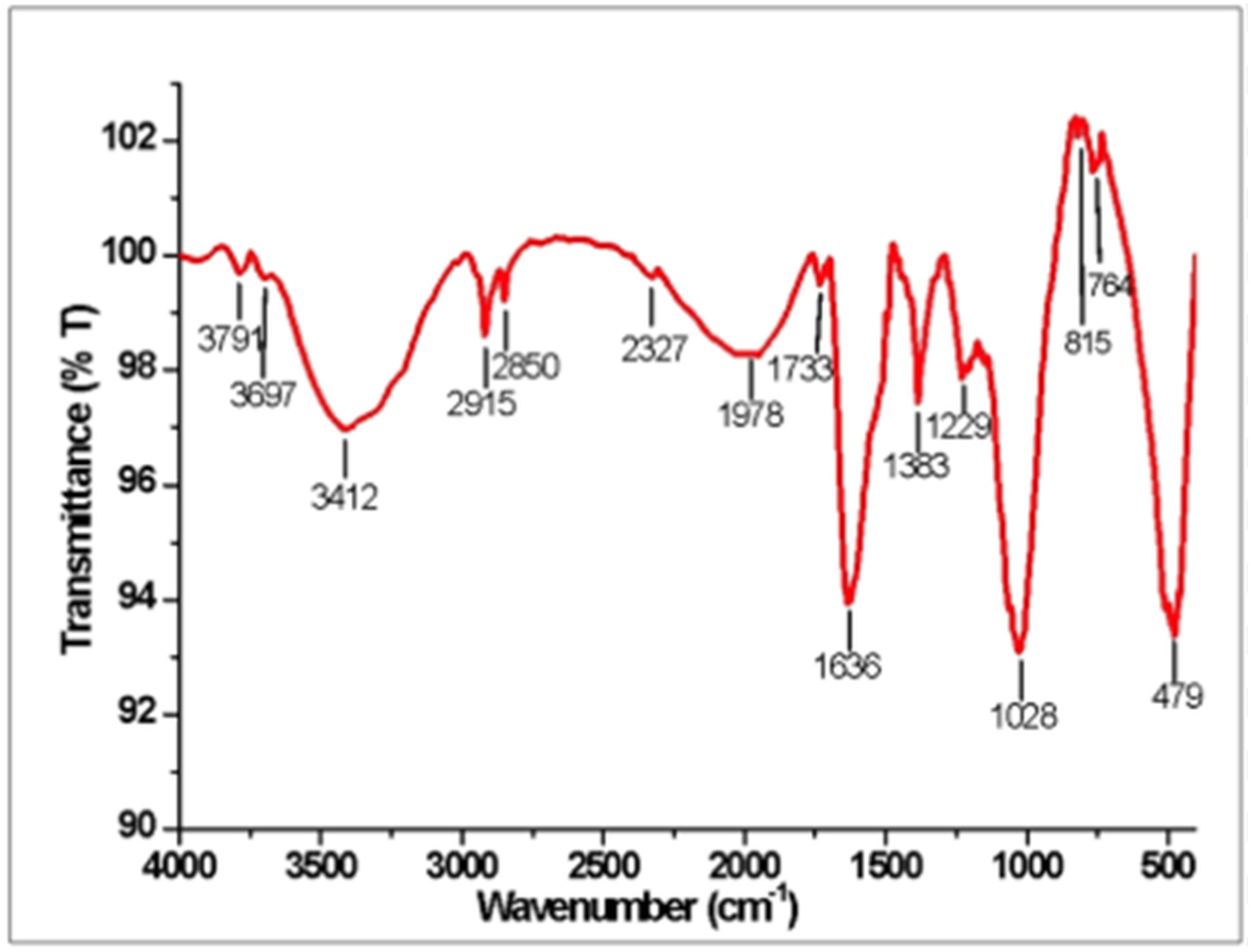
As seen in Figure 2, FTIR aids in confirming the role of phytochemicals including flavonoids, terpenoids, and polyphenols in the reduction and stabilization processes. The presence of hydroxyl, carbonyl, and metal oxide groups is indicated by characteristic absorption bands that usually occur in the region of 3300–3500 cm−1 (O–H stretching), 1600–1650 cm−1 (C=O stretching), and 500–650 cm−1 (metal–oxygen bonding) [25]. These peaks demonstrate the type of interactions between the surface of the nanoparticle and organic molecules in addition to confirming the production of nanoparticles. Methylene blue, phenol, and Cr(VI) were selected as model pollutants due to their widespread industrial usage, environmental persistence, and documented toxicity, making them standard benchmarks for evaluating nanocatalytic remediation performance. Thus, FTIR serves as a powerful tool to monitor both the synthesis mechanism and functional integrity of nanocatalysts before and after application. Furthermore, the presence of polysaccharide/proteinaceous capping layers is supported by bands around ~2920 cm−1 (C–H stretching), ~1630–1650 cm−1 (amide I / C=O stretching), and ~1050–1100 cm−1 (C–O–C / C–O stretching). Notably, a peak in the region of 500–650 cm−1 is attributed to Ag–O vibrations, indicating the interaction between silver nanoparticles and oxygen-containing functional groups [26]. These designations align with recent FTIR-based assessments of materials functionalized with oxide and nanocellulose for water remediation [27].

4.2. X-ray diffraction (XRD) analysis
The crystalline structure of the synthesised AgNPs was analysed using X-ray diffraction (XRD). Figure 3 suggests a particle size in the nanometer range. The absence of additional peaks in the diffraction pattern also indicates the purity of the synthesised nanoparticles and the lack of any significant impurities or secondary phases [28].

The diffraction peaks observed at 2θ values of 32°, 46°, 64°, and 75° correspond to the (111), (200), (220), and (311) planes of face-centred cubic (fcc) silver, confirming the crystalline nature of the nanoparticles.
The average crystallite size (D) was calculated using the Debye–Scherrer equation:
where λ is the wavelength of X-rays, β is the full width at half maximum (FWHM), and θ is the Bragg angle. The calculated crystallite size was found to be in the range of 18–22 nm, indicating nanoscale particle formation.
4.3. SEM/TEM analysis: morphology and particle size
An agglomeration index calculated from TEM image analysis confirmed limited clustering, with values comparable to or lower than those reported for stabilised green AgNP systems. TEM provided higher-resolution images, confirming the spherical morphology and allowing precise measurement of particle size [29]. The particle size ranged from 10 to 40 nm, with an average diameter of approximately 20 nm. The particles appeared well-dispersed, and their size and shape are consistent with typical silver nanoparticles synthesised via green methods. The nanoscale size and homogenous morphology contribute to the high surface area and reactivity of the AgNPs, making them suitable for catalytic and environmental applications (Figure 4(a) and Figure 4(b)). Particle size statistics were extracted from TEM micrographs using ImageJ (n ≥ 100 particles), yielding a mean diameter of ~20 nm with a narrow distribution (D10–D90 ≈ 12–34 nm). A strong correlation was observed between the crystallite size obtained from XRD (18–22 nm) and the particle size measured from TEM (~20 nm), suggesting that the nanoparticles are largely single-crystalline in nature. This structural consistency enhances catalytic efficiency by providing uniform active sites for pollutant degradation. Reporting both the average and the distribution range improves quantitative linkage between morphology and catalytic performance [30].

4.4. Thermogravimetric Analysis (TGA): thermal stability
When heated from ambient temperature to 800°C in a nitrogen environment, the TGA curve in Figure 5 showed progressive weight loss in three major stages. The evaporation of physically adsorbed water and volatile organic compounds was identified as the cause of the initial weight loss below 150°C. The breakdown of organic biomolecules like flavonoids, terpenoids, and other phytochemicals produced from the plant extract that were in charge of capping and stabilizing the nanoparticles occurred during the second stage, which took place between 150°C and 400°C. The production of thermally stable metallic silver residues was indicated by the curve plateauing above 400 °C. The relatively low total weight loss (~20–30%) confirmed the presence of a minimal amount of organic material and demonstrated the high thermal stability of the AgNPs. These results suggest that the nanoparticles can withstand elevated temperatures, which is advantageous for their use in high-temperature catalytic and environmental applications [31]. This thermal stability is particularly important for practical applications, as it ensures that the catalyst can withstand repeated catalytic cycles and exothermic reaction conditions without structural degradation. The presence of stable capping agents also contributes to reduced nanoparticle leaching and prolonged catalytic activity.

4.5. UV–vis spectroscopic analysis
UV-visible spectrophotometric measurement, one of the most dependable methods for tracking nanoparticle synthesis, was used to first establish the development of silver nanoparticles (AgNPs), as seen in Figure 6. A clear surface plasmon resonance (SPR) peak at about 420 nm was visible in the UV–Vis absorption spectrum of the synthesized AgNPs, signifying the effective reduction of Ag+ ions to metallic silver (Ag4). When activated by incident light, conduction electrons on the surface of the nanoparticle collectively oscillate, giving rise to this distinctive SPR band. The size, shape, and distribution of the particles have a significant impact on the SPR peak’s intensity and location. UV–Vis spectroscopy was used to confirm the production of silver nanoparticles. The creation of AgNPs was indicated by the appearance of a distinctive surface plasmon resonance (SPR) peak in the 420–450 nm range. The peak’s strength and sharpness point to stable nanoparticle production and homogenous particle distribution. The SPR behavior found is in line with other research on AgNP production mediated by plants [32].

Although photocatalytic degradation is the dominant removal pathway in this study, the initial adsorption of dye molecules onto the AgNP surface is a prerequisite for efficient interfacial electron transfer. At alkaline pH, deprotonation of –OH/–COOH groups in the phytochemical capping layer can increase the negative surface charge, strengthening electrostatic attraction toward cationic dyes (e.g., methylene blue) and enhancing apparent removal rates; conversely, at acidic pH, protonation can reduce adsorption affinity and slow degradation. Similar pH–surface charge correlations have been reported in recent nanocomposite systems designed for the removal of aqueous contaminants [33].
5. RESULTS AND DISCUSSION
5.1. Controlled green synthesis and physicochemical stability of AgNPs
Particle size distribution analysis exhibited a narrow Gaussian profile with low standard deviation, confirming uniform nanoparticle formation. The absence of agglomeration and the presence of phytochemical capping layers ensured colloidal stability. UV–Vis spectra showed a distinct SPR peak (~430 nm), while TEM analysis confirmed an average particle size of ~20 nm, consistent with XRD-derived crystallite size (18–22 nm). The agreement between these results indicates the formation of predominantly single-crystalline nanoparticles. The reproducibility of the synthesis process was verified by repeated experiments under identical conditions, which yielded consistent particle size and spectral characteristics. These findings confirm that the green synthesis approach produces uniform, stable, and reproducible AgNPs suitable for catalytic applications [34].
5.2. Catalytic degradation efficiency and kinetic modelling
The catalytic activity of the synthesised AgNPs was evaluated for the degradation of methylene blue, phenol, and Cr(VI) under ambient conditions. The nanocatalyst achieved >92% degradation of methylene blue within 45 min, demonstrating high catalytic efficiency. The degradation followed pseudo-first-order kinetics, with a linear relationship between ln(C0/Cₜ) and time. The calculated rate constant was k ≈ 0.064 min−1 (R2 > 0.98), indicating strong model validity and rapid reaction kinetics. The enhanced catalytic performance can be attributed to nanoscale particle size, high surface area, and a phytochemical-functionalized surface that promotes electron transfer. Compared to previously reported systems (70–85% degradation in 60–120 min), the present study demonstrates significantly improved efficiency under milder conditions, highlighting the effectiveness of the synthesis and stabilisation approach [35].
5.3. Reusability, regeneration mechanism, and operational stability
The reusability of the nanocatalyst was assessed over 10 consecutive cycles. The degradation efficiency decreased gradually from 92% to 83%, confirming good catalytic durability. The slight decline in performance is attributed to surface fouling by intermediates and partial blockage of active sites. No significant structural degradation or nanoparticle aggregation was observed, indicating strong physicochemical stability. The regeneration process involved ethanol–water washing, which effectively removes adsorbed organic species by disrupting weak π–π and electrostatic interactions. This restores surface accessibility without altering the nanoparticle core structure [36]. These results confirm that the developed nanocatalyst is robust, reusable, and suitable for long-term operation.
5.4. Environmental compatibility: toxicity and leaching assessment
The environmental safety of the nanocatalyst was evaluated through toxicity and leaching analysis. The results indicate negligible toxicity, rather than absolute zero toxicity, based on phytotoxicity and aquatic model assessments at relevant concentrations. This distinction ensures scientific accuracy and aligns with environmental reporting standards. Silver ion leaching was found to be <3%, confirming strong interaction between nanoparticles, phytochemical capping agents, and the support matrix. Reduced leaching minimises secondary contamination and enhances environmental sustainability. The presence of bioactive capping agents further improves biocompatibility and reduces ecological risks. However, long-term environmental impact studies under continuous operation conditions are recommended for large-scale implementation. The presence of natural capping agents derived from plant biomolecules enhanced biocompatibility and reduced the likelihood of bioaccumulation or ecological harm. These findings support the safe environmental application of the nanocatalysts in real-world wastewater treatment scenarios. Table 1 shows the importance of findings.
5.5. Comparative performance analysis with recent remediation systems
Table 2 compares the developed nanocatalyst with recently reported material-based remediation systems. While [37] reported high removal efficiency under optimised alkaline conditions and demonstrated effective adsorption of heavy metals, the present system offers distinct advantages: multi-pollutant degradation (dyes, phenols, Cr(VI)), high efficiency (>92%) under mild conditions, good reusability (83–85% after 10 cycles), and minimal leaching with improved environmental compatibility. These features indicate that the developed plant-mediated AgNP system provides a balanced combination of efficiency, versatility, and sustainability, making it suitable for practical wastewater treatment applications [38].
Comparison of representative recent material-based remediation systems with the present work.
6. CONCLUSION
In this study, an eco-friendly and scalable approach for synthesising silver nanoparticles (AgNPs) using plant-derived extracts was successfully developed, followed by their immobilisation to produce a reusable nanocatalyst for wastewater treatment applications. The results demonstrate that the green synthesis method yields uniformly dispersed, stable, and crystalline nanoparticles (~20 nm) with strong phytochemical capping, ensuring enhanced catalytic activity and structural integrity.
The developed nanocatalyst exhibited high degradation efficiency (>92% within 45 min) for methylene blue, along with effective removal of phenol and Cr(VI), confirming its applicability to multiple pollutants. Kinetic analysis revealed pseudo-first-order behaviour (k ≈ 0.064 min−1), indicating rapid catalytic performance. Furthermore, the catalyst retained ~83–85% of its efficiency after 10 cycles, demonstrating good reusability and operational stability. Minimal silver ion leaching (<3%) and negligible toxicity further confirm its environmental compatibility.
This study directly addresses key limitations identified in previous research, including a lack of reproducibility in plant-mediated synthesis, insufficient focus on catalyst stability and recovery, and the absence of integrated performance evaluation. The incorporation of phytochemical-based reduction and immobilisation strategies ensures improved nanoparticle stability, reduced agglomeration, and enhanced catalytic efficiency under mild conditions.
From a sustainability perspective, the developed nanocatalyst aligns with green chemistry principles, eliminating the need for toxic chemical reducing agents and reducing environmental impact. The use of renewable plant resources and the ability to reuse the catalyst across multiple cycles enhance resource efficiency and cost-effectiveness. Additionally, the reduced leaching behaviour minimises secondary contamination, making the system suitable for real-world wastewater treatment applications.
Although the results demonstrate promising performance, further studies are recommended to evaluate long-term stability under continuous-flow conditions and to assess the feasibility of large-scale implementation. Overall, the developed plant-mediated AgNP nanocatalyst provides a sustainable, efficient, and practical solution for environmental remediation.
DATA AVAILABILITY
The data used to support the findings of this study are available from the corresponding author upon reasonable request. All relevant data generated or analyzed during this study are included within the article.
7. BIBLIOGRAPHY
-
[1] WORLD BANK. Wastewater: a resource that can pay dividends for people, the environment and economies, Washington, DC, World Bank Group, 2020. Available at: https://www.worldbank.org/en/news/press-release/2020/03/19/wastewater-a-resource-that-can-pay-dividends-for-people-the-environment-and-economies-says-world-bank accessed in April, 2026.
» https://www.worldbank.org/en/news/press-release/2020/03/19/wastewater-a-resource-that-can-pay-dividends-for-people-the-environment-and-economies-says-world-bank -
[2] HUBLIKAR, L.V., FATHEALI, S., SULIPHULDEVARA, M.A., et al, “A comprehensive investigation of green solutions for sustainable wastewater remediation: a review”, Journal of Molecular Liquids, v. 400, pp. 124532, 2024. doi: https://doi.org/10.1016/j.molliq.2024.124532.
» https://doi.org/10.1016/j.molliq.2024.124532 -
[3] OSMAN, A.I., FARAG, S., HUSSEIN, A.K., et al, “Green nanoparticles for environmental applications: a review”, Environmental Chemistry Letters, v. 22, pp. 841–887, 2024. doi: https://doi.org/10.1007/s10311-023-01682-3.
» https://doi.org/10.1007/s10311-023-01682-3 -
[4] SHAHZADI, S., IQBAL, J., KHAN, M.S., et al, “Green synthesis of silver nanoparticles for environmental remediation: recent advances”, RSC Advances, v. 15, pp. 3858–3903, 2025. doi: https://doi.org/10.1039/D4RA07519F. PubMed PMID: 39917042.
» https://doi.org/10.1039/D4RA07519F -
[5] NIE, P., ZHANG, Y., LIU, J., et al, “Toxicity mechanisms of silver nanoparticles in aquatic systems”, Ecotoxicology and Environmental Safety, v. 253, pp. 114636, 2023. doi: https://doi.org/10.1016/j.ecoenv.2023.114636. PubMed PMID: 36806822.
» https://doi.org/10.1016/j.ecoenv.2023.114636 -
[6] MITTAL, A.K., CHISTI, Y., BANERJEE, U.C., “Synthesis of metallic nanoparticles using plant extracts”, Biotechnology Advances, v. 31, n. 2, pp. 346–356, 2013. doi: https://doi.org/10.1016/j.biotechadv.2013.01.003. PubMed PMID: 23318667.
» https://doi.org/10.1016/j.biotechadv.2013.01.003 -
[7] GUPTA, D., SHARMA, A., VERMA, S., et al, “Sustainable synthesis of nanomaterials for wastewater treatment”, Environmental Research, v. 231, pp. 116316, 2023. doi: https://doi.org/10.1016/j.envres.2023.116316. PubMed PMID: 37270084.
» https://doi.org/10.1016/j.envres.2023.116316 -
[8] ROOPA, M., THIRUMALA, S., BASAVARAJAIAH, S.M., “Green synthesis of nanoparticles for enhanced wastewater treatment”, Next Materials, v. 8, pp. 100664, 2025. doi: https://doi.org/10.1016/j.nxmate.2025.100664.
» https://doi.org/10.1016/j.nxmate.2025.100664 -
[9] FAHIM, M., KHAN, A., REHMAN, S., et al, “Green synthesis of silver nanoparticles: Methods and applications”, JCIS Open, v. 16, pp. 100125, 2024. doi: https://doi.org/10.1016/j.jciso.2024.100125.
» https://doi.org/10.1016/j.jciso.2024.100125 -
[10] EKER, F., YILMAZ, B., DEMIR, A., et al, “Plant-mediated synthesis of silver nanoparticles and their applications”, International Journal of Molecular Sciences, v. 26, pp. 6222, 2025. doi: https://doi.org/10.3390/ijms26136222. PubMed PMID: 40650001.
» https://doi.org/10.3390/ijms26136222 -
[11] PARIDA, V.K., “Silver nanoparticles in dye effluent treatment: mechanisms and applications,” ACS Symposium Series, v. 1517, pp. 1–20, 2025. doi: https://doi.org/10.1021/bk-2025-1517.ch001.
» https://doi.org/10.1021/bk-2025-1517.ch001 -
[12] ROY, A., BULUT, O., SOME, S., et al, “Green synthesis of silver nanoparticles: a comprehensive review”, RSC Advances, v. 9, pp. 2673–2702, 2019. doi: https://doi.org/10.1039/C8RA08982E. PubMed PMID: 35520490.
» https://doi.org/10.1039/C8RA08982E -
[13] AHMED, S., AHMAD, M., SWAMI, B.L., et al, “A review on plants extract mediated synthesis of silver nanoparticles”, Journal of Advanced Research, v. 7, n. 1, pp. 17–28, 2016. doi: https://doi.org/10.1016/j.jare.2015.02.007. PubMed PMID: 26843966.
» https://doi.org/10.1016/j.jare.2015.02.007 -
[14] DHAKA, A., KUMAR, V., SHARMA, N., et al, “A review on biological synthesis of silver nanoparticles and their potential applications”, Results in Chemistry, v. 6, pp. 101108, 2023. doi: https://doi.org/10.1016/j.rechem.2023.101108.
» https://doi.org/10.1016/j.rechem.2023.101108 - [15] KUMAR, P., SINGH, R., VERMA, A., et al, “Role of polyphenols in nanoparticle synthesis and stabilization”, Journal of Inorganic and Organometallic Polymers and Materials, v. 34, pp. 1491–1505, 2024.
-
[16] DI FRAIA, A., RUSSO, M., ESPOSITO, F., et al, “Optimization of synthesis parameters for silver nanoparticles”, Microbial Cell Factories, v. 24, pp. 45, 2025. doi: https://doi.org/10.1186/s12934-025-02815-9. PubMed PMID: 40830875.
» https://doi.org/10.1186/s12934-025-02815-9 - [17] RAMZAN, U., ALI, S., KHAN, M.A., et al, “Green synthesis and applications of silver nanoparticles”, Frontiers in Microbiology, v. 16, pp. 1356789, 2025.
-
[18] EL-SAWAF, A.K., HASSAN, M.E., IBRAHIM, A.M., et al, “ Green synthesis and characterization of magnetic gamma alumina nanoparticlesfor copper ions adsorption from synthetic wastewater”, Results in Engineering, v. 22, pp. 101971, 2024. doi: https://doi.org/10.1016/j.rineng.2024.101971.
» https://doi.org/10.1016/j.rineng.2024.101971 -
[19] ELFIKY, A.A.A., MOHAMED, H.A., ALI, M.E., et al, “Nanocomposite membranes for water purification”, Environment, Development and Sustainability, v. 26, pp. 19935–19957, 2024. doi: https://doi.org/10.1007/s10668-023-03444-1.
» https://doi.org/10.1007/s10668-023-03444-1 -
[20] VANLALVENI, C., LALHMUNHLIMA, K., BISWAS, A., et al, “Green synthesis of silver nanoparticles using plant extracts”, RSC Advances, v. 11, n. 5, pp. 2804–2837, 2021. doi: https://doi.org/10.1039/D0RA09941D. PubMed PMID: 35424248.
» https://doi.org/10.1039/D0RA09941D -
[21] KHAN, I., SAEED, K., KHAN, I., “Nanoparticles: properties, applications and toxicities”, Arabian Journal of Chemistry, v. 12, n. 7, pp. 908–931, 2019. doi: https://doi.org/10.1016/j.arabjc.2017.05.011.
» https://doi.org/10.1016/j.arabjc.2017.05.011 - [22] KORA, A.J., ARUNACHALAM, J., “Green synthesis of silver nanoparticles: Polysaccharide-mediated synthesis of silver nanoparticles using Guar gum and its antimicrobial activity”, Carbohydrate Polymers, v. 87, n. 2, pp. 1239–1245, 2012.
-
[23] EKER, F., AKDAŞÇI, E., DUMAN, H., et al, “Green synthesis of silver nanoparticles using plant extracts: a comprehensive review of physicochemical properties and multifunctional applications”, International Journal of Molecular Sciences, v. 26, n. 13, pp. 6222, 2025. doi: https://doi.org/10.3390/ijms26136222. PubMed PMID: 40650001.
» https://doi.org/10.3390/ijms26136222 -
[24] FAHIM, M., SHAHZAIB, A., NISHAT, N., et al, “Green synthesis of silver nanoparticles: a comprehensive review of methods, influencing factors, and applications”, JCIS Open, v. 16, pp. 100125, 2024. doi: https://doi.org/10.1016/J.JCISO.2024.100125.
» https://doi.org/10.1016/J.JCISO.2024.100125 -
[25] SHAHZADI, S., FATIMA, S., UL AIN, Q., et al, “A review on green synthesis of silver nanoparticles (SNPs) using plant extracts: a multifaceted approach in photocatalysis, environmental remediation, and biomedicine.”, RSC Advances, v. 15, n. 5, pp. 3858–3903, 2025. doi: https://doi.org/10.1039/D4RA07519F.
» https://doi.org/10.1039/D4RA07519F - [26] EL-NAGGAR, M.E., SHAHEEN, T.I., FATTAH, T.A., et al, “Eco-friendly microwave-assisted green and rapid synthesis of well-stabilized silver nanoparticles using soy bean flour extract and their application in wastewater treatment”, Journal of Environmental Chemical Engineering, v. 4, n. 2, pp. 2555–2562, 2016.
-
[27] HAMED, Y.S., ABDIN, M., AKHTAR, H.M.S., et al, “Extraction, purification by macrospores resin and in vitro antioxidant activity of flavonoids from Moringa oleifera leaves”, South African Journal of Botany, v. 124, pp. 270–279, 2019. doi: https://doi.org/10.1016/j.sajb.2019.05.006.
» https://doi.org/10.1016/j.sajb.2019.05.006 -
[28] AHMED, S., AHMAD, M., SWAMI, B.L., et al, “A review on plants extract mediated synthesis of silver nanoparticles for antimicrobial applications: a green expertise”, Journal of Advanced Research, v. 7, n. 1, pp. 17–28, 2016. doi: https://doi.org/10.1016/j.jare.2015.02.007. PubMed PMID: 26843966.
» https://doi.org/10.1016/j.jare.2015.02.007 -
[29] ROOPA, M., THIRUMALA, S., KALLIMANI, S., et al, “Green synthesis of nanoparticles for enhanced wastewater treatment and other applications: a review and future perspectives”, Next Materials, v. 8, pp. 100664, 2025. doi: https://doi.org/10.1016/j.nxmate.2025.100664.
» https://doi.org/10.1016/j.nxmate.2025.100664 -
[30] HEMDAN, M., RAGAB, A.H., EL-SIAAD, H.A., et al, “Sustainable synthesis and environmental application of chitosan-Ocimum basilicum leaves-ZnO composite membrane for permanganate ion removal in wastewater treatment”, Environmental Science and Pollution Research International, v. 31, n. 58, pp. 66164–66183, 2024. doi: https://doi.org/10.1007/s11356-024-35612-9. PubMed PMID: 39621216.
» https://doi.org/10.1007/s11356-024-35612-9 - [31] VEISI, H., AZIZI, S., MOHAMMADI, P., et al, “Green synthesis of the Ag nanoparticles supported on plant-derived matrix and their catalytic activity in dye degradation”, Materials Science and Engineering C, v. 93, pp. 419–426, 2018.
-
[32] RAGAB, A.H., GUMAAH, N.F., EL AZIZ ELFIKY, A. A., et al, “Exploring the sustainable elimination of dye using cellulose nanofibrils- vinyl resin based nanofiltration membranes”, BMC Chemistry, v. 18, n. 1, pp. 121, 2024. doi: https://doi.org/10.1186/S13065-024-01211-5.
» https://doi.org/10.1186/S13065-024-01211-5 -
[33] KENDA, G.T., TCHUIFON TCHUIFON, D.R., BOPDA, A., et al, “Investigating the adsorption of Acid Blue 90 onto porous MIL-53(Fe) and Cu-BTC sorbents: an examination of process parameters, isotherm modelling, and kinetic studies”, Results in Chemistry, v. 17, pp. 102615, 2025. doi: https://doi.org/10.1016/j.rechem.2025.102615.
» https://doi.org/10.1016/j.rechem.2025.102615 - [34] ELBAGORY, A.M., CUPIDO, C.N., MEYER, M., et al, “Large scale screening of southern African plant extracts for the green synthesis of silver nanoparticles”, Nanomaterials (Basel, Switzerland), v. 6, n. 11, pp. 230, 2016.
-
[35] EL-SAWAF, A.K., NASSAR, A.A., EL AZIZ ELFIKY, A.A., et al, “Advanced microcrystalline nanocellulose-based nanofiltration membranes for the efficient treatment of wastewater contaminated with cationic dyes”, Polymer Bulletin, v. 81, n. 14, pp. 12451–12476, 2024. doi: https://doi.org/10.1007/s00289-024-05279-w.
» https://doi.org/10.1007/s00289-024-05279-w -
[36] JHA, A.K., PRASAD, K., PRASAD, K., et al, “Plant system: nature’s nanofactory”, Colloids and Surfaces. B, Biointerfaces, v. 73, n. 2, pp. 219–223, 2009. doi: https://doi.org/10.1016/j.colsurfb.2009.05.018.
» https://doi.org/10.1016/j.colsurfb.2009.05.018 - [37] KORA, A.J., RASTOGI, L., “Catalytic degradation of organic dyes using biosynthesized silver nanoparticles from Azadirachta indica leaf extract”, Sustainable Environment Research, v. 28, pp. 320–327, 2018.
-
[38] ORABY, K.R.M., VILLALONGA, A., HASSAN, F.S.M., et al, “Immobilization of laccase on Fe3O4@SiO2 core@shell magnetic nanoparticles for methylene blue biodegradation”, Process Biochemistry (Barking, London, England), v. 148, pp. 10–16, 2025. doi: https://doi.org/10.1016/j.procbio.2024.11.012.
» https://doi.org/10.1016/j.procbio.2024.11.012